Comparison of Acidic and Polymeric Agents in Synthesis of
TiO
2
Nanoparticles via a Modified Sol-Gel Method
Masoud Karimipour
Department of Physics, Vali-E-Asr University of Rafsanjan, Rafsanjan, Iran Email: [email protected]
Received July 11, 2013; revised August 15, 2013; accepted August 21,2013
Copyright © 2013 Masoud Karimipour. This is an open access article distributed under the Creative Commons Attribution License, which permits unrestricted use, distribution, and reproduction in any medium, provided the original work is properly cited.
ABSTRACT
TiO2 nano particles were synthesized in Rutile and Anatase phases by sol-gel method using two kind of complex agents,
acidic (Citric Acid) and organic complex agent (acetyl acetone) at 400˚C, 500˚C, 650˚C sintering temperatures. The structural analysis by XRD diffraction confirmed phase formation of titanium oxide. Particles sizes were determined by using Scherrer formula. TEM was employed to confirm nano particles formation. The size of nano particles as well as Phase formation can be controlled by the type of complex agent and sintering temperature. Acetyl Acetone causes a more crystalline structure and more uniformity of size distribution in 400˚C sintering temperatures. Moreover, it results in obtaining single phase TiO2 nanoparticles at 400˚C and 650˚C sintering temperature. On the other hand, at high sinter-
ing temperature, the particles obtained from polymeric agent tend to agglomerate larger in size than the acidic product.
Keywords: Sol-Gel Method; Photo Catalyst; Rutile; Anatase; Complex Agent
1. Introduction
Titanium dioxide which is known as Titania occurs in four forms: Rutile (Eg = 3.0 eV), Anatase (Eg = 3.2 eV), Brookite (Eg = 2.96 eV) and TiO2-β. Brookite and Ana-
tase phases are rare and have more photocatalytic activity than Rutile phase [1]. TiO2 is desirable due to its inert-
ness, stability, and low cost [2]. It is also self regenerat- ing and recyclable. Its redox potential of the H2O/*OH
couple (−2.8 eV) lies within the band gap. However, its large band gap (Eg = 3.2 eV) only allows the UV ab- sorption of the solar spectrum. Titania nano particles are highly considered for the technological and industrial applications because of its photo catalytic activities [3], such as self-cleaning [4], anti bacterial [5], fog proofing [6]; and also, as a new source of energy saving in dye sensitized solar cells [7-9]. Titania nano particles are prepared by many techniques such as sol-gel [10], hydro- thermal [11] and co-precipitation processes [12]. But, there are still many ongoing researches [13] to develop new features and simplification of nanoparticles synthe- sis within a desired size distribution. In this study, we used a simple Pechini sol-gel process [14,15] with two different complex agents in order to study the role of polymeric and non-polymeric agents in phase purity and size formation.
2. Experimental Details
The titanium oxide nano particles have been prepared by Sol-gel process in two steps. Titanium isopropoxide (TTIP) was used as precursor. Acetyl acetone (AcAc: CH3COCH2COCH3) and acetic acid
(HOC(COOH)(CH2COOH)2) were used as both complex
and polymer agent and finally absolute ethanol as solvent. In first step, starting solution was prepared with diluting 0.1 M TTIP by 40 cc absolute ethanol with the same vol- ume ratio and then mixed with 0.1 M AcAc (Citric Acid) and stirred with magnet for 1 hr in 40˚C to establish ini-tial sol. This sol was red (yellow)-color and pH = 6.5 (3.0). For gaining transparent sol witch has nano particles of Titania as complex compounds, the sol was refluxed in oil bath at 130˚C for 4 h. After this step, sol was or- ange(yellow-green)-color and pH = 8.4(6.0). In the next step, we used oil bath to heat the sol, indirectly at T = 80˚C for 36 hrs until forming gel. The gel firstly was dried up by direct heating on hot plate at 120˚C for 2hrs and then for final drying, the gel was heated at 150˚C for 30 minutes. The titanium oxide nano particles cannot be obtained unless the dried gel calcinated at 400, 500, 650˚C for 1 hr. the weight of powders measured before and after calcinations that the results have come in Ta-bles 1 and 2.
temperature (˚C) 39.9 black 3.210 8.04 400 28.47 gray 2.289 8.04 500 28.08 white 2.258 8.04 650
Cu-Kα radiation of wavelength 1.5405 Å (operated at 25
kV, 20 mA) was employed for structural studies. TEM was employed for nano particles size analysis. The Uv- Vis spectra were prepared by spectrophotometer (Agilent 8453) for determining band gap of nano particles.
3. Results and Discussion
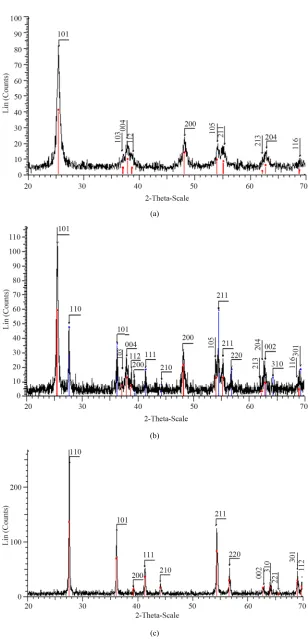
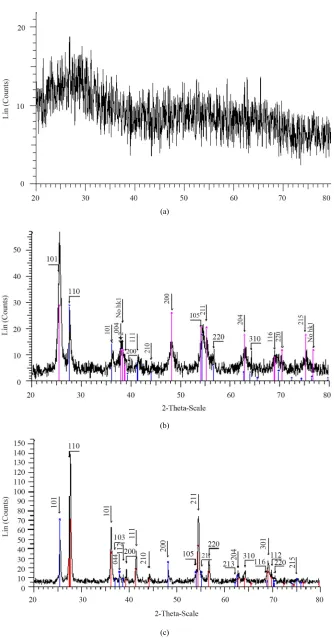
Structural characterization: the XRD patterns of ti-
tanium oxide nano particles (Figures 1 and 2) show Ru-
tile and Anatase phases formation. The (101)-plane for Anatase and (110)-plane for Rutile are the main diffrac- tion planes seen in the figures. the mean crystalline size of nanoparticles is estimated using scherrer formula, and Anatase/Rutile phase ratio also is determined using Eq- uation (1) [11] in which, xA is the Anatase phase contri- bution in the powder, IR and IA are the intensity of the highest peaks of Rutile and Anatase in XRD patterns, respectively.
11 1.26
A R
x I IA (1)
Figure 1(a) show phase formation of Anatase and
small crystalline size (Table 3) in lowest sintering tem-
perature, which may due to using organo-metalic pre- cursor and organic complex agent, it allows Ti-O bonds formation and postpones the condensation process rather than hydrolysis [12]. Comparison of Tables 3 and 4
shows that in the sintering temperature at which both Anatase and Rutile phases coexist, AcAc case results in a uniform crystalline growth process other than Citric Acid one. The observation of mixed Anatase and Rutile phases at 500˚C (Figure1(b)) and Rutile phase at 650˚C (Fig- ure1(c)) indicates phase transition of Anatase to Rutile.
Moreover, application of AcAc as complex agent results in obtaining single phase TiO2 nanoparticles in 400˚C and
[image:2.595.57.539.104.177.2]600˚C sintering temperatures. Actually powders did not show any crystalline phase below 400˚C sintering tem-
Table 3. Nano crystalline size of calcined powders prepared by AcAc as complex agent.
XA/R (%) D(110)R (nm) D(101)A (nm) Sintering temp.
(˚C)
- - 9 400 67 35 30 500 - 52 - 650
[image:2.595.308.537.320.396.2]A: Anatase phase, R: Rutile hase.
Table 4. Nano crystalline size of calcined powders prepared by citric acid as complex agent.
XA/R(%)
D(110)R
(nm) D(101)A
(nm) Sintering temp.
(˚C)
- - - 400 62 46 12 500 28 50 60 650
A: Anatase phase, R: Rutile hase.
perature. thus, comparing citric acid and AcAc chemical formula one can be said that the lower the amount of carbon existing in the dried powders, the lower the sin- tering temperature at which phase formation occurs.
TEM images (Figures 3 and 4) show that with increas-
ing of sintering temperature, agglomeration of nano par- ticles has been occurred. Acetyl Acetone causes a more crystalline structure and more uniformity of size distribu- tion in 400˚C sintering temperatures. On the other hand, in highest sintering temperature, the particles obtained from polymeric agent tends to agglomerate larger in size than the acidic one.
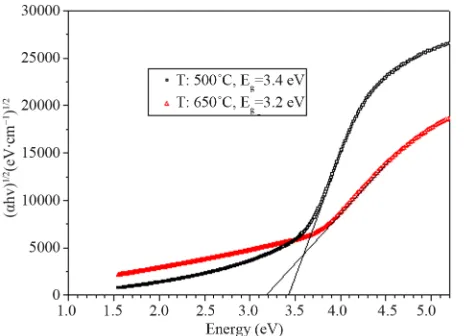
Optical characterization: Using Uv-Vis spectra and
Tauc formula, The optical absorption edge was analyzed by the following relationship [16], αhν = A (hν − Eg)m
[image:2.595.309.538.446.520.2](a)
(b)
[image:3.595.143.451.71.710.2](c)
(a)
(b)
[image:4.595.133.467.73.711.2](c)
(a) (b)
[image:5.595.116.484.84.454.2](c)
Figure 3. TEM images of nano powder prepared by AcAc as complex agent, calcined at (a) T = 400˚C, (b) 500˚C, (c) 650˚C.
[image:5.595.114.480.482.648.2](a) (b)
Figure 4. TEM images of nano powder prepared by citric acid as complex agent, calcined at (a) T = 500˚C, (b) 650˚C.
for direct and indirect transitions and Eg is the optical band gap. We estimated the direct energy band gap of nano particles. The optical results show that nano parti- cles with smaller size which sintered at 500˚C have smaller band gap rather than nano particles which sin-
tered at 650˚C (Figure 5). This may be due to existing of
Figure 5. energy gap of nano particles prepared with solgel process and using AcAc complex agent (T: sintering tem-perature).
4. Conclusion
TiO2 nanoparticles have been synthesized simply via
complexing-polymerizing sol-gel method. The effect of polymer agent on size distribution of particles shows that AcAc is a proper candidate to synthesize particles in pure Anatase phase below 10 nm. Also, sintering at 650˚C shows pure Rutile phase with narrow size distribution about 100 nm. Moreover, application of Citric acid gives rise to a less agglomeration of particles after annealing at 650˚C which does not have pure phase.
REFERENCES
[1] K. Mori, KONA, “Photo-Functionalized Materials Using Nanoparticles: Photocatalysis,” KONA, Vol. 3, No. 23, 2005.
[2] D. M. Blake, P. C. Maness, Z. Huang, E. J. Wolfrum and J. Huang, “Application of the Chemistry of Titanium Ox- ide to Disinfection and the Killing of Cancer Cells,”
Separation and Purification Methods, Vol. 28, 1999, pp. 1-50.
[3] M. O. Abou-Helal and W. T. Seeber, “Preparation of TiO2 Thin Films by Spray Pyrolysis to Be Used as a Photo- Catalyst,” Applied Surface Science, Vol. 195, No. 1-4, 2002, pp. 53-62. doi:10.1016/S0169-4332(02)00533-0 [4] A. Zaleska “Doped-TiO2: A Review,” Recent Patents on
Engineering, Vol. 2, No. 3, 2008, pp. 157-164. doi:10.2174/187221208786306289
[5] Y. L. Jeyachandran, S. K. Narayandass, D. Mangalaraj, C. Y. Bao and P. J. Martin, “The Effect of Surface Composi-
try, Vol. 164, No. 1-3, 2004, pp. 167-172.
[8] P. Cameron and L. Peter, “Compact TiO2 Blocking Lay- ers in Dye Sensitized Nanocrystalline Solar Cells,” The Journal of Physical Chemistry B,Vol. 104, No. 5, 2000, pp. 949-958. doi:10.1021/jp993220b
[9] A. Heft, T. To. lke, A. Pfuch and C. Erbe, “Photocata-lytically Active Thin Films on Float Glass with Enhanced Hydrophilicity and Transmission for Photovoltaic Appli- cations,” Solar Energy Materials & Solar Cells, Vol. 90, No. 17, 2006, pp. 2846-2854.
doi:10.1016/j.solmat.2006.04.008
[10] W. Chen, X. D. Sun and D. Weng, “Morphology Control of Titanium Oxides by Tetramethylammonium Cations in Hydrothermal Conditions,” Materials Letters, Vol. 60, No. 29-30, 2006, pp. 3477-3480.
doi:10.1016/j.matlet.2006.03.035
[11] Ch. Wang and J. Y. Ying, “Sol-Gel Synthesis and Hydro- thermal Processing of Anatase and Rutile Titania Nano Crystals,” Chemistry of Materials, Vol. 11, No. 11, 1999, pp. 3113-3120.
[12] Z. Tang, J. Zhang, Zh. Cheng and Zh. Zhang, “Synthesis of Nanosized Rutile TiO2 Powder at Low Temperature,”
Materials Chemistry and Physics, Vol. 77, No. 2, 2002, pp. 314-317. doi:10.1016/S0254-0584(02)00003-2 [13] X. B. Chen and S. S. Mao, “Titanium Dioxide Nanomate-
rials: Synthesis,Properties, Modifications, and Applica- tions,” Chemistry of Materials, Vol. 107, No. 7, 2007, pp. 2891-2959. doi:10.1021/cr0500535
[14] M. Kakihana, “Invited Review ‘Sol-Gel’ Preparation of High Temperature Superconducting Oxides,” Journal of Sol-Gel Science and Technology, Vol.6, No. 1, 1996, pp. 7-55. doi:10.1007/BF00402588
[15] M. P. Pechini, “Method of Preparing Lead and Alkaline Earth Titanates and Niobates and Coating Method Using the Same to Form a Capacitor,” US Patent No3330697, 1967.