http://dx.doi.org/10.4236/ojce.2016.63035
Characterization of Mixed Mortars with
Partial Replacement of Sand with
Sugarcane Bagasse Ash (SCBA)
Carlos Humberto Martins1, Tainara Rigotti de Castro2, Camila Colhado Gallo1 1StateUniversityof Maringá, Maringá, Brazil
2StateUniversityof Paraná, Campo Mourão, Brazil
Received 30 April 2016; accepted 30 May 2016; published 2 June 2016
Copyright © 2016 by authors and Scientific Research Publishing Inc.
This work is licensed under the Creative Commons Attribution International License (CC BY).
http://creativecommons.org/licenses/by/4.0/
Abstract
This paper analyzes the effect of partial sand replacement by sugarcane bagasse ash in mixed mortars utilizing a 1:2:9 mix proportion by volume for cement, lime and fine aggregate. The ash is characterized by its particle distribution, pozzolanic activity, chemical composition, bulk density, moisture content and loss on ignition. The mortars are then produced with a constant water/ce- ment ratio of 2.64 and a partial replacement of sand with sugarcane bagasse ash using different substitution percentages (0%, 5%, 10%, 15% and 20%). The mortars are characterized in the plastic state: water retention, bulk density and air content, and in the hardened state: capillary coefficient, tensile strength by bending test, axial compressive strength and flexural and longitu-dinal Young’s modulus. The statistical analysis of the results showed that the ash can be incorpo-rated into mortars without causing significant alterations in its properties.
Keywords
Mortars, Sugarcane Bagash Ash
1. Introduction
Maschio, [4]).
The waste incorporation as an alternative solution has shown satisfactory results in the literature, especially the utilization of sugarcane bagasse ash within the construction business (González-López et al., [5]; Chen, Sun, Gau, Wu & Chen, [6]; Lima, Varum, Sales & Neto, [7]; Souza, Teixeira, Santos, Costa & Longo, [8]; Akram, Memon & Obaid, [9]; Cordeiro, Toledo Filho, Tavares & Fairbairn, [10]). Previous studies analyze the charac-teristics of the ash and its possible application in constructions through additions and partial replacements of ag-gregate and binders in concrete, cement paste, mortars, ceramic materials and soil blocks.
Sugarcane bagasse is the main byproduct of sugarcane processing, which is widely utilized as boiler’s fuel in order to generate energy and such process generates waste such as bottom and fly ash. Considering that in the 2013/2014 harvest season around 652 million tons of sugarcane were crushed and that all bagasse was used to generate energy, then approximately 3.9 million tons of sugarcane bagasse ash were produced (Conab, [11]).
A portion of this amount of ash returns to canebrake soil, even though it is a nutrient poor material with a dif-ficult deterioration and it may contain heavy metals which can contaminate aquifers and the soil. The literature highlights that this practice is common amongst sugarcane farmers and it is considered environmentally friendly, however it seems that the use of pesticides is ignored; the combination of ash, filter cake and vinasse with pesti-cides is highly prejudicial to the soil (Sales & Lima, [12]). When the ash is not properly disposed of, it can cause contamination of adjacent terrains, aquifers and can create health issues, resulting in severe social and environ-mental problems. Thus, since this waste does not have another use, the best option is to dispose of it in landfills (Frías, Villar & Savastano, 2011). The need for reducing the areas utilized for this waste’s disposal adds to the need to reduce the environmental impacts caused by it. This paper seeks to assist in this effort by analyzing the effects of the partial replacement of sand with sugarcane bagasse ash in mortars utilizing a 1:2:9 mix pro-portion by volume for cement:lime:fine aggregate. Firstly the ash was characterized to obtain its physical and chemical properties and then the bottom ash was used as a partial sand replacement at 5 different percentage values.
2. Materials and Methods
2.1. MaterialsCement, lime, fine aggregate, bottom sugarcane bagasse ash and water were utilized to produce the mixed mor-tars. The cement used was Portland, class 32 (CP II Z-32), fabricated in the state of Parana, Brazil. The material presented a bulk density of 2.97 g/cm3, initial and final curing time of 290 - 363 (h:min) respectively and Blaine surface area of 3526 (cm2/g). The lime was the hydrated CH III type of the brand Mottical, made in the state of Parana; its bulk density was 2.60 g/cm³ and its Blaine surface area was 1314 (cm2/g). The sand used as fine ag-gregate was obtained in the city of Maringa, Parana and presented a bulk density of 2.64 g/cm³ and a fineness modulus of 2.91.
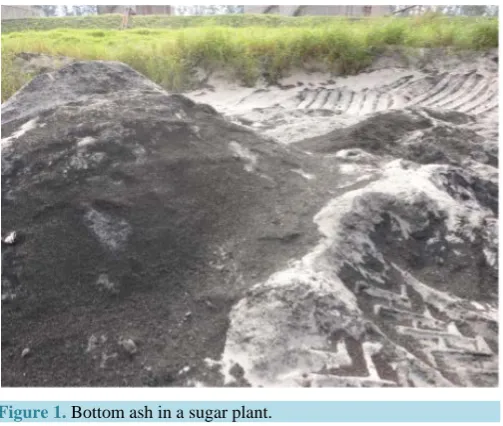
The ash was obtained from a sugar plant located in the south of Brazil, (Figure 1), collected from the boiler’s bottom and transported in plastic bags. Prior to the characterization procedure of the ash, the material was sieved with a 0.6 mm sieve in order to remove leaves and any portion of bagasse that was not completely burnt.
2.2. Mix Design
Figure 1. Bottom ash in a sugar plant.
and, in order to facilitate the mortar’s production process, the mix was converted to mass proportion.
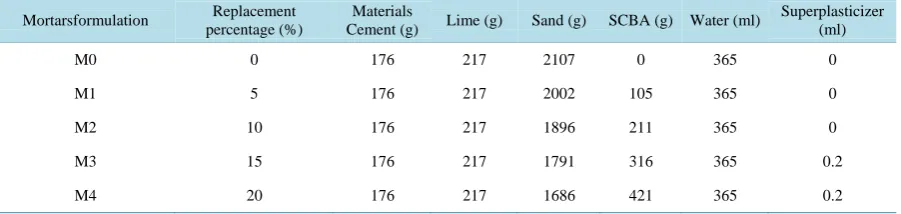
The mix proportion by mass (kg), a total of 2.5 kg of dry components was chosen, according to the recom-mendation of NBR 13,276 [13] and afterwards the fine aggregate was replaced by the SCBA, as is shown in Table 1.
To obtain the necessary water volume, a consistency index of 260 ± 5 mm (NBR 13276 [13]) was used, re-sulting in a water/cement ratio of 2.64. As the sand replacement with SCBA caused a reduction in the mortar consistency due to the fineness and high specific surface area of the ash, it was necessary to add the Sika Visco-crete 20HE superplasticizer to improve the workability of the M3 and M4 mortars, once their consistency in-dexes were not within the stipulated range.
2.3. Fabrication of Mortars
A laboratory mixer was used to mix the mortar’s components; firstly, the dry materials, except the cement, were added to the bowl followed by the water; then the components were mixed at a low velocity for 4 minutes. The mass of the mortar was measured and then it was stored for 16 to 24h (NBR 13276 [13]). After this maturation interval, the mixture had its mass obtained to verify the water loss by evaporation and afterwards the cement and the water replacement were mixed to the mortar for another 4 minutes at a low velocity.
3. Methods
3.1. SCBA Characterization
3.2. Mortar Characterization
In order to characterize the mortars, experiments in the plastic and hardened state were carried out.
For the plastic state properties such as water retentivity (NBR 13277 [23]), bulk density and air content (NBR 13278 [24]) were obtained. For the hardened state several experiments were carried out; to determine the capil-lary coefficient (NBR 15259 [25]) the mortar’s samples were cast in prismatic molds of dimensions 40 × 40 × 160 (mm) according to the NBR 13279 [26] and the masses of the samples were measured after 10min and 90min. The tensile strength obtained by bending tests (NBR 13,279 [26]) counted on the application of a un-iformly distributed load in the cross section located at the center-point of the prismatic sample which was simply supported (Figure 2(a) and Figure 2(b)). Using the halves of the fractured samples, the axial compressive strength of the hardened mortar was tested. The flexural and longitudinal Young’s modulus were determined according to the ASTM E 1876-09 (Astm [27]) using an impulse excitation of vibration in either longitudinal (E long) (Figure 3(a)) and flexural (E flex) (Figure 3(b)) modes. For the experiment, mortar cylinder samples with a diameter of 5cm and a height of 10 cm were casted according to the ABNT NBR 7215 [28].
The parameters adopted for the hardened state experiments included laboratory conditions such as air temper-ature of (23 ± 2)˚C and relative humidity of (60 ± 5)% and curing time of 48h.The samples were tested when they were 28 days old.
4. Results and Discussion
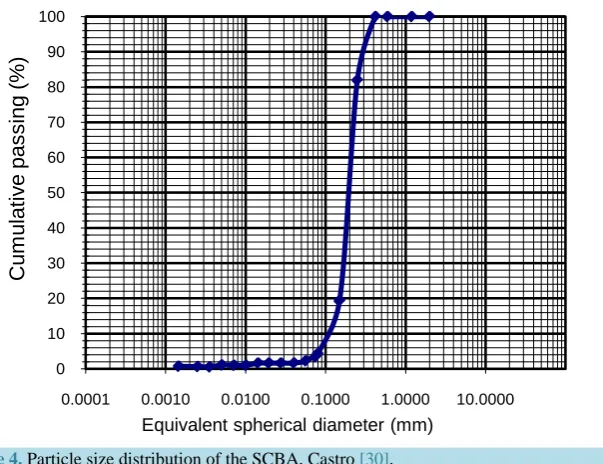
4.1. SCBA CharacterizationThe grain size distribution curve of the SCBA, shown in Figure 4, reveals that 51% of the sample was retained in the sieve with diameter of 0.06 mm and passed the 0.2 mm and according to the NBR 6502 [29] classification, this means that the ash could be compared to a fine sand. The sample presented a small variation in the diameter values, indicating uniformity of the particles.
The analysis of the SCBA pozzolanic activity showed a low concentration of calcium hydroxide per gram of ash (101 mg Ca(OH)2/g), meaning that the sample did not present relevant pozzolanic activity, as it is shown in
the report of the experiment, which was carried out in the Technological Research Institute (IPT-SP).
The SCBA bulk density (2.75 g/cm³) was similar to the sand result; this outcome was already expected as previous research which used ash from four different plants all presented bulk density results similar to the fine aggregate, around 2.65 g/cm³ (Sales & Lima, [12]).
The SCBA moisture content was 0.16% and the loss on ignition was 9.56%; the literature brings a similar value of 10% for the loss on ignition in previous studies (Agredo, Gutiérrez, Giraldo & Salcedo, [31]). It is im-portant to highlight that the slight difference between values can be justified by the amount of organic matter present in the ash.
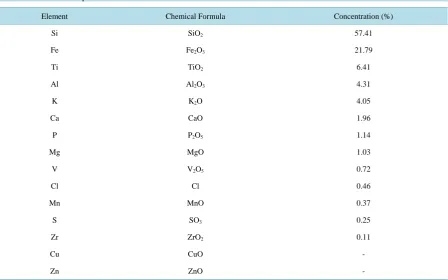
The chemical composition of the ash samples can be observed on Table 2, which shows are levant presence of silica (57.41%) and a lower percentage of iron oxide (21.79%). When these results are compared to previous studies, it was noticed that the ash analyzed in this paper presented a smaller amount of silica, once percentages as high as 66% were found (Frías, Villar & Savastano, [32]). This variation could be attributed to differences between soils, fertilization methods, burning method of the bagasse and others.
[image:4.595.90.541.103.210.2](a) (b)
Figure 2.(a) Equipment used for experiments; (b) Load point for the determination of the tensile strength by bending test.
[image:5.595.171.461.283.400.2](a) (b)
Figure 3. (a) Longitudinal (E long); (b) Flexural (E flex) Young’s modulus.
Table 2. Chemical composition of the SCBA.
Element Chemical Formula Concentration (%)
Si SiO2 57.41
Fe Fe2O3 21.79
Ti TiO2 6.41
Al Al2O3 4.31
K K2O 4.05
Ca CaO 1.96
P P2O5 1.14
Mg MgO 1.03
V V2O5 0.72
Cl Cl 0.46
Mn MnO 0.37
S SO3 0.25
Zr ZrO2 0.11
Cu CuO -
[image:5.595.90.539.437.717.2]Figure 4.Particle size distribution of the SCBA, Castro [30].
Table 3. Chemical elements found in the solubilized sample of SCBA whose concentration exceed the limits of Brazilian codes.
Components Limits (mg/l) SCBA
Aluminum 0.2 0.79
Lead 0.01 0.12
Cadmium 0.006 0.005
Manganese 0.1 0.02
was possible to observe that the leachate sample analysis results were within the limits stablished for organic compounds. Thus, the SCBA sample could be classified as a “non-hazardous waste-class II A-non-inert” (NBR 10004 [22]) which means that the ash may present properties such as biodegradability, combustibility or water solubility. Previous studies presented the same ash classification (Sales & Lima, [12]).
4.2. Mortar Characterization
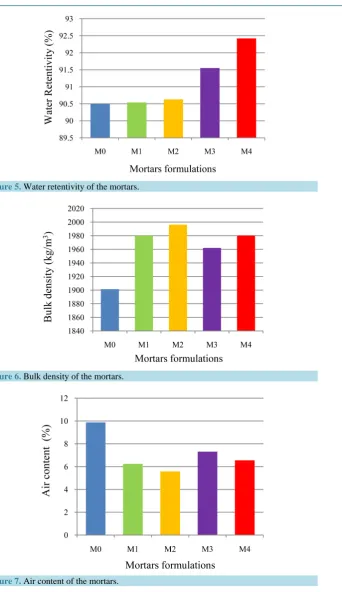
Through the analysis of the water retentivity results, it was possible to observe that, even though the sand re-placement with SCBA reduced the consistency of the mortar, it increased the mortar’s ability of retaining water
(Figure 5). This is considered a positive improvement as a higher water retentivity would reduce water loss
from the mortar to absorbent surfaces, allowing the complete hydration of the cement and the lime. In addition, this characteristic could influence the available time to apply and regularize the mortar, it could also improve its performance. Finally, the water retentivity could affect properties on the hardened state due to its influence in the binder’s reaction during the curing.
The sand replacement with SCBA also caused a raise in the bulk density of the mortars M1 and M2 when compared to M0 (Figure 6). This increase could be explained by the higher bulk density of the ash in compari-son to the fine aggregate and by the filling of the voids between sand grains with ash grains. It is important to highlight that the decrease of the bulk density of M3 could be related to the addition of superplasticizer, which aid the incorporation of air, resulting in a lower bulk density. To reinforce the pattern that the higher the sand replacement with ash the higher the bulk density, the results for M4 were superior to M3, even though both had superplasticizer addition.
As the sand replacement by SCBA increased, the air content of the mortars decreased (Figure 7). This could be explained by the filling of the voids between sand grains with ash grains, avoiding the entrance of air. The air
0 10 20
0.0001 0.0010 0.0100 0.1000 1.0000 10.0000
C
[image:6.595.89.538.353.441.2]Figure 5.Water retentivity of the mortars.
Figure 6.Bulk density of the mortars.
Figure 7. Air content of the mortars.
content increased in the mortar M3 due to the addition of superplasticizer which is responsible for air incorpora-tion. When the mortar M4 is compared to the M3, it is possible to observe a reduction in the air content, which could indicate an excess of fine material.
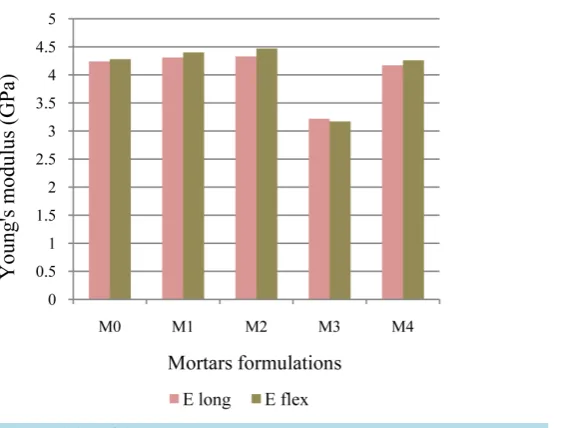
[image:7.595.199.477.426.650.2]The flexural and longitudinal Young’s modulus of the mortars M1 and M2 were slightly higher than the M0 (Figure 10); this property influences directly the mortar’s ability of mortars, absorbing deformations. Similarly to the previous results, it was observed a decrease of this property for the mortar M3, followed by an increase for the mortar M4, possibly due to the fact that both mortars presented the same quantity of superplasticizer but M4 had a higher quantity of ash.
Figure 8. Capillary coefficient of the mortars.
[image:8.595.196.429.500.690.2]Figure 10. Young’s modulus of the mortars.
5. Conclusions
The employment of sugarcane bagasse ash for the production of mortars seems to be an interesting waste utili-zation, resulting in a reduction in the need for disposal areas for the ash, reducing the utilization of sand and the environmental impact caused by your extraction.
The partial sand replacement with SCBA caused a decrease in the mortar workability, however it was cor-rected by the utilization of superplasticizer.
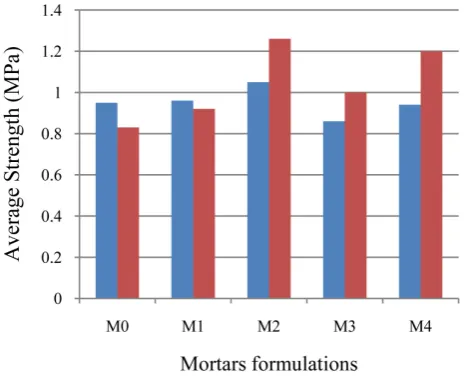
The SCBA use showed advantages such as the increase of water retentivity and the bulk density; the latter improvement caused an increase of the strengths as well.
It was observed as a disadvantage, the slightly raise of the mortars permeability due to a higher porosity caused by the waste presence.
The utilization of superplasticizer caused a reduction in the strength results; however its presence improved the workability and reduced the permeability and the Young’s modulus.
References
[1] Ibrahim, A.R.B., Roy, M.H., Ahmed, Z.U. and Imtiaz, G. (2010) Analyzing the Dynamics of the Global Construction Industry: Past, Present and Future. Benchmarking: An International Journal, 17, 232-252.
http://dx.doi.org/10.1108/14635771011036320
[2] Brown, S. and Lugo, A.E. (1994) Rehabilitation of Tropical Lands: A Key to Sustaining Developing. Restoration Ecology, 2, 97-111. http://dx.doi.org/10.1111/j.1526-100X.1994.tb00047.x
[3] Alwaeli, M. (2003) Application of Granulated Lead-Zinc Slag in Concrete as an Opportunity to Save Natural Re-sources. Radiation Physics and Chemistry, 83, 54-60. http://dx.doi.org/10.1016/j.radphyschem.2012.09.024
[4] Faraone, N., Tonello, G., FurlanI, E. and Maschio, S. (2009) Steelmaking Slag as Aggregate for Mortars: Effects of Particle Dimension on Compression Strength. Chemosphere, 77, 1152–1156.
http://dx.doi.org/10.1016/j.chemosphere.2009.08.002
[5] González-lópez, J.R., Ramos-lara, J.F., Zaldivar-Cadena, A., Chávez-Guerrero, L., Magallanes-Rivera, R.X. and Burciaga-Díaz, O. (2015) Small Addition Effect of Agave Biomass Ashes in Cement Mortars. Fuel Processing Tech-nology, 133, 35-42. http://dx.doi.org/10.1016/j.fuproc.2014.12.041
[6] Chen, C., Sun, C., Gau, S., Wu, C. and Chen, Y. (2013) The Effects of the Mechanical-Chemical Stabilization Process for Municipal Solid Waste Incinerator Fly Ash on the Chemical Reactions in Cement Paste. Waste Management, 33, 858-865. http://dx.doi.org/10.1016/j.wasman.2012.12.014
[7] Lima, S.A., Varum, H., Sales, A. and Neto, V.F. (2012) Analysis of the Mechanical Properties of Compressed Earth Block Masonry Using the Sugarcane Bagasse Ash. Construction and Building Materials, 35, 829-837.
http://dx.doi.org/10.1016/j.conbuildmat.2012.04.127
Management, 30, 1114-1122. http://dx.doi.org/10.1016/j.wasman.2010.01.026
[13] Associação Brasileira de Normas Técnicas. NBR 13276 (2005). Argamassa para assentamento e revestimento de paredes e tetos: Preparo da mistura e determinação do índice de consistência. Rio de Janeiro.
[14] Associação Brasileira de Normas Técnicas. NBR 7181 (1984). Solo: Análise granulométrica. Rio de Janeiro.
[15] Raverdy, M., Brivot, F., Paillere, A.M. and Dron, R. (1980) Appreciation de l’activite pouzzolanique des constituants secondaires. 7 th International Congress Chemical Cement, Vol. 3, Paris, 1980, 36-41.
[16] Associação Brasileira de Normas Técnicas. NBR 15895 (2010) Materiais pozolânicos: Determinação do teor de hidróxido de cálcio fixado—Método Chapelle modificado. Rio de Janeiro.
[17] Associação Brasileira de Normas Técnicas. NBR 6508 (1984) Massa específica dos Sólidos. Rio de Janeiro.
[18] Associação Brasileira de Normas Técnicas. NBR NM 24 (2003) Materiais pozolânicos: Determinação do teor de umidade. Rio de Janeiro.
[19] Associação Brasileira de Normas Técnicas. NBR NM 18 (2012) Cimento Portland: Análise química—Determinação de perda ao fogo. Rio de Janeiro.
[20] Associação Brasileira de Normas Técnicas. NBR 10005 (2004) Procedimento para obtenção de extrato lixiviado de resíduos sólidos. Rio de Janeiro.
[21] Associação Brasileira de Normas Técnicas. NBR 10006 (2004) Procedimento para obtenção de extrato solubilizado de resíduos sólidos. Rio de Janeiro.
[22] Associação Brasileira de Normas Técnicas. NBR 10004 (2004) Resíduos Sólidos: Classificação. Rio de Janeiro.
[23] Associação Brasileira de Normas Técnicas. NBR 13277 (2005) Argamassa para assentamento e revestimento de paredes e tetos: Determinação da retenção de água. Rio de Janeiro.
[24] Associação Brasileira de Normas Técnicas. NBR 13278 (2005) Argamassa para assentamento e revestimento de paredes e tetos: Determinação da densidade de massa e do teor de ar incorporado. Rio de Janeiro.
[25] Associação Brasileira de Normas Técnicas. NBR 15259 (2005) Argamassa para assentamento e revestimento de paredes e tetos: Determinação da absorção de água por capilaridade e do coeficiente de capilaridade. Rio de Janeiro.
[26] Associação Brasileira de Normas Técnicas. NBR 13279 (2005) Argamassa para assentamento e revestimento de paredes e tetos: Determinação da resistência à tração na flexão e à compressão. Rio de Janeiro.
[27] Astm Internacional. E1876-09 (2012) Standard Test Method for Dynamic Young’s Modulus, Shear Modulus, and Poisson’s Ratio by Impulse Excitation of Vibration. Pensilvânia.
[28] Associação Brasileira de Normas Técnicas. NBR 7215 (1996) Cimento Portland: Determinação da resistência à compressão. Rio de Janeiro.
[29] Associação Brasileira de Normas Técnicas. NBR 6502 (1995) Rochas e Solo. Rio de Janeiro.
[30] Catro, T.R. (2015) Argamassa mista com a cinza pesada e a cinza leve do bagaço de cana-de-açúcar: Propriedades no estado fresco e endurecido. Dissertação (Mestrado em Engenharia Urbana), Universidade Estadual de Maringá.
[31] Agredo, J.T., Gutiérrez, R.M., Giraldo, C.E.E. and Salcedo, L.O.G. (2014) Characterization of Sugarcane Bagasse Ash as Supplementary Material for Portland Cement. Ingeniería e Investigación, 34, 5-10.
http://dx.doi.org/10.15446/ing.investig.v34n1.42787
[32] Frías, M., Villar, E. and Savastano, H. (2011) Brazilian Sugarcane Bagasse Ashes from the Cogeneration Industry as Active Pozzolans for Cement Manufacture. Cement and Concrete Composites, 33, 490-496.