
ISSN: 2252-8938 139
Type-2 Fuzzy Logic Control of a Doubly-Fed Induction
Machine (DFIM)
Loukal Keltoum, Benalia Leila
LGE Research Laboratory, Department of Electrical Engineering, Faculty of Technology, University Mohamed Boudiaf of M’sila, Algeria
Article Info ABSTRACT
Article history:
Received August 5, 2015 Revised Oct 9, 2015 Accepted Nov 15, 2015
The fuzzy controllers have demonstrated their effectiveness in the control of nonlinear systems, and in many cases have established their robust and that their performance is less sensitive to parameter variations over conventional controllers. In this paper, Interval Type-2 Fuzzy Logic Controller (IT2FLC) method is proposed for controlling the speed with a direct stator flux orientation control of doubly-fed induction motor (DFIM), we made a comparison between the Type-1 Fuzzy Logic Control (T1FLC) and IT2FLC of the DFIM, first a modeling of DFIM is expressed in a (d-q) synchronous rotating frame. After the development and the synthesis of a stabilizing control laws design based on IT2FLC. We use this last approach to the control of the DFIM under different operating conditions such as load torque and in the presence of parameter variation. The obtained simulation results show the feasibility and the effectiveness of the suggested method.
Keyword:
Direct stator flux orientation control
Doubly fed induction motor Interval type-2 fuzzy logic controller
Type-1 fuzzy logic control Copyright © 2015 Institute of Advanced Engineering and Science. All rights reserved. Corresponding Author:
Loukal Keltoum,
Department of Electrical Engineering,
University Mohamed Boudiaf of M’sila, Algeria, BP 166 Ichbilia 28000 Algeria.
Email: [email protected]
1. INTRODUCTION
Since the early years of industrialization, the researchers were faced with "how to control the electric machines at variable speeds." For electric drives require increasingly high performance, increased reliability, and reduced cost. Among these machines is doubly fed induction machine (DFIM) [1-3] the DFIM is an asynchronous machine with wound rotor which can be supplied even time by the stator and the rotor external source voltages [4]. It was first studied to be used as a high-speed motor. The many benefits of this machine are: reduced manufacturing cost, relatively simple construction, higher speed and do not require ongoing maintenance. In recent decades, and gratitude to advances in technology power electronics and microcomputer, different applications of DFIM then became possible whose interest lies mainly in the speed control options with and without mechanical sensors and flux control powers for hypo and hyper-synchronous features regimes in either operations motor or generator. [5] For operation at different speeds must be inserted in the machine a converter PWM (Pulse Width Modulation) between the machine and the network. For, whatever the speed of the machine, the voltage is rectified and an inverter connected to the network side is responsible for ensuring consistency between the network frequency and that delivered by the device. The DFIM is essentially nonlinear, due to the coupling between the flux and the electromagnetic torque. The vector control or field orientation control that allows a decoupling between the torque and the flux. [6] [7]
With the field orientation control (FOC) method, induction machine drives are becoming a major candidate in high-performance motion control applications, where servo quality operation is required. Fast transient response is made possible by decoupled torque and flux control. The most widely used control
method is perhaps the proportional integral control (PI). It is easy to design and implement, but it has difficulty in dealing with parameter variations, and load disturbances [8]. Recent literature has paid much attention to the potential of fuzzy control in machine drive applications.
In the area of control of electrical machinery, research is increasingly oriented towards the application of modern control techniques. These techniques involved dizzily with the evolution of computers and power electronics. This enables leading manufacturers to high performance processes. These techniques are linear control [1], sliding mode control [1] [4], feedback linearization, adaptive control, and fuzzy control [9], this last Fuzzy Logic Controller (FLC) usually give better results for non-linear systems with variable parameters, the DFIM is an ideal candidate for testing the performance of fuzzy logic controllers [10]. The present work concerns "The IT2FLC of the speed in a vector-control of DFIM.
The paper is organized as follows: In Section 2 mathematical model of the DFIM is presented. In section 3, we begin with the DFIM oriented model in view of the vector control; next the stator flux is estimated. A number of artificial intelligence based controller is introduced in section 4. Interval type 2 fuzzy logic systems and a type 2 fuzzy inference engine are presented in section 5 and give the design procedure of the proposed controller then the simulation results are given in section 6. Finally, some conclusions are drawn in section 7.
2. DESCRIPTION AND MODELING OF DFIM
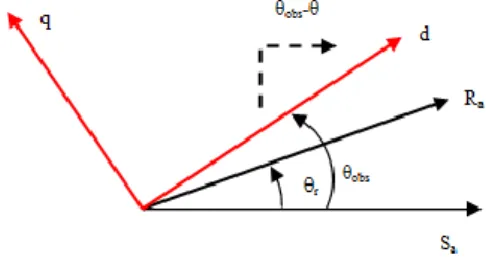
The electrical model of the DFIM is expressed in a (d-q) synchronous rotating frame (figure 1).
Figure 1. Defining the Real Axes of DFIM from the Reference (d, q)
2.1. Reference Fixed Relative to the Rotating Field (d, q)
For a reference related to the rotating field, was s rm in the system of equations is as
follows:
0 0
0 0
sd s sd sd s sd
sq s sq sq s sq
d dt
V R I
V R I
(1)
0 0
0 0
rd r rd rd rd
rq r rq rq rq
d I R
V dt
V
I R
(2) Expressions of flux are given by
sd s sd rd
sq s sq rq
rd r rd sd
rq r rq sq
l M
l M
l M
l M I I I I I I I I
(3)
sd rd
sd s sd s s s sq s rq
sq rq
sq s sq s s s sd s rd
rd sd
rd r rd r r rq sq
rq sq
rq r rq r r rd sd
d d
R l M l M
dt dt
d d
R l M l M
dt dt
d d
R l M l M
dt dt
d d
R l M l M
d
I I
V I I I
I I
V I I I
I I
V I I I
I I
V I
t dt I I
(4)
2.2. DFIM Model in the Form of State Equation
For the DFIM the control variables are the stator and rotor tensions, [10] with considering: a. An input-output current decoupling is set for all currents;
b. The (d-q) frame is oriented with the stator flux;
c. Due to the large gap between the mechanical and electrical time constants, the speed can be considered as invariant with respect to the state vector.
Under these conditions, the electrical equations of the machine are described by a time variant state space system as shown in (5)
. .
.
X A X B U Y C X
(5)
With X, A, B, U, Y and C represent the state vector, system state evolution matrix, matrix of control, vector of the control system, output vector and output matrix (observation matrix) respectively,
Where
T sd sq rd rq
X i i i i
(6)
T
sd sq rd rq
U V V V V
(7) Whereis,ir,VsandVrdenote stator currents, rotor currents, stator terminal voltage and rotor terminal voltage, respectively. The subscripts s and r stand for stator and rotor while subscripts d and q stand for vector component with respect to a fixed stator reference frame. [11]
From a matrix representation:
1 0 0 0 0 . 0 0 0 0
0 0 0
0 0 0
0 ( ) ( ) 0 0
( ) 0 ( ) 0 0
sd s sq s r rd r rq sd
s s s s
sq
s s s s
s s r rd r
s s r rq r
s s s s M M R R R M
I L M
I L M
d L I dt L I I
L M L M
I
L M L M
M L I L
R
L M
M I L
1 sd sq rd rq V V V V
(8)
0 0 0 0 0 0 0 0 s s s s L M L M L L L M M and
0
0
0 ( ) ( )
( ) 0 ( )
s s s
s s s
s s r
s s r
s s s s R R R R L M L M Z M L M L
Then equation (5) becomes:
1
1. . .
dX
L Z X L U
dt
(9)
In analogy to equation (9) with equation (5) we find A
L1. Z and B
L1.[11]1 3 5
1 5 3
4 6 2
6 4 2
s s
s
s
a a a a
a a a a
A a a a
a a a
(10) 1 3 1 3 3 2 3 2 0 0 0 0 0 0 0 0 b b b b B b b b b (11)
1 0 0 0 0 1 0 0 0 0 1 0 0 0 0 1 C (12) Where 1 a
1 s s R a L 2 r
r
R a
L
3 r
S r
R M a
L L
4 s
s r R M a L L 5 s M a L 6 r M a L
1 1
s b L 2 1 r b L 3 s r M b L L
1 2
s r
M L L
Wheres,
,L,R and M denote stator pulsation, rotor pulsation, inductance, resistance andmutual inductance, respectively.
is redefined leakage factor. [10]The generated torque of DFIM can be expressed in terms of stator currents and stator flux linkage as:
. .
e sq rd sd rq
S
PM
C i i
L
(13) WhereP, is the number of pole pairs. In addition the mechanical dynamic equation is given by
e r
d
J C C f
dt
(14) Where J and f denote the moment of inertia of the motor and viscous friction coefficient, respectively, Cr is the external load and Ω is the mechanical speed.
3. VECTOR CONTROL BY DIRECT STATOR FLUX ORIENTATION
To simplify the control you need to make a judicious choice reference. To this, we place ourselves in a reference (d, q) related to the rotating field with an orientation of the flux stator, according to the condition of the stator flux orientation [12] [13]
sd s
and sq 0 (15)
Replaces (15) in (1) and (2) we obtained
*
0 0
sd s sd sq sq rq
s
sq s sq s sd
sd
rd r rd rq
s
rq r rq rd rd
V I I I
V I
I
V I
V I I
M R
L R
R R
M
(16)
The torque equation becomes
*
.
e rq
S s
PM
C I
L
(17)
*
*.
. .
S
rq e
s
L
I C
P M
(18)
Equation (4) was:
* s
s
rq s
s s
q s
d dt
R M I V L
(19)
According to the equation (3) of the stator flux, then:
1
( )
1
( )
sd sd rd
s
sq sq rq
s
I MI
L
I MI
L
(20)
From the relations (20) and (4)
1
sd sd rd sd
s s
sq sq rq s sq
s
M
V I
T T
M
V I
T
(21)
2
2
1 1
( )
1
( )
1 1
( )
1
( )
rd rd sd
r s s r s r
sd s rq rd
r s s r
rq rq sq
r s s r s r
sd s rd rq
r s r
M M
I I V
T L T L L L M
I V
L L T L
M M
I I V
T L T L L L M
I V
L L L
(22)
The relationship of the mechanical speed .
( . )
.
r rq sd s
C
d P M f
I
dt J L J J
(23)
Where s s
s
L T
R
and r r
r
L T
R
are stator and rotor time-constant respectively. [10]
3.1. Stator Flux Estimator
In the direct vector control stator flux oriented DFIM, precise knowledge of the amplitude and the position of the stator flux vector is necessary. Motor mode of DFIM, the stator and rotor currents are measured, the stator flux can be estimated. [10] The flux estimator may be obtained by the following equations
sd s sd rd
sq s sq rq
I I
l M
lI MI
(24)
The position stator flux is calculated by the following equations:
r s
(25)
In which:
,
s
s dt dt
(26)Where:
P. and s is the electrical stator position,
is the electrical rotor position.4. CONTEXT OF TYPE-2 FUZZY LOGIC CONTROLLER
The classic fuzzy logic now called Type-1 has been generalized to a new type of fuzzy logic called fuzzy logic-2. In recent years, Mendel and O. Castillo [14] [15] and his colleagues have been working on this new logic; they have built a theoretical basis, and demonstrated its effectiveness and superiority to the type-1 fuzzy logic. This new class of Type-2 fuzzy systems in which the premise of membership values them is kind of fuzzy sets-1. The Type-2 fuzzy sets are very effective in circumstances where it is difficult to accurately determine the membership functions for fuzzy sets; therefore, they are very effective for incorporating uncertainties. [16]
The concept of fuzzy sets Type-2 was introduced by Zadeh [16] [17] [18] as an extension of the concept of ordinary fuzzy set called fuzzy-type-1. Type-2 fuzzy set is characterized by a fuzzy membership function, ie, the value of membership (membership degree) of each element of the set is a fuzzy set in [0, 1]. Such sets can be used in situations where we have uncertainty about the values of belonging themselves. Uncertainty can be either in the form of the membership function or one of its parameters. [16]
Consider the transition from normal sets to fuzzy sets. When we cannot determine the degree of membership of an element has a set of 0 or 1, using fuzzy sets Type-1. The same when we cannot determine
the fuzzy membership functions by real numbers in [0, 1], then we use fuzzy sets like-2. So ideally we need to use fuzzy sets type- ∞ to complete the representation of uncertainty. Of course, we cannot realize this in practice, because we have to use fuzzy sets of finite type. Therefore, the type-1 fuzzy sets can be considering him a first order approximation of uncertainty, while the type-2 fuzzy sets will consider him the second approximation. [16]
The structure of a fuzzy system Type-2 is shown in the figure 2.
Figure 2. Structure of type-2 fuzzy logic system [16]
4.1. Type-2 Membership Functions
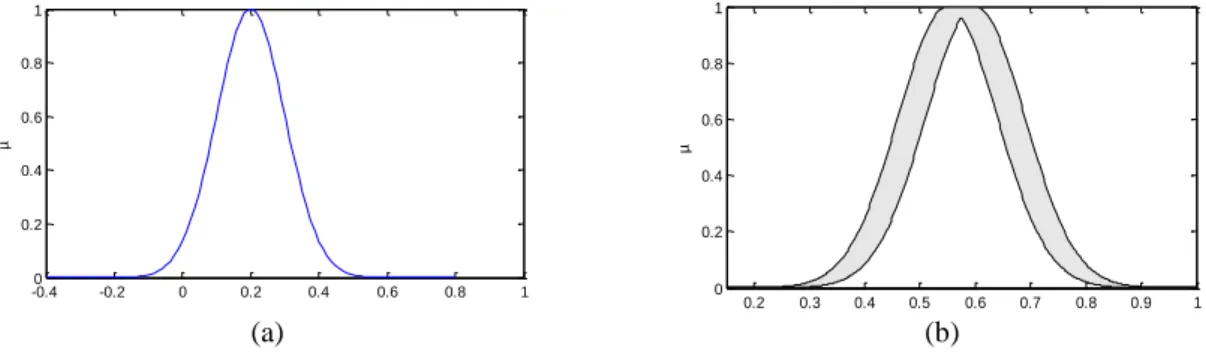
Type-2 fuzzy logic systems are characterized by the form of their membership functions. Figure 3 shows two different membership functions (a) a typical type-1 membership function, (b) a blurred type-1 membership function that represents a Type-2 membership function.
(a) (b)
Figure 3. (a) Type-1 Membership Function, (b) Footprint of Uncertainty
4.2. Fuzzifier
The membership function type-2 gives several degrees of membership for each input. Therefore, the uncertainty will be more represented. This representation allows us to take into account what has been overlooked by the type-1. The fuzzifier maps the input vector
e e1, 2, ,e n
Tto a type-2 fuzzy systemAx, very similar to the procedure performed in a type-1 fuzzy logic system.4.3. Rules
The general form of the ith rule of the type-2 fuzzy logic system can be written as:
If e1 is ̃ and e2 is F2i
~
and en isFni
~
, than yi Gi i1,,M (27)
Where ̃ represent the type-2 fuzzy system of the input state j of the ith rule, x1, x2, …,xn are the inputs, ̃ is
the output of type-2 fuzzy system for the rule i, and M is the number of rules. As can be seen, the rule structure of type-2 fuzzy logic system is similar to type-1 fuzzy logic system except that type-1 membership functions are replaced with their type-2 counterparts.
-0.40 -0.2 0 0.2 0.4 0.6 0.8 1
0.2 0.4 0.6 0.8 1
µ
0.2 0.3 0.4 0.5 0.6 0.7 0.8 0.9 1
0 0.2 0.4 0.6 0.8 1
4.4. Inference Engine
In fuzzy system interval type-2 using the minimum or product t-norms operations, the ith activated rule Fi
x1, xn
gives us the interval that is determined by two extremes fi
x1, xn
and fi
x1, xn
[19]:
1,
[ ( ,1 ), ( ,1 )] [ , ]i i
i i
i
n n n
F x x f x x f x x f f
(28)
with fi and fiare given as:
1
1
1
1
i i
n
i i
n
i
n
F F
i
n
F F
f x x
f x x
(29)
4.5. Type Reducer
After the rules are fired and inference is executed, the obtained type-2 fuzzy system resulting in Type-1 fuzzy system is computed. In this part, the available methods to compute the centroid of type-2 fuzzy system using the extension principle [15] are discussed. The centroid of type-1 fuzzy system A is given by:
1
1 n
i i i
A n
i i
z w C
w
(30)Where n represents the number of discretized domain of A,
z
i
R
andw
i
0
,
1
. If each zi and wi arereplaced with a type-1 fuzzy system, Zi and Wi, with associated membership functions of
Z
z
i and
iW
W
respectively, by using the extension principle, the generalized centroid for type-2 fuzzy system A~ is given by:
1 1 1 1
1 1
1
1
*
n n n n
n n
i Z i i W i
n A
z Z z Z w W w W
i i i
n i i
T z T z
GC
z w w
(31)T is a t-norm and
A
GC
~is a type-1 fuzzy system. For an interval type-2 fuzzy system:
1 1 1 1
1 , , 1 , ,
1
1
,
1
M M
M M M
M
l r l r
i i
l r
A
M
y y y y y y f f f f f f
i M
i i
GC y x y x
f y f
(32)4.6. Deffuzzifier
To get a crisp output from a type-1 fuzzy logic system, the type-reduced set must be defuzzied. The most common method to do this is to find the centroid of the type-reduced set. If the type-reduced set Y is discretized to n points, then the following expression gives the centroid of the type-reduced set as:
11 n
i i
i
output m
i i
y y
y x
y
(33)We can compute the output using the iterative Karnik Mendel Algorithms [20] [21]. Therefore, the defuzzified output of an IT2FLC is:
2
l r
output
y x y x
Y x (34)
with:
11 M
i i l l i
l M
i l i
f y y x
f
and
1
1 M
i i r l i
r M
i r i
f y y x
f
(35)5. TYPE-2 FUZZY CONTROLLER DESIGN
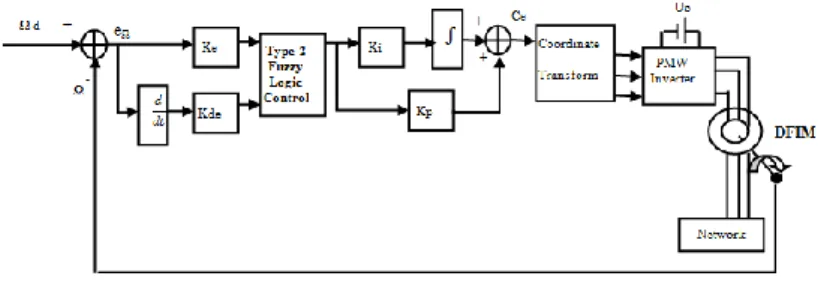
In this problem, vector control by direct stator flux orientation used in the control of the DFIM; the bloc diagram of the speed control was replaced by an IT2FLC. The DFIM system model was simulated first using a conventional T1FLC and then with IT2FLC. The rule base was the same for both Type-1 and Type-2 Fuzzy Logic Controllers. The Fuzzy control strategy is based on a human operator experience to interpret a situation and initiate its control action. The IT2FLC in a vector-control of DFIM used is presented in Figure 4.
Figure 4. Control Scheme for DFIM using the IT2FLC
e
anderepresent the output error and its derivative, respectively. For the speed the error and its derivative are given by
( ) d
e k (36)
( 1) ( )
( ) e k e k
e k
T
(37)\ With: T and are the sampling period and desired speed respectively.
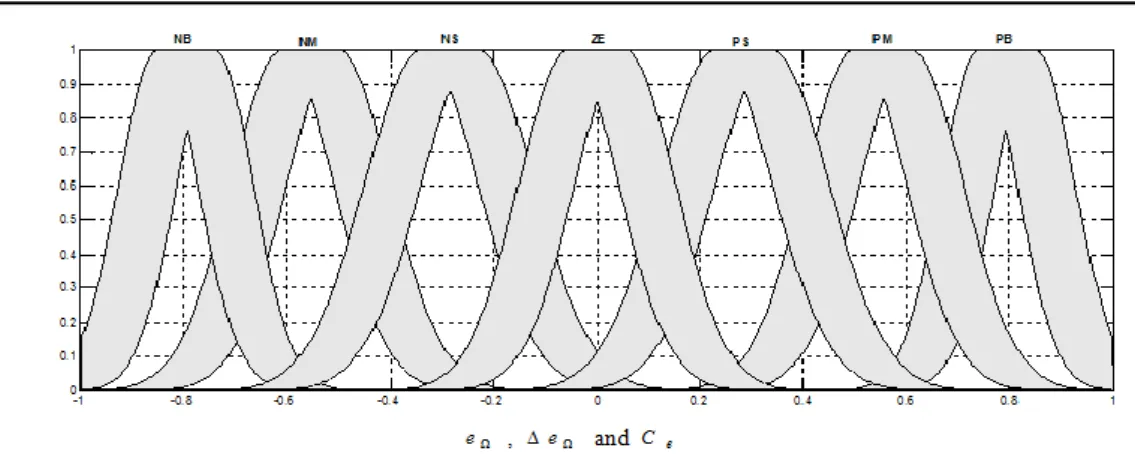
The speed errors, their variation and the control signal are chosen to be identical shapes Gaussian (Figure 5), and we are quantized into seven levels represented by a set of linguistic variables: negative big (NB), negative medium (NM), negative small (NS), zero (ZE), positive small (PS), positive medium (PM) and positive big (PB).
Figure 5. Type-2 Fuzzy Membership Functions of the Speed Error, their Variation and the Control Signal
In this work, the controller fuzzy rules are gathered in Table 1.
Table 1. Fuzzy Rules for IT2FLC [22]
The processed surface is shown in Figure 6
Figure 6. Surface for the TorqueCe
6. TYPE-2 FUZZY CONTROLLER DESIGN
Several simulations have been run using the Matlab and Simulink ® software in order to validate the theoretical results. The simulation system consists of 3 modules:
In this section, simulations results are presented to illustrate the performance and robustness of proposed controls law, the IT2FLC applied to the DFIM with the speed control. The DFIM used in this work is a 0.8 KW, whose nominal parameters are reported in the table 2.
( ) e k
NB NM NS ZE PS PM PB
NB NB NB NB NM NS NS ZE
NM NB NM NM NM NS ZE PS
NS NB NM NS NS ZE PS PM
( )
e k ZE NB NM NS ZE PS PM PB
PS NM NS ZE PS PS PM PB
PM NS ZE PS PM PM PM PB
Table 2. Parameters of the DFIM [11]
Definition Symbol Value
DFIM Mechanical Power Pw 4 kW
Stator voltage Usn 380 V
rotor voltage Urn 220 V
Nominal current In 3.8/2.2 A
Nominal mechanical speed n 1420 rpm
Nominal stator and rotor frequencies sn 50 Hz
Pole pairs number P 2
Stator resistance Rs 11.98 Ω
rotor resistance Rr 0.904 Ω
Stator self inductance Ls 0.414 H
rotor self inductance Lr 0.0556 H
mutual inductance M 0.126 H
Moment of inertia J 0.01 Kg.m2
friction coefficient f 0.00 IS
The speed and flux regulation performance of the proposed the IT2FLC is checked in terms of load torque variations. The motor is operated at 157 rad/s under no load and a load disturbance torque (5 N.m) is suddenly applied at t=0.6s and eliminated at t=1.6s (-5 N.m), and the rotor resistance variations (increase at 100 % of nominal value rotor resistance), while the other parameters are held constant.
The responses of speed, torque, stator flux and rotor current are shown in Figures 7-10; the IT2FLC shows the good performances to achieve tracking of the desired trajectory.
At these change of load, the IT2FLC throw-outs the load disturbance very rapidly with no overshoot and with a negligible static error as can be seen in the response of speed (see Figure 7). The decoupling of torque-flux is maintained in permanent mode. We can see the control is robust from the point of view load variation.
Figure 7. Result of Speed under a Load Cr=5 N.m in the Interval [0,6 Sec-1,6 Sec]
0 0.2 0.4 0.6 0.8 1 1.2 1.4 1.6 1.8 2
0 20 40 60 80 100 120 140 160
time(s)
S
p
e
e
d
(r
a
d
/s
)
Interval Type-2 Fuzzy Logic controller Desierd
Figure 8. Result of Torque under a Load Cr=5 N.m in the Interval [0,6 Sec-1,6 Sec]
Figure 9. Result of Stator Flux under a Load Cr=5 N.m in the Interval [0,6 Sec-1,6 Sec]
Figure 10. Result of Rotor Current under a Load Cr=5 N.m in the Interval [0,6 Sec-1,6 Sec]
0 0.2 0.4 0.6 0.8 1 1.2 1.4 1.6 1.8 2
-5 0 5 10 15 20 25 30 35
time(s)
T
or
qu
e(
N
.m
)
Torque Ce Cr
0 0.2 0.4 0.6 0.8 1 1.2 1.4 1.6 1.8 2
-0.4 -0.2 0 0.2 0.4 0.6 0.8 1
time(s)
S
ta
to
r
F
lu
x
(W
b
)
Flux-sd Flux-sq
0 0.2 0.4 0.6 0.8 1 1.2 1.4 1.6 1.8 2
-40 -30 -20 -10 0 10 20 30 40
time(s)
R
o
to
r
C
u
rr
e
n
t(
A
Figure 11. Simulated Results Comparison of IT2FLC and T1FLC of Speed Control of DFIM under Load Variation with Zoom in the Interval [0,6 Sec-2 Sec] under a Load Cr=5 N.m
The IT2FLC based drive system can handle the rapid change in load torque without overshoot and undershoot and steady state error, whereas the T1FLC has steady state error and the response is not as fast as compared to The IT2FLC.
7. CONCLUSION AND FUTURE WORKS
In this paper a new approach for the speed control of DFIM is presented. To achieve our goal a mathematical model of DFIM was presented. Type-2 Fuzzy Logic Controller is performed. This approach is based on the Interval Type-2 fuzzy logic. The obtained simulation results illustrate the good performance of the proposed method in the case of the change of load and resistance variation torque and its robustness with respect to parametric uncertainties. In our ongoing work we are currently implementing the proposed control system in the real DFIM.
REFERENCES
[1] PE Vidal. Commande non-linéaire d'une machine asynchrone à double Alimentation. Doct. Thesis, Dept. of Elect. Eng., National Polytechnic Institute of Toulouse, France, 2004.
[2] G Salloum. Contribution à la commande robuste de la machine asynchrone à double alimentation”, Doct. Thesis, Dept. of Elect. Eng, National Polytechnic Institute of Toulouse, France, 2007.
[3] MS Vicatos, JA Tegopoulos. A Doubly-fed induction machine differential drive model for automobiles. IEEE Transactions on Energy Conversion. June 2003; 18(2): 225-230.
[4] Y Bekakra, D Ben attous. Speed and flux control for DFOC of doubly fed induction machine using sliding mode controller. Acta Electrotechnica et Informatica, 2010; 10: (4): 75-81.
[5] JC Prescott, BP Raju. The inherent instability of induction motors under condition of double supply. Proceedings of the IEE, the Institute of Electrical Engineers Monograph, 1958; 105(7): 319-330.
[6] E Blaschke. The Principe of field orientation as applied to the new transvector closedloop control system for rotating field machine. Siemens Review, 1972; (34): 217-220.
[7] M Chaari, M Soltani, Gossa. Comparative study between the conventional regulators and fuzzy logic controller: application on the induction machine. International Journal of Sciences and Techniques of Automatic control & computer engineering IJ-STA, December 2007; 1(2): 196-212.
[8] LX Hebert, Y Tang. Fuzzy logic enhanced speed control of an indirect field- oriented induction machine drive. IEEE Trans. Power Electronics, September 1997; 12(5): 772-778.
[9] Y Harbouche, L Khettache, R Abdessemed. Sliding mode control of the double feed asynchronous machine applied by current sources. Asian Journal of Information Technology, 2007; 6(3): 362-368.
[10]D Ben Attous, Y Bekakra. Speed control of a doubly fed induction motor using fuzzy logic techniques. International Journal on Electrical Engineering and Informatics, 2010; 2(3): 179-191.
0 0.2 0.4 0.6 0.8 1 1.2 1.4 1.6 1.8 2
0 20 40 60 80 100 120 140 160
time(s)
S
p
e
e
d
(r
a
d
/s
)
Interval Type-2 Fuzzy Logic controller Desierd
Type-1 Fuzzy Logic controller
1 1.5 2
154 155 156 157 158 159
time(s)
S
p
e
e
d
(r
a
d
/s
)
[11]L Benalia. Control of a double feed and double star induction machine using direct torque control. Prof. Moulay Tahar Lamchich (Ed.), InTech, 2011; 113-126.
[12]M Machmoum, F Poitiers, L Moreau, ME Zaim, E Le- doeuff. Etude d’éolienne à vitesse variable basées sur des machines asynchrones (MAS-MADA). GE44, Polytechnic Institute of Nantes, France, 2003.
[13]A Farrokh payam, M Jalalifar. Robust speed sensorless control of doubly-fed induction machine based on input-output feedback linearization control using a sliding-mode observe. International conference on power electronics, drives and energy systems, 2010; 10(11):1392-1400.
[14]JM Mendel. Uncertain Rule-Based Fuzzy Logic Systems: Introduction and New Directions. Prentice-Hall, Upper Saddle River, NJ, first edition, 2001.
[15]O Castillo, P Melin. A review on interval type-2 fuzzy logic applications in intelligent control. In intelligent control, Inform. Sci, in press, 28 April 2014.
[16]N Ezziani. Commande adaptative floue backstepping d’une machine asynchrone avec et sans capteur mecanique. Doct. Thesis in Computer Engineering, automatic and signal processing, Reims University, France, Avril 2010. [17]LA Zadeh. The Concept of a Linguistic Variable and its Application to Approximate Reasoning. Information
Sciences, 1975; 8:199-249.
[18]RI John, S Coupland. Type-2 Fuzzy Logic a Historical View. IEEE Computational Intelligence Magazine, 2007; 2(1):57-62.
[19]JM Mendel, RI John, F Liu. Interval type-2 fuzzy logic systems made simple. IEEE Transactions on Fuzzy Systems, 2006; 14(6): 808-818.
[20]HA Hagras. A hierarchical type-2 fuzzy logic control architecture for autonomous mobile robots. IEEE Trans. Fuzzy Syst, 2004; 12(4): 524-539.
[21]Q Liang, JM Mendel. Interval type-2 fuzzy logic systems: theory and design. IEEE Transactions on Fuzzy Systems, 2000; 8(5): 535-550.
[22]S Barkati, EM Berkouk, MS Boucherit. Application of type-2 fuzzy logic controller to an induction motor drive with seven-level diode-clamped inverter and controlled in feed. Electr Eng, 2008: 347-359.
BIOGRAPHIES OF AUTHORS
Me. Loukal Keltoum was born in Msila, Algeria. She received License and Master Degrees in Electrical Engineering from University Msila - Algeria, in 2010 all in electrical engineering. In 2013, she participate your Doctorate electrical engineering in Msila University- Algeria; his current research interests include the machine DFIM, fault tolerant control, non linear system.
Me. Benalia Leila was born in Batna, Algeria in 1974. She received her Magister and Doctorate degrees in Electrical Engineering from the University of Batna, in 2002 and 2010, respectively. In 2003, she has been working in the Department of Electrical Engineering, University of M’sila, as a Lecturer. Currently, she is the Director of the Electrical Engineering Laboratory. Her current areas of research include design and control of double feed induction machines and renewable energy.
![Figure 7. Result of Speed under a Load Cr=5 N.m in the Interval [0,6 Sec-1,6 Sec]](https://thumb-us.123doks.com/thumbv2/123dok_us/8385184.2227882/11.892.252.655.681.948/figure-result-speed-load-cr-interval-sec-sec.webp)
![Figure 8. Result of Torque under a Load Cr=5 N.m in the Interval [0,6 Sec-1,6 Sec]](https://thumb-us.123doks.com/thumbv2/123dok_us/8385184.2227882/12.892.221.690.117.369/figure-result-torque-load-cr-interval-sec-sec.webp)
![Figure 11. Simulated Results Comparison of IT2FLC and T1FLC of Speed Control of DFIM under Load Variation with Zoom in the Interval [0,6 Sec-2 Sec] under a Load Cr=5 N.m](https://thumb-us.123doks.com/thumbv2/123dok_us/8385184.2227882/13.892.237.697.114.414/figure-simulated-results-comparison-speed-control-variation-interval.webp)
