French-Language Education Strategy Task Force
Report Presented to the Honourable Gerard Kennedy
Ontario Minister of Education
(This is a translation of the report by the Groupe de travail sur une stratégie
en matière d
=
éducation en français)
TABLE OF CONTENTS Introduction ……….……….……….. 1 Background………….…..………...……….1 Components Reviewed….………..……….………4 Key Issues ………..………..………….. 6 . Other Issues…….………..……….30
Renewal of the Task Force Mandate………….………. …….………..39
Conclusion…….……….40
Appendix A Summary Table of Additional Investments………. 41
Appendix B The Task Force’s Members, Mandate and Timetable……….………. 42
Appendix C Briefs……….. 43
Introduction
This report was prepared by the French-Language Education Strategy Task Force (FLESTF) in February and March of 2004 on behalf of the language provincial educational associations. It includes an analysis of the factors that cause difficulties for language education. It also suggests measures to be taken to remedy the problem areas occurring under present funding for language education. Although the issues and circumstances described apply to both language school authorities and to French-language district school boards, the calculation of additional investments apply only to French-French-language district school boards This report also identifies other issues related to French-language education that are of concern but have not, for the moment, been included in the estimate of the additional investments required to correct the situation. The FLESTF wishes to draw the Ministry’s attention to those concerns so it can take them into account as it continues to implement the Rozanski Report.
Background
The report of the Education Equality Task Force (the Rozanski Report), Investing in Public Education: Advancing the Goal of Continuous Improvement in Student Learning and Achievement, submitted to the Ministry of Education on December 10, 2002, includes a recommendation that relates specifically to French-language education (recommendation 14):
“… that the Ministry of Education review the brief submitted to the task force by the 12 French-language school boards, together with the Association des conseillères et des conseillers des écoles publiques de l’Ontario and the Association franco-ontarienne des conseils scolaires catholiques, and amend the funding formula as appropriate to ensure that each of the grants in the formula recognizes the higher costs experienced by French-language boards in delivering education programs and services.”
In the November 2003 Speech from the Throne, the government announced its intention to implement this recommendation in the following way:
“[Your government] acknowledges the urgent need for a Francophone education strategy and will strike a task force immediately to ensure that all Ontario children receive an excellent education.”
Following the Speech from the Throne in November 2003, the Minister of Education asked the Assistant Deputy Minister, French-Language Education and Educational Operations Division, to form the French-French-Language Education Strategy Task Force (FLESTF) to advise him as soon as possible on what measures were required. The FLESTF includes representatives of French-language partners in the education community: the Association des conseillères et des conseillers des écoles publiques de l’Ontario (ACEPO), the
Association des directions et des directions adjointes des écoles franco-ontariennes (ADFO), the Association des enseignantes et des enseignants franco-ontariens (AEFO), the Association franco-ontarienne des conseils scolaires catholiques (AFOCSC), the
Association des gestionnaires en éducation franco-ontarienne (AGEFO), the Conseil ontarien des directions d’éducation en langue française (CODELF), the Fédération de la jeunesse franco-ontarienne (FESFO) and Parents partenaires en éducation (PPE). The Task Force’s mandate and a list of its members are presented in Appendix B. At their first meeting, the members examined the mandate from the government: to reach a consensus between the key French-language partners on the proposed means for implementing recommendation 14 of the Rozanski Report concerning the needs of the French-language district school boards. The Minister of Education asked the Task Force to advise him within eight weeks so that he would be able to take action during the next education funding cycle.
The Task Force members based their discussions on three premises.
• To ensure that the education provided to the Francophone minority is of the same quality as the education provided to the majority, the French-language schools must have access to additional funding to implement the curriculum, which is demanding, and to meet Ontario’s high standards.
• The government will follow through on it plans to implement the Rozanski Report’s recommendations, one of which concerns the needs of the French-language district school boards.
• It must be assumed that when the government reviews the funding formulas, there will be no reduction in funding for the French-language district school boards. However, some concern was expressed about the Learning Opportunities Grant (LOG). A change in the components of that funding envelope could have a negative impact on the French-language district school boards.
The French-Language Education Strategy Task Force (FLESTF) believes that the government of Ontario should review the funding of components related to the particular circumstances of French-language education, and that it is urgent to address the key issues. It is necessary to devise stable, predictable measures that will meet the Francophone community’s expectations:
• ensure access to French-language schooling of comparable quality to the that available to the official language majority, as described in section 23 of the Canadian Charter of Rights and Freedoms;
• provide funding for each French-language district school board so that it can offer programs, services and facilities that are comparable to the programs, services and facilities in the schools of the public education system of the majority;
• facilitate the acquisition of the skills in the Ontario curriculum’s learning expectations, which will ensure that each student will be successful in school and will obtain an Ontario Secondary School Diploma;
• foster the emergence of young Francophones who are aware and proud of their identity, who have developed the skills necessary to pursue their goals in life, who are prepared to continue learning throughout their lives and who are actively
involved in the French-language community as well as the community at large on the social, political, environmental, spiritual, cultural and economic levels;
• promote and expand the use of French in all spheres of school and community activities;
• counter assimilation among students and maintain student enrolment and retention French-language schools through the development of alliances with parents and partnerships with Francophone and Francophile community organizations; • increase the ability of French-language schools and district school boards to contribute to the linguistic and cultural
development of the Francophone community;
• foster success in school by improving teaching and learning conditions;
• promote the recruitment and retention of personnel in the French-language district school boards and schools.
The other 32 recommendations in the Rozanski Report are vital to the French-language district school boards. As noted in the report, there is a correlation between the implementation of measures related to recommendation 14 and the implementation of measures to address the other 32 recommendations.
In December 2003, the representatives of the French-language trustee associations and the representatives of the senior management of French-language district school boards on the Rozanski follow-up French Language Steering Committee provided their
recommendations for the funding of education in Ontario in a document addressed to the Assistant Deputy Minister (ADM), French-Language Education and Educational Operations Division (FLEEOD). In January 2004, a brief entitled The Francophone Perspective on the Funding of Education in Ontario [Unofficial translation] was submitted to the Ministry by the Association franco-ontarienne des conseils scolaires catholiques (AFOCSC) and the Association des conseillères et des conseillers des écoles publiques de l’Ontario (ACEPO). The ACEPO-AFOCSC brief, all the briefs and presentations by Francophone groups to the Rozanski Task Force, and the papers written for the FLESTF served as a starting point for the Task Force’s deliberations (the briefs are listed in Appendix C).
Components Reviewed
The FLESTF recognizes that the delivery of programs and services by all French-language district school boards depends to a large extent on the resources available to them. French-language district school boards have to deal with a context that is significantly different from the context within which English-language district school boards operate, as explained in the Rozanski Report (2002, p. 37):
First, French-language boards have facilities, enrolments and average school sizes that are smaller than those of English-language boards. As a result, French-English-language boards generally cannot benefit from economies of scale in the same way that English-language boards do. Second, French-language boards operate over vast territories. The distances between schools and board offices make it difficult to share resources and require more travel, both of which increase costs. Third, material resources, specialized human resources and community support in the French language are extremely difficult to obtain and often nonexistent in the communities served by French-language boards. This lack of resources and supports leads to
additional costs as French-language boards try to offer programs and services comparable to those offered by their English-language coterminous boards. It also makes it difficult for them to maintain the French-English-language learning environment and cultural values they are striving to provide for their students.
In view of the government’s recognition of the urgent need to adopt a strategy on French-language education (Speech from the Throne, November 2003) and in light of its mandate, the FLESTF examined the needs of the French-language education system, which are in addition to the needs of elementary and secondary education for the whole province. The FLESTF would like to emphasize the importance of taking action on all of the Rozanski Report’s recommendations; otherwise, the corrective measures for French-language education will be compromised.
The FLESTF focused on the components, areas of concern related to programs and services that had been identified. The French-language district school boards require immediate additional investment to close the gap between the quality of French-French-language and English-language education.
The components are as follows:
□ Junior Kindergarten and Kindergarten
□ Mandate of the French-language school: leadership at the school board level □ Actualisation linguistique en français
A) Actualisation linguistique en français: intensive support and partial support B) Actualisation linguistique en français: staff training
C) Actualisation linguistique en français: classroom resources and support for learning at home D) Actualisation linguistique en français: liaison with parents
□ Animation culturelle
A) Animation culturelle: Animation culturelle staff B) Animation culturelle: Animation culturelle activities □ Delivery of programs in French
□ Special Education
□ Administration and management of French-language district school boards □ Small elementary and secondary schools – administration component
KEY ISSUES
JUNIOR KINDERGARTEN AND KINDERGARTEN The Issue
Junior Kindergarten and Kindergarten programs in the French-language district school boards are provided by the French-language district school boards on a full-time basis, even though current funding is only for part-time programs.
The Specific Circumstances of the French-Language District School Boards (FLDSB)
The rate of anglicization among children in Ontario’s Francophone community is accelerating. According to an analysis by the federal Office of the Commissioner of Official Languages, the children most affected by anglicization are from families whose parents often use English because one of the parents is English-speaking. It is estimated that more than 50% of households that have children with French-language education rights (A. Martel, 2001) have one parent who does not speak French. And according to Statistics Canada (2002), approximately 46% of Anglophone-Francophone mixed marriages do not transmit the French language to their children. In addition, Francophone children who learn French at home, as is the case for children with two Francophone parents, are exposed to assimilation factors from outside the home very early, before they start school.
The 1999 Early Years Study, Reversing the Real Brain Drain, by Dr. J. Fraser Mustard and the Honourable Margaret Norrie McCain, eloquently demonstrated the importance of the early years in a child’s life: “the earlier a young child is given encouragement and education, the better the results are.” The French-language community knows that it is doubly important to reach young Francophones early in their lives in order to introduce them to their language and culture, to oral communication, reading and writing in French, and to the other subjects of the curriculum: Math, Science and Technology, Arts and Personal and Social Development. The Gilbert and Ayari (2000) study confirmed this: “French-language early childhood education in a minority environment has become a pre-requisite for linguistic continuity.” A part-time Junior Kindergarten (4-year-olds) and Kindergarten (5-year-olds) program is not enough. A full-time program is required to help children to rebuild their mother-tongue skills and to prepare them to begin learning the Ontario Grade 1 curriculum and ensure their success in school.
At the present time, all 12 FLDSBs offer full-time Junior Kindergarten and Kindergarten programs. They manage to fund the portion of these programs that is not funded by the Ministry by using funds from other budget envelopes, which results in reduced services in other areas. This type of funding scheme is a temporary measure and is no longer sustainable.
Calculation of the Necessary Additional Investment
The Ministry has already acknowledged the particular situation of the FLDSBs by adding $10 million to the French as a First Language (FFL) grant. The school boards applied that additional funding to their full-time Junior Kindergarten and Kindergarten programs.
The FLDSBs therefore receive approximately $27.9 million, including $10 million from the French as a First Language (FFL) grant. In fact, they require an additional $25.2 million, as shown in Table 3 above: the direct costs are $53.1 million, and the revenue is approximately $27.9 million. In addition, there are not enough spaces for these programs, and the FLDSBs require an investment of $2.2 million for new pupil places.
MANDATE OF FRENCH-LANGUAGE SCHOOLS: LEADERSHIP AT THE SCHOOL BOARD LEVEL The Issue
The challenges of creating the teaching and learning conditions that make it possible to develop French language and culture and ensure success in school exceed the resources provided under current funding for French-language education.
The Specific Circumstances of the French-Language District School Boards
The mandate of French-language schools has been defined over the past few years as part of the reform of secondary schools and of the Ontario curriculum in accordance with section 264, subsection (1)(f) of the Education Act, R.S.O. 1990. The framework for the mandate can be found in the various policy and resource documents published by the Ministry since 1997, including the following:
- Curriculum guidelines for Junior Kindergarten through Grade 12 – 30 policy documents
- Les écoles secondaires de l’Ontario de la 9e à la 12e année. Préparation au diplôme d’études secondaires de l’Ontario, 1999 [French-language version of Ontario Secondary Schools, Grades 9 to 12 – Program and Diploma Requirements, 1999]
- Des choix qui mènent à l=action – Politique régissant le programme d=orientation et de formation au
cheminement de carrière dans les écoles élémentaires et secondaires de l=Ontario, [French-language version of Ontario Secondary Schools, Grades 9 to 12 – Program and Diploma Requirements, 1999]
- Le curriculum de l=Ontario de la 9e à la 12e année. Planification des programmes et évaluation, 2000
[French-language version of The Ontario Curriculum, Grades 9 to 12 – ProgramPlanning and Assessment, 2000] - Aménagement linguistique en français – Guide d’élaboration d’une politique d’aménagement linguistique.
Palier élémentaire et secondaire, 1994
The FLDSBs and their predecessors (the FLACs and FLSs) have always understood the necessity of providing teaching and learning conditions that foster the educational success of young people in minority settings.
The FLESTF has identified the measures related to the mandate of French-language schools that require additional investment. These measures are grouped under the following headings: Actualisation linguistique en français and Animation culturelle. The specific rationale for each component of these headings is provided below.
Since the government has rightly recognized the importance of an additional investment to hire a person to lead the Student Success Program (an initiative formerly known as Students-At-Risk, renamed by the Minister on February 24, 2004), an additional investment unique to French-language education is required to hire a person for each school board.
The FLESTF suggests that FLDSBs could establish a position for a leader to be filled by an expert in French-language education in a minority setting (a coordinator or pedagogical consultant) who has the skills necessary to coordinate the implementation of
Actualisation linguistique programs and to promote the development of the French language and culture, as described in the Ministry’s policy documents.
Calculation of the Necessary Additional Investment
As illustrated in Table 4 below, each FLDSB has the same cost for this item: a salary of $83,378 and office expenses of $15,000. The necessary additional investment is approximately $1.2 million.
ACTUALISATION LINGUISTIQUE EN FRANÇAIS
This component has four elements: (A) intensive support and partial support; (B) staff training; (C) classroom resources and support for learning in the home; and (D) liaison with parents. The circumstances relating to each element are described below, as are the necessary additional investments.
A. Actualisation linguistique en français: Intensive Support and Partial Support The Specific Circumstances of the French-Language District School Boards
The curriculum policy document Actualisation linguistique en français et perfectionnement du français. Le curriculum de l’Ontario de la 1re à la 8e année, 2002 eloquently describes the effects of the challenge of teaching French in a linguistic minority setting.
Franco-Ontarian schools are expected to provide learning programs that meet the needs of all their clientele, which includes students who have French-language education rights under section 23 of the Canadian Charter of Rights and Freedoms and Ontario’s Education Act, as well as those who are accepted by the Admissions Committee under the Education Act. In order to meet the particular needs of students who cannot immediately follow the regular curriculum for linguistic, cultural, or school-related reasons… [Unofficial translation]
The above-mentioned anglicization of young Francophones requires vigilance throughout their elementary and secondary education. The rebuilding and consolidation of a young Francophone’s mother-tongue skills can take a number of years.
Although French-language schools have been providing support for the learning of French for many years, the release of the
Actualisation linguistique en français et perfectionnement du français policy documents in 1999 for the secondary level and in 2002 for the elementary level led to significant implementation activities, including staff training, the writing of school curricula, the development of teaching and learning resources for the Franco-Ontarian context, and the development of diagnostic assessment tools. The FLDSBs are unable to sustain the delivery of ALF programs at the elementary and secondary levels because they do not have enough teaching and learning support in the form of teacher in-service training and learning resources for students who should receive ALF programs. This need is specific to French-language education.
Table 5 below shows the percentage of Grade 3 and 6 students in the FLDSBs who do not speak French at home. It also shows how the incidence of this phenomenon varies from school board to school board. The FLDSBs in regions with the highest concentrations of Francophones have the lowest percentages of students who do not speak French at home, while those in the regions with lower
Table 6 below shows the percentage of students who may not have adequate language skills to ensure success in school. The data are used to estimate the number of students who require support. The data are broken down into grade ranges: JK to Grade 3, Grades 4 to 8, and Grades 9 to 12. For example, if 20% of students do not use French on a daily basis at home, we calculate that 20% of the school enrolment for a grade range requires an ALF program, since these students (20% of the enrolment) do not have the language skills to meet the requirements of the demanding new curriculum during their regular schooling. It is clear that there are significant needs in all of the FLDSBs.
Calculation of the Necessary Additional Investment
Table 7 below illustrates the method of calculating the necessary additional investment: the number of teachers required for
Actualisation linguistique en français programs times the average teacher’s salary. The teacher-student ratio is based on the FLDSBs’ experience in correcting the current situation. By taking the estimate of the total enrolment that requires ALF support and multiplying by a 1:50 teacher-student ratio, a normal ratio under these circumstances, we obtain the calculated amount for the JK-3 range. The same formula is applied to the other grade ranges, with progressively lower teacher-student ratios. Note that the support requirement decreases steadily from Junior Kindergarten to Grade 12.
B. Actualisation Linguistique en français: Staff Training
The Specific Circumstances of the French-Language District School Boards
Because so many students in French-language schools require partial or intensive support in learning and consolidating their language skills, the FLDSBs must make a greater investment in staff training.
The FLDSBs must provide in-service training programs in areas such as the following: - teaching the Actualisation linguistique en français curriculum; - identification and tracking of students;
- Animation culturelle;
- teaching in a French-language minority setting;
- the use of teaching resources focusing on language development; - e-learning.
Teaching children of an official language minority community in Canada is not comparable to teaching children of the official
language majority community. All of the preceding and following chapters demonstrate the difference between teaching and learning in a French-language school and teaching and learning in an English-language school.
Calculation of the Necessary Additional Investment
Table 8 below shows the necessary additional investment: one day of training for each classroom teacher in each French-language school.
C. Actualisation Linguistique en français: Class Resources and Support for Learning in the Home The Specific Circumstances of the French-Language District School Boards
Ordinary class resources are not appropriate for instruction that involves rebuilding a student’s mother-tongue skills in a minority situation. The FLDSBs must therefore create resources for the ALF program from scratch, although some resources for the teaching of French as a Second Language have been adapted to reflect the cultural aspect of the minority setting.
In terms of support for learning in the home, the French-language printed and audiovisual materials that are appropriate for children who are rebuilding or consolidating their language skills are not accessible to students outside of school. Public libraries, video stores and bookstores in most communities are not equipped to meet this need. The FLDSBs are currently experimenting with methods to support learning activities in the home, and these experiments are providing valuable information. However, such projects require significant financial investment by the schools.
Calculation of the Necessary Additional Investment
Table 9 below illustrates the method of calculating the necessary additional investment based on a lump sum of $79 for each student enrolled in an Actualisation linguistique en français program.
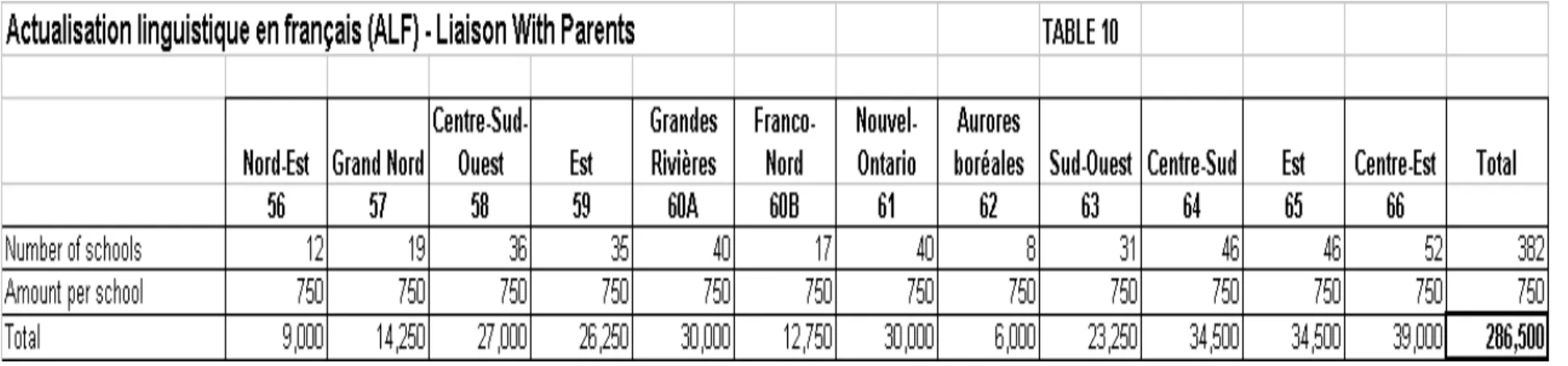
D. Actualisation linguistique en français: Liaison with Parents
The Specific Circumstances of the French-Language District School Boards
The home must play a supportive role. As previously noted, almost half of all homes with French-speaking students have one English-speaking parent. We need to help these parents help their children. The preferred method is to provide information and training sessions for English-speaking and French-speaking parents to help them understand the importance of arranging their family life in such a way as to support the acquisition and promotion of French language and culture. They must be encouraged to persevere in their efforts and to appreciate the value of the French-language education their children are receiving at French school.
The French-language schools need to set up programs to help these parents provide support at home. Calculation of the Necessary Additional Investment
Table 10 below illustrates the method of calculating the necessary additional investment based on an annual amount of $750 per school.
ANIMATION CULTURELLE
The Specific Circumstances of the French-Language District School Boards
Animation culturelle is a strategy specifically used in French-language education. The policy document Les écoles secondaires de l’Ontario de la 9e à la 12e année. Préparation au diplôme d’études secondaires de l’Ontario, 1999 describes animation culturelle as follows (p. 85):
… Animation culturelle is intended to promote success in school and the cultural development of the student by placing learning in a meaningful context in which French culture and language become relevant in the student’s eyes. The integration of animation culturelle into various subject areas is focused on the development of three key skills that are essential for the success and growth of students who attend Franco-Ontarian secondary schools. These are:
- communication skills, meaning all of the linguistic skills and knowledge that allow a person to express him/herself in French in various contexts, and to understand reality;
- learning skills, meaning the ability to analyse and process information that provides access to knowledge conveyed by the language. This skill makes French a learning tool;
- cultural affirmation skills, meaning skills based on emotional considerations, which provide a person with enough self-confidence and motivation to express him/herself in French in various contexts and to identify him/herself with French-speaking culture.
The development of these three key skills underlies the formulation of an overall expectation for Animation culturelle. The student uses French and all of the related cultural referents to express his/her understanding of the subject being studied, to synthesize the information communicated to him/her, and to use this information in various contexts. Animation culturelle is an essential strategy for fulfilling the school’s mandate to support success in school. In fact, section 264, subsection (1)(f), of the Education Act, R.S.O. 1990, directs and encourages teaching staff in French-language schools to use only French in school operations. The Ministry’s policies and the secondary education policy provide clarifications for the implementation of this provision.
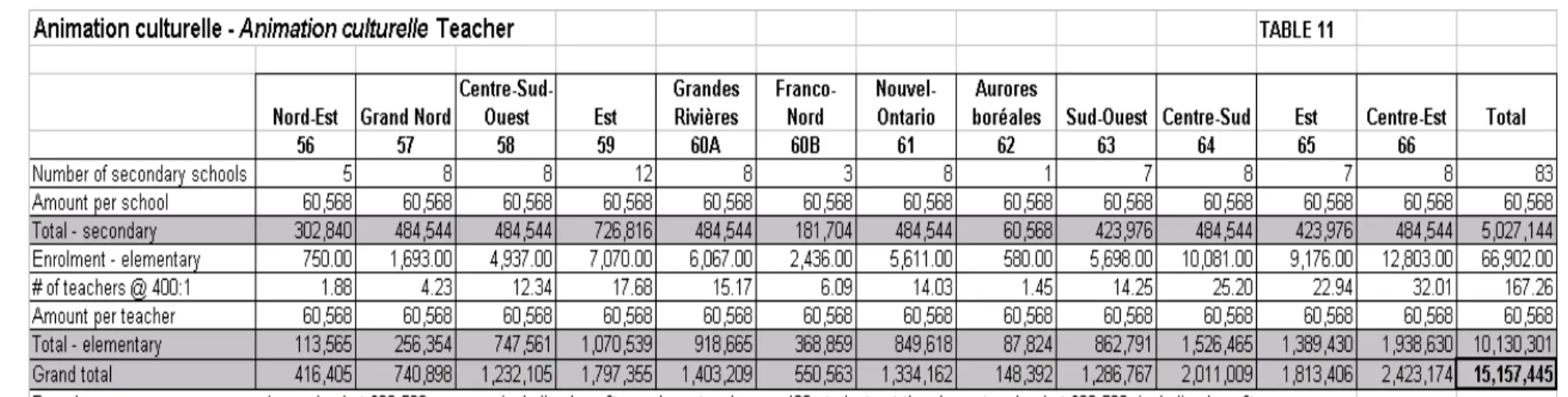
A. Animation Culturelle Staff
For many years, the Animation culturelle leader initiative in the schools has been referred to as the “animatrice culturelle” or
“animateur culturel”, although at present very few schools have such a staff member because the FLDSBs have lost the ability to fund the delivery of this service over the last few years. Much like the school leader in other programs, the animatrice culturelle or
animateur culturel promotes coordination among the school’s teaching staff in ensuring that the school environment fosters the development of the French language and culture. This means having objects that reflect French culture in the school, promoting cultural activities, introducing strategies to ensure that French is the main language used in the school, and ensuring liaison with French-language community agencies and organizations. In short, the animatrice culturelle or animateur culturel brings French culture alive in the school and makes it a living reality for the students. This is how studying in French takes on its full significance for the students.
Calculation of the Necessary Additional Investment
Table 11 below illustrates the method of calculating the necessary additional investment: the salary envelope for one staff member in each secondary school, and the equivalent of one person based on a ratio of one person to 400 students for each elementary school. The necessary additional investment is approximately $15.2 million.
B. Cultural Activities
The Specific Circumstances of the French-Language District School Boards
The rationale for cultural activities in French-language schools is based on the mandate of French-language schools. In fact, the new Ontario curriculum requires that Animation culturelle be integrated into all subject areas and every grade, from Junior Kindergarten to Grade 12. Cultural activities promote success in school: oral communication, reading and writing in a variety of contexts and on a variety of subjects. Outside of the school environment, students usually immersed in English-language contexts and seldom have the opportunity to practice skills learned at school.
Calculation of the Necessary Additional Investment
Table 12 below illustrates the method of calculating the necessary additional investment: $300 per class, a lump sum of $10,000 per school, a lump sum for small FLDSBs regardless of the number of schools, and a weighting factor (1.25) applied to the per-school amount for the FLDSBs in regions that are most heavily affected by assimilation.
Table 13 provides a summary of all three components: the mandate of French-language schools, Actualisation linguistique en français (ALF) and Animation culturelle.
DELIVERY OF PROGRAMS IN FRENCH The Issue
Current funding does not sufficiently reflect the high cost of resources and support required for the delivery of French-language programs.
The Specific Circumstances of the French-Language District School Boards
Tables 14 and 15 below show that French-language schools receive only about half of the funding that English-language schools receive for French immersion. The FLESTF believes that French-language instruction in both school systems should receive the same level of funding.
It is more and more common to come across teachers in French-language schools who do not have sufficient knowledge of English to be able to teach it. French-language schools do not have additional funding to hire staff to teach English courses as a replacement for the regular classroom teacher. However, English-language schools have the right to additional teaching staff for French as a Second Language (Core French and Extended French) at the elementary level, as a replacement for the regular class teacher.
French-language schools have a typical percentage of students who require special education programs, but it would be surprising to find a comparable percentage in a so-called “immersion” school. In addition, English-language district school boards also do not have additional costs for administration in French, since all administrative activities are in English.
Calculation of the Necessary Additional Investment
Tables 14 and 15 below illustrate the method of calculating the necessary additional investment.
- Using the grant amount per French-language immersion student in English-language schools, it can be demonstrated that the English-language district school boards (ELDSBs) receive twice as much funding for teaching in French (immersion
- There is an additional inconsistency: the teaching of French (Core French) in English-language elementary schools is funded at a rate of $244 per student, while the French-language schools do not receive anything for the teaching of English/Anglais and English for Beginners.
- For the secondary level, FLDSBs receive a per student amount of approximately $495. On the other hand, when the calculation for FSL funding is applied to each Grade 9, 10, 11 and 12 credit, the amounts come to $623 per Grade 9 and 10 student and $957 per Grade 11 and 12 student.
The necessary additional investment to put the FLDSBs on an equal footing with the ELDSBs is approximately $30.9 million, comprising $26.2 million for elementary schools and $4.7 million for secondary schools.
SPECIAL EDUCATION The Issue
All district school boards have to provide a series of programs and services to meet the needs of special education students. The French-language district school boards are unable to do so effectively.
The Specific Circumstances of the French-Language District School Boards The following list describes a number of difficulties specific to the FLDSBs:
- the difficulty that the FLDSBs have in identifying students due to the lack of specialized staff and the lack of diagnostic assessment and early identification resources in French, which is a particularly difficult and costly problem when it becomes necessary to purchase external services;
- the lack of French-language programs in care and treatment facilities, daycare services and correctional services (section 20);
- the difficulty in providing teaching programs that are related to the quality standards for the various
exceptionalities (behavioural exceptionalities, severe developmental difficulties, autism and related disorders, deafness and partial deafness, speech and language difficulties, learning difficulties, giftedness, mild intellectual deficiency, developmental disability, physical disability, blindness and poor vision, and multiple
exceptionalities);
- access to health and community and social services professionals (speech therapists, psychologists, physiotherapists, and so on) that are capable of providing services in French;
- the coordination and integration of community services in French, given the number of municipalities in the region covered by the FLDSB, and the lack of resources in French;
- the additional costs for the purchase of educational materials and specialized assessment tools; - the costs of staff training;
- the difficulty of bringing enough students together to create separate classes;
- the adaptation of educational materials, the lack of community services in French, the costs of maintaining support teams.
Calculation of the Necessary Investment
The task of quantifying the additional costs necessary to correct these problems is nearly impossible in the short term. However, we suggest a method for making an estimate in Table 16 below. The existing FLP grant makes up 8% of the basic grant per elementary student, taking into account the additional cost for providing services in a minority context. The FLDSBs have already indicated that the FLP grant is inadequate. When the Français langue première (FLP) grant is adjusted to be on par with the English-language district school boards for language teaching, it makes up 16% of the basic grant for elementary students. The Special Education grant must then be increased by 16% to reflect the additional costs of providing special education programs and services in a minority context.
The necessary additional investment is 16% (improved FLP grant) of the Special Education Per Pupil Amount (SEPPA) and the Intensive Support Amount (ISA), which is $86.7 million x 16% = $13.8 million.
THE ADMINISTRATION AND MANAGEMENT OF THE FRENCH-LANGUAGE DISTRICT SCHOOL BOARDS The Issue
The current grant for the administration and management of the French-language district school boards is inadequate for FLDSBs operating in French in Ontario.
The Specific Circumstances of the French-Language District School Boards
For administrative purposes, the French as a First Language (FFL) grant may not be used to pay any additional administrative costs that FLDSBs incur because they use French as the language of administration.
The FLDSBs are responsible for serving many communities spread over an average area of 34,000 km2, including an average of 70 municipal administrations and a number of coterminous school boards. Proportionally, it is more expensive to run the business of a FLDSB. The costs are higher, and there is a loss of productivity because of the vast area served.
According to the current formula and based on their vast territories, the FLDSBs have neither the senior managers nor the resources to manage their operations. Supervision of staff and evaluation of the system both suffer. They also have difficulty supporting the basic services provided by school trustee associations. In addition, the FLDSBs perceive that they must justify their needs more than the English-language district school boards. The FLDSBs feel that they have double the burden that their English-speaking counterparts have.
Calculation of the Necessary Additional Investment
An additional investment of 18% for the FLP grant is divided among the Administration and Management components in the following manner:
- 5% for the school board envelope
- 2% for the Supervisory Officer envelope - 11% for the board administration envelope. The necessary additional investment is approximately $10.2 million.
SMALL ELEMENTARY AND SECONDARY SCHOOLS: ADMINISTRATION COMPONENT The Issue
The Rural and Remote Education Strategy makes distance and remoteness the key factors for calculating additional funding, while the size of the school is the critical factor for most French-language schools.
The Specific Circumstances of the French-Language District School Boards
Although the measures taken by the government following the James Downey report, Strengthening Education in Rural and Northern Ontario – Report on Rural Education Strategy, 2003, were helpful for small French-language schools, the FLESTF is of the opinion that their problems are far from being resolved. The fundamental and most critical factor for French-language schools is their size. This has become a secondary factor, and distance has been made the primary factor in the systemic measures arising from the Downey report. According to the arguments in the report, a large school can help a small school located nearby by sharing some of its
resources, such as administrative services. However, French-language schools that are close to each other are usually both small, and they do not have resources that they can share. Proximity provides no advantage for many French-language schools.
All French-language schools that are unable to take advantage of the resources of a nearby school, because it is also a small school, should be able to receive the support provided for under the Rural and Remote Education Strategy.
Calculation of the Necessary Additional Investment
OTHER ISSUES
The following additional issues are just as important, but the FLESTF is unable to measure the impact of improvements based on the Rozanski Report that could address these issues. They are as follows:
- Small school programs and services - Pupil accommodation
- Special education - Transportation
- Le perfectionnement du français (ESL/ESD in English) - School authorities
The FLESTF believes that these issues should be considered in the future, and it wishes to draw them to the Ministry’s attention so that it can take them into account as it continues with implementation of the Rozanski Report in 2004-2005.
SMALL SCHOOLS EDUCATIONAL PROGRAMS AND SERVICES The Issue
The Rural and Remote Education Strategy makes distance and remoteness the key factors for calculating additional funding, while the size of the school is the critical factor for most French-language schools.
The Specific Circumstances of the French-Language District School Boards
We have already described the effects that the Rural and Remote Education Strategy has on the administrative infrastructure of French-language schools. Because of their size, small French-language schools do not have enough resources to share among
themselves, whether they are far away or close by. Most small schools have a limited ability to provide the programs and services that parents have a right to expect for their children.
The FLESTF would like to have examined the educational needs of small elementary and secondary schools. However, given the time constraints for the preparation of this report, the Task Force has not had the time to gather the information needed to determine:
- the educational support necessary in elementary schools that have students in multi-grade classes, where there are up to four grades in one class;
- the minimum range of courses necessary in secondary schools to ensure that the student can earn an Ontario Secondary School Diploma in four years.
Half of the French-language secondary schools have less than 250 students. Every year, 500 to 600 students from French-language elementary schools switch to English-language secondary schools. Students who choose to go to a French-language secondary school do not have access to the courses they need. Scheduling conflicts are inevitable, because the French-language secondary schools do not have the ability to offer multiple sections of the same course (i.e., offer a course more than once in a school timetable). Teachers are required to teach courses for which they do not have the training or experience. It is not surprising that almost half the students who have French-language education rights do not go to French-language schools.
The Ministry must take these factors into account when it adjusts education funding. Calculation of the Necessary Additional Investment
Without knowing what corrective measures the reforms of education funding will bring to this disturbing situation, the FLESTF is unable to calculate the necessary additional investment and would like to re-examine this matter (see Tables 18 and 19).
PUPIL ACCOMMODATION The Issue
The transfer of schools from English-language district school boards to the French-language district school boards at the time they were established (1997-1998) was not very beneficial to the French-language community. The schools were of poor quality, did not meet the needs of the community and were not in the right location.
The Specific Circumstances of the French-Language District School Boards
The quality and location of the schools transferred to the FLDSBs and the design and set-up of their teaching areas are poor and do not necessarily meet the FLDSBs’ accommodation needs. This situation has been obvious to parents and students, and weighs heavily in their decision to choose and pursue French-language education. In addition, FLDSBs that have received capital grants for the
construction of new schools generally build larger numbers of small schools than the English-language district school boards. A small construction project entails additional costs. For example, it is more costly per square foot to build a small school that can
accommodate 500 students than a school that can accommodate 1,000 students.
The FLESTF considers it urgent to provide the FLDSBs with the means to make capital improvements, as is the case for all other school boards. The problems that the FLDSBs face, such as retaining and recruiting students, are becoming more serious as time goes on.
Calculation of the Necessary Additional Investment
The Ministry considers that these problems will be resolved through the following components of the education funding model: RECAAP, capital transition pressures, funding for new pupil places, and schools with prohibitive costs of repair.
Without knowing what corrective measures education funding reforms will bring to this disturbing situation, the FLESTF is unable to calculate the necessary additional investment and would like to re-examine this matter.
SPECIAL EDUCATION
This report has already described the difficulties in the delivery of special education programs and services, due to factors such as the lack of expertise and teaching resources. The problem below affects a number of special education cases.
The Issue
The number of identified students is greater in the FLDSBs than the provincial average for all school boards.
The Specific Circumstances of the French-Language District School Boards
In the opinion of the FLESTF, there are proportionally more French-language students who have been identified as requiring special education. An English-language school might have 10% of its students identified as requiring special education, compared with 12% for a French-language school. The FLDSBs are awaiting the Ministry’s comparative analysis of the number of identified students in the FLDSBs and the ELDSBs. If the FLESTF’s opinion is well-founded, the FLDSBs would like to discuss corrective measures. This problem may be the result of the methods of identification of special education cases because there are not enough French-language resources such as psychology experts and diagnostic and tracking tools, and thus the additional grant calculated in the preceding pages could in fact reduce or eliminate the problem.
Calculation of the Necessary Additional Investment
Without knowing what corrective measures education funding reforms will bring to this disturbing situation, the FLESTF is unable to calculate the necessary additional investment and would like to re-examine this matter.
TRANSPORTATION The Issue
The funding formula for transportation is faulty and out of date.
The Specific Circumstances of the French-Language District School Boards
The FLESTF has learned that a new funding formula for the transportation of students is in preparation. The Task Force also
understands that the current funding scheme is based on 1997 transportation data, with annual adjustments for school enrolment. The FLESTF has serious reservations about the original database. Although enrolment in French-language schools is only 5% of the total enrolment in the province, the FLDSBs spend 15% more than the funds allocated by the province for this purpose.
In the agreements they have made with the coterminous English-language district school boards (12 English-language district school boards on average), the FLDSBs are almost always the poorer partner, and their transportation needs normally take second place. The school buses then become an English-language service provided by the FLDSB, which is quite outside of their statutory obligation to deliver educational programs and services in French.
The FLESTF would also like to point out that the specific transportation of special education students is much more expensive for the FLDSBs, given the long distances and the absence of economies of scale.
Calculation of the Necessary Additional Investment
Without knowing what corrective measures education funding reforms will bring to this disturbing situation, the FLESTF is unable to calculate the necessary additional investment and would like to re-examine this matter.
PERFECTIONNEMENT DU FRANÇAIS (PDF) The Issue
Implementation of the new Perfectionnement du français curriculum policy documents, one for the elementary level and the other for the secondary level, is beset by the same difficulties as the Actualisation linguistique en français (ALF) curriculum; in fact, the problems are even worse because the PDF has fewer resources.
The Specific Circumstances of the French-Language District School Boards
As explained above, immigrant families who move to Ontario and whose home language or first language is French need to be welcomed by French-language schools, so that they can be integrated into French-language schooling and Canadian society.
French-language schools also receive new French-speaking students every year from foreign countries, especially from countries where French is the language of education or of public administration. Some of these students who have recently moved to Ontario have had an educational experience that is very different from the one offered here, have had their education interrupted or have very little schooling. Helping those students to become familiar with their new environment and to fill in any gaps in reading, writing or math is a priority, because the success of their future studies depends on this, as does their personal growth and their integration into society.1 [Unofficial translation]
The integration of new arrivals into an English-language school is not comparable to the integration of new arrivals into a French-language school. The minority context of the French-French-language schools deprives them of significant community resources that could facilitate their integration; English-language schools have access to those resources.
English-language schools have access to professional educational networks for the teaching of English as a Second Language (ESL) and English Skills Development (ESD), which was begun a number of decades ago. French-language schools have nothing that is comparable. Support for teaching staff must definitely be provided by the Ministry and the FLDSBs.
The funding formula for ESL/ESD has been amended to provide better support for this program, while the funding formula for PDF, the equivalent program to ESL/ESD, has remained unchanged.
Calculation of the Necessary Additional Investment
Without knowing what corrective measures education funding reforms will bring to this disturbing situation, the FLESTF is unable to calculate the necessary additional investment and would like to re-examine this matter. However, the Ministry should begin by consolidating the funding formulas for PDF and ESL/ESD and take into account the barriers to learning in French in a French school from the time the student arrives in the country.
SCHOOL AUTHORITIES
For the definition of school authorities, see the Education Act, R.S.O. 1990, section 1, subsection (1). The Issue
The Ministry of Education funds a number of school authorities, seven of which are school authorities that manage French-language schools.
The Specific Circumstances of the School Authorities
School authorities operate small French-language schools in remote and isolated regions. All the particular situations and challenges faced by French-language district school boards are also faced by the school authorities. When the Ministry adjusts the funding formulas for school authorities, it must therefore provide additional funds to take into account the particular circumstances mentioned earlier in this report, such as Junior Kindergarten and Kindergarten programs, Actualisation linguistique en français, Animation culturelle, the delivery of programs in French and special education.
Calculation of the Necessary Additional Investment
The FLESTF has not calculated the necessary additional investment for this item, but it encourages the Ministry to consider a formula based on adjustments that are made for the particular circumstances that we know are faced by French-language district school boards. The FLESTF would like to re-examine this matter.
RENEWAL OF THE TASK FORCE’S MANDATE
As indicated in the Other Issues Section, the FLESTF needs to continue its examination of these issues once the Ministry has announced the new measures for education funding in response to the recommendations in the Rozanski Report. It is in the government’s interest and the French-language community’s interest to continue consideration of the Rozanski Report’s
recommendations, in particular with regard to the problems for which the necessary additional investments cannot be calculated before the Ministry proposes its new funding measures. The FLESTF members agree that a French education strategy should be examined over a longer term, to take into account all the needs of the French-language district school boards and school authorities, so that a continuum of high-quality programs and services can be provided for Francophone students.
CONCLUSION
The FLESTF has set out some measures that are required to correct the situations that have a specific negative impact on French-language education, based on the premise that all the measures taken in response to the recommendations of the Rozanski Report will be systemic measures that will be applied to French-language district school boards in a way that acknowledges the particular
circumstances of French-language education. Any failure to fully acknowledge these circumstances will compromise the calculation of the necessary investments suggested by the FLESTF. The FLDSBs will once again have to reduce funding of one program or service in order to pay for another program or service, and that method of operating can no longer be sustained.
Under the Canadian Charter of Rights and Freedoms, French-language parents and students have the right to expect educational programs and services that are of the same quality as those offered by the English-language district school boards. The retention of students in French-language schools is closely linked to the quality of these programs, services and facilities. It is therefore crucial that the government immediately invest in French-language education, so that the French-language district school boards and school authorities can provide equivalent programs and services in facilities of equal quality to students who have the right to attend French-language schools in Ontario. The government cannot postpone until tomorrow the investments that are necessary to reinforce the ability of the French-language district school boards and school authorities to carry out their mandate.
Appendix B
FRENCH-LANGUAGE EDUCATION STRATEGY WORK GROUP
Association/Organization Member
Ministry of Education Denis B. Vaillancourt, ADM, FLEEO Conseil ontarien des directions d’éducation
en langue française (CODELF) Michel Serré – CSDECSO Alphonse Ainsworth – CSDCGR Denis S. Chartrand – CÉPEO Association des gestionnaires de
l’éducation franco-ontarienne (AGÉFO)
Pierre Filiatrault – Business Superintendent in secondment to the 12 FLDSB
Association franco-ontarienne des conseils scolaires catholiques (AFOCSC)
Joseph Bisnaire – Chair
Robert Gagné – Chief Executive Officer Association des conseillères et des
conseillers des écoles publiques de l’Ontario (ACÉPO)
Ronald Marion – Chair
Louise Pinet – Chief Executive Officer Association des enseignantes et des
enseignants franco-ontariens (AEFO) Lise Routhier-Boudreau – Chair Bernard A. Éthier – Executive Vice-President Association des directions et des directions
adjointes des écoles franco-ontariennes (ADFO)
Serge Plouffe – Chair
Parents partenaires en éducation (PPÉ) Paul Trudel – Chief Executive Officer Fédération de la jeunesse franco-ontarienne
(FESFO)
Nora Villaréal – CÉPEO Nicolas St-Amant – CSDCCS Ministry of Education,
French-Language Education and Educational Operations Division
Ginette Plourde – Director Rémy Gagnon – Policy Analyst Robert E. Laplante – Advisor Maurice Boutet – Advisor
MANDATE and TIMETABLE
To reach a consensus between the key French-language partners on the proposed means for implementing recommendation 14 of the Rozanski Report concerning the needs of the French-language district school boards.
Appendix C
BRIEFS
A. Francophone organizations that gave presentations or submitted briefs to the Education Equality Task Force, 20022 Association des conseillères et des conseillers des écoles publiques de l’Ontario
Association des directions et des directions adjointes des écoles franco-ontariennes Association des enseignantes et des enseignants franco-ontariens
Association des enseignantes et des enseignants franco-ontariens Centre-Sud et Sud-Ouest, conseil publique no 58
Association franco-ontarienne des conseils scolaires catholiques Conseil d’école secondaire Confédération
Conseil ontarien des directrices et des directeurs de l’éducation de langue française Conseil scolaire de district catholique de l’Est ontarien
Conseil scolaire de district catholique des Aurores boréales Conseil scolaire de district catholique des Grandes Rivières Conseil scolaire de district catholique du Centre-Est de l’Ontario Conseil scolaire de district catholique du Nouvel-Ontario
Conseil scolaire de district catholique Franco-Nord
Conseil scolaire de district des écoles catholiques du Sud-Ouest Conseil scolaire de district des écoles publiques de l’Est de l’Ontario Conseil scolaire de district du Centre Sud-Ouest
Conseil scolaire de district du Grand Nord de l’Ontario Conseil scolaire de district du Nord-Est de l’Ontario Fédération de la jeunesse franco-ontarienne
2 Education Equality Task Force, 2002 (the Rozanski Report), Investing in Public Education: Advancing the Goal of Continuous Improvement in Student Learning and Achievement, Appendix G.
B. Members of the FLESTF that submitted documents for study Association des enseignantes et des enseignants franco-ontariens
LIST OF ACRONYMS Appendix D ACÉPO Association des conseillères et des conseillers des écoles publiques de l’Ontario
ADFO Association des directions et des directions adjointes des écoles franco-ontariennes ADM Assistant Deputy Minister
AEFO Association des enseignantes et des enseignants franco-ontariens AFOCSC Association franco-ontarienne des conseils scolaires catholiques AGÉFO Association des gestionnaires de l’éducation franco-ontarienne ALF Actualisation linguistique en français
CÉPEO Conseil des écoles publiques de l’Est ontarien
CODELF Conseil ontarien des directions d’éducation en langue française CSDCGR Conseil scolaire de district catholique des Grandes Rivières CSDECSO Conseil scolaire de district des écoles catholiques du Sud-Ouest CSDLF Conseil scolaire de district de langue française
ELDSB English-Language District School Board
ESL/ESD English as a Second Language/ English Skills Development
ÉSO Les écoles secondaires de l’Ontario de la 9e à la 12e année. [French-language version of Ontario Secondary Schools, Grades 9 to 12 – Program and Diploma Requirements, 1999]
FESFO Fédération de la jeunesse franco-ontarienne FLESTF French-Language Education Strategy Task Force
FLEEO French-Language Education and Educational Operations FLAC French Language Advisory Committee
FLS French Language Section (in English school boards) FLP Français langue première
ISO Intensive Support Amount LOG Learning Opportunities Grant PPE Parents partenaires en éducation
RECAAP Real Estate Capital Asset Assessment Program SEPPA Special Education Per Pupil Amount