ABSTRACT
Certain racial and ethnic groups, individuals with disabilities, and those from low socio-economic backgrounds remain underrepresented (UR) in the biomedical sciences. This underrepresentation becomes more extreme at each higher education stage. To support UR scholars during the critical transition from baccalaureate to PhD, we established an intensive, 1-yr postbaccalaureate training program. We hypothesized that this interven-tion would strengthen each participant’s competitiveness for leading PhD programs and build a foundation of skills and self-efficacy important for success during and after gradu-ate school. Scholar critical analysis skills, lab technique knowledge, and Gradugradu-ate Record Examination scores all improved significantly during the program. Scholars reported sig-nificant confidence growth in 21 of 24 categories related to success in research careers. In 5 yr, 91% (41/45) of scholars transitioned directly into PhD programs. Importantly, 40% (18/45) of participating postbaccalaureate scholars had previously been declined accep-tance into graduate school; however, 17/18 of these scholars directly entered competitive PhD programs following our training program. Alumni reported they were “extremely well” prepared for graduate school, and 95% (39/41) are currently making progress to gradua-tion with a PhD. In conclusion, we report a model for postbaccalaureate training that could be replicated to increase participation and success among UR scholars in the biomedical sciences.
INTRODUCTION
Diversity in the United States is no longer a future consideration; it is the reality of the current societal landscape. Projections indicate that by 2023 there will be no racial majority among the nation’s youth, and the Census Bureau reported that the majority of births in the United States in 2011 were nonwhite for the first time (U.S. Census Bureau, 2012). In stark contrast to the population’s changing demographics, the pop-ulation of leaders in the biomedical enterprises of academia, government, and indus-try is relatively homogeneous. Recent data by the National Science Foundation (NSF) show that the percentage of individuals from groups that are underrepresented (UR) in the sciences (African Americans, Hispanics, American Indians and Alaska Natives, and Pacific Islanders, and individuals with disabilities and from low socioeconomic backgrounds) decreases at each rung of the science, technology, engineering, and mathematics (STEM) academic career path. While 18.9% of STEM bachelor’s degrees are awarded to UR students, only 7.3% of STEM doctorates and 4.3% of STEM profes-sors at R1 doctoral institutions are from UR groups (NSF, 2015).
Several studies have shown that diversity of thought and background promotes scientific progress (Page, 2008; Ferrini-Mundy, 2013; Freeman and Huang, 2014). Diverse teams of problem solvers outperform groups composed solely of the top per-formers (Hong and Page, 2004). In addition, a diverse faculty benefits student learn-ing by providlearn-ing a broader range of pedagogical techniques and more frequent student Joshua D. Hall,†* Jessica R. Harrell,† Kimberley W. Cohen,‡ Virginia L. Miller,§ Patricia V. Phelps,∥ and Jeanette G. Cook†
†Office of Graduate Education and §Department of Microbiology and Immunology and Depart-ment of Genetics, University of North Carolina School of Medicine, Chapel Hill, NC 27599; ‡Strategic Evaluations, Inc., Durham, NC 27707; ∥Professional Development and Career Office, Johns Hopkins School of Medicine, Baltimore, MD 21205
Preparing Postbaccalaureates for Entry
and Success in Biomedical PhD Programs
Kenneth Gibbs, Monitoring Editor
Submitted January 15, 2016; Revised May 2, 2016; Accepted May 25, 2016
DOI:10.1187/cbe.16-01-0054
*Address correspondence to: Joshua D. Hall ([email protected]).
© 2016 J. D. Hall et al. CBE—Life Sciences Education © 2016 The American Society for Cell Biology. This article is distributed by The American Society for Cell Biology under license from the author(s). It is available to the public under an Attribution–Noncommercial–Share Alike 3.0 Unported Creative Commons License (http://creativecommons.org/licenses/ by-nc-sa/3.0).
engagement in effective educational practices (Umbach, 2006). Therefore, it is imperative that educational institutions adapt to provide opportunities and environments for all students to explore their interests, achieve their potential, and become key players in our nation’s workforce to solve the large-scale chal-lenges facing our society.
To address the specific disparity between life sciences bach-elor’s degrees awarded to UR students compared with the per-centage of UR biomedical PhDs awarded, the National Insti-tutes of Health (NIH) implemented the Postbaccalaureate Research Education Program (PREP) (www.nigms.nih.gov/ training/PREP). These programs target recent graduates from UR groups with an interest in graduate school and biomedical research careers. The goal of PREP is to strengthen the pre-paredness of UR scholars for research-intensive biomedical PhD programs and build a foundation of skills, experiences, and sci-entific self-efficacy that maximizes their chance of success and persistence in science careers. In fact, addressing the extreme lack of diversity at the faculty and senior scientist level is the ultimate goal of federally funded initiatives like PREP. Currently, there are 32 PREPs across the United States (National Institute of General Medical Sciences, 2016). All PREPs are housed at research-intensive institutions, and common features include
∼75% effort for mentored research and 25% effort for “further skills development” during (typically) a 1-yr appointment (National Institutes of Health [NIH], 2016).
While a previous study examined factors involved in a schol-ar’s decision to pursue postbaccalaureate training and how these factors related to an individual’s feeling of readiness for graduate school (Gazley et al., 2014), the work presented here examines outcomes of a PREP intervention itself and how spe-cific programmatic components contribute to building the skills and scientific self-efficacy that are important for persistence in the biomedical training path. A program that successfully pro-motes inclusion in the sciences must not only focus on skill building but must also consider the unique “experiences and career development patterns” of UR individuals compared with their majority counterparts (Gibbs et al., 2014).
Our theoretical framework is that a successful scientific PhD preparatory program must not only build laboratory skills but must also enhance a scholar’s “science identity,” which includes knowledge of a discipline, ability to perform relevant profes-sional practices, and a sense of belonging and recognition within a scientific network confirmed by oneself and others (Carlone and Johnson, 2007; Hurtado et al., 2009). Therefore, our program includes a mentored research experience but also directly provides opportunities to build skills and gain experi-ences outside the lab that are necessary components of success in scientific careers. These experiences occur within the context of a cohort of scholars who are intentionally provided opportu-nities to build community both within the cohort and also within the broader research environment at our institution. Through this program, scholars should gain increased self-effi-cacy in a constellation of competencies, thus contributing to increased science identity and a desire to pursue and persist in scientific research careers.
As is the goal for all NIH-funded PREPs, our goal in design-ing University of North Carolina (UNC) PREP (hereafter referred to as UP) was to build a program that increases the number of UR scholars who matriculate in competitive biomedical PhD
programs and to prepare these scholars for subsequent success within those programs. We postulated that enabling students to “hit the ground running” in graduate school increases both the likelihood that they have a positive and productive graduate experience and that they pursue competitive postdocs and sci-entific positions after graduate school. We therefore designed a program that provided specific training and support in a range of areas that are necessary for entry into and success within biomedical PhD programs. Initially, the program focused on building a strong support network and acclimating scholars to the environment of full-time research at an R1 doctoral univer-sity, then preparing scholars for the biomedical PhD program application and admissions process. Concurrently, we provided professional development training in skills that are important for success in science but are not often explicitly taught in the research lab (unspoken rules of lab culture, giving an effective talk, preparing a poster, time management, scientific writing, money management, etc). By developing a program that blends lab training, support in a multitude of relevant professional pro-ficiencies, and intentional community building among scholars and with scientifically trained program staff, our hypothesis was that an intervention of this type would lead to successful out-comes for UR scholar acceptance into and persistence in highly competitive biomedical PhD programs. In addition, we investi-gated which programmatic components were most beneficial to students and how the PREP intervention influenced the scien-tific self-efficacy of scholars. In this study, we present findings and outcomes from the first 5 yr of UP.
METHODS AND RESULTS Program Participants
and a focus group session. Relevant or illustrative quotes from focus group interviews and qualitative survey responses are pre-sented in this report throughout the text.
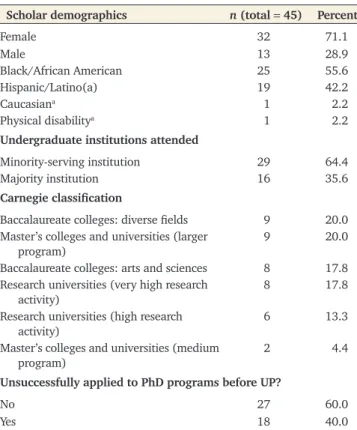
Five cohorts have completed UP to date, totaling 45 postbac-calaureate scholars. UP scholars were primarily African Ameri-can or Hispanic/Latino(a) (55.6 and 44.2%, respectively), and as has been observed for other PREPs (Gazley et al., 2014), UP scholars were predominantly female (71.1%; Table 1). We have also observed this trend for our graduate programs; our incoming class of biology and biomedical PhD students is 63%
female. While the intersection of underrepresentation exists among female scientists who are also from UR racial or ethnic groups, we did not directly study the impact of intersectionality here. The majority of UP scholars received their bachelor’s degree from minority serving institutions (64.4%), and approx-imately one-third (31.1%) attended research-intensive univer-sities (Indiana University Center for Postsecondary Research, 2015) before joining UP. Scholar selection was competitive, with ∼100 applications for 8–10 slots (Supplemental Table S1). The majority of scholars were supported by the NIH PREP grant, with an additional one or two scholars funded from other sources, including institutional funds and individual faculty research grants. We selected scholars based on a stated desire to pursue a biomedical PhD and some evidence of having pur-sued research opportunities in the past, though the majority of scholars had limited research experience before entering UP. Each applicant submitted an undergraduate transcript, per-sonal statement, and three letters of recommendation. We did not require Graduate Record Examination (GRE) scores for UP applicants. A subgroup of scholars applied to UP after being declined by UNC’s Biological and Biomedical Sciences Program (BBSP), an umbrella first-year PhD training program. Forty per-cent (18/45) of UP scholars joined the program after having unsuccessfully applied to PhD programs (Table 1).
Program Design
Summer Development Session (SDS). The UP time line and program structure is highlighted in Figure 1. The first five iter-ations of the UP 1-yr postbaccalaureate experience began each year in early June. The first 4 wk consisted of the Summer Development Session (SDS or Summer boot camp), which included five primary components: critical analysis of scientific literature, hands-on lab skills, GRE preparation, professional development workshops, and lab selection. One goal of the SDS was to build community among the cohort and between the scholars and program staff. In addition, the SDS provided accli-mation to the research institution environment and intensive skill building before the scholars began full-time research. Importantly, during the SDS, scholars met with program staff to discuss their research interests and receive guidance about lab TABLE 1. Scholar demographics and backgrounds (2010–2015)
Scholar demographics n (total = 45) Percent
Female 32 71.1
Male 13 28.9
Black/African American 25 55.6
Hispanic/Latino(a) 19 42.2
Caucasiana 1 2.2
Physical disabilitya 1 2.2
Undergraduate institutions attended
Minority-serving institution 29 64.4
Majority institution 16 35.6
Carnegie classification
Baccalaureate colleges: diverse fields 9 20.0
Master’s colleges and universities (larger program)
9 20.0
Baccalaureate colleges: arts and sciences 8 17.8
Research universities (very high research activity)
8 17.8
Research universities (high research activity)
6 13.3
Master’s colleges and universities (medium program)
2 4.4
Unsuccessfully applied to PhD programs before UP?
No 27 60.0
Yes 18 40.0
aSame scholar.
options. Scholars then met with multiple faculty members to select a research lab that matched both their scientific interests and preferences for a training environment (mentoring style, lab culture, etc.). Once scholars joined a research lab, they con-tinued to meet as a group with program staff once per week for the remaining 11 mo of the program for additional skill build-ing, including training in the responsible conduct of research, oral research presentations, preparation for the graduate school application and interview process, critical analysis, and scien-tific writing. Importantly, since the scholars were scattered in their individual research labs during the final 11 mo of the pro-gram, the group meetings provided continued contact among the cohort and between the scholars and program leaders and maintained a sense of community among the group.
Critical Analysis of Scientific Literature. When students join research labs, they are often first given a stack of research arti-cles to get “up to speed.” This experience can be daunting for early-career scientists with minimal practice reading the scien-tific literature. To strengthen their critical analysis skills and paper-reading efficiency, UP scholars participated in an inten-sive primary literature–based course during the SDS. The course began with a workshop explicitly describing strategies for effectively and efficiently reading a research article. Each week of the SDS, scholars read a review article and three research articles centered on a common theme (topics included neurophysiology of alcoholism, the microbiome, cancer and DNA repair). Faculty members or postdocs led students through in-depth discussions of each article from the big picture to spe-cific research methods used. At the end of each week, scholars completed a take-home exam consisting of questions requiring higher-order thinking such as experimental design and drawing connections between papers; the exam questions were similar to those encountered in graduate-level courses. Following the exam, students met with the course instructor to go over their answers and address any areas of weakness (including writing skills). By the end of this module, students had read in detail
∼16 articles and, as a result, expanded their knowledge of sci-entific vocabulary, approaches, techniques, and topics.
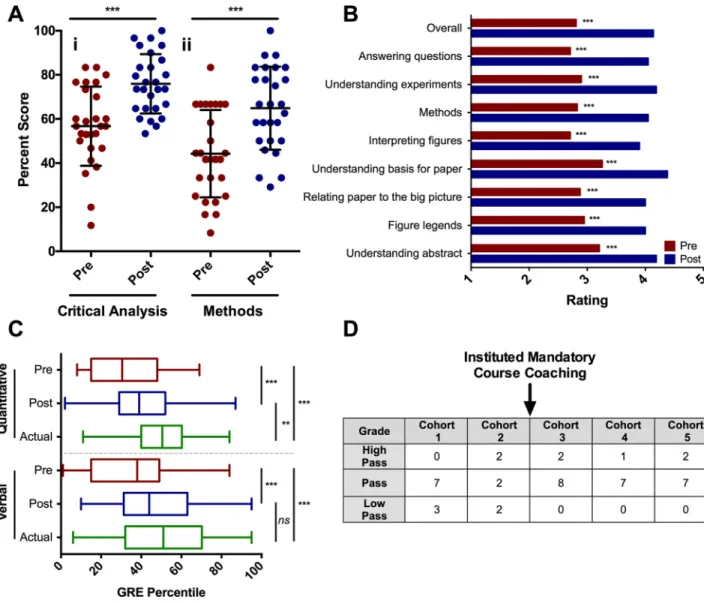
To measure scholars’ critical analysis baseline and their growth during the SDS, we assigned participants a primary research article on the first day of the SDS along with a series of questions that probed their ability to understand the rationale, experimental methods, controls, results, and conclusions. Scholars had 2 h to read the paper and complete the assess-ment. At the end of the 4-wk critical analysis module, scholars received the same paper and questions and repeated the exer-cise. We randomized and blindly graded the baseline and pos-tanalysis responses using a scoring rubric to assess growth in the ability to efficiently analyze a research article. Scores sig-nificantly improved following the critical analysis block (56.7 ±
17.9 pre vs. 75.9 ± 13.4 post, p < 0.001, n = 27; Figure 2Ai). In addition, scholars reported increased confidence in all surveyed aspects of reading and understanding the research article from the preassessment to the postassessment (Figure 2B). We con-sidered the possibility that this improvement simply reflects practice with the same paper. For this reason, we experimented with using different papers for the pre- and postassessment in the first 2 yr, but differences in the difficulty level among papers and variability in scholar background knowledge confounded
assessment of the intervention. Moreover, the assessment paper was not discussed following the baseline exercise, so the stu-dents received no feedback on how well they answered the baseline assessment questions. Between the baseline and pos-tassessment, the scholars read and discussed in-depth ∼16 arti-cles over 4 wk, so it was unlikely that they benefited signifi-cantly from remembering the paper from the first reading. The assigned article, assessment, and scoring rubric are provided in the Supplemental Material.
Scholars reported in focus groups that the SDS critical anal-ysis block improved not only their ability to analyze scientific papers but also their paper-reading efficiency:
“I think what was really helpful was the critical analysis part [of the SDS] because they trained us in my undergrad just to take classes… Take tests but not actually have discussions on papers. So I never had that experience in my undergrad and I got it here and … I see that I was missing that component.” (Focus group response)
“[We gained experience] at reading papers and then trying to actually figure out … how to read through it and see what are they asking, the key factors to look for. Okay, did they prove it? What were they saying? What happened? Did they have enough data to back up their point and how well did they do this? It also kind of taught you how to read papers quicker.” (Focus group response)
“If you’re starting out and you need to get the ball rolling on your research, you want to quickly scan papers, you don’t want to spend two hours reading through one paper. So [learning that skill] was very helpful too.” (Focus group response)
The critical analysis block contributed to increasing the sci-ence identity of scholars by increasing content knowledge through the reading of papers and, perhaps more importantly, by strengthening general paper-reading skills and efficiency.
that scholars possessed a foundation of knowledge and under-standing about the workings of the research lab and biomedical research, which gave them confidence before they joined a UP research mentor’s lab.
To determine scholar progress, on the first and last day of the lab skills course, we assessed students’ familiarity with com-mon biomedical techniques and what they are used for (e.g., immunoblots to determine protein expression, RNAi to sup-press translation). Scholars improved significantly (44.2 ± 19.8 pre vs. 64.9 ± 18.9 post, p < 0.001, n = 27) in their knowledge
of common biomedical methods and techniques and what types of questions these methods can address (Figure 2Aii). The assessment used can be found in the Supplemental Material.
“I had never done a Western blot before so when we did one during the summer, I was, like, ‘I don’t think I want to do this.’ And then I walk into [my research lab] and they’re, like, ‘We do so many Western blots.’” (Focus group response)
“What was helpful was that [program staff] usually made us go through every single step and understanding why, like what happens on the molecular level that you don’t see in the tube? So when I got into lab, then I asked the same questions, and sometimes even my mentor was stumped. He’d be, like, ‘I don’t know, actually, I’ve never thought about that.’ So that helped. To get on that sort of level where you’re, like, questioning, okay, why, and what happened and why was it designed this way?” (Focus group response)
GRE Preparation. Despite evidence that the GRE is biased against females and UR minority groups (Miller and Stassun, 2014), the GRE is still a ubiquitous requirement of the graduate school admissions process. Thus, we recognized that significant GRE preparation is a necessary component of pregraduate pre-paratory programs. During the SDS, scholars received didactic instruction on quantitative and verbal concepts and general test-taking strategies. Every session began with vocabulary “challenges”; we placed students in groups to compete against one another in games that reinforced the most commonly used GRE vocabulary words (a key component to success in the ver-bal section). At the end of each session, we assigned practice problems that utilized the skills learned in class that day. In the afternoon, scholars had dedicated time to work on GRE prob-lems individually and in groups. They submitted completed problem sets to the instructor, who used their responses to determine which problems were most challenging to students. These problems were then topics for class the next day.
UP scholars significantly improved both verbal (34.6 ± 21.3– 47.7 ± 22.8, p < 0.001, n = 42) and quantitative (31.5 ± 17.4– 41.4 ± 19.7, p < 0.001, n = 42) GRE percentile scores from the pretest taken on the first day of the SDS to the posttest taken on the final day of the SDS (Figure 2C). The pre- and posttests used were official Educational Testing Service (ETS) comput-er-based practice tests from the ETS Powerprep II software that simulates the actual GRE exam. Scholars took the official GRE within 2 mo of completing the SDS, and their official scores were significantly higher than their pretest scores (Figure 2C, p < 0.001, verbal and quantitative, n = 42). Actual GRE scores were also, on average, higher than the posttest scores (48.6 ±
24.8 percentile verbal, 49.2 ± 16.6 percentile quantitative, n =
42), but this difference was only significant for the quantitative section (Figure 2C, p < 0.01).
While GRE preparation was likely not any scholar’s favorite aspect of the SDS, students recognized that the GRE is currently an important component in graduate school admissions:
“Personally I don’t think good GRE scores will define a good scientist. But … I took the pre-test before going to the course and I took the after-test and my scores increased dramatically.” (Focus group response)
Professional Development Workshops. During the SDS, scholars also participated in workshops that addressed
addi-tional skills important to being a successful student and researcher. Topics included time management, money manage-ment, an introduction to lab culture, how to keep a lab note-book, how to interview with faculty when selecting a lab, how to succeed in the research lab, and how scholars can make the most out of their UP year. These workshops addressed important pro-fessional practices that contribute to a scholar’s science identity.
Laboratory Research. For the lab selection process, UP schol-ars met with two to three faculty within their research interest areas. All laboratory selections were made by the end of the SDS, in early July. Within the first 2 wk of the research experi-ence, program staff led an orientation session describing pro-grammatic expectations and specific expectations of scholars, faculty, and day-to-day laboratory mentors (often senior gradu-ate students or postdocs). Because the goal of UP scholars is to matriculate and succeed in PhD programs, the orientation ses-sion emphasized the importance of independent research proj-ects for UP scholars. During this session, we introduced the UP individual development plan (IDP) process (described in the following section), and previous UP mentors shared their expe-riences and advice for mentoring UP scholars.
In the first 5 yr, 34 UNC faculty participated as UP mentors, and nine out of 34 served as UP mentors in multiple years. At the end of each year, the majority of UP mentors rated their scholars’ overall research progress and growth to be “very good” or “excellent” during their PREP years (Supplemental Table S3). Overall, faculty mentors were very satisfied with the pro-gram (6.29 ± 0.94 on a seven-point satisfaction scale, n = 34; Supplemental Table S4), and 91% (31/34) of PREP mentors surveyed were “likely” or “very likely” to host another PREP scholar in the future (Supplemental Table S5). Currently, UP scholars have coauthored 24 peer-reviewed manuscripts result-ing from research done durresult-ing their 11-mo UP experiences, including two papers with UP scholars as the first author. In addition, UP scholars presented their research along with all first-year biological and biomedical PhD students in an end-of-semester poster session.
faculty advisors did, and the IDP meetings were often a confi-dence booster for the scholar:
“You got to see where you were as far as how your PI’s viewing how you’re doing, which is actually a lot better than I thought I was doing. So that was helpful for me.” (Focus group response)
“I got to see how harshly I’m grading myself relative to how my PI viewed me, which was higher than I view myself.” (Focus group response)
“I think the good thing about [the IDP] is your PI starts to get more involved in the process if they haven’t already been. So since they have to evaluate you, it kind of forces them to think, well, how good is this person doing on presentations or get-ting prepared for research? So then they want to become more involved … So I think there’s a benefit there.” (Focus group response)
In addition, alumni recounted that the IDP process during UP provided a useful and safe venue for critically assessing their progress. Alumni also reported that the type of communication that was fostered during UP IDP meetings provided a model for communicating with their PhD advisors in graduate school:
“The activity that was the most helpful in preparing me for graduate school was the IDP meetings with [program staff] and my mentor because they really allowed me to critique how I was progressing. It also allowed for a neutral and comforting platform where we could talk about my strengths and weak-nesses.” (Alumni survey, open-ended response)
“Getting to see how [IDP] meetings with [program staff] and our PREP advisor were conducted helped me to schedule and orga-nize how I now communicate and conduct meetings with my advisor. It also helped me to see the significance of ‘talking things out’ if there is some social tension or any other type of distraction going on in the lab space.” (Alumni survey, open-ended response)
The IDP process was also beneficial for the faculty advisors. Faculty mentors reported satisfaction with the level of commu-nication with the program staff, which was primarily accom-plished through the IDP process (Supplemental Table S3).
Graduate Course Performance. Graduate-level course work typically differs from undergraduate course work in both for-mat and expectations. To prepare scholars for PhD-level course work, all UP participants took a graduate-level course for credit alongside UNC biological and biomedical PhD students; National Institute of General Medical Sciences funding and institutional support provided tuition funds. Scholars chose courses based on their individual research interests and back-ground. Graduate-level courses at UNC are graded “H” (high pass, approximately top 10%), “P” (pass), “L” (low pass), and “F” (fail). In the first 2 yr, the program provided a course coach (typically a graduate student who had previously performed well in the course) if a student performed below average on the first exam. However, we found that it was often challenging to “catch a student up” once they were behind. This issue was compounded in courses in which the first assessment did not occur until halfway through the semester. Therefore, in year 3, we began assigning all scholars a course coach at the beginning
of the semester. All UP scholars met weekly in small groups with their course coaches to review notes and ask questions. On the addition of mandatory coaching, scholar course grades improved dramatically, and all scholars received at least a “P” (Figure 2D). An additional benefit of PREP scholars taking a graduate-level course is their ability to prove themselves aca-demically to a graduate admissions committee, especially for scholars with an undergraduate grade point average (GPA) or GRE scores lower than average for admitted students at their target graduate institutions. Importantly, four of the seven scholars receiving an “H” had previously been declined sion into PhD programs before UP, which indicates that admis-sions committees may have difficulty predicting the future aca-demic performance of applicants based on past acaaca-demic metrics (GRE scores and undergraduate GPA).
Scholar Confidence and Self-Efficacy
but have less confidence in their technical abilities. Therefore, we divided scientific self-efficacy into 24 competencies (listed in Figure 3). Throughout our program design, we purposefully built opportunities for scholars to gain experience, and thus confidence, in all of these areas.
To assess the impact of UP on scholar scientific self-efficacy, participants reported their confidence level for each item on the first day of the program and again, a year later, during the last week of the program. To minimize bias and encourage honest responses, an external evaluator administered and analyzed the surveys, and scholars were aware that their replies were anony-mous and would only be shared with program staff in aggregate. Scholar confidence increased significantly (p < 0.01, n = 44) for 21 of the 24 categories after completion of the UP (Figure 3). Interestingly, two of the three categories that did not show a significant increase in scholar confidence were general state-ments of science identity, “Having a successful science career” and “Being a scientist.” One explanation could be that these were two of the items scholars initially reported being most con-fident about at program outset, leaving less room for increased reported confidence (though, notably, confidence could decrease but did not in any case). The fact that scholars were initially confident in their general ability to be a scientist and have a successful career but were noticeably less confident in all of the
specific pieces that go into achieving that goal could represent a general naïveté that goes along with being an early-career trainee, or it could indicate a selection bias by our program for UP scholars that strongly demonstrate a general (though not yet refined) desire to pursue a PhD and a research career.
In exit surveys and focus group interviews, scholars con-firmed the increased self-efficacy observed from survey responses; they reported feelings of increased confidence in their ability to be a scientist:
“The skills and areas I believe that were most strengthened through my involvement with the PREP program were my pre-sentation skills, scientific writing skills, critical thinking skills and just overall having more confidence in my ability to be a successful scientist.” (Exit survey, open-ended response)
“I think for me especially, it’s shown me that I can hold my own with the big dogs.” (Focus group response)
Outcomes
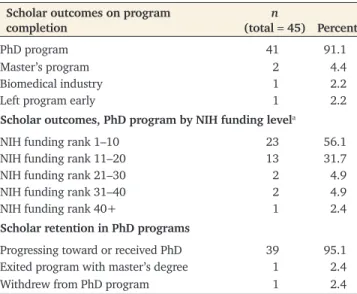
the past 5 yr, 91.1% (41/45) of UP scholars transitioned directly into biomedical PhD programs, an additional two scholars entered science master’s programs, and one went directly into an industry position (Table 2). During the first 5 yr of UP, 14/41 of the scholars who entered PhD programs joined UNC’s BBSP PhD program. While we are certainly eager to retain talented students for our own graduate programs, the goal of UP is to prepare scholars for the graduate programs that are the best fit for them professionally and personally. It is important to note that being an UP scholar is not a “rubber stamp” into UNC’s biomedical PhD programs; not all UP scholars received an offer of admission, though most were very competitive. In addition, applying to UNC for graduate school is not a requirement. UP scholars had an average of 3.4 PhD program acceptances, so typically they had multiple programs to choose from and selected the one that was the best fit for them.
The retention rate of UP scholars in PhD programs is cur-rently 95.1% (39/41). Because our program is only 5 yr old, UP scholars from the first cohort are just beginning to graduate, but thus far, nine out of 10 have either graduated or are on track to graduate within the next year (the 10th scholar initially entered a PhD program but finished with a master’s degree and works in a research position at a leading R1 institution). This result is significant, given that the national PhD completion rate for biomedical science fields averages around 63% (Council of Graduate Schools, 2008; National Research Council, 2011), which is also the average PhD completion rate for scholars from all NIH-funded PREPs, nationally (Hall et al., 2015). There are many factors that go into assessing the quality of a research institution, but for biomedical science in the United States, NIH funding is a useful proxy for the focus and intensity of biomed-ical research activity taking place at an institution. More than half (23/41) of UP scholars entered PhD programs at institu-tions that currently rank in the top 10 for NIH funding, and 87.8% (36/41) of scholars entered PhD programs at top-20 NIH-funded institutions (Table 2). Of the scholars who had been rejected from PhD programs before UP, 17/18 were
accepted into PhD programs after UP, and 16 of those scholars entered graduate programs at top-20 NIH-funded institutions. These positive outcomes highlight the potential impact of bridge programs like UP that keep talented UR trainees within the research community on paths to scientific leadership.
The benefits of UP for graduate school acceptance were often increasingly clear to scholars once they transitioned from UP into a PhD program, and this appreciation was a common theme reported by UP alumni surveyed after their first year of graduate school:
“I was told during my interviews that the main reason I was a candidate was because of my year in PREP. I have been able to take a lot of the things I learned during my time at UNC into what I do in graduate school.” (Alumni survey, open-ended response)
Benefit of Program Components
To assess the usefulness of specific programmatic components to participants, we surveyed scholars during the final week of the program and again after they completed their first year of grad-uate school. The alumni survey asked scholars to assess which interventions had persistent benefits during graduate school. On exit, scholars rated most program components as beneficial, with mean ratings for all components averaging greater than 3.5 on a five-point scale (Figure 4). In most cases, ratings of program components by alumni trended to be even higher than those for scholars just exiting the program. Responses on open-ended alumni survey items corroborate the finding that scholars considered the program even more beneficial in retrospect:
“Most of the things that I learned as a PREP student were not apparent at first. It wasn’t until I was completely immersed in graduate school that I realized the value of what we went through in the process [of] our training to become better grad-uate students.” (Alumni survey, open-ended response)
Interestingly, but perhaps not surprisingly, three of the four program components rated by scholars as most beneficial were related to interpersonal professional relationships with program staff, research mentors, and fellow UP scholars (social activi-ties). These data indicate a phenomenon we have observed that is difficult to enumerate—the importance of relationships and social support during the training process. The importance of community and support networks is often overlooked in studies or descriptions of research programs or interventions, but it is an important theme that we intentionally strive to promote within our program through team building during the SDS, weekly meetings with all scholars and program staff, and regu-lar social activities (planned and impromptu). Our results indi-cate that intentional fostering of support networks and commu-nity is a critical component of a successful research education program, which affirms the third pillar of our theoretical frame-work—the importance of feeling a sense of belonging within a scientific community. It is worth noting that UP scholars were included alongside our biological and biomedical graduate stu-dent population at social and academic events, including social activities, graduate courses, and poster sessions. In these ways, scholars also became integrated into the broader research com-munity outside of the program and their own lab.
TABLE 2. Scholar outcomes on program completion Scholar outcomes on program
completion
n
(total = 45) Percent
PhD program 41 91.1
Master’s program 2 4.4
Biomedical industry 1 2.2
Left program early 1 2.2
Scholar outcomes, PhD program by NIH funding levela
NIH funding rank 1–10 23 56.1
NIH funding rank 11–20 13 31.7
NIH funding rank 21–30 2 4.9
NIH funding rank 31–40 2 4.9
NIH funding rank 40+ 1 2.4
Scholar retention in PhD programs
Progressing toward or received PhD 39 95.1
Exited program with master’s degree 1 2.4
Withdrew from PhD program 1 2.4
aNIH Report FY (2015), Domestic Higher Education Institutions. National
The importance of interpersonal relationships with program staff and peers came up regularly during scholar focus group interviews and open-ended responses upon program exit:
“[The program staff] have your back and you want someone to have your back … at all times.… If something [goes] bad in the lab or something, they’ll just work with you to kind of solve it. So yeah, they have your back.” (Focus group response)
“Being able to talk to PREP staff on tough days in lab and interacting with other PREP students at weekly meetings reminded me that I wasn’t going through this alone.” (Exit survey, open-ended response)
Even after leaving the program, alumni recognized the importance of social activities and community building as a key component of their success during UP. Perhaps more importantly, alumni also reported seeking out similar commu-nity and support systems they encountered during UP at their graduate institutions during their PhD training, which likely is a contributing factor to their high rates of retention in gradu-ate school:
“The team-building exercises done during the summer were also very important. I feel that they were helpful in solidifying this new group of people into a team.” (Alumni survey, open-ended response)
“I almost feel that the team building and social activities were most important. Now in year 5 [of graduate school], I realize how long graduate school can be and how many challenges all graduate students can face. Unfortunately, some of the students of color at my school have encountered the types of discrimina-tion that we like to think no longer exist in science. PREP taught me the importance of fostering community, and I have taken that with me to my new school and it had made all obstacles easier to overcome.” (Alumni survey, open-ended response)
(Supplemental Table S8), indicating that the benefits of UP continued to be apparent once the scholars transitioned from UP into graduate school. Open-ended responses from the alumni survey also demonstrated this appreciation:
“None of the activities were not valuable to me. All of them helped me in preparing for grad school and even now that I am in grad school.” (Alumni survey, open-ended response)
“Every source of information and guidance in this program is extremely valuable and should not be overlooked. I have thought back on several of my experiences at UNC now that I am in graduate school and very happy that I took advantage of every single one of them.” (Alumni survey, open-ended response)
DISCUSSION
A recent study examined factors that led individual students with an interest in a biomedical PhD to choose a PREP instead of directly entering graduate school (Gazley et al., 2014). Not surprisingly, the authors found that scholars enter postbacca-laureate programs for many different reasons based on their specific goals and expectations and their general feeling of “readiness” for graduate school that goes beyond their prepara-tion. In addition, PREPs provide an important safety net to catch potential postbaccalaureate researchers who are initially declined by PhD programs. As we demonstrated here, a sizable portion of scholars in our program chose PREP as a backup plan after not being accepted into graduate school.
In our experience, PREP scholars typically fall into one of two categories: 1) students who performed well academically as undergraduates but became interested in research toward the end of their undergraduate careers and thus have minimal research experience; or 2) students with consistent research experience at their home institution and/or through summer research programs but with a history of academic performance that is below what is typically required for admission into top biomedical PhD programs. Either type of student may be per-fectly capable of success in a PhD program but is minimally competitive right out of their undergraduate studies because of a specific shortcoming in their graduate admissions application. PREP offers benefits to both types of students through providing a year of full-time research experience (especially important for the first group) combined with opportunities for scholars to prove themselves academically by performing well in gradu-ate-level course work or boosting their GRE scores (especially important for the second group). Importantly, an effective PREP must also build skills and self-efficacy in the many professional practices that go along with being a scientist besides bench work and must intentionally foster a supportive network and scien-tific community in which the scholar develops a sense of belong-ing. These things together contribute to effectively forming scholars’ science identities and increasing the likelihood they will persist in science as they advance through their training.
SUGGESTIONS FOR POSTBACCALAUREATE PROGRAMS While all PREPs and other biomedical postbaccalaureate pro-grams contain research components and a selection of profes-sional development activities, our analysis identified a few par-ticular areas that go beyond skill building that have contributed to positive scholar outcomes.
Build Community into Programming
Scientific research is a challenging and sometimes stressful pursuit. There can be challenges faced by students from UR groups in addition to those faced by their majority peers. For example, UR undergraduate researchers within diversity pro-grams indicated an enhanced need to validate their compe-tence and affirm their identity as scientists, especially in the face of external expectations or criticism from peers and fam-ily members (Hurtado et al., 2009, p. 209). “In response to external criticism and misunderstanding, it becomes clear that students must find ways to reinforce their developing science identity. For example, to counteract negative perceptions or misunderstandings about being a scientist, students turn to the support they receive from the structured research pro-grams in which they participate.” Indeed, outgoing UP schol-ars rated the program staff as the most beneficial component of the program, closely followed by the research mentoring they received, going to the Annual Biomedical Research Con-ference for Minority Students (ABRCMS), and social activities. These benefits were also recognized by scholars once they left the program, indicating that the relationships built during the program and the support they provided was instrumental to overall successful outcomes. Therefore, while it is certainly important to connect students with research experiences, efforts to foster community and a support network among peers and with program staff is critical for maximizing student outcomes. In UP, scholars are all required to start the program together in June. Besides the educational content, important benefits of the SDS are the bonds that are built within the cohort and with the program staff. On day 1 of the program, we include team-building games that rapidly build familiarity and trust among the scholars. Scholars and program staff con-tinue to work closely together daily during the first 4 wk of the program. After the SDS, once scholars scatter to their respec-tive research labs, scholars maintain connection through the weekly group meetings and regular social activities through-out the year.
Choose Program Staff with a Science Background
Most federally funded scientific diversity initiatives are led by a faculty PI and are often supported by a nonfaculty staff person who acts as a program coordinator, director, or both. In our experience, having program staff who themselves have been through scientific graduate training has been especially benefi-cial to students. Typically, with the exception of the faculty research mentors, the program coordinator/director has the most direct contact with the students, and this individual is often seen as a “safe” person to whom students can air frustrations or stresses they are facing. Moreover, program staff with a science background are able to provide not only social support but also direct assistance with reading and discussing scientific papers and feedback on research progress and research presentations:
Institutional Support
UP is intensive not only for the individual scholars but also for the staff themselves. In addition to scheduled events such as the SDS, weekly meetings, social events, IDP meetings, and so on, scholars benefit from regular unscheduled interactions with the director, coordinator, and other staff members to discuss per-sonal challenges, choices, and successes. The director and coor-dinator also devote many hours each week to evaluating UP applicants, providing individual feedback on assessments and graduate school application drafts, and preparing meeting materials. UNC faculty contribute in essential ways to the pro-gram as advisors, panel discussion participants, and mock inter-viewers in addition to their roles as laboratory mentors, but the research and teaching commitments of tenured faculty pre-clude making a major time commitment to PREP. NIH funding through the R25 provides partial salary support for program staff, but we find that providing the benefits of scientifically trained staff with the primary task of supporting UP scholars requires additional institutional financial investment. We esti-mate that replicating UP requires at least one full-time position at a competitive salary; at UNC this effort is divided between two individuals. In addition, UNC institutional funds supple-ment the R25 to cover the costs of travel and housing for on-campus interviews, a new laptop computer for each scholar, attendance at ABRCMS plus a local conference, and fall semes-ter tuition—typically at the out-of-state rate.
In conclusion, we report a model for a postbaccalaureate training program that has transitioned more than 90% of UR participants from the program into top-tier biomedical PhD pro-grams with 95% retention over the past 5 yr. The success of these first five cohorts has generated considerable enthusiasm by UNC departments, centers, and individual faculty to expand future cohorts. It is our hope that these practices will be repli-cated or adapted elsewhere to increase participation and suc-cess among UR scholars in the biomedical sciences.
ACKNOWLEDGMENTS
This work was supported by the NIGMS PREP grant R25GM089569. Special thanks to the UNC School of Medicine, the Lineberger Comprehensive Cancer Center, the UNC Office of the Vice Chancellor for Research, BBSP-participating units, UP faculty mentors, and the many senior lab members who served as day-to-day research mentors. The authors gratefully acknowledge Donita Robinson, Ashalla Freeman, and Dawayne Whittington for their help in preparing this article. Last, but not least, thanks to the talented scholars who participated in this program.
Facilitate Communication between Mentors and Scholars We have observed through our own PhD admissions process for the BBSP that the single most important component of the graduate school application is the most recent research mentor letter of recommendation. Even if other aspects of a PhD appli-cation are strong, a lukewarm letter from a research mentor can greatly hinder an applicant’s chances for admission. We found that the process of formally checking in with mentors and schol-ars at least once per semester (and at least 2 months before the PhD application deadline) via the UP IDP process was beneficial for facilitating communication between student and PI. Struc-tured research programs have the advantage of liaising with the student and PI to strengthen their communication lines, which ultimately enable students to clarify and meet expectations.
Provide Professional Development Opportunities
To become successful scientists, students must master other professional skills that are just as important as competencies at the bench. While these non–bench related professional skills are often not explicitly taught, students are still expected to become proficient in them. Officially, PREPs are 75% research and 25% “further skills development” (NIH, 2016); however, programs providing the most impact likely include relevant instruction and opportunities beyond biomedical course work and GRE preparation, such as opportunities for giving research talks and receiving feedback, poster presentations, scientific writing, interview skills, navigating the research culture, and other “soft skills” that are critical for success and science identity. We found that meeting with students weekly and focusing on developing these skills was important to their success. Not surprisingly, many of these topics were reported by scholars as being most helpful (Figure 4). Alumni indicated an increased appreciation of the benefits of these professional development activities, likely due to an increase in their recognition of the importance of these skills as they matriculated through graduate school.
Recruit Participants Declined for Admission into PhD Programs
While the availability of postbaccalaureate training programs like PREP is becoming more widely known through expanded numbers of programs and recruiting efforts, we have found that many eligible students still do not know these programs exist. Because PREPs are housed at research-intensive institutions, it is likely that these universities also have their own selective bio-medical PhD programs. Each year, we contact eligible UR appli-cants from our own graduate admissions pool who are declined admission to inform them about PREP opportunities (both our program and a link to the NIH PREP listing of all programs). Many of the students who entered our program through this mechanism were considering other career options after being initially declined from graduate programs. PREP, and other postbaccalaureate opportunities, can offer a necessary “plan B” and minimize the likelihood that talented UR scholars with an interest in biomedical research exit the scientific training path. In our experience, these scholars are extremely motivated to improve their competitiveness, and clearly they are interested in pursuing a biomedical PhD, because they already applied. Therefore, we recommend that institutions do not overlook their own PhD applicant pool when recruiting for their postbac-calaureate program.
REFERENCES
Bandura A (1997). Self-Efficacy: The Exercise of Control, New York: W.H. Freeman and Company.
Carlone HB, Johnson A (2007). Understanding the science experiences of successful women of color: science identity as an analytic lens. J Res Sci Teach 44, 1187–1218.
Chemers MM, Zurbriggen EL, Syed M, Goza BK, Bearman S (2011). The role of efficacy and identity in science career commitment among underrepre-sented minority students. J Soc Issues 67, 469–491.
Council of Graduate Schools (2008). PhD Completion Project: Program Completion and Attrition Data. www.phdcompletion.org/quantitative/ book1_quant.asp (accessed 13 January 2016).
Lent RW, Sheu H-B, Singley D, Schmidt JA, Schmidt LC, Gloster CS (2008). Lon-gitudinal relations of self-efficacy to outcome expectations, interests, and major choice goals in engineering students. J Vocat Behav 73, 328–335. Lewis BF (2003). A critique of literature on the underrepresentation of African
Americans in science: directions for future research. J Women Minor Sci Eng 9, 361–373.
Miller C, Stassun K (2014). A test that fails. Nature 510, 303–304.
National Institute of General Medical Sciences (2016). Postbaccalaureate Research Education Program (PREP) Institutions. https://publications .nigms.nih.gov/multimedia/map/prep (accessed 14 January 2016). National Institutes of Health (2016). Postbaccalaureate Research
Education Program (PREP) (R25) Program Announcement. http://grants .nih.gov/grants/guide/pa-files/PAR-14-076.html (accessed 14 January 2016).
National Research Council (2011). An Assessment of Research-Doctorate Programs: Panel on the Biomedical Sciences, ed. JF Lorden, CV Kuh, and JA Voytuk, Washington, DC: National Academies Press.
National Science Foundation (2015). Women, Minorities, and Persons with Disabilities in Science and Engineering: 2015. www.nsf.gov/statistics/ wmpd (accessed 13 January 2016).
Page SE (2008). The Difference, Princeton, NJ: Princeton University Press. Umbach PD (2006). The contribution of faculty of color to undergraduate
education. Res High Educ 47, 317–345.
U.S. Census Bureau (2012). Most Children Younger Than Age 1 Are Minorities, Census Bureau Reports. www.census.gov/newsroom/releases/archives/ population/cb12-90.html (accessed 14 January 2016).
Freeman RB, Huang W (2014). Collaborating with People Like Me: Ethnic Co-authorship within the US, NBER Working Paper No. 19905, Cambridge, MA: National Bureau of Economic Research.
Gazley JL, Remich R, Naffziger-Hirsch ME, Keller J, Campbell PB, McGee R (2014). Beyond preparation: identity, cultural capital, and readiness for graduate school in the biomedical sciences. J Res Sci Teach 51, 1021–1048. Gibbs KD Jr, McGready J, Bennett JC, Griffin K (2014). Biomedical science
Ph.D. career interest patterns by race/ethnicity and gender. PLoS One 9, e114736.
Hall A, Mann J, Bender M (2015). Analysis of Scholar Outcomes for the NIGMS Postbaccalaureate Research Education Program, Bethesda, MD: National Institute of General Medical Sciences.
Hong L, Page SE (2004). Groups of diverse problem solvers can outperform groups of high-ability problem solvers. Proc Natl Acad Sci USA 101, 16385–16389.
Hurtado S, Cabrera NL, Lin MH, Arellano L (2009). Diversifying science: un-derrepresented student experiences in structured research programs. Res High Educ 50, 189–214.
Indiana University Center for Postsecondary Research (2015). The Carnegie Classification of Institutions of Higher Education, 2015 ed. Bloomington: Indiana University School of Education. http://carnegieclassifications .iu.edu (accessed 30 December 2015).