W
HY don’t physicians follow clinical practice guidelines? This question was asked by Cabana et al.1 15 yr ago and continues to be a concern in health care today. The bar-riers to adherence to published clinical guidelines at that time were noted to be multifactorial, and numerous reports show that these barriers to adherence still exist, with poor adherence to guidelines being associated with poor patient outcomes and concerns for patient safety.2–19 Recommendations concerning methods that might help mitigate barriers include the use of checklists and decision support systems.20The 2010 American Society of Regional Anesthesia and Pain Medicine (ASRA) consensus statement on regional
What We Already Know about This Topic
• Adoption and correct application of evidence-based guide-lines are often delayed and incomplete
• In other specialties, electronic decision support tools improve adherence to practice guidelines or protocols
What This Article Tells Us That Is New
• In this multicenter, randomized trial of more than 250 resi-dents and faculty, use of an electronic decision support tool improved adherence to guidelines in a testing environment regarding regional anesthesia and anticoagulation compared with a control group who could freely access the guidelines and any other cognitive aid
Copyright © 2015, the American Society of Anesthesiologists, Inc. Wolters Kluwer Health, Inc. All Rights Reserved. Anesthesiology 2016; 124:186-98
ABSTRACT
Background: The American Society of Regional Anesthesia and Pain Medicine (ASRA) consensus statement on regional anesthesia in the patient receiving antithrombotic or thrombolytic therapy is the standard for evaluation and management of these patients. The authors hypothesized that an electronic decision support tool (eDST) would improve test performance compared with native physician behavior concerning the application of this guideline.
Methods: Anesthesiology trainees and faculty at 8 institutions participated in a prospective, randomized trial in which they com-pleted a 20-question test involving clinical scenarios related to the ASRA guidelines. The eDST group comcom-pleted the test using an iOS app programmed to contain decision logic and content of the ASRA guidelines. The control group completed the test by using any resource in addition to the app. A generalized linear mixed-effects model was used to examine the effect of the intervention. Results: After obtaining institutional review board’s approval and informed consent, 259 participants were enrolled and ran-domized (eDST = 122; control = 137). The mean score was 92.4 ± 6.6% in the eDST group and 68.0 ± 15.8% in the control group (P < 0.001). eDST use increased the odds of selecting correct answers (7.8; 95% CI, 5.7 to 10.7). Most control group participants (63%) used some cognitive aid during the test, and they scored higher than those who tested from memory alone (76 ± 15% vs. 57 ± 18%, P < 0.001). There was no difference in time to completion of the test (P = 0.15) and no effect of training level (P = 0.56).
Conclusions: eDST use improved application of the ASRA guidelines compared with the native clinician behavior in a testing environment. (Anesthesiology 2016; 124:186-98)
Submitted for publication November 13, 2014. Accepted for publication July 27, 2015. From the Departments of Anesthesiology (M.D.M., J.M.E., R.K.G., J.M.C.), Surgery (J.M.E.), Biomedical Informatics (J.M.E.), and Biostatistics (Y.S., M.S.S.), Vanderbilt University Medical Center, Nashville, Tennessee; Department of Anesthesia and Perioperative Medicine, Medical University of South Carolina, Charleston, South Caro-lina (W.R.H.); Department of Anesthesiology, University of North CaroCaro-lina at Chapel Hill, Chapel Hill, North CaroCaro-lina (M.P.S.); Department of Anesthesiology, University of Kentucky, Lexington, Kentucky (A.N.D., R.M.S.); Department of Anesthesiology, The Ohio State University, Wexner Medical Center, Columbus, Ohio (K.R.M.); Department of Anesthesiology, Perioperative and Pain Medicine, Brigham and Women’s Hospital, Harvard Medical School, Boston, Massachusetts (R.L.); Department of Anesthesia and Critical Care, University of Chicago, Chicago, Illinois (M.E.N.); and Department of Anesthesiology, Duke University Medical Center, Durham, North Carolina (E.L.M.).
A Smartphone-based Decision Support Tool Improves Test
Performance Concerning Application of the Guidelines
for Managing Regional Anesthesia in the Patient Receiving
Antithrombotic or Thrombolytic Therapy
Matthew D. McEvoy, M.D., William R. Hand, M.D., Marjorie P. Stiegler, M.D., Amy N. DiLorenzo, M.A., Jesse M. Ehrenfeld, M.D., Kenneth R. Moran, M.D.,
anesthesia in the patient receiving antithrombotic or throm-bolytic therapy (hereafter referred to as ASRA guidelines) is the standard for the assessment of patients taking antico-agulant medications who need to be evaluated for the safety of placement and management of regional or neuraxial anesthesia blocks (epidural or spinal anesthesia).21 Although these evidence-based guidelines are recognized as the stan-dard for patient management, the complete document and executive summary are more than 40 pages long. Thus, it is likely that clinicians who perform procedures for regional or neuraxial anesthesia are unfamiliar with all of the details of the ASRA guidelines and that lack of adherence to these guidelines poses a problem for patient care and safety. On the basis of the previous work concerning a different major clinical guideline, we hypothesized that a smartphone-based electronic decision support tool (eDST) would improve test performance in the application of the ASRA consen-sus guidelines; test performance is not patient care, but it is a risk-free way of assessing knowledge of the guide-line.22 Accordingly, we performed a multicenter prospective randomized trial investigating the effects of an eDST on adherence to the ASRA guidelines concerning regional and neuraxial anesthesia for patients receiving anticoagulation compared with native physician behavior.
Materials and Methods
After obtaining institutional review board’s approval (Nash-ville, Tennessee) and informed consent, anesthesiology resi-dents, fellows, and faculty at 8 university-based institutions were recruited through email to participate in a prospective, randomized trial in which they completed a 20-question multiple-choice question (MCQ) test involving clinical sce-narios related to the ASRA guidelines. The trial occurred from September to December 2013.
Knowledge Test Creation and Validation
The test creation process involved a modified Delphi technique that included anesthesiologists, educators, guideline experts, and faculty with training in medical board question writing from four participating institutions.23–25 The construct of the test was assessed for content, response process, and internal structure validity.26 The ASRA guidelines cover a range of medi-cations known to affect coagulation and also the following four principal actions performed in regional or neuraxial anesthesia:
1. Performing the regional or neuaraxial anesthetic procedure
2. Restarting a medication after the procedure
3. Removing a neuraxial/perineural catheter while an anticoagulant is being administered
4. Restarting an anticoagulant medication after neuraxial/ perineural catheter removal
In this test creation and evaluation process, each MCQ was mapped to a specific portion of the ASRA guidelines, and the questions were written such that each one tested a unique medication–action combination (validity source: represen-tative of test items to knowledge domain and quality of test questions). Four faculty not involved with the test creation took the test and reviewed the answers in comparison to the ASRA guidelines to confirm that there was one clear best answer (validity source: quality of questions). Interitem corre-lation analysis was performed. Because the grading of the quiz was objective with a single correct answer for each question agreed upon by the group of faculty that evaluated the quiz, there was no reliability assessment of grading. The test was not used for participant assessment in any pass–fail manner, but rather in assessing the effect of the eDST as measured by cor-rect responses to each question. The stems and MCQs can be reviewed in appendix 1.
Electronic Decision Support Tool Creation
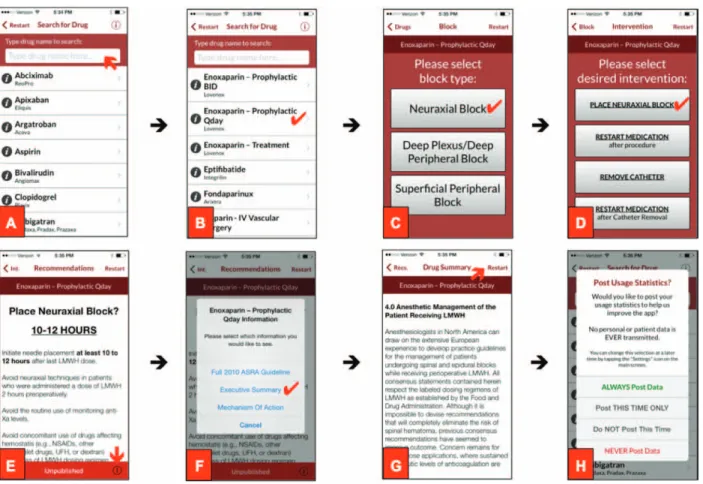
The eDST (ASRA Coags©,* ASRA, USA) used in this study was programmed on the iOS platform and presented on the Apple iPod Touch (Apple, Inc., USA). A subset of the authors (M.D.M., W.R.H., R.G., J.M.C., and R.M.S.), in consultation with executive board members from ASRA, designed the logic of the eDST directly based on the ASRA guidelines. An iOS programmer created the code and executable application (Mus-tard Seed Software, USA). Various screenshots of the eDST can be seen in figure 1. Participants had no previous exposure to or formal training on use of the eDST before this study. The eDST was presented on iPod Touch or iPhone devices used specifi-cally for this research project so that participants would not have access to the eDST before their testing session.
Study Design
Participants were randomly assigned to the eDST or control group through the use of a random number generator (see fig. 2). Demographic information was collected on partici-pants, including training level, gender, and age, along with survey data concerning clinical experience, self-reported confidence in the application of the ASRA guidelines, and smartphone use. The eDST group was allowed to complete the test using the ASRA Coags© app (copyright 2014, Vanderbilt University and the ASRA). The control group was allowed to complete the test using any resource other than the eDST (e.g., memory, internet, pocket cards). All partici-pants were given access to an online video presentation after enrollment, which included a brief overview (approximately 10 min) of the ASRA guidelines and the format of the MCQ test. The eDST group was also shown an additional 5-min overview of the use of the app. Unlimited time was allowed * The decision support tool described in this study was developed
for participant completion of the test, and time from start to completion was recorded.
Multisite compliance and logistics were regulated in the Department of Anesthesiology at Vanderbilt University. Randomization was implemented using computer-generated random numbers and was assigned in blocks of 100 to each site with 1 randomization block of 50 based on the training level of resident and 1 randomization of block of 50 for fel-lows/faculty. All participants were excused from active clinical duties and asked to silence all pagers and phones during the test. Testing of participants was accomplished within a 10-day period at each site, and all sites completed the study within a 4-month period. The programs that participated in the study were Vanderbilt University Medical Center (Nashville, Ten-nessee), Medical University of South Carolina (Charleston, South Carolina), University of Kentucky (Lexington, Ken-tucky), University of North Carolina (Chapel Hill, North
Carolina), Ohio State University (Columbus, Ohio), Harvard University/Brighman and Women’s Hospital (Boston, Massa-chusetts), University of Chicago (Chicago, Illinois), and Duke University (Durham, North Carolina). Participants were instructed to select the single best answer for each question. The answers given to each item were recorded into a REDCap database (REDCap, Vanderbilt University, USA).
Statistical Analyses
medication category (common: heparin, enoxaparin, warfarin, nonsteroidal antiinflammatory drugs and herbals; uncommon: others), and other practice characteristics. Participant demo-graphics were summarized using the sample mean, SD, quartiles, and percentages, where appropriate, and stratified by control and intervention group. For the primary analysis, generalized linear mixed-effects regression model was used to examine the effect of intervention on the rate of correct responses, adjusting for age, gender, training level, and medication category. As a secondary analysis, we further examined the interaction between medica-tion category and intervenmedica-tion and the interacmedica-tion between question number and intervention. A random intercept was used to account for correlation among responses within respon-dent. Odds ratios (95% CIs) were used to quantify the adjusted effect of intervention, and that of each covariate, on the rate of correct response. Internal consistency of the test was assessed by using Cronbach α coefficient. Finally, a post hoc analysis was per-formed evaluating the performance of those in the control group who reported the use of some form of a cognitive aid and those who reported performance from memory alone.
Because no preliminary performance data were avail-able for the study population, an a priori power analysis was not performed. The recruited sample size (eDST = 122; control = 137) provided 80% power to detect very subtle increases (~0.3 SD units) in the primary outcome, the propor-tion of correct responses attributable to the use of the eDST, assuming two-sided hypothesis testing and an α level of 0.05. All analyses were implemented using R 3.0.2 (R Foundation for Statistical Computing, Austria). Numerical values are pre-sented as mean ± SD unless otherwise noted, and a signifi-cance level of 0.05 was used for statistical inference.
Results
After obtaining institutional review board’s approval at all institutions and informed consent, a total of 259
participants were enrolled and randomized (control = 137; eDST = 122). Table 1 displays demographic information. The mean percent correct was 92.4 ± 6.6% in the eDST group and 68.0 ± 15.8% in the control group (P < 0.001, see fig. 3). The eDST group had a higher correct answer rate for all questions, and the adjusted odds of a correct answer was 7.8-fold greater in the eDST group, relative to control (95% CI, 5.7 to 10.7). Time required for test completion was not different between groups (control, 22 ± 9 min vs. eDST, 21 ± 8 min, P = 0.15). Because of an error with log-ging of the time function for some participants, 92% of participants had data available for analysis (N = 238/259; control = 122/137 and eDST = 116/122).
Table 2 shows the model-based effect estimates from the primary analysis (the effect of eDST intervention on the pro-portion of correct answers, adjusting for age, training level, and medication category). There was no evidence of train-ing level (faculty vs. residents, P = 0.56) or medication type (common vs. uncommon, P = 0.12) effects, adjusting for intervention group and other covariates. There was a signifi-cant interaction between question number and intervention (P < 0.001). However, use of the eDST was associated with greater odds of correct response for all questions, relative to control, suggesting that the effect of intervention is to con-sistently improve the rate of correct response. Specifically, the effect of intervention was greatest for question 10 (odds ratio, 69.7; 95% CI, 7.8 to 620.5) and smallest for ques-tion 3 (odds ratio, 3.08; 95% CI, 0.5 to 18.9). This effect of the eDST was also true in the subset of regional anesthesia faculty, with the percent correct answers for regional faculty being 94 ± 5% for eDST and 77 ± 13% for control (N = 13 and = 9, respectively; P < 0.001). Thus, the control regional faculty (N = 9) scored on average 10% higher than all other control participants (67%). All data sets were complete with no ambiguity in answer selection or other potential sources Fig. 2. This CONSORT diagram shows how participants
were recruited, enrolled, allocated, and then analyzed. eDST = electronic decision support tool.
Table 1. Demographics
Control
(N = 137) (N = 122)eDST
Age (yr) 36.2 (11.2) 34.7 (8.4)
Female 47 (34.3) 45 (36.9)
Level of training
Intern (PGY-1 resident) 3 (2.2) 4 (3.3) CA-1 (PGY-2 resident) 25 (18.2) 23 (18.9) CA-2 (PGY-3 resident) 29 (21.2) 22 (18.0) CA-3 (PGY-4 resident) 26 (19.0) 24 (19.7)
Fellow 2 (1.5) 5 (4.1)
Faculty 43 (31.4) 31 (25.4)
Regional Anesthesia Faculty 9 (6.6) 13 (10.7) Training
Resident 85 (62.0) 78 (63.9)
Faculty 52 (38.0) 44 (36.1)
of error apparent to the authors. Cronbach α coefficients were calculated to be 0.85 ± 0.005, indicating a good level of internal consistency for each item and the test as a whole.
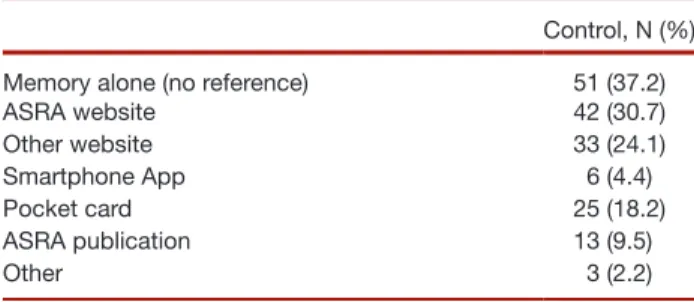
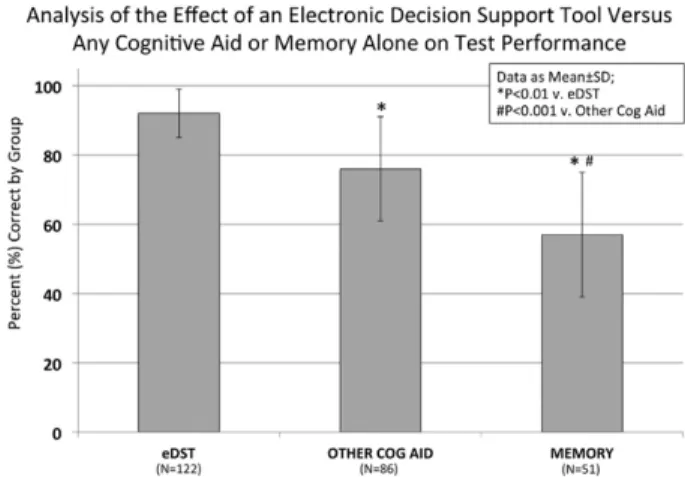
Of note, 63% of participants in the control group used some (one or more) form of a cognitive aid during the test (see table 3), with use of the ASRA website, other websites, and pocket cards being reported by 30.7, 24.1, and 18.2% of the control group, respectively. Of note, only 9.5% reported actually referencing the full ASRA consensus guideline publi-cation, and a post hoc analysis was performed to assess for any effect of the use of a cognitive aid in this group. In the control group, those reporting that they used some form of a cognitive
aid scored significantly better than those who performed from memory alone (76 ± 15% vs. 57 ± 18%, P < 0.001, respec-tively). When compared with both these groups (control + cognitive aid and control − memory alone), those in the eDST group performed significantly better (P < 0.01, see fig. 4).
In the pretest survey, the majority of respondents in both groups reported that the most frequently accessed reference that they referenced in the clinical setting being tested was a copy of the ASRA guidelines accessed through the Inter-net. Also, an overwhelming majority of participants reported feeling confident in their ability to apply the guidelines Fig. 3. This graph illustrates the effect of the electronic decision support tool (eDST) on performance compared with native be-havior for each question and overall. The eDST significantly improved overall performance and performance for each question, except for question 3 where the scoring for both eDST and control was more than 95% correct. The error bars for the overall mean show the SD for each group across the entire test. Data are shown as mean ± 95% CI.
Table 2. Effect of Covariates and Intervention on the Odds of Answering Correctly
Components Assessed in
Multivariable Model OR CI P Value
Participant age 0.99 0.97–1.01 0.144
Faculty 0.88 0.58–1.34 0.56
Uncommon medication 1.14 0.97–1.35 0.12 Intervention (eDST) 7.59 5.54–10.41 <0.001
This table displays an analysis of the recorded covariates in the general-ized linear mixed-effects regression model. For the primary analysis, gen-eralized linear mixed-effects regression was used to examine the effect of intervention on the rate of correct responses, adjusting for age, training level, and medication category, which is shown here as the average odds ratio of obtaining a correct answer when the covariate is considered as well as when the eDST was used.
eDST = electronic decision support tool; OR = odds ratio.
Table 3. Utilization of Reference Aid by Type in the Control Group (N = 137)
Control, N (%)
Memory alone (no reference) 51 (37.2)
ASRA website 42 (30.7)
Other website 33 (24.1)
Smartphone App 6 (4.4)
Pocket card 25 (18.2)
ASRA publication 13 (9.5)
Other 3 (2.2)
This table details the use of reference aids by the control group, which should depict native behavior by physicians. Of note, approximately 63% of participants in this group used some reference aid when completing the test (86/137), with some participants reporting that they used more than one cognitive aid.
concerning when to place a neuraxial block or remove a cath-eter relative to anticoagulant dosing (84 and 79%, respec-tively); and 62% of participants in the control group reported feeling confident that they could adhere to the ASRA guide-lines concerning when to restart an anticoagulant after placing or removing a catheter. See appendices 2, 3, and 4 for complete details from the survey, including confidence in guideline application, data concerning familiarity with smartphones, and the frequency with which medical software or eDSTs are used by participants in a routine practice.
Discussion
Why don’t physicians follow clinical practice guidelines? This has been asked for almost two decades, and it remains a problem today. It has been suggested that summary checklists and decision support tools (DSTs) might improve the correct application of consensus guidelines.20 Accordingly, our study addressed whether an eDST designed to present the ASRA guidelines to physicians could improve performance in the application of guidelines in a variety of clinical scenarios pre-sented as a MCQ test. Our group has recently shown that an eDST similar to the one in this study improves performance concerning the application of consensus guidelines for the preoperative cardiac evaluation of patients undergoing non-cardiac surgery.22 However, it should be noted that our previ-ous study investigated the effects of the DST compared with the effects of memory alone, whereas in this study, we allowed participants in the control group to use any resource that they would normally use when managing a patient receiving regional or neuraxial anesthesia who was also getting antico-agulation. As such, our results advance upon those previous results and demonstrate four important findings.
First, the use of an eDST greatly improved performance compared with native physician behavior. Poor adherence
to the ASRA guidelines concerning neuraxial blockade and anticoagulation has been demonstrated previously, thus highlighting the potential role for an eDST.27 The electronic, smartphone-based DST tested in this study (ASRA Coags©) improved performance, as measured by MCQ test selections consistent with the ASRA guidelines, by an absolute 24% (36% relative) compared with performance with native physician behavior. In specific, the DST provided a statisti-cally significant benefit for 19 of the 20 MCQ scenarios (see fig. 3), and this effect was equally present for common and uncommon medications (table 2). Of note, some cognitive aid was associated with better performance than memory alone, and the use of the eDST specifically tested in this study resulted in better performance than either memory alone or the use of other cognitive aids. This finding is sig-nificant because control group members were instructed to take the test using any aid or support tool that they would normally use during routine clinical practice. Thus, use of the eDST tested in this study resulted in performance supe-rior to native physician behavior with or without a cognitive aid. Because the number of anticoagulant medications rap-idly increases, our findings demonstrate a simple solution to an actual problem.28,29
Second, the effect of the eDST was not dependent on the training level. It would seem intuitive that physicians with more training and more years of practice experience would perform better than those who have yet to graduate from residency. However, we did not find any such effect across the study population. In a subgroup analysis, it was noted that control group Regional Anesthesia faculty scored 10% higher than others in the same group, but because of the sample size, this was not significant. Several previous studies have noted that clinicians at various levels of training and years of experience in practice showed no difference in perfor-mance in both crisis and noncrisis situations when managing the event from memory alone, with all groups performing poorly.23,24,30–32 These reports, along with our study, speak to the fact that some facts may be best recalled and applied with the help of a cognitive aid.33–37 Furthermore, this find-ing may highlight the particular areas of interest where the developers of guidelines and DSTs should work together to have a significant impact on healthcare delivery.20
Third, the positive effect of the eDST was generalizable across a wide range of institutions. Any time when a new DST is introduced, its efficacy and uptake will be determined by a number of factors, including the usability (design inter-face), clinician attitude toward the tool, and local culture. In addition, the general awareness of a guideline and clinician familiarity with the specific content can serve as a barrier to implementation.1,20,38 Current recommendations encour-age local modification of cognitive aids as needed to improve usability; mandating the use of such tools cannot guarantee its use or efficacy.36,39 Rather, implementation is multifactorial, and local factors have been shown to be very important.40,41 Our study did not specifically test the implementation of the Fig. 4. This graph displays an analysis of the effect of an
eDST that we describe in a clinical setting. However, because usability is one major aspect of implementation of any DST, our finding of improved test performance of guidelines across a large number of institutions is noteworthy, particularly when 63% of participants in the control group reported using some form of decision support (e.g., Internet, pocket card) during the study. That is, the control group used aids with which they were already familiar, whereas the intervention group used an aid that had just been introduced to them. Good usability of the DST is likely because of the fact that we performed an iterative design process for the user interface and decision logic during the programming of the app, seeking feedback from multiple sources, as described elsewhere.42–44
Fourth, self-reported confidence level in application of the guidelines being tested varied significantly from actual performance. Even though proper knowledge concerning the ASRA guidelines was demonstrated only 63% of the time by the control group, greater than 75% reported feeling confident in their ability to apply the guidelines concerning when to place a neuraxial block or remove a catheter relative to anticoagulant dosing (see table 2). Understanding the gap between reported familiarity with and actual application of the guidelines is important.
Taken together, these findings could have great import for future paradigms of education and practice of physicians and other healthcare providers.33,45 Much literature is emerg-ing about the need to embed a culture of safety and practice concerning checklists, DSTs, and other cognitive aids within medical education.35–37 A number of pedagogical approaches have been recently shown to improve adherence to guide-lines in a variety of settings, ranging from team training to electronic medical records with embedded DSTs.46–50 We report on the effect of a DST deployed on mobile technol-ogy, a form increasingly used by clinicians and learners.51–54 This form of active information retrieval and application in the workplace is something that our current trainees, who are digital natives, adept with these computer techniques, expect now and in future practice. Moving away from mem-orization and into information access and application is a strategy that can be ingrained in the training of clinicians and one that will possibly improve the use of guidelines.55 Future studies will need to address this question, and physi-cians will need to work with national organizations to pro-duce DSTs that can guide safe patient management, as we have done with the ASRA since the creation of this DST as an iOS application.
At this point, two particular limitations of this study should be noted. First, this study reports the effect of a DST on knowledge of guidelines in a structured testing condition rather than clinical practice. Second, the tool did not lead to perfect performance, and there was some variability in the degree of improvement in the rate of correct responses across the 20 tested scenarios (i.e., an intervention-by-scenario interaction). The latter may be because of limitations in the validity of the testing construct, or to other, more nuanced
factors. Concerning testing construct, one source of vali-dation is the fact that control group Regional Anesthesia faculty scored higher than other control group participants by 10%. There are also a variety of reasons in cognitive pro-cessing/decision-making that explain why physicians do not use decision support even when it is available. This is most common when physicians (mistakenly) believe that they recognize a clinical situation or recall a fact correctly. It is not human nature to regularly verify that which we already believe to be correct unless there has been significant training to do so, such as forced closed loop communica-tion in the airline or military industries. We suggest that what this finding really means, rather than lack of validity of the test or procedure, is that human factors engineering is an important part of decision support and that simply providing a tool with the ability to reach the correct answer is insufficient to prevent error with 100% certainty. Future research can address both of these limitations by exploring the effect of this DST in actual clinical practice or at least with in situ simulation replicating clinical encounters.
Conclusions
In summary, use of the eDST significantly improved scores on a test of knowledge of the ASRA guidelines for simulated scenarios of patients being evaluated for regional anesthesia who are taking anticoagulant medications. Because all clini-cians should attempt to practice evidence-based medicine, and because an increasing percentage of the population is taking an expanding number of anticoagulant medications, these results indicate that it may be time to embrace decision support technology for such patients undergoing neuaraxial or regional anesthesia. Future research needs to address the implementation of such tools in the clinical setting.
Acknowledgments
This study was funded by a grant from the Vanderbilt In-stitute for Clinical and Translational Research (Nashville, Tennessee). This study is from the S.A.G.E. (Study Group for Anesthesiology Graduate Education) Research Collab-orative.
Competing Interests
For completeness, Drs. McEvoy and Hand have received funding from Edwards Life Sciences (Irvine, CA) for research completely unrelated to this project. The other authors declare no competing interests.
Correspondence
References
1. Cabana MD, Rand CS, Powe NR, Wu AW, Wilson MH, Abboud PA, Rubin HR: Why don’t physicians follow clinical prac-tice guidelines? A framework for improvement. JAMA 1999; 282:1458–65
2. McEvoy MD, Field LC, Moore HE, Smalley JC, Nietert PJ, Scarbrough SH: The effect of adherence to ACLS protocols on survival of event in the setting of in-hospital cardiac arrest. Resuscitation 2014; 85:82–7
3. Alweis R, Greco M, Wasser T, Wenderoth S: An initiative to improve adherence to evidence-based guidelines in the treat-ment of URIs, sinusitis, and pharyngitis. J Community Hosp Intern Med Perspect 2014;4
4. Mearis M, Shega JW, Knoebel RW: Does adherence to National Comprehensive Cancer Network guidelines improve pain-related outcomes? An evaluation of inpatient cancer pain management at an academic medical center. J Pain Symptom Manage 2014; 48:451–8
5. Wu Y, Johnson KB, Roccaro G, Lopez J, Zheng H, Muiru A, Ufere N, Rajbhandari R, Kattan O, Chung RT: Poor adher-ence to AASLD guidelines for chronic hepatitis B manage-ment and treatmanage-ment in a large academic medical center. Am J Gastroenterol 2014; 109:867–75
6. Verduri A, Ballerin L, Simoni M, Cellini M, Vagnoni E, Roversi P, Papi A, Clini E, Fabbri LM, Potena A: Poor adherence to guidelines for long-term oxygen therapy (LTOT) in two Italian university hospitals. Intern Emerg Med 2014; 9:319–24 7. Affronti ML, Schneider SM, Herndon JE II, Schlundt S,
Friedman HS: Adherence to antiemetic guidelines in patients with malignant glioma: A quality improvement project to translate evidence into practice. Support Care Cancer 2014; 22:1897–905
8. van Blijderveen JC, Straus SM, de Ridder MA, Stricker BH, Sturkenboom MC, Verhamme KM: Adherence to renal function monitoring guidelines in patients starting antihy-pertensive therapy with diuretics and RAAS inhibitors: A ret-rospective cohort study. Drug Saf 2014; 37:369–77
9. Kumbhani DJ, Fonarow GC, Cannon CP, Hernandez AF, Peterson ED, Peacock WF, Laskey WK, Pan W, Schwamm LH, Bhatt DL; Get With the Guidelines Steering Committee and Investigators: Predictors of adherence to performance mea-sures in patients with acute myocardial infarction. Am J Med 2013; 126:74.e1–9
10. Fujii H, Iihara H, Ishihara M, Takahashi T, Yoshida K, Itoh Y: Improvement of adherence to guidelines for antiemetic medication enhances emetic control in patients with colorec-tal cancer receiving chemotherapy of moderate emetic risk. Anticancer Res 2013; 33:5549–56
11. Leighton H, Kianfar H, Serynek S, Kerwin T: Effect of an electronic ordering system on adherence to the American College of Cardiology/American Heart Association guide-lines for cardiac monitoring. Crit Pathw Cardiol 2013; 12:6–8 12. van der Veer SN, Tomson CR, Jager KJ, van Biesen W:
Bridging the gap between what is known and what we do in renal medicine: Improving implementability of the European Renal Best Practice guidelines. Nephrol Dial Transplant 2014; 29:951–7
13. Desalu OO, Onyedum CC, Adeoti AO, Gundiri LB, Fadare JO, Adekeye KA, Onyeri KD, Fawibe AE: Guideline-based COPD management in a resource-limited setting—Physicians’ understanding, adherence and barriers: A cross-sectional survey of internal and family medicine hospital-based physi-cians in Nigeria. Prim Care Respir J 2013; 22:79–85
14. Milani RV, Lavie CJ, Dornelles AC: The impact of achieving perfect care in acute coronary syndrome: The role of com-puter assisted decision support. Am Heart J 2012; 164:29–34 15. Fletcher JJ: Adherence to evidence-based clinical manage-ment guidelines: More bang for the buck. Crit Care Med 2012; 40:3331
16. Calvin JE, Shanbhag S, Avery E, Kane J, Richardson D, Powell L: Adherence to evidence-based guidelines for heart failure in physicians and their patients: Lessons from the Heart Failure Adherence Retention Trial (HART). Congest Heart Fail 2012; 18:73–8
17. Asche CV, Leader S, Plauschinat C, Raparla S, Yan M, Ye X, Young D: Adherence to current guidelines for chronic obstructive pulmonary disease (COPD) among patients treated with combination of long-acting bronchodilators or inhaled corticosteroids. Int J Chron Obstruct Pulmon Dis 2012; 7:201–9
18. Sykes PK: Prevention and management of postoperative delirium among older patients on an orthopedic surgical unit: A best practice implementation project. J Nurs Care Qual 2012; 27:146–53
19. Haut ER, Lau BD, Kraenzlin FS, Hobson DB, Kraus PS, Carolan HT, Haider AH, Holzmueller CG, Efron DT, Pronovost PJ, Streiff MB: Improved prophylaxis and decreased rates of preventable harm with the use of a mandatory computer-ized clinical decision support tool for prophylaxis for venous thromboembolism in trauma. Arch Surg 2012; 147:901–7 20. Pronovost PJ: Enhancing physicians’ use of clinical
guide-lines. JAMA 2013; 310:2501–2
21. Horlocker TT, Wedel DJ, Rowlingson JC, Enneking FK, Kopp SL, Benzon HT, Brown DL, Heit JA, Mulroy MF, Rosenquist RW, Tryba M, Yuan CS: Regional anesthesia in the patient receiving antithrombotic or thrombolytic therapy: American Society of Regional Anesthesia and Pain Medicine Evidence-Based Guidelines (Third Edition). Reg Anesth Pain Med 2010; 35:64–101
22. Hand WR, Bridges KH, Stiegler MP, Schell RM, DiLorenzo AN, Ehrenfeld JM, Nietert PJ, McEvoy MD: Effect of a cognitive aid on adherence to perioperative assessment and manage-ment guidelines for the cardiac evaluation of noncardiac sur-gical patients. ANESTHESIOLOGY 2014; 120:1339–49
23. Vigoda MM, Behrens V, Miljkovic N, Arheart KL, Lubarsky DA, Dutton RP: Perioperative cardiac evaluation of simulated patients by practicing anesthesiologists is not consistent with 2007 ACC/AHA guidelines. J Clin Anesth 2012; 24:446–55 24. Vigoda MM, Sweitzer B, Miljkovic N, Arheart KL, Messinger
S, Candiotti K, Lubarsky D: 2007 American College of Cardiology/American Heart Association (ACC/AHA) Guidelines on perioperative cardiac evaluation are usually incorrectly applied by anesthesiology residents evaluating simulated patients. Anesth Analg 2011; 112:940–9
25. Morgan PJ, Lam-McCulloch J, Herold-McIlroy J, Tarshis J: Simulation performance checklist generation using the Delphi technique. Can J Anaesth 2007; 54:992–7
26. Downing SM: Validity: On meaningful interpretation of assessment data. Med Educ 2003; 37:830–7
27. McEvoy MD, Bailey M, Taylor D, Del Schutte H Jr: Noncompliance in the inpatient administration of enoxa-parin in conjunction with epidural or spinal anesthesia. J Arthroplasty 2000; 15:604–7
28. Schulman S: New oral anticoagulant agents—General fea-tures and outcomes in subsets of patients. Thromb Haemost 2014; 111:575–82
29. Undas A, Pasierski T, Windyga J, Crowther M: Practical aspects of new oral anticoagulant use in atrial fibrillation. Pol Arch Med Wewn 2014; 124:124–35
30. Henrichs BM, Avidan MS, Murray DJ, Boulet JR, Kras J, Krause B, Snider R, Evers AS: Performance of certified reg-istered nurse anesthetists and anesthesiologists in a simula-tion-based skills assessment. Anesth Analg 2009; 108:255–62 31. Murray DJ, Boulet JR, Avidan M, Kras JF, Henrichs B,
Woodhouse J, Evers AS: Performance of residents and anesthesiologists in a simulation-based skill assessment. ANESTHESIOLOGY 2007; 107:705–13
obesity in pregnancy: A comparison of certified nurse-mid-wives and obstetrician-gynecologists. Obstet Gynecol 2014; 123(suppl 1):170S–1S
33. Lockman JL, Schwartz AJ: Learn it-memorize it! Better yet—Open your smartphone and use the information! ANESTHESIOLOGY 2014; 120:1309–10
34. Bloom BS: Taxonomy of Educational Objectives: The Classification of Educational Goals. 1st ed. New York, NY, Longmans, Green, 1956, pp 1–18, 62–89
35. Gaba DM: Perioperative cognitive aids in anesthesia: What, who, how, and why bother? Anesth Analg 2013; 117:1033–6 36. Goldhaber-Fiebert SN, Howard SK: Implementing
emer-gency manuals: Can cognitive aids help translate best prac-tices for patient care during acute events? Anesth Analg 2013; 117:1149–61
37. Marshall S: The use of cognitive aids during emergencies in anesthesia: A review of the literature. Anesth Analg 2013; 117:1162–71
38. Wachter SB, Agutter J, Syroid N, Drews F, Weinger MB, Westenskow D: The employment of an iterative design pro-cess to develop a pulmonary graphical display. J Am Med Inform Assoc 2003; 10:363–72
39. Urbach DR, Govindarajan A, Saskin R, Wilton AS, Baxter NN: Introduction of surgical safety checklists in Ontario, Canada. N Engl J Med 2014; 370:1029–38
40. de Vries EN, Prins HA, Crolla RM, den Outer AJ, van Andel G, van Helden SH, Schlack WS, van Putten MA, Gouma DJ, Dijkgraaf MG, Smorenburg SM, Boermeester MA; SURPASS Collaborative Group: Effect of a comprehensive surgical safety system on patient outcomes. N Engl J Med 2010; 363:1928–37
41. Conley DM, Singer SJ, Edmondson L, Berry WR, Gawande AA: Effective surgical safety checklist implementation. J Am Coll Surg 2011; 212:873–9
42. McCoy AB, Waitman LR, Lewis JB, Wright JA, Choma DP, Miller RA, Peterson JF: A framework for evaluating the appro-priateness of clinical decision support alerts and responses. J Am Med Inform Assoc 2012; 19:346–52
43. McCoy AB, Melton GB, Wright A, Sittig DF: Clinical deci-sion support for colon and rectal surgery: An overview. Clin Colon Rectal Surg 2013; 26:23–30
44. https://www.hf.faa.gov/HFPortalnew/Training.aspx?AspxAu toDetectCookieSupport=1#gsc.tab=0. Accessed May 2, 2014
45. Palladini G, Russo P, Milani P, Foli A, Lavatelli F, Nuvolone M, Perlini S, Merlini G: A phase II trial of cyclophospha-mide, lenalidomide and dexamethasone in previously treated patients with AL amyloidosis. Haematologica 2013; 98:433–6 46. Wayne DB, Didwania A, Feinglass J, Fudala MJ, Barsuk JH,
McGaghie WC: Simulation-based education improves quality of care during cardiac arrest team responses at an academic teaching hospital: A case-control study. Chest 2008; 133:56–61 47. Gifford W, Davies B, Tourangeau A, Lefebre N: Developing
team leadership to facilitate guideline utilization: Planning and evaluating a 3-month intervention strategy. J Nurs Manag 2011; 19:121–32
48. Dykes PC, Acevedo K, Boldrighini J, Boucher C, Frumento K, Gray P, Hall D, Smith L, Swallow A, Yarkoni A, Bakken S: Clinical practice guideline adherence before and after imple-mentation of the HEARTFELT (HEART Failure Effectiveness & Leadership Team) intervention. J Cardiovasc Nurs 2005; 20:306–14
49. Field LC, McEvoy MD, Smalley JC, Clark CA, McEvoy MB, Rieke H, Nietert PJ, Furse CM: Use of an electronic decision support tool improves management of simulated in-hospital cardiac arrest. Resuscitation 2014; 85:138–42
50. Arriaga AF, Bader AM, Wong JM, Lipsitz SR, Berry WR, Ziewacz JE, Hepner DL, Boorman DJ, Pozner CN, Smink DS, Gawande AA: Simulation-based trial of surgical-crisis check-lists. N Engl J Med 2013; 368:246–53
51. Chu LF, Erlendson MJ, Sun JS, Alva HL, Clemenson AM: Mobile computing in medical education: Opportunities and challenges. Curr Opin Anaesthesiol 2012; 25:699–718 52. Chu LF, Young CA, Zamora AK, Lowe D, Hoang DB, Pearl
RG, Macario A: Self-reported information needs of anesthe-sia residency applicants and analysis of applicant-related web sites resources at 131 United States training programs. Anesth Analg 2011; 112:430–9
53. Hardyman W, Bullock A, Brown A, Carter-Ingram S, Stacey M: Mobile technology supporting trainee doctors’ workplace learn-ing and patient care: An evaluation. BMC Med Educ 2013; 13:6 54. Ozdalga E, Ozdalga A, Ahuja N: The smartphone in medi-cine: A review of current and potential use among physicians and students. J Med Internet Res 2012; 14:e128
Appendix 1: Multiple-choice Test
Participant ID: _________
Please select the SINGLE BEST answer in line with the Ameri-can Society of Regional Anesthesia and Pain Medicine (ASRA) Management Guidelines for Neuraxial and Regional Anesthe-sia in the Patient Receiving Antithrombotic or Thrombolytic Therapy
1. A 42-yr-old otherwise healthy, white woman with uterine cancer is presenting for a total abdominal hysterectomy. You have planned to place a low-thoracic epidural for postoperative pain control. She received heparin 5,000 units subcutaneously 30 min ago, and orders are written for this dose every 12 h. She is on no other medications. How long should you wait before placement of the epidural?
A) 1 h after last dose B) 2 h after last dose C) 4 h after last dose
D) No contraindication to placing epidural
immedi-ately [C]†
2. A 68-yr-old Hispanic man is postoperative day 2 from thoracotomy for left-sided bleb resection. He has sud-den new onset of neurologic symptoms and is diagnosed with acute ischemic stroke followed by alteplase admin-istration. The pain service is contacted by the covering nurse practitioner because he thought there may be an issue with the patient’s thoracic epidural. What is the best course of action?
A) Continue current therapy
B) Discontinue epidural catheter immediately C) Recommend neurologic monitoring every 3 h D) No definitive recommendation. Check
fibrin-ogen level to help guide timing of catheter removal [U]
3. A 57-yr-old African American woman is on warfarin for atrial fibrillation and is scheduled for a colectomy for diverticulitis. Her international normalized ratio (INR) in clinic 2 weeks before scheduled surgery date is 2.9. The surgeon would like her to receive a thoracic epidural and asks about how to coun-sel her regarding her warfarin. Which of the following is the best course of action?
A) Hold for 3 days and check for normalized INR on day of surgery to ensure it is less than 1.8.
B) Hold for 5 days and check for normalized INR on
day of surgery to ensure it is less than 1.5 [C].
C) Hold for 7 days and proceed with epidural.
D) Hold night before surgery and check INR on day of surgery to ensure it is less than 1.5.
4. A thoracic epidural is placed preoperatively without com-plication for an open abdominal aorta aneurysm repair in a 72-yr-old white man. How long before systemic hepariniza-tion (intravenous unfrachepariniza-tionated heparin) can be given after placement of the epidural?
A) Minimum of 30 min B) Minimum of 1 h [C] C) Minimum of 2 h D) Minimum of 3 h
5. A 66-yr-old white man presents on the morning of surgery for a total hip arthroplasty, and you plan to place a lumbar plexus catheter. He had a drug-eluting stent placed 12 months ago. He had intolerable side effects from clopidogrel and prasugrel and has thus been receiving ticlopidine for antiplatelet therapy. How long should he be off his ticlopidine before placement of the block?
A) 3 days B) 7 days C) 14 days [U] D) 21 days
6. A 74-yr-old African American man comes to the postanesthe-sia care unit with a lumbar epidural after a large lower extrem-ity free-flap plastic surgery procedure. The plan is to leave the epidural in place for 3 to 4 days. When performing postop-erative pain rounds, you notice an order for 40 mg enoxaparin subcutaneously every 24 h. What do you do?
A) Give first dose of enoxaparin 8 h postoperatively
and second dose at least 24 h later. Epidural cath-eter can be safely maintained [C].
B) Discuss safety concern of this dosing regimen with surgical team and recommend 30 mg enoxaparin sub-cutaneously every 12 h instead.
C) Give first dose of enoxaparin 4 h postoperatively and second dose 24 h later. Epidural catheter can be safely maintained.
D) For safety reasons with this dosing regimen, remove epidural immediately and wait 12 h for enoxaparin dosing.
7. A 65-yr-old white man with coronary artery disease and his-tory of drug-eluting right coronary artery stent placement 12 months ago presents for exploratory laparotomy for colorectal carcinoma resection. He stopped his clopidogrel 6 days ago. An epidural is planned for postoperative pain control. Which of the following is the proper management?
A) Postpone the case until the patient has been off clopi-dogrel for 10 days.
B) Proceed with case as patient has been off clopidogrel for more than 5 days.
C) As patient has been off clopidogrel 5 to 7 days,
delay surgery to assess whether platelet function is normal [C].
D) Postpone the case until the patient has been off clopi-dogrel for 14 days.
8. A 78-yr-old white man with history of systolic heart failure (ejection fraction 27% on recent echocardiogram), uncon-trolled diabetes, and multiple deep vein thromboses presents for placement of intertrochanteric screw after a right hip frac-ture yesterday. He has a history of heparin-induced throm-bocytopenia after treatment for a pulmonary embolus a year ago. He was placed on argatroban for deep vein thrombosis prophylaxis last night and is presenting for surgery this morn-ing. He requests a spinal for his anesthesia. What is the guide-line recommendation concerning placement of a spinal for this patient?
A) Neuraxial technique is not recommended [U] B) Wait for 2 h after last dose
C) Wait for 12 h after last dose D) Wait for 24 h after last dose
9. A 58-yr-old white woman with known history of heparin-induced thrombocytopenia takes fondaparinux because of a concomitant diagnosis of atrial fibrillation. She had a partial pancreatectomy after appropriate cessation of anticoagula-tion in which a high thoracic epidural catheter was placed. How long after placement of the catheter is it safe to restart fondaparinux?
A) Wait for at least 2 h after placement B) Wait for at least 6 h after placement
C) Fondaparinux is not recommended for patients
with indwelling catheters [U]
D) Wait at least 24 h after placement
10. A 57-yr-old Asian man presents for bilateral total knee replacements on consecutive days. The surgeon has requested an epidural be placed and remain in place through the second surgery. Your preoperative interview reveals the patient takes ginkgo biloba and garlic supplements for pro-phylactic anticoagulation because of an aspirin allergy. He has taken these herbal supplements on the day of surgery. How long after taking these supplements can he have an epidural safely placed?
A) Wait for 2 h after taking garlic B) Wait for 6 h after taking ginkgo biloba
C) Proceed immediately as there is no significantly
increased risk of hematoma [C]
D) Wait for 4 half-lives before placing neuraxial block
11. A 23-yr-old African American woman with Factor V Leiden deficiency had a scheduled repeat cesarean section to orchestrate the timing of her anticoagulation. The case was performed under epidural because of the possibility of adhesions and extended duration. Normal coagulation was confirmed before the epidural placement. You are now in the recovery area after an uncomplicated surgical delivery, and you have just removed her epidural catheter. She has had a pulmonary embolism previously and thus is very anxious to restart her anticoagulation. How long until she may be safely dosed with prophylactic 30 mg enoxaparin subcutaneously twice daily?
A) Restart immediately as her risk of deep vein thrombo-sis and pulmonary embolism is very high
B) Wait a minimum of 4 h after catheter removal for the first dose of low-molecular-weight heparin (LMWH) C) Wait a minimum of 24 h after surgery for the first
dose of LMWH [C]
D) Wait a minimum of 6 h after surgery for the first dose of LMWH
12. A 55-yr-old African American male patient with infected total knee arthroplasty presents preoperatively for arthrotomy and hardware removal. Twelve hours ago, he required angioplasty and was started on eptifibatide until he can have definitive cardiac therapy after having his infected joint removed. The cardiologist stated that it was okay to hold the eptifibatide for surgery and that he would recommend avoiding general anes-thesia for the case to avoid hemodynamic stress on his heart. The patient is also exceedingly anxious about general anes-thesia and requests spinal anesanes-thesia. As such, the case will be performed under subarachnoid block. How long should eptifibatide be held before performing the block?
A) Wait for at least 2 h B) Wait for 4 to 8 h [U] C) Wait for 12 h
D) Subarachnoid block not recommended for patient on eptifibatide
13. A 66-yr-old white man is admitted with necrotizing pancre-atitis. The patient had a pulmonary embolism earlier in this hospitalization that has resolved. He was started on 30 mg enoxaparin subcutaneously twice daily. Pancreatic debride-ment is scheduled for tomorrow, and the anesthetic plan includes a thoracic epidural for postoperative pain control. How long should the anesthesiologist wait to place the epi-dural after the last preoperative enoxaparin dose?
A) Wait for at least 2 h B) Wait for at least 6 h
C) Wait for at least 10 to 12 h [C]
D) Neuraxial block is not recommended for patients on LMWH twice daily
14. A 71-yr-old white woman with a prosthetic aortic valve pres-ents for a left total hip arthroplasty. Anesthesia is planned with lumbar plexus catheter. Her warfarin was held for 5 days. When can you safely place lumbar plexus catheter?
A) The patient has been off warfarin long enough (5 days); proceed with block
B) Wait for at least 7 days and recheck international nor-malized ratio (INR)
C) Proceed with block if INR has normalized [C] D) Proceed with block if INR is less than 2.0
A) 1 h B) 2 h
C) 10 to 12 h [C]
D) 1 h before the next scheduled dose of enoxaparin
16. A 25-yr-old otherwise healthy Asian woman athlete sched-uled for knee reconstructive surgery desires to be awake dur-ing the procedure. Her only medication is ibuprofen and she took 800 mg orally 12 h before surgery. The most appropriate action would be:
A) Measure platelet function before any neuraxial tech-nique is performed
B) Wait for at least 3 half-lives of ibuprofen before per-forming neuraxial technique
C) Proceed and perform spinal anesthesia but do not perform epidural anesthesia
D) Proceed with spinal or epidural anesthesia [C]
17. An orthopedic surgeon wants to use prophylactic daily doses of dalteparin subcutaneously for thromboprophylaxis after a hip replacement procedure. A continuous epidural catheter is used during the procedure in a 52-yr-old Indian man and is left in place overnight for pain control. When should the epidural catheter be removed in relation to dalteparin dosing?
A) At least 2 h before the first dose [U] B) At least 2 h after the first dose C) At least 12 h after the last dose
D) At least 12 h after the last dose and after checking prothrombin time and partial thromboplastin time
18. A 76-yr-old white man with peripheral vascular dis-ease underwent femoral popliteal bypass with epidural anesthesia. The epidural was placed on the first attempt
without complication. Postoperatively, the epidural catheter was removed after an appropriate time period after the last dose of systemic heparinization. How long must you wait until intravenous heparin can be safely restarted?
A) 1 h [C] B) 2 h C) 4 h D) 12 h
19. A 48-yr-old Asian woman with colon cancer underwent col-ectomy 2 days ago. An epidural catheter that was placed pre-operatively has provided excellent pain management but was just now removed. Enoxaparin 40 mg subcutaneously once daily has been used for deep vein thrombosis prophylaxis in the postoperative period. How long should you wait after epi-dural catheter removal to restart enoxaparin?
A) May restart immediately B) Minimum of 2 h [C] C) Minimum of 4 h D) Minimum of 10 h
20. A 44-yr-old African American woman who is receiving unfractionated heparin (5,000 units subcutaneously twice daily) for deep vein thrombosis prophylaxis after total abdominal hysterectomy has a continuous epidural catheter in place and the surgeon asks that it be removed. The nurse just administered 5,000 units subcutaneously unfraction-ated heparin. How long should you wait before removing the catheter?
A) Catheter can be removed immediately [C] B) 2 h
C) 4 h D) 12 h
Appendix 2: Number of Neuraxial and Regional Blocks Performed
Control (N = 137) eDST (N = 122)
Approximately how many neuraxial blocks (epidurals and subarachnoid blocks) have you performed?
0–25 22 (16.1) 26 (21.3)
26–50 14 (10.2) 10 (8.2)
51–100 22 (16.1) 17 (13.9)
101–150 17 (12.4) 15 (12.3)
> 150 62 (45.3) 54 (44.3)
Approximately how many peripheral nerve blocks have you performed (including brachial and lumbar plexus)?
0–25 41 (29.9) 34 (27.9)
26–50 32 (23.4) 18 (14.8)
51–100 21 (15.3) 23 (18.9)
101–150 14 (10.2) 19 (15.6)
Appendix 3: Use of References and Confidence in Practice Concerning ASRA Guidelines
Control (N = 137) eDST (N = 122)
When presented with a patient on antithrombotic or thrombolytic therapy who is a potential candidate for neuraxial blockade, what reference do you utilize most frequently during preoperative evaluation to determine whether the patient is an appropriate candi-date for block?
Supervising faculty direction 28 (20.4) 25 (20.5)
ASRA guidelines accessed on the web 74 (54.0) 68 (55.7)
ASRA guidelines in hard copy 17 (12.4) 11 ( 9.0)
Personal knowledge of ASRA guidelines 18 (13.1) 18 (14.8)
How often do you refer to the ASRA guidelines for regional or neuraxial anesthesia when evaluating patients for neuraxial blockade who are receiving antithrombotic or thrombolytic therapy?
Very frequently 31 (22.6) 18 (14.8)
Frequently 45 (32.8) 33 (27.0)
Occasionally 33 (24.1) 43 (35.2)
Rarely 20 (14.6) 21 (17.2)
Never 8 ( 5.8) 7 ( 5.7)
I am confident in my ability to appropriately apply the ASRA guidelines in the patient receiving antithrombotic or thrombolytic therapy in the following conditions:
When to place a neuraxial block
Strongly disagree 5 ( 3.6) 4 (3.3)
Disagree 8 ( 5.8) 7 (5.7)
Undecided 9 ( 6.6) 16 (13.1)
Agree 72 (52.6) 70 (57.4)
Strongly agree 43 (31.4) 25 (20.5)
When to remove a catheter
Strongly disagree 2 ( 1.5) 2 ( 1.6)
Disagree 9 ( 6.6) 15 (12.3)
Undecided 18 (13.1) 21 (17.2)
Agree 75 (54.7) 65 (53.3)
Strongly agree 33 (24.1) 19 (15.6)
When to restart antithrombotic medication after placing catheter
Strongly disagree 3 ( 2.2) 1 (0.8)
Disagree 12 ( 8.8) 22 (18.0)
Undecided 37 (27.0) 34 (27.9)
Agree 65 (47.4) 55 (45.1)
Strongly agree 20 (14.6) 10 ( 8.2)
When to restart antithrombotic medication after removing catheter
Strongly disagree 3 ( 2.2) 1 (0.8)
Disagree 16 (11.7) 25 (20.5)
Undecided 33 (24.1) 30 (24.6)
Agree 62 (45.3) 55 (45.1)
Strongly agree 23 (16.8) 11 ( 9.0)
Data are represented as n (%).
ASRA = American Society of Regional Anesthesia and Pain Medicine; eDST = electronic decision support tool.
Appendix 4: Smartphone Familiarity and Frequency of Smartphone Use
Control (N = 137) eDST (N = 122)
How familiar are you with the use of a “smartphone” or “smart device”?
Never used one before 2 (1.5) 0 (0.0)
Some limited experience 9 (6.6) 7 (5.8)
Very familiar with its use 126 (92.0) 114 (94.2)
How often do you use medical software or electronic cognitive aids on a smart phone or iPod?
Never 18 (13.1) 14 (11.5)
Monthly 19 (13.9) 22 (18.0)
Weekly 40 (29.2) 35 (28.7)
Daily or almost daily 60 (43.8) 51 (41.8)