Diastereoselective synthesis of vicinal tertiary and
N
-substituted quaternary stereogenic centers by
catalytic hydroalkylation of dienes
†
Matthew J. Goldfogel and Simon J. Meek*
An efficient and diastereoselective (CDC)–Rh-catalyzed hydroalkylation of dienes with 1,3-oxazol-5(4H )-ones is reported. Aryl and alkyl substituted dienes are converted to a,a-substituted oxazolones (24 examples) by the formation ofN-substituted quaternary carbon stereogenic centers in good yields (up to 96%) and with high diastereoselectivity (>20 : 1 dr). The reaction is tolerant of a range of dienes and oxazolones bearing various functional groups. Utility of the oxazolone products is illustrated through hydrolysis to form a,b-substituted a-amino acid analogues and stereoselective epoxidation of the resultant alkene to create four contiguous stereocenters.
Introduction
The catalytic hydroalkylation of alkenes is a valuable, atom-economical approach for the synthesis of C–C bonds from readily available starting materials.1Pioneering studies have led to the development of intermolecular processes that employ styrenes,2unactivated alkenes,3allenes,4and alkynes5as eff ec-tive substrates that can react with appropriate C-based nucleo-philes. Despite recent advances in alkene hydroalkylation, intramolecular6 examples predominate and most trans-formations utilize nucleophiles that are malonate derived or trade atom-economy for reactivity.7While this reaction is oen applied to the transformation of alkenes, the intermolecular hydroalkylation of dienes remains relatively unexplored. The hydroalkylation of diene substrates is synthetically useful; such reactions convert readily available unsaturated hydrocarbons into versatile allyl-containing building blocks. Only a limited number of catalytic intermolecular hydroalkylations of dienes have been reported, with none able to effectively promote the diastereoselective addition of C-based nucleophiles to terminal dienes such as3.
Catalytic intermolecular diene hydroalkylation was rst accomplished with a Pd catalyst by Takahashi.8Subsequent Pd catalyzed hydroalkylations have introduced a variety of enoliz-able nucleophiles.9 These reactions selectively generate linear products via 1,4-addition with modest to excellent site-selec-tivity. The reactions work well with 2,3-substituted dienes but
for 1,4-substituted dienes reactions are limited to methyl-substituted or cyclic substrates (e.g., cyclohexadiene).8
We postulated that the catalyst controlledg-selective addi-tion of a prochiral enol nucleophile to 1-substituted diene would enable C(sp3)–C(sp3) formation and generate vicinal strereogenic centers. Enantioselective Michael additions of 1,3-oxazol-5(4H)-ones to activated C–C p bonds10 has been demonstrated (aldehydes,11 ketones,12 amides,13 allenoates14), however, despite these notable advances, additions to unac-tivated alkenes or dienes substrates have not been reported. In this report, we describe a catalytic addition of substituted 1,3-oxazol-5(4H)-ones to 1-substituted dienes that is site- and dia-stereoselective (Scheme 1).15
We have previously developed carbodicarbene (CDC) Rh complexes for the catalytic hydroamination16 and hydro-arylation17of dienes under mild conditions in the presence of various polar functional groups.18The reported carbodicarbene (CDC)-supported Rh catalyst 1 exhibits secondary activation through the reversible interaction of Lewis acids and the CDC
Scheme 1 Diastereoselective (CDC)–Rh(I) catalyzed hydroalkylation
of dienes with 1,3-oxazol-5(4H)-ones. Department of Chemistry, University of North Carolina at Chapel Hill, Chapel Hill, NC
27599-3290, USA. E-mail: [email protected]; Web: http://www.chem.unc.edu/people/ faculty/meek/
†Electronic supplementary information (ESI) available. See DOI: 10.1039/c5sc04908c
Cite this:Chem. Sci., 2016,7, 4079
Received 4th January 2016 Accepted 4th March 2016
DOI: 10.1039/c5sc04908c
www.rsc.org/chemicalscience
Science
EDGE ARTICLE
Open Access Article. Published on 11 March 2016. Downloaded on 8/13/2019 2:50:46 PM.
This article is licensed under a
Creative Commons Attribution 3.0 Unported Licence.
ligand,19which modulates electron donation to the Rh center (i.e., increasing the electrophilicity of the catalyst).17 This reversible activation lessens inhibition by the nucleophile. We sought to extend the use of this catalyst to the formation of C(sp3)–C(sp3) carbon bonds and the diastereoselective
genera-tion of two contiguous stereogenic centers.
Herein, we present the rst diastereoselective catalytic addition of oxazolones to 1-substituted dienes. The reactions generatea,a-disubstituted allylic amino acid products in up to 96% yield and >20 : 1 dr. Products contain two contiguous stereocenters, including an N-substituted quaternary carbon. The transformation is catalyzed by 5 mol% of the (CDC)–Rh catalyst in the presence of 5 mol% lithium salt at 50 C and affords theanti-addition products.
Results and discussion
We began our studies for an efficient catalytic hydroalkylation of dienes by the reaction of oxazolone2with phenylbutadiene3 in the presence of 5 mol% (CDC)–Rh complex 1and 5 mol% LiPF6activator in toluene at 50C (Table 1, entry 1). We were
encouraged to observe the formation of4in 17% yield and 10 : 1 dr (anti/syn). A brief survey of solvents provided slightly higher yields (up to 21%), but reduced diastereoselectivities (<6 : 1 dr) in all cases (see ESI†). As such, toluene was used for further optimization. A variety of Lewis acid activators were screened (entries 2–4, Table 1) and demonstrated that lithium salts were most effective; 5 mol% of AgCl and LiBF4 resulted <10%
conversion to 4most likely the due to poor solubility of the metal salt in toluene. Weaker coordinating counter anions lead to dramatically improved reactivity as shown by LiBArF
4, which
furnishes 4 in 51% yield with 18 : 1 dr. Further increase in reaction efficiency can be achieved through the use of alcohol co-solvents (entries 5–8). While addition of i-PrOH led to no improvement in the LiBArF
4promoted reaction (50% yield, 11 : 1
dr, entry 5), treatment of3and4with 5 mol% (CDC)–Rh and 5 mol% LiPF6in toluene/i-PrOH 40 : 1 at 50C proved optimal,
delivering 4 in 85% yield and 19 : 1 dr (entry 6). Screening various alcohol co-solvents results in both decreased conversion and selectivity (entries 7 and 8); MeOH andt-BuOH afforded4 in 26% yield (3 : 1 dr), and 29% yield (5 : 1 dr), respectively. It should be noted that MeOH as a co-solvent leads to competitive oxazolone decompositionviaring-opening. The conditions re-ported in entry 6 were identied as optimal and employed in further reaction development, although LiBArF4was found to be
optimal for certain substrates (vide infra). Additional control reactions run without LiPF6(entry 9), or with 2.5 mol% [Rh(cod)
Cl]2and 5 mol NaBArF4in place of (CDC)–Rh1(entry 10) result in
no reaction, highlighting the importance of cationic (CDC)–Rh complex1, in combination with a Lewis acid co-catalyst, for reactivity.
Determining the role of the alcohol and its inuence on reaction efficiency and diastereoselectivity cannot necessarily be decoupled, however, a number of observations can be made: (1) the lithium salt is required for the reaction to occur. (2) Considering the difference in reaction efficiency between LiPF6
and LiBArF4 without i-PrOH, the alcohol is likely assisting in
solubilizing the lithium salt. (3) Addition of i-PrOH changes the product diastereoselectivity, either suggesting hydrogen bonding of the alcohol with the nucleophile or alcohol solvation of the lithium salt. In the case of LiPF6dr increases where as for
LiBArF4 the selectivity decreases. (4) Additional roles, such as
formation of Brønsted acid, are disfavored by reactions run in the presence of 2,6-ditert-butyl pyridine, which show no dele-terious effects (see ESI†for details). (5) Use of chiral alcohols and diols do not result in an enantioselective reaction (see ESI† for details).
With optimized conditions in hand, we sought to explore the diene scope of the hydroalkylation with oxazolone2. For certain diene substrates LiBArF4proved to be the more effective lithium
salt in order to obtain good yields and selectivities. As shown in Table 2, formation of the N-substituted quaternary carbon occurs readily with modest to excellent levels of selectivity with aryl (5–13) and alkyl dienes (14–16). Electronic modications to the aryl ring were well tolerated by the reaction. Aryl rings bearing halogens or electron withdrawing groups react with only slight decreases to yield and diastereoselectivity;p-Cl-,p -F-andp-NO2-phenylbutadienes react to give5in 67% yield (19 : 1
dr), 6 in 70% yield (6 : 1 dr), and 7 in 48% yield (8 : 1 dr), respectively. Electron-rich arenes are also compatible, but result in reduced anti/syn diastereoselectivity; p -MeO-phenyl-butadiene reacts to form8in 58% yield and 4 : 1 dr. Phenyl-butadiene containing alkyl substitution at theortho-,meta- and
para-positions of the aryl ring are excellent substrates providing 9in 59% yield (>20 : 1 dr),10in 66% yield (>20 : 1 dr), and11in 89% yield (6 : 1 dr). The high selectivity in the formation of9 and10demonstrates the inuence of sterics and its translation to increased diastereoselectivity in C–C bond formation with Table 1 Survey of conditions for diastereo selective (CDC)–
Rh-catalyzed hydroalkylation 1,3-diene 3 with 1,3-oxazol-5(4H)-one2a
Entry Activator; mol% Alcoholb Yieldc(%); drd
1 LiPF6; 5 — 17; 10 : 1
2 AgCl; 5 — 0;—
3 LiBF4; 5 — 8; 4 : 1
4 LiBArF4; 5 — 51; 18 : 1
5 LiBArF4; 5 i-PrOH 50; 11 : 1
6 LiPF6; 5 i-PrOH 85; 19 : 1
7 LiPF6; 5 MeOH 26; 3 : 1
8 LiPF6; 5 t-BuOH 29; 5 : 1
9 — i-PrOH 0;—
10e LiPF
6; 5 i-PrOH 0;—
aSee ESI for experimental details; all reactions performed under N
2
atm. bA solvent ratio of 40 : 1 toluene/alcohol used. cYields of puried products are an average of two runs.dValues determined by analysis of 400 or 600 MHz1H NMR spectra of unpuried mixtures with hexamethyldisiloxane as an internal standard. eReaction run with 2.5 mol% [Rh(cod)Cl]2and 5 mol% NaBArF4as catalyst.
Open Access Article. Published on 11 March 2016. Downloaded on 8/13/2019 2:50:46 PM.
This article is licensed under a
only slight decreases in yield. Dienes bearing oxygen heterocy-cles participate in the hydroalkylation reaction with12formed in 91% and in 9 : 1 dr; however, pyridyl groups appear to inhibit catalyst1as13does not form under the same reaction condi-tions.20 Alkyl-substituted dienes are effective substrates and react with oxazolone2 to produce alkenyl products 14–16 in good yields and selectivities (Table 2). We anticipated that the decreased size of the alkyl chain, compared to an aryl ring, would result in diminished diastereoselectivity, however, the opposite was observed; 14 was formed in high diaster-eoselectivity (12 : 1 dr) in 66% yield. The increaseda-branching in cyclohexylbutadiene results in lower reactivity and diaster-eoselectivity, providing15 in 43% yield but in 3 : 1 dr. Addi-tionally, the mild reaction conditions are tolerant of silyl ether functionality; for example homoallyl TBS ether16is delivered in 68% yield and 4 : 1 dr without silyl ether deprotection or elim-ination to form the conjugated diene. For some substrates lower conversions can be observed due to competitive ring-opening of the oxzalone by i-PrOH, however, yields can oen be improved by increasing the equivalents of the nucleophile.
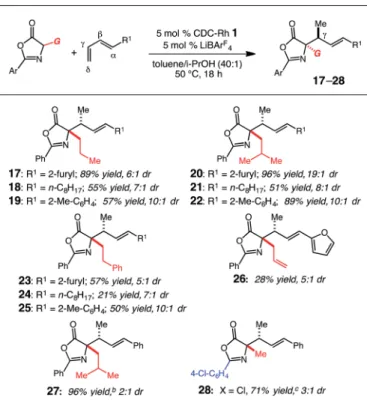
We next examined the scope of the oxazolone nucleophiles tolerated by (CDC)–Rh catalyst 1. To explore the interplay between the identity of the oxazolone substituent and diene, oxazolones were reacted with representative dienes bearing heterocyclic, alkyl and aryl motifs to afford 17–28 (Table 3). Extension from methyl- to n-propyl-substituted oxazolones (17–19) resulted in high conversions, similar to those obtained with2, but with lower selectivity compared to9,12and14;17
was produced in 89% yield with 6 : 1 dr,18was synthesized in 55% yield with 7 : 1 dr, and19was formed in 57% yield with 10 : 1 dr. The lower selectivity may be a consequence of increased sterics on thea-substituent inuencing the orienta-tion of the nucleophile as it approaches the activated diene. Reactions with sec-butyl-substituted oxazolone demonstrate thatb-branched alkyl substituents work effectively as20–22are formed in good to high yields with varying selectivity; 20 is formed in 96% yield with 19 : 1 dr, while21is synthesized in 51% yield with 8 : 1 dr and22in 89% yield with 10 : 1 dr. To further demonstrate that increased substitution on the oxazo-lone is viable, phenethyl-oxazooxazo-lone was reacted to give23–25;23 was formed in 57% yield with 5 : 1 dr,24in 21% yield with 7 : 1 dr and25in 50% yield with 10 : 1 dr. The (CDC)–Rh catalyst is compatible with alkenes as evidenced by the successful formation of26in 28% yield with 5 : 1 dr. The reduction in yield is from competitive isomerization of the allyl group to the internal alkene, which is not a competent nucleophile. Furthermore, formation of27(2 : 1 dr) demonstrates the subtle effect that the sterics of the diene play in obtaining a selective reaction (cf.,22, generated in 20 : 1 dr). We were able to modify the aryl substituent of the oxazolone, as demonstrated by the formation of28;p-Cl-phenyl-oxazolone reacted to provide28 in 71% yield and 3 : 1 dr, however, the site-selectivity of the reaction decreased to give a 11 : 1 mixture of g,d- and a,d -regioisomers.
Table 2 (CDC)–Rh(I)-catalyzed hydroalkylation of substituted dienesa
aSee ESI for experimental details. b5 mol% of LiPF
6. c5 mol% of
LiBArF4. All reactions performed under N2 atm. Yields of puried
products are an average of two runs.
Table 3 Oxazolone scope for (CDC)–Rh(I)-catalyzed hydroalkylationa
aSee ESI for experimental details. All reactions performed under N
2
atm. Yields of puried products are an average of two runs.bFormed as a 20 : 1 mixture of thea- andg-regioisomers.cFormed as a 1 : 11 mixture ofa- andg-regioisomer.
Open Access Article. Published on 11 March 2016. Downloaded on 8/13/2019 2:50:46 PM.
This article is licensed under a
The substituted oxazolone products generated through the catalytic stereoselective hydroalkylation protocol can be readily transformed to other useful molecules (Scheme 2). Firstly, ring-opening of allyl-substituted oxazolone 4 with MeOH and K2CO3 at 22C delivers methyl esters 29in 87%
yield; synthesis of29 conrmed the antidiastereoisomer as the major product by comparison to previously reported data.15dTwo additionala,a-disubstituted products,20and21,
were converted to their corresponding methyl esters30and31 in 99% and 84% yield, respectively. Second, conversion of the oxazolone moiety to benzoyl-protected amino acids can be accomplished by acid hydrolysis; the conversion of24to 32 with dilute HCl in 87% yield is representative. Finally, the vicinal tertiary allylic, and N-substituted quaternary stereo-centers can be used to impart stereocontrol in further alkene functionalizations. In this regard,18(9 : 1 dr) was successively hydrolyzed to the methyl ester and subjected to m-CPBA epoxidation to form epoxide33 in 58% yield over two steps with complete stereocontrol.21The resulting product contains four contiguous stereocenters and a versatile epoxide ring, which could be opened stereoselectively to introduce a variety of nucleophiles.22
According to our data, a possible catalytic cycle for the re-ported hydroalkylation is depicted in Scheme 3. While the specic role of the lithium salt is not yet determined, previous studies indicate that secondary binding to the CDC carbon (e.g., II) decreases electron density at the Rh center, resulting in decreasedp-back donation,17and thus facilitating nucleophile addition (II/III).23Product formation and regeneration ofI could occur by two possible pathways: (a) direct Rh–alkyl protonation; (b) proton transfer to Rh and subsequent reductive elimination.24
Conclusions
In summary, we have demonstrated the rst diastereo- and siteselective hydroalkylation of 1-substituted 1,3-dienes with oxazolone nucleophiles promoted by a cationic (CDC)-Rh catalyst. The use of a catalytic lithium salt activator, and alcohol serve to provide optimal reactivity and good diaster-eoselectivity under mild conditions for a range of dienes with oxazolone nucleophiles. The resulting products contain two contiguous stereocenters and an N-substituted quaternary center, which can be deprotected to generate useful amino acid analogues, or exploited to impart acyclic stereocontrol in alkene epoxidation. Related studies are in progress to expand the scope of carbon-based nucleophiles and alkene electro-philes in hydroalkylation processes as well as development of enantioselective variants.
Acknowledgements
Financial support was provided by the University of North Carolina at Chapel Hill, the Petroleum Research Fund of the American Chemical Society (52447-DNI1). We are grateful to C. Roberts (UNC) for her contributions to the synthesis of (CDC)–Rh complex1.
Notes and references
1 J. F. Hartwig,Science, 2002,297(5587), 1653.
2 (a) X. Yao and C.-J. Li, J. Org. Chem., 2005, 70, 5752; (b) M. Rueping, B. Nachtsheim and A. Kuenkel, Synlett, 2007, 1391; (c) G.-W. Wang, Y.-B. Shen, X.-L. Wu and L. Wang,
Tetrahedron Lett., 2008,49, 5090.
3 (a) X. Wang and R. A. Widenhoefer,Chem. Commun., 2004, 660; (b) M. E. Cucciolito, A. D'Amora and A. Vitagliano,
Organometallics, 2010, 29, 5878; (c) Z. Wang, B. J. Reinus and G. Dong,J. Am. Chem. Soc., 2012,134, 13954; (d) F. Mo and G. Dong,Science, 2014,345, 64.
4 (a) B. M. Trost, C. J¨akel and B. Plietker, J. Am. Chem. Soc., 2003, 125, 4438–4439; (b) B. M. Trost, A. B. C. Simas, B. Plietker, C. J¨akel and J. Xie, Chem.–Eur. J., 2005, 11, 7075–7082; (c) B. M. Trost, J. Xie and J. D. Sieber, J. Am. Chem. Soc., 2011,133, 20611–20622.
5 (a) W.-B. Liu, H.-F. Jiang and C.-L. Qiao,Tetrahedron, 2009, 65, 2110; (b) M. R. Uehling, A. M. Suess and G. Lalic,J. Am. Chem. Soc., 2015,137, 1424; (c) A. M. Suess, M. R. Uehling, Scheme 2 a-Allyl oxazol-5(4H)-one functionalizations.aDetermined
by analysis of 600 MHz1H NMR spectra of unpurified mixture.
Scheme 3 Proposed catalytic cycle.
Open Access Article. Published on 11 March 2016. Downloaded on 8/13/2019 2:50:46 PM.
This article is licensed under a
W. Kaminsky and G. Lalic,J. Am. Chem. Soc., 2015,137, 7747. For related intramolecular examples, see: (d) B. K. Corkey and F. D. Toste, J. Am. Chem. Soc., 2007, 129, 2764; (e) E. C. Minnihan, S. L. Colletti, F. D. Toste and H. C. Shen,J. Org. Chem., 2007, 72, 6287; (f) J.-F. Brazeau, S. Zhang, I. Colomer, B. K. Corkey and F. D. Toste,J. Am. Chem. Soc., 2012, 134, 2742; (g) Z. Wang, B. J. Reinus and G. Dong,
Chem. Commun., 2014,50, 5230.
6 (a) W. Fang, M. Presset, A. Gu´erinot, C. Bour, S. Bezzenine-Lafoll´ee and V. Gandon,Org. Chem. Front., 2014,1, 608; (b) Y.-P. Xiao, X.-Y. Liu and C.-M. Che,Angew. Chem., Int. Ed., 2011, 50, 4937; (c) C. Liu, C. F. Bender, X. Han and R. A. Widenhoefer, Chem. Commun., 2007, 3607; (d) C. Liu and R. A. Widenhoefer, Tetrahedron Lett., 2005, 46, 285; (e) H. Qian and R. A. Widenhoefer,J. Am. Chem. Soc., 2003, 125, 2056; (f) H. Qian, T. Pei and R. A. Widenhoefer, Organometallics, 2004, 24, 287; (g) D. Yang, J.-H. Li, Q. Gao and Y.-L. Yan,Org. Lett., 2003, 5, 2869; (h) T. Pei and R. A. Widenhoefer, Chem. Commun., 2002, 650; (i) X. Han, X. Wang, T. Pei and R. A. Widenhoefer, Chem.–Eur. J., 2004, 10, 6333; (j) J.-H. Li, Q.-M. Zhu, Y. Liang and D. Yang,J. Org. Chem., 2005, 70, 5347; (k) A. Boutier, C. Kammerer-Pentier, N. Krause, G. Prestat and G. Poli,Chem.–Eur. J., 2012,18, 3840; (l) R. Goddard, G. Hopp, P. W. Jolly, C. Kr¨uger, R. Mynott and C. Wirtz,J. Organomet. Chem., 1995,486, 163; (m) Y.-M. Wang, N. C. Bruno, ´A. L. Placeres, S. Zhu and S. L. Buchwald, J. Am. Chem. Soc., 2015, 137, 10524.
7 (a) T. Iwasaki, R. Shimizu, R. Imanishi, H. Kuniyasu and N. Kambe, Angew. Chem., Int. Ed., 2015, 54, 9347; (b) K. B. Urkalan and M. S. Sigman, J. Am. Chem. Soc., 2009, 131, 18042; (c) R. J. DeLua and M. S. Sigman,J. Am. Chem. Soc., 2011,133, 11454; (d) X. Lin and F.-L. Qing,Org. Lett., 2013, 15, 4478; (e) R. J. DeLuca and M. S. Sigman, Org. Lett., 2013,15(1), 92.
8 K. Takahashi, A. Miyake and G. Hata,Bull. Chem. Soc. Jpn., 1972,45, 1183.
9 (a) P. W. Jolly and N. Kokel,Synthesis, 1990,1990, 771; (b) A. Leitner, J. Larsen, C. Steffens and J. F. Hartwig,J. Org. Chem., 2004, 69, 7552; (c) B. M. Trost and L. Zhi,
Tetrahedron Lett., 1992,33, 1831–1834.
10 R. A. Mosey, J. S. Fisk, T. L. Friebe and J. J. Tepe,Org. Lett., 2008,10, 825.
11 Y. Hayashi, K. Obi, Y. Ohta, D. Okamura and H. Ishikawa,
Chem.–Asian J., 2009,4(2), 246.
12 (a) E. P. ´Avila, A. C. de Mello, R. Diniz and G. W. Amarante,
Eur. J. Org. Chem., 2013,2013, 1881; (b) J. Zhang, X. Liu, C. Wu, P. Zhang, J. Chen and R. Wang, Eur. J. Org. Chem., 2014, 2014, 7104; (c) S.-Y. Zhang, G.-Y. Ruan, Z.-C. Geng, N.-K. Li, M. Lv, Y. Wang and X.-W. Wang,
Org. Biomol. Chem., 2015, 13, 5698; (d) M. Weber, S. Jautze, W. Frey and R. Peters,Chem.–Eur. J., 2012,18, 14792.
13 For recent examples of related 1,6-Michael addition, see: (a) D. Uraguchi, K. Yoshioka, Y. Ueki and T. Ooi,J. Am. Chem. Soc., 2012, 134, 19370; (b) H. Hu, Y. Liu, J. Guo, L. Lin,
Y. Xu, X. Liu and X. Feng,Chem. Commun., 2015,51, 3835; (c) G. Li, W. Sun, J. Li, F. Jia, L. Hong and R. Wang,Chem. Commun., 2015,51, 11280.
14 M. Kalek and G. C. Fu, J. Am. Chem. Soc., 2015, 137, 9438.
15 Allyl substituted oxazolones can also be accessedvia metal-catalyzed allylic alkylations, however, products bear different substitution patterns to those obtain by the reported method. For examples, see: (a) B. M. Trost, C. Heinemann, X. Ariza and S. Weigand,J. Am. Chem. Soc., 1999,121, 8667–8668; (b) B. M. Trost and X. Ariza, J. Am. Chem. Soc., 1999, 121, 10727–10737; (c) M. Kawatsura, H. Tsuji, K. Uchida and T. Itoh, Tetrahedron, 2011, 67, 7686–7691; (d) M. Kawatsura, D. Ikeda, T. Ishii, Y. Komatsu and J. Uenishi,Synlett, 2006, 2435.
16 M. J. Goldfogel, C. C. Roberts and S. J. Meek,J. Am. Chem. Soc., 2014,136, 6227.
17 C. C. Roberts, D. M. Mat´ıas, M. J. Goldfogel and S. J. Meek,
J. Am. Chem. Soc., 2015,137, 6488.
18 For additional examples of CDC ligands used in catalysis, see: (a) Y.-C. Hsu, J.-S. Shen, B.-C. Lin, W.-C. Chen, Y.-T. Chan, W.-M. Ching, G. P. A. Yap, C.-P. Hsu and T.-G. Ong,Angew. Chem., Int. Ed., 2015, 54, 2420–2424; (b) C. Pranckevicius, L. Fan and D. W. Stephan, J. Am. Chem. Soc., 2015, 137(16), 5582–5589; (c) W.-C. Chen, J.-S. Shen, T. Jurca, C.-J. Peng, Y.-H. Lin, Y.-P. Wang, W.-C. Shih, G. P. A. Yap and T.-G. Ong, Angew. Chem., Int. Ed., 2015, 54, 15207–15212.
19 (a) C. A. Dyker, V. Lavallo, B. Donnadieu and G. Bertrand,
Angew. Chem., Int. Ed., 2008,47, 3206; (b) G. Frenking and R. Tonner, in Contemporary Carbene Chemistry, ed. R. A. Moss and M. P. Doyle, John Wiley & Sons, Inc, 2013, pp. 216–236.
20 Catalytic hydroalkylation of 3 in the presence of 10 mol% 2,6-di-tertbutylpyridine afford 4 in 86% conv., and >20 : 1 dr. This indicates that Lewis basic N-heteroarenes do not inhibit hydroalkylation due to their Bronsted basicity, but rather by binding to the (CDC)–Rh catalyst.
21 For a review of substrate-directed epoxidations, see: (a) A. H. Hoveyda, D. A. Evans and G. C. Fu,Chem. Rev., 1993, 93, 1307. For specic examples of amide directed epoxidations, see: (b) L. Goodman, S. Winstein and R. Boschan, J. Am. Chem. Soc., 1958,80(16), 4312–4317; (c) P. Kocovsky and I. Stary,J. Org. Chem., 1990,55(10), 3236– 3243; (d) P. O'Brien, A. C. Childs, G. J. Ensor, C. L. Hill, J. P. Kirby, M. J. Dearden, S. J. Oxenford and C. M. Rosser,
Org. Lett., 2003,5(26), 4955–4957.
22 For recent examples of stereospecic ring-opening of internal epoxides with carbon nucleophiles, see: (a) E. M. Valent´ın, M. Mulero and J. A. Prieto, Tetrahedron Lett., 2012, 53, 2199–2201; (b) N. Terayama, E. Yasui, M. Mizukami, M. Miyashita and S. Nagumo, Org. Lett., 2014, 16, 2794–2797; (c) K. B. Raju, B. N. Kumar, B. S. Kumar and K. Nagaiah, Helv. Chim. Acta, 2015,98, 386–399; (d) Z. A. Kasun, X. Gao, R. M. Lipinski and M. J. Krische, J. Am. Chem. Soc., 2015, 137, 8900–8903. For recent examples of stereospecic ring-opening of
Open Access Article. Published on 11 March 2016. Downloaded on 8/13/2019 2:50:46 PM.
This article is licensed under a
internal epoxides with nitrogen nucleophiles, see: (e) H. C. Kim and S. H. Kang,Angew. Chem., Int. Ed., 2009, 48, 1827–1829; (f) N. Kavitha, V. P. Kumar and S. Chandrasekhar, Tetrahedron Lett., 2013, 54, 2128– 2130.
23 (a) O. Eisenstein and R. Hoffmann,J. Am. Chem. Soc., 1980, 102, 6148–6149; (b) O. Eisenstein and R. Hoffmann,J. Am. Chem. Soc., 1981,103, 4308–4320.
24 For a DFT study regarding cleavage of Rh–alkyl bond in hydroamination, see: H. M. Senn, P. E. Bl¨ochl and A. Togni,J. Am. Chem. Soc., 2000,122, 4098–4107.
Open Access Article. Published on 11 March 2016. Downloaded on 8/13/2019 2:50:46 PM.
This article is licensed under a