Clustering Network Topology Control Method Based on
Responsibility Transmission
Zhihua Li1,2, Pengfei Li1,2, Xi Yin1, Kexiang Cui2
1
Key Laboratory of Advanced Process Control for Light Industry Ministry of Education, School of IoT Engineering, Jiangnan University, Wuxi, China
2
Engineering Research Center of IoT Technology Application Ministry of Education, Wuxi, China Email: [email protected]
Received June 19, 2012; revised August 1, 2012; accepted August 9,2012
ABSTRACT
The topology control is an effective approach which can improve the quality of wireless sensor network at all sides. Through studying the mechanism of sensor network data transmission, the nature of data transmission in wireless sensor network is concluded as a kind of responsibility transmission. By redefining the responsibility and availability of nodes, the strategy for cluster head selection is studied, the responsibility and availability is determined by the combination of the residual energy, location and current flow of nodes. Based on the above, new clustering network topology control algorithm based on responsibility transmission CNTCABRT and hierarchical multi-hop CNTCABRT is presented in this paper, whose algorithm structure is along the famous LEACH algorithm. Experimental result demonstrates its promising performance over the famous LEACH algorithm in the cluster head selection, the size of cluster, the deploy- ment of nodes and the lifetime of nodes, and several innovative conclusions are proposed finally.
Keywords: Wireless Sensor Network; Cluster-Based Topology Control; Accumulated Evidence; Responsibility Transmission; CNTCABRT Method
1. Introduction
Wireless sensor networking had become the most chal-lenging topic in the IT field at present. Network topology architecture control is not only the premise and basis for studying high-efficiency node deployment and routing protocol design, but also the basic assurance to compre-hensively save node energy and improve network per-formance [1-4]. Therefore, studies of the topology archi-tecture control strategy and algorithm with low energy consumption, low network delay, and high reliability serve as the groundwork for wireless sensor networking.
Based on an analysis of the operation mechanism, ad- vantages, and disadvantages of the LEACH algorithm [4-6] and its strategy for cluster head selection, we pro- posed the Clustering Network Topology Control Al- gorithm Based on Responsibility Transmission (CN- TCABRT) in this study. The proposed algorithm con- siders many network factors, such as the distance be- tween node and cluster head, residual energy of node, and data traffic of nodes, during cluster head selection, thus overcoming the shortages of the LEACH algorithm. Performances of the CNTCABRT algorithm were inves-tigated in terms of deployment of cluster head, quality of cluster head, size of cluster, energy consumption of node,
lifetime of nodes. This study increases the family mem- bers of network topology control algorithm based on clus- ter.
2. Related Work
selecting the cluster head, thereby easily causing uneven distribution of cluster heads, uneven node energy con- sumption, and unreasonable topology structure. Studies have shown that the LEACH-centralized algorithm [2] offsets the shortages associated with random cluster head selection and insufficient consideration of the amount and location of cluster heads with every round of itera- tion, thus improving the quality of produced clusters. However, meaningless energy consumption, and conse- quently cluster expenditure, is increased by the periodical reporting of energy, location, and other information of each node to the base station and the transmission of un- related information. A previous study used Data Aggre- gation-Exact and Approximate [3] first clustering for cluster head selection of the whole network, after which the pool of cluster heads was used for determining second- level cluster heads. Data was transmitted to the base sta-tion through the second-level cluster head. This algo- rithm is difficult to implement and increases time delay of data transmission among nodes.
3. Methodology
In general, the CNTCABRT algorithm follows the same clustering principle as the LEACH algorithm. Studies on the mechanism of wireless sensor network data transmis- sion have revealed that sensor network data transmission improves with responsibility transmission. Thus, we pro- posed an algorithm that selects the cluster head through the strategy of accumulating evidence with responsibility. Briefly, the algorithm periodically divides the whole sensor network into several clusters, with each cycle re- ferred to as a round. Each round involves cluster forma- tion and data transmission. The algorithm exhibited good performance in controlling cluster head selection, cluster deployment, and cluster size.
3.1. New Understanding of the Mechanism of Sensor Network Data Transmission
From the data perspective, information is generally con- cealed by abundant multi-sensor source data in the wire- less sensor network. There is a certain “cause-and-effect” relationship between information and multi-sensor source data reflected by the “transmission” during information flow, such as data transmission from common nodes to boundary cluster head, data retransmission from boun- dary cluster head to base station, and so on. In this pro- cess, the self-adaptive selection of the boundary cluster head can be considered as the effect, since only those with strong availability can be selected as the boundary cluster head. Here, it is possible to regard such “avail-ability” as the responsibility of nodes to the network. Based on this idea, data transmission in a sensor network
can be understood as a growth process of “responsibility” expressed by the continuous selection of cluster head by nodes. This process can be compared likened to a data structure tree, where nodes with poor responsibility and availability during the growth process are eliminated, leading to the untimely end of cluster heads and nodes that were not selected for data forwarding. Therefore, the nature of data transmission in a sensor network is a kind of “responsibility transmission”, where responsibility and availability are influenced by node energy, transmission delay, distances between nodes, and other factors in the sensor network.
3.2. Strategy for Cluster Head Selection
In this section, we study the strategy for cluster head se- lection based on the transmission mechanism above and the Affinity Propagation Clustering APC from literature [7]. We aimed to redefine the responsibility and avai- lability of nodes that were transmitted with comprehend- sive consideration of the residual energy of node, node distance, energy consumption based on transmission dis- tance, energy consumption based on data quantity, and other network factors. The maximum sum of responsibi- lity and availability was taken as the accumulated evi- dence of cluster head selection.
Suppose that all nodes form a set
1 2 3
X x , x , x , , x , xi n , where n is the total amount of nodes.
Definition 1. ar (i,j) represents the appropriate rate between node i and j, which indicate the degree of node j
appropriate for the cluster head of node i.
2 2
current _ current
,
,
i j i j
j_ j
x x y y
ar i j i j
E F
ar i j p i j
(1)
where
x yi, i
is the coordinate of node i;
x yj, j
isthe coordinate of node j; j_current is the current residual energy of node j (energy consumption in the energy loss model is influenced by transmission distance); j_ current is the estimate value of node flow, which is a constant in the LEACH algorithm; is the reference degree equi- valent to the mid-value of matrix formed by
E
p
F
,ar i j ;
and ar i j
, is the degree of attraction of node j to nodei, that is, the probability of node j serves as the cluster head of node i.
Definition 2. Node can be taken as the responsibility (r) evidence and availability (a) evidence of the cluster head and are redefined as follows:
, , max , ,
1, 2, , ,
r i k ar i k a i k ar i k
k n k k
, min 0, , 0, ,
1, 2, , ,
i
a i k r k k r i k
i i i i k
(3)where is the responsibility between node i and k. If k is viewed as the potential cluster head node, then responsibility is transmitted from node i to node k and is equivalent to the accumulated evidence for node k to be the cluster head of node i. is the availability between node i and k transmitted from node k to node i, as the Equation (1). It reflects the accumulated evidence for node i to select node k as the cluster head. Thus, it measures whether k can finally become the true cluster head after several rounds of self-adaptation.
,r i k
,a i k
Formulas (2) and (3) iterate according to Formulas (4) and (5):
new old
, 1 ( , ) ,
r i k r i k r i k (4)
new old
, 1 , ,
a i k a i k a i k
(5)where
0,1 is the learning rate in updating r i k
, and a i k
, .Responsibility and availability transmit among nodes in actual network until all node energy is consumed. In addition, the value of continuously changes after each round of data transmission. A high value indicates stronger evidence and greater possibility for node k to become the cluster head; otherwise, node k cannot be selected as the cluster head. Therefore, for each round of circulation of the algorithm, select the k with the maximum value of
, ,r i k a i k
, ,r i k a i k
, ,a i k r i k . If , i is the cluster head; if , then k is the cluster head of i.
ik ik
3.3. CNTCABRT Method
The CNTCABRT algorithm is an application of the wire- less communication energy transmission loss model [8]. Energies consumed for transmitting every bit data to the preset distance is as the follow:
2
elec 0
4
elec amp 0
, _ elec _ amp ,
TX
fs
E l d ETX l ETX l d
lE l d d d
lE l d d d
(6)where L is the preset distance; ETX and RX are ener-
gies consumed for sending and receiving data, respec- tively;
E
fs
and mp are the energy consumption of the
signal amplifier; and 0 is the critical distance between Friss free space propagation model and multipath at-
d
tenuation model (d0 Efs Emp ). Shorter distance from
all nodes within the cluster to the cluster head indicates lower energy consumption for communication within the cluster. According to the strategy of cluster head selec-
tion (Section 2.2), the probability that a node becomes selected as cluster head depends on three node character- istics: energy, flow, and transmission distance. Therefore, the algorithm will select a node with greater residual en- ergy and less transmission flow as the cluster head. Our findings led to the construction of the following algo-rithm:
Algorithm 1: Basic CNTCABRT
Step 1. One hundred sensor nodes are produced ran-domly. The initial energy of the initial node is 0, the maximum circulation round is , and iterations of evidence updating is IterMax;
E
max r
Step 2. While (irmax)
Step 3. The appropriate rate is computed according to Equation (1). Set parameter P and learning rate
,ar i j
and initialize r i j
, and a i j
, ;IterIter Step 4. While (current iterations Max)
Step 4.1. Update evidence matrix r i j
,
,jwith Equa-tions (2) and (3). Update matrix with Equations (4) and (5);
a i
Step 4.2. Current iterations IterIter 1
Step 5. Obtain node k with max
a i k
, r i k,
for every node i. If ik, then i is the cluster head. If ik, then k is the cluster head of i. The network enters into a stable data transmission stage after successful cluster establishment.Step 6. Current circulation round i i 1
The proposed algorithm may produce few nodes with- in the cluster, or even clusters with a single node. This problem can be corrected by combining these small or singular clusters with each other or with neighbor clus- ters.
Compared with the LEACH algorithm, the basic CNTCABRT algorithm utilizes the same time comple- xity but has increased time consumption for computing responsibility evidence. In addition, space complexity variation in the proposed algorithm mainly comes from the storage of accumulated evidence during cluster head selection. However, the strategy of cluster head selection follows the idea of overall optimization of APC algo- rithm. Therefore, the CNTCABRT algorithm can con- tribute to the optimization and control of network topo- logy architecture. From this perspective, our proposed algorithm is better than the LEACH algorithm.
3.4. Hierarchical Multi-Hop CNTCABRT
CABRT method with the same energy loss model as the basic CNTCABRT algorithm.
Algorithm 2: Hierarchical Multi-Hop CNTCABRT Step 1. One hundred sensor nodes were produced randomly. The initial energy of the initial node is 0, the maximum circulation round is , and iterations of evidence updating is IterMax;
E max
r
Step 2. While (i rmax)
Step 3. The appropriate rate is computed ac- cording to Equation (1). Set parameter P and learning rate
,ar i j
and initialize r i j
, and ; IterMax a i
,jStep 4. While Iter )
Step 4.1. Update evidence matrix with Equa- tions (2) and (3), and update matrix with Equa- tions (4) and (5);
( , )
r i j
,a i j
Step 4.2. Current iterations IterIter 1
Step 5.1. Obtain node k with max
a i k
, r i k,
head
c
for every node i. If , then i is the cluster head. If , then k is the cluster head. Forming the first layer of cluster head set:
thusly;
ik
head ,
ik
head1 2 i l
Step 5.2. Compute for evidence matrix , head , ,
,r i j and
of the boundary cluster head in set c using Equ- ations (2) and (3) and Equations (4) and (5) respectively. Obtain k with
,a i j
max a i k, r i k,
, head , head
and form the sec-ond layer of cluster head set:1 2 i l
Step 5.3. Enter stable data transmission stage, that is, node transmits data to the first layer of cluster head c and
c retransmits data to boundary cluster head C, which re- transmits data to the base station.
head , head , C
Step 6. i i 1
Obviously, the core idea of the hierarchical multi-hop CNTCABRT algorithm is to further form layers for the cluster head based on the basic CNTCABRT algorithm. This will enable optimization of the boundary cluster heads from the first layer of cluster head through data retransmission to the base station according to the stra- tegy of cluster head selection (Section 3.2). The hierar- chical multi-hop CNTCABRT algorithm is advantageous because it incorporates the advantages of the basic CN- TCABRT algorithm and is appropriate for application in large-scale wireless sensor networks as well.
4. Simulation and Result Analysis
We performed a programming simulation under mat- labR2009 environment in order to verify the efficiency of the basic and the hierarchical multi-hop CNTCABRT algorithms. Experimental parameters were set as follows: initial energy of sensor node 0 ; random de- ployment of 100 sensor nodes within the target regions of
; the base station was located in the center of the region ; set
0.3 J
E
100 m 100 m
50, 50
ETX ERX 50nJ bit; datapacket was 2000-bit long and control package was 32-bit
long; 2
100 pJ b m fs
, 4
0.0013 pJ b m mp
; en-
ergy consumption for data fusion was 5 nJ bit signal
and data fusion rate was 0.6; the number of circulation rounds was 1000; and the probability for a node to be- come cluster head in the LEACH algorithm was 0.05. The reference degree p of the CNTCABRT algorithm was equivalent to the middle value of the matrix formed by ar i j
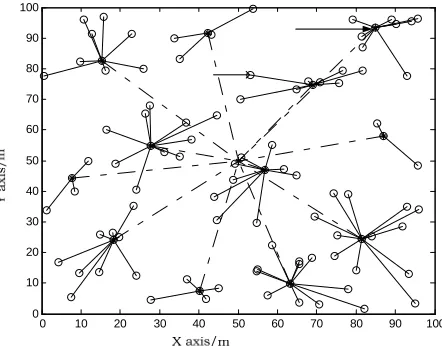
, . Learning rate was 0.9.Comparisons of the basic CNTCABRT algorithm and the LEACH algorithm performance in clustering and cluster head selection are shown in Figures 1 and 2, re- spectively. In these figures, “o” represents common nodes, “*” represents the cluster head, a dotted line con- nects cluster head and nodes within the cluster, and a straight line connects cluster head and base station. Using the basic CNTCABRT algorithm for clustering, the se- lected cluster heads had a relatively reasonable distribu- tion within a cluster of moderate size, since distances between nodes, residual energy, flow size, and other net-
0 10 20 30 40 50 60 70 80 90 100
[image:4.595.312.533.340.513.2]0 10 20 30 40 50 60 70 80 90 100
Figure 1. Distribution of clusters with CNTCABRT.
0 10 20 30 40 50 60 70 80 90 100
[image:4.595.314.532.539.716.2]0 10 20 30 40 50 60 70 80 90 100
work factors were taken into consideration during selec- tion. In contrast, the LEACH algorithm exhibited a high degree of randomness in cluster head distribution and formed large clusters, thereby easily causing high energy consumption of local nodes.
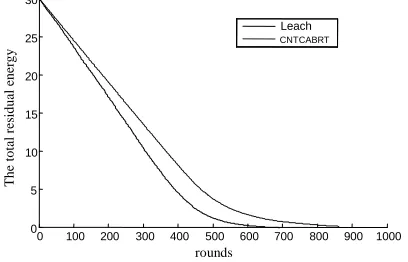
We compared the energy consumption of basic CNT- CABRT algorithm and LEACH algorithm (Figure 3). With greater number of iterations, the total energy con- sumption of both LEACH algorithm and basic CNT- CABRT algorithm increased. However, the energy con- sumption of basic CNTCABRT algorithm decreased more slowly than that of the LEACH algorithm. The greater energy consumption in the LEACH algorithm can be attributed to uneven cluster head distribution, large cluster size, and abundant data for forwarding from clus- ter head. On the other hand, the basic CNTCABRT algo- rithm consumed well-distributed energy in the network due to the more optimized cluster head selection and de- ployment, which is beneficial for energy saving and slowing the rate of increase of energy consumption to a certain extent.
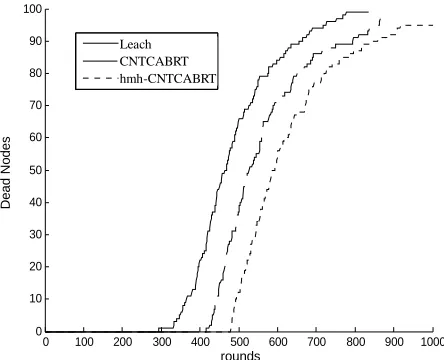
[image:5.595.71.275.389.520.2]The comparison of basic CNTCABRT algorithm and LEACH algorithm in terms of node survival is shown in
Figure 4. The basic CNTCABRT algorithm is able to
0 100 200 300 400 500 600 700 800 900 1000 0
5 10 15 20 25 30
Leach
CNTCABRT
rounds
T
h
e total
re
si
dual ener
[image:5.595.59.280.556.711.2]gy
Figure 3. The relationship between the energy consumption and the iteration round.
0 100 200 300 400 500 600 700 800 900 1000 0
10 20 30 40 50 60 70 80 90 100
进 行 轮 数
节点
死亡数目
Leach CNTCABRT
De
ad node
s
rounds
Figure 4. The relationship between the death numbers of nodes with the iteration rounds.
[image:5.595.314.533.562.718.2]optimize cluster head deployment because it considers factors such as residual energy of nodes and distance between nodes in order to balance their energy consump- tion. Therefore, the first node of the basic CNTCABRT algorithm died later than that of the LEACH algorithm (at the 410thvs the 280th round, respectively). Further- more, the last node death in the basic CNTCABRT algo- rithm occurred far later than that in the LEACH algo- rithm, indicating that the CNTCABRT algorithm is able to prolong network lifetime. The untimely end of nodes in the LEACH algorithm can be attributed to unreason- able cluster head deployment and uneven cluster size. In addition, with respect to the oversized clusters (Figure 2), cluster heads would have to retransmit abundant data groups, thus consuming relatively more energy and easily causing untimely end of nodes.
Figure 5 displays the results of clustering and cluster head selection using the hierarchical multi-hop CNTC- ABRT algorithm.
We compared the total energy consumption of the hie- rarchical multi-hop and basic CNTCABRT algorithms, as well as the LEACH algorithm (Figure 6). The basic CNTCABRT algorithm and LEACH algorithm apply single-hop communication for data transmission and their nodes consumed great amounts of energy due to the long distance between nodes. In contrast, the hierarchical multi-hop CNTCABRT algorithm applies multi-hops for data forwarding and applies the optimized strategy (Sec- tion 2.2) in selecting the second layer of cluster heads. Experimental results revealed that the hierarchical multi- hop CNTCABRT algorithm can save energy excellently and can slowly decrease the energy consumption curve. A comparison of the three algorithms in terms of node death is shown in Figure 7. The first node death in the hierarchical multi-hop CNTCABRT algorithm occurred at the 465th round, thus significantly lagging behind the two other algorithms. Furthermore, the time interval be- tween the first and the last node deaths was significantly
0 10 20 30 40 50 60 70 80 90 100
0 10 20 30 40 50 60 70 80 90 100
0 100 200 300 400 500 600 700 800 900 1000 0
5 10 15 20 25 30
进 行 轮 数
剩
余能量
Leach CNTCABRT hmb- CNTCABRT
The
to
ta
l re
si
dua
l e
n
er
gy
rounds
[image:6.595.59.283.83.257.2]Leach CNTCABRT hmh-CNTCABRT
Figure 6. The relationship between the residual energy and the iteration rounds.
0 100 200 300 400 500 600 700 800 900 1000
0 10 20 30 40 50 60 70 80 90 100
进行轮数
节点死亡数
目
Leach CNTCABRT hmb- CNTCABRT
De
ad
No
d
e
s
rounds
Leach CNTCABRT hmh-CNTCABRT
Figure 7. The relationship between the death numbers of nodes with the iteration rounds.
longer than that of the two other algorithms. Findings indicate that the hierarchical multi-hop CNTCABRT algorithm can save network energy while achieving good performance in prolonging node survival time. The death rate of nodes was slowed distinctively.
5. Conclusions
In this study, we investigated the mechanism of sensor network data forwarding and redefined the responsibility and availability appropriate for sensor network data transmission. In addition, we developed a strategy of cluster head selection that takes many network factors such as residual energy of node, data transmission dis- tance, and flow into consideration in order to optimize the deployment and selection of cluster heads. We pro- posed the basic CNTCABRT algorithm and the hierar- chical multi-hop CNTCABRT algorithm. Simulation re-
sults strongly proved the good performance of these al- gorithms. Further analyses led to the following innova- tive conclusions:
(1) The application of responsibility and availability to sensor network data transmission ensures the optimiza- tion of cluster head selection and optimization of net- work topology architecture control, thus performing double adjustment.
(2) The deployment and transition of cluster heads can increase the energy consumption of the network. Opti- mization of cluster head deployment can significantly reduce energy consumption and prolong network life- time.
(3) Since cluster head deployment can influence energy consumption, clusters should be appropriately sized.
However, the basic and hierarchical multi-hop CNT- CABRT algorithms take more time for clustering com- putation compared with the LEACH algorithm. Thus, future studies can further improve the proposed algo-rithms. Furthermore, possible application of the CNT- CABRT algorithm in large-scale wireless sensor net- works should be studied and a feasible routing protocol according to the topology control method of CNTC- ABRT should be studied.
6. Acknowledgements
This work is supported by the Fundamental Research Funds for the Central Universities (grant No. JUSRP- 211A41) and the National Science Foundation of China (grant No. 60704047).
REFERENCES
[1] L.-M. Sun, J.-Z. Li and Y. Chen, “Wireless Sensor Net-works,” Tsinghua University Press, Beijing, 2005.
[2] C. F. Wan and S. F. Du, “A Hierarchical Topology Gen-eration Algorithm for Wireless Sensor Networks,” Chi-nese Journal of Sensors and Actuators, Vol. 23, No. 3, 2010, pp. 441-446.
[3] J. N. Al-Karaki, R. Ul-Mustafa and A. E. Kamak, “Data Aggregation in Wireless Sensor Networks—Exact and Approximate Algorithms,” Proceedings of the IEEE Work- shop on High Performance Switching and Routing, Phoe-nix, 2004, pp. 241-245.
[4] V. Katiyar, N. Chand, G. C. Gautam and A. Kumar, “Im-provement in Leach Protocol for Large-Scale Wireless Sensor Network,” 2011, pp. 1070-1073.
[5] D. M. Yan, J. K. Wang, L. Liu, B. Wang and P. Xu, “Topology Control Algorithm Based on Overlapping Clustering,” 2010, pp. 737-741.
[image:6.595.62.284.297.477.2][7] B. J. Frey and D. Dueck, “Clustering by Passing Mes-sages between Data Points,” Science, Vol. 3, No. 15, 2007, pp. 972-976. doi:10.1126/science.1136800
[8] Z. Liu and Z.-D. Qiu, “Ring Based Multi-Hop Clustering