ENVIRONMENTAL, OCCUPATIONAL, AND MEDICAL EXPOSURES ASSOCIATED WITH METHICILLIN RESISTANT STAPHYLOCOCCUS AUREUS NASAL CARRIAGE IN
PATIENTS ADMITTED TO AN EASTERN NORTH CAROLINA HOSPITAL
Leah Hope Schinasi
A dissertation submitted to the faculty of the University of North Carolina at Chapel Hill in partial fulfillment of the requirements for the degree of Doctor of Philosophy in the Department
of Epidemiology.
Chapel Hill 2012
ii
ABSTRACT
LEAH HOPE SCHINASI: Environmental, occupational, and medical exposures associated with methicillin resistant Staphylococcus aureus nasal carriage in patients admitted to an
eastern North Carolina hospital (Under the direction of Steve Wing)
Methicillin resistant Staphylococcus aureus (MRSA) is a versatile human pathogen. Originally acquired in medical settings, strains later emerged in the community and, most recently, within the context of industrial livestock production. Epidemiologic research on sources of MRSA acquisition and transmission is important for designing effective infection prevention measures. The objective of this work was to investigate medical, household, environmental, and occupational exposures associated with MRSA nasal carriage identified at admission among patients at a rural tertiary care hospital.
I conducted a hospital based case control study at Vidant Medical Center (VMC), the largest hospital in eastern North Carolina, which is a region with intensive livestock
iii
iv
ACKNOWLEDGEMENTS
I have many people to thank for their contributions and support. Amy Ising, the program manager at the NC Disease Event Tracking and Epidemiologic Tool, first connected me, via Bill Cleave, with Keith Ramsey from Vidant Medical Center’s (VMC) Division of Infection Control, and thus put the forces in motion for me to conduct this research at VMC. I am grateful to Keith Ramsey for supporting my research at VMC. Also, the staff in VMC’s Division of Infection Control provided essential project support and assistance. In particular, Delores Nobles helped design the participant recruitment protocol; Kerri Augustino
conducted the laboratory work and provided critical input regarding interpretation of molecular results; and Darlene King provided daily administrative assistance. I am also grateful to Meghan Davis, Amy Peterson, Ellen Silbergeld, and Christopher Heaney for their recommendations during the preliminary planning and designing of this study. In addition, I am grateful to Devon Hall, Dothula Baron, Jennifer Hall, Clifton Smith, Norma Mejia, and Amy Lowman for their advice when I designed the structured interview questions.
My father, Michael Schinasi, assisted with the translation of the interview materials. He and my mother, Meryl Besterman, provided support as I completed the doctoral program. They also provided me with room and board and much needed extra support while I
v
thoughtful and creative input throughout all stages of my dissertation work. Jessica Rinksy provided thoughtful input on the presentation and interpretation of information related to MRSA. Ghassan Hamra served as my unofficial second dissertation support group; he offered helpful analytic suggestions, patiently listened to me talk about MRSA, livestock and the trials and tribulations of data collection on countless occasions, and cooked me many delicious dinners along the way. I am grateful to all of my committee members, who
vi
TABLE OF CONTENTS
LIST OF TABLES ... x
LIST OF FIGURES ... xi
LIST OF EQUATIONS ... xii
LIST OF ABBREVIATIONS ... xiii
Chapter I. Background ... 1
Overview ... 1
S. aureus biology ... 2
History of MRSA ... 3
Molecular typing ... 4
S. aureus as a commensal organism ... 8
Duration of carriage ... 9
Community and healthcare associated MRSA ... 10
vii
Epidemiology of MRSA carriage ... 12
Animals, livestock, and MRSA ... 15
Phenotypic characteristics of MRSA CC398 ... 19
Antibiotic use and industrial animal production ... 20
Transmission of MRSA in the environment ... 22
Public health relevance of livestock associated MRSA ... 25
Livestock production in eastern North Carolina ... 26
Summary ... 26
Figure ... 27
II. Specific aims ... 28
III. Materials and methods ... 33
Study design and setting ... 33
MRSA screening and typing ... 33
Inclusion criteria ... 35
Participant identification ... 35
Enrollment and interviews ... 36
viii
Data checking and cleaning ... 38
Geocoding ... 38
Identification of concentrated animal feeding operations near participant homes ... 39
Human and swine population densities and rural area classifications ... 39
Statistical analysis ... 40
Variables ... 43
Table ... 51
IV. Medical and household exposures associated with methicillin resistant Staphylococcus aureus nasal carriage in patients hospitalized at an eastern North Carolina hospital ... 52
Introduction ... 52
Methods ... 53
Results ... 58
Discussion ... 62
Figure ... 66
Tables ... 67
ix
Introduction ... 72
Methods ... 73
Results ... 81
Discussion ... 87
Tables ... 92
VI. Conclusion ... 95
Background ... 95
Summary of work conducted ... 96
Discussion and implications for future work ... 99
Conclusions ... 103
APPENDIX ... 105
x
LIST OF TABLES
Table
3.1 Comparison of information derived from medical charts
and in-hospital interviews describing antibiotic use in the past year... 51 4.1 Characteristics and diagnoses of methicillin resistant
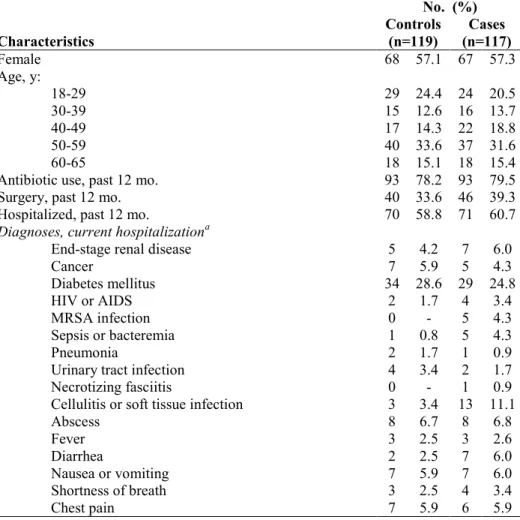
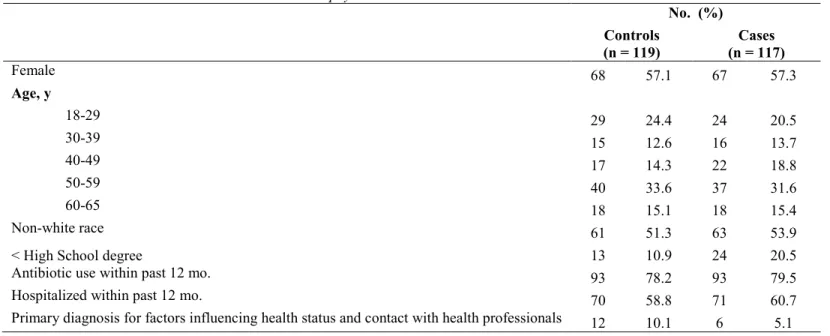
Staphylococcus aureus nasal carriers and their matched controls ... 67 4.2 Distribution of first-listed diagnoses for the current hospitalization
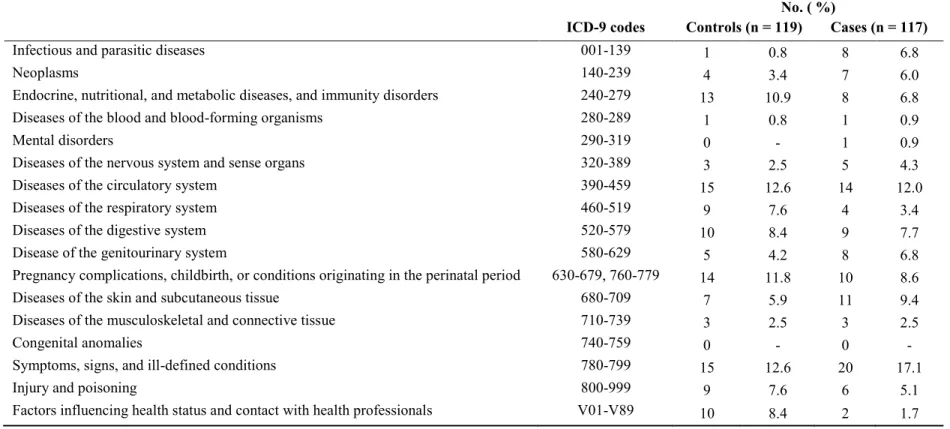
among methicillin resistant Staphylococcusaureus nasal carriers and their matched controls, categorized according to chapters from the
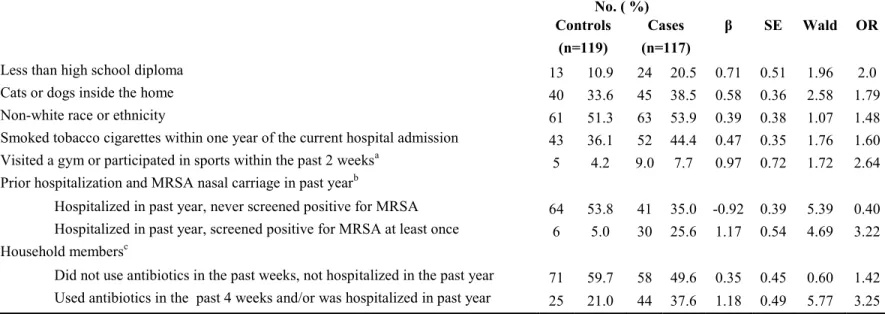
International Classification of Diseases, ninth edition (ICD-9)... 68 4.3 Estimates of association of methicillin resistant Staphylococcus aureus
nasal carriage with medical and household exposures from a
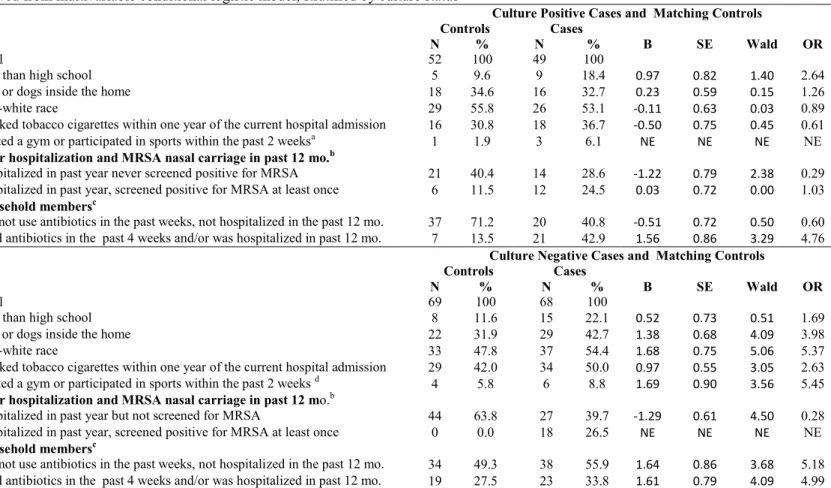
multivariable conditional logistic model ... 69 4.4 Estimates of association of methicillin resistant Staphylococcus aureus
nasal carriage with medical and household exposures, derived from
multivariable conditional logistic model, stratified by culture status ... 70 4.5 Estimates derived from univariable logistic models conditioned on
age and gender, comparing community associated and healthcare associated methicillin resistant Staphylococcus aureus (MRSA) nasal
carriers to their matched controls ... 71 5.1 Characteristics of methicillin resistant Staphylococcus aureus nasal
carriers and their matched controls ... 92 5.2 Estimates of associations of methicillin resistant Staphylococcus
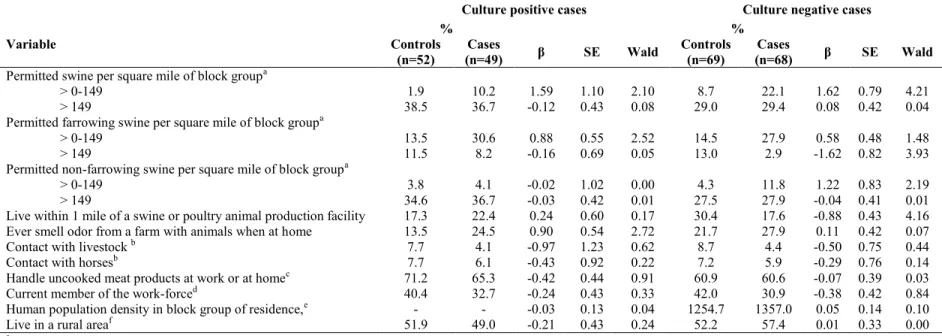
aureus nasal carriage with environmental and occupational exposures,
derived from conditional logistic regression models ... 93 5.3 Estimates of association of methicillin resistant Staphylococcus aureus
nasal carriage with environmental and occupational exposures from conditional logistic models adjusted for education, stratified
xi
LIST OF FIGURES
Figure
1.1. Permitted swine in each North Carolina block group. ... 27 4.1. Numbers of cases and controls enrolled and included in
xii
LIST OF EQUATIONS
log(p/1-p)=αi+ ∑cii... 40
log(p/1-p)= 4.9E-5 x (a-b) - 1.8 E-9 x (a2-b2) + 1.2E-14 x (a3-b3)... 84
log(p/1-p)= 4.8E-4 x (a-b) - 9.5E-8 x (a2-b2). ... 84
xiii
LIST OF ABBREVIATIONS
β Beta
CA-MRSA Community associated MRSA
CAFO Concentrated animal feeding operation
CC Clonal complex
DWQ Division of Water Quality HA-MRSA Healthcare associated MRSA
ICD-9 International Classification of Diseases, 9th edition Ln Natural logarithm
MLST Multi locus sequence typing MGE Mobile genetic elements
MRSA Methicillin resistant Staphylococcus aureus MSSA Methicillin susceptible Staphylococcus aureus NHAMES National Health and Nutrition Examination Survey NT-MRSA Non-typeable MRSA
OR Odds ratio
PBP Penicillin binding protein PFGE Pulsed field gel electrophoresis
rep-PCR Repetitive Polymerase Chain Reaction ROS Reactive oxygen species
S. aureus Staphylococcus aureus
xiv SD Standard deviation
SE Standard error
Spa staphylococcal protein A
ST Sequence type
CHAPTER 1
Background
Overview
Methicillin resistant Staphylococcus aureus (MRSA) is a versatile human pathogen that has evolved resistance to methicillin and other beta (ß)-lactam antibiotics [1]. In the United States in 2005, MRSA caused an estimated 94,360 invasive infections and 18,650 deaths [2].
MRSA has a long history that continues to evolve. MRSA was first identified in the United States in the 1960s in tertiary care hospitals. At this time, MRSA predominantly affected elderly and sick patients [1]. Then, in the early 1990s, MRSA was detected in younger and healthier people who did not have any of the traditional medical exposures, such as surgery or hospitalization, associated with MRSA acquisition [3]. Around this time, companion animals were recognized as potential vectors for MRSA transmission [4]. Most recently, new strains of MRSA were identified in humans and associated with livestock [5, 6]. Community associated (CA), health care associated (HA), and livestock associated (LA) strains of MRSA are genotypically and phenotypically distinct [7]. However, CA strains are now causes of HA infections [2, 8] and people without any recent medical exposures might be carrying CA strains [9].
2
emergence of new CA strains. The decrease in MSSA might be due to increased use of antimicrobials at the population level, which promotes resistant strains [10]. In parts of Europe, increased prevalence of MRSA carriage and infection has been attributed to the emergence of LA MRSA [11].
S. aureus has a remarkable ability respond to environmental pressures [12, 13]; this is demonstrated by the bacteria’s history and biology. Epidemiologic research and
surveillance are essential for identifying novel strains of MRSA and for designing effective interventions and prevention strategies. In the sections below, I outline MRSA’s history, biology, and epidemiology, introduce key terms and concepts, and identify remaining knowledge gaps and research needs that support the importance of my dissertation work.
S. aureus biology
S. aureus is a member of the staphylococci genus [14]; it is a prokaryotic cell [15] and a gram positive bacteria [14] that appears as clusters of cocci under a microscope [1]. S. aureus has a cell wall that is 50% peptidoglycan in weight. The peptidoglycan chains that make up the cell wall are cross-linked by tetrapeptide chains that are bound to
N-acetylmuramic acid and a pentaglycine bridge, the latter of which is exclusive to S. aureus
[1].
3
allow the bacteria to adapt to different ecological niches [16]. Bacteria sometimes transfer MGEs from one to another via horizontal gene transfer [16]. Horizontal gene transfer allows
S. aureus to survive in new environments [16]. Benign, antibiotic resistant bacteria can transfer resistance genes to pathogenic bacteria; therefore, even selection for resistant, commensal bacteria can be dangerous [17].
S. aureus reproduce through the process of binary fission, which is an asexual process that results in genetically identical offspring. Sometimes mutations occur; these cause
offspring to differ from their parents in terms of their genetic make-up [18].
These structural and reproductive characteristics allow the bacteria to respond to exposures to antibiotics [16]. Bacteria that harbor resistance genes are able to survive in the presence of antibiotics, while susceptible strains die. The resistant bacteria then produce genetically identical bacteria. In addition to naturally selecting for resistant bacteria, low levels of antibiotic treatments may stimulate bacteria to form reactive oxygen species (ROS), which lead to the development of mutations that allow resistance [19].
History of MRSA
Penicillin is beta (ß)-lactam antibiotic, meaning that it has a ß-lactam nucleus in its molecular structure. It was introduced into clinical practice in the 1940s. Soon after its introduction, S. aureus developed resistance to the antibiotic by producing penicillinase, which is a ß-lactamase enzyme. Penicillinase destroys penicillin by hydrolyzing the amide bond of the ß-lactam ring of penicillin. Production of penicillinase is encoded by the structural gene blaZ, which is controlled by the regulatory genes blaI and blaR1[20].
4
hydrolysis by penicillinases. Methicillin and other ß-lactam antibiotics are substrate analogs of penicillin-binding proteins (PBP), which catalyze the construction of the cross-links of peptide that occur between the glycan chains in the cell wall. These antibiotics inhibit PBPs and cause the bacterial cell wall to weaken, resulting in eventual lysis and death [21].
Methicillin resistance in S. aureus is attributable to the bacteria’s expression of an alternative penicillin-binding protein, known as PBP2a or PBP2’. PBP2a has low affinity for all ß-lactam antibiotics. Therefore, methicillin resistance refers to the bacteria’s ability to resist all ß-lactam antibiotics. Today, use of methicillin has by in large been replaced by other antibiotics such as oxacillin. However, methicillin resistant S. aureus is the term that is most commonly used to describe resistance to ß-lactam antibiotics [20].
The mecA gene, which is located on the chromosome in a MGE called the staphylococcal cassette chromosome mec (SCCmec), encodes PBP2a. The SCCmec is located in the staphylococcal chromosome, inside a gene called the orfX, which has two recombinase genes, ccrA and ccrB. These genes aid the integration and excision of SCCmec. SCCmec can also integrate other mobile elements or resistance genes [20]. There are
different types of SCCmec, denoted using a number, which vary depending on their structural composition [14].
Molecular typing
5
Numerous methods for molecular typing of MRSA exist. Techniques for genotyping of MRSA include the following: pulsed field gel electrophoresis (PFGE), repetitive
polymerase chain reaction (rep-PCR), multilocus sequence typing (MLST), staphylococcal protein A gene typing (spa-typing), SCCmec typing [1, 22] and whole genome sequencing (WGS) [23]. I briefly describe each of these below.
Pulsed field gel electrophoresis
Until recently, pulsed field gel electrophoresis (PFGE) using the restriction enzyme
SmaI was considered the gold standard for ascertaining relatedness of MRSA isolates. With PFGE, bacteria are set in agarose and lysed in situ. The chromosomal DNA is then digested (cut into small fragments) using SmaI. Portions of agarose, which have the chromosomal DNA fragments, are inserted into wells of an agarose gel. On the basis of size, the restriction patterns of the isolates are situated into a pattern of discrete bands in the gel. These
restriction patterns can then be compared to one another to determine the relatedness of isolates [24]. However, livestock associated MRSA strains were not typeable using PFGE with smaI digestion [6]. Bens et al. [25] later found this non-typeability was due to a DNA methylation system. LA MRSA is typeable using PFGE with the APAI [26] or EAGI enzymes [27].
Repetitive polymerase chain reaction
The Diversilab® Staphylococcus kit for DNA fingerprinting (bioMerieux, Boxtel, The Netherlands) is a commercial package that is useful for typing within clinical
6
the system does not require DNA sequencing facilities, as does the use of MLST or spa -typing. The system works by amplifying repetitive non-coding sequences in the genome, separating fragments using electrophoresis, and comparing the size of these fragments to determine genetic relatedness between strains and to compare strains to the DiversiLab® MRSA library, which contains 70 samples of 14 representative USA pulsed field gel electrophoresis types [28]. The Diversilab® system has been shown to be useful for typing MRSA isolates for potential outbreaks; however, the system is not considered to be as discriminatory as PFGE [29].
Multi locus sequence typing
With MLST, bacterial isolates are characterized based on sequence analysis of fragments of 7 housekeeping genes (arcC, aroE, glpF, gmk, pta, tpi, and yqiL); these
housekeeping genes are about 500 base pairs in length. For each fragment, the sequences are assigned distinct alleles. The alleles of the genes are used to characterize the lineage of S. aureus and to assign a sequence type (ST) that corresponds to the allelic profile. The ST for an allelic profile can be accessed from the MLST website (http://www.mlst.net/) [30]. There are numerous alleles at each of the 7 loci; therefore, it is unlikely that isolates will have identical allelic profiles [31, 32].
Isolates with the same allelic profile may be designated as members of the same clone [31, 32]. The algorithm based upon related sequence types (BURST) can be used to
7
the same CC based on a similarity threshold set by the user. The ancestor of a CC is the ST with the most single locus variants [30].
Spa-typing
Spa-typing is simpler than MLST, since it involves DNA sequencing of only one gene, the polymorphic X, or short sequence repeat region (SSR) of the protein A gene (spa). The polymorphic X region contains a variable number of 24-base pair (bp) repeats. The SSR region is biologically diverse, which might be due to deletion and duplication of repetitive units and point mutations [33]. Spa types can be found at a public spa type database (http://tools.egenomics.com/) and at the Ridom Spa Server (http://spaserver.ridom.de/). These 2 databases provide slightly different spa type assignments. For example, the same isolate would be described as spa1 by the public spa type database but as spa008 by the Ridom Spa Server [31]. It is possible to classify spa types into clonal complexes using the algorithm based upon repeat pattern (BURP). A spa type may correspond to several STs, but the spa types remain within an assigned clonal cluster [30].
8
SCCmec typing
Typing of the SCCmec element is common. This method is based on identifying the different structural characteristics of SCCmec chromosome in order to characterize its type [15]. Detection of the SCCmec chromosome is also used to identify methicillin resistance.
Whole genome typing
Whole genome typing has been described as superior to spa-typing and MLST, especially for source tracking and evolutionary studies. It better characterizes variations within ST and CC groups. In contrast, other methods, like Spa-typing and MLST, may be limited due to homoplasy, lateral gene transfer, and/or homologous recombination [23, 34].
S. aureus as a commensal organism
In addition to being a dangerous pathogen that causes invasive human infections, S. aureus is also commensal [35]. An asymptomatic person with MRSA on their body is known as a MRSA carrier, or as being MRSA colonized. Carriers of MRSA are more likely to develop bacterial infections; they may also spread the bacteria to other people with whom they come into contact [1]. Based on data from the National Health and Nutrition
Examination Survey (NHANES), approximately 84 million and 2 million
non-institutionalized people living in the United States between 2001 and 2002 were colonized with MSSA and MRSA, respectively [36].
9
those who are persistently colonized carry higher loads of bacteria and are more likely to develop S. aureus infections [37].
In humans, the main ecological niche for S. aureus is the anterior nares [1].
Approximately 20% of people are chronically nasally colonized by S. aureus and 30% are intermittently colonized. Persistent nasal carriage of S. aureus might result from the
bacteria’s introduction into the nose via nose picking, for example, in combination with nasal trauma [37]. Other parts of the body might be colonized by S. aureus--the skin, perineum, pharynx, for example, and less commonly, the gastrointestinal tract, vagina, and axillae [37].
Hands are the main vector for transmitting S. aureus from the environment into the nose, and vice versa [37]. For example, many nosocomial S. aureus infections are acquired from the hands of health care workers [1]. Although less common, S. aureus can also reach the nose directly through the air; this is an important mechanism since it causes dispersal of the bacteria to many different sources, which the hands might then touch and subsequently introduce into the nose [37].
Duration of carriage
Relatively few longitudinal studies of MRSA have been conducted; therefore, information on duration of carriage is sparse. In a study in Pennsylvania, among 8 index cases, defined as patients who presented to the hospital with soft tissue MRSA infections, the average duration of colonization was 33 days and ranged from 14 to 104 days. Mean
10
300 days, however, the prevalence of colonization had not declined much below 50%, and prevalence of colonization never decreased much below 20%. This finding suggests that some people are decolonized quickly whereas others are chronic MRSA carriers [39]. In another hospital-based study, for patients who were readmitted at least once, the half-life time for persistence of MRSA carriage was 566 days [40]. Factors that have been shown to predict longer duration of carriage include having a household member who is concurrently colonized [38], being colonized at multiple anatomical sites, and anatomical site of
colonization [40].
Recent research has suggested that the predominant strain of LA MRSA in the United States, CC398, is not as persistent of a human colonizer compared to others [7]. For example, workers who are carriers of MRSA ST398 have been shown to become decolonized during periods of non-contact with livestock [41, 42].
Community and healthcare associated MRSA
11
HA and CA MRSA strains differ genetically. CA MRSA is believed to have emerged as a result of CA-strains of MSSA acquiring SCCmec. CA MRSA strains tend to carry
SCCmecIV or SCCmecV, which are the smallest of the SCCmecs. These two types of SCCmec tend to be susceptible to a number of non-ß-lactam antibiotics. In contrast, HA MRSA strains generally carry larger SCCmec types that are multi-drug resistant [35].
Over time, there has been a mixing of HA and CA strains. For example, hospital acquired infections have been attributed to strains that were classified as CA [48], and a recent hospital-based study found that a high proportion of patients who had not been
hospitalized in the past 6 months were carrying HA strains [9]. The most common CA strain in the United States, USA300, has developed unusual plasmid-mediated resistance
phenotypes, probably due to its introduction into human medicine settings [49]. Because of this mixing, CA and HA MRSA are sometimes defined based on the type of exposures a person has received. A commonly used definition is that a MRSA infected or carrying person with any of the following types of exposures is classified as having acquired their MRSA in a healthcare setting—as a result of current or recent hospitalization, use of an indwelling venous catheter, residence in a long term care or rehabilitation hospital, having recently had surgery, or dialysis [2, 50].
Epidemiology of MRSA infections
MRSA infections have been associated with a number of exposures, including the following: among children, having a parent who works at a school or daycare; use of
12
history of skin boils [51], presence of a wound [52], contact with school athletic facilities such as locker rooms or training areas [53], participation in athletics, especially contact sports [54, 55], incarceration [56], men who have sex with men [57, 58], being a member of the military [59], being over the age of 65 [60] or under the age of 2, injection drug use [61], having a recent influenza like illness or severe pneumonia, having a concurrent skin and soft-tissue infection [62], having a history of MRSA colonization or infection [62 ], or having had close contact with a person (eg. living in the same household) who was infected with MRSA [62]. In Hong Kong, CA MRSA infections were positively associated with sharing of personal items (towels, razors, nail clippers, for example) and negatively associated with hand-washing and with acne [63]. In the Southeastern United States, Ferreira et al. [64] compared visitors to an outpatient clinic who had MRSA infections (cases) with pet-owners utilizing a veterinary clinic. They found that the following variables were associated with MRSA infection: living with children, having a family member who was diagnosed with MRSA in the past year, being hospitalized in the past year, being diagnosed with a disease or having taken a medication that affects immune function, and having been treated with
antibiotics in the past year. Companion animals inside the home have also been implicated as potential sources of MRSA infection or re-infection. Ferreira et al. identified identical strains of MRSA in pets and their owners [64].
Epidemiology of MRSA carriage
13
temperature, or relative humidity [37]. In a study using data from the National Health and Nutrition Examination Survey (NHANES) in 2001-2002, the following characteristics were related to MSSA carriage: being younger than age 65, male, having less than a high school education, and having asthma. The following characteristics were associated with MRSA carriage: being age 65 or older, female, diabetic, and residing in a long-term care facility in the previous 12 months. Compared to whites, a lower proportion of Hispanic individuals were MRSA colonized. The authors of this study speculate that some of the differences in risk factors for MRSA versus MSSA carriage might reflect traditional HA MRSA risk factors [36]. Kuehnert performed a similar analysis using NHANES data from 2001-2002 and found similar results [62].
14
being hospitalized in the previous year. Among females, MRSA carriage was associated with being 60 or older, diabetic, and having a household income below the poverty level [10].
More recently, a multi-center study of hospital admissions in Scotland showed MRSA carriage was associated with older age, having a high frequency of prior hospital admissions, having been admitted from someplace other than home, and having been admitted for a medical emergency rather than for an elective surgery [65]. A study of long term dialysis patients in Taiwan found that nasal MRSA carriage was strongly associated with nursing home admission, nasogastric tube feeding, and congestive heart failure [66]. Other
underlying conditions, such as diabetes, COPD, cellulitis, folliculitis, being long-term bed ridden, and having a previous hospitalization were not as predictive of MRSA colonization; however, sample sizes were very small for some exposures, making it difficult to draw conclusions. In a hospital-based study in Georgia, place of residence (residential vs. alternative housing), skin or soft tissue infection diagnosis at admission, history of MRSA colonization or infection in the past 12 months, HIV infection, incarceration in the past 12 months, hospitalization history, and previous antibiotic use were related to MRSA
colonization [67].
Animals such as horses [68], poultry [69-71], cats [72-74], dogs [72-74], pigs [5, 54, 75-77], veal calves [78], and cows [6] have also been shown to be vectors for MRSA
carriage. MRSA has also been found in animal food products, including milk and cheese [79] and retail meat [80-82]. However, the extent to which meat handling plays a role in human MRSA carriage and transmission remains unclear.
15
the prevalence of MSSA and MRSA nasal carriage was 43.8% and 15.2%, respectively [83]. When paramedics, physicians, nurses, and clerical or non-clinical workers were compared, paramedics had the highest prevalence of MSSA carriage but physicians had the lowest prevalence (57.7% vs. 38.5%). The highest prevalence of MRSA carriage was in nurses and the lowest was in paramedics (10.5% vs. 1.9%). In another study at 5 different teaching hospitals in Pittsburgh, PA [84], among 255 emergency department workers receiving nasal cultures, there was a 4.3% prevalence of MRSA, which is higher than the national estimates. Interestingly, all MRSA positive health care workers were nurses, nursing assistants, or patient care technicians; none worked as physicians, physician’s assistants, or in clerical or social services positions.
Veterinary personnel may also be exposed to MRSA. Among 417 individuals who attended a veterinary conference, 6.5% had MRSA in their nasal cavities. Of those with MRSA, 15.6% worked in large-animal and 4.4% in small-animal practices [74]. In a more recent study, 17.3% of 341 veterinary personnel (veterinarians and technicians) screened positive for MRSA [85]. Most recently, contact with animals through work in
slaughterhouses [71, 86], pig stables [87], with horses [68], and more generally as pig farmers [54, 75, 76] has been associated with MRSA carriage.
Animals, livestock, and MRSA
16
associated (LA). In North America and Europe, the predominant LA MRSA strain belongs to CC398 [88].
In one of the first studies to identify CC398, Armand-Levre found identical MRSA sequence types on pigs and pig farmers, suggesting potential exchange of MRSA between the groups [89]. Around this same time, in the Netherlands a 6 month old and her 2 parents who lived on a farm and raised pigs were colonized with MRSA strains that were non typeable (NT) using PFGE with SmaI restriction; this finding suggested a newly emergent strain of MRSA [5]. Subsequently, a survey in the Netherlands showed that 23% of 26 pig farmers were colonized with NT MRSA [5]. Also in the Netherlands, 8 of 10 pigs on a farm were colonized with the same MRSA strains as family members who lived on the farm, suggesting pig to human transmission of the bacteria [76]. In an important study, also in the
Netherlands, Van Loo et al. found that individuals colonized with NT MRSA had
approximately 9 times the odds of contact with pigs and 13.5 times the odds of contact with cattle, compared to individuals colonized with MRSA that was typeable with PFGE [6]. In this study, MLST showed that 32 of the 35 study participants with NT MRSA were colonized with MRSA ST398. Van rijen et al. reported an increase in MRSA incidence in a
Netherlands hospital between 2002 and 2006, and they attributed this increase to the emergence of MRSA CC398 [90].
MRSA CC398 has been observed on pigs [77], chickens [71], turkeys [91], cattle [26], and horses [92], and in retail meat products [81, 93]. It has been found on workers at pig [77 , 86] and broiler slaughterhouses [71].
-17
type t3992 and ST1379, which is a member of CC97 [94]. In Asia, the predominant LA-strain of MRSA is ST9 [7].
LA MRSA has been detected in numerous countries, including Spain [94], Southeast Austria [95], Belgium [54, 69, 70], Denmark [96], Germany [97], Italy [98], and Korea [99]. Compared to Europe, research in North America on the relationship between human MRSA carriage and animals is less extensive. In a cross-sectional survey of 20 farms in Ontario, Canada [75], Khanna et al. found that 25% of 285 pigs and 20% of 25 workers were MRSA colonized. The most frequently detected MRSA strains were genetically related and belonged to CC398. In the first published study of this relationship in the United States, Smith et al. [27] surveyed 2 swine production facilities in Iowa and Illinois and observed an overall 45% prevalence of MRSA colonization in pig caretakers and a 49% prevalence in pigs. MLST analysis on a subset of isolates indicated that workers and pigs were carrying MRSA ST398. Interestingly, the authors only detected MRSA in humans and pigs at one of the 2 swine production facilities that they surveyed. The authors speculate that this could be due differences in the source of the pigs at the 2 production facilities (Canada for the facility at which MRSA was detected and Michigan for the other) and/or the age of the facility (the facility at which MRSA was detected was older and raised more pigs than the other). The 2 facilities also raised different breeds of pig.
18
the separation of the barns from the dust prevents airborne spread of MRSA [100]. In an anonymous survey of pork producers in the United States that was conducted in 2008, 3.7% of respondents reported a MRSA skin or soft tissue infection [101].
Researchers have investigated characteristics that predict MRSA carriage in animals and in human workers. For example, spending more hours working in the stable, more time feeding calves, conducting veterinary care, and managing the stable have been associated with LA MRSA carriage in humans [78]. Job tasks have also been investigated as factors that could be related to MRSA carriage. Smith et al reported that workers who did not obtain blood or other specimens from pigs had higher odds of MRSA carriage compared to those who participated in these tasks [27]. Factors such as animal age (younger) [27, 78, 102], antibiotic use [103], and group treatment with antimicrobials [102] have been shown to be associated with MRSA carriage in the animals.
19
some but infrequent transmission of MRSA ST398 from workers to household members [97]. A study in the Netherlands found MRSA ST398 carriage in 1 of 534 people without livestock contact. The prevalence in this group was much lower than that among those with livestock contact (13 of 49) [86].
The epidemiology of LA MRSA could be changing, however. For example, recently in Iowa, MSSA ST398 was cultured from the nose and throat of a childcare worker who did not have any contact with livestock [105]. Some have argued that lower rates of transmissibility of MRSA CC398 might have partially to do with patient-related factors. A recent study of admitted patients in Germany showed that a higher proportion of patients carrying MRSA CC398 upon admission were younger, had shorter lengths of stay in the hospital, were men, had invasive measures (endoscopies, catheterizations, etc) and had a lower mean number of International Classification of Diseases (ICD) diagnoses [106]. However, low transmissibility of the strain might have also to do with phenotypic characteristics of LA strains, which I discuss below.
Phenotypic characteristics of MRSA CC398
20
strains of MSSA that acquired the SCCmec cassette after being transmitted to livestock. Furthermore, human MSSA strains carried human innate immunomodulatory genes, but LA MRSA CC398 lacked these genes, which play an important role in human niche adaptation. This analysis suggests that the MRSA strains lost the human niche genes after they were introduced to nonhuman hosts [23]. Another recent study compared the genome of MSSA ST398, a virulent resistant strain of MSSA that has recently caused dangerous infections and is easily transmissible between humans, to that of the LA MRSA ST398 [109]. The comparison showed that the genome of the human associated MSSA strain was better adapted to the human host compared to LA MRSA ST398; the human associated strain carried human-specific immune evasion cluster genes. In addition, the human strain demonstrated enhanced adhesion to human skin keratinocytes and keratin.
Phenotypic heterogeneity has been observed within CC398. Recently, researchers observed different resistance and PFGE patterns among MRSA CC398 isolates collected from the same farm. The investigators speculate that this might result from importation of animals from difference places, or diversification of the strain through horizontal gene transfer, genetic rearrangements, or changes of spa types resulting from the loss or acquisition of single spa repeats [26].
Antibiotic use and industrial animal production
In industrialized animal production facilities, livestock are raised indoors in
21
cesspools, called lagoons, where it is stored until being sprayed onto nearby farmland. These conditions provide an ideal environment for bacteria to thrive and allow easy animal-to-animal transmission of pathogens [110].
Industrial animal producers administer antimicrobials to livestock for several reasons—for therapeutic purposes, to promote animal growth, and to prevent disease in susceptible flocks [110, 111]. Subtherapeutic use of antimicrobials in animal production facilitates growing animals in confinement by preventing sickness in the animals [112]. It also promotes lower production costs since the antibiotics allow the animals to grow faster, feed for shorter amounts of time, and reach slaughter weight sooner [111]. Food producers say that antimicrobial use is essential because it maintains animal health and protects the economics of this food production system [113].
A 2009 United States Food and Drug Administration report demonstrated that multiple classes of antimicrobials that are medically important for humans are also distributed for use in food animal production [114]. This shared use could promote bacterial resistance to medically important antimicrobials, thus rendering these drugs ineffective and creating challenges for treating infections in humans [115]. In the European Union [111], the use of medically important antimicrobials for nontherapeutic purposes in livestock production has been banned; however, it continues in the United States.
22
residents decreased. Similarly, Skot-Rasmussen compared antibiotic resistance trends of
Campylobacter jejuni in broiler chicken meat imported from other countries to meat from Denmark, where the use of fluorquinolones in animals is restricted. The authors found that bacteria on Danish broiler chicken meat had lower resistance patterns to ciprofloxacin, nalidixic acide and tetracycline compared to meat from other countries. In addition, they found that, for the most part, bacterial isolates collected from people who traveled outside Denmark had higher levels of resistance patterns to ciprofloxacin and nalidixic acid compared to isolates from people who had not traveled outside the country [117].
Investigators have also compared the prevalence of bacteria in animals raised on antibiotic free farms to that in animals raised on farms that routinely administer antibiotics. In a recent German study, neither MRSA nor MSSA was found in the nares of pigs raised on alternative farms (smaller farms that provide room for the pigs to run and do not apply antibiotics to animals that exceeded a body mass of 25 kg). MSSA was found in
approximately 35% of 89 people who worked or lived on the farms; however, only one person was nasally colonized with MRSA CC398 [103].
Transmission of MRSA in the environment
There are various mechanisms by which MRSA may be transmitted in the
23
There is some evidence that antibiotic resistant bacteria may exist in the waste that livestock secrete; people who inhale the air within or near swine facilities could be exposed to drug resistant bacteria. For example, Nandi et al. found antibiotic resistance genes in gram positive bacteria in poultry litter [119]. Similarly, in the south eastern United States,
enterococci isolated from poultry litter or transport containers in processing production facilities showed resistance to a number of antimicrobial classes [116]. Resistant bacteria have also been found in areas near concentrated animal feeding operations (CAFOs), which might be due to the emission of particulate matter from inside confinement houses into the external environment [110]. Gibbs et al. [120] sampled bioaerosols for antibiotic resistant bacteria located inside, downwind, and upwind from a swine CAFOs. The investigators found organisms that were resistant to at least 2 classes of antibiotics at all locations; S. aureus was the most prevalent organism. The amount of antibiotic resistant organisms inside the confinement houses was 2 times that which was found upwind of the facility. The
prevalence of antibiotic resistant bacteria was higher downwind compared to upwind of the facility. At the time of sampling the pigs were not receiving nontherapeutic doses of antibiotics, but had been treated with oxy-tetracycline 4 weeks prior to sampling. The
24
Antibiotic resistant organisms may also be transported in water. Anderson et al. [123] sampled groundwater at four sites in eastern North Carolina and found antibiotic resistant
Escherichia coli (E. coli) more frequently in water on or near industrial swine farms than on farms without swine. This suggests that water near swine operations could be an important environmental reservoir for antibiotic resistant bacteria and antibiotic resistance genes. Sapkota et al. [124] sampled surface and ground waters up- and down-stream from a swine CAFO in eastern North Carolina. They found higher levels of enterococci and E. coli in waters up gradient from the CAFO. The enterococci that they found in down gradient waters expressed higher levels of resistance to antibiotics used in swine production compared to isolates that were collected from up-gradient waters. Interestingly, enterococci that were recovered from down and up gradient water samples were susceptible to vancomycin, which is an antibiotic that is not approved for use in swine production in the United States.
Antibiotic resistant bacteria have also been isolated in sewage sludge and pig slurry [125] and wastewater treatment plants have been shown to be a potential reservoir for MRSA [126]. There is also emerging evidence that fish might be a vector for transmission of MRSA. In Malaysia, MRSA was found in the brains, eyes, and kidneys of farm-raised Tilapia fish [127].
25
resistant genes from swine waste to other environments, such as water, crops, and other wildlife [129].
Public health relevance of livestock associated MRSA
MRSA ST398 does not generally carry the toxin genes that contribute to the pathogenicity of MRSA. Recently, however, a Chinese study identified a high prevalence of MSSA ST398 that harbored the toxin gene Panton-Valentine Leukocidin [130]. In this study, the patients carrying MSSA ST398 did not have any recent contact with livestock.
LA MRSA strains could acquire toxin genes through horizontal gene transfer, or might already possess as of yet unidentified toxin genes [88]. There have already been cases of LA MRSA strains causing invasive infections, including endocarditis [131], ventilator-associated pneumonia [132], respiratory tract infections[133], pyomyostis, cellulitis, abscesses [15], other skin and soft-tissue infections [96], and more [14, 88].
26 Livestock production in eastern North Carolina
In North Carolina, as of August of 2009 there were 2,166 swine animal production facilities with active wastewater discharge permits from the NC Division of Water Quality. The majority of these operations are located in the southeastern region of the state [137] (Figure 1.1). The state produces about 10 million hogs and produces approximately 14.4% of US pork [138]. The Environmental Defense Fund estimated that in NC, three million pounds of antibiotics, the same amount used in human medicine, are used annually in animal
production. NC ties with Iowa for using the most antibiotics in animal feed in the USA [139]. Eastern NC is also home to the world’s largest pork processing plant, Smithfield Packing Incorporated [140].
Summary
MRSA is a resilient organism that evolves in response to environmental pressures. Once confined to clinical settings, it later emerged in the community, affecting people without recent medical exposures. Even more recently, strains of MRSA emerged that were associated with industrial livestock production. The potential for these strains to be
27
Carolina. I conducted a hospital-based case control study of inpatients at the Vidant Medical Center (VMC), which is the largest hospital in eastern North Carolina.
Figure
CHAPTER 2
Specific aims
Methicillin resistant Staphylococcus aureus (MRSA) is a pathogenic bacteria that has evolved resistance to methicillin and other ß-lactam antibiotics [1]. Infections from
Staphylococcus aureus cause severe clinical conditions that are associated with increased medical costs [141] and may sometimes culminate in patient death. People may also asymptomatically carry MRSA on their bodies. Historically, MRSA was nosocomial; later, genetically and phenotypically distinct strains emerged in the community [8]. Healthcare associated (HA) and community associated (CA) MRSA strains are genetically distinct [35, 142]; however, they have started to mix in terms of their epidemiology. Indeed, the
epidemiology of MRSA is constantly evolving.
Factors associated with MRSA carriage or infection include demographic[10, 65] and residential characteristics [67], medical exposures [10, 65, 67], history of MRSA
colonization or infection, past antibiotic use [67, 143], living with companion animals, with children, with someone infected with MRSA, or in crowded or substandard housing [64, 144, 145], or playing contact sports [55, 146]. Recently, meat animals were recognized as
29
[110]. Identification of environmental sources for MRSA is important for infection prevention, especially within hospitals where heavy use of antimicrobials could impose selective pressures on CA or LA strains.
The overall objective of this research was to investigate environmental, household, and occupational exposures associated with MRSA nasal carriage among patients admitted to Vidant Medical Center (VMC), a tertiary care hospital in eastern North Carolina. VMC is the largest and only academic medical center in eastern North Carolina, a region that is densely populated by animal production facilities. Since February 2007, VMC has screened all admitted patients for MRSA using duplicate swabs of the anterior nares [147]. This screening program presents a unique opportunity to study MRSA carriage at the time of hospital admission. Using data from VMC’s screening program and information on
occupational, environmental, and medical exposures that I ascertained through structured in-hospital interviews, geographic mapping, and medical record abstraction; I addressed the following specific aims:
1) Investigate associations between medical and household exposures and MRSA nasal carriage by:
a. Reviewing medical charts and conducting structured interviews to identify information on previous medical exposures;
b. Conducting structured interviews to ascertain information about household member presence and medical exposures;
30
d. Developing a multivariable logistic regression model to derive estimates of association between MRSA nasal carriage and medical and household exposures
Rationale: The scientific literature suggests that the following factors may be associated with MRSA carriage: previous medical contact (i.e. surgery, hospitalization, antibiotic use, etc.), history of MRSA carriage, prior hospitalization of household members, prior antibiotic use by household members, living with pets, cigarette smoking, and playing contact sports or attending a public gym. I investigated the relationship between these variables and MRSA carriage among patients who were screened for MRSA nasal carriage at the time of admission to VMC.
Hypothesis: The following factors will be positively associated with MRSA carriage: recent medical contact, recent antibiotic use, indoor pets, gym use or sports participation, cigarette smoking, household member presence, and
household member medical exposures (i.e. antibiotic use and past hospitalization). 2) Examine associations between environmental exposures to livestock, horses, or
meat and MRSA carriage by:
a. Characterizing participants’ environmental exposures through the following scenarios:
i. Living within 1 mile of swine or poultry concentrated animal feeding operations (CAFOs),
31
iii. Ability to smell odors from animal farms when at home, iv. Handling meat at home or at work,
v. Having contact with livestock or horses in the community, vi. Living with household members who work with livestock and/or
on farms; and
b. Comparing the log-odds of MRSA nasal carriage in participants with the above environmental exposures to the log-odds of MRSA nasal carriage in participants without the above exposures.
Rationale: Handling of uncooked meat may be associated with MRSA carriage. People who live near CAFOs may experience exposure to the bacteria via the following routes: Coming into contact with dust from CAFOs; drinking well water that could be contaminated by waste from CAFOs; wading, swimming, or fishing in surface waters that might be contaminated by waste from CAFOs; or coming into contact with other humans who have contact with livestock.
Additionally, living with someone who works with CAFOs may be a risk factor for MRSA carriage.
Hypothesis: Higher proportions of cases than controls will have recent environmental exposures to livestock, horses, and meat.
3) Investigate associations between occupational exposures and MRSA carriage by: a. Characterizing participants’ occupations and the industries for which they
work,
32
c. Comparing the log-odds of MRSA carriage across industry categories, Rationale: As a result of workplace exposures, people may become carriers of MRSA and vectors for transmission of this pathogen into the community.
Hypothesis: Higher proportions of cases than controls will work in medical related settings, with children, and/or with livestock.
4) Examine associations between MRSA strain carriage and environmental, occupational, and household exposures by:
a. Characterizing the strain of MRSA that cases are carrying as CA or HA, and
b. Comparing the log-odds of occupational, environmental, household, and medical exposures in CA MRSA carriers versus controls and HA MRSA carriers versus controls.
Rationale: Traditionally, HA and CA MRSA carriage has been associated with different epidemiologic exposures.
Hypothesis: HA and CA MRSA carriers will differ in terms of the log-odds of exposure to various medical, environmental, household, and occupational exposures.
CHAPTER 3
Materials and methods
Study design and setting
This was a hospital based case-control study. Vidant Medical Center (VMC) is an 861 bed teaching hospital of the Brody School of Medicine at East Carolina University. VMC is the tertiary care center for 29 counties in eastern North Carolina. In February of 2007, VMC implemented a universal MRSA screening program; all admitted patients are screened for MRSA by duplicate swabs from the anterior nares [147]. Patients are screened for MRSA within 24 hours of their hospital admission.
MRSA screening and typing
34
For each case, approximately 24 to 48 hours after the screening was performed, the duplicate nasal swab was transferred to the infection control laboratory, streaked onto a CHROMagar® MRSA plate (CHROM agar Microbiology, Paris, France) and incubated for 24-48 hours at 37 ˚C. According to manufacturer recommendations, rose or mauve colored colonies were identified as MRSA.
After 24 hours of incubation on blood agar plates, DNA was extracted using an UltraClean™ Microbial DNA Isolation Kit (Mo Bio Laboratories, Solana Beach, CA). The NanoDrop® ND-1000 Spectrophotometer (Isogen, Ijssel stein, The Netherlands) was used to estimate the genomic DNA concentrations. Extracts were diluted to give a final DNA concentration of 35 ng/μl.
35 Inclusion criteria
To be eligible to participate, patients were required to live in one of the top swine producing zip codes in NC. I identified the list of eligible zip codes using data from the North Carolina Division of Water Quality (NC DWQ). The NC DWQ publishes a publicly available data base that provides information on the geographic locations, numbers and types of animals allowed to be produced at each production facility in North Carolina that has been issued a non-discharge wastewater permit. I used this information to characterize top swine producing zip codes in North Carolina. For each zip code that contains at least one facility, I calculated the total number of swine that were produced in that zip code. I then calculated the median number of swine that were produced in the North Carolina zip codes; this was equal to 1,032,750 swine. Any zip code in which 1,032,750 or more swine were produced was designated to be an eligible zip code. In total, 176 zip codes met this criterion.
Other eligibility criteria included the following: 1) ages 18 to 65 2) screened for MRSA at VMC, 3) present in the hospital at a time when interviews were being conducted, 4) English or Spanish speaker, and 5) able to answer questions during an interview.
Participant identification
36
who screened positive for MRSA nasal carriage at the time of admission. Controls were people who screened negative for MRSA.
The daily reports were input into Statistical Analysis Software version 9.3. For each eligible case, I identified patients who could serve as a matching control; these were people who screened negative for MRSA, were admitted to the hospital within 24 hours of the case, were ± 5 years of the case, and were the same gender as the case. Each potential matching control was assigned a unique random number. I attempted to enroll the lowest randomly numbered control.
Enrollment and interviews
For every potential participant, I paged the physician taking care of that person; I introduced the study to the medical provider and made sure that it was appropriate that I approach the patient about participating. After receiving approval, I visited each potential participant in their room, introduced the study, and invited them to participate. If the patient was sleeping or receiving a medical treatment when I approached them, I returned to their room at a later time. If the patient was unconscious but a family member was present, I invited to the family member to participate on behalf of the patient.
37
environment, meat handling, and demographic information. The complete questionnaire that I used for the interviews is presented in Appendix 1.
Medical chart review
To check that the exposures that I asked about during the interview occurred prior to the MRSA screen, I reviewed the microbiology lab results to identify the date that the MRSA nasal swab that defined case/control status was taken. I reviewed medical charts to see if the participant had surgery within the past year. I also identified the primary diagnosis for the current hospitalization. I classified the primary diagnoses according to the International Classification of Diseases, 9th (ICD-9) edition.
I reviewed medical records to confirm participant reports about hospitalizations within the past year. I also identified the last date within a year of the current hospital admission that the patient was prescribed an antibiotic, if at all. If, during the interview, the participants reported not using antibiotics in the past year but the medical chart indicated that they were prescribed an antibiotic, I adjusted the variable coding to reflect the information from the medical chart. If participants reported antibiotic use but there was no evidence of prescription in the medical chart, I coded the variable according to the participant report.
38 Data checking and cleaning
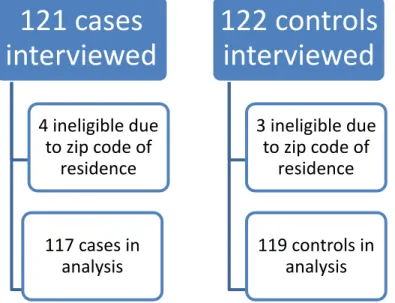
To check the data entry, I randomly selected and compared 10% of the paper copies of the interviews with the data that were entered into the Qualtrics® system. There were data entry errors in fewer than 1% of the paper copies. Where possible, I also compared variables that were collected from the interview with the information in the medical charts (age, address, previous hospitalization, and previous antibiotic use). I corrected the data on age, previous hospitalization, and previous antibiotic use based on the information in the medical charts. If the address that the participant reported was outside the list of eligible zip codes, I excluded the person from the study.
For the medical chart review, I began by checking only 10% of the records. I identified inconsistencies and so, with the exception of the data on previous MRSA screenings, I checked all of the records against the medical records a second time. For the data on MRSA screenings, I checked only 10% of all records against the medical records, since I found minimal mistakes in those that I checked.
I imported all of the data into SAS 9.3. I performed cross-checks on relevant variables to identify inconsistencies, outlying values, and other suspicious values.
Geocoding
39
Identification of concentrated animal feeding operations near participant homes
I used satellite imagery in Google Earth™ to identify 1 or more swine or poultry CAFO within 1 mile radii of participants’ home and work addresses. In North Carolina, swine CAFOs store animal waste in open air pits, euphemistically called lagoons, but most poultry operations do not utilize these liquid waste management systems. Therefore, I identified images of animal barns beside small bodies of water, the lagoons, as swine and images of barns without lagoons as poultry CAFOs.
Human and swine population densities and rural area classifications
I downloaded topically integrated geographic encoding and referencing (Tiger)® shapefiles showing census block groups and urban areas from the 2010 United States Census [151]. I used SAS version 9.3’s GINSIDE procedure to define each home address as an urban area, urban cluster, or rural area. I combined urban areas and clusters into a single “urban” category. Urban clusters contain at least 2,500 people and urbanized areas contain 50,000 or more people. I also used the GINSIDE procedure to identify the census block group to which each home address belonged.
40
pigs [27, 152]. Swine densities were defined as the number of permitted swine divided by the number of square miles in a block group.
I also used 2010 United States Census data to assign human population densities to each block group. I defined human population densities as the number of people living in a block group divided by the number of square miles in the area.
Statistical analysis
I used Statistical Analysis Software version 9.3 to conduct all analyses.
Investigation of medical and household exposures associated with MRSA carriage
I developed a multivariable model to estimate associations between medical and household exposure variables and MRSA carriage (case/control status). This model was a conditional logistic regression model. The equation for the conditional logistic regression can be expressed as:
log(p/1-p)=αi+ ∑cii ,
where p represents the probability of being a case, αi represents the overall level of the
log-odds of the outcome within each matched set (stratum) that is not being estimated by the conditional model fitting, crepresents the i variables that were included in the models to predict case status, and i represents the estimates for the change in the log-odds of being a
case that were associated with incremental changes in the coding for each term.
41
gym or playing sports in the past 2 weeks, 5) smoking cigarettes in the past 12 months, 6) household member prior hospitalization in the past 12 months and antibiotic use in the past 4 weeks, and 7) living with cats or dogs inside the home. Variables were selected a priori
based on evidence from the scientific literature that they might be related to MRSA carriage. I selected time windows and variable coding schemes that provided the most predictive model with the fewest degrees of freedom, as indicated by deviance and Akaike information criteria (AIC) statistics. I also ran the multivariable model using data for only cultured cases and their matched controls.
Based on results from the molecular typing analysis, I also examined the relationship between HA or CA MRSA carriage and the variables in the model; I compared the log-odds of exposure in HA or CA MRSA carriers to their matched controls. Because sample sizes were small, I ran separate models for each predictor variable and conditioned only for the matching variables, gender and age.
Investigation of environmental and occupational exposures associated with MRSA carriage
42
with horses, and 6) indirect contact at work or direct contact at home with livestock, defined as pigs, cows, chickens, turkeys. To provide a comparison of relationships between MRSA carriage and environmental or occupational contact with livestock, I also examined
relationships between densities of humans living in the census block group area of residence, residence in a rural or urban area, and employment status. To be defined as employed, participants had to have worked in the 2 weeks that preceded the current hospital admission.
All exposure variables were coded as binary terms, except those representing swine head count total, swine densities, and human population density. I coded the human
population density variable as a linear term; this coding produced a smaller AIC statistic compared to quadratic, cubic, or categorical coding.
Variables representing densities of total, farrowing, and non-farrowing swine were coded as 3-level categorical variables (0 swine/square mile of block group, referent vs. 149 swine/square mile vs. > 149 swine/square mile). Zero was the median and mode for the distribution of total swine density and 149 was the 25% of the distribution of observations with non-zero values for swine density. Using the 25% rather than 50% as the cut-point provided superior model fit, as indicated by a comparison of AIC statistics. Coding the density variables using three categories let to improved model fit compared to binary coding, to other categorical coding schemes and to using linear, quadratic or cubic terms. I also explored the relationship between total swine count and case status. Coding total swine count using linear, quadratic, and cubic terms produced the smallest AIC statistic.
All models were conditioned on the matching variables age and gender. I also
proxy-43
measure for socioeconomic status and unmeasured environmental factors that could confound the relationship between the exposure and outcome variables. In addition, I included the education term in the model based on the assumption that it was not on the causal pathway between exposures and case status.
After running the models on the full data set, I reran them using a stratified data set; I compared cases whose MRSA swabs grew colonies to their matched controls and cases whose swabs did not grow colonies to their matched controls. In addition, I ran the models to compare CA MRSA carriers and HA MRSA carriers to each of their matched controls.
Below, I describe in detail the variables that I included in the analyses.
Variables
Age
Cases and controls were matched on the basis of age (± 5 years). Age was calculated by subtracting the patient’s date of birth from the day on which I identified them as a
potential case or control.
Gender
Cases and controls were matched based on gender, which was identified in the medical records.
Race/ethnicity
This variable was self-reported by the participants during the interview. The
44
categories of race/ethnicity other than black and white, I collapsed the variable to be dichotomously coded: black or other vs. non-Hispanic white.
Education
This variable was self-reported by the participant during the interview. The
participant was presented with the following options to describe the highest degree that they had earned in school: more than bachelor’s degree, bachelor’s degree, associate’s degree, high school diploma, less than high school diploma, and other. Based on the distribution of this variable, I began by considering this is a three-level variable: 1) less than high school diploma, 2) high school diploma or GED 3) More than high school diploma or GED. Ultimately, this variable coded as a 2-level variable (High school/GED or more vs. less than high school).
Hospitalized in the past year
45
Surgery in the past year
Information on this variable was derived by reviewing the doctor’s notes in the patient medical charts for the year preceding their current hospital admission. This variable was dichotomously coded.
Primary diagnosis
Information on each of these variables was derived from the primary diagnosis noted in the discharge notes for the current hospitalization.
Positive MRSA screen within the past year
I identified those patients who had screened positive for MRSA within the past year by reviewing microbiological lab results in the participants’ electronic medical charts. This variable was coded as a dichotomous variable.
Antibiotic use in the past year:
46
People could have received antibiotics from various sources other than the hospital; therefore, I based the classification of antibiotic use in the past year on participant reports during the interview. However, because of evidence in their medical charts, I reclassified those 23 people who reported that they had not used antibiotics in the past year as people who had. For the 5 people who had reported that they did not know if they had used
antibiotics in the past year, I filled in this missing data using information from their medical charts. To maintain consistency with much of the literature on MRSA carriage, I coded this variable dichotomously (used antibiotics in the past year vs. did not use antibiotics in the past year).
Household member antibiotic use and prior hospitalization
Participants without household members could not live with someone who had been hospitalized or had used antibiotics. Therefore, I combined these variables into a three-level indicator variable (0=no household members, 1=had household member(s), none of whom were hospitalized or used antiobiotics, 2=had household member(s) who used antibiotics in the past 4 weeks or was/were hospitalized in the past year).
Below, I describe the origin of each of the variables that were used to derive this composite variable. I explored various time windows for the variables describing household member antibiotic use and hospitalization; I selected those that were most predictive of case status in univariable and multivariable models.
Number of household members
47
Household member antibiotic use
During the interview, I asked participants if, starting the day before they were admitted to the hospital, any member of their household had used antibiotics in the past 4 weeks, 6 months, or year.
Previous hospitalization by household member
During the interview, I asked participants if any member of their household was hospitalized within the past 4 weeks, 6 months, or year.
Household member employment
During the interview, I asked participants who had any household members if those household members were currently employed. I combined this information with information on household member presence to create a 3-level categorical variable: (0=no household member present vs. 1=household member(s) present but none were currently working vs. 2=household member present and at least one was currently working).
Smoking in the past year
During the interview, I asked participants when the last time was that they smoked tobacco cigarettes. The participants selected one of the following options to describe their smoking status: 1) never, 2) more than a year ago, 3) more than a month but less than a year ago, 4) more than a week but less than a month ago, 5) more than a day but less than a week ago, and 6) less than a day ago.