Fused Nonacyclic Electron Acceptors for E
ffi
cient Polymer Solar Cells
Shuixing Dai,
†,‡Fuwen Zhao,
§Qianqian Zhang,
∥Tsz-Ki Lau,
⊥Tengfei Li,
†Kuan Liu,
†Qidan Ling,
‡Chunru Wang,
§Xinhui Lu,
⊥Wei You,
∥and Xiaowei Zhan
*
,††Department of Materials Science and Engineering, College of Engineering, Key Laboratory of Polymer Chemistry and Physics of
Ministry of Education, Peking University, Beijing 100871, China
‡Fujian Key Laboratory of Polymer Materials, College of Materials Science and Engineering, Fujian Normal University, Fuzhou
350007, China
§Institute of Chemistry, Chinese Academy of Sciences, Beijing 100190, China
∥Department of Chemistry, University of North Carolina at Chapel Hill, Chapel Hill, North Carolina 27599-3290, United States ⊥Department of Physics, Chinese University of Hong Kong, New Territories, Hong Kong, China
*
S Supporting InformationABSTRACT: We design and synthesize four fused-ring electron acceptors based on 6,6,12,12-tetrakis(4-hexylphen-yl)-indacenobis(dithieno[3,2-b;2′,3′-d]thiophene) as the elec-tron-rich unit and 1,1-dicyanomethylene-3-indanones with 0− 2 fluorine substituents as the electron-deficient units. These
four molecules exhibit broad (550−850 nm) and strong
absorption with high extinction coefficients of (2.1−2.5)×105
M−1cm−1. Fluorine substitution downshifts the LUMO energy level, red-shifts the absorption spectrum, and enhances electron mobility. The polymer solar cells based on the
fluorinated electron acceptors exhibit power conversion
efficiencies as high as 11.5%, much higher than that of their nonfluorinated counterpart (7.7%). We investigate the effects
of the fluorine atom number and position on electronic
properties, charge transport,film morphology, and photovoltaic properties.
■
INTRODUCTIONOrganic solar cells (OSCs) are considered to be one of the promising alternatives to silicon-based solar cells since they present unique features, such as low processing cost, semi-transparency,flexibility, and light weight.1−3For a long period of time, OSCs mainly employed fullerene derivatives (e.g., PC61BM and PC71BM) as electron acceptors which, paired with
electron donating polymers or small molecules, have successfully achieved power conversion efficiencies (PCEs) over 11%.4−7However, fullerene derivatives suffer from several shortcomings, such as poor absorption in the visible region, limited tunability of energy levels, and morphology instability, which hinder the further development of OSCs. On the other hand, nonfullerene electron acceptors possess advantages over their fullerene counterpart, such as enhanced absorption in the visible and even near-infrared (NIR) region, tunable energy levels, good device stability, and easy synthesis and purification. For all these reasons, rapid progress has been made with these nonfullerene electron acceptors, which have led to impressive PCEs.8−35
R e c e n t l y , i n d a c e n o d i t h i o p h e n e ( I D T ) - a n d indacenodithieno[3,2-b]thiophene (IDTT)-based fused-ring electron acceptors (FREAs) have attracted considerable
attention.36−51 These FREAs exhibit broad and strong
absorption, suitable lowest unoccupied molecular orbital (LUMO) and highest occupied molecular orbital (HOMO) energy levels, and high electron mobility. OSCs based on these FREAs have exhibited high PCEs with small energy loss51and good device stability.37Most of these FREAs, such as ITIC,36 ITIC-Th,37and IDIC,38,48are based on IDT or IDTT donor unit and 1,1-dicyanomethylene-3-indanone (IC) acceptor unit. In this work, we design and synthesize an electron-rich unit 6,6,12,12-tetrakis(4-hexylphenyl)-
indacenobis(dithieno[3,2-b;2′,3′-d]thiophene) (IBDT) and three electron-deficient units fluorinated IC, to construct a small library of four FREAs (INIC series) based on IBDT end-capped with IC or fluorinated IC (Chart 1, Scheme 1). Our molecular design rationale is as follows. First, IBDT has larger rigid and coplanar structure and stronger electron-donating ability than IDT and IDTT, both of which are beneficial to enhancing the absorption
and charge transport. Second, fluorinated IC has stronger
electron-withdrawing ability than IC due to strong
electro-negativity of fluorine atom, and promotes intermolecular
interactions through forming noncovalent F−S and F−H bonds, which is favorable for charge transport.52−54 Third,
“acceptor−donor−acceptor” structure in INIC series can induce intramolecular charge transfer and lead to broad and strong absorption throughout the visible and even NIR region (500−850 nm). Indeed, our results show thatfluorinated INIC exhibit lower energy levels, red-shifted absorption, and higher
electron mobility than nonfluorinated INIC. Furthermore,
nonfullerene OSCs based on fluorinated INIC electron
acceptor and a wide-band-gap polymer donor FTAZ55(Chart 1) exhibit PCEs as high as 11.5%, significantly higher than that of nonfluorinated INIC (7.7%). More importantly, with this series, we are able to investigate the effects of the number of fluorine atoms and their positions on electronic properties, charge transport,film morphology, and photovoltaic properties.
■
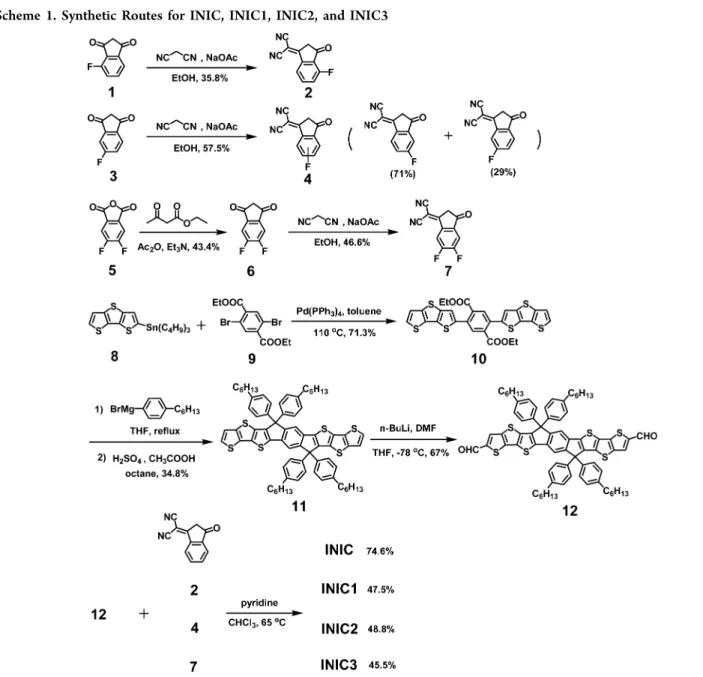
RESULTS AND DISCUSSIONSynthesis and Characterization. The fluorinated IC moieties (2, 4, and 7) were synthesized from corresponding monofluorinated or difluorinated indanedione (1,3, and6) and malononitrile (Scheme 1). Compound 4 is a mixture of two isomers, which was difficult to separate. Thus, we used them together for thefinal condensation reaction without separation.
Stille coupling reaction between compounds 8 and 9 with
Pd(PPh3)4 catalyst yielded compound 10. A double nucleo-philic addition of (4-hexylphenyl)magnesium bromide to the ester groups in 10, followed by intramolecular cyclization via acid-mediated Friedel−Crafts reaction afforded IBDT (11). Compound11was lithiated byn-butyllithium in THF solution at−78°C, then quenched by dry DMF to afford aldehyde12.
INIC, INIC1, INIC2 and INIC3 were synthesized using Knoevenagel condensation reactions between IC,2,4, 7 and
aldehyde 12, respectively. The new compounds were fully
characterized by spectroscopic methods and elemental analysis (see theSupporting Information).
The four INIC series compounds exhibit good solubility in
organic solvents, such as chloroform (CF) and o
-dichlor-obenzene (DCB). The thermal stability of these four molecules was investigated using thermogravimetric analysis (TGA)
(Figure S1, Supporting Information). The TGA curves of
four compounds show decomposition temperatures (Td, 5%
weight loss) varying from 302 to 342°C, which indicate good thermal stability.
The UV−vis absorption spectra of INIC, INIC1, INIC2, and INIC3 were measured in chloroform solution and thinfilms. In solution, four molecules show similar absorption spectra shapes with peaks from 692 to 710 nm (Figure 1a), and similar molar extinction coefficients from 2.1×10⁵to 2.5×10⁵M−1cm−1at maximum absorption peaks (Table 1). In thin films, all four molecules show red-shifted and broader absorption spectra than their solutions. The absorption peaks of these four
compounds red shift gradually from 706 to 744 nm (Figure
Cyclic voltammetry (CV) was employed to investigate the electrochemical properties of INIC, INIC1, INIC2, and INIC3 (Figure 1c). Four compounds exhibit irreversible reduction waves and quasi-reversible oxidation waves. The HOMO and LUMO energy levels are calculated from the onset oxidation and reduction potentials, assuming the absolute energy level of
FeCp2+/0 to be 4.8 eV below vacuum. The HOMO levels of
INIC, INIC1, INIC2 and INIC3 are estimated to be−5.45 eV
to −5.54 eV and LUMO levels are −3.88 eV to −4.02 eV
(Figure 1d,Table 1). Thefluorination downshifts the molecular
HOMO and LUMO levels. Specifically, INIC3 with two
fluorines has lower LUMO level than INIC1 and INIC2 with
onefluorine, whereas three fluorine-modified molecules show similar HOMO levels. The band gaps of INIC, INIC1, INIC2, and INIC3 estimated from the CV data are 1.57, 1.57, 1.54, and 1.50 eV, respectively, similar to the optical band gaps.
The electron mobilities of four compounds were measured using the space charge-limited current (SCLC) method (Figure S2). The electron mobilities of INIC, INIC1, INIC2 and INIC3 are 6.1×10⁻⁵, 1.0×10⁻⁴, 1.2×10⁻⁴, and 1.7×10⁻⁴cm2V−1
s−1, respectively (Table S1). Fluorinated compounds, partic-ularly difluorinated INIC3, exhibit higher mobility.
Photovoltaic Properties. Our previously reported wide-band-gap (2.00 eV) polymer donor FTAZ exhibits strong absorption at 400−620 nm with a molar extinction coefficient
of 9.8 × 10⁴ M−1 cm−1, which is complementary with
absorption of INIC series (Figure S3).55The energy levels of
FTAZ (HOMO =−5.38 eV; LUMO =−3.17 eV) match with
those of INIC series (Figure 1d). FTAZ exhibits a high hole mobility of 1.2×10⁻³cm2V−1s−1,56matching with those of INIC series (Table S1). Thus, we used FTAZ as a donor and INIC series as acceptors to fabricate bulk heterojunction (BHJ) OSCs with a structure of indium tin oxide (ITO)/ZnO/
FTAZ:acceptor/MoOx/Ag. The optimized FTAZ/acceptor
weight ratio is 1:1.5 (Table S2). The optimized
1,8-diiodooctane (DIO) content is 0.25% DIO (v/v) (Table S3).
Table 2 summarizes the open circuit voltage (VOC), short
circuit current density (JSC), fill factor (FF), and PCE of the
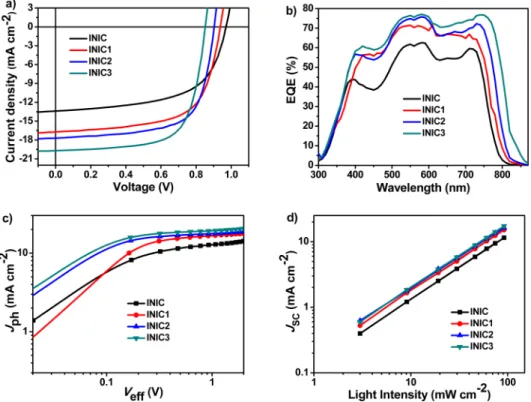
optimized devices. The current density−voltage (J−V) curves of the best PSCs are shown inFigure 2a.
Fluorination of INIC decreases average VOC of OSCs from 0.957 to 0.857 V, which is consistent with the trend of lowering
LUMO by fluorination in INIC series. The OSCs based on
nonfluorinated INIC show averageJSCvalue of 13.51 mA cm−2,
whilefluorination of INIC enhances averageJSCto 16.63−19.44 mA cm−2. In particular, the OSCs based on difluorinated INIC3
show the highestJSCof 19.68 mA cm−2. The trend infill factor
(FF) is similar to that in JSC. The OSCs based on
nonfluorinated INIC show average FF value of 57.9%, while fluorination of INIC enhances average FF to 64.3%−67.4%. In particular, the OSCs based on difluorinated INIC3 show the highest FF of 68.5%. The best PCE of the OSCs based on nonfluorinated INIC is 7.7%, while the best PCE of the OSCs
based on monofluorinated INIC1 and INIC2 is 10.1% and
10.8%, respectively. The OSCs based on difluorinated INIC3 show the best performance:VOC of 0.852 V,JSCof 19.68 mA
cm−2, FF of 68.5%, and PCE of 11.5%. Clearly, fluorination of INIC significantly enhances the performance of nonfullerene OSCs. The photon energy loss (Eloss) is calculated using the formulaEloss=Eg−eVOC.57,58TheElossvalues of the OSCs are 0.61−0.63 eV, which are relatively small.
The external quantum efficiency (EQE) spectra of the
optimized devices are shown inFigure 2b. The OSCs based on these four INIC acceptors show broad photoresponse extending from 300 to 850 nm. The maximum EQE values of INIC, INIC1, INIC2 and INIC3-based devices are 62.6%, Figure 1.(a) UV−vis absorption spectra of INIC, INIC1, INIC2, and INIC3 in chloroform and (b) as a thinfilm; (c) cyclic voltammograms for INIC, INIC1, INIC2, and INIC3; and (d) energy levels for FTAZ, INIC, INIC1, INIC2, and INIC3.
Table 1. Absorption and Energy Levels of INIC, INIC1, INIC2, and INIC3
compd Td(°C)a λs,max(nm)b λf,max(nm)c εmax(M−1cm−1)d Egopt(eV)e HOMO (eV)f LUMO (eV)g Egcv(eV)h
INIC 311 692 706 2.1×10⁵ 1.57 −5.45 −3.88 1.57
INIC1 302 710 720 2.2×10⁵ 1.56 −5.54 −3.97 1.57
INIC2 342 704 728 2.1×10⁵ 1.52 −5.52 −3.98 1.54
INIC3 327 710 744 2.5×10⁵ 1.48 −5.52 −4.02 1.50
aDecomposition temperature measured from TGA.bAbsorption maximum in solution.cAbsorption maximum infilm.dMolar extinction coefficient
atλmaxin solution.eOptical band gap calculated from the absorption edge of thinfilm.fHOMO energy level estimated from the onset oxidation
potential.gLUMO energy level estimated from the onset reduction potential.hHOMO−LUMO gap estimated from CV. Table 2. Performance of the Optimized OSCs Based on FTAZ/Acceptor
PCE (%)
devicea VOC(V) JSC(mA cm−2) FF (%) best avgb calculatedJSC(mA cm−2) Eloss(eV)
FTAZ/INIC 0.957±0.006 13.51±0.18 57.9±1.3 7.7 7.5 13.00 0.61
FTAZ/INIC1 0.929±0.003 16.63±0.06 64.3±0.4 10.1 9.9 15.93 0.63 FTAZ/INIC2 0.903±0.004 17.56±0.20 66.8±0.9 10.8 10.6 17.17 0.62 FTAZ/INIC3 0.857±0.003 19.44±0.24 67.4±1.0 11.5 11.2 19.13 0.62
71.5%, 75.8 and 77.0%, respectively, indicating efficient charge generation and collection. In the NIR region, the IPCE spectra are broadened and enhanced gradually from INIC to INIC1, INIC2 and INIC3, resembling the absorption profile of the four INIC acceptors in the NIR region (Figure 1b). TheJSCvalues
of INIC, INIC1, INIC2 and INIC3-based devices calculated from integration of the EQE spectra with the AM 1.5G reference spectrum are 13.00, 15.93, 17.17, and 19.13 mA cm−2, respectively, which are in good agreement with JSC values
measured fromJ−V(the error is <5%,Table 2).
To probe the exciton/charge dynamics, we measured the photocurrent density (Jph) versus the effective voltage (Veff) to
study the charge generation, dissociation and extraction properties. Jph is defined as JL − JD, where JL and JD are the photocurrent densities under illumination and in the dark, respectively.Veffis defined asV0−Vbias, whereV0is the voltage at which photocurrent is zero and Vbiasis the applied voltage bias. InFigure 2c,Jphreaches saturation (Jsat) at 2 V, suggesting
the charge recombination reach the minimal level and all the charge are collected by the electrodes. The charge dissociation probability (P(E, T)) can be calculated from Jph/Jsat. Under
short-circuit condition, the P(E, T) of INIC, INIC1, INIC2, and INIC3 based OSCs are 94.5%, 94.1%, 94.2%, and 95.5%, respectively, indicating efficient charge dissociation and collection for all four INIC based OSCs.
We also measured theJSCversus light density (P) curves to
study charge recombination behavior (Figure 2d). The
relationship between JSC and P can be described as JSC ∝ Pα.59 If all the charges are swept out and collected by the electrode before recombination,αshould be equal to 1, whileα < 1 means the existence of charge recombination. Theαvalues of INIC, INIC1, INIC2, and INIC3-based OSCs are 0.983, 0.976, 0.981, and 0.98, respectively, suggesting negligible bimolecular charge recombination at the short circuit condition.
The hole mobility and electron mobility of the four blended films were measured using the SCLC method (Figure S4). The FTAZ:fluorinated INIC blends exhibit higher electron mobility than the FTAZ: INIC blend (Table S4), resembling the trend in pure INIC series (Table S1). Since hole mobilities of all the blendedfilms are similar (1.8×10⁻⁴−3.0×10⁻⁴cm2V−1s−1),
the FTAZ/INIC blend shows unbalanced charge transport (μh/ μe= 13), while the FTAZ/fluorinated INIC blends show more
balanced charge transport (μh/μe= 1.4−2.4). Thus, the higher
electron mobility and more balanced charge transport in the FTAZ:fluorinated INIC blends are one of the reasons for the
higher JSC and higher FF in these fluorinated INIC-based
devices (Table 2).
Film Morphology and Microstructure. To understand
the active layer morphology, we first used atomic force
microscope (AFM) to obtain the height and phase images of these four active layers (Figure S5). All four active layers (thin films) exhibit smooth surface morphology with a
root-mean-square (RMS) roughness of 0.54−0.9 nm. We next employed
grazing-incidence wide-angle and small-angle X-ray scattering (GIWAXS and GISAXS) measurements to probe the bulk morphology of these thin films.60,61 Figure 3a shows 2D GIWAXS patterns of FTAZ/INIC, FTAZ/INIC1, FTAZ/
INIC2, and FTAZ/INIC3 thinfilms. Thefilms of FTAZ/INIC,
FTAZ/INIC1, and FTAZ/INIC2 exhibit preferential“face-on” oriented molecular packing with the lamellar peak located atqr ≈0.32 Å−1and theπ−πpeak located atq
z≈1.7 Å−1(Figure 3b), which agree with the corresponding peak positions of pure FTAZ (Figure S6), indicating that the mixing of FTAZ and INIC/INIC1/INIC2 preserves the favorable“face-on”oriented FTAZ semicrystalline domains. Interestingly, the GIWAXS pattern of FTAZ:INIC3 is dramatically different: the face-on oriented domains present a sharp lamella peak atqr≈0.29 Å−1
and a π−π peak at qz ≈1.84 Å−1, agreeing with the
corresponding lattice constants of pure INIC3 (Figure S6). Figure 2.(a)J−Vcharacteristics and (b) EQE spectra of the best OSCs under illumination of an AM 1.5 G at 100 mW cm−2; (c)J
phversusVeff
Therefore, the lamella peak appearing atqz= 0.42 Å−1, clearly
visible in the out-of-plane direction (Figure 3b, right), should be assigned to“edge-on”oriented FTAZ domains. Notice that the lattice constant of FTAZ shrinks a lot (d= 2π/q= 15.0 Å) compared with that of otherfilms (d= 19.6 Å), indicating that the cocrystallization of FTAZ and INIC3 leads to a tighter
packing of FTAZ. Thus, FTAZ/INIC3 blend films not only
exhibit highest crystallinity compared with other three counterparts, but also maintain both FTAZ and INIC3 semicrystalline packings. Although FTAZ domains reorient into relatively unfavorable “edge-on” orientation, INIC3 domains remain in the favorable“face-on” orientation. This is consistent with the highest electron mobility and more balanced electron and hole mobility observed in the FTAZ/ INIC3 blendfilm.
Figures 3c and S7 present 2D GISAXS patterns, GISAXS intensity profiles and bestfittings along the in-plane direction of pure FTAZ, pure acceptors and the FTAZ/acceptor blends. We
adopt the Debye−Anderson−Brumberger (DAB) model, a
polydispersed hard sphere model and a fractal-like network
model61 to account for the scattering contribution from
intermixing amorphous phases, FTAZ domains and acceptor domains, respectively. The FTAZ domains remain the same for the four blends (∼4.5 nm) and the acceptor domains are 15.6, 14.5, 23.1, and 17.6 nm for INIC, INIC1, INIC2, and INIC3, respectively. The correlation lengths of the intermixing phase are 32.6, 27.0, 39.0, and 42.0 nm for FTAZ/INIC, FTAZ/ INIC1, FTAZ/INIC2, and FTAZ/INIC3, respectively. These results suggest that the nanoscale phase separation of all four films is in a reasonable range for efficient exciton dissociation. The stronger crystallinity of INIC3 does not lead to undesirable micron size aggregation as observed in some small molecule acceptors with strong crystallinity.62
■
CONCLUSIONSIn summary, four new fused-ring electron acceptors (FREAs), INIC, INIC1, INIC2, and INIC3, based on a fused-nonacyclic IBDT core end-capped with nonfluorinated or fluorinated IC were designed and synthesized for application in nonfullerene OSCs. These four molecules have strong absorption in the visible and even near-infrared region with high extinction coefficients of 2.1−2.5 × 10⁵ M−1 cm−1. Three fluorinated molecules INIC1, INIC2, and INIC3 show red-shifted absorption and lower HOMO/LUMO energy levels relative
to the nonfluorinated INIC due to electron-withdrawing
property of fluorine. The fluorinated molecules, particularly the difluorinated INIC3, have higher electron mobilities than INIC withoutfluorine substitution. FTAZ/INIC3 blend films not only exhibit highest crystallinity compared with other three counterparts, but also maintain both FTAZ and INIC3 semicrystalline packings, possibly due to fluorine-induced intermolecular interactions. This is the main reason for the highest electron mobility and more balanced electron and hole
mobility observed in the FTAZ/INIC3 blend film. The
nanoscale phase separation of all the films is in a reasonable range for efficient exciton dissociation, and the stronger crystallinity of INIC3 does not lead to undesirable micrometer size aggregation. Since the wide-band-gap polymer donor FTAZ and the narrow-band-gap INIC series acceptors exhibit complementary absorption, matched energy levels and matched mobility, the nonfullerene OSCs based on FTAZ/INIC series blends exhibit small energy loss of 0.61−0.63 eV, yet efficient charge dissociation and collection, negligible bimolecular charge recombination, and finally high PCEs of 7.7−11.5%. Fluorination of INIC significantly enhances the PCE from 7.7% to >10%, in particular, the OSCs based on difluorinated INIC3 show the best PCE of 11.5%. These results demonstrate the great potential of the new IBDT and fluorinated IC building blocks for constructing high-performance nonfullerene accept-ors.
■
ASSOCIATED CONTENT*
S Supporting InformationThe Supporting Information is available free of charge on the
ACS Publications websiteat DOI:10.1021/jacs.6b12755. Detailed experimental procedures including synthesis, characterization and device fabrication, and additional characterization data, such as TGA, SCLC, AFM,
GIWAXS, and GISAXS (PDF)
■
AUTHOR INFORMATIONCorresponding Author
*[email protected] ORCID
Xiaowei Zhan:0000-0002-1006-3342
Notes
The authors declare no competingfinancial interest.
■
ACKNOWLEDGMENTSX.Z. wish to thank the 973 Program (No. 2013CB834702) and the NSFC (No. 91433114). T.L. and X.L. acknowledge the
financial support from RGC of Hong Kong GRF (No.
14303314) and CUHK Direct Grant (No. 4053128). Q.Z., and W.Y. were supported by the Office of Naval Research (No. N000141410221) and NSF (No. DMR-1507249).
■
REFERENCES(1) Cheng, Y. J.; Yang, S. H.; Hsu, C. S.Chem. Rev.2009,109, 5868. (2) Lu, L.; Zheng, T.; Wu, Q.; Schneider, A. M.; Zhao, D.; Yu, L.
Chem. Rev.2015,115, 12666.
(3) Lin, Y.; Zhan, X.Acc. Chem. Res.2016,49, 175.
(4) Chen, C.-C.; Chang, W.-H.; Yoshimura, K.; Ohya, K.; You, J.; Gao, J.; Hong, Z.; Yang, Y.Adv. Mater.2014,26, 5670.
(5) Zhou, H.; Zhang, Y.; Mai, C. K.; Collins, S. D.; Bazan, G. C.; Nguyen, T. Q.; Heeger, A. J.Adv. Mater.2015,27, 1767.
(6) Zhao, J.; Li, Y.; Yang, G.; Jiang, K.; Lin, H.; Ade, H.; Ma, W.; Yan, H.Nat. Energy2016,1, 15027.
(7) Li, M.; Gao, K.; Wan, X.; Zhang, Q.; Kan, B.; Xia, R.; Liu, F.; Yang, X.; Feng, H.; Ni, W.; Wang, Y.; Peng, J.; Zhang, H.; Liang, Z.; Yip, H.-L.; Peng, X.; Cao, Y.; Chen, Y. Nat. Photonics 2016,
DOI: 10.1038/nphoton.2016.240.
(8) Zhan, X.; Facchetti, A.; Barlow, S.; Marks, T. J.; Ratner, M. A.; Wasielewski, M. R.; Marder, S. R.Adv. Mater.2011,23, 268.
(9) Lin, Y.; Zhan, X.Mater. Horiz.2014,1, 470.
(10) Zhong, Y.; Trinh, M. T.; Chen, R.; Purdum, G. E.; Khlyabich, P. P.; Sezen, M.; Oh, S.; Zhu, H.; Fowler, B.; Zhang, B.; Wang, W.; Nam, C. Y.; Sfeir, M. Y.; Black, C. T.; Steigerwald, M. L.; Loo, Y. L.; Ng, F.; Zhu, X. Y.; Nuckolls, C.Nat. Commun.2015,6, 8242.
(11) Zhong, Y.; Trinh, M. T.; Chen, R.; Wang, W.; Khlyabich, P. P.; Kumar, B.; Xu, Q.; Nam, C.-Y.; Sfeir, M. Y.; Black, C.; Steigerwald, M. L.; Loo, Y.-L.; Xiao, S.; Ng, F.; Zhu, X. Y.; Nuckolls, C.J. Am. Chem. Soc.2014,136, 15215.
(12) Wu, Q.; Zhao, D.; Schneider, A. M.; Chen, W.; Yu, L.J. Am. Chem. Soc.2016,138, 7248.
(13) Meng, D.; Sun, D.; Zhong, C.; Liu, T.; Fan, B.; Huo, L.; Li, Y.; Jiang, W.; Choi, H.; Kim, T.; Kim, J. Y.; Sun, Y.; Wang, Z.; Heeger, A. J.J. Am. Chem. Soc.2016,138, 375.
(14) Meng, D.; Fu, H.; Xiao, C.; Meng, X.; Winands, T.; Ma, W.; Wei, W.; Fan, B.; Huo, L.; Doltsinis, N. L.; Li, Y.; Sun, Y.; Wang, Z.J. Am. Chem. Soc.2016,138, 10184.
(15) Sun, D.; Meng, D.; Cai, Y.; Fan, B.; Li, Y.; Jiang, W.; Huo, L.; Sun, Y.; Wang, Z.J. Am. Chem. Soc.2015,137, 11156.
(16) Lee, J.; Singh, R.; Sin, D. H.; Kim, H. G.; Song, K. C.; Cho, K.
Adv. Mater.2016,28, 69.
(17) Zhong, H.; Wu, C.-H.; Li, C.-Z.; Carpenter, J.; Chueh, C.-C.; Chen, J.-Y.; Ade, H.; Jen, A. K. Y.Adv. Mater.2016,28, 951.
(18) Lin, H.; Chen, S.; Hu, H.; Zhang, L.; Ma, T.; Lai, J. Y.; Li, Z.; Qin, A.; Huang, X.; Tang, B.; Yan, H.Adv. Mater.2016,28, 8546.
(19) Liu, Y.; Mu, C.; Jiang, K.; Zhao, J.; Li, Y.; Zhang, L.; Li, Z.; Lai, J. Y.; Hu, H.; Ma, T.; Hu, R.; Yu, D.; Huang, X.; Tang, B. Z.; Yan, H.
Adv. Mater.2015,27, 1015.
(20) Liu, J.; Chen, S.; Qian, D.; Gautam, B.; Yang, G.; Zhao, J.; Bergqvist, J.; Zhang, F.; Ma, W.; Ade, H.; Inganäs, O.; Gundogdu, K.; Gao, F.; Yan, H.Nat. Energy2016,1, 16089.
(21) Zhang, X.; Lu, Z.; Ye, L.; Zhan, C.; Hou, J.; Zhang, S.; Jiang, B.; Zhao, Y.; Huang, J.; Zhang, S.; Liu, Y.; Shi, Q.; Liu, Y.; Yao, J.Adv. Mater.2013,25, 5791.
(22) Zhan, X.; Tan, Z. a.; Domercq, B.; An, Z.; Zhang, X.; Barlow, S.; Li, Y.; Zhu, D.; Kippelen, B.; Marder, S. R.J. Am. Chem. Soc. 2007,
129, 7246.
(23) Lin, Y.; Wang, Y.; Wang, J.; Hou, J.; Li, Y.; Zhu, D.; Zhan, X.
Adv. Mater.2014,26, 5137.
(24) Sharenko, A.; Proctor, C. M.; van der Poll, T. S.; Henson, Z. B.; Nguyen, T.-Q.; Bazan, G. C.Adv. Mater.2013,25, 4403.
(25) Shivanna, R.; Shoaee, S.; Dimitrov, S.; Kandappa, S. K.; Rajaram, S.; Durrant, J. R.; Narayan, K. S.Energy Environ. Sci.2014,7, 435.
(26) Guo, Y.; Li, Y.; Awartani, O.; Zhao, J.; Han, H.; Ade, H.; Zhao, D.; Yan, H.Adv. Mater.2016,28, 8483.
(27) Hartnett, P. E.; Timalsina, A.; Matte, H. S.; Zhou, N.; Guo, X.; Zhao, W.; Facchetti, A.; Chang, R. P.; Hersam, M. C.; Wasielewski, M. R.; Marks, T. J.J. Am. Chem. Soc.2014,136, 16345.
(28) Gao, L.; Zhang, Z. G.; Xue, L.; Min, J.; Zhang, J.; Wei, Z.; Li, Y.
Adv. Mater.2016,28, 1884.
(29) Earmme, T.; Hwang, Y.-J.; Murari, N. M.; Subramaniyan, S.; Jenekhe, S. A.J. Am. Chem. Soc.2013,135, 14960.
(30) Li, H.; Hwang, Y.-J.; Courtright, B. A. E.; Eberle, F. N.; Subramaniyan, S.; Jenekhe, S. A.Adv. Mater.2015,27, 3266.
(31) Li, H.; Kim, F. S.; Ren, G.; Hollenbeck, E. C.; Subramaniyan, S.; Jenekhe, S. A.Angew. Chem., Int. Ed.2013,52, 5513.
(32) Zhou, E.; Cong, J.; Hashimoto, K.; Tajima, K.Adv. Mater.2013,
25, 6991.
(33) Zhou, Y.; Kurosawa, T.; Ma, W.; Guo, Y.; Fang, L.; Vandewal, K.; Diao, Y.; Wang, C.; Yan, Q.; Reinspach, J.; Mei, J.; Appleton, A. L.; Koleilat, G. I.; Gao, Y.; Mannsfeld, S. C. B.; Salleo, A.; Ade, H.; Zhao, D.; Bao, Z.Adv. Mater.2014,26, 3767.
(34) Zhou, Y.; Ding, L.; Shi, K.; Dai, Y. Z.; Ai, N.; Wang, J.; Pei, J.
Adv. Mater.2012,24, 957.
(35) Dou, C.; Long, X.; Ding, Z.; Xie, Z.; Liu, J.; Wang, L.Angew. Chem., Int. Ed.2016,55, 1436.
(36) Lin, Y.; Wang, J.; Zhang, Z.-G.; Bai, H.; Li, Y.; Zhu, D.; Zhan, X.
Adv. Mater.2015,27, 1170.
(37) Lin, Y.; Zhao, F.; He, Q.; Huo, L.; Wu, Y.; Parker, T. C.; Ma, W.; Sun, Y.; Wang, C.; Zhu, D.; Heeger, A. J.; Marder, S. R.; Zhan, X.J. Am. Chem. Soc.2016,138, 4955.
(38) Lin, Y.; He, Q.; Zhao, F.; Huo, L.; Mai, J.; Lu, X.; Su, C. J.; Li, T.; Wang, J.; Zhu, J.; Sun, Y.; Wang, C.; Zhan, X.J. Am. Chem. Soc.
2016,138, 2973.
(39) Holliday, S.; Ashraf, R. S.; Wadsworth, A.; Baran, D.; Yousaf, S. A.; Nielsen, C. B.; Tan, C. H.; Dimitrov, S. D.; Shang, Z.; Gasparini, N.; Alamoudi, M.; Laquai, F.; Brabec, C. J.; Salleo, A.; Durrant, J. R.; McCulloch, I.Nat. Commun.2016,7, 11585.
(40) Liu, W.; Li, S.; Huang, J.; Yang, S.; Chen, J.; Zuo, L.; Shi, M.; Zhan, X.; Li, C.-Z.; Chen, H.Adv. Mater.2016,28, 9729.
(41) Bin, H.; Zhang, Z. G.; Gao, L.; Chen, S.; Zhong, L.; Xue, L.; Yang, C.; Li, Y.J. Am. Chem. Soc.2016,138, 4657.
(42) Bin, H.; Gao, L.; Zhang, Z.-G.; Yang, Y.; Zhang, Y.; Zhang, C.; Chen, S.; Xue, L.; Yang, C.; Xiao, M.; Li, Y.Nat. Commun.2016,7, 13651.
(43) Yang, Y.; Zhang, Z. G.; Bin, H.; Chen, S.; Gao, L.; Xue, L.; Yang, C.; Li, Y.J. Am. Chem. Soc.2016,138, 15011.
(44) Baran, D.; Ashraf, R. S.; Hanifi, D. A.; Abdelsamie, M.; Gasparini, N.; Rohr, J. A.; Holliday, S.; Wadsworth, A.; Lockett, S.; Neophytou, M.; Emmott, C. J. M.; Nelson, J.; Brabec, C. J.; Amassian, A.; Salleo, A.; Kirchartz, T.; Durrant, J. R.; McCulloch, I.Nat. Mater.
2016,DOI: 10.1038/nmat4797.
(45) Li, S.; Ye, L.; Zhao, W.; Zhang, S.; Mukherjee, S.; Ade, H.; Hou, J.Adv. Mater.2016,28, 9423.
(46) Yao, H.; Chen, Y.; Qin, Y.; Yu, R.; Cui, Y.; Yang, B.; Li, S.; Zhang, K.; Hou, J.Adv. Mater.2016,28, 8283.
(47) Li, Z.; Jiang, K.; Yang, G.; Lai, J. Y.; Ma, T.; Zhao, J.; Ma, W.; Yan, H.Nat. Commun.2016,7, 13094.
Gao, F.; Wei, Z.; Ma, W.; Wang, C.; Hodgkiss, J.; Bo, Z.; Inganas, O.; Li, Y.; Zhan, X.Adv. Mater.2016,DOI: 10.1002/adma.201604155.
(49) Lin, Y.; Zhang, Z.-G.; Bai, H.; Wang, J.; Yao, Y.; Li, Y.; Zhu, D.; Zhan, X.Energy Environ. Sci.2015,8, 610.
(50) Wu, Y.; Bai, H.; Wang, Z.; Cheng, P.; Zhu, S.; Wang, Y.; Ma, W.; Zhan, X.Energy Environ. Sci.2015,8, 3215.
(51) Cheng, P.; Zhang, M.; Lau, T.; Wu, Y.; Jia, B.; Wang, J.; Yan, C.; Qin, M.; Lu, X.; Zhan, X. Adv. Mater. 2016, DOI: 10.1002/ adma.201605216.
(52) Lei, T.; Xia, X.; Wang, J.-Y.; Liu, C.-J.; Pei, J.J. Am. Chem. Soc.
2014,136, 2135.
(53) Sakamoto, Y.; Komatsu, S.; Suzuki, T.J. Am. Chem. Soc.2001,
123, 4643.
(54) Kim, H. G.; Kang, B.; Ko, H.; Lee, J.; Shin, J.; Cho, K.Chem. Mater.2015,27, 829.
(55) Price, S. C.; Stuart, A. C.; Yang, L.; Zhou, H.; You, W.J. Am. Chem. Soc.2011,133, 4625.
(56) Li, W.; Albrecht, S.; Yang, L.; Roland, S.; Tumbleston, J. R.; McAfee, T.; Yan, L.; Kelly, M. A.; Ade, H.; Neher, D.; You, W.J. Am. Chem. Soc.2014,136, 15566.
(57) Veldman, D.; Meskers, S. C. J.; Janssen, R. A. J.Adv. Funct. Mater.2009,19, 1939.
(58) Kawashima, K.; Fukuhara, T.; Suda, Y.; Suzuki, Y.; Koganezawa, T.; Yoshida, H.; Ohkita, H.; Osaka, I.; Takimiya, K.J. Am. Chem. Soc.
2016,138, 10265.
(59) Schilinsky, P.; Waldauf, C.; Brabec, C. J.Appl. Phys. Lett.2002,
81, 3885.
(60) Lu, X.; Hlaing, H.; Germack, D. S.; Peet, J.; Jo, W. H.; Andrienko, D.; Kremer, K.; Ocko, B. M.Nat. Commun.2012,3, 795. (61) Mai, J.; Lau, T.-K.; Li, J.; Peng, S.-H.; Hsu, C.-S.; Jeng, U. S.; Zeng, J.; Zhao, N.; Xiao, X.; Lu, X.Chem. Mater.2016,28, 6186.