The Slow Orbital Evolution of the Accreting Millisecond Pulsar IGR J0029
+
5934
Alessandro Patruno1,2 1
Leiden Observatory, Leiden University, Neils Bohrweg 2, 2333 CA, Leiden, The Netherlands 2
ASTRON, the Netherlands Institute for Radio Astronomy, Postbus 2, 7900 AA, Dwingeloo, The Netherlands Received 2016 September 5; revised 2017 March 24; accepted 2017 March 24; published 2017 April 13
Abstract
The accreting millisecond pulsars IGR J00291+5934 and SAX J1808.4–3658 are two compact binaries with very similar orbital parameters. The latter has been observed to evolve on a very short timescale of∼70 Myr, which is more than an order of magnitude shorter than expected. There is an ongoing debate on the possibility that the pulsar spin-down power ablates the companion, generating large amounts of mass-loss in the system. Therefore it is interesting to study whether IGR J00291+5934 does show a similar behavior as its twin system SAX J1808.4–3658. In this work we present thefirst constraints on the orbital period derivative of IGR J00291+5934. By usingXMM-Newtondata recorded during the 2015 outburst and adding the previous results of the 2004 and 2008 outbursts, we are able to measure a 90% confidence level allowed range of- ´5 10-13<P˙b<6´10-13.
This implies that the binary is evolving on a timescale longer than 0.5 Gyr, which is compatible with the expected timescale of mass transfer driven by angular momentum loss via gravitational radiation. We discuss the scenario in which the power loss from magnetic dipole radiation of the neutron star is hitting the companion star. If this model is applied to SAX J1808.4–3658, then the difference in orbital behavior can be ascribed to a different efficiency for the conversion of the spin-down power into energetic relativistic pulsar wind and X-ray/gamma-ray radiation for the two pulsars, with IGR J00291+5934 requiring an extraordinarily low efficiency of less than∼5% to explain the observations. We thus conclude that the pulsar wind ablation model is unlikely to be an accurate description of the mechanism driving the orbital evolution of the two systems.
Key words:binaries: general –stars: individual(IGR J00291+5934)–stars: neutron– stars: rotation–X-rays: stars
1. Introduction
The accreting millisecond X-ray pulsar (AMXP) IGR J00291+5934 is a peculiar transient X-ray binary for two reasons. The first is that it is the fastest spinning known accreting pulsar, with a spin frequency ofν≈599 Hz. Despite it being still far from the 716 Hz record holder PSR J1748-2446AD(Hessels et al.2006), IGR J00291+5934 has shown a measurable spin-up during one outburst in 2004 and spin-down during quiescence, which allows the determination of its spin evolution over few years’ timescale (Burderi et al. 2006; Patruno 2010; Hartman et al. 2011; Papitto et al. 2011). The second reason, which is also the main motivation of this work, is that when looking at its orbital parameters, IGR J00291
+5934 is basically a twin system with the other well-known AMXP SAX J1808.4–3658 (Chakrabarty & Morgan 1998; Wijnands & van der Klis1998; see also Table1 in Patruno & Watts 2012 for a comparison). IGR J00291+5934 was first discovered during an outburst in 2004 December (Galloway et al. 2005; Shaw et al. 2005), and it has been observed in outburst again in 2008 (Lewis et al. 2010; Patruno 2010; Hartman et al. 2011; Papitto et al. 2011) and 2015 (Sanna et al.2015). Its 2008 outburst showed a peculiar behavior, with afirst short outburst lasting≈5 days, followed within 1 month by a second 12-day-long outburst (Patruno 2010; Hartman et al.2011). The source has a radio counterpart(Pooley2004), and its astrometric position has been determined with great accuracy(≈0 04, Rupen et al.2004). The binary has an orbital period of 2.46 hr, so that its orbit is expected to evolve because of angular momentum loss from gravitational wave emission
(see, e.g., Paczyński1971; Bildsten & Chakrabarty 2001). Its companion star has a minimum mass of 0.039M, with a
detected optical counterpart both during outburst (Fox & Kulkarni2004)and quiescence(D’Avanzo et al.2007; Jonker et al.2008; Torres et al.2008). In particular, careful modeling of the optical counterpart in quiescence has shown that the donor is almost certainly irradiated by a source of energy that is much more powerful(by a factor≈50–100)than the quiescent X-ray luminosity available to the system (D’Avanzo et al.2007). The irradiation of the donor from a pulsar wind is a particularly interesting scenario, because it has been suggested as the mechanism at the origin of the peculiar orbital evolution of SAX J1808.4–3658(di Salvo et al.2008; Burderi et al. 2009), which is expanding on a very short timescale of
≈70 Myr instead of the expected billion years predicted by the theory of angular momentum loss from gravitational waves
(Hartman et al.2008; Patruno et al.2012,2016).
In this work we analyze the data from a new set of observations carried out by the XMM-Newton observatory during the last 2015 July/August outburst of IGR J00291
+5934. We focus on the orbital evolution of the system, since the number of outbursts and the length of the observational baseline are now sufficient to measure the orbital period evolution of the binary. Since IGR J00291+5934 and SAX J1808.4–3658 share so many similarities, it is plausible to expect a similar orbital period evolution for both systems, and in this paper we test this hypothesis.
2. Data Analysis
source on 2015 July 28 at 11:48:19 and ended its task on 2015 July 29 at 11:51:02 UT.
We used the European Photon Imaging Camera (EPIC), which is composed of two MOS CCDs(Turner et al.2001)and a pn camera (Strüder et al.2001) sensitive in the 0.1–12 keV range. In this work we use only the EPIC-pn data, which are recorded in TIMING mode, with sampling time of about 29.56μs, sufficient to clearly detect the accretion powered pulsations. The data are processed using SAS version 15.0.0, with the most up-to-date calibration files (CCF) available on 2016 September.
Standard data screening criteria3 were applied in the extraction of scientific products, with a 0.3–10 keV energy range selected and a net exposure of 72 ks(after removing solar
flares and telemetry dropouts). Photons are extracted in a rectangular region with a width of 6 pixels centered around the RAW coordinate 38, and only when the PATTERN=0. The background is obtained from a region of the same size, at RAWX 2-8. The data are barycentered using the SAS tool
barycen, with the source coordinates of Rupen et al.(2004). The pulsations are folded in pulse profiles of 32 bins, with a length of ≈500 s each, using a circular Keplerian orbit and a constant pulse frequency. The first-guess ephemeris are taken from the 2004 outburst(see, e.g., Patruno2010), with the time of passage to the ascending node (Tasc) updated from Kuiper et al. (2015), which performed a first timing analysis of the 2015 outburst withINTEGRALdata.
3. Results
Since the pulse profiles of IGR J00291+5934 are nearly sinusoidal, we define the pulse time of arrivals(ToAs)as the peak of the sinusoid of each profile. We thenfit the ToAs with the software TEMPO2 (v. 2016.05.0; Hobbs et al. 2006) by using a constant pulse frequency plus a constant circular Keplerian orbit(ELL1 model). We then refine the ephemeris by iterating the procedure until convergence is achieved. We refer to the pulse frequency (observable) as distinct from the spin frequency, since it has been shown that the X-ray flux has an influence of the pulse ToAs and might affect the determination of the correct spin frequency up to several tenths of μHz
(Hartman et al.2008; Patruno et al. 2009; Patruno2010). We
find a pulse frequency of ν=598.89213099(6)Hz, and no pulse frequency derivative is detected with∣ ˙ ∣n <10-11Hz s-1
at the 95% confidence level.
To detect the evolution of the orbit we instead follow the procedure already outlined in Patruno et al.(2012)and Patruno et al. (2016), which is also used in di Salvo et al. (2008); Hartman et al.(2008,2009); Burderi et al.(2009,2010); Sanna et al.(2016)—that is, we select all four measuredTascfrom the
2004, the double 2008, and the 2015 outbursts, and we use the quantityDTasc=Tasc,i-(Tasc,ref +N Pb), whereTasc,irefers to theith outburst,Nis the closest integer to(Tasc,i-Tasc,ref) Pb, andPbis the orbital period. Since the best determination ofPb is made in 2004, we use that outburst as the reference one in ourfirst set of calculations(see, e.g., Table3 in Patruno2010). We use a polynomial expansion to describe the evolution of the
time of passage through the ascending node:
= + + +
( ) ˙ ( )
T N T P N 1P P N
2 ... . 1
b b b
asc asc,ref 2
In our analysis wefirst calculate the differential correction to the orbital periodδPbbyfittingDTasc with a linear function
d
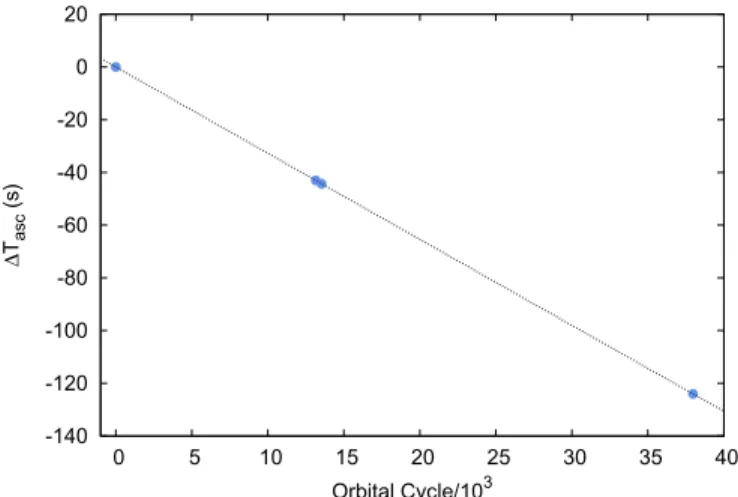
DTasc= P Nb . The fit gives δPb=3.266(2) ms with a
χ2/dof=0.15/3 (see Figure 1). The very smallχ2indicates
that the statistical errors on the fitted parameters, which are calculated for aΔχ2=1, are unrealistic. The 2004 and 2015 outbursts have errors on Tasc, which are a factor of a few
smaller than the two 2008 outbursts. Therefore, whenfitting a linear function, there is little contribution from the 2008 data points and the fit gives a very small χ2. To take this into account, we proceed in two independent ways. Thefirst is to explore the χ2 surface of the fit and then select the 68% confidence intervals that correspond to Δχ2=1. The linear trend is very evident, so we use the best-fitδPbto correct the orbital period. We then re-analyze the data published in Patruno(2010)for the entire data set recorded for IGR J00291
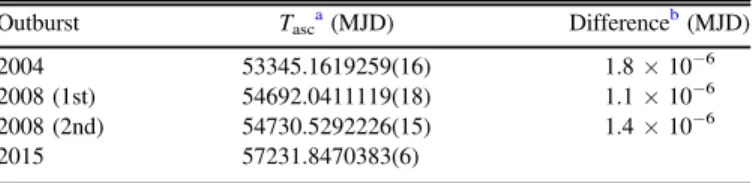
+5934, by folding the 2004, 2008, and 2015 data with the new orbital period andfitting the ToAs of each of the four outbursts with a Keplerian orbit where Pbis now fixed (as well as the projected semimajor axis of the orbit4), and we fit onlyTasc. This gives a new set of improved5 Tasc, which we report in
Table1.
We then inspect the newΔTascto see whether residual trends
are visible. For example, in SAX J1808.4–3658 a clear polynomial trend is observed (di Salvo et al. 2008; Hartman et al.2008; Patruno et al.2012,2016), which is interpreted as an expansion of the orbit. The residual trend is plotted in2. The plot shows very little structure, which is indicative of a very slow variation of the orbit. The data can indeed be wellfitted with a constant consistent with zero. Afit with a linear(constantPb)or with a quadratic polynomial(Pband P˙b) gives both the linear and the quadratic term consistent with zero(see Figure2). We Figure 1.Differential corrections to the time of passage through the ascending node found when using the value ofTasc, as reported in Patruno(2010). A
linear trend(dotted line)is visible and can be wellfitted by shifting the orbital period by ≈3.3 ms. The error bars of the data are smaller than the symbols used.
3
See https://xmm-tools.cosmos.esa.int/external/xmm_user_support/ documentation/uhb/index.html.
4
We also tried to detect variations of the projected semimajor axes of the orbit a1. The four a1 show no trend and are well fit by a constant
(χ2
/dof=4.2/3). 5
The magnitude of the errors on each individualTascdepends on both the
therefore can set a 90% confidence interval for any orbital period derivative of- ´5 10-13<P˙b<6 ´10-13. This means that
the orbital evolution timescale of IGR J00291+5934 is at least
t> P˙ ~0.5 Gyr
P b
b . Thefinal orbital ephemeris of IGR J00291
+5934 are reported in Table2.
The second method used was to combine all the data from 2004 up to 2015 in a single sequence of ToAs and fit a Keplerian orbital solution with a P˙b term with TEMPO2. The orbit can be phase-connected because the total number of cycles observed isNcycles≈40,000 and the initial error on our
orbital period is sPb=0.002 s (the 2004 orbital period; see
Patruno2010), so thatsPbP Nb cycles»0.2 s. We stress that
the pulse frequency (and its first time derivative) are very weakly covariant with the Keplerian parameters, so that any unmodeled trend in the neutron star spin is not affecting the determination of the orbital solution. Indeed, by calculating the covariance matrix between the orbital and the spin parameters, we find that the degree of correlation between any orbital element (Tasc, Pb, P˙b, and a1) and the spin parameters (spin frequency and first time derivative) is always smaller than
≈0.2. The results are fully compatible within 1 sigma with those reported in Table2, and also give compatible statistical uncertainties and confidence intervals.
4. Discussion
The orbital evolution of IGR J00291+5934 proceeds on a timescale>500 Myr, which is in line with the expectation of a binary evolving via angular momentum loss caused by gravitational wave radiation. Indeed, in this case, the evolu-tionary timescale is Paczyński(1971):
t = + +
- ⎛ ⎝
⎜ ⎞⎠⎟ ⎛⎝⎜ ⎞⎠⎟
( )
( ) q
q
M M
M
P 380 1
days Gyr. 2
b
gw
2
1 2
5 3 8 3
whereq=M2/M1 is the binary mass ratio, andM1andM2are
the neutron star and donor mass. If we use reasonable values of
M1=1.4M,M2=0.1M, thenq0.07 andtgw 7 Gyr,
consistent with the upper limits observed in this work. Although there is still the possibility that IGR J00291+5934 evolves on a timescale shorter than predicted(a factor∼10 is still allowed by our upper limits on P˙b), the binary seems to pose at the moment no challenge to the predicted behavior from the theory of binary evolution. However, when compared with the orbital evolution of the AMXP SAX J1808.4–3658, the results presented in this paper become difficult to interpret. Indeed the “twin” system SAX J1808.4–3658 has shown an expansion of the orbit with aP˙b»3.5´10-12, which is about
one order or magnitude larger than our allowed range on IGR J00291+5934. The interpretation of why the orbits of these two systems behave so differently is puzzling if we look at all other measured parameters of the two binaries. SAX J1808.4–3658 shows indeed very similar properties: its orbit is 2.01 hr, its minimum companion star is 0.043M ( Chakra-barty & Morgan 1998), and the companion is irradiated by a powerful source of energy (Homer et al. 2001; Deloye et al.2008; Wang et al.2013). It has been proposed that for both AMXPs, the source of extra irradiation comes from the spin-down power of the neutron star, which might turn on during quiescence and with its powerful wind irradiate the exposed face of the donor star(Burderi et al. 2003; Campana et al.2004; D’Avanzo et al.2007). To understand whether such a scenario is energetically feasible for IGR J00291+5934, we can assume two extreme cases: the first with the minimum donor mass and with a neutron star mass ofM1=2.5M, and the second with the maximum donor mass and M1=1.2M. With these parameters, we can calculate the orbital separation and the donor Roche lobe radius for the two most extreme mass ratios. The fraction of intercepted pulsar radiation/wind can be Table 1
Time of Passage through the Ascending Node for IGR J00291+5934
Outburst Tasca(MJD) Differenceb(MJD)
2004 53345.1619259(16) 1.8×10⁻⁶ 2008(1st) 54692.0411119(18) 1.1×10⁻⁶ 2008(2nd) 54730.5292226(15) 1.4×10⁻⁶ 2015 57231.8470383(6)
Notes. a
The statistical errors are given at the 68% confidence level. b
The difference is between the new values and previous ones reported in Patruno(2010).
Figure 2.Differential corrections to the time of passage through the ascending node after subtracting a constantPbmodel and re-calculating theTascvalues
(see Table1). A constant function consistent with zerofits the data well, and a quadratic polynomial(dotted line: bestfit model; solid lines: limiting cases) provides constraints on the presence of an orbital period derivative
- ´5 10-13<P˙b<6´10-13(90% confidence interval).
Table 2
IGR J00291+5934 Orbital Solution
Parameter Value Stat. Errora
Tasc[MJD] 57231.8470383 6×10⁻⁷
Pb[s] 8844.07673 9×10⁻⁵
˙
Pb[10-13s s] (−5; 6) (90% c.l.)
a1[lt-ms] 64.993 0.002
e <0.0002 (95% c.l.)
Pepoch[MJD] 57300
Note. a
estimated with the simple expression f=(R2 2A)2, whereR2
is the Roche lobe radius and A is the orbital separation. This fraction is nearly identical between IGR J00291+5934 and SAX J1808.4–3658, f=0.4%–1.0% (i.e., their donors are absorbing equal fractions of input energy).
Beside the excessive optical luminosity of the companion, there is further evidence(in both systems)that the neutron star is indeed losing power, most likely due to magnetic-dipole radiation during quiescence. IGR J00291+5934 has been observed to spin-down in quiescence at a rate of 3–4×10⁻¹⁵Hz s−1 (Patruno 2010; Hartman et al. 2011; Papitto et al. 2011), and SAX J1808.4–3658 is seen to spin down at a similar rate of ~10-15Hz s-1 (Hartman
et al. 2008, 2009; Burderi et al. 2009; Patruno et al. 2012). The assumption that the source of spin-down is the magnetic dipole radiation has lead to the indirect measurement of the neutron star magneticfield in both systems:(1.5–2.0)×108G for IGR J00291+5934 and (1–3)×108G in SAX J1808.4–3658 (Hartman et al. 2008; Papitto et al. 2009; Patruno et al.2012). The spin-down power available in the two systems is therefore of the same order of magnitude, although it is larger by a factor of 5 in IGR J00291+5934, if we assume that the moment of inertia is the same for the two neutron stars. Other similarities between the two binaries include the observation of thermonuclear X-ray bursts (Zand et al. 1998; Bozzo et al. 2015), the presence of Hα emission line in outburst (Roelofs et al. 2004, L. Kaper 2017, private communication), the detection of transient radio signals during outbursts(Gaensler et al.1999; Pooley2004), a relatively short recurrence time for the outbursts (3–4 years for SAX J1808.4–3658 and 4–7 years for IGR J00291+5934), and comparable mass transfer and accretion rates (Bildsten & Chakrabarty 2001; Galloway et al. 2005). The outburst behavior of the two sources is, however, quite different when looking at their duration and fluences. Indeed IGR J00291
+5934 shows typical outburst durations of a few weeks, whereas SAX J1808.4–3658 has a main outburst lasting approximately for a month, followed by several months of low-luminosity state when reflares are observed (see for example Patruno et al. 2016). This translates in a different total fluence, with IGR J00291+5934 having a 2–10 times smaller value (Galloway 2006; De Falco et al. 2017). This might translate into a very different X-ray irradiation and perhaps larger mass loss in SAX J1808.4–3658. However, the similar over-luminosity of donor stars in both systems during quiescence suggests that this cannot be the crucial reason, and a mechanism must be operating during quiescence rather than during the outbursts. It follows that either the two binaries do not evolve likewise because of these few differences, which is hard to justify as explained previously, or ifany of the similar observables (see a summary in Table 3) is used to support a specific interpretation of the fast orbital evolution of SAX J1808.4–3658, the same should be true for IGR J00291+5934. For example, the aforementioned over-luminous optical counterparts of IGR J00291+5934 and SAX J1808.4–3658 in quiescence have been interpreted as being generated by irradiation of the donor from the pulsar radiation/wind. In particular, the power injected by the pulsar into the companion of SAX J1808.4–3658 has been suggested to lead to a large mass-loss (di Salvo et al.2008; Burderi et al.2009), which in turn would explain the large orbital P˙b. In this highly nonconservative mass-transfer scenario, about 99% of the
mass transferred is lost in a stellar wind. A similar interpreta-tion for IGR J00291+5934 seems difficult to reconcile with its slow orbital evolution that at the moment is compatible with a conservative scenario(i.e., no mass-loss). Indeed the variation of the orbital period of the binary as a consequence of a spherical wind loss from the donor is(Frank et al.2002)
=
-˙ ˙
( ) P
P
M
M
2 . 3
b
b
2
2
If we use our upper limit onP˙b, then
= -
-
˙ ˙ ( )
M P
P M M
1
2 10 yr , 4
c b
b
c 10 1
which is about an order of magnitude smaller than proposed, for example, in SAX J1808.4–3658. We notice that the higher spin-down luminosity of IGR J00291+5934 cannot be at the origin of such behavior, because it would in principle drive a higher mass loss and thus a faster orbital evolution, which is opposite of what is observed. To explain such a dramatic difference in behavior between these two accreting systems, we propose three possibilities.
Afirst possibility is that there are two different mechanisms operating in these binaries. There is a subtle difference in the optical behavior of IGR J00291+5934 with respect to SAX J1808.4–3658 during quiescence that was first reported by Jonker et al.(2008)and more recently by Baglio et al.(2017). If the irradiation of the companion is entirely responsible for the optical excess observed during quiescence, then the orbital modulation in the optical/near-IR band should peak at the neutron star inferior conjunction(phase 0.5). This was indeed observed in the near-infrared by D’Avanzo et al. (2007). However, Jonker et al.(2008)observed IGR J00291+5934 in
Table 3
Comparison between Observables in IGR J00291+5934 and SAX J1808.4–3658
Parameter
IGR
J00291+5934 SAX J1808.4–3658
Min. donor mass[M] 0.039 0.043 Max. donor massa[M] 0.09 0.10 Donor radius[Re] 0.13–0.20 0.11–0.17
Orbital period[hr] 2.46 2.01
Proj. semimajor axis[lt-ms] 64.993 62.812 Outb. recurrence time[yr] 4–7 3–4 Irradiationb[1033erg s-1] ≈8–10 ≈1–10
Lsdc[1034erg s-1] 7 2
Intercepted powerf (0.4–1.0)% (0.4–1.0)% Outburstfluence
(10−3erg cm−2) 0.76–2 4.9–7.7
Notes.This table summarizes the properties of IGR J00291+5934 and SAX J1808.4–3658 relevant for the orbital evolution of the systems(see the main text for an explanation and references).
a
The maximum companion mass is specified as a 90% confidence level upper bound assumingi=26°, where the probability for the inclination is taken to be cos−1(i) (Hobbs et al.2006).
b
This parameter indicates the minimum power required to produce sufficient irradiation to explain the optical counterpart. For SAX J1808.4–3658 the irradiation luminosity is given for a range of distances 2.5–3.5 kpc, whereas for IGR J00291+5934 the distance isd=4.2±0.1 kpc(D’Avanzo et al.2007; De Falco et al.2017).
c
quiescence in the I-band(on 2016 September 13 and 14)and found an orbital modulation peaking at phase 0.34±0.03 instead of phase 0.5. Furthermore, Jonker et al. (2008) and Baglio et al. (2017)found very large (∼1 mag) opticalflares. The conclusion of Jonker et al. (2008) was that a modulation with a period slightly different from the orbital one might be responsible for the sinusoidal modulation observed. Something similar is seen in cataclysmic variables and other X-ray binaries when superhumps are detected. However, the modulation detected by Jonker et al.(2008)and D’Avanzo et al.(2007)has an amplitude of only a few percent, meaning that the bulk excess optical light cannot come from a superhump.
The second possibility is that the mass-loss scenario in SAX J1808.4–3658 is not correct and that the orbital period derivative is caused by a different phenomenon. Hartman et al. (2008, 2009) and Patruno et al. (2012) proposed a scenario in which quadrupolar mass variations in the donor cause a variation of the orbital parameters due to spin–orbit coupling(Applegate1992; Applegate & Shaham1994; see also Patruno et al. 2016 for a detailed comparison of both the mass-loss and Applegate models). In this scenario the donor is required to have a large magnetic field for the effect to take place, and in SAX J1808.4–3658 it was estimated that afield of the order of 1kG is necessary. The Applegate mechanism(or a similar one) is appealing because it might explain the observation in terms of an unseen magnetic field of the donor star (which, in the case of IGR J00291+5934, should be weakly or not magnetized). However, it is not clear whether such a mechanism can take place in a tiny donor star like those observed here, and indeed some criticism exists in the literature
(see, e.g., Brinkworth et al.2006, Völschow et al.2016). The main objection to the model is that the formation of a mass quadrupole requires a certain amount of energy that is too large when compared with the nuclear energy budget of the donor or to the tidal dissipation in the system (see, e.g., Brinkworth et al.2006).
Given that the fraction of absorbed powerfis identical in both AMXPs, thefinal possibility is that the pulsar wind irradiation of the donor proceeds in the two systems with different efficiency. For example, D’Avanzo et al. (2007)estimated that the power required to irradiate the donor of IGR J00291+5934 is 4×1033erg s-1 (SAX J1808.4–3658 requires a similar value;
see Burderi et al.2003; Campana et al.2004), whereas the spin-down power available in the system is Lsd=Iww˙ »8 ´
-1034erg s 1, whereI=1045g cm2is the moment of inertia of
the neutron star, andωandw˙ are the angular frequency and its
first time derivative (which come from observations). This requires thatlessthan≈5% of the spin-down power is converted into energetic wind and X-ray/gamma-ray radiation. For SAX J1808.4–3658 instead, the spin down-power is 2×1034erg s-1
and the efficiency required is close to 40%(Patruno et al.2016). Although it is possible that the pulsar wind is much weaker in IGR J00291+5934—since the generation of pulsar winds in millisecond pulsars is not completely understood (see, e.g., Harding et al. 2005 and Sironi & Spitkovsky 2011)—the observational evidence suggests that the pulsar wind ablation model cannot be the right explanation for the orbital evolution of these two binaries if the pulsar winds operate in a similar way. A
final caveat that needs to be discussed is the potential difference between the fluences of the outbursts of the two sources discussed previously. A possible way to verify this scenario in the future is to carefully measure the X-rayfluences for similar
LMXB systems and compare this to their orbital evolution timescale. If a correlation is found between outburstfluences and magnitude of the orbital period derivatives, then the X-ray irradiation should be considered as a viable possibility also in IGR J00291+5934 and SAX J1808.4–3658.
5. Conclusion
We have placed stringent constraints on the orbital evolution of the accreting millisecond pulsar IGR J00291+5934. Wefind an allowed range for the orbital period derivative that translates into an orbital evolution timescale larger than 0.5 Gyr. There is a substantial difference between this behavior and that of SAX J1808.4–3658, an AMXP with very similar orbital parameters and donor properties. Wefind that if we want to explain the orbital evolution of both binaries with a mass-loss model due to irradiation of the companion, then the pulsar in IGR J00291
+5934 is radiating power that is partially converted into winds and high energy photons with an efficiency of less than 5%.
I acknowledge support from an NWO Vidi fellowship.
References
Applegate, J. H. 1992,ApJ,385, 621
Applegate, J. H., & Shaham, J. 1994,ApJ,436, 312
Baglio, M. C., Campana, S., D’Avanzo, P., et al. 2017, arXiv:1701.02321 Bildsten, L., & Chakrabarty, D. 2001,ApJ,557, 292
Bozzo, E., Papitto, A., Sanna, A., et al. 2015, ATel,7852, 1
Brinkworth, C. S., Marsh, T. R., Dhillon, V. S., & Knigge, C. 2006,MNRAS, 365, 287
Burderi, L., Di Salvo, T., D’Antona, F., Robba, N. R., & Testa, V. 2003,A&A, 404, L43
Burderi, L., Di Salvo, T., Menna, M. T., Riggio, A., & Papitto, A. 2006,ApJL, 653, L133
Burderi, L., Di Salvo, T., Riggio, A., et al. 2010,A&A,515, A44 Burderi, L., Riggio, A., di Salvo, T., et al. 2009,A&A,496, L17 Campana, S., D’Avanzo, P., Casares, J., et al. 2004,ApJL,614, L49 Chakrabarty, D., & Morgan, E. H. 1998,Natur,394, 346
D’Avanzo, P., Campana, S., Covino, S., et al. 2007,A&A,472, 881 De Falco, V., Kuiper, L., Bozzo, E., et al. 2017,A&A,599, A88
Deloye, C. J., Heinke, C. O., Taam, R. E., & Jonker, P. G. 2008,MNRAS, 391, 1619
di Salvo, T., Burderi, L., Riggio, A., Papitto, A., & Menna, M. T. 2008,
MNRAS,389, 1851
Fox, D. B., & Kulkarni, S. R. 2004, ATel,354, 1
Frank, J., King, A., & Raine, D. J. 2002, in Accretion Power in Astrophysics, ed. J. Frank, A. King, & D. Raine(3rd ed.; Cambridge: Cambridge Univ. Press),398
Gaensler, B. M., Stappers, B. W., & Getts, T. J. 1999,ApJL,522, L117 Galloway, D. K. 2006, in AIP Conf. Proc. 840, The Transient Milky Way: A
Perspective for MIRAX, ed. F. DʼAmico, J. Braga, & R. E. Rothschild (Melville, NY: AIP),50
Galloway, D. K., Markwardt, C. B., Morgan, E. H., Chakrabarty, D., & Strohmayer, T. E. 2005,ApJL,622, L45
Harding, A. K., Usov, V. V., & Muslimov, A. G. 2005,ApJ,622, 531 Hartman, J. M., Galloway, D. K., & Chakrabarty, D. 2011,ApJ,726, 26 Hartman, J. M., Patruno, A., Chakrabarty, D., et al. 2009,ApJ,702, 1673 Hartman, J. M., Patruno, A., Chakrabarty, D., et al. 2008,ApJ,675, 1468 Hessels, J. W. T., Ransom, S. M., Stairs, I. H., et al. 2006,Sci,311, 1901 Hobbs, G. B., Edwards, R. T., & Manchester, R. N. 2006, MNRAS,
369, 655
Homer, L., Charles, P. A., Chakrabarty, D., & van Zyl, L. 2001,MNRAS, 325, 1471
in’t Zand, J. J. M., Heise, J., Muller, J. M., et al. 1998, A&A,331, L25 Jonker, P. G., Torres, M. A. P., & Steeghs, D. 2008,ApJ,680, 615 Kuiper, L., Falanga, M., De Falco, V., et al. 2015, ATel,7949, 1 Lewis, F., Russell, D. M., Jonker, P. G., et al. 2010,A&A,517, A72 Lipunov, V., Rebolo, R., Serra-Ricart, M., et al. 2015, ATel,7835, 1 Paczyński, B. 1971,ARA&A,9, 183
Patruno, A. 2010,ApJ,722, 909
Patruno, A., Bult, P., Gopakumar, A., et al. 2012,ApJL,746, L27 Patruno, A., & Watts, A. L. 2012, arXiv:1206.2727
Patruno, A., Wijnands, R., & van der Klis, M. 2009,ApJL,698, L60 Patruno, A., Jaodand, A., Kuiper, L., et al. 2016, arXiv:1611.06023 Patruno, A., Maitra, D., Curran, P. A., et al. 2016,ApJ,817, 100 Pooley, G. 2004, ATel,355, 1
Roelofs, G., Jonker, P. G., Steeghs, D., Torres, M., & Nelemans, G. 2004, ATel,356, 1
Rupen, M. P., Dhawan, V., & Mioduszewski, A. J. 2004, ATel,364, 1 Sanna, A., Pintore, F., Riggio, A., et al. 2015, ATel,7836, 1
Sanna, A., Burderi, L., Riggio, A., et al. 2016,MNRAS,459, 1340 Shaw, S. E., Mowlavi, N., Rodriguez, J., et al. 2005,A&A,432, L13 Sironi, L., & Spitkovsky, A. 2011,ApJ,741, 39
Strüder, L., Briel, U., Dennerl, K., et al. 2001,A&A,365, L18 Torres, M. A. P., Jonker, P. G., Steeghs, D., et al. 2008,ApJ,672, 1079 Turner, M. J. L., Abbey, A., Arnaud, M., et al. 2001,A&A,365, L27 Völschow, M., Schleicher, D. R. G., Perdelwitz, V., & Banerjee, R. 2016,
A&A,587, A34
Wang, Z., Breton, R. P., Heinke, C. O., Deloye, C. J., & Zhong, J. 2013,ApJ, 765, 151