Abstract
Loggerhead sea turtles (Caretta caretta) navigate across a wide swath of the North
Atlantic Ocean during their juvenile years. This navigational feat is accomplished, at least in
part, by the ability of turtles to detect and respond to variation in the earth’s magnetic field,
particularly its intensity and inclination. The aim of this study was to identify potential
ontogenetic (i.e., age-dependent) differences in the response of sea turtles to the geomagnetic
field. We used a dynamic, magnetic virtual reality system to test the directional swimming
preference of two groups of loggerhead turtles (one group composed of turtles aged 0 to 5
months and one group aged 6 to 10 months) placed in magnetic fields that simulated two
geographic points along the migration route of C. caretta. For both test locations, the two groups
of sea turtles exhibited significantly different directional bearings. This is consistent with the
idea that response to the geomagnetic field changes as a sea turtle ages. The results of this study
may inform future conservation efforts by enhancing our understanding of how individuals sense
and navigate through the environment during early and vulnerable stages of their lives.
Introduction
Among the many navigational abilities of loggerhead sea turtles (Caretta caretta), it is
their map sense, which tells the turtles where exactly they are located in their ocean habitat, that
is least understood. Young loggerhead sea turtles migrate across the Atlantic Ocean and back to
the coastal waters of North America using this map sense, which is thought to be based on the
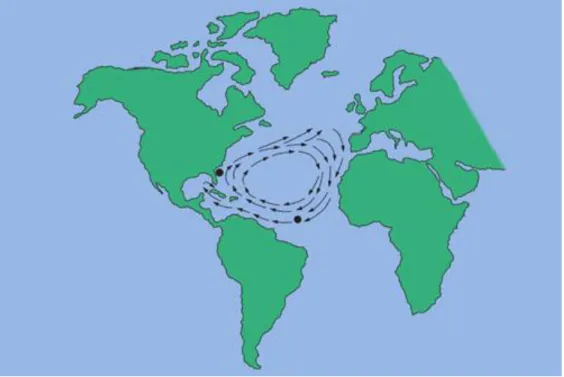
Earth’s magnetic field1. This map sense allows turtles to remain within the North Atlantic Gyre
(Figure 1), an optimal environment for growing turtles because of its temperature and food
Figure 1. The North Atlantic Gyre, which surrounds the Sargasso Sea, with arrows showing direction of the water current and the possible migration route of loggerhead sea turtles. The dots along indicate the two test locations (Topsail and Barbados).
The ability of turtles to detect both magnetic intensity3 and inclination4 appears to
underlie the map sense. The combination of these two magnetic variables creates a bi-coordinate
system analogous to that produced by latitude and longitude and theoretically allows a turtle to
determine its precise location in the open ocean. Magnetic inclination angle varies across the
Earth’s surface, being perpendicular to the Earth’s surface at the poles and parallel at the equator
(Figure 2.A). Magnetic intensity changes similarly to inclination with intensity generally
increasing with distance from the equator (Figure 2.B). Although these two variables both
change from the equator to the poles, they vary at different angles relative to the Earth’s axis,
thus giving a unique combination of intensity and inclination for many locations in the Atlantic
C
Figure 2. Isolines of inclination angle (A) and total intensity (B) of the geomagnetic field in North America. (C) Isolines of inclination (broken lines) overlaid with isolines of intensity (solid lines) in the North Atlantic. Isolines are contiguous lines in which all points along each line have equivalent values.
Previous research suggests that turtles use their map sense to determine which direction
to travel, especially at key locations in the gyre where multiple currents move in different
directions5. For example, in the northeastern region of the North Atlantic Gyre, the current in
which the turtles should continue to travel veers southward while a secondary current that could
lead a turtle into dangerously cold water moves northward (Figure 1). By swimming south along
In the current project, we have created a virtual magnetic reality environment in which to
further study the magnetic map sense of loggerhead sea turtles. Turtles were exposed to magnetic
fields simulating those that would be experienced at various locations in the North Atlantic Gyre.
We then measured the directional swimming preference of individuals at these critical locations.
We conducted these experiments with turtles in different age classes to identify any possible
ontogenetic variation in response to the geomagnetic field. These potential differences are
especially important given that turtles reach certain locations within the gyre only as they grow
older, and their abilities to efficiently navigate might also change as they age because of where
they should be in the gyre system. For instance, a newly hatched sea turtle does not need to
efficiently navigate the splitting current in the northeastern portion of the gyre, but an older turtle
does. There is no need for the hatchling to have a strong preference because there is little chance
of it reaching this location in the near future. The work may provide a better understanding for
how turtles use their map sense and how it might change based on their age and corresponding
location within the gyre system.
METHODS
TURTLE CARE
All turtles were collected from Bald Head Island, North Carolina, during the 2015
hatching season (August-September). A maximum of two turtles were collected from each nest
as they hatched. Hatchlings were then transported to our laboratory at the University of North
Carolina at Chapel Hill, where they were kept in individual tanks and cared for according to
IACUC protocol. Turtles were allowed at least two full days of rest between experimental trials
to allow for adequate recuperation.
EXPERIMENTAL SETUP
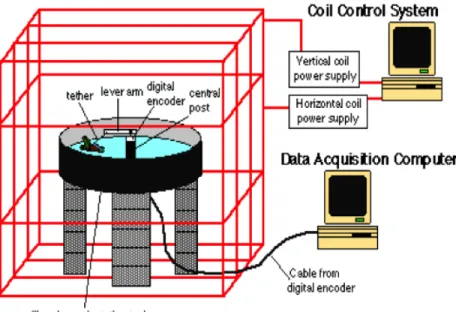
The simulated environment was created with a computerized, magnetic coil system
supported by wooden beams. The coils were composed of a series of wires that changed the
magnetic field inside the system when electric current ran through them8. A circular, salt-water
pool, in which the turtles swam, was located inside the coil system. The magnetic field produced
by the coil system changed based on the turtle’s orientation (i.e., directional bearing in degrees)
in the pool, which was monitored by a tracking arm and digital encoder. The tracking arm was
connected by monofilament line to a nylon harness that held the turtle during experimentation.
The lighting of the system was also controlled to account for effects of any possible light-based
orientation of the turtles7. The edge of the pool was bordered by a light rope that created an even
lighting source no matter the orientation of the turtle. Any additional light was blocked from the
experimental system by surrounding the system with blackout curtains and covering the windows
of the room. Lastly, a video camera was positioned above the experimental structure in order to
Figure 3. The experimental setup used in this study. The diagram indicates the lever (tracking) arm, the monofilament tether line, and the coil system (red). The coil system is computerized in order to change the magnetic field based on the turtle’s position as transmitted by the tracking arm and through the digital encoder.
EXPERIMENTAL PROTOCOL
Before each experimental trial, the magnetic coils, rope lights, and video monitor were all
turned on, and the temperature of the water in the pool was measured. The magnetic field was set
to the equivalent of that experienced at one of the two critical locations under study, Topsail or
Barbados, using custom software. Following this, the turtle was placed in the nylon harness,
room lights were extinguished, and the turtle was allowed to acclimate to the conditions for five
minutes. Turtles then experienced a magnetic field that changed as if the turtle was swimming at
a speed of 2000 mph for fifteen minutes. This stage allowed the turtles to become accustomed to
a rapidly changing magnetic field. At the end of this initial stage, the lights were turned on in
order to prevent the turtles from becoming dark-adapted, which could lead to orientation towards
slight irregularities in the lighting of the system. At this time, the system was reset to the
The turtle was allowed to acclimate again for one minute before the second stage of the trial
began. This stage was identical to the procedure of the 2000 mph stage apart from the simulated
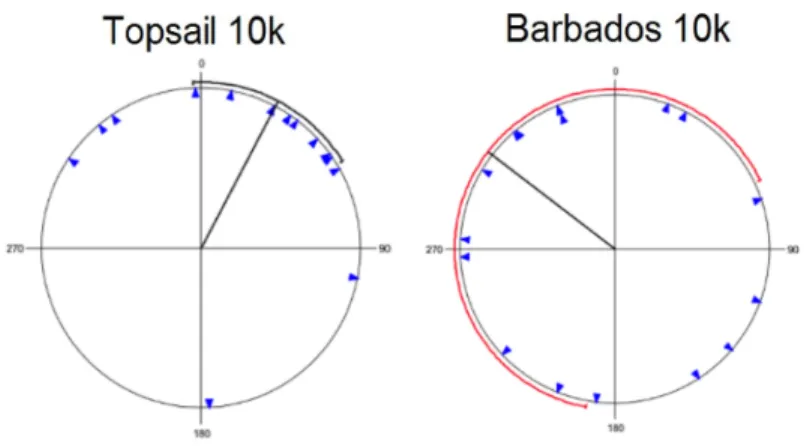
speed of the turtle, which was changed to 10000 mph. All trials were run with turtles in two
different age groups. The first series of trials was made up of turtles ranging in age from 0 to 5
months, while the second contained turtles ranging from 6 to 10 months.
DATA ANALYSIS
The data collected during these experiments included the latitude and longitude
coordinates tracked through the migration of the turtle through the virtual reality environment.
These coordinates were used to create a map of the turtle’s movement as if the turtle was truly
located in the geographical location equivalent to the magnetic field values recorded throughout
the experiment. Additionally, the overall directional bearing of the turtle was determined based
on the initial and final latitude and longitude coordinates using a script from
www.moveable-type.co.uk. Using the computer program Oriana, the trials for an individual location were
analyzed using a Rayleigh test to determine the mean directional bearing and the confidence
interval for each location. To see if the dispersion was different between two trials at the same
location, the Mann-Whitney U Test was used.
RESULTS
The experiment consisted of two treatments (Topsail and Barbados) for the two age
groups under consideration. Turtles aged 0 to 5 months exhibited a significant directional
swimming preference when starting at Topsail (p = 0.003, n = 14, Figure 4). The mean bearing
magnetic field of Barbados (p = 0.642, n = 16, Figure 4). Unlike younger turtles, experimental
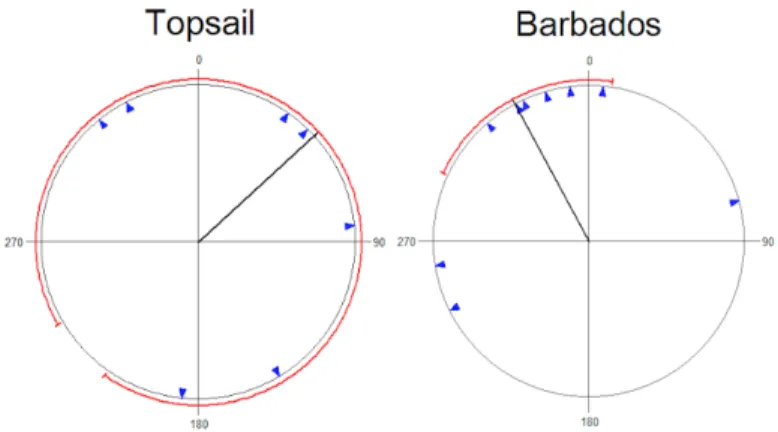
subjects aged 6 to 10 months did not exhibit significant orientation at the Topsail location (p =
0.531, n = 7, Figure 4). However, they did show significant orientation when starting at
Barbados p = 0.017, n = 9, Figure 4). At Barbados, a mean angle of 331.69˚ was measured,
which points in a northwestern direction. The dispersion between the two different Barbados
trials was significantly different (p = 0.019). However, the difference between the two Topsail
trials was not significant (p = 0.28).
Figure 5. These figures display data collected at 10000 mph for turtles aged 6-10 months. Left: No significant orientation at Topsail (p = 0.531, N = 7, X̄ = 47.45˚, r = 0.308). Right: Barbados
orientation is significant in the northeast direction (p = 0.017, N = 9, X̄ = 331.69˚, r = 0.651, 95%
CI: 295.102˚-8.267˚).
DISCUSSION
The Topsail data for turtles aged 0 to 6 months show an overall directionality toward the
northeast, and this matches what would be required to stay within the North Atlantic Gyre during
the loggerhead sea turtle migration. The northeast direction at Topsail gets the turtle away from
the coast and into the Gulf Stream, which flows eastward into the North Atlantic Gyre. Turtles
do not show a significant preference in the Barbados location in the first trial. However, the
mean orientation is toward the northwest. A northwest directionality at Barbados would keep an
individual within the North Atlantic Gyre rather than continuing south into the southern
hemisphere.
Results for the group aged 6 to 10 months were somewhat different. While the general
direction swam at each location was the same, the significance between trials changed vastly.
The results from Barbados trials were significant, with turtles oriented to the northwest, while the
results for Topsail were not significant. For each location, there was little change in average
directionality to the northeast in the younger test group, and the older group was also aligned in
roughly the same direction. Similarly, the first Barbados trial gave a directionality toward the
northwest, and the second trial followed in an almost identical orientation. Even though the
overall directionality at each location did not vary greatly, the significance of the results between
a single location’s trials did change. In addition, the dispersion between data points for the two
trials at the Barbados location was significantly different from each other.
One interesting finding is the shift between significance to nonsignificance in the Topsail
location and vice versa in the Barbados location. To put this in context, sea turtles travel around
the North Atlantic Gyre in a clockwise fashion. One of the first locations they would encounter
in the real world is Topsail, while they would not encounter the Barbados location until later in
life after they have traveled through the gyre for a while. The strong preference for the northeast
direction at Topsail in the young population might indicate past selection to swim into the gyre
system at this time in their life when they most need it. Later in life that strong preference is not
under as strong selection because they will be further along in the gyre system. This can be
shown in the older turtle trial, which still has the turtles traveling in the same average direction,
but the dispersion is much more scattered. Additionally, the Barbados trial has a reasonable
directionality that would keep them within the gyre in the younger population of turtles, but
again, the data are much more dispersed. As the turtles grow older though, their northwestern
preference becomes stronger leading to a highly significant orientation in the older group. Their
preference grows stronger as the probability of encountering the Barbados location in their real
world travels increases. These data suggest that the turtles might have an innate preference for
which direction to travel at each location, but the strength of this preference might vary based on
Because all trials indicated an average direction to the north, there is a possibility of a
nonmagnetic cue causing the northward orientation. Statistically, the presence of a bias has not
yet been proven, but with more data-points, one of the following explanations could be
supported. One potential source of bias is the addition of a wireless router to our experimental
room, which could be emitting radio signals interpretable to the turtle subjects under one of the
proposed mechanism of magnetoreception9. Additionally, turtles can be attracted to light cues
and, at such times, often ignore magnetic cues. Because of this, the movement of the surrounding
blackout curtains caused by air conditioning airflow might affect the setup’s lighting, and the
varied reflective qualities of the different material that make up the ceiling above the setup could
make certain sections brighter than others.
Although the two Topsail trials are not significantly different from each other, the r value
of the second trial is much lower, suggesting a greater dispersion. It may be that increasing the
sample size for the second trial will allow a demonstration of a difference between the two
distributions. Furthermore, the program used to manipulate the magnetic field experienced by the
turtles is based on a geomagnetic field model for the year 2010. The geomagnetic field changes
over time, and the magnetic field perceived in the experiment might not accurately replicate what
the field in the wild is at the desired location in the modern day.
The goal of these experiments is to recreate the migration of these turtles in the lab. If
successful, the research could provide a behavioral assay for how the map sense works and how
magnetic field are detected. Additionally, the migration route will help conservation efforts for
this endangered species. By knowing where the turtles are located throughout their early years of
With further experimentation, the lab will be one step closer to successfully mapping the entirety
of the migration route of the loggerhead sea turtle.
CITATIONS
1. A. B. Bolten et al., Ecol. Appl. 8, 1 (1998).
2. A. Carr, Bioscience 36, 92 (1986).
3. K. J. Lohmann, C. M. F. Lohmann. J. Exp. Biol. 194, 23 (1994).
4. K. J. Lohmann, C. M. F. Lohmann. J. Nature 380, 59 (1996).
5. K. J. Lohmann, S. D. Cain, S. A. Dodge, & C. M. F. Lohmann. Science 294, 5541 (2001)
6. K. J. Lohmann, N. F. Putman, C. M. F. Lohmann. ScienceDirect 22, 2 (2012)
7. K. J. Lohmann, C. M. F. Lohmann. J. Exp. Biol. 199, 73 (1996)
8. R. Merritt, C. Purcell, G. Stroink. Rev. Sci. Instrum. 54, 879 (1983).
9. S. Johnsen, K. J. Lohmann. Physics Today 29, 61 (2008).
ACKNOWLEDGEMENTS
Thank you Professor Catherine Lohmann for allowing me to join your lab and being the best
teacher I could ever imagine. Thank you Professor Ken Lohmann for educating me both in lab
meetings and on statistics. Thank you Vanessa Lynch for taking such great care of our turtles.
Thank you Dave Steinberg for editing my thesis so meticulously. Thank you to my fellow
undergraduate research team Dominique Capaldo and Josh Hanover for watching turtles swim in
the dark along side of me. Thank you to my BIOL 692H instructor Amy Maddox for teaching me
everything I need to know about a thesis and a talk. Thank you to all my BIOL 692H classmates