Library Policy as a Potential Barrier to the Access of Public Library eBook and eReader Services by People Experiencing Homelessness
Rachel Anne Spencer Undergraduate Honor’s Thesis
School of Information and Library Science
University of North Carolina at Chapel Hill 2017
Approved by:
Acknowledgements
I would like to thank Dr. Amelia Gibson for her instruction and guidance as I started the process of writing this honor’s thesis and Dr. Barbara Moran for serving as my thesis advisor as I completed this project. Your support and willingness to work with me one-on-one as I worked on this project is something I greatly appreciate. Thanks are extended also to Dr. Ronald Bergquist, my second reader and a valuable resource, for the guidance you gave prior to my undertaking of this project well into its completion. Thanks to Dr. Barbara Moran, Dr. Ronald Bergquist, and Dr. Ryan Shaw for serving as members of my committee.
Thanks are extended to the libraries and staff that allowed me to interview them and include them, albeit anonymously in this project. Your cooperation in this project was vital to its completion and I appreciate your time and participation.
Romans 12: 11 says, “Never be lacking in zeal, but keep your spiritual fervor, serving the Lord.” Lord, I dedicate this work and the fervor I’ve put into its completion over the past year to You. I hope that my thesis conclusion can somehow assist and bless libraries and all the
Abstract
Contents
Acknowledgements ... 2
Abstract ... 3
Tables ... 5
Introduction ... 6
Literature Review... 8
eBooks and eReading Services in Public Library Settings ... 9
Brief Historical Overview of Opinions on “the Homeless” in Library Science Literature ... 11
Methods... 17
Advantages and Limitations of Methodology... 20
Results ... 21
eBooks and eReaders ... 22
Policies ... 27
Library Staff Members’ Perceptions of People Experiencing Homelessness ... 30
Summary ... 36
Discussion ... 37
References ... 39
Appendix A.1: Consent Forms ... 42
Tables
Table 1: Respondents per County ... 21
Table 2: What Vendors Supply eBooks ... 22
Table 3: Who Asks for Assistance? ... 25
Table 4: Ways around Barriers ... 29
Table 5: Perceptions of Homelessness by the Numbers ... 30
Table 6: Where Did You Learn to Provide Service to People Experiencing Homelessness? ... 31
Introduction
Public libraries serve a broad variety of patron groups with diverse and often conflicting needs, which can cause problems in establishing how to most effectively serve certain patron groups. One of the patron groups public libraries often face problems with is patrons who are experiencing homelessness. People experiencing homelessness are often viewed by other patrons and sometimes by library staff as “problem patrons,” because in addition to using the typical library services, they use the library as a place to sleep, clean up, and take shelter during the day (Budnick, 2006). Patrons experiencing homelessness use many library services, but little has been written about their use of eBooks, eReaders, and the possible barriers public libraries may be imposing that would hamper their use of these technologies.
There are many studies on the legal and monetary barriers imposed by eBook vendors, which limit libraries’ abilities to circulate eBooks, but no available research that addresses whether public library policies could be providing a barrier to access of eBooks or eReaders. Research that might help identify any public library polices that are barriers to access of eBooks and eReaders by patrons experiencing homelessness would be beneficial to public libraries and their patrons because identifying the policies could lead to these policies being changed.
The following questions are explored to determine whether library policies could be providing a barrier to access of eBook and eReader services by houseless populations:
What are the policies related to eBook and eReader services?
Do library policies present barriers preventing people experiencing homelessness from accessing services and/or materials in general?
Though there have been examples of library literature which seem to advocate
Literature Review
This literature review is divided into two sections: eBook and eReader services in public library settings and the perceptions of houseless populations by library staff. The sections address the three overarching themes of this paper: eBooks and eReading devices in public library settings, policy-related barriers to eBooks and eReaders, and a brief historical overview of opinions on “the homeless” in library science professional literature. The terms of greatest importance to the understanding of this research are defined here:
eBook and eReader services are the ability to check out eBooks on personal or library-supported devices, including the existence of tangible objects and support offered to make eReader access possible, such as eBooks, eReaders, other devices that support eBooks, and library Wi-Fi connections.
Library Policies are defined by Moran, Stueart, and Morner (2013) as “a statement that commits management to a definite course of action.” In the context of this paper, “management” is to be replaced with “library staff and patrons,” indicating that the policies we are looking at have a direct and “definite” effect on the way library staff can provide services and library patrons can use those services. (Moran)
People experiencing homelessness, people experiencing houselessness, and houseless populations are the terms used throughout this thesis to describe people who are homeless. While “homeless” and “homeless people” are still used when quoting respondents, person first
eBooks and eReading Services in Public Library Settings
Research conducted by Bertot, Jaeger, Lee, Dubbels, McDermott, & Real reveals that 90% of public libraries in the United States have eBook lending services (Bertot, Jaeger and Lee); however, only 62% adults know that their local libraries provide these services. In the 2016 Pew Library Survey, Horrigan notes that “44% of those 16 and older say their public libraries loan out eBooks, while 10% say this is not true of their communities’ libraries.” The remaining 46% presumably do not know this service is available. (Horrigan)
“Popular E-Content at The New York Public Library: Successes and Challenges” details the services offered by New York Public Library, particularly popular eBook vendor, Overdrive. The Overdrive interface is discussed in detail, because one of the major barriers to eBooks in older populations is lack of familiarity with digital materials. The majority of the problems discussed with Overdrive and other e-content vendors are the lack of available formats and instinctual interfaces. (Platt)
Rodzvilla details a variety of problems libraries that wish to circulate eBooks may face. Most notable are the legal issues that affect library ability to circulate materials. Equally important, but briefly mentioned are the considerations for health of eBook users. For eBook readers who do not have access to eReaders such as Nooks and Kindles, eye strain and computer vision syndrome can be a big issue. (Rodzvilla)
they could assist the recipient and once after Christmas for patrons who had received the devices as gifts and were interested in using them. (Baumgartner)
Maceviciute & Wilson (2013) identified the implications of policy in eBook circulation in Sweden, through a survey of public libraries. The study reported the opinions of librarians and not patrons. The librarians expressed concerns about the limited collection of titles made
available by Swedish eBook vendor Elib. The conceptualization of barriers to eBook circulation presented in this case is different than the conceptualization of barriers to eBook circulation that will be examined in this thesis in that there is a focus on barriers that are not necessarily imposed by the libraries lending the eBooks. Licensing and the legal barriers the library may experience in obtaining and circulating eBook copies of materials can be significant. Despite limited focus focus on legality and the barriers presented by Elib, the survey questions included inquiries about the types of assistance patrons wanted with eBooks, giving an introductory idea of what barriers patron might themselves perceive. (Maceviciute and Wilson)
“Reader's block: a systematic review of barriers to adoption, access and use in e-book user studies” relied on systematic review and literature review to address the barriers to eBook adoption. Girard (2014) studied users in a public, school, and academic library settings, looking specifically at physical and cognitive barriers. The physical barriers were directly related to the available software and hardware, while cognitive barriers presented were self-imposed, such as the feeling of “betraying books” by reading on an untraditional medium. (Girard)
Brief Historical Overview of Opinions on “the Homeless” in Library Science Literature ALA Policy 61 was created in 1990 to advocate for more effective and inclusive service to library patrons experiencing homelessness (American Library Association). ALA Policy 61 has since become ALA Policy B.8.10 Library Services for the Poor (American Library
Association).
Gieskes (2009) described librarians’ perceptions of the poor, what services libraries offered, where they felt information for librarians as professionals could be strengthened to help them adequately serve poor community members, and what resources they were currently using to inform themselves and their poor patrons. Gieskes laid out the objectives of a proposed American Library Association (ALA) policy, surveyed 648 ALA members, and assessed the responses that were received to return recommendations that were intended to lead to the implementation of ALA Policy 61. The responses present an overview of these practicing librarians’ perspectives on services to the poor. Interestingly, the only survey question all respondents answered was one that asked them about how many of their patrons were poor. By contrast, many librarians were offended they were asked to make assumptions when asked how the poor might be identified. They were also asked about what collaboration they had with existing services to the poor and whether lack of professional guidance from the ALA prevented them from doing more. (Gieskes)
of knowledge of local policy and included biases against houseless populations. An example of a response that incorporates bias is, “[…] people who use the public computers, people unaffiliated with the university, community members who use the library as a public space, and those who are seen as a nuisance and "high maintenance."” Respondents frequently identified the poor as being nuisances or high-maintenance, a relatively common complaint against persons
experiencing homelessness who “use library inappropriately,” engaging in such activities as bathing in the bathroom. (Gieskes)
Another example of “the poor” as nuisances and a high-maintenance population can be found in Blaise Cronin’s 2002 Library Journal commentary, “What the Library is Not.” Cronin lumps people experiencing homelessness into the category of “atypical patrons,” whose activities include watching porn, masturbating in the library, carrying large boxes into the library, bathing, being barefoot, and being either homeless or a latch-key kid. In this work, Cronin explicitly states, “A library is not a refuge for the homeless,” as he calls for the actions he finds offensive to be prohibited in favor of what he considers appropriate public decorum. (Cronin)
The guidelines proposed by ALA Policy 61 are supportive of the research that will be done to identify the barriers that may exist to eBook and eReader access for community members experiencing homelessness experiencing homelessness. Among these guidelines, the ones that best support the pending research promoted elimination of barriers, equal funding, increased awareness of available services, and sensitization training for librarians. (American Library Association)
community members experiencing homelessness. He starts by citing Cronin (2002), and goes on to reveal, “Letters of response published in subsequent Library Journal issues supported Cronin’s sentiments by a ratio of 3:1.” Gehner also introduces the concept of librarianship overcoming socially exclusive operation through the examples of British libraries, the British government, and examples of an equivalent British guideline to ALA’s Policy 61. (Gehner)
In contrast with Gehner’s praise of British libraries and their commitment to fighting social exclusion, case studies of public libraries in the UK conducted by Muddiman, Durrani, Pateman, Dutch, Linley, and Vincent (2013) reveal that not many British libraries are actively working to be socially inclusive. Outreach was revealed to be relatively sparse and even in libraries in close proximity to underserved populations, the passive approach to eliminating social exclusion by simply being open to all and providing the same quality of service to all people experiencing homelessness seemed to have little effect. Houseless populations were not a surveyed group, so it is difficult to comment on their experiences or the other information-seeking behaviors they could potentially be engaged in. (Muddiman, Durrani and Pateman)
“The ability of public library staff to help homeless people in the United States: Exploring relationships, roles and potential” examines librarian perspectives on homeless
Wong (2009) discussed the juxtaposition of library inclusiveness with historical perspectives on people experiencing homelessness as problem patrons. The argument of this work is that houseless populations do present problems for public libraries, but not in the sense that stereotyping people experiencing homelessness as dirty, aggressive, unstable, or as “problem patrons” suggests. The problem lies instead in making sure we are providing adequate
information services for houseless populations and defending their rights to these services from anyone who would suggest their current experience of houselessness should negate their rights as library patrons. (Wong)
Ferrell (2010) describes “problem patrons” and how libraries define them, versus how they should. While houseless populations were not the primary focus of this piece, they have been targeted as problem patrons, so it is important to include pieces like this which examine the underlying reasons librarians might view patrons as nuisances. Ferrell also compares nursing to librarianship, as both are public service careers and much like library’s “problem patrons” nurses have to deal with “difficult patients.” Two major takeaways were that labeling patrons as
“problem patrons” does little to solve the problem, and instead widens the gap in understanding between the librarian and the patron; behaviors, rather than people, are the problem. Even at that, the problem with problem behaviors isn’t necessarily that they are problems for all librarians or that the behavior is rule breaking, as Ferrell writes, “There are times when the ‘problem’ is not a crime, or even a violation of library rules, but is a ‘problem’ for the individual librarian in the moment.” (Ferrell)
While the primary focus is on information needs of youth and families experiencing
houselessness, she does acknowledge that both funding and policies can provide barriers to services for houseless populations. In addition, the statistics and demographic information about houseless populations is useful in debunking the stereotype of people experiencing homelessness as adults who are often addicts or suffering with mental illness, although these stereotypes should not deter us from seeking to provide library services to houseless populations, debunking them and looking at the reality of the situation is useful for librarians seeking to provide services to houseless populations that will address their information seeking needs. (Terrile)
Skinner (2016) details how Central Library in Winston-Salem, North Carolina improved its services to patrons experiencing homelessness. With the assistance of a federal grant, the library hired a Peer Support Specialist to help with the houseless population and began offering programs for patrons from this population. Sensitivity training was provided for both library staff (during their annual Staff Training Day) and other members of the community by speakers and programs. The library determined the needs of their patrons experiencing homelessness by surveying all users of the Central Library, and including a question about residence, which served as the variable to separate the responses of houseless populations from other patrons. It was found that computer use was the number one reason patrons experiencing homelessness used Central Library, but that books, magazines, and AV were still of interest. Programming related to job and life skills, computer instruction, and book clubs were requested, though recreational programs were “of primary interest.” (Skinner)
Budnick indicates that the attitudes of both library staff and patrons who are not experiencing homelessness can contribute to policies that present barriers to houseless
Methods
Semi-structured interviews of 12 library staff from a cluster of six counties in a southern state were conducted. Appropriate library staff were either identified through consultation with the branch manager or another senior member of staff via phone or email. These interviews were conducted to glean information about eBook and eReader services offered by the library, library policies, and the staff’s general opinions and perceptions of the homeless and their use of the library. The goal in doing this was to determine whether library policies could be presenting barriers to access of eBook and eReader services by people experiencing homelessness and whether library employees’ opinions regarding houseless populations were in any way related to whether or not barriers presented by library policy existed that prevented people experiencing homelessness accessing eBooks and eReaders. Inductive analysis and comparison of the responses given during these interviews was conducted.
The questions address asked during the interviews are divided into three categories that address the following topics. The list of prepared questions appears in Appendix A: 2, but it should be noted not every participant was asked every question, nor were questions limited to the ones prepared in advance.
On eBooks and eReaders: These questions were prepared with the intention of
On Policy: The policies specifically asked about related to requirements for becoming a cardholder, circulation, and computer use. The goal in asking questions about library policy was to identify what policies exist that have the potential to cause barriers to homeless populations’ access to library services, whether library staff have ever had barriers pointed out to them by patrons (or would-be patrons) of the library, and to what degree library staff are willing or able to work around the barriers library policy could present.
On Homeless and Perception of Homeless Patrons: These questions were posed to get an idea of what experiences library staff had with people experiencing homelessness, what
percentage of the library’s patronage staff believed to be experiencing homelessness, and what information about people experiencing homelessness library staff had been exposed to.
Please Note: These questions were intentionally written to avoid person first language so that if the researcher read the questions verbatim, respondents wouldn’t feel the need to filter their answers against the perceived political correctness of person first language. The exact vocabulary used to describe houseless populations during interviews varied between “homeless people,” “people experiencing homelessness,” and “shelter residents” to reflect the type of vocabulary used by participants in order to make library staff feel comfortable disclosing their true opinions houseless populations.
Interviews were conducted face-to-face and over the phone, contingent on respondents’ preferences and the availability of both respondents and the researcher. These interviews were transcribed on paper, with care to avoid the transcription of identifying variables. When
When interviews were conducted over the phone, the consent forms were read aloud and participants orally gave their consent, which was then recorded on a form by the researcher. A copy of the form participants were given appears in Appendix A: 1. The form does request permission to audio-record interviews, included so the researcher could use discretion in determining whether audio-recording was necessary to ensure adequate documentation of participant response, but no audio-recording was done.
Consent forms are being kept in a locked cabinet until the thesis is published, at which point they will be shredded. The transcriptions of interviews are kept in a locked cabinet when not being used by the researcher, but will be available for examination by committee members at the defense of this paper. Immediately after the defense, the original copies of interview
Advantages and Limitations of Methodology
Semi structured interviewing was chosen for the balance of structure and flexibility it provides. This style of interviewing requires the researcher to develop a set of questions with enough formal structure to stay on task, but is not so formalized as to prevent unanticipated data from being addressed. The limitations of semi structured interviews is that they suggest having a coding schema, which was developed for this study. This study is being conducted as a pilot study and while some questions were prepared in advance, there were no expectations tied to the answers of participants. (Wildemuth)
Results
The results of this study are reported through the use of charts and quotes from
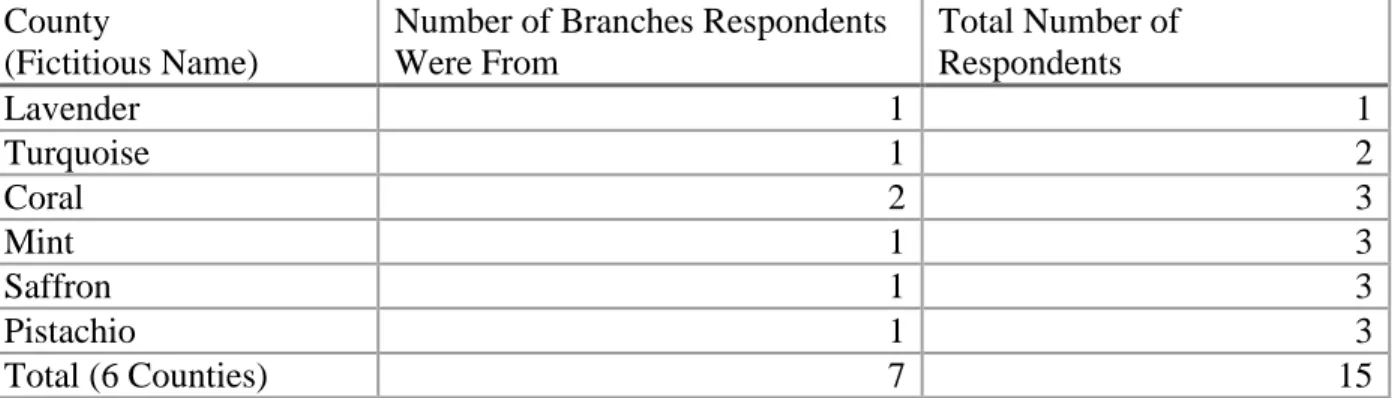
respondents. Library staff members from seven public libraries located in six of the counties in one southern state were interviewed. For the purpose of this study, each county was given a fictitious name. Table 1 shows the anonymized name of each county and as can be seen, five of the six counties had more than one respondent, with a total number of 15 respondents. Five of the counties are clustered together in the center of the state, while Coral is to the west, separated from this cluster by one other county.
County
(Fictitious Name)
Number of Branches Respondents Were From
Total Number of Respondents
Lavender 1 1
Turquoise 1 2
Coral 2 3
Mint 1 3
Saffron 1 3
Pistachio 1 3
Total (6 Counties) 7 15
Table 1: Respondents per County
The questions library staff were asked can be seen in Appendix B. The responses to questions that were not important to the study have not been reported in the results section. The results are reported in three sections: those pertaining to eBooks and eReaders, those detailing policy, and the library staff members’ perceptions of people experiencing homelessness.
eBooks and eReaders
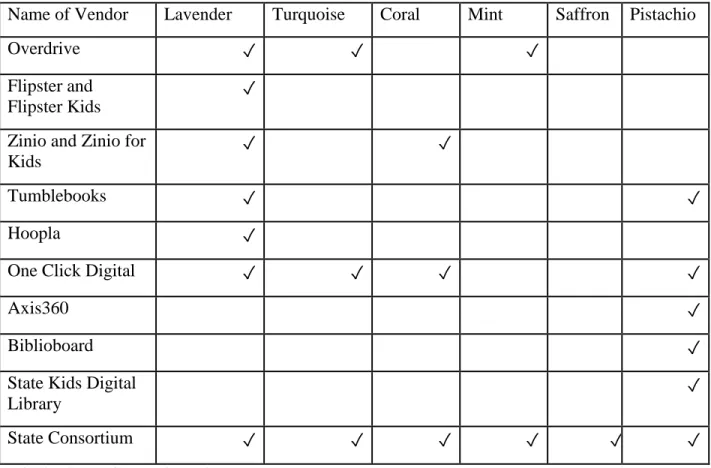
Participants were asked several questions about the nature of eBook and eReader services at their libraries. All respondents indicated eBooks were available for circulation. Respondents reported that the eBooks in the library are supplied by a number of vendors. The vendors can be seen in Table 2: What Vendors Supply eBooks. In this table, a check mark indicates the library offers eBook, eAudiobook, or digital magazine services through the vendor. As can be seen, all of the libraries rely on the state consortium. Overdrive provides service for half of the libraries. The libraries varied in the number of vendors they used, with Lavender and Pistachio using the greatest number of vendors.
Name of Vendor Lavender Turquoise Coral Mint Saffron Pistachio
Overdrive ✓ ✓ ✓
Flipster and Flipster Kids
✓
Zinio and Zinio for Kids
✓ ✓
Tumblebooks ✓ ✓
Hoopla ✓
One Click Digital ✓ ✓ ✓ ✓
Axis360 ✓
Biblioboard ✓
State Kids Digital Library
✓
State Consortium ✓ ✓ ✓ ✓ ✓ ✓
A library card was necessary for use of all the eBook and eReader services, though Lavender Library also links to a free online eBook provider on its website. Participant 2
indicated Overdrive could not be used if patrons has a fine of more than $5 on their library card. The libraries varied on whether they had eReaders available for circulation. Two
counties, Mint and Coral, definitely have eReaders available for circulation. Coral offers Sony Readers and Nooks for checkout. Mint offers Kindles for checkout, noting that while Mint doesn’t require borrowers to have an email address, getting the Kindle books from Amazon does.
Some libraries had circulated eReaders in the past, but do not at present. The respondent from Lavender indicated they may have circulated eReaders at some point in time before the respondent became a member of Lavender’s staff, but the library no longer offers
eReaders. One respondent from Turquoise indicated Turquoise Library had circulated Nooks in the past, but that the devices had been removed from the collection, explaining the Nooks had been removed from Turquoise’s collection because patrons weren’t interested in checking out the Nooks because books were already downloaded on the devices (devices were loaded with
when the Nooks were purchased. Turquoise library’s website did not indicate whether or not they have Nooks available for circulation.
Each respondent was asked about the demographics of their patron base and about the patrons who as for assistance with eBook and eReader services. A comparison between the two demographics based on responses can be seen in Table 3. Only respondents from either of the Coral libraries listed people of color specifically as the demographic of people seeking help with eBooks and eReading devices, which is significant because they seem to have the most diverse populations based on their perceived demographics of their general patronage. Other libraries that describe their patronage as diverse or go into little detail list white, middle class to affluent, retirees as the primary patrons of the eBook and eReader services.
County Describe the demographics of your patronage in general.
Who asks for assistance with eBooks/eReaders?
Lavender Diverse… Includes “white middle class, Latino, people who don’t speak English and people experiencing homelessness”
“white, middle class (I’m assuming because they all had iPads and iPods), older adults in their late 50s to 70s”
Turquoise Demographics vary by time of day, but they do have large elderly patronage.
Mostly elderly people, skews towards 60+ in age
Coral (branch 1)
“Our patronage is divided in almost equal thirds between white, Hispanic, and black”
Middle age – retirees, mostly Caucasian and to a lesser extent black and Hispanic
Coral (branch 2)
Mostly Latino and African American
Mostly African American women 20 – 40 years old, To a lesser extent other members of Latino and African American communities, at least 25 years old
Mint Did not address racial diversity,
but do see diverse group of ages
Agreed that most patrons asking for assistance were older
Saffron Most of patronage is white and affluent, most circulation of
adult materials is done by older adults
Pistachio Did not address demographics Mostly older adults, 60+ years old Table 3: Who Asks for Assistance?
After asking about the demographics of eBook and eReader users, participants were asked about how they provided assistance to patrons who needed help using eBooks or eReaders. Most respondents indicated they preferred to help patrons get started using their eBook and eReader services when patrons were able to meet in person, and if possible, set up appointments. Turquoise indicated many of their patrons took the initiative to ask for
appointments, rather than to just show up. Coral schedules 1 to 2 hour appointments and uses an algorithmic process that determines patrons’ learning styles and what they already know about their device to help them best diagnose the problem and teach patrons. One respondent from Coral indicated the staff member brought his/her personal device as well. Respondents from Mint indicated they prefer to help people in person and that the library may be designing a program targeting instruction for eBook and eReader users. Saffron indicated they offered a formal service called “Device Advice” in which one-on-one appointments were made to help people use their devices to access eBooks. Pistachio indicated assistance usually began over the phone, and resulted in patrons bringing their devices to the library.
Policies
The six libraries varied in the type of documentation required to use library materials. All libraries indicated photo ID and proof of address are required to sign up for a card with full borrowing privileges. Most indicated proof of address was hardest for patrons to provide, but Pistachio and Lavender respondents did mention photo IDs could be harder for houseless populations to have access to. Table 4 shows what type of cards are available to patrons without these documents and some ways library staff have been working around these policies to help their patrons.
County Are other types of cards available? If so, requirements for registration?
Are there ways around policy that you know of?
Lavender Temporary cards – No ID, proof of temporary address, grants access to computers and 10 materials
Computer cards – do not require ID, grant access to computers
Shelter addresses are accepted for both standard and temporary cards
Turquoise Temporary cards – Issued over the summer with some proof of local address
Institutional cards – Issued to shelters and daycares for institutional staff to use.
Have honor books (Honor books are books that are not required to be checked out, though patrons are ask to return them "on their honor.")
Coral Computer cards – Issued trustingly to patrons with or without ID
Mail people postcards they can then return to the library with the postcard as proof of address
Mint No Mail people postcards they can then return to
the library with the postcard as proof of address Children in the county school system can use their lunch number to access library resources, even if their parents cannot be present to sign them up for a card.
Saffron Temporary card – need photo ID, allow patrons complete access to services for 30 days, at which point the card can be renewed for another 30 days
Teacher cards - available for people who teach within the county, need to see school badge
Currently in the process of getting policy approved that would allow people experiencing homelessness to bring in a document with the shelter’s letterhead and the individual’s name/info as proof of address.
Pistachio Temporary card – Good for six months, limit five items. Need photo ID
Institutional Card – For group home residents
Computer Use Only Card – Need photo ID
Patrons may use a permanent address at which they can receive mail, even if it’s not their current living address.
The homeless shelter can print statements on their letterhead that a person lives there as proof of address.
Library Staff Members’ Perceptions of People Experiencing Homelessness
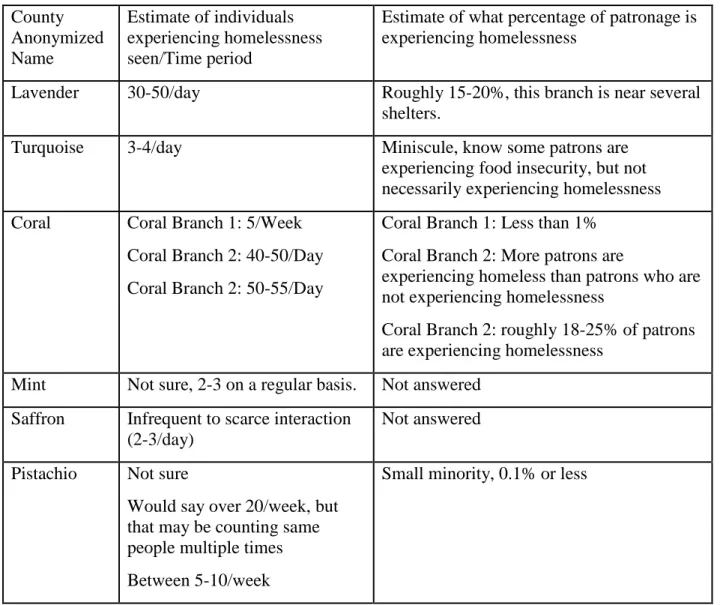
Staff were asked to estimate the frequency with which people experiencing homelessness visited their branch (see Table 5). This was asked to determine whether the libraries with a higher population of people experiencing homelessness had better attitudes and policies towards houseless populations.
County Anonymized Name
Estimate of individuals experiencing homelessness seen/Time period
Estimate of what percentage of patronage is experiencing homelessness
Lavender 30-50/day Roughly 15-20%, this branch is near several shelters.
Turquoise 3-4/day Miniscule, know some patrons are
experiencing food insecurity, but not necessarily experiencing homelessness Coral Coral Branch 1: 5/Week
Coral Branch 2: 40-50/Day Coral Branch 2: 50-55/Day
Coral Branch 1: Less than 1% Coral Branch 2: More patrons are
experiencing homeless than patrons who are not experiencing homelessness
Coral Branch 2: roughly 18-25% of patrons are experiencing homelessness
Mint Not sure, 2-3 on a regular basis. Not answered Saffron Infrequent to scarce interaction
(2-3/day)
Not answered
Pistachio Not sure
Would say over 20/week, but that may be counting same people multiple times Between 5-10/week
Small minority, 0.1% or less
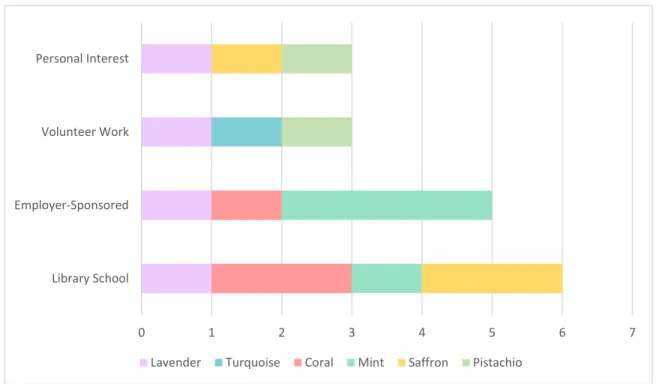
Librarians were also asked where they had received instruction on providing library services to people experiencing homelessness (see Table 6). Some of the responses indicated that staff had been given instruction on topics they felt to be related or useful in interacting with people experiencing homelessness. These responses were not included in this chart, and
consisted of instruction related to handling problem patrons, providing service to the mentally ill, and safety seminars. One member of Coral Library’s staff is specifically trained to help connect people experiencing homelessness with the resources they need and has the additional experience of having personally experienced homelessness.
Table 6: Where Did You Learn to Provide Service to People Experiencing Homelessness?
There are many stereotypes of the behavior and hygiene displayed by people experiencing homelessness. In order to see if library staff believed these stereotypes, participants were asked
0 1 2 3 4 5 6 7
Library School Employer-Sponsored Volunteer Work Personal Interest
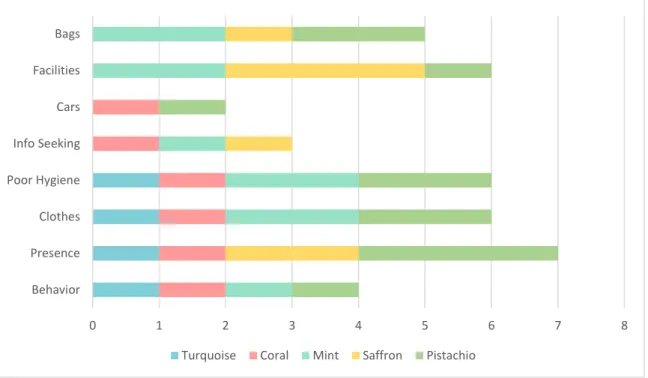
about how they might identify patrons as experiencing homelessness. The respondents indicated that there were any number of ways library staff identified people experiencing homelessness which can be seen in Table 7. Among these were:
Behavior referring to erratic or unusual behavior
Presence referring to frequency of visits to the library or large amounts of time spent there
Clothes referring to patrons dressing in layers or wearing worn/ripped clothing
Info Seeking referring to patrons asking questions that would be important to houseless populations (legal, medical, and resource advice)
Poor hygiene referring to bad odor, unshaven appearance, poor dental care, etc.
Cars referring to cars appearing to be used to live in
Facilities referring to inappropriate use of library facilities (bathing in the sink, sleeping)
Bags referring to patrons carrying bags of unusual size or number.
Table 7: What Might Make You Assume Someone is Experiencing Homelessness?
Along with these assumptions, several library staff described individuals they knew to be experiencing homelessness who either did or didn’t fit these stereotypes. Most library staff expressed concern over feeling judgmental when asked to divulge what they perceived as a potential identifier of homelessness, but when assured that wasn’t the purpose of the research, they willingly shared these opinions, making sure to qualify these perceptions with the awareness that it could be hard, impossible even, to tell if someone was experiencing homelessness or not.
Even though most library staff were quick to point out problem behaviors aren’t always associated with people experiencing homelessness, four of the respondents report that people experiencing homelessness did display erratic/unusual behavior and six report people
experiencing homelessness made inappropriate use of facilities. One Turquoise respondent went as far as to compare the erratic behavior to being able to tell people are “off their meds, behaving so erratically it’s difficult to imagine them holding down a job.” In contrast with this, a Coral
0 1 2 3 4 5 6 7 8
Behavior Presence Clothes Poor Hygiene Info Seeking Cars Facilities Bags
library staff member described learning of people who have chosen to be homeless intentionally, describing them as “people who have chosen to be off the grid. They’re bright, capable people who have decided not to participate in society. Learning about them was an eye-opening experience for me.”
A library staff member at Mint expressed empathy for people experiencing homelessness who are “targeted by librarians (at other libraries, not Mint) who go out of their way to harass and wake up the homeless.” Conversely, a library staff member from Saffron said they woke up anyone who was sleeping in the library as it was a liability concern. When pressed, the potential liability was described as both being a concern in case of emergency (such as fire or natural disaster) and to make sure the patron wasn’t extremely ill.
When asked what people experiencing homelessness use or ask for help with in the library, most respondents mentioned the periodicals, computers, assistance in finding and applying for jobs, and assistance seeking other services like low-income housing and food assistance. The member of Coral library staff whose job was centered around Coral’s houseless populations and who had experienced homelessness in the past was asked specifically whether or not this unique position had made the staff member aware of people experiencing homelessness being users of eBooks and/or eReading devices. The response given was, “Yes, many homeless individuals have digital devices and are very familiar with them. I have noticed people I’m working with using eBooks.”
Summary
All seven of the libraries at which library staff were surveyed provided eBooks. Additionally, at least two of the libraries (Coral and Mint) provided eReaders, with Turquoise staff offering conflicting responses on whether or not eReaders were offered. To check out eBooks and/or eReaders from any library, a library card was required. Lavender Library also linked to a site providing eBooks in the public domain.
In order to be allowed to register for a card with full access to all materials, photo ID and proof of address was required at all libraries. Two libraries (Lavender and Pistachio) allowed people experiencing homelessness to get shelters to provide documentation of their residence in the shelter in order to sign up for a card, and Saffron is working on adding this to their policy. Mint and Pistachio have partnered with the public school systems in their areas to make sure all children that visit the library or attend school in the county have access to materials, regardless of their parents’ existing fines or ability to be present for the child’s registration for a library card. Coral and Mint mail postcards to borrowers who don’t have adequate proof of address, allowing them to return with the postcard as proof they can receive mail at the address they intend to provide.
Almost every library staff member was uncomfortable when asked to detail what variables might lead them to assume someone is homeless, responding that the question made them feel judgmental. Despite this, library staff cited a variety of potential indicators of
Discussion
The findings of this paper indicate the policies requiring photo ID and proof of address to obtain a library card are the most likely to present barriers. Neither eBooks, nor eReading
devices could be borrowed without a card.
Library staff interviewed said people experiencing homelessness often had difficult times obtaining library cards because they could not prove their address and/or the library didn't issue standard cards to people with addresses at shelters. Patrons found it difficult to provide photo IDs (either they did not have a photo ID, or if they did it was often expired or too worn to be useful). The variety of ways that librarians have used to help people experiencing homelessness obtain cards around library policy is an indicator that policy can and does present a barrier to access of eBook and eReader services by people experiencing homelessness. The willingness of library staff to work with patrons indicates that while these barriers exist, it is unlikely they are intentionally created to present barriers to the use of library eBook and eReader collections by people experiencing homelessness.
A member of Coral library staff indicated that some people experiencing homelessness do have devices that support the eBook services provided by libraries and make use of these services. When recognizing that some members of houseless populations have devices that would facilitate eBook borrowing, it makes little sense to me that libraries require users to have library cards with full permissions to access eBooks. These items automatically disappear from a patron's device after their allotted circulation period expires, so they are not at risk of not being returned.
“They’re part of our community, so it’s good to know what’s going on in their lives and what’s available to assist that community.” It is often difficult to gain the perspectives of people
References
American Library Association. "61: Library Services for the Poor." 1990. —. "B.8 Services and Responsibilities of Libraries (Old Number 52)." 2010.
Anderson, K. A., C. D. Simpson and L. G. Fisher. "The ability of public library staff to help homeless people in the United States: Exploring relationships, roles and potential." Journal of Poverty and Social Justice (2012): 177-190.
Baumgartner, Thomas. "Christmas Technologies: Implementing a Technology Instruction Program in a Public Library Setting." Journal of Library Innovation, vol. 4, no. 1 (2013): 44-52.
Bertot, J. C, et al. "2013 digital inclusion survey: Survey findings and results." (2014).
Budnick, Vanessa M. Perceptions of Library Students versus Library Professionals Toward the Homeless Patron: A Comparative Study. Chapel Hill, NC: UNC School of Information
and Library Science, 2006. Print.
Cronin, Blaise. "What a Library is Not." Library Journal (2002): 46.
Ferrell, Shelley. "Who Says There's a Problem: A New Way to Approach the Issue of “Problem Patrons"." Reference & User Services Quarterly (2010): 141-151.
Gehner, J. "Libraries, Low-Income People, and Social Exclusion." Public Library Quartely (2010): 39-47.
Girard, A. "Reader's block: a systematic review of barriers to adoption, access and use in e-book user studies." Information Research (2014): 180-193.
Hersberger, Julie. "The Homeless and Information Needs and Services." Reference & User Services Quarterly (2005): 199-202.
Horrigan, John B. "Libraries 2016." 2016. Web.
Maceviciute, E. and T. D. Wilson. "EBooks in swedish public libraries: Policy implications." (2013): 29-34.
Moran, Barbara B. Library and Information Center Management. 8th Ed. Santa Barbara, CA: Libraries United, 2013. Print.
Muddiman, D., et al. "Open to all? The public library and social exclusion: Executive summary." New Library World (2001): 145-158.
Platt, Christopher. "Popular E-Content at the New York Public Library: Successes and Challenges." Publishing Research Quarterly vol. 27, no. 3 (2011): 247-253.
Rodzvilla, John. "The Portable E-Book: Issues with eBook Reading Devices in the Library." Serials, vol. 22, no. 3 (2009): S6-S10.
Skinner, E. J. "People Experiencing Homelessness: How Libraries Can Be Community
Collaborators and Catalysts for Change." World Library and Information Congress 2016. Columbus, Ohio: IFLA, 2016.
Wildemuth, B. M. Applications of social research methods to questions in information and library science. Westport, CT: Libraries Unlimited, 2009. Print.
Appendix A.1: Consent Forms
UNIVERSITY OF NORTH CAROLINA at Chapel Hill Research Consent Form Primary
Investigator:
Rachel Anne Spencer
Protocol Title: Semi-structured Interviews of Library Staff
DESCRIPTION: You are invited to participate in a research study on the experiences of
homeless library patrons regarding eBooks and eReaders to determine whether library policy and advertising of eBook and eReader services could be presenting a barrier to use of eBook and eReader services by homeless patrons. You will be asked several questions related to library policies, eBooks and eReaders, and providing library services to homeless patrons. If you give consent to be audio-recorded, the investigator may opt to do so.
TIME INVOLVEMENT: Your participation will take approximately 30 minutes to an hour.
RISKS AND BENEFITS: There are no foreseeable risks to you or the library associated with this study. The benefits which may reasonably be expected to result from this study are
PAYMENTS: You will not receive payment for your participation.
PARTICIPANT’S RIGHTS: If you have read this form and have decided to participate in this
project, please understand your participation is voluntary and you have the right to withdraw your consent or discontinue participation at any time without penalty or loss of benefits to which you are otherwise entitled. The alternative is not to participate. You have the right to refuse to answer particular questions. The results of this research study may be presented at scientific or professional meetings or published in scientific journals. Neither your identity, nor the identity of the library (including identifiable information such as city, county, or state) will be disclosed.
CONTACT INFORMATION:
Questions: If you have any questions, concerns or complaints about this research, its procedures, risks and benefits, contact the Primary investigator, Rachel Anne Spencer (336)-693-8984.
Indicate Yes or No:
I give consent to be audiotaped during this study.
___Yes ___No
The extra copy of this signed and dated consent form is for you to keep.
SIGNATURE _____________________________ DATE ____________
Appendix A.2: Interview Instrument: Library Staff On eBooks and eReaders
1. Do you offer eBook and/or eReader services?
a. If yes, what are the policies related to circulation and use of the… eBooks? eReaders? b. Also if yes, are eBook and/or services advertised? How?
2. Do you feel comfortable assisting community members with eBook and/or eReader services? 3. If you’ve ever helped community members with eBook and/or eReader services can you
describe what that assistance entailed?
4. How frequently are you asked about eBooks and/or eReaders?
5. Please describe what sorts people asked for assistance with eBooks and eReaders? (eg: age, race, gender, perceived socioeconomic status)?
6. How do the demographics of people you’ve assisted with eBooks and eReaders compare with the demographics of people you assist in general?
On Policy
1. What is required to become a cardholder?
2. What, if anything, are the different requirements for the following groups: a. student/temporary residents
b. new borrowers (and how long are patrons considered new?) c. persons living in shelters or group homes
d. visitors from out of state/out of the county e. homebound patrons using outreach services
4. Are policies different for the following groups and if so, in what way? a. student/temporary residents
b. new borrowers (and how long are patrons considered new?) c. persons living in shelters or group homes
d. visitors from out of state/out of the county e. homebound patrons using outreach services
5. Are all of your policies written down somewhere easy for patrons to access? a. Easy for you to access?
b. Are there any “unwritten rules” that block access to any materials by certain groups of patrons?
6. What would you do or say if a patron belonging to one of the groups with modified or limited access questions the reasoning behind giving them modified or limited access?
a. How do you think your direct supervisor would react in this scenario? b. What about other senior or managerial staff?
7. Do you believe the limitations and modifications put in place by such policies are ethical? Why or why not?
On Homelessness and Perception of Homeless Patrons
1. Do you know if there are any statistics available on the number of homeless persons the library serves?
2. Without those statistics, how many different homeless individuals would you say you see in the course of a week?
4. Are you familiar with statistics or articles relating to the information-seeking needs of or library patronage of homeless people? And if so, do you think it has an effect on your general assumptions on your own library?
5. Aside from patrons who openly discuss their homelessness, what would lead you to assume a patron might be homeless?
6. What kinds of materials do patrons you know to be homeless generally use or ask for assistance with?
7. What kind of materials do patrons you think may be homeless generally use or ask for assistance with?
8. Have you had any sort of training or taken any classes related to providing library service to homeless patrons?
a. If so, was it a part of your training for this job?
b. If not, then where did you accumulate such knowledge? (School, etc.) 9. Have you had any general instruction on how to interact with homeless people?