Listening to The Heart: Exploring Atmospheres through Experiments with Affective Capture and Sound
By Tony Hong Liu
Senior Honors Thesis Department of Geography
University of North Carolina at Chapel Hill
April 10th, 2017
Thesis Advisor
Acknowledgements:
Table of Contents
INTRODUCTION: THE AFFECTIVE POWER OF LISTENING ... 1
CAPTURING AFFECT THROUGH ATMOSPHERES OF LISTENING:RESEARCH TOPIC AND FOCUS ... 4
CH.1: THE LITERATURE OF AFFECTIVE LISTENING ... 8
GEOGRAPHIC ENGAGEMENTS WITH SOUND ... 9
NON-REPRESENTATIONAL THEORY ... 12
AFFECT AND EMOTION ... 16
AFFECTIVE ATMOSPHERES: ... 19
SOUND,AFFECT, AND AFFECTIVE ATMOSPHERES ... 24
CH. 2: CREATING METHODOLOGIES FOR LISTENING - VENTURE INTO EXPERIMENT ... 26
CAPTURING FEELING WHEN LISTENING –EXPERIMENTING WITH TECHNIQUES & THE RHIZOME ... 26
EXPERIMENTAL TECHNIQUE 1-SPEAKING FEELINGS AFTER LISTENING ... 27
EXPERIMENTAL TECHNIQUE 2-WRITING FEELINGS WITH TEXT ... 30
EXPERIMENTAL ANALYSIS -CHOOSING TECHNIQUE 2 ... 31
APPLYING EXPERIMENTS:AFFECTIVE ATMOSPHERES,FEELING, AND EMOTION ... 34
CH. 3 – PERFORMANCE METHODS AND FEELINGS, CREATING AUDIO THROUGH AN ENSEMBLE ... 35
PHONOGRAPHY AND AUTOETHNOGRAPHY IN THE CREATION OF PERFORMANCE: ... 35
DATA ANALYSIS AND FEELING CATEGORIZATION ... 39
PHONOGRAPHIC PERFORMANCE PIECES ... 45
ENSEMBLE,AN EXPERIMENT IN DECONSTRUCTING ATMOSPHERES OF LISTENING: ... 54
SUBJECTIVITY & THE POLITICS,PROMISES, AND POSSIBILITIES OF NON-REPRESENTATIONAL AFFECTIVE WORK ... 58
CONCLUSION: CHARACTERISTICS OF ATMOSPHERE AND AFFECT & BENEFITS OF TECHNIQUES IN AFFECTIVE CAPTURE ... 65
REFERENCES ... 70
Introduction: The Affective Power of Listening
It was sometime between September 29th and October 17th of 2016 when Dan Zawacki’s girlfriend “suffered an episode of vasovagal syncope” (Van Der Kolk, 2016). In other words, she – the unnamed, experiencing subject – fainted. Triggered by emotional, postural, and situational stimuli, the condition is described as a “transient loss of neural control of circulation” (Jardine, 2013, p. 75). While fainting manifests in colloquial narratives, personal encounters, and
representations across various expressive cultures, the causal conditions that provoked this episode of fainting are distinctive – fainting by listening to a podcast.
In late September of 2016, the podcast Love + Radio, known for its use of sound design and taboo subject material, posted the story, A Girl of Ivory. As explained by the primer on the podcast’s website, the story begins with two characters, Davecat and Sidore. They “had a blissful marriage together in the suburbs of Detroit,” but “one day, a Russian woman, Elena, showed up
unexpectedly at their doorstep, declared her love for both of them, and asked to move in” (Baker,
Carrier, & Van Der Kolk, 2016a). While narratives about polyamorous relationships challenge
traditional love stories premised on monogamy, it was more than this uncommon narrative that
caused Zawacki’s girlfriend to faint. The podcast begins by narrating Davecat and Sidore’s first
encounter at a club as they listened to industrial music. Once the podcast describes their
relationship development, Elena is introduced. Throughout the listening experience, audio tracks
range from questions asked by the podcast’s producers, music, Davecat, Sidore, and Elena’s
voices, as well as ambient sounds. The episode is approximately forty minutes long, and around
the sixteen minute mark, Elena states “usually, I sleep with Davecat cause my joint’s aren’t as
stiff as Sidore’s [joints]” (Baker, Carrier, & Van Der Kolk, 2016b). This is the beginning of the
She downloaded the episode and queued it up for her morning commute on the Metro. While I drove off for work, she stood on the train and listened, and I waited for her to call me with her reaction. Instead, I got a call from a paramedic: my girlfriend, an otherwise young and healthy woman, suffered an episode of vasovagal syncope right as the twist was revealed (Van Der Kolk, 2016).
A descriptive account of her experience as it occurred might read as follows. Passengers
surround her on the train and scenes from outside blur past. As she stands, electrical signals
within some piece of technology interact, and these signals eventually translate to sounds that
emerge through a listening appliance. Her body, the device that plays the podcast, the listening
appliance, and the podcast itself, all come together to form an atmosphere, and she is immersed
within it. During the listening experience, sounds from the podcast transform back into electric
signals when processed by her brain (Xiong et al., 2012). Yet as this occurs, her heart slows
down, her blood pressure drops, and her brain receives an insufficient amount of blood
(Shmerling, 2016). She faints. Referring back to the mechanisms of fainting, her standing met
postural requirements, yet something within the podcast catalyzed her emotional and/or
situational responses. What exactly lead to these outcomes?
Within podcasting, human voices are meant to represent humans. This seems
self-evident, that a corporeal entity exists behind vocals emerging from technologically mediated
forms of transmission. Moreover, in the episode, there is nothing that would suggest Elena and
Sidore are anything but human – until Elena mentions joints. What is the significance of joint
stiffness in determining who sleeps with Davecat? Elena’s comments are incommensurate with
the context of her statement. Upon hearing this segment, the listener feels confused, and this
confusion is ultimately resolved by the revelation that Elena and Sidore are in fact, life-sized
dolls. Actors perform Elena and Sidore’s voices, and the sequence of events connecting Davecat,
but it is suggested that they emerged through listening, thus fulfilling all conditional stimuli for
vasovagal syncope – sound and situation affecting to overwhelm body and its processes.
In Western audio storytelling, specifically public radio broadcasting, certain terms have
emerged which convey sound’s affective capacity to alter bodily conditions. The “driveway
moment” describes an experience where one is compelled by an audio story so that they “stay
in…[a] car to hear it to the end” (NPR, 2008). The term is reflective of historical and social
conditions in which audio stories were traditionally heard, when driving and thus tied to radio
signals and terrestrial transmitters, but technological growth has transformed access to audio
stories exemplified by digital listening formats such as the podcast. Nonetheless, the term still
describes how an affective condition emerges when listening. Explaining another affective
listening situation, radio producer Rob Rosenthal (2017) uses the term “transportive moment”– a
phrase created after listening to the story Jump Blue. However, Rosenthal created the term to
describe an affective listening experience that the term driveway moment could not capture.
Jump Blue details the experiences of Russian free diver Natalia Molchanova. In the story, an actor narrates one of Molchanova’s free dives. After describing Molchanova’s
emergence from the water, a scene that conveys relief as a dangerous situation has been averted, the story reveals that Molchanova’s emergence is in fact a hallucination as she slowly drowns into the bottom of the sea. Accompanying this narration is fluctuating sound design which alters the felt qualities of the podcast. Describing his situation, Rosenthal states,
I was in my car driving, listening to a story, and I noticed I had practically stopped breathing. I was literally holding my breath as I listened. Now what do you call that? It’s more than a drive-way moment. It’s more like I’ve left the car. It’s like a, a transportive moment. I had a
From a geographical framework, Rosenthal’s comments are interesting in that his breathe or lack thereof is explained as transportive: a bodily phenomenon manifesting outside of bodily space. This example echoes Massumi’s (2002) commentary regarding the disorienting qualities of emotions as they are “described as being outside of oneself at the very point at which one is most intimately and unshareably in contact with oneself” (p. 35; Thrift, 2004a, p. 63).
While Massumi’s commentary suggests that Rosenthal experienced emotion, other scholars might contend that what Rosenthal experienced was affect informed by an atmosphere from listening. In the end, Rosenthal’s experience, the driveway moment, and the fainting story all reflect how the experience of listening can alter affective states of being.
Capturing Affect through Atmospheres of Listening: Research Topic and Focus
In these stories, listening occurs in the mundane moments of life - a morning commute, a drive. Yet within the banal, affective states emerge which punctuate the flow of experience, forming subdued feelings and affording possibilities for extraordinary ones. In the previous stories, description revealed how affective change stemmed from listening. Along with these accounts from audio media, academic geographers have also turned to descriptive
representations when documenting affective atmospheres. Describing the competing affective atmospheres of vivacity and worry in a hospital waiting room, Ben Anderson and James Ash (2015, p. 40) narrate an encounter where women banter about popular culture aside anxious patients. On the other hand, Tim Edensor (2012) describes the atmospheres of Blackpool’s Illuminations, a festive gathering centered on ornate lights, by describing atmosphere as
informed by interviews with attendees and his own experience at the event (p. 1103-1104). These descriptions reveal how representations of atmospheres are informed by reflection. That said, in
each of these decriptions, there is a difference between the phenomenological experience of
capturing the affective resonances of listening. How does one go about capturing affect during experience?
This research project falls under auspices of geographic attempts to explore phenomena given methodological problems of capture and representation. It follows a tradition of human geographers who utilize various media in the exploration of non-representational topics such as the banal, quotidian, and emotive aspects of experience. For example, Eric Laurier (2014a) uses videos as an ethnomethodological practice to defamiliarize the habitual and show how
phenomena are “made relevant” (p. 261) in the particularities of context. Michael Gallagher (2015) has listeners explore abandoned landscapes while listening to creative audio pieces he terms audio drifts, investigating unfamiliar resonances and hauntologies of landscape (p. 480). While Gallagher’s work represents a way to integrate sound in geographic research,
methodologies for documenting affective resonances when listening are limited. As Gallagher and Prior (2014) have stated, “phonographic methods - including
listening...need to be developed further” (p. 267). They describe how geographic engagements with sound have generally utilized traditional methods including “interviews, ethnography, archival research and discourse analysis” (p. 267-68). These methods tend to detail affect after experience; they project meaning onto bodies, which “means that the ‘action’ is not in the bodies, habits, practices of the individual or the collective,” i.e. the capture of affect during a phenomenological encounter (Anderson and Harrison, 2010, p. 5). Given these methodological issues when attempting to explore habits and practices, geographers have engaged new
One of these possibilities for capturing affect through listening falls under the
experimental possibilities of non-representational theory. Regarding topics, NRT investigates the “practical dimensions of human existence” aiming to move beyond signification rooted in
“discourse, ideology, or symbolic order” (Castree, Kitchin, Rogers, 2013, p. 347; Anderson and Harrison, 2010, p. 2). That said, non-rep is more than research focus but also implicated in research outputs and data collection. As Vannini (2015) states when describing how to write non-representational research:
You cease to be so preoccupied with how the past unfolded and with your responsibility for capturing it…It is the present that suddenly interests you, and how the present can unfold in the future: what can become of your work, in what unique and novel ways it can reverberate with people, what social change or intellectual fascination it can inspire, what impressions it can animate, what surprises it can generate, what expectations it can violate, what new stories it can generate (p. 12).
Non-representational research and its outcomes should render, resonate, rupture and reimagine; it should entangle researcher “in relations and objects rather than studying their structures and symbolic meanings,” moving away from pedantic efforts at “faithfully [describing]” that which cannot be completely described (Vannini, 2015, p. 15). Exemplifying these non-representational research outcomes, Laurier (2014b) utilizes a graphic transcript in the form of a comic strip to convey the dynamism of action in visual, spatial, and temporal modes. Moreover, Sheller (2015) uses mobile media and iPhone applications to explore body, location, and the digital as both practice and research creation (p. 137-141). Under this non-representational orientation, an aversion exists towards analyses that simply represent, categorize, and thereby limit phenomena.
This research follows a non-representational ethos in practice and output by
other phenomena, and constituted by non-human bodies and human bodies (Anderson, 2009, p.77; Gallagher, Kanngieser, Prior, 2016, p. 8). Moreover, as an affective atmosphere is “revealed precisely as it is expressed in bodily feelings, and qualified in emotions and other actions,” the concept offers a lens to experiment with the capture of affective data and its
recreation (Anderson and Ash, 2015, p. 44). Given this window of analysis, I specifically explore the affective atmospheres of a podcast called The Heart. The podcast utilizes
more-than-representational sound design and focuses its stories on topics pertaining to “the triumphs and terrors of human intimacy, the bliss and banality of being in love and the wild diversity of the human heart,” reflecting non-representational topics (WNYC, N.D.).
Expounding on data collection experiments, I utilize McCormack’s (2015) notion of technique - “a form of doing that needs to be honed through skillful practice, without necessarily crystallizing as a well-policed set of methodological protocols” (p. 92). Given
non-representational theory’s emphasis on situated knowledges tied to relational encounter, I refer to
Deleuze and Guattari’s (1988) concept of rhizome to write out experiments with the capture of
affect as a mechanism to explore multiple ways of knowing. As for non-representational output, I
create audio performance pieces that integrate sound design manifest from listening to convey
the felt dynamics of the podcast’s affective atmospheres. That said, after detailing affective
capture and performance creation, I describe an experiment with the idea of ensemble where I
attempt to disentangle the relational assemblage of atmosphere through discursive analysis. I
conclude that a complete disentangling of an atmosphere’s generators as reflection of feeling is
impossible reaffirming the idea that atmosphere is not reducible to any singular generator and is
Given this experimental research design informed by non-representational
methodologies, I aim to answer two questions. What do experiments with affective capture
through atmospheres of listening reveal about academic discussions on affect, emotion, and
affective atmospheres? Moreover, what are the benefits of engaging in the discursive
deconstruction of feeling and atmosphere if a disentangling is impossible? To summarize, I
reaffirm the understanding of atmosphere as one which blurs the boundary between emotion and
affect because of experiential subtleties and an affective excess that sometimes manifests from
atmosphere (Anderson, 2009, p. 80). As for affect, I emphasize its precognitive and transpersonal
qualities. Regarding discursive analysis of atmosphere, I argue that the process can help attune to
affective life by revealing spatial-temporal extensions of subjectivity, and in the process, provide
opportunities to explore difference informing the non-representational call to enliven the world.
The following is a breakdown of this project. Chapter 1 is a literature review of geographic engagements with sound, affect and emotion, as well as affective atmospheres. Chapter 2 details the creation of methodologies for listening and experiments with affective capture. Chapter 3 details methods for audio performance creation and affective analysis
including creative performance pieces and arguments on subjectivity. Finally, in the conclusion, I emphasize remarks answering the two questions posed earlier while positing further research possibilities with listening.
Ch.1: The Literature of Affective Listening
attending to debates on affect and emotion by examining them through phenomena called affective atmospheres. At the end of the review, I connect sound, affect, and atmosphere to establish the groundwork for the experimental approaches for capturing affect through listening.
Geographic Engagements with Sound
Sound is fleeting, emerging, and disappearing in the context of unique spatio-temporal circumstances. Despite this ephemerality, sound is also prevalent, pervading lived environments and reflecting a core part of lived engagements, qualities human geographers have engaged when exploring sound’s relation to space, place, and other social worlds. Referring to sounds found in everyday life, Canadian composer R.M. Schafer (1993) used the term soundscape to refer to various acoustic fields of study and sound’s resonance in various human and more-than-human environmental contexts (Saldanha, 2009, p. 236-37; Gallagher and Prior, 2014, p. 273). On the other hand, Pocock (1989) explores sound’s contextual and culturally situated qualities, noting the “dominance of the eye” (p. 193) and visual data within geographic scholarship, a trend scholars have noted has continued more than a decade after Pocock’s publications (Gallagher and Prior, 2014; Gallagher et al., 2016). Susan Smith (1994) expounds on soundscape as the interconnected relationship between sound and a social landscape. She emphasizes sound’s affective qualities including its role in “experience, expression, and emotion” within geographic imaginaries (p. 232, 238). Ultimately, Pocock, Smith, and Schafer’s explorations refer to sound’s social and spatial qualities, informing how current geographers discuss sound.
Soundscape refers to a broad designation of sound - how the manifestations of sound such as voice, music, or noise create an encompassing aurality in the world. While also exploring sonic elements that constitute environment, Henri Lefebvre’s (2004) concept of rhythmanalysis emphasizes a particular element of the sonic realm - rhythm. The term generally denotes
said, for Lefebvre, these moments must be understood through repetition, as no rhythm exists “without repetition in time and space, without reprises, without returns, in short without measure” (p. 6; Vojcic, 2014, p. 85). As repetition marks moments, Lefebvre emphasizes the unique qualities of repetition – that “there is no identical absolute repetition” (p. 6) – a claim Vojicic sees as similar to Deleuze’s comments on repetition as difference differing (Vojicic, 2014, p. 84; Gallagher, 2016, p. 45). As applied to current investigations of sound, Lefebvre’s concept of rhythmanalysis echoes a move towards the non-representational, specifically how sound can work as a relational assemblage in difference. Thus, along with soundscape, rhythmanalysis informs theoretical contributions in sound’s function and qualities.
Recognizing an ocular preoccupation within research, recent engagements with sound have used its transmission mechanisms as methodological opportunities. As a means of sonic transmission, radio has been described as a populist medium of information disemmination, potentially explained by low access costs and relative technological simplicity (McLuhan, 1994). Using radio to explore community, Catherine Wilkinson (2015) investigates young people’s relationship to Liverpool station KCC Live, arguing that community formation between young people and KCC Live differs based on locale and practices associated with radio. Investigating young people but focusing on methods, Susie Weller (2006) examines the possibilities of
community radio and the phone-in as participatory research method, especially for young people who may feel silenced. Thus, radio offers avenues for research into social relations and methods.
attune to landscapes before and after expansion. They conducted oral history interviews with former residents to create an audio piece for listening while walking through the territory of the non-existent neighborhoods; within the audio piece, they used musicality, the present tense, and silence to attune listeners “to become sensitive to their present” while recognizing the changes and differences in landscape (p. 82). Moreover, Butler (2006) views the audio walk as a research method to explore “flowing, multi-sensory, and embodied ways for social and cultural
geographers to research the outside environment,” particularly emphasizing themes of landscape, memory, and place (p. 889). Nonetheless, as Gallagher and Prior (2014) describe, the idea of the soundwalk (p. 274) isn’t new and was coined by Schafer (1993) to describe “‘an exploration of a soundscape of a given area’” (p. 213). Calling for expanded geographic approaches with the sonic, Gallagher (2015) uses an audio drift - “an experimental, environmental sound work designed to be listened to on a portable MP3 player whilst walking in a ruinous landscape” - to explore the abandoned St. Peter’s College in Cardross, Scotland (p. 467). In his reflection, Gallagher emphasizes two qualities associated with audio drifts - the uncanny and more-than-representational excess. Ultimately, both the sound walk and audio drift reflect artistic and creative possibilities with geography and sound. While artistic, these engagements are not uncritical and work to reveal traditional engagements within human geographic scholarship.
including sound (p. 86; Tuan, 2004, p. 165). Discussing the audio drift, Gallagher (2015) argues that audio geographies can represent the haunted and phantasmagoric quality of places while remaking listener association with landscape, elements reflected in the interviews Gallagher conducted with those who participated in sound walks (p. 480). Not only a way to facilitate connection with place, sound can also represent place while constituting experiences. Discussing the urban form in the rise of hip-hop culture during the 1970s, Mark Katz (2010) describes the noisiness of the cross-Bronx and Sheridan expressways as conditions of early hip-hop DJs lived realities. Informed by these sonic dimensions, Katz suggests that the DJ emphasis on sound system size reflects sonic power as creative expression and action against the expressway roar symptomatic of the Bronx’s urban blight. Moving from city to body, Berren (2016) describes an emotional cartography where bodies sense and perceive sound thus “making meaning through our minds and bodies at the same time” (p. 80). In Berren’s analysis, the body’s sensorial capacities, including listening, facilitate place connections, affect, and one’s orientation. The twentieth issue of Emotion, Space, and Society (Doughty, Duffy, and Harada, 2016) explores scholarship focused on sound’s role “in understandings of self, others and place,” (p. 39, 40) and the editors describe recent engagements with embodiment and performativity to explore sound’s potential within geographic scholarship. While sound can act as a filter for geographic inquiry, recent emphases on affect, performativity, and embodiment reflect the influence of
non-representational thought on the field of investigation, a field which will be explored in the subsequent section (Gallagher and Prior, 2014, p. 274).
Non-Representational Theory
aims to move beyond signification from structural elements such as “discourse, ideology, or symbolic order” (Anderson and Harrison, 2010, p. 2). As Anderson and Harrison (2010) explain, research within human geography preceding (and overlapping) the non-representational turn often grounded theoretical and epistemological claims in social constructivist modes of analysis focusing on representations (p. 4). For example, recognizing a multiplicity of social
categorizations - race, gender, class, and sexuality amongst others – social constructivists understand how the experience of bodies as coded by particular social categories, including the intersections of those categories, disclose information on structural meaning for those particular bodies (Crenshaw, 1991). As non-representational theory aims to move beyond structural significance, its relation to sound is reflected in aural phenomena without representational qualities such as ambient noise. That said, certain sounds have structural signification such as language, and this signification is also essential to non-representational thought.
When exploring symbolic meaning, social constructivists do not assume a naturalized symbolic order. As Anderson and Harrison (2010) note, academic work focusing on
representational significance has revealed the constructed and contested nature of symbolic structures (p. 5). In this regard, they say social constructivist thought informed
2005, p. 84). Given this focus on the haptic and subtle dimensions of experience,
(re)presentations of affect should expand possibilities in the world, not solely function as signifiers of symbolic meaning (Lorimer, 2005, p. 90; Thrift, 2004). Utilizing concepts such as performativity – one explored by feminist geographers – non-representational thinkers have developed an orientation for expanding possibilities in the world.
One way of expanding possibilities is by reinterpreting representation. As Anderson and Harrison (2010) state, representations should be “understood as presentations,” as “things and events [which] enact worlds” and “not reflections of some a priori order waiting to be unveiled, decoded, or revealed” (p. 15, 19). Harkening back to the work of Judith Butler (1990),
representational performance resonates with Butler’s performativity of gender, “the repeated stylization of the body...within a highly rigid frame that congeal over time to produce the appearance of substance, of a natural sort of being” (p. 33; Valentine, 2007). While appearing natural, Butler notes that gender is not essential but transforms in different socio-spatial contexts, as gender is constantly becoming and gender identities performed. Performativity as well as the haptic and emotive dimensions of life are rooted in the body. Nonetheless, social constructivist analyses problematically frame the body, since meaning is projected onto bodies and materiality which “means that the ‘action’ is not in the bodies, habits, practices of the individual or the collective” (Anderson and Harrison, 2010, p. 5). Noting the overlooked role of bodies in producing meaning through action, non-representational theory thus prioritizes experiences as immanent orderings in a radically constructivist orientation, a newness that Butler explores in the notion of gendered performativity expanded to other elements of life (Anderson, 2014, p. 164).
experience. If representations are performative and performativity resides in the specificity of each situational context including the relations that constitute that context, then representations are ultimately mediated through relations. In non-representational theory, the term mediation, amongst other uses, describes the processual mediation of life, whereby life is immanent and tied to the flow of routine in existence (Cadman, 2009, p. 456). Yet within this routine, entities affect “one another in and through relations” constituting and subtly transforming life by the
particularities of relational configurations (Anderson, 2014, p. 13). While relationality suggests the social, the social cannot be taken for granted. As Anderson and Harrison (2010) note, “there is no order, there is only multiple orderings” (p. 18). Recognizing these multiple orderings, the social is not limited to human corporeality but expanded to “relational-material or ‘associative’ accounts of ‘the social,’” whereby the social includes both material and non-representational phenomena, such as lights, sounds, and textures, as they emerge in contextual specificity (Anderson and Harrison, 2010, p. 12-13). Taken to an extreme, the social includes Latour’s extension of agency to a variety of non-human phenomena including sleeping policemen, bacteria, and sheep dogs (Laurier, 2010, p. 203). While non-representational theory does not necessarily extend agency to the more-than-human as an actor network theorist might, it does recognize the social and relational as more-than-human, both the broader materiality and non-representational elements which inhabit an encounter.
related to the notion of event. Event manifests from encounter yet rather than offering a window into relationality, event brings about “new potentialities for being, doing, and thinking”
(Anderson and Harrison, 2010, p. 19). This potentiality from an event relates to McCormack’s (2010) discussion of experience (p. 202). When McCormack speaks of experience, he describes its relational qualities, a dynamic and continual reproduction across various bodies (p. 204). As Anderson speaks of the relationality of encounter, McCormack writes of the relational qualities of experience, both creating opportunities to experiment within the world. Importantly, for non-representational theorists, “world” is not just a static, physical, out-there but an enactment that emerges from inhabiting, attuning to difference, and training “senses, dispositions and
expectations,” in the process, creating a background in which encounters and novel experiences may emerge (Anderson and Harrison, 2010, p. 9). While recognizing the connections between encounter, event, and experience, each is connected by an emphasis on emerging immanence - specific, temporal manifestations - and relational particularities which give rise to that said emergence. Non-representational geographers have applied these ideas of immanence and relation to a variety of phenomena including emotion and affect. That said, in the process, disagreements have emerged regarding how to understand the terms.
Affect and Emotion
Non-representational theory’s focus on the routines of life have recognizes affective dimensions, becoming a focus of scholarly research called the emotive or affective turn (Pile, 2010, p. 5). That said, affect and emotion are contested terms. Explaining prevailing
quality to affect, emphasizing more-than-human qualities or a “pre-personal capacity” (Edensor, 2012, p. 1105; Thrift, 2009, p. 88; Cadman, 2009, p. 456). Gallagher et al (2016) agree. In a call to expand geographies of listening, they define affect as “more than feeling or emotion...better thought of as forces that impinge on bodies, which may or may not be felt” (p. 8). For definitions of affect emphasizing its precognitive qualities, bodily (inter)subjectivity does not disappear; it is (re)introduced via emotion as the expression of affect or recognition as a social phenomena. This is seen with McCormack’s (2008) description of emotion as affective intensities manifesting “in a socio-culturally recognizable form” (p. 426). Precognitive affect defined as more-than-human qualities – sense, flow, and force – emphasizes bodies; they are sites that receive affect and subsequently where emotion manifests. That said, critics of this pre-cognitive reading of affect argue that this interpretation favors the human within an understanding of affect given the emphasis on human body. Recognizing these critiques, other scholars have sought to complicate the understandings of affect and emotion.
configurations, rather than unproblematic claims about what affect really is ‘out there’ in the world” (p. 12). Similarly, Edensor (2012) argues that affect is not “purely precognitive,” because human anticipation for Blackpool Illuminations’ light shows and festive atmospheres create conditions that influence affective experience (p. 1104, 1119). He also attends to the variety of non-representational and discursive factors which create the Illuminations’ affective conditions - human bodies, art, lights, motorcycle parades, and sounds.
Given these competing definitions of affect and emotion, I take Anderson’s pragmatic ethos of how different definitions of affect can reveal relations as well as what readings of affect accomplish, in the process re-interpreting pre-personal affect as transpersonal. Detailing sound’s affective capacities, Gallagher (2016) relays a story about picking up one of his recording microphones beyond his conscious perception as a boy in a go-kart attempts to grab it. In this example, Gallagher states that “sonic affect propagated from an assemblage of boy and go-kart (legs, feet, pedals, wheels, tarmac), through a body of air, to affect an assemblage of man and
microphones (ears, hand, arm, windjammer, bench)” (p. 44). Gallagher’s study emphasizes two
important points. First, his reading shows how affect as pre-personal push is ultimately
relational, part an assemblage of human and non-human bodies, and thus also transpersonal.
Secondly, Gallagher notes how sound as affect challenges an anthropogenic hegemony which
has dominated humanistic studies including this one, as he describes how sound as affect can
reverberate across, between, and within bodies even if no humans are present to witness (p. 44).
Thus, we see how pre-personal readings of affect have transpersonal qualities which blur the
definition between the two. Moreover, Gallagher’s definition of affecting sound gives
recognition to the assemblage of bodies, particularly the non-human ones, which play an
valuable in that they recognize how subjectivity matters – because of time and anticipation – in
the manifestation of affect. By reconciling these competing definitions, we see how affect can be
informed by pre-personal, transpersonal, and personal elements, each reading helping to
elucidate the constitution of affect. Nonetheless, these understandings do not necessarily describe
how to register affect in experience. That said, using the framework of affective atmospheres
allows for affective capture tied to the complex and ambiguous qualities of atmosphere.
Affective Atmospheres:
Colloquially, atmosphere reflects gaseous dimensions of the physical planet suggesting an encapsulation as atmospheric elements rise, expand, and envelop. Informed by this
understanding, early scholarly examinations into affective atmospheres defined the phenomenon as tone or felt presence. Bohme (2013b) describes atmosphere as “a certain mental or emotive tone permeating a particular environment” whereby the atmosphere spreads “spatially around [him]” (p. 5). Referring to the Greek term ekstasis to describe the materiality which constitutes atmospheres, Bohme (2013a) gives another definition for atmosphere: “the felt presence of something or someone in space” (p. 5). While tone and felt presence help describe affective atmospheres, these descriptions are somewhat abstract and untethered from specificity. That said, this abstraction informs another character of atmosphere – ambiguity & instability. When
describing the ontological status of affective atmospheres, Anderson (2009) states how they move “between presence and absence, between subject and object, and between the definite and indefinite” (p. 77). These precarious qualities also emphasize atmospheres instability,
alongside the formation of subjectivity” (p. 77). Providing a window into the particular relational elements that constitute atmosphere, atmosphere is “revealed precisely as it is expressed in bodily feelings, and qualified in emotions and other actions” (Anderson and Ash, 2015, p. 44). Thus, affect and emotion not only reflect atmospheric revelation but also provide a window into its constitution.
Referring to one of the main elements of non-representational thought, when Anderson describes the precarious quality of atmospheres, he is noting their relational constitution - that is, affective atmospheres emerge from relationalities. Bohme (1993) recognizes the assemblage of bodies that constitutes atmosphere and describes this assemblage as constellation. He states that atmospheres “are spaces insofar as they are ‘tinctured’ through the presence of things, of persons or environmental constellations” (1993, p. 121). Similarly, when Edensor (2012) discusses the emergence of Blackpool Illumination’s affective atmospheres, he describes relationalities
between lighting, music, mobile people, and environmental conditions such as weather (p. 1105). Referring to Bohme and Dufrenne, Anderson (2014) also describes how “atmospheres are
generated by bodies - of multiple types - affecting one another as some form of envelopment is produced” (p. 149). Thus, we see how an assemblage of human and non-human bodies,
representational and non-representational phenomena work to create atmosphere.
simply determined by its conditional parts. While Bohme states that atmospheres can be reduced to their constitutive elements, other scholars have emphasized atmosphere’s irreducible, singular qualities. Discussing the work of Dufrenne, Anderson (2014) describes how an atmosphere manifests as “a singular affective quality that is irreducible to a series of interacting, component parts” (p. 142; Dufrenne, 1973). Atmospheres thus “emanate from but exceed the assembling bodies” (Anderson, 2009, p. 77). This polarity reveals the tension within discussions of atmosphere; they are simultaneously rooted in generators yet irreducible to those generators. Given this situation, “atmosphere is both an effect of a gathering of elements and a mediating force that actively changes the gathering it emanates from” (Anderson and Ash, 2015, p. 44).
While these disagreements reflect nascent investigations of the phenomena, the effects of atmosphere have been less contentious - blurring definitions, setting felt conditions, and
enveloping with the potential to haunt and exceed “a represented world” (Anderson, 2009, p. 79). In regards to problematics associated with demarcating definitions of emotion and affect,
Besides mentioning how envelopment relates to atmospheres’ blurring capabilities, Anderson (2009) also describes how this envelopment can lead to other outcomes including a haunting and overwhelming that “discloses the space-time of an ‘expressed world’” (p. 79). Atmospheres “interrupt, perturb and haunt fixed persons, places or things” – they linger even as they shift and change (p. 78). Why might this be? In certain instances where atmosphere
overwhelms, “the representational content of the aesthetic object” creates “a space of intensity that overflows a represented world” (Anderson, 2014, p. 142, 2009, p. 79). While this intensive flowing of space-time sounds abstract, it ultimately refers to atmospheres’ capacity to produce an affective excess which thereby conditions and demarcates encounters in time and space. Thus, these excesses linger.
Given these various outcomes of atmosphere – blurring definitions, providing conditions for feeling, creating intensive space-times – affective atmospheres can transform future
possibilities, movements, and modulations. Thibaud (2011) describes how atmosphere “gives rhythm to our movements and modulates the manner in which we move” (p. 209; Edensor 2012). Moreover, Duff (2010) describes atmospheres as having the possibility to orient potential action in place, “for the realisation of specific experiences ambitions, and capacities” in regards to the personal (p. 882; Edensor 2012). When McCormack (2010) speaks of experiment, he is referring to the radical newness of relationalities that constitute experience, an explanation similar to the production of atmosphere which reveals similarity between experiment and affective
atmospheres. Both relationally constituted, affective atmospheres may represent one
a causality exists whereby atmospheres act on the body to create conditions for change. Given this possibility for change and a recognition that atmospheres are revealed in feeling, then
attempts at ascertaining the relational constitution of atmospheres matter. What are ways one can go about analyzing this relational constitution?
Atmospheres are always in the process of becoming. From subject to object and vice versa, atmospheres are constructed from an assemblage of human and more-than-human
generators. That said, the moment an atmosphere shifts from subject to object, from affecting to affected, is often unclear. Offering an expanded methodological framework to further detail affective atmospheres, Anderson and Ash (2015) offer the terms weight and mass to help describe changes that occur to atmosphere.
To detail the coexistence and change of affective atmospheres, Anderson and Ash use the qualitative descriptions of mass and weight. As applied to the constitutive elements of an
Sound, Affect, and Affective Atmospheres
Sound is an apt fit for this research paper’s focus on non-representational geographies and affective atmospheres, as sound affects. Distinguishing within various types of sound, Kanngieser (2012) emphasizes the aural voice and calls for a “geography of voice and a politics of speaking and listening” (p. 336). According to Kanngieser, the multidimensional qualities of voice – its varying “timbres, intonations, paces and frequencies” (p. 341) - have differing affective and representational elements which thereby work to alter social relations (p. 343-44). From Hitler’s vocal amplitude to Australian Labor leader Julia Gillard’s attempt at using a working-class accent for strategic political purposes, Kanngieser reveals how the voice’s
utterances have a “profoundly political significance” (p. 340). Thus, attunement to speech offers a lens into dynamics of social relations, power, and feeling. Gallagher (2016) also emphasizes sound’s affective qualities. He states that sound’s repeating affective tendencies activate feeling
and that sonic affect has power over bodies that sometime merges with meaning; this is because
the body is the literal mechanism for sound’s transmission where the voice’s affective power
along with semiotic signification create possibilities for bodily control – Franklin Delano Roosevelt’s fireside chats and Hitler’s use of radio and sound both capitalize on sound’s
affective qualities, the former instilling hope and the latter creating affects of anger and rage (p. 47). These pieces reveal how sound is embedded into the social dimensions of life. That said, in the recognition of sound and power, Kanngiser and Gallagher refer to the relational and social
quality of sound and its movement through and between various bodies, human and nonhuman,
echoing the constitution of affective atmospheres.
Sound’s affective qualities reflect the formation of affective atmospheres. When Bohme
(2013a) discusses the stage set as a metaphor for the creation of atmospheres, he describes how
the atmosphere generated on the stage in, by and large, the same way” (p. 3). With this comment,
Bohme refers to the intersubjective manifestation of atmosphere and one commonly catalyzed by
sound. Comparing the set designer to musicians, sound designers, or radio producers, these
creators use sound to craft and convey particular affective atmospheres. They form a blueprint
for conditioning certain feelings but these feelings ultimately result from subjective
particularities. As Zebracki (2016) notes, electronic dance music has the tendency to affect
bodily movements as it is paired with other environmental conditions such as lighting, bodies,
and alcohol (p. 111). That said, sound does not have to be intentionally structured to condition affective atmospheres. Describing a scene in a hospital waiting room, Anderson and Ash (2015)
reveal co-existing affective atmospheres of vivacity – emerging from the voices of ladies who
are discussing popular culture – and hesitancy, exuded by waiting patients (p. 40). In this
example, sonic elements – the multi-dimensional qualities of voice and their semiotic content –
affected other bodies contributing to a particular affective atmosphere. Thus, the affective
dimensions of sound condition and help form affective atmospheres.
As this literature review has established, atmospheres are implicated in affect and
emotion, since atmospheres blur the two; at the same time, they are also implicated because
atmospheres are revealed by affect and emotion. On the other hand, sound relates to affective
atmospheres by reflecting their constitution while also informing their creation. We have the
foundations for potential experiment - given the fact that atmosphere is revealed in feeling where
sound affects as it is implicated in atmosphere, we see how listening and the attunement to
feeling from listening thus allows for the exploration of atmosphere. That said, despite exploring
new methods for sonic research such as Gallagher and Butler’s experimental audio walks as well
manifests from ascertaining affect after the fact of experience through some form of interview;
once again, meaning is placed onto bodies, not emerging from the bodies themselves (Anderson and Harrison, 2010, p. 5). Given this problem as well as no predetermined method to study affective resonances of listening during experience, I utilize experiments under McCormack’s
(2015) definition of technique to explore affective capture.
Ch. 2: Creating Methodologies for Listening - Venture into Experiment
Capturing Feeling When Listening – Experimenting with Techniques & the Rhizome Anderson (2014) states that “atmospheres require completion by the subjects that
‘apprehend’ them” (p. 145). Even if atmosphere is formed by the particularities of any
contextual, relational emergence, the subject matters. To document feeling when listening, I turn
to McCormack’s notion of technique. As McCormack (2015) states, technique “suggests a form
of doing that needs to be honed through skillful practice, without necessarily crystallizing as a
well-policed set of methodological protocols” (p. 92). That is, technique is experiment – one that
attunes to affective phenomena with multiple possibilities in how that attunement may emerge.
In this regard, the benefit of technique, and one which applies to affective atmospheres, is that it
complements “the ethos and enactment of non-representational styles of thinking as a kind of
‘weak theory in an unfinished world’” (McCormack, 2015, p. 92).
affective moments emerged by pressing the “M” button. Right after, I switched to the software program Stickies and wrote notes on feelings that stemmed from the podcast’s specific section.
With these techniques in mind, I utilize Deleuze and Guattari’s (1988) concept of the rhizome to document this process in autoethnographic, narrative form. While similar to atmosphere in its relational constitution, the rhizome’s conceptualization of time and
functionality as map separate it from atmosphere and make it a helpful tool to think with.
Referring to the work of Deleuze and Guattari, Laura Ogden (2011) notes how the rhizome
disrupts linear progressions of time, as the rhizome has “‘neither beginning nor end, but always a middle (miliue) from which it grows and which it overspills’” (p. 32; Deleuze and Guattari 1988). Moreover, she discusses the rhizome as a map with “multiple ‘entryways’ and practices of modification” (p. 31; Deleuze and Guattari p. 12-13). Applied to this project, entryways are reflected by timestamps when listening and subsequent documentations of those initial
responses.With these new entryways, possibilities for entangling past resonances with current experiences occur, creating opportunities to attune to atmosphere. That said, I stress that this application of rhizome is not to recreate atmosphere in its original, phenomenological mode but to reflect upon the capture of feeling during atmospheric emergence. In the following, I narrate the experience of using these two techniques and the eventual choice to use text-based data as the primary output for analysis when listening.
Experimental Technique 1 - Speaking Feelings after Listening
Image 1: Material bodies present in the act of listening
In the moment, all have arrived in my bedroom, preceding the act of listening and informing the atmosphere that is about to manifest. But other bodies are bustling outside of my vicinity.
I live in a duplex with eleven other men. I am one of six on the first side of this structure, and I hear the life of the other five throughout this side of the house. They are cooking, shouting, moving, rising slowly from late Saturday night escapades, packing backpacks with books for work which should have been done earlier in the weekend but nevertheless will get done. They are living, contributing to a jovial atmosphere that permeates my home. Yet my door is closed, so this atmosphere does not intrude on the meditative, focus that orients my being and permeates my room before the act of listening.
I sit on a red mat, and face the window outside of my room. Laptop in lap, an auxiliary jack rests inside my laptop’s headphone port. The jack traces its way back into the electronic speakers that usually amplify the turntable in my room - analog sound replaced by the digital. Everything is in place, and I speak my thoughts before listening. Something feels strange about speaking into the recorder with no other human bodies around. But I continue.
I begin by listening to the trailer for the podcast – what is called “season 0, episode 0,” by its creators. I listen uninterrupted, and at the end of the episode, speak to the recorder
(https://soundcloud.com/user-312599537/s0e0-response-after-listening - please copy and paste this and any following links; Office for Mac only allows simple HTMLs which is why the error message “cannot locate the internet server or proxy server” emerges). I begin talking, thinking that it will be easy to comment on the felt qualities of the podcast, but I sit in an extended period of silence. My mind draws a blank as to what to say and what part of the recording to comment on. The awkward feeling of speaking into the recorder reemerges. Yet these comments were made after the recording, and I have not yet tried to stop the recording during the act of listening.
I listen to Season 1 Episode 1. The episode is about entering “a world with new rules” once “we do something for the first time,” specifically in regards to romantic activities such as “the first kiss,” and whether it will give way to other firsts and more prolonged romantic engagements (Prest and Kaboli, 2015b). During the episode, the podcast’s host, Kaitlin Prest, describes the first time she rode a bicycle; in this scene, ambient, fluttering sound effects weave their way in and out of her description. The atmosphere is light, nostalgic, and airy. Yet after this description, a different scene emerges, one that jettisons the atmospheric returning to the
the scene, someone describes feeling vulnerable when revealing her “animal self,” and thereafter details the progression of her desired make-out scene. A feeling emerges, I pause the recorder and respond (https://soundcloud.com/user-312599537/s1e1-response-and-pausing). I give a brief, cursory analysis – what I believe is contributing to my feeling as the atmosphere extended itself around me. I continue the podcast. After listening, I give my thoughts about the episode and some brief analysis (https://soundcloud.com/user-312599537/s1e1-response-after-listening).
Experimental Technique 2 - Writing Feelings with Text
In the same day as experiment one, I revisit Season 1, Episode 1. After sliding the blue audio tracer back to its edge within Adobe Audition, I open up stickies, and write on a new note. Image 3: “Season 1, Episode 1” technique one before listening
Returning to Adobe Audition, I press the space bar, and continue listening. Sound weaves. Atmospheres form, spreading around my room. I press the “M” button on my keyboard when a feeling emerges. Rapidly, I shift to the note by pressing “command” and “tab.” I throw words on the note attempting to describe what is felt during listening. Even if I cannot pinpoint them exactly at the present moment, I continue the podcast thus repeating the process seven times for this episode. At the end of listening, I am left with this documentation.
I know that these markers and the text described are incomplete. They are the residual fragments and evidences of attempts at grasping the felt conditions which emerged during the process of listening. That said, I continue with this process for the rest of the podcasts episodes, something feels appropriate about this technique. Later on, I document this process of data collection with videos of my actions on the screen (https://www.youtube.com/watch?v=an2WQCuIOt0).
Experimental Analysis - Choosing Technique 2
Text-based documentation of technique two outperformed the phonographic
documentation of technique one, because of the latter’s tendency to disrupt listening combined with complications associated with speaking into an audio recorder as mechanism for
documenting feeling. In experiment one, I paused the podcast, grabbed the recorder, and
proceeded to describe my feelings into the recorder. Given this recognition of actions required to catalogue feeling verbally, one must be cognizant of when feelings emerge. That said, during this process of listening, a self-conscious questioning began, where I would ask something to the effect of, “am I feeling something now,” as moments would transpire, thinking about when to pause and thinking about what to feel. In this regard, this technique complicated listening because my focus was on thinking, not listening, thereby diminishing an attunement to
the physical act of pausing the podcast also disrupted atmosphere. In the act of pausing to record one’s voice, sounds stopped enveloping the room and the atmosphere of investigation dissipated. On the other hand, for experiment 2, the podcast did not stop during the majority of listening incidents. There were a few occasions when I would return the marker to an earlier section to re-listen to an affective scene but this was rare, as I could quickly take note of feeling. An issue with technique two is that the audio episode still continues when taking note of feeling, but because notes consisted of less than a sentence and usually a few words, I could quickly return to listening. Thus, for experiment 1, the physical act of pausing as well as condition to concentrate on thinking complicated listening and thus an attunement to atmosphere in a manner that did not apply for experiment 2.
The next set of issues associated with experiment 1 included speaking into the audio recorder, as evinced by responses during and after. After listening to the podcast’s trailer, I responded with my thoughts (Prest and Kaboli, 2015a). At the six second mark, I state
“ummm…wow yeah overall that was really…really good…mmm” where these ellipses indicate pauses between my comments. After this last “mmm,” nine seconds of silence pass, and I respond with “solid, okay, cool beans,” thereafter ending the recording. One of the reasons for this silence was in thinking about where to direct my mind’s attention - what exactly to say about the episode, what part of the episode to comment on, and what feelings out of a broader
clip used as an example, I discuss how a scene increased my heart rate leading to “pre-arousal vibes.” Yet during this recitation, I once again couldn’t help but notice how awkward it felt to comment on this scene vocally, where a sense of unease emerges from the tone of my voice. This begs the question as to why I felt uncomfortable speaking into a microphone. First, the scene from the episode – sexual foreplay – and the associated feeling – “pre-arousal” – are socialized as part of the private sphere within a public-private divide. Speaking this content out loud ultimately forced private material into the public space, even though no one else was listening, and this transgression of the private-public divide contributed to my sense of unease. Despite this sense, it was ultimately affective and transparent in its manifestation, where the causality
between content and feeling was traceable. That said, how would a verbalized response look for less perceptible feelings? Given an alternative choice using experiment 2 as well as this research project’s focus and time constraints, I did not spend energy to investigate. Nonetheless I surmise that for less perceptible feelings, the act of pausing the recording to speak those feelings would have resulted in similar silences to my response after listening to Season 0, Episode 0.
vocalize feeling either stopping to think through what is meant or as noted, sitting in silence. This suggests that the manner of documentation informs the output of data which is collected – not only in the digital file itself, an audio file versus a text-based document, but also the
information that is communicated in those files. This is not to say that the data collected from speaking is worse than that of text-based writing, but that it is less suitable for the context of this project pragmatically and in ascertaining affective atmospheres and feeling.
Applying Experiments: Affective Atmospheres, Feeling, and Emotion
Even though this project ended up utilizing technique two, the process of experimenting with both techniques was useful as literature on atmosphere was reaffirmed. Edensor and Anderson note how affective atmospheres blur the boundary between affect and emotion. For Anderson (2009), the purpose of utilizing affective atmospheres is to attune to the “ambiguities of affect/emotion” while also unsettling “the distinction between affect and emotion” (p. 80). This ambiguity emerged when utilizing technique one, as evinced by silences in my response after listening – affect and emotion at a dynamic interplay verging on perceptual awareness but ultimately leaving my listening body in an intermediate position. My experiences suggest that atmosphere attunes to the subtle dynamics between affect and emotion. That said, I also contend that the “affective ‘excess’” of atmosphere’s “space of intensity” blurred the boundary between affect and emotion (Anderson, 2009, p. 79, 80). Caught up in this intensity, experiential affect and feeling blurred as I was enthralled in the act of listening – affect coursing through objects and feelings registering within me to be overwhelmed by affect. After experiencing the intensity of the scene from the podcast (https://soundcloud.com/user-312599537/s1e1-scene-before-pause-and-comment), my spoken response
atmosphere’s capacity to blur affect and emotion also rests in an experiential phenomena associated with the intensity of atmosphere.
Given an understanding of affect and emotion as separate phenomena, my experience would read something like this – affect as push or force emerged from the podcast, moved across bodies and thus registered in my emotions or feelings. Noted in the act of documentation,
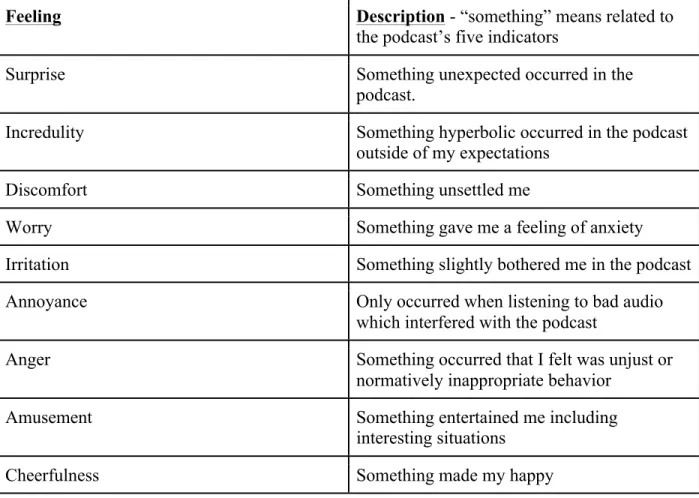
translating feelings to discrete phenomena was an arduous process, because while I felt, I often did not know exactly what I was feeling. What this resulted in was descriptions of an event within the podcast that I could pinpoint to help explain my feeling at a later moment, as well as descriptions of my physical state. This resulted in a range of responses including “smile at the freedom; the honesty,” “cringe, not gross but worryish”, “sexy dragon,” and “she knows what she's doing, smile” amongst others. If feeling is different than knowing what is individually felt, than the pre-personal qualities of affect as pre-cognate are emphasized. This is because feeling was intellectually unintelligible during experience until after the point of feeling via analysis or reflection; for some feelings such as happiness or sadness, I could quickly categorize but even these required a moment of reflection as to understand what exactly was being felt. Thus, responses that marked attempts to capture feeling revealed affect’s pre-cognate qualities.
Ch. 3 – Performance Methods and Feelings, Creating Audio through an
Ensemble
Phonography and Autoethnography in the Creation of Performance:
hidden, fleeting, beyond or at the periphery of everyday awareness,” including the more-than-representational such as affective atmospheres (p. 271). Performance is one suggested method to investigate affective phenomena while integrating audio media within research outputs; it refers to creations constituted by “an ensemble of human and more-than-human actors” exemplified by creative audio work such as sound walks (p. 277; Butler and Miller, 2005; Butler, 2006).
Moreover, Gallagher and Prior suggest that evaluative criteria for performance can include affective qualities of listening, attention drawn to performativity, and performative elements which engage site and space (p. 279-280) It is by combining this phonographic performativity with autoethnography that facilitates this project’s (re)creation of atmosphere.
With synonyms including narratives of self, self-stories, personal narrative, and reflexive ethnography, autoethnography is described as “an autobiographical genre of writing and research that displays multiple layers of consciousness, connecting the personal to the cultural” (Ellis and Bochner, 2000, p. 740). At its epistemic foundations, autoethnographic knowledge is rooted in the lived encounters of its researchers. Experience, knowledge, and encounter are all mediated through the body, the site of self and a vehicle to the external social world. Recognizing the body’s capacity for internal and external orientation, autoethnography denotes lived encounters which look “outward on social and cultural aspects of...personal experience” and “inward, exposing a vulnerable self that is moved by and may move through, refract, and resist
interpretations” (Ellis and Bochner, 2000, p. 739). Thus, autoethnography uses lived encounters to reflect upon experiences yet recognizes a structural framework in which experiences reside.
While autoethnography often manifests as writing, it is not limited to that form of
Martin Zebrecki’s (2016) exploration of electronic music clubs, “embodied knowledge” of techno-space is conveyed through writing, drawing, and “introspective poetic revelation” (p. 111). Zebrecki’s goal is to convey “wordless encounters” experienced within clubs, and he uses sub and superscripts to denote trangressive and culturally identified experiences in his research (p. 115). Zebrecki’s use of autoethnography reveals the method’s emphasis on interaction, where readers engage “morally, emotionally, aesthetically, and intellectually” (Bochner and Ellis, 2000, p. 745). From writings in the forms of poetry to creative drawings, autoethnography can result in multiple outputs all aimed at conveying the experiences of the autoethnographer.
Aside from various forms of output, autoethnography has its own benefits within research – challenging cultural standards of abstract, academic writing associated with the third person, passive voice in favor of a more intimate, emotive, and embodied orientation. Critics of the style argue that autoethnographic forms of writing which make the researcher known delegitimize data and the research itself, a positivist epistemological framework which values universal
‘apprehend’ them,” show how a listening subject is fundamental in the constitution of the atmosphere (p. 144). As a sensing subject reveals atmosphere, then autoethnography reflects a logical extension to explain that sensing and feeling.
Given these epistemic justifications, an effective way to convey knowledge about
atmospheres emerges from the combination of autoethnography and performative phonography. As noted in the introduction of this paper, non-representational research should enliven and take caution with pedantic efforts to “faithfully describe” phenomena such as atmosphere (Vannini, 2015, p. 15). While an overarching orientation is not enough to justify practice, applying these non-representational approaches to affective atmospheres themselves reveals that creative outputs apply for the phenomena. First, Vannini’s (2015) comments on “[ceasing] to be so preoccupied with how the past unfolded and with your responsibility for capturing it” are slightly uncanny as applied to atmosphere, amorphous phenomena evading simple capture even when revealed through feeling (p. 15). Moreover, as Anderson and Ash (2015) state, “an attempt to separate out the assembling of atmospheres into effects and determinants is likely to fall short precisely because atmospheres envelop” (p. 43). Even if one deconstructs and analyzes atmosphere, that researcher would never be able to fully relay the atmosphere as occurring during its existence. Finally, the process of deconstructing atmosphere as object is categorically at odds with the nature of atmosphere, since atmosphere is both subject and object, where the process of representing atmosphere thus violates its nature. While having justified
non-representational outputs tied to autoethnography and phonography, what exactly is performed? In the deconstruction of various atmospheres, I explore their generators in phonographic performance. In this regard, deconstruction performs two roles – it not only tests the
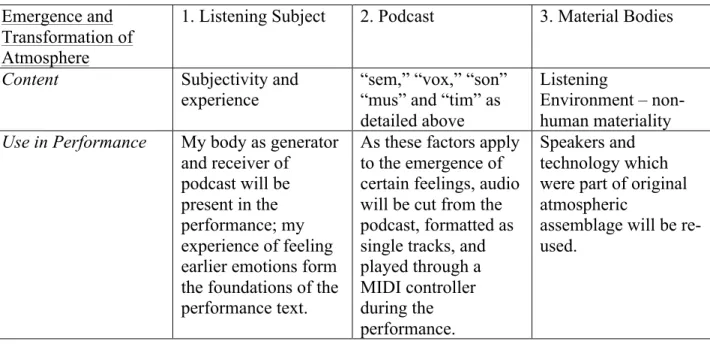
but also provides content for creative performance. Affective atmospheres are constituted by an assemblage of human and non-human bodies which inform the act of listening, and three broad categories help explain the assemblage’s constitution for this project: the listening body, non-human material bodies, and the variety of sonic phenomena present in the act of listening. In attempts to deconstruct atmosphere, non-representational methods do not “[eschew] empirical analysis altogether” – in this research, analysis is incorporated into research outputs of
performance (Vannini, 2015, p. 12). This is performance which aims for possibility, that draws attention to the affective qualities of listening, to performativity, and to the engagement of site and space as potential evaluative criteria (Bochner and Ellis, 2000, p. 751-752; Gallagher and Prior, 2014, p. 280). In striving to satisfy these criteria within research outputs, I “learn to fail, to fail better,” and “multiply possibilities for action, to pose the question once again, and again, of what non-representational theories might become” (Vannini, 2015, p. 15; McCormack, 2015, p. 91).
Data Analysis and Feeling Categorization
From this analysis, I was able to parse out generators that can be attributed to five categories: “sem,” “vox,” “son,” “mus,” and “tim.” Sem is short for semiotic and refers to something that was said; vox is short for vocal and describes how something was said as related to Kanngieser’s (2012) comments on the affective qualities of voice; son is short for sound effects related to ambient sounds and natural sounds; mus is shorthand for music. While mus and son are related, they differ in that mus denotes a greater level of form to sound as something we might recognize as song with melody and phrasing. Last of all, tim is shorthand for time and this descriptive is the most ambiguous, as it denotes how feeling is conditioned by time or past events. Given the fact that the episodes from the podcast are stories, different scenes resonated because of how they related to earlier scenes; to begin listening near the end without the middle or beginning would lead to different feelings than if one listens from the beginning. I also used time to describe certain poetic and stylistic elements that occur in a scene to catalyze feeling – for example, how rapidly someone speaks or if repetition occurs to emphasize an affect.