Por Gusto y Por Necesidad:
Understanding the Barriers and
Opportunities to Latinx Entrepreneurship in
Rural Communities
Lucia Constantine
April 2018
A paper submitted to the faculty of The University of North Carolina at Chapel Hill
in partial fulfillment of the requirements for the degree Master of City and Regional Planning.
Table of Contents
Introduction 3
Literature Review 5
Data & Methods 12
Case Study of Siler City 13
Discussion 24
Best Practices for Accelerating Latinx Entrepreneurship 26
Conclusion 30
Introduction
Rural communities across the United States have been deeply impacted by economic restructuring, urbanization, globalization and most recently, the Great Recession. Many small towns have experienced not only the loss of industry and jobs but also population decline as residents seek opportunities elsewhere. Population decline can devastate a rural community due to a shrinking tax base, less support for local businesses and institutions and fewer incentives for educated, young adults to remain or relocate to the area (Carr, Lichter, & Kefalas, 2012).
However, some rural communities are experiencing a resurgence as immigrants and refugees move to these areas in search of economic opportunity. Nearly 83% of the
population increase in rural areas between 2000 and 2010 was attributable to increases in the number of people of color. Latinxs accounted for more than half of the rural population gain in this decade (K. M. Johnson, 2012). Immigrants in rural communities are more likely both to be working-age and to have children than those born in the United States, which can offset the effects of population decline (Carr et al., 2012).
The majority of immigrants initially move to rural communities to pursue economic opportunities, primarily in agriculture and meat processing. These industries have become the dominant employers in these places, particularly as the meat-processing industry has shifted from urban areas to rural non-unionized areas in the Midwest and South. Due to low rates of pay and high rates of injury and turnover, meat-processing plants and large-scale farms have difficulties recruiting US-born workers and rely on immigrants to meet their labor demand (Champlin & Hake, 2006). Thus, the presence of a meat-processing plant causes rapid demographic change in small towns which brings both benefits and challenges (Artz, Jackson, & Orazem, 2010).
population through small-town entrepreneurship. Immigrants are twice as likely to start businesses as their native-born counterparts (R. Fairlie, 2012). These businesses contribute to economic development and community building in a number of ways including paying taxes, creating jobs, reducing commercial vacancy downtown and providing spaces for cultural interaction (Schuch & Wang, 2015a). Often these businesses are launched without technical assistance or formal loans which demonstrates entrepreneurs’ resourcefulness and tenacity but also highlights the need for more institutionalized support. With better access to capital and targeted technical assistance, many businesses have the potential to evolve and expand. Over time, new businesses can diversify the economy and industry mix of a small town, making it more resilient to economic change. Thus, providing support for Latinx entrepreneurship can be an important strategy for rural economic development (“A Rural Service Provider ’s Guide to Immigrant Entrepreneurship” 2006).
This master’s paper has two purposes. The first is to understand how Latinx entrepreneurs are transforming the physical, cultural and economic landscape of small towns. The second is to assess how local institutions can successfully engage and support Latinx entrepreneurs by addressing some of the unique challenges they face. The paper begins by reviewing the literature on immigration to rural communities, immigrant
integration as economic development, and Latinx entrepreneurship. Next, I introduce Siler City, a small town in North Carolina, as a case study, providing a brief history and
Definition of terms
The preferred language for self-identification varies among people of Latin American origin. The U.S. Census has historically used the term Hispanic to refer to Spanish-speakers from both Latin America and Spain. This report uses the terms Hispanic, Latino, and Latinx interchangeably to people in the U.S. of Latin American origin or ancestry. Latinx is a relatively new gender-inclusive term used by some individuals of Latin American origin.
I also use the term “immigrants” to refer to the foreign-born (i.e. those who were not U.S. citizens at birth). This includes naturalized citizens, lawful permanent residents,
temporary immigrants, refugees and the undocumented. While not all Latinx are foreign-born, the majority of immigrants to the United States and foreign-born residents are from Mexico or countries in Central America.
Literature Review
Economic changes have led to a shift in immigration patterns
The U.S. South has experienced dramatic demographic change in the past two decades, due largely to an increase in Latinx, particularly Mexican, immigration.
Latinxs accounted for 26% of nonmetropolitan growth even though they represented 3.5% of the rural population. Growth accelerated in the 2000s, as Latinxs accounted for 54% of growth while representing 5% of the population. By 2010, 3.8 million Latinxs lived in rural areas (Carr et al., 2012). Although the reasons for dispersion are complex, changes in the economy across all levels offers a likely explanation.
The shift in immigration patterns coincided with the transformation of the U.S economy in relation to global forces and the subsequent restructuring of industries like manufacturing and poultry processing. In North Carolina, deregulation and trade
liberalization in the eighties and nineties contributed to the decline of traditional industries like textiles, furniture and tobacco (Popke, 2011). Local firms couldn’t compete with cheap foreign imports and were forced to relocate or shut down. Rural communities were hit especially hard as many of these industries were the primary employer and taxpayer in town. In an effort to recruit new industry, counties and towns offered low taxes, low unionization rates and generous incentives for companies to relocate, which proved appealing to poultry processors.
Locating in Southern states allowed poultry processors to take advantage not only of mild climates and low feed prices but also of right-to-work regimes, low wages and
As part of integration, poultry firms have done everything possible to keep labor costs low and productivity high which has resulted in precarious working conditions, job insecurity and a demand for expendable workers (Alexander, 2012; Champlin & Hake, 2006). Poultry plants have deskilled many jobs by significantly automating processes. Worker on the assembly line are pressured to work faster, repeating the same motions over and over at higher speeds, which results in accidents and injury. Precarious working
conditions coupled with high rates of occupational injury have led to significant turnover. The de-skilling of jobs means workers have little value to the employer, who has no
incentive to invest in training, increase wages or retain employees (Alexander, 2012; Kandel & Parrado, 2005)
Given high rates of turnover, the poultry industry’s demand for workers exceeds the supply available in rural communities where processors are located. Rather than improve working conditions and raise wages to attract native workers, processors have turned to transnational labor market to recruit immigrant workers that, for a multitude of reasons, will make few demands (Alexander, 2012). Unable to find work in their countries of origin, many Latinx immigrants were “pushed” north in search of economic opportunity. Economic and political crises in Latin America combined with the passage of neoliberal trade policies like NAFTA have fueled significant migration (Popke, 2011; Vásquez et al., 2008). Poultry processing jobs are relatively well-compensated compared to jobs in their countries of origin, which brought Latinxs immigrants to rural communities. For example, in North Carolina, counties with poultry processing saw a 6% increase in the Latinx
growth in rural communities like Siler City, North Carolina has been closely linked to industrial restructuring and corporate recruitment in poultry processing.
Latinxs can reverse population decline and spur economic growth but also pose challenges for rural communities
The influx of Latinx immigrants has proved both beneficial and challenging for rural communities. In many small towns, Latinx immigration is offsetting decades of population decline and economic stagnation. One study showed that 221 nonmetropolitan counties would have experienced absolute population decline between 2000 and 2005 in the absence of Hispanic population growth (K. M. Johnson & Lichter, 2008). New residents mean more taxpayers contributing to funding of roads and schools, a consumer base to support local businesses and services, and a source of community vitality (Mathema, Svajlenka, & Hermann, 2018). Estimates show that Latinxs contribute as much as $9 billion annually through purchases and taxes to the North Carolina economy (Kasarda & Johnson, 2006). Another study found that the growth in Hispanic population in rural counties was linked to faster growth in income per capita in those counties (Coates & Gindling, 2013). Thus, Latinxs can be key engines for economic growth in these communities.
commercial vacancy rates downtown and provide new spaces for social and cultural interaction (Schuch & Wang, 2015a).
At the same time, the rapid and unexpected demographic change can be
disconcerting for small towns that have limited resources to accommodate sudden growth and less capacity to deal with cultural change than larger cities (Mathema et al., 2018). New arrivals place pressure on schools, housing and clinics and may require specialized services due to language abilities and cultural differences. Immigrants are also perceived to bring a host of social problems including higher crime rates and more public assistance. However, one study found that while the presence of meatpacking plants impacted demographic composition, it had no impact on government expenditures (Artz et al., 2010). Nonetheless, the arrival of Latinx immigrants has been a source of tension and conflict in rural
communities due to perceived competition in the local labor market and racial prejudice (Popke, 2011; Winders, 2005).
Nguyen, 2016). Thus, creating favorable environments for Latinx entrepreneurship can have important implications for regional resilience.
Recognizing the role that Latinx immigrants can play in economic revitalization, some rural communities have embraced newcomers as part of their economic development strategy. Long Prairie, Minnesota is a good example of a small town that has welcomed immigrant entrepreneurs. Mexican workers were initially drawn to Long Prairie for work in agriculture but have since settled and opened grocery stores, restaurants and bakeries along the main commercial corridor in town. The mayor and city council have been supportive of entrepreneurship going so far as to rent town property to a Latinx worker-owned
cooperative farm. “We’d be in a big hurt today if it wasn’t for the people that have migrated here,” recognized Don Rasmussen, long-time mayor of Long Prairie (Steiner, 2018).
Similarly, economic developers in Howard County, Iowa created specialized support services to accelerate Latinx entrepreneurship including hosting community forums, providing translation services and offering language courses at the community college (A Rural Service Provider’s Guide to Immigrant Entrepreneurship, 2006). These towns
demonstrate that local economic development decision makers and practitioners can play an important role in facilitating entrepreneurship.
Understanding the unique needs of Latinx entrepreneurs can inform best practices
Although there is a growing recognition that Latinxs contribute to the economy and quality of life in rural communities, more research is needed to understand the motivations and barriers of Latinx entrepreneurs in these places. Studies in urban areas have found that Latinx business owners are typically older, have higher levels of education and have spent more time in the United States than non-business owners(Carpenter & Loveridge, 2018; Wang & Li, 2007). But compared to their urban counterparts in established gateways, Latinxs in new rural destinations tend to be more recent arrivals with lower levels of
likely to be undocumented (Kandel & Cromartie, 2004; Vásquez et al., 2008). While place has no impact on employment rates, rural Latinx immigrants were more likely to live in poverty and less likely to earn area median income than urban Latinx immigrants (Kandel, Henderson, Koball, & Capps, 2011). These characteristics suggest that entrepreneurs in rural areas are more likely to be “pushed” rather than “pulled” into entrepreneurship and self-employment due to lower human capital and barriers to economic mobility (Lofstrom, 2011; Volery, 2007). A qualitative study in Harrisburg, Virginia supports this hypothesis, finding that many Latinx entrepreneurs initially drawn to work in poultry processing plants, opened their own businesses after blocked mobility and discrimination in the workplace (Zarrugh, 2007). Understanding the characteristics of Latinx business owners in rural areas can help inform best practices for not only supporting existing business owners but also engaging potential entrepreneurs.
One of the most significant barriers for Latinx entrepreneurs everywhere is access to financing. Latinxs are more likely to finance their businesses with personal savings or informal loans from families and friends and less likely to seek loans from financial
institutions (Bates & Robb, 2015; Orozco, Oyer, & Porras, 2017). They may be discouraged from seeking loans or may not see loans as a viable option (R. W. Fairlie, 2012). In some cases, they may not understand the requirements for obtaining capital and have not prepared the necessary documentation ( e.g. business plans, cash flow projections or balance sheets) for doing so (Orozco et al., 2017). A study of Latinx business owners in rural counties in Arkansas found that several wanted assistance with business plan writing and more
entrepreneurs are thriving. Greater access to capital and technical assistance will expand their potential economic impact.
Siler City, North Carolina provides an interesting test case for examining the impact of immigration on a rural community, exploring why Latinxs are opening businesses and understanding how local institutions can best foster Latinx entrepreneurship. Findings in the literature suggest that Latinx entrepreneurs were at least initially drawn to Siler City by jobs in poultry processing and later pushed into entrepreneurship by limited economic mobility. They may be younger, less educated and less settled than Latinx business owners elsewhere. Most likely, they financed their businesses through personal savings which limited the scope and scale of their businesses. Thus, we expect to see a preponderance of tiendas, restaurants, beauty salons and mechanic shops in Siler City rather than professional services, finance or insurance firms. As a relatively new immigrant destination, Siler City has not developed the infrastructure of more established gateways but has at least made some efforts towards integrating Latinx entrepreneurs into the business community.
Data & Methods
The data for this study is derived from 1) publicly available social and economic data sources including the Decennial Census, American Community Survey and ReferenceUSA, 2) secondary sources on Siler City including newspaper articles, reports and community plans, 3) semi-structured interviews with Latinx business owners operating in the formal economy and community informants.
businesses with physical locations. Various locally embedded organizations were contacted for potential assistance in identifying and recruiting participants but ultimately, showing up in person proved most effective if limited in terms of sample size. Ultimately,
semi-structured interviews, lasting between 30 minutes and an hour, were conducted with two business owners. The questions included basic demographics, owner’s motivation for starting a business, start-up costs, demographics of clientele, and knowledge and utilization of technical services (See Appendix)
Case Study: Siler City
Siler City, North Carolina has experienced rapid demographic change in the past several decades due to the hiring practices of the local poultry plants. While the arrival of Latinx immigrants has been a source of controversy, the community has since evolved to be more inclusive and welcoming of newcomers. The case offers one example of how
communities across the United States are working through demographic and cultural change as well as how Latinx entrepreneurs have thrived in the face of challenges. In addition to a brief economic and social history of Siler City, the section below provides some recent data trends and insights from interviews with business owners.
History of Poultry Production and Latinx Labor
With a population of over 8,000, Siler City is the largest town in Chatham County, located between the Research Triangle and Triad regions of North Carolina. With the arrival of the railroad in 1884, the town became the county’s distribution hub for industrial and agricultural products (Vásquez et al., 2008). For much of its history, the town’s
economy centered around manufacturing of textiles and furniture as well as poultry
textile industry in the 1980s and 1990s due to changing trade policies and competition overseas (Jones Hoyle, 2008).
Although poultry processing remained a part of the Siler City economy, the industry and workforce were transformed by the aforementioned changes in economic and
immigration policy. The opening, transfer, and closure of plants in Siler City reflects larger industry trends of vertical integration and consolidation through corporate mergers. None of the plants in Siler City are locally owned and all have cycled through a few corporations. One of the plants owned by Pilgrim’s Pride was shut down in 1996, purchased and reopened by Golden Poultry Co, renamed Golden Kist, Inc and subsequently sold back to Pilgrim’s Pride in 2007 (Jones Hoyle, 2008). Furthermore, Latinx workers have almost entirely
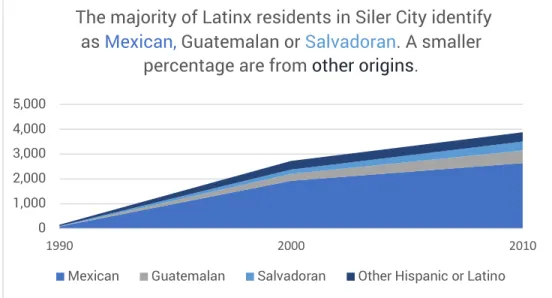
replaced a historically black and white workforce. Although estimates vary, the workforce at the two poultry plants, which combined employed 1,800 workers, was estimated to be 90% Latinx at one point (Cravey, 1997). The migration of Latinxs, predominantly from Mexico, had a dramatic effect on town demographics. Between 1990 and 2010, the Hispanic
population increased by 2000% from 184 to 3,925 (See Figure 1) (U.S. Census Bureau). At the peak, Latinxs made up 49.5% of the population.
Figure 1: Latinx by Specific Origin in Siler City, 1990 - 2010
Source: American Decennial Census
0 1,000 2,000 3,000 4,000 5,000
1990 2000 2010
The majority of Latinx residents in Siler City identify as Mexican,Guatemalan or Salvadoran. A smaller
percentage are from other origins.
The closure of the two major poultry processing plants – Pilgrim’s Pride in 2008 and Townsend in 2011 – resulted in the loss of 1,300 jobs and led some Latinxs to leave, but many chose to stay. The Latinx population has decreased slightly in the past decade – potentially because of the closure of poultry-processing plants, the economic recession and shifting immigration policy – but remains significant. In 2017, the population of Siler City was 43.5% Latinx, which is significant compared to the ethnic makeup of the state, which is 9% Latinx and nation which is 17.8% Latinx (U.S. Census Bureau). In the absence of the poultry processing, Latinx residents have found work in and around Chatham County or have started their own businesses. Thus, it seems the Latinx community in Siler City is “here to stay”.
particularly as the industry shifts away from hiring Latinx workers towards more vulnerable refugee populations from Myanmar, Bhutan, and Somalia (Grabell, 2017).
Reactions to Rapid Demographic Change
As a new immigrant destination, Siler City lacked much of the infrastructure and resources to support the rapid influx of Latinx immigrants in the nineties. Housing was scarce, pushing Latinxs first into apartment complexes and mobile homes in historically African American neighborhoods and then into poor White neighborhoods (Cravey, 1997). Without English as Second Language Programs and bilingual teachers, local schools also struggled to accommodate new arrivals (Cravey, 1997; Vásquez et al., 2008) Similarly, health clinics did not have the capacity to effectively meet the specific needs of Latinx immigrants which included limited work leave, lack of transportation, low English proficiency and incomplete documentation status (Cuadros, 2001).
Religious organizations and non-profits stepped in to provide support for new arrivals. In Siler City, congregations provided space to gather and often sponsored activities like festivals, soccer leagues and family picnics. Bilingual ministers and staff can play a mediating role between Spanish-speaking congregants and the English community and sometimes offer legal support (Vásquez et al., 2008). Several community-based nonprofits were also established to address the unique needs of a growing Latinx community. One example is El Vinculo Hispano/The Hispanic Liaison. Started in 1995, El Vinculo Hispano offers individualized assistance on a variety of issues, advocates on behalf of the Latinx community, and serves as a bridge between the Latinx community, government agencies, and law enforcement (El Vinculo Hispano, 2019). These organizations helped Latinx immigrants navigate the customs and systems of their new home while promoting better integration in the community.
former Klansmen and white supremacist, David Duke, to give a speech at a rally against the town’s Spanish speaking population. “Either you get the INS to kick the illegal aliens out, or you’ll lose your community and your heritage,” said Duke at the rally (Yeoman, 2000). His words capitalized on fears held by some residents that Latinx migrants take jobs, increase crime and exhaust institutional resources. However, not all residents felt hostile towards their new neighbors. In response to the Duke rally, another group of residents, representing different congregations in town, organized a Jubilee Pilgrimage for Peace and Justice two months after the rally (Vásquez et al., 2008). Six years later, another rally was held in Siler City, this time spearheaded by El Vinculo Hispano as part of nationwide demonstrations calling for immigration reform. The rally was the largest in North Carolina with attendees from across the state but some residents felt it was a setback to improved relations because of its forceful approach (Biewen & Watson, 2008).
Relations between Latinx immigrants and local officials have also been strained but have evolved over time. In 1994, the mayor of Siler City appointed a Hispanic Task Force, with no Latinx representation, to address perceived challenges and tensions associated with the influx of Latinx immigrants. The task force published a brochure to “educate” Latinx on the community’s expectations and included warnings about having chickens and goats, junk in the yard, and domestic violence (Holland et al., 2007). “It was a very offensive brochure and made a lot of assumptions about us and who we are and who we aren’t and what we are about, and it was all about, we’re a bunch of criminals and we’ve got to learn how to
behave,” said Ilana Dubester, one of the founders of El Vinculo Hispano (Biewen & Watson, 2008). In 1999, county commissioner Rick Givens wrote a letter to Immigration and
these documents instilled fear in Latinx residents and created an atmosphere of hostility, which came to a head at the rally involving David Duke in 2000 (Yeoman, 2000). Although unsubstantiated, many Latinx assumed local officials were involved in organizing the rally since it was held on the steps of town hall (Vásquez et al., 2008). However, the Duke rally also represented a turning point in relations. In 2000, Chatham County became one of three North Carolina counties to establish a Human Relations Commission. Moreover, since 2000, schools and health services have implemented a suite of programmatic changes to better meet the needs of Latinx residents.
Despite efforts to better integrate Latinxs, recent social and economic data show that Latinxs continue to fare worse economically than whites in Siler City. Latinx households have a lower median income than white households ($37,000 versus $26,000) but are on par with Black households ($26,000) (U.S. Census Bureau). While Latinxs make close to median income in Siler City, which is $27,000, they make significantly less than the median income among Latinxs nationally (See Figure 2).
Figure 2: 2017 Median Household Income by Race in Siler City vs. US
Source: American Community Survey, 2017)
$0 $10,000 $20,000 $30,000 $40,000 $50,000 $60,000 $70,000
Black or African American Alone Hispanic or Latino White Alone, Not Hispanic or Latino
Although Latinxs are more likely to be employed than whites, they are more likely to live in poverty suggesting they primarily work low wage jobs. Latinxs also have lower levels of educational attainment than whites – 66% of Latinxs have less than a high school degree compared to 13% of whites – which presents limited opportunities for economic mobility. Citizenship status may also present challenges for economic mobility. Half of Latinxs are foreign-born and many are not naturalized citizens, which includes legal (e.g. green card, asylum, work visas) and undocumented statuses. Although an increasing number of young Latinxs have U.S. citizenship, they may live in mixed-status families where a parent is undocumented. Together, these trends indicate that further interventions are needed to address the specific needs of the Latinx community and leverage their unique assets.
Latinx Businesses in Siler City
In spite of persisting cultural tensions and economic changes, Latinxs have continued to settle and thrive in Siler City. As of 2017, 45% of the foreign-born Latinx population had been in Siler City for eighteen years or more. The longer immigrants stay, the more likely they are to buy homes and start businesses (Jiménez, 2011). Latinx-owned businesses are a visible presence downtown, with tiendas advertising Latin American foods, beauty salons, and evangelical churches occupying storefronts downtown.
However, Latinxs are underrepresented in business ownership. Despite making up 43% of the population, Latinxs only own 8% of businesses in Siler City (Reference USA).1 Most owners are men but women are also represented – 37% of businesses are female-owned. Consistent with findings in the literature, the majority are in “low-barrier” industries like construction, retail trade and food services with a handful of businesses in “high-barrier” industries like finance & insurance. Some businesses are focused on providing products and services for ethnic consumers, while others are providing high demand services
– including construction and transportation - for the native market. The most common business types were religious organizations, freight services, restaurants, and contractors. The majority of businesses had a sales volume of less the $500,000 and employed one to four workers but collectively Latinx-owned businesses generated over $42 million in sales
volume and employed more than 270 workers (See Table 1) (Reference USA).2 This data only reflects formal businesses, it is likely that a number of Latinx entrepreneurs are operating in the informal economy. Thus, while Latinx businesses are already making an economic impact, there is untapped potential for expanding entrepreneurship.
Latinx businesses are spatially clustered in downtown Siler City - along 2nd Avenue, Chatham Avenue and 3rd Street – and along U.S. Route 64 which is the largest road through town. Businesses are able to take advantage of flows of traffic and people through these areas while also increasing street level activity with new customers. Although the locational choice of Latinx business owners may be more strategic than political, they nonetheless are shaping the cultural landscape and contesting notions of place. With signs in Spanish and products from other countries, Latinx businesses create a different sense of place than native-born stores and give downtown Siler City a multicultural feel. By creating a space for social and cultural interactions among the town’s residents, Latinxs can also serve as a bridge between different communities. Although the visibility of Latinx businesses downtown represents a form of placemaking, an indicator of physical integration and a sign they are “here to stay”, it does not necessarily translate into political representation or social integration (Schuch & Wang, 2015b; Smith & Winders, 2008).
Table 1: Attributes of Latinx Owned Businesses in Siler City
Count Percentage
Number of employees
1 to 4 61 84%
5 to 9 5 7%
10 to 19 7 10%
20 to 49 0 0%
500 to 999 0 0%
Grand Total 0 0%
Location sales volume range
Less than $500,000 43 59%
$500,000 to $1 million 6 8%
$1 to $2.5 million 10 14%
$2.5 to $5 million 1 1%
$5 to 10 million 1 1%
No data 12 16%
Two-digit North American Industrial Classification Sector (NAICS)
Construction 13 18%
Manufacturing 1 1%
Wholesale Trade 5 7%
Retail Trade 12 16%
Transportation and Warehousing 6 8%
Finance and Insurance 1 1%
Real Estate and Rental and Leasing 2 3%
Professional, Scientific, and Technical Services 2 3%
Management of Companies and Enterprises 1 1%
Administrative and Support and Waste
Management and Remediation Services 5 7%
Health Care and Social Assistance 6 8%
Accommodation and Food Services 6 8%
Other Services (except Public Administration) 13 18%
Profiles of Entrepreneurship in Siler City
Latinx entrepreneurs are driven by a complex range of motivations and goals and can be limited by particular constraints. Direct engagement with business leaders reveals different needs and opportunities than what can be interpreted in the data. To this extent, I
conducted interviews with two business owners in the community whose different
trajectories highlight the need for more strategic support for Latinx entrepreneurs. Names have been changed to protect privacy.
Por necesidad y por gusto | Out of necessity and because of enjoyment
Originally from Mexico, Juan moved to the United States in 1982 and has lived in Siler City for the past fifteen years. He owns and runs a tienda, which operates as a small grocery with ethnic foods, a meat shop and a small restaurant. In addition to food products, the store also offers a range of merchandise including calling cards, piñatas, knickknacks and religious materials. Juan’s brother initially started the store and Juan moved here to Siler City to work with him. However, Juan took over the store fifteen years ago and now runs it along with his wife. Juan had previous business experience in Mexico and had run several small
businesses of his own including a paper goods store. Currently, the store employs ten workers who cooks butcher meats, and attend to customers. Although serving a diverse clientele from Siler City and nearby towns, Juan primarily uses Spanish with his customers due to his low level of English proficiency.
According to Juan, his brother started the business por gusto y por necesidad, because of interest and necessity. They spent $20,000 to $30,000 in start-up costs using personal
as Latinx, he cited money and political concerns, particularly recent ICE raids in Sanford.3 He believes it’s difficult to start a business as a Latinx particularly if undocumented.
Exigen mas a los Latinos | They demand more of Latinos
Originally from Jalisco, Raul initially moved to the United States when he was 13 years old. Now 59, he has moved between the United States and Mexico several times and most recently lived in Willow, North Carolina. He and his partner, Ana, moved to Siler City to open a restaurant serving Mexican cuisine. Although Ana has no prior business experience, Raul has always been entrepreneurial. In Mexico, he worked as a commercial trucker for a while but eventually started his own clothing manufacturing business. He sold off that business to start the restaurant.
After some extensive renovations, their restaurant opened about eight months ago. They chose Siler City because they were able to purchase the building and believed it was a good location. They invested around $180,000 of their personal savings in purchasing the
building, renovating the space and other start-up costs. Raul is fluent in English which has enabled him to seek out technical assistance and loans from a range of sources. He contacted the Small Business Administration in Raleigh and applied to be considered a minority and woman-owned business but never heard back. He was offered a loan through the town but the interest rate was too high. He knows of several business associations in town but doesn’t have time to attend gatherings at the moment.
When asked about the barriers to starting a business, Raul talked extensively about his experience with code enforcement. Despite his language capabilities, he had difficulty understanding the building and planning code requirements and felt the approval process was unclear. He wishes he had been informed of all of the building codes in advance rather than on a case-by-case basis after renovations were underway. He also felt the codes were
enforced differently depending on your ethnicity. “They [inspectors] demand more if you’re Latino,” said Raul, referring to inspectors. While he has had to put in a grease trap, a
handrail and paved parking, the business across the street, which started around the same time, has not had to do any of those things. While his observations may not be true, he perceives differential treatment.
In spite of their efforts, business is not going as well as Raul and Ana would like. They serve primarily a native white clientele that come every once in a while, but have not cultivated regulars or gained much traction among the Latinx population. Consequently, they are looking for ways to promote their business and are interested in receiving
additional training and support around marketing and accounting. However, given resource and time constraints, training would need to be free or low cost for them to participate.
Discussion
customers). Thus, while they may face constrained labor choices in a place like Siler City, they are also able to exercise individual agency in their decision to open a business.
The experiences of Juan and Raul also highlight the complexity of experiences in the Latinx community of Siler City, particularly in terms of motives for migration. Much of the literature on new destinations suggest that rural migration is linked to demand for cheap labor in agriculture or meat processing. While many Latinx immigrants were initially drawn to Siler City for jobs in poultry processing, the establishment and expansion of the Latinx population has created business opportunities for entrepreneurs who provide goods and services for both the immigrant and native community. In this case study, both
entrepreneurs seized opportunities presented by a growing market for culturally-oriented products and services. It is conceivable that other Latinx business owners may have been able to transition out of poultry processing jobs and into small business ownership but more research is needed. The presence of Latinx businesses may attract further settlement of Latinx immigrants in search of familiar goods and services and can also inspire other Latinxs residents to start their own businesses.
However, there appears to be a disconnect between Latinx businesses and local institutions. One business owner expressed frustration in dealing with local government while the other showed disinterest in working with them. The disconnect could be
attributable to a number of factors including language ability, lack of awareness of offerings, cultural norms of self-reliance, and a distrust of government and financial institutions (Moon et al., 2014; Orozco et al., 2017). While one owner acknowledged he could use some
technical assistance, the other did not see any potential benefit. As the owners of small, independently operated storefronts, both have limited time and resources to attend meetings and workshop. In order to effectively engage Latinx business owners, local institutions will need to develop greater cultural competency as well as more targeted and inclusive
As Siler City contemplates its economic future, the town has started to recognize the contributions and harness the potential of Latinx immigrants. In 2017, Siler City underwent a multi-year community planning process to identify issues affecting the immigrant
population and generate public policies. Part of the Building Integrated Communities Program at the University of North Carolina at Chapel Hill, the process involved a
community assessment and a series of stakeholder workshops. Over 75 residents representing a diverse sample of immigrants in Chatham County participated, along with town officials and service providers. Participants made recommendations for local government across issues like transportation, housing, public safety and law enforcement, leadership, and business. Business recommendations included employing more bilingual people in public government, translating materials, codes and guidelines into Spanish and having town officials visit Latinx business owners (Gill et al., 2018). These recommendations are a good starting point and would contribute towards creating a more inclusive business environment but further direct engagement with business owners will reveal other needs and help build trust.
Best practices for accelerating Latinx entrepreneurship
While Building Integrated Communities identified some needs in the Latinx business communities in Siler City and offered some preliminary recommendations for local
government, more systemic and structural interventions – such as direct technical assistance and better access to capital - are needed. As government agencies and community-based organizations in Siler City begin to engage Latinx business owners, they can seek
technical assistance (Brenner, 2009). Drawing upon existing guides, research and report recommendations, this section synthesizes best practices in accelerating Latinx
entrepreneurship in rural towns.
Create an inclusive culture and supportive networks
In small towns, the established business community may not always welcome Latinx business owners because of misconceptions and misunderstandings. Additionally, they may not know how to connect with Latinxs business owners due to language barriers and cultural issues. Shifting the local mindset and developing a shared vision to welcome and support newcomers can be an important first step. As an example, the Iowa State University Extension and Outreach office has a dedicated facilitator who works closely with business owners to navigate the start-up process and educates the community about the contributions immigrants make.(McDaniel, 2014) They also created “A Citizen’s Guide for Change” that offers lessons from four Iowa communities that have experience an influx of Latinx
immigrants (Extension, 2001)
Language can be a significant barrier to accessing services and technical assistance. Making resources and services available in multiple languages is critical as is hiring bilingual staff and/or interpreters. Beyond language capabilities, organizations must develop cultural competency to effectively engage Latinx entrepreneurs. For example, understanding the business practices in an entrepreneur’s country of origin can help explain their expectations when working with service providers (Grey, Rodríguez, & Conrad, 2004). Furthermore, the Latinx community is not a monolith so understanding the nuances and differences in culture can help tailor services.
Through partnerships, local government agencies, financial institutions and economic development organizations can boost their visibility within Latinx communities and form a network of referral services.
In addition to formal business support services, Latinx entrepreneurs can also benefit from informal network connections with other Latinx entrepreneurs and within the larger business community. Existing Latinx business owners can serve as mentors for fledgling entrepreneurs, offering insights about the landscape and assistance navigating start up processes. These types of connections can help owners compensate for lack of formal business education and may be more effective than other interventions (Carpenter & Loveridge, 2018)
Offer customized technical assistance and business support
Navigating complex regulations and tax laws for operating a business is another challenge for Latinx entrepreneurs. Economic developers and service providers can assist entrepreneurs by creating a comprehensive information packet that includes market research, local contacts, tax requirements, and building codes. In addition to having information readily available, some communities establish a lead organization to orient Latinx entrepreneurs and refer them to appropriate services, technical assistance and trainings (A Rural Service Provider's Guide to Immigrant Entrepreneurship, 2006). Proactive outreach strategies such as visiting Latinx businesses directly and offering workshops in nontraditional settings like churches are needed to engage nontraditional entrepreneurs.
2015, the accelerator sponsors workshops, seminars, credit counseling and wraparound services to support entrepreneurs of color. The accelerator has connected its member firms with larger corporations in the area to build capacity and access to larger contracts. They have also partnered with Greensboro Community Development Fund to increase access to capital (Munn & McHugh, 2018).
There is precedent for the incubator model in Siler City. In partnership with the town, Central Carolina Community College started the North Carolina Arts Incubator in 2001 to support the creativity and entrepreneurship of local artists. The Incubator purchased and renovated several buildings downtown to offer affordable space for working artists. Additionally, Central Carolina Community College became one of the tenants and offered training in both artistic skills and good business practices. Along with affordable rents and networking opportunities, the incubator training and support for artists at different stages of their business. (Homegrown Tools, 2018). Thus, it is conceivable that Siler City could start something similar for its entrepreneurs of color.
Increase access to financing
Entrepreneurs in rural regions have difficulties accessing capital. That difficulty is compounded for Latinx entrepreneurs who may be unfamiliar with or wary of U.S. financial institutions, may not have built an adequate credit history to access loans, or may not
understand lending practices. Many Latinx entrepreneurs finance their business with
personal savings or loans from family and friends (R. W. Fairlie, 2012; Orozco et al., 2017). Consequently, there is a need for additional sources of financing to support Latinx
entrepreneurs in rural areas. Some models of financing that have proven successful include microloan programs, revolving loan funds, community foundations and regional angel networks (A Rural Service Provider’s Guide to Immigrant Entrepreneurship, 2006).
materials needed to access government or financial institution funding. Without materials like business plans, cash flow projections, balance sheets and market analyses, entrepreneurs are often rejected for loans. Access to capital has important implications for a business’s ability to scale. To this end, the Carolina Small Business Development Fund, a community development financial institution that provides capital and business services to foster
economic development in underserved communities across North Carolina, has developed a “Programa Empresarial Latino” to target Latinx entrepreneurs. In addition to personalized assistance and loans, the program has done several workshops in Spanish including one in Siler City (Carolina Small Business Development Fund, 2018).
Conclusion
In rural communities across the country, Latinx immigrants are reversing population decline, expanding the workforce and spurring economic growth through entrepreneurship. Although demographic change can pose challenges for small towns because of the particular needs and cultural differences of the Latinx population, it can also serve as a catalyst for economic revitalization and form a base for improved community resilience. As more and more Latinxs settle permanently in rural communities, they open new businesses in
References
A Rural Service Provider’s Guide to Immigrant Entrepreneurship. (2006).
Alexander, C. S. (2012). Explaining Peripheral Labor * A Poultry Industry Case Study.
Berkeley Journal of Employment and Labor Law, 33(2), 353–399.
Artz, G., Jackson, R., & Orazem, P. F. (2010). Is it a jungle out there? Meat packing, immigrants, and rural communities. Journal of Agricultural and Resource Economics,
35(2), 299–315. https://doi.org/10.2307/41960519
Bates, T., & Robb, A. (2015). Impacts of Owner Race and Geographic Context on Access to Small-Business Financing. Economic Development Quarterly, 30(2), 159–170.
https://doi.org/10.1177/0891242415620484
Biewen, J., & Watson, T. (2008). Nuevo South. Retrieved February 26, 2019, from http://americanradioworks.publicradio.org/features/immigration/c1.html
Brenner, C. T. (2009). Structures and Strategies of Immigrant Integration: Evidence from Local Governments in the New Latino Destinations of the United States. Journal of Public Management and Social Policy, 15(1), 31–70.
Cameron, A. E., & Cabaniss, E. R. (2018). Forging Their Own Path to the Labor Market: Hispanic Women Business Owners in North Carolina. Social Currents, 5(4), 369–385. https://doi.org/10.1177/2329496517734568
"Case Study: Siler City, North Carolina" (2018) NCGrowth | Kenan Center for Private Enterprise Http://homegrowntools.unc.edu/.
Carpenter, C. W., & Loveridge, S. (2018). Differences Between Latino-Owned Businesses and White-, Black-, or Asian-Owned Businesses: Evidence From Census Microdata.
Economic Development Quarterly, 32(3), 225–241. https://doi.org/10.1177/0891242418785466
Carr, P. J., Lichter, D. T., & Kefalas, M. J. (2012). Can Immigration Save Small-Town America? Hispanic Boomtowns and the Uneasy Path to Renewal. Annals of the American Academy of Political and Social Science, 641(1), 38–57.
https://doi.org/10.1177/0002716211433445
Champlin, D., & Hake, E. (2006). Immigration as industrial strategy in American meatpacking. Review of Political Economy, 18(1), 49–70.
https://doi.org/10.1080/09538250500354140
Coates, D., & Gindling, T. H. (2013). Is Hispanic population dispersion into rural counties contributing to local economic growth? Contemporary Economic Policy, 31(4), 649– 668. https://doi.org/10.1111/j.1465-7287.2012.00334.x
Cravey, A. J. (1997). Latino Labor and Poultry Production in Rural North Carolina.
Southeastern Geographer, 37(2), 295–300. https://doi.org/10.1353/sgo.1997.0001 Extension, I. (2001). The Impact of Immigration on Small- to Mid-Sized Iowa
Fairlie, R. (2012). Open for business: How Immigrants Are Driving Small Business Creation in the United States. https://doi.org/10.1038/488557a
Fairlie, R. W. (2012). Immigrant entrepreneurs and small business owners, and their access to financial capital. Sba, SBAHQ-10-R(May). Retrieved from
http://www.sba.gov/sites/default/files/rs396tot.pdf
Flores, A. (2017). How the U.S. Hispanic population is changing. Retrieved September 26, 2018, from http://www.pewresearch.org/fact-tank/2017/09/18/how-the-u-s-hispanic-population-is-changing/
Gill, H., Gutiérrez, J., Keel, J., Little, C., Lopez, S., Mciver, M., … Soto, M. (2018). in Siler City , North Carolina :
Grabell, M. (2017, May 5). "Can Low Wage Industries Survive without Immigrants and Refugees?" ProPublica, Retrieved from: https://www.propublica.org/article/low-wage-industries-immigrants-and-refugees
Grey, M., Rodríguez, N., & Conrad, A. (2004). Immigrant and Refugee Small Business Development in Iowa: A Research Report with Recommendations. New Iowans Program University Of, (November). Retrieved from
http://www.bcs.uni.edu/icili/pdfs/Immigrant-and-Refugee-Small-Business-Report.pdf Harwood, S. A., & Lee, S. S. (2015). Immigrant-friendly community plans: Rustbelt efforts
to attract and retain immigrants (pp. 236–262). University of Toronto Press. Retrieved from
https://www.scopus.com/record/display.uri?eid=2-s2.0-.84967225544&origin=inward&txGid=f7ce0137f9df9df2838a73d4f25c7654
Holland, D., Nonini, D., Lutz, C., Bartlett, L., Frederick-McGlathery, M., & Guldbrandsen, T. (2007). Local democracy under siege : activism, public interests, and private politics. New York University Press.
Jiménez, T. (2011). Immigrants in the United States: How Well Are They Integrating Into Society? Washington, DC: Migration Policy Institute. Retrieved from
http://scholar.google.com/scholar?hl=en&btnG=Search&q=intitle:Immigrants+in+the+U nited+States:+How+Well+Are+They+Integrating+into+Society?#0%5Cnhttp://scholar.g oogle.com/scholar?hl=en&btnG=Search&q=intitle:Immigrants+in+the+United+States:+ How+well+are+the
Johnson, J. (2018, June 22). “It’s a job, a local job.” Will chicken plant help Siler City bounce back? Herald Sun. Retrieved from
https://www.heraldsun.com/news/local/counties/chatham-county/article213534034.html
Johnson, K. M. (2012). Rural Demographic Change in the New Century. Carsey Institute,
Winter(44), 1–12.
Johnson, K. M., & Lichter, D. T. (2008). Natural Increase : A New Source of Population Growth in Emerging Hispanic Destinations in the United States AND Natural
United States. Population and Development Review, 34(2), 327–346.
Jones, A. (2016, October 19). Manufacturer approved for Chatham County incentives, boosts job pledge to 714. Triangle Business Journal.
Jones Hoyle, A. (2008). Siler City relied on its poultry industry. Triangle Business Journal. Retrieved from
https://www.bizjournals.com/triangle/stories/2008/04/21/story4.html?s=print
Kandel, W., & Cromartie, J. (2004). New Patterns of Hispanic Settlement in Rural America Settlement in Rural America. Rural Development Research Report.
https://doi.org/10.1080/13600818.2016.1193130
Kandel, W., Henderson, J., Koball, H., & Capps, R. (2011). Moving Up in Rural America: Economic Attainment of Nonmetro Latino Immigrants. Rural Sociology, 76(1), 101– 128. https://doi.org/10.1111/j.1549-0831.2011.00047.x
Kandel, W., & Parrado, E. (2005). Restructuring of the US Meat Processing Industry and New Hispanic Migrant Destinations. Population and Development Review, 31(3), 447–471.
Kasarda, J., & Johnson, J. H. (2006). The Economic Impact of the Hispanic Population on the State of North Carolina. Chapel Hill, NC.
Lester, T. W., & Nguyen, M. T. (2016). The economic integration of immigrants and regional resilience. Journal of Urban Affairs, 38(1), 42–60.
https://doi.org/10.1111/juaf.12205
Lofstrom, M. (2011). Low-skilled immigrant entrepreneurship. Review of Economics of the Household, 9(1), 25–44. https://doi.org/10.1007/s11150-010-9106-1
Mathema, S., Svajlenka, N. P., & Hermann, A. (2018). Revival and Opportunity Immigrants in Rural America. Retrieved from
https://cdn.americanprogress.org/content/uploads/2018/08/31062741/ImmigrantsInRur alAmerica-RPRT.pdf
McDaniel, P. (2014). Revitalization in the Heartland of America: Welcoming Immigrant Entrepreneurs for Economic Development.
Moon, Z. K., Farmer, F. L., Miller, W. P., & Abreo, C. (2014). Identification and Attenuation of Barriers to Entrepreneurship: Targeting New Destination Latino Migrants. Economic Development Quarterly, 28(1), 61–72.
https://doi.org/10.1177/0891242413513495
Munn, W., & McHugh, P. (2018). Powering Up Prosperity: Accelerating Businesses of Color in North Carolina. Budget and Tax Center Reports, (December), 1–13. Nguyen, M., Gill, H., & Stephen, A. (2015). Community Planning for Immigrant
Integration: Multiculturalism and Diversity in Urban Planning. In M. A. Burayidi (Ed.),
Cities and the Politics of Difference (pp. 214–235). Toronto: University of Toronto Press. https://doi.org/10.3138/9781442669956-012
Popke, J. (2011). Latino Migration and Neoliberalism in the U.S. South: Notes Toward a Rural Cosmopolitanism. Southeastern Geographer, 51(2), 242–259.
https://doi.org/10.1353/sgo.2011.0023
Price, M., & Chacko, E. (2009). The mixed embeddedness of ethnic entrepreneurs in a new immigrant gateway. Journal of Immigrant and Refugee Studies, 7(3), 328–346.
https://doi.org/10.1080/15562940903150105 Reference USA
Robles, B. J., & Cordero-Guzmán, H. (2007). Latino self-employment and entrepreneurship in the United States: An overview of the literature and data sources. Annals of the American Academy of Political and Social Science, 612(2), 18–31.
https://doi.org/10.1177/0002716207303541
Schuch, J. C., & Wang, Q. (2015a). Immigrant businesses, place-making, and community development: a case from an emerging immigrant gateway. Journal of Cultural Geography, 32(2), 214–241. https://doi.org/10.1080/08873631.2014.995403
Schuch, J. C., & Wang, Q. (2015b). Immigrant businesses, place-making, and community development: a case from an emerging immigrant gateway. Journal of Cultural Geography, 32(2), 214–241. https://doi.org/10.1080/08873631.2014.995403 Singer, A. (2015). A Typology of Immigrant Gateways, 2014.
Smith, B. E., & Winders, J. (2008). “We’re here to stay”: Economic restructuring, Latino migration and place-making in the US South. Transactions of the Institute of British Geographers, 33(1), 60–72. https://doi.org/10.1111/j.1475-5661.2007.00287.x
Steiner, A. (2018). Immigrant entrepreneurs revitalize Minnesota town. Retrieved August 15, 2018, from https://www.minneapolisfed.org/publications/fedgazette/immigrant-entrepreneurs-revitalize-minnesota-town
U.S. Census Bureau (2017). American Community Survey 5-year estimates. Retrieved from www.socialexplorer.com.
U.S. Census Bureau (1990). Decennial Census. Retrieved from www.socialexplorer.com. U.S. Census Bureau (2000). Decennial Census. Retrieved from www.socialexplorer.com. U.S. Census Bureau (2010). Decennial Census. Retrieved from www.socialexplorer.com. Vásquez, M. A., Seales, C. E., & Marquardt, M. F. (2008). New Latino destinations.
Latinas/os in the United States: Changing the Face of América. https://doi.org/10.1007/978-0-387-71943-6_2
Volery, T. (2007). Ethnic entrepreneurship: A theoretical framework. Handbook Of
Research On Ethnic Minority Entrepreneurship: A Co-Evolutionary View on Resource Management, 30–41. https://doi.org/10.1016/S1074-7877(03)04012-1
Wang, Q. (2010). Immigration and ethnic entrepreneurship: A comparative study in the United States. Growth and Change, 41(3), 430–458. https://doi.org/10.1111/j.1468-2257.2010.00532.x
entrepreneurs in three U.S. southern metropolitan areas. GeoJournal, 68(2–3), 167–182. https://doi.org/10.1007/s10708-007-9081-0
Wilson, J., & Svajlenka, N. P. (2014). Immigrants Continue to Disperse, with Fastest Growth in the Suburbs. Retrieved from
https://www.brookings.edu/research/immigrants-continue-to-disperse-with-fastest-growth-in-the-suburbs/
Winders, J. (2005). Changing politics of race and region: Latino migration to the US South.
Progress in Human Geography, 29, 683–699. Retrieved from https://journals.sagepub.com/doi/pdf/10.1191/0309132505ph577oa Yeoman, B. (2000). Hispanic Diaspora, 34.
Zarrugh, L. H. (2007). From workers to owners: Latino entrepreneurs in Harrisonburg, Virginia. Human Organization, 66(3), 240–248.
Appendix
Interview Protocol - English
Introduction:
I’m a graduate student at UNC-CH researching the status of Latino businesses in Siler City, their needs, what is available to them and how to address them.
The Latino community is an important part of the economy of small towns like Siler City. As a business owner, your opinion is very important to the study. Your contributions can help make town leaders better aware of the particular needs of your community.
The interview takes about 30 minutes. You may choose not to respond and can opt to not use your name or business in the final report.
Thank you for your participation.
Basic demographics • Where are you from?
• Why did you move to Siler City? • What’s the highest level of education? • What’s your level of fluency in English? • How old are you?
• How long have you lived in Siler City? In the US? • When did you start your business?
• Are you the sole proprietor?
Business formation
• Did you have previous experience owning a business? • Why did you want to start a small business?
• How did you start this business? o Did you start informally? o Source of funding?
o How much start-up capital? o Any technical assistance?
• Where do your customers/clients come from (e.g. ethnicity and location)? • What language do you use with clients?
• In your opinion, what are the challenges to opening a business (e.g. cultural differences, financial barriers, etc)?
Integration
• Since you’ve lived in Siler City, have you seen a change in the number of Latino businesses? Are they formal or informal?
• How do informal businesses become formal?
• Are you familiar with business training opportunities in the state? o Which ones?
o Have you taken advantage?
• Have you worked with town government or town groups? o Why not?
o How could they do a better job?
• What is the future of the Latino community in Siler City?
o Specifically, how will the chicken plant impact the future of the town?