Michael John Sasscer
A dissertation submitted to the faculty of the University of North Carolina at Chapel Hill in partial fulfillment of the requirements for the degree of Doctor of Educational Leadership in the
School of Education.
Chapel Hill 2016
Approved by: Fenwick W. English James Veitch
ABSTRACT
Michael John Sasscer: The Influence Of The Principal’s Style On Academic Press, Community And Student Learning
(Under the direction of Fenwick W. English)
Worldwide, there is an increasing demand for developing and implementing innovations that will improve public education (Moolenaar, Daly, & Sleegers, 2010). Improving school leadership ranks high on the list of priorities for school reform (The Wallace Foundation, 2013). The purpose of this study was to examine (a) self-described leadership behaviors of principals across all three school levels (i.e., elementary, middle, and high) and (b) the influence of
transactional and transformational leadership behaviors of principals and the connections among these leadership behaviors and three school variables: schools’ academic press, sense of
community, and student achievement.
The intent of the current research was to propose a new, concise model of effective leadership in enhancing student-learning outcomes through cultivating a climate of academic press and sense of community. Press and community are key factors in establishing a school’s climate and the conditions under which learning is likely to be enhanced. This study used a SEM methodology to propose a fixed theoretical model, fit it to observed data, and comment on
whether or not it was the best theoretical model to explain a principal’s influence on student learning outcomes through two intervening variables.
were coupled with 107 participating school principals spanning elementary and secondary schools on the Multifactor Leadership Questionnaire. Measures of model fit indicated the measurement models for the latent variables academic press and sense of community poorly fit these empirical data. Additionally, measures of overall model fit indicated the hypothesized model poorly fits these empirical data. Additional results of this study found that
transformational leadership predicted academic press; elementary schools have a significant impact on academic press, as compared to high schools; and free-and-reduced lunch rates predicted student learning outcomes. These data did not support the conclusions that principals’ leadership behaviors had a direct or an indirect effect on student learning outcomes as mediated by school climate variables. Implications were discussed for policy, practice, and future
ACKNOWLEDGEMENTS
I believe in the mantra it takes a village to raise a child – no matter the age. Well, it would be a gross understatement to assert this process is possible without the motivation, support, and encouragement of many people. In this regard, I want to acknowledge those who have had an impact on my passion for education, my studies, and have provided multitudes of supportive praise in completing my journey.
First and foremost, I would like to thank my parents. Each uniquely taught me the value of education and of hard work. All instilled in me a passion to make a difference in the lives of others. Most powerfully, they taught me to think, to question, and to take action with an open mind for what is and what may be, while recognizing that failure is not an option. Thank you for providing me a life of love amidst a sea of turmoil to ensure I have the support to pursue my dreams, achieve my goals, and grow in happiness.
My wife, Amy, has been on the front line and in the trenches with me throughout this journey – sometimes feeling like an enduring battle. Her selfless dedication to my goal is a testament to her love and support. Thank you for providing a space for me to freely express my passion.
including: Dr. Fenwick W. English, who also serves as my dissertation advisor; Dr. Catherine Marshall, who served as my university-based internship supervisor; Dr. Eric A. Houck; Dr. Stanley Schainker; Dr. Kathleen Brown; and Dr. James Veitch.
TABLE OF CONTENTS
LIST OF TABLES ... xiii
LIST OF FIGURES ... xv
LIST OF ABBREVIATIONS ... xvii
CHAPTER 1: INTRODUCTION ... 1
Introduction ... 1
Statement of the Problem ... 6
Purpose of the Study ... 8
Research Question ... 14
Significance of Research ... 14
Theoretical Framework ... 15
Assumptions of the Research ... 20
Limitations of the Research ... 20
Definition of Terms ... 22
Summary ... 24
CHAPTER 2: LITERATURE REVIEW ... 26
Introduction ... 26
Theoretical Framework ... 27
Leadership and Style ... 28
Leadership ... 29
The progression of leadership style types ... 33
Personality and leadership style ... 36
Transactional and transformational leadership ... 36
Transactional style theory ... 39
Transformational style theory ... 40
An integrated theory ... 42
School Culture and Climate ... 44
Organizational culture ... 46
Academic emphasis ... 46
Collective trust ... 47
Collective efficacy ... 47
Organizational climate ... 48
Open climate ... 48
Closed climate ... 49
School health ... 49
School citizenship ... 49
Academic press ... 50
Sense of community ... 51
School climate, principal leadership, and student achievement ... 54
Principal leadership behaviors ... 55
Student achievement ... 56
Effectiveness and the Effects of a Leader’s Style ... 57
Practices that enhance the effects of leadership and
operationalize press and community ... 61
Matching needs to be effective ... 65
Distinguishing the characteristics and practices of effective leaders ... 66
Transformational leadership, transactional leadership, the effects of leadership, and student achievement ... 67
Student achievement ... 67
Motivation ... 68
Satisfaction ... 69
Efficacy ... 70
Contradictions with the effects of transformational leadership ... 70
A rival hypothesis ... 71
Related Studies ... 74
Summary ... 79
CHAPTER 3: METHODS ... 81
Introduction ... 81
Research Methodology ... 81
Steps 1 and 2: Specification and identification ... 84
Basic multiple linear regression equation ... 86
Structural model one ... 86
Structural model two ... 88
Structural model three ... 89
Structural model four ... 91
Step 4: Re-specification ... 94
Step 5: Reporting ... 94
Description of sample ... 95
Definition of variables ... 97
Data ... 101
MLQ:Form5X description ... 101
Leadership style data ... 105
TWC:2014 description ... 106
Academic press and sense of community data ... 109
Student performance data ... 110
Summary ... 112
CHAPTER 4: RESULTS ... 113
Introduction ... 113
Content Validity for Academic Press and Sense of Community ... 113
Descriptive Statistics of Research Variables ... 126
A Structural Equation Modeling Analysis for Student Achievement ... 130
Steps 1 and 2: Specification and Identification ... 130
Step 3: Estimation ... 131
Step 4: Re-specification ... 142
Summary ... 150
CHAPTER 5: DISCUSSION ... 151
Introduction ... 151
Summary of Findings ... 153
Discussion ... 153
Reflections of the findings ... 154
Limitations of the present study ... 162
Success of TWC:2014 to measure academic press and sense of community ... 162
Leadership style, academic press and sense of community ... 168
Academic press, sense of community, and student outcomes ... 168
Leadership style, academic press, sense of community, and student outcomes ... 169
Implications ... 175
Future Research ... 180
Conclusions ... 181
APPENDIX A: IRB APPROVAL FORM ... 183
APPENDIX B: CONTENT VALIDITY EXPERT CERTIFICATION ... 201
APPENDIX C: CONTENT VALIDITY EXPTERT CERTIFICATION SUMMARY ... 206
LIST OF TABLES
Table 1 - TWC Questions Explored to Measure Academic Press ... 12
Table 2 - TWC Questions Explored to Measure Sense of Community ... 13
Table 3 - Academic Press and Sense of Community Operationalized by Practices of Successful School Leaders Reflected in other School-related Sources ... 62
Table 4 - Description of Sample ... 97
Table 5 - TWC Constructs and Items used to Define Academic Press ... 99
Table 6 - TWC Constructs and Items used to Define Sense of Community ... 100
Table 7 - TWC Questions Used to Measure Academic Press ... 114
Table 8 - TWC Questions Used to Measure Sense of Community ... 115
Table 9 - Indicator statistics for the Latent Variable Academic Press ... 117
Table 10 - Summary of the Goodness of Fit Statistics for the Latent Variable Academic Press ... 122
Table 11 - Indicator statistics for the Latent Variable Sense of Community ... 123
Table 12 - Summary of the Goodness of Fit Statistics for the Latent Variable Sense of Community ... 126
Table 13 - Descriptive Statistics of Research Variables ... 126
Table 14 - Summary of the Goodness of Fit Statistics for Overall Model ... 131
Table 15 - Structural Equation Modeling Results for Research Variables ... 134
Table 16 - Total, Total Indirect, and Specific Indirect Effects ... 142
Table 17 - SEM Results for Research Variables Including District Number ... 144
Table 18 - Summary of the Goodness of Fit Statistics for Model with District Effect (district number) ... 145
Table 20 - Summary of the Goodness of Fit Statistics for Model with
District Effect (district wealth) ... 148 Table 21 - BIC Approximations and Differences ... 149 Table 22 - Examples of Indicators for Academic Press Where Time
LIST OF FIGURES Figure 1 - A path model of the influence a principal’s leadership
behavior has on academic press and sense of community
that impacts student learning ... 19 Figure 2 - A path model of the direct effect between observed variables
and latent variables and the indirect effect mediated via two
intervening latent variables on student learning outcomes ... 85 Figure 3 - A path model of the direct effect between observed variables
and a latent variable ... 87 Figure 4 - A path model of the direct effect between observed variables
and a latent variable ... 89 Figure 5 - A path model of the direct effect between observed variables
and a latent variable and the indirect effect mediated via an
intervening latent variable on student learning outcomes ... 90 Figure 6 - A path model of the direct effect between observed variables
and a latent variable and the indirect effect mediated via an
intervening latent variable on student learning outcomes ... 92 Figure 7 - Reporting the unstandardized parameter estimates for the
total indirect effects of the independent variables on student learning outcomes (SO1) mediated through the intervening
variable academic press ... 135 Figure 8 - Reporting the unstandardized parameter estimates for the
total indirect effects of the independent variables on student learning outcomes (SO1) mediated through the intervening
variable sense of community ... 136 Figure 9 - Reporting the unstandardized parameters for the total
indirect effect of transactional leadership on student learning outcomes through academic press and
sense of community while holding constant all of the other
predictors in the model ... 139 Figure 10 - Reporting the unstandardized parameters for the total
indirect effect of transformational leadership on student learning outcomes through academic press and
sense of community while holding constant all of the other
Figure 11 - An alternative model that offers changes to the measurement
LIST OF ABBREVIATIONS TWC North Carolina Teacher Working Conditions Survey MLQ Multifactor Leadership Questionnaire
SEM Structural equation modeling
RMSEA Root mean squared error of approximation CFI Comparative fit index
TLI Tucker Lewis index
Chapter 1 Introduction
Reforming schools as organizations, through shifting educational, political, and socio-economic challenges, requires principals to be orchestrators of change (Smith & Bell, 2011). An emphasis on results has moved school reform to a new level of accountability (Cotton, 2003), and in this context principals are responsible for enhancing progress on multiple measures of educational achievement with less time, fewer resources, and more external pressure (Grubb & Flessa, 2006). Public education’s changed mission has prompted a paradigm shift in the area of leadership that dictates the need for school leaders to be executives instead of administrators (North Carolina Department of Public Instruction [NCDPI], 2007). This shift requires a need to move from bureaucratic to adaptive models of leadership. Bureaucratic models emphasize control and accountability through standardized procedures, which requires skills to provide for maintenance and continuity (i.e., management). Adaptive models emphasize shared decision making and collective problem solving, which requires skills to provide for constant learning and evolution (i.e., leadership) (Silins, 1994).
varying school contexts. Bolman and Deal (1991, as cited in Kelley, Thornton, & Daugherty, 2005) state that balance between leadership and management requires the objective perspective of the manager, as well as the brilliant flashes of vision and commitment that wise leadership provides. A leader’s style and model of leadership affects his/her effectiveness and the school climate itself, which has important implications for student achievement.
The 21st century principal has added responsibilities in his/her role to meet the pressures for performance and provide the necessary resources for the academic success of students (Moolenaar, Daly, & Sleegers, 2010). Principals continue to be tasked with demonstrating that good, effective programs have been implemented in their schools, but now need to show
Research on effective schools (e.g., Weber, 1971 and Edmonds, 1979) emerged in the 1970s to suggest that determinants of student achievement were related to school-level variables in addition to student demographics. According to Edmonds (1979), five factors contribute to a school’s effectiveness: (a) strong leadership; (b) climate of high expectations for student
achievement; (c) purposeful and orderly school atmosphere; (d) prioritizing the instructional program; and (e) frequently monitoring student improvement. These interrelated factors contribute to the make-up of a school’s culture. Purkey and Smith (1983) contend that school culture is the mix of interrelated factors that provide each school with a unique climate. School climate can be described by the characteristics of the school environment that define one school from another and influence teacher behavior (Hoy, Tarter, & Kottkamp, 1991). Finding
distinctions between culture and climate is subtle. The term climate is appropriate when the aim is to describe actual behaviors of school members through shared perceptions of behavior (Hoy et al., 1991). This study focused on climate as it sought to understand patterns of principal behavior in schools.
Decomposing school climate begins with identifying the openness of a school’s climate as influenced by principal behavior. Forsyth, Adams, & Hoy (2011) contend that “open” climates exist where principal behavior with teachers is supportive, provides help, encourages teacher initiative to solve problems, and alleviates the pressure of administrative busy work. In contrast, principals in “closed” climates demonstrate behavior that is close, controlling, and non-supportive (Forsyth et al., 2011). Furthermore, Halawah (2005) suggests that “open” climate
2005). According to Smith and Piele (2007, p. 340), “A principal’s spoken language, written language, and body language can serve as motivating forces that shape a positive school culture.”
The principal and school environment exist in an interactive relationship, so changes in instructional practices cause changes in the conditions of teaching and learning. The principal receives feedback that causes reciprocal effects in the leader’s behavior (Hallinger & Heck, 1998). Therefore, improvement in school climate enhances the principal’s effectiveness, teacher’s performance, and students’ achievement and behavior (Halawah, 2005).
Additionally, the principal is responsible for outcomes of productivity and satisfaction attained by students and staff members (Beckerman, 2005). To understand how a principal influences these outcomes, it is necessary to further dissect open and closed climate schools. The organizational health of a school is associated with the openness of a school’s climate (Forsyth et al., 2011). Healthy schools have a strong academic emphasis and high morale among students and teachers (Forsyth et al., 2011). Those essential variables define the constructs of academic press (the extent to which schools appear driven by academically oriented goals, values and activities) and sense of community (a sense of attachment, commitment, responsibility, and purpose within an increasingly diverse and diffuse social context) (Shouse, 1996). This
connection allows for the use of academic press and sense of community to describe a school’s climate. Thus, academic press and sense of community were used in this study to reference climate. Next, it is important to understand the effects of these variables on student achievement.
that principals who create a social climate where the entire staff works together to foster a caring attitude (sense of community) worked in high-achieving schools. Shouse (1996) has shown that when a school’s sense of community is built around academic press, there is a significant effect on student achievement.
A principal plays an important role in contributing to a school’s academic press and sense of community. They maintain academic press and sense of community through four core
leadership practices: (1) setting directions; (2) developing people: (3) redesigning the
organization; and (4) managing the instructional program (Leithwood, Patten, and Jantzi, 2010). How a leader chooses to emphasize his/her leadership style to influence press and community through these practices can impact teachers’ motivation, efficacy, and satisfaction (Blase & Blase, 2000), though there are times when transformational leadership is heralded as a more effective model (Mahdinezhad, Suandi, Silong, & Omar, 2013).
School leadership matters. “Leadership serves as a catalyst for unleashing the potential capacities that already exist in the organization” (Leithwood et al., 2006, p. 15), such as
instructional quality. A high quality teacher positively impacts student performance. “Great teachers are the key not only to closing our nation’s achievement gaps, but also to providing advanced learning opportunities to every child” (Hassel & Hassel, 2010, p. 4). Similarly, highly effective principals raise the achievement of a typical student in their schools by between two and seven months of learning in a single school year (Branch, Hanushek, & Rivkin, 2013). A great teacher plus an effective principal would make a powerful duo aimed to close achievement gaps.
principal directly influences teachers and teachers directly influence students, which means principals have an indirect effect on students’ performance (Leithwood et al., 2010). For this reason, making the simple leap between leadership and student achievement would be ill-advised. Mapping out smaller steps between the two would capture more of the nuances involved in a principal’s role and with the impact on improved student achievement. One such step would be to investigate the relationship between leadership behaviors and school conditions that are likely to enhance student achievement.
Statement of the Problem
Worldwide, there is an increasing demand for developing and implementing innovations that will improve public education (Moolenaar et al., 2010). Improving school leadership ranks high on the list of priorities for school reform (The Wallace Foundation, 2013). U.S. politicians have focused their political platforms around the contributions of principal leadership to the implementation of initiatives aimed at improving student learning (Leithwood & Seashore-Louis, 2012). New Leaders for New Schools and the George W. Bush Institute have made the
principalship a focus of their activities (Branch et al., 2013). The point made consistently in each of these arenas is that there is great social justification for research about successful educational leadership because of its connection to student learning and school reform (Leithwood & Seashore-Louis, 2012).
Principal quality is important for student outcomes, yet determining the impact of
such as how much a leader contributes to teaching and learning, what conditions enhance those contributions, and what forms of leadership are exercised in those conditions.
The so-called accountability era has dramatically changed the nature of work in schools (Avolio & Bass, 2004; The Wallace Foundation, 2013) and accentuated the gap that persists in effective leadership behavior because leaders are exercising their leadership more as a manager of tasks than a leader of teaching and learning. Consequently, teacher morale is low and teacher recruitment and retention suffer. The art of leadership must be enhanced to influence the
conditions of teaching and learning that are likely to improve student learning outcomes. As researchers push to understand what leaders do to make a difference in student learning (Hattie, 2012; Sun & Leithwood, 2012), more attention on leaders’ behaviors is needed to understand principals’ roles in fostering improved conditions of teaching and learning.
Specifically, more work is needed to understand the relationship between leadership behaviors and the condition of a school’s academic press and sense of community. A major barrier to improving effective leadership may be that a principal’s leadership style is mismatched with the conditions of the school. Thus, an essential goal is to avoid obvious mismatches
between the efforts of principals to create positive conditions of learning that negate the desired result. Hallinger and Heck (1998) suggest that more research is required to understand the interplay of contextual forces with the exercise of school leadership.
This study focused primarily on the relationship of a leader’s use of style (i.e.,
expectations, and engaging others in decision making (Cotton, 2003). Therefore, there is a need to further understand principals’ use of transactional and transformational leadership behaviors (Antonakis, Avolio, & Sivasubramaniam, 2003) as it relates to principals’ decisions over aspects of a school’s academic press and sense of community. This will provide knowledge on how to better understand how much a leader contributes to teaching and learning, what conditions enhance those contributions, and what forms of leadership are exercised in those conditions.
Purpose of the Study
The purpose of this study was to examine (a) self-described leadership behaviors of principals across all three school levels (i.e., elementary, middle, and high) and (b) the influence of transactional and transformational leadership behaviors of principals and the connections among these leadership behaviors and three school variables: schools’ academic press, sense of community, and student achievement. Press and community are key factors in establishing a school’s climate and the conditions under which learning is likely to be enhanced. Furthermore, press and community are maintained by four core practices performed by principals that directly influence teaching and learning and affect a school’s academic achievement. Investigating the relationship to a leader’s style will move our understanding of the principal’s role in improving
students’ academic achievement.
Murphy, Weil, Philip, & Mitman (1982) and Shouse (1996) define four indicators of a
school’s academic press: (1) collective responsibility for student learning; (2) high expectations
North Carolina Teacher Working Conditions survey (TWC) survey into press (see Table 1) and community (see Table 2) constructs. This study used perceptual data from teachers on the TWC from elementary, middle, and high schools across 57 North Carolina school districts to (1) measure the levels of academic press and sense of community in order to (2) conduct
correlational analyses to explore the relationships with six leadership behaviors. Schools and school districts use the TWC survey instrument to provide school profiles based on eight
constructs linked to the conditions of teaching and learning: (1) time; (2) facilities and resources; (3) community support and involvement; (4) managing student conduct; (5) teacher leadership; (6) school leadership; (7) professional development; (8) instructional practices and support.
Next, it is important to connect these constructs to the actual practices leaders perform to derive academic press and sense of community, and, ultimately, the conditions under which learning results are likely to be enhanced. A school’s academic press and sense of community is maintained through four core leadership practices. Leithwood et al. (2010) offer that a leader’s efforts to do these things have direct effects on teachers’ motivation, capacities, and
is to establish high academic expectations while providing instructional support to create an “academic climate” where pupils and teachers place a strong emphasis on pupil achievement, which makes significant contributions to achievement (De Maeyer, Rymenans, Van Petegem, van der Bergh, & Rijlaarsdam, 2006; Leithwood et al., 2006).
Thus, it is important to unpack how a leader goes about the exercise of leading and improving those practices in order to improve the effects of leadership. Accordingly, this study surveyed principals in school districts across North Carolina. The principals will were asked to complete a questionnaire providing their self-perception of their leadership behaviors. They completed the Multifactor Leadership Questionnaire (MLQ:Form5X), a 45-item Likert scale questionnaire designed by Bass and Avolio (2004) to measure principals’ transactional to transformational leadership behaviors. This instrument, used in previous studies, defines transformational leadership by four behavior types: (1) idealized influence; (2) inspirational motivation; (3) intellectual stimulation; and (4) individualized consideration. Two behavior types define transactional leadership: (1) contingent reward and (2) management-by-exception (active).
of community, and student achievement. The independent variable was the principals’ leadership behaviors; the dependent variables were academic press, sense of community, and student achievement.
This study measured positive student learning outcomes using test-based student academic achievement data. Grissom, Kalogrides, and Loeb (2015) contend a large number of studies in educational leadership have used student test score data to examine the impact of school leadership on schools. The use of school-level averages of student achievement scores has limited researchers from estimating leadership effects on student growth (Grissom,
Kalogrides, & Loeb, 2015). For this reason, this study used a performance composite score that combines achievement scores with growth scores.
This was a quantitative study that aimed to explain the relationship among the
aforementioned school level variables. A quantitative methodology allows for a researcher to
gather numeric data from a large number of individuals and use statistical procedures to analyze
the relationship between key variables (Creswell, 2005). The researcher’s interest to determine whether one or more variables might influence another variable justifies the use of quantitative methods (Creswell, 2005). The researcher worked with the Odum Institute at the University of North Carolina at Chapel Hill, which provided guidance in the area of research design and survey methodology.
regressand in another equation. This system of equations is referred to as a model. SEM considers the equations simultaneously to describe the direct effect between two variables and the indirect effect mediated via an intervening variable.
Table 1
TWC Questions Explored to Measure Academic Press Indicator of Academic Press as defined in
the literature
Corresponding TWC Questions Collective Responsibility for Student
Learning
(Hoy, 2012; Shouse, 1996; Murphy, Weil, Philip, & Mitman, 1982)
• Teachers collaborate to achieve consistency on how student work is assessed
• Teachers have knowledge of the content covered and instructional methods used by other teachers at this school
• Teachers work in professional learning communities to develop and align instructional practices High Expectations for All Students
(Hoy, 2012; Shouse, 1996; Murphy, Weil, Philip, & Mitman, 1982)
• Teachers believe almost every student has the potential to do well on assignments
• Teachers believe what is taught will make a difference in students’ lives • Teachers require students to work
hard Academic and Instructional Focus
(Hoy, 2012; Shouse, 1996; Murphy, Weil, Philip, & Mitman, 1982)
• Class sizes are reasonable such that teachers have the time available to meet the needs of all students • Teachers have sufficient
instructional time to meet the needs of all students
• Teachers know what students learn in each of their classes
• Teachers have time available to collaborate with colleagues
• Teachers are protected from duties that interfere with their essential role of educating students • Teachers use assessment data to
inform their instruction
maximize their likelihood of success with students
Disciplinary Climate
(Shouse, 1996) • Students at this school follow rules of conduct • Teachers consistently enforce rules
for student conduct
Note. The range of dates in the citations speaks to the amount of time researchers and educators have devoted to these concepts. A researcher may infer from this amount of time that these concepts are relevant and important to the areas of principal effectiveness and student outcomes. Furthermore, a researcher may infer that these concepts are continuously adapting to the changes seen in the school environment, and more work is needed to study how these concepts are
defined and used in practice. Table 2
TWC Questions Explored to Measure Sense of Community Indicator of Sense of Community as
defined in the literature Corresponding TWC Questions
Shared values and understandings (Hoy, 2012; Shouse, 1996; Bryk &
Driscoll, 1988; Newmann, Rutter, & Smith, 1989)
• Students at this school understand expectations for their conduct • Policies and procedures about
student conduct are clearly understood by the faculty
• The faculty and staff have a shared vision
Common agenda of activities (Hoy, 2012; Shouse, 1996; Bryk &
Driscoll, 1988; Newmann, Rutter, & Smith, 1989)
• School administrators support teachers’ efforts to maintain discipline in the classroom • Teachers are recognized as
educational experts
• Teachers are trusted to make sound professional decisions about
instruction
• Teachers are relied upon to make decisions about educational issues • Teachers are encouraged to try new
things to improve instruction Ethic of Caring
(Hoy, 2012; Shouse, 1996; Bryk &
Driscoll, 1988; Newmann, Rutter, & Smith, 1989)
• There is an atmosphere of trust and mutual respect in this school • The school leadership consistently
supports teachers
The Research Question
The major research question of this study was does the principal’s leadership style (i.e., transactional and transformational) influence a school’s academic press and sense of community and differentially impact student achievement? The main hypothesis was that a principal’s style of leadership style correlates to positive changes in a school’s academic press and sense of community. Moreover, there were measurable differences between schools’ academic press and sense of community—and such differences varied in accordance with principals who employ varying combinations of transformational leadership behaviors and transactional leadership behaviors, which could affect student achievement differentially as a result.
Significance of This Research Study
This study aimed to expand existing understanding and knowledge of transactional and transformational leadership as it relates to how school principals decide to influence academic press and school community. This study offered style (transactional and transformational) as one significant dimension to the practice of effective educational leadership. The goal was to discern if leadership style impacts the effects of school leadership and contributes to the effectiveness of a school leader. This represents a core challenge for the health and longevity of the educational system to distinguish, retain and recruit high quality leaders capable of delivering academic excellence and instructional equity, while celebrating cultural diversity. According to Leithwood et al. (2006), those in a role to teach principals’ leadership need to become more sophisticated in identifying and developing people with the potential to successfully meet the great expectations now held for school leadership.
community. Furthermore, this study may clarify the importance of transactional and
transformational leadership in educational settings. By understanding the influence a leader’s style has on press and community, school district leaders may be better equipped with
knowledge to place their principals in a position to succeed and offer them valuable support. Human resource departments may be better equipped to distinguish qualities in candidates that make them more effective in leading the technical challenges, as well as rising to meet the adaptive challenges of moving the school towards becoming a learning organization (Harvey, Cambron-McCabe, Cunningham, & Koff, 2013). For principals, these data should provide
insights about the relationship between their choice in style and changes in press and community. Additionally, these data should provide principals a process to better understand the needs of their teachers and students in order to guide their behaviors and practices through school improvement. For institutions of higher education and professional development programs, the results from this study may offer new course or training material to prepare public school executives to lead with style.
Theoretical Framework
This study was defined by three theories combined to create a robust conceptual
framework. Constructive/developmental personality theory (Kegan, 1982, as cited in Kuhnert & Lewis, 1987), builds a conceptual bridge to the more practical style theories of transactional and transformational leadership. This theory was used to explain how leaders understand,
principal leadership behavior (Trepanier, Fernet, & Austin, 2012). Therefore, this theory was most helpful, in this study, when used as a logical link to explain what lens, or value orientation,
a principal brings to a school before observing any relationship between transactional and
transformational leadership and press and community.
Avolio and Bass (2004) cite several studies that relate the five-factor model of personality (i.e., neuroticism, extraversion, openness to experience, conscientiousness, and agreeableness) to transformational leadership. Specifically, research found that openness to experience is positively correlated with transformational leadership (Avolio & Bass, 2004). Furthermore, research (e.g., Atwater & Yammarino, 1993; Bono & Judge, 2003; Pillai, Williams, Lowe, & Jung, 2003) has found correlations between transformational leadership and cognitive and personality traits, such as ascendency, conscientiousness, moral reasoning, optimism, and idealism (Avolio & Bass, 2004). Therefore, it was important to consider that a principal has developed a set of personality traits that he/she bring with him/her, which assists in the process
of constructing meaning of their experiences. In this study, it meant that a principal may be
predisposed to see, interpret, and act on a situation based on their personality. Thus, there is a relationship between a principal’s value orientation and leadership style.
vision of the future with followers in mind (Avolio, Waldman, & Yammarino, 1991; Bass, 1985; Den Hartog, et al., 1997; Chin, 2007; Moolenaar et al., 2010; Yammarino & Bass, 1990). It was important to include transactional leadership behaviors because they provided the groundwork to move a school forward and may offer the linkage between transformational leadership and student learning outcomes (Silins, 1994; Smith & Bell, 2011). The main difference between the theories is the degree to which each style influences the effects of leadership (i.e., teachers’ motivation, efficacy, and satisfaction) (Hater & Bass, 1988). Therefore, the relation between leadership style and positive student learning outcomes is mediated by improvements in teachers’ motivation, efficacy, and satisfaction.
The aforementioned theories can be combined to create a mediated-effects model (see Figure 1), first proposed by Pitner (1988) and adapted by (Hallinger & Heck, 1998), which served as the conceptual framework. Leithwood (1994) states that leadership behaviors
contribute to the outcomes desired by schools, but the contribution is almost always mediated by organizational factors such as teacher commitment and teacher perceptions of school climate. Most recently, Grissom et al. (2015) state that principals’ effects on students is mediated by teachers because “principals affect student achievement via their effects on teachers’
instructional capacity” (p. 8). Hallinger and Heck (1998) cite several studies that evidence a consistent pattern of indirect effects of principal leadership on school effectiveness. Hallinger and Heck’s (1996) extensive review of empirical research about the principal’s role in school effectiveness reveals evidence that leaders may affect student achievement through an
Nonetheless, “a finding that principal effects are mediated by other in-school variables does nothing whatsoever to diminish the principal’s importance” (Hallinger & Heck, 1996, p. 39). The significance of this framework is that it enriches the understanding of how the phenomenon surrounding the interaction between a leader’s style and decisions concerning a school’s
academic press and sense of community unfolds and explains the connection to improving student learning outcomes.
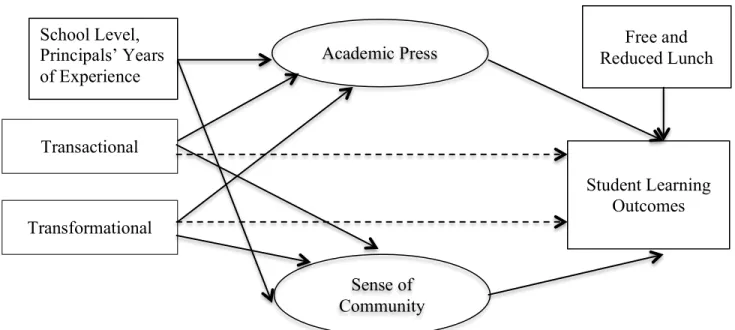
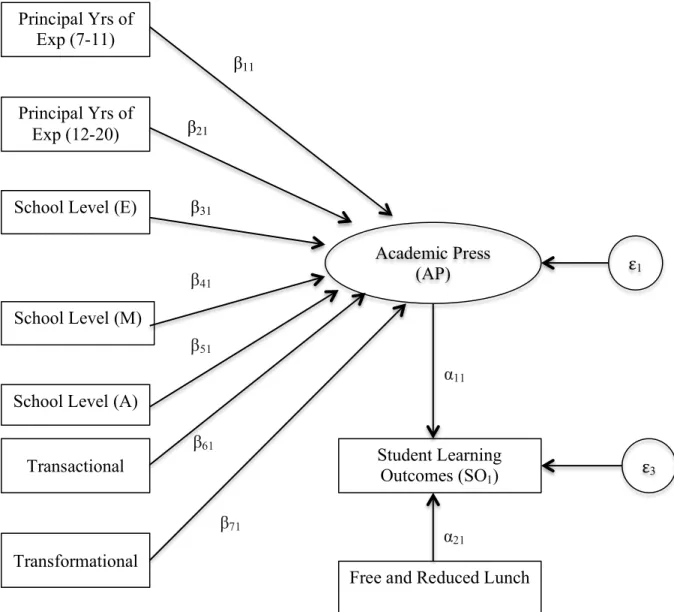
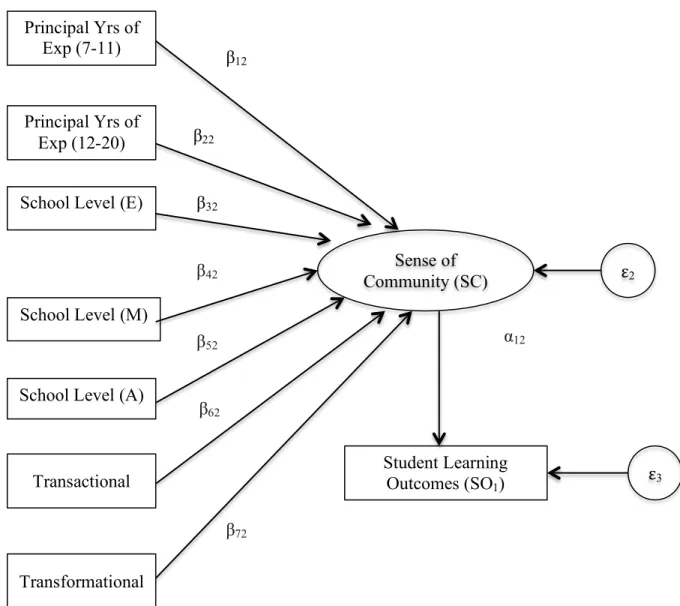
This study began with a conceptual model - a visual representation of theoretical variables of interest and expected relations among them (Kline, 2016). A path diagram should model the most parsimonious explanation of the phenomenon under consideration by connecting the smallest number of variables with the smallest number of arrows (Loehlin, 2004). The first part of the model (see Figure 1) looked at transactional and transformational leadership styles along with school level and principals’ years of experience as covariates and measured the direct impact with latent variables academic press and sense of community. The second part of the model looked at the latent variables academic press and sense of community and free-and-reduced lunch rate as a covariate and measured the direct impact with student outcomes. This 2-dimensional model aimed to assess the indirect and direct effects of transactional and
transformational leadership on a school’s academic press, sense of community, and student learning outcomes and compare to tell if there was mediation. The model aimed to predict how they are related.
The major claim was that principals’ transactional”ness” and transformational”ness” would explain differences in schools’ academic press, sense of community, and student
Figure 1. A path model of the influence a principal’s leadership behavior has on academic press and sense of community that impacts student learning. The relation between the principal and positive student learning outcomes is mediated by improvements in schools’ academic press and sense of community. In a reticular action modeling (RAM) – developed by J.J. McArdle – latent variables are designated by placing them in circles and observed variables by placing them in squares (Loehlin, 2004, p. 16). A straight, one-headed arrow represents a direct casual
relationship between two variables, also known as a structural effect. This study will use
regression coefficients to describe to what extent a change on the variable at the tail of the arrow is transmitted to the variable at the head of the arrow (Loehlin, 2004, p. 12).
Hallinger & Heck provide a rationale for the use of this model with the assertion that “well-designed studies must use theoretical models that allow for the likelihood that the
relationship between principal actions and school outcomes is indirect rather than direct” (1996, p. 24). Futhermore, Hallinger and Heck conclude effective principals focus on influencing school processes that are directly linked to student learning such as the practice of professional learning communities. Studies based on this leadership model have revealed statistically significant indirect effects on principal leadership on student achievement via such variables (Hallinger & Heck, 1996).
School Level, Principals’ Years of Experience
Student Learning Outcomes
Free and Reduced Lunch Academic Press
Sense of Community Transactional
Assumptions of This Research Study
As previously mentioned, today’s principals are held accountable for the academic success of their students. The principal is responsible for outcomes of productivity and
satisfaction attained by students and teachers, as well as the climate of the school (Beckerman, 2005; Chin, 2007). Multiple assumptions were made based upon this premise. First, it was assumed that the principal’s leadership behavior (i.e., transactional and transformational) would affect the condition of a school’s academic press and community (i.e., school climate), and through changes in press and community student achievement would be impacted differentially. Moreover, the principal has a direct impact on teachers, so it was assumed that styles
(transactional and transformational) that correlate with high levels of press and community may
strengthen the principal's influence on teachers and the principal’s impact on student learning
outcomes. Additionally, an assumption of this study – specific to principals’ leadership behavior
- was that the transactional and transformational continuum is inclusive, that is, it includes all of
the relevant stylistic nuances to be significant.
The most powerful achievement effects are predicted when high levels of academic press work in tandem with a school’s commonality of beliefs, activities, and traditions, and care for students (Shouse, 1995). An assumption was made that principals would want to choose leadership behaviors that would maximize effectiveness in improving teaching and learning conditions and student achievement.
Limitations of This Research Study
school climate. The condition of each school’s climate was defined by the constructs of academic press and sense of community. There are many additional variables that make-up a school’s climate with some being easier to define than others (Hoy et al., 1991).
Academic press and sense of community were measured using data from the TWC. One limitation of using the TWC was that the eight available TWC constructs do not fully capture all of the relevant school conditions that support press and community identified in the literature. Another limitation of using the TWC for a school-level analysis was the assumption that every individual in the school holds the same perception about the condition of the school’s press and community. Studies that do not account for within-school variation can run the risk of
overemphasizing (or underemphasizing) differences in press and community between schools (Hallinger & Heck, 1998). The same risk of overemphasizing a principal’s style is true when a study, such as this one, holds principals solely responsible for student learning. Finally, data from the TWC were only taken from one year, which limited the analyses to represent a mere snapshot of the phenomenon.
One of the difficulties in predicting student achievement is that socio-economic status (SES) status generally overwhelms all other organizational variables in explaining the variance. Thus, it is important to find school properties that can explain student achievement controlling for SES. This study proposed academic press and sense of community as key candidates. Principals can affect student achievement indirectly using their leadership behaviors to enhance their organizational climate in which press and community are elements.
Another limitation was the conceptual model used for this study. An argument could be made for examining the reciprocal effects between the principal and features of the school. Hallinger and Heck (1998) propose that the principal and school environment exist in an
interactive relationship. For example, principals may change the school’s curriculum program or instructional practices, which causes changes in the conditions of teaching and learning. The principal receives feedback that causes reciprocal effects in the leader’s behavior (Hallinger & Heck, 1998).
Definition of Terms
Some of these terms listed are widely used and variously interpreted. The terms are limited to these definitions for the purpose of this study.
Academic Press: The extent to which schools appear driven by academically oriented goals, values and activities (Shouse, 1996).
Contingent Reward: The leader clarifies expectations and offers recognition when goals are achieved. Followers achieve an expected level of performance (Avolio & Bass, 2004).
Individualized Consideration: The leader pays attention to each individual’s need for achievement and growth by acting as a coach or mentor. The leader helps followers reach higher levels of potential, and recognizes individual differences, needs and desires (Avolio & Bass, 2004).
Inspirational motivation: The leader motivates others by providing meaning and challenge to followers’ work. The leader builds enthusiasm and optimism and encourages individual and team spirit among followers (Avolio & Bass, 2004).
Intellectual stimulation: The leader stimulates followers to be innovative and creative by questioning assumptions, reframing problems, and approaching old situations in new ways. The leader solicits new ideas and creative solutions from followers and includes them in the process (Avolio & Bass, 2004).
Leader Effectiveness: How a leader performs in improving three areas: (1) the
conditions of press and community through setting directions, developing people, redesigning the organization, and managing the instructional (teaching and learning) program (Leithwood et al., 2006); (2) teacher motivation, efficacy, satisfaction, productivity, and performance (Blase and Blase, 2000); and (3) student learning outcomes.
Leadership: “Leaders inducing followers to act for certain goals that represent the values and the motivations – the wants and needs, the aspiration and expectations – of both leaders and followers. And the genius of leadership lies in the manner in which leaders see and act on their own and their followers’ values and motivations” (Burns, 1978, p. 19).
Management-by-exception (active): The leader specifies the standards for compliance and what constitutes ineffective performance. The leader closely monitors followers for deviance, mistakes and errors and then takes swift corrective action (Avolio & Bass, 2004).
Sense of Community: Builds among students and teachers a sense of attachment, commitment, responsibility, and purpose within an increasingly diverse and diffuse social context (Shouse, 1996).
Transactional Leadership: “Emphasizes the transaction or exchange that takes place among leaders, colleagues, and followers. This exchange is based on the leader discussing with others what is required and specifying the conditions and rewards these others will receive if they fulfill those requirements” (Avolio & Bass, 1994, p. 3).
Transformational Leadership: “Is seen when leaders stimulate interest among colleagues and followers to view their work from new perspectives, generate awareness of the mission or vision of the team and organization, develop colleagues and followers to higher levels of ability and potential, and motivate colleagues and followers to look beyond their own interests toward those that will benefit the group” (Avolio & Bass, 1994, p. 2).
Summary
This study investigated transactional and transformational leadership as they relate to school principals in various school climates. It investigated the relationship between school principals’ leadership behaviors and the condition of schools’ academic press and sense of community. Using the TWC and MLQ:Form5X, this study attempted to examine (a) self-described leadership behaviors of principals across all three school levels (i.e., elementary, middle, and high) and (b) the influence of transactional and transformational leadership
Chapter 2 Introduction
This summary of relevant literature examines general concepts such as: (a) leadership and style; (b) school culture and climate; and (c) leader effectiveness and the effects of leadership. Leadership is a performance about influencing people to attain a goal. In the case of school leadership, the goal is student achievement by the way of academic excellence and instructional equity. Exceptional principals may use their leadership style to elicit more motivation, efficacy, and satisfaction from their teachers by shaping the culture and climate of the school, which may improve student achievement. This literature review has been strategically arranged by theme in accordance with this line of argument to move the reader to understand the importance of this present study. Spanning four sections, this chapter will review empirical and conceptual readings that discuss the relationship between the three areas outlined above and expose remaining questions yet to be answered.
climate influence teachers’ motivation, efficacy, and satisfaction and student achievement. The last section will review related leadership studies using transformational measures to describe leadership behaviors and their relationship to varying aspects of school climate, including academic press and sense of community.
Theoretical Framework
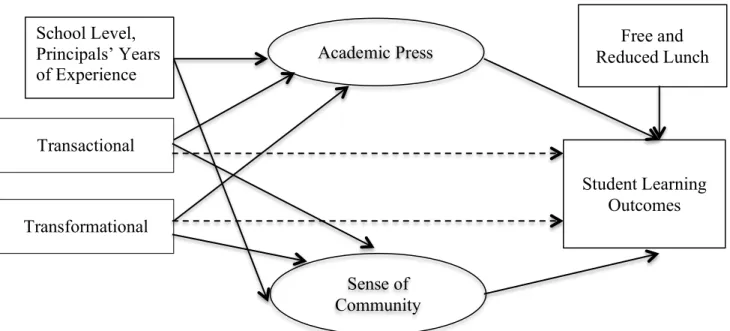
As was discussed in chapter one, the major theoretical underpinnings of this study come from the research on transactional and transformational leadership (Bass, 1985; Avolio & Bass, 1991; Avolio & Bass, 2004). Figure 1 depicts a path model of the influence a principal’s leadership behavior has on academic press and sense of community, which may, differentially, impact student achievement.
From this model, the study’s independent variable is the principals’ leadership behaviors; the dependent variables are academic press, sense of community, and student achievement. The SEM technique starts with the specification of a model to be estimated, which is a series of hypotheses about how the variables in the analysis are generated and related (Hu & Bentler,
School Level, Principals’ Years of Experience
Student Learning Outcomes
Free and Reduced Lunch Academic Press
Sense of Community Transactional
1999). SEM requires a priori (deductions from theory) specifications reflected in the study’s hypotheses and used to make up the model to be analyzed (Kline, 2016). A review of the literature was to provide scholarly opinion and empirical research in accordance with the relationships proposed in this path model and theoretical justification of the six hypotheses developed to explore the research question:
1. H0: There is no relationship between principals’ self-perception of their leadership style, as
measured by the MLQ:Form5X, and the school’s academic press.
2. H0: There is no relationship between principals’ self-perception of their leadership style, as
measured by the MLQ:Form5X, and the school’s sense of community.
3. H0: There is no relationship between principals’ self-perception of their leadership style, as
measured by the MLQ:Form5X, and student achievement.
4. H0: There is no relationship between a school’s academic press and student achievement.
5. H0: There is no relationship between a school’s sense of community and student achievement.
6. H0: There is no relationship between the principals’ self-perceptions of their leadership style, a
school’s academic press, sense of community, and student achievement. Leadership and Style
According to Bass and Bass (2008, p. 439), “leaders must balance the advantages of a more democratic approach, which ordinarily contributes to the commitment, loyalty,
Leadership
Leadership is a strategic act, composed of practices aimed to influence followers to attain a goal (i.e., increase job performance, create positive student learning outcomes, or strive for social justice). Burns (1978) defines leadership as “leaders inducing followers to act for certain goals that represent the values and the motivations – the wants and needs, the aspiration and expectations – of both leaders and followers” (p. 19). It is essential to incorporate followers into the act for leaders to be successful. Strategically, leaders employ practices that will elicit a drive in followers to work for a greater good. Schwahn and Spady (2010) propose that motivation and productivity are significantly enhanced when leaders create and produce something that has intrinsic meaning and really engages followers. Burns (1978) builds an ideal form of leadership on the foundation of social justice and equity:
At the highest stage of moral development persons are guided by near universal ethical principles of justice such as equality of human rights and respect for individual
dignity….What kind of leadership reaches into the need and value structures, mobilizing and directing support for such values as justice and empathy? 1. Leadership that operates at need and value levels higher than those of the potential followers…. 2. Leadership that can exploit conflict and tension within persons’ value structures (arouse a sense of dissatisfaction…). Leaders can redefine aspirations and gratifications to help followers see their stake in…social movements. Most important, they can gratify lower needs so that higher motivations will arise to elevate the conscience of men and women. (pp. 42-43)
Leadership, by this definition, moves beyond managing simple outcomes and requires an artful competence of the human condition. “How far a leader models values and emotional behavior and influences them in faculty and students is the exercise of intelligence that distinguishes man from machine and is the charter mark of leadership” (Lumby & English, 2010, p. 22).
2010). Furthermore, leaders should empower their followers. Through empowerment, Schwahn and Spady (2010) suggest leaders can create in followers a genuine sense that they “really matter” and can “make a difference” in the larger scheme of things. To aspire to Burn’s (1978) ideal form of leadership, a complete leader must be characterized by more than one quality. Schwahn and Spady (2010) offer five domains that embody the total leader: (a) Visionary
Leaders frame creative and innovative visions; (b) Relational Leaders develop collaborative and collegial ownership; (c) Quality Leaders build skilled and expert capacity; (d) Service Leaders ensure compassionate and dedicated support; and (e) Authentic Leaders define ethical purpose. Energy for each domain is supplied by a state of consciousness, creativity, collaboration, and competence; being a total leader is an art form.
The Barber Model of Leadership (Barber, 1985) explains the factors that shape a leader’s act. According to English (2008), Barber’s leadership model contains three internal variables (i.e., character, worldview, and style) that impact a leader’s consciousness, creativity,
collaboration, and competence, or the energy a leader is able to put towards their performance (English, 2008). Each variable is important to expand upon to build a practical understanding of leadership in conjunction with the previously mentioned characteristics that distinguish
leadership from management. First, a leader’s character is the person’s stance as he/she
experiences the events of life. Second, a leader’s worldview consists of the primary beliefs of a leader, particularly how he/she conceives of social causality, human nature, and the central moral conflicts of the time. Third, a leader’s style is the way a leader acts (i.e., the habitual way of performing) three political roles: (a) rhetoric – the manner of speaking to the media and various audiences; (b) personal relations – face to face relations with people and groups; and (c)
him/her (English, 2008). It is the style variable that this study will examine and elaborate on in more detail.
The Barber model aligns with Burn’s (1978) ideal form of leadership by requiring a leader’s actions to represent the expectations of followers. These expectations can be sorted into three basic categories: (a) reassurances – a feeling that things will be all right; (b) a sense of progress and action – a take charge person, a doer, a turner of wheels, a producer of progress; and (c) a sense of legitimacy – a defender of the faith, someone who personifies the betterness we all want in an inspiring way (English, 2008). A leader needs to meet these expectations in order for their act to be effective in influencing followers. More importantly, Burns (1978) contends learning shapes a leader’s act: learning from experiences, learning from followers, and learning from successes and failures.
Combining the work of these researchers provides a bridge from theory to practice. Practicing or aspiring leaders can see more clearly that in order to satisfy the function of leadership (i.e., improving the condition of teachers’ motivation, teachers’ abilities, knowledge and skills, and teachers’ work settings) they must create a vision, build relationships aligned with the values and needs of their followers, and empower their followers. By doing these things, leaders can make their influence more tangible in the organization by improving teacher motivation, efficacy and satisfaction.
Leadership Style Defined
Leadership is a strategic performance: a cognitive and interpretive act. School leaders employ different behaviors to influence teachers (also referred to as followers). These
will be discussed in great detail throughout this review. It is important to study style because “when leaders use specific leadership behaviors consistent with their deeply-ingrained values, they can achieve great things” (Sarros & Santora, 2001, p. 384). There are different schools of thought as to how to categorize styles or behaviors of leaders. Smith and Piele (2007) define style as the characteristic way in which a leader uses power, makes decisions, and interacts with others. Shockley-Zalebak (1988) shares the following theory about leadership style:
Style theories for understanding leadership attempt to identify a range of general
approaches leaders use to influence goal achievement. These approaches are theorized to be based on the leader’s assumptions about what motivates people to accomplish goals. Particular approaches also are thought to reflect complex relationships among the personal characteristics of the leader (i.e. communication competencies, communication apprehension, internal motivational forces), the requirements of the situation at hand, and the resources over which the leader and followers have control or influence. (p. 205) Consequently, leadership style is the collective set of behaviors leaders employ to aid their performance to influence followers and attain a goal. Shockley-Zalebak (1988) suggests a leader’s influence stretches from the processes and procedures for how the task is accomplished to how people are supported. To enhance the effect of such influence, leaders and followers participate in complex tactical interactions influenced by individual preference and strategic objectives, as well as the needs of a particular situation. There are a myriad of options for style that a leader may choose from, so “the task now becomes one of identifying optimal
combinations of style variables that can predict consequences like effectiveness, empathy, conflict resolvability, emotional comfortableness, and healthy personality” (Norton & Pettegrew, 1977, p. 280).
out of their experiences to advance our knowledge of how leaders understand, experience, and approach the enterprise of leading” (p. 650). Additionally, a leader’s personality acts as a predictor of style, which includes communication. A communication style is an expression of a person’s personality, which gives both consistency and individuality to a person’s behavior (De Vries, Bakker-Pieper, Konings, & Schouten, 2011; Feist & Feist, 2006). Kuhnert and Lewis (1987, p. 650) conclude that “while the behaviors of leaders may change under different
circumstances, the underlying personality structures that produce the behaviors are quite stable.” The most widely discussed leadership styles are those positioned on a continuum between transactional and transformational. The operational definition of these styles began with Burns (1978), has been enhanced by Bass (1985), and continues to expand in recent literature.
According to Blase (1993):
In transactional leadership, Burns (1978) said, leaders and followers both work to achieve individual and separate goals. In contrast, transformational leadership, which is
fundamentally moral, emerges from the needs, aspirations, and values of followers and results in mutuality of purposes between leaders and followers. (p. 157)
This literature review will unpack the significance of these two styles of leadership on the effects of leadership (i.e., teacher motivation, efficacy, and satisfaction).
procedures, and behavior. A democratic style engages followers in supportive communication that facilitates interaction between leaders and followers and encourages follower involvement and participation in the determination of goals and procedures. A laissez-faire style withdraws from followers and offers little guidance or support. Styles are chosen to have an impact on group outcomes. Groups with laissez-faire leaders are not as productive and satisfying as groups with democratic leaders. Groups led by authoritarian leaders are most efficient; however, they experience more hostility, aggression and discontent. Overall, groups led by democratic leaders are most effective and have a higher degree of commitment to group outcomes (Hackman & Johnson, 2000). These dynamics will be discussed in greater detail in Part II.
The authoritarian, democratic, and laissez-faire styles are simplified by Hackman and Johnson (2000) into two broader styles, task and interpersonal. A task leader demonstrates a much greater concern for getting work done than for the people doing the work. An
followers (Hackman & Johnson, 2000). The breakdown between task production and concern for relationships with people is further discussed in the Blake and Mouton Managerial Grid, which charts leadership styles as impoverished management, middle-of-the-road management, country club management, task management, and team management. Leaders work to make balances among these dimensions (Shockley-Zalebak, 1988).
The most enduring theme in style research is the contrast between “task” orientation and “relationship” orientation. Research shows the distinction lies in the difference in the way leaders approach their work (Smith & Piele, 2007). “Some leaders are fascinated by the technical challenge of getting things done: setting goals, organizing meetings, and monitoring activities. Other leaders, are seemingly more attuned to the people around them, display great skill at communicating and motivating” (Smith & Piele, 2007, p. 78). The main difference is the process by which leaders motivate followers and the type of goals set (Den Hartog, Koopman, & Van Muijen, 1997; Hater & Bass, 1988).
The difference between task- and relationship-oriented leaders has been examined with effectiveness measures and performance outcomes. As cited in Bass and Bass (2008), Pandy (1976) reported that groups with relationship-oriented leaders generated more ideas than groups with task-oriented leaders. Katz, Maccoby, and Morse (1950) and Roberts, Miles, and
Blankenship (1968) found that the performance of groups was higher under a
relationship-oriented style than under a more disinterested style of supervision. Philipsen (1965a, 1965b) also found that relationship-oriented leadership correlated positively with group effectiveness. Group effectiveness was found to be influenced by the interaction between relationship-oriented
However, the effectiveness of leaders is greatest when the leaders are both task-oriented and relationship-oriented in attitudes and behavior (Bass & Bass, 2008).
Personality and leadership style. A leader’s personality orientation has been shown to be linked to which style of leadership is preferred. Based on the Orientation Inventory (ORI), Bass (1962c) found task-oriented leaders prefer feeling satisfied by a job well done, being surrounded by bright, interesting friends, and being a leader who gets things done. In contrast, relations-oriented leaders prefer working cooperatively, being surrounded by helpful friends, and being a leader who was easy to talk to (Bass & Bass, 2008). Similar distinctions can be made with employees and their preference for a type of leader. Ehrhart and Klein (2001, as cited in Bass & Bass, 2008) reported that employees who were more interested in extrinsic rewards for performance favored more relationship-oriented supervisors whereas employees who preferred more structure and security in their work favored more task-oriented supervisors.
Over time, the needs of organizations, leaders, and their followers have changed, which has necessitated an evolution of leadership style. In recent literature, the task/relationship distinction has been expanded on as theories of transactional and transformational leadership. These forms of leadership serve as the major theoretical pillars of this study.
Transactional and Transformational Leadership
Organizations are faced with having to adapt to a changing world to remain competitive (Avolio & Bass, 2004). Structured organizational hierarchies of the past are being remodeled in order to continually improve the potential of one’s workforce (Avolio & Bass, 2004).
and ordinary political leaders motivate their associates. Bass (1985) extended Burns’s ideas to the field of education, among others, and dedicated his work to defining and refining a broad continuum of leadership behaviors ranging from laissez-faire leadership to charismatic leadership. A more differentiated theory of leadership was warranted to account for the limitations associated with two-factor (task and relationship) models of leadership for the purpose of leadership research and training (Antonakis et al., 2003). The work of these researchers opened the door for others to navigate the varying relationships that exist between leadership behaviors and leader effectiveness, and how those relationships have changed over time.
The need for organizations to promote change and deal with resistance to it has shifted the emphasis from leading through contingent rewards to democratic, participative, relationship-oriented, and considerate leadership – a shift that has directed leadership away from maintaining quantity and/or quality of performance to leading transformations in beliefs, values, and needs of not just the individual but the organization as well (Avolio & Bass, 2004). Therefore, Avolio and Bass (2004) conclude that leadership requires the higher-order exchange process of
transformational leadership in addition to the reward for effort exchange behavior and corrective orientation that typifies transactional leadership.
Bass’s (1985) original theory of leadership included four transformational and two transactional leadership behaviors (Antonakis et al., 2003). Based on numerous studies, Bass
and Avolio (1991) expanded the theory to what is currently coined the full range of leadership theory (FRLT) (Antonakis et al., 2003). This study will examine transactional and