Deliverable 1.1
ADDRESS technical and
commercial conceptual
architectures
vision
The research leading to these results has received funding from the European Community's Seventh Framework Programme (FP7/2007-2013) under grant agreement n° 207643
ADDRESS Technical and Commercial
Conceptual Architectures - Core document
Deliverable D1.1 - Conceptual architecture including description of: participants, signals exchanged, markets and market interactions, overall expected system functional behaviour – Core document.
Programme FP7 – Cooperation / Energy
Grant agreement number 207643
Project acronym ADDRESS
Type (distribution level) Public
Date of delivery 21st October 2009
Report number D1.1 Status and Version Final, V 1.0
Number of pages 129
WP/Task related WP1/T1.5
WP/Task responsible R. Belhomme/F. Bouffard
Author(s)
R. Belhomme, Maria Sebastian, Alioune Diop, Marianne Entem, François Bouffard, Giovanni Valtorta, Angelo De Simone, Ramon Cerero, Cherry Yuen, Seppo Karkkainen, Wolfgang Fritz
Partner(s) Contributing EDF SA, University of Manchester, Enel Distribuzione,
Iberdrola, ABB, VTT, Consentec
Document ID
ADD-WP1-T1.5-DEL-EDF-D1.1-Technical_and_Commercial_Architectures-V1.0
ADD-WP1-T1.5-DEL-EDF-D1.1-Technical_and-Commercial_Architectures-V1.0.doc
ADDRESS Technical and Commercial Conceptual Architectures - Core document ADD-WP1-T1.5-DEL-EDF-D1.1-Technical_and_Commercial_Architectures
Revision 1.0
Executive Summary
ADDRESS (“Active Distribution networks with full integration of Demand and distributed energy
RESourceS”) is a four-year large-scale R&D European project launched in June 2008. The project coordinator is ENEL Distribuzione SpA and the consortium consists of 25 partners from 11 European countries spanning the entire electricity supply chain, qualified R&D bodies, SMEs (Small and Medium Enterprises) and manufacturers.
The aim of the project is to develop a comprehensive commercial and technical framework for the development of “Active Demand” in the smart grids of the future.
In ADDRESS, “Active Demand” (AD) means the active participation of domestic and small commercial consumers in the power system markets and in the provision of services to the different power system participants. Within ADDRESS, “Active Demand” involves all types of equipment that may be installed at the consumers (or prosumers) premises: electrical appliances (“pure” loads), distributed generation (such as photo-voltaic arrays or micro-turbines) and thermal or electrical energy storage systems.
The present Deliverable D1.1 entitled “Conceptual architecture including description of: participants, signals exchanged, markets and market interactions, overall expected system functional behaviour” has been produced in Work Package 1 (WP1) of the project. The main objective of this deliverable is to describe the conceptual technical and commercial architectures developed to enable AD and exploit its benefits, and more specifically:
1. the participants and other components of the architectures,
2. the services that could be provided by AD and the markets interactions,
3. the different interactions between the participants and the design of the signals exchanged between them in relation to the provision of these services,
4. the overall system behaviour both from the commercial and technical points of view and the corresponding basic requirements for the implementation of the architectures,
5. the issues to be solved and potential barriers to be removed. Deliverable D1.1 is composed of two reports:
- the present report which is the core document of the deliverable and provides a condensed and hopefully reader-friendly description of the technical and commercial architectures developed in the ADDRESS project.
- a second document containing the appendices which provide a detailed description of topics covered in the core document.
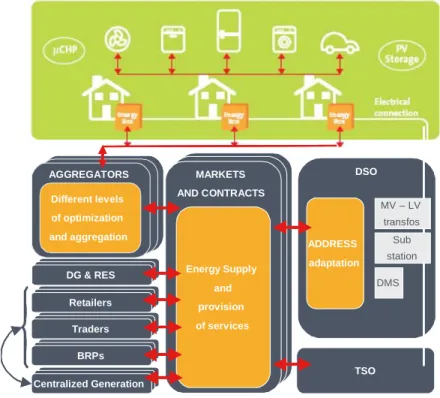
Figure 1 shows a simplified representation of the proposed architecture. In this architecture, the aggregators are a central concept. The aggregators are the key mediators between the consumers on one side and the markets and the other power system participants on the other side, namely:
- The aggregators collect the requests and signals for AD-based services coming from the markets and the different power system participants.
- They gather the “flexibilities” and the contributions provided by consumers to form AD-based services and they offer them to the different power system participants through various markets. It should be emphasized that the “flexibilities and contributions of consumers are provided in the form of modifications of their consumption profile. Therefore aggregators form their AD services and offers using consumers’ “demand modifications” and not consumers’ energy profile as such. Or in other words, aggregator sells a deviation from the forecasted level of demand, and not a specific level of demand.
ADDRESS Technical and Commercial Conceptual Architectures - Core document ADD-WP1-T1.5-DEL-EDF-D1.1-Technical_and_Commercial_Architectures Revision 1.0 Retailers BRPs DG & RES Traders Centralized Generation AGGREGATORS Different levels of optimization and aggregation MARKETS AND CONTRACTS Energy Supply and provision of services TSO DSO ADDRESS adaptation DMS MV – LV transfos Sub station Retailers BRPs DG & RES Traders Centralized Generation AGGREGATORS Different levels of optimization and aggregation MARKETS AND CONTRACTS Energy Supply and provision of services TSO DSO ADDRESS adaptation DMS MV – LV transfos Sub station Retailers BRPs DG & RES Traders Centralized Generation AGGREGATORS Different levels of optimization and aggregation MARKETS AND CONTRACTS Energy Supply and provision of services TSO DSO ADDRESS adaptation DMS MV – LV transfos Sub station
Figure 1. ADDRESS scope and simplified representation of the architecture The participants in the architecture and the AD services provided to them
A part from the aggregators and the consumers, two types of participants may be distinguished:
- regulated participants: DSOs and TSOs,
- deregulated participants or participants in competition. For these latter, 9 players are considered and they may be divided into three main categories:
o Producers: central producers, decentralised electricity producers, producers with regulated tariff and obligations (reserve, volume, curtailment, etc.)
o Intermediaries: retailers, production aggregators, electricity traders, electricity brokers, Balancing Responsible Parties (BRPs).
o Consumers: large consumers.
For all the participants, their needs and expectations with respect to active demand are analysed on the basis of their functions and stakes and the possible services that AD could provide them are identified and described. This leads to a large number of different AD services, and more specifically:
- 24 different AD services for the 9 deregulated players,
- 7 different AD services provided to DSOs and TSOs.
Therefore before going further in the description of these services, it is necessary to define standardized AD products in order to formulate the identified services. The outcome of a thorough reflection on those services has been the identification of three basic AD-based products
summarized in Table 1.
The SRP and CRP products imply single specific unidirectional volume (which could possibly be a volume range). The CRP-2 can be considered as the combination of two separate CRP with the appropriate associated demand reduction and increment.
ADDRESS Technical and Commercial Conceptual Architectures - Core document ADD-WP1-T1.5-DEL-EDF-D1.1-Technical_and_Commercial_Architectures
Revision 1.0
Table 1. AD products and their main characteristics AD Product Conditionality Typical example
Scheduled re-profiling (SRP)
Unconditional (obligation)
The aggregator has the obligation to provide a specified demand modification (reduction or increase) at a given time to the product buyer.
Conditional re-profiling (CRP)
Conditional (real option)
The aggregator must have the capacity to provide a specified
demand modification during a given period. The delivery is called upon by the buyer of the AD product (similar to a reserve service).
Bi-directional conditional re-profiling (CRP-2)
Conditional (real option)
The aggregator must have the capacity to provide a specified
demand modification during a given period in a bi-directional range [ -y, x ] MW, including both demand increase and decrease. The delivery is called upon by the buyer of the AD product (similar to a reserve service).
The interactions between the participants and the aggregator
Using the templates, the 31 AD services previously identified are then formulated in a standardized form which provides the signals and information exchanged between the participants and the aggregator for the request of the AD services.
Special relationships between participants are examined in detail:
- Relationships between the regulated participants, i.e. the DSO and the TSO, which require a good coordination between them at different levels:
o From the commercial point of view where for some kind of services a coordination between DSO and TSO might be needed to avoid conflicting requests or improve efficiency, provided that this “coordination” between the TSO and the DSO does not introduce any bias in the market and does not raise any barriers for any deregulated players to provide services.
o From the technical point of view a coordination is needed between the DSO and the TSO to carry out the technical validation of the AD transactions performed by the aggregators. Indeed, the actions performed by aggregators through the management of their consumers’ portfolio have an impact on the power flows and voltages on the lines and other network equipment. There might be some cases where network constraint violations will occur. In order to avoid these network constraints violations, DSOs and TSOs need to assess the impact of prospective AD actions and take appropriate measures when these actions cause or could cause a problem. This may require a “curtailment” of the AD products if no other solutions can be found.
- Relationships between the aggregators and the DSO regarding the technical validation mentioned above.
- Relationships between the aggregators, retailers, BRPs and TSOs regarding possible imbalances that can be caused by the AD transactions of an aggregator:
o Imbalances for the retailers whose consumers are providing their flexibility to the aggregator.
o Imbalances for the BRPs in the perimeter of which the consumers are.
o Physical imbalances on the electricity system.
o Imbalances for the same players at the time the energy payback possibly occurs.
ADDRESS Technical and Commercial Conceptual Architectures - Core document ADD-WP1-T1.5-DEL-EDF-D1.1-Technical_and_Commercial_Architectures
Revision 1.0
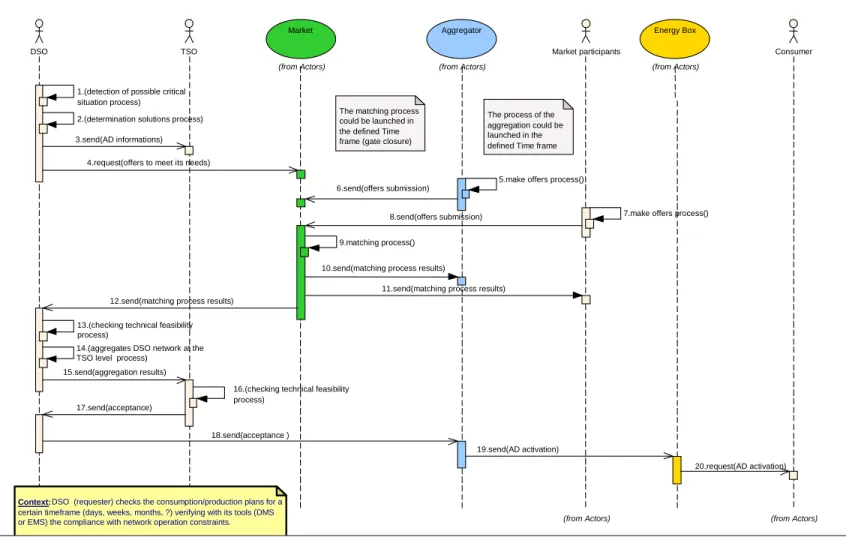
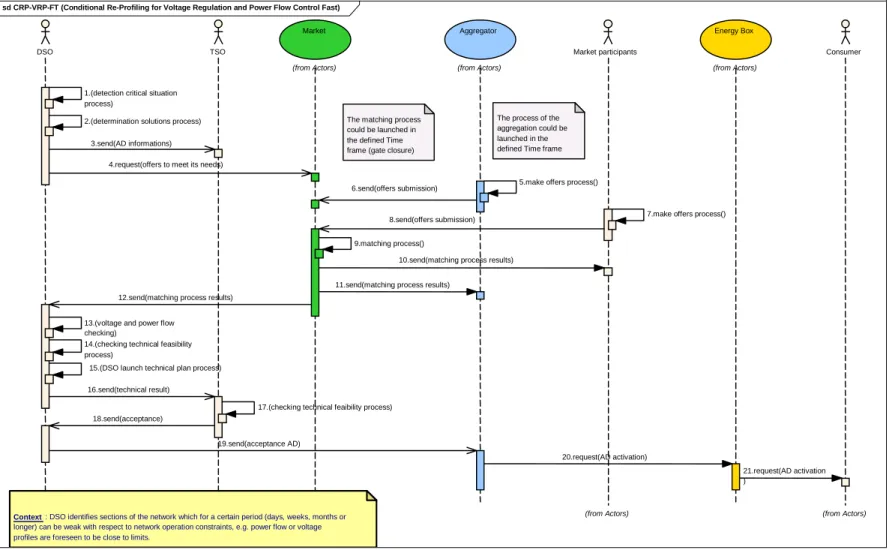
represents on a timeline all the interactions between the players involved in the provision of this service (including those involved in the technical verification), along with their internal processes. The use cases for the AD services are therefore quite an important part in the technical and commercial architectures of the ADDRESS project.
In particular, four references use cases are defined taking for basis the services provided to the retailer and to the DSO, two for SRP products and two for CRP products. It appeared that, sensibly, the use cases for the retailer could be adapted with only minor changes for all deregulated players. In the same way the use cases for the DSO are very similar to those for the TSO. These 4 use cases are represented in UML diagrams.
The aggregator and consumers’ flexibilities
As mentioned previously, the ADDRESS aggregator is a central player in the ADDRESS architecture. The aggregator of the flexibilities provided by domestic consumers is a fairly new player in the energy business. This has led to a specific study on its roles, activities and means of relationship with other players, the results of which are presented in the Deliverable.
More specifically, the following topics are described:
- The roles and main functions that an aggregator will play in the overall market framework, or more precisely from the point of view of the electricity system.
- The relationship with the electricity system players for the provision of AD products: this topic has already been discussed above from the points of view of the characterisation of the services and products provided to the different (regulated and deregulated) players, of the implied relationships between the aggregator and these players and of the exchanges of information and signals. In this part, the following aspects are now considered: the relationship between the aggregator and the consumers, the exchanges of information with the Energy Box, the management of the energy payback effect, the monitoring/assessment of service delivery (by the aggregator to the buyer of the service) and of consumers’ response (to aggregator’s requests), the participation in organized markets.
- The internal activities of the aggregator: which seeks to clarify the business internal organization of an aggregator, identifying the main functionalities and activities it should develop in order to carry out its functions in the system and maximise its profits, and in particular:
o Building a portfolio of AD “clients” (or buyers) and AD sales opportunities
o Building a portfolio of AD “providers” (or consumers) and
o Operative decisions: forecasting (consumption, load flexibility, prices, …), setting up the offers, managing the orders coming from the commitments previously agreed, calculate activation signals for consumers, analyse consumers’ response, …
o Risk management (market risk, credit risk, operational risk).
- The particular case when the aggregator is a retailer: the implications of this configuration with respect to the above issues are discussed.
At the end an overview of consumers’ flexibility is provided:
- first from the point of view of the equipment possibly present at the consumers’ premises: electric appliances, DG, RES, storage system, etc.
- then the flexibility aggregated at consumer level (at the level of the house or the building).
Process for the calculation of price and volume signals
A process is presented for the calculation of the price and volume signals based on an optimisation approach, which the various participants may use. As such it gives algorithms that may be
ADDRESS Technical and Commercial Conceptual Architectures - Core document ADD-WP1-T1.5-DEL-EDF-D1.1-Technical_and_Commercial_Architectures
Revision 1.0
implemented in the participants’ business processes.
More specifically, the general approach is first presented, along with the processes for the regulated and the deregulated players, and the rationale of the process. Then the optimisation formulations are given for both a SRP and a CRP products. Finally two examples of the application of the proposed calculation process are provided: one regarding a SRP for the Decentralized Producer and the other for a CRP for the Centralized Producer.
Overall system behaviour, corresponding basic requirements and issues/barriers to be solved
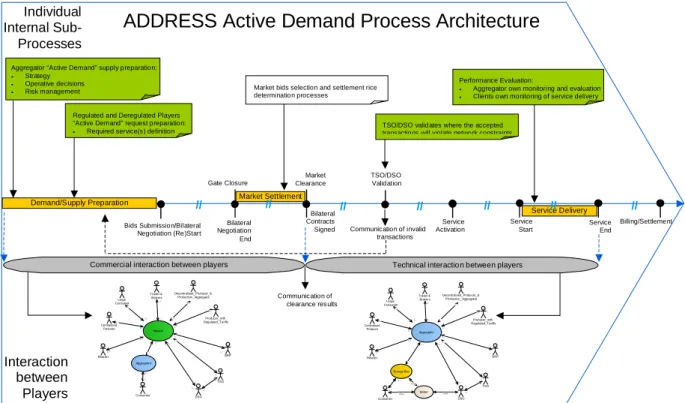
All the “pieces/results” previously described are then collected to provide an overall description of the ADDRESS commercial and technical architectures. They are presented in the form of a chronological process and simplified UML role models for both types of architectures. This overall description is schematically illustrated in Figure 2.
Individual Internal Sub-Processes Interaction between Players Bids Submission/Bilateral Negotiation (Re)Start Gate Closure Market Clearance TSO/DSO Validation Service Activation Service Start Service End Bilateral Negotiation End Bilateral Contracts Signed // Demand/Supply Preparation Service Delivery
Aggregator “Active Demand” supply preparation: Strategy
Operative decisions Risk management
Regulated and Deregulated Players “Active Demand” request preparation:
Required service(s) definition
Performance Evaluation:
Aggregator own monitoring and evaluation Clients own monitoring of service delivery
Commercial interaction between players Technical interaction between players
Market bids selection and settlement rice determination processes
Billing/Settlement
// // // // //
ADDRESS Active Demand Process Architecture
Communication of clearance results
Communication of invalid transactions
TSO/DSO validates where the accepted transactions will violate network constraints
Market Settlement // Trader & Brokers BRP Decentralised_Producer_& Production_Aggregator TSO DSO Consumer Retailer Centralised Poducer Market Aggregator Large Consumer Producer_with Regulated_Tariffs 1..* 1..* 1..* 1..* 1..* 1..* 1..* 1..* 1..* 1..* 1..* 1..* 1..* 1..* 1 1..* 1 1..* 1..* 1..* 1..* 1..* 1..* 1..* Trader & Brokers BRP Decentralised_Producer_& Production_Aggregator TSO DSO Consumer Retailer Centralised Poducer Aggregator Large Consumer Producer_with Regulated_Tariffs Energy Box Meter «flow» 1 1..* 1..* 1..* 1 1..* 1 1..* 1..* 1..* 1..* 1..* «flow» 1..* 1..* 1..* 1..* 1..* 1..* 1..* 1..* 1..* 1..* 1..* 1..* «flow»
Figure 2. ADDRESS process architecture diagram
The distinction between the “commercial” and “technical” parts is defined as follows:
- the commercial architecture (“contract negotiation” and “settlement” stages) deals with all the interactions, players structures, processes involved in the “negotiation” phase of the AD services (including the preparation of requests and offers) until the market clearance or the signature of the contracts (depending on the case). It also deals with the settlement stage after the end of the service.
- the technical architecture (“operational” stage) deals with all the interactions, player structures, processes involved in the activation and actual delivery of the AD services, after the market clearance or the signature of the contracts until the end of the service. This also includes the management of the energy payback effect and the possibly related monitoring actions.
Figure 2 is described in detail in the Deliverable, namely both:
ADDRESS Technical and Commercial Conceptual Architectures - Core document ADD-WP1-T1.5-DEL-EDF-D1.1-Technical_and_Commercial_Architectures
Revision 1.0
two simplified UML role models.
Then the commercial and technical requirements for the implementation of the architectures are presented in recapitulative tables and different ways to structure these requirements are described. These structures help to understand the relationships between the requirements, the AD services/products and the players.
Finally the issues to be addressed for the implementation of ADDRESS architectures are summarized. They can be subdivided into “general prerequisites” and “problems or barriers”.
“General prerequisites” are very obvious aspects that are necessary to make AD service provision feasible such as communication infrastructure, economic viability, acceptance by consumers, market access and regulatory framework.
“Problems or barriers” are less obvious aspects that depend more on the specific situation and interests of the actors involved. They can have technical, economic, socio-economic and/or regulatory reasons. Since these barriers are not reflected as obviously by the ADDRESS work structure, it is particularly important to identify them and to point out potential solutions. Therefore, they have been treated in greater detail. They have been subdivided into groups, based on their nature and/or the underlying reasons:
- AD acceptance by the players (not only consumers),
- Regulatory issues (lack of incentives, volume threshold, obligations, etc.),
- Contractual issues and pricing model
- Conflicting interests of players with respect to AD services
- Monitoring and/or verification of service provision by the aggregators to the buyers and by the consumers to the aggregator
- Management of information (ownership, confidentiality, etc.)
- Risks: uncertainty on AD availability, energy “payback” effect, network topology, etc.
Conclusions and next steps
The work done in WP1 is mainly conceptual work. Deliverable D1.1 gives the vision of the ADDRESS technical and commercial architectures and provides the foundations on which the other WPs are going to build/develop the ADDRESS solutions. From now on the other WPs are going to work in parallel on parts of the architectures. Therefore one of the objectives of this Deliverable is to be a reference document for these activities and be a “tool” to ensure their coherence, complementarity and completeness.
However this does not mean that it will not evolve. Indeed, the future work in those WPs may reveal needs for adaptations, modifications and/or complements due for instance to technical feasibility issues, social acceptance aspects or regulatory constraints. In such a case, Deliverable D1.1 will need to be revised.
As mentioned above the work on the ADDRESS technical and commercial architectures (developed conceptually in WP1) will continue now in the other WPs of the project. The activities performed in these WPs are described. In particular the next steps involve for a part the definitions of detailed specifications for the developments (carried out in these WPs) on the basis of the technical and commercial requirements defined here.
Finally the next deliverable, Deliverable D1.2 – “Application of the conceptual architecture in 4 or 5 specific scenarios”, will describe:
- 4 or 5 scenarios chosen to reflect different sufficiently representative European electricity system situations relevant for the ADDRESS future at the horizon of 2020 and
ADDRESS Technical and Commercial Conceptual Architectures - Core document ADD-WP1-T1.5-DEL-EDF-D1.1-Technical_and_Commercial_Architectures Revision 1.0
Table of contents
Executive Summary ... 2
Table of contents ... 8
List of figures... 10
List of tables ... 11
1.
ADDRESS objectives, concepts, architecture and introduction to
Deliverable D1.1... 13
1.1. The ADDRESS project: target and objectives...13
1.2. ADDRESS architecture and concepts...14
1.2.1. Overview of ADDRESS architecture...14
1.2.2. ADDRESS concepts ...15
1.3. Objectives of WP1 and its two deliverables ...16
1.4. Introduction to Deliverable D1.1...16
1.4.1. Objectives and main structure of the deliverable...16
1.4.2. Deliverable D1.1: the core document ...17
1.4.3. Deliverable D1.1: the appendices ...18
1.4.4. Articulation of both reports of Deliverable D1.1 ...19
2.
Description of the services provided by Active Demand ... 20
2.1. Needs and expectations of the power system participants ...20
2.1.1. Needs and expectations of the deregulated players...21
2.1.2. Needs and expectations of the regulated players (DSOs and TSOs) ...23
2.2. The ADDRESS services and products...25
2.2.1. Product definitions ...25
2.2.2. Product description template ...27
2.2.3. Locational information for AD service provision...29
2.3. Standardized formulation of the AD services ...31
2.3.1. AD services for deregulated players ...31
2.3.2. AD services for regulated players ...35
2.4. Relationships between the players ...38
2.4.1. Relationships between regulated players ...38
2.4.2. Relationship between regulated and deregulated players...40
2.4.3. Issues related to energy balancing and settlement ...43
2.5. Reference use cases...45
2.5.1. Reference use cases for deregulated players (based on the retailer)...46
2.5.2. Reference use cases for regulated players (based on the DSO) ...52
2.6. Summary ...58
3.
The ADDRESS aggregator and consumers’ flexibility... 60
3.1. Main functions of an aggregator ...60
3.2. Relationship with electricity system players for the provision of AD products...62
3.2.1. Relationships with the consumers and the Energy Box ...63
3.2.2. Management of the energy payback effect...65
3.2.3. Measurement/monitoring of AD service delivery ...67
3.2.4. Participation of aggregators in organised markets ...72
3.3. Internal activities of the aggregator ...72
3.3.1. Building a portfolio of AD clients and AD sales opportunities...73
3.3.2. Operative decisions ...74
ADDRESS Technical and Commercial Conceptual Architectures - Core document ADD-WP1-T1.5-DEL-EDF-D1.1-Technical_and_Commercial_Architectures
Revision 1.0
3.4. Aggregators versus retailers ...80
3.5. Consumers’ flexibility...81
3.5.1. DG, RES and storage technologies at consumers’ premises...81
3.5.2. Consumers’ loads and their flexibility ...83
3.5.3. Aggregated flexibility at consumer level ...84
4.
Process for the calculation of price and volume signals ... 87
4.1. General approach...87
4.1.1. Process for regulated players ...88
4.1.2. Process for deregulated players ...89
4.2. Formulation of price and volume signals - Rationale of the process ...90
4.3. Optimisation formulations for SRP ...91
4.4. Optimisation formulations for CRP...93
4.5. Application of the price and volume signal calculation process to selected players and services ...95
4.5.1. SRP - Load shaping for optimising the profit of a Decentralised Producer ...95
4.5.2. CRP - Short term optimisation problem of a centralized producer providing tertiary reserve service...96
5.
ADDRESS commercial and technical architectures... 98
5.1. Description of ADDRESS technical and commercial architectures ...98
5.1.1. Internal Sub-processes (Top half of architecture diagram) ...100
5.1.2. Interaction between Players (Bottom half of architecture diagram)...101
5.2. Requirements for the implementation of the architectures...103
5.2.1. Technical and commercial Requirements: recapitulative tables...104
5.2.2. Structures to organised the requirements...107
5.3. Issues to be addressed for the implementation of ADDRESS architectures ...108
5.3.1. General prerequisites...110
5.3.2. Potential problems or barriers and possible solutions ...111
6.
Next steps within ADDRESS ... 114
7.
Acknowledgement... 116
8.
References... 117
9.
Revision history ... 117
Appendix A.
ADDRESS Glossary... 118
A.1. Notations, abbreviations and acronyms...118
A.2. List and identification of the AD services ...120
A.3. Definitions...123
ADDRESS Technical and Commercial Conceptual Architectures - Core document ADD-WP1-T1.5-DEL-EDF-D1.1-Technical_and_Commercial_Architectures
Revision 1.0
List of figures
Figure 1. ADDRESS scope and simplified representation of the architecture ... 3
Figure 2. ADDRESS process architecture diagram... 6
Figure 3. ADDRESS target and objectives ... 13
Figure 4. ADDRESS scope and simplified representation of the architecture ... 15
Figure 5. Simplified representation of payback effect for controlled water heaters based on [5]. 27 Figure 6. AD product standardised delivery process... 28
Figure 7. SRP reference use case for deregulated players: short term load shaping for the retailer... 48
Figure 8. CRP reference use case for deregulated players: reserve capacity for the retailer to manage short-term risks... 51
Figure 9. SRP reference use case for regulated players: Scheduled re-profiling for VRPF control (slow) for the DSO ... 54
Figure 10.CRP reference use case for regulated players: Scheduled re-profiling for VRPF control (fast) for the DSO... 57
Figure 11.Overview of aggregators internal functionalities... 62
Figure 12.Possible relationships between Energy box and other equipment/players... 65
Figure 13.Request for a service by a DSO based on increments/modifications ... 69
Figure 14.Request for a service by a DSO based on “zero reference” or volume limits ... 70
Figure 15.Optimisation of AD clients portfolio ... 73
Figure 16.Possible structure for the inputs and outputs of the aggregation scheduling and trading optimisation system ... 76
Figure 17.Seasonal working days prototypes (clusters) in Spain... 85
Figure 18.Manageable consumption (lower part of the curve in red) and unmanageable consumption (upper part of the curve in blue) per prototype in Spain – Summer (total consumption = red+blue)... 86
Figure 19.DSO/TSO Process ... 88
Figure 20.Deregulated Players Process ... 89
Figure 21.Example SRP demand curve obtained by computing the optimal SRP volume (crosses) at regular intervals ... 92
Figure 22.Explanation of the ADDRESS process architecture diagram... 98
Figure 23.ADDRESS process architecture diagram... 99
Figure 24.UML diagram showing the commercial interactions between the players ... 102
Figure 25.UML diagram showing the technical interactions between the players ... 103
Figure 26.Commercial requirements – Structure 1 (extract) ... 107
Figure 27.Technical requirements – Structure 2 ... 109
Figure 28.Technical requirements – Structure 3 ... 110
ADDRESS Technical and Commercial Conceptual Architectures - Core document ADD-WP1-T1.5-DEL-EDF-D1.1-Technical_and_Commercial_Architectures
Revision 1.0
List of tables
Table 1. AD products and their main characteristics... 4
Table 2. Structure of Deliverable D1.1 – Sections of Core document and Appendices... 19
Table 3. Summary of the results obtained for the retailer ... 21
Table 4. Summary of the expectations of the deregulated players with respect to AD... 22
Table 5. Summary of DSOs and TSOs expectations with respect to AD... 23
Table 6. The three main types of AD services for DSOs and TSOs ... 24
Table 7. AD products and their main characteristics... 26
Table 8. AD product/service description template... 28
Table 9. List of AD services for deregulated players... 31
Table 10. List of AD services for regulated players (DSO, TSO) ... 35
Table 11. AD services for regulated and deregulated players ... 58
Table 12. List of risks and their mitigation ... 79
Table 13. Commercial architecture requirements ... 105
Table 14. Technical architecture requirements ... 106
Table 15. Recapitulative overview of the potential barriers against AD development and possible solutions ... 112
Table 16. Contributors to the work leading to the results described in Deliverable D1.1... 116
Table 17. Notations, abbreviations, acronyms ... 118
Table 18. Electricity system players to which AD products/services are provided... 120
Table 19. List of AD services ... 121
ADDRESS Technical and Commercial Conceptual Architectures - Core document ADD-WP1-T1.5-DEL-EDF-D1.1-Technical_and_Commercial_Architectures
Revision 1.0
1. ADDRESS objectives, concepts, architecture and
introduction to Deliverable D1.1
The present report is the core document of Deliverable D1.1 of the ADDRESS European project. Before describing the contents of this deliverable and the results obtained in the project, it is useful to start with a short overview of the ADDRESS project itself.
That’s why this first section will successively present:
- the ADDRESS project target and objectives,
- its main concepts and the proposed architecture,
- a short description of Work Package 1 (WP1) in which Deliverable D1.1 has been produced,
- an introduction to Deliverable D1.1: its objectives and main structure (sections and appendices), along with the delineation between the two reports which compose the deliverable.
1.1. The ADDRESS project: target and objectives
ADDRESS (“Active Distribution networks with full integration of Demand and distributed energy
RESourceS”) is a four-year large-scale R&D European project launched in June 2008. The project coordinator is ENEL Distribuzione SpA and the consortium consists of 25 partners from 11 European countries spanning the entire electricity supply chain, qualified R&D bodies, SMEs (Small and Medium Enterprises) and manufacturers [1].
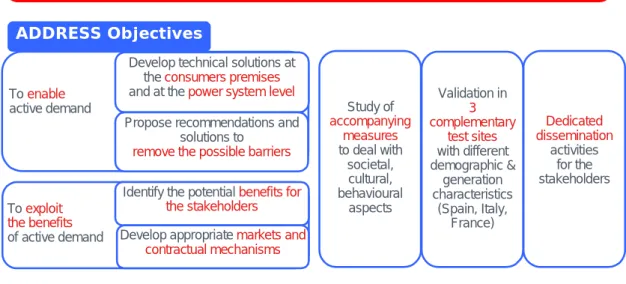
The project target and objectives are summarized in Figure 3.
To enable
active demand
To exploit
the benefits of active demand
Develop technical solutions at
the consumers premises
and at the power system level
Propose recommendations and solutions to
remove the possible barriers
Study of accompanying measures to deal with societal, cultural, behavioural aspects
Identify the potential benefits for
the stakeholders Validation in 3 complementary test sites with different demographic & generation characteristics (Spain, Italy, France)
Develop appropriate markets and
contractual mechanisms Dedicated dissemination activities for the stakeholders
Active Demand (AD):active participation of domestic and small commercial consumers in the power system markets and service provision to the power system participants
AD involves all types of equipment installed at the consumers premises: electric appliances (“pure” loads), distributed generation (PV, micro-turbines, …) and thermal or electrical energy storage systems.
ADDRESS Target
ADDRESS Objectives
Figure 3. ADDRESS target and objectives
More specifically, the ADDRESS European project aims to deliver a comprehensive commercial and technical framework for the development of “Active Demand” in the smart grids of the future.
ADDRESS Technical and Commercial Conceptual Architectures - Core document ADD-WP1-T1.5-DEL-EDF-D1.1-Technical_and_Commercial_Architectures
Revision 1.0
In ADDRESS, “Active Demand” (AD) means the active participation of domestic and small commercial consumers in the power system markets and in the provision of services to the different power system participants. Within ADDRESS, “Active Demand” involves all types of equipment that may be installed at the consumers (or prosumers) premises: electrical appliances (“pure” loads), distributed generation (such as photo-voltaic arrays or micro-turbines) and thermal or electrical energy storage systems.
The main objectives of the project are the following:
- ADDRESS will develop technical solutions both at the consumers’ premises and at the power system level to enable AD and to allow real-time response to requests from markets and/or from power system participants.
- This implies identifying the possible barriers against AD deployment and proposing recommendations and solutions to remove these barriers.
- Complementarily, ADDRESS will identify the possible benefits of AD for the different power system participants and will develop appropriate contractual and market mechanisms for the exploitation of these benefits.
- In addition to technical and economic questions, ADDRESS will deal with regulatory, societal and cultural aspects and, in particular, the project will define recommendations to lower possible regulatory barriers, and will study accompanying measures in dealing with small consumers’ socio-cultural and behavioural factors.
- The concepts and solutions will be validated in three different field test sites with different demographic and electricity supply characteristics in Spain, Italy and on a French island.
- Finally, dedicated dissemination activities will be carried out for the different types of stakeholders. The structure of the project in terms of Work Packages (WPs) closely follows the methodology adopted to reach these objectives. It is described in Appendix B, with a schematic representation of the work schedule and the list of the main deliverables.
1.2. ADDRESS architecture and concepts
1.2.1. Overview
of ADDRESS architecture
Figure 4 shows the ADDRESS scope along with a simplified representation of the proposed architecture. It shows the participants and the main components, and in a very simplified way how they interact, i.e. via technical and/or market channels. In the rest of the document the participants and their interactions will be detailed. This forms the conceptual architecture, see Subsection 1.4.1 for further detail on how the architecture is to be understood in the ADDRESS project.
In this architecture, the aggregators are a central concept. The aggregators are the key mediators between the consumers on one side and the markets and the other power system participants on the other side, namely:
- The aggregators collect the requests and signals for AD-based services coming from the markets and the different power system participants.
- They gather the “flexibilities” and the contributions provided by consumers to form AD-based services and they offer them to the different power system participants through various markets. It should be emphasized that the “flexibilities and contributions of consumers are provided in the form of modifications of their consumption profile. Therefore aggregators form their AD services and offers using consumers’ “demand modifications” and not consumers’ energy profile as such. Or in
ADDRESS Technical and Commercial Conceptual Architectures - Core document ADD-WP1-T1.5-DEL-EDF-D1.1-Technical_and_Commercial_Architectures
Revision 1.0
other words, an aggregator sells a deviation from the forecasted level of demand, and not a specific level of demand.
In the ADDRESS architecture, all the power system participants are considered with respect to the services provided by active demand, but particular attention is paid to the aggregator, the consumers and the Distribution System Operator (DSO), which will be the subjects of detailed studies.
At the consumer level, the Energy Box is the interface between the consumer and an aggregator. It carries out the optimisation and the control of the loads and local distributed energy resources at the consumer’s premises. It“represents” the consumer from an aggregator’s perspective.
The Distribution System Operators (DSOs) also play an important role because AD (as developed in the project) concerns consumers connected to distribution networks. DSOs will still have to continue to ensure secure and efficient network operation. They will do so mainly through interactions with the other power system participants and, in particular, with aggregators via markets. They will also maintain direct interactions with TSOs for this purpose.
So as mentioned above, in the project, development of algorithms and prototypes will be carried out in detail for the above three power system participants. The interactions with the other power system participants will be simulated using simplified models that include sufficient detail to allow the proper validation of the solutions.
Retailers BRPs DG & RES Traders Centralized Generation AGGREGATORS Different levels of optimization and aggregation MARKETS AND CONTRACTS Energy Supply and provision of services TSO DSO ADDRESS adaptation DMS MV – LV transfos Sub station Retailers BRPs DG & RES Traders Centralized Generation AGGREGATORS Different levels of optimization and aggregation MARKETS AND CONTRACTS Energy Supply and provision of services TSO DSO ADDRESS adaptation DMS MV – LV transfos Sub station Retailers BRPs DG & RES Traders Centralized Generation AGGREGATORS Different levels of optimization and aggregation MARKETS AND CONTRACTS Energy Supply and provision of services TSO DSO ADDRESS adaptation DMS MV – LV transfos Sub station
Figure 4. ADDRESS scope and simplified representation of the architecture
1.2.2. ADDRESS
concepts
Apart from the aggregator, the following main concepts will be developed and used in ADDRESS:
- The interaction between the power system participants will be based on the exchange of real-time price signals and volume signals (mainly power-based signals), where “real time” means here a time scale of 20 to 30 minutes ahead or longer (hour ahead, day ahead, …). These signals may
ADDRESS Technical and Commercial Conceptual Architectures - Core document ADD-WP1-T1.5-DEL-EDF-D1.1-Technical_and_Commercial_Architectures
Revision 1.0
additionally be modulated by geographical / topological information or other type of information whenever needed. Direct load control by DSO will be not considered but the limit of this will be investigated (in particular with respect to a secure grid operation).
- The “Demand” approach (in contrast with “generation” approach). Dealing with domestic and small commercial consumers needs to develop an appropriate approach:
o Appropriate technologies will be developed at consumers’ premises.
o The services will be “requested” through appropriate price and/or volume signal mechanisms and provided on a voluntary and contractual basis.
o Accompanying measures will be studied to deal with societal and behavioural aspects.
- Distributed intelligence and local optimisation are needed:
o To deal with topologically-dependant services.
o To allow the participants to optimise their real-time response according to the real-time signals.
The challenge here is to put the “right amount” of intelligence at the “right place”.
1.3. Objectives of WP1 and its two deliverables
The previous subsection has briefly described the proposed concepts and architecture of ADDRESS. The objectives of Work package 1 (WP1) of the project are precisely to develop:
- the project concepts, and in particular the aggregator and the mechanisms for the exchange of price and volume signals,
- the ADDRESS technical and commercial architectures along with the corresponding functional requirements based on the project concepts,
- 4 or 5 scenarios chosen to reflect different sufficiently representative European electricity system situations relevant for the ADDRESS future at the horizon of 2020
The results are reported in the two deliverables of WP1, namely:
- the present Deliverable D1.1 entitled “Conceptual architecture including description of: participants, signals exchanged, markets and market interactions, overall expected system functional behaviour” gives the results of the first two points above.
- The results of the third point, along with the application of the technical and commercial architectures to the scenarios, will be reported in the next deliverable - Deliverable D1.2 – “Application of the conceptual architecture in 4 or 5 specific scenarios”..
In future steps (outside the scope of this document), the concepts, the technical and commercial architectures and the scenarios will be further specified, developed and then implemented in the other WPs of the project. The results will be described in other project deliverables (listed in Appendix B).
1.4. Introduction to Deliverable D1.1
1.4.1.
Objectives and main structure of the deliverable
The main objective of Deliverable D1.1 is to describe the conceptual technical and commercial architectures developed to enable AD and exploit its benefits, and more specifically:
1. the participants and other components of the architectures,
2. the services that could be provided by AD and the markets interactions,
3. the different interactions between the participants and the design of the signals exchanged between them in relation to the provision of these services,
ADDRESS Technical and Commercial Conceptual Architectures - Core document ADD-WP1-T1.5-DEL-EDF-D1.1-Technical_and_Commercial_Architectures
Revision 1.0
corresponding basic requirements for the implementation of the architectures, 5. the issues to be solved and potential barriers to be removed.
Deliverable D1.1 is composed of two reports:
- the present report which is the core document of the deliverable and provides a condensed and hopefully reader-friendly description of the technical and commercial architectures developed in the ADDRESS project. It consists of 9 Sections plus Appendix A (the project glossary) and is described in more detail in the next subsection.
- a second document containing the appendices which provides a detailed description of topics covered in the core document. The document of the appendices is composed of 9 Appendices “numbered” from B to J. It is described in more detail later.
Recalling the 5 points covered by the deliverable and listed above,
- The first 3 points, namely the participants, the services provided by AD, the interactions between the participants and the signals exchanged are covered in Sections 2 and 4 of the core document and in Appendices C, D, E and G, regarding the regulated and deregulated participants (other than the aggregator and the consumers) and their relationships with the aggregator.
- The description of the aggregator, its interactions with the consumers and the signals exchanged are covered by Section 3 of the core document and Appendix F.
- The last 2 points, namely the overall system behaviour, the basic requirements for the architecture implementation and the issues to be solved are covered in Section 5 of the core document and in Appendices H and I.
Both reports of Deliverable D1.1 are now further detailed in the next two subsections, along with their articulation.
1.4.2.
Deliverable D1.1: the core document
The core document of Deliverable D1.1 (= the present report) is expected to be self-sufficient and to provide a condensed description of the most important results obtained. It comprises the following sections:
- Section 1 gives an overview of the target and objectives of the ADDRESS project. It describes the architecture and main concepts of the project, the objectives of the first WP and the contents of its two deliverables. It provides an introduction of Deliverable D1.1.
- Section 2 describes the services that could be provided by AD to the different electricity participants, along with the necessary interactions between these participants both from the technical and commercial points of view and the design of the signals exchanged.
- Section 3 is devoted to the description of the AD aggregator, which is a central concept of the project, and of the consumers’ flexibilities.
- Section 4 then presents the proposed process for the calculation of the service remuneration and of the price signals.
- Section 5 collects all the “pieces” presented in the previous sections to provide an overall description of the commercial and technical architectures, along with the main issues or potential barriers to be solved. It summarizes the basic requirements for the provision of the AD services and therefore for the implementation of the developed architectures.
- Section 6 gives the main conclusions and an overview of the next steps.
- Sections 7, 8 and 9 give respectively the acknowledgements, the references and the revision history of the document.
ADDRESS Technical and Commercial Conceptual Architectures - Core document ADD-WP1-T1.5-DEL-EDF-D1.1-Technical_and_Commercial_Architectures
Revision 1.0
Finally, Appendix A - ADDRESS Glossary (the only appendix included in the core document) provides:
- the main notations, abbreviations and acronyms used in the project,
- the list of the AD services (or products) identified and studied in the project, along with the table of the regulated and deregulated players to which these services are provided,
- the definitions of specific terms, expressions and concepts used in ADDRESS.
1.4.3.
Deliverable D1.1: the appendices
As mentioned previously, the appendices of Deliverable D1.1 can be found in a second document, except for the Glossary (Appendix A). This section gives the list of the appendices that can be found in the second report of Deliverable D1.1 along with a short description.
The appendices provide a detailed description of topics covered in the core document but even though some repetitions are made between the sections of the core document and the appendices, the appendices are not expected to be self-sufficient.
Appendix B - ADDRESS project structure and main deliverables describes:
- The structure of the project and the methodology adopted to reach the objectives.
- The main expected results along with the corresponding schedule.
Appendix C - Active demand (AD) services for deregulated players describes:
- The deregulated players along with their roles, main stakes, short term and long term needs with respect to their stakes.
- The services that AD can provide to them. - The description of the corresponding use cases.
Appendix D - AD services for regulated players (DSO and TSO) describes: - The regulated players needs and expectations with respect to AD.
- The services that AD can provide to them. - The description of the corresponding use cases.
Appendix E - Relationship between the players discusses the relationships
- Between the regulated and deregulated players, and in particular between the aggregators and the DSOs and TSOs.
- Between DSOs and TSOs
- Between the aggregators, the retailers and the BRPs or the balancing mechanism
Appendix F - The ADDRESS aggregator and consumers’ flexibility describes - The relationship between the aggregator and the consumers.
- The management of the energy payback effect. - The aggregator’s strategy and operatives decisions. - Aggregator’s risk management.
- Monitoring/assessment of AD product provision.
- The consumers’ flexibility and capabilities for AD service provision.
Appendix G – Process for the calculation of the price and volume signals exchanged between the players for AD exploitation describes the approach proposed for representing the optimisation process of the different players and the calculation of the price and volume signals that will be exchanged in relation with the AD product delivery.
Appendix H - Requirements for the implementation of the technical and commercial architectures, describes:
ADDRESS Technical and Commercial Conceptual Architectures - Core document ADD-WP1-T1.5-DEL-EDF-D1.1-Technical_and_Commercial_Architectures
Revision 1.0
- The technical and commercial requirements for the provision of the AD services.
- How they can be grouped and further categorised to provide technical and commercial requirement-based structures.
Appendix I - Issues to be addressed for the implementation of the ADDRESS architectures, describes the issues to be solved and potential barriers to be removed that have been identified in relation with the implementation of the ADDRESS architectures.
Appendix J - Relevant elements of standardisation and brief description of the UML approach:
describes different elements of standardization that may be useful for the ADDRESS project such as the ETSO role model, IEC standards, the activities of associations such as ETSO, UCTE, ENTSO-E, ebIX, UN-CEFACT and gives an overview of the advantages of the UML approach.
1.4.4.
Articulation of both reports of Deliverable D1.1
Table 2 shows the relationship between the sections of the core document and the appendices of Deliverable D1.1. This table therefore summarizes the overall structure of Deliverable D1.1.
Table 2. Structure of Deliverable D1.1 – Sections of Core document and Appendices Core document Document of the appendices Core document
Section 1 - ADDRESS objectives, concepts, architecture and introduction to Deliverable D1.1
Appendix B – ADDRESS project structure and main deliverables
Appendix C - Active demand (AD) services for deregulated players
Appendix D - AD services for regulated players (DSO and TSO)
Section 2 - Description of the services provided by Active Demand
Appendix E - Relationship between the players
Section 3 - The ADDRESS
aggregator and consumers’ flexibility
Appendix F - The ADDRESS aggregator and consumers’ flexibility
Section 4 - Process for the calculation of price and volume signals
Appendix G – Process for the calculation of the price and volume signals exchanged between the players for AD exploitation
Appendix H - Requirements for the implementation of the technical and commercial architectures
Section 5 – ADDRESS commercial and technical architectures
Appendix I - Issues to be addressed for the implementation of the ADDRESS architectures Appe ndix J - Relev ant el em ents of standar disati on a nd bri e f descripti on o f the UML ap proac h Sectio n 6 – Concl u sio n s an d next steps Sectio n s 7, 8, 9 – Acknow le d geme n ts, References, Rev isi on history Appe ndix A – ADDRESS Glossary
ADDRESS Technical and Commercial Conceptual Architectures - Core document ADD-WP1-T1.5-DEL-EDF-D1.1-Technical_and_Commercial_Architectures
Revision 1.0
2. Description of the services provided by Active
Demand
With respect to the ADDRESS architecture, this section describes:
- The regulated and the deregulated electricity system participants taking part in the architecture (apart from the aggregator and the consumers who are considered in Section 3), along with their needs and expectations with respect to AD (Subsection 2.1 below).
- The services and products that can be provided to them by AD within the scope of the project. In particular, emergency situations will not be studied, as well as services involving time responses not compatible with the 20 to 30 minute minimum time frame considered for the exchange of signals with the consumers. The three main AD products are defined in Subsection 2.2 and a standardized formulation of the identified AD services is given both for the regulated and deregulated players in Subsection 2.3.
- The different interactions between the participants and the aggregators and between some participants themselves in Subsection 2.4 regarding some issues that were identified and in Section 2.5 in the form of reference use cases defined for the provision of the AD services1.
- The design of the signals exchanged between them in relation with the provision of the services of which elements can be found in Subsections 2.2 to 2.5 in relation with the topics dealt with in the subsection.
Finally, Subsection 2.6 gives a table summarizing all the AD services that have been identified and characterized.
The detailed results obtained on these topics can be found in Appendices C (for deregulated players), D (for regulated player) and E (for relationship induced by special issues identified).
2.1. Needs and expectations of the power system participants
Regarding AD service provision, two main types of participants in the electricity systems may be distinguished:
- regulated participants: DSOs and TSOs,
- deregulated participants or participants in competition.
For the latter, 9 players were identified apart from the ADDRESS consumers (=domestic and small commercial consumers) and the aggregator2. They were divided into three main categories:
- Producers: central producers, decentralised electricity producers, producers with regulated tariff and obligations (reserve, volume, curtailment, etc.)
- Intermediaries: retailers, production aggregators, electricity traders, electricity brokers, Balancing Responsible Parties (BRPs).
- Consumers: large consumers.
For the purpose of ADDRESS, in order to have a clear and more easily understandable view, we consider here “archetypal” players with clearly separated roles and functions. They are defined in the
1
The use case for a service represents on a timeline all the interactions between the players involved in the provision of this service (including those involved in the technical verification), along with their internal processes.
ADDRESS Technical and Commercial Conceptual Architectures - Core document ADD-WP1-T1.5-DEL-EDF-D1.1-Technical_and_Commercial_Architectures
Revision 1.0
Glossary (Appendix A). However, in “real” life, a given company may have several of the roles as defined in this section.
2.1.1.
Needs and expectations of the deregulated players
The needs and expectations of the deregulated players with respect to active demand were analysed on the basis of their functions and stakes. More specifically, for each of these players, the following aspects were analysed:
- Role of the player and main functions in the system.
- Main stakes and contextual constraints.
- Short-term needs and long-term needs generated by the stakes.
- How AD can meet these needs.
- Possible services provided by AD and basic requirements.
As an example, Table 3 summarizes the results obtained for the retailer. The results of this analysis for all the other deregulated players are given in Appendix C.
Table 3. Summary of the results obtained for the retailer Player role “Retailer”
Principal function(s) in the system
To purchase electricity on the wholesale market To supply electricity to its customers
Contextual constraints To meet the declared consumption programme. To respect supply contracts with its customers.
Main Stake To maximise its profits under constraint of risk management
Short-term needs generated by the stakes
Forecasting and setting of the sales conditions and prices.
Forecasting and negotiation of the purchasing conditions and costs. Maximising the margin between purchases and sales.
Long-term needs generated by the stakes
Structuring strategically its portfolio of consumers and wholesale suppliers
Can AD meet any of these needs, and how?
- To minimise consumption when the margin is negative and maximise consumption when margin is positive
requires a modification in power consumption on a given time span at a given time
- To minimise deviations from the declared consumption programmes and from the contracted purchase volumes
requires a modification in power consumption at very short term (intra-day)
- Month(s) ahead: to help structure long-term purchasing contracts so as to maximise margin
requires a recurring periodic modification in power consumption for a given time span over a given period (seasonal)
Summary of expectations with respect to Active Demand
To optimise short term purchases and sales
To minimise short term risks by an Active Demand reserve for activation during high imbalance situations
ADDRESS Technical and Commercial Conceptual Architectures - Core document ADD-WP1-T1.5-DEL-EDF-D1.1-Technical_and_Commercial_Architectures
Revision 1.0
Table 4 reports the main expectations of the deregulated players that can be satisfied by AD services, which will be discussed in this deliverable.
Table 4. Summary of the expectations of the deregulated players with respect to AD Players Expectations
Retailer (RET) To minimise consumption when the margin is negative and maximise consumption
when margin is positive requires a modification in power consumption on a given time span at a given time
To minimise deviations from the declared consumption programmes and from the contracted purchase volumes requires a modification in power consumption at very short term (intra-day)
Month(s) ahead: to help structure long-term purchasing contracts so as to maximise margin requires a recurring periodic modification in power consumption for a given time span over a given period (seasonal)
Decentralised electricity Producer (DP)
Reduce imbalance costs requires a modification in power consumption at short term (intra-day).
Optimise the profits generated by commercial activity by buying AD flexibility as a function of the market prices requires a modification in power consumption at short term (intra-day).
Provide more flexibility for participating in frequency control services requires a modification in power consumption available at very short notice (a few minutes).
Centralised Producer (CP)
Provide CP more flexibility for participating in frequency control services requires a modification in power consumption available at very short notice (a few minutes)
Optimise the profits generated by commercial activity by buying AD flexibility as a function of the market prices requires a modification in power consumption at short term (intra-day).
Producer with Regulated Tariffs (PwRT)
Reduce imbalance costs requires a modification in power consumption at short term (intra -day).
Optimise the profits generated by commercial activity by buying AD flexibility as a function of the market prices requires a modification in power consumption at short term (intra -day).
Provide more flexibility for participation in frequency control services requires a modification in power consumption available at very short notice (a few minutes). Reduce the investment costs of future generation facilities requires a modification in power consumption available at long term (a few months or years) Avoiding loss of excess generation in valley hours requires a modification in power consumption available at medium term (day(s) ahead)
Production Aggregator (PA)
Reduce imbalance costs requires a modification in power consumption at short term (intra -day).
Optimise the profits generated by commercial activity by buying AD flexibility as a function of the market prices requires a modification in power consumption at
ADDRESS Technical and Commercial Conceptual Architectures - Core document ADD-WP1-T1.5-DEL-EDF-D1.1-Technical_and_Commercial_Architectures
Revision 1.0
Provide more flexibility for participating in frequency control services requires a modification in power consumption available at very short notice (a few minutes).
Electricity Trader
Optimise short-term purchases and sales by trading AD flexibility as a function of the market prices and to reduce market volatility and risk requires a modification in power consumption at short term (intra-day).
Electricity Broker
Extend the range of products proposed to market participants requires modification in power consumption at different notices.
Balancing Responsible Party (BRP)
Assist in meeting balancing functions requires a modification in power consumption at short term (intra -day).
Large
consumer (LC)
Minimise purchases when prices are high
2.1.2.
Needs and expectations of the regulated players (DSOs and TSOs)
Active Demand may provide solutions to certain needs of DSOs and TSOs. Main cases are listed in Table 5 which gives the expectations of DSOs and TSOs with respect to AD. These expectations are discussed in detail in Appendix D.
Table 5. Summary of DSOs and TSOs expectations with respect to AD3
# Expectation DSO TSO
1 Power flow control/Network congestion solution X X
2 Network restoration/Black start X X
3 Frequency control/Power reserve X X
4 Voltage control and Reactive power compensation X
5 Islanded operation/micro-grids X X
6 Reduction of system losses X X
7 Optimised development and usage of the network X
However, it should be mentioned some of the above expectations or some aspects of them are outside of the ADDRESS scope, namely:
- Expectation 5 “islanded operation/micro-grids”.
- Aspects of other expectations which require a fast response, or imply use of AD in emergency or special operating conditions (situations that will not be studied in ADDRESS).
The above expectations can be further compacted into three main types of AD services (see Table 6) that can meet them:
- Voltage regulation and power flow control
3
Examples of already existing Demand Response programmes carried out to meet expectations of TSOs and DSO can be found for instance in [2], [3], [4].
ADDRESS Technical and Commercial Conceptual Architectures - Core document ADD-WP1-T1.5-DEL-EDF-D1.1-Technical_and_Commercial_Architectures
Revision 1.0
- Tertiary active power control
- Smart load reduction
Each of them requires a modification of the consumption (or production) in reaction to DSO/TSO requests with a response time depending on the service provided.
Table 6. The three main types of AD services for DSOs and TSOs
Type of AD service
Expectation Voltage Regulation and Power Flow Control
Tertiary Active Power Control
Smart Load Reduction
Power flow control/Network congestion solution
X X
Frequency control/Power reserve X
Network restoration/Black start X
Voltage control and Reactive power compensation
X
Reduction of system losses X X
Optimized development and usage of the network
X X
In Table 6,
- Voltage regulation and power flow control: system operators (DSO and TSO) can resort to AD services to carry out voltage regulation and power flow control. They can accomplish these functions by foreseeing production/consumption plans for a target period and rearranging them if they do not comply with network constraints. They also have the possibility of requesting a production/consumption modification during the target period, to be used as back up.
- Tertiary Active Power Control: tertiary reserves (for frequency control) are used as non-automatic action to restore adequate control margins, i.e. when generators work close to the upper or the lower bound of their regulating capabilities. Frequency control is under the responsibility of TSOs. However with the development of distributed generation on distribution networks and the evolution towards active distribution networks, DSOs may be involved, directly or indirectly, in the provision of the services for this control.
- Smart load reduction: both TSO and DSO might need some form of load reduction in a certain area of their networks when, due to maintenance issues or following network failure, a load reduction is needed (here, emergency control of loads is not considered). Nowadays if such a problem occurs, entire feeders are disconnected. AD could contribute to smarter load reduction carried out by aggregators selling these services to TSOs and DSOs.
These main types of AD services are discussed in detail in Appendix D and basic requirements are derived for each of them.
A good coordination will generally be needed between TSOs and DSOs. This issue is discussed in Section 2.4.
![Figure 5. Simplified representation of payback effect for controlled water heaters based on [5]](https://thumb-us.123doks.com/thumbv2/123dok_us/8931773.2377776/28.892.224.671.626.1007/figure-simplified-representation-payback-effect-controlled-water-heaters.webp)