Face Recognition Based Security System Using Sift Algorithm
Tegala Balaprasad (M.Tech)1R.V.V.Krishna (Ph.d)21Aditya College of Engineering & Technology, Kakinada, India.
2Associate Professor in Aditya College of Engineering &Technology, Kakinada, India.
Abstract: Present days most of the door lock systems are organized by humans with the application of keys, secured password & unpredictable pattern to operate the door. The purpose of this paper is to help the users to develop the security by using face detection & recognition at high sensitive locations. Face is a very complicated multidimensional structure hence it requires well recognized computing techniques for the identification of the face. This paper is encompassed into three parts: namely face recognition, automatic door access mechanism & sends SMS. Face recognition is the process of detecting the region of face in a person. This concept is implemented by using SIFT (Scale Invariant Feature Transform) Algorithm. It is established on Image features (Space, image translation, rotation, scaling, illumination and camera viewpoint), these set of significant features are used to describe the variation among face images. Face recognition is an essential part of biometrics in that basic mannerisms of human is matched to the existing data in database and depending on result of equivalent identification of a human being is extracted. The door responds automatically for the known person due to the command from the ARM7 processor. If the person is known from database sends
report to the person mobile as a SMS “Welcome to the office”. On the other hand, alarm will ring for the unknown person & sends SMS to the control room as “
Unknown person is in front of the door”.
Keywords: SIFT Algorithm, SMS, GSM, ARM7.
I.Introduction
Automatic personal identification is become popular by using biometrics data instead of using security cards, passwords and pattern recognition. Many useful approaches are there in biometrics identifications like fingerprint, eye iris, retina, voice, face etc., Most of the biometrics information have to be gathered by using finger print scanner, palm print scanner, DNA analyzer etc., All these different approaches encompass certain advantages and disadvantages which must be reflected in emerging biometric systems such as system reliability, price, flexibility, requirement of physical contact with the scanning device and many other parameters. Security system plays an important function to eliminate illegal authentication. Many researches had done in order to design several types of automated security system. Zuo et.at [1] proposed Home Face, real-time embedded face recognition system for customer
applications, which activates a personalized service by automated identification of users. This system is extended for smart home environment for user identification. Kramberger et al [2] recommended the architecture of a door phone embedded system with collaborative voice response. Ultimate advantage of this system is even in noisy environment the efficiency of speech recognition is enriched using embedded microphone array. Ibrahim et al.[3] paper emphases on the study and improvement of an automated face recognition system with the potential application for office door access control.
In all the above methods, the target of the objects has to touch with the required hardware in the stage of data collection. But the advantage of our system is that face recognition does not require being touched with the hardware. Face recognizes automatically by using face-recognized technique with the help of camera, which has to capture our image. The functioning of the entire face recognition system is influenced by the reliability of the face detection. In this paper we are using SIFT (Scale Invariant Feature Transform) Algorithm to identify face of the user. We have different techniques to identify the face still we are choosing SIFT because of best features (Space, image interpretation, rotation, scaling, illumination and camera viewpoint), before going to in detail of SIFT once we recollect different face recognitions techniques.
Principle Component Analysis (PCA): (Turk & Pentland, 1991)[4]
PCA is a technique to identify the image by using concept of eigenvectors (Eigen values) to linear model variation in high dimensional data. PCA mechanism works on dimensionality reduction by projecting an original n-dimensional data onto m (<<n) dimensional linear subsequence by the reflecting eigenvectors of the data covariance matrix. Its object is to find a set of mutually orthogonal basis functions that accumulate the directions of concentrated variance in the data and for which the coefficients are pairwise decorrelatd. PCA was a method is used to describe face images in terms of
a set of “Eigen Faces”. Eigen face method is expected to suffer under variation in lighting direction & we require more no of images in different positions of same image to get desired output.
Linear Discriminant Analysis (LDA): (Belhumeur, 1997)[5]
which the points of different sections are far from each other while requiring data points of the same class to be close to each other. Where is in PCA which encodes information in the form of orthogonal liner space, LDA encodes for the discriminating information in a linearly separable space using basic functions that are need not be necessarily orthogonal. It is generally believed that algorithms based on LDA are superior to those based on PCA. However, the recent work (Martinez & Kak, 2001) on PCA & LDA shows that, when the training data set is small.
Locality preserving projections (LPP): (Niyogi, 2003)[6]
We have one more linear method for the face analysis is Locality preserving Projections (LPP) where a face subspace is acquired and the local structure is discovered. LPP is a general approach for multiple learning. It is known by finding the optimal linear approximations to the Eigen functions (Eigen faces) of the Laplace Betrami operator on the assorted. Therefore, it is still a linear technique & it seems to recover important aspects of the intrinsic nonlinear manifold structure by preserving local structure. This leads to a recently developed method for face recognition; namely the Laplacian face approach, which is an appearance-based face recognition method.
All methods perform well if presented with an image, which similar to an image in the training set. Eigen face method is expected to suffer under variation in lightning direction. The fisher face method appears to be the best at extrapolating and interpolating over variation in lighting. Removing the initial principle components does improve the performance of the Eigen face method in the presence of lighting variation, but does not alleviate the problem.
II.New Proposal
SIFT (Scale Invariant Feature Transform)
Scale Invariant Feature Transform (SIFT) features are obtained from images with the help of consistent equivalent between different visions of the same object. The extricated features are invariant to scale, orientation, illumination and viewpoint. These features are extracted in four steps. The first step recognizes the locations of attentive potential points on the image by discovering the maxima & minima for the set of difference of Gaussian (DOG) filters applied at different scales all over the image. In second step abandonment points of low contrast polishes these locations. In third step an orientation is allocated to each key point based upon given local image features. Finally, the local feature descriptor is processed at each & every key point. This local feature descriptor is centered on local gradient, transferred information according to the positioning of the key point to offer orientation invariance. For any object there are many features, attractive points on the object, which can be
extracted to deliver a “feature” description of the object.
This description can then be used when trying to locate the object in an image encompassing many others
objects. There are many considerations when obtaining these features & how to record them. SIFT image features require a set of feature of an object that are exaggerated by many of the complications practiced in other methods, such as object scaling & alternation. While allowing for an object to be accepted in a larger image SIFT image features also permit for objects in numerous images of the same position, taken from different locations within the situation, to be predictable. SIFT features are also very irrepressible to the influence
of “noise” in the image.
Features of the SIFT
The SIFT approach, for image features generation, takes an image & transforms it into a “large collection of local feature vectors”. Each & every of
these feature vectors is variant to any scaling rotation or translation of the image. This approach shares many features with neuron responses in primate vision. To aid extraction of these features the SIFT algorithm applies as a 4 stage filtering approach:
Stage1: Space extrema detection
In The first stage, it inspects the image under numerous scales and octaves to detach points of the picture. These points, called extrema, which are known as potential associations for image features. These points also labeled as key points are recognized in the scale space by seeing for image locations that represent maxima or minima of the difference of Gaussian (DOG) function. The scale space of an image is expressed asa function L(x,y,σ), that is formed from the complication of a variable scale Gaussian G(x,y, σ),
with the input image, I(x, y). By the definition we say scale of image is
L(σ) = { G(x,y,σ)∗I(xx,y) 0≤ x,y< N, }
where the Gaussian function
here σ signifies the regular deviation of the Gaussian
G(x,y,σ).
This stage of the cleaning attempts to recognize those locations and scales that are perceptible from different views of the same object. This can be powerfully realized using a “ scale space” function.
Further it has been shown under realistic assumptions it must be constructed on the Gaussian function. The scale
space is defined by the function: L(x,y, σ) = G(x,y, σ) *
I(x,y) ,Where * is the the convolution operator. G(x,y,σ)
is a variable – scale Gaussian & I(x,y) is the input image. Various techniques can be used to detect stable key point locations in the scale-space. Difference of Gaussian is one of the such technique , locating scale-space extrema, D(x,y,σ) by computing the difference
between two images, one with scale k times the other.
D(x,y, σ) is then given by:
D(x,y, σ) = L(x,y,kσ) –L(x,y, σ) ,To detect the local maxima and minima of D (x,y, σ) each point is
minimum or maximum of all these point then this point is an extrema.
Stage2: Keypoint Localistaion
In this stage, low distinction points & non-localized points alongside the edges are removed. This process is accepted as the recognition of unpredictable
keypoints. It estimates the value of D(x,y,σ) at each
keypoint. If the value is below some threshold, which means that the construction has distinction, the keypoint is detached. Then after it estimates the ratio of principle curvatures of each keypoint to examine for irrelevant points in the Difference of Gaussian function. For keypoints with high edge reactions, the principle curvature through the edge will be much higher than the principle curvature along it. So that, to eliminate unbalanced edge keypoints based on the principle curvature, the ratio of principle curvatures of each keypoint is tested. If the proportion is below some threshold point, the keypoint is retained there, otherwise else it is detached. If the task value at Z is below a limit value then this point is omitted. This eliminates extrema with low difference. To reject extreama based on modest localization is notable that in these cases are a large principle curvature through the edge but a small curvature in the vertical direction in the difference of Gaussian function.
Stage3: Orientation Assignment
This final stage targets to allocate the reliable orientation to the keypoionts centered on local image properties. The keypoints descriptor, explained below, can be characterized qualified to thus orientation, accomplishing invariance to rotation. The approach appropriated to discover an orientation is: Use the keypoints scale to Gaussian flattened image L,
Compute gradient magnitude as below expressed
formula for the image
Compute orientation of the image as shown below
expressed formula
Localize the uppermost peak in the histogram. Use this peak and other local peak within 80% of the height of this peak to construct a keypoint with that orientation. Some points will be apportioned for multiple orientations. Fit a parabola to the 3-histogram values nearby points to each peak to incorporate the peaks situation.
Stage4: Keypoint Descriptor
The local gradient data used above considered to create keypoints descriptors. The gradient
information is rotated to line up with the orientation of the keypoint and weighted by a Gaussian with variances of 1.5*(keypoint scale). This data is then used to create a set of histograms over a window concentrated on the keypoint. Keypoint descriptors typically uses a set of 16 histograms, coupled in a 4x4 grid, each with 8 orientation pins, one for each of the main compass directions and one for each of the mid-points of these directions. This results in a feature vector encompassing 128 elements.
These consequential vectors are known as SIFT keys and are used in a nearest-neighbors methodology to identify achievable objects in an image. Collections of keys that decide on a possible typical are recognized, when 3 or more keys approve on the model parameters this model is evident in the image with high prospect. Due to the large number of SIFT keys in an image of an object, normally a 500x500 pixel image will generate in the region of 2000 features, significant levels of blocking are possible while the image is still recognized by this technique.
Approach By SIFT Algorithm
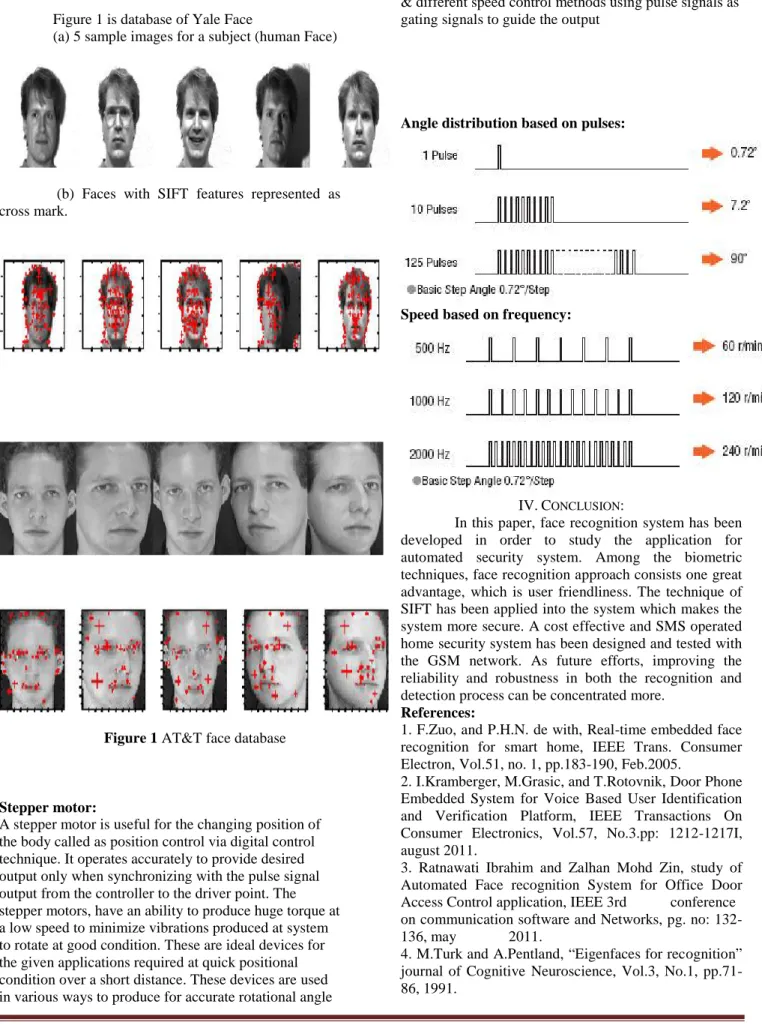
We recommend a methodology established on SIFT features for face recognition. The SIFT features are obtained from all the faces in the database. Then given a new face image, the features obtained from that face are compared against the features from each face in the database. The face in the database with the biggest number of equivalent points is measured the nearest face, and is used for the arrangement of the new face. A feature is measured with another feature when the distance to that feature is less than a particular segment of the distance to the next adjacent feature. These assurances are diminishing the number of false matches. This is because in case of a false match, there will be a number of other near features with close distance, due to the high dimensionality of the features. On the other hand, in case of a correct match, it is unlikely to catch another feature that is too close due to the highly distinguishing environment of the SIFT features. III. Results & Databases
Figure 1 is database of Yale Face
(a) 5 sample images for a subject (human Face)
(b) Faces with SIFT features represented as cross mark.
Figure 1 AT&T face database
Stepper motor:
A stepper motor is useful for the changing position of the body called as position control via digital control technique. It operates accurately to provide desired output only when synchronizing with the pulse signal output from the controller to the driver point. The stepper motors, have an ability to produce huge torque at a low speed to minimize vibrations produced at system to rotate at good condition. These are ideal devices for the given applications required at quick positional condition over a short distance. These devices are used in various ways to produce for accurate rotational angle
& different speed control methods using pulse signals as gating signals to guide the output
Angle distribution based on pulses:
Speed based on frequency:
IV. CONCLUSION:
In this paper, face recognition system has been developed in order to study the application for automated security system. Among the biometric techniques, face recognition approach consists one great advantage, which is user friendliness. The technique of SIFT has been applied into the system which makes the system more secure. A cost effective and SMS operated home security system has been designed and tested with the GSM network. As future efforts, improving the reliability and robustness in both the recognition and detection process can be concentrated more.
References:
1. F.Zuo, and P.H.N. de with, Real-time embedded face recognition for smart home, IEEE Trans. Consumer Electron, Vol.51, no. 1, pp.183-190, Feb.2005.
2. I.Kramberger, M.Grasic, and T.Rotovnik, Door Phone Embedded System for Voice Based User Identification and Verification Platform, IEEE Transactions On Consumer Electronics, Vol.57, No.3.pp: 1212-1217I, august 2011.
3. Ratnawati Ibrahim and Zalhan Mohd Zin, study of Automated Face recognition System for Office Door Access Control application, IEEE 3rd conference on communication software and Networks, pg. no: 132-136, may 2011.
4. M.Turk and A.Pentland, “Eigenfaces for recognition”
5. Peter N.Belhumeur, Joao P.Hespanha, and David J.kriegman. Eigenfaces Vs Fishersface: Recognition using class specific linear projection. IEEE Transactions on pattern analysis and machine Intelligence, 19(7): 711-720, July 1996.
6.Brown ,M.and Lowe, D.G 2002. Invariant Features from Inter Point groups. In British Vision conference, Cardiff, wales, pp.656-665.
7.Lowe, D.G.1996. Object recognition from local Scale Invariant Features. In International Conference on computer Vision, Corfu, Greece, pp.1150-115.
8.Yale face database. http://cvc.yale.edu
9. Y.K.Choi, K.M.Kim , J.W.Jung, S.Y.Chun and
K.S.Park, “Acoustic Intruder Detection System for
Home Security” IEEE Trans. Consumer Electron , Vol. 51,No. 1, pp: 130-138, Feb. 2005..
10. Y.Zao and Z. Ye, “ A LowCost GSM/GPRs Based Wireless Home Security System”,IEEE Trans. Consumer Electron, Vol %1, No1, PP: 567-572, May.2008.
11.R.A.Fisher. The use of multiple measures in taxonomic problems. Ann. Eugenics, 7:179-188, 1936 12. David G. Lowe. Distinctive image features from scale-invariant keypoint. International journal of computer vision, 60, 2004.
13. F. Samaria and A. Harter. Parameterization of a stochastic model for human face identification. In 2nd IEEE workshop on applications of computer Vision, 1994.
14. Daniel L. Swets and John Weng. Using discriminate Eigen features for image retrivel. IEEE Transactions on pattern analysis and machine Untelligence, 18(8): 831-836, August 1996.
Mr. T. BalaPrasad obtained his B.E degree from Anil Neerukonda Institute of Technology & Sciences, Visakhapatnam, Andharpradesh in Electronics and communication Engineering and presently doing his M.Tech Embedded systems at Aditya College Of Engineering & technology, in Kakinada, Andharpradesh. His area of interest is Image processing based embedded systems. He is Associate member of IETE.