Vol.6 No.3 June 2019: 22-30 Article history:
Accepted 27 April 2019 Published online 27 April 2019
Journal of Soft Computing and Decision
Support Systems
A New Algorithm to Improve the QOS of MANET Network in Media
Access Layer
Arman Kavoosi Ghafi a,*, Mohammad Hossein Shafiabadi b, Adnan Samerian Hosseini c, Saeed Haghgoo b a
Department of Computer Engineering, Borujerd Branch, Islamic Azad University, Borujerd, Iran b
Department of Computer Engineering, Islamic Azad University of IslamShahr, Iran c
Department of Computer Software, Islamic Azad University of Abadan, Iran
* Corresponding author email address: [email protected]
Abstract
In this paper, the IEEE 802.11 standard DCF algorithm is used in the media access layer to improve the quality of service featur es including latency, delay and vibration delays. The characteristics examined for service quality vary according to the applica tion of the contingency network. As a result, various applications have been introduced to improve service quality. In general, the DCF algorithm is divided into two subsets called the base DCF algorithm and the DCF algorithm with the sending of RTS / CTS packets. Then, to investigate and demonstrate the ability of the proposed High Quality Performance of Traffic Based Adaptive (HQPTBA) and High Quality Size Based Adaptive (HQSBA) algorithms to improve the quality of service, NS2 software was used to compare delay characteristics, network latency, and delay vibration. The results of the comparison show that due to the greater flexibility of the proposed algorithms as well as the separation of packets by size, the HQSBA algorithm has improved service quality characteristics compared to other previous methods.
Keywords: MANET, QOS, Throughput, Latency, Network.
1. Introduction
The significant development of wireless networks, and the expansion of equipment, such as portable computers, PDAs, cellular phones, as well as military applications of the wireless network, have led to Mobile Ad Hoc networks, especially mobile distributed networks, or MANET as one of the main and most widely used telecommunications networks. As the advantages of these networks, the ability to quickly and easily deploy networks in military environments or areas that suffer from natural disasters such as earthquakes can be mentioned. These types of networks do not require the deployment of complex infrastructures and the use of Base Station to control network traffic like the rest of WLAN networks, therefore the complexity and cost of installing this kind of network is reduced (Mo et al., 2008).This feature has led to the widespread use of MANET networks in wireless sensor networks. In these types of networks, nodes can move freely and communicate with other nodes in their radio range through a common channel to exchange data. As far as the radio range of these nodes is limited, communication requires multi-hop routing algorithms (De Rango et al., 2014; Fan et al., 2014). As mentioned, MANET networks
lack infrastructure results in several problems, such as network variable matching, inaccurate information related to the node status, the absence of base station for controlling the remaining nodes and network traffic, the tendency to error in the common channel, the problem of hidden and exposed terminals, limited availability of resources, and low channel security. The pre-mentioned problems in the MANET network will reduce network throughput, and increase characteristics such as end-to-end latency and jitter. Improving these issues is known as improving service quality. The characteristics of the service quality are different in relation to the application of wireless networks. These characteristics include bandwidth, jitter, and latency in audio/video applications, or security in military applications. The existence of route in emergency applications or searches is considered as one of the key features of this type of applications, and also in applications such as wireless communication in wireless network sensors, the minimum energy consumption is an important feature of service quality (Zhong et al., 2014; Syed et al., 2015).
standard, and the use of the DCF algorithm from this standard. The IEEE 802.11 standard covers the medium access control, and the physical layer of the OSI model. In the IEEE 802.11 standard media layer, there are two algorithms for nodes access to the channel. The first algorithm is called DCF, which is used in two types of networks, the one with infrastructure, and another without infrastructure, and the second algorithm, which is known as the PCF algorithm is considered as an extension to the DCF algorithm to support real-time traffic (Liang et al., 2015; Sharma et al., 2013).
In this paper, the IEEE 802.11 standard DCF algorithm is used in the media access layer to improve the service quality characteristics, including latency, Jitter, and network throughput. In general, the DCF algorithm is divided into two subsets called the DCF algorithm, and the DCF algorithm, along with the sending of RTS / CTS packets (Mohanty et al., 2014; Wu et al., 2014).
Both SBA and TBA backtrack algorithms are introduced based on the DCF algorithm in the IEEE802.11 standards. Finally, the results of applying the proposed algorithms are evaluated using various scenarios in the NS2 simulator software.
2. The proposed adaptive backtrack algorithms based on traffic and classified adaptive backtrack
As described in the backtrack algorithm, the IEEE 802.11 uses two backtrack algorithms to stabilize the service quality and control the access to the common channel, which these two algorithms are included of a backtracking algorithm before sending, and a backtracking algorithm after sending. The before sending backtrack algorithm is defined to reduce the possibility of interference, and after sending backtrack algorithm is used to ensure that the channel is free for subsequent uploads (Fang et al., 2015; Nguyen et al., 2013).
In the before sending backtrack algorithm, if the packet reaches the empty queue and the channel is detected for the time interval as free DIFS, then the sender node will send the packet immediately, but if the channel is detected busy, the sender node will wait until the packet ends in the channel, and then invokes the backtrack algorithm. In this case, the sender node selects a random slot from the interval [0, CW], and launches the back off timer by this random value according to Eq. (1).
SlotTime CW
Rand er
BackoffTim [0, ]
(1)
In Eq. (2), the CW value is obtained from the following equation.
max min CW CW
CW
(2) The value of a function is selected in the form of a uniform random distribution from the interval, and the value of random slots is pre-defined used in the physical layer, according to the protocol. Selecting a larger value for CW reduces the probability of the same amount of back off
timer, and therefore reduces the possibility of interference. Each time the channel is empty, the timer will stop, if the sender node is found busy (Zhou et al., 2015; Latchman et al., 2013).
At the same time, by zeroing the back off time, the node is allowed to access the channel. In this proposal, two methods are proposed to optimize the backtrack algorithm as follows (Ting et al., 2016).
3. Adaptive backtrack algorithm based on traffic or HQPTBA backtrack Algorithm
In the HQPTBA backtrack algorithm, unlike the IEEE 802.11 backtrack algorithm, in which CW value resets to the minimum with each successful loading, and with each unsuccessful upload, the CW value is twice. In the HQPTBA backtrack algorithm, in order to change the CW, the network traffic condition, and the amount of successful and unsuccessful uploading is used. In the HQPTBA backtrack algorithm; controlling the number of posts by using the census of postings can control latency, jitter, and network throughput. This method, which requires a census of the number of past successful and unsuccessful posts, is in terms of precision depending on the number of past selected samples (Ding et al., 2014; Nagendra Naik et al., 2014).
The main characteristic of the HQSBA algorithm is the classification proposition when sending packets and assigning values and to each of the classes. Since the IEEE 802.11 standard does not differentiate between packets with various sizes to access to the channel, and all packets have the same chances to receive the channel with any size, this issue creates problems in those networks that send packets of different sizes. This problem arises when larger packets occupy channels longer than smaller packets. In the proposed HQSBA algorithm, the inadequacy of channel allocation between packages with distinct sizes can be reduced to a certain extent by using classification, which results in an increase in the quality of service.
4. HQPTBA backtrack algorithm or traffic-based adaptive algorithm in distributed networks
Switching over distributed networks causes network traffic to change. As a result, the following problems can be noted in traffic that is due to the switching of transmitter and receiver nodes in different parts of the network. According to the IEEE 802.11 standards, each successful upload time and resetting the CW to in subsequent transmissions may increase traffic on the transmitter node, because of the change in the connectivity and the formation of new paths. In this case, resetting the CW to will increase the chances of a collision, as well as latency and jitter due to the increased probability of retransmissions. In the opposite case, if the transmitter node traffic is reduced immediately after unsuccessful transmission, in the unsuccessful state of the DCF algorithm, the CW value doubles, but a one-time traffic reduction can cause a successful sending and, as a result, reset the CW too. In this case, if reducing traffic as it was said is instantaneous, re-increasing traffic may increase the likelihood of a collision. This issue in networks with cross-sectional traffic, such as distributed networks, reduces network throughput and increases latency, and jitter. In general, in distributed networks with high traffic volumes, resetting CW with leads to an increase in the probability of interference due to a sudden CW reset to, resulting in an increase in the transmission and receipt of data, which as the result, the service quality characteristics will be weakened. It is worth noting that the decrease or increase of traffic and its impact on network throughput is justified, because the number of retransmissions in the IEEE 802.11 standard is limited, so that if the retransmissions are repeated, the latency and jitter increases, as well as the ramp-up of the retransmissions number of the threshold value causes the packet to be discarded, and ultimately reduce network passivity. In the proposed HQPTBA backtrack algorithm in this paper; both successful and unsuccessful packet transmitting modes have been modified in the IEEE 802.11 standard DCF algorithm. In this algorithm, first, the network traffic condition is checked statistically based on the number of successful and unsuccessful transmissions, and then it is decided from the results on how to change the CW value for the backtrack algorithm (Xia et al., 2013; Le et al., 2012).
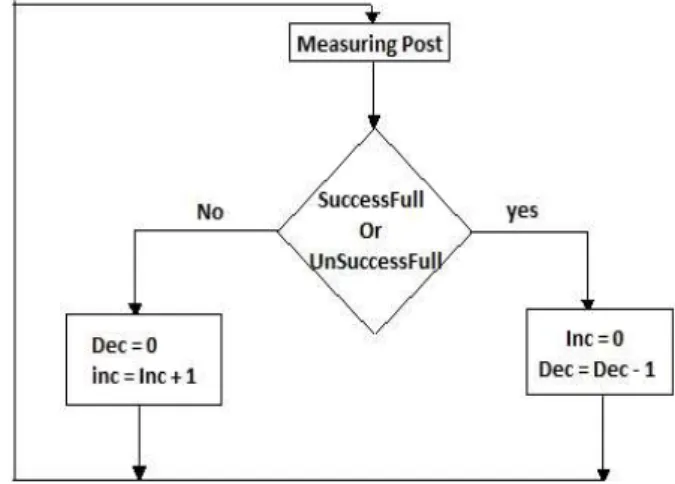
In the HQPTBA backtrack algorithm, network traffic measurement is done by surveying the number of unsuccessful and unsuccessful transmissions on the network to reduce the impact of items such as instantaneous changes in network traffic or high traffic on service quality features. In this regard, first, two counters with the names Inc and deck are defined for unsuccessful and successful transmissions. Then, these two counters are defined in such a way that with each successful transmission, first, the deck variable is increased to a unit, and then the inc variable is zero, and then with each unsuccessful send, the deck variable first becomes zero, and then the inc variable is increased to one unit. This is shown in Fig. 1 In this way, the number of successive
successful transmissions in the deck variable, and the number of unsuccessful consecutive transmissions are stored in the inc variable, and then the HQPTBA backtrack algorithm is decided according to the values of the two inc and deck counters for increasing, decreasing or not changing the CW. After determining the number of consecutive unsuccessful and unsuccessful posts, the following statistics are decided for each new posting about how to assign and set the CW. The HQPTBA backtrack algorithm attempts to match the IEEE 802.11 standard backtrack algorithm to distributed networks or high-traffic networks (Ullah et al., 2012).
Fig. 1.How to distinguish successful and unsuccessful posts.
5. Simulation results of the HQPTBA algorithm
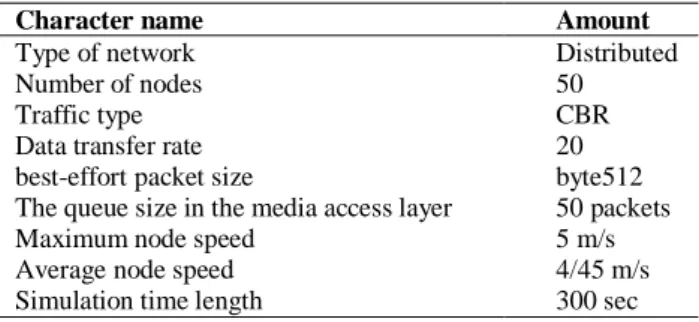
Table 1
Characteristics intended for simulation.
Amount Character name
Distributed Type of network
50 Number of nodes
CBR Traffic type
20 Data transfer rate
byte512 best-effort packet size
50 packets The queue size in the media access layer
5 m/s Maximum node speed
4/45 m/s Average node speed
300 sec Simulation time length
To evaluate the performance of the HQPTBA backtrack algorithm, this algorithm is compared with IEEE 802.11 standard and also HBAB standard backtrack algorithms. As described in the description of service quality improvement and fixation, the characteristics discussed in the quality of service include network throughput, latency, and jitter. Therefore, this simulation is carried out in an environment with 50 nodes for network throughput charts (Kbps), end-to-end delay (ms), and eventually jitter (ms) versus increasing the number of transmitter / receiver nodes.
5.1 Comparison of network throughput in three backtrack algorithms; HQPTBA, IEEE 802.11, and HBAB
The throughput comparison which is caused by the application of the HQPTBA backtrack algorithm in the distributed network is carried with the IEEE 802.11 standard, and the HBAB backtrack algorithm. In this comparison, in order to show the effect of increasing the network traffic load, the pair of transmitter / receiver nodes from 5 transmitter / receiver nodes have been increased up to 40 transmitter / receiver nodes. The analysis Fig. 2 shows that with increasing number of transmitter nodes from 5 to 40 pairs, the network throughput in all three HQPTBA algorithms, IEEE 802.11 standard, and HBAB has been reduced at different rates. However, the reduction in the HQPTBA backtrack algorithm is lower than the two standard IEEE 802.11, and HBAB algorithms. The average reduction rate of the network throughput, due to the application of the HQPTBA algorithm is lower than the IEEE 802.11 standard, and HBAB. The average of network throughput improvement originated from applying the HQPTBA algorithm to the IEEE 802.11 standard is 24%. Since in the best-effort traffic some factors such as latency, jitter has higher priority in network throughput improvement, and thus the algorithm can be used to improve the quality of service for best-effort traffic applications.
In distributed networks, if the backtrack algorithm is applied, the IEEE 802.11 standard, due to the instant CW reset in successful transmissions, as well as successive fluctuations in network traffic load, due to node displacement, and interconnection, the probability of interference while sending packets at the sender node, or receiving packets in the receiver node increases.
Fig. 2.Comparison of throughput in terms of increasing.
Also, with increasing of the interference likelihood, and retransmissions, the network throughput decreases, which undermines the quality of service. However, in the simulation scenario, using the HQPTBA algorithm, it can be seen that due to the investigation of the network traffic situation in previous postings, and applying this feedback to set the backtrack algorithm in subsequent postings, an increase in network throughput can be seen, resulted from the size of the CW, correspondent with the traffic load status including success and failure of previous posts. As a result, as shown in Fig. 2. applying the HQPTBA algorithm, improvement can be seen in service quality (network throughput) relative to the IEEE 802.11 standard backtrack algorithm. As shown in Fig. 2 with increasing transmitter / receiver nodes up to 10 pairs, because of the low network traffic load, there is no significant change in the quality of service improvement, but with increasing network load it is observed that the amount of network throughput dropping The network in the HQPTBA algorithm is less than the rest of the algorithms, which this improvement is resulted from applying the feedback from the network traffic in the CW variable setting. The difference between the HQPTBA and HBAB algorithms is in the uniformity of the CW change and set in the HBAB algorithm, unlike the HQPTBA algorithm, which uses a flexible algorithm. The network upgrade process continues to reach 35 pairs of transmitters/receivers. By increasing the traffic of 35 pairs of transmitters /receivers, the network is saturated, and as a result, the interconnection of networks throughput amounts to each other is prominent, because of the excessive increase in the number of retransmissions as well as the disassembly of packets.
5.2 Comparison of end-to-end latency in the three HQPTBA, IEEE 802.11, and HBAB backtrack protocols
backtrack algorithms will be compared with the HQPTBA backtrack algorithm according to the scenario Table 1.
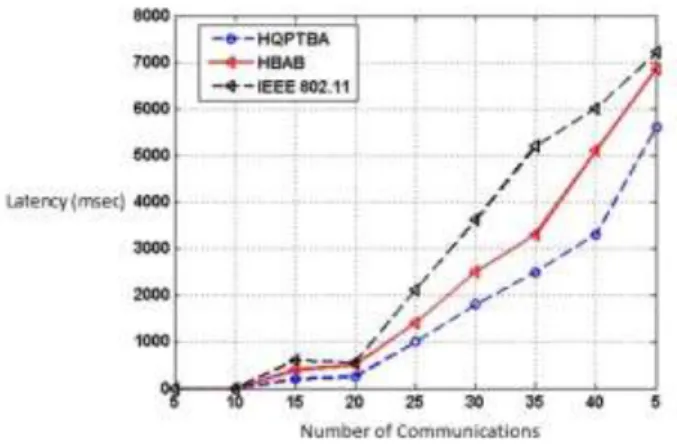
In Fig. 3 the latency of the proposed backtrack algorithm HQPTBA and the IEEE 802.11 standard, as well as HBAB, is shown for increasing the number of pairs of transmitter / receiver nodes from 5 to 40 pairs. The average latency (delay) time using the HQPTBA backtrack algorithm is reduced by 46% compared to the IEEE 802.11 standard backtrack algorithm, which means improving service quality. This latency will ultimately increase the amount of traffic of each network delivers to a common value, because the traffic load of the network is saturated by increasing the pair of transmitter / receiver nodes after increasing from a given value.
Fig. 3.Latency comparison of three algorithms in terms of increasing the number of pairs of transmitter / receiver nodes.
As the network traffic load increases, end-to-end latency will be greatly increased in packet delivery. However, since the network connectivity type is variable, and due to the node's movement, the traffic of transmitter and receiver node is changing, therefore, the CW resetting to the minimum value, due to the displacement and fluctuation of the network traffic load, weakens the service quality characteristics, including end-to-end latency in the standard IEEE802.11.
As it is shown in Fig. 4 with increasing number of transmitter / receiver nodes up to 10 pairs of changes, no significant change cannot be seen, but by increasing this number to 20 to 35 pairs, it can be seen that the latency of HQPTBA has been reduced about 46% compared to the IEEE 802.11 standard algorithm. This improvement of service quality in end-to-end latency is due to the avoidance of a decrease or increase in CW, due to the momentary changes of traffic, as well as the movement of nodes.
In the HQPTBA algorithm, the amount of network traffic load changes is applied to the backtrack algorithm, which makes the CW value more adaptable to the HQPTBA algorithm than other IEEE 802.11 and HBAB algorithms. As another reason to improve the quality of service for the end-to-end variable is to avoid an increase in the number of retransmissions, as well as the reduction of unused free slots. By increasing the number of transmitter /
receiver nodes from 35 pairs, due to the saturation of the network from the high rate of sending traffic, the amount of latency will go toward each other and increase in the same direction.
5.3 Comparison of jitter in HQPTBA, IEEE 802.11, and HBAB three backtrack algorithms
Jitter is another feature of the quality of service, which the fluctuations, and changes of this variable, resulting in loss of service quality in voice transmission applications. Fig. 4 presents the comparison of jitter changes in terms of increasing the number of transmitter / receiver nodes for the three HQPTBA and IEEE 802.11 and HBAB backtrack algorithms, for increasing the number of pairs of nodes from 5 to 40. As it is shown in the diagram Fig. 4 the average jitter after increasing the number of transmitter / receiver nodes from 10 pairs for the HQPTBA backtrack algorithm is about 21% lower than the IEEE 802.11 standard.
Fig. 4. Comparison of jitter by increasing the number of transmitter / receiver nodes.
As shown in Fig. 4 the amount of jitter with increasing network traffic load in the HQPTBA backtrack algorithm is less than the IEEE 802.11 and HBAB backtrack algorithm, which means improving the quality of service in distributed networks is applying the HQPTBA backtrack algorithm. This average reduction of jitter, as described in the network throughput, and latency forms, is due to controlling the reduction or increase of CW due to the traffic momentary changes caused by node displacement, as well as preventing an increase in the number of retransmissions at the collision moment, after successful posting, and also reducing the number of free slots.
but nevertheless take less time of the channel. This injustice regarding the time of competition for access to the channel, and the availability of the channel will increase the latency and jitter of packets with different size while using the standard IEEE 802.11 and HQPTBA and HBAB standard backtrack algorithms. In following the HQSBA, which is a new algorithm, and also based on the classification and allocation of distinctive characteristics for each class will be analyzed, as this algorithm has been improved by addressing the inequality problem in IEEE 802.11 and the HQPTBA backtrack algorithm, and the service quality characteristics are better than all other IEEE 802.11, HQPTBA, and HBAB standard methods.
6. Conditions for simulating the HQSBA algorithm
The HQSBA algorithm uses a classification mechanism to improve the quality of service for those traffics with real-time applications and best-effort. As a result, the improvement of service quality due to the use of the HQSBA backtrack algorithm compared to the HQPTBA algorithm, as well as the IEEE 802.11 standard backtrack algorithm has been improved more. The network under study in this algorithm is a distributed network with 50 nodes in an environment with dimensions of. In this network, two classes of CBR traffic types are defined with packets’ sizes of 100 bytes and 900 bytes.
The average speed of the nodes is 45.4 m / s, and the transmission rate is 20 package/s. In this networking, due to the variability of node alignment and displacement, the simulation is repeated 10 times at each load. The duration of the simulation scenario is 300 seconds. The network characteristics and simulation conditions are summarized in Table2.
Table 2 Intended characteristics for simulation.
Amount Character name
Distributed Type of Network
50 Number of node
CBR Traffic type
20 Data transmission rate
100 byte Package size of class 1
900 byte Package size of class 2
50 packages The queue size in the media access layer
5 m/s Maximum node speed
4.45 m/s Average node speed
300 sec Simulation duration
6.1 Comparison of network transmissions in HQSBA, and IEEE 802.11 two backtrack protocols
Network transmissions are of paramount importance to real-time best-effort applications. However, latency and jitter in data transfer applications have a higher priority. HQSBA algorithm is used to improve the quality of service in this algorithm through classifying of packages, by considering the size of the packages.
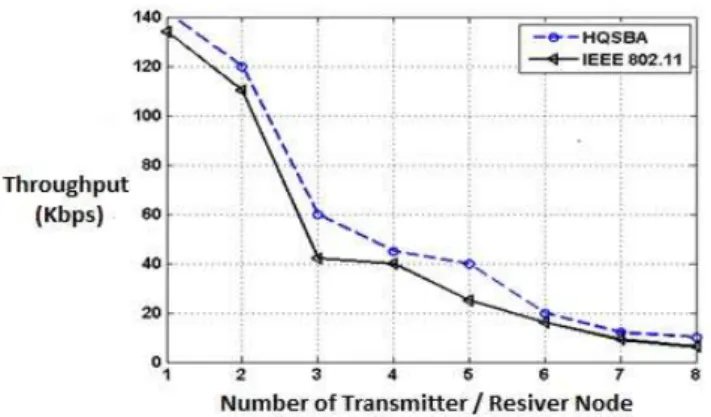
In Figs. 5 and 6 the network throughput is compared and shown in two classes 1 and 2 for the HQSBA and IEEE 802.11 standard backtrack algorithms. In Fig. 5, the horizontal axis is shown in Class 1 and so on. and so on. in
terms of increasing the number of pairs of transmitter / receiver nodes from 2 to 16 nodes in the transmitter / receiver, and the vertical axis is equal to the network throughput in Kbps. Similarly, in Fig. 6 in class 2, the horizontal axis represents the number of pairs of transmitter / receiver nodes arranged from 5 nodes to 40 nodes, and the vertical axis in Kbps represents the network throughput. As can be seen from Fig. 6 the output of the network goes down by increasing the number of sender/receiver nodes. By increasing the number of transmitter / receiver nodes, the network throughput decreases, and eventually, it goes towards the minimum possible value in both the HQSBA backtrack algorithm and the IEEE 802.11 standard.
Fig. 5. Comparison of the HQSBA algorithm, and the IEEE 802.11 class 1 and so on. standard.
Fig. 6.Comparison of the HQSBA algorithm, and the IEEE 802.11 Class 2 standard.
for increasing the number of pairs of transmitter / receiver nodes from 4 to 14 for class 1 and so on. and so on. and 10 to 35 pairs for class 2.
The reason for improving network throughput in Figs. 5 and 6 is the classification of packets of different sizes when accessing the channel, and giving different access preferences. These priorities in the HQSBA backtrack algorithm are the assignment of distinct values and in two classes 1 and 2. In other words, by assigning smaller values, and for packets of class 1 and so on. which packets are sent with a size of 100 bytes, the time for access to the channel decreases compared to class 2. In addition to the classification concept, in the HQSBA backtrack algorithm, in order to reduce the interference and discard of packets, due to the change in the alignment and traffic load fluctuation in each of classes 1 and 2, the change in the CW value, as well as the time setting of the HQSBA backtrack, take place based on the amount of network traffic load takes place. In other words, by increasing the amount of traffic load in each class, the CW value is chosen to reduce the probability of a larger interference, but by reducing network traffic, the CW value is also reduced to avoid loss of time slots. The process for the CW in each class improves the network throughput in the HQSBA backtrack algorithm compared to the IEEE 802.11 backtrack algorithm.
6.2 Comparison of end-to-end latency in HQSBA, and IEEE 802.11 backtrack protocols
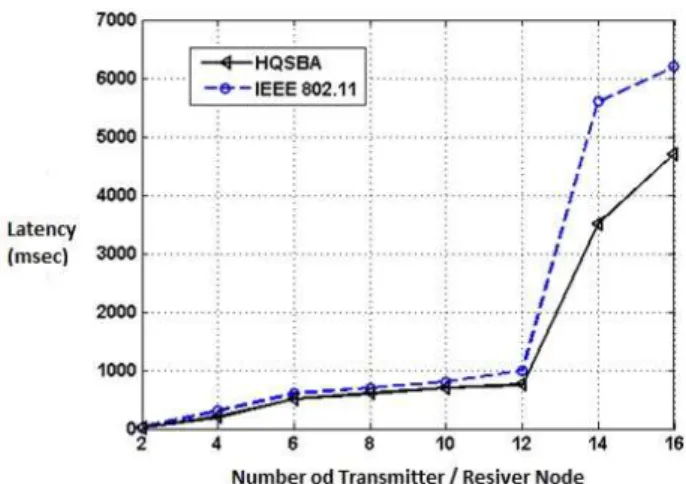
In the HQSBA algorithm, using the concept of classification, the latency of sending smaller sized packets has decreased compared to the IEEE 802.11 backtrack algorithm. The applications of this algorithm can be used to refer to voice transmissions in distributed networks. In this section, the comparison of end-to-end latency in two HQSBA backtrack algorithms, and the IEEE 802.11 standard is discussed. Comparison of latency caused by two HQSBA backtrack algorithms and IEEE 802.11 standard is shown in Figs. 7 and 8 In Fig. 7 the number of transmitter / receiver nodes has been increased from 2 to 16, and in Class 2, to evaluate the latency, the traffic load has been increased from 5 to 40 nodes see Fig. 8 Latency is presented in both figures in the millisecond.
The average latency value using the HQSBA backtrack algorithm has approximately 35% decreased for Class 1 and so on. and so on. and up to 29% for class 2, compared to IEEE 802.11 standard backtrack algorithm, for increasing the number of pairs of transmitter / receiver nodes from 4 to 14 for Class 1and 10 to 35 pairs for Class 2. This latency reduction is because of avoiding any further increase in the number of retransmissions in both classes.
As shown in Figs. 7 and 8 the latency value increases with nonlinear increase in traffic, but the latency increasing in the HQSBA backtrack algorithm is lower than the IEEE 802.11 standard. This decrease means as an improvement in service quality, especially in data transfer applications. The reason for improving the quality of service is the same as in the definition of the HQSBA backtrack algorithm, due
to facilitating the access of smaller packets to the channel comparing to larger ones. Also, in each class, in order to reduce the chances of interference of packets sent at the sender node or packets received at the node and prevent loss of slots when the channel is open, the CW value for each traffic class is matched to the network load, and HQSBA backtrack algorithm timing is adjusted in a way that prevents a sudden CW reset. As a result of using this algorithm, increasing in latency takes place in a lower rate comparing to the IEEE 802.11 standard, but ultimately, with the increase in network load, and reaching to the maximum value, as shown in Figs. 7 and 8 the latency value is inclined toward the same value.
Fig. 7.Comparison of the latency diagram of the two HQSBA algorithms, and IEEE 802.11 class 1 standard.
Fig. 8.Comparison of the latency of the two HQSBA algorithms, and the IEEE 802.11 class 2 standard.
6.3 Comparison of jitter in two HQSBA backtrack protocols and IEEE 802.11 backtrack
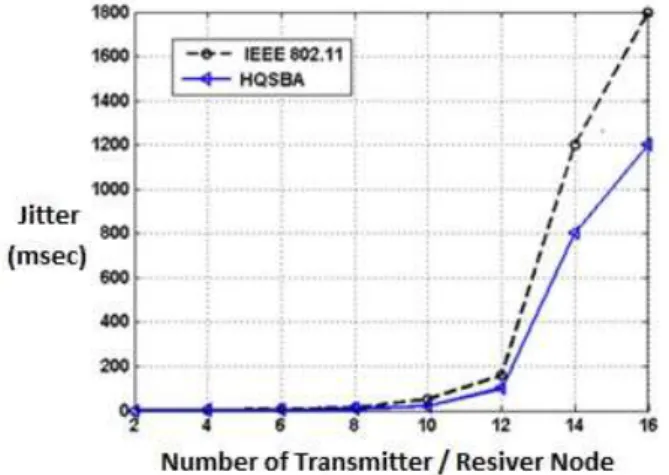
nodes. As shown in Figs. 9 and 10, the average jitter for the HQSBA backtrack algorithm in Class 1 and so on. has been decreased about 28%, and in Class 2 about 23%, based on the IEEE 802.11 standard for increasing the number of pairs of transmitter / receiver nodes from 4 to 14 for Class 1 and so on. and so on. and 10 to 35 pairs for Class 2. This decrease reflects improved service quality in the HQSBA backtrack algorithm than the IEEE 802.11 standard in the distributed network.
Fig. 9.Comparison of jitter of two HQSBA algorithms, and IEEE 802.11 Class 1 standard.
Fig. 10.Comparison of jitter of two HQSBA algorithms, and IEEE 802.11 class 2 standard.
As discussed in the previous section on comparing latency, using the class differentiation in terms of the priority of access to the channel, justice can be adhered in access to the channel. In the HQSBA backtrack algorithm, in addition to classifying each class in order to reduce the possibility of interference and retransmissions; the CW value is adapted to the traffic situation of the network. As a result, the value of the HQSBA backtrack timing in each class is selected in a row, in a way that reduces the number of wasting slots, as well as reduce the number of retransmissions which are allocated to sending packets.
It is worth noting that in the proposed algorithms, as well as the HBAB algorithm, due to the application of a gentle process in reducing the CW value, we see more of
these algorithms in high traffic compared to IEEE 802.11 standard. Improvement of service quality results for HQPTBA and HQSBA algorithms is presented in Table 3.
Table 3
Improvement of service quality by HQPTBA and HQSBA algorithms
Improvement of the HQPTBA
algorithm Improvement of
HQSBA algorithm Quality
service elements
%42 Class1
%18/19 Throughput
Class2 %8
%46 Class1
%35
Latency %29 Class2
%21 Class1
%28 Jitter
Class2 %23
7. Conclusion
The proposed HQPTBA and HQSBA algorithms have used NS2 software to improve the quality of service to compare latency, network throughput, and jitter. The HQPTBA and HQSBA backtrack algorithms are compared with the standard IEEE 802.11 and HBAB algorithms, which is an algorithm based on past post reviews. The comparison results show that due to the flexibility of the proposed algorithms as well as the separation of packets by size, the HQSBA algorithm has improved service quality characteristics compared to other previous methods.
References
Bianzino, a. P., & Chaudet, C., & Rossi, D., & Rougier, J. (2012). A Survey of Green Networking Research: IEEE Commun. Surv. Tutorials, 14(1) 3–20.
De Rango, F., & Fazio, P., & Scarcello, F., & Conte, F. (2014). A New Distributed Application and Network Layer Protocol for VoIP in Mobile Ad Hoc Networks: Mobile Computing, IEEE Transactions, 2185–2198. Ding, W., & Yang, F., & Song, J., & Niu, Z. (2014).
Energy-efficient orthogonal frequency division multiplexing scheme based on time– frequency joint channel estimation: Communications, IET, 3406– 3413.
Fan, Y., & Li, J., & Xu, K., & Gomes, N. J., & Lu, X., & Dai, Y., & Yin, F. (2014). Improved IEEE 802.11 point coordination function considering the fiber-delay difference in distributed antenna systems: Communications Workshops (ICC), IEEE International Conference, 407–411.
Fang, S., & Liu,Y., & Ning, P. (2015). Wireless Communications under Broadband Reactive Jamming Attacks, Dependable and Secure Computing, IEEE Transactions , 99- 1.
Latchman, H., & Katar, S.,& Yonge, L., & Gavette, S. (2013). MAC Protocol Data Unit (MPDU) Format: Homeplug AV and IEEE 1901: A Handbook for PLC Designers and Users. Wiley-IEEE Press, 1–384. Le, T. A., & Hong, C. S., & Razzaque, M. a., Lee, S., &
Congestion Control Algorithm for Multipath TCP: IEEE Commun. Lett., 16( 2) 275 –277.
Liang, W., & Li, Z., & Zhang, H., & Wang, S., & Bie, R. (2015). Vehicular Ad Hoc Networks : Architectures, Research Issues, Methodologies, Challenges, and Trends, 224,228.
Mo, S., & Hsu, J., & Gu, J., & Luo, M., & Ghanadan, R. (2008). Network synchronization for distributed MANET: Military Communications Conference, MILCOM IEEE, 1(7), 164.
Mohanty, P., & Kabat, M. R. (2014). A Hierarchical Energy Efficient Reliable Transport Protocol for Wireless Sensor Networks: Ain Shams Eng, 1141– 1155.
Nagendra Naik, D., & Hussain, T., & Limbu, S., & Patowary, G. (2014). QoS performance analysis of routing protocols in Vehicular Ad-hoc Networks: Communications and Signal Processing (ICCSP), International Conference, 1251–1255.
Nguyen, S. H., & Vu, H. L., & Andrew, L. L. H. (2013). Service Differentiation without Prioritization in IEEE 802.11 WLANs,” Mobile Computing, IEEE Transactions on, vol. 12, no. 10. pp. 2076–2090, 2013. Sharma, D. K., & Kumar, C., & Mandal, S. (2013). An
efficient cluster-based routing protocol for MANET: Advance Computing Conference (IACC), 2013 IEEE 3rd International, 224–229.
Syed , I., & Kim, B., & Roh, B., & Oh, I. (2015). A novel contention window backoff algorithm for IEEE 802.11 wireless networks: Computer and Information Science (ICIS), IEEE/ACIS 14th International Conference, 71– 75.
Ting, K. C., & Wang, H. C., & Kuo, F. C., & Tseng, C. C. (2012). A listening power-saving Mechanism in MAC layer for the DCF of 802.11n: Wireless Personal Multimedia Communications (WPMC), 15th International Symposium, 529–533.
Ullah, S., & Sup, K. (2012). An Ultra Low-power and Traffic-adaptive Medium Access, 1021–1030.
Wu, Y., & Xia, H., & Lu, Y., & Zhang, T. (2014). Clustering-based time-domain power control algorithm for improving energy efficiency in dense small cell network: Wireless Personal Multimedia Communications (WPMC, International Symposium, 80–84.
Xia, H., & Jia, Z., & Li, X., & Ju, L., & Ju, E. (2013). Trust prediction and trust-based source routing in mobile ad hoc networks: Ad Hoc Networks, 11(7) 2096–2114. Zhong, L., & Shoji, Y., & Nakauchi, K., & Eum, S. (2014).
BE-DCF:Barring-Enhanced Distributed Coordination Function for Machine Type Communications in IEEE 802.11 networks: Communications Workshops (ICC), 2014 IEEE International Conference, 467–471.