
Implementation of Area Efficient and High Bit Rate Serial-Serial Multiplier
With On-the-Fly Accumulation by Asynchronous Counters
Suda Sriram M.Tech, Embedded Systems.
Joggaih Institute of Tech. & Engg. College of Engineering. Kalagampudi, West Godavari District.
Andhra Pradesh, India. [email protected]
Ch. Kanakalingeswara Rao Assistant Professor in ECE dept. Joggaih Institute of Tech. & Engg. College of
Engineering. Kalagampudi, West Godavari District. Andhra Pradesh, India.
Abstract—Traditional Serial-Serial multiplier addresses the high data sampling rate. It is effectively considered as the entire partial product matrix with n data sampling cycle for n×n multiplication function instead of 2n cycles in the conventional multipliers. This multiplication of partial products by considering two series inputs among which one is starting from LSB the other from MSB. Using this feed sequence and accumulation technique it takes only n cycle to complete the partial products. It achieves high bit sampling rate by replacing conventional full adder and highest 5:3 counters. Here asynchronous 1’s counter is presented. This counter takes critical path is limited to only an AND gate and D flip-flops. Accumulation is integral part of serial multiplier design. 1’s counter is used to count the number of ones at the end of the nth iteration in each counter produces. The implemented multipliers consist of a serial-serial data accumulator module and carry save adder that occupies less silicon area than the full carry save adder. In this paper we implemented model address for the 8bit 2’s complement implementing the Baugh-wooley algorithm and unsigned multiplication implementing the architecture for 8×8 Serial-Serial unsigned multiplication.
Keywords—Binary multiplication, on-the-fly accumulation, parallel multipliers, serial and serial-parallel multiplier.
I. INTRODUCTION
Multipliers are essential building blocks in VLSI circuits. Hardware implementation of a multiplication operation consists of three stages, specifically the generation of partial products (PPs), the reduction of partial products (PPs), and the final carry propagation addition. The partial products can be generated either in parallel or serially, depending on the target application and the availability of input data. The partial products are reduced by carry-save adders
(CSAS)[5]using an array or tree structure. Carry propagation addition is inevitable when the number of partial products is reduced to two rows. This final adder can be a simple ripple carry adder (RCA) for low power or a carry look-ahead adder (CLA) for high speed. As the height of PP tree increases linearly with the word length of the multiplier, it aggravates the area, delay and power dissipation of the two subsequent stages.
Therefore, it is highly desirable to reduce the number of partial products before the CSA Stage. In the implemented method the partial product formation is revamped using an algorithm named as serial-serial algorithm which is explained in the following sections. The generated partial products are passed to a group of asynchronous 1’s counters for accumulation. The counters will count the number of ones in the partial products which is used for addition. In the following sections an approach to the design of serial multiplier that is capable of processing input data without input buffering and with reduced total number of computational cycles.
x N serial multiplier, several serial-parallel multipliers.
II. SERIAL MULTIPLIERS
In a serial-serial multiplier both the operands are loaded in a bit-serial fashion, reducing the data input pads to two serial multipliers are popular for their low area and power. Bit-serial processing can result in efficient communications, both within and between VLSI chips, because of the reduced number of interconnections required. Serial multiplier designs which are particularly suitable for applications where input data are sequentially presented .The operating speeds are determined mainly by the propagation delays along the critical path within the processing elements. A major advantage offered by bit serial processors is when the operands are available only one bit at a time, the processing speed can be improved using bit-serial arithmetic elements. The structures that use this approach can achieve moderate speeds with comparatively small area. A. Implementation Stages for Serial- Serial Multiplier
This operation consists of three stages i) The generation of partial products. ii) The reduction of partial products. iii) Final carry-propagation addition.
The partial products can be generated either in parallel or serially, depending on the target application and the availability of input data. The partial products are generally reduced by carry-save adders using an array or a tree structure. Carry propagation addition is inevitable when the number of partial products is reduced to two rows. This final adder can be a simple ripple carry adder for low power or a carry look-ahead adder for high speed. It is highly desirable to reduce the number of partial products before the carry-save adder’s stage. The drawback is that and higher order compressors are slower and consumes more power than the full adders. An accumulator is an adder which successively adds the current input with the value stored in its internal register.
B.Serial Multiplier with Counter Based Accumulator
In this type of multipliers the partial products are formed in a serial manner. Instead of using full adders counters are used to count the number of 1‟s in a column in this structure. This method provides power minimization from the fact that the counter output will not toggle unless a „1‟ is present at its input. The counter output is applied to a ripple carry adder to obtain the final product. By using this counter based accumulator the partial products are
formed in N cycles for an NXN multiplication. A new approach to serial/parallel multiplier design by using parallel 1s counters to accumulate the binary partial product bits. The 1s in each column of the partial product matrix due to the serially input operands are accumulated using a serial D-flip flop (DFF) counter.
III. IMPLEMENTED SERIAL-SERIAL MULTIPLIER
Accumulation is an integral part of serial multiplier design. A typical accumulator is simply an added that successively adds the current input with the value stored in its internal register. Generally, the adder can be a simple RCA but the speed of accumulation is limited by the carry propagation chain. The accumulation can be speed up by using a CSA with two registers to store the intermediate sum and carry vectors, but a more complex fast vector merged adder is needed to add the final outputs of these registers. A new approach to serial accumulation of data by using asynchronous counters is suggested here which essentially count the number of 1’s in respective input sequences.
A.8 Bit Word Length for Unsigned Multiplier
A new technique of generating the individual row of partial products by considering two serial inputs, one starting from the LSB and the other from MSB. It takes only n cycles to complete the entire partial product generation.
The product of two unsigned numbers X and Y can be written as
n-1 n-1
P = ∑ ∑ xiyj2i+j --- (1)
i=0 j=0
Where xi and yj are the ith and jth bits of X and Y with bit 0 being the LSB.
Reversing the sequence of index I and rearranging the above equation can be written as
P= ΣrPPr --- (2)
Where
PPrL= {0 r=0 Σkxn-k-1. yr. 2n+r-k-1 ,r=1,2,...n-1} PPrC = {0
r=0
Σxn-r-1.yr. 2n-1 , r=1,2,...n-1} PPrR= {0
r=0
The partial product row PP rcan be generated in r cycles if X is fed from MSB(bitn-1) first and Y is fed from LSB first (bit 0), then in the rthcycle ,PPrC is a partial product bit generated by the current input bits xn-r-1 and yr,PPrL are partial product bits of the current input bit, yr and each of the preceding input bits of X, i.e xn-k-1,for k=0,1,….r-1.andPPrRare the partial product bits of the inputbitxn-r-1,andeachofthe preceding input bits of Y, i.e Yr-k-1 for k=0,1,2,….r-1.By appropriately sequencing the input bits of X and Y into a shift register, one PP(PPr)in each cycle can be generated. As a result P can be obtained in n cycles.
Figure.1 Partial product generation schemes for an 8 X 8 serial-serial multiplication :(a)
conventional and (b) proposed
The PP generation of an 8×8 multiplier for two unsigned numbers X and Y. “Fig.1 (a)”, shows the conventional partial product formation and “Fig.1 (b)”, shows the generation sequence of the PPs. Row r generated in cycle r, for r=0,1……..n-1.The PPs in “Fig.2”, are generated in such an unconventional way in order to facilitate their accumulation on-the-fly by the Implemented counter-based accumulation
technique. A PP bit corresponding to the middle column of the PP is produced by the centered AND gate.
The latched outputs are wired to the correct FAs and HAs (half adders) according to the positional weights of the output bits produced by the counters. From “Fig.2”, it is observed that the column height has been reduced from 8 to 4 and the final product, can be obtained with two stages of CSA tree and a final RCA. Similarly, for 16×16, 32×32 and 64× 64 multipliers the column heights are reduced logarithmically from 16, 32, and 64 to 5, 6, and 7, respectively. This drastic reduction in column height leads to a much simpler CSA tree, and hence reducing the overall hardware complexity and power consumption.
Figure.2Implemented architecture for 8 × 8 serial-serial unsigned multiplication
The latching register between the counter and the adder stages not only makes it possible to pipeline the serial data accumulation and the CSA tree reduction, but also prevents the spurious transitions from propagating into the adder tree.
B.8 bit word length for 2’s complement numbers
Figure.3Implemented architecture for 8×8 serial-serial 2’s complement multiplication
The addition of the term raises the height of CSA tree by only two bits regardless of the word length of the operands.
n-2 n-2 n-2 n-2 PI= XI YI= ∑ ∑ x
iyj2i+j+ 2n-1 ∑ xiyn-12i+ ∑
xn-1yi2j
i=0 j=0 i=0 j=0
+ xn-1yn-122n-2+2n_22n-1
---3
The multiplication of two unsigned numbers by the multiplier can be expressed as,
n-2 n-2 n-2 n-2 PI= X Y = ∑ ∑ x
iyj2i+j+ 2n-1 ∑ xiyn-12i+ ∑
xn-1yi2j
i=0 j=0 i=0 j=0
+ xn-1yn-122n-2
---4
The difference between (3) and (4) is given by Ψ = PI– P
n-2 n-2 = 2n-1 ∑ x
iyn-12i+ ∑ xn-1yi2j
i=0 j=0 n-2 n-2 - 2n-1 ∑ x
iyn-12i+ ∑ xn-1yi2j
i=0 j=0 + 2n– 22n-1
n-2 = 2n-1 ∑ (x
iyn-1+ xiyn-1– 2xiyn-1) 2i
i=0 n-2
+ ∑ (xn-1yi+ xn-1yj– 2xn-1yj) 2j
j=0
+ 2n - 22n-1--- (5)
As xiyn-1+ xiyn-1= 1 and xn-1yi+ xn-1yj=1, (5) can
be simplified to n-2 Ψ = 2n-1∑ (1 - 2x
iyn-1) 2i
i=0
n-2
+ ∑ (1 - 2xn-1yj) 2j + 2n– 22n-1---(6)
j=0
To extend the unsigned multiplier architecture for signed multiplication without introducing a
high
over-head,thedifferenceexpressedin6mustbesimplified.Si nce Σin-2 2i=Σjn-22j,the following summation terms embedded in(6) can be simplified by the closed form expression of a geometric progression, i.e., 20+ 21+
22+ ... + 2n-2= 2n-1-1.
n-2 n-2
2n-1 ∑ 2i+ ∑ 2j = 2Ψ-1(2n-1-1 + 2n-1-1)
i=0 j=0
= 22n-1– 2n --- (7)
By substituting (7) into (6), the constant terms 2 2n-1– 2ncancel out and the difference, Ψ is reduced to
n-2 n-2 Ψ = -2n ∑ x
iyn-12i+ ∑ xn-1yj2j
---(8)
i=0 j=0
The difference Ψ of (8) is added to P so that the structure can be modified to obtain PI, the product of
the 2’s complement multiplication
PI= P + Ψ
n-2 n-2 = P - 2n ∑ x
iyn-12i+ ∑ xn-1yj2j
----(9)
i=0 j=0
In the implemented PP generation method, Yn-1 arrives only in cycle n-1.The generation of Σin-2XiYn-12i has to be delayed until cycle n-1.There main in g terms Σj n-2 Xn-1 Yj 2Jcan be computed
during the initial n-1cycles. Hence, The difference can be corrected in the CSA tree .It is trivial that a n-1 bit shift register, a NAND gate and several FAs are required for adding Ψ.
IV. PERFORMANCE COMPARISON AND IMPLEMENTATION RESULTS
multipliers also for Delay and area [11] shown in Table II.
TABLE I
DELAY COMPARISON OF 8x8 MULTIPLIERS [10]
S.No Name of the Multiplier Delay(nsec)
1 Array Multiplier 47
2 Booth Multiplier 117
3 Vedic Multiplier 27
4 Implemented Signed 4.36 Unsigned 4.28
TABLE II
AREA AND DELAY COMPARISON OF 8x8 MULTIPLIERS [11]
S. N o
Multiplier Algorithm for
8x8
NO of Slice s/CL B’S
Cyc les
Max Operat
ing Freque ncy(M HZ)
Critic al Path Delay (nsec)
1 Carry rippleMultiplier 60 2n 14.97 66.8
2 Wallace treemultiplier 79 2n 19.23 52.00
3 MultiplierBraun 79 2n 21.82 45.82
4
Pipelined constant coefficient Multiplier
26 2n 70.42 14.20
5
Pipelined Serial parallel
with converters
21 2n 88.9 11.24
6 Shift and addMultiplier 33 2n 93.98 10.64
7 PipelinedGuild
Multiplier 199 2n 98.75 10.12
8 Carry SavePipelined
Multiplier 187 2n 100.09 9.99
9 Impleme nted
Signe
d 177 n 227.99 4.38
Unsig
ned 96 n 233.31 4.28
VHDL simulation
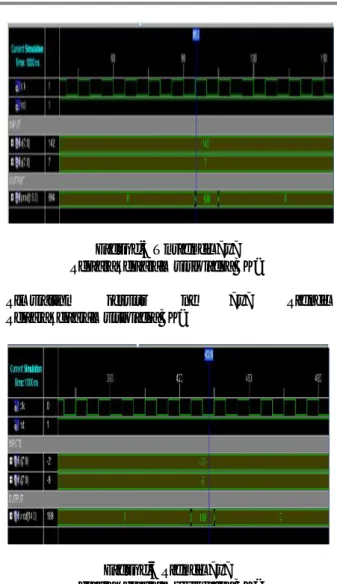
The VHDL simulation of the two multiplier is presented in this section. The VHDL code for an unsigned and signed multiplier using a fast carry propagation adder and fast carry look-ahead adder (CLA). The VHDL model has been developed using the Direct VHDL simulator. The multipliers use 8-bit values and simulation results of two multipliers are shown below waveforms. This code was synthesized using Xilinx Spartan 3E family. This chapter explains about the simulation of Area Efficient and A High Bit Rate Serial-Serial Multiplier with On-the-Fly Accumulation by Asynchronous Counters Synthesis report shown TABLE III.
Simulation results of 8x8 Unsigned Serial_Serial_Multiplier_CPA
Figure.4 Unsigned 8x8 Serial_Serial_Multiplier_CPA
Simulation results of 8x8 Signed Serial_Serial_Multiplier_CPA
Figure.5 Signed 8x8 Serial_Serial_Multiplier_CPA
Figure.6 Unsigned 8x8 Serial_Serial_Multiplier_CLA
Simulation results of 8x8 Signed Serial_Serial_Multiplier_CLA
Figure.7 Signed 8x8 Serial_Serial_Multiplier_CLA
*Synthesis Report
The Synthesis report for both an unsigned multiplier using a fast carry propagation adder and fast carry look-ahead adder and an signed multiplier using a fast carry propagation adder and fast carry look-ahead adder shown Table III.
TABLE III
AREA AND DELAY RESULTS OF IMPLEMENTED 8x8 MULTIPLIERS
Description
Serial_Serial_Multiplier
Carry Propagation adder Serial_Serial_MultiplierCarry look-ahead adder No. of slices
utilization out of 4656
(Area)
Critical Path Delay (nsec)
No. of slices utilization out of 4656
(Area)
Critical Path Delay (nsec) Unsigned 96 (2%) 4.283 94 (2%) 4.283 Signed 177(3%) 4.368 179 (3%) 4.386
V. CONCLUSION
In this paper, design of multiplier by using carry propagate adder (CPA) and Carry look-ahead adder
for addition of final partial product terms and by introducing Carry Save Adder (CSA) for reducing the partial product lines. Our implementation technique effectively forms the entire partial product matrix in just n sampling cycles for an n x n multiplication instead of at least 2n cycles in the conventional serial-serial multipliers. It achieves a high bit sampling rate by replacing conventional full adders and 5:3 counters with asynchronous 1’s counters so that the critical path is limited to only an AND gate and a D flip-flop (DFF). The use of 1’s counter to column compress the partial products preliminarily reduces the height of the partial product matrix from n to [log2 n] +1, resulting in a significant complexity reduction of the resultant adder tree. The multipliers presented in this paper were all modeled using VHDL (Very High Speed Integration Hardware Description Language) for 8-bit unsigned and signed data. The comparison is done on the basis performance parameters i.e. Area (2% & 3%) and Speed (4.283ns & 4.368ns) previously in the literature.
VI .SCOPE OF EXPANSION
The further extension of this 8 x 8 serial-serial unsigned multiplication and 8 x 8 serial-serial 2’s compliment multiplication can be implemented by using 16 x 16 –bit, 32 x 32 -bit are more than but architecture includes an area overhead and design complexity.
REFERENCES
[1] Meher MR,Ching Chuen Jong; Chip Hong Cheng , “A High bit rate Serial-Serial multiplier”,IEEE Trans.VLSI,vol.19,pp.1733-1745,Sept 2010
[2] Essam Elsayed and Hatem M. El-Boghdadi “Area-Time Efficient Digit-Serial-Serial Two’s Complement Multiplier” Vol. 2, Special Issue 1, Part 2, February 2009.
[3] OHSANG KWON and KEVIN NOWKA “A 16-Bit by 16-16-Bit MAC Design Using Fast 5:3 Compressor Cells” Journal of VLSI Signal Processing 31, 77–89, 2009.
[4] P. Assady “A New Multiplication Algorithm Using High-Speed Counters” European Journal of Scientific Research ISSN 1450-216X Vol.26 No.3 (2009), pp.362-368.
[5] Harpreet Singh Dhillon and Abhijit Mitra “A Reduced-Bit Multiplication Algorithm for Digital Arithmetic” International Journal of Computational and Mathematical Sciences 2:2 2008
High Speed Compressors for High Speed Multipliers” Vol. 8, No. 3, November 2006, 293-306
[7] Nibouche.O, Bouridarie.A, and Nibouche.M (2001), ‘New architectures for serial-serial multiplication’ in Proc. IEEE Conf. Circuits Syst. (ISCAS), Sydney, Australia, vol. 2, pp. 705–708.
[8] H. K. Mecklai and A. L.Webb, “Compact buffer design for serial I/O”U.S. Patent 6 167 109, Dec. 26, 2000.
[9] Sungwook Kim and Gerald E. Sobelman, “ Digit-Serial Multiplier Design Using Skew-Tolerant Domino Circuits” University of Minnesota Minneapolis, MN 55454, USA (2000).
[10] Sumit Vaidya and Deepak Dandekar “ Delay-Power Performance Comparison Of Multipliers In Vlsi Circuit Design” International Journal of Computer Networks & Communications (IJCNC), Vol.2, No.4,
(2010)
[11] J.Senthil Kumar G.Lakshminarayanan “Design and Implementation of FPGA based Fast Multipliers with Optimum Placement and Routing using Structure Organizer” Department of ECE, Regional Engineering College, Tiruchirapalli.
[12] 0. Nibouche.O, A. Bouridarie, M. Nibouche.O “New Architectures for Serial-Serial Multiplication” 0-7803-6685-9101/$10.0002000 IEEE.
[13] A AGGOUN, A ASHUR and M K IBRAHIM “Area-Time Efficient Serial-Serial Multipliers” ISCAS 2000 - IEEE International Symposium on Circuits and Systems, May 28-31, 2000, Geneva, Switzerland.
[14] Paolo Ienne and Marc A. Viredaz “Bit-Serial Multipliers and Squarers” IEEE Transactions on Computers. vol. 43, no. 12, December 1994.
![Ethyl 5 methyl 4 oxo 3 phenyl 2 propylamino 3,4 dihydrothieno[2,3 d]pyrimidine 6 carboxylate](data:image/gif;base64,R0lGODlhAQABAIAAAP///wAAACH5BAEAAAAALAAAAAABAAEAAAICRAEAOw==)