dosage form that disintegrates and dissolves in the mouth, either on or beneath the tongue or in the buccal cavity without water, within 60 s or lower. The US Food and Drug Administration (FDA) Center for Drug Evaluation and Research (CDER) defines, in the orange book, an oral disintegrating tablet as, “A solid dosage form containing medicinal substances, which disintegrates rapidly, usually within a matter of seconds, when placed upon the tongue.” At present, oral disintegrating tablets are the only quick-dissolving dosage form recognized by FDA and listed in the approved drug products with therapeutic equivalence evaluations.[1,2]
The drug selected for the study was cefexime trihydrate, which is used in the treatment of uncomplicated urinary tract infections.[3,4] The aim of the study was to formulate
an oral disintegrating tablet of cefixime trihydrate using two superdisintegrants separately (crosscarmellose sodium and sodium starch glycolate), and to select the best among the two based on the disintegration time and other tableting properties.
INTRODUCTION
Disintegrants are agents added to tablet formulations to promote the break-up of the tablet into smaller fragments in an aqueous environment, thereby increasing the available surface area and promoting a more rapid release of the drug substance. In more recent years, several newer disintegrants have been developed, often called “super disintegrants.” These newer substances can be used at lower levels than conventionally used disintegrants. Three major mechanisms and factors affecting tablet disintegration are suggested as swelling, porosity and capillary action and deformation. Three major group of compounds that have been developed as superdisintegrants are modified starches, cross-linked polyvinylpyrrolidone and modified cellulose.
One of the major streams of application of superdisintegrants is in the formulation of oral disintegrating tablets/mouth dissolving tablets. An oral disintegrating tablet is a solid
Formulation Development, Evaluation and Comparative Study
of Effects of Super Disintegrants in Cefixime Oral Disintegrating
Tablets
Remya KS, Beena P, Bijesh PV, Sheeba A
Nazareth College of Pharmacy, Othera P.O, Thiruvalla, Pathanamthitta (Dist.), Kerala - 689 546, India
Address for correspondence: Miss. Remya K. S.; E-mail: [email protected]
ABSTRACT
The present work was aimed at formulation development, evaluation and comparative study of the effects of superdisintegrants in Cefixime 50 mg oral disintegrating tablets. The superdisintegrants used for the present study were sodium starch glycolate and crosscarmellose sodium. The formulated tablets were evaluated for various tableting properties, like hardness, thickness, friability, weight variation, disintegration time and dissolution rate. Comparative evaluation of the above-mentioned parameters established the superiority of the tablets formulated with crosscarmellose sodium to those formulated with sodium starch glycolate.
Key words: Cefixime, superdisintegrants, oral disintegrating tablets
MATERIALS AND METHODS
Materials
Cefixime trihydrate was procured from Aurobindo Pharma Ltd . Sodium starch glycolate and croscarmellose sodium were procured from DK Enterprises, while magnesium stearate and talc was from Nice Chemicals .
Methodology Preformulation studies[5-7]
Preformulation study is defined as an investigation of the physical and chemical properties of drug substance alone and when combined with the excipients. The overall objective of preformulation testing is to generate information useful to the formulator in developing a stable and bioavailable dosage form that can be mass produced. The commonly investigated preformulation parameters include angle of repose, bulk density/tapped density, pour density, Carr’s compressibility index and Hausner ratio.
Angle of repose
It is determined by allowing a powder to flow through a funnel and fall freely on to a surface. Further addition of powder is stopped as soon as the pile touches the tip of the funnel. A circle is drawn around the pile without disturbing it. The height and diameter of the resulting cone are measured. The same procedure is repeated three times and the average value is taken. Angle of repose is calculated by using the following equation:
Tan θ = h/r
Where, h = height of the powder cone; r = radius of the powder
Bulk density
Unless otherwise specified, pass a quantity of material sufficient to complete the test through a 1.00-mm (no. 18) screen to break up agglomerates that may have formed during storage. Into a dry 250-ml cylinder introduce, without compacting, approximately 100 g of the test sample (M) weighed with 0.1% accuracy. If it is not possible to use 100 g, the amount of the test sample and the volume of the cylinder may be modified. Select a sample mass having an untapped apparent volume of 150–250 ml. A 100-ml cylinder is used for apparent volumes between 50 and 100 ml. Fill the cylinder carefully. Carefully level the powder without compacting, if necessary, and read the unsettled apparent volume (Vo). Calculate the bulk density, in g/ml, using the formula,
Bulk density = M/Vo
Tapped density
Accurately weighed quantity of powder is introduced into a measuring cylinder. Mechanically tap the cylinder containing the sample by raising the cylinder and allowing it to drop under its own weight using a suitable mechanical tapped density tester at a nominal rate of 300 drops/min. Tap the cylinder 500 times and measure the tapped volume (Va). Repeat the operation for an additional 750 tappings and again measure the tapped volume as (Vb).
If the difference between Va and Vb is <2%, Vb is the final tapped volume (Vf). If the difference is higher, repeat the tapings for an additional 1,250 times, and then the tapped density can be calculated using the following formula (United States pharmacopoeia, 2004)
Tapped density = M/Vf
Where, M = weight of the sample taken; Vf = final tapped volume
Carr’s index
The compressibility index of granules can be determined using Carr’s compressibility index, and can be determined by the following formula:
(Tapped density –
Pour density) Carr’s index (%) =
Tapped density X 100
Hausner ratio
The Hausner ratio can be determined using the following formula:
Hausner ratio (%) = Tapped density X 100 Pour density
Compatibility studies
IR studies of drug and drug with superdisintegrants were carried out in order to check the compatibility between the drug and the excipients.
Formulation development
formulations were prepared, of which five formulations included varying concentrations of the superdisintegrant sodium starch glycolate and five of crosscarmellose sodium. The list of ingredients is given in Tables 1 and 2.
Tablet evaluation[8-10]
The selected batches made in bulk were subjected to evaluations as per Indian pharmacopoeia.
Weight variation
Twenty tablets were selected at random, weighed and the average weight was calculate. Not more than two of the individual weights should deviate from the average weight by more than 5%.
Friability
For each formulations, preweighed tablet samples (20 tablets) were placed on the friabilator, which is then operated for 100 revolutions. The tablets were then dusted and reweighed. Conventional compressed tablets that loose <0.5–1.0% of their weight are considered acceptable.
Hardness
Tablet hardness of each formulation was determined using a Monsanto hardness tester . Results were calculated from the average results of six tablets.
Thickness
Tablet thickness is determined using vernier calipers.
Six tablets were evaluated to determine the average thickness.
Disintegration test
Introduce one tablet into each tube and add a disc to each tube. Suspend the assembly in the beaker containing the specified liquid and operate the apparatus for a specified period of time. The tablet passes the test if all tablets have disintegrated. If one or two tablets fail to disintegrate, repeat the test on 12 additional tablets, such that not <16 of the total of 18 tablets tested disintegrate. If the tablets adhere to the disc, repeat the test by omitting the disc. The preparation complies with the test if all the tablets in the repeat test disintegrate.
Dissolution studies/in vitro release studies Medium
0.05 M potassium phosphate buffer, pH 7.2, prepared by dissolving 6.8 g of monobasic potassium phosphate in 1,000 ml of water and adjusting with 1N sodium hydroxide to a pH of 7.2, 900 ml.
Apparatus
Dissolution apparatus with 100 rpm.
Time
Forty-five minutes.
Procedure
The amount of cefixime released was determined by measuring the absorbance of the sample withdrawn at 280 nm in comparison with a standard solution having a
Table 1: Formulation of cefixime with sodium starch glycolate
Ingredients S 1( mg) S2(mg) S3(mg) S4(mg) S5(mg)
Cefixime trihydrate 55.90 55.90 55.90 55.90 55.90
Microcrystalline cellulose 214.30 211.50 - - 217.10
Pregelatinised starch - - 214.30 211.50
-Sodium starch glycolate 5.60 8.40 5.60 8.40 2.80
Magnesium stearate 1.40 1.40 1.40 1.40 1.40
Talc 2.80 2.80 2.80 2.80 2.80
Average weight ( mg) 280.00 280.00 280.00 280.00 280.00
Table 2: Formulation of cefixime with cross carmellose sodium
Ingredients C 1( mg) C2(mg) C3(mg) C4(mg) C5(mg)
Cefixime trihydrate 55.90 55.90 55.90 55.90 55.90
Microcrystalline cellulose 214.30 211.50 - - 217.10
Pregelatinised starch - - 214.30 211.50
-Sodium starch glycolate 5.60 8.40 5.60 8.40 2.80
Magnesium stearate 1.40 1.40 1.40 1.40 1.40
Talc 2.80 2.80 2.80 2.80 2.80
known concentration of USP cefixime reference standard (RS) in the same medium.
RESULTS AND DISCUSSION
Preformulation studies
Values of the preformulation studies are given in Table 3, from which it is evident that all the parameters analyzed showed satisfactory flow properties and compression characteristics.
Compatibility studies
IR spectra of cefixime, sodium starch glycolate, crosscarmellose sodium and combinations are given in Figures 1–5. The results of the FTIR spectral analysis showed that the peaks and the pattern of the spectra were similar in all cases, which indicated that there was no chemical interaction or decomposition of cefixime during the preparation of the tablets.
Formulation
Because the aim of the project was to formulate cefixime 50 mg DT tablet, which disintegrated within 1 min, priority was given so as to get good results with cost-effectiveness of the product.
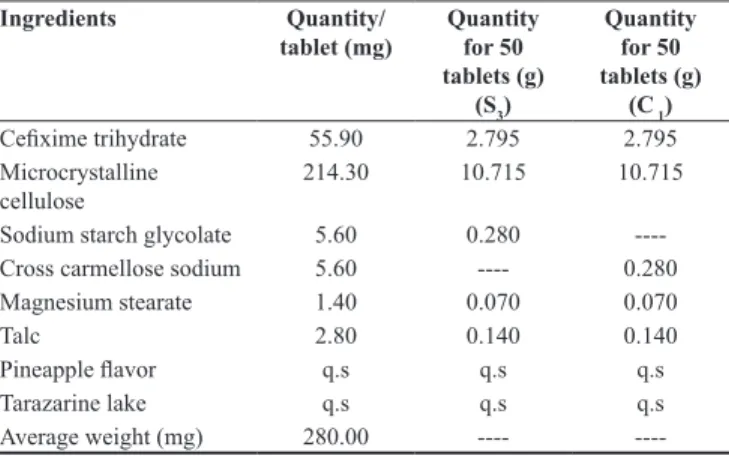
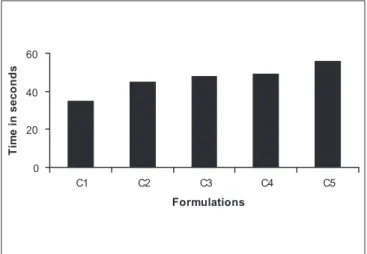
From the tables and histograms, it was evident that the formulations C1 and S3 stood ahead in all the tableting properties and in disintegration performance. Both the batches were prepared in bulk [Table 4] and confirmatory evaluation tests were carried out.
DT stands satisfactory with the time limit of <1 min for all
Table 3: Physicochemical evaluation of the formulations
Parameters Formulation with cross carmellose
mean value of (C1 – C5)
Formulation with sodium starch
glycollate (S1 – S5) Angle of repose 24 ° 37’ 2.1’’ 27° 25’ 13.02’’ Bulk density / tapped
density 0.6517 0.7117
Pour density 0.5140 0.5761
Carr’s compressibility index 21.12 19.05
Hausner ratio 1.26 1.23
Table 4: Tablet ingredients for scale up batch
Ingredients Quantity/
tablet (mg) Quantity for 50 tablets (g)
(S3)
Quantity for 50 tablets (g)
(C 1)
Cefixime trihydrate 55.90 2.795 2.795
Microcrystalline
cellulose 214.30 10.715 10.715
Sodium starch glycolate 5.60 0.280
----Cross carmellose sodium 5.60 ---- 0.280
Magnesium stearate 1.40 0.070 0.070
Talc 2.80 0.140 0.140
Pineapple flavor q.s q.s q.s
Tarazarine lake q.s q.s q.s
Average weight (mg) 280.00 ----
----Table 5: Evaluation parameters of the best formulations
Tablet evaluation
parameters Formula S3 Formula C1
Diameter 0.96 0.95
Thickness 0.36 0.38
Hardness 3.0 3.5
Friability 0.751 0.725
Weight variation pass pass
Disintegration time (sec) 42 32
Dissolution rate (%) 94.56 96.37
Table 6: Evaluation of tabletting parameters
Tablet parameters Formula S1 Formula S2 Formula S3 Formula S4 Formula S5
Thickness (cm) 0.37 0.37 0.36 0.38 0.36
Hardness (kg/cm2) 2.6 2.8 3.0 2.6 2.6
Friability (%) 0.750 0.751 0.526 0.640 0.575
Table 7: Evaluation of tabletting parameters
Tablet parameters Formula C1 Formula C2 Formula C3 Formula C4 Formula C5
Thickness(cm) 0.38 0.37 0.37 0.36 0.37
Hardness (kg/cm2) 2.8 2.8 2.6 2.4 2.6
Friability (%) 0.538 0.751 0.752 0.638 0.575
Table 8: Disintegration profile of the formulations
Formula S1 S2 S3 S4 S5 C1 C2 C3 C4 C5
the batches, as shown in Figures 6 and 7. Now, the question exists for fixing the best batch among the rest. Hence, for the comparative study, one with the same percentage was selected (2%). The batches S3 and C1 were selected to carry out further evaluation [Table 5].
Evaluation of tableting properties of the selected batches confirm the standards prescribed in Indian pharmacopoeia. The results are given in Tables 6 and 7.
Disintegration time was found to be within 1 min and
Figure 1: IR spectrum of cefixime
500 750 1000 1250 1500 1750 2000 2250 2500 2750 3000 3250 3500 3750 4000 1/cm 55 60 65 70 75 80 85 90 95 100 %T 35 44 .9 2 32 98 .0
5 3186
.1
8
31
37
.9
7 2947.0
3
29
29
.6
7 2854
.4
5
26
13
.3
7 2491.8 6 2401
.2 1 17 64 .7 5 17 51 .2 4 16 64 .4 5 15 87 .3
1 154
6. 80 15 35 .2 3 13 82 .8 7 12 24 .7 1 Cefixime
Figure 3: IR spectrum of sodium starch glycollate
500 750 1000 1250 1500 1750 2000 2250 2500 2750 3000 3250 3500 3750 4000 1/cm 65 70 75 80 85 90 95 100 %T 34 07 .98 29 31 .60 15 98 .88 11 55
.28 1103.2
1 10 80 .06 10 16 .42 70 7.8 3 57 6.6 8 NaStarch Glycolate
Figure 5: IR spectrum of cefixime tablet blend with sodium starch
glycolate 500 750 1000 1250 1500 1750 2000 2250 2500 2750 3000 3250 3500 3750 4000 1/cm 20 30 40 50 60 70 80 90 100 %T 33 84 .84 32 74 .90 32 01 .61 31 39 .90 29 02 .67 14 27 .23 13 21 .15 11 63 .00 11 12 .85 10 58 .85 10 20 .27 formula 2
Figure 2: IR spectrum of crosscarmellose sodium
500 750 1000 1250 1500 1750 2000 2250 2500 2750 3000 3250 3500 3750 4000 1/cm 60 65 70 75 80 85 90 95 100 %T 34 94 .77 34 61 .99 33 82 .91 31 90
.04 3153.4
0
31
24
.47 3082.0
4 29 18 .10 28 50 .59 27 58
.02 2696.30
15
98
.88
14
21
.44 1325.01
12 63 .29 11 57 .21 11 12 .85 10 60 .78 10 20 .27 70 9.7 6
Cross carmilos Na
Figure 4: IR spectrum of cefixime tablet blend with crosscarmellose
sodium 500 750 1000 1250 1500 1750 2000 2250 2500 2750 3000 3250 3500 3750 4000 1/cm 75 77.5 80 82.5 85 87.5 90 92.5 95 97.5 100 %T 33 94
.48 3255
.62 29 16 .17 17 66 .67 16 64 .45 14 27 .23 11 64 .92 11 14 .78 10 60 .78 10 26 .06 99 7.1 3 formula 1
Figure 6: Disintegration profile of the selected batch
0 20 40 60 80
S1 S2 S3 S4 S5
the percentage drug release, which confirms the in vitro bioavailability, was found to be 94.56 and 96.37, respectively, for S3 and C1, which proves the credibility of the selected products. The results are given in Table 8.
With reference to Table 5, a comparison of the different parameters like hardness, friability, disintegration and dissolution was carried out and superiority of the tablets formulated with crosscarmellose was established.
CONCLUSION
The aim of the present project is formulation development, evaluation and comparative study of superdisintergrants in the Cefixime 50 mg oral disintegrating tablet.
Figure 7: Disintegration profile of the selected batch
0 20 40 60
C1 C2 C3 C4 C5
Formulations
Ti
m
e
in
s
ec
on
ds
With the proof of different evaluation parameters listed in Table 8, it was concluded that C3 (CCS) was the best formulation.
Comparative evaluation studies proved that crosscarmelose is superior to sodium starch glycolate.
REFERENCES
1. Carter JC. The role of disintegrants in solid oral dosage manufacturing.
Carter Pharmaceutical Consulting Inc., 2002-6
2. Raymond C R, Paul JS, Sian CO. 5th ed. Hand book of Pharmaceutical
Excipients. London: Pharmaceutical Press and American Pharmacist association; 2006.
3. Department of heath, social services and public safety, British
Pharmacopoeia, London: The stationary office on behalf of MHRA; 2005. 4. McMillan A, Young H. The treatment of Pharyngeal Gonirrhoea with a
single oral dose of Cefixime. Int J STD AIDS 2007;18:253-4.
5. Leon L, liberman, Kanig. 2nd ed.The Theory and practice of Industrial
pharmacy. Bombay: Varghese publishing house; 1991.
6. Aulton ME, editor . Pharmaceutics, The science of dosage form design.
2nd ed. Sydney: Churchill livingstone; 2002.
7. Loyd VA, Nicholas GP, Howard CA. 8th ed. Ansel’s pharmaceutical sosage
forms and drug delivery systems. London: Lippincott Williams and Willkins; 2005.
8. Ministry of health and family welfare; Government of India. Indian Pharmacopoeia, Delhi: Controller of Publications; 1996.
9. Shirsand SB, Suresh S, Para MS, Swamy PV, Kumar DN. Plantago ovata mucilage in the design of Fast disintegrating tablets. Indian J Pharm Sci 2009;71:41-5.
10. Mundada AS, Meshram DR, Mishra M, Bhalekar MR, Avari JG. Formulation and evaluation of bitterless rapidly disintegrating tablet of Famotidine using ion exchange resins. Int J Pharm Excipients 2008;7:23-5.