103
RESEARCH CONDUCTED IN THE EXPERIMENTAL FIELD, ON
FERTILITY OF THE PSAMOSOIL IN THE DANUBE LOWLAND (AREA
POIANA MARE-DOLJ)
BUZATU CLAUDIU, CĂLINA, A., MILUŢ, M., CROITORU, A.
University of Craiova
Key words: sandy soil, dune, eutric
ABSTRACT
In order to test the productive ccapacity of sandy soils from Poiana Mare as well as the way they respond to fertilization there were carried out two monofactorial experiments: one experiment was located on an eutric sandy soil (typical) placed on the tip of the dune and the second one was set up between dunes on a wide place. The treatments were as follows:
V1= not fertilized (control);
V2= fertilized by N100;
V3= fertilized by N100 P60;
V4= fertilized by N100 P60 K40;
V5= fertilized by manure, 30 t/ha, applied every three years.
The experiment lasted three years in a wheat – maize crop rotation.These crops are most frecquently cropped in this area in in the above mentioned crop rotation. The trials have been carried out with irrigation.
MATERIAL AND METHOD
The determination of physical, hydrophysical and chemical properties of soil have been made according with „ Metodology of elaborating pedological studies”, I.C.P.A. – 1987.
INDTRODUCTION
In order to set up the experiment there were identified two zones that are most representative for the entire surface of sandy soil from Danube lowland.
RESULTS AND DISCUSSIONS Psamosoil characterization of experimental field
In order to set up the experiment there were identified two zones that are most representative for the entire surface of sandy soil from Danube lowland.
This way, for the typical sandy soil (eutric) there was identified a dune of middle height and wider platform. The soil is characterized by a high sand percentage (over 90%) and a low clay content (under 10%).
Table no.1. The main physico-chemical properties of psamosoil where the trials were located
S
O
IL
Dept
h
Cm Sand
2
-
0.2
mm
L
o
am
0.02
-0.0
0
2mm
Clay
<
0.
00
2m
m
HUMU
S
% Nt %
P K
pH
(H2O)
SB me/mg
sol ppm
MOLIC PSAMOSOIL
0- 20 91.6 3.2 5.2 0.41 0.026 9.6 55 7.7 6.3
20- 40 92.1 3.4 4.5 0.24 0.014 8.5 49 8.2 7.6
EUTRIC PSAMOSOIL
0- 20 83.7 6.1 10.2 1.58 0.079 30.0 101 7.9 9.8
104
The humus content is low and the soil is low supplied by nutrients (table 1).
For the molic sandy soil there was identified a place between dunes with middle depth yet well developed. The soil has a lower sand content (under 85% and higher content in fine fractions (1.58%) and the nutrient content is good in cocmparison with the typical sand.
The analytical data show that the first soil has a low productive potential and the molic sandy soil has a higher productive potential.
All sandy soils from Danube lowlandd have an alkaline reaction, the pH values ranging between 7.6 and 8.4. The presence of calcium carbonates is evident for most of the zones.
Results obtained for wheat production on eutric psamosoil on the Danube lowland, the area Poiana Mare
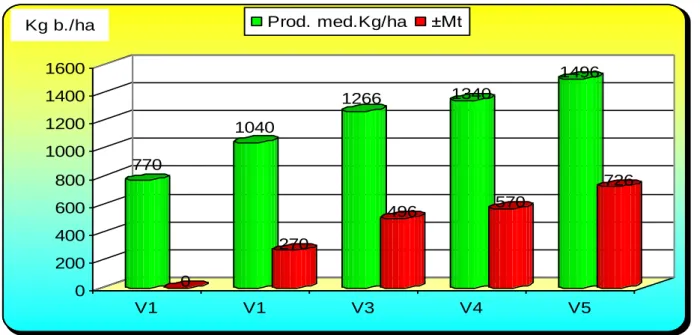
Analyzing the wheat yields during three years of experimentation there can be said that they are low yet taking account of not irrigated conditions, they express the low producctive potential of sandy soils (table 2, figure 1).
Table no.2 . The influence of mineral and organic fertilization on the production of weat on eutric
psamosoil in the area Poiana Mare
Treatment
Average yield Kg/ha
Percentage yield
%
±Ctrl. Significanc e
V1= not fertilized (Ctrl) 770 100 - -
V2= N100 1040 135 270 Xx
V3= N100 P60 1266 164 496 Xxx
V4= N100 P60 K40 1340 174 570 Xxx
V5= manure 30 t/ha 1496 194 726 Xxx
DL 5% 130 Kg/ha DL 1% 189 Kg/ha DL 0.1% 284 Kg/ha
The average wheat yield obtained in three years of experimentation (2006, 2007 and 2008) has been of 770 kg/ha with not fertilized treatment taken as control.
By applying ammonium nitrate 300 kg/ha (V2) the yield increased to 1,040 kg/ha,
the nitrogen fertilizer applied alone has brought a percentage output of 35% and a yield output of 270 kg/ha which is distinct significant.
By fertilizing with 300 kg/ha ammonium nitrate and 125 kg/ha concentrated superphosphate (V3), the average yield on three years of experimentation has increased to
1,266 kg/ha, a percentage output of 64% over control (V1) and a yield output of 496 kg/ha.
The commparison between V2 and V3 shows that the phosphorus fertilizer has brought a
105
770
0
1040
270
1266
496
1340
570
1496
726
0 200 400 600 800 1000 1200 1400 1600
V1 V1 V3 V4 V5
Prod. med.Kg/ha ±Mt
Kg b./ha
Figure no. 1 . Evolution of production of wheat after mineral and organic fertilization on eutric
psamosoil (typical) of the area Poiana Mare (the average grainproduction(Kg/ha)/2006, 2007, 2008)
With the fourth treatment where there was applied 300 kg/ha ammonium nitrate, 125 kg/ha concentrated superphosphate and 100 kg/ha potassium chlorine the yield reached 1,340 kg/ha.
The percentage output has been of 74% and the yield output was of 570 kg/ha. Making a commparison between V3 and V4 we can say that the potassium based fertilizer
has brought a percentage output of only 10% and a yield output of only 74 kg/ha therefore much reduced in comparison with outputs brought by nitrogen and phosphorus.
Manure applied in 30 t/ha rate, once every three years (V5) is the fertilizer that has
given the best results on the three years period of experimentation. The average yield of wheat with this treatment has been of 1,496 kg/ha, with a percentage output of 94% and a yield output of 726 kg/ha. Therefore, even in not irrrigatedd conditions the organic fertilization can double the yield on sandy soils from Danube lowland.
Calculating the yield output expressed in kg/kg of active ingredient (a.i.) fertilizer (table 3) there can be noticed that the N100P60 (V3) treatment has brought an output of yield
of 3.1 kg/kg a.i., with N100 P60 K40 (V4) treatment the yield output has been of 2.85 kg/kg a.i.
and with N100 (V4) treatment it was of 2.70 kg/kg a.i.
Table no. 3. Yield output of wheat crop on eutric psamosoil (typical) in Poiana Mare-Dolj (kg
wheat / Kg active ingredient of fertilizer)
Specification Treatment
V1 V2 V3 V4
Kg wheat/Kg a.i. - 2.70 3.10 2.85
In order to compare all average wheat yields obtained during three years of experimentation after the system each of each there was drawn a table with the following colons (table 4):
- Current number vor the five treatments; - Wheat yield in increasingly order;
106
- Yield differences and their significations taking as control each variant in comparison with the others.
Table no. 4. Calculation of multiple comparisons on culture of wheat in eutric psamosoil
(typical) in the area Poiana Mare-Dolj
Nr. Crt Yield
(Kg/ha) Variant 1040 1266 1340 1496
1 1496 V5 726*** 456*** 230 ** 156 *
2 1340 V4 570*** 300*** 74 -
3 1266 V3 496*** 226** - -
4 1040 V2 270** - - -
5 770 V1 - - - -
DL 5% 130 Kg/ha DL 1% 189 Kg/ha DL 0,1% 284 Kg/ha
From these results there can be noticed that when V1 was taken as control the
difference of yield with V2 (270 kg/ha) has been distinct significant and all other differences
have been very significant. When V2 variant was taken as control, the yield difference to V3
(226 kg/ha) has been distinct significant and the yield differences over V4 and V5 have
been very significant.
Taking as control the V3 treatment, the yield differences over V4 has been of 74
kg/ha which means significant and the yield difference over V5 has been distinct
significant.
When V4 has been taken as ccontrol the yield difference over V5 was of 156 kg/ha
and it was significant.
Results obtained for wheat production on molic psamosoil of the Danube lowland, the area Poiana Mare
The average wheat yields obtained during experimentation years on molic sandy soil are double over the ones obtained on eutric sandy soil and that proves the yielding potential of these soils is higher. With the control treatment the average yield has been of 1,306 kg/ha, 600 kg/ha higherr than the one obtained on eutric sandy soil (table 5, figure 2).
Table no.5. The influence of mineral and organic fertilization on the production of weat on
molic psamosoil in the area Poiana Mare
Treatment
Average yield Kg/ha
Percentage yield
%
±Ctrl. Significanc e
V1= not fertilized (Ctrl) 1306 100 - -
V2= N100 1533 117 227 Xx
V3= N100 P60 1720 132 414 Xxx
V4= N100 P60 K40 1773 136 467 Xxx
V5= maanure 30 t/ha 1920 147 614 Xxx
107
The mineral and organic fertilization have brought yield outputs with all treatments yet, a little lower than on dunes.
With the variant fertilized by 300 kg/ha ammonium nitrate the wheat yield has been of 1,533 kg/ha grains, with a percentage increase over the control of 17% and a yield output of 227 kg/ha which was distinct significant.
When along with ammonium nitrate there was applied concentrated superphosphate in quantity of 125 kg/ha the wheat yield has been of 1,720 kg/ha with an increase over the control of 414 kg/ha.
The percentage increase was of 32% and the yield output was very significant. Comparing the yields of V2 and V3 we can say that phosphorrus based fertilizer has
brought a percentage output of 1187 kg/ha, both a little lower than nitrogen based fertilizer (ammonium nitrate) applied alone (V2).
1306
0
1533
227
1720
414
1773
467
1920
614
0 200 400 600 800 1000 1200 1400 1600 1800 2000
V1 V1 V3 V4 V5
Prod. med.Kg/ha ±Mt
Kg b./ha
Figure no. 2. Evolution of production of wheat after mineral and organic fertilization on molic
psamosoil of the area Poiana Mare (the average grainproduction(Kg/ha)/2006, 2007, 2008)
With the forth variant, where the mineral fertilization has been made with 300 kg/ha ammonium nitrate, 125 kg/ha concentrated superphosphate and 125 kg potassium chlorine, the wheat yield has been of 1,773 kg/ha.
The percentage output over V4 has been of 36% and the yield output was of 467
kg/ha. Comparing the yields of V3 and V4 there can be noticed that the potassium based
fertilizer has brought a percentage output of only 4% and a yield output of 53 kg/ha, so much lower in comparison with outputs brought by nitrogen and phosphorus. This aspect can be explained by low potassium rate (100 kg/ha) and the natural reserve in potassium of this type of soil.
Manure applied in 30 t/ha rate (V5) has given the best results on three years period
of experimemntation on molic sandy soil. The average wheat yield with this variant has been of 1,930 kg/ha, recording a percentage output of 47% and a yield increase of 614 kg/ha.
108
Table no. 6.
Increase the harvest of wheat crop on molic psamosoil in Poiana Mare-Dolj (kg wheat / Kg active substance)
Specification VARIANT
V1 V2 V3 V4
Kg wheat/Kg a.i. - 2.27 2.58 2.34
The interpretation of yield results over the system each to each variant (table 6) shows that, when V1 variant has been taken as control, the yield difference over V2 (227
kg/ha) has been distinct significant and the yield differences over V3 (414 kg/ha), V4 (467
kg/ha) and V5 (614 kg/ha)0 have been very significant.
Taking as control the V2, the yield difference over V3 (187 kg/ha) has been distinct
significant and the yield difference over V4 (240 kg/ha) and V5 (387 kg/ha) have been very
significant.
When V3 has been taken as control, the yield difference over V4 (50 kg/ha) was
significant and over V5 (200 kg/ha) has been distinct significant.
With V4 as control, the yield difference over V5 (147 kg/ha) was significant.
Table no.7. Calculation of multiple comparisons on culture of wheat on molic psamosoil in the
area Poiana Mare-Dolj
Nr. Crt Yield
(Kg/ha) Variant 1533 1720 1773 1920
1 1920 V5 614*** 387*** 200 ** 147 *
2 1773 V4 467*** 240*** 50 -
3 1720 V3 414*** 187** - -
4 1533 V2 227** - - -
5 1306 V1 - - - -
DL 5% 105 Kg/ha DL 1% 152 Kg/ha DL 0.1% 229 Kg/ha
CONCLUSIONS
Overall, there can be said that the experimental results obtained on molic sandy soil with wheat crop have had the same tendency, with the specification that the yield differences over the control have been lower, which can be explained by the higher natural reserve of nutrients on this soil.
BIBLIOGRAPHY
1. Canarache, A., 1990 - Fizica Solurilor Agricole, Editura Ceres Bucureşti. 2. Filipov F., 2005 - Pedologie. Ed. „Ion Ionescu de la Brad”, Iaşi.
3. Mihalache M., Ilie L., 2008 - Pedologie-Solurile României. Ed. Domino, Bucureşti.
4. Obrejanu, Gr. şi colab., 1972 - Valorificarea nisipurilor și solurilor nisipoase din România. Editura Ceres, București.
5. Paulette Laura, 2007 - Pedologie, studiul solului în teren şi laborator. Ed. Todesco,
Cluj-Napoca.