50
APPLICATION OF THE ANALYTIC HIERARCHY PROCESS IN
SELECTION OF THE MOST IMPORTANT NON-WOOD FOREST
PRODUCTS FOR DOLJ COUNTY
ILIE COSMIN CÂNTAR1
, CRISTIAN MIHAI ENESCU2, LUCIAN DINCĂ3
1“Marin Drăcea” National Institute for Research and Development in Forestry, Timișoara, e-mail: [email protected] 2Department of Soil Sciences, University of Agronomic Sciences and Veterinary Medicine of Bucharest 3“Marin Drăcea” National Institute for Research and Development in Forestry, Brașov
Keywords: AHP, Dolj, non-wood forest products, NWFPs
ABSTRACT In Romania, non-wood forest
products (NWFPs) are mainly
represented by wildlife species of hunting interests, fish from the waters included into the forest fund, forest berries, forest seeds, edible mushrooms, medicinal and aromatic plants and resin. The NWFPs belong to their owners with the exception of the first two categories.
The aim of this study was to highlight the most important NWFPs from Dolj County. The analyze model was based on Analytic Hierarchy Process and 19 criteria and 8 alternatives (NWFPs) were used. The processing of the data was done using Expert Choice Desktop software.
The eight selected NWFPs
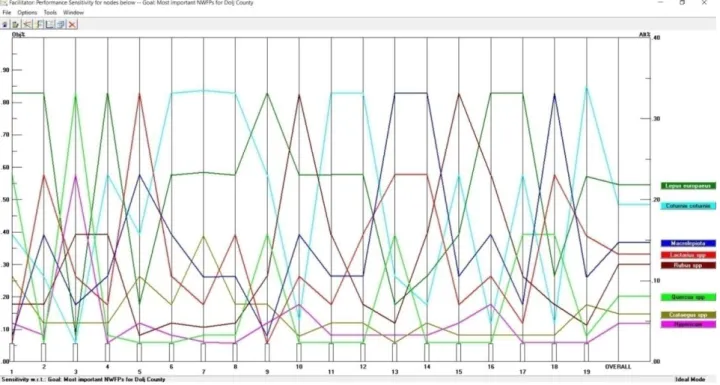
consisted in parasol mushroom, milk-caps, oak seeds, black berries, berries of common hawthorn, Saint John’s wort, European hare and common quail. According to the AHP results, the most important non-wood forest product for Dolj County is the European hare, while the less important one is Saint John' worth. The results of this study represent an important contribution to the evaluation of the potential of the NWFPs for Dolj County with a special view on their harvesting, marketing and other linked activities.
INTRODUCTION
Non-wood forest products (NWFPs) represent one of the main categories of forest products, edible mushrooms, forest berries and medicinal plants being the most common products worldwide. In Romania, according to Article 58, paragraph (3) of the Forest Code (Law no. 46/2008), the non-wood forest products are represented by wildlife species of hunting interests, fish from the waters included into the forest fund, forest berries, forest seeds, edible mushrooms, medicinal and aromatic plants and resin. The NWFPs belong to their owners with the exception of the first two categories.
Across Romania the distribution of NWFPs is uneven, in most of the cases being dependent on the presence of the forest sites. As a consequence, in the counties situated in mountainous and hilly regions where the forests are well represented, the potential of harvesting NWFPs is higher in comparison with the counties situated in plain regions.
By taking also into consideration that the forest management in Romania is focused on timber production and little attention is given to the management of NWFPs (Enescu 2017), in countries with
low wood resources, NWFPs could
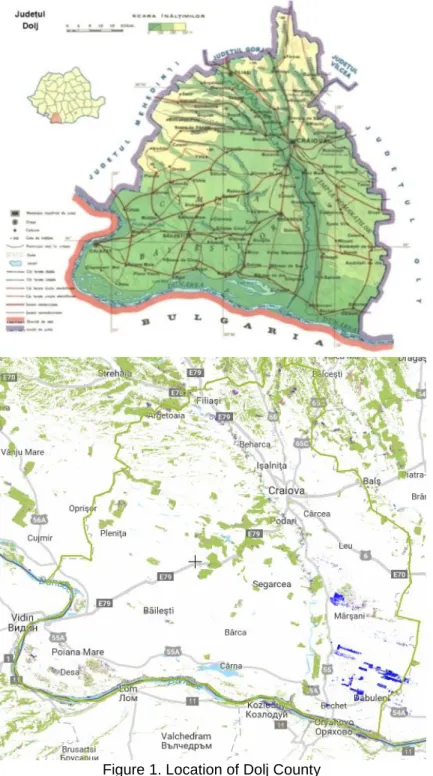
51 both for forest owners and forest managers. This is also the case of Dolj County, which is situated in the southern-western part of Romania (Figure 1), having an area of
7.414 km2 and bordering with Vâlcea and
Gorj Counties in the North, with Mehedinţi County in the West, with Olt County in the East and with the Danube in the South (Popescu 2013).
The total forest area in Dolj County accounts for approximately 84.400 hectares
(INS 2016), that is around 11% of the total area of the county, most of them being managed by Dolj Forestry Directorate, a
territorial branch of National Forest
Administration Romsilva, through its nine forest districts, namely Amaradia, Calafat, Craiova, Dăbuleni, Filiași, Perișor, Poiana Mare, Sadova and Segarcea, and only a few of them being managed by private forest districts (Abrudan 2012).
Figure 1. Location of Dolj County
52 The main forest stands across the county are composed by oak species, especially Turkey oak (Quercus cerris L.) and Hungarian oak (Q. frainetto Ten.), but also pedunculate oak (Q. robur L.), black
locust (Robinia pseudoacacia L.) and
several willow and poplar species (Golea and Pleniceanu 2003). Pedunculate oak is less represented in comparison with the other two oak species, but its presence in the region is very important from a genetic point of view. Recently, within Sadova forest district a forest genetic resource for pedunculate oak was designated and included in the national catalogue of forest genetic resources (Budeanu et al. 2016). This stand that has more than 7 hectares is very important in the region for collecting the acorns that should be used to reintroduce this species in its former natural distribution range. Nowadays, across the county, there are still some old pedunculate oak individuals, such the one from Dioști, which is estimated to be 400-500 years old (Bolea and Vasile, 2011).
During the last two centuries, several experiments aimed at introducing other tree species in the region were conducted. In general, their aim was to stabilize the flying sands or to obtain productive cultures or even for ornamental purposes or in small scale forest plantations. As regards the latter case, an example is the introduction of the black walnut (Juglans nigra L.) in the
southern-western part of the county, near Segarcea (Nicolescu 1998).
Among the introduced allochthonous tree species, the black locust is by far the
most representative one. The first
plantations were established in Dolj County almost 200 years ago (Enescu and Dănescu 2013) and in some regions, such as Ciurumela-Tunari Forest, one may still find nowadays some of the first stands established to stabilize the flying sands (Geacu et al. 2018). Black locust was and continue to be one of the best choice to reclaim the sandy soils, being well known that Dolj County is one of the counties that are affected by drought (Lupu et al. 2010;
Marinică and Marinică, 2014), the
decreasing of the rainfall amount and the increasing of the temperatures being the main factors causing the desertification (Popa 2018). Unfortunately, in the last three decades the uncontrolled logging caused the reduction of the black locust-dominated shelterbelts and compact cultures and the expansion of the sandy soils (Iordache and
Ciuinel, 2013; Dumitrașcu et al. 2014;
Prăvălie et al. 2014; Vijulie et al. 2017), being estimated that the forest area decreased with almost three thousand hectares (Prăvălie 2013).
The aim of this study was to highlight
the most important non-wood forest
products from Dolj County.
MATERIAL AND METHODS
In order to determine the most important NWFPs for Dolj County, an Analytic Hierarchy Process (AHP) was performed. AHP represents a multi-criteria decision analysis developed by Thomas Saaty four decades ago (Saaty 2008).
AHP is one of the most used decision support model worldwide to solve
complex decision-making problems in
several domains, including biological
sciences (Aras et al. 2004; Wang et al. 2004; Park et al. 2013). Analytic Hierarchy Process uses pairwise comparisons of
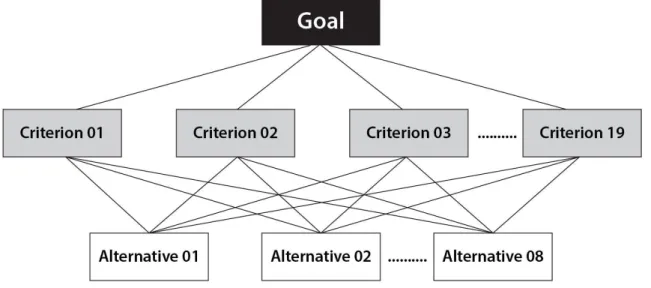
selected criteria aimed at assessing how much more important one is than the others (Huang et al. 2011). Thus, the complex problem (i.e. the purpose of this research) is hierarchically structured, the goal being at the top of the hierarchy, while the criteria (and sub-criteria, if any) at the levels of the hierarchy and the alternatives (i.e. the eight selected non-wood forest products) at the bottom of the hierarchy (San Cristóbal 2011).
The analysis model (i.e. 19 criteria, 8
53 products and 4 categories of NWFPs; Figure 2) used was the one developed
within COST Action FP1203: European
Non-Wood Forest Products (NWFPS)
Network, being recently used for similar
studies in the case of Maramureș, Prahova, Timiș and Bihor counties (Enescu et al. 2017; Enescu et al. 2018a; Enescu et al. 2018b; Timiș-Gânsac et al. 2018).
Figure 2. AHP model
The most important non-wood forest products from Dolj County were selected based on the data available in the forest management plans of the nine forests districts above-mentioned. For selecting the wildlife species of hunting interest, the data available on the website of Ministry of
Waters and Forests regarding the
population size and the hunting quota was taken into account (MAP 2017). The processing of the data was done using Expert Choice Desktop software package (v. 11.5.1683).
RESULTS AND DISCUSSION
The selected NWFPs were the following ones: the parasol mushroom [Macrolepiota procera (Scop.) Singer], the milk-caps (Lactarius spp.) for Mushrooms
category, oak (Quercus spp.) seeds for
Tree products category, black berry (Rubus
fruticosus L.), common hawthorn
(Crataegus monogyna Jacq.), Saint John’s
wort (Hypericum perforatum L.) for
Understory plants category and European
hare (Lepus europaeus Pallas.) and
common quail (Coturnix coturnix L.) for
Animal origin category, respectively.
The AHP alternative ranking for the 19 criteria taken into consideration is shown in Table 1.
54
AHP alternative ranking
Table 1
Criterion
Mushrooms Tree products Understory plants Animal origin M acrol ep iota proce ra La ct ariu s spp . O ak see ds b lack be rr y ( R ub us fr u ti cosu s ) h aw tho rn ( C rataeg us m on og yna ) S ai nt Joh n' w ort ( H ype ri cum pe rf ora tu m ) h are ( Lepus eu rop ae us ) q ua il ( C otur ni x cotu rni x )
1 2 3 4 5 6 7 8
1 Harvesting period 2 1 7 4 5 3 8 6
2 Portfolio of derived products 6 7 1 4 3 2 8 5 3 Harvested quantity / worker / 8 hours 4 5 8 6 3 7 2 1
4 Harvesting cost 5 4 2 6 3 1 8 7
5 Knowledge for recognition 7 8 1 2 5 3 4 6 6 Knowledge for harvesting 6 5 1 3 4 2 7 8 7 Tools needed for harvesting 5 4 2 3 6 1 7 8 8 Complexity of harvesting process 5 6 2 3 4 1 7 8
9 Distribution range 2 1 6 5 4 3 8 7
10 Market potential 6 5 1 8 2 4 7 3
11 The price of raw product 5 4 1 6 3 2 7 8 12 The price of the derived product 5 6 1 4 3 2 7 8 13 Transport (harvesting - storage center) 8 7 6 3 1 2 4 5
14 Perishability 8 7 1 6 3 2 5 4
15 “Celebrity” of the product on market 5 4 1 8 2 3 6 7
16 Market demand 6 5 1 7 2 4 8 3
17 Biotic threats 4 3 6 5 2 1 8 7
18 Abiotic threats 8 7 6 4 2 1 5 3
19 Development of harvesting process 5 6 2 3 4 1 7 8
As regards the oak seeds, even if in this study this non-wood forest product did not ranked in the top, we believe that its importance is expected to grow in the future mainly due to the fact the oaks record abundant fructification very rare (the
55 mushrooms taken into consideration within this study recorded similar results, the parasol mushroom being a little bit more
preferable than the milk-caps, mainly due to its distribution range and market potential.
Figure 3. The ranking of the eight NWFPs
CONCLUSIONS
The diversity and the potential of harvesting and marketing of non-wood forest products in Dolj County is not so high due to the fact that the forest area is not very well represented. Instead, if we take into consideration the protection
functions against desertification of
several forest stands, in the perspective of limiting/reducing the wood harvesting in the area, the harvesting and marketing of certain non-wood forest products could represent an important source of income, both for forest owners and the forest managers.
The results of this study represent
an important contribution to the
evaluation of the potential of the NWFPs. with a special view on their harvesting, marketing and other linked activities.
The combination between Analytic Hierarchy Process and Expert Choice Desktop proved to be a very easy-to-use tool to solve a complex decision problem. In order to obtain more representative results, future research studies should take into account additional criteria and to involve specialists and stakeholders from different fields.
BIBILIOGRAPHY Abrudan, I.V., 2012. A decade of
non-state administration of forests in
Romania: achievements and
challenges. International Forestry
Review 14(3): 275-284.
Aras, H., Erdogmus, S., Koc, E., 2004. Multi-criteria selection for a wind observation station location using analytic
hierarchy process. Renewable Energy 29: 1383-1392.
Bolea, V., Vasile, D., 2011. Famous trees of common oak (Quercus robur L.). Revista de Silvicultură și Cinegetică 29: 39-47.
Budeanu, M., Stuparu, E.,
56
highly adaptability. Revista de Silvicultură și Cinegetică 38: 21-26.
Dumitraşcu, M., Grigorescu, I., Cuculici, R., Dumitraşcu, C., Năstase, M., Geacu, S., 2014. Assessing long-term changes in forest cover in the South West Development Region. Romania. Forum geografic 13(1): 76-85.
Enescu, C.M., Dănescu, A., 2013.
Black locust (Robinia pseudoacacia L.) – an invasive neophyte in the conventional land reclamation flora in Romania. Bulletin of the Transilvania University of Brașov, Series II: Forestry • Wood Industry • Agricultural Food Engineering 55(2): 23-30.
Enescu, C.M., 2017. The most important non-wood forest products from Argeș County. Current Trends in Natural Sciences 6(11): 63-70.
Enescu, C.M., Dincă, L., Vasile, D., 2017. Importance of non-wood forest products for Maramureș County. Revista de Silvicultură și Cinegetică 40: 92-97.
Enescu, C.M, Dincă, L., Crișan, V., 2018. The most important non-wood forest products from Prahova County. Revista Pădurilor 1: 45-51.
Enescu, C.M., Dincă, L., Cântar, I., 2018. Which are the most common non-wood forest products in Timis County? Research Journal of Agricultural Science 50(1): 51-56.
Geacu, S., Dumitraşcu, M.,
Grigorescu, I., 2018. On the
Biogeographical Significance of Protected
Forest Areas in Southern
Romania. Sustainability 10(7): 1-18. Golea, C., Pleniceanu, V., 2003. Biodiversity of the stock of wood within the County of Dolj. Revista Forum Geografic – Studii și cercetări de geografie și protecția mediului 2(2): 57-62.
Huang, I.B., Keisler, J., Linkov, I., 2011. Multi-criteria decision analysis in environmental sciences: Ten years of applications and trends. Science of the Total Environment 409: 3578-3594.
Institutul Național de Statistică (INS), 2016. Suprafața fondului forestier pe categorii de terenuri și specii depăduri, macroregiuni, regiuni de dezvoltare și
județe. Available at:
http://statistici.insse.ro/shop/.
Iordache, C., Ciuinel, A.M., 2013. The impact of human intervention on the forest fund within the Southern part of Dolj County. Muzeul Olteniei Craiova. Oltenia. Studii și comunicări. Științele Naturii Tom 29(2): 268-273.
Lupu, A.B., Ionescu, F.C., Borza, I., 2010.The phenomenon of drought and its effects within Romania. Research Journal of Agricultural Science 42(4): 102-109.
Marinică, I., Marinică, A.F., 2014.
Considerations on Desertification
Phenomenon in Oltenia. Forum
geografic. Studii și cercetări de geografie și protecția mediului XIII(2): 136-147.
Ministerul Apelor și Pădurilor
(MAP), 2017. Centralizator studii
evaluare faună cinegetică 2017. Available
at: http://apepaduri.gov.ro/efective/.
Nicolescu, N.V., 1998.
Considerations regarding black walnut (Juglans nigra) culture in the north-west of Romania. Forestry 71(4): 349-354.
Park, S., Choi, C., Kim, B., Kim, J., 2013.Landslide susceptibility mapping using frequency ratio, analytic hierarchy process, logistic repression, and artificial neural network methods at the Inje area, Korea. Environmental Earth Sciences 68: 1443-1464.
Popa, R.G., 2018.Desertification – a mass phenomenon that contributes to soil degradation. Fiability & Durability 1: 363-368.
Popescu, G., 2013. Diagnostic analysis of the agricultural population of Dolj County, Romania. Research Journal of Agricultural Science 45(4): 164-169.
Prăvălie, R., 2013.
57
Prăvălie, R., Sîrodoev, I., Peptenatu, D., 2014. Changes in the forest ecosystems in areas impacted by aridization in south-western Romania. Journal of Environmental Health Science and Engineering 12:2.
Saaty, T.L., 2008. Decision
making with the analytic hierarchy process. International Journal of Services Sciences 1(1): 83-98.
San Cristóbal, J.R., 2011. Multi-criteria decision-making in the selection of a renewable energy project in Spain: The Vikor method. Renewable Energy 36: 498-502.
Timiș-Gânsac Voichița, Cristian Mihai Enescu, Lucian Dincă, Aurelia
Oneț, 2018. "The management of non-wood forest products in Bihor county". Natural Resources and Soustainable Development, Vol. 8, No. 1, pag. 27-34.
Vijulie, I., Matei, E., Manea, G., Tîrlă, L., Cuculici, R., 2017. Land use reconversion in the drought – and aridity – affected areas in SW Romania (Bechet, Dolj County). Analele Universității București. Seria Geografie: 69-81.
Wang, G., Huang, S.H.,
Dismukes, J.P., 2004. Product-driven supply chain selection using integrated
multi-criteria decision-making
methodology. International Journal of