Stephen C. Sherman. A User-centered Evaluation of the North Carolina State University Libraries Learning Commons. A Master’s Paper for the M.S. in L.S degree. April, 2008. 74 pages. Advisor: Jeffrey Pomerantz
This study explored student perceptions of the North Carolina State University Libraries Learning Commons. This investigation involved two approaches. A survey, offered both online and print, was used to gather input directly from students. This survey was
supplemented by a qualitative data analysis of posts to the Learning Commons discussion board, which had been used as an outlet for communication between students and library staff. The results of these analyses were used to identify the strengths of the Learning Commons, as well as areas in which services or resources might be improved. Students indicated that they valued the relaxed atmosphere of the Learning Commons, the
computing facilities offered, and the physical space available for work or study. The popularity of the Learning Commons, however, was perceived to have a negative impact on the level of noise in the space and the availability of both computers and seating.
Headings:
Learning commons
A USER-CENTERED EVALUATION OF THE NORTH CAROLINA STATE UNIVERSITY LIBRARIES LEARNING COMMONS
by
Stephen C. Sherman
A Master’s paper submitted to the faculty of the School of Information and Library Science of the University of North Carolina at Chapel Hill
in partial fulfillment of the requirements for the degree of Master of Science in
Library Science.
Chapel Hill, North Carolina April 2008
Approved by
TABLE OF CONTENTS
LIST OF TABLES ... 2
LIST OF FIGURES ... 2
ACKNOWLEDGEMENTS... 3
INTRODUCTION ... 4
LITERATURE REVIEW ... 10
METHODOLOGY ... 20
Rationale... 21
Data Collection – Student Survey... 22
Data Collection – Discussion Board Posts... 24
Data Analysis... 25
RESULTS ... 27
Student Survey... 27
Question 1: Level of Study... 27
Question 2: Major / Area of Concentration... 31
Question 3: For what purpose or activity do you use the Learning Commons most often?... 38
Question 4: What do you like most about the Learning Commons?... 39
Question 5: What aspect(s) of the Learning Commons would you like to see improved and how?... 43
Question 6: What effect, if any, has the Learning Commons had on your use of the library?... 46
Discussion Board Posts... 50
DISCUSSION ... 53
LIMITATIONS AND FUTURE RESEARCH... 59
CONCLUSION... 61
REFERENCES ... 62
APPENDIX A: NCSU LIBRARIES LEARNING COMMONS FLOOR PLAN... 66
APPENDIX B: STUDY FACT SHEET (PRINT VERSION) ... 67
APPENDIX C: STUDY FACT SHEET (ONLINE VERSION) ... 69
APPENDIX D: DISCUSSION BOARD CONSENT POST ... 70
APPENDIX E: SURVEY QUESTIONNAIRE ... 71
LIST OF TABLES
Table 1. All Respondents by Level of Study ... 27
Table 2. Respondents by Level of Study – Online vs. Print Survey... 29
Table 3. Level of Study – Survey Respondents vs. Actual... 30
Table 4. All Respondents by College ... 32
Table 5. Respondents by College – Online vs. Print Survey ... 34
Table 6. College Enrollment – Survey Respondents vs. Actual ... 36
Table 7. Q3 – All Respondents ... 38
Table 8. Q4 – All Respondents ... 40
Table 9. Q4 – Undergraduate vs. Graduate Student Responses ... 42
Table 10. Q5 – All Respondents ... 44
Table 11. Q5 – Undergraduate vs. Graduate Student Responses ... 45
Table 12. Q6 – All Respondents ... 47
Table 13. Q6 – Undergraduate vs. Graduate Student Responses ... 49
Table 14. Grouped Comments – LC Discussion Board Posts ... 51
Table 15. Major Categories of Comments Posted to LC Discussion Board... 52
Table 16. Selected Comments – LC Strengths (Q4)... 54
Table 17. Selected Comments – Areas of Improvement (Q5)... 56
LIST OF FIGURES Figure 1. All Respondents by Level of Study... 28
Figure 2. Respondents by Level of Study – Online vs. Print Survey ... 29
Figure 3. Level of Study – Survey Respondents vs. Actual ... 31
Figure 4. All Respondents by College ... 33
Figure 5. Respondents by College – Online vs. Print Survey... 35
Figure 6. College Enrollment – Survey Respondents vs. Actual... 37
Figure 7. Q3 – All Respondents... 39
Figure 8. Q4 – All Respondents... 41
Figure 9. Q4 – Undergraduate vs. Graduate Student Responses ... 42
Figure 10. Q5 – All Respondents... 44
Figure 11. Q5 – Undergraduate vs. Graduate Student Responses ... 46
Figure 12. Q6 – All Respondents... 48
Figure 13. Q6 – Undergraduate vs. Graduate Student Responses ... 49
Figure 14. Grouped Comments – LC Discussion Board Posts... 51
ACKNOWLEDGEMENTS
INTRODUCTION
The advent of the World Wide Web as an information medium sparked a crisis in academic libraries during the 1990s. There was a small revolution in the ways that academic libraries functioned on a day-to-day basis. That decade saw the widespread adoption of the online catalog, the proliferation of electronic databases, and the initial stages of digitization. This technological change created competition for libraries in the form of Internet search engines and online forums. College and university libraries experienced a decline in usage as students conducted their research from dorm rooms and coffee shops rather than in study carrels in the stacks. This problem caused libraries to reexamine their services and the needs of their user populations in an effort to reposition themselves at the center of learning in academic institutions.
What they discovered was that students were no longer satisfied with the
traditional models of library service. The generation that entered college at the beginning of the 21st century demanded more interactive media, better tools to evaluate information, more integrated services, and a social context for learning. One outcome of this
assessment was the development of new models for reference service, including
of the Information Commons – a collaborative workspace providing a combination of service points and technologies in support of student learning.
The concept of the Information Commons was popularized by Donald Beagle, then a librarian at the University of North Carolina at Charlotte. Beagle foresaw a new type of library facility encompassing a central service point, the availability of areas for both individual and collaborative study, and the incorporation of other campus support units to assist students (Beagle, 1999). Other aspects of the model that have emerged since then include the presence of research and computing assistance, the availability of multimedia and production software on computers, and a hybrid staffing model including a mixture of librarians, information technology specialists, and public services assistants (Spencer, 2006). While the specific characteristics of Information Commons at different libraries may vary, especially in name, these remain the guiding principles in
implementing any such library space.
Since its inception, the Information Commons concept has been implemented in many academic libraries throughout the United States and Canada. The result has been a resurgence in the use of physical facilities and the rebirth of the library as the center of academic learning. Libraries have used a number of traditional statistical methods to measure the effects of the Information Commons on the use of their resources. The most common result of implementation has been a marked increase in gate counts and thereby the number of students visiting the library (Malenfant, 2006; Albanese, 2004). Other effects observed include a rising number of information and reference questions, greater demand for multimedia programs, and the need for expanded staff competencies
the Information Commons model in academic libraries. These quantitative measures are often the easiest methods of evaluation, and accordingly have been among the initial steps toward assessment in libraries implementing the model. Together, they testify to the new position of the library on campus and the greater visibility of its services and facilities in the eyes of the students.
The wealth of quantitative data concerning the effects of the implementation of the Information Commons exists in stark contrast with the paucity of studies that have been conducted demonstrating an analysis of qualitative user data. Few libraries that have implemented Information Commons have gone so far as to conduct formal assessments of the projects, with both quantitative and qualitative measures. There are even fewer published accounts of such studies. Those that have conducted some sort of assessment have usually investigated separate aspects of the model without addressing the Information Commons as a whole. For instance, Bailey and Tierney (2002) described several instruments that were used at UNC-Charlotte, including a survey of staff
members working in the Information Commons, a survey of library patrons, and
evaluations completed as part of library instruction classes. MacWhinnie (2003) points to several issues that may explain the lack of comprehensive assessment. These include the inability to evaluate the multiple features that are inherent in the model and the lack of a reliable method for measuring the effectiveness of these aspects as a coherent entity.
There is indeed a critical need for more qualitative data in the assessment of Information Commons. The statistical counts need to be balanced with student
are drawn to the Information Commons for its innovative nature. In his conceptualization of the Information Commons, Beagle (1999) states that "change is always the operative word, for successful implementation of an Information Commons involves functional integration of technology and service delivery to realign the library with the rapidly evolving digital environment" (p.83). This need for evolving services does not dissipate when the space first opens to students, but rather persists so long as the Information Commons is present. Regular assessment of user perceptions is necessary in order to update planned initiatives and prepare the library to meet the ever-changing needs of college students.
The NCSU Libraries Learning Commons
but comfortable furniture, and eBoards advertising university and library events and services.
Assessment has been part of the NCSU Libraries Learning Commons from its very inception. Library staff collected a number of usage statistics both before and after implementation of the new space, including gate counts, the number of reference
transactions, and laptop checkouts. The need for qualitative feedback was also
addressed, however, as one of the main goals of the Learning Commons implementation was the creation of a library space that could be informed by student opinion. The focus on the Learning Commons as a student-centered space reflects Beagle's conceptualization of the Commons model. The NCSU library staff adhered to this vision in a number of ways. In designing the Commons, a number of student advisory groups and focus groups were consulted in order to get an idea of what students wanted in the space. After the Learning Commons opened, plans for further focus groups, surveys, and a discussion board for student feedback were established. The Learning Commons discussion board, in fact, has been available since the opening of the facility and has produced a good number of student comments. This forum created a unique opportunity for students and library staff to interact and work to develop services in the Learning Commons. The focus on assessment and student-centered design at NCSU created an environment that was receptive to the need for qualitative input and which provided an ideal climate for this study.
Purpose of this Study
the assessment process for the NCSU Libraries Learning Commons. The primary research question of this study was, therefore:
What are students' perceptions of the NCSU Libraries Learning Commons?
This question guided the development of the study methodology and the instruments used to assess the facility. The findings from this research will help to inform future decisions on services and the use of space in the Learning Commons. Student input is viewed as a necessary part of this process, especially as it relates to the Information Commons concept and its evolutionary nature. The results of this study may also serve to inform the design of Information Commons-type spaces in academic libraries more generally, though this will not be a major purpose of this research.
LITERATURE REVIEW
Since the mid-1990s, the Information Commons model has experienced
widespread adoption in academic libraries. The concept emerged from the evolution of library services occurring during that period and the growing effect it had on the
information-seeking behaviors of students. The origins and evolution of the Information Commons model have been well documented in the library and information science literature. Numerous articles have discussed the meaning of the concept, its implications for academic libraries, and future directions of the model. The literature also provides ample evidence of current practices concerning Information Commons facilities and services through the many published case studies. There is a substantial gap, however, in the coverage of assessment of Information Commons in libraries. While there are a number of documented quantitative methods of analysis, there are very few providing examples of qualitative studies. One objective of this study, therefore, was to address this gap in the literature by conducting a qualitative study of the Learning Commons at North Carolina State University.
the 'library as place' movement, in which librarians worked to redesign library spaces to accommodate both developing technological needs and the evolving nature of student learning.
The 1990s saw a growing number of renovation and new construction projects in college and university libraries in response to the 'library as place' movement. Shill and Tonner (2003; 2004) conducted a study of physical improvements in academic libraries during the years 1995-2002 and found that more than 390 such projects had taken place within that period. Among the more prevalent features of the new facilities were the inclusion of snack bars or coffee bars, upgrades to computing and network access, and an increase in the amount of student seating available. Usage data collected as part of the study showed an increase in gate counts and circulation for 80% of the responding libraries, with more than a quarter of these reporting an increase of 100% or greater in daily use. Thus, the study served to refute Carlson's concept of the deserted library.
The relationship between the 'library as place' movement and the development of the Information Commons concept has been well established (Beagle, 2002; Spencer, 2006). Shill and Tonner's study identified a number of factors that were associated with an increase in usage, among which were computing and network access, the quality of natural lighting, the quality of user work spaces, and the general layout of facilities. Although the study did not identify specific types of new facilities, all of these variables are associated with the Information Commons model.
experimented with the idea of more advanced computer labs and redesigned spaces, it was his article that truly defined the model for others to follow. His piece (Beagle, 1999) provided the theoretical basis for a new model in library service that would be built around the experience of the user. Beagle envisioned a physical space featuring (1) a general information desk that serves as an initial point of contact, (2) a combination of work areas allowing for both individual and collaborative study, and (3) the integration of other campus units in support of research and learning. Outside of its physical aspects, the Information Commons was also meant to be adaptable to change as determined by the evolving needs of users. The model was designed to be flexible, so as to avoid the same issues of stagnation that led to the initial problem of declining use.
Subsequent models have added to Beagle's definition of the Information Commons. Additional aspects include the presence of research and computing
assistance, the availability of multimedia and production software on computers, and a hybrid staffing model including a mixture of librarians, information technology
specialists, and public services members (Church, 2005; Cowgill, Beam, & Wess, 2001; Haas & Robertson, 2004). While the specific characteristics of Information Commons at different libraries may vary, the dedication to Beagle's original guiding principles has remained consistent.
conceptual level, the Learning Commons has been defined as a more advanced model of the Information Commons, with the emphasis on the creation of knowledge rather than on the synthesis of information (Schmidt & Kaufman, 2005; Bailey & Tierney, 2008, p.2-4). In practice, however, the two names have been used interchangeably and have
become synonymous, much like the concepts of bibliographic instruction and information literacy education in reference work.
As would be expected, the development and implementation of the Information Commons model has resulted in the publication of a number of case studies in the library and information science literature. These tend to focus on the practical aspects of library redesign and usually include detailed descriptions of the new facilities and services in order to serve as examples for others to follow. Lowry (1994) described one of the earliest implementations at the University of Iowa. There, a computer lab was introduced to link classroom instruction with library research in light of the transition to electronic resources. Cowgill, et al. (2001) and Whitchurch & Belliston (2006) both illustrated the issues of training staff for new initiatives and dealing with the increase in patron use associated with Information Commons in academic libraries. Church et al. (2002) gave an account of the many technological aspects associated with the creation of an
Information Commons, especially when dealing with the combination of library and IT services. The example the authors provide is that of a pay-for-print system integrated with the library's computer workstations in the new space.
implications for the broader scope of college and university libraries. A number of useful resources have sprung up on the World Wide Web, as well. The most comprehensive is David Murray's site (2004) providing a directory of libraries with Information Commons facilities and a bibliography of sources on the topic. Though the site has not been
updated since 2004, it remains a valuable, though no longer comprehensive, collection of resources. Murray's site also links to the INFOCOMMONS-L listserv, which is itself another trade source for information on the subject.
Even more case studies have identified the practice of user-centered design in adapting the Information Commons model to local environments. Just as the 'library as place' movement had helped to formulate the Information Commons concept, the
renewed emphasis on users and usability affected the way in which academic libraries set out to implement the model. Tramdack (1999), in his reaction to Beagle's initial article, pointed to the need to include user input in development of the model, given the emphasis on student learning.
Commons (Spencer, 2007). These examples illustrate some of the ways in which users' perceptions have been brought into the design of new facilities in academic libraries.
The practice of evidence-based design is paralleled by the need for regular assessment and evaluation. Beagle (1999) alluded to this when he described the ever-changing nature of the Information Commons as he conceived of it. MacWhinnie (2003) pointed to this need also, but added that assessment of such facilities in academic
libraries may pose a major issue. The multidimensional nature of the Information Commons model precludes the development of a more complicated instrument for evaluation. In addition, the difficulty of measuring student learning as a result of the existence of these spaces has confounded many librarians. These complexities may explain why no uniform method of Information Commons assessment has emerged.
Librarians have developed several methods of evaluation in order to cope with these problems. The first, requiring the least amount of revision, has been to include the Information Commons in the library's broader evaluation programs. Libraries continue to simply administer their regular assessment programs without incorporating the
(2002) mentioned three survey instruments in development at UNC-Charlotte – one gauging the experiences of information desk staff, another judging public service aspects, and the last dealing with library instruction. This method, however, de-emphasizes the integration of services that is so essential to the Information Commons model.
A third method of evaluation has been even more evident in the literature. Many libraries have turned to readily-accessible quantitative data such as gate counts and circulation statistics in an attempt to solve the problem of assessment. Increased usage of library facilities has been the most widely-cited effect associated with implementation in both refereed journals (Halbert, 1999) and trade magazines (Albanese, 2004). Other sources of quantitative data include closed-ended surveys, attendance at library events or workshops, and the number of reference or directional questions asked. Malenfant (2006) provided one example of a user survey conducted to assess an Information Commons. The survey, distributed to the students at Westminster College, asked respondents to rank services on a scale, with 'Excellent' being the highest value. While limited in scope, these quantitative methods have provided useful measurements for libraries in evaluating facilities and services.
assistants. The researchers found that these individuals felt disconnected from the everyday functions of the Commons due to the relatively short duration of desk hours. The authors then took multifaceted approach to assessment, using both a log of
transactions at the information desk and a user satisfaction survey. They were hoping to answer two questions: (1) how had the Information Commons changed the types of questions being asked at the desk and (2) did users feel that their needs were being met. The results of the transaction logs showed a growing diversity of questions, requiring new competencies from those staffing the information desk. The study resulted in a modification of services in which both the number of service points and the demand on professional staff were reduced.
The number of articles exhibiting quantitative methods of assessment lies in stark contrast with the dearth of qualitative examples. At this time, there are very few
published qualitative studies of an Information Commons in the LIS literature. Those articles that do mention the use of focus groups or open-ended surveys do so without a discussion of methods or results. Schmidt and Kaufman (2005), for example, discuss the positive impact of the Learning Commons as judged by focus groups, comments, and consultations. They do not describe these instruments in any more detail, though. Other articles mention the future development of such methods, but there isn't any follow-up in the literature.
University library. In order to assess students' perceptions of the Learning Commons, a web-based survey was presented with a monetary reward offered as an incentive to participate. The survey included a combination of closed- and open-ended questions, with the goal of evaluating current services and identifying future needs. An article appearing in New Zealand Libraries described a more purely qualitative study (Garriock, 2004). At that institution, a two-fold approach to determining students' perceptions was used. Two small focus groups were conducted with semi-structured questions to gather initial data. After deciding that this sample was too small to be representative, the librarians conducting the study then created an online questionnaire with twelve
questions. Each of the questions was left open-ended so as to gather the widest range of responses. In this way, the librarians were able to gather input that they would not otherwise have anticipated.
The lack of published qualitative assessments supported the assertion that further research in this area was needed to develop such methods and to provide a model for others to follow. Qualitative methods are necessary for a number of reasons. First, the user-centered nature of the Information Commons model requires that patrons be included in assessment – not just in head counts, but with open, unformatted input. Second, the already well-established practice of including users in the design of learning spaces needs to be carried through the entire process of evaluation and revision in order to be consistent. Lastly, qualitative analysis in general provides a greater depth of
METHODOLOGY
This study employed a two-fold method to assess student perceptions of the NCSU Libraries Learning Commons. First, a survey of current NCSU students was used to gather their general perceptions of the Learning Commons. This survey involved collecting some basic quantitative data for statistical purposes, but most of the
questionnaire was devoted to the collection of quantitative information from students. These questions were mostly open-ended to allow students to shape their responses in their own terms. After the surveys had been collected, the responses to each question were coded according to their general themes. These themes were then reviewed and consolidated once the initial coding had been completed in order to facilitate analysis and discussion of the results.
Rationale
The decision to conduct the study in this manner was based on both theoretical and practical reasoning. The expected time constraints and dearth of resources were major factors in deciding to employ a survey rather than focus groups or some other method of data collection. These methods often require large blocks of time to administer as well as physical space and a considerable amount of setup. Surveys, by contrast, may require time to design and analyze, but are generally easier to administer once they have been initated. Another advantage to survey research is that it allows the researcher to study a larger pool of respondents (Babbie, 2008, p.274). While focus groups are time intensive for the researcher and limit the ability to study large samples, the use of a survey allowed for the collection of data from a larger number of students. This was deemed especially appropriate, given the size of the study population, which spans the entire student community at NCSU.
study. This method of providing for feedback is relatively new to academic libraries, but is well suited to the interactive and organic nature of the Information Commons concept.
The decision to include qualitative rather than quantitative data was another important aspect of this study. One of the purposes of the study was to help close the gap in the literature discussing qualitative evaluation of Information Commons facilities in academic libraries. Therefore, it was important to use methods that were well-suited to the collection of this type of data. Rather than design the survey with closed options for responses, open-ended questions were employed in the survey to gather as broad a perspective as possible from the respondents. This was done in order to collect data that was highly representative of students' true perceptions. This element was crucial to the study, since the Learning Commons is meant to be both user-centered and user-directed. The qualitative analysis of the discussion board posts mirrored these qualities, since user posts were self-initiated. For both components of the study, the value of the results were expected to offset the disadvantages of the added time spent coding responses.
Data Collection – Student Survey
A brief, six question survey was developed to gather qualitative information about the perceptions of the Learning Commons from current students. Print as well as online versions of the survey were created both to ensure a sufficient rate of return and to
Learning Commons and were designated as collection points for the surveys. Reference staff gathered the completed surveys from these bowls at least once a day during the two week period. More blank copies of the survey were distributed throughout the Learning Commons as necessary until the survey period had ended.
The online version of the survey used the same questions, but was displayed with different formatting due to the use of a free, web-based data collection service.
Advertisements were used to communicate the link for the online survey to potential participants (seeAppendix F). These were distributed through several different media, including the student newspaper, a campus events weblog, the Learning Commons discussion board, and printed flyers that were posted to campus bulletin boards near dormitories, classroom buildings, and other gathering places.
While signed consent was not deemed necessary for participants, a fact sheet was provided with both the print and online surveys to inform students of the study's
requirements (seeAppendixes B & C). For the print version of the survey, the fact sheet was stapled to the front of the questionnaire, and for the online version the fact sheet appeared as the introductory page for the survey site. After the two week period for the survey had ended, all remaining blank copies of the print version were collected from the Learning Commons and recycled and the link to the online version was made inactive.
The questionnaire (see Appendix E) consisted of both closed- and open-ended questions. The former, however, were only used to gather broad demographic
sophomore, junior, senior, graduate, or other), as well as their major or area of
concentration. This data was later used in the analysis to seek out trends in the usage of or perceptions of the Learning Commons. A third question then asked students to identify their primary uses of the Learning Commons:
• For what purposes or activities do you use the Learning Commons most often? This question was followed by a number of suggested responses (individual study, group study, computing, and library research, meeting friends, or taking a break) and also allowed for the respondent to specify other uses under the choice 'Other'. The remaining three questions were open-ended and allowed participants to phrase their own responses:
• What do you like most about the Learning Commons?
• What effect, if any, has the Learning Commons had on your use of the library? • What aspect(s) of the Learning Commons would you like to see improved? The last four questions were all linked to or based on an existing mission and assessment plan for the Learning Commons, which included goals for assessing the effectiveness of the facility as it relates to the broader mission of the University Libraries.
Data Collection – Discussion Board Posts
To complement the student surveys, an analysis of posts and comments to the Learning Commons discussion board was also included in the study. These posts originally appeared on the Learning Commons page of the library web site
collected for analysis, with two exceptions. First, posts that had been removed by the discussion board administrator due to inappropriate content or other reasons were not examined, as they were no longer publicly viewable. Second, those posts that had been initiated by library staff were omitted, since they did not include student input of any kind. The user names of staff that had posted to the discussion board were obtained prior to data collection in order to facilitate this step. Posts that were identified for inclusion were copied and pasted into individual text files and saved under sequential file names in the order in which they were collected (i.e. post01, post02, post03...). Any comments or replies that accompanied a post were saved with that same thread and were considered part of the same unit of analysis. Since traditional means of obtaining consent were not practical for this part of the study, an alternative method was used to inform authors of posts about the study. The discussion board administrator posted a message (see Appendix D) presenting information about the study and requesting that anyone who wished to exclude their posts from the analysis contact the study's principal investigator. This message was kept visible on the discussion board until the completion of the study.
Data Analysis
The method of open coding was used to analyze the remainder of the survey responses and the posts from the Learning Commons discussion board. Each response or post was analyzed for broad themes and these were then recorded along with
accompanying demographic information in an Excel spreadsheet. As an example, a comment about the need for more computers in the Learning Commons might be
classified under 'computing'. For the discussion board posts, this process was carried one step further, as each category was given a modifier according to the nature of the post. Comments expressing approval of services or facilities were given the modifier 'positive', those of a disapproving nature were coded 'negative', and any posts suggesting changes were labeled 'improvement'. For example, a post asking for a greater variety of
RESULTS
Student Survey
A total of 149 surveys were collected from students during the two-week period of March 17, 2008 to March 30, 2008. Of the total number received, 52 were collected through the online version of the survey and 97 copies of the print survey were collected from inside the Learning Commons. The following sections describe the responses to individual questions in the survey.
Question 1: Level of Study
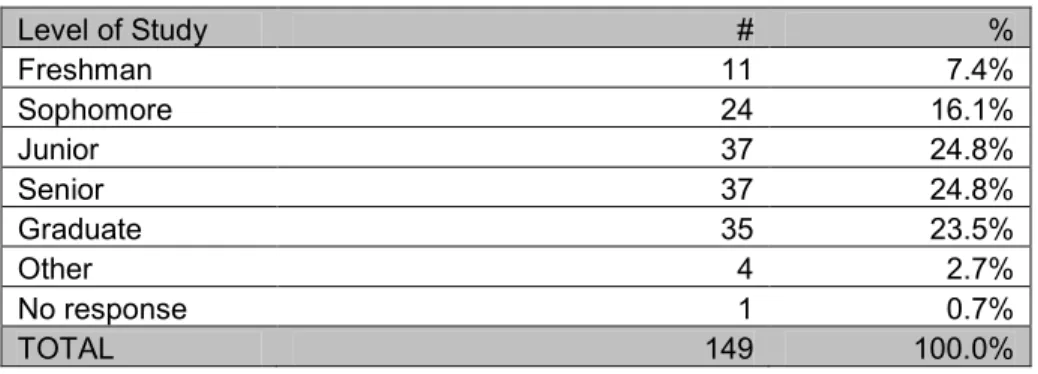
The first question asked students to identify their level of study at NCSU in terms of freshman, sophomore, junior, senior, graduate, or other. Table 1 and Figure 1 show the distribution of respondents by level of study. While juniors, seniors, and graduate students were evenly represented, sophomores accounted for somewhat fewer responses. Freshmen were the smallest group with eleven respondents, four individuals marked 'other' as their level of study, and one left no response for the question.
Table 1. All Respondents by Level of Study
Level of Study # %
Freshman 11 7.4%
Sophomore 24 16.1%
Junior 37 24.8%
Senior 37 24.8%
Graduate 35 23.5%
Other 4 2.7%
No response 1 0.7%
Figure 1. All Respondents by Level of Study (n=149)
11
24
37
37 35
4 1
Freshman
Sophomore
Junior
Senior
Graduate
Other
No response
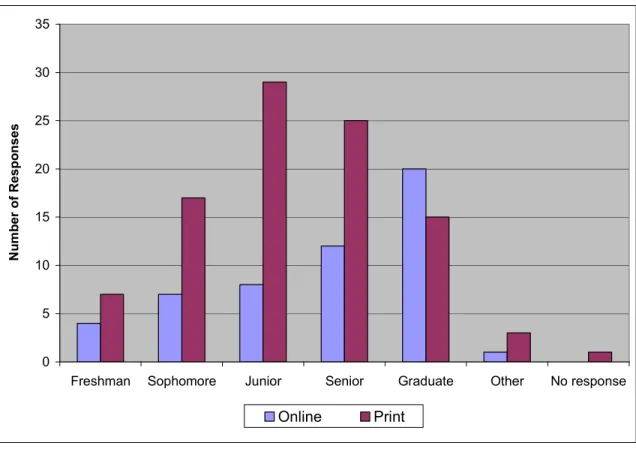
Table 2 and Figure 2 display a comparison of respondents to the online and print versions of the survey by level of study. For respondents to the online survey, graduate students were the largest group, followed by seniors, juniors, sophomores, and freshmen. One online respondent marked 'other' for this question, and there were no blank
Table 2. Respondents by Level of Study – Online vs. Print Survey
Level of study Online Print
Freshman 4 7
Sophomore 7 17
Junior 8 29
Senior 12 25
Graduate 20 15
Other 1 3
No response 0 1
TOTAL 52 97
Figure 2. Respondents by Level of Study – Online vs. Print Survey (n=149)
0 5 10 15 20 25 30 35
Freshman Sophomore Junior Senior Graduate Other No response
N u m b e r o f R e s p o n s e s Online Print
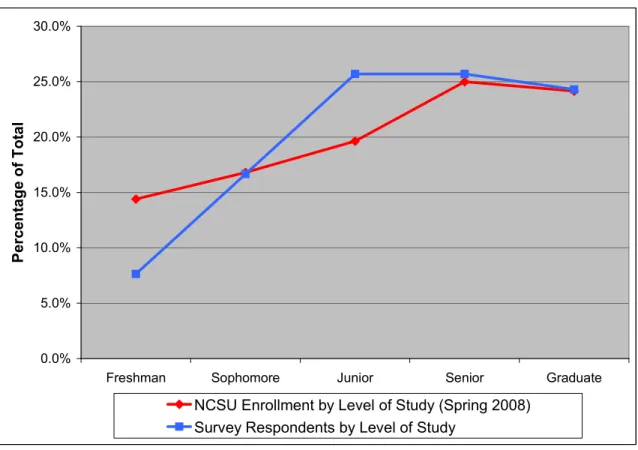
When judged against actual enrollment statistics for the university, the
identified as graduate students, seniors, and sophomores were all remarkably close to the figures for actual enrollment. This is especially notable considering that no form of statistical sampling was used in selecting respondents for the survey. The proportion of juniors represented in the survey was less similar, and differed from actual numbers by about 5%. Freshmen were most significantly underrepresented in the survey population when compared to actual enrollment (7.6% vs. 14.4%).
Table 3. Level of Study – Survey Respondents vs. Actual
Survey Respondents
Level of Study # %
Freshman 11 7.6%
Sophomore 24 16.7%
Junior 37 25.7%
Senior 37 25.7%
Graduate 35 24.3%
TOTAL* 144 100.0%
*Excludes 5 surveys with other/no response for level of study NCSU Enrollment - Spring 2008*
Level of Study # % Freshman 3633 14.4% Sophomore 4240 16.8%
Junior 4956 19.6%
Senior 6308 25.0%
Graduate 6097 24.2% TOTAL 25234 100.0%
Figure 3. Level of Study – Survey Respondents vs. Actual (% of totals)
0.0% 5.0% 10.0% 15.0% 20.0% 25.0% 30.0%
Freshman Sophomore Junior Senior Graduate
P
e
rc
e
n
ta
g
e
o
f
T
o
ta
l
NCSU Enrollment by Level of Study (Spring 2008) Survey Respondents by Level of Study
Question 2: Major / Area of Concentration
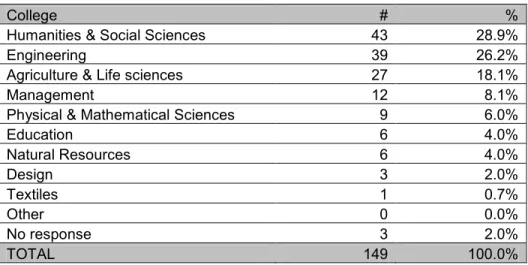
Table 4 and Figure 4 present the distribution of survey respondents by college. Of the 149 total responses, approximately 60% were attributed to three colleges:
Agriculture & Life Sciences, Engineering, and Humanities & Social Sciences. The latter represented the highest number of responses for the survey, with 43. The College of Design and College of Textiles were the least represented units, with three and one respondents, respectively. Three surveys did not have a response to this question.
Table 4. All Respondents by College
College # %
Humanities & Social Sciences 43 28.9%
Engineering 39 26.2%
Agriculture & Life sciences 27 18.1%
Management 12 8.1%
Physical & Mathematical Sciences 9 6.0%
Education 6 4.0%
Natural Resources 6 4.0%
Design 3 2.0%
Textiles 1 0.7%
Other 0 0.0%
No response 3 2.0%
TOTAL 149 100.0%
Figure 4. All Respondents by College (n=149)
0 5 10 15 20 25 30 35 40 45 50
Humanities & Social Sciences
Engineering
Agriculture & Life sciences
Management
Physical & Mathematical Sciences
Education
Natural Resources
Design
Textiles
Other
No response
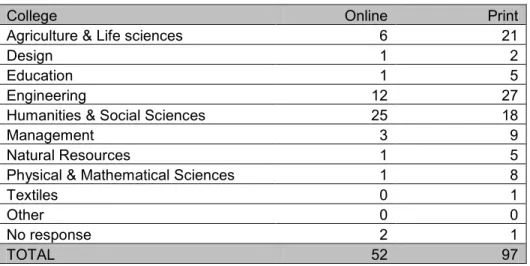
Table 5 and Figure 5 show a comparison of respondents by college for the online and print versions of the survey. The College of Humanities & Social Sciences
comprised just less than half of all respondents to the online version. In fact, the top three colleges (Humanities & Social Sciences, Engineering, and Agriculture & Life Sciences) accounted for more than 80% of responses. The remaining colleges were represented by three or fewer respondents, and two online surveys did contain responses for this question.
Similar to the online survey, the three top colleges for the print version were again Humanities & Social Sciences, Engineering, and Agriculture & Life Sciences.
Sciences was much less prominent (48.1% vs. 18.6% of total responses). These three colleges accounted for nearly 70% of respondents to the print survey. The remaining 30% of respondents were split among the other six colleges. One survey did not contain a response for this question.
Table 5. Respondents by College – Online vs. Print Survey
College Online Print
Agriculture & Life sciences 6 21
Design 1 2
Education 1 5
Engineering 12 27
Humanities & Social Sciences 25 18
Management 3 9
Natural Resources 1 5
Physical & Mathematical Sciences 1 8
Textiles 0 1
Other 0 0
No response 2 1
Figure 5. Respondents by College – Online vs. Print Survey (n=149)
0 5 10 15 20 25 30
Agriculture & Life sciences
Design
Education
Engineering
Humanities & Social Sciences
Management
Natural Resources
Physical & Mathematical Sciences
Textiles
Other
No response
Number of Respondents
Online Survey Print Survey
Table 6. College Enrollment – Survey Respondents vs. Actual
Survey Respondents by College
College # %
Agric. & Life Sciences 27 18.5%
Design 3 2.1%
Education 6 4.1%
Engineering 39 26.7%
Humanities & Soc. Sci. 43 29.5%
Management 12 8.2%
Natural Resources 6 4.1%
Phys. & Math. Sciences 9 6.2%
Textiles 1 0.7%
TOTAL* 146 100.0%
*Excludes 3 surveys with no response for college NCSU Enrollment by College - Spring 2008*
College # %
Agric. & Life Sciences 4764 18.9%
Design 665 2.6%
Education 1666 6.6%
Engineering 7251 28.7%
Humanities & Soc. Sci. 4350 17.2%
Management 2854 11.3%
Natural Resources 1206 4.8% Phys. & Math. Sciences 1510 6.0%
Textiles 968 3.8%
TOTAL 25234 100.0%
Figure 6. College Enrollment – Survey Respondents vs. Actual (% of totals) 0.0% 5.0% 10.0% 15.0% 20.0% 25.0% 30.0% 35.0% Ag ric.
& L ife S
cie nce s De sig n Ed uca tion En gin
eeri ng
Hu ma
niti es
& S oc.
Sci .
Ma nag
em ent
Na tura l R eso urc es Ph ys.
& M ath
. S cie nce s Te xtile s P e rc e n ta g e o f T o ta l
Question 3: For what purpose or activity do you use the Learning Commons most often?
The third question asked respondents to select their preferred activities or uses for the Learning Commons from a predefined list. Respondents were asked to check all items that were applicable, and a space was provided for additional uses or comments. Table 7 and Figure 7 show the total number of selections for each activity or use that was listed. The most popular activity among respondents was individual study (121
selections), followed by computing (93), group study (66), library research (53), taking a break (50), and meeting friends (30). Ten other uses were also recorded, of which some examples were video games, tutoring, and "wasting time".
Table 7. Q3 – All Respondents
Response # %
individual study 121 28.6% group study 66 15.6%
computing 93 22.0%
library research 53 12.5% meeting friends 30 7.1% taking a break 50 11.8%
other 10 2.4%
Figure 7. Q3 – All Respondents (n=423)
121
66
93 53
30
50
10
individual study
group study
computing
library research
meeting friends
taking a break
other
Question 4: What do you like most about the Learning Commons?
taken to include both hardware and software, received the next highest mention, with 58 responses. Rounding out the top three was physical space, which accounted for another 35 responses. This category included comments related to the available seating,
workstations, furniture, and the physical layout of the Learning Commons. The remaining categories listed as strengths included group study space (11 responses), library staff (11), the convenience or multiple uses of the facility (9), video games (7), white boards (5), and library materials (3). Two miscellaneous comments could not be placed into any of the existing categories and are listed under 'other'.
Table 8. Q4 – All Respondents
Grouped Responses # %
atmosphere/environment 62 29.0% computing facilities 58 27.1% physical space 35 16.4% group study space 11 5.1%
library staff 11 5.1%
convenience/multiple uses 9 4.2%
video games 7 3.3%
white boards 5 2.3%
library materials 3 1.4%
other 2 0.9%
no response 11 5.1%
Figure 8. Q4 – All Respondents (n=214) 0 10 20 30 40 50 60 70 atm osph ere/ envi ronm ent com putin
g fa cilit ies phys ical spa ce grou p st
udy spac
e
libra ry s
taff conv enie nce/ mul tiple use s vide o ga
mes
whi te b
oard s
libra ry m
ater ials
othe r
no re spon
se
Table 9 and Figure 9 provide a comparison of undergraduate and graduate student respondents' comments for this question. Graduate students listed the computing
facilities as a strength more often than the atmosphere or environment of the Learning Commons, whereas the opposite was true of undergraduates. Another key difference was that graduate students did not list either the video games or the convenience of the
Table 9. Q4 – Undergraduate vs. Graduate Student Responses
Grouped Responses
Undergraduate Graduate All atmosphere/environment 47 14 61
computing facilities 38 18 56
physical space 25 9 34
group study space 8 3 11
convenience/multiple uses 8 0 8
video games 7 0 7
library staff 6 4 10
white boards 4 1 5
library materials 2 1 3
other 1 1 2
no response 7 3 10
TOTAL* 153 54 207
*Excludes 7 responses with no data for level of study.
Figure 9. Q4 – Undergraduate vs. Graduate Student Responses (n=207)
0.0% 5.0% 10.0% 15.0% 20.0% 25.0% 30.0% 35.0% atm osph ere/ envi ronm ent com putin
g fa cilit ies phys ical spa ce grou p st
udy spac e conv enie nce/ mul tiple use s vide o ga
mes
libra ry s
taff
whi te b
oard s
libra ry m
ater
ials other
Question 5: What aspect(s) of the Learning Commons would you like to see improved and how?
For the fifth question, students were asked to provide at least one possible area of improvement for the Learning Commons. As with the previous question, responses were open-ended and each comment was coded separately into a list of themes and categories. Table 10 and Figure 10 present the coded categories of student responses for this
Table 10. Q5 – All Respondents
Grouped Responses # %
remove video games 36 18.8%
reduce noise level 31 16.2%
add computers 28 14.7%
more group study areas 10 5.2%
more seating 9 4.7%
better computing 9 4.7%
improve printing 8 4.2%
add computers (Linux) 4 2.1%
more video games 4 2.1%
more white boards 4 2.1%
add vending machines 3 1.6%
more power ports 3 1.6%
restrict computer use to academic purposes 3 1.6%
better furniture 2 1.0%
improve housekeeping 2 1.0%
other 14 7.3%
no response 21 11.0%
TOTAL 191 100.0%
Figure 10. Q5 – All Respondents (n=191)
0 5 10 15 20 25 30 35 40 rem ove vide o ga
mes
redu ce n
oise leve l add com pute rs mor e gr
oup stud
y ar eas
mor e se
atin g
bette r com
putin g impr ove prin ting add com pute rs (L
inux )
mor e vi
deo gam
es
mor e w
hite boa rds add vend ing mac hine s mor e po
wer por
ts
rest rict c
ompu ter u
se
bette r fur
nitu re impr ove hous ekee
ping othe r
no re spon
Table 11 and Figure 11 show a comparison of comments from undergraduate and graduate student respondents. While the overall trends for both groups remained similar, there were a few specific differences. First, all comments requesting more Linux
computers came from graduate students, suggesting a specialized need that might be filled. Also, graduate students generally commented less on the physical aspects of the Learning Commons, such as the furniture or layout. Instead, graduate students appeared to be more concerned with computing facilities and the atmosphere for study.
Table 11. Q5 – Undergraduate vs. Graduate Student Responses
Grouped Responses Undergraduate Graduate All
remove video games 25 10 35
reduce noise level 23 7 30
add computers 23 4 27
more group study areas 8 2 10
more seating 7 2 9
better computing 7 2 9
improve printing 6 2 8
add computers (Linux) 0 4 4
more video games 3 1 4
more white boards 4 0 4
add vending machines 3 0 3
more power ports 2 1 3
restrict computer use to academic purposes 2 1 3
better furniture 2 0 2
improve housekeeping 2 0 2
other 9 3 12
no response 15 5 20
TOTAL* 141 44 185
Figure 11. Q5 – Undergraduate vs. Graduate Student Responses (n=185) 0.0% 5.0% 10.0% 15.0% 20.0% 25.0% rem ove vid eo g
am es red uce no ise leve l
add co
mp ute
rs
mo re g
rou p s
tud y a
rea s
mo re s
eatin g
bett er
com putin
g imp rove pri ntin g
add co
mp ute
rs ( Lin
ux)
mo re v
ide o g
am es
mo re w
hite bo
ard s
add ve
ndin g m
ach ine
s
mo re p
ow er
port s rest rict co mp ute r u
se
bett er fu
rnitu re imp rove ho use kee pin g oth er
no r esp
onse
P e rc e n ta g e o f R e s p o n s e s Undergraduate Graduate
Question 6: What effect, if any, has the Learning Commons had on your use of the library?
relaxed or enjoyable experience (13), individuals reporting that the Learning Commons (as opposed to other parts of the library) was now their primary destination for research or computing (12), respondents reporting improved study skills (6), and those stating decreased use of the library due to effects of the Learning Commons implementation (5). Eight miscellaneous responses could not be attributed to any of these categories and were therefore grouped under 'other'.
Table 12. Q6 – All Respondents
Grouped Responses # %
increased use 57 38.0%
no change 17 11.3%
more relaxed/enjoyable 13 8.7% LC is primary library use 12 8.0% moved to different part of library 8 5.3% improved study skills 6 4.0%
decreased use 5 3.3%
other 8 5.3%
no response 24 16.0%
Figure 12. Q6 – All Respondents (n=150) 0 10 20 30 40 50 60 incr ease
d us e
no c hang
e
mor e re
laxe d/en
joya ble
LC is prim
ary libra
ry u se
mov ed to
diff eren
t par t of l
ibra ry
impr oved
stu dy s
kills
decr ease
d us e
othe r
no re spon
se
Table 13. Q6 – Undergraduate vs. Graduate Student Responses
Grouped Responses Undergraduate Graduate All
increased use 46 10 56
no change 10 6 16
more relaxed/enjoyable 10 2 12 LC is primary library use 9 3 12 moved to different part of library 7 1 8
improved study skills 4 1 5
decreased use 3 2 5
other 6 2 8
no response 15 8 23
TOTAL* 110 35 145
*Excludes 5 responses with no data for level of study.
Figure 13. Q6 – Undergraduate vs. Graduate Student Responses (n=145)
0.0% 5.0% 10.0% 15.0% 20.0% 25.0% 30.0% 35.0% 40.0% 45.0% incr ease
d us e
no c hang
e
mor e re
laxe d/en
joya ble
LC is prim
ary libra
ry u se
mov ed to
diff eren
t par t of l
ibra ry
impr oved
stu dy s
kills
decr ease
d us e
othe r
Discussion Board Posts
Comments posted to the Learning Commons online discussion board were also analyzed in order to supplement the responses from the survey. Each post and its subsequent threads were examined for themes and were then coded according to their content (i.e. 'computing'). A further descriptor was assigned to each post based on the nature of the comments. Comments expressing approval of services or facilities were given the modifier 'positive', those of a disapproving nature were coded 'negative', and any posts suggesting changes were labeled 'improvement'. As an example, a post asking for a greater variety of computers would be coded 'computing – improvement'.
Table 14. Grouped Comments – LC Discussion Board Posts
Grouped Comments # %
computing - improvement 10 15.9% video games - positive 8 12.7% noise - negative 8 12.7% video games - improvement 8 12.7% physical spaces - positive 7 11.1% technology - improvement 6 9.5% video games - negative 3 4.8% computing - positive 2 3.2% housekeeping - improvement 2 3.2% other - improvement 2 3.2%
other 7 11.1%
TOTAL 63 100.0%
Figure 14. Grouped Comments – LC Discussion Board Posts (n=63)
0 2 4 6 8 10 12 com putin
g - i mpr
ovem ent
vide o ga
mes - po
sitiv e
nois e - n
egat ive
vide o ga
mes - im
prov emen t phys ical spa ces
- pos itive
tech nolo
gy - impr
ovem ent
vide o ga
mes - ne
gativ e
com putin
g - p ositi
ve
hous ekee
ping - im
prov emen
t
othe r - im
prov emen
t othe
r
according to the broad categories of positive, negative, or improvement. Nearly half (44.4%) of all posts dealt with improvement of services in one way or another. Positive comments made up the second largest group with 27%, and negative posts accounted for 17.5% of the total number. The comments coded 'other' were not assigned subcategories and were therefore included separately in this analysis.
Table 15. Major Categories of Comments Posted to LC Discussion Board
Major Categories # %
Improvement 28 44.4%
Positive 17 27.0%
Negative 11 17.5%
Other 7 11.1%
TOTAL 63 100.0%
Figure 15. Major Categories of Comments Posted to LC Discussion Board
45%
27% 17%
11%
Improvement
Positive
Negative
DISCUSSION
The results of the student survey suggest a number of trends relevant to assessment. First, the implementation of the Learning Commons appears to have succeeded in transforming the library into a center of student activity. The majority of student respondents noted that the Learning Commons either caused their use of the library to increase dramatically, made their time spent in the library feel more relaxed and enjoyable, or it became their primary study location (see Figure 12). Respondents
attributed their use of the Learning Commons to a number of popular features. Among the strengths identified in the survey were the computing facilities available to students, the relaxed atmosphere, and the physical spaces available to work or study (see Figure 8). There are still, however, aspects of the Learning Commons that students feel need to be improved in order to maximize their ability to effectively use the space. The popularity of the LC has created problems of noise and distraction for students attempting to work or study individually, as well as increasing competition for computing resources and space. Respondents at all levels shared concerns over the former issue, especially as it related to the inclusion of video games in the LC (see Figure 10). As for the latter,
students in general expressed a desire for more resources of every type. As the popularity of the LC continues to rise, the library will need to accommodate more and more
students. While these themes were confirmed in the analysis of discussion board posts, this second part of the study did contribute some further insight into student use of the LC. One of the major uses of the discussion board was to post suggestions for
a useful means of communication between students and library staff, and may provide a solution to the need for constant revision in LC services and resources. Each of these trends was reinforced by the individual comments from students.
Perceived Strengths of the Learning Commons
When asked what they liked most about the LC, more than two thirds of comments from student respondents related either to the computing facilities, the atmosphere, or the physical spaces and amenities (see Figure 8). The fact that the atmosphere or environment of the LC was nearly tied with the computing facilities in terms of the number of comments suggests that the mixed use model of the Learning Commons is indeed highly desirable. Students seemed to approve of the combination of relaxed atmosphere, readily-accessible computing resources, and ample work space. Table 16 presents sample comments from respondents in these categories.
Table 16. Selected Comments – LC Strengths (Q4)
Category Comment
"lighting, layout – it is very visually appealing" "the environment is casual and comfortable" Atmosphere/environment
"décor is very comfortable – not as serious and 'strict' as the rest of the library"
"computer access"
"availability of computers" Computing facilities
"access to state-of-the-art technology" "relaxed, lots of room"
"computers with large desk space; I like to be able to spread out while still having access to a computer"
Physical space
Perceived Weaknesses of the Learning Commons
The popularity of the mixed-use LC model has given rise to several complaints among students, however. Both issues relate to the volume of activity in the LC and the competition among students for study space and computing resources. First, the larger number of students using the library and the LC has created a much busier, noisier environment. While student respondents listed the relaxed atmosphere of the LC as one of its chief strengths, they also showed a desire to have quieter spaces for study. When respondents were asked to name an area of improvement for the LC, the second-highest number of responses corresponded to the reduction of noise (see Figure 10). The only category with more responses related to a specific cause of noise and distractions, namely video games. The inclusion of gaming in the library was originally intended only for special events and for use in support of the computer engineering program. The library acquired, through monetary donations, several leading game consoles and used these to market the LC during its opening week. The continued demand and use of the video games by students led library staff to make the video games a permanent fixture in the LC. The results of the survey suggest that while students appreciate the availability of the video games for study breaks, they also feel that they should be moved to another part of the library to facilitate quieter study in the LC. Table 17 shows some sample
Table 17. Selected Comments – Areas of Improvement (Q5)
Category Comment
"the video game area is great but maybe it shouldn't be in the middle of everything, it can be kind of distracting"
"maybe have a space for the video games where they cannot bother others who are studying"
Remove video games
"move the video games farther from study/computing areas "it needs to be a lot quieter in [the] new wing or create a space w/big tables + computers somewhere else"
"I would like the noise due to cell phones to be reduced" Reduce noise level
"it stays very crowded and loud"
"more seating – more comfy chairs + couches"
"it's ridiculous how hard it is to get on a computer in here" "Expand area to install more work areas! Hard to get access during weekdays!"
Add computers; more seating; more group study space
"more computers – redo the West Wing too!"
same design principles (see Table 17). This may also be an answer to the more general problem of competition for resources inside the Learning Commons. Creating similar spaces elsewhere might reduce the demand on LC computers and seating and alleviate some of the issues of noise and crowding.
Undergraduate vs. Graduate Student Use
Overall, graduate students did not appear to have been impacted as much by the implementation of the Learning Commons as did undergraduates. The proportion of graduate students reporting no change in their use of the library following the opening of the LC was nearly twice that for undergraduates (see Figure 13). Moreover, the
proportion of undergraduates reporting increased use was noticeably higher than that of graduate students. These findings suggest that the LC has been more successful in drawing in undergraduates, and that the space may need to be adjusted to accommodate more graduate student work.
study would eliminate the need for graduate students to visit two different parts of the library for their research needs.
Methods of Assessment
The methods of evaluation used in this study will be of importance to other libraries with similar facilities. The survey was notably successful both in gathering interest from students and in creating a sample population that replicated the parameters of the larger student body as a whole (see Figures 3 & 6). Having both online and print versions of the survey appears to have worked well in including opinions from users of all backgrounds. The findings from the analysis of discussion board posts were of even greater note. The large proportion of comments that dealt with everyday improvements or suggestions from students suggest that this medium can be utilized effectively as an outlet for regular student feedback (see Figure 15). Since surveys, focus groups, and other types of assessment can take months to plan and administer, a feature such as this discussion board can allow for fast and easy communication between students and library staff. This type of communication is especially important for facilities such as the
LIMITATIONS AND FUTURE RESEARCH
This study was primarily exploratory in nature and therefore carries several limitations in terms of its applicability to the larger context of academic libraries in general. First, many characteristics of this study population and its object are unique to North Carolina State University. It follows that some specific findings may only apply to this institution and will not be of use to other libraries. Second, the sample population was not derived in any scientific or statistical manner. Although the resulting sample did reflect the larger student body in many ways, the study was not designed to be an exact replication of these parameters. In this way as well, the ability to generalize from these results is limited. Future studies may address these issues with purposeful or probability sampling among either within one library or across a number of institutions.
Another aspect of this study that deserves further examination is the effect of LC implementation on different types of library users. This study was able to include some non-users through the utilization of an online survey, but a more comprehensive
Further research will also be needed to address the evolving goals of the Learning Commons model. While the Information Commons model is based more on the
CONCLUSION
The Information Commons model of service is being adopted by an increasing number of academic libraries. As this model becomes more prevalent, the issue of assessment will be of increasing importance. This study of the NCSU Libraries Learning Commons provides one example of the evaluation process in an academic library. Both the online and print surveys provided valuable insight into student perceptions of the Learning Commons. Students were found to approve of the atmosphere of the LC, the computing facilities available, and the physical space provided for work or study. The popularity of these aspects, however, was perceived to have negative impacts on the noise level of the LC, especially as a result of the inclusion of video games. The high demand for LC resources was also deemed to have a negative effect on the availability of computers and seating. Despite this issues, the majority of students reported using the library more often as a result of the Learning Commons implementation. This increase was more prominent among undergraduates than graduate students, perhaps suggesting a need for adjustment of services or further marketing. The comments from the Learning Commons discussion board confirmed the findings of the survey and provided further insight into the opportunities for ongoing communication between students and library staff. Since this study was exploratory in nature, further research will need to be
REFERENCES
Albanese, A. R. (2004). Campus library 2.0. Library Journal, 129(7), 30-33.
Babbie, E. R. (2004). The Practice of Social Research (10th ed.). Belmont, CA: Wadsworth.
Bailey, D.R., & Tierney, B.G. (2008). Transforming Library Service Through
Information Commons: Case Studies for the Digital Age. Chicago: American Library Association.
Bailey, R., & Tierney, B. (2002). Information Commons redux: Concept, evolution, and transcending the tragedy of the commons. The Journal of Academic Librarianship, 28(5), 277-286.
Beagle, D. (1999). Conceptualizing an Information Commons. The Journal of Academic Librarianship, 25(2), 82-89.
Beagle, D. (2002). Extending the Information Commons: From instructional testbed to Internet2. The Journal of Academic Librarianship, 28(5), 287-296.
Carlson, S. (2001). The deserted library. Chronicle of Higher Education, 48(12), A35.
Church, J. (2005). The evolving Information Commons. Library Hi Tech, 23(1), 75-81.
Church, J., Vaughan, J. B., & Starkweather, W. M. (2002). The Information Commons at Lied Library. Library Hi Tech, 20(1), 58-70.
Cowgill, A., Beam, J., & Wess, L. (2001). Implementing an Information Commons in a university library. The Journal of Academic Librarianship, 27(6), 432-439.
Duncan, J. M. (1998). The Information Commons: A model for (physical) digital resource centers. Bulletin of the Medical Library Association, 86(4), 576-582.
Gardner, S., & Eng, S. (2005). What students want: Generation Y and the changing function of the academic library. Portal: Libraries and the Academy, 5(3), 405-420.
Garriock, B. (2004). Intention and perception: The Information Commons at Manukau Institute of Technology. New Zealand Libraries, 49(10), 352-60, 364.
Haas, L., Robertson, J., & Association of Research Libraries. (2004). The Information Commons (SPEC Kit 281). Washington, DC: Association of Research Libraries, Office of Leadership and Management Services.
Halbert, M. (1999). Lessons from the Information Commons frontier. The Journal of Academic Librarianship, 25(2), 90-91.
MacWhinnie, L. A. (2003). The Information Commons: The academic library of the future. Portal: Libraries and the Academy, 3(2), 241-257.
Malenfant, C. (2006). The Information Commons as a collaborative workspace.
Reference Services Review, 34(2), 279-286.
Murray, D. (2004). Information Commons: A directory of innovative services and resources in academic libraries.Retrieved October 28, 2007, from
http://ux.brookdalecc.edu/library/infocommons/ic_home.html.
Nikkel, T. (2003). Implementing the Dalhousie Learning Commons. Feliciter, 49(4), 212-214.
Schmidt, N., & Kaufman, J. (2005). Learning Commons: Bridging the academic and student affairs divide to enhance learning across campus. Research Strategies, 20(4), 242-256.
Shill, H. B., & Tonner, S. (2003). Creating a better place: Physical improvements in academic libraries, 1995-2002. College & Research Libraries, 64(6), 431-466.
Shill, H. B., & Tonner, S. (2004). Does the building still matter? Usage patterns in new, expanded, and renovated libraries, 1995-2002. College & Research Libraries, 65(2), 123-150.
Spencer, M. E. (2007). The state-of-the-art: NCSU Libraries Learning Commons.
Reference Services Review, 35(2), 310-321.
Tramdack, P. J. (1999). Reaction to Beagle. The Journal of Academic Librarianship, 25(2), 92-93.