The names of persons, families, and corporate bodies pose a particularly thorny problem for catalogers and other metadata specialists because they are simultaneously one of the most salient and most mutable pieces of metadata identifying a digital object. Despite continuing advances in distributed, web-based name authority control, this important work remains largely neglected by institutional repositories (IRs) in their efforts to archive the research outputs of their institution. This study aims to explore the possibilities surrounding name authority control in an IR context. Particularly, the study seeks to determine whether a linked data (or linked data-like) approach—in which Uniform Resource Identifiers (URIs) rather than name strings are stored for the authors of repository objects—is a feasible one for the Duke Digital Repository, and if specific steps can be outlined to provide a recommendation for implementing any such approach.
Headings:
Name authority records (Information retrieval)
Authority files (Information retrieval)
Linked data (Semantic Web)
Institutional repositories
Scholarly electronic publishing
A NEW WHO'S WHO: USING URIS IN A LINKED DATA APPROACH TO NAME AUTHORITY CONTROL by
Moira C. Downey
A Master’s paper submitted to the faculty of the School of Information and Library Science of the University of North Carolina at Chapel Hill
in partial fulfillment of the requirements for the degree of Master of Science in
Information Science.
Table of contents
Introduction 3
Library name authority control and institutional repositories 3
Library data as linked open data and LD4 5
The Duke Digital Repository 8
Purpose of this study 10
Literature review 11
The evolving nature of library name authority control 11
Shifting to shared authority and identifiers 13
Leveraging author identifiers in implementing linked data 20
Research questions 27
Research design 28
Results 31
Author identifier uptake and researcher career status 31
Identifier distribution by discipline 34
Discussion 36
Limitations 41
Conclusions and next steps 43
Bibliography 45
List of figures:
Figure 1: Researcher ID Information Flow 20
Figure 2: Percent of total sample of authors with Duke University affiliation 31 Figure 3: Identifier distribution by data source 33 Figure 4: Author identifier distribution by career status, Duke authors 33 Figure 5: Author identifier distribution by discipline, total sample 35 Figure 6: Percent of author identifiers per discipline, by data source 35
Introduction
Library name authority control and institutional repositories
The names of persons, families, and corporate bodies pose a particularly thorny problem for catalogers and other metadata specialists because they are simultaneously one of the most salient and most mutable pieces of metadata identifying a digital object. Name strings such as "John Smith," "Rosa Parks," or "Department of Cell Biology and Physiology" enable discovery and collocation of all works by an author or corporate body. Such strings of text are critical to search and retrieval, construction and analysis of
citations, linking of intellectually related objects, and management of copyright (Xia, 2006). They are also vital for generating important internal information like deposit or usage statistics for reporting. At the same time, these strings are often drawn from heterogeneous data sources or are entered by multiple actors over time, resulting in syntactical variations in spelling, case, abbreviation, and formality (Bilenko, Mooney, Cohen, Ravikumar, & Fienberg, 2003). Name strings can also be fluid and are subject to changes stemming from a range of possible circumstances varying from departmental reorganization to marriage or gender transition. This dynamism can, in turn, severely inhibit the possibilities of machine processing of digital object metadata. 1
Libraries have performed some variety of name control for decades. Historically, authority records have been used both to establish a form of the name that serves as an authorized access point for the entity, and to provide a record of changes to the
1 For an amusing read on the limitations of machine processing capacity of personal names, see
authorized form of the name, alternative forms of and cross references to the name, and evidence for decisions made about the form of the name (Tillett, 2004). While these records have been successful in centralizing maintenance of information about entities over time, challenges persist in performing this work at scale and in making information about entities globally meaningful and interoperable. However, as data maintained by cultural heritage institutions gradually move to a Web environment, new opportunities are surfacing, particularly with regard to enhancing the usability of authority data and broader data sharing among institutions (Niu, 2013; Tillett, 2004).
Despite continuing advances in distributed, web-based name authority control, this important work remains largely neglected by institutional repositories (IRs) in their efforts to publish and archive the research outputs of their institution. This state of affairs derives from a confluence of circumstances and has equally disparate effects. In outlining some of the technological and policy challenges IRs face conducting this kind of
metadata work, Salo (2009) highlights as a principal cause the inability of IRs to rely on well-established name authority vocabularies (such as the Library of Congress Name Authority File (LCNAF) or Virtual International Authority File (VIAF)) for information about 2 3
authors who produce chiefly journal articles or highly local scholarship (i.e., students authoring theses and dissertations); this content rarely receives the item-level cataloging afforded monographic materials that is likely to generate traditional authority records. A similar gap persists for campus organizations and departments. The dearth of existing name authorities for researchers and campus corporate bodies means that in many cases, repositories may be forced to maintain information about these entities locally, a practice which can be difficult to sustain for a major research university, and can quickly become
2 http://id.loc.gov/authorities/names.html
complicated depending on the repository's metadata schema and data modeling. Without proper authority control, the ability of IRs to optimize precision and recall in search
retrieval is compromised, along with the capacity to conduct accurate reporting on repository content.
Library data as linked open data and LD4
Linked data is perhaps most understandably characterized as "a set of best practices for publishing and connecting structured data on the Web," that seeks to leverage technologies central to the Web—chiefly, Uniform Resource Identifiers (URIs) and HyperText Transfer Protocol (HTTP)—to better integrate and make use of
relationships among data from various sources (Bizer, Heath, & Berners-Lee, 2009). This set of best practices is well summarized by the "rules" for published linked data
established by Berners-Lee in 2006: 1. Use URIs as names for things
2. Use HTTP URIs so that people can look up those names.
3. When someone looks up a URI, provide useful information, using the [appropriate] standards (RDF, SPARQL)
4. Include links to other URIs so that they can discover more things (Berners-Lee, 2006).
structured data; be available in a non-proprietary format, such as CSV or XML; be
available using common and open standards to identify things (namely, URIs); and finally, must be linked to other data to provide appropriate context. 4
Broadly speaking, linked data has increasingly been looked upon as an
encouraging model for storing metadata about digital objects in the libraries, archives and museums that constitute the cultural heritage sector. As a content agnostic technology, linked data is an appropriate publishing technique for information about the broad array of materials curated by such institutions. Libraries in particular have been moving along a lengthy trajectory toward integrated data sharing that is of a piece with linked data, as exemplified by the establishment of cooperative cataloging networks and shared bibliographic databases like the Program for Cooperative Cataloging (PCC) and the Online Computer Library Center (OCLC)'s Worldcat service, as well as the development of open data retrieval and sharing protocols such as Z39.50 and the Open Archives Initiative Protocol for Metadata Harvesting (OAI-PMH) (Summers & Salo, 2013). In recent years, a contingent of library professionals have argued that technologies like the
Machine-Readable Cataloging (MARC) standard that have served the library community well for so long are increasingly outmoded (Coyle, 2010; Tennant, 2002, 2004). As libraries gradually embrace digital materials and new software systems in a networked environment, space has opened to think more holistically about how library bibliographic data is encoded and integrated with the wider Web. Arguing in favor of transitioning library data to linked data, Coyle contends that, to adequately serve library users, library services "must not only be on the Web" where library users are, "but need to be of the Web" (2010, p. 6). Moreover, she finds it to be "clear that resources cataloged by libraries
are part of the online information landscape"—a landscape that "does not make use of the MARC record" (Coyle, 2010, p. 8).
Much effort has been expended in recent years to make good on Coyle's vision. Since 2014, a collaborative effort among Cornell University, Harvard University, and Stanford University (with some participation from the Library of Congress), has governed two large-scale projects to move library data further along this path: Linked Data for Libraries (LD4L) and Linked Data for Production (LD4P) . Both LD4L and LD4P have built 5 6
on existing technologies intended to extricate library data from various silos (catalogs, finding aids, reading lists, et al.) in order to make them more easily consumed and better integrated with the broader web. In particular, one of the chief goals of the LD4P grant project has been to shore up "the common environment, standards, and protocols that have allowed libraries to interact so strongly in the past." A good deal of this endeavor 7
has focused on engineering a linked data environment for legacy MARC data and its traditional workflows, specifically the BIBFRAME format envisioned by the Library of Congress. However, beyond systemic initiatives like BIBFRAME, smaller projects to integrate linked data principles into existing MARC data abound, especially efforts to capture URIs in subfields $0 and $1 in MARC21 formats (Nakasone & Pearce, 2018; Shieh & Reese, 2015).
A workflow that facilitates describing entities in terms of unique, persistent URIs on the Web holds some real promise for performing authority control in an institutional repository environment. Writing in a recent report, Coyle goes on to draw a connection between the affordances of linked data and the evolution of what she refers to as
5 https://ld4l.org/ld4l-2014/overview
6 https://wiki.duraspace.org/pages/viewpage.action?pageId=74515029
"bibliographic control," that is, "the organization of library materials to facilitate discovery, management, identification, and access" (2010, p. 7). She notes the encouragement of the Working Group on the Future of Bibliographic Control to think beyond the library catalog when considering avenues by which users seek and encounter information, and its observation that the future of bibliographic control will be "collaborative, decentralized, international in scope, and Web-based" (Coyle, 2010, p. 7). Reconceptualizing entity names as "things" rather than "strings"—transforming data from textual strings like "Bill Clinton" to identifiers (or "things") like "viaf.org/viaf/102338519/" that are machine processable and system interoperable—is a key first step in making library and other cultural heritage data truly dynamic and "of the Web." Moreover, such a step has the potential to mitigate many of the more onerous aspects of authority control, obviating the need for broad-scale manual intervention when a change is made to the entity resource. The challenge in the context of the IR is finding an appropriate knowledge base or controlled vocabulary for campus entities producing locally-originated scholarship.
The Duke Digital Repository
The Duke Digital Repository (DDR) as currently configured is a multi-platform repository program that encompasses both a local instance of DSpace software and a 8
parallel, highly customized technology stack following the Samvera community 9
framework. The chief components of this stack are a custom-built Ruby on Rails application that functions as the digital asset management interface and repository front-end, and a Fedora 3.0 (Flexible Extensible Digital Object Repository Architecture) 10
8 http://www.dspace.org/
9 https://samvera.org/
storage platform. Both DSpace and the Fedora/Samvera framework are commonly used open source software solutions for institutional repositories. DSpace is the more turnkey of the two platforms, offering a ready-to-use repository application that need be
customized only to the extent required by the local institution. By contrast, the
Fedora/Samvera framework is just that—an open-source, community-based framework for developing a repository front-end application. While the Samvera community is currently working to construct more complete software products for digital asset management, the application supporting the DDR remains, for the time, highly bespoke.
DDR development staff have recently articulated a desire to minimize the current level of customization and to better realize the benefits of open source software
development by working on a product that is better aligned with the efforts of the broader Samvera community. To that end, and to accommodate a newly instituted research data curation program at Duke University, the DDR is presently engaged in building a new repository application for research data using the Samvera community’s Hyrax software. 11
Hyrax extends the Samvera framework for building web applications on top of a repository back-end and a search index to provide a user interface around common repository and social networking features. Unlike previous Samvera framework
applications, Hyrax rests on a newer version of Fedora (Fedora 4.0) as its digital object store. The upgrade from Fedora 3.0 to 4.0 saw the implementation of a new data model meant to better leverage emerging web technologies, notably by providing support for linked data. The convergence of these circumstances provides an opportunity to think creatively about developing linked data or linked data-like solutions to some of the metadata and authority concerns posed by repository content.
The DSpace arm of the repository facilitates name authority control of
Duke-affiliated persons through a heavily mediated process that involves reconciling name strings as entered by a depositor with a custom-built JavaScript look-up service that queries the campus identity management system (IDMS); this metadata is keyed to the individual’s unique identifier within Duke’s campus IDMS. At present, no automated authority control of any kind is conducted in the Samvera/Fedora application. Curators charged with ingest of materials to the repository are responsible for ensuring that the names being entered in each object's metadata are uniform within the repository, but no reconciliation with an outside service or knowledge base is performed as part of the ingest process. This workflow not only becomes a time-consuming process of manual remediation, but also introduces the possibility for human error. Some community
development has been carried out in support of in-application querying of authority data, but real-world implementation of this functionality is neither wide-spread nor
well-documented to date.
Purpose of this study
modeling entities locally? Taking advantage of the DDR's current work in building a repository for research data, the author is interested in formulating a proposal at the level of both policy implementation and software development for linked data solutions to name authority control and entity disambiguation in a Hyrax application.
Literature review
The evolving nature of library name authority control
As discussed above, the library community has been engaged in the work of authority control, documenting cataloger decisions on how to represent the single, authorized form of a particular heading in the library catalog, for more than a century (Niu, 2013; Tillett, 2004). This work has traditionally existed to enforce consistency within the catalog, and enforcement points have typically included access elements like names, titles, and subjects. Ensuring the uniqueness and conformity of these access points while providing a network for cross-referencing and linking variant and related headings is essential to supporting the functions of the library catalog. In his 1876 Rules for a Printed Dictionary Catalog, Charles Ammi Cutter described these functions broadly as finding, collocating, evaluating, and locating resources. Throughout the latter half of the 20th century, the International Federation of Library Associations and Institutions (IFLA) began to revisit Cutter’s catalog objectives, and to repurpose them into a series of user tasks that inform the Functional Requirements for Bibliographic Records (FRBR) 12(Tillett, 2004; Vellucci, 2000).
12 For a discussion of the evolution of these user tasks and what that evolution may have missed,
see Coyle, K. (2015). Mistakes Have Been Made. Presented at the annual meeting of Semantic Web in Libraries, Hamburg, Germany. Retrieved from
Each of IFLA’s revised user tasks—find, identify, select, and obtain—are facilitated by the implementation of the single, authorized form of an entity that is the heart of authority control. As Vellucci notes, finding is enabled by ensuring that entity names are unique and that only one name is used for each entity, that variant forms are represented and interlinked, and that related entities are collocated in the catalog. Identifying is supported by allowing users to distinguish among similarly named entities by applying unique and consistent headings. Though not directly supported by authority control as traditionally conceived, selection of a particular entity may be influenced by the
availability or structure of a controlled access point. Finally, obtaining access to the resource is contingent upon the provision of a physical location; in the case of digital materials, this generally refers to the use of a Hypertext Transfer Protocol (HTTP) Uniform Resource Locator (URL) (Vellucci, 2000). Although institutional repositories are far newer knowledge aggregators than library catalogs, retrieval of information resources within repositories stipulates a similar set of user tasks.
subject occur, the consequent heading change in the authority record must be
propagated throughout all bibliographic records with that particular heading (Niu, 2013). Internationalized data presents a further challenge to the effectiveness of a single, globally authorized heading in that such a heading presumes a shared standard for cataloging rules, language, and script (Tillett, 2007).
As libraries began to automate their cataloging and authority control operations with the development of integrated library systems in the 1970s and 80s, and authority and bibliographic records moved to a digital environment, systems designers gradually recognized the potential advantage in using a control number in bibliographic records in place of a text string for an entity. These unique numbers held several advantages over text strings; in Tillett’s description, a “control number would be linked to a corresponding authority record to save on storage, to make global update easier, and in general to provide better control over the displayed forms of names used” (Tillett, 2007). Additionally, numerical identifiers are language and cataloging standard neutral, and remain constant even as the authorized heading itself changes. Unfortunately, record control numbers are also only meaningful in local databases; when data is meant to be exchanged among systems, this solution presents a significant administrative burden (Niu, 2013; Tillett, 2007).
Shifting to shared authority and identifiers
bibliographic records in the form of printed cards, by the 1970s, formal groups like the Cooperative Online Serials Program (CONSER), Name Authority Cooperative Program (NACO), Subject Authority Cooperative Program (SACO), and others provided an
infrastructure for collaborative data sharing among cataloging institutions. In 1995, these organizations came under the umbrella of the Program for Cooperative Cataloging (PCC), which aimed to coordinate cataloging activity and facilitate data exchange (Stegaeva, 2016). The concept of Universal Bibliographic Control envisioned achieving economies of scale with respect to bibliographical data production through shared responsibilities (Angjeli, MacEwan, & Boulet, 2014). Complicating matters, in the context of shared authority files like the Library of Congress Name Authority File, authority records may be required to "uniquely identify a name in the context of hundreds of libraries' catalogs representing millions of works and millions of authors" (Smith-Yoshimura et al., 2014, p. 7).
In this increasingly interconnected and digital environment, IFLA proposed to build a centralized international authority system pinned to the use of an International Standard Authority Data Number (ISADN). With an ISADN, one library could choose “John F
Kennedy” as the preferred heading and record both the ISADN and “John F Kennedy” in its bibliographic records; a second library could instead choose to use “Jack Kennedy” as the preferred heading, and by storing the unique ISADN, its bibliographic records would be linked to those of the first library (Niu, 2013). A daunting project from the beginning, the International Authority System as proposed by IFLA would require implementation and maintenance of an international database and registry to enforce uniqueness among identifiers (Tillett, 2007). Delsey (2004) discusses some of the additional logistical
bounded geographically or territorially, along with the requisite deduplication and record merging. Several other iterations of globally unique identifier solutions were proposed in the ensuing years—International Standard Authority Number, an ISO International
Standard Text Code, and targeted use of the Library of Congress Control Numbers among them—though none were systematically implemented, and none were able to make full use of the possibilities of networked information (Tillett, 2004). In 2008, IFLA's effort was abandoned in favor of monitoring the progress of two other authority identifier initiatives (IFLA Working Group on Functional Requirements and Numbering of Authority Records, 2008).
particular record with an established identifier from one authority cluster to another
(Angjeli et al., 2014; Sandberg & Jin, 2016). Despite this caveat, the VIAF model represents an important step forward in preparing library data for better integration with the broader Web.
In addition to VIAF, the International Standard Name Identifier (ISNI) is an open 13
International Organization for Standardization (ISO) standard for assigning unique identifiers to entities. Much like VIAF, ISNI aggregates information from a number of databases worldwide and links entities using matching algorithms. Through a centralized group of third-party registration agencies, ISNIs associate the public name of an agent with a unique, persistent identifier that is designed to be not only language and system independent, but also to transcend geographic territory and domain (Angjeli et al., 2014). Metadata associated with each identifier, much of which is extracted from VIAF records, enables disambiguation in the central assignment system. A good deal of this metadata is extracted from VIAF records, which also contain links to ISNI URIs. While the key driver for the establishment of the ISNI scheme was the need for precise identities to facilitate communication and payment associated with rights management, the mission of ISNI has broadened, and ISNI identifiers subsequently have been created for PhD dissertation authors and various other VIAF entities. ISNI URIs also maintain links to data found in Wikipedia and Wikidata (Warner, 2017).
Cooperative cataloging and authority control mechanisms like the Library of Congress Name Authority Files and VIAF still rely heavily on local establishment and maintenance of authority records. Even in a digital, globally networked environment, comprehensive authority work remains labor and cost-intensive, and is conducted for only
a small fraction of agents responsible for producing content that is chiefly monographic in nature; not every author is going to have a LCNAF or VIAF entry (Salo, 2009; Sandberg & Jin, 2016). In discussing the growing need to compile and track researcher output,
Smith-Yoshimura, et al. (2014) recognize and examine a second authority mechanism: researcher registries. Registration files are distinct from authority files chiefly in that the former "strives to create a unique ID for a given entity," while the latter does the same, but "may impose additional constraints such as formulating the text string associated with the entity according to specific rule sets (e.g., Resource Description and Access or RDA)" (Smith-Yoshimura et al., 2014, p. 7). The fundamental purpose behind such systems, however, is identical: author disambiguation and collocation of work.
Although a number of systems for furnishing authoritative researcher IDs have been explored in recent years, these efforts tend to be limited by discipline, affiliation, or publisher, or are part of a proprietary system (Haak, Fenner, Paglione, Pentz, & Ratner, 2012; Smith-Yoshimura et al., 2014). One researcher registration mechanism that appears to be gaining traction by virtue of its international and interdisciplinary approach is the Open Researcher and Contributor Identifier (ORCID) . Created principally to address the 14
researcher name ambiguity problem in scholarly publishing, ORCID's "core mission … is to provide a registry of persistent unique identifiers for researchers and scholars" (Haak et al., 2012, p. 259). If ISNI can be thought of as a third-party registration system, ORCID operates as a "self-claim" registry, allowing researchers to create and maintain a profile from which they can link to their own scholarly works and grants. Researchers can also furnish a variety of other information, including work and educational history, a
biographical statement, and any other names or aliases under which they have published
during their career. Each profile is then associated with a unique, 16-digit identification number that serves as the base of a resolvable URI from which information about the researcher can be accessed. The identifiers are assigned from a block of ISNI numbers reserved for scholarly researchers and administered by a separate organization
(Sandberg & Jin, 2016). ORCID does not maintain any barriers to registration (other than access to an email account), and an institutional affiliation is not required to establish a profile.
In a sense, systems like ORCID undertake to devolve the authority work traditionally carried out by libraries and other cultural heritage institutions back to the researchers themselves. This both eases the burden on traditional purveyors of authority while granting individual researchers some measure of autonomy over how they are presented in the scholarly communications universe. As Bilder acknowledges, it also creates a bit of a paradox wherein ORCID claims to establish unique identifiers for
individual researchers while "creating a database comprised of both self-asserted records and many (potentially) externally asserted records—a process that is highly likely to result in the deposit of duplicate records for some researchers" (2011, p. 2). This approach could also negatively impact the accuracy of the record if a researcher is not diligent in keeping a profile up to date. Moreover, it could result in profiles that do not contain enough public data to unambiguously distinguish authors with similar names; to this point, Sandberg & Jin find that "ORCID entries are overwhelmingly undifferentiated" (2015, p. 542). Some additional concerns about the use of ORCID data include the system's privileging of authors whose names adhere to western name order conventions, and a possible bias 15
15 Supak-Smolcic, V., Simundic, A.-M., & Lundberg, G. D. (2016). Identification of authors without
against scholarship within the humanities, which is generally published as monographs rather than journal articles. 16
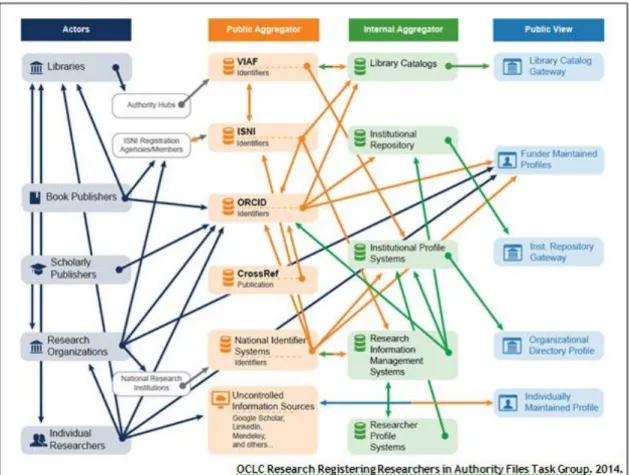
These identifier systems and databases are increasingly interrelated. As
characterized by Smith-Yoshimura, et al., researcher registries overlap with authority hubs to varying degrees; LC/NACO Name Authority Files increasingly include ISNIs and also contribute data to VIAF (2014). Both VIAF and ISNI are administered by OCLC, and ORCID and ISNI act as feeders to VIAF. VIAF records often contain ISNI URIs. The diagram below, from a 2014 OCLC report on addressing the author ambiguity problem in scholarly
publishing, illustrates the overall complexity of the existing researcher identification ecosystem and information flow; key questions remain about how to reconcile these data among systems, and how to ensure that corrections or updates to researcher information fully propagate throughout these systems (Smith-Yoshimura et al., 2014).
16 Webster, P. (2013, February 27). Great idea, but for now ORCID doesn’t match how humanities
publication works [Blog post]. Retrieved from:
FIGURE 1: RESEARCHER IDENTIFIER INFORMATION FLOW (Smith-Yoshimura et al., 2014, p. 19)
Leveraging author identifiers in implementing linked data
(Berners-Lee, 2006). Similarly, as articulated in a recent PCC task force report,
"integrating external data with one's own more than simply exposing one's own data … will enable more fluid navigation and leveraging of the richness of the linked data environment for enhanced discovery" (Report for PCC Task Group on the Creation and Function of Name Authorities in a Non-MARC Environment, 2013, p. 10). In other words, reformulating library bibliographic and authority data as linked data that is better aligned with the architecture of the Web has the potential to improve access to collections and provide users with a richer, more integrated picture of library holdings (Coyle, 2010; Summers & Salo, 2013).
Beyond the possible improvements to navigation and discovery afforded by making explicit and machine-actionable the relationships among identities, linked data may address some of the concerns about disambiguation and persistence raised by the traditional use of authorized name text strings. Cultural heritage institutions have, generally speaking, historically expressed some reservations about the use of URLs like those at the heart of linked data technology as a mechanism for data-exchange because of their perceived fragility. A number of persistent identifier technologies have been introduced as a result of this shared concern , as has a series of recommendations from 17
the World Wide Web Consortium (W3C), the chief standards organization for the Web, for constructing persistent URIs (Summers & Salo, 2013). "Cool URIs," as they have been characterized, "are designed with simplicity, stability and manageability in mind," and commonly avoid the use of personal names, file extensions, or topic and classification by subject (Berners-Lee, 1998; Sauermann & Cyganiak, 2008). URIs that are created by following this convention are less likely to break due to changes in either technology or
17 See Digital Object Identifier (DOI), Handle, Archival Resource Key (ARK), and Extensible Resource
nomenclature. The semantically opaque, globally unique identifiers provided by VIAF, ISNI, and ORCID, along with the web-resolvable URIs assigned to Library of Congress Name Authority Files provided through the Library of Congress's Linked Data Service , 18
are excellent building blocks for remaking authority control in a linked data environment. While very few institutions have outlined a path forward for wholesale conversion of their bibliographic data to linked data, some are giving thought to more granular ways in which they can begin to prepare their legacy records. The shift to Resource Description and Access (RDA) from AACR2 as a shared content standard is part of this effort, but some additional work has centered around the use of MARC subfields $0 and $1 to store URIs in existing MARC 21 fields. Initially defined in 2007 as a container for the system control number of the related authority record, the subfield $0 was redefined in 2010 to include a standard identifier like an ISNI. Unfortunately, libraries using this convention are still only building strings, not semantic objects, and wholesale conversion of MARC 21 data to RDF data is, to an extent, hindered by the inability to distinguish between URIs that reference a real-world individual and URIs that reference an authority record about that individual (PCC Task Group on URIs in MARC, 2017; Shieh & Reese, 2015).
Nonetheless, several institutions have moved forward with projects to integrate URIs with their existing MARC data through projects ranging from the small in scale (Cornell's local enhancement of a small set of records with URIs and Harvard's inclusion of ISNIs for faculty in the School of Design) to very large (George Washington University's
programmatic addition of over 4 million URIs in the subfield $0 to existing bibliographic records and the National Library of Medicine's enhancement with MeSH URIs of over 1.5 million legacy bibliographic records) (Bremer et al., 2017). Elsewhere, North Carolina State
University has recently completed a pilot project to insert personal name URIs into a small subset of their existing catalog data (Nakasone & Pearce, 2018).
Outside the context of legacy MARC data and the traditional catalog, other library systems are being developed that incorporate linked data principles and mechanisms natively. This effort has been prevalent among institutional repository software, where metadata about repository content is rarely encoded in MARC. The data model underlying linked data technologies, Resource Description Framework (RDF), expresses statements about digital objects in the form of subject-predicate-object triples, where the subject is the resource being described, and the predicate relates some characteristic about the subject and describes the relationship between subject and object (Cyganiak et al., 2014). RDF does not necessarily accommodate hierarchical information well, and can make it difficult to construct complex descriptions in which the object of a triple is another triple statement. Doing so would entail creating and managing objects in the repository that are not actual digital objects, but are instead concepts like subjects or persons (Hardesty & Young, 2017). For newer systems, like the Samvera community's Hyrax project, that have been built to store RDF properties with the digital object, this characteristic of RDF has meant a shift in thinking about and working with descriptive metadata.
Some work has been done to make it easier for applications like Hyrax to rely on externally modeled entities and concepts, and another notable product of the LD4L project has been the development of tools to facilitate the adoption of linked data among the Samvera community. One of the most mature of these tools is the "Questioning Authority" (QA) gem , which enables in-application querying of either locally or externally 19
controlled vocabularies or other authorities. The linked data branch of the QA gem stores
19 In the Ruby programming language, a gem is a packaged library of code or application that can
the URI for the entity with the object in the repository, but also enables the application to fetch the preferred label for the URI, in the form of a human-readable text string
associated with the entity (in traditional authority control, this role would be filled by the authorized heading). The preferred label is then indexed and used to facilitate faceted search (Rayle, 2018). The QA gem is designed to allow for the application to be
configured to query a wide array of publicly available linked data sources, including the Library of Congress's Linked Data Service, DBPedia , and OCLC's Faceted Application of 20
Search Terminology (FAST) service.
As noted above and highlighted in a 2013 report from the PCC, "the linked data environment is much larger than library catalogs, and the resources which libraries provide to their users contain many names not found in library authority files" (Report for PCC Task Group on the Creation and Function of Name Authorities in a Non-MARC
Environment, 2013, p. 11). To address this gap, some institutional repositories have identified data sources closer to home, successfully leveraging the university's existing human resources or other campus identity management databases to provide non-MARC name authorities. Ilik describes a pilot project at Texas A&M University to publish RDF data about campus entities through a particular linked data platform, VIVO 21(Ilik, 2014). VIVO is an open source software product and ontology designed to track, aggregate, and present scholarship and scholarly activity throughout an institution. In the case of Texas A&M, developers were able to extract basic information about campus researchers, their positions, and their campus organizations—full names, contact information, job titles, institutional identifiers, organizational names and hierarchies, etc.—and generate VIVO
20 DBPedia is a large-scale knowledge base of structural data extracted from Wikipedia:
http://wiki.dbpedia.org/
URIs for use in the open access repository, electronic theses management system, and library catalog. Ilik does not provide implementation details regarding how the university intended to use the VIVO URIs in its repository systems, and it is not clear how the software is equipped to consume linked data. Cornell University also runs a VIVO instance, and the libraries have been able to leverage its institutional data by inserting VIVO URIs for academic advisors into MARC records for theses and dissertations (Warner, 2015). As of 2017, however, these URIs had not been made available as resolvable links to the individual's VIVO profile in the catalog interface (Warner, 2017).
Elsewhere, Indiana University - Purdue University Indianapolis (IUPUI) has
engaged in a pilot program to convert faculty data to structured linked data via Wikidata (Lemus-Rojas & Odell, 2018). This strategy iterates on recommendations made by Harper & Tillett (2007)for converting large controlled vocabularies into RDF data sets. Staff selected eighteen faculty members from the IUPUI School of Philanthropy and compiled data from various scholarly profile sources, including Scopus, LinkedIn, Twitter, ORCID, and VIAF; this data included information about faculty co-authors and their publications. Staff then converted this hand-compiled information into structured, consumable RDF data that was subsequently published via Wikidata , a free and open structured 22
knowledge base that is part of the broader Wikimedia organization (which includes Wikipedia). An open source application, Scholia, was then used to generate scholarly profiles by querying the knowledge base, allowing end users to explore the
collaborations and scholarly interests of the selected researchers (Lemus-Rojas & Odell, 2018). This process was acknowledged to be time and labor intensive, however, and it is
not clear how scalable such a workflow would prove to be. Nor does this solution necessarily offer immediate access to the content, as would be the case in an IR.
It should be acknowledged that linked data solutions are not without drawbacks, even as the use of URIs marks an improvement over the use of text strings. As the Semantic Web has scaled, and the amount of data that is published as linked open data increases, several concerns have arisen surrounding entity disambiguation. The problem of co-reference, whereby two URIs refer to the same entity, is not dissimilar from issues that have plagued more traditional authority control work. In the context of the Semantic Web, this occurs when an entity is represented in multiple knowledge bases or data sets, leading to a proliferation of URIs that all, ostensibly, refer to the same object (Jaffri, Glaser, & Millard, 2007). To address this issue, liberal use has been made of the Web Ontology Language (OWL) property owl:sameAs to indicate that two URI references point to the same entity; recent analysis, however, suggests that in many cases the owl:sameAs property has been inconsistently and inappropriately applied (Halpin, Hayes, McCusker, McGuinness, & Thompson, 2010; Jaffri, Glaser, & Millard, 2008). The selection of an identifier may also depend on subtle nuances in the context of use; is the entity being referenced the geographic region of Spain, or the political unit of Spain? Specific use cases may be better met by application of one ontology over another. The threat, as Halpin & Glaser note, is that inappropriate use of owl:sameAs, combined with overambitious machine processing inferences "could lead linked data to become a semantic soup in which all things are equivalent" (2012, p. 70).
Further complicating matters is the distinction drawn between information
identified by a URI may comprise an information resource if its "essential characteristics can be conveyed in a message"; by contrast, a non-information resource is any object whose "essence is not information", like a car or a dog (Jacobs & Walsh, 2004). A person, such as the researcher responsible for the content of a data set, is one such
non-information resource, or RWO. As Halpin points out, this distinction can quickly complicate identity on the Semantic Web:
"URIs for information resources are like addresses which imply that the address tells you exactly where to find a thing, while the URI of a non-information resource functions more like a name, and the possession of name by itself tells one little if nothing about the thing with the name" (2006, p. 4).
Going forward, any efforts to employ linked data technologies to manage identity on the Web must grapple with this intrinsic ambiguity, acknowledging that descriptive
information will always be inherently partial (Booth, 2016).
Research questions
Within the specific context of the Duke Digital Repository, this study endeavors to answer the following research questions:
● RQ1: What does the identifier landscape look like for authors currently associated with data set objects in the existing DDR software stack? What percentage of data set authors are affiliated with Duke and therefore have internal identity data? What percentage of these authors already have associated external URIs?
● RQ2: Can the DDR's Hyrax application avoid modeling people as data objects by identifying an appropriate external database for author identities and source for author URIs?
end-user to follow a link to more contextual information be used in the repository application interface?
● RQ4: What is the recommended course of action for implementing name authority control in a Samvera/Fedora repository using linked data design principles?
Research design
This work was intended to be a case study exploring potential linked data solutions for name authority control in an institutional repository built for research data publication and preservation. As discussed above, name authority control is some of the most vital work that IRs have yet to embark upon at anything approaching scale. Duke is no exception to this trend, although library staff and other campus stakeholders
understand the growing need for accurate and detailed reporting regarding materials in the repository. While the Duke Digital Repository is presently comprised of several software platforms that contain a diverse range of materials, this inquiry took as its focus only the research data sets that have already been published in the existing
Samvera/Fedora technology stack. These data are targeted for an upcoming migration to a Hyrax/Fedora application that is under active development.
and Duke's VIVO instance, Scholars@Duke, to see if they were campus-affiliated entities with available biographical data.
Name strings were then further queried against four major researcher databases: LCNAF, ORCID, VIAF, and ISNI. LCNAF and VIAF were chosen as being representative of more traditional library authority systems, while ORCID and ISNI were selected as
illustrative of researcher registries. In a departure from Sandberg & Jin, Scopus and Mendeley were not searched, chiefly due to the proprietary nature of the data these systems contain. For all four systems an author was considered to be a match if there was only one entry, or if it was possible to manually disambiguate among multiple query results by examining publicly available educational or employment information, checking publication titles against those listed in the individual's Scholars@Duke profile (which has been curated by the researcher or a designated proxy), or through conducting further manual research. All databases were searched in March 2018. In keeping with the search for an appropriate data set that was also open, simple queries for entity information additionally were run against the DBPedia knowledge base, using the query select distinct ?person where {?person foaf:name "[author string]"@en}.
After identifying an appropriate data source from which to draw author
personal or institutional blog posts written by repository staff, that may recount an institutions' efforts in these areas.
An additional piece of the data collection strategy consisted of a series of unstructured background and requirements-gathering interviews with current DDR staff and stakeholders. Duke University staff external to the libraries who are engaged in campus-wide identity management activity were also interviewed. Given staff time constraints, these interviews most often took the form of face-to-face meetings, in which various parameters of the current repository approach to authority and needs from any future workflow or technological implementation were discussed. Staff ultimately
identified for background interviews included: the DDR Metadata Architect, a DDR Senior Web Services Analyst, and the Data Curator for Duke University’s research networking system, Scholars@Duke. Staff identified for requirements-gathering data collection interviews included two Senior Research Data Management Consultants and the DDR Metadata Architect.
Results
Author identifier uptake and researcher career status
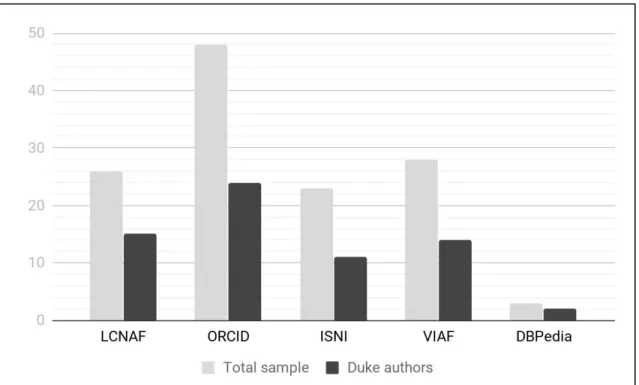
Internal Duke author data: Prior to further data analysis, one name was removed from the initial list of 92, as it was insufficiently clear whether the individual was affiliated with Duke (internal directory services returned multiple, undifferentiated results). Of the remaining 91 names, 41 (45.1%) had an entry in the Duke internal directory and were thus judged to have an affiliation with the university. 25 of 41 (roughly 61%) Duke-affiliated authors had profiles with Scholars@Duke, not all of whom were faculty (although all persons identified as faculty in the directory had a Scholars@Duke profile; an unsurprising finding, as faculty are mandated by the university to maintain such a profile)—in fact, 4 students also had Scholars@Duke profiles. None of the remaining 50 authors had a Scholars@Duke profile, which was anticipated, as Scholars@Duke is populated with data from the Duke faculty human resources database.
FIGURE 2: PERCENT OF TOTAL SAMPLE OF AUTHORS WITH
DUKE UNIVERSITY AFFILIATION
identified through Duke's internal data as either staff or faculty, and therefore presumably could be characterized as established researchers. Only one student had a LCNAF.
ORCID: Of the total sample, 48 authors, or approximately 52.7%, could be
positively associated with an ORCID profile, while a further 10 returned hits but could not be sufficiently differentiated. 24 of the 41 Duke-affiliated authors (58.5%) had
unambiguously associated ORCID profiles, while a further five were impossible to disambiguate. Within that Duke-affiliated sample, 16 of 24 authors were identified as faculty or staff, and the remaining 8 were identified as students. Within the ORCID system, it was in some cases impossible to determine whether or not an author had an identifier, as several authors returned multiple entries with no publicly available disambiguating information. This finding is consistent with Sanberg & Jin, who noted that "ORCID searches were complicated by a preponderance of identifiers that were attached to non-unique names and contained no other distinguishing information" (2016, p. 545).
ISNI: 23 authors had strong matches in the ISNI database, and an additional five were difficult to disambiguate. It should also be noted that several authors seemed to have multiple ISNIs assigned to them, while several others with ISNIs had only very brief stub records that were of limited utility in conducting differentiation. Among Duke affiliated authors, only 11 could be affirmatively associated with an ISNI, all 11 of which were identified by Duke as either faculty or staff. No students had an ISNI.
VIAF: 28 authors had VIAF records that were strong matches, and an additional 7 returned hits but were difficult to disambiguate. As with ISNIs, a few authors had multiple associated VIAF clusters and identifiers. Half of those with VIAF profiles were
DBPedia: Only 3 authors returned hits querying DBPedia, 2 of whom were Duke-affiliated Political Science Department faculty. Due to the sparsity of data available in this database, DBPedia was removed from any further analysis.
FIGURE 3: IDENTIFIER DISTRIBUTION BY DATABASE
Identifier distribution by discipline
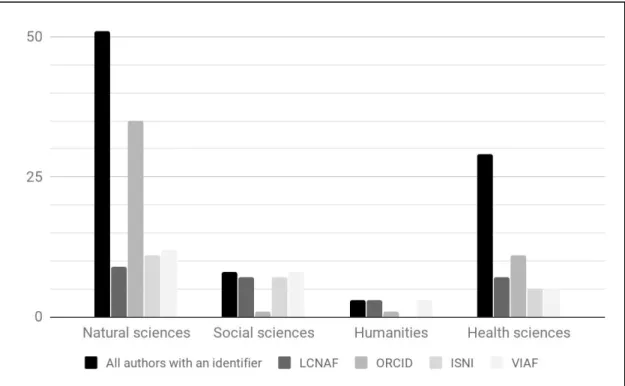
FIGURE 5: AUTHOR IDENTIFIER DISTRIBUTION BY DISCIPLINE, TOTAL SAMPLE
FIGURE 6: PERCENTAGE OF AUTHOR IDENTIFIERS BY DISCIPLINE PER DATABASE
Discussion
Research Question 1
● What does the identifier landscape look like for authors currently associated with
data set objects in the DDR? What percentage of data set authors are affiliated
with Duke and therefore have internal identity data? What percentage of these
authors already have associated external URIs?
As discussed above, a little less than half of the authors in the sample were Duke-affiliated, and just over half of those individuals had VIVO URIs available through Scholars@Duke, the preponderance of whom were classified as established researchers (faculty or staff). This breakdown is consistent with the literature, which addresses how the rise of cross-institutional collaboration and highly multi-authored scholarship, in which publications may list as many as 500 separate authors, means that institutional
repositories increasingly must prepare to accommodate metadata about content
produced at least in part by individuals with no affiliation to the local institution (Niu, 2013; Rotenberg & Kushmerick, 2011). The discrepancy in data availability between students and faculty or staff reflects the variation in identity management requirements around campus; faculty are required to maintain a VIVO profile, while expectations for students vary from department to department.
258). This disparity is also suggested by a recent review of ORCID adoption across disciplines conducted by the Technical and Human Infrastructure for Open Research Project, which found that biology, clinical medicine, and technology and other applied sciences were best represented in the ORCID system, while philosophy, theology, and the arts and general humanities were represented poorly by comparison (Dasler, Deane-Pratt, Lavasa, Rueda, & Dallmeier-Tiessen, 2017). Moreover, monographic academic publishing is rarely carried out by students, skewing representation in
traditional authority sources toward more established faculty. The sample data from the DDR generally follows these trends.
Research Question 2
● Can the DDR's research data repository avoid modeling people as data objects
by identifying an appropriate external database for author identities?
context and provenance of published data. Ideally, the data source to be leveraged would be one that includes entries for a "critical mass" of authors, both faculty and students.
Though the approach taken by Texas A&M University was appealing, given Duke's use of the VIVO-based platform Scholars@Duke, there were several concerns with
leveraging local human resources or other campus identity management data. While nearly all authors with a Duke affiliation could be identified by querying the Duke
directory, at least one author returned multiple results, none of which contained enough differentiating information to positively identify that individual. Moreover, the VIVO data published through Scholars@Duke is not historical, and profiles are removed when an individual leaves the institution. The sample analyzed in this study was known to contain a handful of researchers who were students at Duke when their data was published, but who have subsequently graduated. Even if these students had been affiliated with a department that required them to establish a Scholars@Duke profile, that data would be expunged from the system after that student graduated. Finally, any edits a researcher may wish to make to the human resources data underlying Scholars@Duke, such as a change in name, would require intervention on the part of administrative staff. Local authorities can be problematic because they are not guaranteed to be comprehensive or to preserve historical data about individuals who have left the institution, and they do not accommodate authors who were never institutionally affiliated; accounting for these cases has rarely been addressed in the literature to date.
is to leverage ORCIDs to exercise in-application name control. Although no one data source could be identified that provided comprehensive coverage of the authors in the sample, ORCID uptake among Duke authors is higher than among the other identifier systems surveyed. Moreover, the balance between students and faculty or staff in the system was much better for ORCID than for LCNAF, ISNI, or VIAF. ORCID identifiers were also found among all areas of research within the sample population, despite higher levels of uptake among the natural sciences and medical disciplines. It may be possible to increase uptake in the humanities and social sciences through policy implementation (for example, establishing an ORCID requirement to deposit data in the repository) or through targeted educational outreach on the part of the library. Most appealing about the use of ORCID data, however, may be the portable nature of the ORCID identifier, which will persist and be maintained even after the researcher leaves Duke.
Research Question 3
● Can external identifiers for those authors that are dereferenceable be stored in
the repository application in place of strings? Can a human readable label still be
used in the repository application interface?
The recommended integration of ORCID data with the Hyrax software borrows from the work generated by the LD4L project centered on the Questioning Authority (QA) and linked data gem. Although technical specifications here are sparse due to constraints on Duke developer time, this study recommends the following. Successful
obtained from the data depositor, have the application fetch and display the
human-readable label for the URI from the available ORCID RDF data, and store both the URI and the display label string with the object (Rayle, 2018). Ideally, the text string with the author label would display as hypertext that would allow an end user to resolve the stored URI, navigating to the author's ORCID profile for contextual information about that individual.
Research Question 4
● What is the recommended course of action for implementing name authority
control in a Hyrax repository using linked data design principles?
From a workflow and policy standpoint, this study recommends requiring an ORCID from an author who wishes to deposit data. As the preceding analysis of current author data suggests, not all depositing researchers will have such an identifier, so it is the recommendation of this report that a service be established to register ORCIDs for researchers who do not currently have one. A similar service was established at Texas A&M University, whereby ORCID registration for graduate students was integrated into the publishing process for electronic theses and dissertations. Staff at Texas A&M found that "the libraries' envisioned role as the issuer and maintainer of authoritative identifiers for campus research outputs fits well with its commitment to advancing changes in the scholarly communication system and is a natural extension of more traditional library functions such as cataloging locally produced content and maintaining name authority files" (Thomas, Chen, & Clement, 2015). Once an ORCID has been acquired for the
to include the researcher's ORCID with the the metadata registered during the process of assigning data sets a Digital Object Identifier (Haak et al., 2012).
Limitations
The broader implications or transferability of a project of this nature are inherently limited; authority control solutions that are appropriate in the context of one institutional repository may not hold for another. In particular, the Duke Digital Repository has a team of developers with the resources required to support customized, open-source repository software. Duke also has a team of curatorial staff within the libraries available to assist researchers with ORCID registration and to ensure that metadata is properly applied at the point of deposit. Smaller, less well-resourced organizations making use of vendor solutions, and who rely more heavily on self-deposit of materials may not have the wherewithal to implement such a solution. Moreover, the small size of the convenience sample of author names limits the transferability of the inferences made from the distribution of author identifiers (although it is helpful that a number of disciplines were represented, along with authors in disparate stages of their careers). These authors are, in a sense, self-selected as well; they are actively publishing data and are therefore likelier to have need of something like an ORCID to participate in the scholarly publishing system.
While the adoption of linked data principles in name authority control work may be broadly applicable beyond the Duke context, some challenges and larger questions remain. The concept of identity, both on the web and more theoretically, can be an exceptionally knotty one; it is also a concept that linked data is perhaps, ultimately,
in or meet the needs of all domains. For example, while a library may be content to point to a URI designating an entity that may only exist as a bibliographic persona (such as a pseudonym) to describe the creator of a resource, the use of an ISNI by a rights management agency to disburse royalties requires precisely identifying a real person, regardless of the pseudonyms they may use (Tillett, 2007, p. 345). Should pseudonyms or alternate forms of a given name be assigned distinct URIs? In what contexts should those disparate URIs be used? As Smith-Yoshimura, et al., caution
"[s]ometimes scholars deliberately maintain distinct identities when publishing in different subject areas or writing under pseudonyms. Privacy control is an additional layer of complexity to consider when developing mechanisms for associating IDs" (2014, p. 15).
Does linking a URI for an author's pseudonym to one that resolves to that author's real identity constitute a breach of privacy, and what responsibility do repository or other library staff bear for maintaining researcher anonymity or pseudonymity? Identity can quickly become a fluid notion that is dependent on context.
human-readable label, mitigates this concern. However, this issue perhaps speaks to some broader, lingering questions about how human users will interface with linked data in production.
Finally, this study was conducted in the setting of an institutional repository intended for campus research data; while the strategy outlined herein may be helpful for institutional repositories, it may also be of little use in controlling other names or
corporate bodies in a more traditional integrated library system. Additionally, the world of bibliographic and data control is intensely complex and the solutions proposed here will not necessarily apply to other controlled entities like works and expressions or subjects.
Conclusions and next steps
Perhaps the most salient limitation of this study centers around the lack of technical expertise involved; due to time constraints, the developer team was largely unavailable for consultation in formulating the recommendations of this study. Immediate next steps toward implementation involve coordination with the team of Duke developers to determine what may be feasible given the existing resources and technical capacity of the software stack. Implementation of broader policy goals, such as requiring ORCIDs from data depositors will likely be easier to achieve, as it does not require any
amendments to the technical infrastructure of the data deposit workflow, and is generally in line with the broader aims of the research data curation program at Duke. In addition, thought should be given to piloting educational outreach efforts around researcher identifiers, particularly ORCIDs, tailored for a social sciences and humanities audience.
of their materials within the broader research and publication lifecycle. Storing metadata about repository materials in a way that makes it easier to accomplish this goal is a good start. In light of the increasing focus on bibliometrics and other means of measuring the impact of research in discussions around academic career assessment, it is essential that repositories and libraries get this right, as the stakes are high for scholars. Especially in the case of early career researchers, helping to ensure that their work is visible and accurately counted is vital to career advancement.
Bibliography
Angjeli, A., MacEwan, A., & Boulet, V. (2014). ISNI and VIAF--Transforming ways of trustfully consolidating identities. Presented at IFLA 2014, Lyon, France. Retrieved from http://library.ifla.org/985/1/086-angjeli-en.pdf
Berners-Lee, T. (1998). Hypertext Style: Cool URIs don’t change. Retrieved from https://www.w3.org/Provider/Style/URI
Berners-Lee, T. (2006). Design note: Linked data. Retrieved from https://www.w3.org/DesignIssues/LinkedData.html
Bilder, G. (2011). Disambiguation without de-duplication: Modeling authority and trust in the ORCID system. Retrieved from
https://www.crossref.org/wp/labs/whitepapers/disambiguation-deduplication-wp-v4.p df
Bilenko, M., Mooney, R., Cohen, W., Ravikumar, P., & Fienberg, S. (2003). Adaptive name matching in information integration. IEEE Intelligent Systems, 18(5), 16–23.
Bizer, C., Heath, T., & Berners-Lee, T. (2009). Linked Data - The Story So Far. International Journal on Semantic Web and Information Systems, 5(3), 1–22.
Booth, D. (2016). URIs and the Myth of Resource Identity. Retrieved from http://dbooth.org/2006/identity/
Bremer, R., Folsom, S., Godby, J., Hawkins, L., Naun, C. C., Schiff, A., … Strawn, G. (2017).
PCC URI Task Group Report April 15, 2017. Program for Cooperative Cataloging.
https://www.loc.gov/aba/pcc/bibframe/TaskGroups/PCC_URI_TG_20170415_Report. pdf
Burke, S. K., & Shorten, J. (2010). Name Authority Work Today. Library Resources & Technical Services, 54(1), 4–20.
Coyle, K. (2010). Library data in the web world. Library Technology Reports, 46(2), 5–11. Cyganiak, R., Wood, D., Lanthaler, M., Klyne, G., Carroll, J. J., & McBride, B. (2014). RDF 1.1
concepts and abstract syntax. W3C Recommendation, 25(02). Retrieved from https://www.w3.org/TR/rdf11-concepts/
Dasler, R., Deane-Pratt, A., Lavasa, A., Rueda, L., & Dallmeier-Tiessen, S. (2017). Study of
ORCID Adoption Across Disciplines and Locations. Retrieved from
https://doi.org/10.5281/zenodo.841777
Delsey, T. (2004). Authority records in a networked environment. International Cataloguing and Bibliographic Control, 33(4), 71–74.
Glaser, H., & Halpin, H. (2012). The Linked Data Strategy for Global Identity. IEEE Internet Computing, 16(2), 68–71.
Haak, L. L., Fenner, M., Paglione, L., Pentz, E., & Ratner, H. (2012). ORCID: a system to uniquely identify researchers. Learned Publishing: Journal of the Association of Learned and Professional Society Publishers, 25(4), 259–264.
Halpin, H. (2006). Identity, reference, and meaning on the web. In Proceedings of the Workshop on Identity, Meaning and the Web (IMW06) at WWW2006, Edinburgh,
Scotland. Retrieved from
http://www.ra.ethz.ch/CDStore/www2006/www.ibiblio.org/hhalpin/irw2006/hhalpin.p df
When owl: sameas isn’t the same: An analysis of identity in linked data. International Semantic Web Conference, 305–320.
Hardesty, J. L., & Young, J. B. (2017). The semantics of metadata: Avalon Media System and the move to RDF. Code4Lib Journal, (37). Retrieved from
http://journal.code4lib.org/articles/12668
Harper, C. A., & Tillett, B. B. (2007). Library of Congress Controlled Vocabularies and Their Application to the Semantic Web. Cataloging & Classification Quarterly, 43(3-4), 47–68.
IFLA Working Group on Functional Requirements and Numbering of Authority Records. (2008). A review of the feasibility of an International Standard Data Authority Number (ISADN). Retrieved from
https://archive.ifla.org/VII/d4/franar-numbering-paper.pdf
Ilik, V. (2014). Cataloger Makeover: Creating Non-MARC Name Authorities. Cataloging & Classification Quarterly, 53(3-4), 382–398.
Jacobs, I., & Walsh, N. (2004). Architecture of the World Wide Web, Volume One. Retrieved from https://www.w3.org/TR/webarch/
Jaffri, A., Glaser, H., & Millard, I. (2007). URI Identity Management for Semantic Web Data Integration and Linkage. Lecture Notes in Computer Science, 125–1134.
Jaffri, A., Glaser, H., & Millard, I. (2008). URI Disambiguation in the Context of Linked Data. Presented at the Linked Data on the Web (LDOW2008). Retrieved from
https://eprints.soton.ac.uk/265181/
Lemus-Rojas, M., & Odell, J. (2018). From Wikidata to Scholia: creating structured linked
data to generate scholarly profiles. Presented at the Code4Lib Annual Conference.