S T U D Y P R O T O C O L
Open Access
The comparative effectiveness of decision
aids in diverse populations with early stage
prostate cancer: a study protocol for a
cluster-randomized controlled trial in the
NCI Community Oncology Research
Program (NCORP), Alliance A191402CD
Joel E. Pacyna
1, Simon Kim
2, Kathleen Yost
1, Hillary Sedlacek
2, Daniel Petereit
3, Judith Kaur
4, Bruce Rapkin
5,
Robert Grubb
6, Electra Paskett
7, George J. Chang
8, Jeff Sloan
9, Ethan Basch
10, Brittny Major
9, Paul Novotny
1,
John Taylor
11, Jan Buckner
1, J. Kellogg Parsons
12, Michael Morris
13and Jon C. Tilburt
1*Abstract
Background:Treatments for localized prostate cancer present challenging tradeoffs in the face of uncertain treatment benefits. These options are best weighed in a process of shared decision-making with the patient’s healthcare team. Minority men experience disparities in prostate cancer outcomes, possibly due in part to a lack of optimal communication during treatment selection. Decision aids facilitate shared decision-making, improve knowledge of treatment options, may increase satisfaction with treatment choice, and likely facilitate long-term quality of life.
Methods/design:This study will compare the effect of two evidence-based decision aids on patient knowledge and on quality of life measured one year after treatment, oversampling minority men. One decision aid will be administered prior to specialist consultation, preparing patients for a treatment discussion. The other decision aid will be administered within the consultation to facilitate transparent, preference-sensitive, and evidence-informed deliberations. The study will utilize a four-arm, block-randomized design to test whether each decision aid alone (Arms 1 and 2) or in combination (Arm 3) can improve patient knowledge and quality of life compared to usual care (Arm 4). The study, funded by the National Cancer Institute’s Community Oncology Research Program (NCORP), will be deployed within select institutions that have demonstrated capacity to recruit minority populations into urologic oncology trials.
Discussion:Upon completion of the trial, we will have 1) tested the effectiveness of two evidence-based decision aids in enhancing patients’ knowledge of options for prostate cancer therapy and 2) estimated whether decision aids may improve patient quality of life one year after initial treatment choice.
Trial registration:Clinicaltrials.gov: NCT03103321. The trial registration date (on ClinicalTrials.gov) was April 6, 2017.
Keywords: Prostate cancer, Clinical trial, Decision aid, Shared decision-making
* Correspondence:[email protected] 1Mayo Clinic, Rochester, MN, USA
Full list of author information is available at the end of the article
Introduction
Men with newly diagnosed localized prostate cancer face challenging treatment decisions. Surgery and radiation therapy are effective treatments, but each has different quality of life implications for men and their partners. These treatments, although potentially life-saving, impose their own burden related to treatment side effects. Some men may benefit from a monitoring approach called“ ac-tive surveillance”if they have early, slow-growing prostate cancer. Making the right treatment choice depends of men being given all appropriate options and making sure they have a high-quality conversation with their specialist. This process creates substantial cognitive and emotional burden. Identifying a course of treatment that accords with patient goals and preferences for cancer control while attending to important quality of life trade-offs is crucial to minimizing the overall burden of the prostate cancer. Thus, prostate cancer treatment provides a crucial oppor-tunity for patients and clinicians to engage in shared decision-making.
Prostate cancer disproportionately affects African-American (AA) men. Previous studies suggest that AA men have a higher incidence of more aggressive or ad-vanced stage prostate cancer and cancer-specific mortal-ity compared to the general population. [1–4] American Indian men from the Northern and Southern Plains also experience disparities in prostate cancer stage and sur-vival comparable to AA men; prostate cancer is also the second leading cause of cancer-related mortality in American Indian men overall. [5, 6] Historically, AA men are less likely to receive radiation therapy or undergo surgery, and more likely to receive “watchful waiting” or active surveillance, despite having a higher incidence of intermediate and high-risk prostate cancer. [7–13] Minority men who undergo definitive therapy are more likely to experience treatment regret and greater functional outcome burden. [14, 15] Although little research has been dedicated to treatment variation in American Indian men, a recent report suggested that this underserved population also has lower rates of definitive treatment following a diagnosis of prostate cancer. [5]
American Indian and Alaska Native (AI/AN) men experi-ence greater prostate cancer mortality than non-Hispanic whites. [6] In Hispanic/Latino men disparities are less clear. In general, although national data do not suggest major outcome disparities in this group, local and regional studies and patterns-of-care studies review pockets of disparities particularly related to delays in care or different treatment patterns for Hispanic/Latino men. [16–22]
Minority men in general experience disparities in pros-tate cancer knowledge and care patterns, and they suffer from more functional outcome morbidity in prostate can-cer. [1–4] Combined, these disparities compound known
disease burden differences in these populations. Studies have documented lower levels of knowledge about pros-tate cancer among AA men compared with other racial/ ethnic groups. [23] Poorer outcomes among minority prostate cancer patients may arise from factors beyond healthcare access. Worse functional outcomes result from overly aggressive treatment, while worse mortality out-comes likely result from under-aggressive treatment. On the one hand greater use of aggressive therapies could save lives, but could at the same time exacerbate existing disparities in functional outcomes associated with aggres-sive therapy.
Disparities also may be rooted, at least in part, in preference-discordant treatment choices stemming from poor communication between physicians and their mi-nority patients. Shared decision-making (SDM) may be especially difficult to achieve when patients’literacy and culturally mediated values challenge the biomedical es-tablishment’s attempts to communicate the complexity surrounding modern treatment choices. In addition to myriad patient and health system factors including no/ under insurance, ability to get insurance coverage, access to health care services, access to second opinions, and the influence of common comorbid health conditions, communication breakdown (failure to achieve SDM) may compound racial/ethnic disparities in treatment outcomes.
specialist consultation and a conversation-facilitating de-cision aid tool with fewer details (Prostate Choice) deliv-ered during specialist consultation—in a four-arm trial testing each decision aid alone and in combination com-pared to usual care. Patient knowledge about prostate cancer treatments will be our primary outcome mea-sured immediately after the index consultation with a urology specialist. We will oversample minority popula-tions to determine whether the decision aids mitigate disparities across race/ethnic groups in their measured knowledge of prostate cancer and its treatments.
Methods Design
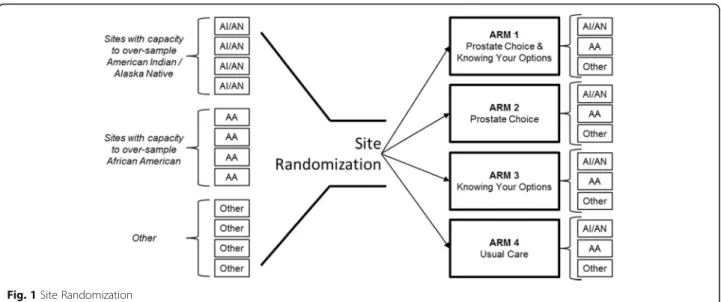
We will use a cluster-randomized controlled trial to compare the effectiveness of the two decision aids alone and in combination. The trial will feature four arms. Two arms will incorporate one of the two decision aids. A third arm will incorporate both decision aids, and the fourth arm will be usual care (i.e., no intervention). Randomization will occur on the site level—entire ur-ology practices will be randomized to one of the study arms. This will protect against contamination, a major concern for studies comparing care delivery interven-tions. [26] The study will be conducted in clinical set-tings where patients have recently learned about their diagnosis of localized prostate cancer and are receiving their first consultation about treatment options.
Setting
Our study will be conducted among institutions which are components of National Cancer Institute’s National Com-munity Oncology Research Program (NCORP) sites. While the parent NCORP Research Base for this trial is the Alliance for Clinical Trials in Oncology (Alliance), members of other bases (SWOG and ECOG-ACRIN) will also be allowed to participate. These groups are members of the National Cancer Institute (NCI) National Clinical Trials Network (NCTN). The trial is sponsored by the Al-liance Disparities and Cancer Care Delivery Research (CCDR) committees and funding for the study is available to NCTN group members as part of NCORP CCDR-des-ignated award funds. NCI defines CCDR research as “multidisciplinary science that examines how patient and clinician behavior, organizational structures, health tech-nologies, and financing approaches influence the availabil-ity, qualavailabil-ity, cost, and outcomes of cancer care. CCDR generates evidence that can be used to improve clinical practice patterns as well as develop and test promising in-terventions within the health care delivery system.” [27] Several participating sites are designated by NCORP as “Minority / Underserved” research centers and have demonstrated success in reaching our target minority populations.
Participants
Inclusion and exclusion criteria
Our trial will enroll men with a new diagnosis of non-metastatic prostate cancer. Eligible participants must have a prostate biopsy not older than 4 months at the time of enrollment. Patients may have a Gleason score from 6 to 10 and must have a prostate-specific antigen (PSA) less than 50 ng/ml. Patients must be enrolled in the study after notification of a positive biopsy but before receiving any consultation about treatment options. Patients presenting for a second opinion are not eligible. Patients must be able to read and comprehend English. In lieu of this require-ment, an English-proficient caregiver or clinical / research support staff may assist participants in reading or transla-tion analogous to clinical care. Participants will not be en-rolled who have had another non-cutaneous malignancy in the previous 5 years. Patients with a history of non-melanoma skin cancer are eligible to participate. Our trial will oversample African American (AA), American Indian/Alaska Native (AI/AN), and Hispanic (HS) men. At least 50% of the study’s total enrollment will draw from these target populations. Sites will be instructed to limit recruitment of men from other racial and ethnic sub-groups to 50% to achieve minority recruitment targets.
Site recruitment
Because of the study design and target enrollment goals, a sufficient number of minority-oriented sites have been identified. The block-randomization study design includes 20 participating sites divided equally across the four arms (see Fig.1), and each site must recruit similar numbers of participants based on our power calculations. In order to participate in our trial, urology practices must be rostered as funded components of the NCORP institutions who re-ceive CCDR funds. In addition to the requirements of the funding structure, qualifying sites must also have urology practices with urologists who are capable and willing to deliver decision-aid interventions in conjunction with their standard care practices for patients with new pros-tate cancer diagnoses. These requirements for site eligibil-ity require significant communication between the study team and sites meeting the NCORP criteria, to determine which sites have the capacity and interest to participate.
Participant recruitment
arms) occur after diagnosis notification and prior to the specialist consultation. Each site will develop methods for identifying eligible patients ahead of visits and for recruit-ing patients in a way that avoids the possibility of inadvert-ent diagnosis disclosure by study staff.
Interventions
The trial intervention arms consist of one or both deci-sion aids targeting men with non-metastatic prostate cancer. The decision aids are designed to convey infor-mation about prostate cancer and its treatments in order to enable patients to make more informed treatment choices under the guidance of their physician. Neither decision aid is intended to displace fundamental aspects of the consultation or constrain physicians’ ability to make treatment recommendations. Two decision aids are being tested in our trial—the Prostate Choice tool which was developed and tested by the study team, and theKnowing Your Optionstool developed by the Agency for Healthcare Research and Quality. [28]
Prostate choice
The Prostate Choice decision aid was originally devel-oped by members of the study team in 2011. In prepar-ation for the trial reported here, the decision aid was revised, and culturally and cognitively tested in focus groups comprising members of our target minority pop-ulations. It is a “text-light” tool incorporating the best available evidence in a literacy-sensitive, web-based de-sign to orient patients toward the range of consider-ations and goals for prostate cancer therapy, including cancer control and quality of life implications. The tool incorporates clinical variables including patients’ age, PSA, primary and secondary Gleason scores, clinical sta-ging, and number of positive and negative biopsy cores. These data are used to return a D’Amico risk category
[29] in a summary screen in the tool. The tool also col-lects co-morbidity variables to return an age and co-morbidity adjusted life expectancy on the summary screen. Patient quality of life priorities are also gathered via the EPIC 26 prostate cancer quality of life measure [30] and some simple visual analogue scales eliciting pa-tients’relative priorities regarding cancer control, bowel and urinary control, and sexual function. All results are provided on a single summary screen along with options for viewing summary information about treatment mo-dalities in pop-up screens for in-visit use. Importantly, active surveillance is presented as a peer-level “therapy” along with surgical and radiation options and hormone therapy. The summary screen becomes the main focus of attention in the consultation, and it allows patients to “drive”the conversation by gravitating toward the elements on the summary screen that are most salient to their decision-making intuitions. TheProstate Choicetool is not intended to constrain clinician advice regarding treatment choices. The specialty clinician may incorporate the tool and still make clinical recommendations, including strongly encouraging or discouraging certain treatment options. The goal, however, is to situate those recommendations within patient-driven, preference-sensitive education in the range of treatments and their situation-specific strengths and lim-itations. Participating clinicians will be given brief orienta-tion videos to explain the tool’s use and on-site training by study staff is available on an as-needed basis.
Knowing your options
The Knowing Your Options tool is a publicly available web-based tool designed and supported by the Agency for Healthcare Quality and Research (AHRQ): https://effecti-vehealthcare.ahrq.gov/topics/decision-aids/prostate-cancer. In contrast to theProstate Choice Tool, theKnowing Your Options Tool (KYO) is text-heavy, with multiple screens
and requiring significant page scrolling. Prostate cancer and specific information about its diagnosis and prognosis are described in detail, and the range of treatment options are described and visualized. The Knowing Your Options tool is an evidence-based tool that was originally designed to be used by the patient outside of and prior to a specialist consultation (perhaps at home) to enhance the treat-ment decision-making process. Similar to Prostate Choice, KYO also collects users’ relevant clinical in-formation for prostate cancer severity and risk of cancer-specific mortality. KYO also queries patients about quality of life priorities relevant to the different primary treatment options for prostate cancer. To our knowledge the efficacy of KYO in increasing patients’ knowledge about prostate cancer treatment options has not been formally tested.
Outcomes and data collection
Primary outcome: Knowledge
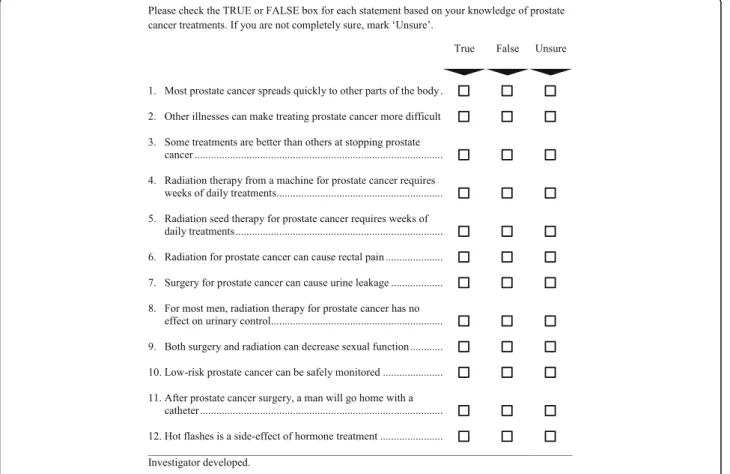
The primary outcome of our study is knowledge about prostate cancer treatments measured immediately after the consultation with the urologist. While consensus is lacking on how to measure shared decision-making, measuring knowledge about treatment options is commonly used as a reliable proxy. [31] To measure knowledge, we designed a
12-item knowledge measure—the Prostate Cancer Treat-ment Questionnaire. The items for this measure were identified by urology experts based on content validity of clinical consideration of essential knowledge needs for patients facing decisions about prostate cancer treatment (see Fig.2). As a pragmatic measure, our instrument omits items about prostate cancer anatomy and physiology and focuses instead on questions regarding disease severity and the implications of the major treatment modalities for sur-vival and quality of life. We conducted cognitive testing of draft measures with 10 prostate cancer survivors to ensure that respondents understand the questions as intended, that the questions are interpreted consistently by all respon-dents, and that respondents are willing to answer the ques-tions. [32] Cognitive testing and input from our patient advocate advisory panel led to refinement of the items. In-stitutional review board (IRB)-approved pilot testing was then conducted in 45 men presenting at the urology de-partment at Mayo Clinic for consultation about treatment choices for a new diagnosis of prostate cancer. Preliminary analyses confirmed that the measure targeted a moderate level of knowledge and could be used to identify improve-ment in knowledge (i.e., the measure did not suffer from ceiling effects). The 12 items were moderately correlated (Cronbach’s alpha of 0.62). Knowledge scores (number of
correct answers) were significantly correlated in a hypothe-sized direction with higher educational attainment (p= 0.02), evidence of concurrent validity. (i.e. knowledge scores increase with increasing levels of educational attainment).
Secondary outcomes: Decisional conflict and regret
The decisional conflict scale was developed and vali-dated by O’Connor [33] as an instrument intended to “elicit 1) health-care consumers’uncertainty in making a health-related decision; 2) the factors contributing to the uncertainty; and 3) health-care consumers’perceived ef-fective decision-making.” The low literacy version of this questionnaire will be used, and it contains 10 items an-swered on a 3 point scale (i.e.,“yes,” “unsure,” “no”) and may be adapted to specific health-care decision scenar-ios. Example questions include agreement with the fol-lowing statements: “Did you know which options were available to you?”,“Did you know the benefit of each op-tion?,” “Did you feel sure about what to choose?” The questionnaire will be administered once, immediately after the consultation (post-consultation). We estimate it will take participants approximately 5–7 min to complete this questionnaire. O’Connor has identified meaningful decisional conflict thresholds—scores less than 25 (associated with implementing decisions) and scores above 37.5 (associated with decision delay and uncertainty). [34] Decisional conflict will serve as an im-portant corroborating measure in our assessment of ef-fectiveness of decision aids. At 12 months, we will administer the Decision Regret Scale (also designed and validated by O’Connor and colleagues). [35] Decisional Regret has been correlated with Decisional Conflict. The Decisional Regret scale is a short, 5-item scale measur-ing “distress or remorse after a (health care) decision.” Questions are answered on a 5-point agreement scale.
Exploratory secondary outcomes: Treatment choice and quality of life
At 12 months post-intervention we will measure patient’s quality of life via the Expanded Prostate Cancer Index Composite (EPIC-26) quality of life scale for urologic func-tioning. This instrument measures health-related quality of life and returns summary scores for urinary, bowel, sexual, and hormonal domains with high test-retest reliability and internal consistency. As an exploratory aim, we will analyze 12-month quality of life (QOL) data to check for minority subgroup difference and differences between intervention arms. At 12 months we will also ascertain via chart review the patient’s treatment choice following the intervention. Treatment utilization will be categorized by the type of treatment the patient had (surgery vs. radiation vs. active surveillance). If we accrue > 10% of our study population among those whose primary language is Spanish, we will
conduct exploratory analyses on differential effects of the intervention in this sub-group.
Statistical considerations
Sample size
A recent Cochrane review suggests that most patients can accurately answer 50% (standard deviation of 12%) of the questions asked of them. [36] On average, decision aids (DAs) increase that knowledge by at least a 20% (and in some cases as high as 60%) increase in questions asked be-ing answered correctly, but 95% of trials show absolute knowledge increases of 10% or greater. We will consider an absolute 8% or larger increase (equivalent to one add-itional item answered correctly in our 12-item measure) in knowledge as clinically meaningful for either the during-consultation or pre-consultation DA in this clinical trial. The four arms of this study make up a 2 X 2 factorial design. Thus, it is natural to consider evaluating the deci-sion aids using a two-way analysis of variance (ANOVA). The two factors in the ANOVA will be 1) having received during-consultation Prostate Choice (yes or no) and 2) having received pre-consultation DA (yes or no). We will consider simultaneously testing (at a significance level of 0.025 for each test) the main effects of the two decision aids as our primary analysis. That is, we will simultan-eously test the null hypothesis that the average knowledge (i.e., the percent of correct responses to questions) among those who received the pre-consultation DA is equal to that among those who did not (vs. an alternative that these two averages are not equal), and the null hypothesis that the average knowledge among those who received the during-consultation Prostate Choice is equal to that among those who did not (vs. an alternative that these two averages are not equal).
from each site (on average) to achieve a total enrollment of 100 patients.
We cannot assume that participants within each site will be independent of each other given our design. Our actual sample size estimate accounts for clustering by site. Assuming the intra-site correlation coefficientρwill be approximately 0.1 (rather than zero) for all study sites, we inflate the target sample size by a factor [37] of 1 + (m-1)ρ= 1 + (5–1)*0.1 = 1.4 to achieve comparable power to that in a patient-level randomized trial. We would then target an effective sample size of 140 pa-tients (approximately 35 papa-tients per arm, 7 papa-tients per site). To account for withdrawal and loss to follow-up for longer term secondary outcomes and allow increased power to detect racial/ethnic differences, we have further inflated the total sample size by 20% to a total number of 172 patients. These 172 patients, recruited from 20 participating sites (about 8–9 patients per site) will re-ceive the intervention (or control) to which their loca-tion is randomized. Of these, we anticipate recruiting 86 men from African American, American Indian race, and/or Hispanic/Latino ethnicity.
Analysis of primary outcome
The primary outcome, knowledge, will be assessed by a standardized questionnaire (the Prostate Cancer Treat-ment Questionnaire) administered once, immediately after the clinical consultation while the patient is still at the study site. The number correct from this 12-item measure will be scored as a percent.
A pre-post method for measuring knowledge was con-sidered. However, several factors led us to favor a one-time post-intervention measurement: 1) Our study’s randomized design should control for differences in baseline knowledge; 2) a pre-post design could be con-founded by learning effects associated with the baseline measurement since the baseline and post-intervention measurements would only be 1–2 h apart. Such learning affects could lead to artificial improvements in our con-trol group which could limit our ability to see“true” dif-ferences attributable to the intervention(s); and 3) a one-time measurement of knowledge will minimize bur-den to responbur-dents, particularly during the consenting and baseline measurement period where we attempt to impose as little disruption to clinical workflows as possible.
Although the randomization unit will be the partici-pating site, our inferential unit for statistical analysis will be the individual patient. Due to the potential for correl-ation among patients within the same site, a mixed ef-fects regression model (also known as random efef-fects model or multi-level model) will be utilized to examine the effects of the during-consultation Prostate Choice and the pre-consultationKnowing Your Optionsdecision
aids. [38] Specifically, this model will contain a fixed intercept, a fixed effect for having received Prostate Choice, a fixed effect for having received Knowing Your Options, and a random, site-specific intercept to allow patients within the same site to be correlated. Baseline patient-level characteristics including race, ethnicity, cancer stage and grade, and site-level characteristics may be incorporated in this model if deemed appropriate. A similar approach will be utilized in the statistical analysis of secondary endpoints. Furthermore, descriptive statis-tics will be reported after incorporating cluster informa-tion, particularly the empirical cluster size, and the observed intra-cluster correlation.
An interim analysis will be used to test if the interven-tion arm (either during-consultainterven-tion Prostate Choice or Knowing Your Options pre-consultation DA) has pro-duced better knowledge than the respective control arm. This study will also be monitored for futility. At interim analysis, a 95% one-sided confidence interval on the dif-ference of knowledge between the intervention and con-trol arm will be computed. If the confidence interval does not cover the target alternative of 0.1 for one of these comparisons, the DSMB may consider stopping the trial early.
Analysis of secondary outcomes
Decisional quality, average clinical time required, and pa-tient QOL scores will be compared across study arms using linear mixed models similar to that used to assess the primary endpoint. In particular, this model will include fixed effects for Prostate Choice and Knowing Your Op-tions and a random, site-specific intercept to allow for subjects within the same site to be correlated. Utilization will be compared across DA types using a generalized lin-ear mixed model, again with fixed effects for having re-ceivedProstate Choiceand having receivedKnowing Your Optionsand a random, site-specific intercept.
absolute difference of 8% in knowledge for either of the decision aids’ main effects using a two-sample t-test (with two-sided alternative) with a 2.5% significance level (i.e. the same analysis/assumptions used to power the primary analysis). If subtle but potentially important trends in subgroup differences are identified in these ex-ploratory analyses, those findings could be used to justify a larger study examining a primary hypothesis related to racial/ethnic difference or could influence the design of subsequent culturally tailored interventions. At present, the science of decision aids and the state of the evidence surrounding racial/ethnic differences in the effect of de-cision aids would not support testing such a hypothesis as a primary endpoint.
Discussion
Preference-sensitive decisions involve uncertainty about net outcome benefit, making patient values and prefer-ences paramount in the treatment decision. [39–41] Be-cause of the lack of clinical trial data suggesting a superior initial active prostate cancer therapy, physicians should help their patients successfully deliberate about the quality of life implications and burdens of different primary treatments to reach a decision that embodies the principles of shared decision-making (SDM). SDM is a model of evidence disclosure and values elicitation intended for preference-sensitive decisions and is en-dorsed by all major professional societies. [42–45]
By incorporating decision aids into the patient experi-ence of receiving clinical guidance and treatment for prostate cancer, we may make critical progress toward shared decision-making in urologic oncology, especially in those patients whose cultural affinities add complexity to effective communication between provider and pa-tient. Decision aids that are sensitive to cultural norms and that enable patient-driven conversation about treat-ment options for prostate cancer may hold one of the keys to reducing known disparities in prostate cancer treatment and outcomes. At the conclusion of our trial, we will have data showing the impact of decisions aids on patient knowledge in a sample enriched with minor-ity men with new diagnoses of prostate cancer.
Acknowledgements
Not applicable.
Funding
Funding for this study is provided by grant R01MD008934 from the National Institute on Minority Health and Health Disparities and by the National Cancer Institute of the National Institutes of Health under the Award Number UG1CA189823 to the Alliance for Clinical Trials in Oncology NCORP Research Base (Jan C. Buckner, M.D., contact PI). The content is solely the responsibility of the authors and does not necessarily represent the official views of the National Institutes of Health.
Availability of data and materials
Not applicable.
Authors’contributions
JEP, SK, KY, HS, DP, JK, BR, RG, EP, GC, JS, EB, BM, PN, JT, JB, MM, JP, and JCT all contributed to the design of the study protocol. All authors read and approved the final manuscript.
Ethics approval and consent to participate
The study has been reviewed and approved by the National Cancer Institute (NCI)‘s Division of Cancer Prevention and Control (DCP) Central IRB (CIRB). Consent for trial participation will be obtained with a written consent form which has been approved by the CIRB.
Consent for publication
Not applicable.
Competing interests
The authors report no conflicts of interest in the conduct and reporting of this study.
Publisher’s Note
Springer Nature remains neutral with regard to jurisdictional claims in published maps and institutional affiliations.
Author details
1Mayo Clinic, Rochester, MN, USA.2University Hospitals, Case Western
Reserve University, Cleveland, OH, USA.3Regional Health, Rapid City, SD, USA. 4Mayo Clinic, Jacksonville, FL, USA.5Albert Einstein Cancer Center, Bronx, NY,
USA.6Medical University of South Carolina, Charleston, SC, USA.7Ohio State University, Columbus, OH, USA.8MD Anderson Cancer Center, Houston, TX, USA.9Alliance Statistics And Data Center, Mayo Clinic, Rochester, MN, USA. 10University of North Carolina, Chapel Hill, North Carolina, USA.11University
of Chicago, Chicago, IL, USA.12Moores UC San Diego Comprehensive Cancer Center, San Diego, CA, USA.13Memorial Sloan Kettering Cancer Center, New York, NY, USA.
Received: 26 March 2018 Accepted: 17 July 2018
References
1. Bach PB, Schrag D, Brawley OW, Galaznik A, Yakren S, Begg CB. Survival of blacks and whites after a cancer diagnosis. JAMA. 2002;287(16):2106–13. 2. Cohen JH, Schoenbach VJ, Kaufman JS, et al. Racial differences in
clinical progression among Medicare recipients after treatment for localized prostate cancer (United States). Cancer causes & control : CCC. 2006;17(6):803–11.
3. Du XL, Fang S, Coker AL, et al. Racial disparity and socioeconomic status in association with survival in older men with local/regional stage prostate carcinoma: findings from a large community-based cohort. Cancer. 2006; 106(6):1276–85.
4. Godley PA, Schenck AP, Amamoo MA, et al. Racial differences in mortality among Medicare recipients after treatment for localized prostate cancer. J Natl Cancer Inst. 2003;95(22):1702–10.
5. Espey DK, Wu XC, Swan J, et al. Annual report to the nation on the status of cancer, 1975-2004, featuring cancer in American Indians and Alaska natives. Cancer. 2007;110(10):2119–52.
6. Henderson JA, Espey DK, Jim MA, German RR, Shaw KM, Hoffman RM. Prostate cancer incidence among American Indian and Alaska native men, US, 1999-2004. Cancer. 2008;113(5 Suppl):1203–12.
7. Hoffman RM, Harlan LC, Klabunde CN, et al. Racial differences in initial treatment for clinically localized prostate cancer. Results from the prostate cancer outcomes study. J Gen Intern Med. 2003;18(10):845–53.
8. Klabunde CN, Potosky AL, Harlan LC, Kramer BS. Trends and black/white differences in treatment for nonmetastatic prostate cancer. Med Care. 1998; 36(9):1337–48.
9. Pisu M, Oliver JS, Kim YI, Elder K, Martin M, Richardson LC. Treatment for older prostate cancer patients: disparities in a southern state. Med Care. 2010;48(10):915–22.
11. Trinh QD, Sammon J, Sun M, et al. Perioperative outcomes of robot-assisted radical prostatectomy compared with open radical prostatectomy: results from the nationwide inpatient sample. Eur Urol. 2012;61(4):679–85. 12. Underwood W, 3rd, Jackson J, Wei JT, et al. Racial treatment trends in
localized/regional prostate carcinoma: 1992-1999. Cancer 2005;103(3):538–545. 13. Wong YN, Mitra N, Hudes G, et al. Survival associated with treatment vs
observation of localized prostate cancer in elderly men. JAMA. 2006;296(22): 2683–93.
14. Hu JC, Kwan L, Krupski TL, et al. Determinants of treatment regret in low-income, uninsured men with prostate cancer. Urology. 2008;72(6):1274–9. 15. Hu JC, Kwan L, Saigal CS, Litwin MS. Regret in men treated for localized
prostate cancer. J Urol. 2003;169(6):2279–83.
16. Hosain GM, Sanderson M, Du XL, Chan W, Strom SS. Racial/ethnic differences in treatment discussed, preferred, and received for prostate cancer in a tri-ethnic population. Am J Mens Health. 2012;6(3):249–57. 17. Kim SP, Boorjian SA, Shah ND, et al. Disparities in access to hospitals with
robotic surgery for patients with prostate cancer undergoing radical prostatectomy. J Urol. 2013;189(2):514–20.
18. Pitman M, Korets R, Kates M, Hruby GW, McKiernan JM. Socioeconomic and clinical factors influence the interval between positive prostate biopsy and radical prostatectomy. Urology. 2012;80(5):1027–32.
19. Siegel R, Naishadham D, Jemal A. Cancer statistics for Hispanics/Latinos, 2012. CA Cancer J Clin. 2012;62(5):283–98.
20. Siegel RL, Fedewa SA, Miller KD, et al. Cancer statistics for Hispanics/Latinos, 2015. CA Cancer J Clin. 2015;65(6):457–80.
21. White A, Coker AL, Du XL, Eggleston KS, Williams M. Racial/ethnic disparities in survival among men diagnosed with prostate cancer in Texas. Cancer. 2011;117(5):1080–8.
22. Winkfield KM, Chen MH, Dosoretz DE, et al. Race and survival following brachytherapy-based treatment for men with localized or locally advanced adenocarcinoma of the prostate. Int J Radiat Oncol Biol Phys. 2011;81(4): e345–50.
23. Allen JD, Kennedy M, Wilson-Glover A, Gilligan TD. African-American men's perceptions about prostate cancer: implications for designing educational interventions.Social science & medicine (1982).2007;64(11):2189–2200. 24. Stacey D, Legare F, Lewis K, et al. Decision aids for people facing health
treatment or screening decisions.The Cochrane database of systematic reviews.2017;4:Cd001431.
25. Trikalinos TA, Wieland LS, Adam GP, Zgodic A, Ntzani EE. AHRQ Comparative Effectiveness Reviews.Decision Aids for Cancer Screening and Treatment. Rockville (MD): Agency for Healthcare Research and Quality (US); 2014. 26. Brown AW, Li P, Bohan Brown MM, et al. Best (but oft-forgotten) practices:
designing, analyzing, and reporting cluster randomized controlled trials. Am J Clin Nutr. 2015;102(2):241–8.
27. National Cancer Institute. Cancer Care Delivery Research (CCDR) within the NCI Community Oncology Research Program (NCORP). 2017;https:// healthcaredelivery.cancer.gov/ccdr/. Accessed September 15, 2017. 28. Agency for Healthcare Research and Quality - U.S. Department of Health &
Human Services. Knowing Your Options: A Decision Aid for Men with Clinically Localized Prostate Cancer. https://effectivehealthcare.ahrq.gov/ topics/decision-aids/prostate-cancer. Accessed 6 Dec 2017.
29. D'Amico AV, Whittington R, Malkowicz S, et al. Biochemical outcome after radical prostatectomy, external beam radiation therapy, or interstitial radiation therapy for clinically localized prostate cancer. JAMA. 1998;280(11):969–74.
30. Wei JT, Dunn RL, Litwin MS, Sandler HM, Sanda MG. Development and validation of the expanded prostate cancer index composite (EPIC) for comprehensive assessment of health-related quality of life in men with prostate cancer. Urology. 2000;56(6):899–905.
31. Sepucha KR, Borkhoff CM, Lally J, et al. Establishing the effectiveness of patient decision aids: key constructs and measurement instruments.BMC medical informatics and decision making.2013;13 Suppl 2:S12.
32. Collins D. Pretesting survey instruments: an overview of cognitive methods. Quality of life research : an international journal of quality of life aspects of treatment, care and rehabilitation. 2003;12(3):229–38.
33. O'Connor AM. Validation of a decisional conflict scale. Medical decision making : an international journal of the Society for Medical Decision Making. 1995;15(1):25–30.
34. O'Connor AM. User manual - decisional conflict scale. 2010;https:// decisionaid.ohri.ca/eval_dcs.html. Accessed December 6, 2017.
35. Brehaut JC, O'Connor AM, Wood TJ, et al. Validation of a decision regret scale. Medical decision making : an international journal of the Society for Medical Decision Making. 2003;23(4):281–92.
36. Stacey D, Legare F, Lewis KB. Patient decision aids to engage adults in treatment or screening decisions. JAMA. 2017;318(7):657–8. 37. Donner A, Klar N. Design and analysis of cluster randomization trials in
health research. London: Arnold; 2000.
38. Chu R, Thabane L, Ma J, Holbrook A, Pullenayegum E, Devereaux PJ. Comparing methods to estimate treatment effects on a continuous outcome in multicentre randomized controlled trials: a simulation study. BMC Med Res Methodol. 2011;11:21.
39. Keirns CC, Goold SD. Patient-centered care and preference-sensitive decision making. JAMA. 2009;302(16):1805–6.
40. O'Connor AM, Llewellyn-Thomas HA, Flood AB. Modifying unwarranted variations in health care: shared decision making using patient decision aids.Health affairs (Project Hope).2004;Suppl Variation:Var63–72. 41. Wennberg JE, Fisher ES, Skinner JS. Geography and the debate over
Medicare reform.Health affairs (Project Hope).2002;Suppl Web Exclusives: W96–114.
42. Berwick DM. Quality chasm factors. Health affairs (Project Hope). 2002;21(5): 301–2. author reply 303
43. Berwick DM. A user's manual for the IOM's 'Quality Chasm' report. Health affairs (Project Hope). 2002;21(3):80–90.
44. Mohler J, Bahnson RR, Boston B, et al. NCCN clinical practice guidelines in oncology: prostate cancer. Journal of the National Comprehensive Cancer Network : JNCCN. 2010;8(2):162–200.