Swarm intelligence grouping of e-learners using
fuzzy inspired PSO method
Fatemeh Ghorbani
Information Technology Department, School of Engineering, Tarbiat Modares University
Tehran, Iran
Gholam Ali Montazer
Information Technology Department, School of Engineering, Tarbiat Modares University
Tehran, Iran [email protected]
Received: June 12, 2013-Accepted: December 13, 2014
Abstract—Recent advances in technology and the integration of these advances in instructional design have led to a mass
individualization where personalized instruction is offered simultaneously to large groups of learners. The first step to adapt instruction is forming different groups of learners based on their attributes. Many methods have used to form learners’ groups in e-learning environment specially data mining techniques such as clustering methods. This paper aims to propose a clustering method to group learners based on their cognitive style and using some specific learners’ observable behaviors while working by system. The objective function of proposed method is defined by considering two criteria in measuring the clustering goodness, compactness and separation, and Particle Swarm Optimization (PSO) method is used to optimize the objective function. This method used to group learners based on cognitive style. Results of the proposed method are compared with K-means, fuzzy C-means, and EFC methods using Davies-Bouldin clustering validity index and comparing the achieved groups based on the cognitive style of learners who are in the same group, shows that the grouping accuracy is in a higher level using fuzzy-inspired PSO method and this method has the better clustering performance than the others and groups similar learners in one cluster.
Keywords-e-Learning System;cognitive Style; Grouping; Fuzzy clustering;Particle Swarm Optimization (PSO).
I. INTRODUCTION
E-learning is a major trend in the computer assisted teaching and learning fields [1]. The goal of e-learning systems is to provide instructional design by employing a learner model built based on some his/her parameters such as learning style and cognitive style. The learner model provides valuable information about learners [2]. The main role of learner model is to identify learner’s attributes so that system can present the educational materials that have been adapted to his/her characteristics [3].
To provide the best learning object and deliver it to learner, consequently increase efficiency and effectiveness of the learning process, these systems should be able to adapt strategy based learner attributes. Various attributes and methods have been used to make
learner model. Brusilovsky identified two different ways to build learner model [2]:
(i) Collaborative approach that asked learners to provide explicitly information for building and updating the learner model. For example, the learners can fill out questionnaire in order to identify their learning style. (ii) Automatic approach that build and update learner model automatically based on the actions of the learners when they are using the learning system. There are some attributes that are different from one learner to other. So they can be used to distinguish between learners and to provide personalized instruction. But to save time and memory, learners’ grouping is used to group learners and to distinguish between them. In this approach learners that have similar attributes fall in a
group. Cognitive style is a learner attribute that can be used in learner model and to provide personalized instruction. Some learner’s behavioral patterns show him/her cognitive style and by discovering these patterns learner’s cognitive style can be determined. One of the most used approaches to discover the learner’s behavioral patterns is data mining techniques. These techniques discover learner’s groups according to some similarity measure between their behaviors. Many clustering algorithms, as a data mining technique have been applied in e-learning environments to identify learner attributes. In [4], the Expectation-Maximization (EM) algorithm was used to group the users into clusters according to their behaviors in Web usage. Carver, et al. grouped learners based on their learning style in and using their questionnaire results adaptive system (CS383). The response system of CS383 facilitates active, global, sensing, and intuitive learners (based on Felder-Silverman learning style model) [5]. Papanikolaou and Grigoriadou designed an adaptive educational hypermedia system by providing guidelines for planning the content, delivery and presentation of educational content to each individual learner [6]. In another work they considered the critical issues influencing the adaptation mechanism based on the learning style information in an adaptive educational hypermedia system [7]. Cha and his co-workers proposed an intelligent learning system that grouped learners based on observing learner behavior patterns [8]. Graf and Kinshukin their adaptive system used a tool that categorized learners based on their behaviors during an online course [9]. Özpolat and Akarused NB Tree classification algorithm in conjunction with binary relevance classifier to extract the learner model based on Felder–Silverman learning style model. They could classify the learners based on their interests and their learning styles [10].
Mor and Minguillon using a proposed clustering algorithm, grouped learners based on produced information during learning process such as user profile, navigational behavior, and academic results. They presented a framework to generate personalized courses [11].
Castro et al proposed a Generative Topographic Mapping (GTM) model to detect a typical behavior on the grouping structure of the learners. They introduced a clustering algorithm to characterize groups of online learners using a constrained mixture of t distributions: the t-GTM, which simultaneously provides robust data clustering and visualization of the results [12]. They proposed other variants of GTM model in [13] to cluster and visualize logged data of the learners' behavior in an online course. Romero applied evolutionary algorithms on the usage data of the Moodle course management system to discover subgroups of learners. They obtained fuzzy rules to describe associations between the learners’ final mark and their interaction with the e-learning system [14]. Hogo classify learners into specific categories based on their profiles using the fuzzy clustering techniques (FCM and KFCM) [15].
In [16], we introduced an evolutionary fuzzy clustering method (EFC) that used genetic algorithm to optimization learners grouping using their behavior and based on their Felder-Silverman learning style model. Although EFC method had the better clustering performance than K
-means and C--means, but genetic algorithm has some drawbacks such as its expensive computational cost. So the performance of method can be improved using other evolutionary methods such as Particle Swarm Optimization (PSO).
In the other hand, the used attributes in learner model should be determined. Cognitive style and learning style are two main attributes that used in learner model. Learning style modeling in a web-based learning environment aims to build a specific framework describing how to design a variety of options for learners with different approaches to learning [17]. Felder-Silverman learning style model [18], describes the learning style of a learner in more detail, distinguishing between preferences on five dimensions. Identifying these dimensions needs to get enough information about learners. Available data always are not sufficient to determine learning style of learner and cause decreasing the determination learning style accuracy. Recent research has considered cognitive styles as another factor that can be used to drive adaptation in adaptive systems [19]. Graf and et al.[20], investigate the relationship between Felder-Silverman learning style model and cognitive style. Their investigation shows field independent learners are intuitive, reflective, visual and verbal, and sequential whereas field dependent are sensitive, active, visual and global. So, based on these result and by considering learner grouping as a clustering problem, since cognitive style has the less dimensions, to improve the clustering result, in this paper we group learners using fuzzy-inspired PSO method and based on cognitive style. The objective function of clustering problem has been defined as [16]. The proposed function met two goodness clustering measure criterion, compactness and separation, and optimizes using PSO. The proposed method has been used to group learners in an online course and its performance has evaluated on extracting students' groups from the underlying LMS logged data compared with K -means, C-means and EFC methods.
The structure of paper is as follows: cognitive style model is introduced in Section 2. In Section 3at first the problem is defined and then the fuzzy inspired PSO clustering method is described. Evaluation of the proposed method and the experimental results are discussed in Section 5 and finally, the conclusion is given in Section 6.
II. COGNITIVE STYLES
Messick [21] defined cognitive style as consistent individual different preferences of organizing and processing information and experience while learning style refers to individual skills and preferences that affect how students perceive, gather, and process learning materials [22]. Goldstein and Blackman define it as “a hypothetical construct that has been developed to explain the process of mediation between stimuli and responses. The term cognitive style refers to characteristic ways in which individuals conceptually organize the environment [23]. There are a variety of cognitive style measures but many may be different names for the same personality dimension [24]. Field independent/ dependent is more compatible in web-based environment than others [17]. So in this paper we focus on it.
Field independent/ dependent cognitive style is determined using Embedded-Figures Test that determines a subject’s field dependence/independence based on the time they
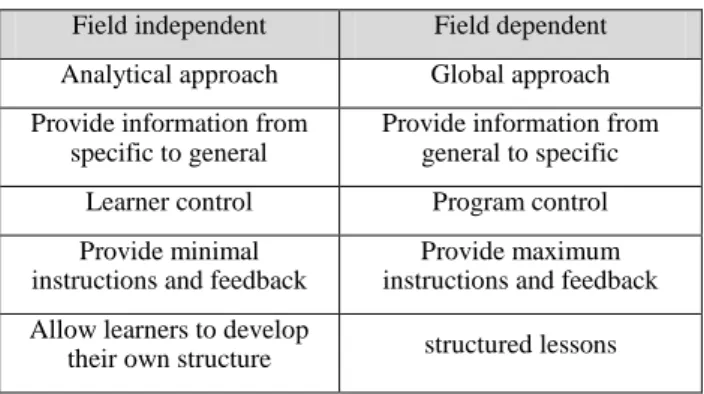
take to find a simple figure in a more complex visual field. Subjects who were field dependent spent more time finding the figure while field independent subjects found the figure quickly. Most people fell on a continuum between being completely field dependent or field independent. Field dependent students prefer to work in groups, and require extrinsic motivation and more structured reinforcement from teachers. Conversely, field independent students prefer individual work and tend to be intrinsically motivated [23]. Table.1 shows some preference of learners in each dimension [17].
TABLE I. LEARNER PREFERENCES IN FIELD INDEPENDENT/ DEPENDENT COGNITIVE STYLE
Field independent Field dependent Analytical approach Global approach Provide information from
specific to general
Provide information from general to specific Learner control Program control Provide minimal
instructions and feedback
Provide maximum instructions and feedback Allow learners to develop
their own structure structured lessons
III. FUZZY INSPIRED PSO CLUSTERING METHOD The aim of learners grouping is discovering groups of learners having the same behavioral patterns. This problem can be seen as a clustering problem and so many clustering methods can be used to do this. By learners grouping, the most appropriate learning objects, is selected according to learners’ behavior. There are some observable learner’s behavior can be used to group them. These data obtain from system log files and are used as a clustering data. To reach better clustering performance two criteria must be considered separation and compactness.
In clustering problems, a given data set is partitioned into clusters such that the similarity between points in same cluster is more than each other in different clusters. Fuzzy clustering uses fuzzy techniques to cluster data and each data can be belong to more than one cluster. There are two criterions to evaluate the clustering performance, compactness of each cluster and separation between clusters [25]. C-means clustering algorithm, as a most used fuzzy clustering algorithm, only considers the compactness of clusters. So, when data are very compact this method can’t separate them successfully because its objective function doesn’t considered separation criterion. While C-means has this problem, we define an objective function so that considers not only the compactness but also the separation. This objective function consists of two parts, to meet separation and compactness criteria. The following section introduced the objective function. 3-1- Objective function
The objective function of fuzzy inspired PSO method is defined as:
( 1 ) 𝐽(𝐾) =∝ 𝐼𝑛𝑡𝑟𝑎(𝐾) + (1−∝)𝐷𝑒𝑛𝑠(𝐾)
Where Intra(K) is a measure to considering the compactness of clusters and is the mean of deviations of
all clusters’ data from their corresponding center. This measure is defined as
𝐼𝑛𝑡𝑟𝑎(𝐾) = 1
𝑁∑ 𝑢
𝑞(𝐶
𝑘|𝑍𝑝)𝑑(𝑍𝑝, 𝐶𝑘) 𝐾
𝑘=1
(2)
where N is the number of data points, K is the number of clusters, Zpis a data point, Ckis the center of cluster k,
) , (Zp Ck
d is an appropriate distance between Zpand Ck
, and 𝑢(𝐶𝑘|𝑍𝑝) is the membership function,
q
is the fuzziness exponent withq
1
, increasing the value of q increases the fuzziness of algorithm. This membership function is defined such as in C-means [25].Dens (K) is a measure to meet the separation criteria and defined as:
(3)
K k K k jj k j
j k C density C density b density K K K Dens 1 1 , )} ( ), ( { max ) ( ) 1 ( 1 ) (
Here
b
k,j is the middle point of the line segment defined by CkandC
jand the term density(Ck) is defined as:
k n p k p p kk uC Z f Z C
C density 1 ) , ( ) ( ) ( (4)
where
n
k is the total number of patterns in clusterC
k. The functionf
(
Z
,
b
)
is defined by otherwise b Z d if b Z f 1 ) , ( 0 ) , (
(5) and
K k k C K 1 ) ( 1
(6)where ( )
k
C
is the variance of clusterC
k . For more details see [16].3-2- Applying Particle Swarm Optimization
In [16] we use genetic algorithm to optimized objective function in Equ.1. The GA employs the principal of “survival of the fittest” in its search process to select and generate individuals (design solutions) that are adapted to their environment (design objectives/constraints). Therefore, over a number of generations (iterations), desirable traits (design characteristics) will evolve and
remain in the genome composition of the population (set of design solutions generated each iteration) over traits with weaker undesirable characteristics.
The GAand its many versions have been popular because of its intuitiveness, ease of implementation, and the ability to effectively solve highly nonlinear, mixed integer optimization problems that are typical of complex engineering systems. The drawback of the GA is its expensive computational cost.
Particle Swarm Optimization (PSO) is a relatively recent heuristic search method whose mechanics are inspired by the swarming or collaborative behavior of biological populations. PSO is similar to the Genetic Algorithm (GA) in the sense that these two evolutionary heuristics are population-based search methods. In other words, PSO and the GA move from a set of points (population) to another set of points in a single iteration with likely improvement using a combination of deterministic and probabilistic rules, but PSO has the same effectiveness (finding the true global optimal solution) as the GA while with significantly better computational efficiency (less function evaluations) by implementing statistical analysis and formal hypothesis testing [26].
PSO is a population-based optimization algorithm developed by Eberhart and Kennedy [27]. This method is inspired by the scenario of a bird flock or fish school searching for food. In such a random search, not all group members know where the food is located except the ones nearest to that location. So the individuals make sudden changes in direction during flocking or schooling; they scatter and regroup together and follow the individuals in the best positions relative to food location to finally find it.
PSO algorithm takes each potential solution to the optimization problem as a particle in the search space. For every such particle, its fitness value (distance to food location in the original scenario) is calculated due to some properly defined fitness function which is used to adjust the particle to a better position. These fitness values are then compared among all particles and the population is updated with the information provided by the fittest solution found in that search round [28]. Each particle owns some information like its location, its velocity, the memory of its own best position and the best position found by the whole population up to the current search round. The last two pieces of information are used to update the velocity and location of the particle.
Mathematically speaking, in continuous PSO algorithm, the location and velocity of the 𝑖-th particle in a 𝑁 -dimentional search space is represented by two 1 × 𝑁 vectors, 𝑥𝑖= [𝑥𝑖1, 𝑥𝑖2, … , 𝑥𝑖𝑁] and 𝑣𝑖= [𝑣𝑖1, 𝑣𝑖2, … , 𝑣𝑖𝑁], respectively. The fittest location found by the particle up to current iteration of algorithm is denoted by 𝑥𝑝𝑏𝑒𝑠𝑡 and the global best location found by the whole population is represented as𝑥𝑔𝑏𝑒𝑠𝑡. When the fittest solution is found at each iteration, all particles update their location and velocity using time-quantized equations 7 and 8.
𝑥𝑖𝑘𝑡+1= 𝑥𝑖𝑘𝑡 + 𝑣𝑖𝑘𝑡+1 (7)
𝑣𝑖𝑘𝑡+1= 𝑣𝑖𝑘𝑡 + 𝑐1𝑟1(𝑥𝑝𝑏𝑒𝑠𝑡 𝑖𝑘𝑡 − 𝑥𝑖𝑘𝑡) + 𝑐2𝑟2(𝑥𝑔𝑏𝑒𝑠𝑡𝑘𝑡
− 𝑥𝑖𝑘𝑡)
(8)
Where t is the iteration counter which is bound to a predefined maximum value, 𝑡𝑀𝐴𝑋, often used as one of the termination criteria for the PSO algorithm. 𝑐1and𝑐2 are positive constants which adjust the maximal flying step of global and individual best location for the particle and their values are usually set to 2. Finally, 𝑟1 and 𝑟2 are random numbers in the interval[0, 1]. To prevent the particle from getting far away out of searching space, another predefined constant 𝑉𝑀𝐴𝑋 is used to bind the particle’s velocity. Each element of the velocity vector should be within the range[– 𝑉𝑀𝐴𝑋, 𝑉𝑀𝐴𝑋] and exceeding values are cut to the appropriate values 𝑉𝑀𝐴𝑋or−𝑉𝑀𝐴𝑋[29].
PSO method can be used effectively to solve NP hard problem such as to optimize the introduced objective function in Equ 1. In fuzzy inspired PSO clustering method, each particle consists of
K
n
floating point numbers, representing K centers in𝑅𝑛, where K is the number of clusters and n is the dimension of space. The fitness function can calculated as stated in subsection (3-1).Knowing the above information, PSO algorithm operates in 6 main steps which are as follows:
Step 1: Random initialization of location and velocity for all particles. The individual best location of each particle is also set to its initial location.
Step 2: Calculation of the fitness value for each particle.
Step 3: Updating individual best location, in case a fitter location is found in the last iteration. Step 4: Updating the global best location, in case
there is an individual best location found with a better fitness value than the previous global best location.
Step 5: Updating the location and velocity of all particles for the next iteration using equations 7 and 8.
Step 6: Checking for the termination criteria. Going back to step 2 for another iteration, if the criteria is not met.
As iterations complete one after another in the process above, the global best solution improves till it reaches the value of the global optimum solution.
IV. EXPERIMENTAL RESULTS
To evaluate the performance and accuracy of the proposed method, we conducted a study on 98 students who participated in a Fundamentals of Computer Networks online course. All kinds of learning materials, assignments, class projects and discussions could be embedded in this course and it may contains topics which have the potential to be discussed in forums, and web media. We have used logged data obtained from the underlying LMS, which includes students' interactions with the educational system. In our system we aim at grouping students using their activities while working with the system. These activities are type of reading material (abstract, concrete), dedicating time for reading concepts and theories, dedicating time for reading
examples and facts, doing additional exercises, reading additional examples, exam doing and revision time, participation in forums, use of chat and mail systems, participation in collaborative/group tasks, choosing group or individual class projects, dedicating time for course view, pattern of access to the course materials, dedicating time for lessons' objectives and overviews. These behaviors reflect the cognitive style of the learner. The clustering task was performed to learn patterns reflecting the student’s behaviors and construct groups of learners with similar behavior and similar cognitive style to provide an efficient collaborative environment.
We have carried out the experiment using K-means, C -means as most widely used clustering algorithm, EFC (our previous work) and fuzzy inspired PSO algorithms and then Davies Bouldin clustering validity index was calculated for them. This index proposed by Davies and Bouldin and minimizes the average similarity between each cluster and the one most similar to it. The Davies-Bouldin index is defined as [30]:
Kk k j
j k
j k
K
j distC C
C diam C diam K DB
1 1, , ,
max 1
(9)
where
diam
(
C
)
is the diameter of cluster, defined by:
C d
u wdiam C w u , max , (10)
The distance can be chosen as the traditional Euclidian metric for numeric feature. It is obvious that the smaller value of DB, the better matching in clustering.
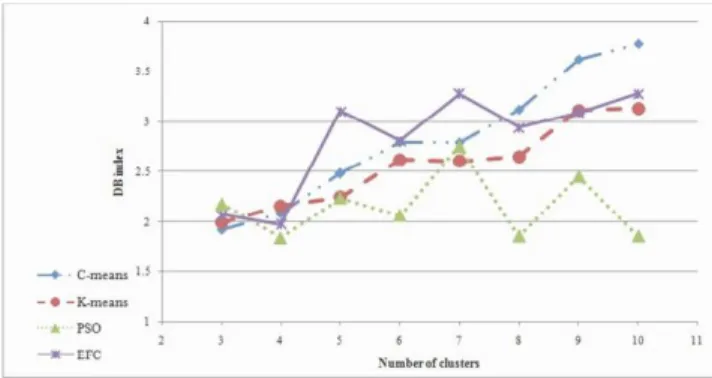
A deep comparison over their results, performance, and their accuracy in grouping students has been done. To evaluate the proposed method, the numbers of clusters were set from 3 to 10 and the clustering task was performed. In C-means, EFC and fuzzy inspired PSO algorithms each data is assigned to cluster with greatest value of membership function and then the DB index is calculated for them. These results have been shown in Fig. 1. As shown in this figure, for all these cluster numbers the fuzzy inspired PSO algorithm has the minimum value of DB index. It means that proposed algorithm has the better performance than K-means, C -means and EFC and achieved clusters using this method are more compact and separate. It means this algorithm has the better clustering results based on clustering goodness factors according to DB index. The minimum of DB index is reached at 4 (number of clusters) for fuzzy inspired PSO and EFC methods and 3 for C-means and K -means.
Fig 1- Davies-Bouldin index obtained by four algorithms
Table.2 shows the total number of learners in each clusters and number of FD and FI learners in them. Bold numbers determine the majority cognitive style in clusters. As shown in Table.2 the obtained clusters using fuzzy inspired PSO method include students who have similar cognitive style and proposed method groups similar learners in the same cluster.
Table 2.Grouping results based on cognitive style in obtained clusters FD learners FI learners Total number of learners Cluster number Algorithm 22 15 37 1
C-means 2 36 21 15
13 12 25 3 26 15 41 1
K-means 2 34 23 11
13 10 23 3 4 11 15 1
EFC 19
18 37 2 2 0 2 3 26 18 44 4 24 8 32 1 Fuzzy- inspired PSO 0 15 15 2 25 0 25 3 1 25 26 4
While GA uses only crossover and mutation operators to update the chromosomes’ positions, PSO uses large amount of information about the design space such as best position and velocity to update the particles’ positions that are assimilated and shared by all members of the swarm. So the computational effort of fuzzy inspired PSO method is less than that of the EFC method to reach the same clustering criteria. According the same reason, the PSO results are more accurate than EFC method. By comparing the runtime of these methods with C-means and K-means, a major point will be apparent on this subject. As the fuzzy inspired PSO method is involved with some calculations to find the center of clusters, it takes more time than C-means and K-means, while clustering task is performed. But as clustering was performed, in fuzzy inspired PSO method learners are grouped in a more appropriate cluster than 3 others method. So if achieved clusters have been used to find most appropriate clusters for a new learner, the fuzzy inspired PSO result is better than other methods. But if we want to group learners in a real time application, proposed method has the low performance and this is the disadvantage of fuzzy inspired PSO clustering method.
V. CONCLUSION
In this paper, we introduced fuzzy inspired PSO clustering algorithm to group students in an online educational system to make a model of students based on some of their behavioral factors and interactions with the system. Grouping learners considered as a clustering problem and so an objective function has used to meet goodness clustering criterion. The proposed objective function has optimized using PSO method. To evaluate performance and accuracy of the proposed method, we conducted a study on 98students participated in an online undergraduate course. In the proposed method, the learners’ grouping is done employing K-means, C-means, EFC and fuzzy inspired PSO algorithms. Comparing clustering accuracy of the algorithms together, using DB clustering validity index, we observed that fuzzy inspired PSO algorithm has more precision and more accuracy in assigning students into some groups according to their behavior which logged in LMS. Comparing obtained clusters using four methods shows the learners in the same clusters were more similar in obtained clusters using fuzzy inspired PSO method. As be stated in pervious sections, learners with different cognitive style have the different preferences. So, in our future work, we will use this method to personalize content and learning recommendations based on learners groups and their cognitive style.
ACKNOWLEDGMENT
This work was supported by the Iran Telecommunications Research Center (ITRC), Tehran, Iran, under Grant No. 90-06-82. Authors would like to thank this center.
REFERENCES
[1]. Baylari, A., Montazer, Gh.A., "Design a personalized e-learning system based on item response theory and artificial neural network approach", Expert Systems with Applications 36, 2009, pp.8013-8021.
[2]. Brusilovsky, P., "Methods and techniques of adaptive hypermedia", User Modeling and User-Adapted Interaction, 6(2-3), 1996, pp. 87-129.
[3]. De Bra, P., "Adaptive educational hypermedia on the web".
Communications of the ACM, 45(5), 2002, 60–61.
[4]. Teng, C., Lin, C., Cheng, S., Heh, J.: Analyzing User Behavior Distribution on e-LearningPlatform with Techniques of Clustering. In: Society for Information Technology andTeacher Education International Conference. (2004) 3052-3058. [5]. Carver, C. A., Howard, R. A., & Lane, W. D., "Addressing
different learning styles through course hypermedia", IEEE Transactions on Education, 42, 1999, pp. 33-38.
[6]. Papanikolaou, K. A., &Grigoriadou, M. "Accommodating learning style characteristics in Adaptive. Educational Hypermedia". In Workshop on individual differences in adaptive hypermedia organized in AH, 2004, Part I, pp. 77-86. [7]. Papanikolaou, K. A., &Grigoriadou, M. "An Instructional
Framework Supporting Personalized Learning on the Web". Proceedings of the The 3rd IEEE International Conference on Advanced Learning Technologies (ICALT’03), 2003, pp. 120 - 124.
[8]. Cha, H., Kim, Y., Park, S., Yoon, T., Jung, Y., & Lee, J. "Learning styles diagnosis based on user interface behaviors for the customization of learning interfaces in an intelligent tutoring system". In Intelligent tutoring systems, 2006, pp. 513-524: Berlin, Springer.
[9]. Graf, S., &Kinshuk. "An Approach for Detecting Learning Styles in Learning Management Systems". Proceedings of the International Conference on Advances Learning Technologies", IEEE Press, (2006), pp. 161-163.
[10]. Özpolat, E., Akar, G.B., " Automatic detection of learning styles for an e-learning system”, Computers & Education 53, 2009, pp.355–367.
[11]. Mor, E., &Minguillon, J., "E-learning personalization based on itineraries and long-term navigational behavior". In 13th international world wide web conference, 2004, pp. 264-265. [12]. Castro, F., Vellido, A., Nebot, A., &Minguillon, J., "Detecting
atypical student behavior on an e-learning system". In I SimposioNacional de Tecnologas de la Información y lascomunicacionesen la Education, 2005, pp. 153–160, Granada, Spain.
[13]. Castro, F., Vellido, A., Nebot, A., &Minguillon, J. "Finding relevant features to characterize student behavior on an e-learning system", Proceedings of The 2005 International Conference on Frontiers in Education: Computer Science and Computer Engineering, FECS 2005, Las Vegas, Nevada, USA, pp.210-215.
[14]. Romero, C., González, P., Ventura, S., del Jesus, M. J., & Herrera, F., "Evolutionary algorithms for subgroup discovery in e-learning: A practical application using Moodle data". Expert Systems with Applications, 2009, 36, 1632-1644.
[15]. M. A. Hogo,"Evaluation of e-learning systems based on fuzzy clustering models and statistical tools". Expert Systems with Applications, 2010, 37, 6891-6903.
[16]. F. Ghorbani, Gh. A. Montazer, “Learners grouping in e-learning environment using evolutionary clustering approach”, Iranan Journal of Information and Communication Technology (IJICT), 2011, (3)(1), 9-19.
[17]. E. Triantafillou, A. Pomportsis, S. Demetriadis, & E. Georgiadou, “The value of adaptivity based on cognitive style: An empirical study”, British Journal of Educational Technology, 35, 2004, pp.95–106.
[18]. R. Felder, L. Silverman, "Learning and teaching styles in engineering education". Engineering education, 78, 1988, pp. 674-681.
[19]. F. Mampadi, Sh. Y. Chen, Gh. Ghinea, M. Chen, “Design of adaptive hypermedia learning systems: A cognitive style approach”, Computers & Education, 56, (2011), 1003–1011. [20]. S. Graf, T. Lin, &Kinshuk, “The relationship between learning
styles and cognitive characteristics – Getting additional information for improving student modeling”, Computers in Human Behavior, 24, 2008, pp.122–137.
[21]. S. Messick, “The nature of cognitive styles: problems and promise in educational practice”, Educational Psychologist (1984), 19, 59–74.
[22]. D. H. Jonassen, &B. L. Grabowski, Handbook of individual differences, learning and instructions. Hillsdale, NJ: Lawrence Erlbaum, 1993.
[23]. H. A. Witkin, C.A., Moore, D.R. Goodenough, P.W. Cox, “Field Dependent and Field-Independent Cognitive Styles and Their Education Implications”, Review of Educational Research, 47, 1997, pp.1-64.
[24]. R. Ridding, I. Cheema, “Cognitive Styles: An Overview and Integration”, Educational Psychology, 11(3/4), 1991, 193 – 216. [25]. J. Bezdek, “Cluster validity with fuzzy sets”, Journal of
.Cybernet. 3, 1974, pp.58–73.
[26]. R. C. Eberhart, Y. Shi, “Comparison between genetic algorithms and particle swarm optimization”, Evolutionary Programming VII, Lecture Notes in Computer Science Volume 1447, 1998, pp 611-616 .
[27]. J. Kennedy, R. C. Eberhart, “Swarm Intelligence”, Morgan Kaufmann Publishers, 2001.
[28]. X. C. Guo, J. H. Yang, C. G. Wu, C. Y. Wang, Y. C. Liang, “A novel LS-SVMs hyper-parameter selection based on particle swarm optimization”, Neurocomputing, 71, 2008, pp. 3211-3215.
[29]. Z. Pei, S. Tian, H. Huang, “A novel method for solving fuzzy programming based on hybrid particle swarm optimization”,International Conference on Computational Intelligence and Security Workshops, 2007, pp. 216-219. [30]. Davies, D. Bouldin, D., "A Cluster Separation Measure", IEEE
transactions on Pattern Analysis and Machine Intelligence, 1(2) (1979).
Gholam Ali Montazer received his B.Sc. degree in Electrical Engineering from Kh. N. Toosi University of Technology, Tehran, Iran, in 1991, his M.Sc. degree in Electrical Engineering from Tarbiat Modares University, Tehran, Iran, in 1994, and his Ph.D. degree in Electrical Engineering from the same university, in 1998. He is an Associate Professor of the Department of Information Engineering in Tarbiat Modares University, Tehran, Iran. His areas of research include soft computing approaches, evolutionary computation, learning systems, and e-commerce environment.
Fatemeh Ghorbani received her B.Sc. degree in Applied Mathematics from Birjand University, Iran, in 2004, her M.Sc. degree in the same field from Tarbiat Modares University (TMU), Tehran, Iran, in 2007 , And her Ph.D. degree in information technology engineering also from TMU. Her research interest is soft computing such as evolutionary computation, neural networks and intelligent agents in e-learning systems.