Deborah Barreau
Based on Carol C. Kuhlthau’s model of information seeking (1988), this
qualitative study examines the first two months of transition from high school to college through a series of three interviews with two freshmen at the University of North
Carolina at Chapel Hill. The resources students were accustomed to using in the various stages of what Kuhlthau termed “the information search process” in high school is compared to the resources they used during their first eight weeks of college. The point of the study was to determine how and why information seeking behaviors change in the first few weeks of college, and how a student’s adaptation to an academic library’s resources might affect their feelings about research. Findings revealed that comfort using library resources and students’ perceptions of the usefulness or applicability of library materials informed whether they adapted to or rejected them when presented with an information need.
Headings:
Use studies -- College and University Students
Information seeking behavior -- College and University Students Information seeking behavior -- Undergraduate Students
by Monique Prince
A Master's paper submitted to the faculty of the School of Information and Library Science of the University of North Carolina at Chapel Hill
in partial fulfillment of the requirements for the degree of Master of Science in
Library Science.
Chapel Hill, North Carolina November, 2003
Approved by:
Table of Contents
Introduction……….. 2
Related Research………. 4
Methodology……… 12
Results………. 17
Discussion……… 35
Conclusion……….. 39
Appendices One……….. 40
Two………. 42
Three……… 43
Introduction
Transitioning from high school to college is perhaps one of the most challenging phases of a person’s life. Gaining independence and self-accountability, learning to manage time and money, making new friends, and learning new study habits are a few of many new experiences college freshmen encounter. With higher expectations from instructors and exponentially more information resources available to them than in high school, college freshmen are faced with the challenges of adapting to and learning to use new technologies and resources offered by campus libraries. The goal for librarians is that students develop information literacy skills that they can apply both in college and in the future. The Association of College and Research Libraries defines information literacy as “knowing how to find, evaluate, and effectively and responsibly use
information from a variety of sources” (ACRL 2003, 8, 10). Certainly freshmen in their first two months of school are not to be expected to fully meet this goal. On the other hand, a noticeable shift in the process of information seeking should have begun to take place as they transition from being high school learners to adult learners in an academic environment.
new skills and resources—whether it be through instructors, friends, personal initiative, librarians, or other means—when they learn, and what these new skills and resources are, could inform decisions about what materials librarians should present in introductory instruction sessions, how many sessions are sufficient, and at what point in their first year is the most beneficial time for library instruction.
Based on Carol C. Kuhlthau’s model of information seeking (1988), this
Related Research
The Information Search Process
Using qualitative methods, Carol C. Kuhlthau studied the library information search process of college-bound high school seniors in two advanced placement English classes (1988). In addition to the search process itself, she was interested in exploring the difficulty incoming freshmen have in using academic libraries despite previous library instruction. She hypothesized that there are a series of stages to an information search, and proposed a six stage search process model incorporating students’ thoughts, feelings, and actions. Kuhlthau based her efforts in part on cognitive psychologist George A. Kelly’s (1963) theory of personality, Robert A. Taylor’s (1968) four levels of information need, and Nicholas Belkin’s (1980) anomalous states of knowledge (ASK). Janet Emig’s study of secondary students (1971) and their feelings of uncertainty and general anxiety during the prewriting phase of an assignment, along with Constance Mellon’s (1986) research on undergraduate library anxiety often caused by students not understanding how libraries work, led Kuhlthau to postulate about how these feelings may inhibit library use by these groups.
The model that Kuhlthau developed following her study of high school seniors is called the “information search process,” or ISP. This model, which can be applied to both high school and college students, is defined as “the user’s constructive activity of finding meaning from information in order to extend his or her state of knowledge on a particular problem or topic,” (Kuhlthau 1991, 361) and is characterized by a series of encounters over time. This model includes the following phases: task initiation, topic selection, prefocus exploration, focus formulation, information collection, and search closure. Kuhlthau acknowledges that this process is not as linear as it appears, but is instead an iterative process for most people.
Kuhlthau’s model defines the six stages of the information search process as follows:
1. Task Initiation. This stage occurs for students when they are given an assignment requiring research. It is often accompanied by feelings of uncertainty and apprehension, as students think about the task. Actions often involve discussing possible topics with others (Kuhlthau 1991, 366).
2. Topic Selection. Feelings often change in this stage from uncertainty to optimism, as students decide on a topic to pursue through research. Typically, this stage involves weighing various possible topics based on interest, assignment requirements, available information resources, and time constraints. Students often continued discussion with others in this phase, and some began preliminary research. If there is a delay in completing this phase, feelings of anxiety increase until a topic is chosen.
Students frequently discovered inconsistencies in their findings, because during this stage, “an inability to express precisely what information is needed makes
communication between the user and the system awkward” (Kuhlthau 1991, 366). It is not uncommon to revert to stage two and decide on a different topic if feelings of confusion become too overwhelming. Specific actions associated with prefocus
exploration include locating general information, reading, and relating new information to known information.
4. Focus Formulation. Frequently focus formulation, which is similar to a hypothesis, represents the turning point in an information search because narrowing a topic causes feelings of uncertainty and anxiety associated with earlier stages to be replaced with increased confidence, clarity, and optimism. Kuhlthau stresses the importance of forming a clear focus at this stage, noting that neglecting to do so causes difficulty throughout the rest of the process and prevents the student from moving on to the next phase.
5. Information Collection. Kuhlthau explains, “Collection is the stage in the process when interaction between the user and the information system functions most effectively and efficiently,” (Kuhlthau 1991, 368) because it is possible for students to articulate their focus to intermediaries and systems and recognize relevant results. Students in this phase search for information that will define, extend, and support their focus (Swain 1996, 96). Kuhlthau found that many students experienced increased confidence in their search and interest in their findings during this stage.
6. Search Closure. The final stage of the ISP is the conclusion of the information search and beginning of the writing phase. Various reasons for ending a search include
gathered, and feelings that enough searching has been done. Feelings vary depending on how students interpret the success of their search.
Deborah E. Swain (1996) studied college freshmen following Kuhlthau’s model, concentrating on its initial stages of topic selection and finding a preliminary focus. She employed qualitative methods similar to Kuhlthau’s in her study of 28 students in a freshmen English course, and incorporated Brenda Dervin’s (1977) sense-making theory and methods. Students were required to keep a daily journal, turn in a topic proposal, and five students were selected to participate in interviews. The journal entries were to include all thoughts, feelings, and actions relating to the project. The interviews focused on how students bridged information gaps while researching their topic. Swain’s results validated Kuhlthau’s ISP model, particularly the idea of moving from ambiguity to specificity, although she found additional support for the idea that students may progress in different orders, skip stages, or return to and repeat stages as necessary. Swain also found that feelings students experienced during the first stages of the ISP align with those Kuhlthau discovered, particularly the movement from uncertainty to clarity, and feelings of either satisfaction or dissatisfaction depending on students’ impressions of their search. Swain elaborated on Kuhlthau’s model by stressing the importance of interpersonal
Undergraduate Library Usage
Few past studies have attempted to identify predictors and correlations between freshman academic library use and background characteristics such as high school library use. Geffert and Christensen (1998) found correlations between freshmen performance on tested and self-assessed library use competencies and high school class size, gender, GPA, and previous library research experience. Factors such as self-confidence or comfort in libraries and self-assessment of library skills were not found to have meaningful correlations. Ethelene Whitmire’s study (2001a) of background
characteristics and college experiences reports that high school library use, along with student-faculty interactions, active learning activities, and engaged writing activities, predicted academic library use for all three years of the study.
Some studies have identified weaknesses in undergraduate library research. Sonia Bodi (2002) agrees with Kuhlthau and Swain that the most problematic areas for students include choosing and narrowing a topic, and continues by noting that employing subject heading searching and evaluating web and other sources are also troublesome for
narrowing a topic, Bodi points out that undergraduate students, particularly in their first two years of study, do not understand the topics they are researching well enough to be comfortable, and may get confused about disagreements or contradictions they find in the literature, further complicating research for those students. Arnold and Jayne (1998) elaborate on the multifaceted handicaps freshmen have when using the library:
Freshmen have poor search skills. Although one-shot instruction sessions try to cover the basics, many students remain confused by the different commands they must learn in order to search the OPAC and several periodical database systems. They have difficulty understanding the concept of Boolean logic, as well as the differences between keyword and subject searching, the value of narrowing a search, and the function of assigned and subject headings. All of these factors contribute to their anxiety, so students almost inevitably focus their attention on finding the ‘right answers’ and on meeting the assignment at hand rather than on learning transferable skills for the duration of their undergraduate career. The research process itself is daunting, as are the many steps and choices students must make, the databases they must consult, and the ambiguities of the process itself. (45)
While the previous researchers concentrated on library search strategies, other studies examined actual patterns of undergraduate library use. According to Jiao and Onwuegbuzie’s 1997 study, the top five reasons students used the library were: studying for tests, reading current newspapers, reading their own textbook, using computerized indexes and online facilities, and meeting friends. This demonstrates that the library facility itself is perhaps as significant for students as the library services provided. Ethelene Whitmire (2001b) studied eleven measures of library use by freshmen,
of the eleven library experiences increased during each year of the study, and the only decrease in frequency over all three years was in asking librarians for help.
In her citation analysis of freshmen composition papers, Kathleen E. Joswick (1994) notes that the undergraduate population, particularly freshmen, have generally been ignored in past citation studies. To overlook this group, which is the largest group of library users, Joswick argues, is to compromise the library’s ability to fully meet the real needs of college library users. Her study revealed interesting results with a wide range of implications. There was an average of six citations per paper. The results demonstrate that students cite slightly more books than articles, particularly when using older materials. For example, the most frequently cited format before 1990 was books, while current material most frequently cited was in periodicals. Joswick postulated that heavy book citation (comprising 46.4% of the total) is perhaps due to the fact that new college students are equipped with the skills required for locating books, which are familiar, readily available, and can be checked out (Joswick 1994, 48, 62). A startling finding was the range of years found in materials cited by freshmen. Despite the currency of many topics, the greatest number of references was to sources published in the 1980’s, and the source years varied from 1906-1991 (Joswick 1994, 49, 63). The range of years cited within bibliographies varied from one to seventy-five years. To Joswick, these figures demonstrate that freshmen are not as conscientious about (or aware of the importance of) locating appropriate current information as they should be,
is inappropriate if students are assigned topics designed to introduce them to scholarly research (Joswick 1994, 63).
Methodology
To achieve the most complete picture of what and how freshmen were learning about academic libraries during their initial encounters, qualitative research methods were utilized. The study consisted of three separate, structured interviews with two college freshmen over the first eight weeks of the fall semester (see appendix one for interview questions).
Subjects
Two college-bound, recent high school graduates were chosen as subjects for this study. They were selected because they were previously known to the author and had expressed their willingness to participate in the study. In the summer prior to beginning their freshman year at the University of North Carolina at Chapel Hill, they received letters informing them about this study, assuring them of their privacy, and requesting their consent to participate. Both students, hereafter referred to as Student A and Student B, participated in a series of three interviews over a period of eight weeks in the fall semester of 2003.
Data Collection
impressions formed during the first few weeks of school. Whitmire found that initial library experiences played a crucial role in subsequent library use throughout the rest of a student’s college career. Swain’s research demonstrates that the initial process of
researching information in the campus library can significantly impact students’ views of information resources on campus. Eight weeks also ensured that the participants would very likely have had the opportunity to gain exposure to at least some new library resources through their coursework.
The first interview took place after the students arrived on campus but before they attended classes. The goal of this tape-recorded half-hour interview was to determine each student’s existing library skill and comfort level and what library resources they were accustomed to or familiar with using, particularly in a high school setting (See Appendix One for interview questions). Interview topics included familiarity with and use of the internet for research, the role of intermediaries, research strategy, sources they were familiar with and when they were used, and thoughts and emotions about library research. They were each also asked to describe their high school library and librarians. A sample assignment (See Appendix Two) which had been given to them prior to the interview was discussed in the context of Kuhlthau’s ISP model, to determine what sources the students would have utilized, and in what stage would those sources most likely be employed. To ascertain this information, Kuhlthau’s model of the information search process was explained to the students (See Appendix Three), and the students subsequently described what resources they would use to research the sample assignment.
they were taking during the fall semester, what assignments they have that require
research, thoughts and emotions about college library resources, whether instructors have discussed research sources or strategies in class, and whether any library resources had been used for class assignments thus far. As the students had not used any library resources, this interview did not contain much information used in data analysis beyond their descriptions of their adjustments to the library.
The third interview took place via email after the students had been in school for eight weeks. This interview covered topics similar to those raised during the second interview, with the purpose of capturing a better overall image of how the students were transitioning and becoming acclimated to using library resources. In addition, the last interview also included a discussion of the students’ actions and attitudes towards library research after attending a library instruction session for their English Composition courses.
Data Analysis
After the interviews were completed, they were transcribed and analyzed using content analysis. Content analysis has been employed in studies of information needs, uses, and retrieval (Allen and Reser 1990), and is a technique used to make “replicable and valid inferences” from data content of communication to the greater context
Method of coding data, which allows a researcher the freedom to develop a theory, rather than test a hypothesis, based on what participants actually say about their own
experiences. The two principles of Grounded Theory are questioning rather than measuring and generating hypotheses (7). This method was chosen because the lack of research regarding the transition aspect of this project was not conducive to hypothesis testing. It also allowed for the freedom to probe the “how’s” and “why’s” of the freshman library learning curve.
When planning for the interviews, questions were created that centered on five specific topics: high school library use (discussed exclusively during the first interview), internet use, people involved in the research process (librarians and friends, primarily), thoughts and feelings about library research, and materials used during the information search process. As the interviews were being coded, it became clear that coding them along the lines of the participants’ responses to questions based on these five predefined topics was the most logical way to group similar concepts. To code when resources were used during stages of the information search process, transcript data relating to the ISP was coded as “information search process” if a specific stage was mentioned, particularly during the discussion of the sample assignment during the first interview. Often,
Results
High School Library—Interview One
Student A and Student B were both asked to describe their high school, its resources, and its staff during the first interview. As they had attended the same high school, their responses were similar, and so are grouped together here.
Both participants attended a public school located in a county adjacent to a large metropolis. They were both enrolled in a library science class for library assistants during their senior year, which allowed them the opportunity to work in the media center for a 90-minute period daily for a semester. Because of this, they were able to accurately depict the library and its resources. Student A described the library as “pretty nice” but noted that many of the books and encyclopedias were older, due to financial constraints within the school system. The media center was equipped with computers that had internet access and an online database, N.C. Wise Owl, which indexed newspapers and magazines. The student who commented on the outdated books noted how helpful the internet and N.C. Wise Owl were in bringing the library’s resources up to date. To the students’ knowledge, no other databases exist in the library.
Library staff included two media specialists for the first three years of the students’ high school careers, and in their senior year, a librarian and an assistant.
personality had a great deal to do with how librarians were perceived among the student body, and thus, how much they were consulted and trusted.
High School Library Resource Use
In the participants’ high school, students are given a tour of the library during their freshman English class. They are also required to take a computer test before graduation, so they used the library computers to practice for that. As expected,
schoolwork dictated how frequently students were forced to use library resources. One of the students explained that she did not remember using the library much for research until her senior year, because teachers did not stress it, and usually suggested that they go online for most of their assignment needs. These students used the library enough to be familiar with its resources and how to use them, and they were able to describe how those resources were used in a typical ISP.
During the first interview, both students seemed to possess roughly the same level of familiarity with resources in their high school library. Resources that were familiar to the participants were typical of high school students, given the frequency and depth of research opportunities in high school courses. Both students mentioned the following resources as ones that they had used for research in the past and were comfortable with: the internet, librarians, encyclopedias, newspapers, magazines, the online catalog
stressed the importance of her peers in the ISP, a resource only briefly mentioned by Student A.
Student A High School Information Search Process
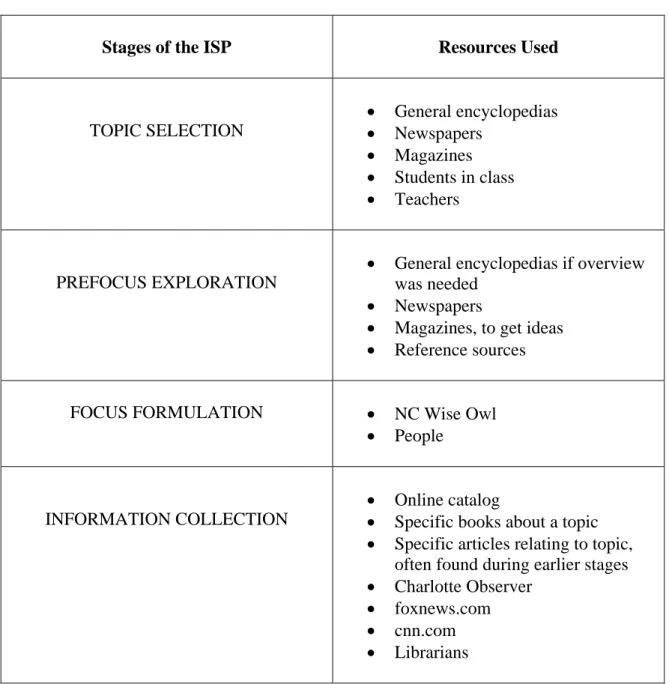
The internet played a large role in information seeking for both students throughout the ISP during high school. Student A explained, “In high school, the computer is the first place we went to for research. We’d go to the internet and type in different search engines.” She noted that Google, in particular, was her preferred internet search engine. She also noted that she usually used the internet continually throughout the information search process. In addition to the internet, Student A reported that she used newspapers and magazines throughout her search, looking at various articles in the topic selection, prefocus exploration, and focus formulation stages to get ideas, then revisiting pertinent articles during the information collection stage. Although she mentioned using newspapers and magazines during all of these stages, she found that N.C. Wise Owl was most effective as she was researching a focused aspect of her topic. This supports what Kuhlthau found in her research, namely that information collection is the stage in which users can most effectively and efficiently search a system for
information, because they know more precisely what they are looking for.
Table 1. Student A High School Information Search Process
Stages of the ISP Resources Used
TOPIC SELECTION
• General encyclopedias • Newspapers
• Magazines • Students in class • Teachers
PREFOCUS EXPLORATION
• General encyclopedias if overview was needed
• Newspapers
• Magazines, to get ideas • Reference sources
FOCUS FORMULATION • NC Wise Owl
• People
INFORMATION COLLECTION
• Online catalog
• Specific books about a topic • Specific articles relating to topic,
often found during earlier stages • Charlotte Observer
• foxnews.com • cnn.com • Librarians
*Student A used the internet continually throughout her search, and noted specifically that the internet was the first place she would go for research.
*Whether she ever consulted a librarian in early stages was not discussed. She
Student B High School Information Search Process
Student B agreed with Student A concerning the importance of internet searching in high school research, noting that for her, the internet has almost taken the place of books, because of its quickness and convenience. When asked if she was comfortable using the internet for research, her response indicated that she was aware of the
complexity presented by relying too heavily on the internet for research needs: “Yes. For the most part, well, sometimes. I guess it depends on what it is because…whenever you have a search that is more general, the internet can’t find it as well.” She identified the internet as fitting most effectively in Kuhlthau’s ISP model during the focus formulation stage, because she found that it works best with specific searches. However, when later asked about her search strategy in general, she noted that the internet would be the first place she would look for information on a topic, during the topic selection stage: “I’d probably go to the internet first, just to see what they have…it has so many venues…if you just type in (for example) ‘Roman Catholicism,’ it would just give you so many ideas on what you could do…Yeah, it gives me ideas because I would go to a certain topic I would like and that interests me.” Later she noted that she would look for additional information by finding internet sources and looking at where information for those publications had been gathered, which means that she also relied on the internet during the information collection stage as well. Although this student did not realize it, she, like Student A, also used the internet throughout her ISP during High School.
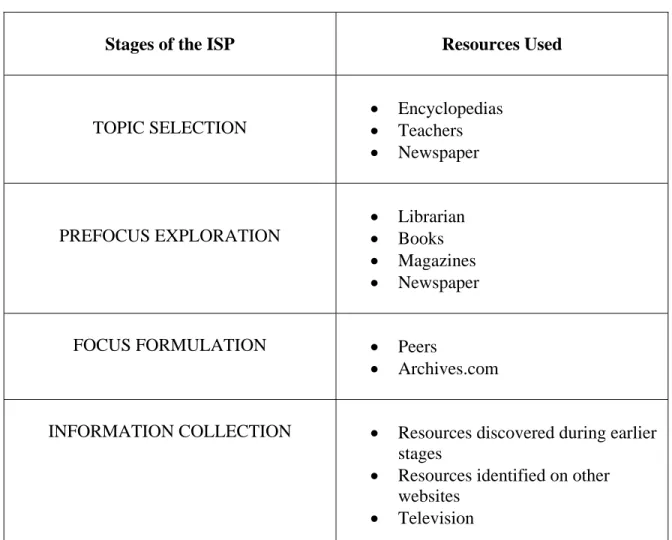
found that she must focus her topic before beginning the information search at all, just so that she would not get “a billion things back” from Yahoo.com, her preferred search engine. She mentioned that one way she used the internet was to look at sources other people used, similar to the way many in higher education search bibliographies in books and journal articles. Like Student A, she preferred to use encyclopedias only initially.
During prefocus exploration for high school assignments, she utilized magazines and newspapers, although as previously discussed, she never mentioned N.C. Wise Owl. This stage was also when she often relied on books and librarians to gain information about a topic.
Student B heavily relied on peers for advice during the focus formulation stage, in addition to the resources mentioned in earlier phases. For the sample assignment, which asked the students to explain how they would research a topic about a current event of their choosing, she selected “the economy” as her topic, and described how she would ask friends who were economics majors and friends of hers who were knowledgeable about the topic for help and advice. She explained that she would consult her friend, and “ask him what he thinks I should do about the topic, what to narrow it down to…” Deborah Swain also noticed this in her interviews with students concerning early stages of the information search process. Swain emphasized the significance of social
interaction when beginning a search because of its potential to relieve stress. She found that topic selection and library resource use were both impacted by interpersonal
Table 2. Student B High School Information Search Process
Stages of the ISP Resources Used
TOPIC SELECTION
• Encyclopedias • Teachers • Newspaper
PREFOCUS EXPLORATION
• Librarian • Books • Magazines • Newspaper
FOCUS FORMULATION • Peers
• Archives.com
INFORMATION COLLECTION • Resources discovered during earlier stages
• Resources identified on other websites
• Television
Discussion and Summary of Interview One
Both students came to college equipped with knowledge of and experiences with using resources commonly found in high school libraries. Basic books, encyclopedias, magazines, newspapers, the online catalog, the internet, and librarians were the most common sources mentioned. Both students were familiar with general encyclopedias and dictionaries, but were unfamiliar with more specialized, subject specific encyclopedias or other appropriate reference books. While Student A mentioned N.C. Wise Owl, she described it as a website, and neither student seemed to be familiar with the function and purpose of online databases. At this point, both participants expressed similar
competencies, were familiar and comfortable with most of the same sources, and expressed similar apprehension about making the transition from using a high school library to navigating UNC’s vast library system. Compared to many other high school students, these participants likely had a better understanding of how to find information in their high school library because of the time they spent there for class credit.
Transition—Interview One and Interview Two
When interviewed before the start of classes, the students were asked about thoughts and feelings they had about library research in college. Student A explained her thoughts in this way: “This library is intimidating to me because it’s huge, and I don’t know where to start, where to look for things…right now, intimidation.” She went on to say, “I expect to be able to find what I need, just because it is a university library.” When asked how she was feeling about the prospect of doing library research in college,
Student B exclaimed,
to touch or talk or move around the wrong way…it just seems so clean, and I would be intimidated and overwhelmed. Even if I did know exactly where everything was…
After the students had been in class for one week, they were interviewed for the second time. The question was asked again, and already there was a noticeable
improvement, due to how comfortable the students were beginning to feel in the library space. Even though she had not yet used it for research purposes, Student A commented, “It is a quiet place to read and go…It is where I go to get most of my work done. I feel comfortable doing work there. I don’t as far as, if I’m going there to look up something. I don’t feel very comfortable because I don’t know where to start.” Student B agreed, “It’s not nearly as intimidating going into the Undergraduate Library, but I still haven’t actually gotten a book off the shelves. I have just been studying and stuff like that.” When later asked if her teachers had discussed research techniques, she said they had not, and continued, “It kind of scares me to go into the library and not know what to do or how to check out or find books.” After one week, neither student had spent time on the library homepage, or used any library resources other than the internet and the physical space. At this point, both students identified the library space as a place they felt comfortable, but they remained uneasy about the research aspects of library use. Transition—Interview Three
Student A College Information Search Process
However, after only eight weeks, a shift had occurred in Student A’s understanding of how an academic library could be used for research, and her information search process reveals those distinctions.
The library instruction session required by her Freshman English Composition class was the primary reason for the shift. She found the session extremely helpful, and it was there that she learned about online periodical databases. She explains, “Learning how to find journals and articles made me feel much more confident for research in my classes.” She also was informed about the distinction between scholarly and popular works during this instruction session, and now understands how to use the “ejournals” resource if she finds an article that is not full text in the database she is using. Student A now feels fairly comfortable with both deciding an appropriate database to use for a research need, as well as finding information using a database. She did note that it was still a little difficult to decide an appropriate database to use, but that when she asked librarians for assistance finding sources and books for an assignment, they helped her better understand her topic, the best sources for it, and how to find information that related specifically to her focus. When asked if she was able to find print sources in the stacks, she said yes, although usually with the help of someone.
they are reliable.” Student A has found that online databases are more scholarly and appropriate to her needs. When asked if she would now classify N.C. Wise Owl as a website or database (as it was unclear as to how it should be classified), she confirmed that it was a database, but said, “I think of it as less helpful than the others. Maybe that’s just because I feel like I’ve graduated from N.C. Wise Owl to ‘real college databases’ or something.” This again demonstrates her successful transition from high school to college library use.
Student A had two assignments requiring library research, one for English, and one for Spanish. While discussing her ISP after eight weeks, she noted that she had not yet used newspapers or subject specific reference sources, but thought they could be very helpful, and she would feel comfortable using them. While general encyclopedias were used in the early stages of her ISP in high school, she explained that they would now be too general for her needs and so, has not used them, nor does she expect to.
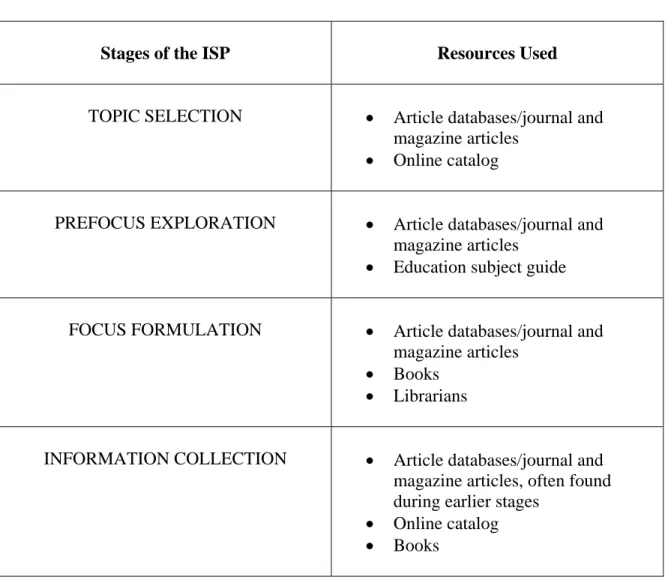
During the topic selection stage, Student A used online periodical databases, specifically Ebsco and Lexis-Nexis. In fact, she used those databases during all stages of the ISP. She also used the online catalog during this initial stage for her Spanish
assignment required only articles, and so she used the periodical databases for the information collection stage of that assignment.
Table 3. Student A College Information Search Process
Stages of the ISP Resources Used
TOPIC SELECTION • Article databases/journal and magazine articles
• Online catalog
PREFOCUS EXPLORATION • Article databases/journal and magazine articles
• Education subject guide
FOCUS FORMULATION • Article databases/journal and magazine articles
• Books • Librarians
INFORMATION COLLECTION • Article databases/journal and magazine articles, often found during earlier stages
Student B College Information Search Process
Student B’s information search process changed as well, although not with the marked improvement that Student A experienced. After one week of class, she needed to select a topic for a Spanish project. Because she did not know exactly what to look for, the internet searches she performed were ultimately ineffective, and so she did not have a topic by the assigned date. This was a source of frustration to her. As mentioned above, this student often went first to the internet for research, but because it was difficult to search with a broad topic, she needed to narrow her focus before beginning her research at all. After eight weeks of college, this aspect of her research and her method of focus formulation without effectively using research tools demonstrates a lack of transition to academic research.
Like Student A, student B had attended a library instruction session prior to the final interview. She explained her experience with the instruction session:
My English class went a couple weeks ago to find articles to write a paper on. I did not end up using any of the articles I found, mainly because none of the items I found were articles. I looked up Title IX and the only thing that showed up was the actual title itself. So, I got frustrated and went online.
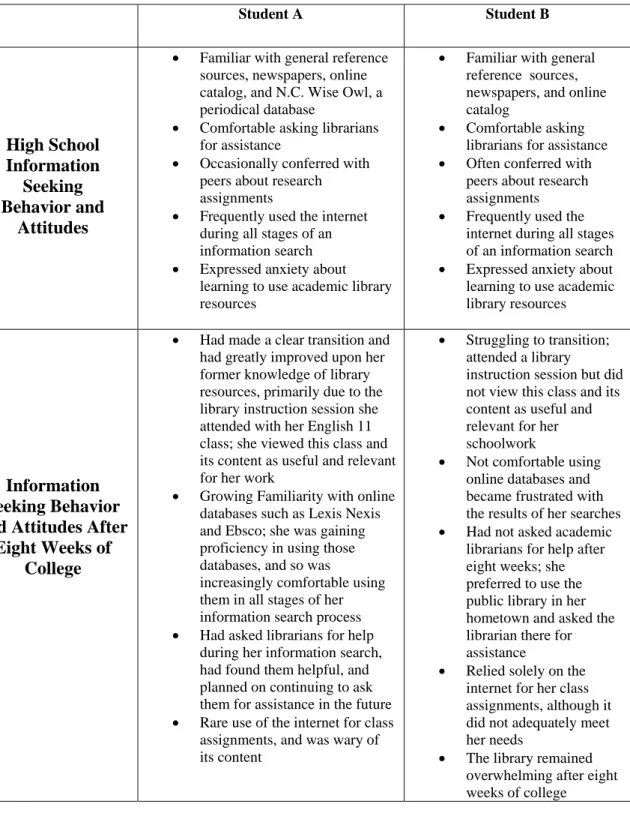
Table 4. Information Seeking Behavior and Attitudes in High School &
College by Student A and Student B
Student A Student B
High School Information
Seeking Behavior and
Attitudes
• Familiar with general reference sources, newspapers, online catalog, and N.C. Wise Owl, a periodical database
• Comfortable asking librarians for assistance
• Occasionally conferred with peers about research assignments
• Frequently used the internet during all stages of an information search
• Expressed anxiety about learning to use academic library resources
• Familiar with general reference sources, newspapers, and online catalog
• Comfortable asking librarians for assistance
• Often conferred with peers about research assignments
• Frequently used the internet during all stages of an information search
• Expressed anxiety about learning to use academic library resources
Information Seeking Behavior and Attitudes After
Eight Weeks of College
• Had made a clear transition and had greatly improved upon her former knowledge of library resources, primarily due to the library instruction session she attended with her English 11 class; she viewed this class and its content as useful and relevant for her work
• Growing Familiarity with online databases such as Lexis Nexis and Ebsco; she was gaining proficiency in using those databases, and so was
increasingly comfortable using them in all stages of her information search process
• Had asked librarians for help during her information search, had found them helpful, and planned on continuing to ask them for assistance in the future
• Rare use of the internet for class assignments, and was wary of its content
• Struggling to transition; attended a library
instruction session but did not view this class and its content as useful and relevant for her schoolwork
• Not comfortable using online databases and became frustrated with the results of her searches
• Had not asked academic librarians for help after eight weeks; she preferred to use the public library in her hometown and asked the librarian there for assistance
• Relied solely on the internet for her class assignments, although it did not adequately meet her needs
Discussion
During the third and final interview, conducted after eight weeks of class, it became obvious that a split had occurred in the experiences of my two participants. Before the beginning of the semester and after one week of classes, both students
appeared to have roughly equal familiarity with high school library resources. They also expressed the same concerns when asked about how they felt about academic library use. After eight weeks, Student A had developed a clear grasp of new resources and had used those in her class assignments. Student B had been presented with the same resources, but so far had rejected them, and still relied primarily on the internet for her research needs. This distinction heavily impacted the degree of success students noticed during their information search processes. Whereas Student A’s successful database searching resulted in useful articles for her class assignments, Student B’s internet searching led to frustration and failure to complete an assignment on time. From this, two themes
emerged from the interviews regarding library resource use. First, the degree of comfort students felt about using certain resources, both in high school and in college, dictated how heavily they were used. Second, for these students, their perceptions of the usefulness or applicability of library materials informed whether they adapted to or rejected those tools.
Comfort Levels
newspaper. One commented, “I know I wouldn’t feel comfortable just going and picking up the Wall Street Journal and looking through it, but the Charlotte Observer, I know where everything is.”
Both students dwelt for a time on comfort when describing their high school librarians. Student A, when asked if she found her high school librarians to be helpful, noted that because she worked in the library for a semester, she became comfortable with them. She noted that other students who were not as familiar with the librarians would feel intimidated. Student B agreed, and explained that she was one of the students who felt intimidated before she worked in the library for a semester. One librarian who was there for her first three years of high school
wasn’t as friendly [as those during her senior year]. I’d always be scared to ask her…so I’d just go in and type a book in the card catalog, grab a book, and get out…It was just not somewhere I felt comfortable…I felt really comfortable, though my last year, because I did have a relationship with them.
She described the first librarian as “always on your case,” uptight about the books and whether students were going to check them out, really loud, scary to other students, and not much like a librarian. The other librarian who took her place was described as sweeter, soft-spoken, laid back, and helpful, more like “a typical librarian.” Clearly personality makes a difference in whether a student feels comfortable trusting and interacting with librarians. These comments, however, indicate that comfort within the physical space of the library is also impacted by a student’s impressions of the library staff.
The final interview with both students confirmed that comfort with the library and its resources clearly had an impact on how the students were adjusting. Student A
finding relevant materials. Because she was comfortable and becoming more familiar with various resources, she continued to increase her usage of the library resources, moving away from internet websites that may not have credible or useful information. After her library instruction session, Student B still felt very overwhelmed by the library as a whole, as well as with finding relevant articles using databases. The result for her was to rely primarily on the internet for most assignments, and even return to her hometown library instead of using the university resources. Although finding information worthy of being incorporated into her college assignments solely on the internet has been difficult for her, she does not feel comfortable using library resources that would allow her to the flexibility of avoiding the internet when appropriate. Perceptions of Library Resource Usefulness
The degree to which students found new library resources to be helpful for their research also influenced whether those resources were adopted or rejected. As a result of her library instruction session, Student A learned about periodical databases, articles and journals, ejournals, subject guides, and the online catalog. She found this session highly valuable, and the tools she learned about had an immediate impact on her college
information search process. Because she viewed databases as useful, and their contents as credible, she adopted this method of researching and, in turn, she feels more
comfortable using this resource. Likewise, she also perceived her interactions with librarians as being useful, because she was aided by “very nice” librarians in finding appropriate resources that met her needs. As a result, she was planning on asking
perceiving new resources as valuable to her information search has aided her transition from high school to college-level research.
Conclusion
This study has emphasized the important role that library instruction must play in helping freshmen adjust to the academic rigors of the university experience. Not only does it allow students exposure to a variety of resources which lead to growing comfort with their use, it also represents the only time students have supervised practice using resources that can significantly affect academic performance. The success of a one-time instruction session such as the type offered by UNC’s libraries can be brought into question; although one student represents a group that can grasp and utilize the concepts addressed during the session, other students clearly need additional practice and
APPENDIX ONE
INTERVIEW QUESTIONS
These were questions asked to both students. Other questions were asked to each as they elaborated on various aspects of the questions, so the interview could capture what was most important to each student.
Interview One
How familiar are you with using the internet for research? How (and how often) do you use the internet for research? What specific websites do you use?
In what stage(s) of your Information Search Process do you rely most heavily on the internet?
Have you ever asked librarians for help when researching? What kinds of questions? During what stages of your ISP did you rely most heavily on librarians for help? Did you find your high school librarians to be helpful?
What other people would you rely on when researching? What is your typical research strategy when writing a paper? Describe your high school library and librarians.
What resources existed; were students trained in use of the library? How did you locate appropriate sources in your high school library? Were you required to use the library for class research frequently? What sources have you used for research in the past?
What words describe your thoughts and feelings about college library research?
Interview Two
What classes are you taking that may require library research?
After being in class for one week, what words describe your thoughts and feelings about college library research?
Have you had to use any library resources for research?
Interview Three
After being in class for eight weeks, what are some words that come to mind describing your thoughts or emotions about college library resources?
Have your instructors taken you to the library or discussed research techniques or resources? If so, how does this affect your confidence in or understanding of those techniques or resources discussed?
Have you had to use library resources for any assignments so far? Which ones (if any)? Describe your experience finding, evaluating, and using those resources. As you are describing these (ANY—internet, online catalog, books, reference sources, databases, people), please explain at what point in your research you used that resource. For example, did you use it: 1.) To choose a topic, 2.) to better understand your general topic, 3.) to develop a focus for your topic, or 4.) to collect information relating specifically to your focus?
How did you discover the sources you mentioned?
What have you found easiest and hardest about searching for information?
How have you been using the internet for your classwork? Have you found that it suits your needs?
APPENDIX TWO
SAMPLE ASSIGNMENT
Consider a current topic of interest to you (the economy, U.S. involvement in Iraq, or UNC’s summer reading program, for example). Do background research on your topic to better understand the issues at stake. Write a 4-5 page paper explaining your stance on the issue, backing up your argument with supporting sources. Be sure to address the alternate views by mentioning sources advocating those opinions. Include a combination of scholarly and popular journals in your final analysis.
Aspects to consider when planning for this sample assignment:
-What sources are appropriate
-Where would you go first (classmates? The internet? Encyclopedias?) -How would you decide on a topic and then narrow it down?
APPENDIX THREE
KUHLTHAU’S ISP MODEL
This simplified version of Carol Kuhlthau’s Information Search Process was given to each student in interview one, and the stages were discussed. They kept the list to refer to as they were answering questions about the sample assignment.
Information Search Process Model
1. Task Initiation—when you receive an assignment
2. Topic Selection—picking a general topic you want to explore (and eventually narrow down to a workable, focused topic)
3. Exploring information on the general topic and looking for a focused aspect of it 4. Focus formulation—coming to a decision about the specific aspect you want to focus on
5. Collecting information on your focused topic
Works Cited
Academic Colleges and Research Libraries. @ your library™ Toolkit for
Academic and Research Libraries: Messages, Ideas, and Strategies for Promoting the Value of Our Libraries and Librarians in the 21st Century, 2003.
Arnold, Judith M., and Elaine Anderson Jayne. “Dangling by a Slender Thread: The Lessons and Implications of Teaching the World Wide Web to Freshmen.” The Journal of Academic Librarianship 24, no. 1 (1998): 43-52.
Auerbach, Carl F., and Louise B. Silverstein. Qualitative Data: An Introduction to Coding and Analysis. New York: New York University Press, 2003. Belkin, Nicholas. “Anomalous States of Knowledge as a Basis for Information
Retrieval.” The Canadian Journal of Information Science 5 (1980): 133-143. Bodi, Sonia. “How Do We Bridge the Gap Between What We Teach and What They Do?
Some Thoughts on the Place of Questions in the Process of Research.” The Journal of Academic Librarianship 28, no. 3 (2002): 109-114.
Coffey, Amanda, and Paul Atkinson. Making Sense of Qualitative Data: Complementary Research Strategies. Thousand Oaks, CA: Sage Publications, 1996.
Dervin, Brenda. “Useful Theory for Librarianship: Communication, Not Information.” Drexel Library Quarterly 13 (1977): 16-32.
Emig, Janet. The Composing Processes of Twelfth Graders. Urbana, Ill: National Council of Teachers of English, 1971.
Joswick, Kathleen E. “Library Materials Use by College Freshmen: A Citation Analysis of Composition Papers.” College & Undergraduate Libraries 1, no. 1 (1994): 43-65.
Kelly, George. A Theory of Personality: The Psychology of Personal Constructs (New York: Norton, 1963).
Kuhlthau, Carol C. “Developing a Model of the Library Search Process: Cognitive and Affective Aspects.” RQ 28, no. 2 (1988): 232-243.
Perspective.” Journal of the American Society for Information Science 42, no. 5 (1991): 361-371.
Levitz, Randi, and Lee Noel. “Connecting Students to Institutions: Keys to Retention and Success.” In The Freshman Year Experience, eds. M.L. Upcraft and John N. Gardner, 65-81. San Francisco: Jossey-Bass Publishers, 1989.
Mellon, Constance A. “Library Anxiety: A Grounded Theory and Its Development.” College and Research Libraries 47 (1986): 160-165.
Pascarella, Ernest T. and Patrick T. Terenzini. “Designing Colleges for Greater Learning.” Planning for Higher Education 20 (1992): 1-6.
Qun G. Jiao and Anthony J. Onwuegbuzie. “Prevalence and Reasons for University Library Usage.” Library Review 46, no. 6 (1997): 411-20.
Swain, Deborah E. “Information Search Process Model: How Freshmen Begin Research.” In Proceedings of the 59th ASIS Annual Meeting in Baltimore,
Maryland, edited by Steve Hardin, 95-99. Medford, N.J.: Information Today, Inc, 1996.
Taylor, Robert. “Question-Negotiating and Information Seeking in Libraries.” College and Research Libraries 29 (1968): 178-194.
Whitmire, E. “A Longitudinal Study of Undergraduates’ Academic Library
Experiences.” The Journal of Academic Librarianship 27, no. 5 (2001b): 379-75. Whitmire, E. “The Relationship Between Undergraduates’ Background