Lyn Marie Batty. Self-Archiving of Articles Published in High-Impact Journals in the Social Sciences. A Master’s paper for the M.S. in L.S. degree. April, 2009. 72 pages. Advisor: Robert M. Losee
Self-archiving of peer-reviewed articles represents one path toward increasing the
public’s exposure to relevant social science research. This paper discusses self-archiving behavior of scholars who have published articles in high-impact journals in the fields of anthropology, sociology, economics and political science. A total of 1,686 articles published during 2007 and 2008 were searched to determine which of the articles had been self-archived. The resulting data illuminates the self-archiving practices of 3,440 individual authors within the four social science fields. The results indicate that self-archiving behavior varies depending on the author’s discipline, region, and author order. Self-archiving policies of journal publishers are also examined to compare restrictions on self-archiving with authors’ self-archiving practices.
Headings:
SELF-ARCHIVING OF ARTICLES PUBLISHED IN HIGH-IMPACT JOURNALS IN THE SOCIAL SCIENCES:
by Lyn Marie Batty
A Master’s paper submitted to the faculty of the School of Information and Library Science of the University of North Carolina at Chapel Hill
in partial fulfillment of the requirements for the degree of Master of Science in
Library Science.
Chapel Hill, North Carolina April 2009
Approved by:
Table of Contents
Introduction...1
Literature Review...3
Open Access...3
Opening Access to Social Science Research ...6
Self-Archiving...11
Institutional and Subject Repositories ...13
Institutional and Funder Mandates...17
Scholars’ Web Pages...20
Publisher Self-Archiving Policies...24
Methodology and Results ...29
Methods...29
Results...32
Discussion and Conclusion ...51
References...65
Introduction
Advances in information technology have produced new avenues for the
communication of scholarly research. As print-only scholarly journals have given way to journals, articles, and other forms of scholarly communication in digital formats, the Internet has become the preferred medium for providing access to the scholarly journal article. Scholars, libraries, research institutions, funding agencies, and governments are in the process of trying to conceptualize the full extent to which the internet may be used to further the dissemination of scholarly research results, not merely within the circles of academia, but to any person, in any country and in any circumstance, who might benefit from the knowledge.
The open access movement, by demanding fewer barriers between the public and scholarly knowledge, has caused upheaval in a scholarly publishing tradition that can trace its roots back to the first publication of the Philosophical Transactions in 1665. Open access proponents have advocated for new publishing models that enable scholars to distribute their scholarly publications freely. Academic libraries have promoted open access policies as an economic counterbalance to the rapid inflation of the costs of scholarly journals, a phenomenon known as the “serials crisis.” Various academic
The president of the Social Science Research Council has publicly called for deliberate steps toward opening access to the research and scholarship created within the social sciences (Calhoun, 2008). Calhoun discussed the opportunities lost by allowing social science debate to become enclosed in the tight circles of academia, noting that, “certainly a social science turned in on itself fails to achieve much public significance. But more important than the desire to promulgate the knowledge of social scientists is the effort to bring their knowledge to bear on pressing social issues.”
Scholars who produce research and seek to disseminate the results of their work face a range of decisions in determining how best to circulate their research results. Before the advent of the Internet, scholars sought to publish articles in the top-ranking journals in their field in order to maximize the dissemination of their work. Scholars have a range of additional options today, including publishing their research in open-access journals, or paying author fees to their publisher to support immediate open-access to their article online. They may seek to negotiate with publishers to procure additional author rights to post their paper in an e-print archive or on their own homepage.
support to faculty and researchers who have largely been left to their own devices in attempting to facilitate wider access to their published research.
As a response to the open access movement, faculty and researchers have invested time and effort in fashioning their own methods for opening access to their published works, largely through self-archiving. Even though acting individually, the combined efforts of self-archiving scholars have had an impact. Self-archived articles may be located by searching for titles or author’s names with commercial search engines such Google, Google Scholar, and Yahoo!, allowing many peer-reviewed articles to be easily found and read for free on the Internet. Studies documenting the behavior of
self-archiving authors in various disciplines have been instructive for institutions and funding bodies considering adopting mandated open access policies, and may provide insights to guide efforts to expand upon the current self-archiving practices of scholars.
This study was undertaken in order to uncover potential patterns in self-archiving behavior in a group of published scholars in the social sciences. The data gathered by this study is intended to help illuminate the self-archiving practices and behaviors of authors who publish in high-impact journals in the social sciences, and to guide suggestions for increasing open access to articles published in respected disciplinary journals.
Literature Review
Open Access
access literature has been defined as scholarly literature that is, “digital, online, free of charge, and free of most copyright and licensing restrictions” (Suber, 2005). While the public’s access to knowledge is universally accepted to be a “public good,” the early interest in the open access movement appears to have arisen less from philanthropic ideals and more from a pragmatic response to a number of disconcerting developments in scholarly communication. It had become apparent over time that the cost of buying subscriptions to the range of scholarly journals required by large research universities had inflated beyond the capability of even the most affluent institutions.
Originally, academic libraries sounded the alarm regarding the rapid acceleration in the cost of scholarly journals to academic libraries. The cost increases predicted the potential loss of access to large amounts of scholarship if the trend continued. In the years between 1986 and 2005, the Association of Research Libraries (ARL), consisting of the 120 largest research libraries in North America, collectively increased their serials expenditures by 302% (ARL, 2005). The crisis caused by escalating serial costs stirred a debate about the future of scholarly communication. At the same time, new technologies had created possibilities to vastly increasing the reach of scholarly communication and while at the same time reduce costs and eliminating barriers to access.
method of transferring ownership of scholarly production to commercial publishers may, in fact, significantly limit access to research and scholarship.
Early open access advocates promoted opening access to previously inaccessible peer-reviewed scholarly articles through the use of new publishing technologies and a reexamination of the economics of publishing (Harnad, 1995; Guedon, 2001). Despite concern that open access ideas might signal the end of the scholarly journal, traditional scholarly publishing modes are still thriving. However, there are now a number of additional avenues available to authors to increase the possibilities of free public access to their scholarship. These avenues include author self-archiving of works published originally in subscription-only peer reviewed journals, author-pays open access, funder-subsidized open access, and a number of others (Willinsky, 2006, p. 212).
Universities and large funding agencies are in the process of moving toward more concrete efforts designed to make scholarship freely available. A policy statement recently released by four leading associations serving research universities1 re-asserted the critical function of the university in the dissemination of knowledge. The document, titled, A Call to Action, stated the need for Universities to take a renewed leadership position in ensuring that research created within the university was widely and publicly accessible. The document suggested that the tacit acceptance of the transfer of a majority of university research output had, over time, lead to the frustration of certain critical functions of academia:
Past norms and practical requirements for dissemination have led to practices of transferring control of access to and use of faculty work outside the academy, limiting the university and faculty members’ ability to ensure broad dissemination and wide use. Where the academy has
relinquished the ability to manage its intellectual capital to best serve its needs and priorities it should act to regain this capability. (Association of American Universities et al., 2009).
Opening Access to Social Science Research
People expect from the social sciences – anthropology, sociology,
economics, and political science – the knowledge to understand their lives and control their future. Edward O. Wilson
Open access to scholarly research produced within the social sciences provides opportunities to enrich public understanding of critical social issues. Social scientists produce relevant studies squarely addressing timely and universal themes, such as social inequality, the functioning of markets, electoral processes, family structures, human evolution, and conflict resolution.
Voices within the social sciences have acknowledged the need for greater access to the scholarly output of their fields. As was noted by the president of the Social Science Research Council (SSRC) in his paper, Social Science for Public Knowledge, “certainly a social science turned in on itself fails to achieve much public significance. But more important than the desire to promulgate the knowledge of social scientists is the effort to bring their knowledge to bear on pressing social issues” (Calhoun, 2008).
(Gusterson & Besteman, 2005, p.5). Health, poverty, employment, marriage,
communities, voting, politics, immigration, war – all are issues to which engaged social scientists could lend their expertise by sharing the results of their research and
knowledge.
The question is not the relevance of high-quality social science research to everyday concerns, but rather how to make the research accessible to the general public so that they begin to seek it out, as they have done with medical research. The goal of increasing access to medical research was the catalyst that drove some of early strides towards opening research to the general public. Funders of medical research, such as the National Institutes of Health (NIH) and The Wellcome Trust, actively promoted open access for the largely medical science research that their funding supported. These agencies have used their considerable leverage to mandate archiving of the articles supported by their funds within publicly accessible archives such as PubMed Central, often within 6 months after publication.
Self-archiving practices are less prevalent in the social sciences than in a number of other sciences. Pre-prints are not circulated within the social sciences in the way that they are in the so-called hard sciences. In many sciences, preprints serve to rapidly disseminate answers to shared problems in the discipline and to establish the primacy of results. The humanities and the social sciences have traditionally placed greater
emphasis upon the monograph as the primary scholarly publishing vehicle. As subject repositories such as arXiv started to develop, the physical and medical sciences had works ready-made for e-print repositories (pre-prints) as part of their disciplinary habits. Social scientists have lagged somewhat in taking up new self-archiving habits needed to provide open access to their articles.
The Social Science Research Network (http://www.ssrn.com) is a subject
repository that has been successful in providing a centralized approach to a large corpus of social science research. Authors from all social science fields, including economics, business, law, political science and sociology can easily upload copies of their articles and papers into the archive. SSRN maintains a digital archive of over 186,000
downloadable full text documents, representing the publications of over 110,656 authors. SSRN statistics show high download activity. Paper downloads average over 7 million per year. It is primarily scholars from economics, law and business who have been most successful in using SSRN. However, greater numbers of political science authors and sociologists are now beginning to post preprints and postprints in SSRN.
In addition to posting digital copies of peer-reviewed research on the web, Zuccala also advocates for better understanding of “where and how laypeople look for peer-reviewed literature” (p. 359) and how laypeople interpret and understand scholarly literature in order to make it useful for their own purposes.
Scholarly treatments of social science issues, such as one might find in a political science journal discussing the reliability of polling data in presidential elections, or a peer-reviewed article measuring the correlation between military occupation and the incidence of terrorism within a country, are often presented in ways that are unfamiliar to the public. Scientists do not generally have a conversational or even journalistic writing style. This is not to say that the findings of scientists are incomprehensible or even disinteresting to the public, for stories abound of patients or their family members who have analyzed reams of studies explaining complicated medical trials in order to find answers to health questions. However, members of the public, along with practitioners working in fields interested in social science research, such as policy-makers, educators, social workers, community activists, and professional and citizen journalists, could potentially benefit from discussion and analysis of stand-alone research articles by those more familiar with the writing and methods of scholarly researchers. (Zuccala, 2009; Willinsky, 2004).
Two UK organizations, the Academy of Social Sciences and the Economic and Social Research Council (ESRC) prepared a joint paper titled, “Learned Societies in the Social Sciences: Developing Knowledge Transfer and Public Engagement.” The paper
mediators between the public and peer-reviewed research. Policy-makers and members of the public reported frustration with the lack of ability to find available social science experts from academia, to assist them in understanding and applying scholarly research outputs (ESRC & Academy of Social Sciences 2008, p. 23).
Mediation between the scholarly research system and the public can take a number of forms, including informal means like Web pages, blogs and other online sources of mediation. A number of websites and blogs have been created within the social sciences to provide a forum for discussion of current research within the social sciences. For example, the Social Science Research Council has created a website (http://www.ssrc.org) which serves to highlight important research developments in the social sciences. The website incorporates some web 2.0 features, including “The Immanent Frame,” a blog for the discussion of religion and the public sphere, another blog to discuss issues related to ongoing developments in Darfur, and a podcast that focuses on current political and social issues.
Additional efforts are being made open access to research in the social science through a number of learned societies and associations. For example, the American Sociological Association selects a number of articles in each issue of the publication American Sociological Review to make immediately open access online. These articles,
Social scientists are actively engaged in the debate about open access, discussing the role of learned societies, exploring the possibilities of alternative publishing models, and promoting robust self-archiving schemes and new subject repositories, such as the recently launched anthropology repository, Mana’o (http://manaoproject.org). The current discussions surrounding open access within the social sciences are not merely concerned with the familiar issues of peer-reviewed journals, repositories and citation counts. Instead social scientists are thinking more broadly about the use of wikis,
multimedia, open datasets, RSS feeds, blogs and other alternative forms of dissemination and debate as a counterbalance to the more static and unidirectional approach of the traditional scholarly journal (Kelty et al., 2008).
Self-Archiving
Often called the “green road” to open access, author self-archiving of peer reviewed articles on the free web has long been seen as a viable avenue towards
increasing the percentage of peer-reviewed scholarship available to the general public. Self-archiving has been defined as the act of placing a digital copy of a scholarly article on the internet in order to make it freely available, preferably in a repository which is OAI-compliant (Budapest Open Access Initiative, 2002). Self-archiving has represented an alternate route to open access for authors who do not have the option publishing in a fully open-access peer-reviewed journal (the “gold road” to open access).
repositories such as arXiv (physics, mathematics and computer science) and RePEc (economics). The disparity in self-archiving rates between disciplines has been shown in a number of studies of self-archiving practices (Hajjem, Harnad & Gingras, 2005;
Bergstrom & Levaty, 2007; Antelman, 2006).
Antelman (2006) reviewed self-archiving practices within six social science disciplines. In the study, economics articles showed a 60% rate of archiving, while other social science disciplines (political science, psychology, sociology, anthropology and geography) had self-archiving rates lower than 30%.
Bergstrom and Lavaty (2007) compared the self-archiving habits of economists and political scientists. The study determined that the self-archiving percentage of articles in economics journals was approximately 70%, while the self-archiving
percentage of articles in political science journals was closer to 30%. Further analysis of possible variables within the sample determined that the strongest predictor of whether an economics article was self-archived was the citation influence per article of the journal in which the article was published. The conclusion was that articles published in higher impact journals were more likely to be self-archived.
Wren suggested four possible reasons for the correlation between self-archiving and high-impact journals: 1) important papers published in high-impact journals create a demand for access which is met by the response of providing the paper online; 2) authors who publish in prestigious, highly cited journals are simultaneously trying to supplement citations by making their article openly accessible; or 3) self-archiving may arise from what the author deems the “trophy effect,” the posting of high-prestige publications by the author to demonstrate scholarly accomplishments.
The higher rate of self-archiving of articles published within high-impact journals may be explained in part by the fact that prolific authors within a field have developed consistent self-archiving habits in response to an expressed interest in their work by a wide network of associated researchers. Instead of responding individually to requests for reprints via telephone or email contact, these authors may have developed a habit of posting their papers on their webpages. The study discussed below seeks to explore the self-archiving behavior of individual authors who published in the highest impact-factor journals in their field, to determine if there are distinctions to be made in the
self-archiving practices of this group.
Institutional and Subject Repositories
access than endeavoring to establish a large number of open access journals (gold OA) in every discipline (Harnad et al., 2008). Gold OA proponents are working towards an OA ideal, where scholarly research is published in peer-reviewed open access journals supported by libraries, funding bodies, scholarly societies, and the cost savings of greater publishing efficiencies. Until that day, green OA proponents suggest working within the current system of publication, and trying to increase access to published works through self-archiving.
There are currently over 100 institutional repositories worldwide, and the number is growing (http://roar.eprints.org). However, despite their ease of use, and their potential to greatly increase the percentage of open access scholarship within an institution or a disciplinary field, institutional repositories have been slow to populate. Researchers who have studied factors contributing to the successful population of institutional repositories have constructed instructive studies of the self-archiving habits of scholarly authors. A number of relevant studies of IRs have determined that depositing rates in different disciplines show variation, indicating that disciplinary culture or habits are a factor in the self-archiving behavior of scholars (Xia, 2007). Others have disputed the disciplinary explanation, noting that success depends upon mandate policies and extensive librarian support to self-archiving authors (Haddow, 2008).
overcome all of the barriers to self-archiving with one action is through an institutional mandate, requiring deposit by all authors (Harnad et al. 2008; Xia, 2007).
Habits related to research and scholarly communication are created over time, and become ingrained and difficult to alter without significant disruption. Understanding scholarly habits is an important factor in determining how to get research into
repositories. Foster and Gibbons (2005), an anthropologist/librarian team at the University of Rochester, undertook a work-practice study to try to understand why institutional repositories were failing to gather content, despite significant efforts. The researchers focused on how to get institutional repositories to fit into the current work of scholars, rather than the more common approach of asking how to get scholars to add their works to institutional repositories.
Foster and Gibbons used a range of data-gathering techniques, including
videotaping sessions of faculty in their offices, watching faculty find and use articles and other research materials, and interviewing faculty through personal and telephone
interviews. The study determined that faculty were uninspired by terms such as “institutional repository” and “metadata”. The authors of the study found that the objectives of faculty were clear and consistent. What scholars primarily wanted was to “do their research, read and write about it, share it with others, and keep up in their fields” (Foster & Gibbons, 2005).
individualized approach to self-archiving created by authors to address their own scholarly purposes. The authors proposed allowing scholars to continue to create “personal digital repositories” with meaning and context created by the scholars
themselves. The authors suggested that meta-tools could be developed after the fact, to link content and loosely describe an institutional or organizational collection as a whole, while providing pointers or indexes for more specific areas.
A large number of the IR’s that have been created within universities have not created meaningful links between a scholar’s homepage and the repository. Creating a separation between a scholar’s works in an IR and additional information about the research found on the homepage is counterproductive. The separation of IR and scholar webpage is unmindful of the possibility that the scholar will be required to self-archive in two places, or give up one or the other.
Institutional and Funder Mandates
The quality of the information made to the public… is dependent upon the proportion of peer-reviewed research to which there is public access compared to the vast amount of other sources of information. (Willinsky, 2006, p. 114)
Meaningful public access to peer-reviewed research is a game of percentages. The goal is to increase the amount of peer-reviewed research that is open access until it grows to the point where it can be found by the public as easily as the toll access databases, the pay-per-view sites, and the great mass of free “science” available on the web.
Simply encouraging authors to contribute their articles to open access journals or to self-archive has not yet created the hoped-for critical mass of peer-reviewed research available to the public. NIH discovered this predicament when their first open access policy for funded researchers was optional. The result, after a short test period, was that an extremely low percentage of authors voluntarily deposited their research. As a result, greater attention has now turned to the potential impact of mandatory OA policies on authors’ self-archiving behavior (see Harnad et al., 2008).
In March, 2009, the National Institute of Health’s open access policy was made permanent. Previously, the NIH policy that mandating self-archiving author manuscripts in PubMed Central had been subject to annual renewals after it was signed in late 2007. The current NIH policy regarding self-archiving reads as follows:
access policy in a manner consistent with copyright law. (NIH Open Access Policy, online)
Without mandates, individual author self-archiving behavior has tended to be unreliable. Having a decentralized array of papers located outside of OAI-compliant repositories results in a set of widely scattered deposits that prove difficult to index or harvest effectively. Funding organizations have not only the ability to mandate author self-archiving, but also the ability to dictate archiving in a centralized and well-indexed repository. By joining together and pointing all article depositors to one centralized location – PubMed Central, funders of medical research have determined a path of action which not only increases the percentage of open-access peer reviewed research, but also increases the findability and searchability of that research.
Publishers, to a certain extent, have deferred to the new OA policies of the large medical funders and have generally accommodated the funders’ attempts to recapture research articles after short embargo periods. One publishing industry spokesperson, in responding to the tremendous leverage possessed by the funding organizations stated: “We must not underestimate the power of the funders. They…are excited by their new-found power to dominate the scholarly communication system, imposing terms and conditions on the allocation of research grants that predate any author contracts with publishers. The “pay-to-publish” model, supported by research funders, is here to stay” (Campbell, 2007). While publishers have been accommodating, they have not been silent in voicing their concern that the new funder OA policies may eventually disrupt
Universities also play a central role in the creation of research; however, they have traditionally played a more limited role in the dissemination of research. Despite the fact that institutes of higher education collectively provide enormous sums of money to support research and scholarship, the university has long maintained a laissez-faire attitude toward the business of transferring ownership to the scholarship created by their faculty. Recently, however, much like the large research funders, a number of
universities have decided to become more active participants in how knowledge, specifically research and scholarship created within their sphere of influence, is disseminated to the world.
In February 2008, Harvard University’s Faculty of Arts & Sciences voted to create the first mandated open access policy in the United States. Following the Arts & Sciences faculty, Harvard’s Law School passed a similar mandate in May 2008, followed by Stanford University’s School of Education unanimously adopting an open access mandate in June, 2008.
has the potential to greatly increase access to scholarly research that has long been unavailable to the public.
Scholars’ Web Pages
Academic scholars, working towards tenure and promotion in higher education, feel pressure to publish in peer-reviewed journals with high impact factors. Within tenure and promotion committees publication and citation are key. Less attention is paid to the rising cost of licensing the highly esteemed journals by the academic library, or to the lack of access to research published in high-impact subscription-only journals.
Almost all of the incentives for academic scholars point toward the goal of maximizing a list of published works, and maximizing the citations to those works. There is no surprise, then, that the typical webpage of an academic scholar includes name and email address, a small photograph, and a CV compiled of lists of publications,
dutifully citing to the journals in which the works were published. Some pages have far more content; some have less. If the audience for a scholar’s webpage is intended to be a hiring or tenure committee, a limited range of material should suffice. However, if a scholar envisions a wider audience of peers, local and global students, or the
condition of funding, “expects authors of research papers to maximize the opportunities to make their results available for free” (Wellcome Trust, 2008, online).
In determining whether or how to self-archive their work, individual authors can easily find themselves at the intersection of several powerful forces: the traditional pressure to publish in important journals, the established machinery of scholarly
publishing and copyright transfer, and the increasing, often influential, voices calling for free and open access to their scholarly work. Their behavior in response is, not
surprisingly, unpredictable. The variety of content, or lack of content, posted on scholars’ homepages may attest to a lack of guidance and support for scholars trying to determine whether to have a public web presence at all, and if so, how to create it without running afoul of publishers and tenure committees.
In the midst of progress in the open access movement, the tenure process has remained fairly traditional. Few OA advocates have suggested that authors be expected to stop submitting their research to established, high-impact journals in lieu of newer, open-access journals whose position in the discipline has yet to be determined.
Professional reputation, tenure and promotion are unavoidable concerns to scholars. One way that certain successful scholars have attempted to reconcile the conflicting incentives is to publish articles in prestigious, high-impact journals, then, with that goal
accomplished, attempt to make the work more open access by self-archiving.
(Swan & Brown, 2005; Antelman, 2006). Many published scholars self-archive in
multiple locations: on their own web page, as well as in subject repositories such as arXiv or RePEc. Scholars are additionally being asked or mandated to self-archive in
Institutional Repositories, and in funder-determined locations, such as PubMed.
It is uncertain what effect mandatory policies that direct article deposit in IRs or funder designated repositories will have on maintenance of academic Web pages. The academic’s personal homepage is the traditional location for article drafts, working papers, presentations, datasets, and other types of communication that explains and elaborates on the scholar’s research. There have been a number of studies conducted that examined the potential of the scholar’s personal homepage as a destination site for
broader audiences. Barjak, Li and Thelwall (2007), performed a link analysis of the homepages of 456 scientists, analyzing country, academic discipline, and a number of other variables in order to determine which factors would predict a greater number of inlinks to a scholar’s webpage. One finding of their study was that the most linked-to content on a scholar’s home page is full-text, i.e. articles, papers, manuscripts, and conference presentations. The authors advise scholars who are interested in raising their online presence, and their visibility in result lists, is to include full-text content on their homepages to increase the number of inlinks to their pages. From an open access
There is great variety among web pages of individual scholars. In order to
examine how scholars as individuals are represented on academic web pages, Thoms and Thelwall (2005) examined a sample of academic websites from countries within the European Union. The study identified the differences between academic websites that are university created versus those that are created by the scholar. The authors concluded that wholly university-created websites have the potential to render a faculty member a “nonentity” (p. 4), depriving the scholar of individuality and focusing primary attention on academic publication lists and little other content. “Non-entity” websites provided no opportunity for individualization or regular updating, and it can be surmised, no
opportunity for self-archiving. Thoms and Thelwell found that even among academics who constructed their own web pages, the content of the self-constructed web pages tended to echo the priorities of the university. The study seemed to indicate that the structure and content of an academic’s webpage was influenced by university or department norms. If the construction of personal web pages is influenced by what is considered to be “typical” within the scholar’s university or department, then the creation of uniform web pages with no obvious page, tab, or location for a scholar’s self-archived papers could be a potent disincentive for the scholar to self-archive.
manner, the author can maintain a centralized web presence to showcase all of his or her works, rather than having a career’s worth of scholarship exist in parts scattered about different repositories and journals.
Publisher Self-Archiving Policies
Authors who submit papers to a range of journals face an array of complex policies governing which rights they may retain, and how these rights might impact their ability to self-archive their published works. The SHERPA/RoMEO database is an online service that attempts to document the current self-archiving policies. The database (http://www.sherpa.ac.uk/romeo.php) is searchable by publication name and also by publisher to help authors quickly determine the policies of the journals prior to submission of articles. SHERPA encourages authors to use the database as a starting point, but to confirm the exact details of a particular journal’s copyright transfer agreements at the publisher’s website.
Among self-archiving authors, there are a variety of choices in determining which version of a paper to archive. Some authors consistently self-archive all papers upon completion. Other authors submit a paper to a journal, and then self-archive the submitted paper with a notation that the paper has been submitted for publication at a particular journal. These early versions of subsequently published papers are often called “preprints”.
sometimes the “accepted manuscript”. Identifying the difference between a pre-print and a post-print is difficult just by looking at the paper. While the author will know whether or not the version has undergone peer-review and edits, it is often difficult to discern simply from the paper. Indications of the “peer-reviewed” postprint include a line in the first footnote thanking one or more referee(s), or a line of text inserted under the title of paper which says, “final version” or “accepted for publication in journal X” or
“forthcoming in Journal Y.”
The definitions of journal article versions are in constant evolution. An effort to being to standardize the definitions of journal article versions was undertaken by the National Information Standards Organization (NISO) together with the Association of Learned and Professional Society Publishers (ALPSP). The joint working group recognized the following distinct versions of journal articles: Author’s original, Submitted Manuscript under Review, Accepted Manuscript, Proof, Version of Record, Corrected Version of Record, Enhanced Version of Record (NISO, 2008).
As a response to the funder policies mandating self-archiving within 6 or 12 months after publication, publishers have made certain accommodations and changes to their self-archiving policies. Some publishers have developed separate agreements for authors who are the recipients of funding. Other publishers have modified their embargo periods to match the terms of the funder mandate.
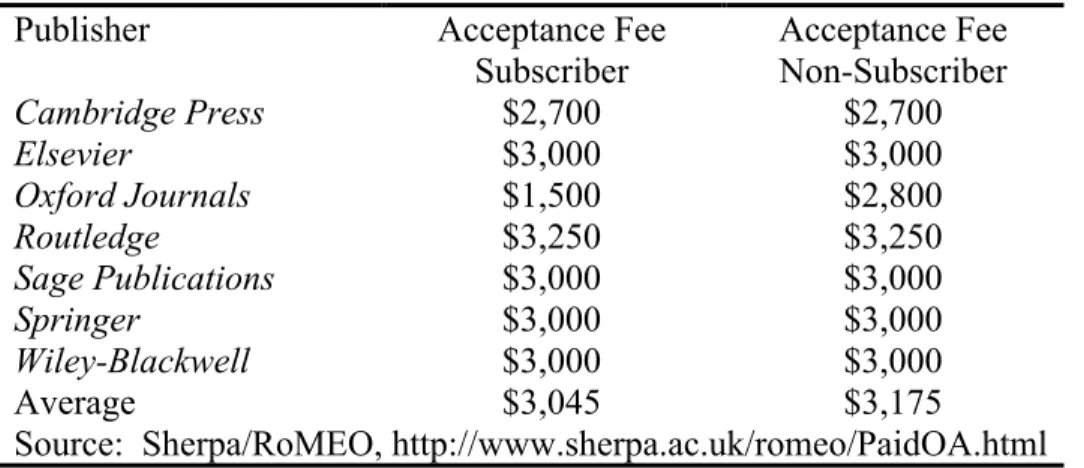
self-archiving the peer-reviewed version of research papers open access, the author can not enter into a copyright agreement with a publisher that does not allow the funding condition to be met. In securing the funds to pay the publishing costs, the author can look to either the grant funds, or to the author’s institution. Author-pays involves the transfer of fees to the journal’s publisher to accommodate the publisher’s interests, yet does not eliminate the need for the author’s institution to also pay for a subscription to the full journal. Some publishers give slight discounts to any author whose library subscribes to the journal. Table 1 shows examples of some of the author-pays fee arrangements.
Table 1: Publishers and Author-Pays Programs
Publisher Acceptance Fee
Subscriber
Acceptance Fee Non-Subscriber
Cambridge Press $2,700 $2,700
Elsevier $3,000 $3,000
Oxford Journals $1,500 $2,800
Routledge $3,250 $3,250
Sage Publications $3,000 $3,000
Springer $3,000 $3,000
Wiley-Blackwell $3,000 $3,000
Average $3,045 $3,175
Source: Sherpa/RoMEO, http://www.sherpa.ac.uk/romeo/PaidOA.html
Mergers and acquisitions within the publishing industry also bring about changes in self-archiving policies. In 2007, John Wiley & Co. and Blackwell Publishing merged. The merger created a company that publishes the journals of over 500 learned societies. The self-archiving policies of a publisher the size of Wiley-Blackwell have the potential to significantly impact scholars in a multitude of fields.
any deposit of the refereed version of the work draws a sharp distinction between the work of the author (the submitted manuscript), and the work of the journal’s referees and editors (the peer-review process). Under a “preprint only” policy, the refereed article (postprint), having benefited from the insights and suggestions of the referees and editors, will not be available for self-archiving within an institutional repository or on an author’s personal Web page.
Publishers may be comfortable with the current levels of self-archiving, because self-archiving has not yet achieved the critical mass of freely available articles that might affect subscription levels. Academic librarians will not be comfortable cancelling
subscriptions with current self-archiving rates at an estimated 10-20% (see Harnad et al., 2008). However, surveys have indicated that librarians are keeping an eye on the amount of content in open access repositories (Pinfield, 2007). Studies of the business models of publishers as they relate to open access repositories have shown that even well populated subject repositories such as arXiv have not produced significant decreases in
subscriptions in relevant journals (Pinfield, 2007; Swan & Brown, 2005). However, it is prudent to assume that the largesse of publishers with regard to permissive self-archiving policies will begin to evaporate if journal or database cancellations begin to impact their business models.
From a self-archiving author’s perspective, the variety of different policies can complicate the attempt to establish a coherent self-archiving practice for an individual scholar or for an institutional repository. There are stark differences in self-archiving policies contained within the universe of publisher agreements. The publisher
confusing array of article “version” definitions. It is possible that many authors simply ignore them.
Antelman (2006) determined that in a set of approximately 2,000 articles self-archived by authors within the social sciences, there was no discernable relationship between publisher self-archiving policy and self-archiving practice. In fact, Antelman’s study found some counterintuitive results. In a number of cases, the self-archiving rate for articles published within journals with more restrictive policies (SHERPA/White) showed a greater percentage than articles published within journals with more lenient self-archiving policies (SHERPA/Green). Ultimately, self-archiving practices appear to be more consistent within disciplines, and also tend to reflect university or department norms (Davis & Connolly, 2007), indicating that self-archiving practices are developed independently from publisher policies, and do not adjust to accommodate different levels of restrictions on self-archiving.
Scholars may publish in a number of journals, representing a range of publishers. For the scholar who wishes to develop a consistent practice of self-archiving his or her papers, and who simultaneously wishes to create a coherent look and feel to his or her Web page, the conflicting directives from publishers about how to self-archive can be daunting. For the younger, or untenured scholar, the issues involved in self-archiving may be even more intimidating. A Ph.D. candidate who has published an article and wishes to self-archive may lack a university-supported homepage or access to an
If confusion and complexity surround the practice of self-archiving published articles, the likelihood of a “better safe than sorry” attitude towards self-archiving is more likely to result. In deciding whether, and how to self-archive a published work, the scholar is expected to walk a precarious line between the pressure to self-archive and eliminate barriers to open access, and the pressure to not self-archive if it could
jeopardize his own career interests and the economic interests of the journal in which he published. Such conflicting incentives may explain much of the randomness in self-archiving habits among published authors, as discerned in the results of the study discussed below.
Methodology and Results
Methods
In determining the open access availability of a set of articles published in high-impact journals in the social sciences, the study follows two inquiries: one focusing on the OA status of the articles themselves, and the second focusing on the self-archiving behavior of the individual authors of the articles. The inquiry involves first searching for open access versions of peer-reviewed articles to determine how many may be located with common search engines, and second, determining the characteristics of the articles’ individual authors with regard to self-archiving practices. The present study addresses the following research questions.
2) Are there common attributes among the authors in the study who were found to have self-archived, either by discipline, or by country or region affiliation?
The data consists of a group of scholarly articles published in 2007 and 2008 among a set of high-impact journals in the fields of Anthropology, Economics, Political Science, and Sociology. The journals in the study are the top 10 journals within each of the four social science fields as ranked by ISI impact-factor. The group of the top ranked journals was chosen specifically for two reasons: 1) to identify journals considered of general importance and broad interest in their field, and 2) to study the behavior of authors who have published articles in high-impact journals, a group that has been identified as more likely to self-archive than other authors (Wren, 2005; Bergstrom & Levaty, 2007). Selecting the 10 highest impact journals from the fields of anthropology, economics, political science, and sociology produced a group of 38 journals2
All articles published in regular issues of the journals during January-June 2007 and January-June 20083 produced the set of articles included in the study (n=1,686). Only full-length articles were included in the study. Book reviews, editorials, and other supplemental materials in the journals were not counted for the study, as these materials are less likely to be self-archived by authors.
The article title and the name of all of the article’s authors were located using the Tables of Contents found at the various websites of the journals or the journals’
publishers. Each article was searched to determine if it had been self-archived by the
2 Two journals, Global Networks and Social Networks, were among the top 10 journals in two fields, so the number of unique journals reviewed was 38. Duplication was omitted in aggregations of total articles and total authors.
following authors: 1st author, 2nd author, 3rd author, and 4th or last author. For the articles with more than 4 authors, the last author’s name was searched in lieu of the 4th author.
The initial search for an open access version of each article was by searching for the title and one or more authors’ names in Google Scholar, using the Advanced Scholar Search functions. If the initial search did not find an open access version of the article, then the full title entered as a phrase in Google. Each author’s institution was determined using the Table of Contents and abstracts found at the publisher or journal website.
By visiting an author’s personal or departmental website, it was determined whether the article was self-archived there, or if there any were links to the article in a subject repository. If applicable, the 2nd, 3rd, and 4th or last authors were searched in the same manner as the first author to determine if any of the co-authors had archived the article on their personal webpage or within an IR or SR. If all previous searches had not produced a self-archived copy of an article, then a final search of the author’s name was conducted using OAIster and OpenDOAR. OAIster is a searchable database that harvests article metadata from OAI-compliant open access repositories (www.oaister.org).
OpenDOAR is a directory of academic open access repositories that uses a customized search engine from Google to index the contents of open access repositories
(www.opendoar.org). The various search methods used in the study were based on the findings and recommendations of Norris, Oppenheim, and Rowland who systematically compared performances for popular search engines in searching for open access articles (Norris, Oppenheim & Rowland, 2008a).
the article, and the publisher’s self-archiving policies were recorded. Adopting a method created for use in a series of studies of open access vs. toll access articles, each author was identified by country and region (North America, Europe, UK and Rest of World) in order to determine possible patterns of self-archiving behavior (Norris, Oppenheim, & Rowland, 2008b).
In contrast with a number of previous self-archiving studies, which used
specialized web crawlers to search for self-archived versions of articles published in high impact journals, searches within this study were conducted using common search
engines, using the types of searches which might be conducted by members of the general public trying to find a social science article which interested them. In addition, searching individual author’s Web pages for each of the articles provided an opportunity to visit a multitude of sites, either created individually by scholars, or by a university or a department for their faculty, as well as the chance to review the usability of features of a large number of institutional repositories.
Results
The results of searching for self-archived copies of articles in anthropology, economics, political science and sociology journals produced the following count: of a total of 1,636 articles in the study, 40.68% (n=686), were found to have been archived by at least one author, and 59.31% (n=1,000) were not found to have been self-archived.
have self archived a copy of their article either on their personal web page or in an institutional or subject repository.
The results indicated similar rates of self-archiving between articles published in 2007 and articles published in 2008. Of the 831 articles published in 2007, 41.9% had been self-archived. Of the 855 articles published in 2008, 39.2% had been self-archived. Results for the four social science disciplines are discussed below.
Anthropology Results
Journals and Impact Factor
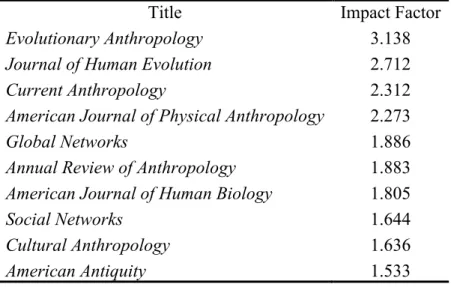
The 10 anthropology journals cover a broad range of topics including evolution, physical and cultural anthropology, local and global networks, and antiquities. The anthropology journals had an impact factor range of 3.138 to 1.533 (Table 2).
Table 2: Anthropology Journals and 2007 ISI Impact Factors
Title Impact Factor
Evolutionary Anthropology 3.138
Journal of Human Evolution 2.712
Current Anthropology 2.312
American Journal of Physical Anthropology 2.273
Global Networks 1.886
Annual Review of Anthropology 1.883 American Journal of Human Biology 1.805
Social Networks 1.644
Cultural Anthropology 1.636
Article Self-Archiving Rate
The total number of anthropology articles included in the study was 529, with 260 articles published in the first half of 2007, and 269 articles were published in the first half of 2008. Out of the 529 total articles, 136 articles (25.52%) were found to have been self-archived by one or more of the contributing authors, while for 393 (74.48%) of the articles, no self-archived copy could be located.
Anthropology Authors
The 529 anthropology articles were written by a total of 1,457 authors. The average number of authors per article was 2.79, the mode was 1, and the median was 7. The study selected the 1st, 2nd, 3rd, and 4th or last author of each article as a subset, to determine whether each of the individual authors had self-archived their article on a personal webpage or in an IR or subject repository. Identifying the subset of all 1st, 2nd, 3rd, and last authors produced a total number of 1,202 authors who were included in the study. The set of anthropology articles included a large set of articles (27%) having more than 4 authors, with a group of over 200 authors who were listed as 5th author or higher.
Within the group of 1202 anthropology authors, 176 authors (14.64%) had self-archived a version of their published article, while the remaining 1,026 (85.36%) authors had not self-archived a version of their article that could be located online.
Figure 1: Self-Archiving Percentage by Author Number
The authors included anthropologists from over 50 countries, including many local anthropologists working along with North American and European anthropologists at internationally important sites.4
Examining anthropology authors on a regional basis shows that majority
(45.28%) of authors come from institutions in North America. The next largest group of authors came from Europe (27.61%). Authors from the United Kingdom comprised 10.74 % of total authors, and 16.36% of the authors were from the combined group of countries from the rest of the world (Table 3).
Table 3: Percent of Anthropology Authors by Region
Article Versions Self-Archived
Of the authors who self-archived, anthropology authors posted articles most frequently in the publisher’s pdf version. Self-archiving of earlier versions, preprints or postprints, was far less common (Table 4). Of the anthropology articles found to be self-archived, 87.5% were in publisher’s pdf format, 9.7% were a preprint version of the published article, and only 2.84% were a postprint or accepted manuscript version of the published article.
Table 4: Anthropology Self-Archiving by Version of Article
Preprint Postprint Publisher’s PDF
2.84% 9.7% 87.5%
The anthropologists in the study self-archived most frequently on their personal or departmental Web page. Fewer of the anthropology articles were self-archived in
institutional repositories. There were a number of articles within anthropology that were self-archived in PubMed Central. Archiving within PubMed is a natural fit for a number of anthropology journals with a strong focus on biology and health, including the
American Journal of Physical Anthropology, and the American Journal of Human
Biology.
North America Europe United Kingdom Rest of World
Economics Results
Journals and Impact Factor
The group of economics journals included coverage of a wide range of issues related to economic theory and practice, including market theory, fiscal policy, finance, accounting, statistics, international trade and development, and political economics. Table 5 shows the titles and the impact factors for the 10 economics journals.
Table 5: Economics Journals and 2007 ISI Impact Factors
Title Impact Factor
Journal of Political Economics 4.190 Journal of Economic Literature 3.973 Quarterly Journal of Economics 3.688 Journal of Accounting & Economics 3.034 Journal of Financial Economics 2.988
Econometrica 2.972
Journal of Economic Perspectives 2.831 Journal of Economic Geography 2.679 Review of Economics Studies 2.539 Journal of Economic Growth 2.292
Article Self-Archiving Rate
There were 410 economics articles included in the study, with 202 articles
Economics Authors
Within economics, there were 410 articles written by 846 authors. The average number of authors per economics article was 2.06, with a mode of 2 and a median of 4. Selecting the 1st-4th authors for each article produced a subset of 839 authors who were included in the study.
As indicated in previous studies, economists show higher rates of self-archiving relative to other disciplines within the social sciences. Of the 839 economics authors in the study, 58% (n=487) of all authors included in the study were found to have self-archived a version of their published article, many in more than one location - while the remaining 352 authors (41.95%) had not self-archived their article.
Within the group of 410 authors listed as first or sole author on each of the
economics articles, 60% (n=246) had self-archived their article, either on a personal Web page, or within a subject repository, primarily within RePEc and SSRN. Of the group of second authors, 57.49% had self-archived (n=167) their article. Of 3rd authors, 52.89% (n=64) had self-archived, and of the group of 4th or last authors, 50% (n=10) had self-archived their article.
Examining the numbers of economics authors from each region showed that North American authors comprised a large majority of the total authors (Table 6). North American authors comprised 74.38% of the total economics authors. Europe had the second highest group of authors with 12.6%, authors from the United Kingdom
economics journals selected for the study are published in the U.S. and concerned with U.S. economics.
Table 6: Percent of Economics Authors by Region
Article Versions Self-Archived
Economics authors made far more extensive use of preprints and postprints than authors from the other three disciplines. Of economics authors who were found to have self-archived their article, 26.3% percent had self-archived a preprint of the article, 41.1% had self-archived a postprint, and 32.65% had self-archived the publisher’s pdf version of their article (Table 7).
Table 7: Economics Self-Archiving by Version of Article
Preprint Postprint Publisher’s PDF
26.3% 41.1% 32.65%
Economists self-archived more frequently than other authors. Because of the greater number of examples of self-archiving, it was interesting to see the variety of different habits of the economists. Articles with multiple authors showed a variety of versions of the same paper. For example, one author would self-archive a preprint, another a postprint and a third a publisher’s pdf. Most authors posted their articles on their home pages, often in hyperlinked lists of working papers. Many articles were found
North America Europe United Kingdom Rest of World
archived on SSRN with links from the author’s web page. Economists tended to have a helpful practice of hyper linking to their co-author’s web page.
Political Science Results
Journals and Impact Factor
The 10 political science journals cover a broad range of issues including the American and European Union political systems, public opinion, voting behavior, confliction resolution, and geopolitical issues. Table 8 shows the political science journals by title and impact factor.
Table 8: Political Science Journals and 2007 ISI Impact Factors
Title Impact Factor
Political Analysis 2.535
American Political Science Review 2.317 American Journal of Political Science 2.032 Public Opinion Quarterly 2.030 Journal of Conflict Resolution 2.030
Political Geography 1.922
European Journal of Political Research 1.679
European Union Politics 1.651
Quarterly Journal of Political Science 1.636
Journal of Politics 1.456
Article Self-Archiving Rate
Political Science Authors
Within political science, there were 385 articles written by 717 authors. The average number of authors per political science article was 1.86, the mode was 1, and the median was 3.5. Selecting the authors who were listed in the 1st, 2nd, 3rd, and 4th or last position for each article produced a set of 705 authors who were searched individually to determine whether the author had self-archived.
A total of 227 political science authors (32.19%) had self-archived a version of their published article, while the remaining 478 authors (67.8%) had not self-archived a version of their article.
Of the political science authors who were identified as first or only author, 34.28% (n=132) had self-archived their article. Of the group of 2nd authors, 31.1% (n=69) had self-archived, of 3rd authors 26% (n=19) had self-archived their article, and of 4th or last authors, 28% (n=7) had self-archived. There was not enough difference
between the self-archiving rates of 1st, 2nd, 3rd and 4th authors to show significance. Table 9 reflects the percentages of political science authors by region. The
majority of political science authors were from North America (72.5%), again reflecting a large percentage of American authors. European authors made up 13.3% of the total, reflecting the presence of two journals focused on European politics. United Kingdom authors comprised 9.8% of the total, and authors from countries in the rest of the world made up 4.4% of the total authors.
Table 9: Percent of Political Science Authors by Region
North America Europe United Kingdom Rest of World
Article Versions Self-Archived
Of the political science authors who were found to have self archived, 30.8% had self archived a pre-print of the article, 11.61% had self-archived a postprint, and 57.59% had self-archived the publisher’s pdf version of the article (Table 10).
Table 10: Political Science Self-Archiving by Version of Article
Preprint Postprint Publisher’s PDF
30.8% 11.61% 57.59%
The majority of the self-archived articles were located on the author’s personal or departmental Web page, although within Europe and Australia, a fair number of articles had been self-archived in institutional repositories. Within the group of political science authors the use of subject repositories was sparse, although a handful of papers were located in SSRN and arXiv.
Sociology Results
Journals and Impact Factor
Table 11 shows the sociology journals and their 2007 impact factors. Many of the journals dealt broadly with the topic of sociology, two focused primarily on populations within the U.S. and one focused largely on populations in the UK. Other sociology
Table 11: Sociology Journals and 2007 ISI Impact Factors
Title Impact Factor
American Journal of Sociology 3.338 American Sociology Review 3.277 British Journal of Sociology 2.449 Annual Review of Sociology 2.400
Global Networks 1.886
Sociology of Health & Illness 1.759 Journal of Marriage and Family 1.756
Economy and Society 1.678
Social Networks 1.644
Social Problems 1.577
Article Self-Archiving Rate
Of the 418 sociology articles within the study, 95 articles (22.73%) were found to have been self-archived by one or more of authors, while 323 (77.27%) of the articles there was no self-archived copy that could be located with any of the search methods. Of the total articles, 210 were published in the first half of 2007, and 208 articles were published in the first half of 2008.
Sociology Authors
The sociology authors in the study represented institutions in 28 separate countries.5 Among the group of sociology authors, 54% (n=432) were from the United States. On a regional basis, the majority of sociology authors came from North America (60.7%). Authors from the UK represented 21.8% of all authors. Authors from Europe represented 11.3% of the total, and authors from all other countries represented 6.16% of the total sociology authors. Table 12 shows the percentage of sociology authors by region.
Table 12: Percent of Sociology Authors by Region
As reported by other studies (Norris, Oppenheim & Rowland, 2008b; Antelman 2006), sociology authors showed a relatively low rate of self-archiving. Of the total number of authors, 129 sociology authors (16.15%) had self-archived a version of their published article, while the remaining 670 authors (83.85%) had not self-archived.
Of sociology authors who were listed as 1st author, 19.14% (n=80) had self-archived their article. For 2nd authors, 3rd authors, and 4th (or last) authors, the self-archiving numbers were 15.52% (n=36), 9.62% (n=10), and 6.7% (n=3), respectively. Although the differences in these self-archiving percentages are small, they are
5 Sociology authors in the study were from the following countries: Africa, Argentina, Australia, Canada, Denmark, Egypt, Estonia, Finland, France, Germany, Ireland, Israel, Italy, Korea, Mexico, The
Netherlands, Norway, New Zealand, Pakistan, Singapore, Slovenia, Spain, Sweden, Switzerland, Turkey, UK, U.S., Vietnam.
North America Europe United Kingdom Rest of World
nonetheless significant (p<0.028%) and show an association between author position and self-archiving rates within sociology.
Article Versions Self-Archived
Sociologists most frequently self-archived the publisher’s pdf version of their articles (57.36%). Sociologists used fewer preprints (25.58%) and postprints (17.05%). Table 13 shows the percentage of articles self-archived by version. Preprint versions were more commonly self-archived by authors from Europe or the United Kingdom. Many of the UK and European authors had self-archived their preprint in an institutional repository. When postprints versions of articles were found, they were often found in PubMed Central as a deposited author’s manuscript, after being published in a journal with medical or health related issues, such as Sociology of Health & Illness.
Table 13: Sociology Self-Archiving by Version of Article
Preprint Postprint Publisher’s PDF
25.58% 17.05% 57.36%
The results reveal distinct disciplinary differences in self-archiving patterns, both in the total percentage of articles self-archived, and in the individual self-archiving patterns of authors within each discipline. In addition, disciplines show distinct habits in the version of the article the authors tend to self-archive the most frequently, and whether authors are most likely to self-archive on their own Web pages, or in subject or
The study also analyzed authors by institution and department to determine if self-archiving habits were associated with groups of scholars in the same setting. Most institutions had small numbers of authors in the study due to the short window of
publication dates in the study (12 months) combined with the limited number of journals per field. Therefore, statistically significant results showing reliable differences in self-archiving rates for individual institutions or departments could not be achieved.
However, a few institutions in a number of fields produced far higher than average results in self-archiving rate. Those results are qualitatively analyzed in the discussion section.
Publisher Self-Archiving Policies
To demonstrate the range of self-archiving policies among the group of journals in the study, the tables in the Appendix combine the publisher self-archiving policies of the 38 journals in the study. The policies are divided into in three tables, showing how different policies handle the self-archiving of preprints, postprints, and the publisher’s pdf. Each self-archiving policy was located on the publisher or journal websites, or was located within the SHERPA/RoMEO database.
The SHERPA/RoMEO database functions by drawing distinctions between publishers and journals in terms of what level of self-archiving permission they allow. The “color” designations are general categories, as two journals of the same color may handle the precise permissions or instructions regarding preprints, postprints or
(SHERPA/white). Publisher policies within each of the four disciplines are discussed individually below.
Economics
Five of the 10 journals are SHERPA/Green (preprint allowed/postprint allowed), three are SHERPA/Yellow (preprint allowed/postprint allowed after embargo), one is SHERPA/Blue (preprint not allowed/postprint allowed); and one was SHERPA/White (preprint restricted/postprint not allowed). Five of the economics journals expressly disallow use of the publisher’s pdf version of the article; five journals either allow the publisher pdf use or are silent. Figure 2 indicates that regardless of the publisher policy, the self-archiving rates of the individual economics authors remained fairly consistent.
Sociology
Three of the 10 sociology journals have policies described as SHERPA/Green (preprint allowed/postprint allowed), five are SHERPA/Yellow (preprint
allowed/postprint allowed after embargo), and 2 are SHERPA/White (preprint restricted/postprint not allowed). Of the 10 sociology journals, 8 journals expressly disallow use of the publisher’s pdf version, and 2 journals allow use of the publisher’s pdf after embargo. Figure 3 shows self-archiving rates of sociology authors within different publisher’s policies. The data indicates that there are a greater percentage of non self-archiving authors who published articles in SHERPA/Yellow journals than who published in journals with SHERPA/Green policies. This does not necessarily indicate that the policies are the reason for the difference in rates, only that the difference exists.
Anthropology
Four of the 10 anthropology journals have policies described as SHERPA/Green, 2 are SHERPA/Yellow, and three are SHERPA/White. One journal’s policy could not be located on the journal site or on the SHERPA/RoMEO database. Seven of the 10
anthropology journals expressly disallow any use of the pdf; 2 journals allow use of the publisher’s pdf (one after embargo; one immediately). One journal, American Antiquity, did not have a policy on pdf use that could be located; however, the journal is not an electronic journal, so no electronic versions of the published articles are widely available. Figure 4 indicates that anthropologists who did not self-archive were more likely to have published their articles in SHERPA/White journals (the most restrictive SA policies). However, the self-archiving rate of authors within SHERPA/Green journals (80.32% did not self archive) and SHERPA/White Journals (88.9% did not self archive) is not
significantly large enough to suggest that the policies have a marked effect on self-archiving behavior.
Political Science
Four of the political science journals have SHERPA/Green self-archiving policies and six journals have SHERPA/Yellow policies. The six SHERPA/Yellow journals all contain embargo periods: three for 12 months, three for 24 months. No political science journals in the study were identified as SHERPA/White, so that there are no complete prohibitions against self-archiving in this group of journals. Three of the journals allow self-archiving of the publisher’s pdf version of the final paper, while seven journals specifically prohibit posting of the publisher’s pdf version. Figure 5 shows that political science authors had only two different policies: SHERPA/Green and SHERPA/Yellow. There was a slightly greater tendency for authors in SHERPA/Green journals to self-archive (35.2% did self-self-archive) than authors in SHERPA/Yellow journals (29.7% did self-archive).