Emma C. Parker. Sourcing Success: Assessment Techniques of Digital Cultural Heritage Crowdsourcing Projects. A Master’s Paper for the M.S. in L.S degree. November, 2018. 52 pages. Advisor: Denise Anthony
This study focuses on how libraries, archives, museums, and other cultural heritage institutions define and assess the success of online crowdsourcing projects. The research was conducted via a survey of twenty-two digital crowdsourcing projects ranging from transcription of digitized archival materials to wildlife documentation projects.
The survey found that institutions had diverse reasons for undertaking crowdsourcing projects and monitored project success through multiple assessment measures dependent on project goals. Survey respondents reported greater satisfaction with their project outcomes when they had identified at least one measurable goal prior to starting the project. In general, survey respondents reported positive feelings about, and an interest in future crowdsourcing projects as tools for description, community engagement, and user recruitment.
Headings:
Crowdsourcing Archives surveys
Archives — Social aspects
SOURCING SUCCESS: ASSESSMENT TECHNIQUES OF DIGITAL CULTURAL HERITAGE CROWDSOURCING PROJECTS
by Emma C. Parker
A Master’s paper submitted to the faculty of the School of Information and Library Science of the University of North Carolina at Chapel Hill
in partial fulfillment of the requirements for the degree of Master of Science in
Library Science.
Chapel Hill, North Carolina November 2018
Approved by
Table of Contents
Introduction ... 2
Literature review ... 4
On the nature of crowds ... 7
Case studies and technical literature ... 8
Evaluating digital projects & assessment of online projects ... 10
Methodology ... 13
Survey construction ... 13
Survey distribution ... 14
Results ... 16
Respondent demographics ... 16
Respondents' crowdsourcing projects ... 18
Project goals ... 22
Assessment methods ... 24
Self-assessment of success and interest in future crowdsourcing projects ... 30
Discussion ... 34
Conclusion ... 37
References ... 39
Appendix A: Recruitment email ... 43
Appendix B: Survey information sheet ... 44
Introduction
Oysters casino. Westphalia ham. Soda split. Peach melba.
These are just a few of the 1,333,247 dishes transcribed by volunteers from a collection of over 17,000 historic menus in the New York Public Library's menu
collection (NYPL Labs, 2017). Since 2011, volunteers have transcribed the text of menus from 150 years of New York's culinary history, allowing food historians and others to search across menus, chart the rise and fall of sugar-cured ham and Carolina rice, and conduct research across a massive collection that would be nearly incomprehensible and unusable without text searching.
But the transcription work was not done by museum staff, or even a team of in-house volunteers, working together, in-person, with formal training. It was conducted by hundreds of people, online, in their own homes, who pitched in and transcribed anywhere from a few dishes to a few hundred menus.
Massive online volunteer projects like this—crowdsourcing projects—are
projects. But when is a crowdsourced project finished? And what does a successful project look like? (Murphy, Peimer, Duplisea, & Fritz, 2015)
Literature review
A single technological advance has changed notions of "discoverability" drastically in cultural heritage institutions: the internet. It has allowed archives to put finding aids and inventories of their holdings online for anyone (with a computer and access to the internet) to find and use. With the rise of inexpensive, high-quality digital imaging equipment, such as scanning and digital cameras, the internet has allowed institutions to make available not just descriptions of their resources, but the resources themselves, in the form of scanned documents and other digitized files.
In the last months of 2005, Jeff Howe, a business and technology journalist, coined a new term: crowdsourcing. He defined it as "the act of taking a job traditionally performed by a designated agent (usually an employee) and outsourcing it to an
undefined, generally large group of people in the form of an open call" (Howe, 2006a). By the following spring, the term had its own Wikipedia page, and a cover article in Wired magazine extolled the uses of crowdsourcing in avenues from business to finance and medicine (Howe, 2006b).
The practice — dividing large, repetitive tasks among the "crowd" to disperse work across many members of the public — far precedes the coining of the term, however. In the 1840's, usage examples and entries in the Oxford English Dictionary were written by over 500 paid and un-paid volunteers as part of the "Reading
But the growth in internet availability in the mid-2000's allowed institutions to seek volunteers from Anchorage to Ankara. Since then, crowdsourcing has been used in science, medicine, cloud computing, business and cultural heritage institutions (Audubon Society, 2017; “CrowdMed,” 2017; U.C. Berkeley, 2017). Using a platform called CrowdMed, doctors and the public collectively created diagnoses of mystery ailments. Citizen science projects asked elementary students and serious scientists alike to send in data about their local environment and bird populations. Cultural institutions, like libraries and museums began to take notice of the capabilities of the new platforms that networked computing offered. In a 2010 article called "Crowdsourcing: How and Why Should Libraries Do It?", Rose Holley wrote:
Users still want more than a simple information transaction and they want the same and more social interactions than they had in the 'pre-digital' days… And now they are telling us they can do even more, they can organise themselves to work together to achieve big goals for libraries and make our information even more accessible, accurate and interesting. Why are we not snapping up this great offer immediately? (Holley, 2010).
Crowdsourcing projects in most cultural heritage institutions tend to be focused on one of three "big goals":
2. Crowd-description - In crowd-description, institutions ask the public to help describe their currently held materials. Often, this takes the form of adding descriptive metadata, like tags, or transcribing scanned writing to generate searchable text. The New York Public Library's What's on the Menu? project used crowd labor to transcribe menus, while the Library of Congress' Flickr Commons uses free-form description in the form of Flickr comments and text. It's this category that's most common among libraries and archives, and on which this paper will primarily focus
3. Crowd-funding - Crowd-funding is the raising of money by dividing the cost of large purchases or investments over many small donations. Though some libraries, archives and museums have used this form of crowd support, this paper focuses primarily on the two categories above.
Holley (2010) lists potential benefits of participating in a crowdsourced project:
On the nature of crowds
Unsurprisingly, quite a bit of the literature surrounding cultural heritage
crowdsourcing projects focuses not on the institutions, but the crowd itself. The common narrative about members of the public who participate in crowdsourcing projects is that they are amateurs, engaging in the work out of a sense of boredom or accidental
curiosity. Daren Brabham, in one of only a handful of articles that begin to probe the ethics of crowdsourcing and the discourse surrounding it, argues that the description of volunteers as amateurs or hobbyists "undermines the fact that large amounts of real work and expert knowledge are exerted by crowds for relatively little reward and to serve the profit motives of companies" (Brabham, 2012). Brabham suggests that the 'crowd' has more experience than professionals often realize, and are working as laborers and deserve to be compensated as such. But beyond what's self-reported in online surveys, there is only a handful of research about the demographics and motivation of participants (Brabham, 2008; Mendes, 2015).
What most of that literature reveals is that participants often aren't engaged with the project in the long-term: the average volunteer participating in the British Library's project to transcribe and convert the card catalog into digital records remains active for just 13 days (Mendes, 2015). Some of the studies also mention varying levels of
involvement among participants, which is somewhat unsurprising. Some fields, such as business and information science, refer to the 80/20 rule of thumb or the Pareto
projects, in which "the top 20% of volunteers are making approximately 85% of the contributions" (Mendes, 2015).
Case studies and technical literature
Though crowdsourcing is a new practice among cultural heritage institutions — becoming widespread only in the last decade — there is quite a bit of excitement in the literature about the promises of crowdsourcing. But much of the literature about
crowdsourcing focuses on crowdsourcing content or resources such as asking a
community to submit photos, oral histories, or even their own documents or artwork. This work tends to be more collaborative or community-driven in nature; it seeks to reflect the community in the work of the institution. But as archives and libraries are especially seizing the power of the crowd to supplement their own work to describe content and make it discoverable, particularly through tagging, transcription, and captioning, this research will focus on projects that use this kind of crowd participation.
Reduced personnel costs, greater discovery, and volunteer and patron
'engagement' (defined broadly) are all described as possible benefits of projects like these (Gunther, Schall, & Wang, 2016; Parilla & Ferriter, 2016). There's some writing, as well, about the technical and procedural process of starting crowdsourcing projects and
There is, nevertheless, a handful of literature about crowdsourcing that moves beyond the potential and into the practical, with reflections on the workflows, protocols, and challenges of crowdsourcing projects that are already underway. Some project developers—from those still in process to those prematurely defunct—have published case studies about the infrastructure, protocol, and results of their crowdsourcing efforts (Alencar-Brayner & Wisdom, 2015; T. Causer, Tonra, & Wallace, 2012; Murphy, Peimer, Duplisea, & Fritz, 2015). Because many of these projects are still ongoing, however, many of these case studies tend to focus on the workflow and structure of the projects, with fewer details about the outcome and assessment of the project. If there is a report on the "success" of the project, it is typically in terms of work completion, or percentage of crowdsourced work that required moderation. The less tangible, more difficult to measure values of "engagement" or community-building are often left unaddressed.
One of the most robust profiles of a crowdsourcing project and its practical realities is the Transcribe Bentham project and the literature that surrounds it. Transcribe Bentham was a project launched by the University College London to transcribe some 40,000 works by Jeremy Bentham. Unfortunately, six months after the start of the project, Transcribe Bentham's grant ended and the project could not continue to pay the research assistants tasked with quality reviews of the transcription (Anderson, 2011).
two-and-a-half times as many as the volunteers would have produced had they continued
transcribing at the same rate" (T. Causer et al., 2012). But they ultimately determine the project was worth it, as "no funding body would ever provide a grant for mere
transcription alone". Progress may not have been speedy, but it provided a slow stream of transcription that they could not have directly paid for. As of September 15, 2017, 18,956 pages of manuscripts had been transcribed, or around 32% of the project. In January 2016, however, the project joined a European Commission grant to train and develop software to transcribe handwritten documents, effectively handing the job of Transcribe Bentham volunteers to a software program.
Evaluating digital projects & assessment of online projects
The second research question that drives this study focuses on the methods for assessment and evaluation of digital crowdsourcing projects that different institutions have used. How do institutions understand whether a project is going well, or whether it has fostered a lasting sense of engagement with the collections, or the institution as a whole?
Though 'assessment' has become a bit of a buzzword in academic library literature, there is considerably less focus on online projects and their evaluation than assessing in-person library programming and instruction, reference services, physical space and circulation data (Dobbs, 2017). Because the digital realm is relatively new, there is also little existing framework for evaluating crowdsourced digital projects. The Society of American Archivists provides Guidelines for Evaluation of Archival
Association's Library Assessment Cookbook has a chapter focused on "websites and web services assessment", but it is primarily focused on library websites as informational sources (Dobbs, 2017). The literature I have reviewed thus far does not contain any
references to pre-project assessment planning or goal-setting, though some case studies do mention the ways they have evaluated their project's progress.
Primary among these is simply reporting statistics about work completed i.e., a percentage of the total pages that have been transcribed or number of new tags added. For example, What's on the Menu? features a running count of dishes (currently 1,333,625) transcribed and how many menus (17,545!, to be exact) (NYPL Labs, 2017). Transcribe Bentham uses its 'Benthameter' to visually display the percentage of boxes of manuscript material that have been scanned and uploaded to the site, as well as publishes a
Methodology
Survey construction
It is only fitting that an evaluation of crowdsourced projects would be, itself, crowdsourced! This research project would not be possible without the expertise and input of archivists, librarians, and museum professionals willing to participate in this study. Because the literature regarding the outcome and assessment of crowdsourcing projects is relatively scant — and much of it is written not by cultural heritage
practitioners but researchers, this study has been designed as an online survey with accompanying follow-up interviews to solicit further details about the evaluation frameworks for selected projects.
I created an online survey using the survey software Qualtrics. In an effort to recruit as many respondents as possible, I tried to keep the survey as brief as possible and to hide questions that may not be relevant to specific projects unless they selected certain options. Thus, the survey had 14 base questions, with follow-up questions asking for specific information depending on the answers that were selected for question 12, which focused on specific assessment methodologies. If a respondent selected multiple
discouraged some potential respondents from completing the survey, though most respondents finished the survey in around 10-12 minutes.
Survey distribution
The choice of online distribution of the survey was intentional: only a small subset of cultural heritage institutions have engaged in crowdsourcing projects, so generating a sufficiently large sample size required casting a wide net. Including
institutions beyond my immediate geographic area or professional network and opening the invitation to participate to institutions across the United States and abroad was imperative to solicit diverse and numerous responses.
The survey was shared with four different listservs maintained by the Society of Archivists, including the general "Announcements" list (with a membership of 6000+ archivists), the "Reference, Access & Outreach" list, the "Manuscript Repositories" and "Metadata and Digital Objects" lists. I also contacted a Crowdsourcing Interest Group listserv based in the UK but with members from around the world, the MCN (Museum Computing Network) listserv (described as "advancing digital transformation in
museums"), the Musées Canada Museums listserv and nineteen email addresses listed as the contact information of larger crowdsourced projects or consortiums directly inviting them to participate (Appendix A).
Results
Respondent demographics
The survey data came from a wide range of cultural heritage institutions. Because the email distribution lists for the survey targeted both archival listservs (which also have subscribers in special collections libraries, archival vendors, and other institutions with archival materials) and museum listservs, as well as general-interest 'digital tools for cultural heritage institutions' lists that transcend institutional divisions, the sample of institutions was varied in institution type, size, budget, and project goals.
Figure 1: Survey respondents' institution type
Library 14% Archive 32% Museum 14% Other: Academic archive/library 4% Other: Digital humanities center 4% Other: Government 4% Other: University 4% Other: Small community museum 4% Other: Research and cultural centers, museums, field stations, archives 5%
Other: Group of SAA LACCHA section volunteers 5% Other: Digitization vendor 5% Other: Historical society with archival
The largest group of respondents—13 of the 21 projects—selected 'other' to describe their institution. When asked to describe further their institution type, it was clear that many of these projects took place in institutions that were not sharply defined as 'archive' or 'museum' or any single kind of institution. This included an academic archive and library, a digital humanities center within a university, and a community museum with archival collections. The number of respondents selecting 'other' might suggest, too, that institutions that are smaller 'jack-of-all-trade' institutions, or smaller organizations within a larger institution, are interested in harnessing the power of the 'crowd' to fulfill projects that might be otherwise beyond the institution's resources.
The second largest group of respondents selected 'archives' as their institution type. This included two US state archives, a European national archive, two university
archives—one with two respondents regarding the same project—and a religious archive. Three of the 22 respondents selected 'library'—two university libraries, and an
independent research library. To further complicate the (sometimes artificial) divisions between these categories, it's worth noting that one of the projects completed by the university libraries used archival materials from the library's special collections, and the other solicited materials to be housed in the university's archives.
The lines between library, museum, archive, historical society and other cultural heritage institutions are often blurred, and are growing blurrier as online projects cross traditional barriers and definitions (Trant, 2009). In retrospect, I could have better
respondents themselves, which can be a useful lens for understanding their project's goals and motivations.
Respondents' crowdsourcing projects
The next survey question asked respondents to "describe your online
crowdsourcing project in a few sentences", and include a link to the project, where applicable. Responses varied in the length and detail included in their descriptions, but most described the materials, the tasks volunteers were expected to complete, and a suggestion of how the project might serve the institution. An example of this is the response from the Alabama Department of Archives and History, describing their
Alabama History DIY: World War I Service Records project:
"The Archives digitized a collection of over 100,000 index-card service records of Alabama men and women who served in WWI. We asked the public to help us transcribe the select information found on the cards to create a new, searchable resource in our digital collections."
As survey responses arrived, it quickly became clear that the projects underway at these 21 institutions were nearly as varied as the institutions themselves, though I could group them into four general types of projects: transcription & translation, metadata, community memory, and crowdfunding.
Transcription projects were the most popular, with 11 of the 21 projects focusing on some element of text transcription. This echoes a larger trend in crowdsourcing literature: transcription projects are the most popular type of online crowdsourcing
projects in the cultural heritage sector (“2010: The Year of Crowdsourcing Transcription | FromThePage Blog,” 2011). These projects require volunteers to have no special
familiarity with early handwriting or typefaces), other than their screen and keyboard. It affords institutions the ability to offer full-text searching of content that was previously unindexed, such as handwritten documents, or documents that scanned using optical character recognition that may not have been accurate. This was the case for the Louisville Leader project, who, in their survey response, described their volunteer task this way: "transcrib[e] articles from an early- to mid-20th century African American newspaper. The newspaper was digitized from microfilm that had, in turn, been made in the 1980s from damaged originals; the resulting OCR was pretty terrible."
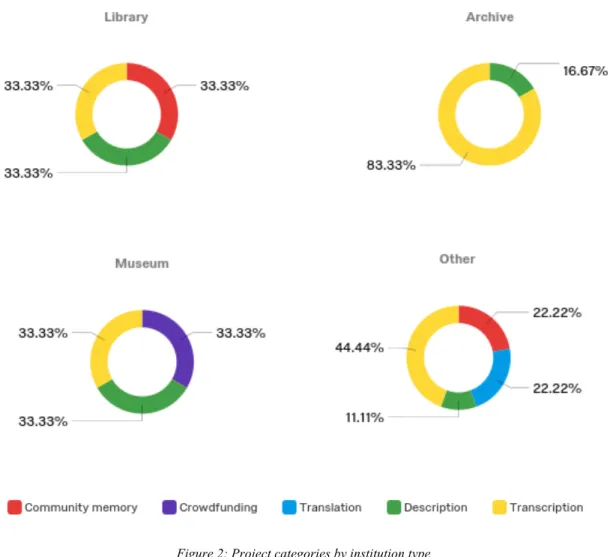
Transcription projects appeared to be especially common in archives, with 83% of respondents' projects involving text transcription. This interest in transcription in archives is not surprising, given the text-heavy collections of most archives combined with a growing interest over the past three decades in digital archival research, an interest that is driving a demand for keyword and full-text searching of archival documents
Figure 2: Project categories by institution type
Translation projects are similar to transcription projects, but tend to require more specialized knowledge. Two respondents reported using translation in their projects: one project recruited members of the Society of American Archivists' Latin American and Caribbean Cultural Heritage Archives section to translate SAA documents and an article into Spanish. Hudson Archival, a digitization vendor, created the other:
"Transcriptions of handwritten, braille, and OCR correction provided by a cadre of trained volunteers. Volunteers must be trained so that transcriptions follow a set of guidelines created to optimize results for screen readers and other devices to assist the vision and hearing impaired communities."
Four institutions also reported focusing on using volunteers to add descriptive
These projects focused on description, ranging from identifying animals in wildlife cameras to photographing and describing museum artifacts for an online museum database.
Three institutions, however, harnessed the power of volunteers not only to add information to existing collections, but also to contribute to those collections themselves. These community memory projects often focus on a local community and solicit
additions in the form of contributing photographs to an online exhibit, identifying faces in unlabeled photographs, and even contributing t-shirts, such as the T-Shirt Archive at the University of North Carolina at Chapel Hill. The project manager described that project this way:
"The UNC T-Shirt Archive is a digital-only collection of T-shirts related to UNC Chapel Hill. We asked contributors to send photos of their UNC-related shirts along with information about the shirts and any related stories and memories they wanted to share. We received shirts spanning from the 1940s to the present, representing a wide variety of aspects of life on campus - athletics, protests, residence halls, student organizations, events, and more."
Project goals
One part of the research question guiding this study was to better understand what a successful crowdsourcing project looks like for institutions as they undertake them. To that end, the next question asked for institutions to identify their reasons for starting a project from a list of options (or to list any other reasons not included) and to rank these goals in order of importance.
Each project identified between one and five goals (averaging around 3 goals each), suggesting that many projects were launched to complete multiple objectives. One goal stood above the others when ranked in importance: "Enrichment of existing description: adding additional information for items that have some existing description. This might
include transcription, naming individuals in photographs, or geotagging. Fifty percent of respondents listed it as their top goal, compared to only 21.4% who selected "Basic description" — i.e., description of items that have not yet been described.
Figure 3: Project goals selected by survey respondents
Even though many respondents said their primary objective was to add new metadata to already-described items, and contrary to some literature that paints crowdsourcing solely as a tool to complete tasks, the most 'popular' goal, was
"Engagement with existing stakeholders" selected by 16 respondents followed by
"Recruiting new stakeholders", which was selected by 13 respondents. This suggests that crowdsourcing may be more widely accepted now as a tool for making connections with users, perhaps even more than a much-touted tool for efficient cataloging, description, or acquisition of new material (Holley, 2010).
Responses listed under 'other' tended to echo the widespread interest in community engagement, as well as harnessing the power of volunteers to more easily expose
materials and facilitate research, typically in the form of adding additional metadata to 'underdescribed' materials. These responses ranged from "engaging the public, and democratizing access to materials" through a university manuscript transcription project to furthering "research on mammal communities" via a citizen science
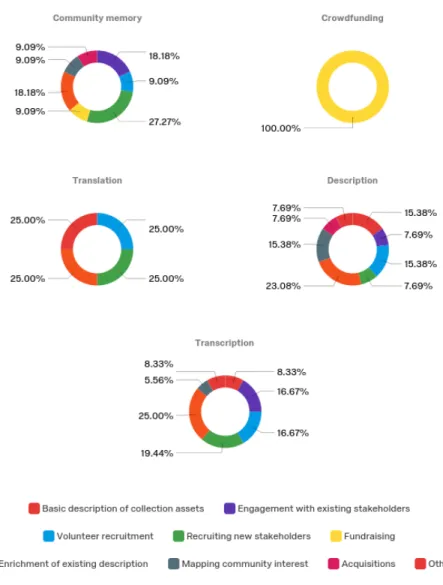
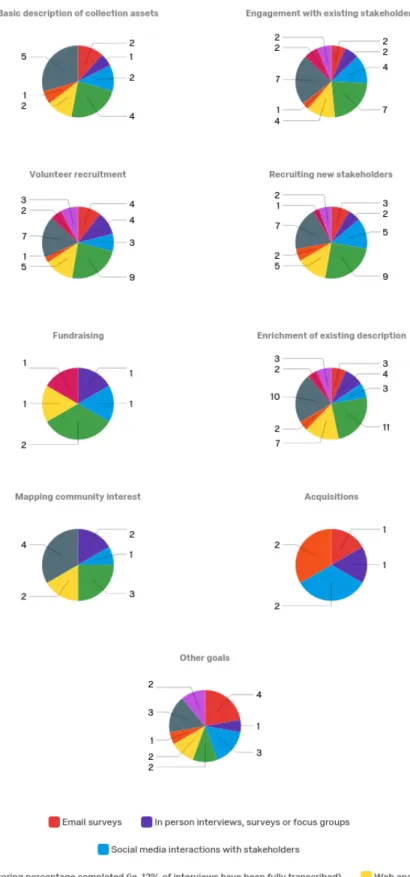
Figure 4: All project goals sorted by project category
Assessment methods
The final question that this research sought to illuminate was how identified project goals were assessed. The following set of survey questions asked whether institutions had set specific goals before starting a project, how they measured those goals (choosing from a list of pre-selected options, plus 'other' for additional methods), and a short description of each assessment type they had used.
and recruitment, such as this museum project to document and transcribe artifacts: "12400 records available by the first year, collections website averaging 300 hits
monthly, 1440 volunteer hours completed in year one, recruit 20 new volunteers". Other projects set goals that were not time-limited, but merely to eventually complete the task for every item, as in the case of the citizen science project, that described their ambitious goal as "camera trap 32 parks in the Mid-Atlantic region and process all images, which was around 3 million."
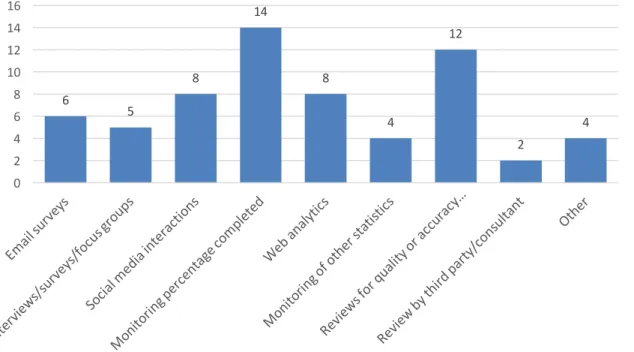
Figure 5: Assessment methods selected by survey respondents
Despite the fact that just under half of respondents reported not having specific goals at the start of the project, all 21 projects did report the use of at least one
assessment or monitoring method throughout the project, such as reviewing web analytics, quality control of transcriptions by staff, focus groups or interviews, or email surveys. Some projects used just one of these methods; others reported using up to five different methods to assess their project's success.
Unsurprisingly, the most widely reported method of assessment was simply to review and monitor the amount of work completed by volunteers. For transcription projects, this was typically the number of transcribed scans. Projects also reported
monitoring the number of photographs identified, number of visitors to the library, and in the case of the crowdfunding project, the amount of money raised.
Twelve of the projects also reported reviewing crowdsourced content for quality and accuracy—one of the early concerns about crowdsourcing was that volunteers may
6
5
8
14
8
4
12
2
4
not reliably produce high-quality work or may use the platform to "troll". However, several studies have shown that volunteer transcribers, researchers, and annotators often produce work that is nearly as good—and in some cases, better—as paid workers
(Munyaradzi & Suleman, 2014; Nowak & Rüger, 2010). In some cases, respondents even reported beginning with more stringent quality control workflows, then loosening them once they saw the quality of work produced by volunteers:
"The Digital Initiatives Librarian actually has to cut and paste the transcriptions into CONTENTdm, so she makes a very cursory scan of the transcriptions in that process. But she very quickly learned there were no issues with the transcriptions. She didn't find errors that were significant enough to warrant close reading on a regular basis, and in five years she has only found one instance where someone created something other than a transcription (it was sort of a commentary on the larger issues raised by the article involved)."
Because these projects are conducted online, social media and web analytics were—unsurprisingly—also commonly listed as assessment tools, with just under a quarter of projects reporting that they used each. Projects used social media to advertise and assess the 'reach' of their project, solicit feedback on the project, and document community interest via sharing and 'likes'. They also reviewed web analytics such as time spent actively engaged with the project interface, new vs. returning logins, and user-reported demographics.
sustained, diverse ways. Those that did identify a specific goal also reported looking at other measures, as well: even if they reported a goal as merely transcribing pages, they also monitored user sentiment on social media, or new volunteer signups. A more holistic and detailed inquiry into assessment methods via a semi-structured interview or
Self-assessment of success and interest in future crowdsourcing projects
The portrait Rose Holley paints in her article Crowdsourcing: How and Why Should Libraries Do It? of volunteers working together to accomplish "big goals" for libraries almost seems too good to be true: projects that seemed impossibly large can be finished in just a few months, the number of new and dedicated users of your materials could grow exponentially, all while generating goodwill toward your mission and collections (Holley, 2010). But crowdsourcing can have hidden costs, technological challenges, sluggish starts, and as one respondent described her small volunteer pool, "you work with what you get" (T. Causer et al., 2012).
The final section of the survey asked respondents to reflect on their
crowdsourcing experiences thus far and consider whether the project was a "success"— defined as they wished—and whether their institution would undertake another
crowdsourcing project.
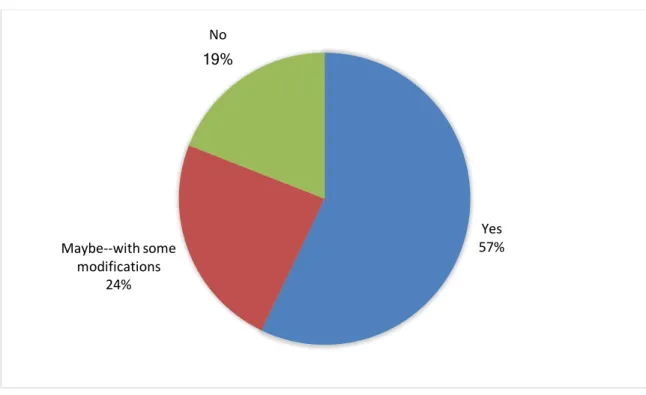
Figure 7: Responses to question 12 "Would your institution consider another online crowdsourcing project?" Yes
57% Maybe--with some
modifications 24%
No
Twelve respondents said yes, they would do another crowdsourcing project, with no reservations. An additional five responded that they might consider another
crowdsourcing project, but with a change to their workflow or available resources. Several cited available staff as a challenge to undertaking another project, suggesting that demands on staff may have exceeded initial estimations. Others mentioned that the amount of work involved in managing the project gave them pause before considering another:
"Certainly not until this one is completed, because it is a lot of work on our end to select articles for transcription, upload them, and paste the transcriptions into the digital media management software! But perhaps a smaller-scale project could be considered in the future."
"We might consider another one but it was a lot of work, however there were rewards for our museum in the form of a computer, printer and equipment as well as money to do the project from the Canadian Heritage Information Network" Four respondents said they were unlikely to complete another crowdsourcing project. Three of those mentioned lack of staff as the reason. Another expressed a preference for in-house and in-person volunteer help, rather than a distributed online model. These four respondents, all of whom completed transcription projects, were varied in size and resources—including two large research universities' special collections departments, a small project sponsored US government agency, and a historical society— but all used software solutions they'd created themselves, some involving significant amounts of staff time to copy and save transcribed data from the volunteer interface.
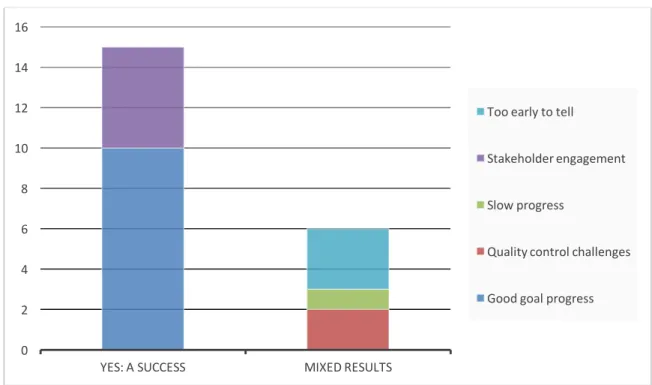
which participants were not hesitant or hedging about their projects. This tended to be driven by one of two reasons:
1. Institutions were happy with the amount of work completed, as demonstrated by comments like: "We feel that the project has been a success because we've managed to create transcriptions for thousands of pages" and "Yes, because we have made a dent in offering full transcriptions of these documents." 2. Institutions were happy with the level of stakeholder involvement. One
institution commented that "Yes. We have 25-30 people attend each week and at least 2 men continued to volunteer from home after the event. For the age group that was being targeted we felt those numbers were great."
These reasons for success correlate strongly with the top three project goals identified by respondents—adding additional details to existing records, recruiting new stakeholders, and engaging existing ones.
Figure 8: Determination of project success with primary reason for assessment
0 2 4 6 8 10 12 14 16
YES: A SUCCESS MIXED RESULTS
Too early to tell
Stakeholder engagement
Slow progress
Quality control challenges
The remaining six responses could be described as "mixed emotions". None of these responses described the project as without success, but answered the question in a less affirmative way than the "resounding yes" category. A project created to evaluate the results of 'gamification' of transcription described their successes through two lenses— yes, it was a success, but no, it was not:
"Yes and no. Successes:
-The primary aim was to demonstrate whether or not digital games could be a successful tool for analyzing and improving digital outputs from OCR and transcription activities. The games developed for this project successfully proved how human verification of texts could succeed where machines had failed. Not everyone though is willing to sit down and transcribe an entire page from a manuscript […]
-We had 5k participants in just under 6 months […]
Not successes:
-by not reaching the critical mass needed it meant the benefits to the overall BHL corpus were limited"
Discussion
Though still a preliminary study, these findings start to illuminate several discoveries about the success and assessment of current digital crowdsourcing projects. These include 1) there are a diversity of reasons that institutions—whether they know it or not—choose to pursue crowdsourcing projects; 2) assessment of crowdsourcing projects requires a multi-faceted, often ad-hoc approach to benchmarking achievements and progress; 3) institutions tend to be happier with their project's progress when they have identified at least one measurable goal prior to starting the project, and 4) in general, institutions have positive feelings about the use of crowdsourcing projects as tools for description, community engagement, and user recruitment.
Because crowdsourcing projects can be so multifaceted in their benefits—and their challenges—assessing them throughout the project can require a similarly multi-pronged approach. Institutions reported using multiple methods of assessment— sometimes as many as five or six—online, in person, and in the back ends of software. Institutions reported being more satisfied with the results of their projects when these assessments aligned with goals that were articulated, whether in a formal or informal way, before the start of the project. Conversely, institutions with less specific goals were less interested in undertaking another crowdsourcing project. One institution, who said of their goals before starting the project "we just dove in" said that they would "probably not" undertake another crowdsourcing project, and that they would "have to do any future crowdsourcing completely differently. There was too much follow up cut-and-paste involved in the way we did it… We'd be much more careful next time - we know more about what could be getting into."
However, the cultural heritage sector is still wrestling with the best ways to measure intangible factors like engagement, community impact, learning, and historical awareness. This extends past the digital realm and into the world of museum exhibits, special collections instruction sessions, and community center events. Assessing our impact is complicated, and methods for assessment are not yet—for better or worse— standardized in meaningful ways (Chapman, DeRidder, & Thompson, 2015).
The most positive finding may be that most institutions were, by and large, happy with the way their projects turned out. It is possible that this is a kind of recency effect, and with reflection and time, their appraisal may shift. It is also possible that
Conclusion
There is quite a bit of future research that might build on and further explore the ways that cultural heritage institutions conceive of and assess their crowdsourcing projects. This study itself could be repeated with greater distribution to institutions
through a variety of targeted online sharing to increase the number of respondents. It may benefit from a re-design of some survey questions, allowing for a greater range of options for questions like institution type, or assessment method. A short online survey with a follow-up interview might better balance the need to collect some demographic, basic information while also delving into workflows and methodology in more granular detail without requiring survey participants to fill out a number of long text-box style questions.
projects in later stages, may also provide useful data. Similarly, a study of the early stages—priority setting, piloting, research and development, and work allocation—might allow a better understanding of how and why institutions engage with crowdsourcing projects.
References
2010: The Year of Crowdsourcing Transcription | FromThePage Blog. (2011, February). Retrieved March 23, 2018, from https://content.fromthepage.com/2010-the-year-of-crowdsourcing-transcription/#comment-13
Alencar-Brayner, A., & Wisdom, S. (2015). British Library Crowdsourcing Projects.
ALISS Quarterly, 11(1), 8–10.
Anderson, K. (2011, March 14). Even Crowdsourcing Can Get Too Expensive. Retrieved September 6, 2017, from https://scholarlykitchen.sspnet.org/2011/03/14/even-crowdsourcing-can-get-too-expensive/
Audubon Society. (2017). Great Backyard Bird Count. Retrieved September 25, 2017, from http://gbbc.birdcount.org/
Brabham, D. C. (2008). Moving the crowd at iStockphoto: The composition of the crowd and motivations for participation in a crowdsourcing application. First Monday,
13(6). https://doi.org/10.5210/fm.v13i6.2159
Brabham, D. C. (2012). THE MYTH OF AMATEUR CROWDS: A critical discourse analysis of crowdsourcing coverage. Information, Communication & Society,
15(3), 394–410. https://doi.org/10.1080/1369118X.2011.641991
Causer, T., Tonra, J., & Wallace, V. (2012). Transcription maximized; expense
minimized? Crowdsourcing and editing The Collected Works of Jeremy Bentham.
Causer, Tim, & Wallace, V. (2012). Building A Volunteer Community: Results and Findings from Transcribe Bentham, 6(2). Retrieved from
http://www.digitalhumanities.org/dhq/vol/6/2/000125/000125.html
Chapman, J., DeRidder, J., & Thompson, S. (2015). Developing Best Practices in Digital Library Assessment: Year One Update. D-Lib Magazine, 21(11/12).
https://doi.org/10.1045/november2015-chapman
CrowdMed. (2017). Retrieved September 25, 2017, from https://www.crowdmed.com/ Dobbs, A. W. (Ed.). (2017). The library assessment cookbook. Chicago: Association of
College and Research Libraries, A division of the American Library Association. Gunther, A., Schall, M., & Wang, C. (2016). The Creation and Evolution of the
Transcription Center, Smithsonian Institution’s Digital Volunteer Platform.
Collections, 12(2), 87–97.
Holley, R. (2010). Crowdsourcing: How and Why Should Libraries Do It? D-Lib Magazine, 16(3/4). https://doi.org/10.1045/march2010-holley
Howe, J. (2006a, June). Crowdsourcing: A Definition. Retrieved October 12, 2017, from http://www.crowdsourcing.com/cs/2006/06/crowdsourcing_a.html
Howe, J. (2006b, June 1). The Rise of Crowdsourcing. Wired Magazine. Retrieved from https://www.wired.com/2006/06/crowds/
Krause, M., & Yakel, E. (2007). Interaction in Virtual Archives: The Polar Bear Expedition Digital Collections Next Generation Finding Aid. The American Archivist, 70(2), 282–314. https://doi.org/10.17723/aarc.70.2.lpq61247881t10kv Library of Congress. (2018, October 24). Crowdsourcing Tool Enables Discovery of
2018, from https://www.loc.gov/item/prn-18-134/crowdsourcing-tool-enables-discovery-of-unique-treasures-at-the-library-of-congress/2018-10-24/
McCausland, S. (2011). A Future Without Mediation? Online Access, Archivists, and the Future of Archival Research. Australian Academic and Research Libraries; Kingston, 42(4), 309–319.
Mendes, A. (2015). Experimenting with crowdsourcing to improve access to the collections of the British Library. ALISS Quarterly, 11(1), 11–14.
Munyaradzi, N., & Suleman, H. (2014). A system for high quality crowdsourced indigenous language transcription. International Journal on Digital Libraries,
14(3), 117–125. https://doi.org/10.1007/s00799-014-0112-4
Murphy, M. O., Peimer, L., Duplisea, G., & Fritz, J. (2015). Failure Is an Option: The Experimental Archives Project Puts Archival Innovation to the Test. The American Archivist, 78(2). Retrieved from
http://americanarchivist.org/doi/pdf/10.17723/0360-9081.78.2.434
Nowak, S., & Rüger, S. (2010). How reliable are annotations via crowdsourcing: a study about inter-annotator agreement for multi-label image annotation. In Proceedings of the international conference on Multimedia information retrieval - MIR ’10 (p. 557). Philadelphia, Pennsylvania, USA: ACM Press.
https://doi.org/10.1145/1743384.1743478
NYPL Labs. (2017, September). What’s on the menu? Retrieved September 24, 2017, from http://menus.nypl.org/
Parilla, L., & Ferriter, M. (2016). Social Media and Crowdsourced Transcription of Historical Materials at the Smithsonian Institution: Methods for Strengthening Community Engagement and Its Tie to Transcription Output. The American Archivist, 79(2), 438–460.
Society of American Archivists. (1994). Guidelines for Evaluation of Archival Institutions. Retrieved September 25, 2017, from
https://www2.archivists.org/groups/standards-committee/guidelines-for-evaluation-of-archival-institutions
Tibbo, H. R. (1989). Abstracts, online searching, and the humanities: An analysis of the structure and content of abstracts of historical discourse (Ph.D.). University of Maryland, College Park, United States -- Maryland. Retrieved from
http://search.proquest.com/docview/303703573/abstract/43BB2A470FCA4B34P Q/1
Trant, J. (2009). Emerging convergence? Thoughts on museums, archives, libraries, and professional training. Museum Management and Curatorship, 24(4), 369–387. https://doi.org/10.1080/09647770903314738
U.C. Berkeley. (2017). SETI@home.
Zhu, Q., 2, & Xiang, H., 2. (2016). Differences of Pareto principle performance in e-resource download distribution. Electronic Library, 34(5), 846–855.
Appendix A: Recruitment email
Hello,
I am a student in the MSLS program at the University of North Carolina at Chapel Hill conducting research about online crowdsourcing projects and the ways that cultural heritage institutions assess their success.
If you've helped manage a project that uses volunteers to describe, transcribe, annotate, or curate materials online, I'd love to hear from you via an online survey. The survey will take approximately 5-10 minutes. Participation is voluntary and the survey is anonymous. No individual subject or personal identifying information will be shared.
The survey is available here: unc.az1.qualtrics.com/jfe/form/SV_cTOtKJPtquFKpEN Please feel free to share this survey link with others who have experience with these types of projects.
Appendix B: Survey information sheet
Assessing Online Crowdsourcing Projects Survey
University of North Carolina at Chapel Hill Research Information Sheet
IRB Study #: 17-2656
Principal Investigator: Emma Parker
The purpose of this research study is to investigate the assessment and success of online crowdsourcing projects. You are being asked to take part in a research study because you helped to manage or initiate a crowdsourcing project at a library, museum, archive, or other cultural heritage institution.
Being in a research study is completely voluntary. You can choose not to be in this research study. If you agree to take part in this research, you will be asked to take the short online survey that follows. Your participation in this study will take about 10-15 minutes.
You can choose not to answer any question you do not wish to answer. You can also choose to stop taking the survey at any time. You must be at least 18 years old to participate. If you are younger than 18 years old, please stop now.
To protect your identity as a research subject, the researcher will not share your
information with anyone else. In any publication about this research, your name or other private information will not be used; only institutional information will be included. At the end of the survey, you will be asked if you'd be willing to participate in a follow-up interview as part of this project. If you answer 'yes', you'll be asked to share your email address on the next page. Participation in a follow-up phone interview is entirely voluntary.
Appendix C: Survey questions
Thank you for your participation in this online survey, which is designed to investigate online crowdsourcing projects (such as online transcription, tagging, description, or sorting) and their assessment in library, archive, and museum settings.
This research is being conducted as part of a masters paper in the School of Library and Information Science at the University of North Carolina at Chapel Hill. If you have any questions, please contact [email protected]. I appreciate your help and your thoughts on the experience working with an online crowdsourced project!
1. Institution:
________________________________________________________________ 2. Institution type:
o
Libraryo
Archiveo
Museumo
Private companyo
Religious institutiono
Historical society / genealogical organizationo
Other ________________________________________________3. Project name:
If you’ve worked on more than one crowdsourcing project, please select one to focus your responses on.
4. Project URL:
________________________________________________________________
5. Please describe your online crowdsourcing project in a few sentences: ________________________________________________________________ ________________________________________________________________ ________________________________________________________________ ________________________________________________________________ ________________________________________________________________
6. What was your role in the management or planning of this project? For example: developer, librarian, project manager, content manager, marketing, etc.
7. What did your instition hope to achieve by undertaking this project? Choose as many as you’d like from the list, or use the “other” option to include items not listed here.
▢
Basic description of collection assetsAdding basic metadata such as title, date, or description for previously undescribed items▢
Engagement with existing stakeholdersConnecting with individuals that already interact with your organization▢
Volunteer recruitmentAttracting new in-person or remote volunteers▢
Recruiting new stakeholders Interacting with new stakeholders (researchers, donors, etc.) who aren't already patrons of your organization▢
FundraisingGenerating interest in giving, or directly deriving revenue▢
Enrichment of existing descriptionAdding additional information for items that have some existing description. This might include transcription, naming individuals in photographs, or geotagging.▢
Mapping community interestDetermining an interst in future projects, finding community "favorites" or 'heatmapping' local interest▢
AcquisitionsCollecting new material for your institution▢
Other Anything else at all that's not listed above!8. Did your institution use any of the following methods to assess the progress of your project?
▢
Email surveys▢
In person interviews, surveys or focus groups▢
Social media interactions with stakeholders▢
Monitoring percentage completed (ie. 12% of interviews have been fully transcribed)▢
Web analytics▢
Review and monitoring of other statistics (pleasedescribe)________________________________________________
▢
Reviews for quality or accuracy by staff▢
Review by third party/consultant▢
Other (pleasedescribe)________________________________________________
9. Did your organization have specific targets for these goals before launching the project?
(For example: we'd like to recruit 10 new volunteers, 30% of transcription will be complete in the first year, etc.)
________________________________________________________________
Please rank the goals you selected in order of importance (where number 1 is most important) to your institution. To rank, you can click and drag items into the order you desire.
______ Basic description of collection assetsAdding basic metadata such as title, date, or description for previously undescribed items
______ Engagement with existing stakeholdersConnecting with individuals that already interact with your organization
______ Volunteer recruitmentAttracting new in-person or remote volunteers
______ Recruiting new stakeholders Interacting with new stakeholders (researchers, donors, etc.) who aren't already patrons of your organization
______ FundraisingGenerating interest in giving, or directly deriving revenue
______ Enrichment of existing descriptionAdding additional information for items that have some existing description. This might include transcription, naming individuals in photographs, or geotagging.
______ Mapping community interestDetermining an interst in future projects, finding community "favorites" or 'heatmapping' local interest
______ AcquisitionsCollecting new material for your institution
______ Other Anything else at all that's not listed above!
11.The following questions displayed only when the relevant option was selected in question 8:
What methods, if any, were used to assess the basic description of digital assets generated during the project?
________________________________________________________________
What methods, if any, were used to assess the enrichment of existing description created during the project?
________________________________________________________________
What methods, if any, were used to assess engagement with stakeholders?
________________________________________________________________
What methods, if any, were used to assess community interest during the project? ________________________________________________________________
What methods, if any, were used to assess the success of volunteer recruitment during the project?
________________________________________________________________
What methods, if any, were used to assess the success of fundraising as a result of the project?
________________________________________________________________
What methods, if any, were used to assess the success of acquisitions of new material as a result of the project?
________________________________________________________________
What methods, if any, were used to assess "[insert text from other]"?
________________________________________________________________
Do you feel like the project is/was a success? Why or why not?
________________________________________________________________
12. Would your institution consider another online crowdsourcing project?