
Sharif University of Technology
Scientia IranicaTransactions A: Civil Engineering http://scientiairanica.sharif.edu
Mean bed shear stress estimation in a rough
rectangular channel using a hybrid genetic algorithm
based on an articial neural network and genetic
programming
Z. Sheikh Khozani, H. Bonakdari
, and A.H. Zaji
Department of Civil Engineering, Razi University, Kermanshah, Iran.Received 23 February 2016; received in revised form 16 May 2016; accepted 19 September 2016
KEYWORDS Articial neural network; Bed shear stress; Genetic algorithm; Genetic programming; Hybrid soft computing models;
Rough rectangular channels.
Abstract. The determination of erosion and deposition patterns in channels requires detailed knowledge and estimation of the bed shear stress. In this investigation, the application of a Genetic Algorithm-based Articial (GAA) neural network and Genetic Programming (GP) was presented to predict bed shear stress in a rectangular channel with rough boundaries. Several input combinations, tness functions, and transfer functions were investigated to determine the best GAA model. Also, the eect of various GP operators on estimating bed shear stress was studied. A comparison between the GAA and GP techniques' abilities to predict bed shear stress was made and then investigated. The results revealed that the GAA model performs better in predicting the bed shear stress (RMSE = 0.0774), as compared to the GP model (RMSE = 0.0835).
© 2018 Sharif University of Technology. All rights reserved.
1. Introduction
The ow structure in open channels is directly aected by the shear stress distribution along the wetted perimeter; hence, the variations of the boundary shear stress are more important. It has long been established that many factors inuence this distribution. These factors include variation of the longitudinal and lateral boundary roughness types, geometry of a cross-section, longitudinal variation of plan-form geometry, and sed-iment concentration and deposition in the bed.
Many direct and indirect methods have been used to calculate the shear stress along a wetted *. Corresponding author. Tel.: +98 831 427 4537;
Fax: +98 831 428 3264
E-mail addresses: [email protected] (Z. Sheikh Khozani); [email protected] (H. Bonakdari); [email protected] (A.H. Zaji)
doi: 10.24200/sci.2017.4256
perimeter [1-8]. Guo and Julien [9] and Babaeyan-Koopaei et al. [10] found that the open channel ow for the separation of bed and wall shear stress was more important for a velocity prole study, while Julien [11] and Berlamont et al. [12] found that it was more important for the bed load transport estimation.
In addition to experimental studies, some re-searchers have focused on determining shear stress using analytical models based on continuity and mo-mentum equations [13,14]. Using the entropy concept, the shear stress distribution was studied along the wall and bed of a channel [15,16]. Berlamont et al. [12] used computational uid dynamic modeling to estimate the shear stress distribution in a rectangular channel and partially lled pipes.
Recently, the application of soft computing tech-niques has been widely used for the prediction of hydraulic phenomena [17-19]. Najafzadeh et al. [20] applied Group Method of Data Handling (GMDH) network to predict abutments scour depth of bridges.
Some researchers utilized GEP model to solve dif-ferent hydraulic problems [21-23]. Azamathulla and Zahiri [24] used linear genetic programming to predict the ow discharge in a compound open channel. Zaji and Bonakdari [25] utilized the ANN and Radial Basis Neural Network (RBNN) to compute the discharge capacity of a triangular side weir. The suspended sediment load was estimated using soft computing techniques by Tayfur [26] and Kisi et al. [27]. Cobaner et al. [28] used a simple ANN method to estimate percentage of shear force carried by walls in rectangular ducts and channels. Sheikh Khozani et al. [29], by ap-plying GP and GAA models, could predict percentage of shear force carried by walls (%SFw) of rough
rect-angular open channels. The authors expressed that the ANN model has better performance in predicting shear force than the traditional shear force relationships. Predicting %SFw in smooth rectangular channels was
studied by Sheikh Khozani et al. [30] using GP and GAA methods.
Because the bed shear stress has an important role in bed load sediment transition, a few studies have been conducted on the rectangular channel with rough boundaries using the soft computing technique. Conse-quently, the aim of this study is to utilize this technique in estimating the bed shear stress in a rectangular channel with non-homogenous roughness. For this goal, the GAA method as a novel combination of modied Genetic Algorithm (GA) and Articial Neural Network (ANN) was used to predict the bed shear stress. The performance of the GAA was compared with that of the Genetic Programming (GP) method, as a practical branch of the GA. Also, the obtained equation by the best method has been compared with the equation of Knight [2].
2. Materials and methods
2.1. Genetic algorithm-based articial neural network
The multi-layer perceptron ANN is widely used in various engineering elds as a successful soft computing method. An ANN method is composed of three major layers: one input layer, one or more hidden layers, and one output layer. Each layer consists of some neurons. The input layer's neurons are the input variables of the considered problem. In the current ANN model, the output layer has one neuron, i.e., the output of the problem. Each hidden layer has some neurons. Each neuron in the hidden layers, at rst, compute the weighted sums of neurons in last layer, and then by putting the results of the summation in the activation functions, the estimation for each neuron is calculated. The activation function selection signicantly af-fects the performance of the model [31-33]. In this study, four combinations of activation functions were
examined to determine the most appropriate one of all. The considered activation functions include the loga-rithmic sigmoid (Eq. (1)), hyperbolic tangent sigmoid (Eq. (2)), and linear (Eq. (3)):
logsig(x) = 1 + e1 x; (1)
tansig(x) = 1 + e2 2x 1; (2)
purelin(x) = x: (3)
In addition to the advantages of the ANN method in modeling the complex problems, the absence of a specic rule in choosing the number of hidden layer nodes makes the modeling process more puzzling. In this study, a modied GA was used to optimize the structure of the ANN method. The GA investigates dierent ANN models with various numbers of neurons in hidden layers and automatically chooses the most appropriate one.
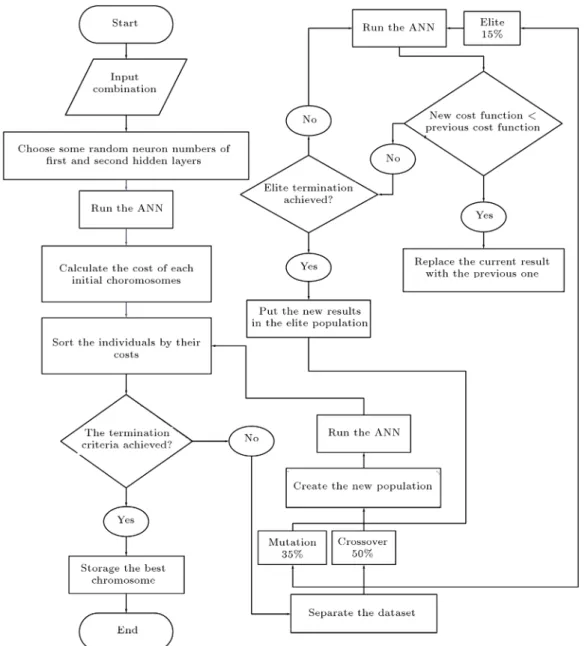
Levenberg-Marquardt Algorithm [34] was used to train the ANN model. It is possible that a good combination of a number of hidden layer neurons was eliminated by the GA due to bad luck with the Levenberg-Marquardt training process and random nature of the training algorithms used. So, the GA used to optimize the ANN model needs some modications. The modied GA used in the optimization of the ANN structure is shown in Figure 1. According to Figure 1, the GA modication was conducted in the elite populations. The elite population consists of the best 15% of the entire chromosomes. Each individual in the elite population was run with the ANN model several times. The best cost for each individual was replaced in the elite population.
This modication has two major benets. First, it prevents the local minimum trapping of the GA. Second, it minimizes the eect of the random nature of the Levenberg-Marquardt training process. Finally, the GAA method, as the combination of the modied GA and ANN methods, was introduced.
2.2. Genetic programming
The GP method, as a branch of the GA algorithm, was developed by Koza [35]. The general processing rules of the GP method are similar to those of the GA algorithm. The rules are as follows. The initial pop-ulation was performed by a number of chromosomes. Here, the chromosomes are the programs. The error of each chromosome was investigated by the deied tness function.
The aim of GP processing is to nd the most appropriate program that could be used to model the considered problem. Because of this, the GP method explicitly becomes a suitable method for the
Figure 1. Flowchart of the GAA model
practical situations. To nd an appropriate GP model in each problem, some of the properties should be specied.
Each GP program uses some functions that must be determined. The functions include arithmetic oper-ations (e.g., +, , , and ), mathematical functions (e.g., sin, cos, and power), and logical functions (e.g., AND, OR, and NOT). There is no specic rule in function determination, and it should be determined for each problem. In this study, to nd the most appro-priate functions, four dierent function combinations were examined.
The processing steps of the GP are as follows: (1) Selecting the initial population of the individuals (programs) randomly; (2) Calculating the cost of each individual by the tness function; (3) Sorting the individuals according to the calculated costs; (4)
Conducting the reproduction, mutation, and crossover on the population and performing the new population; (5) Achieving one of the termination criteria (e.g., the time of the run, number of generations, and value of the error) in the process. Table 1 shows the characteristics of the GP model used.
2.3. Case study
The dimensionless mean bed shear stress data of the experiments were used; these were originally conducted by Knight [2]. By using the Preston pipe technique, Knight [2] calculated the bed shear stress along a ume that was 15 m in length, 460 mm in width, and with a constant bed slope of 9:58 10 4. This ume had
a rectangular cross-section with rough boundaries and shear stress that was measured at dierent ow depths. The ranges of the geometric and hydraulic
characteris-Table 1. The characteristics of the GP model. Parameter
name
Parameter specication
Population size 500
Mutation frequency 93% Crossover frequency 50% Number of replication 10
Block mutation rate 30% Instruction mutation rate 30% Instruction data mutation rate 40% Homologous crossover 95% Program initial size 64 Program maximum size 256
Function combination To be determined Fitness function To be determined
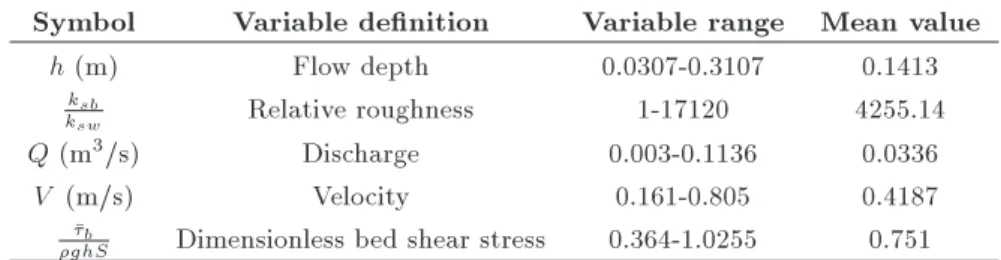
tics of the rectangular channel used by Knight [2] are listed in Table 2.
Knight [2] presented an empirical equation for calculating the mean bed shear stress as follows:
b
ghSf = 1 0:01 (%SFw) ; (4)
where b is the mean bed shear stress, Sf is the energy
slope, h is the water depth, is the uid density, and %SFwis the total shear force carried by the walls. This
total shear force can be calculated as follows: %SFw= e
tanh () 0:5[tanh () ]2; (5) where = 3:264 log B
h + 3
+ 6:211, = 1 5, and
= logksb
ksw
.
The shear stress depends on the hydraulics of the ow, cross-section, and bed and wall roughness. The dependent parameters are: ow velocity (V ), hydraulic radius (R), uid density (), geometry of the channel (B), bed and wall roughness (ksb; ksw),
ow depth (h), and energy slope (Sf). A functional
relationship between the bed shear stress and the eective parameters can be expressed as follows:
b = F (; g; B; h; ksb; ksw; R; Sf; V ) :
Using a dimensional analysis for expressing the dimen-sionless bed shear stress, the following function was obtained:
b
ghSf = f
B h;
ksb
ksw; Fr; Re
; (6)
where B
h is the aspect ratio, kkswsb is the relative rough-ness, Fr is the Froude number, and Re is the Reynolds number.
Table 2 shows the ranges of data set parameters that were used in modeling. About 75% of all data were selected randomly for training, and the remaining data were used for testing stage.
Eq. (4) was also selected to predict the mean bed shear stress and was compared with the proposed model.
3. Application and results
In order to investigate the accuracy of the models and the tness function, six statistical parameters were used. These parameters include: the Root Mean Squared Error (RMSE), Mean Squared Error (MSE), Mean Absolute Error (MAE), average absolute devia-tion (%), Scatter Index (SI), and BIAS as follows:
RMSE = v u u tPn
i=1(ip im) 2
n ; (7)
MSE =
n
P
i=1(ip im) 2
n ; (8)
MAE = 1 n
n
X
i=1
jip imj; (9)
= 0 B B @ n P
i=1jip imj n
P
i=1ip
1 C C
A 100; (10)
SI = 0 B B B @ v u u tPn
i=1(ip im) 2 n 1 C C C A 0 B B @Pnn
i=1im
1 C C
A ; (11)
Table 2. Ranges of the geometric and hydraulic variables of the rectangular channel. Symbol Variable denition Variable range Mean value
h (m) Flow depth 0.0307-0.3107 0.1413
ksb
ksw Relative roughness 1-17120 4255.14
Q (m3/s) Discharge 0.003-0.1136 0.0336
V (m/s) Velocity 0.161-0.805 0.4187
b
BIAS =
n
P
i=1ip im
n ; (12)
where ip shows the value of the predicted mean bed
shear stress by the model, and im is the measured
mean bed shear stress in the laboratory.
To compute the mean bed shear stress, eight dierent input combinations were tested. These input combinations were:
(i) B=h, Fr and ksb=ksw;
(ii) B=h, Fr and Re;
(iii) B=h, Fr and ksb=ksw;
(iv) B=h, Re and ksb=ksw;
(v) Fr, ksb=ksw and Re;
(vi) B=h and ksb=ksw;
(vii) B=h and Fr;
(viii) Fr and ksb=ksw.
The results were compared with the RMSE, MAE, and % statistic parameters.
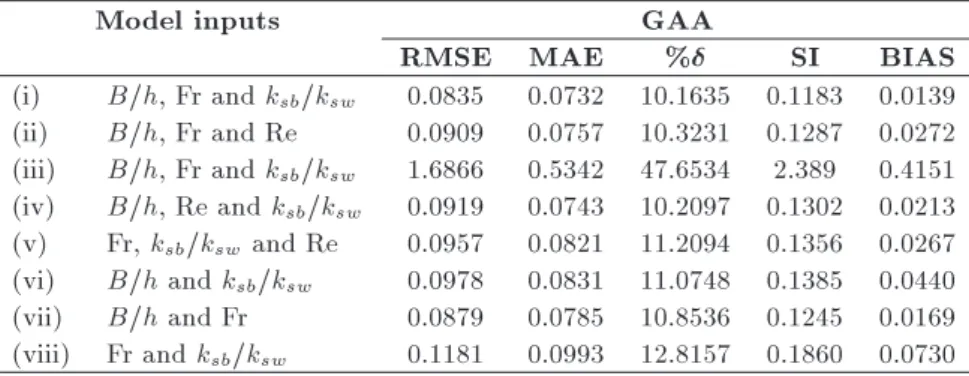
In the rst step of the GAA model, by assuming MSE as a tness function and the logarithmic trans-fer function, the mentioned input combinations were investigated. As shown in Table 3, the GAA model with the input combination of (ii) was more accurate with the smallest values of the statistical parameters. Various GP models were developed using the same
input combinations as the GAA model. Similar to the GAA model in the GP model, the assumption tness function in the rst step was that the MSE and default function (+; ; ; ) were used to select the best input combination. As shown in Table 4, the input combination (i) is more appropriate than the others with RMSE of 0.0835.
Continuing to use the selected input combination, a comparison was checked between the MSE and MAE to nd a more appropriate tness function in the GAA model. The results of this comparison are presented in Table 5. According to the results, it is clear that the MSE tness function provides more accurate results with RMSE of 0.0774 than the MAE tness function with RMSE of 0.0918. To select the best tness function in the GA model, MSE and MAE were investigated. From Table 5, it is clear that the MSE tness function (based on the absolute error) produces the best results for computing the mean bed shear stress. Consequently, the MSE tness function with better statistical results (RMSE = 0.0835, MAE = 0.0732, and % = 10:1635) was selected.
In the nal step, four dierent conditions were studied by the GAA model using the logarithmic, pure-lin and hyperbolic tangent, as the transfer functions. The outcomes (Table 6) show that the GAA model with the logarithmic transfer function in a hidden layer and the purelin transfer function in the output layer operates better between the transfer functions.
The selection of the basic operators in building
Table 3. Statistical measures of the models in the test period of GAA model.
Model inputs GAA
RMSE MAE % SI BIAS
(i) B=h, Fr and ksb=ksw 0.0875 0.0711 9.7614 0.1239 0.0228 (ii) B=h, Fr and Re 0.0774 0.0631 8.6560 0.1096 0.0229 (iii) B=h, Fr and ksb=ksw 0.0942 0.0755 10.5406 0.1335 0.0106 (iv) B=h, Re and ksb=ksw 0.0836 0.0618 8.7320 0.1184 0.0019 (v) Fr, ksb=ksw and Re 0.0811 0.0672 9.0700 0.1149 0.0352 (vi) B=h and ksb=ksw 0.0910 0.0738 10.2469 0.1289 0.0143 (vii) B=h and Fr 0.0844 0.0718 9.9990 0.1253 0.0123 (viii) Fr and ksb=ksw 0.1099 0.0893 11.9109 0.1557 0.0434 Table 4. Statistical measures of the models in the test period of GP model.
Model inputs GAA
RMSE MAE % SI BIAS
(i) B=h, Fr and ksb=ksw 0.0835 0.0732 10.1635 0.1183 0.0139 (ii) B=h, Fr and Re 0.0909 0.0757 10.3231 0.1287 0.0272 (iii) B=h, Fr and ksb=ksw 1.6866 0.5342 47.6534 2.389 0.4151 (iv) B=h, Re and ksb=ksw 0.0919 0.0743 10.2097 0.1302 0.0213 (v) Fr, ksb=ksw and Re 0.0957 0.0821 11.2094 0.1356 0.0267 (vi) B=h and ksb=ksw 0.0978 0.0831 11.0748 0.1385 0.0440 (vii) B=h and Fr 0.0879 0.0785 10.8536 0.1245 0.0169 (viii) Fr and ksb=ksw 0.1181 0.0993 12.8157 0.1860 0.0730
Table 5. Fitness function selection for the models. Models Statistical
parameters MSE MAE
GAA
RMSE 0.0774 0.0918 MAE 0.0631 0.0734 % 8.6560 10.4547
SI 0.1096 0.1300 BIAS 0.0229 -0.0040
GP
RMSE 0.0835 0.0957 MAE 0.0732 0.0813 % 10.1635 11.0186
SI 0.1183 0.1356 BIAS 0.0139 0.0315
the parse tree is the nal step in the GA model. The basic range of the investigated functions is:
F 1 = f+; ; ; g ;
F 2 = f+; ; ; ; sin (x) ; cos (x)g ;
F 3=+; ; ; ; sin (x) ; cos (x) ; jxj ; p ; Power : A set of preliminary model runs was carried out to test the performance of the models with the function sets and select the best one to use in the next stage of the study. All of these procedures were conducted for input combination (i) by the MSE tness function. The investigated results of these sets of functions are illustrated in Table 7. Based on the comparison of the various GP operators listed in this table, it can be deduced that the GP default operator function set (F 1) surpasses all of the other structures. It was determined that the simple operator function is better to use
than the other function sets, since the other operator function sets resulted in complicated computations.
Finally, the comparison between the GAA and GP models was conducted. As can be seen in Table 8, the GAA model with an RMSE of 0.0774 was compared to the GP model with an RMSE of 0.0835. The GA model was selected due to its better performance. The GP model is capable of predicting the mean bed shear stress, too. When comparing the GAA predictions with the measured data for the test stage, the proposed model was proved to be highly capable to estimate the mean bed shear stress with few errors.
With regard to selecting the GAA model as the best model, the equation obtained from the proposed model with input combination (i), MSE tness func-tion, and logarithmic and linear transfer functions in the hidden and output layers, respectively, are as follows:
b
ghS =purelin(( logsig((logsig(input iw + b1)) lw + b2)) ow + b3; (13)
input =B
h Fr Re
; (14)
iw = 2
4 0:45126:623 20:878 21:350 24:510 25:914 21:0370:122 0:348 0:349 0:225 0:006 0:000 0:001 0:000 0:000 0:000 0:000
3 5 ;
(15)
lw = 2 6 6 6 6 6 6 4
3:167 1:971 0:045 2:700 2:451 4:757 5:707 3:610
0:715 0:687 1:799 3:610 4:661 2:240 3:713 3:809 2:605 1:191 0:280 1:207 2:093 4:041 0:244 0:435
3 7 7 7 7 7 7 5
; (16)
Table 6. Transfer function selection process for the GAA model. Hidden layers
transfer function
Output layer
transfer function RMSE MAE % SI BIAS
logsig purelin 0.0774 0.0631 8.6560 0.1096 0.0229 logsig logsig 0.0833 0.0719 9.9282 0.1180 0.0179 tansig purelin 0.0952 0.0790 10.8712 0.1348 0.0206 tansig tansig 0.0817 0.0658 8.9494 0.1158 0.0289 Table 7. Statistical parameters for the preliminary selection of the basic functions for the parse tree.
Denition RMSE MAE % SI BIAS
F 1 f+; ; ; g 0.0835 0.0732 10.1635 0.1183 0.0139
F 2 f+; ; ; ; sin (x) ; cos (x)g 0.1048 0.0926 12.5872 0.1484 0.0296 F 3 n+; ; ; ; sin (x) ; cos (x) ; jxj ; p ; Powero 0.0988 0.0772 10.9509 0.1400 {0.0011
Table 8. Comparison between the GAA and GP models. Model Statistic parameters
RMSE MAE % SI BIAS
GAA 0.0774 0.0631 8.6560 0.1096 0.0229 GP 0.0835 0.0732 10.1635 0.1183 0.0139
ow = 0:100 0:142 0:323 0:030T; (17) b1=6:737 17:422 15:387 10:120 9:627 0:481;
(18) b2=1:595 1:609 0:531 0:122; (19)
b3= [0:536]: (20)
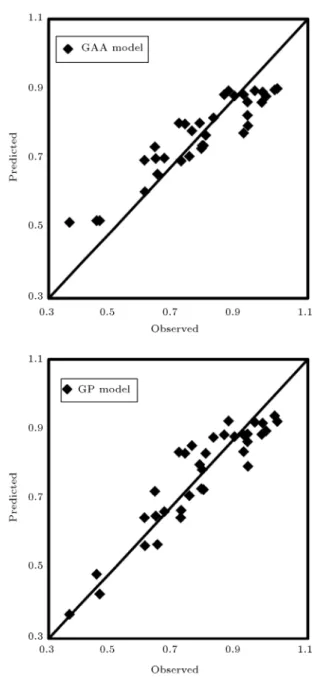
In Figure 2, the calculated mean bed shear stress of the GAA and GP models for the training step were presented in the form of a scatterplot. As can be seen, the GAA model predicts the mean bed shear stress better than the GP model does for training processes. The GAA model estimates were found to be closer to the corresponding observed values than those of the GP model were. As seen, the two models' predictions underestimated shear stress values for some cases and overestimated for other cases. Figure 3 illustrates the estimates of the GAA and GP models in the form of a scatterplot for test dataset. It can be clearly seen from the scatterplots that the estimates of the GAA model are less scattered and closer to the exact line than those of the GP model. According to the results, performance of the GAA model in estimating bed shear stress is higher than that of the GP model. Therefore, the GAA model was selected as the best model to estimate bed shear stress in rectangular channels with at bed.
Table 9 shows the comparison between the ob-tained equation of the best model (GAA) and the presented equation by Knight [2]. The results show that the GAA model has a lower error of mean bed shear stress (RMSE = 0.0731, MAE = 0.0607, and % = 8:0451) for a rectangular channel with rough boundaries than that of the equation of Knight [2] (Figure 4). According to these results, the GAA model is much closer to the exact line than the equation of Knight [2], and hence, is more accurate. Therefore,
Figure 2. Observed versus computed mean bed shear stress of the GAA and GP models for a training test.
the obtained equation by the GAA model is more ap-plicable in rectangular channel with rough boundaries and can be used instead of the equation proposed by Knight [2].
In the proposed equation, the Froude and Reynolds numbers are eective in calculating the mean bed shear stress, in addition to the aspect ratio;
Table 9. Comparison between the GAA models and the equation of Knight [2].
Model Statistic parameters
RMSE MAE % SI BIAS
GAA Model 0.0731 0.0607 8.0451 0.0974 0.0046 Equation of Knight [2] 0.0804 0.0683 9.0925 0.1044 {0.0192
Figure 3. Comparison of the GAA and GP mean bed shear stress estimates with the observations in the test status.
however, in the equation presented by Knight [2], the aspect ratio is the only eective parameter. In Figure 4, the GAA model data overestimate the value of the mean bed shear stress for b
ghS > 0:73 and
underestimate the value in b
ghS < 0:73. In addition,
in the GAA model, fewer data are in the range of the 10% error. Equation of Knight [2] underestimates the mean bed shear stress value more than the GAA model does. When the underestimated values predict bed shear stress, the erosion occurs in the channel since the actual values of shear stress are higher than the predicted values, and the designed channel is poor in erosion. Therefore, the equation is used which is obtained by the GAA due to designing more stable channels.
Figure 4. Comparison of the performance of the GAA model with the equation of Knight [2].
4. Conclusions
The distribution of the bed shear stress is eective in the shape of the bed topography channels in sediment transportation. In this study, the GAA and GP models, as two methods of the GA, were compared to predict the mean bed shear stress in a rectangular channel with non-homogeneous roughness. Both soft computing models were extended and the performance of each model in each step was evaluated. For each model, several input combinations and tness func-tions were studied to recognize the best state among them. The statistical parameters were used to evaluate predicted mean bed shear stress values of the GAA and GP models. The results showed the best program for the GP model obtained by input combination (ii), MSE tness function, and (+; ; ; ) mathematical functions. The best formula in the GAA model was concluded with input combination (ii), MSE tness function, and log-pur transfer function. The accuracy of the GAA and GP techniques in predicting this object was investigated, and the GAA model was introduced as a more powerful model compared with GP model.
The results showed that the GP model has the ability to estimate the mean bed shear stress, but the GAA model has smaller values of statistical parameters (RMSE = 0.0731, MAE = 0.0607, and % = 8:0451), and hence performs better than the GP model. Finally, the obtained equation with the GAA model was com-pared with that presented by Knight [2]. In addition to being simple, this equation was better in estimating the mean bed shear stress than that of Knight [2]. The obtained equation by the GAA method can be used instead of the equation proposed by Knight [2] in calculating mean bed shear stress. This study suggests that the proposed GAA model is strong and useful in
predicting the mean bed shear stress in a rectangular channel with rough boundaries.
References
1. Knight, D.W., Demetriou, J.D. and Hamed, M.E. \Boundary shear in smooth rectangular channels", J. Hydraul. Eng., 10, pp. 405-422 (1984).
2. Knight, D.W. \Boundary shear in smooth and rough channels", J. Hydraul. Div., 107, pp. 839-851 (1981).
3. Tominaga, A., Nezu, I., Ezaki, K. and Nakagawa, H. \Three-dimensional turbulent structure in straight open channel ows", J. Hydraul. Res., 27, pp. 149-173 (1989).
4. Bonakdari, H., Tooshmalani, M. and Sheikh, Z. \Predicting shear stress distribution in rectangular channels using entropy concept", Int. J. Eng., 28(3), pp. 357-364 (2015).
5. Alhamid, A.A.I. \Boundary shear stress and velocity distributions in dierentially roughened trapezoidal open channels", PhD Thesis, The University of Birm-ingham (1991).
6. Sheikh, Z. and Bonakdari, H. \Prediction of boundary shear stress in circular and trapezoidal channels with Entropy concept", Urban Water J., 13(6), pp. 629-636 (2015).
7. Knight, D.W., Yuen, K.W.H. and Al Hamid, A.A.I. \Boundary shear stress distributions in open channel ow", In: K. Beven, P. Chatwin, J. Millbank (Eds.), Physical Mechanisms of Mixing and Transport in the Environment, Wiley New York, pp. 51-87 (1994).
8. Ardiclioglu, M., Sekcin, G. and Yurtal, R. \Shear stress distributions along the cross section in smooth and rough open channel ows", Kuwait J. Sci. Eng., 33, pp. 155-68 (2006).
9. Guo, J. and Julien, P.Y. \Shear stress in smooth rect-angular open-channel ow", J. Hydraul. Eng., 131(1), pp. 30-37 (2005).
10. Babaeyan-Koopaei, K., Ervine, D.A., Carling, P.A. and Cao, Z. \Velocity and turbulence measurements for two overbank ow events in River Severn", J. Hydraul. Eng., 128, pp. 891-900 (2002).
11. Julien, P.Y., Erosion and Sedimentation, U.K. Cam-bridge University Press (1995).
12. Berlamont, J.E., Trouw, K. and Luyckx, G. \Shear stress distribution in partially lled pipes", J. Hydraul. Eng., 129(9), pp. 697-705 (2003).
13. Han, Y., Yang, S.Q. and Dharmasiri, N. \Application of main ow data in the determination of boundary shear stress in smooth closed ducts", World Envi-ronmental and Water Resources Congress: Crossing Boundaries, Albuquerque, NM (2012).
14. Yang, S.Q., Dharmasiri, N. and Han, Y. \Momentum balance method and estimation of boundary shear stress distribution", J. Hydraul. Eng., 138, pp. 657-660 (2012).
15. Knight, D.W. and Sterling, M. \Boundary shear in circular pipes partially full", J. Hydraul. Eng., 126(4), pp. 263-275 (2000).
16. Bonakdari, H., Sheikh, Z. and Tooshmalani, M. \Com-parison between Shannon and Tsallis entropies for prediction of shear stress distribution in circular open channels", Stoch. Env. Res. Risk Assess., 29(1), pp. 1-11 (2015).
17. Sheikh Khozani, Z., Bonakdari, H. and Ebtehaj, I. \An analysis of shear stress distribution in circular channels with sediment deposition based on gene expression programming", Int. J. Sediment Res. (2017). DOI: org/10.1016/j.ijsrc.2017.04.004 (2017).
18. Gharagheizi, F., Ilani-Kashkouli, P., Farahani, N. and Mohammadi, A.H. \Gene expression programming strategy for estimation of ash point temperature of non-electrolyte organic compounds", Fluid Phase. Equilibria., 329, pp. 71-77 (2012).
19. Sheikh Khozani, Z., Bonakdari, H. and Zaji, A.H. \Estimating the shear stress distribution in circular channels based on the randomized neural networks technique", Appl. Soft Comp., 58, pp. 144-148 (2017).
20. Najafzadeh, M., Barani, G.A. and Hessami Kermani, M.R. \GMDH based back propagation algorithm to predict abutment scour in cohesive soils", Ocian Eng., 59, pp. 100-106 (2013).
21. Kisi, O., Emin Emiroglu, M.E., Bilhan, O. and Gu-ven, A. \Prediction of lateral outow over triangular labyrinth side weirs under subcritical conditions using soft computing approaches", Expert Syst. Appl., 39, pp. 3454-3460 (2012).
22. Shiri, J., Ashraf Sadraddini, A., Nazemi, A.H., Kisi, O., Landeras, G., Fakheri Fard, A. and Marti, P. \Generalizability of gene expression programming-based approaches for estimating daily reference evap-otranspiration in coastal stations of Iran", J. Hydrol., 508, pp. 1-11 (2014).
23. Sheikh Khozani, Z., Bonakdari, H. and Zaji, A.H. \Using two soft computing methods in prediction wall and bed shear stress in smooth rectangular channels", Appl. Water Sci. (2017). DOI: 10.1007/s13201-017-0548-y (2017).
24. Azamathulla, H.M. and Zahiri, A. \Flow discharge prediction in compound channels using linear genetic programming", J. Hydrol., 454-455, pp. 203-207 (2012).
25. Zaji, A.H. and Bonakdari, H. \Performance evaluation of two dierent neural network and particle swarm optimization methods for prediction of discharge ca-pacity of modied triangular side weirs", Flow Meas. Instrum., 40, pp. 149-156 (2014).
26. Tayfur, G. \Articial neural networks for sheet sed-iment transport", Hydrol. Sci. J., 47, pp. 879-892 (2002).
27. Kisi, O., Dailr, A.H., Cimen, M. and Shiri, J. \Sus-pended sediment modeling using genetic programming and soft computing techniques", J. Hydrol., 450-451, pp. 48-58 (2012).
28. Cobaner, M., Seckin, G., Seckin, N. and Yurtal, R. \Boundary shear stress analysis in smooth rectangular channels and ducts using neural networks", Water Environ. J., 24, pp. 133-139 (2010).
29. Sheikh Khozani, Z., Bonakdari, H. and Zaji, A.M. \Application of soft computing technique in prediction percentage of shear force carried by walls in rectangu-lar channel with non-homogenous roughness", Water Sci. Technol., 73(1), pp. 124-129 (2016).
30. Sheikh Khozani, Z., Bonakdari, H. and Zaji, A.M. \Application of a genetic algorithm in predicting the percentage of shear force carried by walls in smooth rectangular channels", Measurement, 87, pp. 87-98 (2016).
31. Zadeh, M.R., Amin, S., Khalili, D. and Singh, V.P. \Daily outow prediction by multi layer perceptron with logistic sigmoid and tangent sigmoid activation functions", Water Resour. Manage., 24, pp. 2673-2688 (2010).
32. Emiroglu, M.E., Bilhan, O. and Kisi, O. \Neural net-works for estimation of discharge capacity of triangular labyrinth side-weir located on a straight channel", Expert Sys. Appl., 38, pp. 867-874 (2011).
33. Pierini, J.O., Gomez, E.A. and Telesca, L. \Prediction of water ows in Colorado River, Argentina. Lat Am", J. Aquatic. Res., 40, pp. 872-880 (2012).
34. Levenberg, K. \A method for the solution of cer-tain non-linear problems in Least-Squares", Qu. Appl. Math., 2(2), pp. 164-168 (1944).
35. Koza, J.R. \Genetic programming as a means for programming computers by natural selection", Stat. Comput., 4, pp. 87-112 (1994).
Biographies
Zohreh Sheikh Khozani is a PhD student in Hy-draulic structures (Civil Engineering), Faculty of En-gineering, University of Razi, Kermanshah, Iran. She obtained MSc degree at Semnan University in 2011.
She has published 16 papers in ISI journals and more than 8 conference presentations. She works in the eld of shear stress distribution and sediment transport in open channels and rivers and use of entropy concept and soft computing methods in engineering applica-tions.
Hossein Bonakdari is a Professor at the Department of Civil Engineering of University of Razi. He earned his PhD degree in Civil Engineering at the University of Caen-France. Dr. Bonakdari had joined University of Razi as a faculty member in 2006; He has supervised 4 PhD and 25 MS theses. He has teaching experience of more than 15 years in the eld of Civil Engineer-ing. Furthermore, From 2013 till 2015, he was the Director General of Training, Research and Technology Development at Ministry of Energy, Iran, and also from 2011-2013, he was the Deputy of Planning & Develop-ment in National Water and Wastewater Engineering Company, Iran. His elds of specialization and interest include: practical application of soft computing in engineering, modeling of wastewater urban drainage systems, sediment transport, computational uid dy-namic and hydraulics, design of hydraulic structures, and uid mechanics. From 2010 till 2011, he has been a researcher at Laboratory of Civil and Environmental Engineering, INSA of Lyon, France. Results obtained from his studies have been published in more than 100 papers in international journals (h-index = 12). He has also more than 150 presentations in national and international conference. He has published two books, and has been rated as a distinguished researcher in the Razi University from 2014 to 2015.
Amir Hossein Zaji is a PhD student in Hydraulic structures, Department of Civil Engineering, Univer-sity of Razi, Kermanshah, Iran. He has 20 published papers in ISI journals. He works in the eld of soft computing methods in engineering applications.

![Figure 4. Comparison of the performance of the GAA model with the equation of Knight [2].](https://thumb-us.123doks.com/thumbv2/123dok_us/8375224.2224602/8.892.110.417.141.791/figure-comparison-performance-gaa-model-equation-knight.webp)
