Acknowledgements
First, I would like to thank my thesis advisors, Dr. Jeffrey Summerlin-Long and Dr. Daniel Gitterman. I appreciate Dr. Summerlin-Long’s willingness to answer my abundance of questions and provide research resources for me. I also greatly appreciate Dr. Gitterman’s detailed,
thoughtful editing suggestions throughout this process.
I would also like to thank my parents for always believing in me and encouraging me to do hard things. My best friend, Riley, has also been an invaluable support system and constant source of positivity, setting a weekly thesis work date with me so we could bounce ideas off of each other, take walks for study breaks, and just keep each other company while working on our individual research.
I am grateful for every individual who agreed to be interviewed for the purpose of this research including Sylvia Novinsky at the North Carolina Pro Bono Resource Center, Kim Bart Mullikin at the North Carolina Bar Association, Allison Standard at the UNC School of Law, James Jolley of the Pro Bono Alumni Board for UNC Law, Kenneth Schorr and Katya Riasanovsky at
Charlotte Center for Legal Advocacy, Jim Barrett at Pisgah Legal Services, and David Wormald at Legal Aid of North Carolina. I was inspired by each individual’s commitment to justice and their dedication to increasing legal access to those in our community who cannot afford it. Thanks to these individuals, I have gained a rich understanding of legal pro bono in North Carolina.
Table of Contents
Acknowledgements ... 1
Abstract ... 3
Table of Figures ... 4
Chapter 1: Introduction and Background ... 5
Key Question ... 5
Background ... 5
Legal Aid Funding... 8
Link to Public Policy ... 14
Road Map ... 14
Chapter 2: Background and Conceptual Framework ... 15
Chapter Overview... 15
Adversarial Legalism ... 15
One-Shotters Versus Repeat Players ... 16
Mandatory Pro Bono Requirements ... 16
Pro Bono Incentives ... 20
Chapter 3: Research Design: Methods and Data ... 28
Aim of this Case Study ... 28
Data ... 29
Limitations... 31
Chapter 4: Findings ... 32
Current Status of North Carolina Pro Bono ... 32
Interview Findings ... 39
Generalizability ... 56
Lessons to Learn from North Carolina ... 57
Chapter 5: Conclusions and Recommendations ... 58
Policy Reforms ... 58
Areas for Further Research... 62
Abstract
Over 80% of the civil legal needs of low-income Americans go unmet every year. While
legal aid organizations are the dominant source of legal assistance for low-income individuals,
they suffer from underfunding and understaffing and do not come close to meeting the vast
amount of needs of low-income Americans. In fact, there is only one legal aid attorney for every
11,000 North Carolinians eligible for their services, compared to one private attorney for every
362 North Carolinians. One way to meet the need for free legal services is through private
attorneys who offer their services for free through pro bono. This research is a case study of
North Carolina, seeking to answer the question: how can North Carolina increase its pro bono
legal services? To evaluate North Carolina’s pro bono culture and suggest suitable policies for
the state, this paper uses a mixed-methods approach of combining quantitative data and
qualitative interviews with leaders in the field of North Carolina. This descriptive case study
suggests three policy reforms to increase North Carolina’s supply of pro bono legal services,
including pro bono program training for legal aid organizations, formal attorney emeritus
Table of Figures
Chapter 1: Introduction and Background
Key QuestionThis paper conducts a case study of North Carolina’s pro bono culture and policies and
then offers policy reforms to increase the state’s pro bono activities. The goal is to determine
how to increase the availability of legal services through pro bono for low-income North
Carolinians. First, this paper presents an overview of unmet legal needs and pro bono more
broadly in the United States, as well as summarize some of the preexisting literature on pro bono,
and then it focuses specifically on pro bono within North Carolina.
Background
Nearly a century ago, esteemed attorney Reginald Heber Smith wrote about the trilemma
that exists within the American legal system: “that the machinery of justice can be operated only
through attorneys, that attorneys must be paid for their services, and that the poor are unable to
pay for such services” (1919, p. 241). America’s legal institutions were formed with the intention
that trained lawyers would be employed, and nothing short of overturning the entire system can
remove the necessity of the attorney, according to Smith (1919). Almost 100 years later, Smith’s
words are still relevant. Attorneys are an essential component of the American legal system, but
individuals who cannot afford legal presentation and are not given a court-appointed attorney
must try to navigate legal matters, ranging from landlord-tenant issues to family law cases to
immigration matters, on their own. While state and local legal aid organizations, as well as other
nonprofits, provide free or reduced-cost service to low-income individuals, it is estimated that
over 80% of the civil legal needs of low-income Americans go unmet (Legal Services
Corporation, 2017). Furthermore, the decentralized structure of the legal profession, especially in
states. This paper will first present an overview of unmet legal needs and pro bono more broadly
in the United States, as well as summarize some of the preexisting literature on pro bono, before
focusing specifically on pro bono within North Carolina.
While the Constitution guarantees a defendant the right to an attorney in a criminal case,
there is no constitutional right to a government-provided attorney in civil cases (“Lassiter v.
Department of Social Services., 452 U.S. 18,” 1981). Civil law is the body of laws that govern
private matters, which is separate from laws presiding over criminal or military matters.
Categories of civil law include contract law, tort law, property law, and family law (Legal
Dictionary, 2016). Individuals can represent themselves in court, but the legal system is complex
and especially confusing for those who have not received a legal education. Since attorneys are
expensive, many people cannot afford to hire one, and legal aid organizations do not have
enough funding or manpower to meet the needs of all low-income people in civil matters. In fact,
there is only one legal aid attorney for every 11,000 North Carolinians eligible for their legal
services. In contrast, there is one private lawyer for every 362 North Carolina residents (North
Carolina Pro Bono Resource Center, “Learn About Us”).
To help meet the need for free or reduced-cost legal services, legal aid societies emerged
in the United States in the late 1800s. The first legal aid societies were established in New York
to assist immigrants. Years later, in the 1920s, coordinated national efforts to create legal aid
societies began (History of Civil Legal Aid, n.d.). In 1964, President Lyndon Johnson instituted
the national Legal Services Program as part of his “War on Poverty.” Through this program, the
federal government invested in the legal aid system to support appellate advocacy, legislative
advocacy, and community engagement efforts. Ten years later, Congress restructured federal
Corporation (LSC) as an independent nonprofit (History of Civil Legal Aid, n.d.). Over the next
six years, federal funding increased fivefold, and LSC expanded its aid to cover virtually every
county in the United States (History of Civil Legal Aid, n.d.).
In an era of increasing Internet research and pro se litigation, is attorney representation
still important? The majority of the research says yes (Taylor Poppe and Rachlinski, 2016). For
example, in family law cases, legal representation is associated with a greater likelihood of
achieving protective orders– 83% with representation, compared to 32% without (Taylor Poppe
and Rachlinski, 2016). Immigrants seeking asylum with representation have a 45.6% success
rate, compared to a 16.3% success rate of those who do not have representation (Taylor Poppe
and Rachlinski, 2016). It is clear that there is a need for legal counsel in civil cases.
Each year, the Legal Services Corporation publishes its “Justice Gap Report,” which
explores the difference between the civil legal needs of low-income Americans and the resources
available to meet those needs. The 2017 report found that 71% of low-income households
experienced at least one civil legal problem in the last year, including issues with health care,
housing conditions, disability access, veterans’ benefits, and domestic violence (Legal Services
Corporation, 2017). 86% of the civil legal problems reported by low-income Americans in the
past year received inadequate or no legal help (Legal Services Corporation, 2017). Over time,
numerous studies have shown that there is a consistent level of unmet legal needs
(Summerlin-Long, 2011). Studies in 1977 and 1981, and 1994 found that roughly 80% of the civil legal needs
of the poor were not met (Summerlin-Long, 2011) A series of state-level studies have also
Legal Aid Funding
Today, the salaried legal aid attorney working for a dedicated legal services organization
continues to be the dominant form of providing legal aid to low-income individuals (Legal
Services Corporation, 2017). These attorneys have the practical experience in civil legal matters
that low-income people need, but they are unable to fully meet the needs of low-income
individuals. The primary problem in terms of expanding their services is not enough funding.
Legal aid funds come from charities, private donors, some state and local governments, and the
federal government’s Legal Services Corporation. LSC is the single largest funder of civil legal
aid for low-income Americans in the nation (Legal Services Corporation, 2017). LSC distributes
more than 90% of its funding to 133 independent nonprofit legal aid programs with more than
800 offices (Legal Services Corporation, 2017). However, LSC funding is not guaranteed from
one year to the next, as it can be cut or reduced in the federal budget. The American Bar
Association urged Congress to increase LSC funding to $450 million in the 2018 budget
(American Bar Association, 2017, “Senate Appropriations Committee”). However, the Trump
administration’s proposed 2018 budget eliminated LSC funding entirely (American Bar
Association, 2017, “Senate Appropriations Committee”). The Senate Appropriations Committee
chose to maintain LSC’s funding at its current level of $385 billion for fiscal year 2018
(American Bar Association, 2017, “Senate Appropriations Committee”).
Legal aid organizations that receive LSC money must conform to strict government
regulations and are not permitted to lobby or file class action suits, so some legal aid
organizations choose not to take LSC money. The money that charities, states, and private
individual donors provide comes with fewer or no stipulations attached. One of the requirements
basic field funding from LSC on Private Attorney Involvement” (Legal Services Corporation,
“Private Attorney Involvement: North Carolina”). According to LSC, their grantees “leverage
federal funding and maximize the number of clients they are able to serve by involving private
attorneys in the delivery of legal services, primarily on a volunteer basis” (Legal Services
Corporation, “Private Attorney Involvement: North Carolina”). The PAI requirement was
originally created under the Carter administration as an attempt to reconnect the private bar with
the daily work of legal aid organizations (Summerlin-Long, 2011). The LSC Board mandated
that 10 percent of LSC funding would be used for PAI. The PAI requirement also fit with
President Reagan’s goal of privatizing social welfare provision (Summerlin-Long, 2011). In
1984, Congress required each participant to use at least 12.5 percent of its LSC money to fund
programs to involve private attorneys through pro bono (Summerlin-Long, 2011). This
requirement forces LSC-funded legal aid organizations to involve private attorneys in their work
(Legal Services Corporation, “Private Attorney Involvement: North Carolina”).
Another source of funding for legal aid organizations is through Interest on Lawyer Trust
Accounts (IOLTA) (American Bar Association, n.d.). Attorneys regularly receive client funds,
referred to as trust money, to be held for future use. If the amount is large or the funds will be
held for a long time, the attorney will typically place the funds in an interest-bearing account for
the client’s benefit. However, if the amount is small or the money only needs to be held for a
short time, it is impractical for the attorney to establish a new account for each client. In a case
such as this, the cost of establishing and administering the account would exceed any interest
generated for the client’s benefit (American Bar Association, n.d.). IOLTA allows attorneys that
handle nominal or short-term client funds to place these funds into pooled, interest-bearing
state, as well as the District of Columbia and the U.S. Virgin Islands, has an IOLTA program
(American Bar Association, n.d.). IOLTA dollars go toward grants for legal aid organizations,
initiatives to educate the public about legal issues, scholarships for law students, and support
efforts to improve the administration of justice by the courts in their state. Some state IOLTA
programs are voluntary, while others are mandatory (American Bar Association, n.d.).
Pro Bono Service
Some private attorneys volunteer by providing pro bono services, often as PAI through a
legal aid provider or other non-profit. Pro bono is short for “pro bono publico”, which means
“for the public good.” There are two different classifications that the American Bar Association
uses to categorize pro bono services (ABA Standing Committee on Pro Bono and Public Service,
2013). Category 1 includes free legal services provided to individuals of limited means or
organizations that address the needs of individuals with limited means. These services may
include full case representation, limited scope representation, legal advice, or representation in
the media (ABA Standing Committee on Pro Bono and Public Service, 2013). Category 2
includes any legal services provided for a reduced fee or no cost to any type of client, as long as
the service is not part of the responsibilities of a paid job. In addition to direct legal advice or
representation, Category 2 services include mediation, speaking or teaching about legal issues,
serving on the board of a pro bono or legal services organization, serving on a bar committee
related to pro bono, lobbying on behalf of a pro bono organization, advocating for policy change,
and supervising another attorney in providing pro bono representation (ABA Standing
Why Do Pro Bono?
Although pro bono hours are not federally or state-mandated, there are a number of
reasons why attorneys, and firms at large, may decide to provide pro bono services. First, some
attorneys engage in pro bono work because they feel it is personally gratifying to provide
much-needed services. In the American Bar Association’s 2013 survey, 70% of lawyers said that they
felt their pro bono clients really needed their help, and 61% said the work was extremely
gratifying (ABA Standing Committee on Pro Bono and Public Service, 2013). Consistent across
various sizes and types of firms, nine in 10 attorneys indicated that they believed it was either
somewhat or extremely important for attorneys to offer pro bono services. Furthermore, nearly
all attorneys believed that pro bono made a difference, at least some of the time, in improving
equal justice under the law. In fact, at least seven in 10 attorneys believed it made a difference at
least most or all of the time (ABA Standing Committee on Pro Bono and Public Service, 2013).
For these reasons, many attorneys feel as though pro bono is a worthwhile and gratifying
experience.
Second, attorneys can take advantage of pro bono opportunities to build their skills,
especially while they are young. For example, in a trial pro bono case, a young attorney may
receive a first-chair opportunity, which provides them with experience they may not otherwise
gain so early in their career (Boutcher, 2010). Third, doing a specified amount of pro bono work
can lead to personal recognition (Boutcher, 2010). Most legal aid organizations and bar
associations give awards or other recognition to lawyers involved in their pro bono programs.
Fourth, pro bono programs help law firms recruit young attorneys, as law students frequently ask
firms about their pro bono involvement (Boutcher, 2010). Fifth, doing pro bono, especially if it
for a firm and for an attorney. Building networks means more opportunities for potential referrals
and for business (Boutcher, 2010).
Finally, lawyers may participate in pro bono because they recognize the legal profession
is a monopoly, historically compared to cartels and craft guilds (Summerlin-Long, 2011). The
organized legal profession has monopolized the market, established self-regulation, created
barriers to entry to the profession, and activated legal restrictions on the practice of law by
non-attorneys. This monopoly has established a relatively low supply of services with a relatively
high price. However, the majority of legal disputes flow through a government-provided judicial
system (Summerlin-Long, 2011). If lawyers wish to continue to self-regulate, maintain the
integrity of their profession, and not be subjected to mandatory pro bono, they must increase
their representation of low-income individuals (Summerlin-Long, 2011).
Category 1 and Category 2 Services Provided
Despite these compelling reasons, however, many attorneys do not actually engage in a
significant number of pro bono hours. The average annual amount of Category 1 service
provided by all attorneys surveyed in 2011 was 56.5 hours, with a median of 30 hours (ABA
Standing Committee on Pro Bono and Public Service, 2013). The large difference between the
mean and median indicates that a small group of attorneys are doing a large number of pro bono
hours, but many are doing much less than the average amount. Private practice attorneys
provided an average of 60.8 hours, with a median of 35 hours (ABA Standing Committee on Pro
Bono and Public Service, 2013). Government attorneys provided an average of 40.8 hours, with
a median of 0 hours, while in-house corporate attorneys provided an average of 32.4 hours, with
a median of 20 hours. Seventy-two percent of Category 1 service was performed directly for
means. The most frequently-reported Category 1 service was legal advice, followed by full case
representation, and then limited scope representation (ABA Standing Committee on Pro Bono
and Public Service, 2013). Twenty percent of those surveyed did not provide any Category 1 pro
bono services at all in 2011 (ABA Standing Committee on Pro Bono and Public Service, 2013).
The attorneys surveyed provided an average of 35 hours of Category 2 pro bono services,
with a median of 10 hours and a mode of 0 hours. This indicates that the majority of attorneys
provided little to no Category 2 services. Private practice attorneys provided an average of 38.5
hours, with a median of 10 hours (ABA Standing Committee on Pro Bono and Public Service,
2013). Government attorneys provided an average of 27 hours, with a median of 0 hours, while
in-house corporate attorneys provided an average of 11.2 hours, with a median of 0 hours (ABA
Standing Committee on Pro Bono and Public Service, 2013). The top Category 2 activities
reported were legal services for a reduced fee or speaking on legal issues. Thirty-two percent of
those surveyed did not provide any Category 2 services (ABA Standing Committee on Pro Bono
and Public Service, 2013).
In its 2011 survey, the American Bar Association found that lack of time was the biggest
discouraging factor for taking on pro bono cases. 79% of attorneys said that lack of time was
discouraging or very discouraging for taking on cases (ABA Standing Committee on Pro Bono
and Public Service, 2013). The second most discouraging factor was commitment to family
obligation, especially among attorneys ages 35 to 44, which is also a time issue (ABA Standing
Committee on Pro Bono and Public Service, 2013). The third most discouraging factor was lack
of skills or experience in the practice areas needed. Of those surveyed, 39% said they would like
to take on pro bono cases outside their expertise but worry they would not do the best job (ABA
said they would take on more pro bono cases if they were able to do so (ABA Standing
Committee on Pro Bono and Public Service, 2013).
Link to Public Policy
For the American justice system to operate fairly and effectively, there is a need for
attorneys not only in criminal cases, but also in a large number of civil cases. It is clear that there
is a significant need for civil legal services for individuals with limited means. Through their
policies, federal and state governments, as well as state and county bar associations, can
positively or negatively influence the availability of free and reduced-cost legal services for
people of limited means. This paper will explore policy options and make recommendations for
effective incentives to increase the availability of free and reduced-cost legal services to
low-income individuals through pro bono in North Carolina.
Road Map
To evaluate North Carolina’s pro bono culture specifically and suggest suitable policies
for the state, this paper uses a mixed-methods approach of combining qualitative interviews with
quantitative data. This descriptive case study will lead to policy recommendations for how North
Carolina can increase its supply of pro bono legal services. Chapter 2 first presents some of the
dominant viewpoints about pro bono within the United States’ legal culture more broadly,
including arguments for and against implementing pro bono mandates and incentives. Chapter 2
also includes research on the effectiveness of current pro bono policies and explains the
contribution this paper will make to existing research. Chapter 3 explains how this research was
conducted, including the format of the interviews and the method of data analysis. Chapter 4
summarizes the major themes uncovered through the interviews and data analysis. Finally,
Chapter 2: Background and Conceptual Framework
Chapter Overview
This chapter contains some of the current existing literature and research on legal pro
bono. First, the chapter summarizes Robert Kagan’s work on adversarial legalism, which
explains why lawyers are necessary in America’s courts. Then, the chapter briefly summarizes
Marc Galanter’s highly-cited law review article that helps explain why pro se litigants are at a
significant disadvantage. Then, the chapter outlines Deborah Rhode and Michael Milleman’s
arguments for creating pro bono mandates rather than creating pro bono incentives. Finally, the
chapter summarizes research on incentives including CLE credit programs, law firm recognition,
and emeritus attorney programs across the country.
Adversarial Legalism
The American system for resolving disputes and handling legal matters is distinctive.
According to Robert Kagan’s Adversarial Legalism, the United States has a system of
“adversarial legalism,” which has a couple of salient characteristics (2009, p. 9). One such
characteristic is litigant activism. Kagan defined litigant activism as a style of legal contestation
in which claims, arguments, and evidence gathering and submission are done not by judges or
government officials, but by disputing parties, acting primarily through lawyers (2009, p. 9).
Kagan said, “The American system is shaped more by an exceptionally large, entrepreneurial,
and politically assertive legal profession, and less by national ministries of justice” (2009, p.
100). Compared to legal systems in many other countries, the American legal system generally
entails more complex bodies of legal rules; more costly forms of legal contestation; stronger,
more punitive legal sanctions; more politically fragmented, less closely coordinated
litigants, who are individuals those representing themselves, the American legal system is
remarkably difficult to navigate.
One-ShottersVersus Repeat Players
In Marc Galanter’s well-known, highly-cited law review article, “Why the "Haves" Come
out Ahead: Speculations on the Limits of Legal Change,” he described his theory that litigants
with the greatest resources and lowest relative risk in litigation have the highest rate of success in
courts (1974). Galanter described how the different elements in the legal system, which include
parties, lawyers, institutional faculties, and rules, interact to benefit the repeat player. Galanter
placed the parties in a lawsuit into one of two categories: one-shotters or repeat players (1974).
One-shotters are parties who seek recourse in the courts only occasionally, such as the spouse in
a divorce case or the victim in an assault case. Conversely, repeat players are parties who are
constantly involved in litigation over similar issues, such as a health insurance company in a
medical malpractice case or a prosecutor in a criminal case (Galanter, 1974). Like Kagan’s work,
Galanter’s research helps explain why pro se litigants are at a significant disadvantage in
America’s courts system because they tend to be one-shotters.
Mandatory Pro Bono Requirements
An often-suggested method for increasing the amount of pro bono service hours provided
is implementing mandatory service requirements for attorneys. However, criticism of this option
is prevalent within the legal field. One class of objections is based on moral grounds, and the
other on practical grounds. On a moral basis, some attorneys view required service as a morally
unjustifiable infringement of their own rights, a form of involuntary servitude that violates the
13th Amendment, or a violation of their First Amendment freedoms of speech and association.
objections are more valid (2005). Practical objections to pro bono requirements include
classification issues about what counts as pro bono, as well as concerns about the equity,
efficiency, and effectiveness of such requirements (Rhode, 2005).
In her book, Pro Bono in Principle and in Practice: Public Service and the Professions,
Deborah Rhode responded to some of the moral objections to mandatory pro bono (2005). Rhode
dismissed the concerns about “involuntary servitude,” saying that asking lawyers to meet the
Model Rules’ pro bono standard, less than an hour a week of uncompensated work, is hardly
servitude (2005, p. 38). Legal activist Michael Milleman agreed. In Mandatory Pro Bono in Civil
Cases: A Partial Answer to the Right Questions, Milleman wrote, “It is surprising–surprising is a
polite word–to hear some of the most wealthy, unregulated and successful individuals in the
modern economic world invoke the amendment that abolished slavery to justify their refusal to
provide a little legal help to those, who in today’s society, are most like the freed slaves” (1990,
p. 70). Rhode added that lawyers who find even minimal assistance unduly burdensome could
substitute a financial contribution to legal aid services (2005, p. 38). Furthermore, Rhode
rejected the argument that pro bono requirements violate freedom of speech and association, as
long as the requirements allow a reasonable range of choice in the activities that qualify.
Practical Concern #1: Pro Bono Classification
Practical concerns about mandatory pro bono are more difficult to address. One problem
is classifying what counts as pro bono service for the sake of a mandatory requirement. If a pro
bono requirement is limited to services performed for low-income clients, who are given
preferred status in the ABA’s current aspirational rule, then that definition would exclude many
crucial public interest organizations, such as those focusing on civil liberties and environmental
any charitable organization, this would not accomplish the original goal: increasing the supply of
legal services for low-income individuals. Furthermore, permitting some but not all charitable
groups to qualify for pro bono credit would raise concerns of political bias (Rhode, 2005, p. 39).
Rhode also mentions another classification issue that arises when determining who would
be subject to a pro bono requirement: should exemptions be granted to lawyers who work for
legal aid, public interest, and public defender offices that already serve low-income individuals?
Some would say yes, because these attorneys are already doing their part. However, if unpaid
service is a professional responsibility, then exemptions would almost certainly raise equity
concerns, especially when other relatively low-paid attorneys, such as those who work for other
government agencies, would still be required to do pro bono work or contribute an equivalent
financial amount (Rhode, 2005).
Concern #2: Effectiveness
Another concern about mandatory pro bono requirements regards their effectiveness.
Critics say that many lawyers lack expertise or motivation to serve underrepresented groups, and
not all of these attorneys would exercise buyout options (Rhode, 2005, p. 41). However, Michael
Milleman challenged the argument that an attorney would not be competent enough to provide
legal services for the poor. Milleman wrote, “Assume that after four years of college, three years
of law school, and varying periods of law practice, some lawyers are ‘incompetent’ to help the
poor…all this despairing assumption tells us is that the poor are far less competent to represent
themselves, and do not have the readily available access to attaining competency that lawyers
have (1990, p. 62). Competency, Milleman said, is a relative concept; even the least proficient
The argument that some lawyers lack motivation to serve underrepresented groups,
however, is undeniable, and providing low-income individuals with an unmotivated,
uninterested, or unavailable attorney would do them little good. Since the demand for
reduced-cost or free legal representation vastly exceeds the supply, and since pro bono attorneys do not
need to be concerned about winning back repeat clients, these attorneys do not need to be
especially concerned about the quality of the services they provide. The ABA’s Standing
Committee on Legal Aid and Indigent Defendants testified against a proposed ABA ethical rule
mandating pro bono assistance, saying, “poor clients…deserve lawyers who want to represent
them and will do it with vigor” (Rhode, 2005, p. 41). One proposed suggestion to alleviate this
concern is to allow lawyers in organizations to satisfy their obligations collectively through
contributions from their most qualified and committed colleagues (Rhode, 2005). Another way to
alleviate this concern is to offer incentives for pro bono service rather than mandates, which will
be discussed in greater detail in this paper.
Concern #3: Efficiency
A final practical concern about pro bono mandates regards efficiency. The costs of
administering mandatory programs and of establishing training and oversight structures will
divert resources from more efficient forms of legal assistance (Rhode, 2005). One of the
weaknesses of the bar’s voluntary pro bono structure is that it rarely includes performance
evaluations, let alone ones that include client assessments (Rhode, 2005). Pro bono programs
generally have resources that are far too limited to meet the legal needs that exist, and
participants are reluctant to divert scarce time to evaluation rather than direct services. Thus, it is
difficult to determine if high-quality services are being provided efficiently (Rhode, 2005).
areas and are unlikely to provide services as efficient as attorneys dedicated to public service
(Rhode, 2005),
Pro Bono Incentives
Given the near-universal animosity of lawyers to pro bono requirements, as well as the
aforementioned concerns, incentives are a more feasible option than mandates. While proponents
of mandatory pro bono may argue that incentives will not do enough to adequately meet the legal
needs of the nation’s poor, the legal community is more likely to be receptive to pro bono
incentives rather than compulsory policies. A number of incentives currently exist, both at the
state level and the individual firm level.
CLE Credit
All active members of a state bar are required to complete a specified number of
Continuing Legal Education hours annually or biannually. Some states have implemented rules
that permit attorneys who take pro bono cases to earn credit toward mandatory CLE
requirements (“CLE Rules,” 2017). According to the American Bar Association, 11 students
have implemented such policies, including Alabama, Arizona, Colorado, Delaware, Louisiana,
Minnesota, New York, North Dakota, Ohio, Oregon, Tennessee, Washington, Wisconsin, and
Wyoming (“CLE Rules,” 2017). Each state mandates its own policies but most commonly, five
hours of pro bono service can count for one hour of CLE credit (“CLE Rules,” 2017). On
average, lawyers can claim up to three hours of CLE credit per year for doing pro bono work for
an approved organization (“CLE Rules,” 2017).
For example, beginning in 2016, Wisconsin attorneys have been able to obtain one CLE
credit for every five hours of pro bono service, capped at six CLE credits for every two-year
President and retired municipal court judge, said, “More carrots are needed to provide incentives
to busy lawyers who are committed to many other things” (Forward, 2016). Wisconsin State Bar
Pro Bono Coordinator Jeff Brown said, “This is not a magic bullet, but instead, part of a larger
system of incentives and reward” (Forward, 2016). New York’s policy is more generous.
Attorneys can receive one CLE credit hour for every two hours of pro bono service, capped at 10
CLE credits for each two-year reporting period (“CLE Rules,” 2017).
The state bar can designate what types of pro bono services count for CLE credit, which
can ensure that only Category 1 hours count for this credit. To date, no research studies have
evaluated the effectiveness of these programs to judge if they have led to an increase in the pro
bono hours, specifically for low-income individuals. As of 2017, only 11 states have begun
allowing some pro bono hours to count toward CLE credits, so there is potential for increased
pro bono participation if other states also implement this incentive (“CLE Rules,” 2017). There is
also potential to increase pro bono hours by raising the cap on CLE credits that can be earned
through pro bono work, if this policy is indeed effective.
Required Pro Bono Credits: A More Feasible Option?
Alternatively, a less-discussed policy option is an opt-out CLE pro bono mandate, which
is almost the opposite of the opt-in approach mentioned above. Numerous studies show that
people choose options presented as defaults more often than they otherwise would, even for
important decisions that require careful thought, such as choosing retirement plans (Thaler,
Sunstein, and Balz, 2012). Elena Romerdahl, attorney and member of the Alaska Bar
Association’s Pro Bono Committee, suggested that the ABA and state bars should issue
incorporate required minimum pro bono credits into the existing CLE requirement structure
hours requirements, with an opt-out option to participate equivalent hours of traditional CLE
skills trainings instead, more attorneys would participate in pro bono services (2009). Romerdahl
said that although opposition to mandatory pro bono is strong, this solution would frame pro
bono requirements differently since it would not ask attorneys to spend more time than they are
already required to spend fulfilling CLE requirements. Essentially, this policy would help switch
the CLE baseline from skills courses to pro bono hours and would result in more attorneys
choosing pro bono (Romerdahl, 2009). This policy option has not been implemented, so it is not
yet possible to evaluate its effectiveness.
Law Firm Policies
In addition to policies that incentivize individual attorneys, policies to incentivize law
firms are an option. Policies that influence individual attorney behavior are much more effective
when accompanied by change within law firms. State bar associations and law journals provide
recognition for exemplary pro bono work, which can help motivate firms to encourage their
attorneys to make time for pro bono. For example, in 2002, the American Lawyer began to
calculate an “A-List” of large law firms based in part on pro bono performance, including both
average hours per attorney and percentage of participating attorneys per firm (Boutcher, 2010).
In the years since this report started being published, pro bono participation has increased and
many large firms have begun to encourage, or even mandate, pro bono participation (Boutcher,
2010). Recognition, rankings, and awards, both community and state-wide, can play a role in
motivating firms to foster positive pro bono cultures (Boutcher, 2010).
The shift toward a more positive pro bono culture within large firms is likely due in part
to firms’ efforts to attract elite students, who often care about pro bono, as well as a sense of
bono policies to outline expectations, hire pro bono coordinators to organize opportunities, or
give associates billable hour credit for pro bono work. According to public policy researcher
Steven Boutcher, one of the easiest ways for a law firm to signal a commitment to pro bono is to
adopt a written policy that provides the rationale for why pro bono is important to the firm
(2010). A formal policy can reduce ambiguity and signal to associates the types of organizations
they are eligible to work with. For example, Davis Wright Treamine, a large firm with
approximately 500 attorneys throughout the United States and China, has a pro bono policy that
explicitly states, “Our attorneys have the freedom to take on matters that interest them
personally. As a result, DWT represents pro bono clients form a broad spectrum of
socio-economic, racial and ethnic backgrounds and political persuasions” (Boutcher, 2010, p. 153).
Hiring a pro bono coordinator or designating a firm employee as pro bono coordinator helps
prioritize pro bono within a firm and make pro bono opportunities more readily available.
Finally, since pro bono hours are in direct competition with billable hours, some large firms have
begun to give associates billable hour credit for pro bono work handled, which may be factored
into their year-end performance reviews and billable hour quotas, just as if the work was
performed for a top client.
Although pro bono hours have steadily increased over the past decade across the largest
law firms in the United States, there was been little analysis about the effectiveness of firm pro
bono policies until Steven Boutcher’s 2010 study. Boutcher tested the effect of pro bono policies
and structure on a firm’s pro bono commitment. For his study, he conducted secondary research
by analyzing data from two different sources: American Lawyer and the Vault Guide to Law
the presence of a formal written policy, whether a firm has a pro bono coordinator, and whether a
firm gives billable hour credit for pro bono work (2010).
Boutcher discovered that firms with a formal pro bono policy do more pro bono
compared to firms that have no policy (48.5 hours per attorney versus 29.1 hours). Law firms
that have a pro bono coordinator spend more time doing this type of work (48.1 hours compared
to 32.1 hours). Firms with a full-time pro bono coordinator commit significantly more time than
those that do not (58.2 versus 48.1 hours). Finally, firms that provide billable hour credit do
slightly more pro bono work compared to firms that do not (47.2 hours compared to 43.7 hours)
(Boutcher, 2010).
Boutcher found that, after controlling for profits, firm size, and firm diversity, the
presence of a written formal pro bono policy and a pro bono coordinator has a positive effect on
pro bono commitment (2010). Not surprisingly, he found that having a full-time coordinator led
to more average pro bono hours than having a part-time pro bono coordinator. Although many
firms have adopted the billable hour credit for pro bono policy, Boutcher found no evidence that
billable hour credit increases pro bono output after he implemented controls. He theorized this
could be because associates might still fear that doing too much pro bono may hurt their chances
for advancement in the firm or because some firms have an informal norm against doing more
than a certain threshold of hours (2010). While Boutcher’s research is useful for shaping
effective pro bono policy for large firms, it is not applicable to medium firms, small firms,
government agencies, or non-profits. This paper will focus specifically on exploring policy
Emeritus Attorney Programs
Since most pro bono services are currently performed by lawyers who are still actively
practicing law, there is a major opportunity for retired lawyers to step up and volunteer their
expertise. When Karen Mathis became ABA president in 2006, she created an “Atticus
Network,” named after the hero of To Kill a Mockingbird, to connect retired lawyers to volunteer
opportunities (Tebo, 2007). In August of 2006, the ABA House of Delegates passed a resolution
calling on states to revamp their ethics rules and bar dues policies to encourage retired attorneys’
pro bono participation and to offer malpractice insurance to retired volunteer lawyers (Tebo,
2007). In 2006, Mathis launched an initiative called Second Season of Service, which had the
goal of recruiting retiring attorneys to share their legal expertise with legal service organizations
on a volunteer basis (Tebo, 2007). Although the Second Season of Service website is no longer
active, the ABA has continued its efforts to encourage retired attorneys to volunteer through its
Commission on Law and Aging (Tebo, 2007).
Retired lawyers encounter some different issues than practicing attorneys do when it
comes to pro bono. Lack of time is no longer the biggest prohibitive factor; instead, attorneys
must navigate obstacles like living in a state in which they are not licensed or no longer carrying
professional liability insurance (Godfrey, 2015). To address these hurdles, many states have
adopted emeritus rules, which aim to lessen the burden for attorneys who agree to limit their
practice to pro bono only (Godfrey & Faith-Slaker, 2016). The majority of the
states with emeritus rules require that pro bono services are provided through a qualified legal
services organization. A handful of states also impose a direct supervision requirement so that
the retired attorney must work directly under or alongside an active legal services attorney
malpractice insurance. Some rules require a minimum age or minimum number of years of
active licensure. Over half of the states with emeritus rules ease or waive the CLE requirement
for attorneys providing only pro bono services (Godfrey & Faith-Slaker, 2016).
To capture the variation in emeritus rules among states, the ABA created an index that
consolidates all of the factors for each state into a simple number. A score of 0 indicates that the
state does not have an emeritus rule, and a score of 9 indicates no restrictions for all of the
factors considered (Godfrey & Faith-Slaker, 2016). The average score among the states with an
emeritus rule is 5.0 (Godfrey & Faith-Slaker, 2016). The states with the lowest scores include
New York, Utah, Florida, New Jersey, and Virginia (Godfrey & Faith-Slaker, 2016). The states
with the highest scores include Illinois, North Carolina, Nevada, Kansas, and Iowa (Godfrey &
Faith-Slaker, 2016). As of 2015, no state had a score of 9 (Godfrey & Faith-Slaker, 2016).
In 2014 and 2015, the ABA asked states with emeritus pro bono practice rules to report
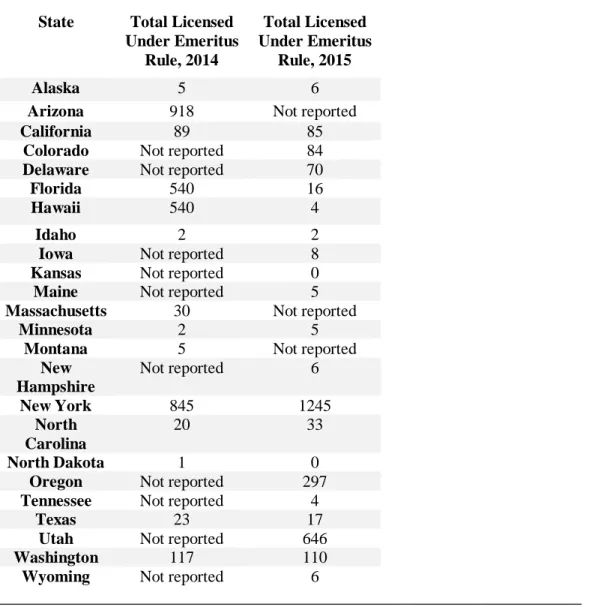
the number of attorneys participating and the number of hours reported. The numbers reported
were modest; half of the states reporting had fewer than 10 participants in 2015, which suggests
underreporting (Godfrey, 2015). New York led the way with 1245 volunteers reported in 2015
(Godfrey, 2015). However, the sample size is small and the data is fairly inconsistent. For
example, Iowa reports eight emeritus attorneys in its pro bono program, with an average of 355
hours of service in 2015 (Godfrey, 2015). Washington State reports 110 emeritus status
attorneys, with an average of 30 hours per volunteer (Godfrey, 2015). Oregon reports 297
emeritus attorneys with an average of 8 hours per licensee (Godfrey, 2015). Since few attorneys
nationwide report involvement with an emeritus pro bono program, there is a lot of potential for
retired attorneys to participate, as well as if legal aid organizations and state bars recruit retired
attorneys more actively.
TABLE 1. Licensed Emeritus Attorneys
___________________________________________
Table 1: Licens ed Emer itus Attor neys
State Total Licensed Under Emeritus
Rule, 2014
Total Licensed Under Emeritus
Rule, 2015
Alaska 5 6
Arizona 918 Not reported
California 89 85
Colorado Not reported 84 Delaware Not reported 70
Florida 540 16
Hawaii 540 4
Idaho 2 2
Iowa Not reported 8
Kansas Not reported 0 Maine Not reported 5 Massachusetts 30 Not reported
Minnesota 2 5
Montana 5 Not reported
New Hampshire
Not reported 6
New York 845 1245
North Carolina
20 33
North Dakota 1 0
Oregon Not reported 297 Tennessee Not reported 4
Texas 23 17
Utah Not reported 646
Washington 117 110
Wyoming Not reported 6
Chapter 3: Research Design: Methods and Data
Aim of this Case StudyThe purpose of this case study is to explore North Carolina’s current legal pro bono
culture and determine what incentives can be offered to encourage attorneys to provide more
legal services to low-income individuals. Existing research focuses primarily on pro bono
nationwide, rather than in just one state such as North Carolina. Additionally, preexisting
research, such as the American Bar Association’s Supporting Justice: A Report on the Pro Bono
Work of America's Lawyers, focuses on asking attorneys or law firm pro bono coordinators about
their individual experiences with pro bono (ABA Standing Committee on Pro Bono and Public
Service, 2013). While this research is valuable for understanding attitudes toward pro bono and
the state of pro bono in the country, a specific case study on North Carolina is a better tool for
determining how the state can improve its pro bono policies and culture. The goal of this case
study is to learn more about North Carolina’s strengths, challenges, and culture with regards to
pro bono legal services.
A case study is a method of learning about a complex instance based on a comprehensive
understanding of the instance (U.S. Government Accountability Office, 1990). Specifically, this
is a critical instance case study, which is frequently used to examine a situation of unique interest
(U.S. Government Accountability Office, 1990). Generalizability is not the goal; rather, the goal
is to more fully understand the unique situation of research interest. In this case, the unique
situation is North Carolina’s pro bono culture and institutions. To evaluate North Carolina’s pro
bono culture and suggest what policies may be best suited for the state, this paper uses a mixed
Data
Quantitative data was secured from several sources, including publicly-available data
from the Legal Services Corporation, the American Bar Association, and the North Carolina
Equal Access to Justice Commission. Unpublished quantitative data was acquired by request
through Pisgah Legal Services and NC IOLTA. Qualitative data was obtained by interviewing
carefully-selected individuals who are highly involved in North Carolina’s pro bono efforts. I
first discovered the Pro Bono Resource Center’s website and I sent an email to the executive
director, Sylvia Novinsky, asking if she would be willing to participate in an interview about pro
bono work in North Carolina for a senior honors thesis. Then, at the conclusion of the interview,
I asked Mrs. Novinsky for recommendations of other individuals with whom I could speak and
sent them individual emails to arrange interviews. At the conclusion of each subsequent
interview, I also asked for recommendations for other individuals to contact who could
contribute a unique perspective of and special knowledge about North Carolina legal pro bono.
In total, I interviewed eight people. Sylvia Novinsky is the executive director of
the North Carolina Pro Bono Resource Center, as well as the founder of the UNC Law
Pro Bono Program and former assistant dean for Public Service Programs at UNC Law.
Kim Bart Mullikin is the senior director of the North Carolina Bar Association and the
former Assistant Dean of Public Interest and Pro Bono Programs at Duke University
School of Law. Allison Standard is the director of Pro Bono Initiatives at the UNC
School of Law. James Jolley is the chair of the Pro Bono Alumni Board for UNC Law
and an associate at Smith Anderson in Raleigh. Kenneth Schorr is the executive director
of Charlotte Center for Legal Advocacy, a position he has held for nearly 30 years. Katya
Advocacy, and she also serves on the NCBA Pro Bono Activities Committee and the
Equal Access to Justice Commission Pro Bono Committee. Jim Barrett is the Director of
Pisgah Legal Services, a position he has held for almost 25 years. Finally, David
Wormald is the Pro Bono Team Leader at Legal Aid of North Carolina. I also
communicated with Katie Russell Miller, Director of Community Engagement at Pisgah
Legal Services, and Mary Irvine, Executive Director of NC IOLTA, via email to obtain
data.
Since the respondents are located in different cities across the state, the interviews were
conducted via telephone. At the beginning of each call, I restated that I was a UNC public policy
senior conducting an honors thesis about North Carolina legal pro bono incentives and culture,
and I gave a brief amount of background about myself. A semi-structured interview format was
used to ask open-ended questions, probe answers with follow-up questions, and allow
respondents to expand upon their answers. This interview style allowed me to more deeply
explore subjects of which a respondent was particularly knowledgeable, to ask clarifying
questions, and to request specific examples. I took detailed notes during each interview. After
each interview, I emailed the respondent to thank them for their time, ask for links to any studies
they cited, request contact information for other potential interviewees they suggested, and to
confirm for accuracy any dates or specific numbers they mentioned so I could include them in
this research. After conducting the first three interviews, I reviewed the responses together,
searching for recurring themes to start creating an outline. Then, after each subsequent interview,
Limitations
A case study does not lend itself well to generalizability. However, since the goal of the
research was to make policy recommendations for North Carolina specifically, I believe a critical
instance case study was appropriate in this case. The critical instance case study method and
interview format allowed me to gain a deep, rich understanding of North Carolina’s pro bono
culture in order to make policy recommendations for the state. Furthermore, I believe this
Chapter 4: Findings
Although it is possible to gain a general understanding of North Carolina’s legal aid
programs and nonprofits through online research, the interviews helped provide a much deeper
understanding of the various pro bono elements in play across the state. The interviews provided
a substantial amount of information that was not available online, such as what programs have
been especially effective and what various legal aid organizations in the state are planning for the
future. This chapter first provide background information about North Carolina’s system of legal
aid and pro bono programs. Then, the chapter analyzes the major themes that emerged through
the interviews.
Current Status of North Carolina Pro Bono
Like many states, North Carolina’s legal aid organizations have experienced chronic
underfunding for years and struggled to fully meet the growing need for legal assistance for
low-income North Carolinians (North Carolina Equal Access to Justice Commission, 2016). Eighty
percent of the civil legal needs of the poor in North Carolina go unmet every year in areas like
domestic violence, divorce, child custody, housing, consumer protection, employment, benefits,
and health (North Carolina Equal Access to Justice Commission, 2016). There is only one legal
aid attorney for every 11,000 North Carolinians eligible for legal aid, while there is one private
lawyer for every 362 NC residents (North Carolina Equal Access to Justice Commission, 2016).
One way for legal organizations to meet the great need is to recruit volunteer attorneys to take on
cases and clients. Although the legal need is significant, attorneys often hesitate to get involved.
Figure 1 shows that of the North Carolina attorneys who already indicated they are interested in
Attorney Involvement: North
Carolina”). This number has
decreased from 37.5% in 2012 (Legal
Services Corporation, “Private
Attorney Involvement: North
Carolina”).
In 2010, North Carolina
adopted State Bar Rule 6.1, which
encourages attorneys to provide at
least 50 hours of pro bono legal
services annually and to contribute
financially to organizations that provide legal services to individuals of limited means (North
Carolina State Bar, 2010). According to David Wormald, the vast majority of North Carolina
attorneys’ reported pro bono hours are facilitated through Legal Aid of North Carolina (LANC)
offices and the Charlotte Center for Legal Advocacy, followed by Pisgah Legal Services
(personal communication, February 20, 2018). A smaller number of hours also occurs through
other non-profit and legal aid organizations, as well as informally through people or
organizations with which attorneys have personal relationships. LANC is the only North
Carolina organization to receive LSC funding, which means it is the only organization that is
mandated to spend 12.5 % of its budget on Private Attorney Involvement (Legal Services
Corporation, “Private Attorney Involvement: North Carolina”).
North Carolina Equal Access to Justice Commission
Within the past decade, the state’s pro bono landscape has progressed as a result of the FIGURE 1: Interested North Carolina
Attorneys Who Accept Pro Bono Cases
SOURCE: LEGAL SERVICES CORPORATION
Figur e 1: Inter es ted Nor th Car olina Attor neys Who Accept Pr o Bono Cas es
efforts of the North Carolina Bar Association, North Carolina Supreme Court, and legal aid
providers. In November of 2005, the North Carolina Supreme Court established the North
Carolina Equal Access to Justice Commission, making North Carolina the 19th state to establish
such an entity (NC Equal Access to Justice Commission, “About”). The Commission’s goal is to
expand access to civil legal representation for low-income individuals in the state. The Chief
Justice of the North Carolina Supreme Court serves as the chair, and 25 members total serve on
the Commission, including representatives from all three branches of state government, legal aid
organizations, clients, and practicing attorneys (NC Equal Access to Justice Commission,
“About”). The North Carolina Equal Access to Justice Commission publishes an annual report
about its impact. In 2012, North Carolina’s Equal Access to Justice Commission suggested a
framework for a statewide pro bono resource center (S. Novinsky, personal
communication, January 29, 2018). At that time, newly-appointed Chief Justice of the NC
Supreme Court Mark Martin took interest in the idea and secured funding for the center through
CLE fees (S. Novinsky, personal communication, January 29, 2018).
North Carolina Pro Bono Resource Center
In April 2016, the Pro Bono Resource Center opened, with Sylvia Novinsky serving as
Executive Director. In her role, Novinsky supports the development of new pro bono programs
and her goal is to foster the growth of a public service culture within the North Carolina Bar.
Novinsky said, “My position is often housed at a state bar association or separately. Sometimes,
legal service providers come together and fund a position like this” (personal
communication, January 29, 2018). She said that the Equal Access to Justice Commission looked
at the Maryland Pro Bono Resource Center, which is nearly 25 years old, as a model for how to
said, “Someone looking at the state needs to say, ‘Who’s leading this?’ and ‘Who’s coordinating
this?’ because often, everyone is doing their own thing and everyone is all over the place. It’s
good to know what’s going on so you can use the resources as effectively as possible” (personal
communication, January 29, 2018).
During the PBRC’s first year, Novinsky’s goal was to institutionalize the center.
Novinsky spent much of the center’s first year traveling around the state meeting with legal
services providers to find out how lawyers can help them. Novinsky mentioned she wanted to be
careful to not just do things legal aid organizations are already doing (personal
communication, January 29, 2018). She gave presentations at law firms and bar associations and
was “on the road as much as possible” to let lawyers know about the PBRC (personal
communication, January 29, 2018). By the end of the first year, Novinsky said she felt like they
had hit as many organizations as they could (personal communication, January 29, 2018). The
PBRC also created a website with a portal containing approximately 30 active pro bono
opportunities at any given time with information about how to contact each individual
organization to volunteer (North Carolina Pro Bono Resource Center, “Learn About Us”).
Although Novinsky does not know how many people have used the site, she mentioned
anecdotally that organizations themselves have told her that attorneys have contacted them to
volunteer after finding them through the NC Pro Bono Resource Center’s website, so she feels
like it is working (personal communication, January 29, 2018).
On January 1, 2017, the PBRC launched a program for voluntary pro bono reporting,
joining 22 other states that track attorney pro bono participation (American Bar Association,
“Pro Bono Reporting;” North Carolina Pro Bono Resource Center, “Learn About Us”). Thirteen
requirements for pro bono legal service. In North Carolina, the PBRC collects information about
hours spent in “(1) activities to improve the law, such as leadership in professional legal
associations, service on boards of legal service providers to clients of limited means, or active
participation in employer pro bono committees; (2) non-legal community service; and (3)
providing financial support to legal service providers, such as Legal Aid of North Carolina,
Legal Services of Southern Piedmont, and Pisgah Legal Services” (North Carolina Court System,
2017). From the reported data, the NC Pro Bono Resource will be able to better quantify the
amount and types of pro bono service provided by North Carolina attorneys. This information
will help the Center improve how attorneys find pro bono opportunities, identify current unmet
legal needs in the state, and provide recognition for top pro bono participants (North Carolina
Court System, 2017).
Attorneys who report 50 hours of pro bono legal service are inducted into the NC Pro
Bono Honor Society and given a certificate from the Supreme Court of North Carolina (The
North Carolina Court System, 2017). In 2017, the Supreme Court of North Carolina recognized
170 attorneys who donated 50 or more hours of legal services in 2016, the first cohort of the NC
Pro Bono Honor Society (The North Carolina Court System, 2017). In total, 541 attorneys shared
information about their pro bono efforts over the 2016 calendar year, reporting 25,700 hours
total, an average of 47.3 hours each (The North Carolina Court System, 2017). There are
currently over 27,000 members of the North Carolina State Bar, so the majority of attorneys have
not yet participated in the voluntary reporting program (Martinadale, “North Carolina State
North Carolina Attorney Emeritus Program
The North Carolina State Bar allows both inactive North Carolina attorneys and both
inactive and active out-of-state attorneys to obtain Pro Bono Practice Status (NC Equal Access to
Justice Commission, “Pro Bono Practice Status for Inactive and Out-of-State Lawyers”). This
policy allows retired attorneys from North Carolina or elsewhere to practice pro bono in the
state, although there is no minimum age requirement (NC Equal Access to Justice Commission,
“Pro Bono Practice Status for Inactive and Out-of-State Lawyers”). To obtain Pro Bono Practice
Status, an attorney must petition and be approved for this status by the North Carolina State Bar
(NC Equal Access to Justice Commission, “Pro Bono Practice Status for Inactive and
Out-of-State Lawyers”). The Pro Bono Practice Status attorney must work under the direct supervision
of a licensed North Carolina attorney at a legal aid organization (NC Equal Access to Justice
Commission, “Pro Bono Practice Status for Inactive and Out-of-State Lawyers”). North Carolina
Pro Bono Practice Status attorneys do not have to pay state bar dues, maintain malpractice
insurance, or complete CLE hours (NC Equal Access to Justice Commission, “Pro Bono Practice
Status for Inactive and Out-of-State Lawyers”).
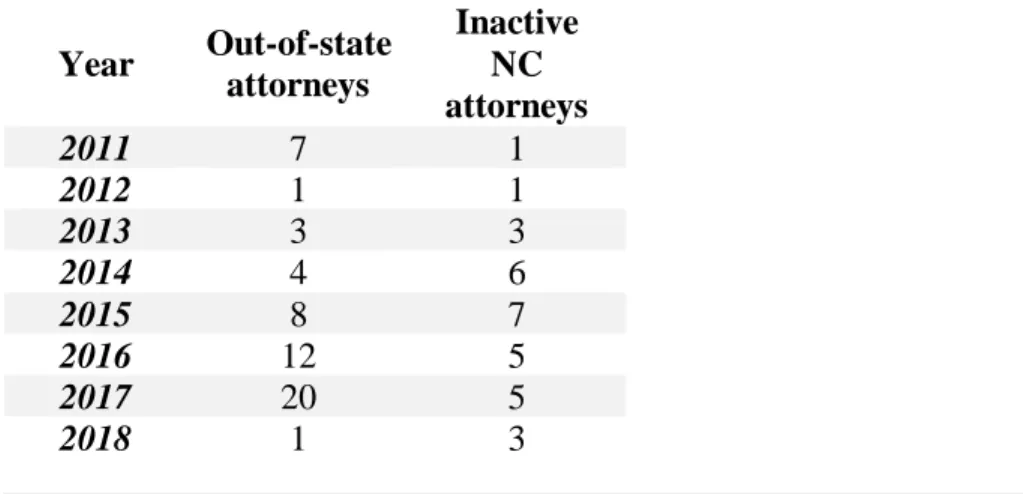
Within the state, 56 individuals have received pro bono practice status (M. Irvine,
personal communication, March 15, 2018). As of 2018, 53 attorneys have pro bono practice
status, as afew received pro bono status and later became licensed in North Carolina fully or
chose to relinquish their pro bono status and fully retire (M. Irvine, personal communication,
March 15, 2018). Figure 2 shows how many attorneys have obtained pro bono practice status
TABLE 2. Pro Bono Practice Status Attorneys in NC _____________________________________________
_________________________________________________________ SOURCE: MARY IRVINE
Table 2 – Pro Bono Practice Status Attorneys in NC
None of the major legal aid providers within the state currently have a dedicated attorney
emeritus program. Of the three, Pisgah has the highest percentage of elderly attorneys among its
volunteers, likely due to the fact that Asheville is a popular retirement destination. While older
attorneys may often not have the same time constraints that younger attorneys do, they face
different issues. For an older attorney who is accustomed to having a secretary make copies and
type drafts, there is a steep learning curve to learning how to use technology and function
without a personal administrative assistant when working at a legal aid organization. However, a
number of older attorneys can use technology well enough to be a valuable addition to a legal aid
organization. Jim Barrett said at Pisgah Legal Services, older attorneys can, at the very least,
assist with client screenings and intake processes with only a small amount of training and
computer knowledge (personal communication, February 16, 2018). Both Jim Barrett and
Kenneth Schorr expressed that they would like Pisgah Legal Services and Charlotte Center for
Legal Advocacy, respectively, to develop a senior attorney emeritus pro bono program (personal
communication, February 16, 2018; personal communication, February 8, 2018). Year Out-of-state
attorneys
Inactive NC attorneys
2011 7 1
2012 1 1
2013 3 3
2014 4 6
2015 8 7
2016 12 5
2017 20 5
UNC Law Pro Bono Board
In 2012, UNC Law created its unique Pro Bono Alumni Board to help bridge the gap
between pro bono involvement between students and alumni. Board members serve three-year
terms and meet three times per year for several hours at a time. According to Allison Standard,
director of UNC Pro Bono Initiatives, the alumni board tries to recruit diverse members
encompassing representatives from government agencies, large firms, in-house counsel, and
non-profits all over the state, as well as D.C (personal communication, February 1, 2018). The board
is divided into several different committees focused on different objectives, such as hosting
networking events for students to connect with alumni who were involved with pro bono as
students and continue to be involved as attorneys. During UNC Law’s Pro Bono Week, the
Alumni Board hosted a lunchtime panel of recent graduates who talked about how they stayed
involved in pro bono after law school. The alumni board also supports alumni in their pro bono
efforts, recruits supervising attorneys for student pro bono projects, and puts together CLEs (A.
Standard, personal communication, February 1, 2018).
Interview Findings
All of the interview questions were centered around gaining a deeper understanding of
North Carolina’s pro bono culture and current incentives in order to make appropriate policy
recommendations. Four major themes emerged when analyzing the answers provided by the
interviewees. First, many of the respondents expressed that they believe many attorneys
generally do have a desire to do pro bono, but that there is a noticeable gap between the
expressed desire to do pro bono and the follow-through due to a number of obstacles. Second,
the interviewees emphasized that partnerships are key for successful, consistent attorney