Determinants of Access to Care and Subsequent Emergency Department Use: The Experience of Latino Participants in Durham County's LATCH Program
By
Kanecia Obie Zimmerman
A master's paper submitted to the faculty of the University of North Carolina at Chapel Hill in partial fulfillment of the requirements for the degree of Master in
Public Health the Public Health Leadership Program.
ABSTRACT Kanecia Obie Zinnnerman
Determinants of Access to Care and Subsequent Emergency Department Use: The Experience of Latino Participants in Durham County's LATCH Program
(Under the direction ofCatbrine Hoyo, Ph. D. and Thomas R. Konrad, Ph. D.)
Introduction: The health care sector has become the focal point of health and is increasingly viewed as the necessary factor for decreased morbidity and mortality. As several studies have linked increases in health care costs to poor access to ambulatory care and subsequent utilization of the Emergency Department (ED), programs have been implemented to increase access to ambulatory care and reduce inappropriate utilization of the ED. Despite the existence of these programs, it is unclear from existing literature what factors determine access to ambulatory care and subsequent utilization of the ED, particularly for Latino persons with low levels of ambulatory care access and poorer health outcomes when compared to non-Latino whites. In this report, we evaluate factors associated with access to ambulatory care for Latino participants of Durham Count's LATCH program and determine whether access to care is associated with utilization of the ED.
characteristics (age, gender, duration lived in the U.S., birthplace, language concordance with a health care provider, satisfaction with health care, existence of a usual source of care, perceived racial discrimination, self-rated health status, insurance status, and care management status) and access to ambulatory health care. We then evaluated these patient characteristics in relation to utilization of the ED. Analyses were performed for a subgroup of participants with at least one ambulatory sensitive condition (asthma, diabetes, hypertension) and for
participants without a condition.
Results: For participants without an ambulatory sensitive condition, care management and language discordance with a health care provider were significantly associated with access to ambulatory care. For those with a condition, self-rated health status and insurance status were significantly
associated with access to health care. For those without an ambulatory sensitive condition, self-rated health status was significantly associated with use of the ED. No factors were significantly associated with use of the ED among those with an ambulatory sensitive condition.
TABLE OF CONTENTS
LIST OF TABLES ... vi
LIST OF FIGURES ... vi
INTRODUCTION ... 1
Descriptive Epidemiology ... 2
Health Insurance, Out-of-Pocket Medical Expenses, and Usual Source of Care: Empirical Evidence of Effects on Access to Care and Health Outcomes ... 6
Socioeconomic Determinants of Health Care Access: Empirical Evidence ... 15
Ethnicity, Acculturation, and Patient Satisfaction with Care as Determinants of Health Care Access: Empirical Evidence ... 17
Inappropriate utilization of the Emergency Department. ... 22
Inappropriate utilization of the Emergency Department and access to ambulatory care services ... 26
Summary ... .32
METHODS LATCH Participants and Study Population ... .34
Data Collection ... .40
Survey Instrument. ... .40
RESULTS ... .45
Emergency Department Use ... .45
Factors associated with perceived and realized poor access to care ... .46
Factors associated with Emergency Department utilization ... .48
DISCUSSION ... 55
Strengths and Limitations ... 61
LIST OF TABLES
Table 1. Study Population ... .49 Table 2. Factors associated with perceived and realized poor access to care
among those without an ambulatory sensitive condition ... .50 Table 3. Factors associated with perceived and realized poor access to care
among those with an ambulatory sensitive condition ... 51 Table 4. Factors associated with utilization of the Emergency Department among those without an ambulatory sensitive condition ... 52 Table 5. Factors associated with utilization of the Emergency Department among
those with an ambulatory sensitive condition ... 53 Table 6. Factors associated with inappropriate utilization of the Emergency
Department ... 54
LIST OF FIGURES
INTRODUCTION
The existing literature on access to health care has arisen from the sentinel work of medical sociologist, Dr. Ronald Andersen, from the 1960s. His
behavioral model was initially developed "to assist the understanding of why families use health services; to define and measure equitable access to health care; to assist in developing policies equitable access."(! )(pI). In his model, population characteristics, the health care system, and the external environment are access variables that work to influence health behavior, including use of health services. In tum, these forces influence health outcomes of perceived and evaluated health status. Andersen suggests that efficient access leads to increased use of health services, which in tum, leads to better outcomes.
Despite Dr. Andersen's work and the forty years that have followed, evidence indicates that little headway has been made concerning improving health care access. Accordingly, results from the National Access to Care Surveys in 1982, 1986, and 1994, indicated that approximately 6% of the American
population reported unmet health needs.(2) Additionally, in a 1997 publication by the Robert Wood Johnson Foundation, authors Berk and Schur noted, it is "disturbing to find that access for vulnerable subpopulations may be
As the health disparities field has come to the forefront of health policy and pnblic health discourse, the concept of health care access has appeared more pertinent than ever. Research has indicated the existence of "racial and ethnic disparities across a broad spectrum of health conditions"(3) and "similar
disparities have been observed for health insurance, access to health care, and the use of health services."(3)(p37).
Descriptive Epidemiology
Not surprisingly, access to ambulatory health care has often been examined within the context of ambulatory care sensitive conditions, chronic conditions shown to be controllable when detailed management protocols are followed within the ambulatory care setting, but may lead to significant morbidity and/or mortality ifleft untreated or inadequately managed through the Emergency Department or other urgent care centers. Among the diseases classified as
ambulatory sensitive, asthma, diabetes, and hypertension are among the most common and severe in the absence of proper management.
Asthma
diagnosed with asthma than non-Hispanic whites. While overall, Hispanics, have
the lowest rates of asthma diagnoses, Puerto Ricans have the highest rate of
lifetime asthma diagnosis, being 80% more likely than non-Hispanic whites to
have been diagnosed with asthma.(4)
Current estimates of asthma prevalence in the United States approach 72
per 1,000 people. While these estimates of prevalence are in part, a function of
improvements in diagnosis and longevity, statistics also indicate that the
incidence of asthma is also on the rise.( 4) Perhaps more importantly, however,
asthma attack prevalence, an indicator of how many people have uncontrolled
asthma and are at risk for a poor outcome, has been estimated at 43 cases per
I 000 persons, with Puerto Ricans having the highest attack prevalence at I 00%
that of non-Hispanic whites. According to a survey in 2002, these attacks led to
approximately 11.8 missed days of work for those who were employed and over
age 18, and 67 visits to the Emergency Department per 10,000 people.
Furthermore, while Hispanics exhibit the lowest prevalence of asthma when
compared to other racial/ethnic groups, rates of asthma-associated hospitalizations
and mortality have been shown to be increased among Hispanics as compared to
non-Hispanic whites.(S, 6)
Diabetes
Statistics also indicate that the number of diabetes cases is on the rise, with
the number of new cases of diabetes diagnosed in adults ages 18 to 79 increasing
by 54% from 1997 through 2004.(7) Of note, rates of new disease diagnoses in
Centers for Disease Control in 2005, the prevalence of diabetes in the United States approaches 20.8 million people, with the great majority of these cases occurring in persons 20 years of age or older. While there is an astounding rate of diabetes cases among non-Hispanic whites, evidence suggests that Mexican Americans are approximately 1.7 times as likely as non-Hispanic whites to have diabetes, while Puerto Ricans are 1.8 times as likely as non-Hispanic whites to be diagnosed with diabetes. (8)
Uncontrolled diabetes contributes to a significant amount of morbidity and mortality, increasing the risk of heart disease, stroke, disease of the nervous system, periodontal disease, and amputations, as well as serving as the leading cause of both blindness and kidney failure in the United States in 2002. Notably, studies have shown that Latino populations are developing diabetes-related complications, including kidney disease and retinopathy, at two times the rate of non-Hispanic whites.(8-l 0)
Hypertension
According to the National Health and Nutrition Examination Survey III conducted in 1999 and 2000,28.4% of the adult population in the United States has hypertension. Age adjusted prevalence rates suggest that the rate of
overall in the United States, the greatest increases have been seen among members of the Hispanic population.(!!)
The significant racial and ethnic disparities in morbidity and mortality related to asthma, diabetes, and hypertension are troubling. 1bis is particularly so among Hispanic populations given projections that the Hispanic population in the US is expected to increase by 2% every year until 2030 and approach 25% of the total population by 2050.(11) This phenomenal increase in population coupled with current trends in incidence, and prevalence of ambulatory sensitive
conditions and their complications could mean an extraordinary financial burden on the U.S. health care system, damage to the labor force and economic well-being of the nation, and most importantly, an incredible loss of productive life.
Ambulatory sensitive conditions such as asthma, hypertension, and diabetes, are conditions whereby adequate ambulatory control should eliminate most of the risk for complications and the need for emergency care or
hospitalizations related to these conditions. Given this, discrepancies in access to care may help to explain the observed disparities in health outcomes between Hispanic patients and those of other races/ethnicities. Accordingly, evidence indicates that Hispanic Americans are nearly twice as likely to not have a usual source of care as white Americans, and Hispanic adults are considerably more likely to report major problems accessing specialty care than are white
indicates that only 17% of Mexican Americans have their hypertension under control, as compared to 30% of non-Hispanic whites.(! I)
In addition to the costs and burdens of uncontrolled disease among racial and ethnic minorities, some have suggested that inadequate access to ambulatory health care services results in inappropriate utilization of the Emergency
Department. In tum, this inappropriate utilization is presumed to lead to poor continuity of care for patients and ultimately, great cost to the patient, the health care system, and society as a whole.
Despite much discourse on the growing need for ambulatory health care access, health care access has remained inconsistently defined,(2) and it is unclear from empirical evidence what factors actually determine ambulatory health care access, particularly for Latino populations who so desperately need it.
Furthermore, it is unclear what conditions of ambulatory health care access are necessary for this factor to translate into the reduction of inappropriate utilization of the emergency department. Ultimately, this knowledge is necessary for forward movement in the health arena.
Health Insurance, Out-of-Pocket Medical Expenses, and Usual Source of Care: Empirical Evidence of Effects on Access to Care and Health Outcomes
African Americans and Hispanics fare worse than wlrites in obtaining access to care.(13) As inadequate health insurance rests the burden of health care financing on the shoulders of individuals and their families, it is not surprising that much of the existing literature examines potential financial barriers to health care access.
Some studies have specifically found that financial factors may be central determinants of utilization of health services and associated medical instruction. Accordingly, a large survey of chronically ill VA and non-VA adult patients found that cost-related medication underuse was lower among VA patients (12%) than among patients with Medicare, Medicaid (25% p = .00004), or no
insurance(35%; p<0.0001). Multivariate analysis found that patients with
Medicare or no insurance were more likely than VA patients to forego medication at least once per month due to cost (adjusted OR: 3.4 and 3.9, p< or=
0.0001).(14)
needed medical care because they owed a physician money.(l5) In addition to this
measure of perceived inadequacy in health care access due to financial burdens,
an analysis conducted by the Center on Budget and Policy Priorities used different
models and assumptions for projected utilization and found that realized health
care access was also affected, as increased copayments led to decreased utilization
of services, including hospital admissions, physician visits, prescription drugs,
and outpatient hospital clinic visits. (16)
Analysis of adult Medicaid policy changes in Utah also provided
discrepant results regarding realized ambulatory care access, depending on
models of analysis used. In one model, when actual utilization of services was
compared with modeled expectations, investigators found that the new imposition
of copayments on those in the Medicaid Waiver Program did not have a
statistically significant association with utilization of most services; however, they
did find statistically significant decreases in utilization of some services such as
prescription drugs. An analysis conducted by the Center on Budget and Policy
Priorities used different models and assumptions for projected utilization and
found that increased copayments led to decreased utilization of services, including
hospital admissions, physician visits, prescription drugs, and outpatient hospital
clinic visits.(l7)
These studies suggest that financial factors are indeed important
determinants of both perceived and realized ambulatory health care access;
however, the discrepancies in results based on analysis model or analysis in
Medicaid studies bear testament to the complexity of this issue. Discrepancies may also display limitations in research design, including the fact that each of the above-mentioned studies were cross-sectional in nature and largely depended upon self-reported indicators of health care access and utilization (data on Utah serves as a notable exception, which included documented utilization from official records, survey, and focus group data). Furthermore, different indicators of health care access were used between the studies, ranging from medication utilization and health services utilization to report of "unmet needs." That is to say that some studies examined realized health care access, through measures of utilization of ambulatory care services, while other studies examined perceived ambulatory access. Additionally, these studies may not be generalizable to Latino populations given the demographic differences between the states from which Medicaid data was obtained, differential state policies in Medicaid eligibility and benefits that may differentially affect one's actual or perceived ability to pay for medical care, and the use of an online questionnaire in the VA study which presents the potential for selection bias for those who have access to the internet.
group received no vouchers and were therefore subject to Medicare co-payment and deductible costs. Results showed a significant difference in the number of voucher recipients who received a mammogram (44%) compared to controls (10%).(18) While these results are consistent with those found in the
abovementioned cross-sectional studies -- that health care finances are important determinants of realized access to health care -- the large discrepancies between those who received a voucher and voucher-recipients who received a
mammogram, suggests that personal out-of pocket expenditures is not the sole factor that serves as a barrier to health care access and appropriate utilization of ambulatory health care services.
A study by Jones, Cason, and Bond also supports this finding as it
analyzed a population oflow-income immigrant Hispanic women who entered the healthcare system for childbirth. They found that though only one-fourth of participants returned to the health care system for purposes of preventive care, that the amount one had to pay out of pocket was not a factor in identifying those who retumed.(19)
expenditures may be important to consider when addressing health care access issues for these populations. Additionally, the studies regarding changes in Medicaid eligibility criteria do not identify the specific reasons for medical service utilization. Comparatively, results of the randomized control trial and the study by Jones, Cason, and Bond, which examined preventive care service
utilization, suggest that determinants of healthcare access may also vary by disease condition and/or need for a particular health care service within the ambulatory care setting. As such, a study by Nelson, Chapko, Reiber, and Boyko examined the association between health insurance coverage and diabetes care in a large, nationally representative sample of patients reporting a diagnosis of diabetes. According to their findings, when compared to those with private insurance, the uninsured were less likely to report recommended preventive services, including annual dilated eye exams, foot examinations, or hemoglobin Al C tests. They were also less likely to perform daily blood glucose monitoring than those with private health insurance.(20)
Examination of the health disparities literature may also provide important insight into insurance as a determinant of health care access because of the
reported differences in health outcomes and ambulatory care access between whites and other races and ethnicities. Accordingly, studies by Weinick et a!, Waidmann and Raj an, Zuvekas and Taliaferro, and Hargraves and Hadley all found that health insurance consistently explained a significant proportion of the Hispanic-White difference in access to care and in three of the four studies (exception is by Wienick et a!), it was the largest contributor to the Hispanic-White differences in health care access. Similarly, the studies found that Black-White disparities in health care access could be explained by differences in health insurance coverage. (3, 21-23)
While these studies generally exhibit good internal validity and therefore lead us to believe that insurance coverage may in fact be the major determinant of health care access in these populations, the use of "having a usual source of care" as one proxy for "health care access" may be problematic. The evidence for "having a usual source of care" as a predictor of health care access has produced mixed results. Accordingly, a study by Lambrew eta! found that "persons with a regular health provider are less likely to report delays in getting medical care, more likely to visit their provider, and less likely to use the emergency rooms for ambulatory care."(24) Additionally, a study of breast and cervical cancer
of 1893 adult Hispanic respondents, investigators Schur and Albers found that
having a usual source of care consistently predicted use of health care
services.(26) Comparatively, in another study, an urban academic medical center
implemented an intervention to provide a usual source of care to 1676 US citizens
or legal residents with income below 235% of the poverty level and who were
ineligible for any state or federal insurance plan. Participants were assigned a
primary care provider and received prescription drug coverage, diagnostic tests,
and outpatient visits for sliding scale copayments. Emergency visits, inpatient
hospitalizations, and outpatient specialty clinic use were evaluated for participants
in the program and other study participants, including uninsured and commercial
patients. Evaluation of the program revealed that use of emergency, inpatient, and
outpatient specialty clinics did not significantly change for any of the groups.(27)
These results suggest that provision of a usual source of care may not be the
definitive factor for ensuring healthcare access and it may not be completely
accurate to use this as the sole proxy for access to care. However, it likely
contributes to a myriad of forces that determine access to ambulatory care, and the
two studies including Hispanic respondents suggest that it may be a particularly
important determinant of realized ambulatory health care access in this
population. Of note, however, these results may not be generalizeable to our
population of interest who are not only Hispanic, but also, low income, largely
without health insurance, and with potentially deadly chronic disease.
While the use of "having a usual source of care as an access variable may
Taliaferro, and Hargraves and Hadley also used other indicators that help to
strengthen their results that insurance status is the major determinant of health
care access. However, one must note that in these studies, differences in
insurance status between Hispanics and Whites, and African Americans and
Whites, did not account for all of the differences in observed access to care.
Rather, insurance explained only 23-33% of the gap in health care access in these
studies.(3, 21-23)
While insurance may be an important contributor to health care access,
given the above findings it would be difficult to assume that sole alleviation of the
lack of health insurance would be adequate to produce the desired results in health
outcomes, particularly for racial and ethnic minorities. Research on the direct link
between insurance status and health outcomes is sparse, but provides an adequate
picture for some conditions. According to the IOM's report, Care Without
Coverage, Too Little, Too Late, uninsured patients with cancer are generally in
poorer health and are more likely to die prematurely than persons with insurance.
Additionally, they found that uninsured adults living with chronic diseases,
including diabetes, cardiovascular disease, end stage renal disease, HIV infection,
and mental illness, uninsured patients have consistently worse clinical outcomes
than insured patients.(28) Despite these findings from the IOM and their
conclusions from their study that "providing health insurance to uninsured adults
would result in improved health, including greater life expectancy, and increased
rates of health insurance coverage would especially improve the health of those in
would likely reduce health disparities among racial and ethnic groups, "(28)(p5) some argue that the question still remains of whether or not providing insurance for the uninsured will defmitely result in improved health outcomes, particularly for racial and ethnic minorities. Alternatively, must we consider the other potential contributors to health and health care access as Dr. Andersen suggests. Furthermore, we believe that these factors of perceived and realized ambulatory health care access must be more closely examined within populations oflargely minority participants if we desire truly to gain insight into the importance of these factors specifically for these populations. Unfortunately, much of the existing literature fails to do such.
Socioeconomic Determinants of Health Care Access: Empirical Evidence We believe the discrepant findings in the literature suggest that we must examine potential determinants of ambulatory health care access and subsequent health outcomes beyond insurance status and related out-of-pocket costs, and beyond whether or not a patient has a usual source of care. Ironically, this idea has also been supported by the Institute of Medicine. In its 1993 report, the !OM developed a broad definition of access to care as, "the timely use of personal health services to achieve the best possible health outcomes."(29) The report continues, saying,
they live. But having insurance or nearby health care providers is no guarantee that people who need services will get them. Conversely, many who lack coverage or live in areas that appear to have shortages of health care resources do, indeed, receive services they need. (29)
Unfortunately, beyond the financial and "usual source of care" indicators, the literature is limited in its ability address and differentiate other potential barriers to health care access. Nonetheless, those such as Theodore Pincus argue that social factors may be the most important determinants of health
outcomes.(30) These may include socioeconomic status, perceptions of health and the healthcare system, and ethnic and cultural barriers to care.
In medical and public health literature, socioeconomic status often includes personal income, education level, or occupation. While numerous studies have documented the difficulties in measuring socioeconomic status and its relationship to health status,(31) some have suggested that variables related to socioeconomic status, such as transportation and education may be particularly relevant for measures of health care access.
friends who could provide transportation had 1.58 times more visits for chronic care than those who did not.(32) As these associations were adjusted for effects of personal characteristics, health characteristics, and distance to health care
provider, transportation may indeed serve as an important independent contributor to health care access; however, more studies are needed to more closely evaluate its effects on health care access and subsequent health care outcomes.
Furthermore, it is likely that transportation as a barrier to access is dependent on where one lives in relationship to health care services.
Education is at least two faceted. It provides the wherewithal to purchase ambulatory health care access and therefore, its effects might be reflected in analysis of financial barriers to health care access. Additionally, education provides access to knowledge about the dangers of chronic and other diseases and thereby may help to dictate health seeking behavior and subsequent realized ambulatory health care access. However, our study of the literature has not discerned these possible connections.
Ethnicity. Acculturation, and Patient Satisfaction with Care as Determinants of Health Care Access: Empirical Evidence
studies have examined the effects of acculturation on perceived and realized ambulatory health care access. The concept of acculturation has been heavily debated, particularly regarding the factors that should be used to define "acculturation."(33) However, most current measures use either language, duration of years lived in the United States, or some combination of these two factors. Much of the literature regarding ambulatory health care access focuses specifically on language. As with other potential determinants of health care access, the results are somewhat discrepant.
Language discordance
Another study evaluated breast and cervical cancer screening rates in a multiethnic population as related to English-proficiency. This study found that reading and speaking only a language other than English and reading and speaking another language more fluently than English were significantly and negatively associated with receipt of breast and cervical cancer screening in unadjusted models. When using adjusted models, the results were attenuated, but limited English proficiency remained negatively associated with cancer
screening.(36)
To gain understanding of the effects of language on realized access to ambulatory care services, a study by Jacobs, Lauderdale, Meltzer, Shorey, Levinson, and Thisted examined the effect of using a comprehensive interpreter services in the delivery ofhealthcare to limited English-proficient patients versus standard healthcare delivery in a comparison group.(37) Interestingly, this study also aimed to study a possible solution to the potential problem oflanguage barriers. This study found that clinical service use increased significantly in the intervention group versus that of the comparison group for office visits,
prescriptions written, and prescriptions filled. Additionally, rectal examinations increased significantly more in the intervention group than in the comparison group, and differences in rates ofFOBT, rectal exams, and flu immunizations significantly decreased between Portuguese and Spanish-speaking patients and those in a comparison group. (3 7)
These findings are unlikely due to chance alone since the studies had different study designs and study populations. Specifically, the studies examined utilization of different services, including preventive services or emergency department services. Additionally, the study by Carrasquillo et al examined the patient's self-projected utilization of future services based on the level of patient reported satisfaction with care they had received, while the study by Jacobs, Lauderdale, Meltzer, Shorey, Levinson, and Thisted examined associations through an intervention.
Studies have also examined the interplay between language and patient satisfaction or physician discrimination against patients. This interplay may have a significant effect on realized access to ambulatory care as well as complicate our abilities to examine the effects oflanguage on access to health care. For example, in the study by Carrasquillo et al, multivariate analysis adjusting for hospital site, age, gender, race/ethnicity, education, income, chief complaint, urgency, insurance status, Medicaid status, ED as the patient's principal source of care, and presence of a regular provider of care, non-English speakers were significantly less likely to be satisfied with care( odds ratio [OR] 0.59; 95% confidence interval [CI] 0.39, 0.90).(34)
ambulatory health care among those with language discordance from that of the health care system.
Acculturation
Other studies have examined components of acculturation in addition to language. Accordingly, a study by Solis, Marks, Garcia, and Shelton found that of acculturation variables used in the study, language, but not ethnic identification predicted use of preventive services.(39) This finding is consistent with
abovementioned studies that have examined language as a potential barrier to health care access. However, any inconsistencies in the use of"acculturation" as a determinant of perceived and/or realized access may be attributable to the potentially complicated nature of this variable and resultant difficulties in comparing measures of acculturation across populations and studies, given our lack of understanding of this measure.(33) For example, Arcia eta! document the inabilities of current models of acculturation to truly differentiate between cultural factors and socioeconomic factors, as low levels of acculturation are likely to also be accompanied by low levels of education and income.(33)
Inappropriate utilization of the Emergency Department
As explained, inadequate access to ambulatory health care is problematic in itself, exposing persons with ambulatory sensitive conditions particularly, to inadequate continuity of care necessary for management and control of potentially life-threatening diseases. Moreover, inadequate access to ambulatory health care has also been linked to "inappropriate" utilization of the emergency
department.( 40) Utilization of the emergency department in the United States has been estimated to have increased from 18 million visits in 1958( 41) to 110 million in 2002.( 42) Additionally, this utilization has mirrored an increase in emergency health care expenditures, rising to a cost of approximately 3% of US health care expenditures in 1987.(43) Given these factors, "inappropriate" utilization of the emergency department has become an important topic for medico-political circles. Furthermore, there are numerous documented
difficulties with ambulatory health care access for racial and ethnic minorities. Thus, we believe that a positive association between inadequate access to
ambulatory health services and "inappropriate" utilization of health care services might highlight the importance of addressing access to health care for the
"Inappropriate" utilization has been deemed a potential target for
reduction in health care expenditures and improvement in overall quality of health care delivery, even prompting policies across the nation for denial of care in the emergency department in situations in which ED visitation is deemed
"inappropriate".( 44) Many have highlighted potential dangers and difficulties with these practices, largely based on important deficits in the literature.(45) Primarily, definitions of "inappropriate" utilization of emergency services are alarmingly inconsistent, thereby precluding an accurate measure of the magnitude of this issue.(45)
While in the 1980's, "non-urgency'' began to define inappropriate visits to the Emergency Department, the literature has yet to agree on subsequent
definitions of"non-urgency." Accordingly, the US General Accounting Office based its 1990 approximation of a 43% rate of non-urgent ED visits on the opinion of the hospital official who responded to the survey, and non-urgent was defined as "not life or limb threatening or did not require immediate care and probably could have been treated in a doctor's office or clinic.(46)
Comparatively, the National Center for Health Statistics derived an approximated figure of 55% non-urgent ED visits in 1992, using data from patient record forms completed by hospital staff. In this case, non-urgent visits were defined as "those made by patients who did not require immediate attention or attention within a few hours."(47) The 1997 National Ambulatory Medical Care Survey estimated that only 9. 7% of ED visits are non urgent. They used data based on the
patients arrived in the ED. Categories included emergent, urgent, semiurgent, or nonurgent, where nonurgent classification was defined by needing to be seen within 2-24 hours of arrival in the ED.( 48)
While these studies took place in different years and may pool from different patient populations, all three of the studies attempted to gather a wide range of nationally representative hospitals. Additionally, barring significant variations from one year to the next in the pool of patients presenting to these emergency departments, it is more likely that the different methods of classification of non-urgency are reflected in the vast differences in the percentages of ED visits identified as "non-urgent."
Lowe and Bindman have further explored the differences in classification of "appropriateness" of emergency department visitation, depending not only on criteria for classification, but also, on the person performing classification. Furthermore, their study addresses another important contributor to the problem of classification discrepancy according to Richardson and Hwang: whether or not studies have determined urgency prospectively or retrospectively.( 49) In their study, Lowe and Bindman identified seven different indicators of inappropriate ED visits. Two assessments of appropriateness were made each from the patient questionnaire and nursing triage form, and three assessments were made
was obtained by patient self-assessment of urgency. Agreement assessments were
performed for each visit, on the multiple methods used for classification,
indicating that there was poor agreement between the indicators for each visit, and
thereby suggesting that in this study, there is truly a wide range of discrepancy
between persons and methods of classification of appropriate and inappropriate
visits to the ED. This discrepancy of course, is problematic, and calls into
question the ethical basis of any effort to divert "inappropriate" visits from the
emergency room, at least until we can consistently define what constitutes
"inappropriate" use.(45)
While the presumed association between access to health care and
"inappropriate" utilization of the emergency department is potentially an
important one for allocation oflimited health care resources and assurance of
adequate quality of care, numerous questions remain, notwithstanding the lack of
consistency in definitions of "inappropriate" use of the Emergency Department.
Among these questions is, "what factors are associated with "inappropriate"
utilization of the Emergency Department, particularly for racial and ethnic
minorities?" We believe that the answer to this question is an important step
towards finding a solution to problems of inappropriate utilization of health
services and just allocation of health care resources as well as potentially
improving racial and ethnic disparities. We also believe that to answer this
question and to derive the potential for increases in ambulatory access to health
care to alleviate inappropriate utilization of the Emergency Department, we must
Emergency Department." We suggest using a measure that takes into account the benefits of ambulatory care and control for ambulatory sensitive conditions such that "inappropriate utilization" includes that for which one utilizes the Emergency Department for help with an ambulatory sensitive condition or an associated complication.
Inappropriate utilization of the Emergency Department and Access to Ambulatory Care services
Emergency Department is weak if indeed there is an association. Alternatively, though this study evaluated presumed determinants of health care access-insurance status, demographics, and geography- these factors may not be the important determinants of ambulatory access to health care for this population of people.
Oktay, Cete, Bray et a! have examined the relationship between
"inappropriate" utilization of the emergency department and aspects of access to health care in the Turkish health system. In this study, "inappropriate" utilization was defined first by three emergency medicine residency trained physicians according to a predetermined classification scheme ranging from category I to category 3. Category 2 described a patient who needed evaluation within 6 hours while a category 3 patient needed evaluation only after 6 hours. Those in
significantly more inappropriate visits to the ED than those in lower income groups. Investigators suggested that for care for minor health problems, lower income patients preferred less expensive public health clinics or government hospital emergency departments as opposed to the university hospital examined in this study. They also suggested that those with insurance had the freedom to visit the emergency department whenever they wanted, regardless of the seriousness of their conditions.( 44) The results found in this study may differ from results in the United States as a function of the differences in patient populations and attributes of the health care systems. Nonetheless, these results suggest that determinants of health care access, including insurance and socioeconomic status, may not be associated with "inappropriate" utilization of the ED in the expected manner-that those with less access to ambulatory care because of inadequate insurance or lower socioeconomic status are more likely to inappropriately utilize the
emergency department.
therefore, that "providing patients with a regular source of care is unlikely to have a significant impact on nonurgent ED utilization without efforts to manage
utilization and ensure adequate access to primary care."( 51)
In a relatively large, nationally representative study by Sarver, Cydulka, and Baker, the relationship between usual source of care and nonurgent use of the ED was explored. Investigators found that dissatisfaction with the usual source of care or the usual source of care's staff, lack of confidence in the usual source of care's ability, difficulty scheduling an appointment, difficulty reaching the usual source of care by phone, and long waiting times with an appointment were all significantly associated with having had a nonurgent visit to the ED within the study period, even when adjusted for age, sex, race, education status, health status, employment status, income, insurance, region of residence, and rural vs. urban residence. Of note, classification of "urgency" was based on pre-published criteria, based on the participants' reporting about the visit and his or her
perception of the visit. Authors concluded that improvements in patient satisfaction with and access to their usual source of care may help to decrease nonurgent visits. (52)
A study by Guttman eta! sought specifically to identifY the factors
are not classified by age, and results were qualitative and not quantitative,
investigators concluded that insurance and the presence of a usual source of care,
which are regarded as access issues are not the primary driving forces for
nonurgent visits to the ED. Instead, investigators discovered that perception of
need, belief of appropriateness because of a worrisome condition or perception
that primary care services were unavailable, or preference for the Emergency
Department were driving forces for use of the ED. Given these results, Guttman et
a! recommend that expanded access to primary care may not be the best solution
to reduce use of the ED.(53)
As a result of the discrepancies in information regarding the "usual source
of care," some studies have examined ambulatory care physician practice
characteristics and their relationships with utilization of the Emergency
Department. Among these is a large study by Lowe eta!, which specifically
looked at this association, based on the assumption that inadequate access to
health care leads to increased use of the emergency department. In this study of a
Medicaid population assigned to 353 physician practices, investigators found that
patients from practices with more than 12 evening hours per week used the ED
twenty percent less than patients from practices without evening hours.
Additionally, a higher ratio of the number of active patients per clinician-hour of
practice time was associated with more ED use, as was a higher proportion of
Medicaid patients.( 54) Thus, this study showed that characteristics of physician
practices, particularly hours of operation and patient population, may be important
utilization. Additionally, others have speculated that physician characteristics may be particularly pertinent for low income populations who, if working, are unlikely to have flexibility or negotiating power to leave their jobs for medical
appointments.(26)
The abovementioned studies display markedly different results despite their efforts to answer a similar question. While studies by Oktay, Cete, and Eray, Guttman et al, and Lowe et a1 found that perceptions of unavailable clinic care appeared to be driving forces for non-urgent visits to the Emergency Department, Gill and Riley found that non-urgent visits were not more common at times when ambulatory care was unavailable. Furthermore, while Gill and Riley and Guttman et a] both found that there was no association between having a usual source of care and non-urgent visits to the ED, the study by Sarver, Cydulka, and Baker found that dissatisfaction with the usual source of care was associated with non-urgent visits to the Emergency Department. Finally, while Gill and Riley and Guttman et a] found no association between having health insurance and non-urgent visits to the Emergency Department, Oktay, Cete, and Eray found that those with insurance or higher income were more likely to visit the Emergency Department for non-urgent reasons than those without insurance or those with lower income. However, the study by Oktay, Cete, and Eray was foreign.
varied greatly, ranging from northeastern urban hospitals in Guttman's study to Turkish hospitals in that by Oktay, Cete, and Eray, to presumed nationally representative populations in studies by Sarver, Cydulka, and Baker and Liu, Sayre, and Carleton. Clearly, more work is to be done concerning the topic of access to ambulatory care and inappropriate utilization of the emergency department.
Summary
As indicated above, the literature on health care access and inappropriate utilization of the emergency department has considerable deficiencies. Not only are these concepts inconsistently defined, but it is also difficult to compare the studies relating to ambulatory access and inappropriate utilization of the
emergency department in order to closely examine the determinants of both health care access and inappropriate utilization. Hence, this has led to difficulty in improving appropriate utilization of the Emergency Department. Furthermore, while studies have been conducted, few have examined these concepts within populations consisting largely of racial and ethnic minorities --the very
populations with not only poorer perceived and realized access to ambulatory care services, but also, with substantial use of the emergency department and
significantly poorer health outcomes. Implementing interventions among racial and ethnic minorities will require a concerted effort to determine pathways by which access to health care influences Emergency Department utilization and
thereby come closer to eliminating health disparities and meeting the goals of Healthy People 2010.
Figure 1: Conceptual Model
Acculturation Insurance status Self-rated health status Usual source of care Satisfaction with care Racial discrimination
~Access to ambulatory health care
t Emergency Department Utilization
Latino Access to Coordinated Health Care (LATCH), a program funded by the US Bureau of Primary Health Care since 2002, is a community-based health care access program for Durham County residents who self-describe as being under or uninsured. This program offers general or specialty ambulatory care, open STD and psychiatric clinics, health education related to chronic and acute disease prevention, information regarding navigation of the United States health care system, and care management to some participants in an ethnically and culturally competent manner. Given this multidimensional approach to health care access, the LATCH program provides quasi-natural experimental conditions where amelioration of barriers to access for Latino populations could be assessed in relation to utilization of the Emergency Department.
METHODS
LATCH Participants and Study Population
Participants included in this study are 448 men and women selected using a stratified random sampling scheme, with the stratum being the level of case management received. Participants were selected from nearly 20,000 uninsured or underinsured inhabitants living in the Durham County between 2002 and 2006. As the LATCH program aims particularly to meet the health service needs of the growing Latino population, LATCH workers identified El Centro Hispano, Lincoln Health Center, Planned Parenthood and/or Catholic Social Ministries of Durham County as places frequented at least once per month by many members of the Durham Latino population (approximately 10,000 persons). Hence, workers identified these sites as the main recruiting sources for participation in the LATCH program.
In LATCH year 1, 2,447 persons were enrolled into the LATCH program,
while in years 2 and 3 enrollment was 1,937 and 1,929 in each year, respectively.
All who were enrolled were eligible for information regarding general or specialty
ambulatory care, open STD and psychiatric clinics, health education related to
chronic and acute disease prevention and information about qualifYing for public
health insurance in a culturally competent manner. Upon enrollment in the
LATCH program, a care manager attempted to contact participants for care
management. If managers were not able to contact a participant, the participant
did not receive care management. Alternatively, those who were contacted
received information concerning how to access the ED versus urgent care versus
a clinic and appropriate times for accessing each, difficulties paying hospital
bills, access to specialty care, letters and forms assistance, transportation to
health-related appointments and social services, Medicaid assistance and referral,
medication/doctor order compliance, translation services, mental health and
substance abuse aid, help with kids' needs, appointment facilitation,
pregnancy-related referrals, and dental access. These particular participants were either
heavily case managed (four or more visits by a case manager), or less case
managed (less than four visits by a case manager, depending on a combination of
participant assertiveness, medical need, and serious access difficulties.
The original evaluation was intended to determine the prevalence of ED in
this largely immigrant, largely uninsured population, and determine whether
improving access to care (by increasing access to health care through provision of
increasing physician work hours to cover evenings at Duke and Durham Regional Hospitals) would decrease ED visits. To meet this goal, for each year following the initial implementation of the LATCH program in 2002, investigators identified the group of enrollees who had had at least one contact with LATCH workers in the previous year. Of this group of people, investigators aimed to derive a sample of approximately 500 LATCH enrollees per year. To obtain this sample size, investigators stratified participants on the basis oflevel of care management. Men and women with high utilization patterns (those with 4 or more LATCH contacts per year) were first selected and then investigators selected a random computer generated sample1 of an equal number of LATCH enrollees with low utilization patterns (less than 4 contacts with LATCH care managers per year, including initial LATCH contact).
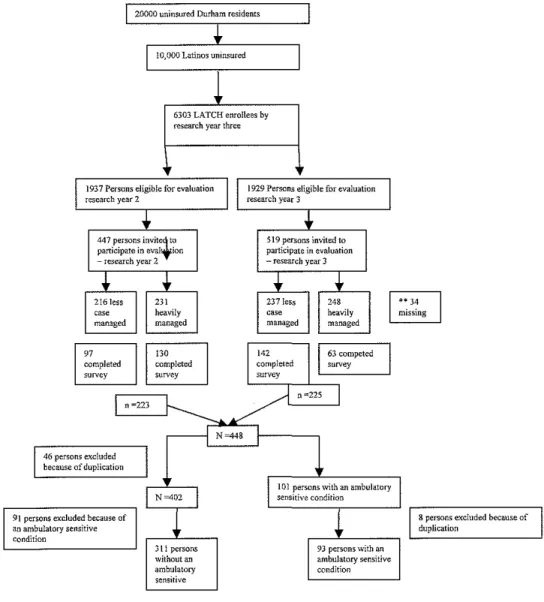
Participants included in the current study were made eligible for this study by virtue of being selected in years two or three using the stratified randomization process. From research year 2, we obtained 44 7 eligible participants, including 231 heavily care managed persons and 216 less care managed persons. From research year 3, eligible participants were numbered at 519 persons, including 248 heavily care managed persons and 237less care managed persons. Sample participants from year two were independently derived from those in year three such that sample participants in year two remained eligible for inclusion in the sample from year three as long as they remained enrolled in the LATCH program by the end of year three.
1
From the total1 066 persons eligible for inclusion in the current study, persons who did not agree to participate in a survey were then excluded, resulting in a final eligible population of 448 persons, with 223 from year 2 and 225 from year 3. Of the 223 persons in year 2, 130 were heavily care managed while 97 were less care managed. Of the year 3 participants, 63 were heavily care managed, while 142 were less care managed.
Of the 448 persons eligible for inclusion in this study, two populations were identified. The first group aims to represent those non-diseased participants enrolled in the LATCH program by research year three and serves as a
comparison group for our main population of interest -those with at least one ambulatory sensitive condition. Given the independently derived samples from years two and three, the 448 persons eligible for inclusion in this study included forty-six duplicates. We randomly selected half of these duplicates and placed them in year two. The other half was placed in year three, thereby reducing the sample size to 402 persons. Those reporting at least one ambulatory sensitive condition were excluded, thereby reducing the size of this comparison group to 311 persons.
of people, resulting in the exclusion of an additional eight persons from the study population (four persons eliminated from year 2 and four eliminated from year 3 because they were duplicates )_2 This reduced this final study population to 93 persons among whom analyses of inappropriate ED use were conducted. Figure 2: LATCH Participants/Study Population
20000 uninsured Durham residents
6303 LATCH enrollees by research year three
447 persons invit1 to participate in eval'fion - research year 2
46 persons excluded because of duplication
9! persons excluded because of an ambulatory sensitive condition
ambulatory sensitive
519 persons invited to participate in evaluation -research year 3
8 persons excluded because of duplication
2
Data Collection
Once participants were identified for the LATCH database, LATCH workers conducted telephone interviews with those from the sample cohort who agreed to participate in the interview process. Participants were given the option of having the interviews conducted in either English or Spanish. Prior to
conducting the interviews, LATCH workers completed identical training sessions on how interviews were to be conducted, and each interview was conducted according to a standard written survey instrument.
Survey Instrument
The survey instrument was developed by LATCH investigators in 2002. The survey included questions about questions about personal demographics, six comorbid conditions and health service use related to these, insurance status, and personal habits.
Of the many questions asked by the LATCH survey, we chose a number to serve as factors for purposes of investigating our research questions. We sought to 1) investigate the prevalence of Emergency Department use among LATCH participants 2) identify the correlates of inappropriate utilization of the
Measures of access to ambulatory care
Participants were asked if they had experienced a time in the year prior to completing the survey where they had needed care and had been unable to get care. Participants were also asked whether they had had a checkup in the year prior completing the survey. These questions served as proxies for perceived and realized access to ambulatory health care. These questions have also been used by and suggested by the Robert Wood Johnson Foundation National Access Survey Analyses.(2) The questions of unmet health need and visits to a health
professional within the last 12 months are also modeled after questions used in both the National Health Interview and Behavioral Risk Factor Surveillance Surveys. Questions on these surveys must undergo cognitive and validity testing before appearing on the surveys and the majority of which have been shown to be at least moderately reliable and valid. Furthermore, these questions have been repeatedly used in national surveys regarding health care accessibility.( 55-58)
Ambulatory care access variables
Insurance Status: Participants reported whether or not they had health insurance
in year prior to participating in the survey.
Usual Source of Care: Participants were asked whether or not they had a ''usual
source of care". Having a usual source of care has been used as a proxy for ambulatory care access in many studies and has therefore been associated with better health outcomes.
Care Management: Participants were considered to have had heavy care
previous year and less care management if they had fewer than four contacts with
a LATCH worker in the previous year.
Satisfaction with Care: Participants indicated how often they were satisfied with
the health care they received. Participants chose from the following responses:
always, often, sometimes, rarely, never, not applicable. For purposes of analysis,
this factor was dichotomized, with those responding "rarely" or "never" classified
as not being satisfied with care and those responding "sometimes," "often," or
"always" classified has being satisfied with care. Satisfaction with care has been
associated with realized ambulatory care access, as those who are less satisfied
with care have been shown to be less likely to appropriately use care.
Perceived racial discrimination: Participants indicated how often they believed
they were discriminated against at their usual source of care because of their race.
Participants chose from the following responses: always, often, sometimes, rarely,
never, not applicable. For purposes of analysis, this factor was dichotomized, with
those responding "never" classified as not being satisfied with care and those
responding "rarely," "sometimes," "often," or "always" classified has perceiving
racial discrimination. Perceived racial discrimination has shown to be associated
with not seeking care and plausibly seeking usual care in the Emergency
Department.
Years in the US.: Some have suggested "years in the U.S" as a proxy for level of
acculturation. Acculturation has been viewed as a factor that may influence health
Language discordance: Participants were asked how often they experienced difficulty communicating with a health care provider at their usual source of care as a result of different languages. These factors have also been closely linked with realized ambulatory care access and may affect utilization of the Emergency Department.
Measures of Inappropriate Emergency Department Utilization
Participants with at least one ambulatory sensitive condition were asked about visits to the emergency department specifically for complications or problems related to their ambulatory sensitive condition. Ambulatory sensitive conditions are those for which care in an ambulatory setting can provide better continuity of care and therefore, higher quality and more efficient care. Thus, care received in the emergency room for ambulatory sensitive conditions is considered to be both preventable and oflower quality, thereby "inappropriate."
Statistical Analysis
Descriptive statistics were performed to separately describe the group of persons with ambulatory sensitive conditions and the population of non-diseased persons. We then investigated the associations between each of the participant's characteristics (gender, age, duration in us, birthplace, language, language
characteristics and inappropriate utilization of care (ER visit for chronic disease-related complication, similarly deriving risk ratios and 95% confidence intervals.) We then examined the relationship between access to care and inappropriate utilization of health care services. Finally, we performed multivariate analysis to determine whether independent patient characteristics and the two outcomes of interest (access to care and inappropriate utilization) were associated. Included in these analyses were all variables whose individual relationship with the outcomes provided a chi squared result of equal to or less than 0.2.3 The most parsimonious model was selected.
3
RESULTS
Univariate analyses indicate that the majority of persons in both the diseased and non diseased groups were female (77% and 72% respectively), young (less than 35 years of age) (59% and 80% respectively), being born in Latin America (87% and 96% respectively), speaking Spanish as their primary language (89% and 98% respectively), and having lived in the United States no more than 8 years (74% and 78% respectively).
Incidence of Emergency Department Use per year
Factors associated with perceived and realized poor access to care Approximately 74% ofthe non-diseased population and 75% of the individuals with at least one ambulatory sensitive condition reported experiencing needing health care and being unable to get it or not having had a checkup at least one time in the year preceding the interview.
Upon investigation of the factors associated with health care access among those without a chronic condition, only care management was significantly
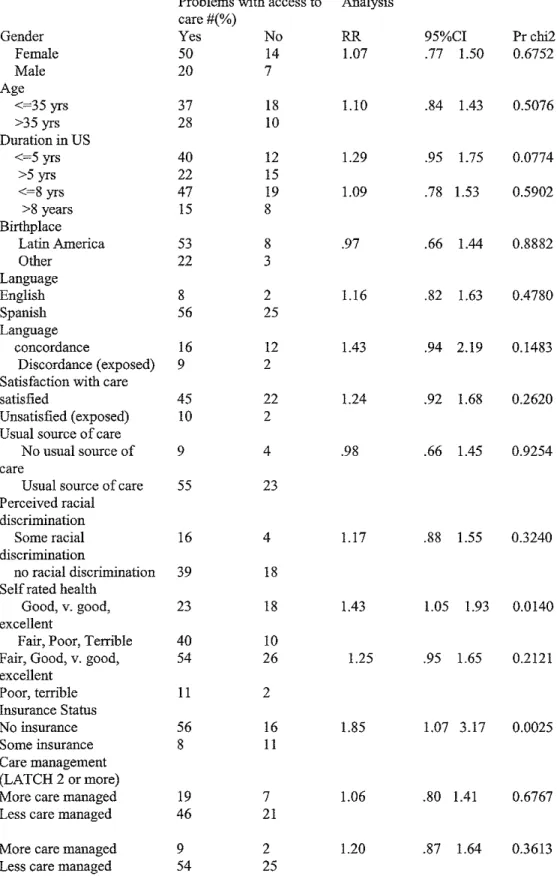
Among the 93 participants with chronic ambulatory conditions, self-rated health and insurance status were significantly associated with having had a checkup in the year prior to the survey or having experienced time in that year when they needed health and couldn't obtain it. Those with self-rated fair, poor or terrible health were 40% more likely to have problems with health care access as compared to those who reported good, very good, or excellent health
(RR=I.43; 95%CI = 1.05-1.93). As expected, those with no insurance were nearly two times as likely to report problems with health care access (RR=I.85;
95%CI= 1.07-3 .17). Interestingly, those with self-rated poor or terrible health were approximately 25% more likely to have problems with health care access than those reporting fair, good, very good, or excellent health; however, this association was of borderline significance in unadjusted analysis (RR=l.25; 95%CI=.95-1.65). When adjusting for duration in the U.S., language discordance, self-rated health status, and insurance status, self rated health status and insurance status remained statistically significant.
Of note, when analyses were performed on the group of persons
model, insurance status remained statistically significant (OR= .25; 95%CI=
.08-.77).
Factors associated with Emergency Department utilization
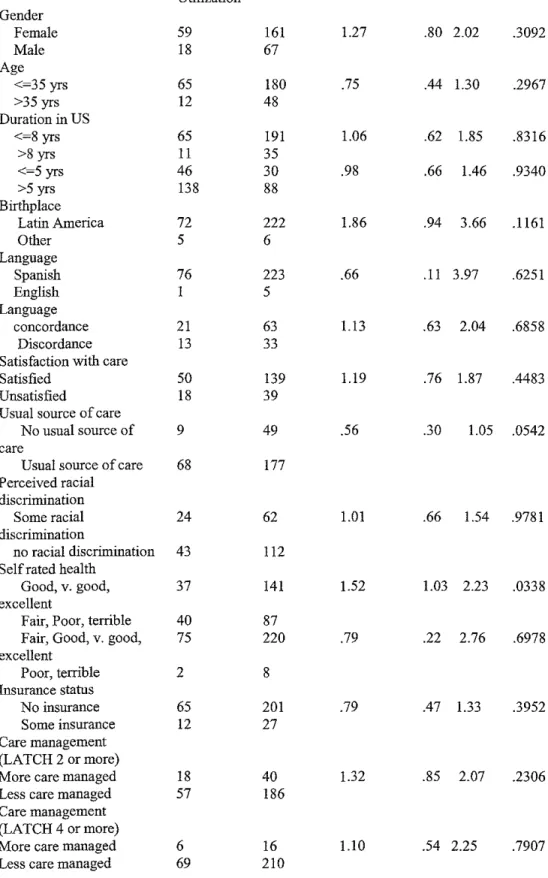
In the population without an ambulatory sensitive condition, self reported
health status and the existence of a usual source of care were significantly
associated with use of the ERin unadjusted analysis. Those with self reported
fair, poor, or terrible health had a 52% greater chance of using the ERas
compared to those with self reported good, very good, or excellent health status
(RR=1.52; 95%CI = 1.03-2.23). Those who reported no usual source of care were
less likely to have used the ED as compared to those who reported no usual
source of care (RR=.56; 95%CI=.30-1.05). The association between use of the ED
and self-reported health status remained significant (OR=l.80; 95%CI=l.06-3.08)
in a model adjusted for birthplace and care management (2 or more visits by a
LATCH worker). The presence or absence of a usual source of care became of
borderline significance in this adjusted model.
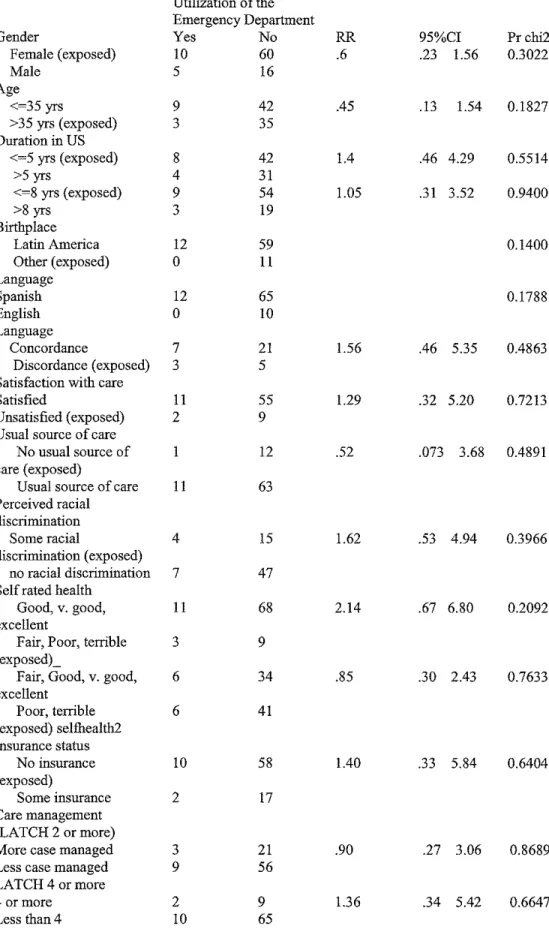
Among individuals with at least one ambulatory sensitive condition,
neither gender, age, duration in the US, birthplace, language, language
discordance with a health care provider, satisfaction with care, existence of a
usual source of care, perceived racial discrimination, self rated health status,
insurance status, nor the level of case management appeared to be significantly
significant association between ED visits and satisfaction with care or self-rated health status when these characteristics were placed into a model.
Furthermore, in this population, gender, age, duration in the US, birthplace, language, language discordance with a health care provider, satisfaction with care, existence of a usual source of care, perceived racial discrimination, self rated health status, insurance status, nor care management were significantly associated with inappropriate utilization of health care services
in unadjusted analysis. While age, birthplace, language, and self-rated health status were of borderline significance in unadjusted analysis, none were significant in adjusted model.
Table I. Study Population
Gender Female Male Age Under 35 35+ Years in US
</~8yrs >8 yrs Birthplace Latin America Other Primary Language Spanish Other
At least one ambulatory sensitive condition
Yes No
77% 72%
23% 28%
59% 80%
41% 20%
74% 78%
26% 22%
87% 96%
13% 4%
89% 98%
Table2. Factors associated with perceived and realized poor access to care among those without an ambulatory sensitive condition
Problems with access to Analysis care#(%)
Gender Yes No RR 95%CI Pr chi2
Female 162 60 .94 .82 1.08 .3737
Male 67 19
Age
<~35 yrs 180 67 .91 .79 1.06 .2845
>35 yrs 47 12
Duration in US
<~5 yrs 140 48 1.01 .88 1.16 .8518
>5 yrs 86 31
<~8 yrs 192 67 1.00 .83 1.21 .9752
>8 years 34 12
Birthplace
Latin America 222 75 .85 .54 1.34 .4073
Other 7 4
Langnage
Spanish 224 78 1.12 .78 1.62 .6109
English 5 I
Langnage
Concordance 70 13 .83 .67 1.03 .0565
Discordance 33 14
Satisfaction with care
Satisfied 133 56 1.13 .96 1.32 .1824
Unsatisfied 46 12
Usual source of care
No usual source of 49 11 1.12 .97 1.29 .1560
care
Usual source of 179 67
care Perceived racial discrimination
Some racial 60 27 .92 .78 1.09 .3249
discrimination
no racial 116 39
discrimination
Self rated health
Good, v. good, 132 47 1.02 .89 1.16 .7736
excellent
Fair, Poor, Terrible 97 32
Fair, Good, v. 222 7 .85 .54 1.34 .4073
good, excellent
Poor, terrible 7 4
Insurance Status
No insurance 202 66 1.12 .89 1.40 .2875
Some insurance 27 13
Care management
(LATCH 2 or more)
2 or more contacts 36 22 .80 .65 .99 .0174
Less than 2 contacts 190 56
Care management
(LATCH 4 or more)
Table 3: Factors associated with perceived and realized poor access to care among those with an ambulatory sensitive condition
Problems with access to Analysis care#(%)
Gender Yes No RR 95%CI Pr chi2
Female 50 14 1.07 .77 1.50 0.6752
Male 20 7
Age
<=35 yrs 37 18 1.10 .84 1.43 0.5076
>35 yrs 28 10
Duration in US
<=5 yrs 40 12 1.29 .95 1.75 0.0774
>5yrs 22 15
<=8 yrs 47 19 1.09 .78 1.53 0.5902
>8 years 15 8
Birthplace
Latin America 53 8 .97 .66 1.44 0.8882
Other 22 3
Langnage
English 8 2 1.16 .82 1.63 0.4780
Spanish 56 25
Langnage
concordance 16 12 1.43 .94 2.19 0.1483
Discordance (exposed) 9 2
Satisfaction with care
satisfied 45 22 1.24 .92 1.68 0.2620
Unsatisfied (exposed) 10 2
Usual source of care
No usual source of 9 4 .98 .66 1.45 0.9254
care
Usual source of care 55 23
Perceived racial discrimination
Some racial 16 4 1.17 .88 1.55 0.3240
discrimination
no racial discrimination 39 18
Self rated health
Good, v. good, 23 18 1.43 1.05 1.93 0.0140
excellent
Fair, Poor, Terrible 40 10
Fair, Good, v. good, 54 26 1.25 .95 1.65 0.2121
excellent
Poor, terrible 11 2
Insurance Status
No insurance 56 16 1.85 1.07 3.17 0.0025
Some insurance 8 11
Care management (LATCH 2 or more)
More care managed 19 7 1.06 .80 1.41 0.6767
Less care managed 46 21
More care managed 9 2 1.20 .87 1.64 0.3613