How can efforts to repurpose your brownfields and expand greenways and connectivity help to revitalize the entire city?
In the first year in my time as mayor, we purchased 1,500 acres of steel mills. I had the city’s redevelopment agency purchase it, and now we’ve redeveloped all that. And if you came to Pittsburgh, you would see that it’s … several thousand units of housing and commercial development. We were very much leading the country in brownfield redevelopment for the scale of what we were doing. At the same time, we were putting in a lot of riverfront parks where all this industrial property was. And now, Pittsburgh was a little late, but now we’re beginning to see a real surge of people moving downtown. For the first time in 50 years, the building permits being issued in the cities are exceeding those being issued in the suburban areas. You’re beginning to really see that trend over the country really accelerate … not now, but right before the [downturn].
When you first became mayor of Pittsburgh in 1994, what did you see as the top concerns for the downtown area?
Pittsburgh was in a freefall in ’94 when I became mayor. We were continuing to lose population – we continue to lose population, but not at the same rate – and [there was] not a lot of investment, so really part of the focus was how do you move from managing decline to trying to manage growth, and what are the investments you make. And so part of it for us was getting, focusing the resources – which was no easy task – on doing something with the old industrial sites that we had; incentivizing developers to think about investing in either an industrial
site or in the downtown area. It really was to get people’s attention, sort of to stand up and say, “Hey, we’re here and we’re willing to do a deal with you,” from a real estate point of view. It was really a discussion of risk: “I am a real estate developer, my M.O. has been developing housing in suburban areas on 100 acres of greenfields, and now, I have this guy coming to me and say[ing] ‘I’d like you to think about building housing on an old steel mill.’ My calculation is, ‘What’s my risk there?’” And my job as mayor was to say, “OK, we’ll share that risk with you.”
What role did riverfront greening have to do with downtown revitalization?
Revitalizing Pittsburgh’s Waterfront Brownfields:
An Interview with Former Mayor Tom Murphy
Heather Schroeder and Brika Eklund,
Carolina Planning
Editors
On January 29, 2010, former Pittsburgh Mayor and current Urban Land Institute fellow Tom Murphy visited
The University of North Carolina at Chapel Hill to deliver the 2010 Robert and Helen Siler Lecture, entitled
“Raleigh/Durham/Chapel Hill: Building a World Class Region to Compete in a Changing Economy.” Earlier
that day, he sat down with the
Carolina Plannin
g editors to share leadership lessons and strategies for using
urban greening to revitalize industrial cities. A condensed and edited transcript follows.
Heather Schroeder received her master’s degree in City and Regional Planning from UNC-Chapel Hill this spring. She is interested in real estate and historic preservation in inner cities.
Brika Eklund is a 2011 master’s candidate in City and Regional Planning at UNC-Chapel Hill. She previously worked for the Z. Smith Reynolds Foundation and the N.C. Housing Coalition.
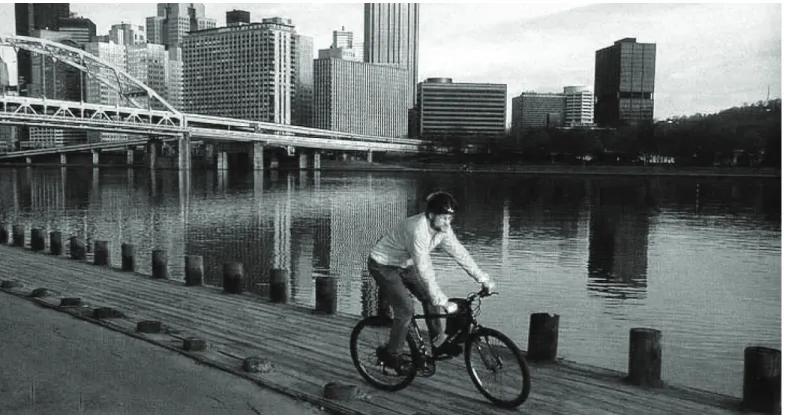
We grew up in Pittsburgh with our mothers telling us two things: be home before the streetlights come on, and never go near the rivers. And my mother would always say, “If you get into those rivers, you are going to melt,” because they were really badly polluted. I’m a runner and [have] been a runner for almost 50 years, and would run on the rivers, and there were essentially no public access to the rivers. Here and there, maybe a hundred yards or so, but no continuous public access to our rivers. And so, when I became mayor, I literally got my public works director to create a crew within our public works department whose job was going to be to build trails, and now we have built 28 miles of riverfront park in the city. … I can go from downtown Pittsburgh at the Point [State Park] all the way to Washington, D.C. on a trail.
Did this spark your interest in Rails-to-Trails?
No, I had been involved well before I became mayor. I was on the board for 10 years, of Rails-to-Trails Conservancy. I would always look for sort of the back yards, if you know what I mean, to run in; I don’t like to run on the streets with traffic. I’ve always looked for that, and I did that in Pittsburgh. And as the old steel mills started to shut down, I would run through the old steel mills, never thinking that I would be mayor. So when I became mayor, that was one of the first [things] I asked us
to do, is to acquire the property and to put trails on them. And so, every time we had an opportunity, we would build a trail.
So this was really a personal project for you?
In terms of the trails, very personal. I mean, it was something I really just cared [about], and [it] created lots of value.
Let me tell you a quick story about greening. Think of Central Park, how does that happen? Who thinks back in the 1840s that we should set aside hundreds of acres for the use of people, when from the Hudson River, for the next 3,000 miles, was all open space. Why would you think that?
And there is a story like that in Pittsburgh, Schenley Park. Up against CMU [Carnegie Mellon University] and the University of Pittsburgh, it’s about a 600-acre park. There was a woman named Mary Schenley who was the heir to one of the Pittsburgh families. … And she inherited all of this property, thousands of acres, and she would sell off pieces of it when she needed some money. That [land] began to be developed as the nicest neighborhoods in Pittsburgh – Squirrel Hill and Shadyside, which are very nice neighborhoods – and she finally in the 1890s came down to the very last piece of property. She wrote to the city that she intended to sell it to this developer. There
was this guy named Henry Bigelow, he was the director of the parks department, who got it into his head that [the] land ought to be a city park – that 600 acres. And he went to the mayor at the time and said, “We ought to buy this land to make it a park.”
And the mayor, being the brave mayor that he was, said, “Let’s have a referendum, and ask” – because he wouldn’t make the decision – “to ask the citizens whether we ought to spend the money to buy this.” And they did, and the citizens overwhelmingly turned it down – said, “Why would we waste our money buying this land, when there is all this other open land all around,” which is now the suburbs.
Henry Bigelow got it in his head that the city needed that land, so he got on the fastest train he could to New York and the fastest steamship he could to London, and two days before Mary Schenley was to sign the sales agreement with the developer, he convinced her to give that land to the city of Pittsburgh for what is now Schenley Park. Around that park is the most valuable real estate in Pittsburgh. I think that is the most enduring piece of any city, its open space.
If you look at suburban communities or newer communities, rarely do they create grand parks. They might have some ballparks or a playground or stuff like that, but they don’t have the Central Park or a Schenley Park where there are trails where you can walk all around. Think about newer cities like that, and you don’t see that very often. I think that is one of the real values that can be created in the city.
Along those lines, North Carolina has a lot of smaller industrial towns that are really falling apart with the exodus of manufacturing. What are some big-city strategies that you think can be translated to smaller communities to capitalize on greenways?
Well, I think that it depends on their employment base first and what is the reason for the town to be there – probably was a textile mill – so part of it is what’s the purpose of the [town] and what’s their competitive values. And I say that critically. Everybody says, “We have a hospital” – [but] everybody has a hospital, it’s not a distinctive competitive value. … these little towns, every one has its own story for why it’s there, and that town will succeed or not because there will be civic leadership that will focus on the critical piece that makes it competitive once again – which might be very different than the thing that originally made it competitive. Could be the architecture, could be the natural environment, could be a whole host of other things.
You’ve worked in such disparate areas as Pittsburgh and the Gulf Coast. Are there any overarching themes that you can see?
It’s always about leadership. Leadership, vision, understanding how you put the resources together. Everywhere I go, people say, “You don’t have money,
there’s no money, you can’t do that.” There’s always money. I just had a discussion like this with the people in Philadelphia. They said, “Philadelphia is plagued with lots of vacant industrial property and vacant houses,” and they said, “We just don’t have the money to be able to do anything with this.” And I said, “How big is the city budget?” They put their heads down and said it’s about $2 billion. “So you’re telling me you don’t have any money? You’re spending $2 billion a year, you have the money. It really is a question [of] what your priorities are, [and] you [are] telling me this isn’t that important.” And that’s the issue, really. It is never about the money. When I go to New Orleans, they say “We don’t have the money to do this,” and I say “How big’s your budget?” If this is really important, you can figure out how to pay for it. If it’s not that important … then be honest about it, this is just not our priority.
And how do partnerships play into that?
Critical. I think that is why I talk more about civic leadership than political leadership. I think it is very important – in many ways, more important than the political leadership – because the civic leadership generally creates stability. Political leadership comes and goes. People get elected for four years or two years, and you might be there for a little while and then they’re gone.
But Joe Riley is the exception, and look at Charleston. … He’s been mayor for 32 years. And he saw historic preservation as the salvation for Charleston, and look what he’s done. And that’s probably one of the best examples of leadership in the country – continuous, long-term leadership and what it can do. … that’s rare that somebody is going to be mayor, in a political realm, that long, so the civic leadership ... Hugh McColl would be a great example for Charlotte, of somebody that was there and had a vision for where Charlotte ought to be. Not just a sleepy southern town, but a dynamite town; but it needed to act like it and look like it, and he did that over the course of a lot of years.
Pittsburgh’s riverfront greenway. Photo courtesy of Tom Murphy.
And Joe says, “Shut the street down, don’t tear the house down.” And then the third picture is a picture of the house, ... and shows it in the middle of a block of a wonderful row of very historic houses. It would be a missing tooth if the house was torn down. And it’s been restored. And he said … “That’s about leadership and focus. It’s about, you have this value, this is what’s important to us.” That’s part of the real story about leadership: there is a sense, a value structure that exists, that people are willing to have conflict about this, that doesn’t lower the vision for the sense of excellence.
So, in terms of the civic leadership … who does that fall upon? Is that the planning director’s role?
At the end of the day, it will fall upon the elected and probably private business leaders. But, the planning directors – like I told you the story about … [Henry] Bigelow – the planning directors of a city are the people that need to create the vision, by and large, to make it real. … You know, when I got elected mayor … Pittsburgh had not had investment. I was just happy if people would invest in Pittsburgh; I didn’t care what it looked like or where it was. And I had a planning director who turned me into a raving maniac about design and land use. And so I was made an honorary member of the [American] Society of Landscape Architects, particularly for
landscape architecture. I really cared about [it] deeply. And so the planning director is not going to have inherent power as the CEO of a corporation or a mayor will have, but the planning director has the power of knowledge, in effect. … They have a responsibility to get people to understand that planning directors need to be keepers of the vision long-term.
Have you heard anything about the initiatives going on in Raleigh?
… I was on a Dorothea Dix panel of looking at what to do with the Dorothea Dix [Hospital] property over there, it’s a big chunk of largely vacant land. … Dorothea Dix would be a great example of where people aren’t willing to make a decision. So you have something languish there, and it’s probably unfortunately more common than not that that happens – is that people avoid the decision, sort of get in the process, fall in love with the process, and in many ways the process makes it easy because you don’t have to make a decision. I mean, with Dorothea Dix, there’s competing interests, and so nobody’s been wanting to make a decision, and so you end up with a potentially valuable piece of property languishing.
these dictated rules, and what is the result?
And that’s really, I think, the idea, is how do you move something along and continue to keep a sense of excellence about the quality of it, and at the same time, try to move it along? And that’s a challenge for planning directors, I think, particularly.
… [in the planning profession], there’s one fundamental lesson that you need to know about yourself, is how important it is to be loved. … If you really don’t like conflict, you might want to think of a different profession. Because you’re not going to be effective in it. You need to be willing to be able to ... manage conflict and sort of enjoy it in a way. It’s this creative tension of what causes things to happen. And I find a lot of people that want to be loved, and I’m not saying that it’s not better or worse...
In the planning profession?
Yeah, they really take conflict badly and it eats at them and they don’t like people not liking them. And, not just in the planning profession, in every profession, I find that. I’m not saying one way is better than the other. Simply, I think it’s a type of human nature.
But that planners can’t be as effective?
I don’t think you can unless you are willing to embrace conflict as part of the process, right? … conflict has gotten a negative connotation to it, but it’s part of a process that you go through to resolve something. … it’s all about how you use conflict, particularly if you’re working for a community organization. The community organizations don’t have power, inherent power, so for community organizations to be successful, they need to
figure out how to influence, how to get power, influence. So, it’s how you use knowledge, or the political process, or publicity, or a whole host of other things.
… There are four legs of a downtown, I think: one is the commercial, one’s the residential, one’s the retail, and the fourth is the culture and the arts. And Pittsburgh’s commercial is still a big employment center in the downtown.
Twenty years ago, The Heinz Endowments, Howard Heinz got it in his head to create a cultural trust district, and he focused on an area that at the time had 22 massage parlors and porno shops. So, it was sort of a seven-block by two-block area. But in the middle of it were two big old vaudeville theaters – one at the time was a burlesque theater – and so he bought both of those, he had the endowment buy both of them, and one became the home of the Pittsburgh Symphony and the other became the home of Broadway shows. [The symphony building is] called Heinz Hall now. If you would go there today, there are almost 2,000 legitimate performances going on in a year, so it’s ballet, the opera. Besides those two venues, there’s probably another 10 venues that have been built, I think seven in my time as mayor. A theater, different types of theater. And so, the cultural district brings almost two million people a year into the city. There’s a threshold, and I don’t know what it is, that it went through, that now supports restaurants. …
So the cultural district is a real story for Pittsburgh. And I think the ballparks, convention center we built, the fact that we, as a city, were able to do that, build all three at the same time … and then the brownfields and then the riverfronts are probably the four big [success] stories.