AN EXAMINATION OF ETHICS CONFLICTS IN PIONEER ACCOUNTABLE CARE ORGANIZATIONS
Craig River Westling
A dissertation submitted to the faculty of the University of North Carolina at Chapel Hill in partial fulfillment of the requirements for the degree of Doctor of Public Health in the Department of Health Policy and Management in the Gillings School of Global Public Health.
Chapel Hill 2014
iii ABSTRACT
Craig River Westling: An Examination of Ethics Conflicts in Pioneer Accountable Care Organizations
(Under the direction of Kristin L. Reiter)
The findings of this study suggest that the Pioneer ACO model does create (or exacerbate) several critical ethical conflicts, and has the potential to mitigate others. These findings suggest that there is uncertainty associated with how to create clinical and business systems that support the ACO, how to manage and communicate the change, and how to reallocate resources.
Seven major ethical issues were identified:
1. Incompatible reimbursement models. The combination of fee-for-service and risk-based contracts creates conflicting incentives to simultaneously increase and decrease utilization.
2. Two standards of clinical care. Patients who could benefit from effective care management programs may not be enrolled because they are not attributed to the ACO.
3. Financial incentives vs. patient choice. Providers are incentivized to keep referrals in the ACO network even if they or a patient would prefer to go out-of-network.
4. “Best” care disagreements. Incentives to provide only the necessary and needed care can result in disagreements between physicians about the right care, and the
iv
5. Required ACO metrics vs. evidence-based care. CMS requires some metrics that do not reflect current evidence-based practices. This creates financial incentives to provide care that the literature suggests is inferior.
6. Shifting resources to focus on prevention. The ability to provide team-based, comprehensive primary care services may result in better patient outcomes at less cost; however, clinician burnout is a risk.
7. Limited support systems for ethical conflicts. A fragmented approach to dealing with ethics conflicts results in a mismatch between an ACO’s values and its clinical and business practices.
v
To Holloway, Riley, Hollis and Caitlin.
vi
ACKNOWLEDGEMENTS
vii
TABLE OF CONTENTS
LIST OF TABLES ... X! LIST OF FIGURES ... XI! LIST OF ABBREVIATIONS ... XII!
CHAPTER 1: INTRODUCTION ...1!
Statement of the Issue ...1!
Background ...4!
Biomedical Ethics Foundation ...5!
Accountable Care Model ...7!
The Ethics of Accountable Care ...11!
Research Purpose and Specific Aims ...13!
CHAPTER 2: REVIEW OF THE LITERATURE ...14!
Literature Review Method ...14!
Literature Review Results ...16!
Managed Care Environment Surveys ...17!
Fee-for-Service Surveys ...23!
Discussion of Literature Review Results ...23!
Implications for Future Research ...24!
Limitations of the Review Process ...25!
CHAPTER 3: RESEARCH DESIGN AND METHODOLOGY ...26!
viii
Study Approach and Design ...28!
Overview ...28!
Data Collection Process ...29!
Key Informant Interview Questions ...30!
Data Management and Analysis ...32!
IRB Approval ...33!
CHAPTER 4: RESULTS ...34!
Summary Description of the Study Sites ...34!
Summary of Major Findings ...35!
Detailed Descriptions of the Ethical Issues ...37!
1. Incompatible Reimbursement Models ...37!
2. Two Standards of Clinical Care ...42!
3. Financial incentives versus patient choice ...47!
4. “Best” Care Disagreements ...51!
5. Required ACO Metrics versus Evidence-Based Care ...54!
6. Shifting Resources to Focus on Prevention ...57!
7. Limited Support Systems for Ethical Conflicts ...61!
ACO Rules that Impact the Ethics Environment ...65!
CHAPTER 5: DISCUSSION ...68!
Pioneer ACO Ethical Dilemmas ...68!
Financial Survival ...69!
Patient Outcomes ...71!
ix
Underlying Message of Moral Distress ...76!
Mitigation Strategies ...77!
Comparing ACO Ethics Findings to Fee-for-Service and Managed Care ...79!
Revised Conceptual Model ...80!
Limitations of this Research ...81!
CHAPTER 6: POLICY IMPLICATIONS AND PLAN FOR CHANGE ...83!
Opportunity ...83!
Part 1: Organizational Ethics Foundation ...84!
Leadership Commitment to an Ethical Organization ...84!
Organizational Ethics Infrastructure ...87!
Learning Collaborative ...89!
Policy Change ...89!
Part 2: Implementing Mitigation Strategies for the Key Findings ...90!
Financial Survival ...90!
Patient Outcomes ...91!
ACO Leader Map for Creating a Culture of Ethics ...95!
APPENDIX 1: ACO QUALITY MEASURES ...100!
APPENDIX 2: KEY INFORMANT INTERVIEW GUIDE ...102!
APPENDIX 3: INTERVIEW CONSENT FORM ...105!
APPENDIX 4: SOVALDI – AN ACO ETHICAL DILEMMA ...107!
x
LIST OF TABLES
Table 1: ACO Implementation Barriers ... 3!
Table 2: Ethics Principles Mapped to IOM Aims ... 6!
Table 3: PGP 5-Year Results ... 8!
Table 4: CMS ACO Program Summary ... 9!
Table 5: Constructs and Search Terms ... 15!
Table 6: Summary of Literature Review Results ... 17!
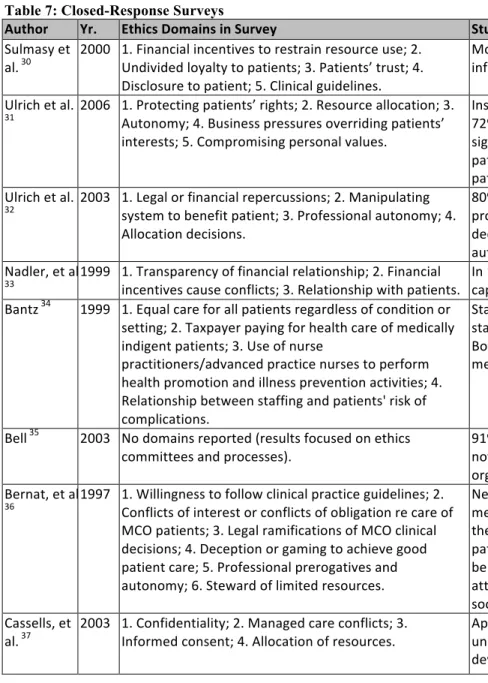
Table 7: Closed-Response Surveys ... 21!
Table 8: Fair vs. Unjustified Harms ... 26!
Table 9: Pioneer Site Profiles ... 34!
Table 10: Major Ethical Issues ... 35!
Table 11: Ethical Issues by Role ... 36!
Table 12: Key Finding Themes ... 69!
Table 13: Summary of Mitigation Strategies ... 78!
Table 14: Comparison of Results to Predicted Ethics Dilemmas ... 79!
Table 15: ACO Ethics Readiness Self Assessment Checklist ... 86!
xi
LIST OF FIGURES
Figure 1: Health Care Reform Road Map ...7
Figure 2: ACO Shared Savings Model ...9
Figure 3: Literature Review Process ...17
Figure 4: Conceptual Model to Eliminate Unjustified Harms ... 27!
Figure 5: Ethical Issues by Site ... 37!
Figure 6: Model of the Crescendo Effect ... 76!
Figure 7: Updated Conceptual Model with Study Results ... 80!
Figure 8: Kotter's Eight Phases of Change ... 95!
Figure 9: Effects on Organizational Performance by Cost Categories ... 96!
xii
LIST OF ABBREVIATIONS
ACA Affordable Care Act
ACO Accountable Care Organization APA American Psychology Association
CMS Centers for Medicare and Medicare Services EMR Electronic Medical Record
FFS Fee for service (the method of paying for services rendered) HMO Health Maintenance Organization
IOM Institute of Medicine
MCO Managed Care Organization
MSSP Medicare Shared Savings Program NP Nurse practitioner
PA Physician assistant PCP Primary Care Physician PGP Physician Group Practice
1
CHAPTER 1: INTRODUCTION
Statement of the Issue
The Centers for Medicare and Medicaid Services (CMS) defines an Accountable Care Organization (ACO) as: “A group of health care providers who give coordinated care, chronic disease management, and thereby improve the quality of care patients get. The organization's payment is tied to achieving health care quality goals and outcomes that result in cost savings.” 1
The Accountable Care Organization concept has been compared to the Managed Care Organization (MCO) experiment in the 1990’s, which was extremely unpopular and eroded trust with consumers. 2,3 The primary similarity between the two care models is that they both are intended to help control health care costs. However, there are three significant differences between the MCO model and the CMS-sponsored ACO program:
1. ACO patients have a choice of which provider to see, and they can change providers at any time. This addresses the MCO problem of a patient being locked into an individual provider (or group) that he or she simply does not like, or likes but prefers another alternative.
2. Any money saved as a result of new care patterns is only shared with the ACO if specific quality-of-care thresholds are met. This addresses the concern that MCOs skimp on providing necessary care in order to save money.
2
These differences are intended to reward ACO providers for improving the quality of patient outcomes while being mindful of costs, which is expected to result in (1) healthier patients and (2) a reduced growth rate in healthcare spending.*
Despite the differences from traditional MCOs, the transition to new incentives and rewards created by the ACO model could put providers in difficult ethical situations. It may be a particularly vexing problem when considering high-cost/low-benefit interventions, such as experimental or off-label oncology treatments, or some end-of-life care. On the other hand, the ACO model may mitigate currently existing ethical conflicts that are created by volume-driven incentives such as ordering more tests, or having patients come to the clinic (for reimbursement reasons) instead of answering questions on the telephone or via email.
Additionally, because the model is so new, virtually every ACO currently has a
combination of fee-for-service (FFS) and shared savings contracts. This means that in order to generate revenues to support current business operations the ACO must simultaneously (1) increase utilization for FFS contracts, and (2) adjust utilization of all services to “appropriate” levels for shared savings contracts (the theory being that waste will be cut out, overall costs will go down, and quality will improve). This tension creates many opportunities for conflicts regarding treatment regimens. For instance, at the organizational level there is a risk of having multiple standards of care based on payer type. At the personal level there is a risk of clinical decisions being influenced by competing compensation incentives.
Every organization transitioning to an ACO must have a clear implementation plan and an effective change management strategy to support its physicians, staff and partners. The most obvious challenges involve financial decisions and clinical changes. For example, from a
3
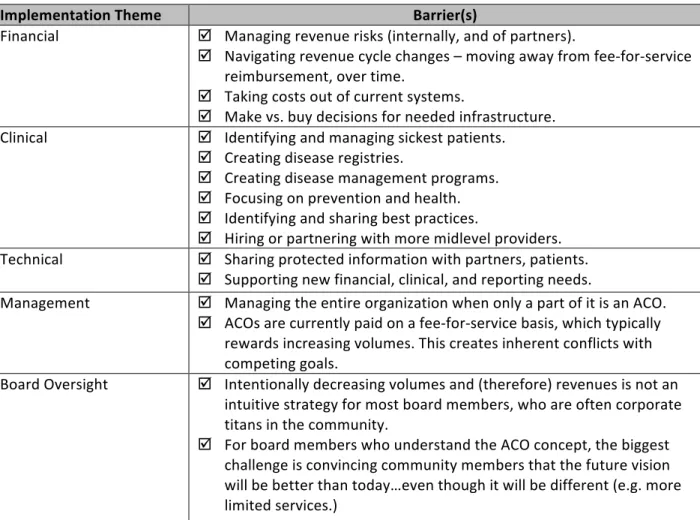
financial standpoint hospitals must figure out how to stay in business as volumes decline. And medical groups must “churn” fewer healthy patients while taking on more responsibility for (and pay more attention to) sicker patients. From a clinical standpoint, all providers must be able to identify and effectively manage chronically ill patient populations. Table 1 summarizes the most significant implementation challenges identified by hospital-based ACO executives during professional (non-research related) conversations with the author:†
Table 1: ACO Implementation Barriers
Implementation!Theme! Barrier(s)!
Financial' ! Managing'revenue'risks'(internally,'and'of'partners).'
! Navigating'revenue'cycle'changes'–'moving'away'from'fee?for?service' reimbursement,'over'time.'
! Taking'costs'out'of'current'systems.'
! Make'vs.'buy'decisions'for'needed'infrastructure.' Clinical' ! Identifying'and'managing'sickest'patients.''
! Creating'disease'registries.'
! Creating'disease'management'programs.' ! Focusing'on'prevention'and'health.' ! Identifying'and'sharing'best'practices.'
! Hiring'or'partnering'with'more'midlevel'providers.' Technical' ! Sharing'protected'information'with'partners,'patients.'
! Supporting'new'financial,'clinical,'and'reporting'needs.'
Management' ! Managing'the'entire'organization'when'only'a'part'of'it'is'an'ACO.'' ! ACOs'are'currently'paid'on'a'fee?for?service'basis,'which'typically'
rewards'increasing'volumes.'This'creates'inherent'conflicts'with' competing'goals.''
Board'Oversight' ! Intentionally'decreasing'volumes'and'(therefore)'revenues'is'not'an' intuitive'strategy'for'most'board'members,'who'are'often'corporate' titans'in'the'community.'
! For'board'members'who'understand'the'ACO'concept,'the'biggest' challenge'is'convincing'community'members'that'the'future'vision' will'be'better'than'today…even'though'it'will'be'different'(e.g.'more' limited'services.)'
As can be seen from this list, scant attention is being given to ethics conflicts that might occur by transitioning away from incentives to increase volumes and towards incentives to provide more
4
efficient and less expensive care (which will likely result in decreased volumes for high cost interventions). Ignoring such conflicts could lead to physician dissatisfaction and a reluctance to embrace the ACO model, creating a grassroots resistance movement that is difficult to
overcome.4-8
Thus, this dissertation seeks to (1) explore the ethics conflicts that are arising or are being mitigated by the ACO model of care, and (2) identify strategies to help leaders proactively address potential ethics conflicts. To be clear on terminology, for this dissertation an ethical conflict is: 9
A situation in which there is some evidence that indicates an action would be morally wrong and some evidence that the same action would be morally right, but all the evidence, taken as a whole, is not conclusive. In an ethical dilemma, if one does act, one’s actions could be seen as morally acceptable in some respects and morally unacceptable in other respects.
Background
In 2001 the Institute of Medicine (IOM) published a seminal report titled, Crossing the Quality Chasm: A New Health System for the 21st Century. 10 The report portrayed a dire U.S. healthcare situation, describing the delivery of care as “…overly complex and uncoordinated, requiring steps and patient ‘handoffs’ that slow down care and decrease rather than improve safety. These cumbersome processes waste resources; leave unaccountable voids in coverage; lead to loss of information and fail to build on the strengths of all health professionals involved to ensure that care is appropriate, timely, and safe.”The report also underscored the gap between the healthcare Americans currently receive and the care that could be possible in a well-designed system.
5
general areas: (1) patients’ experiences; (2) the “microsystems” (replicable units) that actually give care; (3) the organizations that house and support microsystems; and (4) the environment of laws, rules, payment, accreditation, and professional training that shape organizational action. 11 Actions to improve these areas would inevitably force the supporting systems and processes to change, too, thereby causing an organic redesign of the current one-size-fits-all approach. The report called for improving performance in six specific, fundamental dimensions of care that are central to creating an ideal delivery system, declaring that care should be: 12
1. Safe: avoiding injuries to patients from the care that is intended to help them.
2. Effective: providing services based on scientific knowledge to all who could benefit, and refraining from providing services to those not likely to benefit.
3. Patient-centered: providing care that is respectful of and responsive to individual patient preferences, needs, and values, and ensuring that patient values guide all clinical
decisions.
4. Timely: reducing waits and sometimes-harmful delays for both those who receive and those who give care.
5. Efficient: avoiding waste, including waste of equipment, supplies, ideas, and energy. 6. Equitable: providing care that does not vary in quality because of personal characteristics
such as gender, ethnicity, geographic location, and socioeconomic status. Biomedical Ethics Foundation
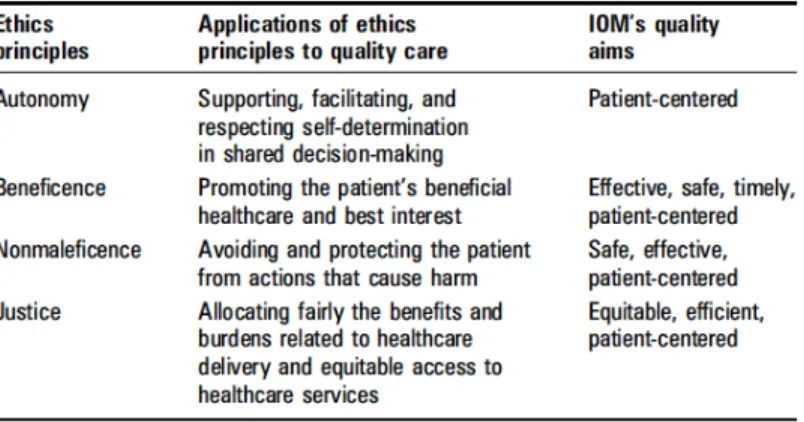
These six IOM aims for improving health care are based on the primary biomedical ethics principles theorized by Beauchamp and Childress: autonomy, beneficence, nonmaleficence, and justice. 9,13 These principles are described in more detail by Ebbesen and Pedersen: 14
6
• As a negative obligation: Autonomous actions should not be subjected to controlling constraints by others.
• As a positive obligation: This principle requires respectful treatment in disclosing information, probing for and ensuring understanding and voluntariness, and fostering autonomous decision-making.
Beneficence
• Prevent and remove evil or harm.
• Do and promote good.
• Weigh and balance the possible goods against the possible harms of an action. Nonmaleficence
• Do not inflict evil or harm. Specifically: Do not hurt other people mentally or physically. Justice
• Beauchamp & Childress propose that "society recognizes an enforceable right to a decent minimum of health care within a framework for allocation that incorporates both
utilitarian and egalitarian standards."
These ethics principles can be mapped directly to the six IOM quality aims, as follows: 13 Table 2: Ethics Principles Mapped to IOM Aims
7 Accountable Care Model
The ACO model was conceived in part to address the challenges put forth in the IOM report. Figure 1 illustrates the care
system domains the IOM authors challenged leaders to address in order to manifest the desired outcomes of safe, effective, efficient, personalized, timely and equitable care. 12 The ACO model creates a framework for all of these things to happen using an ethics foundation to link the quality of
care (patient outcomes) and the value of care (the cost of care divided by quality). The ACO model is specifically designed to increase financial rewards for providers to better coordinate services and to provide the right care at the right time (no more and no less), thereby resulting in better outcomes and healthier patients. 15-17 (Note: better care coordination may actually increase utilization in some areas of care, but overall costs are expected to decrease as a result of
providing only truly useful interventions.)
Although the term “Accountable Care Organization” was coined in 2006 by Elliott Fisher at The Dartmouth Institute, the concept of risk-based contracting has been around since the 1970s when Health Maintenance Organizations (HMO) contracted with groups of providers. 18 The 1990’s saw capitation (where financial risk is assumed by providers who are paid a per
8
member per month fee, regardless of services rendered) gain favor. This created an incentive for HMOs to “cherry pick” healthy patients, and try to exclude sicker, more expensive patients. This dilemma led CMS to launch the Physician Group Practice (PGP) demonstration project in 2005, which tested the viability of risk-based contracts that included quality thresholds as a
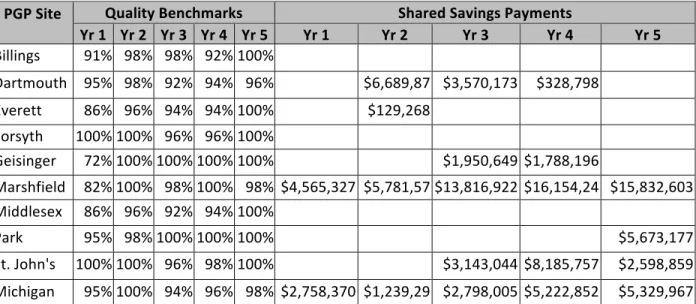
replacement for FFS Medicare. The demonstration included 10 large PGPs (see Table 3) that, in addition to their regular Medicare reimbursements, could earn a share of savings generated above a 2% threshold if 32 specific quality metrics were met. 19
Table 3: PGP 5-Year Results
PGP!Site! Quality!Benchmarks' Shared!Savings!Payments'
Yr!1' Yr!2' Yr!3' Yr!4' Yr!5' Yr!1' Yr!2' Yr!3' Yr!4' Yr!5' Billings' 91%' 98%' 98%' 92%'100%'
' ' ' ' '
Dartmouth' 95%' 98%' 92%' 94%' 96%'
'$6,689,87 9'
$3,570,173' $328,798'
' Everett' 86%' 96%' 94%' 94%'100%'
' $129,268' ' ' '
Forsyth' 100%'100%' 96%' 96%'100%'
' ' ' ' '
Geisinger' 72%'100%'100%'100%'100%'
' ' $1,950,649' $1,788,196' '
Marshfield' 82%'100%' 98%'100%' 98%' $4,565,327' $5,781,57 3'
$13,816,922' $16,154,24 2'
$15,832,603' Middlesex' 86%' 96%' 92%' 94%'100%'
' ' ' ' '
Park' Nicollet'
95%' 98%'100%'100%'100%'
' ' ' ' $5,673,177'
St.'John's' 100%'100%' 96%' 98%'100%'
' ' $3,143,044' $8,185,757' $2,598,859' Michigan' 95%'100%' 94%' 96%' 98%' $2,758,370' $1,239,29
4'
$2,798,005' $5,222,852' $5,329,967'
As Table 3 indicates, in the fifth year, only seven participants achieved the quality benchmarks and the remaining three groups achieved at least 30 of the benchmark measures; however, only four groups managed to surpass the 2% savings threshold to earn shared savings payments from CMS in the fifth year.
9
ACO provisions. 1 CMS administrators borrowed ideas from the PGP Demonstration project to draft the ACO program rule, which after a public comment and feedback period was published in the Federal Register in November 2012 as part of the final Medicare Shared Savings Program (MSSP) rule. Thus, ACOs were officially born as part of the MSSP.
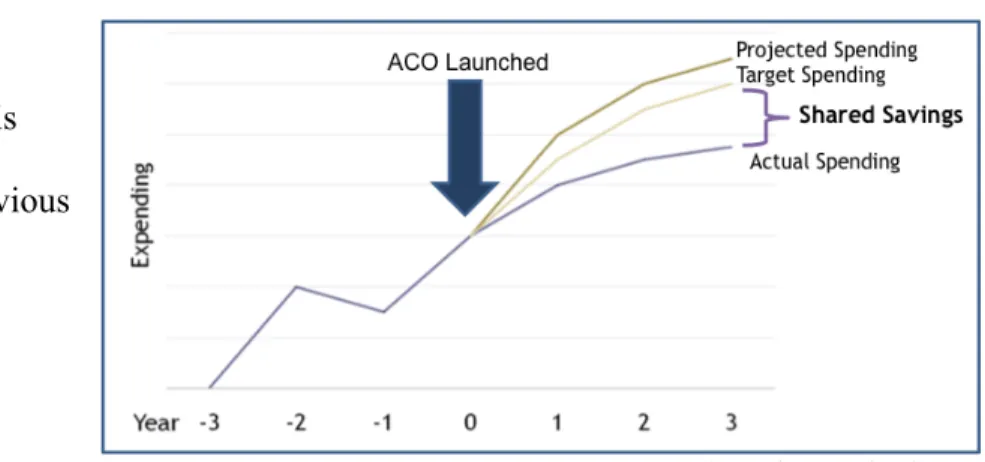
The central promise of the ACO model is to reward providers for improving the health of their patients versus relying excessively on ever-increasing volumes of acute interventions. Savings that result from a reduction in utilization and accrue to CMS (the payer) are shared with the ACO, provided that certain care quality benchmarks are met. Figure 2 illustrates how the basic shared savings model
works.20 When the ACO is launched, a target benchmark is established based on three previous years of data on assigned
beneficiaries (and adjusted for overall spending growth and
beneficiary characteristics). 1 Spending is tracked over time, and shared savings are distributed if thresholds and quality targets are met. Specific requirements depend upon the type of ACO program the organization is participating in.
Table 4 describes the two primary CMS-designated ACO programs, MSSP and Pioneer:21 Table 4: CMS ACO Program Summary
' MSSP!ACO!Program! Pioneer!ACO!Program!
Risk!Tracks‡' Track'1:'1?sided'risk'only'
Track'2:'2?sided'risk'only' Two'sided'risk'with'transition'to'population'based'payments'
‡
In the MSSP program, ACOs can choose two different risk tracks. 1-sided risk allows the ACO to benefit from any shared savings, but it does not get penalized for missing cost or quality targets. 2-sided risk allows a higher
percentage of any shared savings payout, but also creates a downside risk of penalties for missing cost or quality targets.
10 Minimum!
Savings!Rate! Track'1:'varies'with'size'Track'2:'2%' 1%' Sharing!Rate! Track'1:'50%''
Track'2:'60%' Increasing'shared'savings/losses'up'to'75%'' Patient!
Assignment! Rules!
• Preliminary'prospective' assignment'with'retrospective' reconciliation'
• Stepwise'attribution'first'to' PCP,'then'to'all'ACO'providers' (includes'specialists,'NP,'PA,' CNS)'
• Option'to'select'retrospective'or' prospective'attribution'
• Attribution'to'PCP,'NP,'PA'and'eligible' specialists:'(nephrology,'oncology,' rheumatology,'endocrinology,'pulmonology)' Size! Requirement! 5,000'beneficiaries' 15,000'beneficiaries' Quality!
Measures! 33'measures,'4'domains' Same'as'MSSP'Program' PrivateKpayer!
collaboration!
Not'required' At'least'50%'of'total'revenues'must'come'from' outcomes'based'contracts'by'end'of'Year'2'
The quality criteria are consistent across both programs, and thresholds must be met to be eligible for shared savings payouts in both. The four domains covered by the quality measures include: 22
1. Patient/caregiver experience 2. Care coordination/patient safety 3. Preventive health
4. At-risk populations
For a list of specific measures, see Appendix 1: ACO Quality Measures.
11
Third, the Pioneer program includes capitated payments: “ACOs that have shown savings over the first two years will be eligible to move to a population based payment model. Population-based payment is a per beneficiary per month payment amount intended to replace some or all of the ACO’s FFS payments with a prospective monthly payment.” This means that after two years eligible Pioneers will start receiving a
combination of FFS reimbursement and population-based payments. The FFS rate is paid at 50% of the usual allowable fee, and the population-based payment (paid to the ACO each month) is estimated as 50% of the ACO’s expected fee for service costs (at 100% allowed amounts).
This experiment with population-based payments may indicate that CMS is considering a prospective payment
system for all ACOs in the future. Such a
shift will not be possible unless ACOs use their shared savings to bridge between FFS and capitation by investing in human resources (physician, staff, and administrative training) and the infrastructure necessary to manage population health and disease management programs.
The Ethics of Accountable Care
Traditional biomedical ethics focus primarily on single patient-provider episodes. The American College of Physicians Ethics Manual states,“The interests of the patient should always be promoted regardless of financial arrangements…a sense of duty to the patient should take
12
precedence over concern about compensation.” 24 Additionally, a core principle of the American Medical Association Code of Medical Ethics is that “A physician shall, while caring for a
patient, regard responsibility to the patient as paramount.” 25 In general such a single-patient-only focus likely contributes to over-utilization and is also exacerbated in a FFS environment where income is driven by volume (for instance, ordering a new image for a patient who was just transferred from another hospital). ACOs, on the other hand, create incentives for physicians to be stewards of common resources (which might lead a radiologists working together to create regional imaging protocols to facilitate transfers, for example). This creates a population-focused ethic, which the American College of Physicians Ethics Manual addresses via the topic of
stewardship: “Physicians have an obligation to…[be] steward[s] of finite health care resources so that as many health care needs as possible can be met, whether in the physician’s office, in the hospital or long-term care facility, or at home.” The American Medical Association Code of Medical Ethics is less prescriptive, but it includes a principle related to resource stewardship: “A physician shall support access to medical care for all people.”
13 Research Purpose and Specific Aims
The purpose of this study is to more fully understand how the ACO model of care affects ethics conflicts in organizations that originally joined the Pioneer ACO program. The study is limited to Pioneer ACOs because the entire census can be contacted without selection bias, and it includes 10 organizations that dropped out – which could be informative to learn if ethics
conflicts were part of the decision to exit the program. The questions being addressed by this study are:
1. What ethics conflicts arise in the Pioneer ACO model? 2. What ethics conflicts does the Pioneer ACO model mitigate? 3. How are Pioneer ACOs addressing ethics conflicts?
The research aims are:
1. Identify the ethics conflicts associated with the Pioneer ACO model of care.
2. Identify methods to mitigate existing or potential ethics conflicts found in Pioneer ACOs. 3. Recommend a plan for change that includes specific actions and products to help ACOs
14
CHAPTER 2: REVIEW OF THE LITERATURE
Literature Review Method
The literature was reviewed for surveys of clinicians and administrators regarding ethics conflicts associated with reimbursement models. Due to the fact that ACOs are so new, only theoretical articles and papers address ethics questions and posit possible solutions related to the ACO model. However, despite the stated differences between ACOs and MCOs, they are similar in that providers in both models are incentivized to limit care to only that which is necessary, no more and no less. This potentially creates similar ethics conflicts in each type of organization. Therefore, the literature was searched for surveys administered in the United States that measured ethics domains and conflicts in managed care or accountable care organizations. To compare the domains of ethics conflicts, the literature was also searched for studies that utilized surveys to measure ethics conflicts created by a FFS reimbursement environment.
Sources
Two primary sources were used to identify relevant articles:
1. PubMed (by the National Center for Biotechnology Information) 2. Web of Science (by Thomson Reuters)
Additionally, several potential articles were identified via snowballing. Key Words, search strategies
15
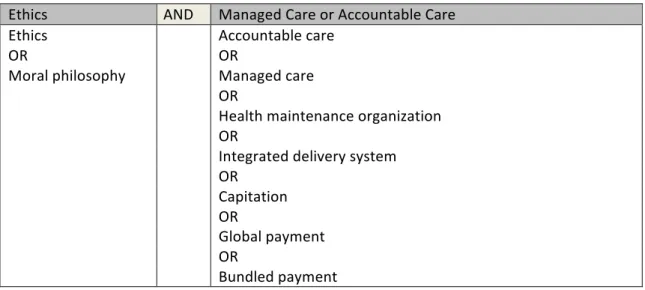
to more MeSH terms to include in (and fine-tune) the search string. Table 5 includes the primary constructs and related search terms for the MCO and ACO search:
Table 5: Constructs and Search Terms
Ethics' AND' Managed'Care'or'Accountable'Care''
Ethics'' ' Accountable'care'
OR' ' OR'
Moral'philosophy' ' Managed'care'
' ' OR'
' ' Health'maintenance'organization'
' ' OR'
' ' Integrated'delivery'system'
' ' OR'
' ' Capitation'
' ' OR'
' ' Global'payment'
' ' OR'
' ' Bundled'payment'
Putting all this together creates the following search string for PubMED:
• (ethics survey OR moral philosophy) AND (accountable care OR managed care OR health maintenance organization OR integrated delivery system OR capitation OR global payment OR bundled payment)
Additionally, the following filters were activated:
• Humans, English, Bioethics, Systematic Reviews, Core clinical journals, MEDLINE
To search the Web of Science database, the following search strings were used:
• TS=(ethic* AND survey AND managed care)
• TS=(ethic* AND survey AND accountable care)
For studies including FFS surveys, the following search strings were used: In PubMED:
• ethics survey AND (fee for service OR FFS) In Web of Science:
16 Inclusion/exclusion criteria
For an article to be included in the final library, it had to meet the following criteria:
• The study includes a survey that contains questions about ethics.
• The outcome measure (dependent variable) is an individual’s perception of ethics conflicts.
• The independent variable is reimbursement model for services.
• The unit of measure is individuals who would be affected by a change in the independent variable.
• The study is based in the United States of America. • The article is in English.
• Any type of study (descriptive, relational, causal) is acceptable.
• Pediatrics studies are excluded due to the extreme emotions associated with child morbidity and mortality.
Literature Review Results
The review process (Figure 3, below) identified the articles that met the inclusion criteria. The PubMED query returned 308 papers. The Web of Science queries returned 145 papers (124 related to managed care, three related to accountable care, and 18 related to FFS). There were 11 duplicates in the database queries. There were also 20 snowball additions. Of the 462 papers identified, a title and abstract review eliminated 431. Ten papers could not be located online, leaving 21 remaining for a full review. After a full review, 19 papers remained in the final library.
17
Independent Variable(s) | Dependent Variable(s) | Ethics Domains | Findings | Limitations | Notes | Role Targeted | Closed/Open | Include/Exclude
The decision of whether or not to include an article in the final library was dependent upon meeting the inclusion criteria.
The literature review details are described in the next section. A summary of results is illustrated in Table 6 below, which maps the most common ethical conflicts identified in the literature to the Beauchamp & Childress ethical domains: Table 6: Summary of Literature Review Results
! Ethical!Domain'
Ethical!Conflict' Justice! Autonomy! Beneficence! NonKmaleficence! Under?treatment'of'patients'due'to'overt'
pressures'or'financial'incentives.' X' X' X' X'
Breaches'of'patient'confidentiality'by'the' clinician'that'are'required'by'the'managed'
care'plan.' ' X' ' X'
Lack'of'disclosure'to'the'patient'of'the' financial'incentives'or'overt'pressures'
under'which'the'[clinician]'functions.' X' X' ' '
Overuse'of'practice'guidelines'(which'gets' into'physician'autonomy'to'diagnose'or' prescribe'treatment'in'ways'that'do'not' exactly'follow'the'guidelines).'
' X' X' X'
Managed Care Environment Surveys
All of the 21 reviewed papers were related to MCOs. Three of them relied primarily upon open-ended survey questions to allow respondents to identify the ethics issues encountered in the
18
workplace. The other 18 papers relied upon surveys that were developed using some
combination of literature reviews, expert contributions, and pilot testing. (It was not possible to identify the question development process in every paper, so some guesswork was involved.) Nineteen of the surveys were directed at clinicians, including doctors (12 studies), nurses (seven studies), and psychologists (two studies). Two of the surveys queried the perceptions of
executives and administrators. Open-Ended Surveys
The three surveys that included open-ended questions targeted different respective audiences. The responses varied greatly, as did the domain categories identified by the researchers; however, some consistent themes emerge in all three studies:
1. Justice is an issue regarding financial arrangements in MCOs and conflicts of interest for providers.
2. Autonomy is at risk concerning confidentiality (e.g. concerns that the MCO will not keep clinical information confidential), and consent (which could result in patients not being fully informed).
3. Beneficence and nonmaleficence are intertwined because helpful services may be withheld by MCOs, and strict adherence to approved clinical pathways could lead to harm.
19
generally accepted business practices in their organizations that they think are unethical. The top unethical practices included hiring/personnel matters (62%); privacy/confidentiality violations (48%); board members' preferential treatment (45%). In for-profit organizations, 28% of the executives agreed that there are unethical practices in their organizations. The top unethical practices were over-diagnosis when over-insured (93%); unnecessary procedures done to make more money (87%); privacy/confidentiality violations (67%); budget improprieties (54%).
Pope et al. (1992) 27 described the results of a national American Psychology Association (APA) survey. (The APA is unique in that it developed its original code of ethics in the 1950’s by directly querying its members versus having a committee develop it.) The survey contained a single, open-ended question: “Describe, in a few words or more detail, an incident that you or a colleague have faced in the past year or two that was ethically challenging or troubling to you." The resulting responses were put into 703 categories, with the top three being: Confidentiality (18%); blurred, dual, or conflictual relationships (17%); payment sources, plans, setting and methods (14%).
Bell (2003) 28 asked nurses to describe two ethical dilemmas they experienced while performing utilization reviews. This was followed up with a series of closed-response questions regarding the ethical principles most important to the respondent. Bell and colleagues assigned the open-ended results to Beauchamp and Childress categories. The ethics issues experienced most often by these nurses were associated with justice (distributing benefits, risks and costs fairly).
Closed-Response Surveys
20
literature reviews to identify relevant domains to query, and therefore each published study reinforced prevailing views. The four overarching issues identified in these surveys are summarized by Eastman and colleagues: 29
1. Under treatment of patients due to overt pressures or financial incentives.
2. Concern about breaches of patient confidentiality (particularly to employers) as managed care plans collect more and more patient information.
3. Lack of disclosure to the patient of the financial incentives or overt pressures under which the [clinician] functions.
4. Overuse of practice guidelines (which involves physician autonomy to diagnose or prescribe treatment in ways that do not exactly follow the guidelines).
21
Table 7: Closed-Response Surveys
Author' Yr.' Ethics'Domains'in'Survey' Study'Findings' Sulmasy(et(
al.(30((
2000( 1.(Financial(incentives(to(restrain(resource(use;(2.( Undivided(loyalty(to(patients;(3.(Patients’(trust;(4.( Disclosure(to(patient;(5.(Clinical(guidelines.( Most(midcareer(physicians(consider(many(of(the(methods(now(commonly(used(to( influence(medical(decisionFmaking(to(be(ethically(objectionable.( Ulrich(et(al.(
31(( 2006( 1.(Protecting(patients’(rights;(2.(Resource(allocation;(3.(Autonomy;(4.(Business(pressures(overriding(patients’( interests;(5.(Compromising(personal(values.( Insurance(constraints(interfered(with(the(ability(to(provide(quality(patient(care(by( 72%(of(respondents;(47%(have(been(asked(by(a(patient(to(mislead(insurers;(the(most( significant(predictor(of(ethical(conflict(is(the(perceived(obligation(to(advocate(for( patients(even(if(it(means(exaggerating(the(severity(of(a( patient’s(condition.( Ulrich(et(al.(
32(( 2003( 1.(Legal(or(financial(repercussions;(2.(Manipulating(system(to(benefit(patient;(3.(Professional(autonomy;(4.( Allocation(decisions.( 80%(perceived(it(was(sometimes(necessary(to(bend(managed(care(guidelines(to( provide(care(that(is(limited(by(the(MCO.(This(resulted(in(conflicts(regarding(business( decisions(overriding(patient(decisions,(unethical(practices,(agency,(legal(liability,( autonomy,(and(values.( Nadler,(et(al.(
33(( 1999( 1.(Transparency(of(financial(relationship;(2.(Financial(incentives(cause(conflicts;(3.(Relationship(with(patients.( In(1996(86%(of(respondents(agreed(with(the(statement:(“the(arrangements(in(capitation(present(a(conflict(of(interest.”(1997(that(was(down(to(75%(agreed.(( Bantz(34(( 1999( 1.(Equal(care(for(all(patients(regardless(of(condition(or(
setting;(2.(Taxpayer(paying(for(health(care(of(medically( indigent(patients;(3.(Use(of(nurse( practitioners/advanced(practice(nurses(to(perform( health(promotion(and(illness(prevention(activities;(4.( Relationship(between(staffing(and(patients'(risk(of( complications.( Staff(nurses(reported(perceiving(that(budget(cuts(had(a(greater(negative(impact(on( staff(positions(and(the(quality(of(patient(care(than(the(nurse(executives(reported.( Both(groups(were(in(favor(of(taxpayers(covering(a(greater(part(of(the(cost(of( medically(indigent(care.(
Bell(35(( 2003( No(domains(reported((results(focused(on(ethics(
committees(and(processes).( 91%(of(respondents(did(not(know(if(organization(had(an(ethics(committee.(92%(did(not(know(if(organization(had(process(for(deciding(ethical(issues.(Only(8%(stated(their( organization(had(a(process(for(dealing(with(ethical(issues(in(utilization(review.( Bernat,(et(al.(
36(( 1997( 1.(Willingness(to(follow(clinical(practice(guidelines;(2.(Conflicts(of(interest(or(conflicts(of(obligation(re(care(of( MCO(patients;(3.(Legal(ramifications(of(MCO(clinical( decisions;(4.(Deception(or(gaming(to(achieve(good( patient(care;(5.(Professional(prerogatives(and( autonomy;(6.(Steward(of(limited(resources.( Neurologists(are(generally(willing(to(follow(clinical(practice(guidelines(if(created(by( medical(societies;(experienced(frequent(conflicts(of(interest/obligation(in(the(care(of( their(MCO(patients;(feared(legal(ramifications(of(their(clinical(decisions(on(MCO( patients;(unwilling(to(employ(deception(or(gaming(to(achieve(what(they(perceived(to( be(good(patient(care;(believed(professional(prerogatives(and(autonomy(were(under( attack(by(MCOs;(the(good(of(their(patients(should(not(be(sacrificed(for(the(good(of( society.( Cassells,(et(
22
Eastman,(et(
al.(29(( 1997( 1.(Under(treatment(of(patients(due(to(overt(pressures(or(financial(incentives;(2.(Breaches(of(patient( confidentiality(by(the(physician(that(are(required(by(the( managed(care(plan;(3.(Lack(of(disclosure(to(the(patient( of(the(financial(incentives(or(overt(pressures(under( which(the(physician(functions;(4.(Overuse(of(practice( guidelines.( 30.2%(of(physicians(indicated(they(were(likely(to(extremely(likely(to(tell(the(patient( that(they(could(not(make(a(referral(to(a(specialist(when(doing(so(would(cost(the( physician(a(25%(salary(bonus.(42.9%(of(the(physicians(stated(that(they(were(likely(to( extremely(likely(to(wait(until(the(HMO's(practice(guidelines(had(been(met(before( operating(to(remove(a(patient's(appendix((even(if(other(clinical(indications(supported( the(intervention).( Eastman,(et(
al.(38(( 2001( 1.(Under(treatment(of(patients(due(to(overt(pressures(or(financial(incentives;(2.(Breaches(of(patient( confidentiality(by(the(physician(that(are(required(by(the( managed(care(plan;(3.(Lack(of(disclosure(to(the(patient( of(the(financial(incentives(or(overt(pressures(under( which(the(physician(functions;(4.(Overuse(of(practice( guidelines.( Doctors(are(more(likely(to(do(what(is(best(for(their(patients(than(for(themselves(or( the(HMO(in(situations(that(directly(involve(patient(care.(Doctors(older(than(age(50( are(less(likely(to(do(what(is(best(for(patient(in(scenarios(that(directly(involve(patient( care.(
Greene(39(( 1997( 1.(PhysicianFpatient(relationship;(2.(Effects(on(quality(of( care.(
<25%(of(respondent’s(organizations(provide(ethics(training.(62%(forFprofit(hospitals( require(senior(management(training(in(business(ethic((versus(33%(of(managed(care( executives(and(just(15%(of(physician(group(administrators).(ForFprofit(hospitals(most( likely(to(have(formal(codes(of(business(and(medical(ethics.(
Feldman(40(((1998( 1.(Conflicts(of(interest(between(patient(needs(and( physician(financial(interest;(2.(Respect(patients'( autonomy;(3.(Patients'(confidentiality;(4.(Obtain( patients'(informed(consent;(5.(Provide(all(diagnostic(and( therapeutic(options((not(just(covered).( Physicians(reported(conflicts(as(follows:( Conflicts(of(interest(between(patients(and(physician's(financial(interest((56%);(Placing( patients'(best(interest(first((54%);(Respecting(patients'(autonomy((49%)(
Ward(41(( 2008( 1.(Considering(costs(of(treatment;(2.(Use(of(costFbenefit( analysis(in(treatment(decisions;(3.(Resource(limitations;( 4.(Rationing.( 11%(of(physician(and(6%(of(nurse(directors(responded(that(rationing(occurs(in(ICUs.( 6%(of(nurses(and(5%(of(physicians(responded(that(cost(constraints(have(a(significant( effect(on(care.(46%(of(all(respondents(said(patients(receive(“too(much”(care( “sometimes(or(frequently.”( Phelps,(et(al.(
42(( 1998( No(specific(domains(were(measured((survey(asked(if(ethical(dilemmas(are(a(concern).( 42%(of(all(respondents((all(psychologists)(indicated(ethical(dilemmas(created(by(managed(care(is(one(of(their(top(5(concerns.( Murphy,(et(
al.(43((
1998( 1.(Control(of(patient(care/treatment(plan,(including(#(of( therapy(sessions(needed.( Survey(of(psychologists.(Negative(effects(were(loss(of(control(over(clinical(decisions( and(potential(harm(to(patients(from(erosion(of(confidentiality.(A(majority(of( respondents(reported(encountering(ethical(concerns(not(addressed(by(APA(ethics( code.( Hojat,(et(al.(
44(( 2000( 1.(Quality(of(care;(2.(Physician(independence(and(freedom(to(provide(optimal(care;(3.(Autonomy( (physician(and(patient)(
23 Fee-for-Service Surveys
This literature review did not identify any studies related to FFS ethics conflicts that met the inclusion criteria. Specifically, none of the studies included a survey.
Discussion of Literature Review Results
As expected, no studies were found related to ethics conflicts in ACOs. However, several papers described the results of surveys that measured perceived ethics conflicts in MCOs. As described above, there are important differences between ACOs and MCOs (in ACOs patients choose providers, physicians and patients make the care decisions, and quality outcomes are as important as reducing costs), but there are also enough similarities (goals are to provide the right care and to lower costs) to consider ethics conflicts identified in MCOs as relevant background for extending this body of research to ACOs.
Many ethics conflicts were identified for MCOs, all of which get to the heart of provider-patient trust:
• Financial arrangements that put pressure on providers to deny care or under-treat patients. • The loss of provider autonomy to communicate openly (including about financial
arrangements), and to recommend the best treatment for a given patient. (This was mitigated by laws to prohibit “physician-gagging,” which eliminated barriers to making recommendations; however, there was still no guarantee that the recommended
intervention would be covered by the MCO.)
• A risk to patient autonomy regarding (1) confidentiality, and (2) the ability to make fully informed decisions.
24
• The possibility of causing harm (maleficence) by following clinical guidelines that may not be best suited for a given situation.
Overall, it is clear that ethics conflicts arise when attempting to integrate effectiveness and cost-worthiness into care process considerations. While ACOs are designed to safeguard against this, there are both perception and implementation risks that financial decisions will once again rule the day.
As noted above, no studies were found that included surveys of ethics conflicts created by FFS reimbursement models. However, the literature contains many opinion pieces on this topic, and several studies that have examined the relationship between physician payments and utilization. In general, four primary ethics conflicts are theorized to result from FFS payment schemes: 38
1. There are financial incentives for physicians to over-treat.
2. The emphasis is on seeing volumes of sick patients versus promoting wellness. 3. Until recently, there has been little oversight of the quality of care provided (and
conversely, few ramifications for providing poor quality care). 4. There is little incentive for providers to be cost-effective.
Overall, the literature review suggests that this is a topic that could be studied in more depth. Implications for Future Research
25
There are several reasons it is important to understand what specific ethical conflicts are being created and/or mitigated by ACOs. First, it is certain that unresolved conflicts are
occurring and causing waste and potentially harm. Second, these conflicts impact provider satisfaction, as well as their buy-in to new payment and care models, and therefore their willingness to change. Ultimately this affects the entire culture of an organization. Third, it is important to identify possible interventions to help mitigate ethics conflicts in the workplace. Limitations of the Review Process
The main limitation of this review is that the primary question addressed by the study, “What ethics conflicts arise or are mitigated in Pioneer ACOs?” has not been answered in the literature.
26
CHAPTER 3: RESEARCH DESIGN AND METHODOLOGY Conceptual Framework
Using the biomedical ethics principles theorized by Beauchamp and Childress of
autonomy, beneficence, nonmaleficence, and justice, the following matrix (modified from the
Weeks original 45 ) shows physical and financial harms present in all systems of care that are ethically fair (even if unfortunate) versus harms that are always unjustified:
Table 8: Fair vs. Unjustified Harms
Type%of%Harm% Fair%Harms% Unjustified%Harms%
Physical) • Inconvenience)
• Foreseen)complications)
• Avoidable)complications) • Avoidable)interventions) Fiscal) • Reasonable)co8payments)
• Lost)income)/)sick)days)
• Unreasonably)high)copayments)and)co8insurance) • Low)value)
• Waste)
Efforts to eliminate unjustified harms using a FFS model have not been successful on a national
level. And given that CMS is the country’s largest payer, spending $472 billion to cover 48
million people in 2012, 46 the federal government is in a strong position to (1) encourage and identify innovative solutions, and (2) lead the entire health care industry towards using them. The
CMS-sponsored ACO model is designed to address these ethically unjustified harms by
refocusing attention on improving care while lowering costs. As one CEO put it, “We’re going to
become an ACO because it’s the right thing to do.”§
27
Figure 4 illustrates potential ethics conflicts created by relying upon multiple
reimbursement methods, as well as a set of possible interventions to transition towards a standard approach to care activity that focuses on quality outcomes while reducing unjustified harms: Figure 4: Conceptual Model to Eliminate Unjustified Harms
The question mark regarding ethics conflicts for ACOs was the focus on this study. Several authors have hypothesized about ACO ethics issues, identifying themes such as: 8
• Patient autonomy versus savings
o How should ACOs balance control over referral patterns (and therefore revenues) with physician and patient preferences?
• Cost shifting
o Increased market power achieved via mergers could lead to increased prices (thereby cost shifting to private payers).
28 • Sharing of benefits
o How should shared savings be distributed fairly? Should patients receive some of the shared savings?
• Resource allocation
o Given limited resources, should the ACO focus on those who are the most sick, or on those most likely to benefit?
• Physician relations
o Can physicians maintain their professional autonomy in an ACO? This study provided evidence to inform the validity of the hypothesized issues. Study Approach and Design
Overview
In order to answer the proposed research questions, the people who are creating, leading, and working in Pioneer ACOs must be queried. Therefore, this study employed a qualitative approach involving key informant interviews of (1) administrators who are responsible for ACO finances or operations, and (2) physicians who are making care decisions in the ACO (both primary care and specialist physicians were included). The research was intentionally limited to people whose decisions affect the provision of care in an ACO. It is a valid argument that associate providers such as nurse practitioners (NPs) and physician assistants (PAs) often provide primary care services; however, since licensed physicians are ultimately responsible for the orders in an ACO, associate providers were not included. This helped keep the scope of the study manageable.
29 Data Collection Process
The research involved semi-structured interviews of key informants at Pioneer ACOs. All of the original 32 Pioneer ACOs were invited to participate, including the nine that had dropped out of the program when the research began (one more dropped out during the research period).
The search engine Google was used to search public records to identify Pioneer ACO leaders, and often several names were identified (e.g. the CEO, ACO Administrator, or Medical Director). Invitations to participate in the study were emailed to at least one ACO leader at each Pioneer site. For people who did not respond, a reminder was sent two weeks later. For those that still did not respond, a third and final email was sent four weeks after the original invitation.
A list of key informants was derived through communications with the primary ACO contact to identify appropriate interview candidates. Interviews were requested with people who had the following roles within the ACO:
• 1 primary care physician • 1 specialist physician
• 1 administrator responsible for financials or operations
Potential subjects were contacted by email to request their participation, at which time a brief description of the study was shared. When a participant agreed to be interviewed, an appointment was scheduled at a time convenient to her/him. The meetings were conducted face to face whenever possible, in a room that allowed adequate privacy to have an honest
conversation. When face-to-face interviews were not possible, interviews were conducted via the telephone after verifying that the participant had adequate privacy to engage in a confidential conversation. All sessions were recorded with participant permission.
30
face-to-face interviews, and verbal consent in the case of telephone interviews. The principal
investigator reviewed the consent form orally and the participant was invited to ask questions
about the study. Study participants were consented and interviewed in English. All study
procedures were described in detail such that the participant was fully informed of their
requirements while in the study. During this consent process the participants were reminded they
were free to choose to take part in the research study or not. Those who consented to participate
in the study were enrolled.
During the consent process, all participants were informed that information they provide
through interviews is confidential (i.e. not shared with anyone outside of the research team) and
voluntary (i.e. they were not obligated to answer any question). Interviewees were told that they
were free to take breaks and/or terminate the interview at any time.
Key Informant Interview Questions
A key informant interview guide and questionnaire were developed for this study. The
interview questions are listed below. The table associated with question #8 is derived from six
health ethics domains to improve care identified by Porter,47 and specific topics identified by
Nelson in an unpublished survey of primary care research network members.48 The author found
these resources helpful to organize and group the key informant interview questions.
A. Background Questions
1. What is your title and role?
2. How have you been involved in implementing the ACO?
31 B. Ethics Conflicts Questions
4. How do care reimbursement models (such as fee-for-service, capitation or shared savings) affect your actions at work?
a. What conflicts does this create?
b. Would these conflicts be mitigated in another reimbursement model? 5. How is your job performance currently evaluated?
a. Does this create any conflicts for you?
6. Has becoming an ACO changed (or will it change) the way your job performance is evaluated?
a. Does this change either create or mitigate any conflicts for you?
7. Are you aware of any other ethical conflicts that have arisen specifically as a result of becoming an ACO?
a. Why didn’t those ethical conflicts exist before? What has changed? 8. Are you aware of any other ethical conflicts that have been mitigated specifically as a
result of becoming an ACO? Please explain.
9. There are some specific healthcare practices that commonly raise ethical challenges. I would like to ask you about the practices that we haven’t discussed yet, to see if you think they are impacted by becoming an ACO:
Domains Business Ethics
• Have you seen a change in how often conflicts of interest occur, such as incentives to increase or decrease services?
• Have you noticed a difference in how resources are being allocated? (Probe: e.g. rationing care)
• Has access to care changed for patients, such as access to needed specialized caregivers or services?
Professional ethics
32
defensive medicine; conflicts with facility policies)
• Have patient-provider relationships changed, such as disagreements over plans of care?
Decision ethics
• Are shared decision-making processes being used any more or less? (Probe: e.g. a formal program to base clinical decisions on patient values and their full understanding of options)
Clinical ethics
• Have treatment decisions been altered specifically to meet ACO requirements? • Has the approach to end of life treatment changed? (Probe: e.g. withholding or
withdrawing life-sustaining treatment; pain management) Organizational ethics
• Is there a formal process to deal with ethical conflicts in your ACO?
• Does your ACO have an ethics training program? (Probe: is it mandatory? Who is eligible to participate?)
• What ethics resources are available to you? (Probe: Training; Internet-based
materials, hardcopy resources, ethics committee case consultations; Are these resources helpful in your practice?)
• What additional ethics resources would you find useful? !
C. End Question
10. Is there anything else that would be helpful for me to know about ethical conflicts being
created or mitigated by ACOs?
The complete interview guide is attached as Appendix 2: Key Informant Interview Guide
- Identifying and Mitigating Ethics Conflicts in ACOs.
Data Management and Analysis
To maintain confidentiality, each ACO entity and the interview subjects were given a
numeric identifier so specific names were not directly linked to the data. Immediately after each
interview, the digitally recorded files were uploaded and saved on a password-protected
computer in the principal investigator’s office, and backed up on a password-protected server.
The interview files were sent electronically to an individual on the research team for
transcription. Interviews were transcribed verbatim and verified against the audio recording to
33
transcripts was complete, the investigator conducted a content analysis, which involved
identifying themes and categories prior to coding the data.
A variety of themes and patterns emerged through this coding process. Following the
coding of all interviews, reports were generated for each code in order to systematically analyze
and report on the information received during the key informant interviews.
Given the small sample, to be considered a true “finding” an issue had to either (1) be
mentioned by at least two individuals or, (2) if mentioned only once have strong face validity.
Findings were prioritized based on strength of evidence (for instance, mentioned by multiple
people in multiple organizations or have strong face validity), and grouped into “themes” for
deeper discussion. Themes were listed and ranked according to strength of evidence and
perceived importance to the interviewees.
Anonymous examples (and re-worded to leave out any identifiable information, if
necessary) were used to illustrate ethical conflicts that arise or are mitigated as part of becoming
a Pioneer ACO.
Hard copies of data and collateral materials such as consent forms were stored separately
in a locked cabinet in the office of the principal investigator. All interview data were stored in
protected files at the principal investigator’s office and backed up on a
password-protected server. After the study was complete, all recordings were destroyed to ensure that no
responses can be linked to an individual.
IRB Approval
Ethics approval for the proposed research study was obtained through the Institutional
Review Board at the University of North Carolina at Chapel Hill. The principal investigator’s
34
CHAPTER 4: RESULTS
Summary Description of the Study Sites
All 32 of the original Pioneer ACO sites were contacted via email with a request to
participate in the study. Seven sites accepted the invitation to participate, and four sites declined.
There was no response from the other 21 sites.
Three different people were interviewed at each site, including an ACO administrator, a
primary care physician, and a specialist (five cardiologists, one general surgeon, and one
psychiatrist). There were 21 total interviews.
The profiles of the ACOs ranged from clinic-centric to hospital-centric, and some had
experience with managed care along with a robust care management infrastructure, while others
were rapidly creating infrastructure to be able to meet the level of coordination required by the
Pioneer ACO program.
The number of patients involved in the respective Pioneer ACO programs varied between
~20,000 and ~80,000 across the sites. Additionally, the number of patients “covered” by
risk-based contracts varied from ~ 75,000 to ~450,000.
Table 9: Pioneer Site Profiles
Site%#% Admin% PCP%
Specialist% Interviewed%
#%of%Pioneer% Patients%%(est.)%
#%RiskDbased%Lives% (est.)%
1) ✔ ✔ Gen.)Surgeon) 60,000870,000) 300,000)
2) ✔ ✔ Cardiologist) 60,000870,000) 250,000)
3) ✔ ✔ Cardiologist) 30,000840,000) 170,000)
4) ✔ ✔ Psychiatrist) 70,000880,000) 450,000)
5) ✔ ✔ Cardiologist) 30,000840,000) 75,000)
6) ✔ ✔ Cardiologist) 30,000840,000) 180,000)
35 Summary of Major Findings
Seven major findings emerged from the key informant interviews regarding ethical
conflicts that are created or mitigated by the ACO model. Only one of the findings has a
potentially mitigating affect (shifting resources to focus on prevention), whereas the remaining
findings point to ethical conflicts resulting from (or being emphasized by) the ACO model:
Table 10: Major Ethical Issues
There was some variation regarding the distribution of these conflicts raised during the
interviews. Table 11 (below) indicates the intensity (i.e. the frequency and consistency with
which the issue was mentioned) of each key finding according to the role of the interviewee: red
Ethical%Issue% Description% Ethics%Category%
1. Incompatible) reimbursement) models)
• The)combination)of)fee8for8service)and)risk8based) contracts)creates)conflicting)incentives)for)an)ACO)to) simultaneously)increase)and)decrease)utilization.)
• Justice)
2. Two)standards)of)
clinical)care) • Medicare)patients)who)would)benefit)from)an)ACO’s)effective)care)management)program)may)not)be) enrolled)because)they)are)not)attributed)to)the)ACO.) As)a)result)they)receive)uncoordinated)and)often) inferior)care.!
• Beneficence) • Justice)
3. Financial)incentives)
vs.)patient)choice) • Providers)are)incentivized)to)keep)referrals)in)the)ACO)network)even)if)they)or)a)patient)would)prefer) to)refer)out8of8network.)
• Autonomy)
4. “Best”)care)
disagreements)) • Incentives)to)provide)only)the)necessary)and)needed)care)can)result)in)(1))disagreements)between) physicians)about)the)right)care,)and)(2))the)
perception)of)“rationing”)resources.)
• Beneficence) • Nonmaleficence) • Justice)
5. Required)ACO) metrics)vs.)
evidence8based)care)
• CMS)requires)some)metrics)that)do)not)reflect) current)evidence8based)practices.)This)creates) financial)incentives)to)provide)care)that)the)literature) suggests)is)inferior.))
• Beneficence)) • Justice)
)
6. Shifting)resources)to)
focus)on)prevention) • The)ability)to)provide)team8based,)comprehensive)primary)care)services)could)result)in)better)patient) outcomes)at)less)cost;)however,)clinician)burnout)is)a) risk.)
• Beneficence) • Justice)
7. Limited)support) systems)for)ethical) conflicts)
• A)fragmented)approach)to)dealing)with)ethics) conflicts)results)in)a)mismatch)between)an)ACO’s) values)and)its)clinical)and)business)practices.)
36
cells indicate ethical conflicts that respondents consistently felt are either being created or felt more intensely as a result of becoming an ACO; yellow cells indicate areas that received roughly equal amounts of positive and negative comments from respondents, suggesting that some felt a conflict was being created while others felt it was being mitigated; white cells indicate areas that did not come up regularly by role across the sites.
Table 11: Ethical Issues by Role
Ethical%Issue% Admin% PCP% Specialist%
1. Incompatible)reimbursement)models) ) ) )
2. Two)standards)of)clinical)care)
) ) )
3. Financial)incentives)vs.)patient)choice)
) ) )
4. “Best”)care)disagreements) ) ) )
5. Required)ACO)metrics)vs.)evidence8based)care)
) ) )
6. Shifting)resources)to)focus)on)prevention)
) ) )
7. Limited)support)systems)for)ethical)conflicts))
) ) )
There was consensus across roles about conflict existing in four areas: incompatible reimbursement models; financial incentives versus patient choice; disagreements about what constitutes “best” care; and ACO metrics that are required but outdated. Administrators and PCPs stressed the issues of two standards of clinical care, and fragmented support for ethical conflicts. PCPs and specialists cited the shifting of resources towards preventive services as potentially mitigating some ethical issues, but with some unintended consequences that may create distress.
37
Figure 5: Ethical Issues by Site
The issue of incompatible reimbursement models was felt by all three roles at all seven of
the sites. The issue of having two standards of care was expressed across all roles at six sites.
Three issues received attention by all the roles at five sites: financial incentives versus patient
choice; “best” care disagreements; and limited support systems for ethical conflicts. The issue of
discrepancies between required ACO metrics and evidence-based care had consensus at three
sites. The issue of shifting resources towards prevention was not consistently mentioned across
roles at the sites.
Detailed Descriptions of the Ethical Issues
The following detailed findings section includes both (1) the ethical dilemmas sites are
experiencing, and (2) mitigation strategies sites are employing to address the dilemmas.
1. Incompatible Reimbursement Models
ACOs have a combination of FFS and risk-based contracts. The FFS model relies upon
risk-38
based contracts rely upon bending the cost curve down and emphasizing quality outcomes over
volume. Several interviewees referred to this as the “two canoes” dilemma, using the analogy of
trying to navigate white water rapids with each foot in a separate canoe. Ultimately this dilemma
is an issue of justice and leads to the question, “Can an ACO provide efficient, equitable care
when reimbursement relies upon conflicting financial incentives?” This predicament was
illustrated by an administrator who said:
The single biggest risk we face as an organization is the transition between payment models. If you move your contracts before you’re prepared to fully change the way you deliver care, or the other way around, either way you’ve lost. And how do you make that transition? There is not a proven way to do it.
The challenge of competing incentives showed up in several different ways, as described below.
1.1 Adjusting Resources to Meet Shifting Revenues
Several of the interviewed sites were hospital-centric ACOs, which are particularly
affected by a shift in revenue from acute care to prevention. A physician administrator
navigating the journey from being a profit center to an expense center offered an example of how
the changing reimbursements affect hospitals:
It’s tough to be in an ACO world and a production-based world simultaneously. Let’s say you have someone who comes into the emergency room that doesn’t really need to be there. At an ACO your goal is to utilize the minimum amount of resources for the most effective quality of care; whereas in a private model, honestly you make money by those visits and encounters. We’re moving from revenue centers to expense centers, and that’s a very interesting, conflicting world.
This transition for hospitals and the resulting revenue shift is a major disruptor to a U.S.
health care system that is built to deliver acute care. One way that ACOs are attempting to deal
with this is through retention and referral streams, as described above and by this administrator:
39
of their care within our network, keep it local, keep it better coordinated. And therefore, the hospitals aren’t net losers in the equation because they’re benefiting from the
stabilized volume.
Ultimately, however, excess capacity needs to be removed from the system. This idea of
“right-sizing” is an important ethical issue of being stewards of resources and removing waste.
As one administrator said:
We’re trying to balance decreasing volumes by helping our hospitals figure out what are the essential services. We realize that not every single hospital may need expensive machines, or needs to be the very best at providing a certain type of service, so we’re really trying to take some of that excess cost out of our health system.
1.2 Physicians Pulled in Many Directions
Several PCPs described the stress of being put in untenable situations by the changing
and competing reimbursement pressures. Here a PCP describes the burden of being more
available for patients outside the clinic walls, while also being compelled to generate more
patient visits at the clinic:
Providers get a message that we need to manage a patient population more effectively. And that means managing patients in the office or out of the office. And yet, on the other hand, there's pressure on us to increase our volumes and generate more revenue. And those two things aren't necessarily able to coexist in a very effective way.
The same PCP goes on to explain the resulting budget dilemmas that come from
competing reimbursement models. On the one hand physicians can generate more short-term
revenue by seeing more patients in the clinic. On the other hand, seeing more patients takes time
away from population management. The ultimate result is exhaustion: