DYNAMIC MODELS OF ASSET RETURNS AND MORTGAGE
DEFAULT
Xi Chen
A dissertation submitted to the faculty of the University of North Carolina at Chapel
Hill in partial fulfillment of the requirements for the degree of Doctor of Philosophy in
the Department of Statistics and Operations Research in the University of North
Carolina at Chapel Hill
Chapel Hill
2017
Approved by:
Eric Ghysels
Chuanshu Ji
Jonathan Hill
Vidyadhar Kulkarni
c
2017
Xi Chen
ABSTRACT
XI CHEN: Dynamic Models of Asset Returns and Mortgage Default
(Under the direction of Eric Ghysels and Chuanshu Ji)
This dissertation consists of three chapters. The first chapter builds a new series
of dynamic copula models and studies the influence of macro variables on the
depen-dence between assets. The second chapter develops a dynamic logistics regression model
and investigates how systematic risk affects mortgage default. The third chapter uses
the frailty model developed in chapter 2 to explore spatial dependence between
com-mercial and residential mortgage risk. In all three chapters, we extend the generalized
autoregressive score (GAS) models proposed in Creal, Koopman and Lucas (2013
a
).
In the first chapter, we propose a series of dynamic copula models with a
short-and long run component specification, inspired by the mixed data sampling (MIDAS)
component structure applied to univariate GARCH models in Engle, Ghysels and Sohn
(2013) and multivariate GARCH models in Colacito, Engle and Ghysels (2011). In
particular, we extend the framework of MIDAS to dynamic copulas. In the framework
of GAS models, we combine macro variables of low frequency with asset returns of
high frequency, and investigate the influence of low frequency macro variables on the
dependence between asset returns. Our data consists of stock portfolios and a bond.
We assess the new class of models with these data and find that an extra component
enhances the model with more volatility. Moreover, the macro variables with MIDAS
work as a proxy for the market condition, and allow that the macro environment affects
how dependence parameter reacts to innovations. With these two flexibilities, the model
performance is consistently improved through our empirical applications.
systematic risk of mortgages. Specifically, we match default rates in multiple dimensions
by extending the GAS models. Our data consists of commercial mortgages in the U.S.
re-tail market from 1997 to 2013. An empirical analysis of these data suggests the influence
of origination month and the originator preference on default rates. To model the effects
of these variables, we group mortgages by these two variables and allow latent factors
to vary by groups. Compared with GAS models using a single factor, our multi-factor
models feature improved empirical fits. To the best of our knowledge, this is the first
attempt that uses observation-driven models to predict mortgage defaults. We show that
the new class of models has better tractability compared with parameter-driven models.
For instance, although our dataset has more than two million records, and our most
complex model incorporates up to 15 frailty factors, the estimation process only takes
two minutes using a standard desktop computer.
In the third chapter, we use the frailty model developed in chapter 2 to explore spatial
dependence between commercial and residential mortgage risk. Our dataset contains 1.6
million records of commercial mortgages and 140 million records of residential mortgages
in the U.S. market. The time range of these records is between January 1999 and March
2016. Our empirical analysis demonstrates strong spatial dependence between
com-mercial defaults and residential default in multiple respects. First, we apply Granger
causality tests to the empirical default rates of commercial mortgages and residential
mortgages in 10 main MSA areas, and the test results in 9 areas reveal a significant
lead and lag relationship of the two mortgage markets. Second, we test the causal
rela-tion among the frailty factors that explain systematic risk of commercial mortgage and
residential mortgage, and provide strong evidence on the close correlations between the
residential and commercial mortgage markets. Last but not least, we show that
residen-tial PD is a good explanatory variable in predicting default of commercial mortgages in
adjacent area, and this prediction power also implies that local residential market drives
the spatial dependence between commercial mortgage default and residential mortgage
ACKNOWLEDGEMENTS
First and foremost, I would like to offer my deepest gratitude to my advisors,
Pro-fessors Eric Ghysels and Chuanshu Ji. It is my fortune to have them as my academic
advisors. Their ingenious thoughts and deep insight have inspired me so much and their
knowledge of finance and statistics is a huge resource for my research. They are always on
my back and support me whenever needed. Besides research, they are also my personal
advisors. They cares about my career and always gives me advice, from which I will
benefit for the rest of my life. In a word, I learnt so much from Professors Eric Ghysels
and Chuanshu Ji, and without them I would not have such a wonderful experience as a
Tar Heel.
I would also like to show my deep appreciation for other committee members:
Pro-fessor Jonathan Hill, ProPro-fessor Vidyadhar Kulkarni, and ProPro-fessor Vladas Pipiras. They
provide invaluable helps in my graduate study and advice for my dissertation. Professor
Jonathan Hill read my dissertation carefully and provided numerous useful comments
and feedbacks. I learnt stochastic models in operations research and market dynamics
from Professor Kulkarni. Professor Pipiras taught me advanced probability. I am
ex-tremely grateful to them
Lastly and most importantly, I would like to thank my parents and wife. They always
love, believe and support me whatever happens and sacrifice a lot for me. I hope to make
TABLE OF CONTENTS
LIST OF FIGURES
...
ix
LIST OF TABLES
...
x
1
Component Dynamic Copula Models with MIDAS
...
1
1.1
Introduction ...
1
1.2
Background ...
2
1.3
Model Formulation ...
7
1.3.1
Notation and Preliminaries ...
7
1.3.2
A New Class of Component Dynamic Copula Models ...
8
1.4
Estimation ... 11
1.5
Empirical Application ... 13
1.5.1
Data and Variables ... 13
1.5.2
Results ... 14
1.6
Conclusions ... 17
2
Frailty Models for Commercial Mortgages
...
26
2.1
Introduction ... 26
2.2
Literature Review ... 28
2.3
Model Formulation ... 31
2.4
Empirical Applications ... 34
2.4.1
Data and Variables ... 34
2.4.2
Estimation ... 37
2.5
Conclusions ... 42
3
Commercial and Residential Mortgage Defaults: Spatial
Depen-dence with Frailty
...
52
3.1
Introduction ... 52
3.2
Background ... 54
3.3
Model Formulation ... 57
3.4
Empirical Applications ... 61
3.4.1
Data ... 61
3.4.2
Variables for Commercial Mortgages ... 62
3.4.3
Variables for Residential Mortgages ... 64
3.4.4
Estimation ... 66
3.4.5
Results ... 69
3.5
Conclusion ... 73
LIST OF FIGURES
1.1
Industrial Production and Realized Correlations ... 21
1.2
The Quarterly Realized Correlations of the Stock and Bond ... 22
1.3
The Quarterly Realized Correlation and Implied Correlations ... 22
1.4
The Monthly Realized Correlations and the Implied Correlations ... 23
1.5
The Implied Correlations of GAS-DCC and GAS-DCC-MIDAS Models ... 23
1.6
The Implied Correlations of GAS and GAS-DCC Models ... 24
1.7
The Implied Correlations of GAS-DCC and GAS-ADD Model ... 25
2.1
Empirical Default Rates (PD) by Mortgage Age ... 46
2.2
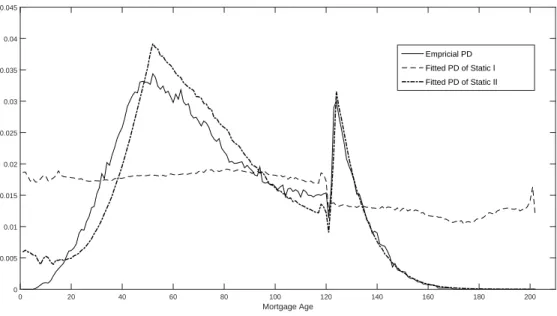
Default Rates by Mortgage Age of Static I and Static II ... 46
2.3
Default Rates by Exposure Month of Static I and Static II ... 47
2.4
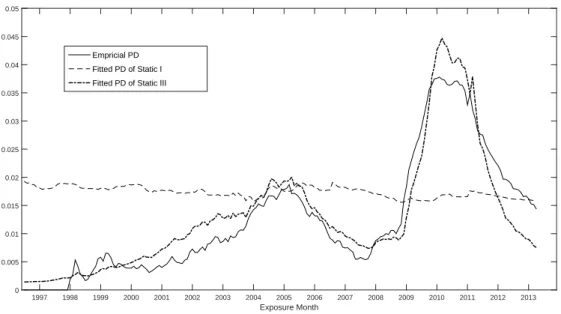
Default Rates by Exposure Month of Static I and Static III ... 47
2.5
Default Rates by Exposure Month of Dynamic I ... 48
2.6
Default Rates by Origination Month of Dynamic I ... 48
2.7
Default Rates by Origination Month of Dynamic II ... 49
2.8
Default Rates by Originator Group of Dynamic II ... 49
2.9
Default Rates by Originator Group and Mortgage Age of Dynamic II ... 50
2.10
Default Rates by Originator Group of Dynamic II and Dynamic III ... 50
2.11
Default Rates by Originator Group and Mortgage
Age of Dynamic II and Dynamic III ... 51
3.1
Empirical Default Rates of Commercial and Residential
Mortgages in the Top 10 MSA Areas ... 84
LIST OF TABLES
1.1
Estimation Results for Consumer Goods
...
18
1.2
Estimation Results for Manufacturing
...
18
1.3
Estimation Results for Health
...
19
1.4
Estimation Results for HiTec
...
19
1.5
Estimation Results for Other
...
20
2.1
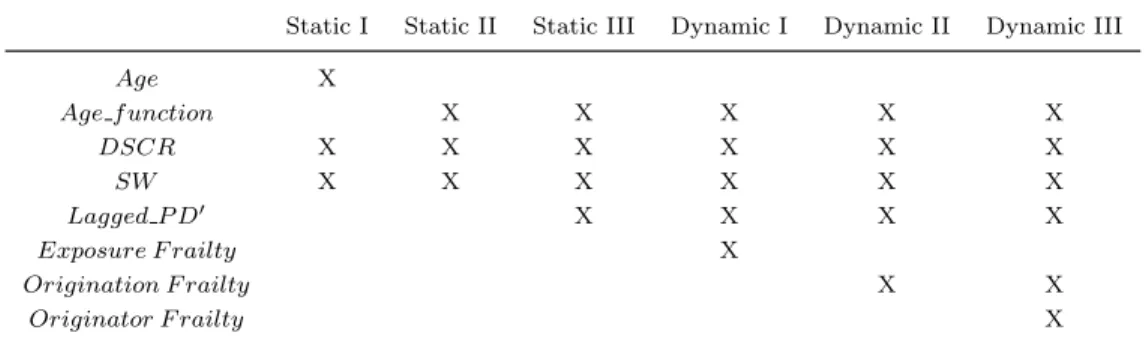
Components of Static and Dynamic Models
...
44
2.2
The Grouping Criterion for Originator Frailty
...
44
2.3
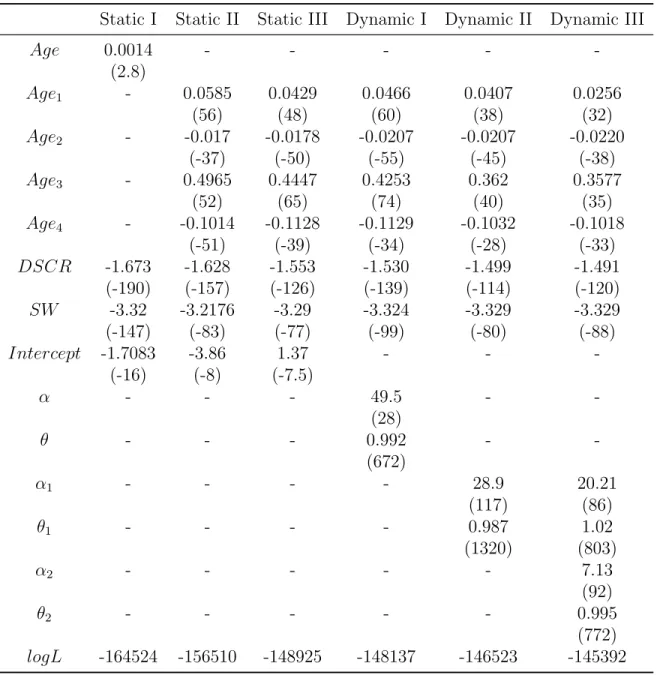
Estimates for Static and Dynamic Models
...
45
3.1
The Summary Statistics of Commercial Mortgages in the
Top 10 MSA Areas ... 74
3.2
The Summary Statistics of Residential Mortgages in the
Top 10 MSA Areas ... 74
3.3
Components of Static and Dynamic Models for Commercial Mortgages
...
75
3.4
Components of Static and Dynamic Models for Residential Mortgages
...
75
3.5
Estimates of the Static and Dynamic Models for Commer-
cial Mortgages ... 76
3.6
Estimates of Static and Dynamic Models in the Los Angeles-
Long Beach-Glendale Area ... 77
3.7
Estimates of Static and Dynamic Models in the New York-
Jersey City-White Plains Area ... 77
3.8
Estimates of Static and Dynamic Models in the Houston-
The Woodlands-Sugar Land Area ... 78
3.9
Estimates of Static and Dynamic Models in the Atlanta-
Sandy Springs-Roswell Area ... 78
3.10
Estimates of Static and Dynamic Models in the Phoenix-
Mesa-Scottsdale Area ... 79
3.11
Estimates of Static and Dynamic Models in the Dallas-
Plano-Irving Area ... 79
3.12
Estimates of Static and Dynamic Models in the Riverside-
San Bernardino-Ontario Area ... 80
3.14
Estimates of Static and Dynamic Models in the Anaheim-
Santa Ana-Irvine Area ... 81
3.15
Estimates of Static and Dynamic Models in the Washington-
Arlington-Alexandria Area ... 81
3.16
Granger Causality Tests between Commercial PD and Res-
idential PD in Main MSA Areas ... 82
3.17
Granger Causality Tests between Commercial Frailty and
CHAPTER 1: COMPONENT DYNAMIC COPULA MODELS WITH
MIDAS
1.1
Introduction
Measuring temporal dependence between financial assets is a key ingredient to risk
hedging, asset pricing, portfolio choices, to name only a few. For example, hedging ratios
dynamically adjust to the varying dependence between financial assets. Likewise, the
pricing of structured products such as CDO’s critically relies on the dependence between
the underlying financial assets.
To model temporal dependence between asset returns, two main methods have been
developed in the literature. One is multivariate GARCH models and the other one
is copula-based models. This chapter focuses on the latter. Copula-based models allow
researchers to model the marginal distribution and dependence structure separately. This
property provides a flexible framework to model multivariate time series and recently
increasing attention has been devoted to conditional copulas when modeling dynamic
dependence of financial assets. Patton (2006) provided the theoretical foundation for
conditional copulas. He used a combination of GARCH models and copulas to model
Deutsche Mark and Yen jointly. The dependence parameters of the copulas are driven
by autoregressive processes. Guegan and Zhang (2010) compared two dynamic copula
models and proposed statistical tests based on conditional copulas. Fengler and Okhrin
(2012) utilized realized variance to model the dependence between daily stock returns,
and the dynamic of the copula is driven by a HAR (Corsi, 2009) process - which is
a MIDAS specification with step functions. To parameterize dynamic copulas in
Autoregressive Score Models (GAS).
In this chapter, we propose a series of dynamic copula models with a short- and long
run component specification, inspired by the mixed data sampling (MIDAS) component
structure applied to univariate GARCH models in Engle, Ghysels and Sohn (2013) and
multivariate GARCH models in Colacito, Engle and Ghysels (2011). Hence, the purpose
of this chapter is to extend the framework of MIDAS to dynamic copulas. In the
frame-work of GAS models, we combine macro variables of low frequency with asset returns
of high frequency, and investigate the influence of low frequency macro variables on the
dependence between asset returns. Our data consists of stock portfolios and a bond. The
stock data are the daily returns on five industry portfolios. The bond data are the daily
returns of a 10-year Treasury bond. We assess the new class of models with these data
and find that an extra component enhances the model with more volatility. Moreover,
the macro variables with MIDAS work as a proxy for the market condition, and allow
that the macro environment affects how dependence parameter reacts to innovations.
With these two flexibilities, the model performance are consistently improved through
our empirical applications.
The rest of this article is organized as follows. In the next section, we review the
literature. Section 1.3 states the model formulation. In section 1.4, we describe the
details of estimation. Section 1.5 discusses empirical applications. The last section
provides concluding remarks.
1.2
Background
To motivate the theoretical framework, it is useful to review the literature on copulas
and related areas. We first introduce the theoretical foundation of static and dynamic
copulas. Next, we focus on various parameterization methods for dynamic copulas. At
We start with the introduction of static copulas. In particular, consider a multivariate
random variable
Y
= [Y
1, ..., Y
n]. Let
F
be the joint cumulative distribution function
(CDF) for
Y
, and
F
ibe the CDF for
Y
i. By Sklar’s theorem (Sklar 1959), there exists
a copula function
C(
·
) : [0,
1]
n→
[0,
1], mapping the marginal distributions of
Y
i
to the
joint distribution through:
F
(
y
) =
C(F
1(y
1), ..., F
n(y
n)
|
ρ)
(1.2.1)
where
ρ
is the dependence parameter of interest. Accordingly, the joint probability
density function (P DF
) can be represented as the product of copula density
c(
·
) and
marginal PDF
f
i:
f
(
y
) =
c(U
1, ..., U
n|
ρ)
nY
i=1
f
i(y
i)
(1.2.2)
where
U
i=
F
i(y
i). Note that it is usually assumed that
c(
·
) and
f
ishare no common
parameters. In the case of (1.2.2),
ρ
does not appear in
f
i.
If we take log of both sides of equation (1.2.2), the product of
c(U
1, ..., U
n|
ρ) and
f
i(y
i) transforms to the sum of
log
(c(U
1, ..., U
n|
ρ)) and
log(f
i(y
i)). This transformation
motivates a two-stage estimation: The first stage estimates the parameters of marginal
distributions with the likelihoods only involving
log(f
i(y
i)), and the second stage
esti-mates the parameters of
c(
·
) with the likelihoods only containing
log(c(U
1, ..., U
n|
ρ)).
This two-stage estimation greatly reduces the computation cost for estimation, because
the parameters of
f
iand
c(
·
) can be estimated in separate optimizations. Comparing
with a joint estimation of all parameters, this two-stage estimation may entail some
ef-ficiency loss. However, as the numbers of parameters increase with problem sizes, the
two-stage estimation may be the only feasible estimation method in practice.
While Skalar’s theorem motivates the application of static copula models, Patton
(2006) further establishes the theoretical foundation of dynamic copula models. Suppose
to time
t
−
1. Patton (2006) showed that the conditional CDF
F
(.
|F
t−1) can be
decom-posed into the conditional marginal CDF
F
i(.
|F
t−1) and conditional copula
C(.
|F
t−1) as
what follows:
F
(
y
t|F
t−1) =
C(F
1(y
1,t|F
t−1), ..., F
n(y
n,t|F
t−1)
|F
t−1)
(1.2.3)
f
(
y
t|F
t−1) =
c(U
1,t, ..., U
n,t|
ρ
t,
F
t−1)
n
Y
i=1
f
i(y
i,t|F
t−1)
(1.2.4)
where
ρ
tis a dynamic dependence parameter and changes with time.
In Patton (2006) both Gaussian and non-Gaussian copulas are constructed to model
the dependence between Deutsche mark and Yen. In the Gaussian case,
ρ
thas the
following dynamic,
ρ
t= Λ
1(δ
t)
δ
t=
ω
+
βδ
t−1+
α
10
10
X
k=1
Φ
−1(U
1,t−k)Φ
−1(U
2,t−k)
where Λ
1(
·
) is a link function to make sure that
ρ
tis between -1 and 1.
δ
tis the
trans-formed dependence parameter. Φ
−1(
·
) is the inverse CDF function of normal distribution
and
U
i,t−k=
F
i(y
i,t−k|F
t−1). This dynamic is of autoregressive form, and it is driven by
a lagged part and an innovation part. For the non-Gaussian case, symmetrized
Joe-Clayton (SJC) copula is used and Patton (2006) suggested the following dynamic for the
tail dependence parameter
ρ
t:
ρ
t= Λ
2(δ
t)
δ
t=
ω
+
βδ
t−1+
α
10
10
X
k=1
Here Λ
2(x) is a link function to ensure
ρ
tlies in its domain. Besides, Patton (2006)
used an ARMA-GARCH model for the marginal distribution of assets returns.
Since the seminal work of Patton (2006), various dynamic copulas have been
pro-posed, and most of them focus on the parameterization of dependence parameters.
Heinen and Valdesogo (2009) suggested using DCC framework to model the
depen-dence parameter. Christoffersen et al. (2012) adapted the DCC framework to reduce
the computational complexity. While all these preceding models are observation driven,
Hafner and Manner (2012) proposed a parameter driven model with a latent stochastic
process. Hafner and Reznikova (2010) also developed a semi-parametric approach to
model the dependence parameter as a smooth function of time. Structural breaks were
used to model the dependence parameter in Dias and Embrechts (2002) and Manner and
Candelon (2010).
Many of these papers assume that the dynamics of dependence parameters are of
autoregressive form that contains a lagged term and an innovation term. Between these
two terms, the choice of the innovation term is crucial and depends on the functional
forms of copulas. For example, Patton (2006) used cross products and differences in the
Gaussian and non-Gaussian cases respectively. In the latter case, differences are used
because the interpretation of cross products is not clear with non-Gaussian distributions.
To formulate the dynamics of parameters in general settings, Creal, Koopman and Lucas
(2013
a
) and Harvey (2013) proposed GAS models, which use the scores of log likelihood
functions as the innovation term. These researchers assumed
δ
t-the transformed dynamic
parameter- of the following form:
δ
t=
ω
+
pX
i=1
A
is
t−i+
qX
j=1
B
jδ
t−jSince
δ
tmay be a vector, all the terms here are of appropriate dimensions.
A
iand
B
jthe scaled score of the likelihood function, as shown below:
s
t=
S
t· ∇
t∇t
=
∂
ln
f
(y
t|
δ
t,
F
t−1;
θ)
∂δ
tS
t=
S(t, δ
t,
F
t−1;
θ)
where
∇
tis the score of the log likelihood function and
S
tis a matrix function to scale
the score. Several choices for the scaling matrix
S
tare proposed: It can be the inverse
information matrix, the “square root” of the inverse information matrix, or an identity
matrix, as displayed below:
S
t=
I
t−|t1−1,
I
t|t−1=
E
t−1[
∇
t∇
0
t−1
]
or
S
t=
J
t−|t−11,
J
0t|t−1J
0t|t−1=
I
t−|t1−1or
S
t=
I
where
I
is an identity matrix. While GAS models apply to general problems involving
time varying parameters, they are of special importance to copula modeling. A large
number of copulas are constructed from non-Gaussian settings, and it is hard to find an
innovation term. GAS models have been applied to dynamic copulas in Oh and Patton
(2013), Salvatierra and Patton (2014) and Patton (2012). In this chapter we also use
this framework and compare its performance with the model driven by cross products.
Component models have also attracted considerable attention in the literature when
modeling volatility and correlation of asset returns. In Engle and Lee (1999), they
pro-posed a GARCH model driven by two components and could be seen as a restricted
GARCH(2,2) model. In Engle and Rangel (2008), a multiplicative component GARCH
Colacito, Engle and Ghysels (2011) developed an additive component models named
DCC-MIDAS, separating long term and short term components. In this chapter, we
ex-tend the frameworks of GARCH-MIDAS and DCC-MIDAS to dynamic copula modeling.
1.3
Model Formulation
The purpose of this section is to introduce a new series of dynamic copula models. In
a first subsection, we provide some preliminaries and describes two benchmark models in
the literature. The second subsection introduces the structures of new dynamic copula
models.
1.3.1
Notation and Preliminaries
To set up models, consider a bivariate stochastic process
y
t= (y
1,t, y
2,t). We assume
the marginal distribution of
y
i,tfollows the GARCH-MIDAS framework in Engle, Ghysels
and Sohn (2013). Specifically, the dynamic of
y
i,tis as follows:
y
i,t=
µ
i+
√
τ
i,tg
i,ti,t(1.3.1)
g
i,t= (1
−
α
i−
β
i) +
α
i(y
i,t−1−
µ
i)
2τ
i,t+
β
ig
i,t−1(1.3.2)
τ
i,t=
m
+
θ
i KX
k=1
ψ
k(ω
i,1, ω
i,2)X
t−k(1.3.3)
where
µ
iis the constant mean of
y
i,t. The volatility dynamic for
y
i,thas two components.
The short term component
g
tassumes an autoregressive form shown in (1.3.2). The long
term component
τ
tis driven by a weighted sum of
X
t−k, and
X
t−kcould be external
information or derived from
y
i,j(j
≤
t
−
1). The weight
ψ
k(ω
i,1, ω
i,2) is determined by
parameter
ω
i,1and
ω
i,2. Denote the information set up to time
t
−
1 as
F
t−1, and we
assume
i,t|Ft
−1∼
F
i(
·
).
copula, i.e.:
F
(
1,t,
2,t|
ρ
t, θ,
F
t−1) =
C(F
1(
1,t), F
2(
2,t)
|
ρ
t, ν,
F
t−1)
where
C(
·
,
·
) is a bivariate copula and
ρ
tis the dependence parameter of interest.
ν
includes static parameters. As will be discussed in the estimation section, we choose t
copula for the joint distribution and skewed t distribution for the marginal distribution
of
i,t. Note that the dependence parameter
ρ
tfor t copula lies in the interval [
−
1,
1].
Regarding the parameterization of
ρ
t, two benchmark models arise in the literature
since we choose t copula for the joint distribution. One is the “cross product” model
used for Gaussian copula in Patton (2006) and t copula in Christoffersen et al. (2012),
with the dynamics as below:
ρ
t= Λ
1(δ
t)
(1.3.4)
δ
t=
ω
+
βδ
t−1+
α
1Ψ
−1(U
1,t−1)Ψ
−1(U
2,t−1)
(1.3.5)
Λ
1(x) =
1
−
exp(x)
1 +
exp(x)
(1.3.6)
where Ψ
−1(
·
) is the inverse CDF of t distribution and
U
i,t−1=
F
i(
i,t−1).
1We call models
based on this dynamic as PROD models in short of “cross product”. Another benchmark
model is GAS model as discussed in section 1.2. Assuming one lag period, we have the
following dynamics:
δ
t=
ω
+
βδ
t−1+
α
1s
t−1(1.3.7)
where
s
t−1is the score of the likelihood function with respect to
δ
t−1.
1.3.2
A New Class of Component Dynamic Copula Models
In this subsection, we introduce the new class of dynamic copula models. At first,
we propose an additive component model based on GAS model, motivated by the
for-1 The degree of freedom and skewness of this t distribution are the same as the ones in the t copula
mulation of DCC-MIDAS model. We add into equation (1.3.7) a time varying intercept
that is the moving average of lagged
δ
tas below:
δ
t=
ω
k
k
X
i=1
δ
t−i+
βδ
t−1+
α
1s
t−1(1.3.8)
This model is a natural extension of DCC-MIDAS model to dynamic copulas. The idea
underlying DCC-MIDAS is extracting two components from the daily correlations: one
short term component from the daily innovation and a long term component driven by
the moving average of realized correlations. Similar logic applies here with two notable
differences. One difference is that we use scores rather than cross products, because
scores incorporate more information from the functional form of t-distribution than cross
products. The other difference is the construction of long term component. While
DCC-MIDAS model uses realized correlation for the dynamic intercept, we use the fitted
dependence parameter to simplify computation. Since most of the times, there is no
closed form relation between realized correlation and the dependence parameter of the
copula. We call this new additive component model as GAS-ADD model.
Similarly, we can also take an average of
k
lagged innovations to form a long term
innovation, yielding another component model as follows:
δ
t=
ω
+
βδ
t−1+
α
1s
t−1+
α
2k
k
X
i=1
s
t−i(1.3.9)
This model shares similar properties with DCC model. It could be seen as a
special-ized DCC model using scores as innovation with parameter restrictions. So we call it
GAS-DCC model.
GAS-DCC and GAS-ADD models decompose the daily innovations of dependence
parameters into long and short term components; moreover, we also want to extract
include macro variables, we choose to follow the GARCH-MIDAS framework in Engle,
Ghysels and Sohn (2013), and incorporate macro variables multiplicatively:
δ
t=
ω
+
βδ
t−1+
α
1τ
ts
t−1(1.3.10)
log(τ
t) =
m
+
θ
11
(K
P
k=1
ψk(ω1,ω2)Xt−k)<0
K
X
k=1
ψ
k(ω
1, ω
2)X
t−k+
θ
21
(K
P
k=1
ψk(ω1,ω2)Xt−k)>0
K
X
k=1
ψ
k(ω
1, ω
2)X
t−k(1.3.11)
where
X
t−kis a macroeconomic variable.
ψ
k(ω
1, ω
2) is the weight assigned by MIDAS
polynomial to
X
t−kwith parameters
ω
1and
ω
2. The above formulation has a natural
interpretation in GARCH model, since asset returns tend to react differently to news
depending on the macroeconomic environment. Now
τ
tinfluences
ρ
tsimilarly but in a
nonlinear way, due to the existence of link function. Note that in Engle, Ghysels and
Sohn (2013), the intercept in equation (1.3.2) is specified as 1
−
α
−
β. However, that
specification is based on the assumption of Gaussian distribution that no longer holds
here. So we use a separate parameter
ω. We call this model GAS-MIDAS thereafter.
GAS-MIDAS model lets macro variables influence short term innovations.
Alterna-tively, we can also weight macro variables by the long term innovations in the GAS-DCC
model. In particular, we divide
α
2in equation (1.3.9) by macro variables and have the
following dynamics:
δ
t=
ω
+
βδ
t−1+
α
1s
t−1+
α
2kτ
t kX
i=1
s
t−i(1.3.12)
log(τ
t) =
m
+
θ
11
KP
k=1
ψk(ω1,ω2)Xt−k<0
K
X
k=1
ψ
k(ω
1, ω
2)X
t−k+
θ
21
KP
k=1
ψk(ω1,ω2)Xt−k>0
K
X
k=1
ψ
k(ω
1, ω
2)X
t−k(1.3.13)
The idea here is weighting long term innovation with long term influence of macro
equa-tion (1.3.13), we propose three new component models for dynamic copulas. We will
compare the performance of these new models with the benchmark models by empirical
applications in section 1.5.
1.4
Estimation
To estimate the parameters of these copula models, we apply the two-stage method
discussed in section 1.2. In the first stage, we estimate the univariate GARCH-MIDAS
models with quasi maximum likelihood method, and normalize the dependent variables
using fitted standard errors. Then we fit a marginal distribution for each of the
normal-ized variables. In the second stage, we fit the copula model with standard maximum
likelihood method. This two-stage estimation is generally applied in literature and makes
the computation much easier than joint estimation. In the following paragraphs, we
dis-cuss the details of this estimation method.
There are numerous choices for the marginal distribution, such as normal distribution,
the standardized t distribution (Bollerslev (1987)), and the skewed t distribution (Patton
(2004)). We use the skewed t distribution for its flexibility. This distribution has two
shape parameters controlling its skewness and tail thickness. A skewness parameter,
λ
∈
(
−
1,
1), describes the degree of asymmetry, and a degrees of freedom parameter,
ν
∈
(2,
∞
), measures the tail thickness. If
λ
= 0, we have the standardized Student’s
t distribution. When
ν
→ ∞
, we have skewed normal distribution. If
ν
→ ∞
and
λ
= 0 , we recover a standard normal distribution. All these flexibilities make skewed
t distribution a good choice to model univariate variables. For further results on this
distribution, refer to Hansen (1994) and Jondeau and Rockinger (2006).
We choose t copula for the multivariate modeling because of its capability to
incor-porate various dependence structures. First, it has a degrees of freedom parameter
ν
ccan model data of both negative and positive correlation. If
ρ
equals to one (minus
one), we have perfectly positively (negatively) correlated data series. This property is
important since the data in empirical applications exhibits both positive and negative
correlations. Not all copulas have such flexibility. For example, Clayton and a number
of other Archimedean copulas can only model positively or negatively correlated data.
For further results on these copulas, refer to Joe (2014) and Nelsen (2007).
For the MIDAS component containing macroeconomic variables, we use the same
variable for both univariate modeling and multivariate modeling. This consistency
en-sures the conditional copula a valid one. For discussions on the validity of conditional
copulas, see Patton (2006). To select the number of lag periods for the MIDAS
com-ponents, we follow the profiling method discussed in Engle, Ghysels and Sohn (2013)
and Colacito, Engle and Ghysels (2011). For the MIDAS polynomial, we choose a Beta
weighting scheme of the following form:
ψ
k(ω
1, ω
2) =
(k/K
)
ω1−1(1
−
k/K
)
ω2−1K
P
j=1
(k/K
)
ω1−1(1
−
k/K
)
ω2−1Beta weighting scheme offers flexible shape for the MIDAS filters. It can provide both
decreasing and increasing schemes. Moreover, it can also offer a hump shaped weighting
shape limited to be unimodal. Besides, there are other weighting schemes available. See
Ghysels, Sinko and Valkanov (2007) for a further discussion on the choices of weighting
schemes.
Besides, for the GAS-ADD model, we choose
k
= 22 for the time varying intercept.
For GAS-DCC model, we choose
k
= 5 for the long term innovation. These lagging
periods are picked by the profiling likelihood methods and the clear interpretation of
1.5
Empirical Application
1.5.1
Data and Variables
In this section, we use the new class of models to investigate the dependence between
stocks and bonds. The bond data are the daily returns of a 10-year Treasury bond. The
stock data are the daily returns of five industry portfolios compiled by Kenneth French,
which could be downloaded from his web page. The five industries include consumer
goods, manufacturing, high tech, health and others. The time range of the data is
from November 30, 1985 to December 30, 2013, with 7042 observations. Because of the
similar patterns across these five industries, we mainly use the pair of manufacturing
industry and 10-year treasury bond as an example. If we mention stock, we mean the
stock portfolio of manufacturing industry. This applies to all the figure examples in the
following paragraphs.
We use monthly growth rate of industrial production (IP) in U.S. as the macro
variable.
2For univariate modeling, we compute the quarterly rolling average of the IP
rates and apply a MIDAS polynomial with the quarterly average. Specifically, if
X
tis
the variable in the MIDAS polynomial as in equation (1.3.3) and
X
t0is the monthly IP
rate, then
X
t= (X
t0+
X
0
t−1
+
X
0
t−2
)/3. For each day, we look back for 16 months, i.e.:
K
= 16 in the MIDAS polynomial. Therefore, there are actually two filters smoothing
the macro variables. Similar applications of filters can be found in Engle, Ghysels and
Sohn (2013).
For multivariate modeling, we use the first order difference of the IP growth rates
and take the quarterly average of the difference to smooth the data. Unlike the
uni-variate modeling, we only assume a flat weight for the MIDAS filter. We make these
transformations based on empirical investigations. Both models of the raw rates and
differences are tested, and the latter one shows a better performance. For the number of
lag periods, empirical tests favor a short window of three months. This short window size
is also supported by the volatile fluctuation of the realized correlations, which is shown
in the the upper panel of Figure 1.1. Clearly, the correlations have many spikes, even if
they are calculated on a quarterly basis. Meanwhile, the IP growth rates in the lower
panel of Figure 1.1 change relatively slow. It is hard to relate the change of correlations
today to the variation of IP growth rates one year ago. Therefore, we only look back for
three months. For such short lag period, the difference between flat weights and uneven
weights becomes negligible, so we select flat weights for computational simplicity.
1.5.2
Results
Before discussing numerical results, let us examine some figures to have a general
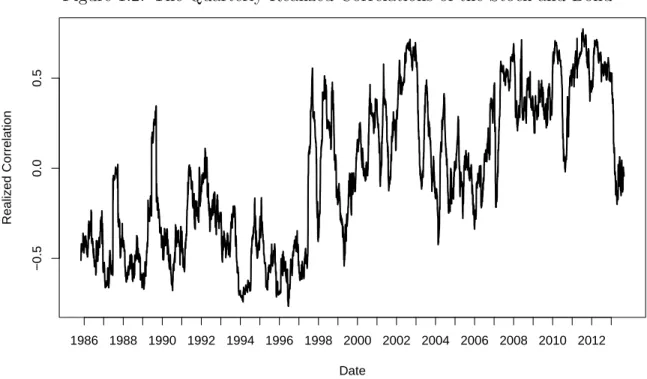
impression of these models. Figure 1.2 plots the quarterly realized correlations of the
stock and bond, and the correlations exhibit strong temporal variations. These variations
support the applications of dynamic copulas, because no static copula can produce such
volatile patterns. Figure 1.3 further plots the quarterly realized correlations along with
the implied correlations of GAS model. It shows that the implied correlations closely
follow the realized ones while the realized ones have wilder fluctuations. In Figure 1.4, we
reduce the sampling window of realized correlations to one month and plot the monthly
realized correlations with the implied correlations of GAS model.
Now the implied
correlations seem to be a long term component of the monthly realized correlation.
These two figures convey that GAS model is highly persistent and similar patterns can
also be observed with GAS-based models through Figure 1.5 to Figure 1.7.
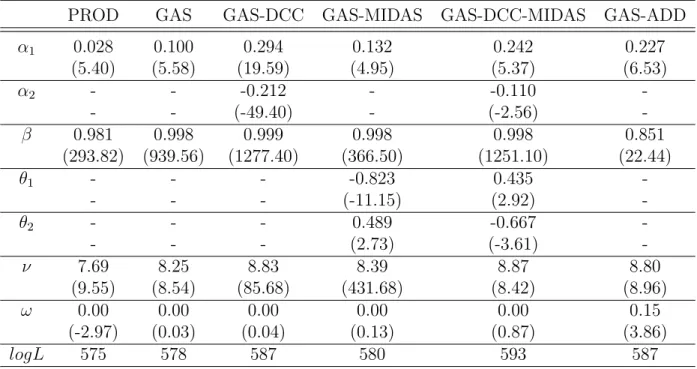
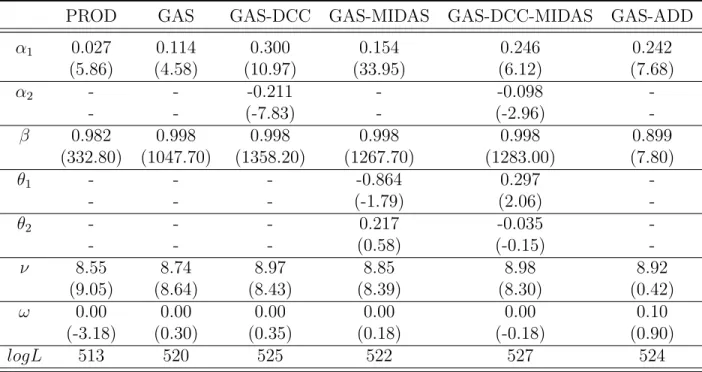
All the estimation results are presented in Table 1 to 5. The last rows of these tables
contain the likelihoods of the six models. By comparing these likelihoods, we make
higher likelihoods than PROD model driven by cross products. Moreover, GAS-DCC
and GAS-ADD models are better than GAS model, and GAS-DCC-MIDAS model is
better than GAS-DCC model in terms of likelihood. Since GAS and GAS-ADD models
are nested, we can apply likelihood ratio tests to compare these two models. It can
be shown that the difference is statistically significant. Similar arguments apply to the
pairs of GAS/GAS-DCC and GAS-DCC/GAS-DCC-MIDAS. By contrast, GAS-MIDAS
model does not offer much more than the GAS model. This may suggest that it is better
to weight long term variations by macro variables than short term variations.
Now let us turn our attention to interpreting parameter estimates. The first rows of
these tables report the estimates of
α
1, reflecting the influence of daily innovations on
dependence parameter. For all the six models, this parameter is significant and has a
positive sign as expected. Furthermore, the estimates of GAS-DCC, GAS-DCC-MIDAS
and GAS-ADD models have much bigger values than the one of GAS model. This may
imply that the former models can offer more volatilities than the latter one.
The second rows of these tables refer to the estimates of
α
2. This parameter measures
the influence of long term (weekly) innovations on the dependence parameter of
GAS-DCC and GAS-GAS-DCC-MIDAS models. The estimates of both models are significant and
have negative signs. These negative signs seem to remove part of the daily innovations
accumulated in the past week, and make GAS-DCC and GAS-DCC-MIDAS models more
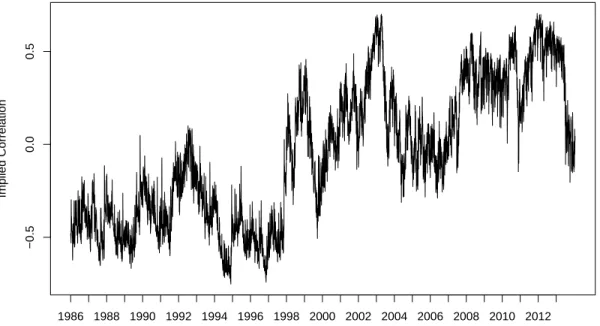
volatile than other models. Figure 1.6 plots the implied correlations of GAS and
GAS-DCC models. GAS-GAS-DCC model has a thicker curve than GAS model, and this also
conveys that the former model has more volatility than the latter.
Besides
α
1and
α
2,
θ
1and
θ
2also affect how innovations integrate into the dependence
parameters. For most of the five industries, these two parameters are significant. In
GAS-DCC-MIDAS model,
θ
1are positive and
θ
2are negative for all five industries. This means
higher,
θ
1X
t1
Xt<0+
θ
2X
t1
Xt≥0is smaller and
|
α
2/τ
t|
is larger. A large
|
α
2/τ
t|
removes
more weekly innovations from the dependence parameter, providing more fluctuations
to the model. Figure 1.5 also demonstrates that the implied correlations of
GAS-DCC-MIDAS model are more volatile than the ones of GAS-DCC model. That’s probably why
GAS-DCC-MIDAS model has a better performance than the GAS-DCC model.
θ
1and
θ
2also appear in GAS-MIDAS model. Since GAS-MIDAS model is not much different
from GAS model in terms of likelihoods, we skip interpreting these two parameters for
GAS-MIDAS model.
While all the parameters mentioned above measure the loading of innovation terms,
β
measures the influence of lagged terms. For all the six models except GAS-ADD
model,
β
are fairly close to one, and GAS based models have higher values than PROD
model. These estimates are consistent with the results in other papers also using GAS
models, say Patton (2012). GAS-ADD model is a special case, since its
β
is lower than
80 percent. But if we add up
β
and
ω, we find that the sums are also close to one in
all industries. So GAS-ADD model transfers part of the weight on the lagged implied
correlation to the intercept that is the long term component in the model. This model
still yields highly persistent implied correlations.
ν
measures the tail thickness of the t copula. The larger the
ν
value is, the thinner
the tail is. Compare the
ν
value of GAS-DCC/GAS-DCC-MIDAS/GAS-ADD model
with that of PROD/GAS model, we find that the former model has a higher value than
the latter, i.e.: the former model has a thinner tail than the latter, and less extreme
events happen with the former models. This comparison conveys that we reduce the tail
thickness by providing more accurate estimates of the dependence parameter.
Some further comparisons can be drawn between GAS-ADD and GAS-DCC models.
Comparing the coefficients and likelihoods of these two models, we find that all these
of
α
1and
ν
are alike; the loadings on lagged terms are both close to one. This similarity
can be further confirmed by examining the implied correlations of these two models
in Figure 1.7, and the two curves of implied correlations are almost the same. These
“coincidences” reveal the interconnection between GAS-DCC and GAS-ADD models and
are possibly caused by the high persistence of GAS models. Since
β
is approximately
one, it influences the model equivalently by adding a time varying intercept or a weekly
innovation.
1.6
Conclusions
In this chapter, we propose a novel class of dynamic copula models and extract long
and short term components from the dependence parameter. An extra component adds
flexibility to the model, and most of the empirical applications show improved prediction.
Moreover, we introduce the MIDAS framework to dynamic copulas and combine daily
returns with monthly updated macro variables. Specifically, we use the macro variable
as a proxy for the market condition, and allow that the market condition affects how
dependence parameter reacts to innovations. We find that introducing macro variables
adds more volatility to the dependence parameter, and therefore improved the model
Table 1.1: Estimation Results for Consumer Goods
PROD
GAS
GAS-DCC
GAS-MIDAS
GAS-DCC-MIDAS
GAS-ADD
α
10.028
0.100
0.294
0.132
0.242
0.227
(5.40)
(5.58)
(19.59)
(4.95)
(5.37)
(6.53)
α
2-
-
-0.212
-
-0.110
--
-
(-49.40)
-
(-2.56)
-β
0.981
0.998
0.999
0.998
0.998
0.851
(293.82)
(939.56)
(1277.40)
(366.50)
(1251.10)
(22.44)
θ
1-
-
-
-0.823
0.435
--
-
-
(-11.15)
(2.92)
-θ
2-
-
-
0.489
-0.667
--
-
-
(2.73)
(-3.61)
-ν
7.69
8.25
8.83
8.39
8.87
8.80
(9.55)
(8.54)
(85.68)
(431.68)
(8.42)
(8.96)
ω
0.00
0.00
0.00
0.00
0.00
0.15
(-2.97)
(0.03)
(0.04)
(0.13)
(0.87)
(3.86)
logL
575
578
587
580
593
587
Notes: This table reports the estimates for the dynamic copula models with 10-year Treasury bond and the stock portfolio of the consumer goods industry. T-statistics are in parentheses.
Table 1.2: Estimation Results for Manufacturing
PROD
GAS
GAS-DCC
GAS-MIDAS
GAS-DCC-MIDAS
GAS-ADD
α
10.028
0.114
0.300
0.154
0.246
0.242
(6.01)
(4.58)
(10.97)
(33.95)
(6.12)
(7.68)
α
2-
-
-0.211
-
-0.098
--
-
(-7.83)
-
(-2.96)
-β
0.982
0.997
0.998
0.998
0.999
0.841
(350.64)
(569.77)
(1118.20)
(752.08)
(1437.60)
(21.10)
θ
1-
-
-
-1.399
0.943
--
-
-
(-67.46)
(6.48)
-θ
2-
-
-
0.411
-0.670
--
-
-
(25.89)
(-4.56)
-ν
9.31
9.88
10.55
10.07
10.31
10.53
(8.32)
(26.53)
(524.23)
(1872.30)
(7.93)
(123.70)
ω
0.00
0.00
0.00
0.00
0.00
0.15
(-3.64)
(-0.23)
(-0.22)
(-0.07)
(1.01)
(3.90)
logL
583
594
604
597
617
605
Table 1.3: Estimation Results for Health
PROD
GAS
GAS-DCC
GAS-MIDAS
GAS-DCC-MIDAS
GAS-ADD
α
10.027
0.114
0.300
0.154
0.246
0.242
(5.86)
(4.58)
(10.97)
(33.95)
(6.12)
(7.68)
α
2-
-
-0.211
-
-0.098
--
-
(-7.83)
-
(-2.96)
-β
0.982
0.998
0.998
0.998
0.998
0.899
(332.80)
(1047.70)
(1358.20)
(1267.70)
(1283.00)
(7.80)
θ
1-
-
-
-0.864
0.297
--
-
-
(-1.79)
(2.06)
-θ
2-
-
-
0.217
-0.035
--
-
-
(0.58)
(-0.15)
-ν
8.55
8.74
8.97
8.85
8.98
8.92
(9.05)
(8.64)
(8.43)
(8.39)
(8.30)
(0.42)
ω
0.00
0.00
0.00
0.00
0.00
0.10
(-3.18)
(0.30)
(0.35)
(0.18)
(-0.18)
(0.90)
logL
513
520
525
522
527
524
Notes: This table reports the estimates for the dynamic copula models with 10-year Treasury bond and the stock portfolio of the health industry. T-statistics are in parentheses.
Table 1.4: Estimation Results for HiTec
PROD
GAS
GAS-DCC
GAS-MIDAS
GAS-DCC-MIDAS
GAS-ADD
α
10.028
0.083
0.211
0.101
0.183
0.177
(6.04)
(6.29)
(4.41)
(5.45)
(4.44)
(4.16)
α
2-
-
-0.135
-
-0.083
--
-
(-2.75)
-
(-2.24)
-β
0.981
0.998
0.998
0.998
0.998
0.875
(329.57)
(1151.00)
(1292.80)
(1229.00)
(1430.80)
(17.04)
θ
1-
-
-
-0.890
0.789
--
-
-
(-1.53)
(4.23)
-θ
2-
-
-
0.056
-0.198
--
-
-
(0.19)
(-0.99)
-ν
9.35
9.83
10.42
9.90
10.54
10.39
(8.27)
(123.55)
(6.88)
(7.73)
(7.44)
(18.56)
ω
0.00
0.00
0.00
0.00
0.00
0.12
(-2.95)
(0.13)
(0.12)
(-0.59)
(0.14)
(2.40)
logL
440
445
449
446
453
450
Table 1.5: Estimation Results for Other
PROD
GAS
GAS-DCC
GAS-MIDAS
GAS-DCC-MIDAS
GAS-ADD
α
10.031
0.129
0.310
0.166
0.284
0.233
(6.45)
(3.96)
(7.09)
(7.05)
(6.48)
(6.99)
α
2-
-
-0.207
-
-0.135
--
-
(-4.41)
-
(-3.33)
-β
0.979
0.997
0.998
0.997
0.998
0.891
(332.55)
(630.02)
(1160.10)
(1044.40)
(1301.80)
(27.79)
θ
1-
-
-
-0.982
0.677
--
-
-
(-2.18)
(5.54)
-θ
2-
-
-
0.262
-0.444
--
-
-
(0.90)
(-5.05)
-ν
7.33
7.70
8.16
7.83
8.44
8.08
(10.58)
(383.07)
(8.85)
(9.52)
(8.88)
(8.94)
ω
0.00
0.00
0.00
0.00
0.00
0.11
(-4.51)
(-0.39)
(-0.25)
(-0.64)
(-1.12)
(3.31)
logL
740
760
770
763
777
769
Figure 1.1: Industrial Production and Realized Correlations
−0.5
0.0
0.5
Date
Realiz
ed Correlation
1986 1988 1990 1992 1994 1996 1998 2000 2002 2004 2006 2008 2010 2012
−15
−10
−5
0
5
Date
Gro
wth Rate
1986 1988 1990 1992 1994 1996 1998 2000 2002 2004 2006 2008 2010 2012
Notes: The upper panel shows the quarterly realized correlations of 10-year Treasury bond and the stock portfolio of
Figure 1.2: The Quarterly Realized Correlations of the Stock and Bond
−0.5
0.0
0.5
Date
Realiz
ed Correlation
1986 1988 1990 1992 1994 1996 1998 2000 2002 2004 2006 2008 2010 2012
Notes: This picture reports the quarterly realized correlations of 10-year Treasury bond and the stock portfolio of manufacturing
industry. The realized correlations are calculated on a rolling basis.
Figure 1.3: The Quarterly Realized Correlation and Implied Correlations
−0.6
−0.4
−0.2
0.0
0.2
0.4
0.6
Date
Correlation
1986 1988 1990 1992 1994 1996 1998 2000 2002 2004 2006 2008 2010 2012 Implied Realized
Notes: This picture reports the correlations of 10-year Treasury bond and the stock portfolio of manufacturing industry. The
dark line shows the implied correlations of GAS model. The light line represents the quarterly realized correlations calculated
Figure 1.4: The Monthly Realized Correlations and the Implied Correlations
−0.5
0.0
0.5
Date
Correlation
1986 1988 1990 1992 1994 1996 1998 2000 2002 2004 2006 2008 2010 2012 Implied Realized
Notes: This picture reports the correlations of 10-year Treasury bond and the stock portfolio of manufacturing industry. The
dark line shows the implied correlations of GAS model. The light line represents the monthly realized correlations calculated
on a rolling basis.
Figure 1.5: The Implied Correlations of GAS-DCC and GAS-DCC-MIDAS Models
−0.5
0.0
0.5
Date
Correlation
1986 1988 1990 1992 1994 1996 1998 2000 2002 2004 2006 2008 2010 2012 GAS−DCC GAS−DCC−MIDAS
Notes: This picture reports the correlations of 10-year Treasury bond and the stock portfolio of manufacturing industry. The
dark line shows the implied correlations of GAS-DCC model. The light line represents the implied correlations of
Figure 1.6: The Implied Correlations of GAS and GAS-DCC Models
−0.6
−0.4
−0.2
0.0
0.2
0.4
0.6
The Implied Correlations of GAS Model
Date
Implied Correlation
1986 1988 1990 1992 1994 1996 1998 2000 2002 2004 2006 2008 2010 2012
−0.5
0.0
0.5
The Implied Correlations of GAS−DCC Model
Date
Implied Correlation
1986 1988 1990 1992 1994 1996 1998 2000 2002 2004 2006 2008 2010 2012
Notes: This picture reports the correlations of 10-year Treasury bond and the stock portfolio of manufacturing industry.
The upper panel shows the implied correlations of GAS model. The lower panel presents the implied correlations of
Figure 1.7: The Implied Correlations of GAS-DCC and GAS-ADD Model
−0.5
0.0
0.5
The Implied Correlations of GAS−DCC Model
Date
Implied Correlation
1986 1988 1990 1992 1994 1996 1998 2000 2002 2004 2006 2008 2010 2012
−0.5
0.0
0.5
The Implied Correlations of GAS−ADD Model
Date
Implied Correlation
1986 1988 1990 1992 1994 1996 1998 2000 2002 2004 2006 2008 2010 2012
Notes: This picture reports the correlations of 10-year Treasury bond and the stock portfolio of manufacturing industry.
The upper panel shows the implied correlations of GAS-DCC model. The lower panel presents the implied correlations of