REVOLUTIONARY TEACHERS: WOMEN AND GENDER IN THE CUBAN LITERACY CAMPAIGN OF 1961
Ann E. Halbert-Brooks
A thesis submitted to the faculty of the University of North Carolina at Chapel Hill in partial fulfillment of the requirements for the degree of Master of Arts in the Department of History.
Chapel Hill 2013
ii ©2013
ABSTRACT
ANN E. HALBERT-BROOKS: Revolutionary Teachers: Women and Gender in the Cuban Literacy Campaign of 1961
(Under the direction of Louis A. Perez Jr.)
The Literacy Campaign of 1961 brought the literacy rate in Cuba from 77 to 96 percent, an increase of nearly one million people, in just twelve months. While this achievement is notable, the Literacy Campaign also proposed a new ideal of womanhood in the wake of the 1959 revolution. Before the revolution, 80 percent of all teachers in Cuba were women and the profession was regarded as a low-status one. The publicity for the 1961 Literacy Campaign, however, presented teaching as heroic, patriotic, and
iv
TABLE OF CONTENTS
LIST OF FIGURES ……….………...v
Chapter I. INTRODUCTION ……….…………..1
II. THE CAMPAIGN OF 1961 ………...3
III. WAR ON IGNORANCE ………..9
IV. ILLITERACY IN CARICATURE ……….17
V. WOMEN BRIGADISTAS ……….22
VI. ADULT WOMEN IN EDUCATION ……….32
VII. VICTORY ……….40
VIII. CONCLUSION ………46
LIST OF FIGURES
Figure
1. “To be educated is to be free”………12
2. Conrado Benítez………...13
3. “Pausas de felicidad”……….14
4. “Attack, comrades! Against the illiteracy!”………...18
5. “Cultural Trench Warfare”………...18
6. “The Great Battle for Literacy”……….19
7. “The Cover of the Grave”………..19
8. “I’m out of here…”………...19
9. Untitled………..19
10. “I am Feeling Bad”………..20
11. “Teaching and Reward”………...20
12. “You’re Hired!”………...21
13. Cover of Bohemia, January 22……….25
14. Cover of Bohemia, November 12………26
15. Cover of Bohemia, December 10……….27
16. Cover of Bohemia, December 17……….27
17. A Young Brigadista……….28
18. Training in Varadero………...28
Introduction
In the census of 1899 after the Cuban War of Independence, only 43 percent of the Cuban population could read and write. Public figures of the day decried this figure and worked to offer the Cuban people greater access to education. By 1907, the literacy rate had risen to 57 percent, 62 percent the following decade, and 72 percent in the census of 1931. After 1931, however, literacy rates stagnated, remaining almost constant in the 1943 and 1953 censuses.1 Public opinion uniformly bemoaned these conditions, with newspapers, magazines, and public figures regularly calling for change. Even foreign researchers shared this frustration, such as the American sociologist Lowry Nelson, who observed: “there appears little rational explanation for the apparent neglect of education in recent years.”2 The problem of illiteracy was particularly acute in rural areas and among the poor, nonwhite population. For example, Oriente, the poorest province in Cuba, only reached a 65 percent literacy rate by 1953 and estimates of rural literacy rates nationwide were just 58 percent.3
Fidel Castro and the 26th of July Movement that took power in January 1959 agreed with the general sentiment that the 76 percent literacy rate of 1953 was unacceptable.4 However, unlike previous Cuban governments, this one proposed to
1 Lowry Nelson, Literacy of the Cuban Population, n.d. 837.42/3-46, 2.
2 Ibid., 3.
3 Anna Lorenzetto and Karel Neys, Methods and Means Utilized in Cuba to Eliminate Illiteracy (UNESCO, 1965), 15.
eliminate illiteracy in a matter of months. In September 1960, Fidel Castro announced the project on his visit to the United Nations in New York, inviting the rest of the world to judge its success or failure. This project, formally called the Literacy Campaign, formally began on January 28, 1961 and concluded successfully on December 22 of that year. More than 200,000 Cubans volunteered as teachers, 105,000 of them young adults between the ages of twelve and nineteen known as Conrado Benítez brigadistas. Propaganda materials for the Literacy Campaign frequently described brigadistas as members of an army dedicated to the patriotic task of fighting illiteracy and ignorance. These brigadistas were assigned to teach illiterate Cubans in the most remote parts of the country, exposing young men and women to extreme poverty most had never seen before.
Brigadistas overwhelmingly described their service as a positive experience, with young women particularly recalling their service in the national struggle against
ignorance as an empowering one. Unlike previous generations of young women, female
The Campaign of 1961
In 1961, the new Cuban government printed two million textbooks for its 1.2 million soon-to-be-literate citizens.5 The first lesson in these slim, cheaply printed black and white books centered on the letters OEA, the Spanish acronym for the Organization of American States. Individually, these three vowels were the first letters many Cubans would read, but together they also represented “an organization joining the countries of the Americas, used by Yankee imperialists to impose their will on Latin American countries.”6 The government that produced these textbooks intended to communicate a particular message through the written word. That message, prepared and spread by the National Literacy Commission in the Ministry of Education, led by Armando Hart Dávalos, was one of a future with universal literacy, racial and sexual equality, economic prosperity, and political autonomy. In short, the National Literacy Commission promised a revolution far greater than the one that succeeded in 1959. The first major initiative in that continuing revolution was the Literacy Campaign of 1961.
While universal literacy might appear a universally acceptable goal, the work of the National Literacy Commission in Cuban Literacy Campaign of 1961 indicated a particularly strong commitment to this goal as it was the first major project of a young and inexperienced government. A mere two years before, Fulgencio Batista fled the
5 Richard Fagen, Cuba: The Political Culture of Adult Education (Stanford: Hoover Institution on War, Revolution, and Peace, 1964), 14.
country, forced from power by Fidel Castro and the 26th of July Movement. Their insurgency against Batista began in 1953, centered in the Sierra Madre Mountains of eastern Cuba, and by 1958 insurgents controlled significant territory but still lacked a comprehensive plan for administering the entire nation. On taking power in January 1959, Castro and the 26th of July Movement faced the challenges of governing a country with high rates of unemployment and inequality, albeit with a euphoric populace cheering for radical change. Some of these changes arrived quite soon—in March 1959, for
example, legal racial segregation and discrimination were abolished. Reductions in rents and utility rates also appeared in the first months of 1959, increasing real wages for the working class by nearly 15 percent.7 Expectations remained high into 1960, when polls estimated that 65 percent of Cubans saw themselves as better off than before 1959, and 74 percent expected further gains in the next five years as well.8 Despite this general optimism, domestic and international opposition to the government remained: supporters of the former Batista dictatorship still carried out acts of sabotage and terrorism, and the United States, traditionally the largest trade partner of Cuba, showed its ever-increasing displeasure with the regime by restricting trade. The government, led by Fidel Castro, responded by seeking alternative markets for Cuban goods in the Soviet Union, further upsetting the United States. Thus, while many Cubans expected and supported change, the government bringing about those changes faced threats to its existence.
7 Louis A. Pérez, Jr., Cuba: Between Reform and Revolution (New York: Oxford University Press, 2011), 244.
8 Lloyd A. Free, the American author of this study, estimated that his study most accurately represented the
5
In this context, literacy achieved relevance through a narrative of intellectual independence in the face of threats from foreign economic and intellectual imperialism.9 Like civil rights policies banning racial discrimination that disproportionately benefitted the poor, access to education and universal literacy would continue the incorporation of poor Cubans into the modern nation. Given a stake in the future of the country and educated about the political climate, the National Literacy Commission appeared to believe that, with political and literacy education, poor Cubans would choose the government that educated them and provided them with social mobility over a government that bowed to the wishes of “Yankee imperialists” and might close off opportunities. Thus, universal literacy was vital to this vision of Cuban national security and the objective in a special sort of conflict—a war against ignorance. As with many wars, this one sought to unite the county, but in addition it promised social mobility for the “soldiers” and a highly skilled workforce for the organizers.
The textbook written for teachers in this campaign, ¡Venceremos!, and the accompanying manual for teachers, Alfabeticemos, sought to place the Campaign in the context of world affairs and introduce Cubans to their new government in an explicitly political, pro-government curriculum. Just over 200,000 teachers received these materials and were tasked with seeking out and working with illiterate Cubans identified in a census by the National Literacy Commission the preceding year. This census revisited Cubans identified as illiterate in previous censuses, but also asked that anyone who hid their illiteracy come forward as well. Before 1960, Cubans discovered to be illiterate
9 This political tradition that combines literacy with armed conflict has been traced as far as the Wars of
Independence in the nineteenth century. Cuban insurgents in these conflicts are credited with teaching illiterate recruits and peasants under their authority to read and write. This is particularly emphasized in works of scholars such as Ana Núñez Machín, La epopeya: Historia de la campaña de alfabetización
might be dismissed from their jobs, but now they would be tested and promised help, not punishment.
Small groups of volunteer teachers would live and work among their students, whether in cities like Havana or rural areas like the Escambray Mountains, supervised by professional teachers under the authority of the National Literacy Commission. Most of the volunteer teachers would work in poor areas—while Havana province, site of the capital and largest city, had a literacy rate of 91 percent, Oriente, the poorest province, had barely a 65 percent literacy rate.10 Literacy plummeted in rural areas as well,
ensuring that many teachers would work beyond the range of modern conveniences like electricity and running water, in a world to which few middle- and upper-class Cubans had prior exposure. These conditions made the few resources the teachers brought with them all the more important. The textbooks were such an effective tool for these teachers that by 1962 the literacy rate in Cuba was well above that of most countries in the world, including the rest of Latin America and even, by some estimates, the United States.11 International observers confirmed the new and unprecedented literacy rate. Observers from the United Nations, for example, consulted throughout the project and declared Cuba to have universal literacy by the end of 1961.12 The impact of overtly political
10 Oficina Nacional de los Censos Demográfico y Electoral, Censos de pblación, viviendas y electoral, 143-148.
11 Jonathan Kozol cited estimates by the United Nations Educational, Scientific, and Cultural Organization
(UNESCO) and the New York Times to draw this comparison. UNESCO estimated the literacy rate in the United States at 6.6 percent in 1973, while the New York Times suggested an illiteracy rate of nearly 20 percent. “A New Look at the Literacy Campaign in Cuba,” Harvard Educational Review 48, no. 3 (1978): 360-361.
12 UNESCO generally regards any country with more than 95 percent of its population able to read and
7
messages in the curriculum was, by many accounts, equally profound, building confidence in the government at a time when its hold on power was tenuous.
Most histories of the Literacy Campaign are the work of educational historians who typically focus on its teaching methods, rather than the social policy implications of mass education and mass mobilization.13 Other scholars and participants have described the Literacy Campaign as an empowering experience for women and the start of the socialist liberation of Cuban women from their traditional roles. Little scholarship has tested the details of this theory. More recently, historians have examined issues of race in the Literacy Campaign. Until recently gender has been less commonly studied.14
The reality is more complex than these analyses would suggest. The public discourse of gender in the Literacy Campaign was grounded in the metaphor of war, which portrayed education, a field traditionally dominated by women, as a heroic, masculine project. This shift in the public discourse might appear to discourage the participation of women, but in fact it provided young women with an opportunity to define acceptable gender roles in their lives. In this regard, the female participants in the Campaign strove to define a New Woman, the female counterpart to the New Man
13 Cuban scholars writing on this subject include Núñez Machín, La epopeya: Historia de la campaña de
alfabetización; Jaime Canfux Gutiérrez, Hacia una escuela cubana de alfabetización (Havana: Editorial Pueblo y Educación, 2007); Luisa Campos Gallardo, Oscar Yanes Álvarez, and Rubén Darío Zayas Montalván, Yo soy el maestro (Havana: Editorial Pueblo y Educación, 2008); José Suárez Amador,
Maestros de verde olivo (Havana: Editorial de Ciencias Sociales, 2009). Educational historians in the United States include Kozol, “A New Look at the Literacy Campaign in Cuba;” Mark Abendroth, Rebel Literacy: Cuba’s National Literacy Campaign and Critical Global Citizenship (Duluth: Litwin Books, 2009). The political scientist Richard Fagen also addressed the Literacy Campaign in his works on the early years of the Cuban Revolution. Fagen was one of the few scholars to address the Literacy Campaign as a political and social event, but he did not particularly analyze race or gender. Cuba: The Political Content of Adult Education; The Transformation of Political Culture in Cuba (Stanford: Stanford University Press, 1969).
14 For the role of race in the 1959 revolution and the years that followed, see for example Devyn Spence
proposed by Ernesto Che Guevara. The Literacy Campaign of 1961 was not a
War on Ignorance
The Literacy Campaign of 1961 was a radical departure from decades of
educational policy. Between 1899, when Cuba received its independence from Spain, and the end of World War II, national literacy rates rose steadily from 50 to 73 percent.15 After World War II, though, literacy rates leveled off, leaving Cuba with a 76 percent literacy rate in the 1953 census; poor Cubans and those living in rural areas were
disproportionately represented among the illiterate. The poorest province, which also had the lowest literacy rates, was Oriente. It had a 65 percent literacy rate overall, but just a 50 percent literacy rate in rural areas.16 Women typically achieved slightly higher levels of education, but frequently worked in lower-status professions.17 Access to education particularly affected these rates—too few schools and teachers existed outside major cities to serve most Cubans.18 Combined with the economic difficulties of the 1940s and 1950s, this literacy rate contributed to Cuban underdevelopment and impressions that it had failed to improve at the same rate as the rest of the world.19 Fidel Castro and the 26th
15 Lorenzetto and Neys, Methods and Means Utilized in Cuba to Eliminate Illiteracy, 15.
16 Oficina Nacional de los Censos Demográfico y Electoral, Censos de población, viviendas y electoral, 143-148.
17 Anton L. Allahar, “Women, Feminism, and Socialism in Cuba,” Revista Interamericana de Bibliografía 45, (1995): 58.
18 Canfux Gutiérrez, Hacia una escuela cubana de alfabetización, 6.
19 This theme is particularly evident in the works of scholars such as Pérez, Cuba: Between Reform and
Revolution. Contemporary writers such as Edmundo Desnoes also emphasized this theme of
underdevelopment. His novel Memories of Underdevelopment: A Novel from Cuba, though originally published in 1965 and set after the 1959 revolution, emphasized the dangers of development and
underdevelopment and defined Cuba as an underdeveloped nation that aspired to more. Edmundo Desnoes,
of July Movement tapped into this disillusionment, promising improvements in education and employment that would reverse this trend of underdevelopment. After the 1959 revolution, however, many teachers formed part of the exodus of middle-class professionals from the island, adding to the labor shortage in education. The new
government attempted to address this problem through an intense propaganda campaign that was expected to draw in volunteer teachers. The propaganda campaign to recruit teachers hinged on the discursive metaphor of a war on ignorance.
The metaphor of war deliberately drew upon nationalist sentiments to elicit public interest and support. If the Literacy Campaign was a war on ignorance, teachers
comprised the army fighting that war. Fidel Castro summarized this idea of war and liberation, saying: “we prefer teaching to any other service for the Revolution: after we have teachers we will choose between other necessities, but teachers are most frequently requested, and the source of great joy on their arrival in the mountains; possibly more than you have seen in other places. The arrival of a teacher in these corners of the country will be met with true joy by the peasants.”20 Teachers thus represented a liberating army for the minds of the Cuban poor. Where a traditional army might bring relief from
physical oppression, teachers freed peasants and workers from intellectual oppression and ignorance to act in their own interest.
The first task in this war was to change the public face of teaching, traditionally a low-status profession. In the 1953 census, there were nearly 43,000 teachers in Cuba, 80 percent of whom were women.21 The gender disparity was especially pronounced in
20 Fidel Castro Ruz, El pensamiento de Fidel Castro: Selección temática, enero 1959-abril 1961 (Havana: Editora Política, 1983), 344-345.
11
primary and secondary education, where men constituted one-fifth and one-tenth of the workforce, respectively. Media descriptions of teachers, particularly literacy teachers, as members of an army formed a radical departure from the traditional feminine past. The traditionally feminine field of elementary education appeared to have no place in a war zone, at least as it appeared on television, in movies, on the radio, and in print media. This shift was particularly evident among the young people, called brigadistas, who formed a large fraction of the teaching force. Brigadistas were more than 105,000 young adults between the ages of 12 and 19 recruited in the spring and summer of 1961 to work in some of the most remote areas of the country. On volunteering to teach, each young adult received an army uniform and kit: fatigues, beret, combat boots, lantern, hammock, blanket, and, in lieu of the firearms carried by the regular military, the teaching manual
Alfabeticemos.22 Young men comprised 45 percent of all brigadistas, an unprecedented level of participation in the teaching profession compared with pre-1959 rates.
The people identified as exemplary teachers suitable for emulation also changed to reflect the higher status of the profession. In 1960, the face of the planned Literacy Campaign was José Martí, the nineteenth-century poet, patriot, and martyr for Cuban independence.23 Martí was widely regarded as one of the finest literary and political minds of Cuban history, as well as the ideological father of the Cuban nation. His
exhortation “to be educated is to be free” thus carried weight when featured prominently in recruiting materials.24 One characteristic image from this period showed an
immaculately attired Martí holding the lamp of knowledge to light the road of liberty for
22 Kozol, “A New Look at the Literacy Campaign in Cuba,” 347.
23 Benson, “Not Blacks, But Citizens! Racial Politics in Revolutionary Cuba, 1959-1961,” 168.
24 José Martí, “José Martí. Artículos. Maestros Ambulantes #3,” accessed October 20, 2012,
a campesino. In his honor, the Literacy Campaign officially began on the anniversary of his birth, January 28, 1961. By identifying the Literacy
Campaign with José Martí, the government identified teaching as heroic and in keeping with the highest patriotic ideals.
On January 5, however, a hitherto unknown young man named Conrado Benítez
permanently displaced Martí as the face of the Literacy
Campaign. Before January 1961, Benítez was not
particularly unusual. He was the nineteen-year-old son of working-class black parents in Matanzas—his father worked as an agricultural laborer and his mother worked as a washerwoman.25 Benítez attended public schools in Matanzas, but did not have the money to pursue higher education.26 In the fall of 1960, he volunteered as one of the first teachers in the Literacy Campaign. Later groups of teachers trained in the seaside resort of Varadero, but these first classes trained in the remote area of Minas del Frío, in the Sierra Maestra Mountains of eastern Cuba. Minas del Frío was one of the least accessible
25 Flora Lescaille et al., Conrado Benítez: Tras las huellas del maestro voluntario (Havana: Editorial de Ciencias Sociales, 2002), 7.
26 Ana Angélica Rey Diaz, Conrado: Primer maestro mártir (Havana: Editora Política, 1987), 6-7.
13
areas on the island, chosen as a training site in part to accustom teachers to physical labor and hardship. In addition to the teaching curriculum, young people worked to support themselves in Minas del Frío. Contemporaries of Benítez later described him as a model warrior and teacher: serious, of good character, respectful, physically fit, and capable of adapting quickly to the harsh conditions in which they worked.27 Where Martí was
traditionally depicted as slender and at times almost androgynous, photographs of Benítez reflect this desirable image of virtuous, patriotic masculinity even when he did not appear in a military uniform.
The mountains were also symbolically
important as the site of the guerrilla war conducted by Fidel Castro and the 26th of July Movement against Fulgencio Batista. Benítez was younger than most of the men and women who fought alongside Castro, but by training in the Sierra Maestra he and others could symbolically join with the guerrillas of the 1950s in the fight for a better Cuba. After his graduation, Benítez received a teaching assignment in the Escambray Mountains of central Cuba. Before his departure, he became engaged to a fellow teacher, Nancy Nertari. While the Sierra Maestra Mountains were the site of a successful patriotic struggle, Escambray remained hostile to the new government. Armed opposition groups took
27 Lescaille et al., Conrado Benítez: Tras las huellas del maestro voluntario, 19-29.
Figure 2: One of the most widely circulated images of Conrado Benítez during the Literacy Campaign. (Juventud Rebelde. El maestro voluntario Conrado Benítez García, Photograph, n.d., http://www.juventudrebelde.cu/multimed
refuge in the Escambray Mountains, attacking perceived government sympathizers. This put Benítez in the middle of a violent guerrilla conflict as well as a war on ignorance.
On January 5, 1961, Conrado Benítez was captured, tortured, and killed by one of these insurgent groups. News reports and government statements charged that
counterrevolutionary forces targeted Benítez precisely because he was poor, black,
educated, and selflessly helping his fellow citizens. Oral histories conducted decades after the Campaign
frequently echoed these details. In essence, as Benson suggests, this Christlike sacrifice was presented as means for the surviving nation to improve itself by achieving universal literacy and defeating
15
imperialism.28 Benítez quickly came to represent everything good about the new, revolutionary Cuba—virtuous masculinity, youth activism, a firm commitment to
accomplishing all objectives for the national good, and harmonious racial equality. Even the name of the brigadista units was chosen to honor the slain volunteer, officially making the young adults the Conrado Benítez brigadistas. Conrado Benítez, martyred by political opponents of the government, became the public face of Cuban literacy
education.
In early January, it was still possible for Cubans to avoid the metaphor of a war on ignorance. Local and national news outlets carried daily accounts of domestic and international donations for the Literacy Campaign, preparations for the arrival of teachers, the printing of textbooks, the census of illiterate Cubans, and even
advertisements endorsing the Campaign from American companies like Coca-Cola, but most illiterate Cubans still had not been assigned a teacher.29 Ideally, the National
Literacy Commission hoped to have a two-to-one student-teacher ratio with no more than a four-to-one ratio if there was an extreme shortage of teachers.30 This also fulfilled a political goal: bringing educated Cubans into close contact with peasants and workers would increase support for radical measures to improve conditions for the poor. Even with a flexible student-teacher ratio, tens of thousands of teachers were desperately needed. On January 23, the day after news of the death of Conrado Benítez appeared in
28 Benson, “Not Blacks, But Citizens! Racial Politics in Revolutionary Cuba, 1959-1961,” 163 and 178.
29 Advertisements from Coca-Cola and other American companies appeared in national print media through
January and February of 1961. While many other companies had been nationalized, Coca-Cola was still privately owned. Nationalized companies employed similar themes, but corporations like Coca-Cola are notable in their choice to engage with the new government even as tensions mounted between the United States and Cuba.
the press, the government announced that all schools would close on April 15 and remain closed for the remainder of the year.31 The reach of the Literacy Campaign would affect everyone. Teachers in those schools should volunteer to work in the Literacy Campaign, either teaching or supervising new recruits, and older students could join the ranks of the
Conrado Benítez brigadistas. Communities would organize public daycares with government support for children whose parents worked outside the home. Even so, parents would inevitably be inconvenienced. Disruptions of daily life on this scale should have been controversial, but observers remarked that public opinion overwhelmingly favored the action.32
31 Fagen, The Transformation of Political Culture in Cuba, 42.
Illiteracy in Caricature
Political cartoons from 1961 offer a particularly concise expression of the ways that the idea of a war on ignorance was intended to achieve resonance in the public imagination. In a compressed format such as a cartoon, conveying meaning depends upon the use of widely recognizable symbols by the artist. These symbols are often caricatures of more complex ideas, but in order to be comprehensible the caricature must reflect something familiar to its audience before it can begin to change or reinforce existing ideas.33 Even when they are intended to shock or surprise the reader, widely recognizable symbols in media like cartoons are essential in communicating the reasons why one should feel shock or surprise.34 Thus, cartoons offer a view of popular conceptions of masculinity, femininity, and war through cartoons, since these images of the Literacy Campaign concisely express the most evocative symbols of the day. Furthermore, most print media in Cuba used cartoons as a way to reach a minimally literate population. Since caricatures drew upon widely recognizable cultural imagery, they were uniquely positioned to speak to a wide audience and change its opinions about education.35
33 Scholars of cartoons in Latin American history include John J. Johnson and Louis A. Pérez Jr. A general
analysis of these techniques also appears in the works of Gillian Rose. John Johnson, Latin America in Caricature (Austin: University of Texas Press, 1980); Louis A Pérez Jr., Cuba in the American
Imagination: Metaphor and the Imperial Ethos (Chapel Hill: University of North Carolina Press, 2008); Gillian Rose, Visual Methodologies: An Introduction to the Interpretation of Visual Materials, 2nd ed. (London: SAGE Publications, 2007).
34 Johnson, Latin America in Caricature, 26.
While the Literacy Campaign was presented as a war, cartoons indirectly acknowledged the contradictions
some observers might feel at the juxtaposition of safe, feminine education with armed conflict. For example, in February one cartoon from the national magazine
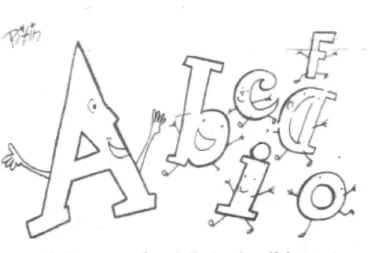
Bohemia showed a smiling, charging group of letters. The caption read “Attack, comrades!
Against the illiteracy!” The simple line drawing emphasized the simplicity and universal appeal of teaching others to read while highlighting the way that militaristic language was adopted for peaceful purposes. The cartoonist, Pitin, expanded on that militaristic theme several weeks later, turning books and pencils into weapons in a cartoon titled “Cultural Trench Warfare.” A banner titled “Primer” flew from a rifle above a rampart made of books, while a pencil aimed over the rampart like a cannon. The inaugural issue of Arma Nueva, the official bulletin of the
National Literacy Commission, made a similar point in a cartoon of a tank titled “The Great Battle for Literacy.” A later scholar would observe that in the Literacy Campaign “force was replaced by reason. Bayonets were exchanged for pencils, military treatises
Figure 4: "Attack, comrades! Against the illiteracy!" (Pitin, Bohemia 53, no. 6 (1961), 112)
19
for books and writing pads,” but these cartoons suggest that the two could exist together and not replace one another.36 Nevertheless, the Cuban nation was winning its war.
Illiteracy and ignorance were also personified in many of the cartoons, such as one from July that showed illiteracy as a skeletal creature
pushed into a grave by a tombstone shaped like a book. More frequently, however, illiteracy and ignorance appeared under attack from young men. In April, for example, illiteracy was pictured as a terrified ghost fleeing a squad of teachers. By December, with the end of the Literacy Campaign in sight,
36 Luisa Eng, La mujer cubana en la revolución educacional (Havana: Letras Cubanas, 1985), 22.
Figure 6: "The Great Battle for Literacy" (Ardion, Arma Nueva, no. 1 (Jan-Mar 1961), 32)
Figure 9: Untitled (Pitin, Bohemia 53, no. 49 (1961), 65) Figure 7: The Cover of the Grave" (Horacio,
"La tapa de la sepultura," Bohemia 53, no. 28 (1961), 130)
cartoons became celebratory. Pitin, for example, published a cartoon on the success of the Literacy Campaign in the first week of December; a smiling male brigadista fired a flag with the slogan “Territory Free of Illiteracy” from a cannon. Uncle Sam and a hairy monster labeled “Illiteracy” ran in terror. Cartoons like this one reinforced the theme of illiteracy as a systemic problem imposed by imperialist powers like the United States. In eradicating illiteracy, Cubans saw themselves defeating the
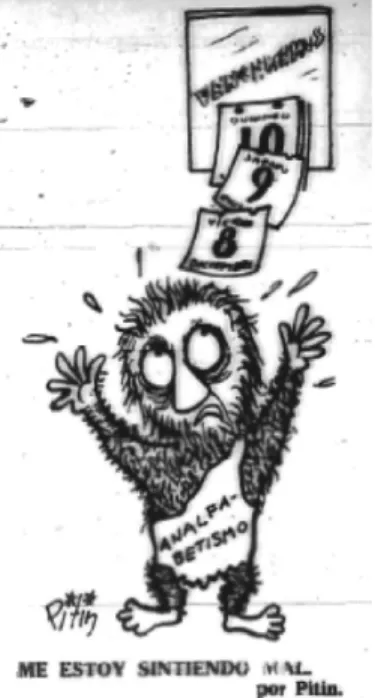
United States. The character Illiteracy returned the following week, throwing up his hands in despair and staring with dread at pages torn from a calendar, remarking: “I am feeling bad.”
Some cartoons avoided the metaphor of war, instead highlighting selfish and even ignoble motivations for learning to read. Unlike cartoons of the War on Ignorance, these images prominently featured women in ways that might demean their motives for participating. One published at the start of the teaching project in January showed a simple cause
and effect relationship: a domestic worker learned to read in the first panel, and in the second received a large paycheck. This was typical of cartoons picturing women; women appeared in the
workforce, but not responding to the same lofty ideals as men. Instead, the
Figure 10: "I am Feeling Bad" (Pitin, Bohemia 53, no. 50 (1961), 73)
21
educated worker remained in her low-status job, dependent on men to teach and pay her. Even magazines for women, such as the biweekly publication Vanidades, emphasized the less-than-honorable goals of women in the workplace. Its regular section “Laugh Along” frequently pictured women as materialistic seductresses who exploited men. One such cartoon, “You’re hired!” showed a buxom young woman sitting demurely in front of the desk of her distracted employer, who seemed to respond more to her charms than the chaos of his office. At least in caricatures, Cuban women failed to exhibit the values for which men like Conrado Benítez died. The
1959 revolution may have proposed a model for a New Man, but the existence of New Women was questioned. Women participating in the Literacy Campaign had to find alternate models for action or ignore these stereotypes.
Women Brigadistas
Unlike what the propaganda images of Conrado Benítez and other young men would suggest, men did not comprise a majority of the teachers in the 1961 Literacy Campaign, and the faithful women who supported them at great personal cost were not the only patriotic women in Cuba. Among the Conrado Benítez brigadistas, for example, young women were 55 percent of the teaching force. Their absence from publicity materials indicates that the metaphor of war and ideas about a new Cuba did not yet include a symbolic place for women, and echoing their relative physical absence from the front lines of previous violent conflicts. Small numbers of Cuban women certainly fought as early as the Ten Years’ War of 1868 to 1878 and some scholars have described this presence of Cuban women in combat as ubiquitous, but this overlooks the fact that they were never a significant portion of the regular army though they were significant in the urban resistance against Batista.37 Even in the rural insurgency of the 1950s, women formed only a single, segregated brigade named for Mariana Grajales.38 Women in
37 Kathryn Lynn Stoner, “Militant Heroines and the Consecration of the Patriarchal State: The Glorification
of Loyalty, Combat, and National Suicide in the Making of Cuban National Identity,” Cuban Studies 34 (2003): 72.
38 Scholarship on the role of women in combat during the 1950s has generally supported the idea that
23
combat were exceptional, not ordinary. The Literacy Campaign increased the presence of women on the front lines of the war for education, but within this metaphor their place was undefined. Unlike Conrado Benítez, a “New Man” in a new Cuba, women were called upon to perform the task at hand, not to fundamentally change what it meant to be a woman in Cuba. Individual women might redefine their positions in society through their literacy work, but the government and the media continued to emphasize traditional roles like that of mother, secretary, or domestic worker.
Since the Literacy Campaign presented the public with a loosely defined “New Woman” who would leave behind traditional gender roles for a few months to teach, all women could be recruited. Propaganda targeted women from virtually all parts of society, promising many paths to patriotic literacy work. While propaganda materials with male subjects focused on a few important individuals—typically young, single, male, and martyred—women in propaganda materials came from a variety of backgrounds. The youngest teacher, a white eight-year-old, and the oldest student, a black centenarian who was born a slave, were women. Today, their pictures hang in the same gallery of the Museum of the National Literacy Campaign as the pictures of martyred male teachers, all young adult men. Female brigadistas, like their male counterparts, were a popular
subject, appearing as wholesome, attractive representatives of the new government who could express doubts and insecurities more easily than their male counterparts. Mothers,
grandmothers, and unmarried adult women also received attention in speeches and news coverage of the Campaign, with targeted calls to action for each demographic.
Nevertheless, female brigadistas were the group most frequently highlighted in news of the Literacy Campaign. While artists depicted young men in cartoons or for recruiting posters, women dominated news of the day-to-day process of teaching. Young, idealistic, patriotic women braving hardship and danger in the wilderness offered much to capture the imagination, or at least more than a housewife teaching her maid to read, in the judgment of many media outlets. Therefore, brigadistas were ubiquitous in coverage of the Campaign, or at least ubiquitous in media that needed a name and a face of a living volunteer for the daily update on the progress of the war on ignorance.
The national news magazine Bohemia appeared to put forward a new standard of female beauty based on the brigadistas, exchanging glamorous movie stars for these uniformed young women. The editors of the magazine, which had the widest circulation of any Cuban periodical, strove to represent the best of the country for the rest of the world to see. To this end, they covered Cuban art, cinema, and literature, the quality of which they believed was equal to that of Europe or North America. While many other Cuban periodicals featured articles on Hollywood actors, for example, Bohemia preferred to publicize domestic acting talent alongside short stories by Cuban writers like Dora Alonso and nonfiction pieces on Latin American cultural luminaries like Pablo Neruda. Photographs and cartoons appeared as well, with the intention of appealing even to illiterate Cubans.39 Before the Literacy Campaign, Bohemia consistently featured photo pieces on fair-skinned Cuban actresses or beauty pageant contestants in makeup and
25
minimal clothing, representing another sort of Cuban excellence that Americans frequently interpreted as promiscuity.
These styles of dress now connoted a decadent, corrupt past to be left behind. Modest dress and patriotic educational work took their place. The leaders of the 1959 revolution proposed to liberate Cuban women from centuries of oppression, just as they had done for other underserved groups like blacks and the poor. Modest attire was one symbol of this move to a liberated but chaste Cuba. For decades, Cuba had been a brothel, a casino, and a bar for U.S. citizens looking to escape Prohibition or cold northern winters. Celebrities like Ava
Gardner, who honeymooned in Havana in 1951, fondly recalled the bright lights of its “gambling houses, whorehouses, and brightly lit cafes” for others seeking vacation
destinations, while writers like Graham Greene elaborated on its corruption.40 Americans who came to Cuba on the eve of the Revolution particularly remarked on the ways that the women lived up to the promises of publications like Bohemia. Brothels were a
particularly appealing way to explore Cuba, and frequently owned by the Mob.41 The Korean War veteran Neill Macaulay, for example, on his way to fight with the rebels in
40 Quoted in Pérez, Cuba in the American Imagination: Metaphor and the Imperial Ethos, 233.
41 Carrie Hamilton, Sexual Revolutions in Cuba: Passion, Politics, and Memory (Chapel Hill: University of North Carolina Press, 2012), 26-27.
Pinar del Río, remarked that not only were the prostitutes he saw attractive, but also “Cuban whores were probably the most polite in the Western Hemisphere.”42 Politeness and beauty were certainly compatible with the ideology of the Revolution, but styles of beauty associated with the decadent lifestyle of the 1950s were now unacceptable. Cuban women could be redeemed, and a change of wardrobe was one way to start the process. Even contemporary accounts of social workers trying to help prostitutes better
themselves frequently emphasize how “ignorance and necessity” forced them into this line of work, and their potential to be redeemed as virtuous patriots in the mold of
brigadistas.43
The editorial staff at the magazine generally allied itself with the new
government, with both institutions holding compatible nationalist sentiments that largely avoided questions of forced censorship. Over the course of the Literacy Campaign, actresses and beauty pageant contestants began to fade out of the magazine and were replaced with equally fair-skinned female brigadistas in uniform. On January 22, for example, an anonymous young woman wearing a rosary
appeared on the cover of the magazine. She was a teacher chosen to represent “the
42 Neill Macaulay, A Rebel in Cuba: an American’s Memoir (Micanopy: Wacahoota Press, 1999), 26.
43 Olga Ferrer, quoted in Laurette Séjourné and Tatiana Coll, La mujer cubana en el quehacer de la
historia, (Mexico D.F.: Siglo Veintiuno Editores, SA, 1980), 38.
27 attitude of the real Cuban woman, present in all the fronts of the new Cuba: production, culture, combat, and social welfare.”44 Other photographic covers connected to the Literacy Campaign featured a statue of Mariana
Grajales on May 14, in honor of Mothers’ Day, and a brigadista working with the mother and daughter of her host family on November 12. By December 10, the tone of the coverage became celebratory, with the cover of the magazine featured a collection of
brigadistas, both male and female, together planting the flag of the Literacy Campaign. The following week, a drawing made the same point. Individual male brigadistas, named or anonymous,were never featured so
prominently as female ones on these covers. Women remained a significant presence in news coverage of the Literacy Campaign, which permeated the work of virtually every news outlet. For most of 1961, education was the single largest issue in the
44 “La portada de Bohemia,” Bohemia 53, no. 4 (1961), 65.
Figure 15: Cover of Bohemia (53, no. 50 (1961))
news, on average comprising nearly one quarter of every issue of Bohemia. Often, this meant that the Literacy Campaign received more coverage than Cuban relations with the United States and the Soviet Union combined. The Cold War raged everywhere else, with the United States and Soviet Union competing for
influence on the island, but in Cuba in 1961 the Literacy Campaign was of paramount importance. The choice to teach or learn offered Cubans a sense of agency in an anxious world, and women were integral to that sense of agency. Even in a country where the government exercised an ever-increasing hold on the media, this dedication was remarkable. At the height of the Cold War, with the United States and the Soviet Union competing for influence around the world and in their own backyard, Cubans were strikingly unconcerned with their place in the
drama.
The invasion of Playa Girón on April 17, organized and financed by counterrevolutionary exiles and the United States government was the sole
Figure 18: "In formation, ready for training in the duties of literary
education. The brutal imperialist aggression, valiantly defeated by the nation, does not detain them in their sacred labor." (“Varadero: Un paraiso para los brigadistas ‘Conrado Benítez’,”Bohemia 53, no. 17 (1961), 90)
29
interruption to the media coverage of the Literacy Campaign. Starting April 17, news coverage absolutely shifted to the traditional Cuban military of men wielding firearms, men who could repel the invaders and prevent the fall of the government that organized the War on Ignorance. Brigadistas were not forgotten, though. A new training camp at the beach resort of Varadero opened a few weeks before the attack, and Bohemia singled out some of the thousands of young women training there in its coverage. In spite of the recent violence, by April 23 the Literacy Campaign was “business that will never halt because of the crime committed by the invading mercenaries…the Revolution equips
brigadistas with the physical and spiritual resources to become men and women.”45 Accompanying photographs emphasized studious young women, as well as groups of young adults.
While Bohemia was the largest news magazine in the country, it was certainly not the only publication that covered the Literacy Campaign. The biweekly magazine Vanidades
also covered the role of women in the Literacy Campaign for its main readership, women. Articles and photographs of female brigadistas
appeared between horoscopes, recipes, and spreads on French fashions until the close of the magazine late in the year. Covers of this magazine
45 Panchito Cano, “Varadero: Un paraiso para los brigadistas ‘Conrado Benítez’,” Bohemia 53, no. 17 (1961), 88.
almost uniformly pictured the faces of young, attractive, frequently nonwhite women, exactly as they had in previous years. Inside, the editors presented the Literacy Campaign and a broader spectrum of Cuban womanhood. Starting with the first pages of the
magazine that year, young women appeared in uniform carrying both firearms and books to defend “the threatened patria” with lessons they learned in a newly constructed
school.46 In stark contrast to Bohemia and even the covers of the magazine, brigadistas in
Vanidades were white, black, and mulata, with less rigid ideas about female beauty. The black instructor Onelia Marín, for example, was singled out as a “wonderful instructor, who commands with precision and martial spirit. Her company is one of the best…her colleagues are very satisfied with her, and her superiors admire and respect her.”47 Marín, like Conrado Benítez, was black, and this emphasis on racial harmony helped reinforce the idea that all Cubans could find fulfillment in an egalitarian Revolution.
Throughout the year 1961, Vanidades also published several profiles of young women, particularly teachers, who exemplified different elements of revolutionary dedication. Unlike Conrado Benítez, these women were free to express the doubts and insecurities any patriotic Cuban might harbor. One such young woman was Argelia Aliet, described in one profile as “ardent and firm in her wish to serve.”48 Like Conrado
Benítez, Aliet enrolled in the teacher training program at Minas del Frío in late 1960. Unlike Benítez, however, Aliet spoke openly of her fears at difficulty of the task ahead of her and the remoteness of her placement, as well as the tears of relief she shed on being welcomed into the community where she would teach with open arms. Working with
46 Elena de los Santos, “Las mujeres cubanas, vanguardia de la patria amenazada,” Vanidades, no. 13 (1961), 10-12 and 123-124.
47 Ibid., 12, 123.
31
members of the community increased her self-confidence, until she could proudly assert that a personal and communal victory was inevitable: “No, I could not permit the failure of those hopes, that enthusiasm, that devotion to going beyond shown by all!...Each morning was a new triumph over my weakness and my selfishness.”49 In a hostile environment, Aliet forged relationships with her students and worked with them to improve the lives of each participant and the nation, exactly as the government had hoped. Revealing these moments of weakness, followed by triumph over that weakness, offered a more accessible model for aspiring Cuban patriots.
Adult Women in Education
Young people like Argelia Aliet and Onelia Marín were not the only women courted through the Literacy Campaign. The new government sought the support of women from all walks of life. Housewives and spinsters would also be mobilized and made virtuous in support of the government. Doing so clearly helped to solidify its hold on power, but also emphasized its confusion about the role of women in the new society under construction. This society had already seen significant changes before 1959— Cuban women only received the right to vote in 1940, well within living memory. However, in the rhetoric of the government and its representatives in the National Literacy Commission, elections were not sufficient to guarantee rights in practice. As with long-enfranchised blacks and mulattoes who suffered discrimination before 1959, all women needed opportunities not available under previous regimes. Unlike the
comprehensive legal change for Cubans of color, moves toward full equality for women were slow and sometimes contradictory. Two notable groups whose support was solicited through the Literacy Campaign were educated single women, most notably Cuban nuns, and mothers who might be educated but had dropped out of the workforce.
33
Nelly and Lourdes. Like many of the brigadistas featured elsewhere, the former sisters were essentially disposable, with their letters bearing little relation to the contents of the article that framed them. While photographs of Nelly and Lourdes were prominently displayed, the author of the framing article spared only a few sentences on the women who tried unsuccessfully to combine dedication to religious life with service to the Revolution. Thus, the women addressed the Cuban reading public with little mediation, but also little time to communicate their messages.
In the letters, each woman explained why she believed that she owed a great deal to the Church. Nelly, the daughter of peasants, had entered a convent school at the age of thirteen. Life in the Church was a route to a better life for her, giving her access to higher education. Lourdes was orphaned at the age of two, but also found security and personal fulfillment in religious life as a young adult. Unlike many of their colleagues in the Catholic Church, however, these nuns wrote not to express anger at the new government, but rather to praise it. Both women recounted how they had left their Dominican convent in Havana to work as teachers in the service of the Revolution. Lourdes was particularly direct about her motivations. “Fidel only follows the same doctrine as Jesus,” she wrote, “giving water to those who are thirsty, giving food to those who are hungry, and shelter to itinerant workers.”50 For these women, religious devotion converged with patriotic and humanitarian values to impel them into a new life in the secular world after the institution they loved, in their assessment, failed them. Liberated from their convent, with its
counterrevolutionary denunciations of new social welfare programs, Nelly and Lourdes
were just two examples of the New Women the Revolution claimed to empower as teachers. Even so, it was unclear if religion and patriotism could coexist.
The role of mothers in society was even more complicated because of the demands placed on families by the Revolution. The ideology of marianismo, where women selflessly underwent hardships for the good of their husbands, children, and ultimately their country, following the example of the Virgin Mary, was held to prove their moral superiority and right to be heard in politics on issues of social welfare and the family.51 Mariana Grajales, who lost nine of her eleven sons to the fight for Cuban
independence, and Leonor Pérez, the mother of José Martí, were notable examples of this phenomenon because both derived their importance in Cuban history from the male relatives they sacrificed. Ideally, women were not passive in the struggle for a better Cuba—they pressed their male relatives into the service of the patria.52 Even in peacetime, the moral authority of women as mothers was a driving force in Cuban feminism.53 In the Literacy Campaign of 1961, mothers remained a galvanizing force, sending sons to fight for the glory of the nation or die trying, but they appeared less enthusiastic about sending their daughters to do the same tasks. Faced with this
51Marianismo derives from Spanish Catholic views of women as morally and spiritually superior to men, likening them to the Virgin Mary. Scholars exploring this ideology in Cuba have included K. Lynn Stoner in her history of civil rights for women and Louis A. Pérez Jr. in his history of suicide. In Stoner, this takes the form of twentieth century women claiming the right to vote as a means to cleanse society of its ills, particularly poverty and the detrimental effects of unhappy marriages. Pérez begins his analysis with the nineteenth-century wars of independence, where marianismo was used to spur women to greater acts of self-sacrifice in the name of independence. It is not a uniquely Cuban phenomenon. Lorraine Bayard de Volo, for example, explores a similar veneration of motherhood in the Nicaraguan revolution among Sandinistas and Contras. Lorraine Bayard de Volo, Mothers of Heroes and Martyrs: Gender Identity Politics in Nicaragua, 1979-1999 (Baltimore: Johns Hopkins University, 2001); K. Lynn Stoner, “From the House to the Streets: Women’s Movement for Legal Change in Cuba, 1898-1958,” unpublished PhD dissertation, Indiana University, 1983; Louis A. Pérez Jr., To Die in Cuba: Suicide in Society (Chapel Hill: University of North Carolina Press, 2005).
52 Pérez, To Die in Cuba: Suicide in Society, 104.
35
reluctance, the new government did not fundamentally destabilize the discourse of
marianismo, with its emphasis on the family. Instead, parents were gently chided for underestimating their daughters in ways that suggested that the family could remain the moral foundation of patriotic Cuban society.
Over the course of the 1961 Literacy Campaign, seventy-one teachers, students, and other literacy workers died. Only four of these deaths, those of Conrado Benítez, Delfín Sen Cedré, Pedro Morejón, and Manuel Ascunce, were attributed to
counterrevolutionary forces. The rest died from accidents and disease that often resulted from living and working in remote areas with little access to medical care. Brigadistas
comprised a large portion of the fallen, as they traveled to some of the most remote areas of the country. Few of these brigadistas left behind extensive documentation of their lives—often the most unique detail about these brigadistas was the reaction their parents gave to reporters. Mothers of these teachers publicly expressed pride in the work of their male and female children, describing them as loyal soldiers in an army of teachers. One of the youngest teachers to die during the Literacy Campaign was Héctor Pouton, at the age of twelve. After his death, his mother proudly declared that he “did not abandon his post.”54 The mother of fifteen-year-old Victoria Vega had a similar statement for the country: “my daughter will continue to the end.”55 The mother of Manuel Ascunce was similarly committed to the cause of universal literacy. Ascunce was a sixteen-year-old Conrado Benítez brigadista who taught in the Escambray in the fall of 1961, the same area where Benítez died in January. Like Benítez, Ascunce was targeted for his work. Counterrevolutionary forces ambushed Ascunce at the home of his host family while he
54 Campos Gallardo, Yanes Álvarez, and Zayas Montalván, Yo soy el maestro, 12.
was out of uniform, threatening to kill everyone if the teacher did not come forward. According to the mother of the family, on hearing this threat, Ascunce announced: “I am the teacher,” sacrificing himself to protect his students.56 His grieving mother encouraged women to keep their children at their teaching placements, “I know that no [mother] will recall their children from their placements, because now more than ever we must stand firm. Cuban mothers; not one step backwards.”57 In the spirit of traditional marianismo, these mothers were ready to see their young sons and daughters die for a worthy cause.
In spite of the danger their children might face, most parents eventually gave their blessing to see their children leave home. Anecdotal evidence suggests, however, that the parents of young women were less likely to welcome an interest in teaching from their children. Some young women, such as Leonela Inés Relys Díaz dealt with this by forging signatures on permission slips and simply running away. Díaz lived with her
grandparents, and first asked for their permission. Years later, she proudly recalled that she “signed the paper for them!”58 Others, like the sixteen-year-old Lillian Delia Navarro Morán, forged the signature for their permission slips but still wanted their approval before leaving. Navarro registered in secret at first and stored her new uniform and equipment with a friend who supported her desire to teach. Not long before she was scheduled to leave, she confronted her family, insisting that the opportunity was too important to pass up: “I’m going, with or without boots, with or without backpack.”59 Even parents who supported the insurgency throughout the 1950s and identified as
56 Ibid., 6.
57 Quoted in Ibid., 10.
58 Quoted in Matilde Serra Robledo, et al., El pueblo dice…: Vivencias de la campaña de alfabetización de
Cuba. (Havana: Asociación de Pedagogos de Cuba, 1999) 18.
59 Quoted in Rebecca Herman, “An Army of Educators: Gender, Revolution and the Cuban Literacy
37
Communists or socialists often had reservations about the practice of the gender equality they supported in theory, arguing that their daughters were too young to face the risks of life as a brigadista. The twelve-year-old Adria Santana was one such brigadista. She forged the signature of her father to join, later pressuring him to let her join since “a communist couldn’t say no.”60 Nevertheless, tens of thousands of young women volunteered, earning them praise from the media that in turn encouraged more young women to follow their example. Even young women who forged signatures and lied to their parents to join the brigadistas were admired, since the cause was important enough to justify such minor transgressions.61
While the role of women was changing and parental authority faced new challenges from young women, the family remained an important component of
revolutionary Cuba. Supervisors and organizers tried to ensure that families remained in touch during the Campaign. Contact was particularly important because brigadistas were isolated from their families and in unfamiliar surroundings, making them susceptible to homesickness or feelings of isolation. UNESCO observers in Cuba at the time
commented approvingly on policy under which “the brigadista, isolated from his usual surroundings, was visited by his family who, if the need arose, had always an automobile at their disposal despite the scarcity of vehicles and the fact that gasoline was difficult to obtain.”62 Thus, children were never totally cut off from their parents, a fear emphasized by Cuban expatriates discussing the Literacy Campaign.
60 Quoted in Ibid., 105.
61 Ibid., 104-105.
Officials within the government also emphasized the importance of respecting family even when it led to temporary gender inequality, such as the placement of young men in more dangerous parts of the country. In an address to brigadistas on this subject the prime minister, Fidel Castro, sided with the young men and women who advocated complete equality, but effectively deferred to parental concerns: “We sometimes hear protests when we send boys to the most isolated places and girls closer to towns. But by no means does this mean that we have any discriminatory ideas about women. The fact is that we are responsible to your parents, and must take every precaution to put them at ease.”63 By placing young women in safer, more controlled environments, their safety was protected so they could return to their parents as happy, healthy adults, albeit ones whose agency remained circumscribed.
In each of these models of revolutionary womanhood, a particular type of woman was courted, sometimes in contradictory ways—single young women could be fully autonomous adults, older childless women could be rejuvenated, and mothers could be idolized for the contributions of their children but still be respected if they acted to protect them. All of these promises could not be fulfilled at once. Young women, for example, were part of two of these promises: the Literacy Campaign promised them autonomy from their parents, but it also promised parents continued control over their daughters. Likewise, men who supported the 26th of July Movement did not necessarily want their wives and girlfriends working outside the home, no matter how patriotic the job. These promises made to and about young women frequently came into conflict. In the assessment of the former brigadista Cándido Rosa Orizondo Crespo, however, these
39
conflicts were usually resolved in favor of the young woman: “in the spirit of the time, the young men made their decisions alone, but the young women had to wait for the consent of their parents and fiancées, some of whom flatly refused. There were engagements broken and wedding plans called off, but the majority obtained permission.”64
Victory
The Literacy Campaign of 1961 succeeded in its primary goal: teaching Cubans to read and write. Its promises for women, however, were not uniformly fulfilled. The Literacy Campaign neither guaranteed equality for all Cuban women, nor was it the start of a comprehensive program of reform in gender policy. In oral histories given since the Campaign, individual brigadistas recalled their teaching careers as a transformative experience. Popular histories echoed this sentiment, enshrining the Literacy Campaign in the popular memory as a transformative moment for women, but it did not match the reality experienced by Cuban women in the decades that followed. Evidence suggests that women neither achieved full equality with men through the Literacy Campaign of 1961, nor was this a goal expected to be realized through the Campaign. Instead, the government used organizations like the Federación de Mujeres Cubanas (FMC) to mobilize women for limited objectives in the service of the Revolution, administratively and ideologically subordinating women to the predominantly male central government even when gains were made relative to other countries.
One part of this continuing problem of inequality was the national federation of women, the FMC, founded in 1960. Fidel Castro is originally credited with the idea for this organization, even to the point of convincing his sister-in-law, Vilma Espín, to be its chief administrator.65 Espín, a chemical engineer who had studied at some of the best universities in the United States, later claimed to have experienced virtually no bias
41
because of her gender, but acquiesced to lead the organization. This close relationship between the FMC and national leaders highlighted both its strengths and weaknesses; the FMC immediately gained legitimacy through its association with the highest echelons of the 26th of July Movement, but because of those same close ties it was frequently unable to act as a critic of the regime. Thus, the FMC had some success in initiatives like the establishment of permanent childcare centers, but women still entered the workforce in lower numbers than men.66 The FMC also had some notable successes relative to other socialist countries. Unlike the USSR, for example, Cuban women did not face restrictions on their employment in certain industries over health concerns.67 Particularly when compared to other activists and systems of government in neighboring countries, the Castro government and the FMC offered a relatively comprehensive plan for the betterment of the status of women.68
Within these limited gains there were significant discursive limitations that were even apparent in the symbol of the FMC: a uniformed woman carrying a baby in one arm and a machine gun in the other. Women were still overtly associated with maternity and the home, contradicting the discourse that called them from the homes of their parents to serve as brigadistas. One reason for this change in message from the government was its initial lack of interest in gender policy. Most important government officeholders were middle-class, white, heterosexual men who can be charged with “[betraying] views
66 Maxine Molyneux, “Socialist Societies Old and New: Progress Towards Women’s Emancipation?,”
Feminist Review, no. 8 (Summer 1981): 7,19.
67 Maxine Molyneux, “State, Gender, and Institutional Change: The Federación de Mujeres Cubanas,” in
Hidden Histories of Gender and the State in Latin America, ed. Elizabeth Dore and Maxine Molyneux (Durham: Duke University Press, 2000), 295.
68 Maxine Molyneux, “Twentieth-Century State Formations in Latin America,” in Hidden Histories of
associated with the prerevolutionary dominant classes, in particular about the desired roles of women and men and the undesirability of homosexuality.”69 Thus, the revolution had limits even within the New Men who led it. These limits reproduced themselves in government policy and the daily lives of Cuban women once there was no longer an urge to appeal to every single Cuban citizen for the day-to-day survival of the regime.
What is more, overtly feminist projects were taboo. For decades after the 1959 revolution the capitalist feminism of the United States and Western Europe appeared antithetical to the socialist liberation of women. Where American feminists saw themselves as experiencing a specific type of discrimination, the FMC and the Cuban government generally argued that feminism would not treat the underlying problem of inequality. Thus, while activists might have similar goals, they often opposed one another on ideological grounds. In 1975, for example, the same year that the Family Code went into effect, guaranteeing women total equality inside and outside the home, Vilma Espín stated: “the liberation of women cannot be separated from the liberation of society in general…A woman cannot have any political, economic, or social rights in a capitalist society where she suffers from class oppression and discrimination.”70 In the view of FMC administrators, feminism as practiced in the United States addressed a single symptom in a broad social malady, and it could hurt the larger cause of universal equality, dividing and weakening the nation. Two years later, Espín still spoke dismissively of feminists, saying “we see these movements in the U.S.A. which have conceived struggles for equality of women against men! That is absurd! For these
69 Hamilton, Sexual Revolutions in Cuba: Passion, Politics, and Memory, 1.