International Journal On Engineering Technology and Sciences – IJETS™
ISSN (P): 2349-3968, ISSN (O): 2349-3976 Volume 1 Issue 7, November 2014
RELIABLE DEADLINE-DRIVEN RESOURCE
ALLOCATION FOR CLOUD SYSTEM
REDUCING USER PAYMENT
Ms.V.SATHYA DEVI, M.E., (CSE), JAY SHRIRAM GROUP OF INSTITUTIONS,
TIRUPPUR. [email protected]
Ms.A.GOKILAVANI,M.E.,(Ph.D).,
ASSISTANT PROFESSOR/CSE,
JAY SHRIRAM GROUP OF NSTITUTIONSTIRUPPUR [email protected]
Abstract— Cloud computing is a new computing paradigm that makes use of the Internet for the tasks that are performed on the computer. With Cloud computing it is possible to access applications and associated data from anywhere. It has massive potential on enterprises that rent computing resources on demand. The cloud computing environments multiplex many users on the same physical infrastructure and also provide an illusion of unlimited computing resources to users. Hence, the user can add to or reduce their resource utilization rate according to the demands. However, achieving good resource allocation is a greater challenge. Better Resource allocation should minimize the costs associated with it; meet customer demands and application requirements. Virtualization technology achieves better allocation strategy for on demand cloud resources.
In this project, 1) A deadline-driven resource allocation problem on the cloud environment is formulated and a polynomial time solution is proposed to minimize user payment in terms of their expected deadlines. 2) A reliable (fault-tolerant) method to guarantee task’s completion within its deadline based on the upper bound of task execution length is proposed. 3) The effectiveness of the system is validated over a real VM-facilitated cluster environment under different levels of competition. By tuning algorithmic input deadline based on the derived bound, task execution length can always be limited within its deadline in the sufficient-supply situation and also in short-supply situation.
Index Terms—Cloud Computing, Resource Allocation, Cost reduction.
I. INTRODUCTION
Cloud computing provides a suitable, on-demand network access to a shared pool of configurable computing resources (software, data storage, network, etc.) that can be rapidly provisioned and released with minimal management effort or service provider interaction. It is an Internet-based computing solution where shared resources are provided like electricity distributed on the electrical grid. Computers in the cloud are configured to work together and the various applications use the collective computing power as if they are running on a single system. The characteristics of cloud computing are: user friendliness, virtualization, Internet centric, variety of resources, automatic adaptation, scalability, resource optimization, pay-per-use, service SLAs (Service-Level Agreements) and infrastructure SLAs.
Reduced cost: Cloud computing can reduce both capital expense (CapEx) and operating expense (OpEx) costs because resources are only acquired when needed and are only paid for when used.
Refined usage of personnel: Using cloud computing frees valuable personnel allowing them to focus on delivering value rather than maintaining hardware and software.
Robust scalability: Cloud computing allows for immediate scaling, either up or down, at any time without long-term commitment.
Cloud computing platforms are rapidly emerging as the preferred option for hosting applications in many business contexts. Startup companies are relying on public cloud infrastructures to deploy their applications, which help
reducing their initial costs. Larger companies are also adopting clouds, either public clouds for expanding their existing infrastructures or rapid deployment of test environments, or private clouds for dynamic on-demand provisioning of virtual resources among their internal divisions. All the resources provisioned by cloud system are supposed to be under a payment model. Each task’s workload is likely of multiple dimensions. First, the compute resources in need may be multi-attribute (such as CPU, disk-reading speed, network bandwidth, etc.), resulting in multidimensional execution in nature. Second, even though a task just depends on one resource type like CPU, it may also be split to multiple sequential execution phases, each calling for a different computing ability and various price on demand, also leading to a potentially high-dimensional execution scenario.
OBJECTIVE
Objective of the project is to formulate a deadline driven resource allocation problem based on the cloud environment facilitated with VM resource isolation technology. To derive an optimal solution based on convex optimization theory that minimizes user payment in terms of their expected deadlines during sufficient supply situation. To derive a reliable method that assures tasks completion within its deadline. To derive a reliable method that assures tasks completion within its deadline when the predicted workload information is inaccurate. To derive an optimal solution that minimizes user payment in terms of their expected deadlines during short supply situation
EXISTING SYSTEM
the compute resources among the multiple applications simultaneously running atop it due to the inevitable mutual performance interference among them. Whereas, cloud systems usually do not provision physical hosts directly to users, but leverage virtual resources isolated by VM technology. Not only can such an elastic resource usage way adapt to user’s specific demand, but it can also maximize resource utilization in fine granularity and isolate the abnormal environments for safety purpose.
Customary job scheduling is often formulated as a kind of combinatorial optimization problem or queue-based multiprocessor scheduling problem. That is, most of the existing deadline-driven task scheduling solutions from single cluster environment confined in LAN to the Grid computing environment suitable for WAN are also strictly subject to the queuing model under which a single machine’s multiple resources cannot be further split to smaller fractions at will.
Some successful platforms or cloud management tools leveraging VM resource isolation technology include Amazon EC2 and Open Nebula. On the other hand, with fast development of scientific research, users may propose quite complicated demands. For example, users may wish to minimize their payments when guaranteeing their service level such that their tasks can be finished before deadlines. Such a deadline-guaranteed resource allocation with minimized payment is rarely studied in literatures. Moreover, inevitable errors in predicting task workloads will definitely make the problem harder.
Traditional optimization problems are often subject to the precise prediction of task’s characteristic (or execution property), which is nontrivial to realize in practice. Also existing systems does not support analyze algorithm’s optimality approximation ratio given the possibly wrong predictions of tasks’ execution properties. Even if there are few recent studies to minimize user payment and meet the task deadline in the sufficient supply situation, there is not one that studies the features in short-supply situation.
ISSUES IN EXISTING SYSTEM
In Existing systems, there are no predictors for identification of high load. Some predictors are available, those predictors takes the wrong decision making. In resource allocation some errors are generated. Also, cost utilization is high. Moreover, existing system cannot always guarantee to execute task within their deadlines. It cannot guarantee high compatibility among more than two VMs on the same machine. It does not consider the fact of tasks to be executed within their deadlines in short-supply situation.
II. PROPOSEDSYSTEM
The aim of the proposed work is to design a resource allocation algorithm with high prediction error tolerance ability based on the elastic resource usage model, also minimizing users’ payments subject to their expected deadlines. Since the idle physical resources can be arbitrarily partitioned and allocated to new tasks, the VM-based divisible resource allocation could be very flexible. This implies the feasibility of finding the optimal solution through convex optimization strategies, unlike the traditional Grid
model that relies on the indivisible resources like the number of physical cores.
The first contribution is devising a novel approach (with only O(n. R square)time complexity) to solve the problem, where R denotes the number of execution dimensions and n is the system scale (the number of compute nodes). Also, the algorithm’s optimality approximation ratio will be analyzed given the possibly wrong predictions of tasks’ execution properties. In particular, when application’s characteristic is predicted with certain levels of errors, will the application’s final execution length (a.k.a., execution time) violate (or surpass) its deadline? If yes, what is the ratio of the final execution time to its deadline? These theoretical results will be significantly valuable to the guarantee of user’s service level in practice. In fact, by setting a relatively stricter deadline properly based on the derived approximation ratio, each task can be guaranteed to be finished within its original deadline even though task properties cannot be predicted accurately. The payment minimization and the guarantee that the tasks are finished within deadline will be analyzed for both sufficient and short-supply situations. For short-supply situations, the idea is to extend the derived algorithm for sufficient supply situation with earliest deadline first algorithm.
III. MODULESOFPROPOSEDWORK
A) MODULES: The modules are:
Optimal Resource Allocation
Load Distribution
Payment Minimization
Fault Tolerance
Optimal Resource Allocation
In this module, the demand for computing power and other resources as a resource allocation problem with multiplicity, where computations that have to be performed concurrently are represented as tasks and a later task can reuse resources released by an earlier task. An algorithm (Optimal Resource Allocation) with a proof of its approximation bound that can yield close to optimum solutions in polynomial time is formulated. Enterprise users can exploit the solution to reduce the leasing cost and amortize the administration overhead. Load Distribution
In this, the incoming tasks are distributed to available system resources to achieve good load balance in a fully decentralized and heterogeneous cloud environment. Each task’s workload is likely of multiple dimensions. First, the compute resources in need may be multi-attribute (such as CPU, disk-reading speed, network bandwidth, etc.), resulting in multidimensional execution in nature. So, resources are allocated for task with its resource requirements that can minimize a task’s execution time. The workload ratio between the data to be read/written from/to disk and those to be downloaded/uploaded via network is decided by comparing their data sizes.
Payment Minimization
International Journal On Engineering Technology and Sciences – IJETS™
ISSN (P): 2349-3968, ISSN (O): 2349-3976 Volume 1 Issue 7, November 2014
request from user, the scheduler checks the pre-collected availability states of all candidate nodes, and estimates the minimal payment of running the task within its deadline on each of them. The host that requires the lowest payment will run the task via a customized VM instance with isolated resources. Specifically, the VM will be customized with such a CPU rate and disk I/O rate that the task can be finished within its deadline and its user payment can also be minimized meanwhile. Finally its computation results will be returned to users.
Fault Tolerance
Cloud systems usually do not provision physical hosts directly to users. If the resources provisioned are relatively sufficient, we can guarantee task’s execution time always within its deadline even under the wrong prediction about task’s workload. Each task can be guaranteed to be finished within its original deadline even though task properties cannot be predicted accurately.
B) DATA FLOW DIAGRAM
The DFD is also called as emit chart. It is a simple graphical measurement that can be used to represent a system in terms of input data to the system, different processing taken out on this data and the resultant data is taken by this system. The data flow diagram (DFD) is one of the most important simulation tools. It is utilized to design the system structure. These components are the system process, the information accessed by the process, an outward entity that interacts with the system and the information flows in the organized structure. DFD depicts how the data pass through the system and how it is modified by a series of alterations. It is a pictorial technique that depicts information flow and the transformations that are applied as data moves from input to output. DFD is also known as emit chart. A DFD can be utilized to introduce a system at any level of précised content. DFD may be segregated into levels that represent increasing information flow and functional detail.
Fig 1. Data Flow Diagram
Fig 1 depicts the Data Flow diagram where the data flows are from three sources the load vector, the cloud server and the availability vector. The data flows from load vector to task
submission and from there to task scheduling. The workload calculation gets input from task scheduling unit and analyzes the workload and sends it to deadline driven unit. The resource allocation unit gets input from all the three sources to allocate resources.
IV. SYSTEMARCHITECTURE
Task
DeadLine Monitor and Driven Recovery
Load Distributor
Resource
User
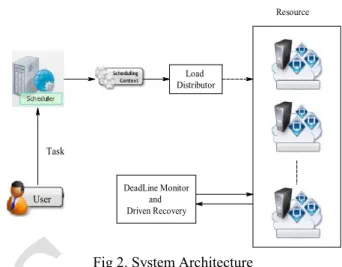
Fig 2. System Architecture
Fig 2 depicts the Architecture diagram where the users task is first sent to the scheduler. The scheduler on receiving the task schedules the task based on the scheduling context and sends it to Load Distributor. The load distributor tries to achieve good load balance in a fully decentralized and heterogeneous cloud environment. It allocates resources for task such that the task’s execution time is minimized. The Deadline Monitor and Driven Recovery guarantees task’s execution time is always within its deadline even under the wrong prediction about task’s workload.
V. SYSTEMREQUIREMENTS
A) Hardware Requirements
CPU : Pentium IV Speed : 2 GHz RAM : 512 MB Hard disk : 40 GB Keyboard : 105 keys Mouse : Logitech mouse Monitor : 15 VGA color
B) Software Requirements
Front end : Java
IDE : Eclipse/Net Beans Back end : MySql 5.5 Operating system : Windows 7
VI. CONCLUSION
the same machines. By analyzing the upper bound of task’s execution time compared to its deadline and taking advantage of the derived bounds and approximation ratio, QoS of user task can be guaranteed in terms of their demands.
VII. FUTUREWORK
In the future, there is a plan to integrate the algorithms with stricter/original deadlines into some excellent management tools like OpenNebula, for maximizing the system-wide performance. More complex scheduling constraints like the compatibility and security issue will also be taken into account.
SCREEN SHOTS
RESOURCE REGISTRATION WITH CLOUD
SERVER
USER REGISTRATION WITH
CLOUD
Task Details
Resource Details
VIII. REFERENCES
[1] Armbrust.M, FoxA., Griffith.R, Joseph.A.D, Katz.R.H, Konwinski.A, Lee.A, Patterson.D.A, Rabkin.A, Stoica.I, and Zaharia.M, “Above the Clouds: A Berkeley View of
Cloud Computing,” Technical Report
UCB/EECS-2009-28, EECS Dept., Univ. California, Berkeley, Feb. 2009.
[2] Khazaei.H, Misic.J.V, and Misic.V.B, “Modelling of Cloud Computing Centers Using m/g/m Queues,” Proc. Int’l Conf. Distributed Computing Systems Workshops (ICDCS), pp. 87-92, 2011.
[3] Mao.M and Humphrey.M, “Auto-Scaling to Minimize Cost and Meet Application Deadlines in Cloud Workflows,” Proc. Int’l Conf. High Performance Computing, Networking, Storage & Analysis (SC ’11), pp. 49:1-49:12, 2011.
International Journal On Engineering Technology and Sciences – IJETS™
ISSN (P): 2349-3968, ISSN (O): 2349-3976 Volume 1 Issue 7, November 2014
[5] Matthews.J.N, Hu.W, Hapuarachchi.M, Deshane.T, Dimatos.D, Hamilton.G, McCabe.M, and Owens.J, “Quantifying the Performance Isolation Properties of Virtualization Systems,” Proc. Workshop Experimental Computer Science (ExpCS ’07), 2007.
[6] Meng.X, Isc.C, Kephart.J, Zhang.L, Bouillet.E, and Pendarakis.D, “Efficient Resource Provisioning in Compute Clouds via VM Multiplexing,” Proc. Seventh Int’l Conf. Autonomic Computing (ICAC ’10), pp. 11-20, 2010.
[7] Nathuji.R, Kansal.A, and Ghaffarkhah.A, “Q-Clouds : Managing Performance Interference Effects for Qos-Aware Clouds,” Proc. European Conf. Computer Systems (EuroSys ’10), pp. 237-250, 2010.
[8] Sheng Di, Cho-Li Wang, “Error Tolerant Resource Allocation and Payment Minimization for Cloud System”, IEEE Transactions on Parallel and Distributed Systems,2013.
[9] Vaquero.L.M, Rodero-Merino.L, Caceres.J, and Lindner.M, “A Break in the Clouds: Towards a Cloud Definition,” SIGCOMM Computer Comm. Rev., vol. 39, no. 1, pp. 50-55, 2009.
[10]Wu.Y, Hwang.K, Yuan.Y, and Zheng.W, “Adaptive Workload Prediction of Grid Performance in Confidence Windows,” IEEE Trans. Parallel and Distributed Systems, vol. 21, no. 7, pp. 925-938, July 2010
.AUTHORS BIOGRAPHY
Ms. V.Sathya Devi received her B.E. degree in Kongu Engineering College, Perundurai. Currently pursuing M.E. degree in Computer Science and Engineering at Jay Shriram Group of Institutions, Tiruppur. Her research interests include Cloud Computing and Network Security.
E-mail: [email protected]
Ms. A.Gokilavani received her B.Tech. degree in Karpagam College, Coimbatore and M.E degree in RVS College of Engineering, Coimbatore.
Currently she is working as an Assistant Professor in Jay Shriram Group of Institutions, Tiruppur. Her research interests include Cloud Computing , Data Mining and Operating Systems.