AN INFRARED STUDY OF THE CIRCUMSTELLAR MATERIAL ASSOCIATED WITH THE CARBON STAR R SCULPTORIS
M. J. Hankins1, T. L. Herter1, M. Maercker2, R. M. Lau3, G. C. Sloan4,5 Draft version November 9, 2018
ABSTRACT
The asymptotic giant branch (AGB) star R Sculptoris (R Scl) is one of the most extensively studied stars on the AGB. R Scl is a carbon star with a massive circumstellar shell (Mshell∼7.3×10⁻³ M)
which is thought to have been produced during a thermal pulse event ∼ 2200 years ago. To study the thermal dust emission associated with its circumstellar material, observations were taken with the Faint Object InfraRed CAMera for the SOFIA Telescope (FORCAST) at 19.7, 25.2, 31.5, 34.8, and 37.1µm. Maps of the infrared emission at these wavelengths were used to study the morphology and temperature structure of the spatially extended dust emission. Using the radiative transfer code DUSTY and fitting the spatial profile of the emission, we find that a geometrically thin dust shell cannot reproduce the observed spatially resolved emission. Instead, a second dust component in addition to the shell is needed to reproduce the observed emission. This component, which lies interior to the dust shell, traces the circumstellar envelope of R Scl. It is best fit by a density profile withn∝rαwhere α= 0.75+0.45
−0.25 and dust mass ofMd= 9.0−+2.34.1×10−6 M. The strong departure
from an r−2 law indicates that the mass-loss rate of R Scl has not been constant. This result is
consistent with a slow decline in the post-pulse mass-loss which has been inferred from observations of the molecular gas.
Subject headings: stars: AGB, stars: Mass-Loss
1. INTRODUCTION
Stars on the asymptotic giant branch (AGB) are an im-portant source of metal enrichment and dust production in the interstellar medium (ISM) (e.g., Matsuura et al. 2009;Boyer et al. 2012). Characterizing the mass-loss of AGB stars is fundamental to our understanding of this phase of stellar evolution (Willson 2000, and ref. therein) and the evolution of the ISM in galaxies (Valiante et al. 2009). AGB stars experience helium burning in ther-mal pulses (TPs), leading to the dredge-up of freshly produced carbon to their surfaces, and high mass-loss rates which transport material to the ISM (Habing 1996, and ref. therein). Observations of circumstellar shells associated with several nearby carbon stars have pro-vided interesting insights on mass loss during and after TP events (Olofsson et al. 1990;Olofsson 1996;Maercker et al. 2012).
R Sculptoris (R Scl) is a nearby (d∼370 pc;Maercker et al. 2016) AGB star which is well studied in a vari-ety of different wavelengths (e.g., Sch¨oier et al. 2005;
Sacuto et al. 2011). R Scl is a carbon star with mas-sive circumstellar shell (Mshell= 4.5×10⁻³ M) that is
thought to have been produced during a TP of the star
∼1800 years ago (Maercker et al. 2012)6. Circumstellar
1Department of Astronomy, Cornell University, 202 Space
Sci-ences Building, Ithaca, NY 14853, USA
2Department of Space, Earth and Environment, Chalmers
University of Technology, Onsala Space Observatory, 43992 On-sala, Sweden
3Jet Propulsion Laboratory, California Institute of
Technol-ogy, 4800 Oak Grove Drive, Pasadena, CA, 91109-8099, USA
4Department of Physics and Astronomy, University of North
Carolina, Chapel Hill, NC 27599-3255, USA
5Space Telescope Science Institute, 3700 San Martin Drive,
Baltimore, MD 21218, USA
6Note thatMaercker et al.(2012) adopts a closer distance to R
material associated with R Scl has been observed using scattered-light-imaging (Gonz´alez Delgado et al. 2001;
Olofsson et al. 2010), polarization (Maercker et al. 2014), and emission from molecular gas (Maercker et al. 2012;
Vlemmings et al. 2013;Maercker et al. 2016). However, the thermal dust emission is not as well studied. Previ-ous works have analyzed mid-infrared spectra of R Scl (e.g.,Hony & Bouwman 2004), although the large radial extent of the dust shell (Rshell∼20”) presents issues with
observing the total flux from the circumstellar material. To improve our understanding of the dust emission in the mid-infrared, R Scl was observed using the Faint Ob-ject Infrared CAmera For the SOFIA Telescope (FOR-CAST; Herter et al. 2012) at 19.7, 25.2, 31.5, 34.8, and 37.1µm. Examining R Scl at these wavelengths is par-ticularly interesting because it is near the peak of the observed dust emission (Sch¨oier et al. 2005). Addition-ally, R Scl is known to be a carrier of the 30 µm MgS featureHony & Bouwman(2004) which is also of interest. The spatial resolution provided by SOFIA/FORCAST at 19.7–37.1µm (∼3.2–3.8”) is sufficient to resolve the ex-tended dust shell associated with R Scl. By modeling the spatial distribution of the dust emission, it is possible to fit the emission from the dust shell and constrain con-tributions from the present-day mass loss. Constraining these components provides a probe of the recent mass-loss history of R Scl.
ALMA observations of R Scl have implied a substan-tial reservoir of molecular gas inside its extended shell (Maercker et al. 2012, 2016). The post-TP mass loss, which is responsible for generating this material, could play a substantial role in the total mass loss of R Scl,
Scl (d∼290 pc) which influences the mass and timescale determi-nation.
which has significant implications for its lifetime on the AGB (Maercker et al. 2016). If there is a substantial amount of dust associated with the molecular gas in-side of the shell, the FORCAST observations may con-strain this dust component. In either case, the FOR-CAST data provides an interesting comparison with the earlier ALMA observations.
In addition to studying the mass-loss history of R Scl, the FORCAST imaging observations also allow us to study the temperature and morphology of the dust emission. Previous observations of the shell have noted features which show deviations from spherical symmetry (Olofsson et al. 2010;Maercker et al. 2014,2016). Some of these features, such as the flattening in the southern portion of the shell, may be related to interactions of the circumstellar material produced by R Scl and its binary companion (Maercker et al. 2014).
2. OBSERVATIONS AND DATA REDUCTION
2.1. SOFIA/FORCAST
We observed R Scl with the 2.5 m telescope aboard the Stratospheric Observatory for Infrared Astronomy (SOFIA) using the FORCAST instrument (Herter et al. 2012). FORCAST is a 256 ×256 pixel dual-channel, wide-field mid-infrared camera with a field of view of 3.40 ×3.20 and a plate scale of 0.76800per pixel. The two channels consist of a short-wavelength camera (SWC) operating at 5 – 25 µm and a long-wavelength cam-era (LWC) opcam-erating at 28 – 40 µm. An internal dichroic beam-splitter enables simultaneous observation from both short-wavelength and long-wavelength cam-eras, while a series of bandpass filters is used to select specific wavelengths.
FORCAST observations of R Scl were taken during SOFIA cycle 4 on 2016 July 18 and 19 on flights 323 and 324. R Scl was observed with the 19.7, 25.2, 31.5, 34.8 and 37.1 µm filters. To increase the efficiency of observations, the 19.7 & 31.5 and 25.2 & 34.8 were si-multaneously observed using the dichroic beamsplitter, while the 37.1 filter was observed individually.
Parallel chopping and nodding on the array were used to remove the sky and telescope thermal backgrounds. The frequency of the chop throw was ∼ 4 Hz, and the integration time at each nod position was∼170 s. A five-point dither pattern aided the removal of bad pixels and mitigated response variations. Table 1 provides further details of the observations.
The final processed data of R Scl were downloaded from the SOFIA Science Center. The quality of the im-ages is consistent with near-diffraction-limited imaging from 19.7 to 37.1 µm; the full width at half maximum (FWHM) of the point spread function (PSF) was 3.000 at 19.7 µm, 3.100 at 25.2 µm, 3.500 at 31.5 µm, 4.000 at 34.8µm, and 4.000at 37.1µm. The RMS noise per pixel was 2.6 mJy at 19.7µm, 3.4 mJy at 25.2µm, 2.7 mJy at 31.5 µm, 3.9 mJy at 34.8 µm, and 2.2 mJy at 37.1µm. The estimated 3σ uncertainty in the flux calibration is
±20%.
To bring the observations at different wavelengths to the same spatial resolution, the data were deconvolved using the Richardson-Lucy algorithm (Richardson 1972, Lucy 1974). The PSF was estimated from in flight ob-servations of the calibrator 2 Pallas, which were taken
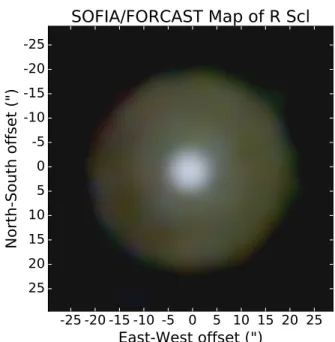
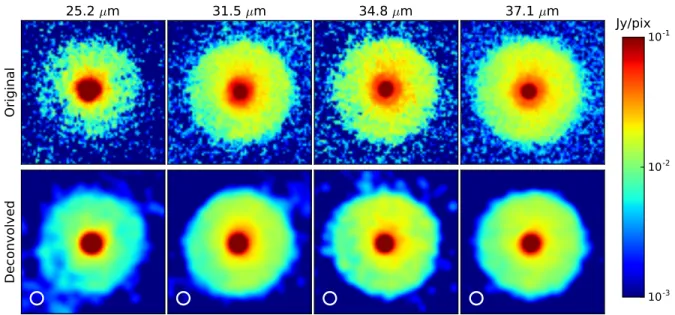
on the same flights as R Scl. After the deconvolution, the maps were convolved back to a uniform beam size of 4.000. Figure 1 displays a false-color map of R Scl using the 25.2, 31.5, and 37.1 µm data, and Figure 2 shows colormaps for the data at each wavelength.
-25 -20 -15 -10 -5 0 5 10 15 20 25
East-West offset (")
25
20
15
10
5
0
-5
-10
-15
-20
-25
North-South offset (")
SOFIA/FORCAST Map of R Scl
Fig. 1.—False color map of R Scl created with the the 25.2 (blue), 31.5 (green), and 37.1µm (red) FORCAST data.
2.2. Data from Other Sources
Data from a variety of sources were used to construct a multiwavelength SED of R Scl. Visible and near-infrared magnitudes were taken from Sacuto et al. (2011) and
Whitelock et al. (2006). Additional observations taken with Herschel/PACS at 70µm were downloaded from the Herschel archive. These data were originally presented byCox et al.(2012) along with Herschel observations of a large sample of AGB stars.
Aside from photometric data, ISO/SWS spectra of R Scl were also available. These data were taken from the uniform database of ISO/SWS spectra (Sloan et al. 2003). R Scl was observed on six different occasions by ISO/SWS (Observation IDs: 24701012, 37801213, 37801443, 39901911, 41401514, 56900115). For this anal-ysis, an average spectra was created from the different data sets. The ISO/SWS spectra are useful to compare with the FORCAST data because the wavelength cov-erage of the SWS usually overlap the FORCAST data. This provides us with an independent check of the FOR-CAST flux calibration. However, comparison between FORCAST and ISO/SWS must be treated carefully be-cause of the extended nature of R Scl.
Original
25.2
µ
m
31.5
µ
m
34.8
µ
m
37.1
µ
m
Deconvolved
10
-310
-210
-1Jy/pix
Fig. 2.—FORCAST observations of R Scl at 25.2, 31.5, 34.8, and 37.1µm. The top row shows the observed data, and the bottom row shows the maps after being deconvolved and convolved back to a uniform beam size. The final beam size is indicated by the white circles in the bottom left of the images. The 19µm data is not shown in this figure because the extended emission is low signal which presents issues with the convolution.
2.3. Dust Extinction
Due to the dusty nature of R Scl, there is modest red-dening of the source at visible wavelengths (AV = 0.18).
We applied the extinction corrections fromSacuto et al.
(2011) for visible and near-infrared photometry. The dust extinction at longer wavelengths is negligible.
3. RESULTS AND ANALYSIS
3.1. Morphology of the Extended Dust Emission Observations of R Scl from 25.2 to 37.1µm reveal ex-tended dust emission around the central source.7 The
spatially extended dust emission at these wavelengths is somewhat uniform in surface brightness, which is a stark departure from a limb-brightened emission profile that one would expect from the dust emission of a ge-ometrically thin shell. There is strong evidence for the presence of a dusty shell surrounding the central source at radius Rshell ∼ 20” (Gonz´alez Delgado et al. 2001;
Olofsson et al. 2010;Maercker et al. 2014). The temper-ature of the shell (Tshell = 75 K; Sch¨oier et al. 2005)
indicates that it should contribute significantly in the mid-infrared. The fact that the observed mid-infrared emission does not appear limb-brightened like a shell is intriguing.
To study the extended infrared emission in greater de-tail, radial profiles of the emission were created using the 25.2, 31.5, 34.8 and 37.1 µm maps. The average radial profiles were generated using an azimuthally averaged radial profile over the map, and statistical uncertainties were determined from the sample of pixels at a given ra-dius. Using the average 37.1µm profile, the radial size of the dust emission was measured at 19.2”. Compensating for the convolved beam size (FWHM∼4.0”), this implies a deconvolved radius of 18.8”. This measurement is con-sistent with the radius of the dust shell determined by
Olofsson et al.(2010) whereRshell=18.5–19.9”.
7The dust emission is also present at 19.7µm but is only weakly
detected (∼1σ/pix).
Further examination of the extended dust emission re-veals an interesting dimming toward the east of the cen-tral source, which is apparent in each of the FORCAST maps from 25.2 to 37.1 µm. To show this feature more clearly, the average radial profile at 37.1µm was plotted along with a several line cuts through the map in Figure
3. The dip in the emission is strongest toward the south-east. It is interesting to note that this feature in the east/southeast corresponds to a region that appears dim in scattered light, but bright in polarization (Maercker et al. 2014). These characteristics could indicate a tem-perature or optical depth effect, though there are several other possible explanations. The next section examines the temperature structure of the dust emission.
0 5 10 15 20 25
Radius (as)
0.00 0.01 0.02 0.03 0.04 0.05 0.06 0.07
Su
rfa
ce
B
rig
ht
ne
ss
(J
y/a
s
2
)
37
µ
m Radial Profile Comparison
North South East West Southeast Avg. 37.1 µm
Fig. 3.—A comparison of the average radial profile at 37µm with cuts taken through different portions of the data, as indicated in the legend. An additional cut is shown in the southeast, which shows the strongest drop in the observed emission.
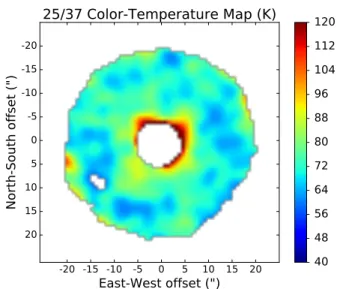
To study the temperature of the dust associated with R Scl, we created a color-temperature map of the observed emission. We assumed that the dust emission is optically thin and can be expressed asFν∼QνBν(Td), whereQν
is the optical efficiency of the dust andTdis defined as the
color-temperature. SinceQν∝νβ (or equivalentlyQν ∝
λ−β), the proportionality of the flux with frequency is
simply: Fν ∝ Bν(Td)νβ. Taking a ratio of two filters
leaves Td and β as the only unknowns. Adopting an
index (β = 2), the color-temperature can be calculated (Figure4).
The average temperature of the dust emission is Td=74±10 K.8 This result corresponds well with a
grey-body peaking near ∼30µm and agrees with a previous determination of the temperature of the dust from fitting the SED (Td = 75±15 K; Sch¨oier et al. 2005). Overall
the temperature of the emission appears fairly uniform, though this may be slightly deceptive since the emission has been collapsed along the line of sight. If there are multiple dust components along the line of sight, it would not be possible to separate them in a map like this. Ad-ditionally, the broad MgS feature located near 30 µm could influence the temperature determination. While the 25 µm filter is likely unaffected by this feature, the FORCAST bands at 31, 34, and 37 µm may have some additional contribution from MgS dust. Section 3.4 will return to this point with more sophisticated models of the dust emission.
-20 -15 -10 -5 0 5 10 15 20
East-West offset (")
20 15 10 5 0 -5 -10 -15 -20
North-South offset (")
25/37 Color-Temperature Map (K)
40
48
56
64
72
80
88
96
104
112
120
Fig. 4.—Color-temperature map of the thermal dust emission associated with R Scl, generated using 25 and 37µm FORCAST data. The bright central source has been masked to better show the extended dust features. Additional details can be found in§3.2. The average temperature of the dust emission is 74±10 K.
3.3. Infrared Spectra of R Scl
ISO/SWS spectra of R Scl provide a large range of contiguous wavelength coverage (2.4-45µm), which over-laps with FORCAST, and moderate spectral resolution (R∼930-2450;Leech et al. 2003). To account for the ex-tended nature of R Scl (Rshell ∼ 20”), which is much
8 There is an additional 15% uncertainty in the absolute value
of the color-temperature due to the absolute flux calibration of the two bands.
larger than the ISO/SWS aperture sizes (14”×20” to 20”×30”), photometry from the FORCAST maps were extracted over apertures equivalent to the ISO/SWS. Figure 5 plots these data, along with the average spec-tra of R Scl. Overall, FORCAST photometry and the ISO/SWS spectra agree fairly well. This demonstrates consistency between the two data sets over the range from 19.7 to 37.1µm.
15 20 25 30 35 40 45
Wavlength (µm)
10 20 30 40 50 60 70 80
Fν
(J
y)
Comparison of FORCAST and ISO/SWS
ISO/SWS FORCAST
Fig. 5.— Comparison of the average ISO/SWS spectra of R Scl with the observed FORCAST photometry, which has been ex-tracted in an aperture matching the ISO/SWS observations. The shaded regions of the spectra indicate the uncertainty due to source variability (e.g., Onaka et al. 2002) and mismatch problems be-tween the different ISO/SWS bands (seeSloan et al. 2003).
By comparing the fraction of the flux contained within the ISO/SWS aperture to the total source flux observed by FORCAST at a given wavelength, it is possible to derive correction factors for the ISO spectra as if it had observed the full source. For the different FORCAST fil-ters, the fractional flux contained in the ISO/SWS aper-ture is 1.0 at 19.7 µm, 0.65 at 25.2 µm, 0.59 at 31.5 µm, 0.58 at 34.8 µm, and 0.59 at 37.1µm. For compar-ison, the ratio of the area of the largest ISO/SWS aper-ture (20”×33”, corresponding to 660 arcsec2) and the
extended dust emission (R=18.8”, corresponding to 1110 arcsec2) is 0.6. Assuming that the flux from the source
is uniformly distributed, this value agrees well with the ratios derived from the FORCAST observations, except at 19.7 µm where the flux from the central point source is more dominant.
3.4. DUSTY Models
The radiative transfer code DUSTY (Nenkova et al. 2000) was used to model the thermal dust emission. For an initial model, we started with a simple geometrically thin dust shell. Parameters for the shell, such as the mass, size, and temperature, were adopted from the lit-erature. Table 2 lists these values and their references. To improve the model, these parameters were allowed to vary and additional dust components were also consid-ered. This process is described in the following subsec-tions. For each model, DUSTY was used to compute the expected SED for the source as well as radial profiles for each of the FORCAST bands. These results were compared to the observed data using a χ2 analysis to
3.4.1. Dust Properties
In the DUSTY models, an MRN size distribution was adopted for the dust grains (dn/da ∝ a−3.5, a
min =
0.005 µm, and amax = 0.25 µm; Mathis et al. 1977).
While it is possible to modify the grain sizes, for ISM grains with typcial sizes, the thermal emission is rela-tively insensitive to this effect. The dust composition was modeled as a mixture of three dust species: amor-phous carbon (AmC), silicon carbide (SiC), and magne-sium sulfide (MgS). The fractional abundance by mass for each component was 0.86 AmC, 0.10 SiC, and 0.04 MgS. These values are consistent with the abundances of SiC and MgS determined bySacuto et al. (2011) and
Hony & Bouwman (2004). Optical properties for each dust component were taken from Zubko et al. (2004),
Pegourie(1988), andBegemann et al.(1994).
AmC dust dominates the total dust mass, and un-certainties in the optical constants for this dust species can have a substantial impact on various model param-eters. For example, Groenewegen & Sloan (2017) find that models of carbon stars using the optical properties of Zubko et al. (1996) result in dust masses which are a factors of ∼5-11 times less than models using the op-tical properties of Rouleau & Martin (1991). For this work, the optical constants from Zubko et al. (2004) were adopted because they are able to reproduce physical properties of the dust shell such as the size and tempera-ture. Models with the constants fromRouleau & Martin
(1991) cannot reproduce the observed size and tempera-ture of the shell without forcing the luminosity to unre-alistically low values. In stating this, it is important to keep in mind that model-dependent uncertainties in the total dust mass have a substantial effect on calculating the total mass loss.
Studies of MgS dust in AGB stars have found that a cu-mulative distribution of ellipsoidal particles (CDE) does a better job of reproducing the observed 30µm feature than a distribution spherical particles (Begemann et al. 1994;Hony & Bouwman 2004). Consequently, the opti-cal properties fromBegemann et al.(1994) were used to calculate extinction coefficients for CDE shapes accord-ing to (Bohren & Huffman 1983, chp. 12). To examine the effect of the MgS dust on the spectrum of R Scl, models with varied MgS abundance from 0 to 10% were studied. The upper limit on the dust abundance is set by the limited amount of Mg and S available to produce dust (Hony & Bouwman 2004).
3.4.2. Geometry
Figure6 panel A shows the radial emission profile for the initial shell model along with the observed radial pro-file at 37 µm. The data show a clear excess at radii between (∼5−15”) compared to the model. While it might be possible to make slight improvements to the fit of this model by scaling up the dust mass, the shape of the profile, which is largely dictated by the geometry of the shell, cannot reproduce the observed radial pro-file. Thus, the observed emission cannot be explained by the shell model alone. As noted in §3.1, the dust shell is expected to be dominant in mid-infrared wavelengths. Therefore, the excess dust emission is likely a secondary dust component, which appears to be located interior to the shell.
To study the excess emission, the model from panel A was subtracted from the observed radial emission profile. Panel B of Figure 6 shows the resulting profile. Since the dust surrounding R Scl is sufficiently optically thin, it is possible to model the secondary dust component separate from the shell component. To model the excess emission, DUSTY was used to create an additional set of models with different radial density distributions for the dust. For the models, a power law was adopted for the density profile with n∝rα, and varied the value of α from -2 to 2 in increments of 0.25. Additional model parameters, such as the inner and outer radii, were also varied to ensure goodness of fit. Table2lists these values and additional parameters used in the models.
3.4.3. Results
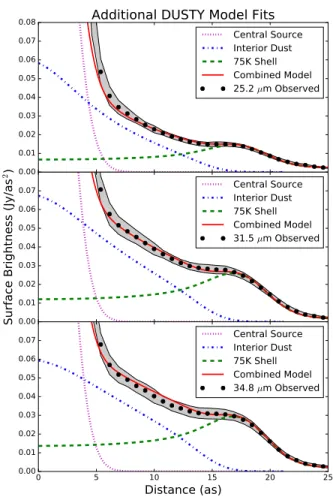
The best-fit radial density profile for the interior dust component was found to be α= 0.75+0.45−0.25. Panel C of Figure 6 shows the combined model with the emission from the shell and the interior dust distribution. Corre-sponding models for each of the other FORCAST wave-lengths were compared with the observed data to ensure consistency. Figure7shows these models and data agree well for the other three bands.
Next, the model SED of R Scl was compared with the observed photometry to ensure the different physical pa-rameters adopted for the stellar component and the dust at longer wavelengths agree with the data. Figure8plots the multi-component DUSTY model and the observed SED of R Scl. Overall, the fit for the DUSTY model does a satisfactory job of reproducing the observed SED. Last, the dust mass was calculated for the DUSTY model at different wavelengths to check the overall scal-ing to the observed flux. The dust mass for the 37.1µm model isMd = 9.0+2.3−4.1×10⁻⁶M. The model at 31.5 &
34.8µm are both comparable to this, while the 25.2µm is slightly smaller (Md∼4×10⁻⁶ M). This difference
could be related to the broad MgS feature because the 31.5, 34.8, and 37.1µm bands likely have some contribu-tion from it. Alternatively, the difference in the masses could indicate deviations from the expected radial tem-perature profile. Determining the dust mass is strongly dependant on temperature and could easily explain the observations. In either case, these effects are difficult to infer with the available data.
Considering the dust abundances further, it is chal-lenging to place constrains on the strength of the MgS emission feature using the FORCAST photometric data alone. The level of the feature on top of the continuum emission appears comparable to the FORCAST calibra-tion uncertainty. To improve constraints on the models, the ISO/SWS spectra were also examined. The broad 30 µm feature is more clearly visible in the average spectra of R Scl because of the increased wavelength coverage and higher spectral resolution. Although, the shape and strength of the feature between the six different ISO ob-servations shows significant variation. These changes are likely artifacts, as there are well documented issues with hysteresis in band 4 of the SWS (ranging from 29–45µm;
Sloan et al. 2003). Thus, the data in this region must be treated with considerable caution.
0.00 0.01 0.02 0.03 0.04 0.05 0.06 0.07
A)
37
µ
m DUSTY Emission Model
Central Source 75 K Shell Combined Model Observed 0.00 0.01 0.02 0.03 0.04 0.05 0.06Su
rfa
ce
B
rig
ht
ne
ss
(J
y/a
s
2)
B)
Central SourceInterior Dust Combined Model Excess Emission
0 5 10 15 20 25
Distance (as)
0.00 0.01 0.02 0.03 0.04 0.050.06
C)
Central SourceInterior Dust75 K Shell Combined Model Observed
Fig. 6.—Observations of the radial emission profile of R Scl at 37.1µm along with models of the dust emission generated by DUSTY. Panel A shows the observed radial profile along with a model for the dust emission from the shell surrounding R Scl. The model for the shell is a poor fit to the data. Panel B shows the residual emission left after subtracting the shell model from panel A. This residual was fitted to determine the radial density profile of the interior dust component. Panel C shows the combination of the best-fit model from panel B along with the shell model from panel A. Note that the observed profiles only consider statistical uncertainties in the data and not the absolute flux calibration.
between the data from 19.7 to 37.1 µm. However, the spectrum beyond this is suspicious. Comparing SED models of R Scl to the spectra, the downturn in the spec-tra from∼35 – 45 µm cannot be reproduced while also fitting the photometry out to 70 µm. It is unfortunate that the spectra at these wavelengths are not more reli-able, as it would greatly improve constraints on the MgS dust emission. Considering these issues, it is not possible to provide updated constraints on the MgS abundance with the available data.
4. DISCUSSION
4.1. Mass-loss History
By constraining the density profile of the interior dust distribution, the FORCAST data have provided us with a glimpse into the post-TP mass loss of R Scl. The fol-lowing steps were taken to model the mass-loss history for R Scl. First, the radial distribution of dust was used to infer the amount of mass at a given radius from R Scl. This depends on both the density profile (fitted in
§3.4.1) and the gas-to-dust ratio of the material (∼590;
Sch¨oier et al. 2005). Next, the timescale of material at different radii was computed based on its expansion
ve-0.00 0.01 0.02 0.03 0.04 0.05 0.06 0.07
0.08
Additional DUSTY Model Fits
Central Source Interior Dust 75K Shell Combined Model 25.2 µm Observed
0.00 0.01 0.02 0.03 0.04 0.05 0.06 0.07
Su
rfa
ce
B
rig
ht
ne
ss
(J
y/a
s
2)
Central Source Interior Dust 75K Shell Combined Model 31.5 µm Observed0 5 10 15 20 25
Distance (as)
0.00 0.01 0.02 0.03 0.04 0.05 0.060.07 Central SourceInterior Dust
75K Shell Combined Model 34.8 µm Observed
Fig. 7.—Observations of the radial emission profile of R Scl at 25.2, 31.5, and 34.8 µm. Models for the shell and interior dust component are shown for each wavelength. The two components combined do a excellent job of reproducing the observed radial emission profile at each wavelength. Note that the observed pro-files only consider statistical uncertainties in the data and not the absolute flux calibration.
100 101 102
wavelength (
µ
m)
1014 1015 1016 1017
ν
F
ν(J
y H
z)
R Scl Model SED
Star Interior Dust 75 K Shell Combined Model Observed SED
Fig. 8.—Observed SED of R Scl with data taken fromSacuto et al. (2011);Whitelock et al. (2006);Cox et al. (2012) and the FORCAST photometry presented in this work. The best-fit two-component (shell + interior dust distribution) DUSTY model de-termined in section 3.4 is shown for comparison.
2012). This variation in gas velocity was approximated as a linear increase of velocity with radius. With the FORCAST data, which does not provide any velocity in-formation, it is not possible to more accurately model the expansion of the circumstellar material.
Figure 9 shows the resulting model of the mass-loss history of R Scl. The solid blue curve denotes the ex-pected mass loss history from the best-fit model, and the green dashed line denotes the mass loss rate of R Scl at the time of the thermal pulse (Maercker et al. 2016). Be-cause the FORCAST observations are limited by their spatial resolution (∼4”), some regions in the plot should be taken with some degree of skepticism. For example, recently produced material (t.400 yr) is not well con-strained by the FORCAST data because its emission is blended with the bright central source. Additionally, the transition region between the interior dust distribution and the outer shell is poorly constrained. The shell com-ponent appears to dominate the emission from R Scl at its outermost radii. However, some interior dust may be blended with and contribute to the emission here as well. High-resolution observations of the circumstellar dust at visible and near-infrared wavelengths may help to constrain the dust components in this region.
Using the resulting mass-loss history from the interior dust component, the average post-TP mass-loss rate was found: M˙ ∼ 2.3×10⁻⁶ M
/yr. This value is
uncer-tain due to unceruncer-tainties in the gas-to-dust ratio, the expansion velocity of the material, and the total dust mass. Considering these issues, it is important to note that while the absolute mass-loss rate may have large uncertainties, the relative change in the mass-loss rate is well constrained by the fitted radial density profile.
0 500 1000 1500 2000 2500
Time (yr)
10-610-5
Ma
ss
Lo
ss
R
at
e (
M
¯/yr
)
Current ˙M
R Scl Mass Loss History
TP Mass Loss Post-TP Mass Loss
Fig. 9.—Mass-loss history for R Scl inferred from the density profile of the interior dust component (blue line). The uncertainty in the mass loss rate (light blue region) was estimated from the un-certainty in the total dust mass determined by the DUSTY models. As discussed in the section 4.1, there are several additional uncer-tainties in determining the absolute mass-loss rate which make the value difficult to constrain. However, the relative change in the mass-loss rate is well constrained from modeling the extended dust emission. The blue dotted line is an extrapolation of the inferred mass loss rate out to the time when the TP occurred, and the black dashed line indicates the current mass loss rate.
Observations of molecular gas emission from R Scl have
also been used to study material inside of the shell.9 Us-ing these data, Maercker et al. (2016) infer an average post-TP mass-loss rate of ∼ 1.6 ×10⁻⁵ M/yr.
Be-cause of the different methods for determining the mass-loss rate and the large uncertainties associated with each method, it is difficult to compare the mass-loss rates from this work andMaercker et al.(2016).
The expected post-TP mass loss for R Scl based on the classical TP scenario (∼ 7×10⁻³ M
; Maercker et al. 2016) is comparable to the mass of the interior component determined by the FORCAST observations (∼ 5×10⁻³ M). However, the classical scenario for
TPs assumes a sharp decline in the mass loss after the TP, which is inconsistent with the model presented here. The slow declining behavior in the evolution of the mass loss rate is more similar to the result found byMaercker et al. (2012,2016).
Considering the slow decline in post-TP mass-loss rate of R Scl merits some discussion on TPs and other car-bon stars with high mass-loss rates. Other well-known carbon stars are known to have high and unsteady mass-loss rates (e.g. IRC +10216; Sloan & Egan 1995; Decin et al. 2011). While these more extreme objects may be unrelated to normal TP phenomena, more typical post-TP objects can also show multiple shells, which indicate strong variations in mass-loss rate (e.g., U Ant;Gonz´alez Delgado et al. 2003). Studies of additional objects will help determine if R Scl represents the larger population of typical carbon stars. Clearly, more work can be done to address these issues.
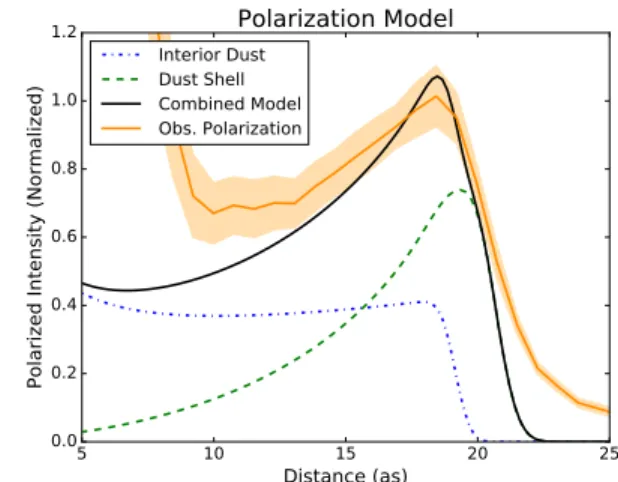
4.2. Comparisons with Polarized Light Observations Observations of scattered light from dust at visible and near-infrared wavelengths have been used to infer the distribution of dust associated with R Scl (Gonz´alez Delgado et al. 2001; Olofsson et al. 2010). Examining the scattered-light intensity is different from the thermal emission because the scattered-light signal is not depen-dant of the temperature of the dust. Nonetheless, these two types of observations have a complementary nature because they both trace the dust distribution. Previous models of the spatial distribution of scattered-light have mainly considered effects from the shell (e.g., Maercker et al. 2014). However, the interior dust distribution dis-cussed in this work could impact these observations. We modeled the light scattering and polarization for R Scl to examine this effect.
For the model, the geometric parameters for the shell and the interior dust distribution were adopted from the models in§4.3, with the exception that the interior dust distribution was allowed to extend out to a radius of
∼18”, which terminates at the shell component. To cal-culate the intensity profile of scattered light, a simple single scattering model was assumed. The integrated scattered-light intensity was calculated along a path, s, described by an impact parameterb, and radiusR, which are related: b = √R2+s2. To estimate the polarized
light contribution, a Rayleigh polarization model was used (P(θ) = (1−cos(θ)2)/(1 + cos(θ)2)), along with
9 This material inside of the shell is referred to as the
the phase function fromDraine(2003)10. Last, the com-puted model profiles were convolved with a Gaussian with FWHM∼1.3” to match the observed polarization data.
Figure10shows the model for the polarized light inten-sity along with the R-band polarized light observations of R Scl from Maercker et al. (2014). The combined model (shell + interior dust) fits the observed polariza-tion better than the shell alone. Previous works, which only considered a single dust shell, underpredicted the amount of polarized light coming from radii interior to the shell. This may have signaled the existence of a sub-stantial interior dust component. However, the quality of the polarization data, which had issues with the cen-tral source masked by the coronograph (.10”), made this emission somewhat suspect. Now that the thermal dust emission has clearly shown the presence of an inte-rior dust component, the results of these two data sets appear consistent. Improved polarization data with sup-pressed effects from the chronograph may provide even better characterization of the interior dust distribution and properties of the dust grains.
5 10 15 20 25
Distance (as) 0.0
0.2 0.4 0.6 0.8 1.0 1.2
Polarized Intensity (Normalized)
Polarization Model
Interior Dust Dust Shell Combined Model Obs. Polarization
Fig. 10.—The polarized-light model for the dust shell and in-terior dust distribution is shown (black) along with the observed R-band polarization fromMaercker et al.(2014) (orange). Consid-ering the effect of an interior dust distribution in addition to the shell fits the data better than the shell alone. The data interior to
∼10” is not reliable due to an issue with the coronagraph.
4.3. Detailed Morphology: Evidence of Binary Interaction?
The structure and morphology of the circumstellar ma-terial associated with R Scl may provide insights into the nature of the source. The dimming in the emission to-ward the east/southeast discussed in§3.1 is a particularly interesting feature. The physical cause of this feature is unclear, though examining this region at other wave-lengths may provide some insight. In the scattered light observations of R Scl, the eastern portion of the emission also appears somewhat fainter than other regions ( Olof-sson et al. 2010), though it appears bright in polarized light (Maercker et al. 2014). These characteristics could indicate the dust in this region is cooler and denser than other parts of the circumstellar material.
10 Note that for δ=0, this expression reduces to the
Henyey-Greenstein phase function
Returning to the color-temperature map (Figure 4), the derived dust temperatures do not show large varia-tions. However, part of the region to the southeast falls below the signal-to-noise cutoff at 25.2µm. In principle, this could be caused by emission which is much cooler than its neighboring regions. Referring to the 70 µm maps from Herschel, the region to the southeast still ap-pears dimmer than its neighboring regions. The south-east feature is not likely to result from changes in tem-perature because the emission at long wavelengths should appear more comparable to neighboring regions, but it could be indicative of a lower dust column along this line of sight.
The flattened southern portion of the shell may have some relation to the southeast feature. Maercker et al.
(2016) suggest that it may have resulted from an interac-tion with R Scl’s binary companion shortly after it was produced. Could an interaction between material pro-duced by R Scl and its binary companion also be respon-sible for the relatively dim regions in the mid-infrared? It is well established that R Scl’s binary companion is act-ing to shape the circumstellar material around R Scl, as evidenced by the interesting spiral-like morphology ob-served in CO emission (Maercker et al. 2012). However, it is unclear if these interactions could also produce a much larger-scale asymmetry in the circumstellar mate-rial. Detailed hydrodynamical modeling of the motions of the gas and dust in the circumstellar environment of R Scl are needed to improve our understanding of this system.
5. CONCLUSIONS
We studied the thermal dust emission from the AGB star R Scl using observations from SOFIA/FORCAST at 19.7, 25.2, 31.5, 34.8, and 37.1 µm. These mid-infrared imaging observations show spatially extended dust emission associated with the circumstellar environ-ment of R Scl. Radiative-transfer modeling with DUSTY revealed that the observed spatial distribution of the dust emission cannot be replicated by a shell alone. In-stead, the observed spatial distribution of emission can be fitted by a shell with an interior dust component. This interior component is best-fitted by a power law n ∝rα withα = 0.75+0.45−0.25, which gives a dust mass of Md = 9.0+2.3−4.1×10−
6 M
. The strong departure from
an r−2 density profile indicates that the mass-loss rate
of R Scl has decreased since the last TP but it has not fallen off as quickly as expected. This result is consistent with a slow decline in the post-TP mass-loss rate inferred from observations of the molecular gas.
The average post-TP mass-loss rate estimated from the dust emission (∼2.3×10⁻⁶M
/yr) is comparable to the
lifetime of stars during this phase (Maercker et al. 2016). To better understand these effects in the population of carbon stars, the mass-loss histories of additional objects need to be studied. Observatories such as SOFIA, the At-acama Large Millimeter Array (ALMA), and the James Webb Space Telescope (JWST) are well suited for these types of studies and will have a significant impact on our understanding of carbon stars and TP behavior in these objects.
Acknowledgments We would like to thank the rest of the FORCAST team, George Gull, Justin Schoen-wald, Chuck Henderson, Joe Adams, the USRA Sci-ence and Mission Ops teams, and the entire SOFIA
staff. We would also like to thank the anonymous ref-eree for the useful comments and suggestions on this paper. This work is based on observations made with the NASA/DLR Stratospheric Observatory for Infrared Astronomy (SOFIA). SOFIA science mission operations are conducted jointly by the Universities Space Research Association, Inc. (USRA), under NASA contract NAS2-97001, and the Deutsches SOFIA Institut (DSI) under DLR contract 50 OK 0901. Financial support for FOR-CAST was provided by NASA through award 8500-98-014 issued by USRA. This material is based upon work supported by the National Science Foundation Gradu-ate Research Fellowship under Grant No. DGE-1144153. MM acknowledges financial support from the Swedish Research Council under grant number 2016-03402.
REFERENCES
Begemann, B., Dorschner, J., Henning, T., Mutschke, H., & Thamm, E. 1994, ApJ, 423, L71 3.4.1
Bohren, C. F., & Huffman, D. R. 1983, Absorption and scattering of light by small particles 3.4.1
Boyer, M. L., Srinivasan, S., Riebel, D., et al. 2012, ApJ, 748, 40
1
Cox, N. L. J., Kerschbaum, F., van Marle, A.-J., et al. 2012, A&A, 537, A35 2.2,8
Cruzal`ebes, P., Jorissen, A., Rabbia, Y., et al. 2013, MNRAS, 434, 437 2
Decin, L., Royer, P., Cox, N. L. J., et al. 2011, A&A, 534, A1 4.1
Draine, B. T. 2003, ApJ, 598, 1017 4.2
Gonz´alez Delgado, D., Olofsson, H., Schwarz, H. E., Eriksson, K., & Gustafsson, B. 2001, A&A, 372, 885 1,3.1,4.2
Gonz´alez Delgado, D., Olofsson, H., Schwarz, H. E., et al. 2003, A&A, 399, 1021 4.1,2
Habing, H. J. 1996, A&A Rev., 7, 97 1
Herter, T. L., Adams, J. D., De Buizer, J. M., et al. 2012, ApJ, 749, L18 1,2.1
Hony, S., & Bouwman, J. 2004, A&A, 413, 981 1,3.4.1,2
Leech, K., Kester, D., Shipman, R., et al. 2003, The ISO Handbook, Volume V - SWS - The Short Wavelength Spectrometer 3.3
Maercker, M., Ramstedt, S., Leal-Ferreira, M. L., Olofsson, G., & Floren, H. G. 2014, A&A, 570, A101 1,3.1,4.2,10,4.3
Maercker, M., Mohamed, S., Vlemmings, W. H. T., et al. 2012, Nature, 490, 232 1,6,4.1,4.1,9,4.3,5
Maercker, M., Vlemmings, W. H. T., Brunner, M., et al. 2016, A&A, 586, A5 1,4.1,4.1,9,4.3,5,2
Mathis, J. S., Rumpl, W., & Nordsieck, K. H. 1977, ApJ, 217, 425
3.4.1
Matsuura, M., Barlow, M. J., Zijlstra, A. A., et al. 2009, MNRAS, 396, 918 1
Nenkova, M., Ivezi´c, ˇZ., & Elitzur, M. 2000, Thermal Emission Spectroscopy and Analysis of Dust, Disks, and Regoliths, 196, 77 3.4
Olofsson, H. 1996, Ap&SS, 245, 169 1
Olofsson, H., Carlstrom, U., Eriksson, K., Gustafsson, B., & Willson, L. A. 1990, A&A, 230, L13 1
Olofsson, H., Maercker, M., Eriksson, K., Gustafsson, B., & Sch¨oier, F. 2010, A&A, 515, A27 1,3.1,4.2,4.3
Onaka, T., de Jong, T., & Yamamura, I. 2002, A&A, 388, 573 5
Pegourie, B. 1988, A&A, 194, 335 3.4.1
Rouleau, F., & Martin, P. G. 1991, ApJ, 377, 526 3.4.1
Sacuto, S., Aringer, B., Hron, J., et al. 2011, A&A, 525, A42 1,
2.2,2.3,3.4.1,8,2
Sch¨oier, F. L., Lindqvist, M., & Olofsson, H. 2005, A&A, 436, 633
1,3.1,3.2,4.1,2
Sloan, G. C., & Egan, M. P. 1995, ApJ, 444, 452 4.1
Sloan, G. C., Kraemer, K. E., Price, S. D., & Shipman, R. F. 2003, ApJS, 147, 379 2.2,5,3.4.3
Valiante, R., Schneider, R., Bianchi, S., & Andersen, A. C. 2009, MNRAS, 397, 1661 1
Vlemmings, W. H. T., Maercker, M., Lindqvist, M., et al. 2013, A&A, 556, L1 1
Whitelock, P. A., Feast, M. W., Marang, F., & Groenewegen, M. A. T. 2006, MNRAS, 369, 751 2.2,8
Willson, L. A. 2000, ARA&A, 38, 573 1
Zubko, V., Dwek, E., & Arendt, R. G. 2004, ApJS, 152, 211 3.4.1
TABLE 1 Observation Details
Flight # Altitude (ft.) Object Filter 1 Filter 2 Integration (s)
323 ∼43,000 R Scl 19.7 34.8 620
323 ∼43,000 R Scl 25.2 31.5 790
324 ∼43,000 R Scl 25.2 31.5 270
324 ∼43,000 R Scl open 37.1 1690
TABLE 2
DUSTY Model Parameters
Parameter Value Type Source
Stellar Temperature 2600 K adopted Cruzal`ebes et al.(2013) Stellar Luminosity 104.0±0.2L
fitted this work
Distance 370 pc adopted Maercker et al.(2016)
Dust Size Distribution dn/da∝a−3.5 adopted this work
Fractional Dust Composition 0.86 AmC adopted this work 0.10 SiC adopted Sacuto et al.(2011) 0.04 MgS adopted Hony & Bouwman(2004) Shell Dust Temperature (Tshell) 75 K adopted Sch¨oier et al.(2005)
Shell Radius 6950 AU (18.8”) fitted this work
Shell Thickness 0.1 adopted Gonz´alez Delgado et al.(2003) Shell Dust Mass 3.7×10⁻⁵M
adopted* Sch¨oier et al.(2005)
Interior Dust Temperature (Tin) 1200 K adopted Sacuto et al.(2011)
Inner Radius (Rin) 10 AU (27 mas) adopted Determined fromTin
Outer Radius (Rout) 5550 AU (15”) fitted this work
Relative Thickness (Y) 550 fitted Y=Rout/Rin
Density Power Law (α) 0.75+0.45−0.25 fitted this work Interior Dust Mass 9.0+2.3−4.1×10
−6M
fitted this work
*For consistency, the dust shell mass has been scaled from the original value quoted in