A R T I C L E
O p e n A c c e s s
CD24
–
p53 axis suppresses
diethylnitrosamine-induced hepatocellular
carcinogenesis by sustaining intrahepatic
macrophages
Dongling Li
1,2, Minling Hu
1, Ying Liu
1, Peiying Ye
3, Peishuang Du
1, Chi-Shan Li
4, Liang Cheng
1, Ping Liu
1, Jing Jiang
5,
Lishan Su
1,6, Shengdian Wang
1, Pan Zheng
3and Yang Liu
1,2,3Abstract
It is generally assumed that inflammation following diethylnitrosamine (DEN) treatment promotes development of hepatocellular carcinoma (HCC) through the activity of intrahepatic macrophages. However, the tumor-promoting function of macrophages in the model has not been confirmed by either macrophage depletion or selective gene depletion in macrophages. Here we show that targeted mutation ofCd24 dramatically increased HCC burden while reducing intrahepatic macrophages and DEN-induced hepatocyte apoptosis. Depletion of macrophages also increased HCC burden and reduced hepatocyte apoptosis, thus establishing macrophages as an innate effector recognizing DEN-induced damaged hepatocytes. Mechanistically, Cd24 deficiency increased the levels of p53 in macrophages, resulting in their depletion inCd24−/−mice following DEN treatment. These data demonstrate that the Cd24–p53 axis maintains intrahepatic macrophages, which can remove hepatocytes with DNA damage. Our data establish a critical role for macrophages in suppressing HCC development and call for an appraisal of the current dogma that intrahepatic macrophages promote HCC development.
Introduction
Hepatocellular carcinoma (HCC) is the third most common cause of cancer-related deaths worldwide. Major risk factors for HCC include hepatitis B virus (HBV) and hepatitis C virus, aflatoxin B1, nonalcoholic steatohepati-tis, chemical carcinogens (alcohol and nitrosamines) and
genetic factors1–3. Accumulating epidemiological and
clinical studies have provided convincing evidence that HCC is an inflammation-related cancer as>90% of HCCs are known to arise in the context of inflammation4,5.
Tumor-associated macrophages (TAMs) are a major
component of the leukocytes infiltrating in tumors. The
prevailing view is that TAMs have a critical role in pro-moting carcinogenesis and is based on several lines of clinical observations. First, increased TAM numbers correlate with angiogenesis, metastasis, and thus poor
prognosis6–9. Consistent with this notion, activated
monocytes/macrophages in the peritumoral stroma of HCC may promote angiogenesis and metastasis by
expanding Th17 and IL-17-producing CD8+T cells (Tc17
cells)10–12. Second, TAM numbers correlate with
intra-tumoral regulatory T cells in HCC patients13,14. Third,
increased expression of PD-L1 in Kupffer cells (KCs) or activated monocytes /macrophages is thought to
con-tribute to the suppression of tumor-specific T-cell
immunity in HCC tissues15,16. Fourth,
monocytes/mac-rophages render natural killer cells dysfunctional in HCC
© The Author(s) 2018
Open AccessThis article is licensed under a Creative Commons Attribution 4.0 International License, which permits use, sharing, adaptation, distribution and reproduction in any medium or format, as long as you give appropriate credit to the original author(s) and the source, provide a link to the Creative Commons license, and indicate if changes were made. The images or other third party material in this article are included in the article’s Creative Commons license, unless indicated otherwise in a credit line to the material. If material is not included in the article’s Creative Commons license and your intended use is not permitted by statutory regulation or exceeds the permitted use, you will need to obtain permission directly from the copyright holder. To view a copy of this license, visithttp://creativecommons.org/licenses/by/4.0/.
Correspondence: Dongling Li ([email protected]) or Yang Liu ([email protected])
1Key Laboratory of Infection and Immunity of CAS, Institute of Biophysics,
Chinese Academy of Sciences, Beijing, China
2OncoImmune-Suzhou, Suzhou, China
Full list of author information is available at the end of the article
1234567890()
:,;
1234567890(
through CD48/2B4 interaction17. Fifth, elevated serum levels of IL-6 have been frequently observed in patients with HCC18.
Corresponding with the clinical observations, data from several lines of preclinical investigations involving die-thylnitrosamine (DEN)-induced HCC in mice are also
consistent with an HCC-promoting function of infl
am-mation and TAMs. For example, although deletion of the
IKKb gene in hepatocytes markedly enhanced
DEN-induced HCC, its deletion in both hepatocytes and
leu-kocytes suppressed HCC development19,20. Although
reduced NF-kβ activation in intrahepatic macrophages
was proposed as the underlying mechanism for reduced
HCC development, lineage-specific deletion was not
technically possible to validate the hypothesis19. Likewise,
IL-6, a major inflammatory cytokine, promoted
tumor-igenesis, and induced the expansion of cancer stem cells by activating the STAT3 signaling pathway21,22. Il-6−/− mice or mice with selective IL-6 ablation in leukocytes
exhibited a significant reduction of HCC development
and eliminated the gender bias in liver cancer23,24. Again, although the genetic defect was attributed to intrahepatic macrophages, such selective deletion cannot be achieved based on the experimental design. Therefore, the putative contribution of intrahepatic macrophages to HCC carci-nogenesis deserves further investigation.
Paradoxically, targeted mutation of key regulators of
inflammatory responses, such as theTlr2andTlr4genes,
which reduces intrahepatic inflammatory responses, has
been shown to dramatically promote DEN-induced HCC25,26, although several groups reported that
germ-line deletion of either Tlr4 or Tlr2 decreased HCC
development27,28. The Tlr4 mutation appears to affect
DNA damage and repair as the expression of Ku70 was
also reduced25. DNA damage occurs at an early stage of
carcinogenesis in normal parenchyma liver cells29. While
the cell-intrinsic mechanisms could repair DNA damage
or eliminate cells with unrepaired damage30, the innate
immune system may also eliminate cells with DNA
damage31 or alter DNA repair through unspecified
mechanisms25. These data raised the intriguing possibility that the innate immune system may protect against DEN-induced HCC carcinogenesis.
CD24 is a glycosylphosphatidylinositol (GPI)-anchored cell surface protein with a broad expression in hemato-poietic cells and cancer cells32. Cd24 acts as a costimu-latory molecule to promote adaptive immunity including
autoimmunity33–37, but represses innate immune
response to liver injuries caused by acetaminophen38.
Given the role forCd24in regulating of inflammation to
liver injuries38, we investigated the impact ofCd24 dele-tion on HCC carcinogenesis. Surprisingly, targeted
mutation ofCd24reduced the number of F4/80+cells and
reduced F4/80+ cell-mediated apoptosis of hepatocytes,
resulting in markedly increased host susceptibility to DEN-induced HCC. Consistent with a protective function of macrophages against HCC carcinogenesis, we show depletion of macrophages at DEN induction, or 5 months after induction, increased the incidence and tumor size of HCC. Our data provide a new model on the evolving function of macrophages during HCC pathogenesis and call for the prevailing view of macrophage function in DEN-induced HCC to be re-evaluated.
Results
Targeted mutation ofCd24promotes
hepatocarcinogenesis
To investigate the role for Cd24 in DEN-induced
car-cinogenesis,Cd24−/−mice and their WT littermates were
injected with 15μg/g DEN on day 15 after birth. Previous
studies revealed no spontaneous liver dysfunction or HCC inCd24−/−mice for up to 2 years39. Within 8 months of
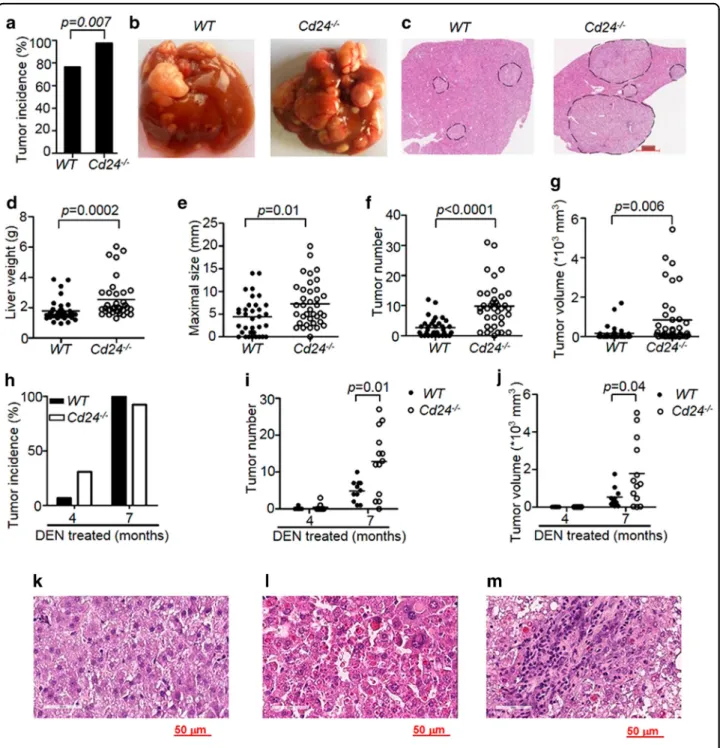
DEN treatment, almost all theCd24−/−male mice (37/38)
developed typical HCC, whereas only 76.5% of WT male
mice (26/34) bore tumors (Fig. 1a). Gross anatomy
(Fig. 1b) and Haematoxylin and eosin (H&E) analysis
(Fig. 1c) revealed that targeted mutation of Cd24
drasti-cally increased the number and the size of HCC lesions. At 8 months, liver weights were significantly increased in
Cd24−/− mice (2.5±0.2 g) compared with those in WT
mice (1.8±0.1 g) (p=0.0002) (Fig. 1d). The increase in liver weight is attributable to increased tumor size, as the
diameters of the largest tumors in Cd24−/− mice (7.7±
0.9) were nearly twice as those in the WT littermates (4.4
±0.7) (p=0.0057) (Fig. 1e). Moreover, the numbers of
observable HCC lesions were significantly higher in
Cd24−/−mice (9.8±1.2) than in WT mice (2.7±0.5) (p <0.0001) (Fig.1f). When all tumors from one mouse were
combined, Cd24−/− mice bore a 5.1-fold larger tumor
volume than WT mice (844.8±219.3vs166.4±64.4,p=
0.0002) (Fig. 1g). To further evaluate the impact of the
Cd24 deletion on HCC onset and progression, we killed
mice at 4 and 7 months. As shown in Fig.1h, at 4 months,
only 1/15 WT mice developed HCC, whereas 4/13
Cd24−/− mice developed visible HCC. While essentially
allCd24−/− mice had visible tumors at 7 months in this
experiment, Cd24−/− livers had more tumors than WT
livers, as measured either by the numbers of observable
HCC lesions (Fig. 1i) or by the total tumor volumes
(Fig.1j).
High-power histology analyses revealed that in addition
to the differences in tumor sizes and incidences, Cd24
deficiency increased malignancy of liver tumors
(Fig. 1k–m). At 8 months after DEN treatment, tumor
cells found in WT mice were benign as the
nuclei/cyto-plasm ratios are small (Fig. 1k). In contrast, the tumor
cells in the Cd24-deficient mice exhibit large and
Fig. 1 Targeted mutation ofCd24promotes the development of HCC carcinogenesis. aIncidence of HCC tumors (diameter≥1.0 mm) in male WT (n= 34) andCd24−/−(n= 38) mice 8 months after 15μg/g DEN administration to 15-day-old mice.bRepresentative gross liver anatomy of 8-month-old DEN-treated male WT (left) andCd24−/−mice (right).cHaematoxylin and eosin (h&e) staining of liver sections (scale bar = 1 mm) in 8-month-old DEN-treated male WT (left) andCd24−/−mice (right). Black dash lines indicate border of the tumor nodules.d–gLiver weightd, maximum tumor diameterse, numbers of≥1.0 mm visible tumors per mousef, and total tumor volumesgin male mice 8 months after DEN (15 µg/g) injection. Data are pooled from multiple experiments.h–jIncidence of mice with liver tumorsh, tumor numbersi, total tumor volumesjin male mice at the 4th or 7th month after DEN (15 µg/g) injection. Two pooled independent experiments. Data represent means. *p< 0.05, **p< 0.01, ***p< 0.001, using two-tailed, unpaired Student’st-teste–g,h–jor Mann–Whitney testd.k–mHigh power (× 40) H&E image of tumor nodules in livers from WTkand
(Fig.1l) and lesions with lymphocyte infiltration (Fig.1m)
were also found in some tumors from theCd24−/−mice.
Apart from alteration in cellular morphology, we also observed extensive architecture changes in tumors from
Cd24−/− but not WT mice (Supplementary Figure S1).
These include ductules extending to the peripheries of foci lesions and associated with bile ducts (Supplementary Figure S1a, black arrow), foci of lesions penetrated into the walls and proliferated in the lumens of a hepatic vein branch (Supplementary Figure S1b, red arrow), and vas-cularization by portal vein branches (Supplementary Fig-ure S1c, blue arrow). These featFig-ures further support the
idea that Cd24 deficiency promotes HCC development.
The striking impact of germline deletion of theCd24gene
in HCC onset and progression suggests that Cd24 is a
critical repressor for carcinogenesis of HCC.
Reduction in acute inflammation and hepatocyte
apoptosis inCd24−/−mice
Reactive oxygen species (ROS) are the major effector molecules produced by neutrophils and activated mac-rophages40,41. As the first test to evaluate the effect of
acute inflammation on HCC, we evaluated the levels of
ROS in WT and Cd24−/− liver sections. As shown in
Fig. 2a and quantified in Fig. 2b, whereas comparable
levels of ROS staining were found in WT and Cd24−/−
livers from control mice that received no DEN, Cd24−/−
sections showed much reduced ROS signals 24 h after
DEN administration. Interestingly, although ROS+cells in
the untreated groups and those isolated from 1 and 4 months after DEN treatment had the morphology of hepatocytes (Supplementary Figure S2), immediately after DEN treatment they became mostly mononuclear cells based on the cellular size. Therefore, reduction in ROS
levels in the Cd24−/− mice may reflect a reduction in
inflammation. In addition, we also evaluated
ROS-induced DNA damage based on the analysis of γ-H2AX
expression in liver tissues. Our data demonstrated that Cd24−/−mouse livers showed a significant decrease inγ -H2AX levels when compared with WT mouse livers (Fig.2c, d).
As ROS is a major mediator for the induction of apoptosis, we evaluated apoptosis in liver sections using
TUNEL staining. As shown in Fig.2e, f, DEN-treated WT
liver sections contained a high number of apoptotic hepatocytes on day 1 after DEN treatment. This number is much lower in theCd24−/−liver sections. To evaluate if ROS is responsible for the death of hepatocytes, we pre-treated mice with hydroxyanisole (BHA) to quench ROS
and then measured the number of TUNEL+cells at 24 h
after DEN treatment. As shown in Supplementary Fig-ure S3, BHA reduced the percentage of apoptotic cells in
the WT but not Cd24−/− cells. Therefore, the elevated
ROS in the WT mice contributed to increased apoptosis of liver cells one day after DEN administration.
Recent studies have shown that depletion of adaptive immune cells promotes formation and progression of
DEN-induced liver cancer42. In order to determine the
potential role of immune cells in HCC initiation, we iso-lated liver mononuclear cells and analyzed the phenotype
of inflammatory cells in the livers of Cd24−/− and WT
mice by FACS analysis. We found that CD11b+
(Sup-plementary Figure S4A and B) were increased in WT but
not in Cd24−/− mice after DEN treatment. In contrast,
the percentage of T cells, including both CD4 and CD8 T cells, was significantly higher inCd24−/− livers than in that of WT mice, with or without DEN treatment (Sup-plementary Figure S4C and D). Higher levels of adaptive
responders may also contribute to increased
carcinogenesis.
Importantly, as shown in Fig. 3a, b, although the
per-centage of macrophages/KCs (F4/80+CD11b+) was
increased in DEN-treated WT livers, DEN treatment failed to increase the frequency of macrophages in
Cd24−/− livers. A more marked difference was observed
by immunohistochemistry (IHC) analysis, which revealed nearly threefold reduction in F4/80+cells from Cd24−/− livers on day 1 after DEN treatment compared with WT livers (Fig. 3c, d). The reduction is transient as it is not
observed on day 30 and beyond when F4/80+cell
num-bers in WT liver return to lower levels (Fig.3c, d). Based
on markers used in previous studies43, we further
(seefigure on previous page)
Fig. 2Cd24deficiency reduces ROS production and apoptosis of hepatocytes.Liver tissues were isolated at 24 h after 15μg/g DEN injection into 15-day-old male mice for histological staining.aandbLiver cryosections were incubated with 2μM dihydroethidine for 30 min at 37 °C. Cells staining positive (red) for the oxidized dye were identified byfluorescence microscopyaand quantified by Image-Pro Plus 6.0 softwareb. At least 10
fields from different mice were counted. Data from two independent experiments are pooled (Control mice:n= 9; DEN-mice:n= 19 or 23).cγ-H2A.X staining for DNA damage in DEN-treated mice. Liver sections were obtained at 24 h after DEN treatment.dRelative Integrated optical density (IOD) of
identified, by FACS analysis, the percentage of
liver-resident KCs (defined as F4/80+CD11bloLy6Clo). We
found that it was increased following DEN treatment in
WT livers but not in Cd24−/− livers (Supplementary
Figure S5A and B). In contrast, the percentage of
monocyte-derived macrophages (MoMs, defined as F4/
80+CD11bhiLy6Cint) was not obviously changed in either
WT or Cd24−/− livers following DEN treatment
(Sup-plementary Figure S5A and C). These data revealed selective decrease of the intrahepatic KCs in theCd24−/− mice shortly after DEN treatment. However, whereas both
flow cytometry result of isolated mononuclear cells and
IHC analysis of liver sections revealed the impact ofCd24
deletion on acute inflammatory cells, only IHC reveals a
net reduction of intrahepatic macrophages in Cd24−/−
livers after DEN treatment. This is perhaps owing to an
uneven loss of F4/80+ cells during FACS isolation of
mononuclear cells in different groups. Despite of the subtle differences, both methods reveal a critical role for
Cd24in the maintenance of high numbers of intrahepatic
F4/80+ cells in DEN-treated mice at the time of DEN
induction.
To substantiate the contribution of Cd24 to acute
inflammation, we measured the amounts of Il-6, Il1b,
Tnfa, and Mcp-1 transcripts in untreated and
DEN-treated mice. As shown in Fig.3e, whereas elevation of
Il-6,Il1b,andTnfatranscripts was observed following DEN
treatment in WT livers, no increase was found in the
Cd24−/− livers. Reduction of IL-1β protein was also
observed in the Cd24−/− livers upon DEN treatment
(Supplementary Figure S6A). However,Cd24deletion had
no effect on the expression ofMcp-1 after DEN
admin-istration (Supplementary Figure S6B). Corresponding to a
reduced inflammatory response, STAT3 phosphorylation
was reduced in Cd24−/− liver tissues after DEN
admin-istration (Supplementary Figure S6C). Furthermore,
although WT mice exhibited a significant increase in
serum HMGB1 levels at 24 h after DEN treatment (Sup-plementary Figure S6D), no increase was found in the sera
fromCd24−/− mice. HMGB1 can be secreted actively by
activated leukocytes and released passively by necrotic
cells. As there were no significant changes in serum ALT
levels, a marker of acute liver toxicity after DEN injection
in WT andCd24−/−mice (Supplementary Figure S6E), it
is more likely that the increased HMGB1 may be secreted from activated leukocytes, but not necrotic hepatocytes.
We next addressed the effects of Cd24 deficiency in
chronic response. We detected a persistent increase in
ROS accumulation in livers of Cd24−/− mice compared
with WT livers 1 and 4 months after DEN administration (Supplementary Figure S2A and B). However, compared
with WT mice after DEN treatment, Cd24−/− mice
dis-played a persistent decrease in cell apoptosis in liver as marked by TUNEL staining (Supplementary Figure S7A
and B). In contrast,Cd24−/−livers showed a remarkable
increase in proliferation biomarker PCNA (proliferating cell nuclear antigen) as indicated by IHC staining (Sup-plementary Figure S7C and D). Except for IL-6, no
sig-nificant differences were observed between WT and
Cd24−/− mice for inflammatory cytokines
(Supplemen-tary Figure S7E). These results suggest that Cd24 defi
-ciency may promote HCC by protecting liver cells from DEN-induced apoptosis and increasing cell proliferation.
Intrahepatic macrophages induce apoptosis of hepatocytes and suppress hepatocellular adenoma in DEN-treated mice
To determine whether DEN treatment induces iNOS expression in macrophages, we isolated liver macro-phages/KCs from DEN-treated mice. The purity of
mac-rophages after isolation was >90% based on
immunofluorescence microscopy result (Fig. 4a). A
sig-nificant increase in iNOS mRNA levels was observed in
DEN-treated WT intrahepatic macrophages (Fig.4b). In
contrast, no increase was found in the livers of
DEN-treated Cd24−/− mice (Fig. 4c). Furthermore, we also
observed that liver macrophages/KCs resided in close
proximity to DNA-damaged cells identified by γ-H2AX
(Fig.4d).
To further confirm that liver macrophages/KCs are
responsible for the hepatocyte apoptosis in DEN-treated
livers, WT and Cd24−/− mice were treated with control
liposomes or liposomal clodronate to deplete macro-phages/KCs starting at 48 h before DEN injection. KCs are depleted as early as 12 h after administration with liposome-encapsulated clodronates, and repopulation starts at the end of the first week44. As shown in Fig.5a, there was almost complete depletion of liver macrophages
in both WT and Cd24−/− mice. The depletion was also
confirmed by F4/80-encoding Emr1 mRNA levels
(Fig. 5b). Consistent with the published data44, depletion
of KCs suppressed the induced mRNA levels ofIl1band
Il6 and slightly increased the levels of Mcp-1
(Supple-mentary Figure S8). TUNEL assay showed that liver macrophage depletion resulted in diminished apoptosis in DEN-treated WT livers, but had no effect on apoptosis in Cd24−/− livers. Importantly, no significant differences existed in the number of apoptotic cells between WT and
Cd24−/− livers after liver macrophages were depleted
(Fig. 5c, d). These data demonstrate that intrahepatic
mice to deplete intrahepatic macrophages 48 h before DEN injection at 13 days of age. Mice in both groups were
kept for five additional months, after which they were
killed and analyzed to determine tumor burden. As expected, at this early time point, no architectural alteration was observed in tumors from either WT or
Cd24−/−, and the tumors were mostly hepatocellular
adenoma (Fig.5e). However, the tumor cells in Cd24−/− adenoma were considerably more advanced in malignant transformation based on the nuclei/plasma ratio and by the pleomorphic nuclei and the presence of mitotic tumor cells (Fig.5e). Summary data were presented in Fig.5f–i.
As shown in Fig.5f, clodronate administration markedly
increased the incidence of macroscopic liver adenoma from 20% (3/15) to 75% (6/8). Furthermore, the ratio of liver to body weight (Fig.5g), number of tumors (Fig.5h),
and maximum tumor sizes (Fig. 5i) were significantly
larger in clodronate-administrated WT mice than in the control treated mice. These data indicate that intrahepatic macrophage depletion at DEN induction promotes inci-dence and growth of HCC.
Accumulating evidence indicates that macrophage counts are significantly higher in peritumoral liver tissues
than in the corresponding intratumoral tissues45,46. By
immunohistochemical staining using an F4/80
anti-body, we confirmed the enhanced accumulation of
mac-rophages in peritumoral liver tissues during DEN-induced hepatocarcinogenesis compared with intratumoral liver tissues (Supplementary Figure S9). To further investigate the role of intrahepatic macrophages after tumor forma-tion, we depleted the intrahepatic macrophages using liposomal clodronate 5 months after DEN treatment when HCC was visible in some mice and killed the mice one month later for analysis. The data were presented in Fig.5j–n. Histologically, the cells in the tumor nodules in control liposome-treated mice lacked features of neo-plastic transformation, as the nuclei were not significantly
enlarged and relatively uniform. In contrast, significant
heterogeneity was observed in the sizes of nuclei in ade-noma in mice with macrophage depletion, and many of
the nuclei were pleomorphic (Fig. 5j), suggesting that
depletion of macrophages at 5 months could still accel-erate malignant transformation of the hepatocellular adenoma. Strikingly, the incidence of macroscopic liver cancers in clodronate-treated mice was 87.5% (7/8), whereas that in the control liposome group was only 9.1% (1/11) (Fig.5k). The number of tumors (Fig.5l), maximal
tumor sizes (Fig.5m), and total tumor volumes (Fig. 5n)
in clodronate-administrated mice were also much increased when compared with control mice. These data suggested that TAM also inhibit HCC progression.
Together, these data indicate that intrahepatic macro-phage depletion at either at DEN induction or 5 months after DEN induction promotes incidence and growth of HCC, although the functions of macrophages at these different timepoints were not necessarily the same. As chronic treatment with clodronate could affect hepatocyte function, it is not possible to continue the treatment until the mice developed HCC. Inshort, intrahepatic macro-phages have an important protective role against DEN-induced HCC. It remains to be investigated whether the protective functions of macrophages against HCC carci-nogenesis are achieved through different mechanisms to that in tumor-bearing mice at different times after DEN treatment.
DEN treatment induces depletion ofCd24−/−macrophages
by a p53-dependent mechanism
To test whether apoptosis of intrahepatic macrophages resulted in the decreased number of macrophages in
DEN-treated Cd24−/− mice, we carried out double
staining with anti-F4/80 antibody and TUNEL assay in liver sections. At 24 h after DEN administration, more
apoptotic macrophages (F4/80+TUNEL+ cells) were
observed in DEN-treated Cd24−/− livers compared with
WT livers, in contrast to what was observed with the
apoptosis of non-macrophages (F4/80−TUNEL+ cells)
(Fig.6a, b). To further confirm the increased sensitivity of
Cd24−/− macrophage to DEN treatment, we measured
the apoptosis and number of peritoneal macrophages 24 h
after DEN administration. As shown in Fig. 6c, a more
severe reduction in the number of peritoneal
(seefigure on previous page)
Fig. 3Cd24deficiency reduces acute inflammation caused by DEN treatment. a,bFlow cytometry analysis (FACS) of intrahepatic F4/80+cells. Liver mononuclear cells were isolated 24 h after 15μg/g DEN or 0.9% NaCl solution (as control) by intraperitoneal injection to 15-day-old mice for FACS.aThe data are representative FACS profiles.bPercentages of F4/80+CD11b+cells among CD45+cells in liver. Data are pooled from multiple
experiments involving age and gender matching mice.canddCd24deficiency decreases the number of intrahepatic F4/80+cells. Liver tissues were
macrophages was induced by DEN inCd24−/−mice than WT mice. Correspondingly, DEN induced the apoptosis
of peritoneal macrophages from Cd24−/− but not WT
mice (Fig.6d, e).
DEN is a typical chemical carcinogen that causes DNA damage and mutations once activated by cytochrome
P450 2E129. DNA damage induces the activation of p53
pathway to eliminate damaged cells30. Our recent
pub-lication showed that Cd24 disrupts ARF-NPM association
and reduces cellular p53 levels in cancer cells47. We
therefore analyzed Cd24 expression on liver cells, and found Cd24 was expressed on hematopoietic cells, but not hepatocytes or tumor cells of HCC and naive mice (Supplementary Figure S10A and B). Flow cytometry analysis revealed high levels of Cd24 on intrahepatic macrophages as well as other leukocytes (Supplementary Figure S10C and D), which raised the intriguing
possibi-lity that the CD24–p53 antagonism discovered in cancer
cells may regulate macrophage survival. In order to determine whether Cd24 regulates p53 in macrophages, we examined the expression of p53 and p53-regulated genes in peritoneal macrophages following DEN treat-ment. The purity of macrophages after isolation was
>90% based on immunofluorescence microscopy result
(Supplementary Figure S11A). As shown in Fig. 7a, p53
protein levels were elevated in both WT and Cd24−/−
macrophages after DEN treatment. However, Cd24−/−
macrophages expressed more p53 protein than WT
macrophages regardless DEN treatment (Fig. 7a). To
determine the functional consequence of p53
upregula-tion, we measured the transcript levels ofp21andpuma,
the prototypic target gene of p53, in DEN-treated
mac-rophages. As shown in Fig. 7b, mRNA level ofp21 was
significantly higher inCd24−/−macrophages, whereas no
obvious difference was found in puma expression
between WT andCd24−/−macrophages (Supplementary
Figure S11B). To substantiate this observation,
macro-phages were isolated from naive WT andCd24−/− mice
and then treated with DEN in vitro for 24 h. As shown in Fig.7c,Cd24−/−macrophages also exhibited higher levels
ofp21mRNA at 24 h after DEN administration relative to
WT macrophages that received the same treatment.
However, the mRNA levels of puma were not changed
after DEN administration, and no difference was observed
between WT and Cd24−/− mice (Supplementary
Fig-ure S11C). These data suggest that the effector that p53 target for apoptosis in macrophages is unlikely Puma. As p21 is involved in senescence rather than apoptosis, the p53 responsive target responsible for apoptosis remain to be defined in this model.
To determine whether elevation of p53 is responsible
for apoptosis of macrophages, we produced Cd24−/−
Trp53−/−, Cd24+/+Trp53−/−, Cd24−/−Trp53+/+, Cd24+/+Trp53+/+ mice by intercrossing mice with dele-tion of either gene. We then treated 15-day-old male mice
with 15μg/g DEN. Twenty-four hours later, intrahepatic
macrophages were assessed by IHC with anti-F4/80 antibody. Images of representative slides from one mouse
in each group are shown in Fig.7d, whereas summary data
from 18 pairs of mice were summarized in Fig. 7e. As
expected, at 24 h after DEN injection, intrahepatic F4/80+ cells were significantly reduced inCd24−/−Trp53+/+mice
when compared with Cd24+/+Trp53+/+ mice.
Remark-ably, the impact of Cd24 was completely ablated with Trp53 deletion (Cd24+/+Trp53−/−). Thus, loss of
intra-hepatic macrophages after DEN treatment of theCd24−/−
mice is attributed to the upregulation ofTrp53gene.
Discussion
Based on the current paradigm that inflammation
pro-motes HCC carcinogenesis and the fact that carcinogen DEN induces extensive death of hepatocytes5, we evaluated
the impact of targeted mutation ofCd24, which exacerbates
host response to cellular injuries38,48. Surprisingly, whereas Cd24deletion did increase susceptibility to HCC, it reduced
rather than increased inflammatory response to DEN. Our
in-depth analysis of this model revealed new insights on the function of Cd24 in macrophages and the function of intrahepatic macrophages on HCC pathogenesis.
Although a large body of circumstantial evidence is consistent with the notion that intrahepatic macrophages
promote HCC development, the proposed
cancer-promoting function of macrophages has not been established by either macrophage depletion or macrophage-specific gene deletion. Here, we provide two lines of direct evidence that argue against this prevailing view.
(seefigure on previous page)
Fig. 4 Cd24 deficiency ablates acute iNOS accumulation in intrahepatic macrophages after DEN treatment. aPurity characterization of isolated intrahepatic macrophages. The isolated liver mononuclear cells were incubated for 2 h to remove the non-adherent cells. The adherent cells were used as source for intrahepatic macrophages that were stained with anti-F4/80 antibodies by immunocytochemical method.b,cQuantitative RT-PCR of iNOS expression in isolated live macrophages/Kupffer cells from mice 24 h after 15μg/g DEN injection at 15 days of age.bWT mice.
cCd24−/−mice. The data were analyzed by Student’st-test. Data from individual mice in two independent experiments are presented.dLiver
First, macrophages are responsible for the apoptosis of DEN-treated hepatocytes in vivo, some of which harbor cancer-causing mutations. This function is suggested by the correlation between the amounts of intrahepatic macrophages and the amounts of hepatocyte apoptosis and, more importantly, validated by in vivo depletion of macrophages. As the depletion of macrophages sub-stantially reduced hepatocyte apoptosis in DEN-treated WT mice, our data demonstrate a role for macrophages in inducing hepatocyte apoptosis. Considering DEN is a
known DNA damaging agent29, we suggest that during
acute inflammation, macrophages may reduce HCC risk
by eliminating cells with DNA damage. A similar function
has been suggested for NK cells by in vitro studies31.
Furthermore, macrophages have been shown to clear
precancerous senescent hepatocytes49. In addition, as
removing macrophages in the Cd24-deficient mice does
not affect the amounts of apoptotic cells, it is likely that
Cd24 deficiency has ablated the activity of intrahepatic
macrophages, either through functional inactivation or through reduction in the number of intrahepatic macrophages.
Second, depletion of macrophages at DEN induction, or 5 months after, substantially increased HCC carcinogen-esis. Although the impact of macrophage depletion at DEN induction suggests that removing cells with DNA damage will likely reduce the chance of carcinogenesis,
the dramatic impact of macrophage depletion at five
months after DEN induction argues against the notion that macrophages evolve into HCC-promoting M2-type macrophages.
Although the focus of the current study was to establish
the functional significance of intrahepatic macrophages
rather than the mechanism of its effector function, our data suggest some potential mechanisms for future
stu-dies. We showed that WT but notCd24−/−mice had high
levels of ROS 1 day after DEN treatment. As the ROS+
cells are mononuclear cells rather than hepatocytes, and ROS are known to be cytotoxic for DEN-treated hepato-cytes, we suggest that elevation of ROS in WT mice (as
compared with Cd24−/− mice) provides an effector
mechanism for intrahepatic macrophages. The reduction
of ROS+ cells also explains the reduced hepatocyte
apoptosis in the Cd24−/− mice. Consistent with this
notion, we found that pre-treatment with butylated BHA
significantly reduced hepatocyte apoptosis in WT but not
Cd24−/− mice. Alternatively, we have observed much
higher levels of iNOS among intrahepatic macrophages in
WT mice when compared withCd24−/−mice. As NO is a
known effector molecule produced by macrophages50,51,
the increase in iNOS not only provides another mechanism by which intrahepatic macrophages induce apoptosis of hepatocytes during DEN treatment, but also suggests a possible role forCd24in the differentiation of macrophages.
It should be pointed out that the surveillance function of macrophages may be achieved by different mechanisms at different stages of carcinogenesis. Although our data suggested that in the early stage, macrophages help to remove hepatocytes with DNA damage, how the macro-phages that surround HCC lesions restrict their growth remains to be investigated.
As outlined in the Introduction, the evidence that supports the role for TAM in HCC human carcinogenesis is based on their ability to either directly suppress CD4 T-cell responses or indirectly induce Tregs that in turn
(seefigure on previous page)
Fig. 5 Intrahepatic macrophages are responsible for increased apoptosis of WT but notCd24−/−mouse livers and for suppression of HCC development.To deplete liver macrophages, 13-day-old mice were injected i.p. with 70μL of liposomal clodronate or control at 48 h before 15μg/g DEN administration.aF4/80 staining for liver macrophages following injection of control liposomes and clodronate liposomes into WT andCd24−/−
would reduce adaptive T-cell immunity52. It therefore remains possible that when T-cell response is the key determinant, macrophages may play a suppressive func-tion. Alternatively, apart from the immune suppressive features, the TAM in human HCC may also possess an innate protective function as described herein. The ulti-mate function of TAM would depend on the balance of these two opposing forces. In the mouse DEN model, however, all genetic studies supporting a role for macro-phages in promoting tumor growth have used drivers that cause deletion in all leukocytes and non-leukocytes19,20. Therefore, these studies do not allow comparison with our data presented herein. Much like other studies cited herein, our model depends on one-time exposure to a genotoxin and thus may differ somewhat from human HCC carcinogenesis that likely results from chronic exposure to toxic chemicals or chronic viral infection. However, our work is more decisive in establishing a surveillance function or macrophages in the DEN-induced HCC model because we showed its function by
direct depletion. The relevance of Cd24 in human HCC
pathogenesis is supported by the fact that Cd24
poly-morphism affects the risk and progression of HCC53,54.
Based on our recent studies in cancer cells, in which we
showed thatCd24increases p53 levels through
antagon-ism with the ARF-MDM2 pathway47, we evaluated the
role for p53 in macrophages survival. Our genetic studies
clearly revealed that Trp53 is downstream of Cd24 in
regulating survival of intrahepatic macrophages. Our genetic evidence provides a new concept that tumor suppressor gene could regulate host immunity through its impact on the survival of innate immune effectors. Apart from the macrophage-intrinsic protective function, a large body of evidence shows a costimulatory function of CD24 for T-cell activation34,36,55,56. Therefore in models in which CD4 T cells promote cancer development, one may expect a different consequence of targeted mutation of
the Cd24 gene. In this context, it would be of great
interest to reconcile the cancer-promoting function of the
Cd24 gene in HCC caused by a HBV transgene, as we
have reported54. Furthermore, given the expression of
CD24 on B cells and a potential role for B cells in HCC pathogenesis57, it is of interest to investigate the function of CD24 on B cells during HCC pathogenesis in the future study.
Materials and methods
Experimental animals
Mice with the targeted mutation ofCd24were produced
using embryonic stem cells from C57BL/6 mice as
described previously39. Trp53 mutant mice
B6.129S2-Trp53tm1Tyj/JNju (referred to as Trp53+/− mice)58 were purchased from Nanjing Biomedical Research Institute of
Nanjing University. Trp53+/− mice were crossed with
Cd24−/− mice, and the offsprings were genotyped by
genomic polymerase chain reaction (PCR) to get the Cd24+/−Trp53+/− mice. Then Cd24+/−Trp53+/− mice were intercrossed to generateCd24+/+Trp53−/−,Cd24−/− Trp53−/−,Cd24+/+Trp53+/+, andCd24−/−Trp53+/+mice.
Cd24−/− and WT mice on a C57BL/6 background were
intercrossed to generate Cd24−/− mice and WT
litter-mates. The genotypes were determined by PCR. All of the
mice were maintained under specific pathogen-free
con-ditions in the animal facility at the Institute of Biophysics, Chinese Academy of Sciences. All studies involving animals were approved by the Institutional Laboratory Animal Care and Use Committee.
Induction of HCC
Fifteen-day-old male mice were injected intraper-itoneally (i.p.) with 15μg/g DEN (Sigma), as indicated. For the tumor initiation model, after 1, 4, 7, and 8 months on normal chow, all mice were killed, and their livers were
removed. Externally visible tumors (≥1.0 mm) were
counted. The length (L) and width (W) of tumors were measured by a vernier caliper. The tumor volume was
calculated by (L×W×W)/2. For the early effects of DEN,
mice were killed 24 h after DEN treatment and peritoneal resident macrophages and liver tissues were collected. The liver tissues were stored at−80 °C for protein isola-tion, TRizol reagent (Invitrogen) for RNA extract, and embedded in optimal cutting temperature compound
(seefigure on previous page)
Fig. 6Cd24maintains macrophages at acute phase during DEN treatment. aandbTwo-color immunofluorescence staining of frozen liver tissue sections 24 h after mice received 15μg/g DEN on the 15th day after birth. Representative liver sections stained with anti-F4/80 antibody and TUNEL assay.aApoptotic macrophages (yellow arrows) were F4/80+/TUNEL+cells. Scale bar = 100
μm.bAverage numbers of TUNEL-positive cells in a high-powerfield of afluroscerence microscope. At least 10fields from difference mice were counted.N= 9.c–eFlow cytometry analysis of peritoneal macrophages. 15-day-old mice were treated with 15μg/g DEN and 24 h later, resident peritoneal cells were harvested by lavage of mouse peritoneal cavity with 3% FCS/PBS. Peritoneal macrophages were stained with F4/80-FITC antibody and PE Annexin V Apoptosis Detection Kit I, and the number and apoptosis of macrophages were analyzed byflow cytometry.cDEN selectively reduces the number of peritoneal macrophages in
Cd24−/−but not WT mice. Data shown are the absolute number of F4/80+cells in the peritoneal cavity at 24 h after DEN treatment.dRepresentative
FACS profiles depicting apoptotic macrophages in vehicle or DEN-treated mice.ePercentages of F4/80+Annexin V+cells in peritoneal cavity. Data are
(OCT) orfixed in 10% formalin for histological staining. The remaining liver tissues were used for isolation of liver mononuclear cells.
Histology and immunofluorescence
The large lobes of livers were immediately embedded in
OCT, or fixed in 10% formalin and paraffin-embedded.
Sections (5.0μm) were subjected to analysis of histological and immunochemical staining.
To examine the accumulation of ROS, freshly prepared
frozen liver sections were incubated with 2.0μM
dihy-droethidine (Invitrogen) for 30 min at 37 °C, after which
they were observed by fluorescence microscopy and
photographed.
TUNEL assays were performed using the In Situ Cell
Death Detection Kit (Roche) on paraffin-embedded liver
sections. For double immunofluorescence staining of F4/
80 and TUNEL, frozen sections were stained with F4/80 antibody, followed by permeabilization with 1% citrate for 15 min at 4 °C, and then TUNEL staining was performed
according to the manufacturer’s instructions. The
mounted slides were observed under a microscope (Leica DM2500). The number of TUNEL-positive cells was determined by manual counting of at least 5 high-power
fields per section.
The immunostaining on frozen liver sections was per-formed as previously described54. Primary antibodies were rat anti-F4/80 (Abcam, ab6640, 1/100), rabbit anti-F4/80 (Santa Cruz, sc-25830, 1/50), rat anti-CD24 (Santa Cruz,
sc-19651, 1/100), rabbit p-Histone H2AX (γ-H2AX)
(Bioworld Technology, Inc., BS4760, 1/100), goat
anti-HNF4α (Santa Cruz, sc-6556, 1/50), rabbit anti-PCNA
(Santa Cruz, sc-7907, 1/300). Secondary antibodies were purchased from Santa Cruz and Zhongshan Goldenbridge Biotech (Beijing, China). For microscope images, positive
cells were quantified with Image-Pro Plus 6.0 software
(Media Cybernetics, Inc.).
Cell isolation
For isolation of liver mononuclear cells, the liver frag-ments were incubated for 30 min in 0.025% collagenase
type IV in HBSS (Gibco) at 37 °C shaking at 220 rpm. The
whole material was passed through a 70μm cell strainer
to get a single cell suspension, centrifuged with 50 G for 3 min to remove hepatocytes. The liver mononuclear cells were recovered from the interface of 40 and 60% percoll (GE Healthcare) after centrifugation. The liver
mono-nuclear cells were washed and used forflow cytometry. To
enrich macrophages, mononuclear cells were suspended in serum-free RPMI-1640 medium and were seeded into 24-well plate. After incubation for 2 h, the cells were washed three times with PBS to remove the non-adherent cells. The adherent cells were used as source for intra-hepatic macrophages, and the purity of macrophages was
determined by morphology and immunofluorescence
staining with F4/80 antibody.
Peritoneal resident cells were harvested by lavage of mouse peritoneal cavity with 2.0 mL of ice cold 3% FCS/
PBS according to the protocol as described59. The
col-lected cells were centrifuged at 1300 rpm for 10 min, and re-suspended in RPMI-1640 medium or PBS for counting. The cells in RPMI-1640 medium were seeded into the wells of 24-well or 96-well plate. After incubation for 2 h, the cells were washed three times with PBS to remove the non-adherent cells. The adherent cells were macrophages
for cell ELISA (for p53) and RT-PCR (forp21andpuma),
or were treated with 20 mM DEN for 24 h for RNA
extract (for p21and puma). For peritoneal macrophages
by flow cytometry, the re-suspended cells in PBS were
immediately counted, washed twice in PBS, and re-suspended in FACS buffer (2% FBS in PBS containing 0.01% NaN3).
Flow cytometry
The following antibodies were used for FACS:
FITC-anti-CD11b (11–0112), APC-anti-CD11b (17–0112),
PE-anti-F4/80 (12–4801), FITC-anti-F4/80 (11–4801),
APC-anti-CD45 (17–0451), PerCp-Cy5.5-anti-CD45 (45–0451),
FITC-anti-CD24 (11–0242), APC-anti-CD24 (17–0242),
PerCP-Cy5.5-anti-NK1.1 (45–5941), PE-anti-CD4
(12–0041), FITC-CD3e (11–0031), PerCP-Cy5.5-Gr1
(45–5931), and PE-anti-Ly6C (12–5932) obtained from
(seefigure on previous page)
Fig. 7 The Cd24–p53 axis sustains macrophages during carcinogenesis. aCell-based ELISA for p53 in macrophages. Macrophages were obtained as described in Figure S11. The p53 protein expression in macrophages was quantitated using a target specific primary antibody and HRP-conjugated secondary antibody detection agent, and the crystal violet provided whole cell staining that was used for cell number counts. The levels of p53 protein were normalized by total cell counts in each well with this formula of OD450/OD595. Each dot represents mean data from one mouse based on triplicate counts. Data from two independent experiments are presented.bCd24deficiency increasedp21mRNA expression after in vivo DEN (15μg/g) treatment. Data from three independent experiments are pooled.cAs inb, except that WT andCd24−/−macrophages were treated
with 20 mM DEN in vitro. Data from two independent experiments are pooled. Statistical significance was determined by student’st-test.dF4/ 80 staining for liver macrophages in DEN-treated mice.Cd24+/+Trp53+/+,Cd24−/−Trp53+/+,Cd24+/+Trp53−/−, andCd24−/−Trp53−/−. Scale bar = 100μm.e
eBioScience, and PE Annexin V Apoptosis Detection Kit I (559763) from BD Pharmingen. Cells were blocked for 15 min with Fc blocking reagent on ice prior to labeled with
fluorescent-conjugated antibodies diluted in FACS buffer.
Cells for phenotypic analyses were stained using the
indicatedfluorescent-conjugated antibody for 30 min on
ice. Appropriate isotype controls were used in all case. Flow cytometry was performed using a FACSCalibur (BD Bioscience, San Jose, CA) and the data were analyzed with FlowJo software (TreeStar, Ashland, OR).
Macrophage depletion
To deplete macrophages,13-day-old mice were injected
i.p. with 70μl of liposomal clodronate (5 mg/ml
clo-dronate) and liposomal control (no cloclo-dronate) (Encap-sula NanoSciences LLC). Fourty-eight hours later, the mice were treated with DEN. In some experiments, mice were killed 24 h after DEN administration for analysis of apoptosis. For the tumor initiation model, mice were kept for additional 5 months, after which they were killed and analyzed to determine tumor load. Depletion of liver macrophages was assessed 72 h after clodronate admin-istration by immunohistochemical staining of frozen liver sections with F4/80 antibody, and RT-PCR analysis of F4/ 80 mRNA levels.
To deplete liver macrophages after tumor already
formed, WT mice were injected with 15μg/g DEN at
15-day of ages. After 5 months, 200μL of 1:1 PBS-diluted
liposomes were injected via the vail vein once every 5 days for 3 times. All mice were killed 1 month after the last injection.
RNA extraction and RT-PCR
Total RNA was isolated from adherent peritoneal or liver macrophages using the miRNeasy Mini Kit (Qiagen)
according to the manufacturer’s protocol. cDNA was
synthesized using total RNA via PrimeScript RT reagent Kit with gDNA Eraser (Takana) according to the
manu-facturer’s instructions. Real-time PCR was performed
using SYBR green PCR master mix (Applied Biosystem, USA) in a 7500 Real-Time PCR System (ABI). Expression levels of evaluated genes were calculated with the
com-parative ΔCt method using hypoxanthine guanine
phos-phoribosyl transferase as a reference gene, and relative
abundance was quantified with the 2-ΔΔCt method. The
following forward and reverse specific primer sequences
were used: Il1b-F (TGAAGCAGCTATGGCAACTG),
Il1b-R (AGGTCAAAGGTTTG GAAGCA); Il-6-F (GA
GGATACCACTCCCAACAGACC), Il-6-R (AAGTG
CATCA TCGTTGTTCATACA); Tnfa-F (CAGCCT
CTTCTCATTCCTGC),Tnfa-R (GGTC TGGGCCATAG
AACTGA); Mcp-1-F (TGCATCTGCCCTAAGGTCT
TC), Mcp-1-R (AAGTGCTTGAGGTGGTTGTGG);
p21-F (CGAGAACGGTGGAACTTTGACT), p21-R
(GGACCCAGGGCTCAGGTAGAC); puma-F (ACC
TCAACGCGCAGTACGA), puma-R (GGGAGGAGT
CCCATGAAGAGA); Emr1-F (ACTGTGGAAAGCAC
CATG TTAGC), Emr1-R (TTTCGATGTCTAGGT
ACTCCGTC); iNOS-F (TGAAGAAA ACCCCTTG
TGCT), iNOS-R (TTCTGTGCTGTCCCAGTGAG);
Hprt-F (ATGAG CGCAAGTTGAATCTG), Hprt-R
(CAGATGGCC ACAGGACTAGA).
Cell-based ELISA for p53 in macrophages
The p53 protein expression in macrophages was quantitatively determined using Total p53 Cell-Based Colorimetric ELISA Kit (ImmunoWay, USA) according to the manufacturer’s instructions. In brief, isolated
macro-phages in a 96-well plate in triplicate were fixed in 4%
formaldehyde for 30 min. Each well was incubated with anti-p53 antibody overnight at 4 °C. After washing three times with wash buffer, samples were incubated with HRP-conjugated secondary antibody followed by incuba-tion with TMB substrate. Read the absorbance at 450 nm after adding stop solution. Crystal violet binds to cell nuclei and gives absorbance reading at 595 nm that is proportional to cell numbers. After washing the plate several times, each well was stained with the crystal violet solution, after which the absorbance at 595 nm was measured. The levels of p53 protein were normalized by total cell number in each well with this formula of OD450/OD595.
Protein preparation and western blot
Total proteins were isolated from frozen liver tissues after homogenization in RIPA buffer supplemented with proteinase inhibitor protease (cocktail and PMFS) and
phosphatase inhibitors (Na3VO4, BETA-glycerophosphate
and Na2P2O4) on ice. Protein from tissue lysate was
quantified using the DC Protein Assay Kit (Bio-Rad).
Equal amounts of protein were used for western blots and cytokine measurement. Western blot was performed according to standard protocols. Lysed proteins were separated using 10% SDS/PAGE and transferred to
poly-vinylidene difluoride membranes (Millipore). Membranes
were exposed to antibodies that recognized STAT3 (CST,
no. 4904), P-STAT3 (CST, no. 9145), and β-actin
(Bio-world, no. AP0060). Theβ-actin was used as an internal
control to normalize the loading materials.
Cytokine determination
Cytokines were measured from serum and liver lysate using Mouse Enhanced Sensitivity Flex Set from BD Cytometric Bead Array (CBA, BD Biosciences) according to the manufacturer’s instructions. CBA for IL-1β, IL-6,
TNF, IL-17A, and IFN-γwere carried out, and data were
acquired on FACS AriaII (BD Bioscience, San Jose, CA).
commercial kits (BIOPCR, H20734) according to the manufacturer’s protocol.
Statistical analysis
The differences in mean values between groups were analyzed by a two-tailed unpaired Independent-Samples t-test unless otherwise indicated. For tumor volume comparison, the total tumor volumes in mice were pre-sented as a logarithmic distribution. After the log10 transformation, the volumes for different subgroups were
presented in a normal distribution (p>0.05 in a
One-Sample Kolmogorov–Smirnov test). Then, the difference
in mean log volumes between mice with WT and
Cd24−/− genotypes was analyzed by Student’s t-test.
These statistical analyses were performed with the GraphPad Prism 5 Software (GraphPad, San Diego, CA) and SPSS19.0 Software (SPSS, Chicago, USA). Data are
presented as means or means±SEM. A result was
considered significant if a p-value was <0.05 (*p<0.05, **p<0.01, ***p<0.001).
Acknowledgements
This study is supported by the National Natural Science Foundation of China (31170836) NIH grants (AI64350, CA171972, CA183030 to YL). We thank Dr. Martin Devenport for editing the manuscript.
Author details
1Key Laboratory of Infection and Immunity of CAS, Institute of Biophysics,
Chinese Academy of Sciences, Beijing, China.2OncoImmune-Suzhou, Suzhou, China.3Center for Cancer and Immunology Research, Children’s Research
Institute, Children’s National Health System and Department of Pediatrics, George Washington University School of Medicine, Washington, DC 20010, USA.4Institute of Biomedical Sciences, Academia Sinica, Taipei, Taiwan.5The
first affiliated hospital, Jilin University, Changchun, China.6Lineberg Comprehensive Cancer Center, University of North Carolina, Chapel Hill, NC, USA
Author contributions
Dongling Li, Minling Hu, Ying Liu, Peiying Ye, Chi-Shan Li, Liang Cheng, Ping Liu, Jing Jiang performed the experiments. Peishuang Du, Shengdian Wang, Lishan Su have critical input in the project design and management. Pan Zheng interpreted the pathology data. Dongling Li and Yang Liu supervised the study. Yang Liu, Dongling Li and Pan Zheng wrote the manuscript.
Conflict of interest
The authors declare that they have no conflict of interest.
Supplementary Informationaccompanies the paper at (https://doi.org/ 10.1038/s41421-017-0007-9).
Received: 16 July 2017 Revised: 30 November 2017 Accepted: 12 December 2017
References
1. Balogh, J., Victor, D. 3rd & Asham, E. H. et al. Hepatocellular carcinoma: a review.J. Hepatocell. Carcinoma3, 41–53 (2016).
2. Sia, D., Villanueva, A., Friedman, S. L. & Llovet, J. M. Liver cancer cell of origin, molecular class, and effects on patient prognosis.Gastroenterology 152, 745–761 (2017).
3. Karin, M. & Dhar, D. Liver carcinogenesis: from naughty chemicals to soothing fat and the surprising role of NRF2.Carcinogenesis37, 541–546 (2016).
4. Bishayee, A. The role of inflammation and liver cancer.Adv. Exp. Med. Biol.816, 401–435 (2014).
5. He, G. & Karin, M. NF-kappaB and STAT3 - key players in liver inflammation and cancer.Cell Res.21, 159–168 (2011).
6. Capece, D., Fischietti, M. & Verzella, D. et al. The inflammatory microenviron-ment in hepatocellular carcinoma: a pivotal role for tumor-associated mac-rophages.BioMed. Res. Int.2013, 187204 (2013).
7. Li, J. Q., Yu, X. J. & Wang, Y. C. et al. Distinct patterns and prognostic values of tumor-infiltrating macrophages in hepatocellular carcinoma and gastric can-cer.J. Transl. Med.15, 37 (2017).
8. Tacke, F. Targeting hepatic macrophages to treat liver diseases.J. Hepatol.66, 1300–1312 (2017).
9. Dong, P., Ma, L. & Liu, L. et al. CD86(+)/CD206(+), diametrically polarized tumor-associated macrophages, predict hepatocellular carcinoma patient prognosis.Int. J. Mol. Sci.17, 320 (2016).
10. Kuang, D. M. et al. Activated monocytes in peritumoral stroma of hepato-cellular carcinoma promote expansion of memory T helper 17 cells. Hepa-tology51, 154–164 (2010).
11. Kuang, D. M., Peng, C. & Zhao, Q. et al. Tumor-activated monocytes promote expansion of IL-17-producing CD8 + T cells in hepatocellular carcinoma patients.J. Immunol.185, 1544–1549 (2010).
12. Zhang, J. P., Yan, J. & Xu, J. et al. Increased intratumoral IL-17-producing cells correlate with poor survival in hepatocellular carcinoma patients.J. Hepatol. 50, 980–989 (2009).
13. Hefetz-Sela, S., Stein, I. & Klieger, Y. et al. Acquisition of an immunosuppressive protumorigenic macrophage phenotype depending on c-Jun phosphoryla-tion.Proc. Natl. Acad. Sci. USA111, 17582–17587 (2014).
14. Zhou, J. et al. Increased intratumoral regulatory T cells are related to intratu-moral macrophages and poor prognosis in hepatocellular carcinoma patients.
Int. J. Cancer125, 1640–1648 (2009).
15. Kuang, D. M., Zhao, Q. & Peng, C. et al. Activated monocytes in peritumoral stroma of hepatocellular carcinoma foster immune privilege and disease progression through PD-L1.J. Exp. Med.206, 1327–1337 (2009).
16. Wu, K., Kryczek, I., Chen, L., Zou, W. & Welling, T. H. Kupffer cell suppression of CD8 + T cells in human hepatocellular carcinoma is mediated by B7-H1/ programmed death-1 interactions.Cancer Res.69, 8067–8075 (2009). 17. Wu, Y., Kuang, D. M. & Pan, W. D. et al. Monocyte/macrophage-elicited natural
killer cell dysfunction in hepatocellular carcinoma is mediated by CD48/2B4 interactions.Hepatology57, 1107–1116 (2013).
18. Wong, V. W., Yu, J. & Cheng, A. S. et al. High serum interleukin-6 level predicts future hepatocellular carcinoma development in patients with chronic hepatitis B.Int. J. Cancer124, 2766–2770 (2009).
19. Maeda, S., Kamata, H., Luo, J. L., Leffert, H. & Karin, M. IKKbeta couples hepa-tocyte death to cytokine-driven compensatory proliferation that promotes chemical hepatocarcinogenesis.Cell121, 977–990 (2005).
20. He, G., Yu, G. Y. & Temkin, V. et al. Hepatocyte IKKbeta/NF-kappaB inhibits tumor promotion and progression by preventing oxidative stress-driven STAT3 activation.Cancer Cell17, 286–297 (2010).
21. Mano, Y., Aishima, S. & Fujita, N. et al. Tumor-associated macrophage pro-motes tumor progression via STAT3 signaling in hepatocellular carcinoma.
Pathobiology80, 146–154 (2013).
22. Wan, S., Zhao, E. & Kryczek, I. et al. Tumor-associated macrophages produce interleukin 6 and signal via STAT3 to promote expansion of human hepatocellular carcinoma stem cells.Gastroenterology147, 1393–1404 (2014).
23. Naugler, W. E., Sakurai, T. & Kim, S. et al. Gender disparity in liver cancer due to sex differences in MyD88-dependent IL-6 production.Science317, 121–124 (2007).
24. Kong, L. et al. Deletion of interleukin-6 in monocytes/macrophages suppresses the initiation of hepatocellular carcinoma in mice.J. Exp. Clin. Cancer Res.35, 131 (2016).
25. Wang, Z., Yan, J. & Lin, H. et al. Toll-like receptor 4 activity protects against hepatocellular tumorigenesis and progression by regulating expres-sion of DNA repair protein Ku70 in mice. Hepatology 57, 1869–1881 (2013).
26. Lin, H., Yan, J. & Wang, Z. et al. Loss of immunity-supported senescence enhances susceptibility to hepatocellular carcinogenesis and progression in Toll-like receptor 2-deficient mice.Hepatology57, 171–182 (2013). 27. Dapito, D. H., Mencin, A. & Gwak, G. Y. et al. Promotion of hepatocellular
28. Loo, T. M., Kamachi, F. & Watanabe, Y. et al. Gut microbiota promotes obesity-associated liver cancer through PGE2-mediated suppression of antitumor immunity.Cancer Discov.7, 522–538 (2017).
29. Verna, L., Whysner, J. & Williams, G. M. N-nitrosodiethylamine mechanistic data and risk assessment: bioactivation, DNA-adduct formation, mutagenicity, and tumor initiation.Pharmacol. Ther.71, 57–81 (1996).
30. Hirao, A., Kong, Y. Y. & Matsuoka, S. et al. DNA damage-induced activation of p53 by the checkpoint kinase Chk2.Science287, 1824–1827 (2000). 31. Gasser, S., Orsulic, S., Brown, E. J. & Raulet, D. H. The DNA damage pathway
regulates innate immune system ligands of the NKG2D receptor.Nature436, 1186–1190 (2005).
32. Fang, X., Zheng, P., Tang, J. & Liu, Y. CD24: from A to Z.Cell Mol. Immunol.7, 100–103 (2010).
33. Bai, X. F., Li, O. & Zhou, Q. et al. CD24 controls expansion and persistence of autoreactive T cells in the central nervous system during experimental auto-immune encephalomyelitis.J. Exp. Med.200, 447–458 (2004).
34. Liu, Y. et al. Heat-stable antigen is a costimulatory molecule for CD4 T-cell growth.J. Exp. Med.175, 437–445 (1992).
35. Liu, Y. et al. Co-stimulation of murine CD4 T-cell growth: cooperation between B7 and heat-stable antigen.Eur. J. Immunol.22, 2855–2859 (1992). 36. Liu, Y., Wenger, R. H., Zhao, M. & Nielsen, P. J. Distinct costimulatory molecules
are required for the induction of effector and memory cytotoxic T lympho-cytes.J. Exp. Med.185, 251–262 (1997).
37. Wu, Y., Zhou, Q., Zheng, P. & Liu, Y. CD28-independent induction of T helper cells and immunoglobulin class switches requires costimulation by the heat-stable antigen.J. Exp. Med.187, 1151–1156 (1998).
38. Chen, G. Y., Tang, J., Zheng, P. & Liu, Y. CD24 and siglec-10 selectively repress tissue damage-induced immune responses.Science323, 1722–1725 (2009). 39. Nielsen, P. J., Lorenz, B. & Muller, A. M. et al. Altered erythrocytes and a leaky
block in B-cell development in CD24/HSA-deficient mice. Blood 89, 1058–1067 (1997).
40. Ceni, E., Mello, T. & Galli, A. Pathogenesis of alcoholic liver disease: role of oxidative metabolism.World J. Gastroenterol.20, 17756–17772 (2014). 41. Reeves, E. P., Lu, H. & Jacobs, H. L. et al. Killing activity of neutrophils is
mediated through activation of proteases by K +flux.Nature416, 291–297 (2002).
42. Schneider, C., Teufel, A. & Yevsa, T. et al. Adaptive immunity suppresses for-mation and progression of diethylnitrosamine-induced liver cancer.Gut61, 1733–1743 (2012).
43. Bleriot, C. et al. Liver-resident macrophage necroptosis orchestrates type 1 microbicidal inflammation and type-2-mediated tissue repair during bacterial infection.Immunity42, 145–158 (2015).
44. Van Rooijen, N. & Sanders, A. Kupffer cell depletion by liposome-delivered drugs: comparative activity of intracellular clodronate, propamidine, and ethylenediaminetetraacetic acid.Hepatology23, 1239–1243 (1996). 45. Zhu, X. D., Zhang, J. B. & Zhuang, P. Y. et al. High expression of macrophage
colony-stimulating factor in peritumoral liver tissue is associated with poor survival after curative resection of hepatocellular carcinoma.J. Clin. Oncol.26, 2707–2716 (2008).
46. Ding, T., Xu, J. & Wang, F. et al. High tumor-infiltrating macrophage density predicts poor prognosis in patients with primary hepatocellular carcinoma after resection. Hum. Pathol. 40, 381–389 (2009).
47. Wang, L., Liu, R. & Ye, P. et al. Intracellular CD24 disrupts the ARF-NPM inter-action and enables mutational and viral oncogene-mediated p53 inactivation.
Nat. Commun.6, 5909 (2015).
48. Liu, Y., Chen, G. Y. & Zheng, P. CD24-Siglec G/10 discriminates danger- from pathogen-associated molecular patterns. Trends Immunol. 30, 557–561 (2009).
49. Eggert, T., Wolter, K. & Ji, J. et al. Distinct functions of senescence-associated immune responses in liver tumor surveillance and tumor progression.Cancer Cell30, 533–547 (2016).
50. Hicks, A. M. et al. Effector mechanisms of the anti-cancer immune responses of macrophages in SR/CR mice.Cancer Immun.6, 11 (2006).
51. Son, K. & Kim, Y. M. In vivo cisplatin-exposed macrophages increase immunostimulant-induced nitric oxide synthesis for tumor cell killing.Cancer Res.55, 5524–5527 (1995).
52. Wan, S., Kuo, N., Kryczek, I., Zou, W. & Welling, T. H. Myeloid cells in hepato-cellular carcinoma.Hepatology62, 1304–1312 (2015).
53. Sheng, L. & Shui, Y. Clusters of differentiation 24 polymorphism and hepatocellular carcinoma. Hepatology 54, 2273 (2011). author reply2273-2274.
54. Li, D., Zheng, L. & Jin, L. et al. CD24 polymorphisms affect risk and progression of chronic hepatitis B virus infection.Hepatology50, 735–742 (2009). 55. Liu, Y. & Linsley, P. S. Costimulation of T-cell growth.Curr. Opin. Immunol.4,
265–270 (1992).
56. Liu, Y. & Zheng, P. CD24: a genetic checkpoint in T-cell homeostasis and autoimmune diseases.Trends Immunol.28, 315–320 (2007).
57. Shalapour, S., Lin, X. J. & Bastian, I. N. et al. Inflammation-induced IgA + cells dismantle anti-liver cancer immunity.Nature551, 340–345 (2017). 58. Jacks, T., Remington, L. & Williams, B. O. et al. Tumor spectrum analysis in
p53-mutant mice.Curr. Biol.4, 1–7 (1994).