Non-Canonical EZH2 Transcriptionally
Activates RelB in Triple Negative Breast
Cancer
Cortney L. Lawrence, Albert S. Baldwin*
Lineberger Comprehensive Cancer Center, University of North Carolina School of Medicine, Chapel Hill, North Carolina, United States of America
Abstract
Enhancer of zeste homology 2 (EZH2) is the methyltransferase component of the polycomb repressive complex (PRC2) which represses gene transcription via histone H3 trimethyla-tion at lysine 23 (H3K27me3). EZH2 activity has been linked with oncogenesis where it is thought to block expression of certain tumor suppressors. Relative to a role in cancer, EZH2 functions to promote self-renewal and has been shown to be important for the tumor-initiating cell (TIC) phenotype in breast cancer. Recently a non-canonical role for EZH2 has been identified where it promotes transcriptional activation of certain genes. Here we show that EZH2, through a methyltransferase-independent mechanism, promotes the transcrip-tional activation of the non-canonical NF-κB subunit RelB to drive self-renewal and the TIC phenotype of triple-negative breast cancer cells.
Introduction
Studies have shown that a subpopulation of cells within a tumor exhibit the ability to self-renew and to initiate tumor formation, while the majority of the cells within the tumor are unable to self-renew and are poorly tumorigenic. These cancer stem cells (CSCs) or tumor initiating cells (TICs) are long-lived and have been shown to be resistant to chemotherapy and to promote tumor reoccurrence and metastasis [1,2]. Importantly, studies have shown that TICs are enriched in high grade tumors and are a predictor of poor prognosis [3]. TICs are observed in multiple subtypes of breast cancer [4,5], including Her2+ cancers and triple negative breast cancer (TNBC), an aggressive subtype of breast cancer characterized by the loss of estrogen receptor (ER), progesterone receptor (PR) and HER-2/neu [6]. Determining signaling pathways critical to TICs offers the potential for new treatments of cancer. In this regard, activities of the NF-κB tran-scription factor family as well as activities of the histone methyltransferase EZH2 have been shown to be important in self-renewal of triple-negative breast cancer (TNBC).
The NF-κB family consists of 5 proteins, p65 (RelA), RelB, c-Rel, p50/p105 and p52/p100, all sharing a common Rel homology domain [7]. Upon stimulation of cells with cytokines or other ligands, NF-κB becomes activated by one of two pathways. The canonical pathway con-sists of the activation of the canonical IκB kinase (IKK) complex, causing IKKβto
a11111
OPEN ACCESS
Citation: Lawrence CL, Baldwin AS (2016)
Non-Canonical EZH2 Transcriptionally Activates RelB in Triple Negative Breast Cancer. PLoS ONE 11(10): e0165005. doi:10.1371/journal.pone.0165005
Editor: Aamir Ahmad, University of South Alabama
Mitchell Cancer Institute, UNITED STATES
Received: August 12, 2016
Accepted: October 4, 2016
Published: October 20, 2016
Copyright:©2016 Lawrence, Baldwin. This is an open access article distributed under the terms of theCreative Commons Attribution License, which permits unrestricted use, distribution, and reproduction in any medium, provided the original author and source are credited.
Data Availability Statement: All relevant data are
within the paper and its Supporting Information files.
Funding: This work was supported by Nation
Institutes of Health,https://www.nih.gov/, R35 CA197684, AB; and Waxman Cancer Research Foundation,http://www.waxmancancer.org/, AB. The funders had no role in study design, data collection and analysis, decision to publish, or preparation of the manuscript.
Competing Interests: The authors have declared
phosphorylate IκBαresulting in its degradation and the subsequent release of p65-p50 dimers. In the non-canonical pathway activated IKKαphosphorylates p100 resulting in proteolytic processing to p52 and release of p52-RelB dimers [7]. In the nucleus, NF-κB dimers activate the transcription of genes involved in cell cycle regulation, inflammation and suppression of apoptosis. Constitutively activated NF-κB can lead to oncogenic transformation through inflammation, cell proliferation, invasion and inhibition of apoptosis [8–11]. Furthermore, NF-κB has been shown to be important for the maintenance of breast TICs isolated from dif-ferent subtypes of breast cancer including HER2+ [12,13] and TNBC [14]. It was shown that both canonical and non-canonical NF-κB promoted the TIC phenotype in triple-negative breast cancer cells [14]. Consistent with this, the NF-κB family of transcription factors has been shown to be activated in HER2+ and TNBC cells [14,15].
EZH2 is the catalytic subunit of the polycomb repressive complex 2 (PRC2) which represses gene transcription through the trimethylation of lysine 27 on histone H3 (H3K27me3) [16]. Upregulation of EZH2 levels has been associated with several cancers [16,17] promoting tumorigenesis partly through the silencing of critical target genes [18]. Additionally, EZH2 has been identified as a transcriptional activator of several genes in various cancers, but the mecha-nisms are less well characterized as compared to the role of EZH2 within the PCR2 complex. EZH2 was found to activate Notch1 and RAF1-β-catenin signaling in breast cancer to promote self-renewal [19,20]. In prostate cancer cells, the histone methyltransferase (HMT) activity of EZH2 is required in order to interact with androgen receptor and activate transcription, yet this is polycomb independent [21]. EZH2 promotes transcriptional activation of c-myc and cyclinD1 in conjunction with estrogen and WNT signaling and does not require its HMT activ-ity [22]. EZH2 was shown to be important in SWI/SNF mutant cancers requiring both catalytic and non-catalytic functions [23]. Furthermore, EZH2 was reported to interact with the RelA/ p65 and RelB subunits of NF-κB in TNBC to activate the transcription of several cytokines, and this was found to be independent of HMT activity [24]. Phosphorylation of EZH2 by CDK2 was shown to promote the oncogenic phenotype in TNBC [25]. Interestingly, TNBC tumors were shown to have elevated levels of EZH2 but surprisingly low levels of H3K27me3 [26] suggesting an HMT-independent role of EZH2 in this tumor subtype. Similarly, in ER-breast cancer cells RelB has been shown to be constitutively active since ER is known to inhibit RelB expression [27,28]. Recently, both EZH2 and RelB have been shown to play a role in the self-renewal of breast TICs [14,19,20] however the interdependence of these two pathways in the maintenance of TNBC TICs has not been explored. Our data identifies an HMT-indepen-dent role of EZH2 as a transcriptional activator of RelB in TNBC contributing to the mainte-nance of triple-negative breast cancer TICs.
Materials and Methods
Cell Culture and Reagents
SUM-149 cells were cultured in HuMEC supplemented with 5% fetal bovine serum (FBS) (Sigma), HuMEC supplement and bovine pituitary extract (Gibco). MDA-MB-231, MCF7 and 293T cells were cultured in Dulbecco’s modified Eagles medium (DMEM) (Gibco) with 10% FBS. HCC-1428 and T47D cells were cultured in RPMI (Gibco) supplemented with 10% FBS. All cell lines were obtained from ATCC. 3-Deazaneplanocin A (DZNep) was obtained from Sigma Aldrich. UNC1999 was a generous gift from the Jian Jin lab.
siRNA Transfection
Non-Targeting #3 (D-001210-03-20) were purchased from GE Dharmacon. For tumorsphere assays cells were transfected with 50 nM siRNA with Dharmafect 1 reagent according to the manufacturer’s instructions. For all other studies, 25 nM siRNA was used. Samples were col-lected 72 hours post transfection for analysis.
Tumorsphere Formation Assay
24 hours post siRNA transfection cells were plated for tumorsphere assays. Cells treated with UNC1999 were plated for the tumorsphere assay and treated with UNC1999 or vehicle for the first 3 days in culture. Cells were cultured under previously described conditions [14] and visu-ally counted after a total of 7 days in culture.
Immunoblotting
Cells were lysed in buffer containing 62.5 mmol/L Tris (pH 6.5), 5% glycerol, 2% SDS, 5% 2-mercaptoethanol, 1× protease inhibitor complete mixture (Roche Applied Science) and 1x phosphatase inhibitor cocktail 3 (Sigma-Aldrich). Protein concentrations were determined using Bradford assay against a standard of bovine serum albumin. Lysate protein (25 μg) was resolved by electrophoresis on SDS-polyacrylamide gels (Mini-PROTEAN TGX Precast Gels, Bio-Rad) and transferred to Immobilon-P membranes (Millipore). Membranes were blocked in 5% milk. Primary antibodies were p65 (8242), EZH2 (5246), SUZ12 (3737) and Actin (3700) from Cell Signaling Technology, RelB (sc-226) from Santa Cruz Biotechnology, H3K27me3 (07–449) from Millipore. Membranes were incubated with secondary antibodies conjugated to horseradish peroxidase (Promega) and complexes were detected using the Super-signal West Pico Chemiluminescent Substrate Kit (Pierce).
Quantitative RT-PCR
Total RNA was isolated using TRIzol (Life Technologies). cDNA was synthesized from 1 μg of RNA using the iScript cDNA Synthesis Kit according to manufacturer’s protocol (Bio-Rad). Quantitative PCR was performed with diluted cDNA using Taqman Gene Expression Assay primer-probe sets from Applied Biosystems. Relative expression was normalized to glucuroni-dase beta using theΔΔCtmethod.
Dual-Luciferase Reporter Assay
The RelB promoter containing 898 base pairs of sequence directly upstream of the start site was cloned into the PGL3-Basic vector (Promega) using SacI and XhoI restriction enzymes (New England Biolabs). 293 cells were transfected with 500 ng of the RelB reporter construct, 50 ng pRL-TK Renilla luciferase construct (Promega) and 500 ng of either pFLAG-CMV-p65 or pCMVHA-hEZH2 (Addgene, #24230) using polyethylenimine linear (Sigma-Aldrich). The cells were harvested 24 hours later in passive lysis buffer and analyzed according to Dual-Lucif-erase Assay System protocol (Promega). Activity was measured using an Lmax Luminometer (Molecular Devices) and relative light units were normalized to pRL-TK Renilla luciferase light units.
Chromatin Immunoprecipitation Assay
sonicated to yield DNA fragments less than 1000 base pairs using a Bioruptor from Diagenode. Aliquots corresponding to 2x10⁶cells were diluted one fold in 2% Triton X-100, 300 mM NaCl, 1% Sodium Deoxycholate and precleared with a slurry of protein G-magnetic beads (Cell Signal-ing Technology), then incubated with 3 μg p65 (sc-109), RelB (sc-226) from Santa Cruz Biotech-nology, EZH2 (39875) from Active Motif, SUZ12 (3737) from Cell Signaling TechBiotech-nology, H3K27me3 (07–449) or IgG (12–371) from Millipore. All solutions contained 1× protease inhibi-tor complete mixture (Roche Applied Science) and 1x phosphatase inhibiinhibi-tor cocktail 3 (Sigma-Aldrich). Antibody-protein-DNA complexes were captured with a slurry of protein G-magnetic beads. Beads were pelleted, and the supernatant from the IgG immunoprecipitation was used as input DNA. Beads were washed as previously described [29], the protein-DNA complexes were eluted in 2% SDS, 10 mM DTT, 0.1 M NaHCO3and the cross-links were reversed by the addition
of 0.2 M NaCl and incubation at 65° overnight. DNA was RNase and Proteinase K treated, phe-nol-chloroform extracted, ethanol-precipitated, and dissolved in TE.
Quantitative PCR
Quantitative PCR (QPCR) was performed with 1μL of input DNA or ChIP DNA per reaction with Maxima SYBR Green/Rox (Fermentas). Absolute quantities were calculated using stan-dards of input DNA. Primer sequences are RelB -631 5’-GGGTTACAACAACGCACAA-3’, RelB-529 5’CCTCCAAGGTCTCGCTAC-3’, MYT 5’-GCTGTGGGGAAAGGTAAGTC-3’, MYT 5’-ATGTCTCCTCTGTCAGACGC-3’.
Results
RelB and EZH2 Are Required for the Maintenance of TNBC TICs
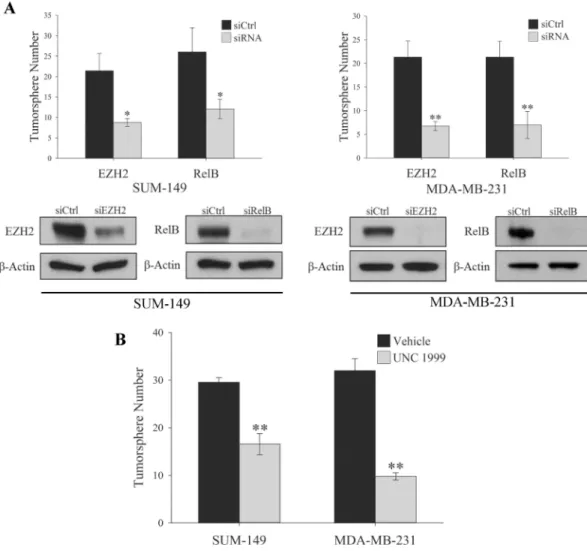
Previously our group showed that both canonical and non-canonical NF-κB signaling is required for the maintenance of TNBC TICs [14]. This data in combination with recent reports of EZH2 having a role in TNBC TIC maintenance [19,20] led us to examine the importance of both EZH2 and the non-canonical NF-κB subunit RelB in the self-renewal capacity of TNBC TICs. A hallmark of breast cancer TICs is the ability to form tumorspheres when plated at a low density in media containing no serum on low adhesion plates [30]. Knocking down RelB or EZH2 in both SUM-149 and MDA-MB-231 TNBC cell lines significantly reduced the num-ber of tumorspheres formed (Fig 1A), as expected. Additionally, inhibiting the HMT activity of EZH2 with the small molecule, UNC1999 [31,32], also reduced tumorsphere formation sug-gesting an HMT-dependent role of EZH2 in the maintenance of TNBC TICs (Fig 1B). Previous reports demonstrated that the HMT activity of EZH2 is not required in the expansion of stem cells in non-tumorigenic MCF10A cells [19] implicating two distinct roles of EZH2 in stem cell maintenance that potentially differs in tumorigenic versus non-tumorigenic cell lines.
In order to determine if these effects are unique to the triple negative subtype of breast can-cer, the contribution of RelB and EZH2 to the self-renewal capacity of several ER+ cell lines was tested. Knockdown of EZH2 only weakly reduced self-renewal of these cells (Fig 2A), while RelB knockdown had a more pronounced response. Additionally, treatment of these ER+ cell lines with EZH2 inhibitor UNC1999 had no effect on tumorsphere formation (Fig 2B), thereby demonstrating that the HMT activity of EZH2 is not required for the maintenance of tumor-spheres in some ER+ breast cancer cells.
EZH2 Is a Transcriptional Activator of RelB
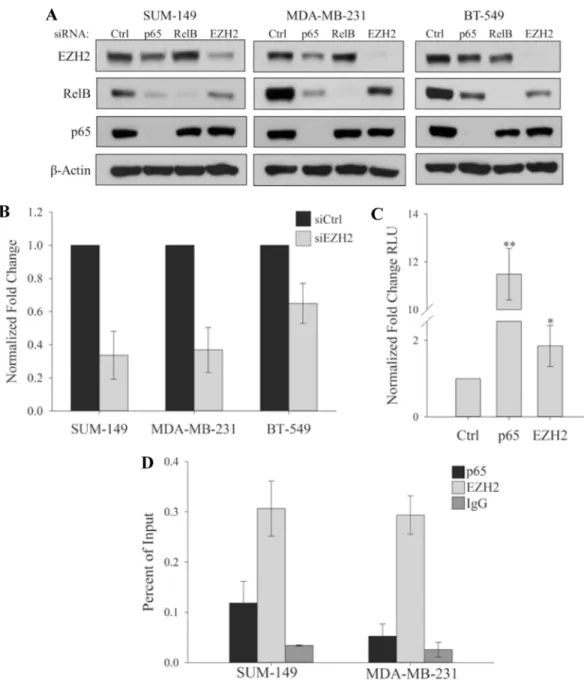
complex with p65 and RelB in TNBC to regulate the transcription of a group of cytokines [3]. To potentially link EZH2 with RelB, we found that, in three different TNBC cell lines, the pro-tein levels of RelB strongly decreases when EZH2 is depleted with either siRNA or shRNA (Fig 3A, and seeS1 Fig). RelB levels also decrease after knockdown of p65, which is consistent with the ability of p65 to regulate RelB expression [33]. Importantly, RelB RNA levels decreased with EZH2 knockdown (Fig 3B) indicating transcriptional control of RelB by EZH2. To further address the potential for EZH2 to transcriptionally activate RelB, cells were transfected with p65 or EZH2 and with a reporter containing the RelB promoter. Luciferase activity increased with p65 or EZH2 to a statistically significant level (Fig 3C), suggesting that both p65 and EZH2 can activate the transcription of RelB. Consistent with this, ChIP analysis of the RelB promoter in TNBC cells demonstrated an enrichment of both EZH2 and p65 (Fig 3D) thereby providing further evidence that EZH2 is a transcriptional activator of RelB in TNBC.
Fig 1. EZH2 and RelB are Required for the Maintenance of TNBC TIC. (A) Top panel, Quantification of
tumorspheres formed by 100 SUM-149 or MDA-MB-231 cells expressing control siRNA or siRNA targeting EZH2 or RelB. Values given as means±standard deviation from three biological repeats.*P<0.05,**P<0.005 versus controls; two tailed unpaired t-test. Bottom panel, Immunoblots of indicated proteins in adherent SUM-149 or MDA-MB-231 cells expressing the indicated siRNA construct.β-actin serves as a loading control. (B)
Quantification of tumorspheres formed by either 100 SUM-149 or MDA-MB-231 cells treated daily for 3 days with 1μM UNC1999. Values given as means±standard deviation from three biological repeats.**P<0.005 versus controls; two tailed unpaired t-test.
The Histone Methyltransferase Activity of EZH2 Is Dispensable for the
Regulation of RelB Transcription
It was important to determine if the methyltransferase activity of EZH2 is required for RelB transcription in TNBC. EZH2 was inhibited with small molecule inhibitors UNC1999 or DZNep, which blocked histone methyltransferase activity of EZH2 as detected by a decrease in H3K27me3 levels. Interestingly, this did not lead to a decrease in RelB levels (Fig 4A). To fur-ther validate that the regulation of RelB by EZH2 is PCR2-independent, we knocked down SUZ12, the subunit of the PCR2 complex which bridges the interaction of EZH2 to nucleo-somes and is required for EZH2 catalytic activity [16]. As expected SUZ12 reduced EZH2 lev-els. Interestingly, RelB levels were elevated over the RelB levels observed upon knocking down EZH2 suggesting that the EZH2 pool remaining after knocking down SUZ12 is able to contrib-ute to RelB transcription (Fig 4B). The histone methylation mark that EZH2 lays down, H3K27me3, was inhibited upon SUZ12 siRNA further indicating that the HMT activity of EZH2 is not required in regulation of RelB. To further validate that EZH2 is acting indepen-dent of the PRC2 complex, enrichment of SUZ12 at the RelB promoter was determined. Although EZH2 was again found to bind at the RelB promoter in TNBC cells, there was no enrichment of SUZ12 at this promoter (Fig 4C). The MYT1 promoter was shown to be regu-lated by the PRC2 complex [34] and was therefore used as a positive control. Indeed there was
Fig 2. Self-renewal of TICs in ER+ Breast Cancer Cells is not Dependent on EZH2 and RelB. (A) Top Panel,
Quantification of tumorspheres formed by 100 MCF7, HCC-1428 or T47D cells expressing control siRNA or siRNA targeting EZH2 or RelB. Values given as means±standard deviation from three biological repeats.*P<0.05 versus controls; two tailed unpaired t-test. Bottom Panel, Immunoblots of indicated proteins in adherent MCF7, HCC-1428 or T47D cells expressing indicted siRNA construct.β-actin serves as a loading control. (B) Left panel, quantification of tumorpsheres formed by 100 MCF7, HCC-1428 or T47D cells treated daily for 3 days with 1μM UNC1999. Values given as means±standard deviation from three biological repeats. Right panel, immunoblots of the indicated proteins in adherent MCF7, HCC-1428 or T47D cells treated daily for 3 days with 1μM UNC1999 to validate EZH2 inhibition.β-actin serves as a loading control.
significant enrichment of EZH2 and SUZ12 in both TNBC cell lines (Fig 4C) further indicating that EZH2 is binding the RelB promoter and activating its transcription independent of the PRC2 complex.
Fig 3. EZH2 is a transcriptional activator of RelB. (A) Immunoblots of indicated proteins in SUM-149,
MDA-MB-231 or BT-549 cells expressing control siRNA or siRNA targeting p65, RelB or EZH2.β-actin serves as a loading control. (B) Real time PCR showing expression of RelB in SUM-149, MDA-MB-231 and BT-549 cells. Expression was normalized to glucuronidase beta. Values given as means±standard deviation from three biological repeats. (C) Dual luciferase assay from HEK293 cells co-expressing the RelB Reporter with either Flag-p65 or HA-EZH2 and Renilla luciferase. Relative light units (RLU) was normalized to Renilla luciferase light units and expressed as fold over the RelB promoter alone. Values given as means±standard deviation of four biological repeats.*P = 0.05,
**P<0.05 versus controls; two tailed unpaired t-test. (D) ChIP analysis of p65 and EZH2 binding at the RelB promoter in SUM-149 and MDA-MB-231 cells. Non-specific binding was estimated from IgG immunoprecipitates. Values given as means±standard deviation from three technical repeats of one representative experiment from the three biological repeats.
Discussion
Our studies demonstrate that the non-canonical NF-κB subunit RelB is transcriptionally regu-lated by EZH2 in TNBC partly contributing to the maintenance of CSCs. Previously it was shown that RelB [14] and EZH2 [19,20] are important for the self-renewal of breast cancer TICs. Here we demonstrate a mechanism linking these previous observations. EZH2 has been identified as a transcriptional activator in TNBC regulating the expression of Notch [19], as well as IL-6 and TNF [24]. In the latter study, regulation of IL6 and TNF was proposed to involve EZH2 in complex with RelB and p65. We showed that IL6 promotes the formation of TNBC TICs and that exogenous IL6 rescues tumorsphere formation when NF-κB is inhibited
Fig 4. The HMT activity of EZH2 is not Required for RelB Transcription. (A) Immunoblots of indicated proteins
in SUM-149 or MDA-MB-231 cells treated with the indicated concentrations of UNC1999 (left panel) or DZNep (right panel) for 72 hours.β-actin serves as a loading control. (B) Immunoblots of indicated proteins in SUM-149 or MDA-MB-231 cells expressing control siRNA or siRNA targeting EZH2, SUZ12 or both EZH2 and SUZ12.β-actin serves as a loading control. (C) ChIP analysis of EZH2 and SUZ12 binding at the RelB promoter or the MYT1 Promoter as a positive control in SUM-149 and MDA-MB-231 cells. Non-specific binding was estimated from IgG immunoprecipitates. Values given as means±standard deviation from three technical repeats of one
representative experiment from the three biological repeats.
[14]. With our finding that EZH2 is a transcriptional activator of RelB it is likely that the upregula-tion of RelB by EZH2 feeds into the previously described pathway targeting IL-6 (and potentially other cytokines), to drive self-renewal. Since knockdown of p65 was shown to promote TNBC self-renewal and since p65 promotes RelB expression with EZH2, it is possible that a primary role for p65 in self-renewal is through the cooperation with EZH2, to promote RelB expression.
Our studies determined that the histone methyltransferase activity of EZH2 is not required for the regulation of RelB transcription, yet tumorsphere number decreases when treated with inhibitors of EZH2 catalytic activity suggesting a role for the histone methyltransferase activity of EZH2 in tumorsphere maintenance. We speculate that the HMT-dependent activity of EZH2 might involve STAT3 signaling. It has been shown that EZH2 methylates STAT3 in glioblastoma stem-like cells which is required for the activation of STAT3-dependent activation of stem cell-associated transcriptional factors and efficient tumorsphere formation [35]. Additionally, the JAK2/STAT3/IL6 pathway has been shown to be required for the growth of CD44-CD24+ breast cancer cells [36], cell surface markers believed to be associated with breast TICs [30]. This sug-gests a possible role for EZH2 in promoting breast cancer stem cells through the methylation and activation of STAT3. Interestingly, this pathway could be preferential for the triple negative sub-type since UNC1999 treatment does not appear to affect tumorsphere formation in ER+ breast cancer cell lines possibly identifying a pathway specific to the aggressive TNBC subtype which could be therapeutically targeted through inhibition of EZH2 activity.
RelB was originally identified to function primarily in the regulation of adaptive immune response [37] and the involvement of RelB in tumorigenesis was less well characterized. RelB was shown to promote tumorigenicity of prostate cancer cells partly due to regulating IL8 levels [38]. Importantly, in prostate cancer tissue nuclear RelB was observed in more samples than p65 and there was a significant correlation between nuclear RelB and patient Gleason score [39]. Similarly, high nuclear levels of active RelB were found in carcinogen-induced murine mammary tumors [40] and nuclear RelB was found to be significantly elevated in nuclei from ER- inflammatory breast cancer tissue samples [41]. Additionally, inhibition of RelB with vita-min D3 sensitized breast cancers to ionizing radiation [42]. A signature gene set has been iden-tified to be regulated by EZH2 and NF-κB specifically in TNBC [24]. Patients with high expression of this gene set were shown to have lower brain and lung metastasis-free survival emphasizing the importance of this signaling pathway in TNBC. The data reported here pro-vide data linking the non-canonical functions of EZH2 with control of RelB, to drive self-renewal of TNBC cells. This mechanism may underlie key aspects of the oncogenic functions for EZH2 and RelB.
Supporting Information
S1 Fig. RelB Levels Decrease after Knocking Down EZH2 with shRNA. Immunoblots of the
indicated proteins in SUM-149 and MDA-MB-231 cells after transduction with a lentivirus carrying pLKO.1-shScramble or pLKO.1-shEZH2 construct.β-actin serves as a loading con-trol.
(TIF)
Acknowledgments
We thank members of the Baldwin laboratory for helpful suggestions.
Author Contributions
Formal analysis: CL.
Funding acquisition: AB.
Investigation: CL.
Methodology: AB CL.
Project administration: AB.
Resources: CL.
Supervision: AB.
Validation: CL.
Visualization: CL.
Writing – original draft: CL.
Writing – review & editing: AB CL.
References
1. Kreso A, Dick JE. Evolution of the cancer stem cell model. Cell Stem Cell 2014 Mar 6; 14(3):275–291. doi:10.1016/j.stem.2014.02.006PMID:24607403
2. Li X, Lewis MT, Huang J, Gutierrez C, Osborne CK, Wu MF, et al. Intrinsic resistance of tumorigenic breast cancer cells to chemotherapy. J Natl Cancer Inst 2008 May 7; 100(9):672–679. doi:10.1093/ jnci/djn123PMID:18445819
3. Lee HE, Kim JH, Kim YJ, Choi SY, Kim SW, Kang E, et al. An increase in cancer stem cell population after primary systemic therapy is a poor prognostic factor in breast cancer. Br J Cancer 2011 May 24; 104(11):1730–1738. doi:10.1038/bjc.2011.159PMID:21559013
4. Nakshatri H, Srour EF, Badve S. Breast cancer stem cells and intrinsic subtypes: controversies rage on. Curr Stem Cell Res Ther 2009 Jan; 4(1):50–60. PMID:19149630
5. Luo M, Clouthier SG, Deol Y, Liu S, Nagrath S, Azizi E, et al. Breast cancer stem cells: current advances and clinical implications. Methods Mol Biol 2015; 1293:1–49. doi: 10.1007/978-1-4939-2519-3_1PMID:26040679
6. Prat A, Adamo B, Cheang MC, Anders CK, Carey LA, Perou CM. Molecular characterization of basal-like and non-basal-basal-like triple-negative breast cancer. Oncologist 2013; 18(2):123–133. doi:10.1634/ theoncologist.2012-0397PMID:23404817
7. Hayden MS, Ghosh S. NF-kappaB, the first quarter-century: remarkable progress and outstanding questions. Genes Dev 2012 Feb 1; 26(3):203–234. doi:10.1101/gad.183434.111PMID:22302935 8. Bradford JW, Baldwin AS. IKK/nuclear factor-kappaB and oncogenesis: roles in tumor-initiating cells
and in the tumor microenvironment. Adv Cancer Res 2014; 121:125–145. doi: 10.1016/B978-0-12-800249-0.00003-2PMID:24889530
9. Staudt LM. Oncogenic activation of NF-kappaB. Cold Spring Harb Perspect Biol 2010 Jun; 2(6): a000109. doi:10.1101/cshperspect.a000109PMID:20516126
10. DiDonato JA, Mercurio F, Karin M. NF-kappaB and the link between inflammation and cancer. Immu-nol Rev 2012 Mar; 246(1):379–400. doi:10.1111/j.1600-065X.2012.01099.xPMID:22435567 11. Perkins ND. The diverse and complex roles of NF-kappaB subunits in cancer. Nat Rev Cancer 2012
Jan 19; 12(2):121–132. doi:10.1038/nrc3204PMID:22257950
12. Cao Y, Luo JL, Karin M. IkappaB kinase alpha kinase activity is required for self-renewal of ErbB2/ Her2-transformed mammary tumor-initiating cells. Proc Natl Acad Sci U S A 2007 Oct 2; 104 (40):15852–15857. doi:10.1073/pnas.0706728104PMID:17890319
13. Liu M, Sakamaki T, Casimiro MC, Willmarth NE, Quong AA, Ju X, et al. The canonical NF-kappaB pathway governs mammary tumorigenesis in transgenic mice and tumor stem cell expansion. Cancer Res 2010 Dec 15; 70(24):10464–10473. doi:10.1158/0008-5472.CAN-10-0732PMID:21159656 14. Kendellen MF, Bradford JW, Lawrence CL, Clark KS, Baldwin AS. Canonical and non-canonical
15. Yamaguchi N, Ito T, Azuma S, Ito E, Honma R, Yanagisawa Y, et al. Constitutive activation of nuclear factor-kappaB is preferentially involved in the proliferation of basal-like subtype breast cancer cell lines. Cancer Sci 2009 Sep; 100(9):1668–1674. doi:10.1111/j.1349-7006.2009.01228.xPMID:
19538528
16. Kim KH, Roberts CW. Targeting EZH2 in cancer. Nat Med 2016 Feb 4; 22(2):128–134. doi:10.1038/ nm.4036PMID:26845405
17. Yamaguchi H, Hung MC. Regulation and Role of EZH2 in Cancer. Cancer Res Treat 2014 Jul; 46 (3):209–222. doi:10.4143/crt.2014.46.3.209PMID:25038756
18. Min J, Zaslavsky A, Fedele G, McLaughlin SK, Reczek EE, De Raedt T, et al. An oncogene-tumor sup-pressor cascade drives metastatic prostate cancer by coordinately activating Ras and nuclear factor-kappaB. Nat Med 2010 Mar; 16(3):286–294. doi:10.1038/nm.2100PMID:20154697
19. Gonzalez ME, Moore HM, Li X, Toy KA, Huang W, Sabel MS, et al. EZH2 expands breast stem cells through activation of NOTCH1 signaling. Proc Natl Acad Sci U S A 2014 Feb 25; 111(8):3098–3103. doi:10.1073/pnas.1308953111PMID:24516139
20. Chang CJ, Yang JY, Xia W, Chen CT, Xie X, Chao CH, et al. EZH2 promotes expansion of breast tumor initiating cells through activation of RAF1-beta-catenin signaling. Cancer Cell 2011 Jan 18; 19 (1):86–100. doi:10.1016/j.ccr.2010.10.035PMID:21215703
21. Xu K, Wu ZJ, Groner AC, He HH, Cai C, Lis RT, et al. EZH2 oncogenic activity in castration-resistant prostate cancer cells is Polycomb-independent. Science 2012 Dec 14; 338(6113):1465–1469. doi:10. 1126/science.1227604PMID:23239736
22. Shi B, Liang J, Yang X, Wang Y, Zhao Y, Wu H, et al. Integration of estrogen and Wnt signaling circuits by the polycomb group protein EZH2 in breast cancer cells. Mol Cell Biol 2007 Jul; 27(14):5105–5119. doi:10.1128/MCB.00162-07PMID:17502350
23. Kim KH, Kim W, Howard TP, Vazquez F, Tsherniak A, Wu JN, et al. SWI/SNF-mutant cancers depend on catalytic and non-catalytic activity of EZH2. Nat Med 2015 Dec; 21(12):1491–1496. doi:10.1038/ nm.3968PMID:26552009
24. Lee ST, Li Z, Wu Z, Aau M, Guan P, Karuturi RK, et al. Context-specific regulation of NF-kappaB target gene expression by EZH2 in breast cancers. Mol Cell 2011 Sep 2; 43(5):798–810. doi:10.1016/j. molcel.2011.08.011PMID:21884980
25. Yang CC, LaBaff A, Wei Y, Nie L, Xia W, Huo L, et al. Phosphorylation of EZH2 at T416 by CDK2 con-tributes to the malignancy of triple negative breast cancers. Am J Transl Res 2015 Jun 15; 7(6):1009– 1020. PMID:26279746
26. Holm K, Grabau D, Lovgren K, Aradottir S, Gruvberger-Saal S, Howlin J, et al. Global H3K27 trimethy-lation and EZH2 abundance in breast tumor subtypes. Mol Oncol 2012 Oct; 6(5):494–506. doi:10. 1016/j.molonc.2012.06.002PMID:22766277
27. Wang X, Belguise K, Kersual N, Kirsch KH, Mineva ND, Galtier F, et al. Oestrogen signalling inhibits invasive phenotype by repressing RelB and its target BCL2. Nat Cell Biol 2007 Apr; 9(4):470–478. doi:
10.1038/ncb1559PMID:17369819
28. Naderi A, Meyer M, Dowhan DH. Cross-regulation between FOXA1 and ErbB2 signaling in estrogen receptor-negative breast cancer. Neoplasia 2012 Apr; 14(4):283–296. PMID:22577344
29. Bronder JL, Moran RG. A defect in the p53 response pathway induced by de novo purine synthesis inhibition. J Biol Chem 2003 Dec 5; 278(49):48861–48871. doi:10.1074/jbc.M304844200PMID:
14517211
30. Fillmore CM, Kuperwasser C. Human breast cancer cell lines contain stem-like cells that self-renew, give rise to phenotypically diverse progeny and survive chemotherapy. Breast Cancer Res 2008; 10 (2):R25. doi:10.1186/bcr1982PMID:18366788
31. Konze KD, Ma A, Li F, Barsyte-Lovejoy D, Parton T, Macnevin CJ, et al. An orally bioavailable chemi-cal probe of the Lysine Methyltransferases EZH2 and EZH1. ACS Chem Biol 2013; 8(6):1324–1334. doi:10.1021/cb400133jPMID:23614352
32. Xu B, On DM, Ma A, Parton T, Konze KD, Pattenden SG, et al. Selective inhibition of EZH2 and EZH1 enzymatic activity by a small molecule suppresses MLL-rearranged leukemia. Blood 2015 Jan 8; 125 (2):346–357. doi:10.1182/blood-2014-06-581082PMID:25395428
33. Bren GD, Solan NJ, Miyoshi H, Pennington KN, Pobst LJ, Paya CV. Transcription of the RelB gene is regulated by NF-kappaB. Oncogene 2001 Nov 22; 20(53):7722–7733. doi:10.1038/sj.onc.1204868
PMID:11753650
35. Kim E, Kim M, Woo DH, Shin Y, Shin J, Chang N, et al. Phosphorylation of EZH2 activates STAT3 sig-naling via STAT3 methylation and promotes tumorigenicity of glioblastoma stem-like cells. Cancer Cell 2013 Jun 10; 23(6):839–852. doi:10.1016/j.ccr.2013.04.008PMID:23684459
36. Marotta LL, Almendro V, Marusyk A, Shipitsin M, Schemme J, Walker SR, et al. The JAK2/STAT3 sig-naling pathway is required for growth of CD44(+)CD24(-) stem cell-like breast cancer cells in human tumors. J Clin Invest 2011 Jul; 121(7):2723–2735. doi:10.1172/JCI44745PMID:21633165 37. Burkly L, Hession C, Ogata L, Reilly C, Marconi LA, Olson D, et al. Expression of relB is required for
the development of thymic medulla and dendritic cells. Nature 1995 Feb 9; 373(6514):531–536. doi:
10.1038/373531a0PMID:7845467
38. Xu Y, Josson S, Fang F, Oberley TD, St Clair DK, Wan XS, et al. RelB enhances prostate cancer growth: implications for the role of the nuclear factor-kappaB alternative pathway in tumorigenicity. Cancer Res 2009 Apr 15; 69(8):3267–3271. doi:10.1158/0008-5472.CAN-08-4635PMID:19351823 39. Lessard L, Begin LR, Gleave ME, Mes-Masson AM, Saad F. Nuclear localisation of nuclear
factor-kap-paB transcription factors in prostate cancer: an immunohistochemical study. Br J Cancer 2005 Oct 31; 93(9):1019–1023. doi:10.1038/sj.bjc.6602796PMID:16205698
40. Demicco EG, Kavanagh KT, Romieu-Mourez R, Wang X, Shin SR, Landesman-Bollag E, et al. RelB/ p52 NF-kappaB complexes rescue an early delay in mammary gland development in transgenic mice with targeted superrepressor IkappaB-alpha expression and promote carcinogenesis of the mammary gland. Mol Cell Biol 2005 Nov; 25(22):10136–10147. doi:10.1128/MCB.25.22.10136-10147.2005
PMID:16260626
41. Van Laere SJ, Van der Auwera I, Van den Eynden GG, Elst HJ, Weyler J, Harris AL, et al. Nuclear fac-tor-kappaB signature of inflammatory breast cancer by cDNA microarray validated by quantitative real-time reverse transcription-PCR, immunohistochemistry, and nuclear factor-kappaB DNA-binding. Clin Cancer Res 2006 Jun 1; 12(11 Pt 1):3249–3256.