VARIOUS REGULATORY AGENCIES REQUIRE THAT WE BRING THE FOLLOWING
INFOR-MATION TO YOUR ATTENTION. PLEASE READ IT CAREFULLY.
WARNING: TO PREVENT FIRE OR SHOCK
HAZARD, DO NOT EXPOSE THIS UNIT TO
RAIN OR MOISTURE.
The Mclntosh you have purchased is a Model MAC 4100. It has a serial number located on the rear panel of the chassis. Record that serial number here:
Serial Number
The model, serial number and purchase date are im-portant to you for any future service. Record the pur-chase date here:
Purchase Date
Upon application, Mclntosh Laboratory provides a Three-Year Service Contract. Your Mclntosh authorized Service Agency can expedite repairs when you provide the Service Contract with the in-strument for repair. To assist, record your Service Contract number here:
Your MAC 4100 Solid State AM-FM/FM Stereo Receiver will give you many years of pleasant and
satisfactory performance. If you have any questions, please contact:
CUSTOMER SERVICE
Mclntosh Laboratory Inc. 2 Chambers Street
Binghamton, New York 13903 Phone: 607-723-3512
Contents
Take Advantage of 3 years
of Contract Service . . .
Fill in the Application NOW.
INTRODUCTION ...2 INSTALLATION.. .3 HOW TO CONNECT...5 WHAT THE FRONT PANEL CONTROLS
DO AND HOW TO USE THEM.. .10 PUSHBUTTONS ...10 FRONT PANEL INDICATORS . . .12 BALANCING YOUR STEREO . .. 13 LISTENING TO YOUR STEREO . ..13 MAC 4100 PERFORMANCE LIMITS .. .15 TECHNICAL DESCRIPTION . .. 16
PERFORMANCE CHARTS...20,21,22,23 BLOCK DIAGRAM...24
MCINTOSH THREE YEAR SERVICE CONTRACT
An application for a THREE YEAR SERVICE CONTRACT is included with this manual.
The terms of the contract are:
1. Mclntosh w i l l provide all parts, materials and labor needed to return the measured performance of the instru-ment to the original performance limits. The CONTRACT does not cover any shipping costs to and from the authoriz-ed service agency or the factory. 2. Any Mclntosh authorized service
agen-cy will repair Mclntosh instruments at normal service rates. To receive service under the terms of the SERVICE CON-TRACT, the SERVICE CONTRACT CER-TIFICATE must be presented when the instrument is taken to the service agency.
3. A l w a y s have service done by a Mclntosh authorized service agency. If the instrument is modified or damaged, as a result of unauthorized repair the SERVICE CONTRACT will be cancelled. Damage by improper use or
mishandl-ing is not covered by the SERVICE CON-TRACT.
4. The SERVICE CONTRACT is issued to you as the original purchaser. To pro-tect you from misrepresentation this contract cannot be transferred to a se-cond owner.
5. For your protection Mclntosh selects only dealers who have technical com-petence to guide purchasers fairly, and provide service when necessary. To receive the SERVICE CONTRACT your purchase must be made from a Mclntosh franchised dealer.
6. Your completely filled in application for a SERVICE CONTRACT must be post-marked within 30 days of the date of purchase of the instrument.
7. To receive the SERVICE CONTRACT all information on the application must be filled in. The SERVICE CONTRACT will be issued when the completely filled in application is received at Mclntosh Laboratory Incorporated in Bingham-ton, New York.
Introduction
The Mclntosh MAC 4100 is a high quality, high power AM/FM Stereo Receiver. Its design has been governed by insistence on great flexibility, sensitivi-ty, high performance with long life. It is easy to use. Some of the many new improvements designed for your listening enjoyment Include:
Low noise field effect transistor analog input swit-ching that keeps signal leads short to reduce possi-ble noise and hum pickup. Mechanical contact noise is also eliminated.
LED Input indicators show which source has been selected and help make input selection faster, easier, surer and more convenient.
New low impedance transistor technology reduces hum and noise interference in the phono preamplifier.
Electronically controlled trimming of the preci-sion stepped volume control maintains a channel to channel accuracy of 1 dB. This high order of exact-ness assures continuing program balance as the listening loudness is changed.
The five band program equalizer permits the ad-justment and improvement of the tone contrast of the five most important listening ranges. Each can be emphasized or de-emphasized to satisfy your taste or listening atmosphere without affecting any of the other ranges.
The high quality power performance is
con-tinuously assured by POWER GUARD. The POWER GUARD circuit dynamically prevents power amplifiers from being overdriven into hard clipping --- which protects your speakers from potential damage - - - which assures that the amplifier will pro-duce its maximum output without increased distor-tion. The power delivered is 100 watts per channel at 4 ohms to give extra dynamic life to your music • even when you're using any combination of 3 sets of stereo loudspeakers.
The selectively lighted dial pointer lights only the relevant part of the tuning indicator to make tuning easier.
Automatic AC power control is provided by the auto On/Off circuit that conveniently shuts off the entire system when the turntable shuts off. No need to interrupt your pleasure at the end of the record.
Front panel tape recorder jacks allow simple plug In of an "outboard" tape recorder without upsetting your regular system connections.
Copies of tapes can be easily made between two connected tape recorders. Front panel tape copying controls function without disturbing other sound sources.
This outstanding receiver will serve you best when you understand its functions and what it is designed to do. Some time invested with this manual will be valuable in your knowledge of how it works.
x 8" [20.32 cm], [see Fig. 2]. In addition, a single 3/8" to 1/2" [1 cm to 1.3 cm] screw hole [see Fig. 2 and Fig. 3] must be drilled in the shelf to secure the receiver after installation. The top of the shelf must be attached flush with the bottom of the custom panel cutout.
BOTTOM OF PANEL CUTOUT AND TOP OF SUPPORT SHELF MUST COINCIDE
Fig. 1 Custom Cabinet Front Panel Cutout.
The MAC 4100 may be used on a shelf or table top in the enclosure in which it comes or may be install-ed in a custom cabinet. In any method of use provide adequate ventilation.
The trouble-free life of an electronic instrument is greatly extended by providing sufficient ventilation to prevent the build-up of high internal temperatures that cause deterioration. Allow enough clearance so that cool air can enter at the bottom of the receiver and be exhaused from the top and rear. With ade-quate ventilation the instrument can be mounted in any position.
The MAC 4100 is installed from the front of a custom cabinet. The desirable space behind the cabinet panel is 15" [38.1 cm] deep, 18-1/2" [47 cm] wide, and 6"-[15.2 cm] high. The unit fits an opening exactly 5-1/16" [12.9 cm] by 17-5/16" [44 cm] wide. Make this cutout carefully. The receiver's front panel has a 1/8" [.32 cm] overhang on both sides and a 3/32" (.24 cm) overhang on the top and bottom, [see Fig. 1].
The weight of the receiver must rest on a shelf in which there is a ventilation hole cutout 15" [38-1 cm]
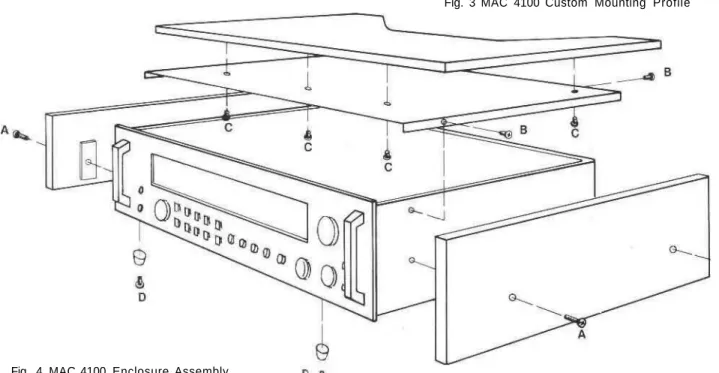
Prepare the MAC 4100 for custom mounting by removing the wood cabinet and feet as follows: 1. Remove 4 screws "A" [see Fig. 4]; two from each
side panel.
2. To remove the enclosure top panel, the receiver's metal top must be temporarily removed. It is at-tached to the chassis by 4 screws "B" [see Fig. 4] installed 2 through the flange on the back and 1 through each of the flanges on the side. Remove these 4 screws. Save the screws to reinstall the metal top after removal of the enclosure top panel.
3. Under the metal top are 5 screws "C" that hold the enclosure top panel to the metal top [see Fig. 4]. Remove the 5 screws "C" that hold the metal top to the enclosure top panel.
4. Replace the metal top on the MAC 4100 with the 4 screws "B".
5. On the bottom of the receiver are the 4 plastic feet held on by screws "D" [see Fig. 4]. Remove these feet. Do not attempt to remove the 4 plastic but-ton glides as these rest against the shelf, (see Fig. 2 and 3). At this point the receiver is ready to be custom installed.
From the front of the cabinet, thread the power cord through the opening in the cabinet panel and slide the MAC 4100 in on the shelf. Adjust the posi-tion to evenly cover the custom panel cutout. Lock the unit in place with a screw and washer inserted through the drilled hole in the mounting shelf [see Fig. 3]. Use a 1-1/4" [3.2 cm] screw for 1/2" [1.3 cm] shelf or a 1-1/2" [3.8 cm] screw for 3/4 [1.9 cm] shelf. Do not use longer screws.
MAC 4100 UNIT OUTLINE (DOTTED) MOUNTING SURFACE
MOUNTING PANEL
Fig. 2 Custom Cabinet Shelf Mounting Cutout.
MOUNTING SURFACE
15" (36.1cm)
MINIMUM DEPTH REQUIRED
FOR 1/2" SHELF USE 1 1/4" SCREW (1.3cm) (3.2cm) FOR 3/4" SHELF USE 1 1/2" SCREW
(1.9cm) (3.8cm) MOUNTING PANEL PLASTIC BUTTONS CUTOUT FOR VENTILATION SECURE UNIT
WITH SCREW AND WASHER
Fig. 3 MAC 4100 Custom Mounting Profile
How to Connect
C O N N E C T I N G T U R N T A B L E S
The MAC 4100 has shorting plugs in the phono in-puts. To prevent unwanted noise remove only the shorting plugs from input j a c k s that a r e 10 be used Connect the cable from the left channel of the turn-table into the INPU1 L PHono 1 jack.
Connect the cable from the right channel of the t u r n t a b l e into the INPUT R PHono 1 j a c k . Connect PHono 2 in the same way for use with a second t u r n
-table
CONNECTING T A P E RECORDERS To Record
Connect a cable f r o m the RECORDER L TAPE 1 OUT jack to the l e f t high level input of the t a p e recorder. Connect a cable from the RECORDER R TAPE 1 OUT jack to the right high level input of the tape recorder. Connect a second recorder in the same manner to the RECORDER T A P E 2 OUT jacks. To Playback/Monitor.
Connect a cable from the left channel output of a tape recorder to the RECORDER L T A P E 1 IN jack. Connect a cable from the right channel output of a tape recorder to the RECORDER R T A P E 1 IN j a c k . Connect a second recorder in the same manner to t h e RECORDER TAPE 2 IN jacks.
Front Panel Tape Recorder Jacks:
Tape recorder inputs and outputs are available at t h e TAPE IN-OUT jacks on the front panel l e f t of the INPUT SELECTOR switch. Rapid, temporary connec-tions to TAPE 2 facilities are easily made without getting at the rear panel. A metal shielded 1/4" stereo phone plug is used Connections are tip: left signal, ring: right signal, and. sleeve: common ground.
When a tape recorder is plugged into the front jacks all the facilities normally associated with TAPE 2 on the rear panel are automatically transfer-red to the front panel jacks.
CONNECTING AC POWER
The receiver AC power cord is plugged into a 120 volt 6O Hz wall outlet.
There are three t y p e s of AC power outlets on the back panel of the MAC 4100 one red. two black, and two green
The red and the green AC power outlets are on at all times. The red outlet can be used for a t a p e recorder with its own AC power switch. Plug the AC power cables f r o m the t u r n t a b l e into the green TURNTA8LE power o u t l e t s on the rear panel
The t w o black o u t l e t s are switched on and o f f when the receiver is turned on or o f f . These are in-tended for equalizers and other accessories.
The POWER ON pushbutton shares AC power control, with the AC power s w i t c h on a turntable, through a current detecting switch circuit On me rear panel the TURNTABLE AUTO/MANUAL switch selects the mode of operation.
When the switch is in the AUTO position and a turntable plugged into one of t h e green AC power outlets, the AC power to the receiver and to the black AC power outlets can be controlled by the turntable on/off s w i t c h . When AC power to the turn-table is turned on, automatically the receiver and the SWITCHED black AC power outlets are t u r n e d on The system will remain on until the turntable is turn-ed oil. The POWER ON pushbutton c o n t r o l s the AC power lor any source other than the turntable.
In the MANUAL position only the POWER ON pushbutton will turn AC power on or off
Some turntables have electronic circuits that draw current all the time. To use these turntables the AUTO/MANUAL switch must be in the MANUAL position. With the A U T O / M A N U A L s w i t c h in the MANUAL position, AC power to the s y s t e m will be controlled by the front panel POWER pushbutton only.
The green AC power outlets are protected with a one amp fuse. Any increase in the value of this fuse will affect the protection of the sensing circuit and may cause damage.
A VHF-TV antenna can be effective when it is designed for both FM and TV reception. Connect the two leads from the VHF-TV antenna to the ANTEN-NA 300W FM push connectors.
CONNECTING PROGRAM SOURCE GROUNDS
A single GROUND post is provided to which grounds for turntables, record changers, tape decks, etc. are connected. To prevent hum pickup, the left and right program cables and the ground wire from that source should be wound or twisted together. Make sure the ground wire does not make any con-nection to the shields of the left and right program cables between the source and the input of the MAC 4100.
FM PRESELECTOR SWITCH
FM receivers can be overloaded by very large antenna input signals when the receiver is located very near to a FM broadcasting station or when a high gain directional antenna is used in a metropolitan area.
The preselector may be switched into or out of the FM RF circuit by a slide switch located on the MAC 4100 rear panel near the AM antenna.
We recommend that the FM Preselector switch be used in the "out" position for all FM listening condi-tions except where there is evidence of overload by strong stations. In that case, the "in" position will immunize against overload. For most stations there will be no listening difference between the two switch positions.
MAC 4100 receivers with serial numbers below BY3000 do not have the FM preselector switch described above.
CONNECTING AN FM ANTENNA
One of three antenna systems can be used: [1] an outdoor FM antenna, or [2] a VHF-TV antenna, or [3] the indoor dipole supplied.
An outdoor antenna is recommended for optimum performance in all areas, In fringe [outlying] areas, best results will be obtained with a highly direc-tional FM antenna used in conjunction with a rotator. If the antenna uses a 300 ohm lead, connect it to the ANTENNA 3000 FM push connectors.
The coaxial cable of an unbalanced 75 ohm anten-na connects to the rear panel ANTENNA 750 FM type F coaxial connector.
An outside antenna system should not be located in the vicinity of overhead power lines or other elec-tric light or power circuits, or where it can fall into such power lines or circuits. When installing an out-side antenna system, extreme care should be taken to keep from touching such power lines or circuits as contact with them might be fatal.
CONNECTING AN INDOOR DIPOLE ANTENNA
The flexible folded dipole antenna [300 ohm] is for use in urban or high strength signal areas. Connect the two leads from the dipole to the ANTENNA 300W FM push connector.
The flexibility of the twin flat wire assembly per-mits it to be placed under a rug, tacked behind the stereo ... or placed in any other convenient location. In some cases, it may be necessary to "position" the antenna for best signal reception. This should be done before it is permanently located.
Avoid locating the antenna next to other wires or metal objects. Any indoor antenna may be ineffec-tive in houses having metal siding or metal foil in-sulation.
AM ANTENNA
For local and most moderately distant AM recep-tion the built-in ferrite loopstick antenna may be us-ed. The AM loopstick antenna is on a swivel base and must be adjusted away from the chassis for best reception.
Distant reception can be improved with the use of a copper antenna wire 50 to 150 feet in length. Sus-pend the wire in a straight line as high as possible. Attach the wire at each end with suitable glass or ceramic insulators. Connect a lead-in wire at any convenient point on the antenna. It is recommended that a lightning arrester be used with an outdoor AM antenna. The arrester should be well grounded to a ground rod or cold water pipe.
CONNECTING A MAXIMUM PERFORMANCE INDICATOR
The scope TP1 and TP2 jacks on the rear panel are used to connect a Mclntosh maximum performance indicator or an oscilloscope. Follow directions outlined in the maximum performance indicator owner's manual.
FUSES
A 4-amp SLO BLO fuse protects the receiver cir-cuits. The fuse does not protect additional equip-ment connected to the rear panel AC power outlets. A one amp fuse protects the turntable auto on cir-cuit. If this fuse opens, power to the green outlets will be interrupted.
CONNECTING LOUDSPEAKERS FOR STEREO
All speakers are connected to the push connec-tors on the rear panel. When stereo speakers have been connected to the proper push connectors, the corresponding front panel pushbuttons turn the speakers on or off.
Selection of the proper guage wire to connect the loudspeakers preserves the quality of sound repro-duction for which the loudspeakers have been de-signed. If undersize wire is used, resistance is added to the receiver/loudspeaker combination which adversely a f f e c t s the performance. Added resis-tance causes reduction of damping characteristics, modification of frequency response and reduction in power output.
Use lamp cord, bell wire, or wire with similar type of insulation to connect the speakers to the am-plifier, in all cases, the leads to and from the speaker should be twin conductor or twisted together. When using 8 ohm speakers and for the normally short distances of under 30 feet between the amplifier and speaker. No. 18 wire or larger can be used. For distances over 30 feet between the receiver and speaker use larger diameter wire. Select the correct size wire for the wire length from the chart. It is recommended that the DC resistance of the speaker leads be less than 5% of the speaker impedance. Up to 10% can be tolerated. Resistance of the leads should be computed for the length of wire both to and from the speaker or speakers. The heavier gauge wires may not fit into the holes in the speaker and receiver terminals. Attach a short piece of lighter gauge wire and then connect to the terminals.
MAXIMUM WIRE LENGTHS
Wire For 4 Ohm Load For 8 Ohm Load Gauge 22 20 18 16 14 12 10
Wire lengths above represent the wire resistance equal to 5% of the speaker impedance
For multiple speaker operation, run separate leads from the receiver to the speakers.
Connect the leads from the left main loudspeaker to the SPEAKER 1 Left and Common push connec-tors. Connect the lead from the right main
Feet 6 10 15 25 40 60 100 Meters 1.8 3.1 4.6 7.6 12.2 18.3 30.5 Feet 12 20 30 50 80 120 200 Meters 3.7 6.1 9.1 15.2 24.4 36.6 66.0
loudspeaker to the SPEAKER I Right and Common push connectors. Connect the leads from a second left loudspeaker to the SPEAKER 2 Left and Com-mon push connectors. Connect the lead from a se-cond right loudspeaker to the SPEAKER 2 Right and Common push connectors. Connect the leads from a third left loudspeaker to the SPEAKER 3 Left and Common push connectors. Connect the lead from a third right loudspeaker to the SPEAKER 3 Right and Common push connectors.
CONNECTING ONE LOUDSPEAKER FOR MONO
The left and right outputs of the MAC 4100 must con-nect to separate loudspeakers. Do not parallel the output connections for a single loudspeaker. If the left and right outputs are connected together ex-cessive heat is generated in the power amplifiers which causes damage even though the MODE SELECTOR pushbutton is in the MONO position. If you wish to drive a single loudspeaker, put the MODE SELECTOR in MONO and connect the loud-speaker to the l e f t or the right loud-speaker push connec-tors only. It is not necessary to connect a load to the other channel output.
CONNECTING A MCINTOSH EQUALIZER
On the JUMPER panel, remove the jumpers bet ween the PREAMP OUT jacks and POWER AMP IN-put jacks. The environmental equalizer is connected between these jacks. Standard shield cables con-nect the PREAMP OUT to the input of the equalizer. Connect the output of the equalizer to the POWER AMP INput jack.
CONNECTING OTHER POWER AMPLIFIERS
External power amplifiers may be fed to the MAC 4100 in two ways:
1. Fed from the RECORDER TAPE OUT. The out-put at this point is not affected by the volume or equalizing controls of the MAC 4100. Use this output to drive an amplifier which has its own controls. A possible use would be to operate an independent system in a remote location where volume re-quirements need to be locally controlled.
2. Fed from the AMPLIFIER - PREAMP OUT jacks. The output at these jacks is affected by the VOLUME, EQUALIZER, BALANCE, and LOUDNESS controls. Use this connection to drive an amplifier without controls of its own. or where the influence of the controls of the MAC 4100 are wanted on all loudspeakers.
What the Front Panel Controls do
and How to use Them
INPUT SELECTOR
The six position IN-PUT SELECTOR con-trols DC voltage fed to FET analog switches which choose the input program selected. The INPUT SELECTOR is turned to:
AUX 1: to connect the output from any high level program source requiring flat amplification to the high level input stage. Such a source could be another tape recorder, a television set, etc. The input impedance is 100,000 ohms
AUX 2: same as AUX 1
AM: to connect the AM tuner circuits to the amplifiers and loudspeakers
FM: to connect the FM tuner circuits to the amplifiers and loudspeakers
PHono 1: to connect the output of magnetic phono cartridge plugged into PHono 1 to the low level amplifying stages. The response of these stages has been shaped to precisely conform to revised RIAA standards. The input impedance is 47,000 ohms, 87 pf
PHono 2: Same as PHono 1
Pushbuttons
IMPORTANT: When the MAC 4100 is operated with either MONITOR pushbutton at the in position, the program heard will be that from the tape recorders only. Signal from any other source will not be heard from the loudspeakers. To hear any other source, make sure the MONITOR pushbuttons are OUT.
The MONITOR switches are mechanically in-terlocked to prevent simultaneous monitoring from two tape recorders. If one button is at the in posi-tion, it must be pushed again to release it to the out position before the other button can be pushed.
The MAC 4100 is designed so it may be used with two tape recorders. The four upper left pushbuttons on the front panel control the signal output of these recorders. They permit playback of either recorder, monitor of either recorder as recordings are being made, or copying of tapes from one recorder to another while listening to a separate program.
MONITOR TAPE 1 pushbutton out: The program source as selected by the INPUT SELECTOR is fed to the power amplifiers and heard through the loudspeakers; pushbutton in: Signal from a tape recorder plugged into TAPE 1 IN Is fed to the power amplifiers and heard through the loudspeakers. MONITOR TAPE 2 pushbutton: Functions similarly to monitor Tape 1. It also controls the program from a tape recorder plugged into the front panel TAPE IN and OUT jacks. When a tape recorder is plugged into the front Jacks all the facilities normally fed to TAPE 2 on the rear panel are automatically transferred to the front panel. The tape recorder plugged into the TAPE 2 IN and OUT jacks on the rear panel Is automatically disconnected.
TAPE COPY T1 - T2 pushbutton in: connects the output from tape recorder 1 to the input of tape recorder 2 without affecting the program being
heard from the speakers. In this position a copy of the program on tape recorder 1 can be made on tape recorder 2. To monitor the original use MONITOR TAPE 1 pushbutton and to monitor the copy use
MONITOR TAPE 2 pushbutton.
TAPE COPY T2 - T1 pushbutton in: connects the output from tape recorder 2 to the input of tape recorder 1 without affecting the program being heard from the speakers. In this position A copy of tape program on recorder 2 can be made on recorder 1. To monitor the original use MONITOR TAPE 2 pushbutton and to monitor the copy use MONITOR TAPE 1 pushbutton.
MONO: The MONO pushbutton switches the audio sections of the receiver from stereo mode to MONO. When the INPUT SELECTOR is in the FM position the FM multiplex light will remain on when tuned to a FM stereo station regardless of the position of the MONO pushbutton. The program heard will be mono. The TAPE OUT jacks are not affected by the MONO pushbutton.
FM MUTE: With the pushbutton in, interstation noise and weaker stations are suppressed; pushbutton out: noise between stations, as well as very weak stations, will be heard as you tune across the dial. SPEAKERS 1, 2 and 3: When each of these pushbut-tons is pushed in, a pair of loudspeakers is con-nected to the power amplifier outputs. Speaker 1, 2 and 3 may be selected one at a time, any combina-tion or all at once.
POWER ON: The POWER ON pushbutton shares AC power control, through a current sensing switch cir-cuit, with the AC power switch on a turntable. On the rear panel the TURNTABLE AUTO/MANUAL switch selects the mode of operation.
When the switch is in the AUTO position and a turntable is plugged into one of the green AC power outlets, the AC power to the receiver and to the black AC power outlets can be controlled by the turntable on/off switch. When AC power to the turn-table is turned on. automatically the receiver and the SWITCHED black AC power outlets are turned on. The system will remain on until the turntable is
turn-ed off. The POWER ON pushbutton controls the AC power for any source other than the turntable.
In the MANUAL position only the POWER ON pushbutton will turn receiver AC power on or off.
EQUALIZER FREQUENCY CONTROLS
Each of five EQUALIZER FREQUENCY controls modifies upward or downward the tone balance of a band of frequencies centered on the frequency marked above the control. The flat position of the control has a detent for easy reference. Each control provides 12 dB boost or cut at the specified center frequency.
Use the EQUALIZER FREQUENCY controls to modify the sound and tone balance of program material. Here are some suggestions from which to start:
Problem Equalizer Correction Bass too weak Raise 30 and/or 150 Male vocalist needs reinforcing Raise 150 Female vocalist reinforcing Raise 500 Hum on program Reduce 30 Violins, trumpets dull Raise 1500 Drum "brushes" not audible Raise 10 K
BALANCE and LOUDness
The BALANCE and LOUDness controls are concentric. The BAL-ANCE control [large outer knob] adjusts for equal volume of either the left or right chan-nels. The volume of the channels can be varied relative to each other without affecting their combin-ed volume.
l e f t . . . turning the control to the left accents the left channel by reducing the right channel output. right . .. turning the control to the right accents the right channel by reducing the left channel output.
The LOUDness control [small center knob] in-creases both bass and treble frequencies of both channels as it is turned clockwise. Adjustment of the LOUDness control allows life-like frequency balance when playing music softly. Its contour is the
same, regardless of the position of the volume con-trol. This contour is accurately modelled after the family of "Equal Loudness" curves identified by Fletcher and Munson.
The loudness circuitry is completely independent of the volume control. Therefore, any desired amount of compensation can be introduced regardless of volume control position.
VOLUME CONTROL
The VOLUME con-trol is a precision step control manufactured for Mclntosh Labora-tory. It has 32 steps with a 70 dB range, plus volume off. Left and right channel tracking are within
1 dB. This extreme accuracy is obtained through special electronically controlled resistance element trimming. Since the switch commutator touches on-ly contact pads and not the precision resistor elements, tracking accuracy is permanently main-tained and is noise free.
HEADPHONE JACKS
The front panel HEADPHONE jacks have been designed to feed low impedance dynamic head-phones. Electrostatic headphones generally require higher power than dynamic headphones. They must be connected to the speaker push connectors on the rear panel.
Plug headphones into the front panel HEAD-PHONE jack. Adjust the front panel VOLUME control for comfortable headphone listening.
Signal to the headphone jacks is not affected by the SPEAKER switches.
Front Panel indicators
The MAC 4100 has three dial scales: 1. AM - marked 550 to 1600 kHz 2. FM - marked 88 to 108 MHz 3. Logging Scale - 0-100
As the tuning knob is turned, the tuning indicator moves across the dial. To make tuning easier only the portion of the indicator directly behind the ap-propriate dial scale is lighted. On FM, the upper tion of the indicator is lighted. On AM, the lower por-tion is lighted.
The logging scale can be used to accurately retune any station. You may find it easier to keep a record of your favorite stations by use of the logging scale.
FM TUNING METER
An FM station is correctly tuned when the meter needle is in the black area of the FM tun-ing meter and the AFL in-dicator light is lighted.
SIGNAL STRENGTH METER
When tuning either an FM or AM signal the signal strength meter indicates the strength of the signal as received from the antenna. The higher the indica-tion the stronger the signal.
AMPLIFIER POWER OUTPUT INDICATORS
The amplifier POWER output in-dicators are to the left of the tuning dial. There are two vertical columns of seven yellow Light Emitting Diode [LED] indicators - the left column for the left channel and right column for-the right channel.
As power to the loudspeakers is increased, more LEDs are turned on, vertically, indicating the in-crease. Each row is independent of the other. The LEDs provide constant and instant information on the amount of power being fed to your speakers.
POWER GUARD
POWER GUARD assures that the amplifier can not
be over driven so amplifier output clipping is eliminated. Clipping is caused when the amplifier is asked to produce more power output than it can deliver with low distortion. Amplifiers are capable of delivering large quantities of power when they are driven to clipping and can have more than 40% har-monic distortion. The extra energy content of the clipped signal will damage most speakers. A Mcln-tosh advancement helps to protect your speaker from this kind of damage. The MAC 4100 has a built in "waveform comparator" that compares the wave shape of the input signal with the output signal. If the non-linearity between the two signals exceeds 0.5% the POWER GUARD circuit operates. Opera-tion is indicated when the LEDs at the top of the amplifier power indicator are lighted in red. As long as the amplifier operates without overload the NOR-MAL indicator illuminates. With POWER GUARD operating the output waveform distortion is limited to 1 %.
INPUT INDICATORS
At the bottom right of the tuning dial area are eight LEDs, six indicate the status of the INPUT SELECTOR switch. The illuminated LED indicates the program source selected.
The two remaining LEDs indicate AFL and FM MPX. AFL indicates the operation of the automatic frequency lock circuit showing that the tuner is cor-rectly tuned to the center frequency of the FM sta-tion.
FM MPX - indicates the FM station is broad-casting a 19 kHz pilot signal necessary for the transmission of FM stereo programs. It denotes the station is broadcasting stereo.
Balancing Your Stereo
The performance and enjoyment of a stereo system is greatly increased when the sound is pro-perly balanced. The balance of the stereo system is affected by many things including room acoustics, furniture placement, room shape, small differences in loudspeakers etc. Factors that affect proper stereo balance are correct phase for both channels and equal program loudness.
TO ADJUST PHASE
Press the MONO pushbutton. Turn the BALANCE control to 12 o'clock. Stand about ten feet In front of and midway between the loudspeakers. The sound should appear to come directly from in front of you.
If the sound is not directly in front of you, reverse the leads on one of the loudspeakers only. When the sound comes from the midpoint between the speakers they are in phase.
TO BALANCE LOUDNESS
Press the MONO pushbutton. Play a familiar recording. Turn the BALANCE control to the 12 o'clock position. While the program is playing stand between the two loudspeakers. Listen for a dif-ference in loudness between speakers. If there is a difference in loudness, turn the BALANCE control toward the speaker that is not as loud. Adjust the BALANCE control until the sound is balanced bet-ween both speakers.
Listening to Your Stereo
FOR ALL LISTENING
Set the "SPEAKERS" pushbuttons in for opera-tion of the desired speakers. Set the monitor pushbuttons out except for tape listening. Turn on power by pressing the POWER ON button in.
LISTENING TO A STEREO RECORD
Turn the INPUT SELECTOR to PHono 1 or PHono 2 whichever is connected to the turntable you wish to hear. Set the MONO pushbutton out for stereo. Ad-just the VOLUME control to desired volume. AdAd-just
the LOUDness control for any desired compensa-tion.
LISTENING TO A MONOPHONIC RECORD
Push the MONO pushbutton in for MONO. Adjust the VOLUME control to desired volume. Adjust the
LOUDness control to any desired compensation.
LISTENING TO A STEREO TAPE RECORDER
Push in either MONITOR TAPE 1 or TAPE 2, whichever is connected to the tape recorder you 13
wish to hear. Set the MONO pushbutton out for stereo. Adjust the VOLUME to desired volume. Ad-just the LOUDness control to any desired compensa-tion.
TAPE MONITORING
To MONITOR the program being recorded, press the corresponding MONITOR TAPE pushbutton in.
A program being recorded may be monitored from the playback head of the tape recorder as the pro-gram is being recorded if the tape recorder has s e p a r a t e playback heads and associated preamplifiers.
A program may be modified with equalizer, balance and loudness controls before recording, by connecting the tape recorder inputs to the JUMPER PREAMP OUT jacks on the rear panel. All front panel controls, then, influence the output of the tape recorder. Note that once recording has started, ad-justment of the controls will change the program to the tape recorder. In addition, the available signal output is much higher than the output available from the RECORDER TAPE OUT jacks. Be sure the signal does not overload the tape recorder input. To hear the program from the loudspeakers a "Y" connector must be used to join the tape recorder, the preamplifier output and power amplifier input.
choice. For most accurate fine tuning of the station, adjust the tuning knob until the AFL indicator lights; a sure indication that the station is exactly tuned and locked in. Adjust the VOLUME to a comfortable level. The FM muting circuit suppresses noise bet-ween stations. It also suppresses weaker stations not strong enough to override the background noise. Muting threshold, carefully adjusted to optimum at the factory, determines the strength of the signal which can be heard with muting in operation. While tuning you may notice the tuning indicator will show a station yet no program is heard from the loudspeakers. The muting circuit in the tuner has re-jected the station because there is noise accompa-nying the weak signal. Push the FM MUTE pushbut-ton to the out position and the station will be heard. Most programs that can be tuned in this manner are of poor quality due to interfering noise.
LISTENING TO AM
Turn the INPUT SELECTOR to AM. Rotate the tun-ing knob so the station of your choice shows max-imum deflection of the SIGNAL strength meter. Ad-just the VOLUME to a comfortable level.
LISTENING TO FM OR FM STEREO
Turn the INPUT SELECTOR to FM. Set the MONO pushbutton in the stereo or out position. The MAC 4100 uses a Mclntosh developed automatic mono/stereo switching circuit. The switching is electronic and switches smoothly and silently without clicks or transients. When the 19 kHz pilot signal for stereo transmission is received the automatic circuitry switches the MAC 4100 to stereo and the FM MPX LED indicator is turned on. If the FM station is" not broadcasting a 19 kHz pilot signal the FM MPX Indicator will remain off and the tuner will automatically switch to mono.
Rotate the tuning knob to the station of your
MAG 4100 Performance Limits
We promise you that the MAC 4100 you buy is capable of performance at or exceeding these limits at the time of purchase or you get your money back. Mclntosh PERFORMANCE LIMITS are the maximum departure from performance perfection permitted for a Mclntosh instrument.
Performance
Mclntosh audio power ratings are in accordance with the Federal Trade Commission Regulation of November 4, 1974 concerning power output claims for amplifiers used in home entertainment products.
POWER OUTPUT
100 watts minimum sine wave continuous average power output, per channel, both channels operating into 4 ohms 20 Hz to 20 kHz, with no more than .05% total harmonic distortion.
75 watts minimum sine wave continuous average power output, per channel, both channels operating into 8 ohms 20 Hz to 20 kHz, with no more than .05% total harmonic distortion.
OUTPUT LOAD IMPEDANCE
4 ohms, 8 ohms
RATED POWER BAND
20 Hz to 20 kHz
TOTAL HARMONIC DISTORTION
.05% maximum at any power level from 250 milliwatts to rated power per channel, 20 Hz to 20 kHz, both channels operating.
INTERMODULATION DISTORTION
.05% maximum at any power level from 250 milliwatts to rated power-per channel both channels operating for any combination of frequencies 20 Hz to 20 kHz.
FREQUENCY RESPONSE
20 Hz to 20 kHz +0, -0.5 dB at rated power
HUM AND NOISE
Power Amp: 100 dB IHFA, 95 dB unweighted, below
rated output
Tape and Aux Input: 95 dB IHFA, 90 dB unweighted,
below rated output
Phono Input: 90 dB IHFA, 80 dB unweighted, below
10 mV input
DAMPING FACTOR
Greater than 30
INPUT SENSITIVITY AND IMPEDANCE Power Amp: 2.5 V; 22,000 ohms
Tape and Aux: 250 mV; 100,000 ohms Phono: 2 mV; 47,000 ohms; 87 pF
TAPE OUTPUT
Tuner: 1.0 V a t 100% modulation [FM] Tape: 250 mV with rated input
Phono: 250 mV with rated input PROGRAM EQUALIZER
±12 dB at 30, 150, 500, 1500, and 10,000 Hz
AM SECTION SENSITIVITY
75 µV IHF [External antenna]
SIGNAL TO NOISE RATIO
45 dB minimum IHF, 55 dB at 100% modulation
HARMONIC DISTORTION
1% maximum at 30% modulation
FREQUENCY RESPONSE
3500 Hz © -6 dB
ADJACENT CHANNEL SELECTIVITY
30 dB minimum IHF IMAGE REJECTION 65 dB minimum, 540 kHz to 1600 kHz FM SECTION SENSITIVITY 2.5 uV [13 dBF] IHF minimum
SIGNAL TO NOISE RATIO
70 dB IHF minimum
HARMONIC DISTORTION
Mono: 0.18% IHF maximum Stereo: 0.38% IHF maximum
FREQUENCY RESPONSE 20 Hz to 15kHz +0,-1 dB CAPTURE RATIO 1.8 dB SELECTIVITY 75 dB IHF minimum SPURIOUS REJECTION 90 dB IHF minimum 15
IMAGE REJECTION 80 dB IHF minimum STEREO SEPARATION 45 dB minimum at 1 kHz SCA REJECTION 60 dB minimum GENERAL SEMICONDUCTOR COMPLEMENT 45 Transistors 31 Integrated Circuits 62 Diodes
1 Silicon Controlled Rectifier
MECHANICAL INFORMATION SIZE:
In cabinet: 18-5/8 inches (473.1mm) wide, 6-1/2 in-ches (165.1mm) high, 15-1/2 inin-ches (393.7mm) deep. Without cabinet: Front panel measures 17-9/16 in-ches (446.1mm) wide by 5-1/4 inin-ches (133.4mm} high. Chassis measures 17-1/8 inches (435mm) wide by 4-15/16 inches (125.4mm) high by 13-1/2 inches (342.9mm) deep. Knob and handle clearance re-quired is 1-1/16 inches (27mm) in front of the moun-ting surface.
FINISH:
Front panel is clear anodized to produce a brushed satin - silver finish with black anodized trim. Cabinet is walnut grained vinyl
WEIGHT:
42 pounds (19 kg) net
56 pounds (25.4 kg) in shipping carton
Technical Description
Engineering direction dictated a receiver design governed by insistence on a preamplifier with ex-cellent flexibility, a FM section with great sensitivity and high selectivity, an AM section whose perfor-mance maximizes reception capabilities and a high performance, high power stereo power amplifier. These values were achieved and they retain the Mclntosh reputation of long life and reliability.
FM SECTION
The radio frequency [RF section] houses the com-plete FM-RF front end and part of the AM-RF cir-cuitry. A seven section variable capacitor is the heart of the RF section. Four sections of the variable capacitor are used for FM. The remaining three are used in the AM section. By interleaving the sections: AM/FM/AM/FM etc., spurious responses have been significantly reduced. The use of the latest state of the art MOS field effect transistors as well as a carefully designed variable tuning capacitor has pro-vided a high degree of RF selectivity and excellent spurious response rejection. Image rejection and spurious responses have been brought to a minimum in the RF section. A dual insulated gate metal oxide silicon field effect transistor [MOS-FET] is used as the first RF amplifier. Each gate of the transistor is internally protected by zener diodes against incoming externally generated transients. Use of the MOS-FET greatly reduces cross modula-tion over a wider dynamic range. This dynamic range permits the input circuit to accept extremely strong signals without overload. The mixer has been designed to use another MOS-FET for high sensitivi-ty, low cross modulation, and freedom from overload. Low temperature co-efficient components
are used in the FM local oscillator to prevent fre-quency drift. This assures that you are properly tun-ed to the station. For optimum signal transfer and lower distortion, a special matching transformer has been designed to interface the FM-RF to the FM-IF amplifier. This matching transformer improves phase linearity of the IF amplifier.
All of the RF circuits to the FM sections of the variable capacitor are encased in a metal module. Within the metal module each FM-RF section is separately shielded by metal partitions. This ex-treme shielding gives protection against radiation or interference.
Antenna connections for either 300 ohm twin lead transmission line or 75 ohm coaxial cable are provid-ed on the rear panel. The normal input impprovid-edance of the RF amplifier is 75 ohms. Impedance match to 300 ohms is provided by a Mclntosh designed balun transformer. Connections for a 300 ohm line are made with push type terminals that do not require the use of tools. For the 75 ohm input, a type F con-nector is provided.
The FM-IF section consists of five integrated cir-cuits and four piezo-electric filters. They combine to give a total gain of over 140 dB. The signal is amplified ten million times. The response curve has nearly linear phase characteristics. The skirts of the response curve are very steep. The maximum width is 170 kHz at 3 dB and 500 kHz at 60 dB. The response is symmetrical each side of the center fre-quency. The filters are permanently sealed and never require adjustment and cannot drift nor vibrate out of adjustment. The exceptionally high gain of the five integrated circuits assures hard limiting at 16
very low levels of Input signal.
A Foster-Seeley discriminator has been designed to complement the integrated circuit IF section. The detected output of the discriminator is extremely low in distortion.
FM STEREO MULTIPLEX
The heart of the multiplex section is a new third generation phase lock loop (PLL) stereo decoder in-tegrated circuit (IC). This PLL IC incorporates two special systems, an automatic variable separation control circuit to reduce background noise when receiving weak stereo stations, and a tri-level digital waveform generation which eliminates interference from SCA signals and from the sidebands of adja-cent channel FM signals.
The variable separation control is operated from the IF amplifier's signal strength detector system. A smooth transition is provided from mono to stereo or visa versa at weak signal levels to provide the op-timum signal to noise ratio and best stereo separa-tion for the prevailing signal condisepara-tions. The circuit operates only during stereo reception, It switches automatically to monaural if the 19 kHz pilot tone is absent.
In the PLL the internal oscillator operates at 228 kHz locked to the 19 kHz pilot tone. The 228 kHz feeds a 3 stage Johnson counter via a binary divider to generate a series of square waves. Suitably con-nected NAND gates and exclusive OR gates produce the tri-level drive waveform for the various de-modulators in the circuit. The usual square wave-forms have been replaced in the PLL and decoder sections by tri-level waveforms. These tri-level forms contain no harmonics which are multiples of 2 or 3. This eliminates frequency translation and detection of interference from the side-bands of adjacent sta-tions since the third harmonic of the sub-carrier (114 kHz) is excluded and interference from SCA broad-casts since the third harmonic of the pilot tone (57 kHz) is excluded. Unwanted spurious audible com-ponents and phase jitter in the PLL with consequent intermodulation distortion are inherently eliminated by this technique.
Additional advantages of the phase locked loop stereo demodulation are the elimination of induc-tors to minimize drift, integral lamp driving capabili-ty to indicate the presence of the 19 kHz pilot carrier, excellent channel separation over the entire audio frequency range, extremely low distortion, low out-put impedance, and transient-free mono/stereo swit-ching.
After multiplex detection, 19 kHz pilot and 38 kHz carrier suppression circuits are used to prevent tape recorder interference.
The FM muting circuit is unusual. It operates both by detecting ultrasonic noise and by sensing correct
tuning of the detector circuit. To 'un-mute' it is necessary for the signal to have an adequate signal-to-noise ratio and to be tuned to the center of the FM carrier. The MUTING circuit can be activated or defeated by the front panel muting pushbutton. The switching on and off of the audio signal is done with FET analog switches.
AM SECTION
The AM-RF amplifier circuit includes a three sec-tion variable tuning capacitor in a metal enclosure. This three section variable capacitor is used for greater spurious rejection. The Mclntosh AM RF amplifier circuit is unique. It has constant sensitivi-ty, constant selectivity and high image rejection across the complete AM band. Ordinary AM-RF cir-cuits cannot do all of this simultaneously. This design achieves equal sensitivity even down to the low end of the band. Spurious, image and in-termediate frequency rejection are all superior. The same circuit delivers equal selectivity across the en-tire band. The Mclntosh circuit is unique in a super heterodyne AM receiver. In addition, there is no loss of audio frequency response at the low end of the band. Another advantage of the Mclntosh circuit is freedom from cross modulation and overloading by strong local stations. A high quality loopstick anten-na is provided and can be rotated for maximum per-formance over 180 degrees. Each MAC 4100 loopstick is individually tuned for optimum perfor-mance. After tuning, the loopstick is sealed. This custom matching of the loopstick to the AM-RF front end maximizes the performance of the loop stick antenna.
A rear panel antenna connector is provided for connecting an external antenna if desired. To main-tain the excellent image rejection and spurious cross modulation of the AM-RF amplifier, an autodyne circuit was used for the AM mixer. The AM-IF uses two double tuned AM-IF transformers designed to obtain a high degree of selectivity yet allowing good audio fidelity. A 10 kHz active filter eliminates the whistle and irritating monkey chatter caused by an adjacent station. The frequency response of all stations is nearly flat from 20 Hz to 3,500 Hz then rolloff begins. Because of the active filter the 10 kHz whistle elements are down over 30 dB or one-thousandth of what they would be without a filter. The automatic volume control system was designed to prevent bursting or thumps when the AM is tuned through a strong signal. Distortion at low audio fre-quencies is minimizing by using a two-section filter instead of the conventional single section.
INPUT SELECTOR SWITCHING
Low level, noise sensitive input selector switching is done electronically using field effect analog swit-ches. The front panel selector simply switches small
amounts of DC which turn the FET analog switches off or on. The design eliminates degradation of fre-quency response and noise pickup from long signal paths necessary with conventional switching.
PHONO AMPLIFIER
The phono amplifier uses a high technology in-tegrated circuit operational amplifier. Its differential input stage has been optimized for low noise and low distortion performance. Open loop gain of this integrated circuit is 100,000- With high open loop gain a large amount of negative feedback can be us-ed around the phono amplifier to further rus-educe noise and distortion. The feedback network also pro-vides precision RIAA frequency compensation. The network uses 1% metal film resistors and 5% poly film capacitors. To achieve low noise performance it is essential that the feedback network be very low impedance. As a consequence, the preamplifier must be capable of operating as a power amplifier to drive this impedance. The actual power output capability of this preamplifier stage is more than 100 milliwatts, a great margin beyond that which is re-quired.
Input sensitivity of the phono amplifier is 2 millivolts. The gain of the amplifier is 42 dB at 1000 Hz. The phono amplifier has a very wide dynamic range. At 1000 Hz the phono input circuit will accept 100 millivolts without overload, a voltage far greater than the output of any current magnetic phono car-tridge. Phono input overload therefore is virtually im-possible. A signal level of 10 millivolts at the phono input at 1000 Hz will produce 1.2 volts at the tape output. The tape output has a source impedance of 200 ohms, designed to operate into a load im-pedance of 47,000 ohms or greater.
HIGH LEVEL AMPLIFIER
At the input to the high level or loudness amplifier the signal passes through the MONO/stereo switch, then through the volume control, and into the amplifier. In the past loudness controls have typical-ly used simple passive circuits connected to a tap on the volume control. As a consequence, compen-sation accuracy was dependent on many variables such as volume control position and differences in input level. The MAC 4100 uses active circuitry. The same type of integrated circuit operational amplifier that is used in the phono amplifier is used here. It has two feedback loops. One feedback loop is flat. The other feedback loop conforms to the Fletcher-Munson equal loudness compensation. A poten-tiometer is placed between these two feedback loops making it possible to select any combination of the two from a flat response to full loudness com-pensation. The overall gain of the stage is 20 dB and is not affected by the position of the loudness con-trol.
EQUALIZER AMPLIFIER
The equalizer amplifier uses high technology in-tegrated circuit operational amplifiers. It's output stage has been optimized for the best transient per-formance and minimum distortion. Five other opera-tional amplifiers are each arranged in a circuit con-figuration that are the equivalent of series tuned cir-cuits, one at each of the five center frequencies. Each series tuned circuit is inserted via the control potentiometer in either the input circuit or feedback circuit of the operational amplifier thereby providing a boost and cut capability of 12 dB for each band of frequencies.
POWER AMPLIFIER
The input impedance of the power amplifier is 22,000 ohms. It requires 2.5 volts RMS to drive the amplifier to rated output. At the input of the power amplifier two transistors are connected as a ferential amplifier. The two input signals to the dif-ferential pair are the input signal and the negative feedback signal from the power amplifier. The dif-ferential amplifier permits the best use of negative feedback to maintain low noise and low distortion performance. The outputs of the differential amplifier are combined in a current mirror to a single output. This combined signal feeds a linear voltage amplifier which in turn drives two medium power driver transistors. The driver transistors feed the out-put stages. The outout-put section is arranged as a fully complementary direct coupled series push/pull amplifier. The power transistors used in the output circuit are selected for their high power dissipation capability, wide frequency response, and large safe operating area. The power transistors are mounted on large black anodized heat sinks to assure that under normal operating conditions the transistors will operate at a low temperature. If operating temperatures should increase due to a shorted speaker or restricted ventilation, an automatic sens-ing device turns the speaker circuit off. The speaker circuit will turn on again when the temperature has returned to its normal limits. This additional protec-tion assures you of reliability even under the most extreme operating conditions. To further insure reliability a special power output SENTRY MONITORING CIRCUIT prevents failure of the power amplifier transistors due to excessive mismatch or shorting of the output. When the MAC 4100 operates normally the SENTRY MONITORING CIRCUIT has no effect on signals passing through the power amplifier. If the power dissipation in the output tran-sistors should rise above normal design limits the SENTRY MONITORING CIRCUIT restricts the drive to the output stage which reduces the dissipation in the output transistors. The SENTRY MONITORING CIRCUIT acts instantaneously for any input signal or load combination. This arrangement assures circuit reliability. Only Mclntosh gives you this degree of protection.
The direct coupled complementary amplifier cir-cuit holds the output at DC ground potential which eliminates the need for an output coupling capac-itor. The available low frequency power output is restricted in competitive circuits that do require a coupling capacitor. The MAC 4100 power amplifier is direct coupled to insure maximum low frequency performance. In most direct coupled circuits, failure of any transistor in the power amplifier will cause a DC potential to appear in the output. To assure that no damaging or interfering DC appears across the output terminals, a special, very fast acting protec-tor circuit constantly moniprotec-tors the output circuit for DC. If, at any time, a constant DC level appears, the speakers are disconnected. The protective circuit reacts in milliseconds. Speakers remain discon-nected until the cause has been fixed. Under normal operating conditions the protective circuit has no af-fect on the operation of the output circuit. This is another example of Mclntosh continuous protection. POWER GUARD
Amplifiers are capable of delivering large quan-tities of power when they are driven to clipping. Clip-ping is caused when the amplifier is asked to pro-duce more power output than it can deliver with low distortion. A clipped amplifier can have more than 40% harmonic distortion. The extra energy content of the clipped signal will damage most loud-speakers, particularly delicate high frequency tweeters. A new Mclntosh advancement helps pro-tect your speakers from this kind of damage. The MAC 4100 has a built-in waveform comparator which compares the wave shape of the input signal with the output signal. If the disparity between the two signals exceeds 0.5% [equivalent to 0.5% total har-monic distortion] a front panel signal illuminates in red at the top of the power output indicators. With any further increase in distortion the POWER GUARD circuit will operate. This circuit limits the In-put dynamically so that the amplifier cannot be over-driven. POWER GUARD eliminates amplifier output clipping.
POWER GUARD does not limit the dynamic range or the power output of the power amplifier. Clipping occurs when an amplifier is asked to exceed its design limits and the capacity of the power supply. Since POWER GUARD does not begin to work until this point is reached, the power capability of the amplifier is never affected.
TURN ON DELAY
The MAC 4100 has transient-free turn on and turn off characteristics. A heavy duty relay, time-controlled by a transistor switch, connects the out-put to the speakers. The control to the transistor switch is derived from a long time constant capacitor charging network that turns the relay on approximately two seconds after the power switch is turned on. The same circuit has a short turnoff time constant and the relay drops out before the receiver's main power supply has a chance to discharge.
POWER SUPPLY
Two high current power supplies - a positive 48 volt and a negative 48 volt DC - are used to drive the output power amplifier. Very large filter capacitors, 12,000 microfarads each, are used to store a large amount of energy to provide good filtering and ex-cellent voltage regulation. Good low frequency response and negligible low frequency distortion in the power amplifier stages depends on the regula-tion of the power supply.
Three additional electronically regulated power supplies are used in the MAC 4100; a + 12 volt sup-ply for the FM front end, and a + 18 volt supsup-ply and a -18 volt supply for all operational amplifiers and the remainder of the circuits. Electronic regulation reduces noise and avoids tuner drift due to power line voltage changes.
Performance Charts
POWER OUTPUT SECTION
HARMONIC DISTORTION VS POWER
RL = 8 OHMS, BOTH CHANNELS OPERATING
POWER OUTPUT IN WATTS
POWER OUTPUT SECTION BOTH CHANNELS OPERATING .05% THD POWER BANDWIDTH
INTERMODULATION DISTORTION vs.
POWER OUTPUT 8 OHM OUTPUT
INPUT FREQUENCIES 60 Hz AND 7 kHz INPUT RATIO: 4.1
OUTPUT SIGNAL WAVEFORM SHOWING ACTION OF POWER GUARD TO ELIMINATE OUTPUT SIGNAL CLIPPING. AMPLIFIER INPUT IS OVERDRIVEN BY 20 dB FOR BOTH OSCILLOGRAM TRACES.
POWER OUTPUT IN EQUIVALENT AVERAGE WATTS TIME
20 FREQUENCY Hz
FM SIGNAL PERFORMANCE
SIGNAL INPUT IN MICROVOLTS
F.M. FREQUENCY RESPONSE AND STEREO SEPARATION
F.M. HARMONIC DISTORTION 100% MODULATION
FREQUENCY IN HERTZ
FREQUENCY IN kHz AM SELECTIVITY
AT 1000 kHz
FREQUENCY IN HERTZ A.M. FREQUENCY RESPONSE
80% Modulation
FREQUENCY IN kHz AM MINIMUM USABLE
LOUDNESS RESPONSE
FREQUENCY IN HERTZ
FREQUENCY RESPONSE OF
EQUALIZER FREQUENCY CONTROLS SET AT MAXIMUM AND MINIMUM
MCINTOSH LABORATORY INC.
2 CHAMBERS ST., BINGHAMTON, N.Y. 13903
607-723-3512
The continuous improvement of its products is the policy of Mclntosh Laboratory Incorporated who reserve the right to
improve design without notice. Printed in U.S.A.