MICHIGAN BAR JOURNAL ♦ MAR CH 2003 MAKING ELECTR ONIC SIGNA TURES STICK
world that work (or fail to work) in the paper world. The only differences are the ways in which the parties perform traditional functions like reviewing contracts and ex-pressing their assent. This article surveys the recent case law, observes the lessons learned, and then offers practical suggestions about how to create (or avoid creating) binding agreements online.
Recent Case Law
More than a year ago, a Massachusetts trial court refused to dismiss a complaint al-leging breach of a contract for the sale of a house, stating that a jury could find that the parties’ e-mail correspondence constituted a valid contract for the sale of real property.2
Last August, the District of Columbia Court of Appeals dismissed a class action suit based on a forum selection clause that called for ex-clusive venue in Virginia courts.3The forum
selection clause resided in a ‘‘click-through’’
C
an a series of e-mails constitute anenforceable agreement for the sale of real property? One court says yes. Will a court enforce a forum selection clause if the clause appears in a scroll box on a computer screen and a party accepts the clause by clicking a button la-beled ‘‘I Agree’’? Another court also answered yes. Can the presentation of an online con-tract and the means of agreement make a contract unenforceable? Yet another court answered yes.
The Uniform Electronic Transactions Act (UETA) and its federal counterpart, the Electronic Signatures in Global and National Commerce Act1(E-Sign), have been law for
more than two years. As case law increasingly addresses UETA, E-Sign, and other issues in-volving electronic contracts, practitioners are having their first look at what works and what does not.
The message from the courts? The same things work (or fail to work) in the electronic
agreement. The appeals court opinion did not dwell on the novelty of the click-through agreement. Rather, the court briefly discussed whether the plaintiff had notice of the forum selection clause, determined that the plaintiff had such notice, and proceeded to give the clause effect.
In October, a federal appeals court re-fused to enforce an arbitration clause in a Netscape license agreement.4 Several of the
plaintiffs downloaded software from Net-scape. Netscape argued that the plaintiffs assented to Netscape’s license terms in so doing, but the Second Circuit disagreed. The web page from which the plaintiffs started the download contained the statement, ‘‘[p]lease review and agree to the terms of the Netscape SmartDownload software license agreement before downloading and using the software.’’ However, a number of factors made the statement and other elements of the Netscape download procedure inade-quate to bind the plaintiffs.
Making
Electronic
Signa
Stick
MAKING ELECTR ONIC SIGNA TURES STICK MAR CH 2003 ♦
MICHIGAN BAR JOURNAL
First, the statement was ‘‘below the fold’’ (or off the screen in the bottom part of the document) so that a plaintiff would have had to scroll down to see the statement. Figure 1 shows the initial screen. Figure 2 shows the statement after scrolling down.5Second, the
button the plaintiffs clicked to download the software was ‘‘above the fold’’ and visible on the web page without scrolling, thus ef-fectively encouraging the plaintiffs to imme-diately click the button and proceed with-out viewing the other information on the page. Third, the button said only ‘‘Down-load’’ and did not contain any aff irma-tive statement of agreement to the license terms. Fourth, the terms of the license agreement were not on the screen and, if the screen contained a link or other convenient means of reviewing the license agreement, it was not apparent from simply looking at the screen.
A federal court also refused in August to enforce a click-wrap agreement between In-ternet payment systems provider PayPal and several of its customers, but the click-wrap agreement played a relatively minor role in
what was essentially an unconscionability case under California law.6
These cases, as well as pre-UETA and pre-E-Sign cases, generally hold click-wrap agreements enforceable,7provided the terms
of the agreements are fairly presented8 and
the offeree expresses affirmative consent.9
Lessons Learned
The case law’s message is straightforward. Electronic writings are writings and electronic signatures are signatures. Defendants who ad-equately notify plaintiffs of the terms of elec-tronic contracts and obtain a plaintiff’s affir-mative assent to those terms win summary judgments. Defendants who make it hard to see the contract terms and who do not obtain a plaintiff’s express consent go to trial (or at least cannot force arbitration). Other than the fact that these cases have their origins on com-puter screens and over networks, the analysis is no different than in cases involving hard-copy writings and manual signatures.
With the underlying law demystified, the task for practitioners is to effectively apply the law of paper contracts to electronic media.
Applying the Technology
and Advising Clients
What is an Electronic Signature?
An electronic signature is ‘‘an electronic sound, symbol, or process attached to or log-ically associated with a record and executed or adopted by a person with the intent to sign the record.’’10Incidentally, a ‘‘record’’ is
‘‘information that is inscribed on a tangible medium or that is stored in an electronic or other medium and is retrievable in perceiv-able form.’’11The concept of a record bridges
the gap between the paper system and the electronic system by providing a generic term for any tangible thing that contains informa-tion. Clay tablets, paper-and-ink writings, and stored e-mails can all be records.
UETA and E-Sign are technology neutral, which is to say that a broad range of things qualify as electronic signatures. For example, one may create a record and sign it entirely by voice mail by simply speaking the content of the record and adding an expression of assent. More intuitively, a graphic file containing a picture of one’s handwritten signature, or
tures
Figure 2
By Donald M. Crawford and Stephen L. Tupper
FAST FACTS:
The same things work (or fail to work) in the electronic world that work (or fail to work) in the paper world.
Defendants who adequately notify plaintiffs of the terms of electronic contracts and obtain a plaintiff’s affirmative assent to those terms win summary judgments.
An electronic signature is ‘‘an electronic sound,
symbol, or process attached to or logically associated with a record and executed or adopted by a person with the intent to sign the record.’’
MICHIGAN BAR JOURNAL ♦ MAR CH 2003 MAKING ELECTR ONIC SIGNA TURES STICK
simply one’s typed name, in an e-mail can constitute an electronic signature.
A
party may also electronically sign an agreement using the electronic proc-ess of clicking a button after having an opportunity to read the terms of an agreement. Such agreements are called ‘‘click-through’’ or ‘‘click-wrap’’ agreements.E-mail and click-wrap agreements have caused the greatest activity in the courts so far, so it is appropriate to focus on these two forms of signatures.
E-mail is most analogous to the hardcopy agreements with which most practitioners are familiar. Most e-mail applications allow users to create and automatically append an infor-mation block to their e-mails. The block usually includes the sender’s name, address, and other contact information. Many users also type their names at the ends of e-mails as a matter of habit.
The best way to create (or avoid creation of ) enforceable contracts using e-mail is to eliminate ambiguity about the meaning of typed names, signature blocks or other e-mail content. Assuming that the default effect of any e-mail should be to make the e-mail non-binding (or at least unsigned), best prac-tices dictate that the e-mail contain an ex-press statement to that effect.
Figure 3 contains a sample e-mail ready to send. The footer, which this user’s e-mail ap-plication has automatically appended to the e-mail, states that neither the footer nor
any-thing else in the e-mail is intended to consti-tute an electronic signature in the absence of an express statement to the contrary. The de-fault effect, therefore, is to leave the e-mail unsigned. In this particular instance (a con-tract for the sale of goods for an amount in excess of $1,000),12the sender has included
such an express statement, so the e-mail is electronically signed. Either way, the e-mail is unambiguous.
In addition to this strategy for individual e-mail user accounts, enterprises can further limit the risk of inadvertently binding them-selves by contractually limiting the e-mail ad-dresses that can effectively receive notices or send binding communications. Where parties negotiate agreements for goods or services and subsequently communicate by e-mail, the original agreement should establish: (i) whether the parties may place and receive orders or amend the contract using electronic communications; (ii) the specific e-mail ad-dresses to which the parties may direct no-tices or other communications; and (iii) the specific e-mail accounts from which the other party may deem communications binding.
Click-Through Agreements
The case law13 and the work product of
an ABA section working group14 provide
ample guidance for creating enforceable through agreements. An effective click-wrap agreement should:
1. Provide to the offeree an opportunity to review the agreement’s terms. The terms (or enough of the terms to suggest the ex-istence of more terms ‘‘below the fold’’) should appear on the same page as any button or other device used to express as-sent, or at least appear in a scroll box that is entirely on the same page. If possible, the presentation should give the offeree the opportunity to print or otherwise pre-serve a copy of the terms. If the license terms are only available through a link or button, displaying the terms in a separate
window helps to organize the overall pres-entation and eliminates potential confu-sion caused by requiring the offeree to use the ‘‘Back’’ button on his or her browser to return to the assent screen.
2. Require that the offeree perform some specific act of assent to the terms. If the act of assent is clicking a button, the but-ton itself should bear the words ‘‘I Accept’’ or other unambiguous expression. It may also be helpful to include an alternative button labeled ‘‘I Do Not Accept.’’ Such an alternative button should terminate the contracting process, possibly with the in-termediate step of telling the offeree that clicking the ‘‘I Accept’’ button is the only means of proceeding with the transaction and allowing the offeree the opportunity to return to the previous screen.
3. Put the offeree on notice that he or she is entering into a binding agreement. If the offeree is less sophisticated (as is particu-larly the case with individual consumers), call the offeree’s attention to the fact that this electronic signature is just as binding as a manual signature on paper.
4. Make sure that the offeree cannot obtain the thing for which the offeree is to con-tract (e.g. installation of the software, ability to download a file, or an order confirmation) without assenting. Note that such an absolute requirement helps to avoid a battle of the forms under the Uniform Commercial Code and the Uni-form Computer InUni-formation Transac-tions Act.15
5. Keep records of the transaction, including the user information and information re-garding the circumstances of the offeree’s acceptance. This should include at least the version of the terms to which the offeree agreed and the time and date of assent. The offeror may also wish to maintain additional information that the offeror’s Internet service provider can cap-ture, including the so-called ‘‘IP address’’
Figure 3
Assuming that the default effect of any e-mail
should be to make the e-mail non-binding (or at
least unsigned), best practices dictate that the
e-mail contain an express statement to that effect.
MAKING ELECTR ONIC SIGNA TURES STICK MAR CH 2003 ♦
MICHIGAN BAR JOURNAL
of the offeree, previous pages the offeree viewed, the referring page, and other rele-vant data16that tend to verify that the
offeree assented to the terms.
Figure 4 contains a model click-through assent screen17that demonstrates the first
four elements.
Other click-wrap agreements accomplish many of the same tasks in slightly different ways. The click-through screen a user sees when installing the popular archiving utility WinZip18appears in Figure 5. The WinZip
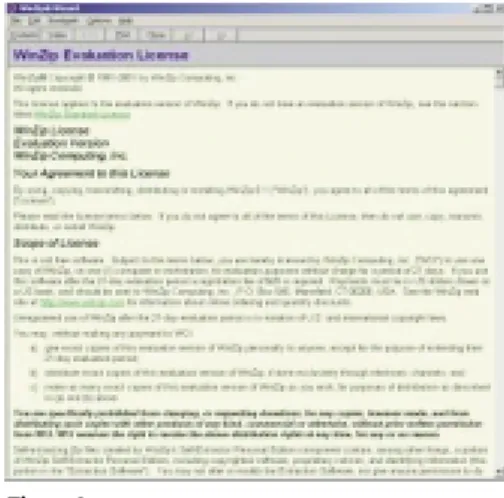
screen is a good minimalist approach. A copy of the license is available by clicking the plainly-labeled ‘‘View License Agreement’’ button and the license text appears in a sepa-rate window as shown in Figure 6. The screen contains an unambiguous ‘‘Yes’’ but-ton, the only alternative to which is an un-ambiguous ‘‘No’’ button. Clicking the ‘‘No’’ button cancels the installation process and closes the application.
Mortgage loan service provider Lend-ingTree.com uses a similar presentation as part of its application process. LendingTree is required to comply with the consumer dis-closure provisions of E-Sign,19 which
in-volves obtaining the consumer’s consent to receive disclosures electronically. At one point in the application process, Lending-Tree presents to the consumer a statement of the consumer’s consent to receive disclosures electronically and provides a link to the dis-closures. Figure 7 is a screenshot of the con-sent screen with the concon-sent in the inset.20
Again, the link to the terms is clear and the terms are available in a separate win-dow,21as shown in Figure 8. In this case, the
consumer expresses assent by clicking a box and then clicking the ‘‘Continue’’ button. The box here is less obvious than an ‘‘I Agree’’ button in the other examples, but clicking the box is an affirmative act, the
box is clearly associated with the assent lan-guage, and even clicking the ‘‘Continue’’ button will not allow the consumer to move past this screen if the consumer has not first clicked the box.
Figure 4 Figure 5 Figure 7 Figure 8 Figure 6
Conclusion
The basic elements that make electronically-signed agreements enforceable are the same as the elements that make paper-and-ink contracts enforceable. The only real hurdle to creating enforceable agreements online is adapting those elements to the format of the computer screen. Parties who simply and
MICHIGAN BAR JOURNAL ♦ MAR CH 2003 MAKING ELECTR ONIC SIGNA TURES STICK
fully disclose contract terms and require defi-nite assent from their offerees have the best chance of prevailing in court or avoiding suit in the first place. ♦
Footnotes
1. 15 USC 7101, et seq.
2. Shattuck v Klotzbach, Civ. Act. No. 01-1109A (S Ct Mass, Dec. 11, 2001).
3. Forrest v Verizon Communications, Inc, Case No. 01-CV-1101 (DC App 2002).
4. Specht v Netscape Communications Corporation, Docket No. 01-7860(L), (CA 2, 2002). 5. The authors are grateful to Joshua N. Rubin, Esq.
of Abbey Gardy LLP for providing both of the Netscape SmartDownload screenshots.
6. Comb v PayPal, Inc, 2002 WL 2002171 (ND Cal 2002).
7. See, e.g. Caspi v Microsoft Network, LLC, 732 A2d 528 (NJ Super Ct App Div 1999). 8. See, e.g. Pollstar v Gigmania Ltd, No.
CIV-F-00-5671 RECSMS, 2000 WL 33266437 (ED Cal Pct 17, 2000).
9. See, e.g. Ticketmaster Corp v Tickets.com Inc, No. CV 99-7654 HLH, 2000 WL 525390 (CD Cal Mar. 27, 2000). 10. MCL 450.832(h). 11. MCL 450.832(m). 12. See MCL 440.2101. 13. See Section 1.
14. ABA Business Law Section Working Group on Electronic Contracting Practices, Click-Through
Agreements: Strategies for Avoiding Disputes on Va-lidity of Assent (2001).
15. See MCL 440.2207, 440.2856, and Section 212 of the Uniform Computer Information Transactions Act (UCITA) and the associated commentary. 16. It is advisable to disclose in a privacy policy what
information the offeror collects and retains. 17. Generated by William Gratsch and the Dykema
Gossett PLLC information technology staff. 18. Screenshots are © 1991–2003 by WinZip
Com-puting, Inc. Used with permission. WinZip is a registered trademark of WinZip® Computing, Inc. WinZip Computing, Inc. required as a condi-tion of its permission that this attribucondi-tion state that the company regards all of its software licenses to be at all times legally enforceable agreements be-tween WinZip Computing, Inc. and its users. 19. See 15 USC 7001(c).
20. Screenshot is © 2002 LendingTree.com. Used with permission.
21. Screenshot is © 2002 LendingTree.com. Used with permission.
Donald M. Crawford is a member in Dykema Gos-sett PLLC’s Bloomfield Hills office. He is a mem-ber of the firm’s Corpo-rate and Finance Practice Group, Automotive In-dustry Team, and E-Com-merce and Technolog y Law team.
Stephen L. Tupper is an associate in Dykema Gos-sett PLLC’s Bloomfield Hills office, a member of the f irm’s E-Commerce and Technolog y Law team, Corporate and Fi-nance Practice Group, and a member of the council of the Computer Law Section of the State Bar of Michigan.