Dr Ambuj Shandil et al JMSCR Volume 07 Issue 08 August 2019 Page 378
Knowledge, attitude and practices regarding breastfeeding amongst
antenatal and postnatal females of Theog, Himachal Pradesh
Authors
Dr Ambuj Shandil
1, Dr Sanya Gupta
2, Dr Pooja Thakur
3,
Dr Abhinay Sharma
4, Dr Arnav Shandil
5*1,3,4,5
MD Civil Hospital Theog, Himachal Pradesh, India
2
MD PGIMER Chandigarh, India *Corresponding Author
Dr Arnav Shandil MD
Civil Hospital Theog, Himachal Pradesh, India
Abstract
Introduction: Breastfeeding is one practice which is popular since ancient times. Though, few females are well aware of the benefits of breast feeding and correct feeding practices, still a large population doesn’t have complete awareness. This study was planned to assess the knowledge, attitude and various patterns practiced (KAP) by antenatal and post-natal mothers of a small town in Himalayas.
Methods: The study was carried out in Civil Hospital, Theog, Himachal Pradesh. 250 females (both antenatal and post-natal) were enrolled in the study. A prestructured questionnaire regarding KAP of breastfeeding was asked from them in a direct one to one interview. Data was recorded and analyzed at the end of 1 year study period. These were also educated and counselled regarding correct feeding practices at the end of interview.
Results:250 females with a mean age 28.5 years (22-34 years) were enrolled in the study. All were aware of nutritional benefits of breastfeeding however; non-nutritional benefits were known to 185 (74%) females. 232 (92.8%) females had positive attitude towards breastfeeding. 82 (32.8%) out of total enrolled mothers were postnatal. Breastfeeding was done by all postnatal females. 65 (79.2%) mothers initiated breastfeeding within first hour of delivery. 56 (68.2%) females had babies aged more than 6 months, and out of these only 8 babies had received exclusive breastfeeding till 6 months of age. 3 (3.6%) out 82 mothers did not give colostrum. Prelacteal feeds were administered by 42(51.2%) mothers. Only 31(37.8%) mothers started complementary feeding appropriately at 6 months of age.
Conclusion: Majority of mothers had knowledge about breastfeeding, its nutritional and non-nutritional benefits and practiced the same. Many had positive attitude towards breastfeeding, however, a large proportion did not practice correct breastfeeding practices. So, health education and health care system needs to be further strengthened to address these issues.
Keywords:Breastfeeding, Knowledge, Practices, Attitude, Lactating mothers.
Introduction
Exclusive breastfeeding (EBF) is defined as feeding of an infant exclusively with breast milk till six months of age initiating within first hour of
delivery. This includes avoidance of water as well as pre lacteal feeds. However, infants can take supplements and medicines.(1) Carol Ballony, Executive Director, UNICEF 2004 stated that http://jmscr.igmpublication.org/home/ ISSN (e)-2347-176x ISSN (p) 2455-0450
Dr Ambuj Shandil et al JMSCR Volume 07 Issue 08 August 2019 Page 379 there is no better way than breast feeding to make
sure that child gets best start in life’(2)
. EBF till 6 months of age is recommended by both WHO and UNICEF.(3) Still global rates of exclusive breast feeding are less than 40%. WHO aims to achieve a global Exclusive breastfeeding rate of at least 50% by 2025.(4) In India, this figure ranges somewhat around 46% in infant up to 1 month of age.(5) EBF not only provides nutrition, but a number immunoglobulins and factors that help to protect the baby from several infections. Besides, it also helps in preventing hypothermia in newborns and helps to strengthen the bond between the mother and the baby. It has several advantages foe mother as well. It decreases postpartum bleeding and also reduces the risk of malignancies in mother.(6) There are several factors which influence the knowledge, attitude and practice of exclusive breastfeeding. These include cultural, demographic, social, biophysical and psychosocial factors. There is enough literature regarding this in past but the data from our region is limited. India, as a whole is far away from the achieving the targets of exclusive breast feeding. Breast feeding though is well accepted in India, but this is practiced very inadequately. This is partly due to ignorance and partly due to taboos which contribute to undesirable breastfeeding practices such as delayed initiation and discarding of colostrum. Hence, we conducted this study in a rural area of Himalayan region of India to assess the knowledge, attitude and practices (KAP) towards EBF and the influence of various social, religious and demographic distribution on these factors.
Methods
The study was conducted in a civil hospital of Theog, which is small hill station in the Himalayan region. This was a questionnaire based study. The objective of the study was to assess the KAP about breast feeding amongst antenatal and postnatal mothers. All full term antenatal primi or multi para women and post-natal lactating mothers visiting either obstetric and pediatric
OPD or admitted in hospital were enrolled. A full informed consent was taken from all the participants. Women who refused to consent or having any serious medical illness and those having a newborn with malformations, were excluded from the study. A face to face direct interview was conducted in all the women at their first visit to the hospital using a pre-designed self-administered, standardized and structured questionnaire regarding KAP of breastfeeding. The questionnaire was structured into 5 sections. Initial section was about demographic and socio-economic details, second section was about pregnancy and delivery details and rest sections were about the breastfeeding practices, top feeds and other complementary feeding practices. The questionnaire consisted of a total of 50 prestructured close ended questions in form of yes or no or agree or disagree. Besides, during the interview session mother were also educated regarding the correct practices and advantages of breast feeding. The questionnaire responses were collected and analysed at the end of the study with a total enrollment of 250 females over a period of 1 year.
Results
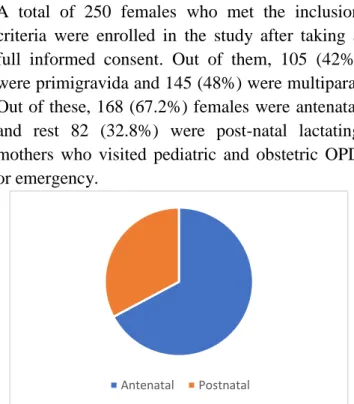
A total of 250 females who met the inclusion criteria were enrolled in the study after taking a full informed consent. Out of them, 105 (42%) were primigravida and 145 (48%) were multipara. Out of these, 168 (67.2%) females were antenatal and rest 82 (32.8%) were post-natal lactating mothers who visited pediatric and obstetric OPD or emergency.
Dr Ambuj Shandil et al JMSCR Volume 07 Issue 08 August 2019 Page 380 The mean age of the females was 28.5 years
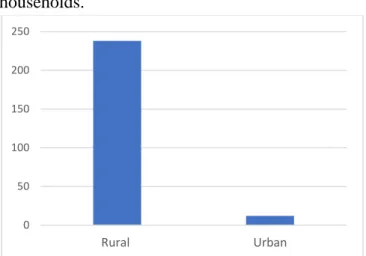
(22-34 years). Mean age of the babies enrolled was 224 days (1 day to 542 days) Most of them belonged to rural areas 238 (95.2%) and few belonged to urban area 12 (4.8%) as well. Amongst the living conditions, 45(18%) lived in kuchha and rest 205 (82%) stayed in pucca house. 230 (92%) lived in joint families, whereas only 20 (8%) mothers stayed as nuclear families. Overcrowding could be found in 235 (94%) of the households.
Fig. 1 Geographic distribution of the study population
207 (83%) females had a mother – in – law or an elderly (>50 years) females at home to guide breast feeding practices. Coming on to the education status, 112 (45%) had less than primary education, 120 (48%) had more than primary education, rest 18 (7%) had not received any formal education. Among these 120 females who had more than primary education, 25 (10%) were graduate and out these only 6 were working. All these mothers who were enrolled had at least once received antenatal counselling regarding breastfeeding importance and practices either via an ASHA/ an anganwadi worker or a health care professional.
Amongst the 82 post-natal mothers, 75 (91%) deliveries were In hospital, out of which 8 (9.7%) were caesarean due to varied reasons, 5 (6%) were home deliveries, and 2 (2.4%) delivered while on the way to hospital.
When the questionnaire was given to all the enrolled females, it was found that all the females
were aware of the fact that the breastfeeding is a good source of nutrition for the babies. About 232 (92%) mothers had positive attitude towards breastfeeding. About 185 (74%) females had good knowledge about nutritional and non- nutritional benefits of breastfeeding.
Details of KAP of the enrolled mothers has been given in the table below.
Table 1 KAP of breastfeeding in the study population
S.No. n (%) n=250
1. Breastfeeding counselling
received
250 (100%)
2. Mothers:
Antenatal Postnatal
168 (67.2%) 82 (32.8%)
3. Breastfeeding should be
given
250 (100%)
4. Knowledge about non-
nutritional benefits
185 (74%)
5. Positive attitude towards
breastfeeding
232 (92%)
N=82
6. Initiation of breast feeding: 0-30 min of life
30-60 min of life >60 min of life
12 (14.6%) 53 (64.6%) 14 (17.1%)
7. Colostrum received
Yes No
79 (96.3%) 3 (3.6%)
8. Prelacteal feeds given
Water/ Juices given before 6 months of age
42 (51.2 %)
4 (4.8%)
9. Exclusive breastfeeding till 6
months
8 (9.7%)
10. Breastfeeding
on demand
at scheduled timing
96.3% (79/82) 3.6% (3/82)
11. Complementary feeding
initiation At 6 months After 6 months Before 6 months
Not initiated yet (even after 6 months of age)
31(37.8%) 16 (19.5%) 11 (13.4%) 9 (10.9%)
Regarding breast feeding practices among post-natal lactating mothers, 56 (68.3%) out of 82 mothers had babies aged more than six months and amongst them only 14.3% (8/56) had given exclusive breast feeding to their babies till 6 months of age. Amongst 68.3 % (56/82) babies who not exclusively breastfed, 42 (75%) babies were such who had received prelacteal feeds like
0 50 100 150 200 250
Dr Ambuj Shandil et al JMSCR Volume 07 Issue 08 August 2019 Page 381 honey, janamghutti, grape water either once or
multiple occasions. 10 (17.8%) babies had received top feeds along with breast milk, and most important cause perceived for the same was inadequate milk output. 4 out 56 females had given water, juices and other liquids to their babies along with breastfeeds.
Amongst the enrolled post-natal mothers, only 12 (14.6%) had initiated breastfeeding within 30 min of delivery, whereas in 53 (64.6%) mothers, it was initiated between 30 -60 min. Rest 14(17.1%) including 8 who underwent cesarean sections had introduction of breastfeeding after 1st hour of life. 3 (3.6%) patients were such who breastfed after 3 days of life, and reason given was the perceived harmful effects of colostrum. All there 3 females were from rural areas and had never received any formal education. There was no post-natal female who never breastfed her child even once. However, out 82 mothers, there were 11 females, who stopped breast feeding before 6 months of age due to varied reasons like poor lactation output, maternal illness or illness of baby in postnatally, and because of shifting to top feeds because jobs of the mothers.
96.3% (79/82) mothers breast fed their babies on demand whereas, only 3.6% (3/82) mothers followed the scheduled timing for breastfeeding. Among these 82 mothers, 31(37.8%) mothers started complementary feeding at 6 months, 16 (19.5%) mothers had started complementary feeding after 6 months, 9 (10.9%) mothers had babies more than 6 months but still not started complementary feeding till enrollment in the study. Reason for starting complementary feeding was found to be lack of education and awareness. 11 (13.4%) babies were started on complementary feeding before 6 months of age, two major reasons from the same was inadequate milk output and advice from mother-in-law or other elderly female at home.
Discussion
Three major international organizations like WHO, UNICEF and AAP (American Academy of
Pediatrics) along with the Indian Academy of Pediatrics recommend exclusive breastfeeding till 6 months of age.(7) Subsequently, after 6 months, complementary feeding should be initiated along with breastfeeding which can be continued till 2 years of age.(8) In the year 1991, WHO and UNICEF joined hand to initiate a baby friendly initiatives (BFI) to promote breast feeding. This was adopted in nearly 20,000 hospitals in 156 countries throughout the world.(9)
This was a major milestone in promoting breastfeeding and more importantly exclusive breast feeding.
Our study was conducted to find out the status of breast feeding in a small town of Himalayan region. The study results revealed that most of the females had positive attitude towards breastfeeding. All females enrolled had breastfed their babies. However, still a lot misconceptions and false beliefs are prevalent in our society regarding breastfeeding, which need to be addressed. Exclusive breastfeeding till 6 months of age was done by only 8 out 56 (14.3%) mothers. However, in a study by Kishore et al, the rate of exclusive breastfeeding was found to be 45.7%(10). In our study, all female breastfed their babies and in 67 out of these 82 (81.7 %) babies breastfeeding was initiated in 1st hour of life. These results are similar to a review of 17 cross sectional studies, published recently from Saudi Arabia, in which
Dr Ambuj Shandil et al JMSCR Volume 07 Issue 08 August 2019 Page 382 was much higher as compared to the rates
reported in earlier studies.(11) The higher rates of awareness in our set up was possibly due to the fact that most of the females had at least once visited the hospital during antenatal period and were given feeding counselling by either ANM/ ASHA or health care professionals.
Though, all of them had awareness about nutritional benefits, non-nutritional benefits were known to only 74% of the females. However, in a study from Ambo, Ethopia, the awareness among females was found to be 90.8%.(12) Thus, the findings in our study suggested that a large proportion of females had positive attitude towards breast feeding. This can be attributed to improved health care system and health education. However, feeding practices are still relatively poor and need to looked upon.
Conclusion
The study lead to the conclusion that there is a good knowledge among and positive attitude regarding breastfeeding in our society, which is practiced since long. However, there are still false beliefs and malpractices like discarding colostrum, giving prelacteal feeds, initiation of complementary feeding at wrong timings and administration of top feeds. These are the issues which need to be addressed by strengthening health education and by further improving health care system. Mass media and telecommunication can also assist in achieving these goals.
References
1. WHO. Exclusive breastfeeding. WHO. World Health Organization; 2017.
2. New Bulletin of World Health Organization, International Journal of Public Health.82 (4) April,2004.
3. WHO. Evidence for Nutrition Actions (WHO. World Health Organization); 2017 4. WHO. WHA Global Nutrition Targets
2025: Breastfeeding Policy Brief.
5. International Institute for Population Science, Mumbai for Government of India. National Family Health Survey-3 (NFHS-3); 2005-06. 2005; 3:2005.
6. Naseem A, Mazher N. A study to evaluate the knowledge, attitude and practices of exclusive breast feeding among primi mothers of healthy term neonates in a tertiary care hospital and predictors offailure of establishment of exclusive breastfeeding in first six months. Int J Contemp Pediatr. 2016;3(3):810-81. 7. Elmougy AM, Matter MK, Shalaby NM,
El-Regal ME, Abu Ali WH, Aldossary SS et al. Knowledge, attitude and practice of breastfeeding among working and nonworking mothers in saudiarabia. Egyptian Journal of Occupational Medicine, 2018;42(1):133-150.
8. Kramer MS and Kakuma R (2012): Optimal duration of exclusive breastfeeding. Cochrane Database Syst Rev;(8): CD003517.
9. WHO (2009): Baby-Friendly Hospital Initiative Revised, updated and expanded for integrated care. Geneva: WHO Press2009.
10.Kishore MSS, Kumar P, Aggarwal AK. Breastfeeding Knowledge and Practices amongst Mothers in a Rural Population of North India: A Community-based Study. Journal of Tropical Pediatrics. 2008;55: 183-8.
11.Al-Binali AM (2012): Breastfeeding knowledge, attitude and practice among school teachers in Abha female educational district, southwestern Saudi Arabia. Int Breastfeed J;7(1):10.