• No results found

A Novel Approach for Choosing Summary Statistics in Approximate Bayesian Computation

N/A
N/A
Protected

Academic year: 2020

Share "A Novel Approach for Choosing Summary Statistics in Approximate Bayesian Computation"

Copied!
92
0
0

Loading.... (view fulltext now)

Full text

(1)

INVESTIGATION

A Novel Approach for Choosing Summary Statistics

in Approximate Bayesian Computation

Simon Aeschbacher,*

,†,1

Mark A. Beaumont,

and Andreas Futschik

§

*Institute of Evolutionary Biology, University of Edinburgh, Edinburgh EH9 3JT, United Kingdom,

Institute of Science

and Technology Austria, 3400 Klosterneuburg, Austria,

Department of Mathematics and School of Biological Sciences,

University of Bristol, Bristol BS8 1TW, United Kingdom, and

§

Institute of Statistics and Decision Support Systems,

University of Vienna, 1010 Vienna, Austria

ABSTRACT

The choice of summary statistics is a crucial step in approximate Bayesian computation (ABC). Since statistics are often not

suf

cient, this choice involves a trade-off between loss of information and reduction of dimensionality. The latter may increase the

ef

ciency of ABC. Here, we propose an approach for choosing summary statistics based on boosting, a technique from the

machine-learning literature. We consider different types of boosting and compare them to partial least-squares regression as an alternative. To

mitigate the lack of suf

ciency, we also propose an approach for choosing summary statistics locally, in the putative neighborhood of

the true parameter value. We study a demographic model motivated by the reintroduction of Alpine ibex (

Capra ibex

) into the Swiss

Alps. The parameters of interest are the mean and standard deviation across microsatellites of the scaled ancestral mutation rate (

uanc

=

4

N

e

u

) and the proportion of males obtaining access to matings per breeding season (

v

). By simulation, we assess the properties of the

posterior distribution obtained with the various methods. According to our criteria, ABC with summary statistics chosen locally via

boosting with the

L

2

-loss performs best. Applying that method to the ibex data, we estimate

^

u

anc

1

:

288 and

nd that most of the

variation across loci of the ancestral mutation rate

u

is between 7.7

·

10

2

4

and 3.5

·

10

2

3

per locus per generation. The proportion of

males with access to matings is estimated as

v

^

0

:

21, which is in good agreement with recent independent estimates.

U

NDERSTANDING the mechanisms leading to observed

patterns of genetic diversity has been a central objective

since the beginnings of population genetics (Fisher 1922;

Haldane 1932; Wright 1951; Charlesworth and Charlesworth

2010). Three recent trends keep advancing this

undertak-ing: (1) molecular data are becoming available at an ever

higher pace (Rosenberg

et al.

2002; Frazer

et al.

2007),

(2) new theory continues to be developed, and (3)

in-creased computational power allows solution of problems

that were intractable just a few years ago. In parallel, the

focus has shifted to inference under complex models (

e.g.

,

Fagundes

et al.

2007; Blum and Jakobsson 2011) and to the

joint estimation of parameters (

e.g.

, Williamson

et al.

2005).

Usually, these models are stochastic. The increasing

com-plexity of models is justi

ed by the underlying processes like

inheritance, mutation, modes of reproduction, and spatial

subdivision. On the other hand, complex models are often

not amenable to inference based on exact analytical results.

Instead, approximate methods such as Markov chain Monte

Carlo (MCMC) (Gelman

et al.

2004) or approximate

Bayes-ian computation (ABC) (Marjoram and Tavaré 2006) are

used. These approximate methods address different issues

in inference and the choice therefore depends on the speci

c

problem. A signi

cant part of research in the

eld is

cur-rently devoted to the re

nement and development of such

methods. ABC is a Monte Carlo method of inference that

emerged from the confrontation with models for which

the evaluation of the likelihood is computationally

prohibi-tive or impossible (Fu and Li 1997; Tavaré

et al.

1997; Weiss

and Von Haeseler 1998; Pritchard

et al.

1999; Beaumont

et al.

2002). ABC may be viewed as a class of rejection

algo-rithms (Marjoram

et al.

2003; Marjoram and Tavaré 2006),

where the full data are projected to a lower-dimensional

set of summary statistics. Here, we propose an approach for

choosing summary statistics based on boosting (see below),

and we apply it to the estimation of the mean and variance

Copyright © 2012 by the Genetics Society of America

doi: 10.1534/genetics.112.143164

Manuscript received June 23, 2012; accepted for publication August 22, 2012

Available freely online through the author-supported open access option.

Supporting information is available online at

http://www.genetics.org/lookup/suppl/

doi:10.1534/genetics.112.143164/-/DC1.

1

Corresponding author: Faculty of Mathematics, University of Vienna, Nordbergstr. 15,

A-1090 Vienna, Austria. E-mail: [email protected]

(2)

across microsatellites of the scaled ancestral mutation rate

and of the mating skew in Alpine ibex (

Capra ibex

). We

further show that focusing the choice of statistics on the

putative neighborhood of the true parameter value improves

estimation in this context.

The principle of ABC is to

rst simulate data under the

model of interest and then accept simulations that produced

data close to the observation. Parameter values belonging to

accepted simulations yield an approximation to the posterior

distribution, without the need to explicitly calculate the

likelihood. The full data are usually compressed to summary

statistics to reduce the number of dimensions. Formally, the

posterior distribution of interest is given by

p

ð

f

j

D

Þ ¼

p

ð

D

j

f

Þ

p

ð

f

Þ

p

ð

D

Þ

¼

p

ð

D

j

f

Þ

p

ð

f

Þ

Ð

F

p

ð

D

j

f

Þ

p

ð

f

Þ

d

f

;

(1)

where

f

is a vector of parameters living in space

F

,

D

denotes the observed data,

p

(

f

) the prior distribution,

and

p

(

D

|

f

) the likelihood. With ABC, (1) is approximated

by

p

e

ð

f

j

s

Þ

}

p

ð

r

ð

s9

;

s

Þ

#

d

e

j

f

Þ

p

ð

f

Þ

;

(2)

where

s

and

s9

are abbreviations for realizations of

S

(

D

)

and

S

(

D

9

), respectively, and

S

is a function generating a

q

-dimensional vector of summary statistics calculated from

the full data. The prime denotes simulated points, in

con-trast to quantities related to the observed data. Further,

r

()

is a distance metric and

d

e

the rejection tolerance in that

metric space, such that on average a proportion

e

of all

simulated points is accepted. ABC, its position in the

en-semble of model-based inference methods, and its

applica-tion in evoluapplica-tionary genetics are reviewed in Marjoram

et al.

(2003), Beaumont and Rannala (2004), Marjoram and

Tavaré (2006), Beaumont (2010), Bertorelle

et al.

(2010), and

Csilléry

et al.

(2010). Although the origin of ABC is generally

assigned to Fu and Li (1997), Tavaré

et al.

(1997), and

Pritchard

et al.

(1999), some aspects, such as the summary

description of the full data, inference for implicit stochastic

models, and algorithms directly sampling from the posterior

distribution, trace farther back (

e.g.

, Diggle 1979; Diggle

and Gratton 1984; Rubin 1984).

A fundamental issue with the basic ABC rejection

algorithm (

e.g.

, Marjoram

et al.

2003) is its inef

ciency: A

large number of simulations are needed to obtain a

satisfac-tory number of accepted runs. This problem becomes worse

as the number of summary statistics increases and is known

as the curse of dimensionality. Three solutions have been

proposed: (1) more ef

cient algorithms combining ABC with

principles of MCMC (

e.g.

, Marjoram

et al.

2003; Wegmann

et al.

2009) or sequential Monte Carlo (

e.g.

, Sisson

et al.

2007, 2009; Beaumont

et al.

2009; Toni

et al.

2009); (2)

tting a statistical model to describe the relationship of

parameters and summary statistics after the rejection step,

allowing for a larger tolerance

d

e

(Beaumont

et al.

2002;

Blum and François 2010; Leuenberger and Wegmann

2010); and (3) reduction of dimensions by sophisticated

choice of summary statistics (

e.g.

, Joyce and Marjoram

2008; Wegmann

et al.

2009). In this study, we focus on

point 3, which involves two further issues. First, most

sum-mary statistics used in evolutionary genetics are not suf

-cient. A summary statistic

S

(

D

) is suf

cient for parameter

f

if the conditional probability distribution of the full data

D

,

given

S

(

D

) and

f

, does not depend on

f

,

i.e.

, if

p

ð

D

¼

d

j

S

ð

D

Þ ¼

s

;

f

Þ ¼

p

ð

D

¼

d

j

S

ð

D

Þ ¼

s

Þ

:

(3)

In other words, a statistic is suf

cient for a parameter of

interest, if it contains all the information on that parameter

that can possibly be extracted from the full data (

e.g.

, Shao

2003). Second, the choice of summary statistics implies the

choice of a suitable metric

r

() to measure the

closeness

of

simulations to observation (except for the nongeneric case

e

= 0 in which no metric needs to be de

ned). The Euclidean

distance (or a weighted version,

e.g.

, Hamilton

et al.

2005)

has been used in most applications, but it is not obvious why

this should be optimal. By

optimal

we mean that the

resulting posterior estimate performs best in terms of an

error criterion (or a set of criteria). The Euclidean distance

is a scale-dependent measure of distance

changing the

scale of measurement changes the results. Since this scale

is determined by the summary statistics, the choice of

sum-mary statistics has implications for the choice of the metric.

For these reasons, the choice of summary statistics should

aim at reducing the dimensions, but also at extracting

(com-binations of) statistics that contain the essential information

about the parameters of interest. This task is reminiscent of

the classical problem of variable selection in statistics and

machine learning (Hastie

et al.

2011), and it is of principal

interest here.

The choice of summary statistics in ABC has become

a focus of research only recently. Joyce and Marjoram

(2008) proposed a sequential scheme based on the principle

of approximate suf

ciency. Statistics are included if their

effect on the posterior distribution is larger than some

threshold. Their approach seems demanding to implement,

and it is not obvious how to de

ne an optimal threshold.

Wegmann

et al.

(2009) suggested partial least-squares

(PLS) regression as an alternative. In this context, PLS

re-gression seeks linear combinations of the original summary

statistics that are maximally decorrelated and, at the same

time, have high correlation with the parameters (Hastie

et al.

2011). A reduction in dimensions is achieved by

choos-ing only the

rst

r

PLS components, where

r

is determined

via cross-validation. PLS is one of several approaches for

variable selection, but it is an open question how it

com-pares to alternative methods in any speci

c ABC setting.

Moreover, the optimal choice of summary statistics may

de-pend on the location of the true (but unknown) parameter

(3)

summary statistics are not suf

cient, because then the

in-formation extracted from the full data by the summary

sta-tistics depends on the parameter value (see Equation 3). It is

therefore not obvious why methods that assess the relation

between statistics and parameters on a global scale should

be optimal. Instead, focusing on the correlation only in the

(supposed) neighborhood of the true parameter values

might be preferable. The issue is that this neighborhood is

not known in advance

if we could choose an arbitrarily

small neighborhood around the truth, our inference problem

would be solved and we would not need ABC or any other

approximate method. However, the neighborhood may be

established approximately, as we will argue later. The idea

of focusing the choice of summary statistics on some local

optimization has also been followed by Nunes and Balding

(2010) and Fearnhead and Prangle (2012). Nunes and Balding

(2010) proposed using a minimum-entropy algorithm to

identify the neighborhood of the true value and then chose

the set of summary statistics that minimized the mean

squared error across a test data set. Fearnhead and Prangle

(2012), on the other hand,

rst proved that, for a given loss

function, an

optimal

summary statistic may be de

ned. For

example, when the quadratic loss is used to quantify the

cost of an error, the optimal summary statistic is the

pos-terior mean. Since the latter is not available

a priori

, the

authors devised a heuristic to estimate it and were able to

show good performance of their approach. The choice of

the optimization criterion may include a more local or

a global focus on the parameter range. Different criteria

will lead to different optimal summary statistics. The

approaches by Nunes and Balding (2010) and Fearnhead

and Prangle (2012), and the one we take here, have in

common that they employ a two-step procedure,

rst

de-fi

ning

locality

and then using standard methods from

statistics or machine learning to select summary statistics

in this restricted range. They differ in the details of these

two steps (see

Discussion

).

Here, we propose a novel approach for choosing

sum-mary statistics in ABC. It is based on boosting, a method

developed in machine learning to establish the relationship

between predictors and response variables in complex

models (Schapire 1990; Freund 1995; Freund and Schapire

1996, 1999). Given some training data, the idea of boosting

is to iteratively train a function that describes this

relation-ship. At each iteration, the training data are reweighted

according to the current prediction error (loss), and the

function is updated according to an optimization rule. It

has been argued that boosting is relatively robust to

over-fi

tting (Friedman

et al.

2000), which would be an advantage

with regard to high-dimensional problems as encountered in

ABC. Different

avors of boosting exist, depending on

assumptions about the error distribution, the loss function,

and the learning procedure. In a simulation study, we

com-pare the performance of ABC with three types of boosting to

ABC with summary statistics chosen via PLS and to ABC with

all candidate statistics. We further suggest an approach for

choosing summary statistics locally and compare the local

variants of the various methods to their global versions.

Throughout, we study a model that is motivated by the

reintroduction of Alpine ibex into the Swiss Alps. The

parameters of interest are the mean and standard deviation

across microsatellites of the scaled ancestral mutation rate

and the proportion of males that obtain access to matings

per breeding season. This model is used

rst in the

simula-tion study for inference on synthetic data and assessment of

performance. Later, we apply the best method to infer

pos-terior distributions given genetic data from Alpine ibex. It is

not our goal to compare all the approaches recently

pro-posed for choosing summary statistics in ABC. This would

reach beyond the scope of this article, but provides a

per-spective for future research. Recently, Blum

et al.

(2012)

carried out a comparative study of the various approaches

and found that, for an example similar to our context, PLS

performed slightly better than approximate suf

ciency

(Joyce and Marjoram 2008), but worse than a number of

alternative approaches including the posterior loss method

(Fearnhead and Prangle 2012) and the two-stage

mini-mum entropy procedure (Nunes and Balding 2010).

Nev-ertheless, PLS has been widely used in recent applications

and we have therefore focused on comparing our approach

to PLS.

We start by describing the ibex model and its parameters.

We then present an ABC algorithm that includes a step for

choosing summary statistics. Later, we describe the boosting

approach for choosing the statistics and we suggest how to

focus this choice on the putative neighborhood of the true

parameter value. Comparing different versions of boosting

among each other and with PLS, we conclude that boosting

with the

L

2

-loss restricted to the vicinity of the true

param-eter performs best, given our criteria. However, the

differ-ence from the next best methods (local boosting with the

L

1

-loss and local PLS) is small.

Model and Parameters

We study a neutral model of a spatially structured

popula-tion with genetic drift, mutapopula-tion, and migrapopula-tion. The

de-mography includes admixture, subdivision, and changes in

population size. This model is motivated by the recent

history of Alpine ibex and their reintroduction into the Swiss

Alps (Figures 1 and 2). By the beginning of the 18th century,

Alpine ibex had been extinct except for

100 individuals in

the Gran Paradiso area in Northern Italy (Figure 1). At the

beginning of the 20th century, a schedule was set up to

reestablish former demes in Switzerland (Couturier 1962;

Stuwe and Nievergelt 1991; Scribner and Stuwe 1994;

Maudet

et al.

2002). The reintroduction has been

docu-mented in great detail by game keepers and authorities.

We could reconstruct for 35 demes their census sizes

be-tween 1906 and 2006 (

Supporting Information

,

File S2

,

census sizes) and the number of females and males

trans-ferred between them, as well as the times of these founder/

(4)

admixture events (

File S3

, transfers). Inference on

muta-tion and migramuta-tion can therefore be done condimuta-tional on

this information. The signal for this inference comes from

the distribution of allele frequencies across loci and across

demes.

We constructed a forward-in-time model starting with an

ancestral gene pool

d

anc

of unknown effective size,

N

e

,

rep-resenting the Gran Paradiso ibex deme. At times

t

1

and

t

2

,

two demes,

d

1

and

d

2

, are derived from the ancestral gene

pool. They represent the breeding stocks that were

estab-lished in two zoological gardens in Switzerland in 1906 and

1911 (Figure 1) (Stuwe and Nievergelt 1991). Further

demes are then derived from these. We let

t

i

be the time

at which deme

d

i

is established. Once a derived deme has

been established, it may contribute to the foundation of

additional demes. The sizes of derived demes follow the

observed census size trajectories (

File S2

, census sizes).

We interpolated missing values linearly, if the gap was only

1 year, or exponentially, if values for

$

2 successive years

were missing. Derived demes may exchange migrants if

they are connected. This depends on information obtained

from game keepers and on geography (Figure 1). Given

a pair of connected demes

d

i

and

d

j

, we de

ne the forward

migration rates,

m

~

i

;

j

and

m

~

j

;

i

. More precisely,

m

~

i

;

j

is the

pro-portion of potential emigrants (see

File S1

) in deme

d

i

that

migrate to deme

d

j

per year. We assume that

m

~

i

;

j

is constant

over time and the same for females and males. Migration

is included in the model, although we do not estimate

migration rates in this article, but in a related article (S.

Aeschbacher, A. Futschik, and M. A. Beaumont,

unpub-lished results). Here, we restrict our attention to the

an-cestral mutation rate and the proportion of males getting

access to matings, marginal to the migration rates (see

below). Estimating migration rates comes with additional

complications that go beyond the focus of this article. A

schematic representation of the model is given in Figure

2. When modeling migration, reproduction, and founder

events, we take into account the age structure of the

pop-ulation (see

File S1

for details).

Population history is split into two phases. The

rst

started at some unknown point in the past and ended at

t

i

=

1906, when the

rst ibex were brought from Gran Paradiso

(

d

anc

) to

d

1

. For this ancestral phase, we assume constant,

but unknown effective size

N

e

and mutation following the

single stepwise model (Ohta and Kimura 1973) at a rate

u

per locus and generation. Accordingly, we de

ne the scaled

mutation rate in the ancestral deme as

u

anc

= 4

N

e

u

.

Muta-tion rates may vary among microsatellites for several

rea-sons (Estoup and Cornuet 1999). To account for this, we use

a hierarchical model, assuming that

u

anc

is normally

distrib-uted across loci on the log

10

-scale with mean

m

u

anc

and

stan-dard deviation

s

u

anc

. In our case,

m

u

anc

and

s

u

anc

are the

hyperparameters (Gelman

et al.

2004) of interest. We

as-sume that

N

e

is the same for all loci, so that variance in

u

anc

can be attributed to

u

exclusively. In principle, variation in

diversity across loci could also be due to selection at linked

genes (Maynard Smith and Haigh 1974; Charlesworth

et al.

1993; Barton 2000), rather than variable mutation rates.

Most likely, we cannot distinguish these alternatives with

our data. The second, recent phase started at time

t

1

and

went up to the time of genetic sampling,

t

g

= 2006. During

this phase, the numbers of males and females transferred at

founder/admixture events and census population sizes are

known and accounted for. Mutation is neglected, since, in

the case of ibex, this phase spans only

11 generations at

most (Stuwe and Grodinsky 1987). At the transition from

the ancestral to the recent phase, genotypes of the founder

individuals introduced to demes

d

1

and

d

2

are sampled at

Figure 1

Location of Alpine ibex demes

in the Swiss Alps. The parts with dark

shading represent areas inhabited by

ibex. The ancestral deme is located in

the Gran Paradiso area in Northern Italy,

close to the Swiss border. The two

demes in the zoological gardens 33

and 34 were

rst established from the

ancestral one. Further demes, including

the two in zoological gardens 32 and

35, were derived from demes 33 and

34. Putative connections indicate the

pairs of demes for which migration is

considered possible. For a detailed

re-cord of the demography and the

gene-alogy of demes see

Figure S1

and

File

S3

. For deme names see

Table S1

. The

map was obtained via the Swiss Federal

Of

ce for the Environment (FOEN) and

(5)

random from the ancestral deme,

d

anc

. At the end of the

recent phase (

t

g

), genetic samples are taken according to

the sampling scheme under which the real data were

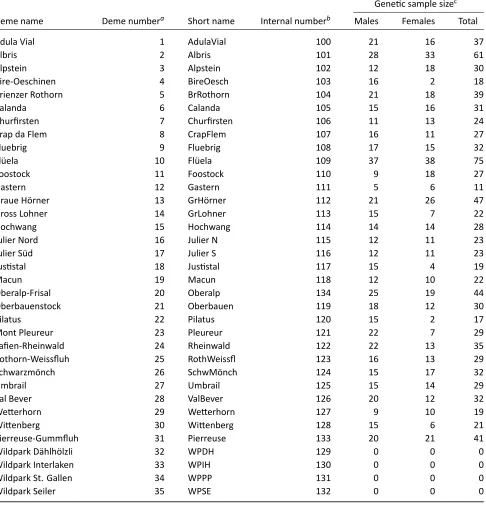
obtained. Of the total 35 demes, 31 were sampled (

Table

S1

).

In Alpine ibex, male reproductive success is highly skewed

toward dominant males. Dominance is correlated with male

age (Willisch

et al.

2012), and ranks are established during

summer. Only a small proportion of males obtain access to

matings during the rut in winter (Aeschbacher 1978; Stuwe

and Grodinsky 1987; Scribner and Stuwe 1994; Willisch and

Neuhaus 2009; Willisch

et al.

2012). To take this into

count, we introduce the proportion of males obtaining

ac-cess to matings,

v

, as a parameter. It is de

ned relative to

the number of potentially reproducing males (and therefore

conditional on male age; see

File S1

) and has an impact on

the strength of genetic drift. For simplicity, we assume that

v

is the same in all demes and independent of deme size and

time.

In principle, we want to infer the joint posterior

dis-tribution

p

ð

m;

~

a

j

D

Þ, where

a

¼ ð

m

u

anc

;

s

u

anc

;

v

Þ

and

m

~

¼

f

m

~

i

;

j

:

i

j

;

i

2 J

m

;

j

2 J

m

g, with

J

m

denoting the set of all

demes connected via migration to at least one other deme

(Figure 1). This is a complex problem because there are

many parameters and even more candidate summary

statis-tics; the curse of dimensionality is severe. Targeting the joint

posterior with ABC naively would give a result, but it would

be hard to assess its validity. It is more promising to address

intermediate steps and assess them one by one. A

rst step

is to focus on a subset of parameters and marginalize over

the others. By marginalizing we mean that the joint

poste-rior distribution is integrated with respect to the parameters

that are not of interest. In our case, we may focus on

a

and integrate over the migration rates

m

~

where they have

prior support (Table 1). In practice, marginal posteriors can

be targeted directly with ABC

without the need to

com-pute the joint likelihood explicitly and integrate over it

(see below). A second step is to clarify what summary

sta-tistics should be chosen for the subset of focal parameters

(

a

). A third one is to deal with the curse of dimensionality

related to estimating

m

~

. In this article, we deal with steps

one and two: We aim at estimating

a

marginally to

m

~

and we seek a good method for choosing summary statistics

with respect to

a

. The third step

estimating

m

~

and dealing

with its high dimensionality

is treated separately (S.

Aeschbacher, A. Futschik, and M. A. Beaumont, unpublished

results). Note that this division of the problem implies the

assumption that priors of the migration rates and male

mat-ing success are independent. We make this assumption

partly for convenience and partly because we are not aware

of any study that has shown a relation between the two in

Alpine ibex. The division into two steps also requires that

the set of all summary statistics (

S

) can be split into two

subsets, such that the

rst (

S

a

) contains most of the

infor-mation on

a

, whereas the second

ð

S

m

~

Þ

contains most of the

information on

m

~

. Moreover,

S

a

should not be affected

much by

m

~

. As shown in the

Appendix

, the results are not

much affected in such a situation while the computational

burden decreases signi

cantly. The arguments in the

Appen-dix

rely on the notions of approximate suf

ciency and

ap-proximate ancillarity.

Methods

The joint posterior distribution of our model may be

factorized as

p

m;

~

a

j

D

¼

p

m

~

j

a

;

D

p

ð

a

j

D

Þ

:

(4)

As mentioned, here we target only the marginal posterior of

a

, which is formally obtained as

p

ð

a

j

D

Þ ¼

ð

M

p

~

m;

a

j

D

d

m;

~

(5)

where

M

is the domain of possible values for

m

~

. By the

nature of our problem,

p

ð

m;

~

a

j

D

Þ

is not available.

How-ever, with ABC we may target (5) directly by sampling from

p

e

(

a

|

s

a

¼

S

a

(

D

)), where we assume that

S

a

is a subset of

summary statistics approximately suf

cient for estimating

a

(

Appendix

). Note that

S

a

may not be suf

cient to

esti-mate the joint posterior (4), however (Raiffa and Schlaifer

1968). The following standard ABC algorithm provides an

approximation to

p

(

a

|

s

a

) (

e.g.

, Marjoram

et al.

2003):

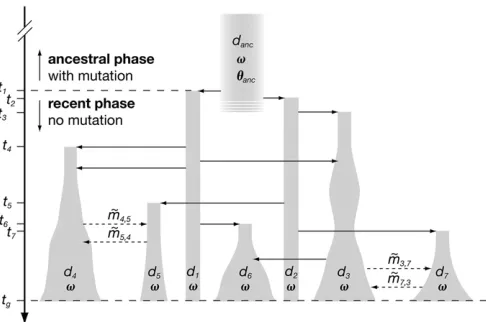
Figure 2

Schematic representation of the demographic model motivated

by the reintroduction of Alpine ibex into the Swiss Alps. Shaded shapes

represent demes, indexed by

di

, and the width of the shapes re

ects the

census size. Time goes forward from top to bottom, and the point in time

when deme

di

is established is shown as

ti

;

t

g

is the time of genetic

sampling. The total time is split by

t

1

into an ancestral phase with

muta-tion and a recent phase for which mutamuta-tion is ignored (see text for

details). Solid horizontal arrows represent founder/admixture events and

dashed arrows migration. The parameters are (1) the scaled mutation rate

in the ancestral deme,

u

anc

= 4

N

e

u

; (2) the proportion of males getting

access to matings,

v

; and (3) forward migration rates between putatively

connected demes,

m

~

i

;

j

. The actual model considered in the study contains

35 derived demes (Figure 1 and

Table S1

). The exact demography is

reported in

Figure S1

and

File S3

, transfers.

(6)

Algorithm A

A1. Calculate summary statistics

s

a

=

S

a

(

D

) from observed

data.

A2. For

t

= 1 to

t

=

N

,

i. Sample

ð

a

9

t

;

m9

~

t

Þ

from

p

ð

a

;

m

~

Þ ¼

p

ð

a

Þ

p

ð

m

~

Þ.

ii. Simulate data

D

9

t

(at all loci and for all demes) from

p

ð

D

j

a

9

t

;

m9

~

t

Þ.

iii. Calculate

s9

a

;

t

¼

S

a

ð

D

t

9

Þ

from simulated data.

A3. Scale

s

a

and

s9

a

;

t

(

t

= 1,

. . .

,

N

) appropriately.

A4. For each

t

, accept

a

9

t

if

r

ð

s9

a

;

t

;

s

a

Þ

#

d

e

, using scaled

sum-mary statistics from A3.

A5. Estimate the posterior density

p

e

(

a

|

s

a

) from the

e

N

accepted points

h

s9

a

;

t

;

a

9

t

i.

Step A2 may be easily parallelized on a cluster computer.

In doing so, one needs to store

h

s9

a

;

t

;

a

9

t

i. Step A5 may

in-clude postrejection adjustment via regression (Beaumont

et al.

2002; Blum and François 2010; Leuenberger and

Wegmann 2010) and scaling of parameters. In general,

the set of well-chosen, informative summary statistics

S

a

is not known in advance. Instead, a set of candidate

statis-tics

S

(chosen based on intuition or analogy to simpler

models) may be available. Therefore, we propose

algo-rithm B

a modi

ed version of algorithm A

that includes

an additional step for the empirical choice of summary

statistics

S

a

informative on

a

given a set of candidate

sta-tistics,

S

(for similar approaches, see Hamilton

et al.

2005;

Wegmann

et al.

2009):

Algorithm B

B1. Calculate candidate summary statistics

s

=

S

(

D

) from

observed data.

B2. For

t

= 1 to

t

=

N

,

i. Sample

ð

a

9

t

;

m9

~

t

Þ

from

p

ð

a

;

m

~

Þ ¼

p

ð

a

Þ

p

ð

m

~

Þ.

ii. Simulate data

D

9

t

(at all loci and for all demes) from

p

ð

D

j

a

9

t

;

m9

~

t

Þ.

iii. Calculate candidate summary statistics

s9

t

¼

S

ð

D

t

9

Þ

from simulated data.

B3. Sample without replacement

n

#

N

simulated pairs

h

s9

t

;

a

9

t

i, denote them by

h

s9

t

*

;

a

t

9

*

i, and use them as

a training data set to choose informative statistics

S

a

.

B4. According to B3, obtain

s

a

from

s

; for

t

= 1 to

t

=

N

,

obtain

s9

a

;

t

from

s9

t

.

B5. Scale

s

a

and

s9

a

;

t

(

t

= 1,

. . .

,

N

) appropriately.

B6. For each

t

, accept

a

9

t

if

r

ð

s9

a

;

t

;

s

a

Þ

#

d

e

, using scaled

sum-mary statistics from B5.

B7. Estimate the posterior density

p

e

(

a

|

s

a

) from the

e

N

accepted points

h

S9

a

;

t

;

a

9

t

i.

Note that

S

a

in steps B3 and B4 may be either a subset of

S

or some function (

e.g.

, a linear combination) of

S

(details

of implementation given below). In the following, we

de-scribe a novel approach based on boosting and recently

pro-posed by Lin

et al.

(2011) for the choice of

S

a

in B3.

Choice of summary statistics via boosting

Boosting is a collective term for meta-algorithms originally

developed for supervised learning in classi

cation problems

(Schapire 1990; Freund 1995). Later, versions for regression

(Friedman

et al.

2000) and other contexts were developed

(Bühlmann and Hothorn 2007 and references therein).

As-sume a set of

n

observations indexed by

i

and associated

with a one-dimensional response

Y

i

. For (binary) classi

ca-tion,

Y

i

2

{0, 1}, but in a regression context,

Y

i

may be

continuous in

. Further, each observation is associated with

a vector of

q

predictors

X

i

¼ ð

X

i

ð

1

Þ

;

. . .

;

X

ð

q

Þ

i

Þ. Given a training

data set {h

X

1

,

Y

1

i,

. . .

,

h

X

n

,

Y

n

i}, the task of a boosting

algo-rithm is to learn a function

F

(

X

) that predicts

Y

. Boosting

was invented to deal with cases where the relationship

be-tween predictors and response is potentially complex, for

example, nonlinear (Schapire 1990; Freund 1995; Freund

and Schapire 1996, 1999). Establishing the relationship

be-tween predictors and response, and weighting predictors

according to their importance, directly relates to the

prob-lem of choosing summary statistics in ABC: Given candidate

statistics

S

, we want to

nd a subset or combination of

statistics

S

a

ð

k

Þ

informative for the

k

th parameter

a

(

k

)

in

a

,

for every

k

. Taking the set of simulated pairs

h

s9

t

;

f

ð

a

9

t

Þi

(

t

=

1,

. . .

,

N

) from step B3 of algorithm B as a training data set,

this may be achieved by boosting. For this purpose, we

in-terpret the summary statistics

S

as predictors

X

and the

parameters

a

(

k

)

as the response

Y

. Note that we use

f

ð

a

9

t

Þ

to be generic in the sense that the response might actually

be a function

such as a discretization step (see below)

of

a

t

9

.

The principle of boosting is to iteratively apply a

weak

learner

to the training data and then combine the ensemble

of weak learners to construct a

strong learner

. While the

weak learner predicts only slightly better than random

guessing, the strong learner will usually be well correlated

with the true

Y

. This is because the training data are

reweighted after each step according to the current error,

Table 1 Parameters and prior distributions

Parameter

Description

Prior distribution

u

anc,

l

Scaled ancestral mutation rate at locus

l

, 4

N

e

u

log

10

ð

u

anc

;

l

Þ

N

ð

m

u

anc

;

s

2

u

anc

Þ

a

m

u

anc

Mean across loci of

u

anc,

l

(on log

10

-scale)

m

u

anc

N

ð

0

:

5

;

1

Þ

s

u

anc

Standard deviation across loci of

u

anc,

l

(on log

10

-scale)

s

u

anc

log

10

-uniform in [0.01, 1]

v

Proportion of mature males with access to matings

v

log

10

-uniform in [0.01, 1]

~

m

i

;

j

b

Forward migration rate per year from deme

i

to deme

j

m

~

i

;

j

log

10

-uniform in [10

2

3.5

, 10

2

0.5

]

a

N

(

m

,

s

2

), normal distribution with mean

m

and variance

s

2

.

(7)

such that the next weak learner will focus on those

obser-vations that were particularly hard to assign. However, too

strong a correlation will lead to over

tting, so that in

prac-tice one de

nes an upper limit for the number of iterations

(see below). The behavior of the weak learner is described

by the base procedure

^

g

ðÞ, a real valued function. The

nal

result (strong learner) is the desired function estimate

^

F

ðÞ.

Given a loss function

L

(,

) that quanti

es the disagreement

between

Y

and

F

(

X

), we want to estimate the function

that minimizes the expected loss,

F

*ðÞ ¼

arg

min

F

ðÞ

E

½

L

ð

Y

;

F

ð

X

ÞÞ

:

(6)

This can be done by considering the empirical risk

n

2

1

P

n

i

¼

1

L

ð

Y

i

;

F

ð

X

i

ÞÞ

and pursuing iterative steepest descent

in function space (Friedman 2001; Bühlmann and Hothorn

2007). The corresponding algorithm is given in the

Appen-dix

. The generic boosting estimator obtained from this

algo-rithm is a sum of base procedure estimates,

^

F

ðÞ ¼

n

X

m

stop

m

¼

1

^

g

½

m

ðÞ

:

(7)

Both

n

and

m

stop

are tuning parameters that essentially

con-trol the over

tting behavior of the algorithm. Bühlmann and

Hothorn (2007) argue that the learning rate

n

is of minor

importance as long as

n

#

0.1. The number of iterations,

m

stop

, however, should be chosen speci

cally in any

applica-tion via cross-validaapplica-tion, bootstrapping, or some informaapplica-tion

criterion [

e.g.

, Akaike

s information criterion (AIC)].

Base procedure:

Different versions of boosting are obtained

depending on the base procedure

^

g

ðÞ

and the loss function

L

(,

). Here, we let

^

g

ðÞ

be a simple componentwise linear

regression (Bühlmann and Hothorn 2007; see

Appendix

).

With this choice, the boosting algorithm selects in every

iteration only one predictor, namely the one that is most

effective in reducing the current loss. For instance, with

the

L

2

-loss (de

ned below), after each step,

^

F

ðÞ

is updated

linearly according to

^

F

½

m

ð

x

Þ ¼

F

^

½

m

2

1

ð

x

Þ þ

n

^

l

ð

^

z

x

ð

^

z

;

(8)

where

^

z

m

denotes the index of the predictor variable

se-lected in iteration

m

. Accordingly, in iteration

m

only the

^

z

th component of the coef

cient estimate

l

^

½

m

is updated.

As

m

goes to in

nity,

F

^

ðÞ

converges to a least-squares

solu-tion. In practice, we stop at

m

stop

, and we denote the

nal

vector of estimated coef

cients as

^

l

¼

l

^

½

m

stop

. Recall that in

our context, the predictor variables

X

correspond to the

candidate summary statistics

S

. For each of the

k

parameters

in

a

, we estimate one function

^

F

½

m

stop

and use it to obtain

new parameter-speci

c statistics

S

a

ð

k

Þ

.

Loss functions:

We employed boosting with three loss

functions. The

rst two,

L

1

-loss and

L

2

-loss, are appropriate

for a regression context with a continuous response

Y

2

.

In this case, the parameters

a

t

9

are directly interpreted as

y

i

[

i.e.

,

f

ð

a

9

t

Þ ¼

a

9

t

]. The

L

1

-loss is given by

L

L

1

ð

y

;

F

Þ ¼ j

y

2

F

j

(9)

and results in

L

1

Boosting. The

L

2

-loss is given by

L

L

2

ð

y

;

F

Þ ¼

1

2

j

y

2

F

2

j

(10)

and results in

L

2

Boosting. The scaling factor

1

2

in (10)

ensures that the negative gradient vector

U

in the functional

gradient descent (FGD) algorithm (

Appendix

and

File S1

)

equals the residuals (Bühlmann and Hothorn 2007).

L

1

-and

L

2

Boosting result in a

t of a linear regression, similarly

to ordinary regression using the least absolute deviation (

L

1

-norm) or the least-squares criterion (

L

2

-norm), respectively.

The difference, and a potential advantage of boosting, is that

residuals are

tted multiple times depending on the

impor-tance of the components of

X

. Moreover, boosting is

consid-ered less prone to over

tting than ordinary

L

1

- or

L

2

-

tting

(Bühlmann and Hothorn 2007). In general, the

L

1

-loss is

more robust to outliers, but it may produce multiple,

poten-tially unstable solutions. Using

L

1

- and

L

2

Boosting to choose

summary statistics means assuming a linear relationship

be-tween summary statistics and parameters. This is a strong

assumption and most likely not globally true. However, the

advantage is that the resulting linear combination has only

one dimension, such that the curse of dimensionality in ABC

may be strongly reduced. Again, the approach using the

L

1

-or

L

2

-loss results in one linear combination

F

^

½

m

stop

per

pa-rameter

a

(

k

)

, such that

S

a

ð

k

Þ

has only one component. These

linear combinations may end up being correlated across

parameters, especially if parameters are not identi

able,

e.g.

, because they are confounded with each other.

To motivate the third loss function, we propose

consid-ering the choice of summary statistics as a classi

cation

problem. Imagine two classes of parameter values

say,

high values in one class and low values in the other. We

may ask what summary statistics are important to assign

simulations to one of these two classes. With

Y

2

{0, 1} as

the class label and

p

(

x

) := Pr[

Y

= 1|

X

=

x

], a natural choice

is the negative binomial log-likelihood loss

L

log

-

lik

ð

y

;

p

Þ ¼

2

½

y

logð

p

Þ þ ð1

2

y

Þlogð1

2

p

Þ

;

(11)

omitting the argument of

p

for ease of notation. If we

pa-rameterize

p

=

e

F

/(1 +

e

F

) so that we obtain

F

= log[

p

/(1

2

p

)] corresponding to the logit-transformation, the loss in

(11) becomes

L

log

-

lik

ð

y

;

F

Þ ¼

log

h

1

þ

e

2

ð

2

y

2

1

Þ

F

i

:

(12)

The corresponding boosting algorithm is called LogitBoost

(or binomial boosting) (Bühlmann and Hothorn 2007). An

advantage is that it does not assume a linear relationship

(8)

between summary statistics and parameters, as is the case for

L

1

- and

L

2

Boosting. Instead, LogitBoost

ts a logistic regression

model, which might be more appropriate. On the other hand,

it requires choosing a discretization procedure

f

() to map

a

t

2

to

y

2

{0, 1} (see below). Since such a choice is arbitrary,

it would be problematic to use the resulting

t (a linear

com-bination on the logit-scale) directly as

S

a

ð

k

Þ

. In practice, we

instead assigned a candidate statistic

S

(

j

)

(

j

= 1,

. . .

,

q

)

to

S

a

ð

k

Þ

if the corresponding boosted coef

cient

^

l

ð

j

Þ

(

cf

.

Equa-tion 8) was different from zero and omitted it otherwise.

Therefore, compared to

L

1

- and

L

2

Boosting, the reduction

in dimensionality was on average lower, but the strong

as-sumption of a linear relationship between

a

(

k

)

and

S

a

ð

k

Þ

was

avoided. Note that, in principle, nonlinear relationships may

be

tted with the

L

1

- and

L

2

-loss, too (Friedman

et al.

2000).

In

File S1

we provide explicit expressions for the population

minimizers (Equation 6) and some more insight on the

boost-ing algorithms under the three loss functions used here.

Partial least-squares regression:

Recently, Wegmann

et al.

(2009) proposed to choose summary statistics in ABC via

PLS regression (

e.g.

, Hastie

et al.

2011 and references

therein). PLS is related to principal component regression.

But in addition to maximizing the variance of the predictors

X

, at the same time, it maximizes the correlation of

X

with

the response

Y

. Applied to the choice of summary statistics,

it therefore not only decorrelates the summary statistics, but

also chooses them according to their relation to

a

. Hastie

et al.

(2011) argue that the

rst aspect dominates over the

latter, however. The number

r

of PLS components to keep is

usually determined based on some cross-validation

proce-dure (see below). In the context of ABC, the

r

components

are multiplied by the corresponding statistics

S

(

j

)

(

j

#

r

) to

obtain

S

a

ð

k

Þ

(Wegmann

et al.

2009).

Global vs. local choice

We have so far suggested that

S

a

is close to suf

cient for

estimating

a

. This will hardly be the case in practice. By

de

nition, the optimal choice of

S

a

then depends on the

unknown true parameter value(s). Ideally, we therefore

want to focus the choice of

S

a

on the neighborhood of the

truth. The latter is not known in practice. As a workaround,

we propose to use the

n

simulated pairs

h

s9

t

*

;

a

t

9

*

i

from step

B3 in algorithm B and the observed summary statistics

s

to

approximately establish this neighborhood as follows.

Local choice of summary statistics in B3:

1. Consider the

n

pairs

h

s9

t

*

;

a

t

9

*

i

(

t

* = 1,

. . .

,

n

) from step

B3 in algorithm B.

2. Mean center each component

s9

(

j

)

(

j

= 1,

. . .

,

q

) and scale

it to have unit variance.

3. Rotate

s9

using principal component analysis (PCA).

4. Apply the scaling from steps 2 and 3 to the observed

summary statistics

s

.

5. Mean center the PCA-scaled summary statistics obtained

in step 3, and scale them to have unit variance. Do the

same for the PCA-scaled observed statistics obtained in

step 4. Denote the results by

s9

_

and

s

_

, respectively.

6. For each

t

*

2

n

, compute the Euclidean distance

d

t

*

¼ k

s9

_

t

*

2

s

_

t

*

k.

7. Keep the

n

9

pairs

h

s9

t

**

;

a

t

9

**

i

(

t

** = 1,

. . .

,

n

9

) for which

d

t

*

#

z

, where

z

is some threshold.

8. Use the

n

9

points accepted in step 7 as a training set to

choose statistics

S

a

with the desired method.

9. Continue with step B4 in algorithm B.

In step 2 above, the original summary statistics are

brought to the same scale. Otherwise, summary statistics

with a high variance would on average contribute relatively

more to the Euclidean distance than summary statistics with

a low variance. However, whether a simulated data point is

far from or close to the target (

s

) in multidimensional space

may depend not only on the distance along the dimension of

each statistic, but also on the correlation among statistics.

This can be accounted for by decorrelating the statistics, as

is done by PCA in step 3. In combination with the Euclidean

distance in step 6, the procedure above essentially uses the

Mahalanobis distance as a metric (Mahalanobis 1936).

Al-though we cannot prove the optimality of this approach, it

seems to work well in our simulations. Note that in steps 8

and 9, the summary statistics are used on their original scale

again. This is because we want our method for choosing

parameter-speci

c combinations of statistics to use the

in-formation comprised in the difference in scale among the

original statistics

even in the vicinity of

s

. The PCA scaling

in step 5 is only used temporarily to determine

d

t

*

in step 6.

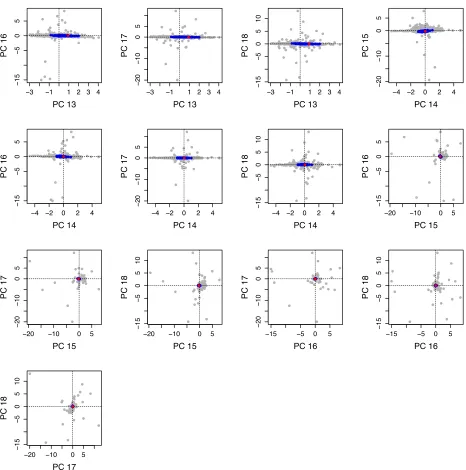
Figure S2

visualizes the different scales and the effect of

determining an approximate neighborhood around

s

.

The scheme just described may be combined with any

of the methods for choosing summary statistics described

above. In our case, we considered ABC with global and local

versions of PLS (called

pls.glob

and

pls.loc

in the following),

LogitBoost (

lgb.glob

and

lgb.loc

),

L

1

Boosting (

l1b.glob

and

l1b.loc

), and

L

2

Boosting (

l2b.glob

and

l2b.loc

). Moreover,

we performed ABC with all candidate statistics

S

(

all

) as

a reference.

Candidate summary statistics:

Our set

S

of candidate

sum-mary statistics consisted of the mean and standard devation

across loci of the following statistics: the average

within-deme variance of allele length, the average within-within-deme

gene diversity (

H

1

), the average between-deme gene

diver-sity (

H

2

), the total

F

IS

, the total

F

ST

, the total within-deme

mean squared difference (MSD) in allele length (

S

1

), the

total between-deme MSD in allele length (

S

2

), the total

R

ST

, and the number of allele types in the total population.

This amounts to a total of 18 summary statistics. We

com-puted

H

1

,

H

2

,

F

IS

, and

F

ST

according to Nei and Chesser

(1983) and

S

1

,

S

2

, and

R

ST

according to Slatkin (1995).

Figure

Figure 1 Location of Alpine ibex demesmodiin the Swiss Alps. The parts with darkshading represent areas inhabited byibex
Figure 2 Schematic representation of the demographic model motivatedconnected demes,access to matings,census size
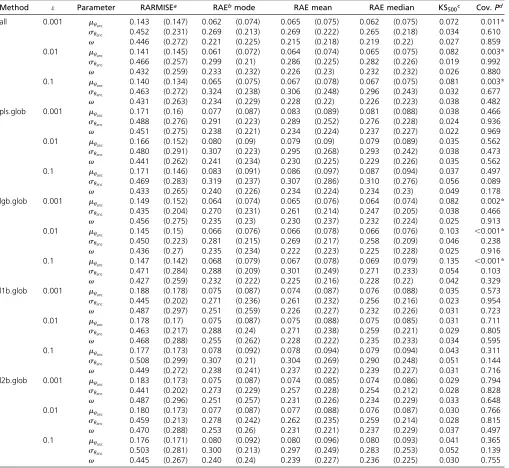
Table 2 Accuracy of different methods for choosing summary statistics on a global scale
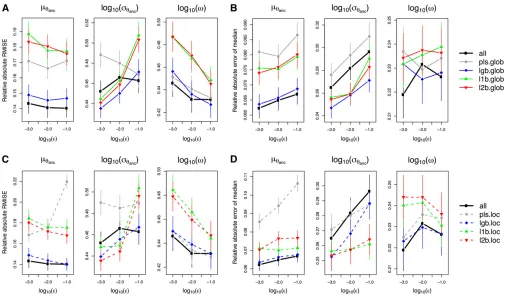
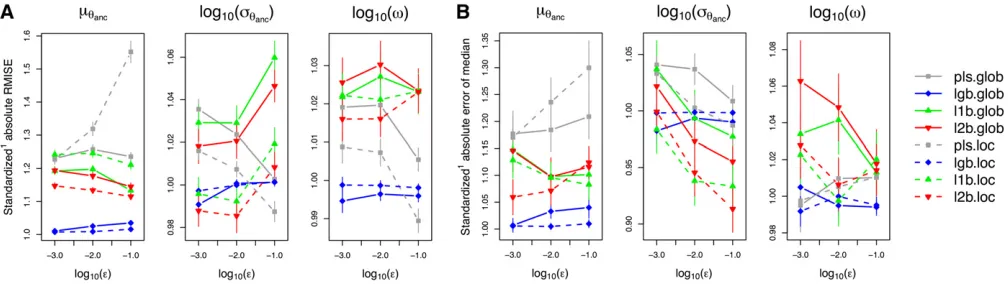
Figure 3 Accuracy of different methods for choosing summary statistics as a function of the acceptance rate (when applied to the whole parameter range ((integrated squared error (RMISE), relative to the absolute true value
+7

References

Related documents

We propose that hetZ regulates heterocyst differentiation by promoting the expression of hetC and of other genes required for heterocyst development and that regulation of

An examination of government bonds in the light of revolutionary as well as events related to the Russo-Japanese War aims to add to the picture: an almost equal price reaction to

To incorporate both the leptokurtic feature and \volatility smile", this paper proposes, for the purpose of studying option pricing, a jump di®usion model, in which the price of

Reconstruction of metabolic pathways for pantothenate, biotin and thiamine was therefore performed by manual curation of whole genome sequences and revealed that one or more genes

New choices for the taxonomy Individuals Nursing Service Providers Other Service Providers Registered Nurse Lactation Consultant Non-RN 174N0000X.. Gutowski, BA,

GSEA: Gene set enrichment analysis; IFN: Interferon; LPS: Lipopolysaccharide; LV GLS: Left ventricular global longitudinal strain; SCM: Septic cardiomyopathy; TLR: Toll-like

The MC-UPQC operation is the combina- tion of two series voltage converter and one shunt volt- age converter which are connected back-to-back with a common DC-link capacitor, by

As the school teacher with limited knowledge of the scientific or mechanical world, Mr Watts is an authority on Dickens ( MP 24), and it is his quiet voice and his narration of