www.msjonline.org pISSN 2320-6071 | eISSN 2320-6012
Original Research Article
Patching with video gaming versus patching with mobile phone use in
treatment of adult amblyopia: an experimental study
Steffy Johnson*
INTRODUCTION
Amblyopia is diminished vision that results from inadequate visual experience during the first years of life. Typically, amblyopia is clinically defined as reduced visual acuity accompanied by one or more known amblyogenic factors, such as strabismus, anisometropia, high refractive error, and cataract. Amblyogenic factors interfere with normal development of the visual pathways during a critical period of maturation. The result is structural and functional impairment of the visual cortex, and impaired form vision. The critical period is seen as the period of time during which abnormal visual inputs can result in amblyopia, but it is also the time during which
amblyopia can be reversed by eliminating the abnormal visual inputs and, usually, occluding the normal eye for some periods of time.
However, there are now reasons to believe that these critical periods for development and treatment of amblyopia cannot be rigidly defined. Firstly, it is clear that visual acuity of the amblyopic eye is not always firmly established even after amblyopia therapy has been terminated, because the age of the patient is beyond what is generally considered to be the critical period.1
Scott and Dickey reported a short term follow up study of amblyopic patients. After patching therapy was stopped Department of Optometry, Little Flower Institute of Medical Science and Research Centre, Angamaly, Kerala, India
Received: 20 July 2020
Accepted: 18 August 2020
*Correspondence:
Miss Steffy Johnson,
E-mail: [email protected]
Copyright: © the author(s), publisher and licensee Medip Academy. This is an open-access article distributed under the terms of the Creative Commons Attribution Non-Commercial License, which permits unrestricted non-commercial use, distribution, and reproduction in any medium, provided the original work is properly cited.
ABSTRACT
Background: Adults with amblyopia are currently offered no treatment in clinical practice Recently, it has been demonstrated that patching one eye of a binocularly normal subject with a diffuser strengthens that eye's contribution to the binocular percept when the diffuser is removed. So, this study assesses effectiveness and difference of occlusion therapy while using mobile phones and while playing video games in adult patients with amblyopia.
Methods: Subjects with refractive, anisometropic, sensory and strabismic amblyopia in 18 to 40 age year old included in the study. It’s a 6 months’ observational study with 2 follow-up after first visit. 66 patients were observed. The first group (n=29) give occlusion therapy while using mobile phone and second group (n=37) done occlusion therapy while playing video games. Student t-test is used to analyse vision and contrast sensitivity and analysed using statistical software SPSS (version 20.0).
Results: Out of 29 patients in first group, 18 (62%) were females, and 11 (38%) were males. Out of 37 patients in second group, 20 (54.1%) were females, and 17 (45.9%) were males. First group (patching with reading in mobile phone) had more improvement than second group (patching with video gaming) in vision and contrast.
Conclusion: Males are more adult amblyopes comparing to females (in both the groups). In case of comparing the
improvement of visual acuity and contrast sensitivity. Better improvement is obtained more in contrast sensitivity during follow-up.
Keywords: Amblyopia, Contrast sensitivity, Mobile phone, Occlusion therapy
seventeen per cent of patients lost a line of visual acuity
and 8% lost two lines or more1-3 In a study of patients 10
years after amblyopia therapy was stopped, Gregersen and Rindziunski reported that 14% of patients lost all of the previously improved visual acuity in the amblyopic eyes, 67% of patients lost at least one line of visual acuity in the amblyopic eye.1
Treatment options for adults with amblyopia isn’t magic. It is real and based on science. For decades there has been a belief among eye doctors that if a patient had amblyopia it can be only treated before 8 to 10 years only. More and more studies are there regarding adult amblyopia therapy by using the occlusion and various another method.
Video gaming has been shown to improve certain visual functions in the normal visual system. Li, Ngo proposed the use of video games to induce plasticity and improve visual function in adult amblyopia.4 They showed that
playing either action (Medal of Honor) or no action (SimCity) video games with the fellow eye patched improved visual and stereo acuity in amblyopia. They suggested that video games induce essentially the same changes as perceptual learning- a reduction of noise and an increase in sampling efficiency. Since then, two additional studies have examined the effect of video games on amblyopia, with both binocular and monocular tasks.5,6
Now a day’s usage of mobile phone is increasing in day by day in our life especially in young generation. Majority of the adult population is engaged in their scheduled lifestyle and most of the people like to use their mobile phones. So, we selected two groups of adult amblyopic population (age18-40 years). One group selected for occlusion while using mobile phone and second one was occlusion while doing video game. We had assessed the improvement of visual acuity and contrast sensitivity in both group and trying to identify which group was better treatment. There are so many studies goings on topic related to adult amblyopia if we have any further treatment options for adult amblyopia it might be another update.
METHODS
A total of 66 subjects were recruited in the study. Written consent was obtained from all subjects after an explanation of the study details. The protocol was approved by the Ethical Committee of Little Flower Hospital of medical science and Research Centre, Angamaly. Adult amblyopia of age between 18-40 years attending to pediatric Ophthalmology unit of Little flower eye hospital Angamaly for 1 year will be participated in the study (September 2018 to August 2019). Subjects with refractive, anisometropic amblyopia/ sensory and strabismic amblyopia in 18 to 40 age year old are to be included in the study and patients with poor compliance, follow up less than 6 months, organic amblyopic patients were excluded.
66 patients were recruited based on inclusion and exclusion criteria. After selection a detailed clinical history including age of onset, family history, birth history, developmental milestones, maternal obstetric history, systemic history, noted and recorded in all available cases. Informed consent obtained from the subjects.
The initial ocular examination- visual acuity using log MAR chart , contrast sensitivity using Pelli Robson chart, near stereopsis using TNO/Lang stereo acuity test, cover test, retinoscopic examination (dry/dilated), subjective refraction, slit lamp examination (anterior segment), fundus examination (90 D or indirect ophthalmoscope) and patients with refractive and anisometropic- amblyopia without any other ocular manifestations selected from other types of amblyopia such as strabismic amblyopia and vision deprivation related amblyopia.
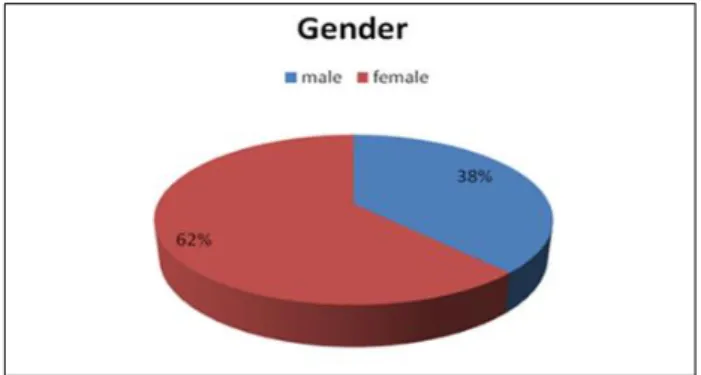
Figure 1: Gender wise distribution of first group (out of 29 patients in first group, 18 (62%) were females,
and 11 (38%) were males).
Counselling given to the patient for using mobile with occlusion. Patient should never use earphones in mobile phones while occlusion. Hand and eye coordination should be maintained during the occlusion period. It is to stimulate the near activity. Likewise, occlusion therapy during video games given to other unit. Video games given according to patient’s interest, but we have 5 different types of games patient has to choose any of from these. They are shooter games, fighting games, color contrast games (candy crush, bubble shooter, etc). Lazy eye is occluded. Occlusion time given according to the patient’s visual acuity. (according to PEDIG classification). Visual acuity, contrast sensitivity, were the parameters we assessed. Improvement of visual acuity and contrast sensitivity in 2 months regular follow up in 2 visits. Change in visual acuity is to be checked with log MAR and contrast sensitivity with Pelli-Robson.
Statistical method
RESULTS
Out of 29 patients in first group, 18 (62%) were males, and 11 (38%) were females (figure 1). From the paired samples test of vision, it infer that there is significant difference between first and third visit because the p-value is less than the level of significant p<0.05 and also highly correlated between these variables (Table 1).
So visual acuity is increased in the follow up visit. From independent samples test table (Table 2), it infers that there is significant difference in contrast sensitivity between first and second visit (p=0) and first and third visit (p=0.003) follow up because the p-value is less than the level of significant (p<0.05) i.e., contrast sensitivity was improved.
Table 1: Paired t-test for accessing the significance of visual acuity in pre and post intervention of first group.
Mean SD Std. error
mean
95% confidence interval
of the difference t-test df Sig. (2-tailed)
Lower Upper
Pair 1 First visit -
second visit 0.01957 0.03612 0.00753 0.00395 0.03518 2.598 22 0.016
Pair 2 First visit -
third visit 0.02895 0.03843 0.00882 0.01043 0.04747 3.284 18 0.004
Table 2: Paired t-test for accessing the significance of contrast sensitivity in pre and post intervention of first group.
Mean SD
Std. error mean
95% confidence interval
of the difference t-test df Sig. (2-tailed)
Lower Upper
Pair 1 First visit -
second visit -0.08478 0.09936 0.02072 -0.12775 -0.04182 -4.092 22 0.000
Pair 2 First visit -
third visit -0.07105 0.09177 .02105 -.11528 -.02682 -3.375 18 0.003
Table 3: Paired t-test for accessing the significance of visual acuity in pre and post intervention of second group.
Mean SD
Std. error mean
95% confidence interval
of the difference t-test df Sig. (2-tailed)
Lower Upper
Pair 1 First visit -
second visit 0.05192 0.15651 0.03069 -0.01129 0.11514 1.692 25 0.0103
Pair 2 First visit -
third visit 0.09000 0.21374 0.04779 -0.01003 0.19003 1.883 19 0.041
Table 4: Paired t-test for accessing the significance of contrast sensitivity in pre and post intervention of second group.
Mean SD
Std. error mean
95% confidence interval
of the difference t-test df Sig. (2-tailed)
Lower Upper
Pair 1 First visit
-second visit -0.06346 0.12850 0.02520 -0.11536 -0.01156 -2.518 25 0.019
Pair 2 First visit -
third visit -0.12000 0.22618 0.05058 -0.22586 -0.01414 -2.373 19 0.028
In second group out of 37 patients in first group, 20 (54.1%) were males, and 17 (45.9%) were females (Figure 3). From the paired samples test it infer that there is no significant difference between first and second visit and first and third visit have significant because the p value is
level of significant. Significant improvement in vision and
contrast sensitivity can be observed in the second group too.
Figure 2: Gender wise distribution of first group (out of 37 patients in first group, 20 (54%) were females,
and 17 (46%) were males).
DISCUSSION
Adult amblyopic patients were divided into 2 groups with total strength of 66 samples. In first group there was 29 patients and second group contain 37 patients. First 29 patients were advised for patching while reading using mobile phones and the next 37 patients were advised for patching along with playing video games in mobile phone. All the parameters were analyzed separately in both groups. In first group most patients have age in between 19 to 23 years of old. In second group it is 20 to 23 years of old. In gender wise assessment 1st group 62% and in 2nd group 54% were males. So, males were more than females (38% in first group and 46% in second group). Similar results found by Ziak et al. In his study a total of 17 subjects 10 were men.7 The main parameters assessed
in 2nd and 3rd visit is visual acuity and contrast sensitivity.
Proper patching with near activity can improve the vision in amblyopic patients who had gone through the critical period of amblyopia. But most of the eye specialist has a myth that after critical period that improvement in vision is not possible. But now there are so many experimental studies are doing regarding adult amblyopia. In here comparing the vision in pre and post intervention of 1st and 2nd group the level of significance is less than that of p
value (i.e., p<0.05). P value is 0.016 in first follow up and 0.004 in second follow up of first group. In 2nd group p
value is 0.0103 in first follow up and 0.041 in second follow up of second group. There is much improvement in vision of both the groups but correlating both groups, 1st group had better improvement than 2nd group because in first follow up of the second group p value is greater than that of level of significance.
Similar improvement was obtained in another 2 studies which is done by Garcia-Romo et al and Scott et al the method of patching is slightly different but significant change in vision were obtained in both studies. In first study by Garcia-Romo et al vision improvement were seen
in age group between 20 to 50 year old group.8 In second
study done by Scott et al most subjects had attained a visual acuity of 20/40 or better, 6% had attained 20/50-20/100, and 2% remained at 20/200 or less.2
In another similar study conducted by Lirw et al and they found playing video games (both action and non-action games) for a short period of time using the amblyopic eye results in a substantial improvement in a wide range of fundamental visual functions including visual acuity (33%), positional acuity (16%).4 So from comparing from
the study video games either it is an action game or any other type of game along with patching of amblyopic eye can give a better results in fundamental visual functions.
In case of comparing the improvement of visual acuity and contrast sensitivity. Better improvement is obtained more in contrast sensitivity. Some patient had improvement only in contrast sensitivity not in visual acuity. In a similar study conducted by Zhou et al they try to access a new form of rapid binocular plasticity in adults with amblyopia (8 subjects). They evaluated improvement in monocular contrast sensitivity and significant improvement was observed in their study.9
Most of the adult amblyopes might be facing problems in their day to day life due to their decreased visual functions. Theoretically no treatments are opted for people in this particular age. But there are more studies going on to this topic adult amblyopia. All those studies are not only based on the improvement of visual functions but also, they were using video games, prosthetic contact lens, virtual reality oculus rift head mounded display for making interest on the amblyopic subjects. These all are different methods used for treating adult amblyopic patients. In all studies improvements is there. From this study we can connive one more thing that reading using mobile phone give more attention and result to the amblyopic eye rather than doing video games.
Future scope of the study
The treatment modalities that have chosen in this study may become a good way for treating adult amblyopia.
CONCLUSION
Significant improvement in visual acuity and contrast sensitivity observed in both the groups patching while reading in mobile phone and patching when playing video games. First group (patching with reading in mobile phone) had more improvement than second group (patching with video gaming). Males are more adult amblyopes comparing to females (in both the groups).
Funding: No funding sources Conflict of interest: None declared
Ethical approval: The study was approved by the Institutional Ethics Committee
54% 46%
REFERENCES
1. Hoyt C. Amblyopia. British Journal of ophthalmology. 2000;84(9):944-45.
2. Scott WE, Dickey CF. Stability of visual acuity in amblyopic patients after visual maturity. Graefe's Arch Clin Experiment Ophthalmolo. 1988;226:154-7.
3. Hoyt CS. Why is the adult amblyopic eye unstable? Br J Ophthalmol. 2004;88:1105-6.
4. Li RW, Ngo C, Levi DM. Video-game play induces plasticity in the visual system of adults with amblyopia. Plos Biol. 2011;9(8)-e1001135.
5. TY Ge. Effectiveness of a binocular video game vs placebo video game for improving visual functions in older children, teenagers, and adults with amblyopia: a randomized clinical trial. JAMA. 2018;136(2):172-81.
6. Singh A. Evaluation of the role of monocular video game play as an adjuvant to occlusion therapy in the
management of anisometropic amblyopia. J Pediatr Ophthalmol Strabismus. 2017;54(4):244-9.
7. Peter Z. Amblyopia treatment of adults with dichoptic training using the virtual reality oculus rift head mounted display: preliminary results. BMC Ophthalmol. 2017;28:105.
8. Romo EG, Rico CP, Diaz IRD, Serrano JA, Blanco R. Treating amblyopia in adults with prosthetic occluding contact lenses. Acta Ophthalmol. 2017;96(3):e347-54.
9. Zhou J. A new form of rapid binocular plasticity in adult with amblyopia. Scientific Reports. 2013;3:2638.