A Look at Five
District
Expanded-Time Schools
January 2014
Financing Expanded
Learning Time in Schools
1
The National Center on Time & Learning (NCTL) is dedicated to expanding learning time to improve student achievement and enable a well-rounded education. Through research, public policy, and technical assistance, NCTL supports national, state, and local initiatives that add significantly more school time to help children meet the demands of the 21st century and prepare for success in college and career.
Cross & Joftus works with states, foundations, school districts, and nonprofit organizations to meet their education goals, and helps clients build internal capacity so they can quickly find solutions to problems and do what they do better.
Authors
Claire Kaplan, Vice President for Knowledge Management and Strategy, NCTL (Project Director) David A. Farbman, Ph.D., Senior Researcher, NCTL
Sharon Deich, Vice President of Education Policy Consulting, Cross & Joftus Heather Clapp Padgette, Consultant, Cross & Joftus
Acknowledgements
This publication was made possible through the leadership support of The Wallace Foundation and the generosity of our funders: Carnegie Corporation of New York, The Eli and Edythe Broad Foundation, the Ford Foundation, and the W.K. Kellogg Foundation.
The Wallace Foundation
The Wallace Foundation is a national philanthropy that seeks to improve education and enrichment for disadvantaged children. The foundation funds projects to test innovative ideas for solving important social problems, conducts research to find out what works and what doesn’t and to fill key knowledge gaps—and then communicates the results to help others.
We also appreciate the contributions of the following members of the NCTL team: Jennifer Davis, President and Co-Founder
Blair Brown, Vice President, Advocacy & Communications David Goldberg, Vice President, National Policy & Partnerships Diane Sherlock, Editorial Director
Finally, we are very grateful to the administrators, teachers, and partners in the five profiled schools for generously sharing their valuable time with us, providing us with substantial information and insight, and demonstrating their commitment to harnessing the power of expanded school time.
3
Table of Contents
INTRODUCTION and KEY FINDINGS
4
CASE STUDIES
Case One: Griffith Elementary School (Balsz, AZ)
10
Case Two: Dr. Orlando Edreira Academy (Elizabeth, NJ)
16
Case Three: McGlone Elementary School (Denver, CO)
22
Case Four: Elmhurst Community Prep (Oakland, CA)
28
Case Five: Orchard Gardens K – 8 Pilot School (Boston, MA)
34
4
Financing Expanded Learning Time in Schools
A Look at Five District Expanded-Time Schools
The Significance of Expanded Time in Schools
Over the last several years, public education in the U.S. has experienced a remarkable growth in the number of schools that have expanded their schedules beyond the conventional calendar of 180 6.5-hour days. Spurred by significant policy activity at the federal, state, and local levels, more and more educators have capitalized on opportunities to increase their school days and years to put in place a host of whole-school strategies that aim to improve educational quality and outcomes. In its latest count, National Center on Time & Learning (NCTL) identified over 1,500 of these schools, about 900 of which are district (i.e., non-charter) schools. The educators implementing these reforms at schools serving more than half a million students—the vast majority of whom come from disadvantaged backgrounds—believe that having more time in productive learning environments, offers the potential for a higher quality education and a stronger future.
Deviating from the conventional calendar is not a trivial undertaking and is usually motivated by a serious and substantial effort at school improvement. For more than a decade, many charter schools, which benefit from considerable budgeting and
staffing flexibility, have operated with longer school days and years. More recently, with changes in state and federal policy, along with new research and promising examples of how more learning time can yield improved outcomes for students, the number of district schools with expanded learning time is on the rise. Even with
these new opportunities, however, district schools still often face significant constraints and challenges in their efforts to implement expanded time. Financing, and then sustaining, the increased costs of an expanded-time schedule is perhaps the most significant test facing educators and policymakers interested in modifying the school calendar.
Today, the many district schools that have undergone a conversion to expanded school time (or that were established with a longer day and/or year) offer the field of education a valuable supply of information about how such expansion can be implemented despite inevitable challenges around financing, programming, and staffing. Indeed, educators and policymakers seeking to generate school improvement through expanded time would do well to learn from those who have engaged in such efforts before them. They also would benefit from understanding the wide variety of ways in which district schools have implemented, paid for, and structured expanded school time, if only to
appreciate that there is no single model or set of models that defines the field. On the contrary, it might be the multiplicity of approaches that could prompt practitioners and policymakers who are currently considering expanding time in their schools to move forward with a plan that both meets
More and more educators have
capitalized on opportunities to expand
school time to put in place
whole-school strategies that aim to improve
5
their students’ specific needs and helps overcome local fiscal and logistical constraints.
The following finance study is produced by NCTL, in partnership with the educational consulting group Cross & Joftus. Taking a careful look at five different models of expanded-time district schools, this study unpacks the realities of implementing more school time—the funding sources, challenges, and opportunities—from financial and educational perspectives. We examine both these aspects because they are inextricably linked, and one cannot understand financing without describing the
programming and staffing that the dollars pay for. Our hope is that the following brief case studies, together with the analysis of common themes and key findings, will offer several cost models and provide some preliminary answers to the question of how schools and districts pay for expanded learning time.
The Current Study
It has been only in the last five to seven years that district expanded-time schools existed beyond a few experimental models, and so the research on the implementation of expanded time has been quite limited.1 The most substantive look at the practices of schools with longer days and/or years, Time Well Spent: Eight Powerful Practices of Successful, Expanded-Time Schools, was published by NCTL in 2011. While this report describes and analyzes the ways in which educators in 30 expanded-time schools (11 of which are traditional district schools) were seeking to achieve their educational goals and best meet students’ needs, it did not focus on how the schools put the financial and other operations in place to enable these practices. Further, most of the examined schools in Time Well Spent are charters
1 There has been significant research around charter
schools—which, until recently, represented the vast majority of expanded-time schools—but these
examinations rarely addressed the finances of expanded time.
and, thus, less relevant to the current analysis. 2 Meanwhile, two studies of note have been produced that explore the cost and operations side of
implementing expanded school time. The first, Taking Stock of the Fiscal Costs of Expanded Learning Time, published by the Center for American Progress in 2008, looks at the major cost drivers associated with expanding school time, from staffing to
transportation.3 Yet, even as the authors reference actual district schools, their intent was not to provide extensive analyses of the examples from which they draw, but rather to offer a general framework of the cost components of expanding school time. The second study on this subject, which offers a deeper analysis of both the costs and program elements associated with expanded time, was sponsored by the Massachusetts Department of Elementary and Secondary Education (DESE) and was intended to examine the specifics of a number of the district schools in the state’s Expanded Learning Time Initiative grant program.4 That study comes closest to the current one, but lacks the geographical and funding diversity presented in this report. Given the state of the research concerning what it takes to fund and implement a sound expanded-time model in district schools, we have conducted this study to address matters that are of central interest to practitioners and district leaders who may be considering the establishment of an expanded-time school of their own. Specifically, Financing Expanded Learning Time in Schools is designed to address the following essential questions about the five subject schools:
2 Claire Kaplan and Roy Chan, Time Well Spent: Eight Powerful Practices of Successful, Expanded-Time Schools
(Boston, MA: National Center on Time & Learning, 2011).
3 Marguerite Roza and Karen Hawley Miles, Taking Stock of the Fiscal Costs of Expanded Learning Time (Washington, DC: Center for American Progress, July 2008).
4 Fran O’Reilly and Tammy Kolbe, Where Does the Money Go?: Expenditures for the Massachusetts Expanded Learning Time Initiative (Malden, MA: Massachusetts Department of Elementary and Secondary Education, December 2011).
6
How much do different schools pay for
expanded time and, specifically, how much does an expanded-time program cost on a per hour and a per student basis?
How are the costs associated with expanded time allocated across various categories of school expenditures?
What are the key sources of funding to cover the costs of each school’s expanded-time model?
What do these extra dollars pay for, in terms of the school’s educational program, and what are the benefits for teaching and learning, as reported by practitioners at the school?
TABLE 1.1
Summary of School Information and Costs
School/ District/ District Per Pupil Expenditure Grades/ # Students/ % Low Income Added Time Total Additional Student Hours (annual) Total Additional Expenditure Per Pupil Additional/ Cost Per Hour
Makes possible…. Griffith Elementary Balsz (Phoenix), AZ $9,430
K – 6 600 studs. LI: 85%
132 $174,000
$ 290
$ 2.20
Daily intervention blocks
Shift of more instructional days to occur before state assessment
Weekly professional development Dr. Orlando Edreira Academy Elizabeth, NJ $17,143
K – 8 524 studs. LI: 81%
430 $717,294
$ 1,369
$ 3.18
Cross-disciplinary curriculum and classes
Enrichment and foreign languages
Collaborative planning for teachers
McGlone Elementary
Denver, CO $ 8,585
PK – 5 600 studs. LI: 97%
243 $560,400
$ 934
$ 3.84
Daily tutoring
Enrichment (both partner staff and school faculty as instructors)
Weekly professional development Elmhurst Community Prep (ECP) Oakland, CA $10,583
6 – 8 350 studs. LI: 90%
432 $711,000
$ 2,031
$ 4.70
Daily intervention blocks
Partner-run enrichment programming Weekly professional development Orchard Gardens Pilot School (OGPS) Boston, MA $16,902
PK – 8 833 studs. LI: 73%
K – 5: 180
6 – 8: 540
K – 5: $559,376
6 – 8: $405,068
K – 5: $ 942 $ 5.23
6 – 8: $ 1,695 $ 3.14
Additional class time (K – 8)
Academic support (6 – 8)
Partner-run enrichment/ apprenticeships (6 – 8)
Weekly professional development
7
To investigate these questions, we present an analysis of five schools from diverse locations around the country, which serve a variety of populations (by size, grade, and demography), and with a wide range of average per pupil expenditures (from a low of $8,585 to a high of $17,143). The funding and cost structures of these sites also differ
considerably, demonstrating the significant variation built into the still-young cohort of district expanded-time schools. Yet, there is also much that the five schools share: Each was selected because it serves a largely high-poverty student body and is located in an urban area. (See Table 1.1, page 6, for details.) Importantly, too, these schools were selected for review specifically because each is high-performing or high-growth in at least one subject, in terms of students’ performance on state assessments.
Collecting the information from these schools entailed interviews with the principals and finance staff, and, in some cases, with teachers as well. Financial data were gathered from either the school itself or from its district. Cross & Joftus and NCTL researchers also examined a variety of documents produced by the schools, including handbooks and communications to parents and the community. Cross & Joftus collected data from Griffith, Elmhurst Community Prep, and McGlone, while NCTL researchers focused on Dr. Orlando Edreira Academy and Orchard Gardens. Both organizations contributed to the drafting of key findings and cross-site conclusions.
Each of the case studies of the five schools featured in Financing Expanded Learning Time in Schools are structured as follows: First, a discussion of the school’s individual educational program; second, an analysis of the costs and funding of the school’s expanded-time structure; and, third, a brief review of the challenges involved in sustaining the school’s particular model. In the cases, we focus on the financial sustainability of the expanded-time models and also touch on other issues that, at the broadest level, affect the likelihood that each school can continue to operate its particular model, at least as it currently exists. Following the case studies, the concluding chapter offers some observations and
considerations for policymakers, education leaders, and practitioners who are seeking to expand time at their schools.
Key Findings
Substantial variation exists among the five schools regarding the ways in which their additional time is funded and how each organizes staffing and directs spending.
What makes these differences particularly interesting is that the programming enhancements each school has put in place as a result of having more time are actually fairly consistent across sites (and, in fact, consistent with those of many other expanded-time schools). The three programmatic enhancements are: (a) a designated period every day (or most days) for intensive tutoring or other type of intervention support; (b) an expansion of enrichment classes and activities; and (c) more dedicated time for teacher collaboration and professional development. In the findings listed below—separated funding and costs—we describe the various ways the profiled schools support these expanded educational opportunities.
Funding
The five expanded-time schools in this study have secured a range of funding—including from federal, state, local, and philanthropic sources. Specifically, two of the sites (Orchard Gardens and Elmhurst Community Prep) created their expanded-time models using federal School Improvement Grants; two more (Griffith and Edreira Academy) direct primarily state monies to fund expanded time; and one (McGlone) uses its site-based budget autonomy and
philanthropic support to build in extra teacher time and a tutoring system. Other featured sites also raise or utilize philanthropic funds to supplement the public sources.
8
Each school (or overseeing district) secures and allocates funding with the specific aim of paying for costs associated with more school time, even as, in some cases, the additional costs quickly become absorbed into the overall budget and become hard to separate as distinct from the standard costs of education.
None of the five schools is guaranteed continued funding to support its expanded time. For this reason, administrators must continue to prove the positive effects of the investment and
periodically secure additional resources or make cost reallocation choices to cover the
expenditures associated with a longer school day and/or year based on their educational priorities.
All five schools face sustainability pressures, regardless of the source of funding, but school leaders are finding ways to continue to fund the expanded-time model. Such continuation is especially notable at the two schools that relied on the federal School Improvement Grant program to fund their longer school day initially, since this significant funding timed out after three years. Still, administrators have found ways to continue the model even after these grants have ended.
Costs
None of the five schools profiled here offers a cost-neutral approach to expanded learning time. Instead, each dedicates additional dollars above the baseline average district per pupil expenditure to support the expanded school schedule. The costs of expanded time across the five schools range from almost $1,695 per child increase for 540 added hours (at Orchard Gardens in Boston) to just under $290 per child increase for 132 hours (at Griffith in Phoenix) (See Table 1.2.)
In all cases, increasing time is cost-efficient, relative to the costs of the regular school day.
That is, the percent increase in time is greater than the percent increase in costs. Specifically, across all five sites examined herein, the average amount of time added neared 30 percent more, while the added costs were less than 10 percent more than the district per pupil expenditure. (See Table 1.2.) Ultimately, the cost of the expanded-time models across the five schools arises from the interplay among educational programming decisions, staffing approaches, the general costs of education for that location (which vary considerably), and the amount and nature of the funding available.
TABLE 1.2
Additional Student Hours vs. Total Additional Costs School (State) Additional Student Hours (Annual)/ Percent Increase in Hrs.* Additional Per Pupil Expenditure (PPE)* Approxi- mate PPE Percent Increase (vs. District PPE) Griffith Elementary (AZ)
132 (11%) $290 3%
Edreira Academy
(NJ)
430 (37%) $1,369 8%
McGlone Elementary
(CO)
243 (20%) $934 11%
Elmhurst Community
Prep
(CA)
432 (41%) $2,031 19%
Orchard Gardens
(MA)
K – 5: 180 (16%)
6 – 8:
540 (45%)
K – 5:
$942
6 – 8:
$1,695
K – 5:
6%
6 – 8:
10%
AVERAGE 28.6% 9.5%
* Additional as compared to pre-expanded-time schedule or to surrounding district schools.
9
In all schools, staffing represents the largest share of costs, although in one of these schools— Elmhurst Community Prep—the bulk of staff costs are managed through contracts with community-based organizations.
In the four schools that pay district certified teachers more to work all, or some portion, of the additional instructional hours, the percent of increased pay is not as great as the increase in the number of hours worked. In fact, for every 10 percent increase in time, teacher salaries rise, on average, by 6 percent. (See Table 1.3.)
TABLE 1.3
Additional Hours Worked vs. Teacher Pay
School
Additional Teacher Hours
(Annual)/ Percent Increase
in Hrs.*
Additional Teacher Pay
(percent)*
Ratio (Pay: Hours)
McGlone
Elementary 301 (20%) 10% 0.49
Griffith
Elementary 140 (11%) 9% 0.90
Edreira
Academy 430 (37%) 18% 0.50
Orchard
Gardens 200 (18%) 11 % 0.68
AVERAGE 21.1% 0.64
* Additional as compared to pre-expanded-time schedule or to surrounding district schools.
NOTE: Elmhurst Community Prep does not extend time for teachers in its model and, thus, offers no additional compensation.
* * *
Despite the variation in both sources of funding and implementation approaches observed across the five profiled expanded learning time schools, one overarching theme unites these sites: At each school, there is a group of leaders and practitioners who have worked very hard, and with a fair degree of flexibility and creativity, to realize the redesign of their educational program around an expanded day and/or year. These dedicated educators have asserted their collective will to take advantage of available funding, flexibilities, and opportunities around staffing and partnerships to put in place their school’s particular expanded-time model, in ways that are feasible, effective, and potentially sustainable. Given how the current system of American public education is still organized to maintain the traditional school schedule and calendar, the mere fact that these educators have enabled their schools to create innovative models of expanded time is, in itself, a considerable
achievement. Indeed, these schools, and the educators who lead them, are true pioneers.
10
CASE ONE
Griffith Elementary School
Phoenix, AZ
A longer school year supported with state and local funds
Griffith Elementary School, located in Phoenix, Arizona, has significantly increased its number of instructional days as part of a set of strategies to improve outcomes for students. With 85 percent of its students qualifying for free or reduced-price lunch, Griffith is one of five schools in the small Balsz School District. In 2009,the entire district, taking advantage of a state funding mechanism that would provide
additional dollars to districts that operated with a longer school year, expanded the number of its
instructional days in all schools— from the traditional 180 to 200. Balsz made this
dramatic calendar shift in an effort to raise achievement in all schools, with particular focus on two of its other elementary schools (not Griffith) that were failing to meet
academic targets. Since then, both schools’
students have made strong achievement gains in grades 3 and 4. Meanwhile, Griffith was recognized by the National Center for Education Achievement/ACT as a 2012 All Subject Higher Performing School. Using the state funding provision that provides additional dollars for districts that have expanded school time, Griffith annually receives an extra $133,000 to support 132 extra hours of instruction.
Griffith’s Expanded-Time Model
In 2008, Balsz schools had been performing so poorly that the district was in danger of being taken over by the state. Enrollment and budgets were declining, and community support was low. The then-
Vital Statistics
Total students: 600 Grades served: K – 6
Low-income: 85%
District per pupil
expenditure: $9,430
Expanded Learning Time Total additional student hours: 132 Total additional teacher hours: 140 Total additional cost: $174,000
Cost per student: $290 Cost per student per hour: $2.20
71%
7% 12%
7% 3%
Student Demographics
Latino African American White Native American Other
74%
67% 71%
51%
Rdng. -Griffith
Rdng. -State
Math -Griffith
Math -State % Proficient:
Low-Income Students Only
11
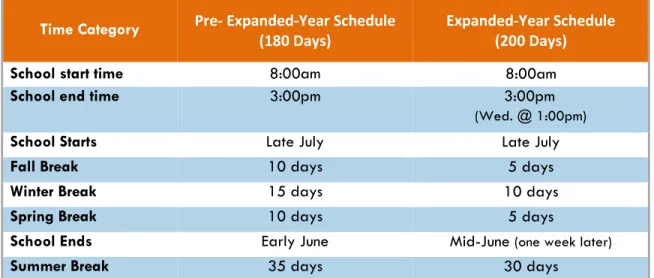
TABLE 2.1
Changes to Griffith Elementary School Calendar
Time Category Pre- Expanded-Year Schedule
(180 Days)
Expanded-Year Schedule (200 Days)
School start time 8:00am 8:00am
School end time 3:00pm 3:00pm
(Wed. @ 1:00pm)
School Starts Late July Late July
Fall Break 10 days 5 days
Winter Break 15 days 10 days
Spring Break 10 days 5 days
School Ends Early June Mid-June (one week later)
Summer Break 35 days 30 days
new superintendent, Jeffrey Smith, began discussions with school leaders, teachers, and committees at each district school about strategies they could implement to improve student outcomes. Previously, leadership had implemented a district-wide “stretched” calendar, with an earlier all-school start date (late July) and more evenly-spaced school breaks throughout the year (i.e., no long summer break).
According to teachers at Griffith, that revised academic year, which still offered just 180 school days per year in total, did seem to help offset summer learning loss and also provided the district’s schools with a greater number of instructional days before state testing took place in the spring. Even with this restructuring, however, Balsz educators realized that, throughout the district, more instruction was needed to better serve its large at-risk student population. So, in 2009, the district moved to add a significant number of days to its school year.
Balsz accomplished the calendar expansion by tapping into a little-used provision of the state school funding formula that provides 5 percent more state funding to districts that lengthen the school calendar by at least 20 days. Balsz officially added these 20 days (yielding a total of 132 more annual student hours) to the school year. While the organization and
length of the school day itself have remained the same (with the exception of the weekly early-release day to allow for teacher collaboration and
development), all district students now receive four additional weeks of instruction every year. All district staff members are expected to work the full 200-day schedule.
Table 2.1 shows that the district fits in the additional 20 days by shortening each break in fall, winter, and spring by one week (for a total of 15 days gained) and then adding one week to the end of the school year, lengthening the school year by those five days. The addition of 20 6.5-hour days translates to 132 more school hours. Balsz also shifts spring break to occur after state testing. This expanded calendar— featuring extra time and a new placement of spring break—builds in two additional weeks for Balsz teachers and students to prepare for the Arizona state assessments (AIMS) in the spring.
At Griffith, the augmented and restructured school calendar has led the school principal, Alexis Wilson, to claim three major educational benefits that have helped to boost student achievement.
More time for targeted support in reading and math
With its expanded instructional year, Griffith has sufficient time to offer targeted students daily
12
intervention blocks in reading and, for those in higher grades, in math as well. These intensive supports are designed to help students work on building phonics skills and reading fluency and for what the principal calls “re-teaching.” In math, students receive
additional practice, reinforcements, and enrichments of key concepts and skills. Each week, students receiving the math intervention take a mini-assessment to check if they are ready to advance.
Shifting instructional content to earlier in year
The additional days have resulted in an instructional shift, where students (at Griffith and throughout the district) have four full weeks more to learn the
material that will be included on the state assessments. Not only are teachers able to cover a greater portion of the curricula prior to the exams—thereby
increasing students’ familiarity with the subject matter—they also report having the flexibility to go into depth on some topics because they do not feel pressured to rush through the content.
Further, having five to six weeks of school following
the administration of the state assessments generates greater vertical alignment of the school’s overall curriculum (i.e., grade-to-grade development), by giving teachers the time to review and reinforce key concepts for their students and to better prepare them to advance to the next grade. Significantly, Griffith teachers also report that the school’s shorter summer break facilitates a quicker and easier transition for students into the new school year. These teachers spend less time than they had in past school years reviewing material and reminding students of discipline procedures.
Extra time for teacher professional development and data review
The expanded year has enabled the school some flexibility to build-in a weekly early release day for students, so that teachers can meet for two hours of professional development and data review. The purpose of these regular sessions is to hone instructional practices and work together to align curricula around the revised schedule. With this weekly time, the school is more effectively supporting teachers and building their capacity as educators.
Costs and Funding
The additional cost of Griffith’s 20 more days of school for the 2011– 2012 school year was approximately $174,000. This figure represents about $290 per student, or $2.20 per student hour. Table 2.2 (see following page) details Griffith’s costs to provide these additional days. When the 20 days were added to Griffith’s calendar, the school’s instructional staff received a 9 percent pay raise to compensate for an estimated 11 percent increase in required work time. During the 2011– 2012 school year, this pay raise for 23 teachers totaled
$126,000. The remaining $48,000 in additional costs for the 20 days includes supplemental salary costs for non-instructional staff and small amounts for supplies, utilities/maintenance, and transportation. There are no extra costs for the school’s two administrators, who, as 12-month employees, were not included in the pay raise agreement, nor any additional costs for employee benefits, which are fixed.
At Griffith (and throughout the district), funds to support the longer school year are covered largely by Arizona through, as noted previously, the provision in the state funding formula that enables districts that add 20 days to “earn” an additional 5 percent of funding. In fact, the supplemental state funds cover approximately 80 percent of the additional cost for the longer school year. (See Table 2.3, page 13.)
Teachers report that the school’s
shorter summer break facilitates a
quicker and easier transition for
students into the new school year.
13
TABLE 2.2
Expenditures for Griffith’s Expanded Year
Cost Category Amount Notes
Instructional Salaries $126,000 Including additional salary costs for the 23 instructional staff at the school—teachers, coaches, librarians, etc.
Administrative Salaries $0 N/A—both school administrators were already 12-month employees
Other Staff Salaries $36,000 Includes additional salary costs for attendance clerk, instructional assistants, bus drivers, and nurses
Benefits $0 No additional costs; benefits already provided for all staff
Contracted Services $0 The school does not contract with any outside providers to cover the additional time
Supplies and Materials $3,000 Includes additional custodial/maintenance supplies
Facilities $4,000 Includes water, sewer, trash, electric, and phone
Transportation $5,000
School transportation costs are relatively low, because most students walk to school; additional costs include:
fuel/maintenance for one regular bus and one special education bus (during the added 20 days)
TOTAL $174,000
TABLE 2.3
Funding Sources for Griffith’s Expanded Year
Funding
Type Description of Funding Amount Timeframe
Local/District Maintenance and Operations Override $41,000 Ongoing (must be approved every five years)
State State provides additional funds for schools
that extend calendar to 200 days $133,000
Ongoing
TOTAL $174,000
Because the longer school year at Griffith Elementary was implemented as part of a district-wide approach to improving achievement (rather than the decision of leaders at Griffith or any individual school), Balsz School District provides the resources needed to close the gap between the total additional cost of the longer school year and the supplemental funds provided by the state. Understanding the funding of the expanded year at Griffith begins with a review
of district finances. Balsz derives additional funds for the longer school year through a modest tax increase approved by local voters. Arizona law allows school districts in the state to implement property tax increases, or overrides, for up to 15 percent of the state’s “revenue control limit,” pending such voter approval. With successful passage of this
“Maintenance and Operations Override” (M&O) each time that it has been on the ballot—every five years,
14
including most recently in 2012—Balsz then dedicates a portion of the additional, voter-approved revenue to fill the gap between state funds and expenses associated with the expanded time. (The M&O also supports many other educational services in the district, such as arts and physical education.) Meanwhile, the school district is also pursuing public and private sources to support further improvements. With rising test scores, Balsz is enjoying a spate of good publicity, which, in turn, is attracting new foundations and corporate supporters. For instance, the district was awarded a $2 million dollar grant for teacher and leadership development from the Ellis Center for Educational Excellence.
Implications for Sustainability
State funding for the expanded school year at Griffith Elementary appears to be very stable, with the provision that supports the expansion now in place for over a decade, weathering the ups and down of the state budget process. Because funding the expanded year also must rely on the continued support of local voters to pass an override (filling in the gap between the actual cost and the state funding), district leadership is aware that such sustained support cannot be assumed. To promote the work of the district (and the 200-day year), Balsz Superintendent Jeff Smith is leading a low-key community campaign called “Believe in Balsz.” Despite the relative stability of funding, emerging local demographic and school-based realities (while not all narrowly financial in nature) are likely to have significant implications for both the Balsz School District and Griffith Elementary as they continue to operate with the 200-day calendar.Enrollment
Griffith Elementary and Balsz district leaders had hoped that the longer school year would attract new families from neighboring districts—families that would bring additional state resources with them. But, as of this writing, this hope has not materialized. In fact, since the local housing market crashed, Griffith
enrollments have declined by 25 percent. Movement across districts has been minimal, and only a few new students from out of the area have enrolled at the school. (Arizona allows students to enroll in schools outside their home district, and the money essentially follows the student since state funding amounts are based on enrollment.) While the expanded school calendar has not yet spurred significant new enrollment from other districts, it has fueled interest from a variety of public and private organizations and partners that are bringing supplementary resources to drive further improvements.
Increased pressure on hiring timelines
Throughout Balsz School District, the shorter summer break means a more rapid turnaround between closing out one year and starting a new year, which, in turn, puts greater pressure on the hiring schedule. With the academic year starting in mid-July, many schools in the district are still filling open positions at the start of school. Such a tight timeline could threaten instructional quality, if teachers are not in place by the start of the new school year or do not have sufficient preparation time before the school year begins.
Teacher turnover
Griffith Elementary and Balsz district leaders were initially concerned that the shift to a longer school year would create more staff turnover, prompted by employees who prefer a shorter school year seeking employment in other districts. While the staff attrition rate for the district has, in fact, been higher than average over the last few years, there is no clear data on the reasons for the turnover. In 2012, Griffith lost 10 teachers from its staff of 23. Although many of these educators left for the usual personal and
professional reasons, a few did cite the longer school year as the reason for seeking a teaching position elsewhere.
To meet this challenge, the district has adapted its recruiting and marketing strategies to highlight the extra pay Balsz teachers receive and specifically includes an appeal to candidates who are interested in joining a district focused on innovation. With this
15
approach and commitment in mind, Balsz district leaders are hopeful that the turnover will subside over time, as the teaching cadre adapts to the new, longer schedule.
* * *
Despite these challenges, there is little doubt that the expanded-year initiative at Griffith, along with that of the entire Balsz School District, has proven to be successful. In fact, as a result of Balsz’s success, more district leaders in Arizona are interested in expanding learning time. In 2013, a group of education leaders and advocates began working with the Arizona legislature on a proposal to increase the state’s contribution to districts that implement 200-day
calendars, from 5 percent to 8 percent of a district’s state-formula funds. This supplement would likely prompt more districts to expand their calendars, because the extra funding would come much closer to covering the full cost of the additional days. Another modification Arizona lawmakers are considering would allow individual schools to access funding specifically to expand school time—in contrast to the present situation, where an entire district must expand its calendar in order for any school to have access to funding. At the time of this writing, such a proposal has not yet been enacted, even as both Griffith Elementary School and Balsz School District have done a great deal to demonstrate first-hand for Arizonans the potential of more learning time to boost student achievement.
16
CASE TWO
Dr. Orlando Edreira Academy
Elizabeth, NJ
An expanded-time school becomes a model for the whole district
Dr. Orlando Edreira Academy, named after a long-time local education leader and known locally as School 26, is situated in a mixed-income neighborhood of Elizabeth, New Jersey. Since it opened in fall 1998, the school has
featured a longer year (200 days) and a longer day (8 hours) and is one of four lottery K – 8 schools in the district, meaning that a student from anywhere in the district can enroll there, provided space is available. The school serves a majority minority population and over 80 percent of the students qualify as low-income. In 2010, after a court ruling ordered the state to distribute more school finance dollars to Elizabeth to meet equity requirements, the entire district—30 schools in all—converted to a longer school day. (See
box, page 19, for details on Elizabeth’s transition to district-wide expanded time.) The time expansion was a deliberate effort to follow the lead of School 26 and a few other district schools, which were demonstrating a very high level of academic performance among their students. (In 2012, for its academic achievement, School 26 ranked in the 97th percentile of schools statewide with similar demographic profiles.) Because the entire Elizabeth district now has an 8-hour day (though not a longer year), the costs associated with the expanded school time—calculated at $717,294—have been absorbed by the overall district budget, which funds much of the added expense of having more time.
Vital Statistics
Total students: 524 Grades served: K – 8
Low-income: 81%
District per pupil
expenditure: $17,143
Expanded Learning Time Total additional student hours: 430 Total additional teacher hours: 430 Total additional cost: $717,294
Cost per student: $1,369 Cost per student per hour: $3.18
75%
18% 6%
1% Student Demographics
Latino
African American White
Asian
89% 67%
86% 53%
Reading Math
% Proficient: Low-Income Students Only
(NJASK, Spring 2012)
17
Edreira’s Expanded-Time Model
In 1997, the district broke ground on a new school which, from the beginning, was intended to be a “state-of-the-art program in a state-of-the-art facility.” As part of this effort, the school board, together with the district leadership, decided to open the school—originally called the Westminster
Academy and renamed for Dr. Orlando Edreira in 2007—with an extended day and year, creative scheduling, and a host of partnerships. During the 2011– 2012 school year, at the urging of
Superintendent Pablo Muñoz, School 26 began the process of becoming certified as an International Baccalaureate® (IB) school and was formally approved as what is called a “candidate school” in 2012. Currently, Dr. Orlando Edreira Academy is the only candidate IB school in New Jersey with both a primary- and middle-school grades program, and it is one of the few IB schools anywhere serving such a high proportion of students who receive free- or reduced-price lunch.
To enact and realize the goals articulated by International Baccalaureate, the non-profit educational foundation that approves schools for inclusion in its program, School 26 offers cross-disciplinary courses and a wide array of enrichment classes and groups, along with two languages and designated time daily for teachers to collaborate.
Cross-disciplinary curriculum
Teachers at School 26 are clear in their desire to collaborate with colleagues across disciplines, not only as they formulate particular lesson plans, but also as they consider how each subject class might develop and advance a certain shared set of skills. Much of this work is driven by the requirements of the IB foundation, which requires all its elementary schools to systematize learning into certain themes (e.g., how the world works, how we communicate,
etc.). At each IB school, faculty shape and realign the standard district curriculum around these themes. As School 26 Principal Howard Teitelbaum explains, “The idea is that you are going to do learning around certain larger concepts, and then the content [required by the district] supports that concept.” Because many of the IB themes are taught through social studies and science, all School 26 students at the elementary level take these classes five days each week. Then, in middle school, Dr. Orlando Edreira Academy science and social studies teachers actually co-teach the literacy classes for some portion of the class period. The co-teaching often works by having one teacher instruct on the content, while the other teacher acts to model the learning process. This method helps students better appreciate how they can acquire and apply knowledge, as well as how to overcome difficult or challenging material.
Even with this less traditional approach to education, School 26 still includes a daily “intervention block” in middle school, for students who need further support in content mastery; while students who may have the knowledge base, but are less engaged, are
provided more social-emotional supports in groups of six or seven students each. Those students who do not need this academic and/or social support have the opportunity to take an additional enrichment class.
Enrichment and foreign languages
As detailed in the schedule (page 18), School 26 offers a broad array of enrichment activities, ranging from visual arts to technology, from music to student government. More than the variety and the breadth of the activities offered, however, the school concentrates on developing depth in these pursuits. For example, School 26 has an accomplished music program, including jazz band and honors chorus. And within these activities, teachers specifically focus on the rigors of learning an instrument and honing the skills of practice and performance. Also, in keeping with both IB requirements and the general
educational philosophy of the school, every Dr. Orlando Edreira Academy student learns both Spanish and Mandarin. Overall, as the principal
Edreira Academy offers a wide
array of enrichment classes,
with two foreign languages
required of all students.
18
Sample Schedule Elementary Grades
Sample Schedule Middle Grades
7:30 AM Homeroom
(7:30 – 7:50)
Homeroom
(7:30 – 7:50)
Mandarin (3x/week)
Spanish (2x/week)
(7:50 – 8:31)
L.E.A.D.S (Humanities)
(7:50 – 9:53)
Language Arts
(8:31 – 9:53)
Soc. Studies
(9:53 – 10:34)
Electives
(9:53– 10:34)
Lunch & Recess
(10:34– 11:19)
Gym (2x/week)
World Language (3x/week)
(65 min.)
Writing (2x/week)
Art/Music (3x/week)
(11:19 – 12:04)
Lunch
(25 min.)
12:00 PM
Math
(12:04– 1:30)
Math
(12:04 – 1:30)
Gym (2x/week)
Library/Music/Tech. (1x/week)
(1:30 – 2:11)
Science
(1:30 – 2:11)
Science
(2:11 – 2:52)
Intervention/Electives
(2:11 – 2:52)
Health (2x/week)
Intervention (3x/week)
(2:52 – 3:33)
Electives
(2:52 – 3:33)
3:30 PM
affirms: “The goal of the expanded day and year is not simply to increase the number of minutes that students are exposed to particular subjects but to expand the richness of the program, to make sure that students have a broad experience in school.”
Collaborative planning
School 26 teachers have common planning every day, sometimes by subject (i.e., cross-grade or “vertical”) and sometimes by grade level (“horizontal”). The purpose of these sessions is to coordinate lesson plans and to help ensure that the content of each class aligns with the learning themes and then, especially at
the middle school level, that each individual class is aligned with one another.
To facilitate this process, a content map for all classes and subjects across the entire school is posted in the teachers’ work room, so that each teacher can understand how his/her own teaching fits into the broader curriculum. With the goal of making learning more cohesive, integrated, and comprehensive for students, the map also furthers the specialist teachers’ efforts to align the content in their classrooms with that of teachers in either the self-contained classrooms (at the elementary school level) or the subject-area
19
History of Expanded Time in Elizabeth, New Jersey
Elizabeth, New Jersey is one of only a very small number of districts in the U.S. that has committed to a longer day for all its schools, including its six high schools. The district-wide transition to an 8-hour day began in 2006 when the Board approved three new magnet schools to open with a day like that of School 26 (though not with an extended year). The one high school in the district also required an 8-hour day for all students. (Since then, the high school has broken into six separate academies, and the longer day remains.) More Elizabeth schools converted to 8-hour days during the 2009 – 2010 school year, when district leadership provided the six lowest-performing schools with an additional 90 minutes per day. This additional time was directed primarily toward a period of the day that was reserved for additional interventions in English language arts (ELA) and math. When Elizabeth received word the following year that the state of New Jersey would be raising the district’s
baseline funding by an additional $81.7 million in order to meet an equity-funding mandate from the Supreme Court of New Jersey, district leaders decided to convert the remaining 14 K – 8 schools to a longer day as well. The total cost of the conversion was calculated at just over $4 million (in added teacher pay), plus another $1.2 million for teacher stipends to staff after-school programming that would run until 6 PM daily. Throughout this process of augmenting the number of expanded-time schools, the pay structure for additional teacher time established at School 26 since its founding became the model adopted by the rest of the district.
classes (at the middle school level). All School 26 teachers also do “macro planning” over the summer to map out their year, and then they develop individual lesson plans over the course of each week.
Costs and Funding
At the Dr. Orlando Edreira Academy, the annual cost of the additional 20 days of school and 90 minutes per day is $717,294. This figure translates to $1,369 per student, or $3.18 per student hour. Table 3.1 (page 20) details the costs for the additional school time. Not surprisingly, the majority of costs—$638,351—of Dr. Orlando Edreira Academy’s expanded-day and expanded-year schedule are associated with
additional days and hours of pay for instructional staff. As noted above, for many years, School 26 was the only expanded-time school in the district and, during this period, it maintained a pay rate for its teachers that was 18.4 percent higher than base salary. When the six lowest-performing schools in the district converted to a longer day (but not a longer year) in 2009, teachers in those schools who worked the
additional 90 minutes per day received an extra 8.4 percent salary above base. Such a calculation was derived from the School 26 contract, which had already specified that its teachers would receive 8.4 percent additional pay for working 8 hours a day and 10 percent more pay for working 20 additional days each year (i.e., for a total of 18.4 percent.) As indicated in Table 3.2 (page 21), funds to support the longer school day and year are covered mostly by Elizabeth Public Schools. According to district
leadership, the district has prioritized spending at the school and classroom levels, with a particularly strong commitment to expanded time for students. In fact, Superintendent Muñoz and the Elizabeth School Board demonstrated this commitment fully in the school budget for 2010 – 2011, a year in which the district faced a significant cut in funding from the state. (Elizabeth receives more than 80 percent of its total revenues of nearly $500 million from the state.) It had been just the previous year that the district had converted its six lowest-performing K – 8 schools to an 8-hour day, and, when faced with a large deficit caused by the loss of millions of state dollars, leadership could have saved $3 million by returning these schools to a regular day
20
TABLE 3.1
Expenditures for School 26’s Expanded Day and Year
Cost Category Amount Notes
Instructional Salaries $ 638,351 Includes additional salary costs for the 45 FTE instructional staff at the school—teachers and paraprofessionals
Administrative Salaries $ 55,652 Includes additional salary for the principal, vice principal (12-month positions) and two administrative secretaries
Other Staff Salaries $ 9,002 Includes additional salary costs for parent liaison
Benefits $ 0 No additional costs; benefits already provided for all staff
Contracted Services $ 0 N/A
Supplies and Materials $ 0 None that can be attributed to expanded time only
Facilities $ 0 None that can be attributed to expanded time only
Transportation $ 14,289 Added costs of running bus routes for 20 additional days
TOTAL $ 717,294
and, in turn, reverting teacher salaries back to baseline levels. Instead, district leaders opted to maintain these six expanded-day schools, while cutting about 400 positions from the district overall. The cuts were mostly from support staff and led, in some cases, to slightly larger class sizes across the district.
The following year (2011 – 2012), the Supreme Court of New Jersey ruled that the state needed to restore funding to previous levels in the neediest New Jersey districts. As a result, Elizabeth received an additional $81.7 million for that year and ongoing (i.e., raising the baseline level of state funding by that amount), prompting Muñoz’s decision to convert every school in the district, including the high schools, to an 8-hour day. The total cost of this district-wide conversion came to $4 million in additional teacher salaries annually. The bulk of the unanticipated dollars from the state was directed to hiring an additional 100 classroom teachers and over 300 instructional coaches in literacy and math.
In the most recent budget, for school year 2013 – 2014, Elizabeth once again faced a relative decline in
revenues because the additional $7 million from the state (versus the amount provided in the previous academic year) did not rise as fast as district costs, especially those related to increases in teacher salaries resulting from a new collective bargaining agreement. Once again, in the face of declining revenues, the Elizabeth Board of Education has opted to maintain expanded-day schedules for the entire district. Rather than eliminate or scale back expanded time, the district is making other operational cuts.
Implications for Sustainability
Throughout the vicissitudes of both the state and district budget processes, the expanded-time program (and its costs) at School 26 has remained somewhat outside the decision matrix; the school was never under threat of losing its additional time. Because the school opened in 1998 with an expanded day and year, Dr. Orlando Edreira Academy appears to maintain a special status in the district. Because they work a greater number of hours, staff at School 26 continue to be higher-paid as a group than teachers at any other Elizabeth school.
21
TABLE 3.2
Funding Sources for School 26’s Expanded Day and Year
Funding
Type Description of Funding Amount Timeframe
Local/District* General funds $ 565,568 Ongoing
Federal Title I and Title III funds $ 151,726 Ongoing
TOTAL $ 717,294
* Over 80% of local education funds come from the state.
Currently, this staff’s salary structure does not appear to be under threat of any cuts. Moreover, School 26’s standing as the only IB school in the district has helped to secure its distinctive place among all Elizabeth’s K – 8 schools. Further, because this IB status is enhanced by the expanded schedule, it seems relatively protected at present from reductions or substantial changes. Nevertheless, additional strains on the district budget may ultimately have some impact on Elizabeth’s capacity to maintain the expanded schedule (at least the 20 additional instructional days) at School 26.
Rising costs of expanded day/year
In the latest round of collective bargaining, the teachers’ union and the district have agreed to increase the additional percentage that Elizabeth teachers are paid for their additional hours worked. Starting in school year 2013 – 2014, Elizabeth teachers working in expanded-day schools will receive a salary boost of 9.2 percent for working an 8-hour day (i.e., up from 8.4 percent, which has been the historic increase in pay associated with the longer school day). In 2014 – 15, this raise will grow an additional 0.8 percent, bringing the total higher pay for the longer day to 10 percent. Teachers working in School 26 also will receive successive 0.8 percent raises over the coming two years, bringing their total augmented pay to 19.2 percent and 20.0 percent, respectively, for the next two school years. In addition to these specific increases pegged to
increased time, the district also has agreed to a 3 percent raise in teachers’ base salaries.
* * *
One of the most remarkable features of School 26 is the stability of its teaching staff. Principal Howard Teitelbaum, who has been at the school since the 2010 – 11 school year, reports that he has not had to replace a single teacher and that many of the Dr. Orlando Edreira Academy teachers have been there since the school opened in 1998, or shortly thereafter. In fact, from the start, the significantly longer schedule at School 26 has attracted teachers who like to define themselves as, what one teacher called, “change agents.” And the vast majority of these teachers have chosen to continue their work at School 26.
Further, both School 26 teachers and administrators report that there is a high level of trust among the adults in the building, such that teachers accept new challenges and are, in turn, entrusted to implement good instruction. Teachers speak glowingly, for example, of the school’s effort to become a fully-certified International Baccalaureate school and have come to understand how it can support their teaching and their students’ learning, even though it was the superintendent and principal who had initiated the effort. This shared history and “culture of enthusiasm,” as one teacher describes the overall climate, bodes well for the future of School 26’s innovative
22
CASE THREE
McGlone Elementary School
Denver, CO
A longer day and year as part of a comprehensive school turnaround plan
In 2010, McGlone Elementary School, located in Denver, Colorado, embarked on an ambitious and comprehensive effort to turnaround the school’s academic performance. A key element of the school’s turnaround strategy hasbeen to expand learning time for its students by nearly 250 hours per year. Serving 600 mostly high-poverty students, McGlone has made significant progress in just two years. From 2011 to 2012, the school saw double-digit gains in the number of its third- and fourth-grade students scoring proficient or advanced on both math and English language arts (ELA) state standardized tests. These gains put McGlone in the top 1 percent of schools in the state of Colorado for growth performance.* McGlone is part of the Denver Summit Schools Network, a group of ten “turnaround schools”— those identified as chronically
underperforming
* Colorado’s growth measure compares students’ year-to-year growth in test scores with the scores of students who
scored similarly on state tests in previous years.
Vital Statistics
Total students: 600 Grades served: PK – 5
Low-income: 97%
District per pupil
expenditure: $8,585
% Proficient: McGlone vs. State
(TCAP, 2010 – 2012)
Expanded Learning Time Total additional student hours: 243 Total additional teacher hours: 301 Total additional cost: $560,400
Cost per student: $934 Cost per student per hour: $3.84
67%
18%
14%
1% Student Demographics
Latino
African American White
Asian
24% 70%
36% 71%
41% 71%
2010 2011 2012
24% 69%
35% 69%
49% 71%
2010 2011 2012
Math ELA
23
and targeted for substantial overhaul to boost student achievement and improve culture—that have been partnering with Blueprint Schools Network, a national nonprofit organization that works closely with schools and districts to implement and monitor its research-based Blueprint school reform model.* One of the key key strategies of the Blueprint framework is more time for learning, and, at McGlone, Blueprint has infused private funds into the school budget to cover most of the costs of the expanded schedule—estimated to be $560,400, or $934 per student. To reallocate funds from the existing school budget, Blueprint also has worked with the McGlone principal in an effort to leverage the school’s status as a Colorado Innovation School. With this status as part of its whole school reform plan, McGlone was granted greater autonomy in areas such as curriculum and instruction, staffing, budgeting, the use of time, and professional development. As they strive to implement a
sustainable expanded-time model, McGlone’s leaders have blended both existing resources and new outside resources to deepen and broaden learning time for their students.
McGlone’s Expanded-Time Model
As part of its turnaround strategy, McGloneElementary has both added days to its calendar and lengthened its daily school schedule. In the 2012 – 2013 school year, the model (which has been
adjusted slightly each year) included 9 more days of school and 1 additional hour for students each day, producing a total of 243 additional hours per year for all students. As shown in the schedule (page 25),
* Blueprint’s model for school reform centers on five key
strategies: 1) Excellence in leadership and instruction, 2) Increasing instructional time, 3) Fostering a no-excuses culture of high expectations, 4) Frequent assessments to improve instruction, and 5) Daily tutoring in critical growth years. This framework is derived from ongoing research on common practices of schools capable of closing the achievement gap between low-income students and their higher-income peers (Dobbie and Fryer, 2013). Blueprint was founded to implement these practices within traditional public schools.
McGlone’s students are in school from 8:00 AM to about 4:00 PM, five days a week.
At McGlone, expanded time makes possible intensive daily tutoring for students, new and augmented professional development opportunities for teachers, and more enrichment opportunities aimed at building student engagement and promoting a
college-oriented school culture. These three components of the program are described below:
Intensive daily tutoring for students
McGlone’s tutoring program is a signature element of the Blueprint model and a core ingredient of the school’s turnaround strategy. The school’s fourth graders receive tutoring in math, while third graders have ELA tutoring. As the schedulealso shows, McGlone’s fourth graders receive math tutoring
during either the first or second half of their 100-minute math block. Students are divided into two groups, so that one group participates in tutoring as the other works with the classroom teacher in a more conventional math lesson. Midway through the math block, the two groups switch places. Meanwhile, McGlone’s third graders have an extended ELA block that is organized much the same way as the fourth-grade math block, with half the class’s students alternating between a tutoring session and an ELA lesson taught by the classroom teacher. The split class/tutoring block allows all students, even those who are on track, to receive more personalized instruction aiming to accelerate their progress. Classroom teachers work with only half their students at a time and tutors work with no more than two or three students at a time, allowing for much more individualized academic support.
All McGlone’s tutors are recruited, trained and supported by Blueprint. The tutoring program is part
The split class/tutoring block allows
all students, even those who are on
track, to receive more personalized
instruction to accelerate progress.
24
of the organization’s year-long fellowship that is designed to attract individuals who are interested in gaining teaching experience and making a difference in the lives of children by building close relationships and supporting their educational development. McGlone has two tutor coordinators on staff (one for math and one for literacy) to supervise and train the tutors and to ensure that the program is implemented effectively and coordinated with the school’s
academic goals and curriculum.
Additional professional development opportunities
Along with providing opportunities for students, McGlone’s longer school day and year also allow for deeper and more consistent professional development for faculty. One day every week, teachers stay an additional hour following student dismissal to
participate in professional learning. Each teacher also has at least one hour of common planning time during the school day, which is spent in systematic data-team
meetings, facilitated discussion regarding instructional practices, and/or team planning.
To further expand planning time, McGlone has hired a science enrichment specialist who teaches science in the fourth- and fifth-grade classrooms several times a week, giving those classroom teachers at least one additional weekly planning period. Moreover, McGlone employs several teacher leaders who teach half-time and work the other half-day as instructional coaches, helping to improve pedagogy across the school. Further, as part of the lengthened school year, the school has instituted four additional professional development days, two of which are spent at an off-site retreat with an aim toward strengthening staff cohesion and building content understanding.
ELT Schedule ELT Schedule
Club Day
8:00 AM Morning Mtg.
(8:00 – 8:20)
Morning Mtg.
(8:00 – 8:20)
Math – Tutoring Group A1
(8:20 – 9:10)
Math – Tutoring Group A1
(8:20 – 9:10)
Math – Tutoring Group A2
(9:10 – 10:00)
Math – Tutoring Group A2
(9:10 – 10:00)
Intervention or Enrichment
(10:00– 10:45)
Intervention or Enrichment
(10:00– 10:45)
Science or Soc. Studies
(10:45 – 11:30)
Literacy
(10:45– 11:30)
Lunch & Recess
(11:30– 12:10)
Lunch & Recess
(11:30– 12:10)
12:00 PM
Literacy
(12:15– 2:35)
Science or Soc. Studies
(12:15 – 1:05)
Literacy
(1:05– 2:00)
Specials
(2:00 – 2:35)
Work Time
(2:35 – 3:00) Clubs
(2:35 – 3:55)
Specials
(3:00 – 3:55)
25
To advance its turnaround efforts, McGlone also has used private funds to make a significant investment in technology, including funding professional
development for teachers to help integrate
technology into the curriculum, supplying interactive whiteboards for teachers, and securing 1:1 laptops for fourth- and fifth-grade students.
Enrichment opportunities to build student engagement and promote a college-oriented school culture
Because of their longer day and year, McGlone students also benefit from more enrichment opportunities. One day each week, all students participate in an hour-long club of their own selection. Club choices—ranging from garden club to ballet, debate, and crochet—are taught by teachers and by community partners. Through the new activities they offer, these weekly clubs build student engagement in school and encourage students to form positive relationships with caring adults. Pursuing similar aims, McGlone also starts the day with a morning
meeting—a hybrid homeroom and advisory period— that focuses on teaching core school values and generating interest in college and career pathways.
Costs and Funding
To compensate classroom teachers for their additional hours worked, McGlone issues a common stipend. Specifically, McGlone’s 34 teachers receive a flat $5,000 annual remuneration, resulting in a total cost of $170,000 for the school. Based on the district average teacher salary of $50,000, this stipend means McGlone’s teachers are receiving about a 10 percent increase in pay. However, because the school’s teachers work roughly 300 more hours per year (or 20 percent more) than their peers at other district schools, their rate of compensation is not directly proportional to the increase in hours. On a percentage basis, the increase in pay is roughly half the increase in time.
At $320,000, McGlone’s tutoring program is the largest cost component of the school’s ELT model. These costs include the salaries for eight tutors and
two tutor coordinators. Tutors receive $25,000, and tutor coordinators are paid $60,000. As presented in Table 4.1 (page 26), the total cost of the expanded learning time components, including the teacher stipends and compensation for the tutors and tutor coordinators, is about $560,400 (which calculates to $934 per student or $3.84 per student hour). Private grants secured by the Denver Public Schools working with McGlone’s partner, Blueprint Schools, provide the primary source of funding for the school’s expanded learning time model. In fact, the program would not be possible without the district’s partnership with Blueprint Schools, which has helped McGlone educators implement the school’s turnaround model
and its expanded-day, expanded-year approach. In addition to supporting the district’s efforts to raise $365,000 to cover the program’s costs, Blueprint provides significant technical assistance and monitoring feedback to the school. So, while community partners provide a few enrichment activities on an in-kind basis, the estimated value of these services is not available, and they do not, in any event, comprise a large part of the overall costs. Beyond the philanthropic contribution and the in-kind services of community-based partners, McGlone principal Suzanne Morey covers approximately $195,000 of the reading tutoring portion of the program by drawing from the school’s per pupil allocation from the district. McGlone’s Innovation School status, with the autonomy it affords in scheduling and budgeting, has been instrumental in enabling Morey to leverage existing resources. For example, Innovation status permits McGlone to opt out of paying for certain district services and to use the savings elsewhere. In one case, the school chose a new math curriculum, which was different from the district-sponsored curriculum, thereby enabling the principal to avoid what the district charges for annual