EVALUATING DEFAULT MODE NETWORK RESTING-STATE
FUNCTIONAL CONNECTIVITYAS A BIOMARKER OF TREATMENT RESPONSE TO MINDFULNESS-BASED COGNITIVE THERAPY FOR ANHEDONIA
Paul Michael Cernasov
A thesis proposal submitted to the faculty of the University of North Carolina at Chapel Hill in partial fulfillment of the requirements for the degree of Master of Arts in the Department of
Psychology and Neuroscience.
Chapel Hill 2020
©2020
ABSTRACT
Paul Michael Cernasov: Evaluating Default Mode Network Resting-State Functional Connectivity as a Biomarker of Treatment Response to Mindfulness-Based Cognitive Therapy
for Anhedonia
(Under the direction of Gabriel Dichter)
TABLE OF CONTENTS
LIST OF FIGURES ... viii
LIST OF TABLES ... ix
LIST OF ABBREVIATIONS ... x
CHAPTER 1: INTRODUCTION ... 1
The Default Mode Network: Relevance as a Biomarker ... 2
Resting State DMN Functional Connectivity in Depression ...3
Neurobiology of Anhedonia ...4
Resting State DMN Functional Connectivity in Anhedonia ...5
Mindfulness-Based Interventions: Relevance to Anhedonia and Neural Correlates ...6
Neural Mechanisms of Mindfulness Practice in Non-clinical Contexts ...7
Potential Neural Mechanisms of Mindfulness Practice for Anhedonia ...8
Present Investigation ...8
CHAPTER 2: METHODS ...11
Study Overview ...11
Participants ...12
Eligibility Criteria ...12
Psychosocial Interventions ...14
Mindfulness-Based Cognitive Therapy ...14
Behavioral Activation Treatment for Anhedonia ...15
Design Considerations ...16
Clinical Symptom Measures ...17
Snaith Hamilton Pleasure Scale ...17
Beck Depression Inventory II ...18
Treatment Differences in Clinical Outcomes ...18
7T Magnetic Resonance Imaging ...18
Acquisition Parameters ...18
Image Preprocessing ...19
Planned Analyses Aims 1 &2 ...19
Estimating DMN Functional Connectivity ...19
Evaluating ROI-to-ROI Predictors of Treatment Response ...20
Planned Analysis Aim 3 ...21
Calculating Graph Theory Metrics of Connectivity ...21
Evaluating Graph Theory Metrics as Predictors of Treatment Response ...22
Post Hoc Analyses: Probing Moderation and Mechanistic Effects of DMN connectivity with Multilevel Modeling ...23
Rationale ...23
CHAPTER 3: RESULTS ...25
MBCT vs BATA Effects on Clinical Outcomes ...25
Motion During fMRI ...28
Planned Analyses Aim 1 ...28
Estimating DMN Connectivity ...28
Evaluating Baseline ROI-to-ROI Connectivity as Predictors of Treatment Response ...28
Planned Analyses Aim 2 ...29
Evaluating Mid-treatment Changes in ROI-to-ROI Connectivity as Predictors of Treatment Response ...29
Planned Analyses Aim 3 ...31
Calculating Graph Theory Metrics of Connectivity ...31
Evaluating Graph Theory Predictors of Treatment Response ...31
Post Hoc Analyses: Probing Moderation and Mechanistic Effects of DMN connectivity with Multilevel Modeling ...32
Time and Treatment Effects on PCC-RLPC Connectivity...32
Baseline PCC-RLPC Connectivity as a Moderator of Treatment Response ...34
Time-Varying PCC-RLPC Connectivity as a Mechanism of SHAPS Improvement...34
CHAPTER 4: DISCUSSION ...35
DMN Connectivity as a Predictor of Treatment Response ...35
DMN Connectivity as a Mechanism of Treatment Response ...36
LIST OF FIGURES
Figure 1. Frequency of Observations per Person ... 14 Figure 2. Changes in Connectivity Between the Posterior Cingulate Cortex and
Cortical Default Mode Network Targets Relate to Anhedonia Improvement ... 30
LIST OF TABLES
LIST OF ABBREVIATIONS
BATA Behavioral Activation Treatment for Anhedonia DMN Default Mode Network
FDR False Discovery Rate GE Global Efficiency
ICA Independent Component Analysis LE Local Efficiency
LLPC Left Lateral Parietal Cortex
CHAPTER 1: INTRODUCTION
Impairments in pleasure and motivation (i.e., anhedonia) are central to a broad spectrum of psychopathology. Perhaps more than any other condition, Major Depressive Disorder (MDD) is closely associated with anhedonia (Pizzagalli, 2014). Despite a panoply of empirically
supported treatments for MDD and its associated symptoms, no treatment is effective for all individuals. Clinical practice for managing MDD symptoms involves trial-and-error selection of various medications, psychotherapy modalities, or neurostimulation techniques. As few as one third of individuals remit within three months of standard treatment (Rush et al., 2006), and the probability of remission decreases as a function of total interventions attempted thereafter (Pigott, 2015). Importantly, anhedonia represents one of the most treatment-resistant symptoms of MDD and other forms of psychopathology (Buckner et al., 2008; Wolf, 2006).
seeks to address this gap in the literature by evaluating whether functional connectivity in the DMN is associated with response to an empirically-supported MBI, Mindfulness-based Cognitive Therapy (MBCT), for individuals with clinically significant anhedonia. The Default Mode Network: Relevance as a Biomarker
The DMN was discovered after a series of positron emission tomography studies revealed consistent deactivation in a constellation of brain regions during attentional, goal-oriented
activities (Shulman et al., 1997). Research with fMRI formally established these ‘task-negative’ regions as an intrinsic neural network by characterizing the temporal coherence of activation patterns during periods of unconstrained mental activity (i.e. resting-states). The medial prefrontal cortex (MPFC), precuneus, posterior cingulate cortex (PCC), and inferior parietal lobules are generally considered the core components of the DMN, although areas such as the thalamus, hippocampus, and lateral temporal cortex are also commonly associated (Raichle, 2015; Whitfield-Gabrieli & Ford, 2012).
The domain-general properties of the DMN (i.e., supporting such wide variety of psychological phenomena as cognition, emotion, perception, and action) have led some researchers to propose this network is part of a unified brain system supporting allostasis, in concert with traditional “salience network” hubs like the insula and anterior cingulate cortex (Kleckner et al., 2017). In terms of cognition, the DMN is most closely associated with
self-reported mind-wandering during an attention task (Christoff et al., 2009). In addition to spontaneous cognition, intentional processing has also shown to elicit DMN activation when autobiographical memory or self-reflection is involved (Johnson et al., 2002; Kelley et al., 2002). For instance, evaluating one’s character traits (e.g. “I am punctual”) elicits robust activation compared to evaluating factual statements (e.g. “There are 60 seconds in one minute”). Although there is overlap between DMN regions active during self-reflection and resting-states, intentional self-reflection preferentially engages the dorsal MPFC (Whitfield-Gabrieli et al., 2011).
Resting State DMN Functional Connectivity in Depression
Given the DMN’s role in supporting self-referential cognition, alterations in MDD are often interpreted to reflect a bias towards internal-attention. Indeed, hyperconnectivity has been specifically related to measures of rumination and emotion-regulation in adults samples (Johnson et al., 2009; Sheline et al., 2009). Furthermore, connectivity between the PCC and amygdala (a salience network hub) positively correlated with rumination among a sample of adolescents with history of depression Peters et al. (2016).
Neurobiology of Anhedonia
Anhedonia is most typically associated with alterations in cortico-striatal circuitry related to salience and reward processing. Most fMRI research has investigated anhedonia within the context of MDD where individuals show reduced expectations for rewards and reduced willingness to exert effort for future rewards (Pizzagalli, 2014). Review articles suggest
Resting State DMN Functional Connectivity in Anhedonia
While the body of evidence specifically associating the symptom of anhedonia with DMN connectivity is small, overwhelming research suggests DMN connectivity is altered in disorders characterized by anhedonia such as MDD, bipolar disorder, and schizophrenia (Whitfield-Gabrieli & Ford, 2012). A central tenet of the National Institute of Mental Health Research Domain Criteria (RDoc) initiative is that treatment development for such conditions will be hastened by investigating neurobiologically based transdiagnostic constructs related to symptoms rather than traditional diagnostic categories (Cuthbert & Kozak, 2013). To that end, Sharma et al. (2017) examined the relations between reward responsivity and resting state connectivity in a large, heterogenous sample of individuals with affective (i.e, MDD and bipolar disorder) and psychotic disorders (i.e., schizophrenia and high-risk relatives) using a data-driven approach. They found hyperconnectivity within the anterior regions of the DMN was positively related to self-reported anhedonia. Notably, these findings were present in each clinical group, highlighting the significance of using an RDoC framework. In a separate study, symptoms of anhedonia were also specifically associated with hyperconnectivity between anterior and posterior regions of the DMN among a sample of adults with MDD (Rzepa & McCabe, 2018). The triple network model of psychopathology would suggest DMN hyperconnectivity in
Mindfulness-Based Interventions: Relevance to Anhedonia and Neural Correlates
The essence of mindfulness practice is noticing the full array of sensory and cognitive experiences unfolding moment-to-moment with openness, curiosity, and nonjudgment
(Gunaratama, 2002). Modern day MBIs are inspired by millenia-old Eastern philosophy. In Buddhist tradition, meditation is a process towards personal transformation through deep awareness of the impermanence of all objects, and the dissatisfaction fueled by attachment to fleeting events (Gunaratama, 2002). In cultivating skillful mindfulness, practitioners train to observe phenomena without self-referential concepts like “me” or “my” and strive to break the
cycles of habitual responding at the root of dissatisfaction. While modern MBIs use jargon from Western psychology the principles remain true to historical foundations.
Meta-analyses confirm that MBIs are effective at managing MDD symptoms and reducing the risk of MDD episode relapse, particularly for individuals with greater residual symptoms (Kuyken et al., 2016; MacKenzie & Kocovski, 2016; Strauss et al., 2014). The largest randomized controlled trial (n=424) comparing 8-weeks of MBCT to antidepressant medication maintenance found no difference between treatments in relapse, residual symptoms, or quality of life at 24 months follow-up, suggesting mindfulness practice is a low-risk, cost-effective
Neural Mechanisms of Mindfulness Practice in Non-clinical Contexts
Given the DMN’s association with internally-oriented cognition as in mind-wandering and self-reflection, this network emerges as a natural target for mindfulness practice in non-clinical contexts. Indeed, neural changes induced by meditation largely include deactivation of DMN structures (Simon & Engstrom, 2015). Studies comparing naïve and experienced
meditators (frequently defined as > 1,000 hours of practice) across various mindfulness
meditations show greater deactivation of the PCC (Brewer et al., 2011; Garrison et al., 2015) and ACC (Garrison et al., 2015) at rest in experienced practitioners. It has been theorized that DMN suppression during mindfulness practice reflects a diminished involvement in habitual modes of self-reference (i.e., a shift toward present-moment awareness and an openness to experience). Few seed-based analyses using the MPFC and PCC show relatively greater connectivity within the DMN of experienced meditators (Brewer et al., 2011; Jang et al., 2011). However, an alternative method of analyzing RSFC, measuring region-of-interest (ROI) to ROI connectivity, showed changes in both directions, with overall more decreases within network observed in pracititioners (Taylor et al., 2013).
experienced meditators engaged in less frequent mind-wandering at rest resulting in less competition between internally and externally oriented networks.
Potential Neural Mechanisms of Mindfulness Practice for Anhedonia
Interestingly, a longitudinal study showed as few as 40 days of meditation training attenuated RSFC within the anterior DMN for healthy naïve meditators (Yang et al., 2016). This finding is relevant to the treatment of anhedonia for several reasons. First, the anterior DMN overlaps with the neural substrates of self-reflection (Whitfield-Gabrieli et al., 2011). Anhedonia is associated with altered self-referential processing such as reduced endorsement of positive self-referential traits (Johnson et al., 2007). Secondly, hyperconnectivity within this region may be associated with both MDD and anhedonia severity (Rzepa & McCabe, 2018). Thirdly, hyperconnectivity within this network may not normalize with antidepressant medication, highlighting a potential unique mechanism of action for MBIs (Li et al., 2013). Together, these findings raise the possibility that alterations in DMN connectivity relate to the therapeutic benefits of mindfulness practice for anhedonia.
The Present Investigation
To determine the specificity of treatment effects on DMN connectivity, MBCT was compared against BATA. Although anhedonia symptoms were the primary clinical outcome of the larger trial, depression symptoms were also studied given the established linkages between depression symptoms and DMN connectivity (Alexopoulos et al., 2012; Berman et al., 2011; van Tol et al., 2014; Zhou et al., 2010).
Aim 1: Evaluate whether baseline connectivity between DMN regions-of-interest (ROIs) predicts anhedonia and depression improvement with MBCT relative to BATA.
Hypothesis: Stronger positive connectivity between ROIs in the DMN will be associated with greater symptom reduction in MBCT than in BATA, highlighting a neural predictor of treatment response for MBI.
Aim 2: Evaluate whether mid-treatment change in connectivity between DMN ROIs predicts anhedonia and depression improvement with MBCT relative to BATA.
Hypothesis: Attenuation of connectivity between ROIs in the DMN from baseline to mid-treatment will be associated with greater anhedonia and depression reductions in MBCT than in BATA, offering preliminary evidence of a mediation effect between MBCT, changes in the DMN, and clinical improvement.
Aim 3: Assess whether graph-theory measures for DMN ROIs predict anhedonia and depression improvement with MBCT relative to BATA. ROIs with significant connections from Aims 1 or 2 will be assessed with respect to their connectivity in the whole-brain network using graph-theory. This approach will help clarify how imbalance within the DMN contributes to anhedonia and depression severity.
centrality for the MPFC with be associated with greater improvement in MBCT than in BATA, suggesting that MBCT causes a shift away from an evaluative self-referential processing style conducive of negative affect.
CHAPTER 2: METHODS Study Overview
The current investigation took place in the context of a multi-center National Institute of Mental Health clinical trial investigating the biological mechanisms and efficacy of a novel transdiagnostic psychotherapy for anhedonia, BATA, compared to individually-adapted MBCT (ClinicalTrials.gov Identifier NCT02874534). This protocol was approved by the Institutional Review Boards at the University of North Carolina, Chapel Hill (UNC) and Duke University. Participants first completed a screening visit to review eligibility criteria and report baseline symptom severity. Eligible participants were randomized to 15 weeks of individual
psychotherapy of either BATA or MBCT. Some early treatment responders (as determined by clinician judgement) elected to complete therapy after 11 sessions. Treatment was administered by PhD-level clinicians trained in behavioral activation and MBCT and supervised licensed clinicians at Duke University and UNC.
Participants
Eligibility Criteria
Participants were 18–50 years old and free of psychotropic medication use for >30 days. Inclusion criteria were Snaith Hamilton Pleasure Scale (SHAPS) scores > 20 and Clinical Global Impressions-Severity scores > 3 to constitute a clinically-impaired anhedonic sample. Exclusion criteria included contraindications for 7 tesla MRI, concurrent psychotherapy, prior mindfulness practice experience, a history of moderate or severe Substance Use Disorder, or a diagnosis for which pharmacotherapy is a first-line treatment (e.g., Bipolar Disorder, Schizophrenia).
Diagnostic and Statistical Manual-5 (DSM-5) diagnoses were assessed by the Structured Clinical Interview for DSM-5, Research Version (First, Williams, Karg, & Spitzer, 2015). Assessors were trained to 100% diagnostic reliability with a standard rater over a minimum of three training interviews.
Sample Size & Attrition
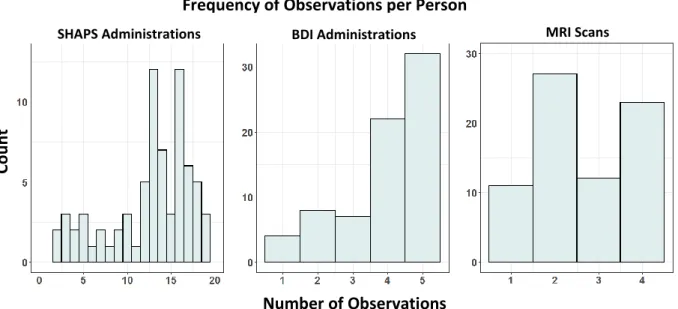
The nesting structure of the data (i.e., the number of unique observations per person for clinical and connectivity measures) is depicted in Figure 1. The total number of MRI scans acquired at each time point in therapy is as follows; 73 scans at baseline, 37 mid-treatment scans at week-8, 24 mid-treatment scans at week-12, and 59 treatment scans. Of note,
post-treatment scans did not indicate post-treatment completion as some participants completed MRI after withdrawing.
Table 1 Demographics and clinical symptom scores.
Sample Characteristic Mean (SD) Range
Sex BATA (n=38) 27 Female, 11 Male MBCT (n=35) 24 Female, 11 Male
Age BATA 27.9 (8.8) 18 – 47
MBCT 31.8 (9.2) 19 – 49
SHAPS BATA 35.7 (3.8) 28 – 44
MBCT 36.9 (5.3) 27 – 52
BDI BATA 20.1 (8.2) 1 – 36
MBCT 24.0 (10.3) 3 – 48
Psychosocial Interventions
Mindfulness-Based Cognitive Therapy
MBCT was administered in an individual format with 15 weekly sessions of 45 minutes. This individual format retains the primary components of the traditional group MBCT including didactic instruction, guided meditations, inquiry of subjective experience, and homework
assignments. The current protocol was modeled on the session outlines presented by Wahbeh et al. (2014).
Mindfulness is presented as a means of empowering individuals by granting more flexibility over habitual response patterns (Segal, 2002). In early phases of treatment, the emphasis is largely on developing core meditation skills of concentration, refocusing, and nonjudgmental acceptance. Foundational exercises taught in the program are focused awareness of breathing and mindful body scanning. Breathing exercises encourage participants to pay
MRI Scans
Figure 1. The nesting structure of the data is depicted by the number of unique observations for each respective variable. The large numbers of repeated measurements are best suited for multi-level modeling analyses. SHAPS – Snaith Hamilton Pleasure Scale; BDI – Beck’s Depression Inventory II
Number of Observations
Co
u
n
t
SHAPS Administrations BDI Administrations
naturally without effortful control. Body scan exercises have participants slowly guide their awareness through one region of the body at a time, developing interoceptive sensitivity. Mind-wandering is an inevitable part of practice. Participants are discouraged from engaging in self-criticism by framing these moments as opportunities to make choices and resume skillful
mindfulness. Later sessions of MBCT emphasize generalizing the meditation skills to cope with stressors and mood shifts in daily life. Psychoeducation is geared toward appreciating the interrelations between negative thoughts, emotions, and sensations, and developing plans to manage stressors.
Most sessions begin with a guided meditation varying in length from 3 – 10 minutes followed by a discussion about subjective experience (i.e. inquiry). Next, participants will reflect on home assignments and discuss barriers to mindfulness practice encountered throughout the week before new topics and exercises are reviewed. At the end of every session participants receive handouts summarizing the content, and at least 30 minutes of daily practice are assigned. Guided meditation CDs are provided to aid in home practice and adherence is monitored through participant report logs (Wahbeh et al., 2014).
Behavioral Activation Therapy for Anhedonia
BATA, the experimental active comparison treatment, was administered for up to 15 weekly individual sessions of 45 minutes. BATA was developed as a modification to Behavioral Activation Treatment for Depression to treat anhedonia transdiagnostically. BATA frames patient’s experiences with anhedonia in a neuroscientific perspective, using language pertinent to reward and learning processes.
motivation for sustainable behavior change. Following value clarification and broad goals, activity hierarchies are developed, establishing behavioral targets across valued life areas, prioritized by ease of implementation. Session 4 focuses discussion on the reduction of behavioral avoidance. Session 5 and above assess completion of previously established goals, discuss perceived barriers to implementing goals, and assign goals for the following weeks. Specific differences from traditional behavioral activation include focus on initiating new
behaviors which may or may not be pursued in the future (i.e., dabbling in activities), and present moment-savoring exercises as a means to enhance consummatory reward processing
experiences.
Under the framework of BATA, patients are encouraged to engage in activities that increase contact with personally relevant, values-congruent reinforcers. While achievable goal-setting is often impaired in the context of anhedonia, therapists use motivational techniques to elicit goal-directed behaviors such as tying goals to stated-values, open-ended questioning, reflective listening, and functional analysis to problem solve barriers. Increased positive affect and decreased negative affect are theorized to result from reduced behavioral avoidance and consequent increased contact with potential reinforcers.
Design Considerations
My original Master’s proposal indicated only participants in the MBCT group would be evaluated. However special considerations motivated the decision to include BATA as a
identical to the experimental treatment in all respects but the purportedly unique mechanisms. As previously noted, BATA and MBCT overlap on certain therapeutic principles, namely BATA includes instruction on present-moment savoring during pleasant activities. This may arguably impact DMN function as present-moment awareness engages the frontoparietal network and deactivates the DMN (Raichle, 2015). While this similarity is of mild concern, it is noteworthy that MBCT encourages momentary awareness decontextualized from positive affective
experiences. Moreover, MBCT is believed to facilitate clinical improvement largely through formal meditation practice. It stands to reason that repeated disengagement and suppression of the DMN during extended periods of concentration would facilitate greater resting-state functional connectivity change in MBCT than in BATA.
Clinical Symptom Measures
Snaith Hamilton Pleasure Scale
Beck Depression Inventory – II
Depressive symptoms were evaluated by the Beck Depression Inventory-II (BDI), a 21-item self-report questionnaire inquiring about cognitive (e.g. pessimism, self-criticism) and somatic (e.g. changes in appetite or sleep pattern) symptoms over the past week. Items are rated using a Likert scale with total scores ranging from 0 to 63 and higher numbers indicative of greater severity. The BDI has excellent internal reliability and test-retest stability (Beck & Steer, 1984).
Treatment Differences in Clinical Outcomes
A series of longitudinal multilevel models (i.e., growth curves) were estimated using the nlme package in R (Pinherio et al., 2016) to examine treatment differences in baseline clinical symptoms and change over time. Model building procedures are detailed in the “Post-hoc Analyses” section.
7T Magnetic Resonance Imaging
Acquisition Parameters
Image Preprocessing
T1-weighted anatomical images were bias-corrected using FSL (v5.0.9) to enhance removal of non-brain tissue with FreeSurfer (v6.0). FreeSurfer derived brain-masks, gray matter, white matter (WM) and cerebrospinal fluid (CSF) segmentations were imported into CONN toolbox (v18b; (Whitfield-Gabrieli & Nieto-Castanon, 2012)) along with raw functional data for remaining preprocessing procedures. Spatial preprocessing of functional volumes included realignment and estimation of motion parameters (three translational and three rotational directions), slice-timing correction, and normalization. FreeSurfer masks were eroded to
minimize partial volume effects and normalized to MNI space. Functional outlier volumes were identified using the Artifact Detection Tool with a conservative threshold of > 0.5 mm.
Realignment parameters plus their first-order derivates, the top five principal components estimated from WM and CSF masks (aCompCor method; (Behzadi et al., 2007)), and outlier timepoints were included as covariates in a multilinear regression to remove BOLD signal variance explained by these confounds. Lastly, the residual timeseries were subject to a high-pass filter (0.01 Hz < f). Participant runs were discarded if the number of volumes scrubbed exceeded 20% of the total volumes.
Planned Analyses – Aims 1 & 2
Estimating Default Mode Network Functional Connectivity
edges. In addition to bivariate correlations, partial correlations were computed as an alternative measure of RSFC. Whereas bivariate correlations measure the associations between paired ROI timeseries in isolation, partial correlations consider multiple sources simultaneously and estimate the unique contributions from each source.
Evaluating ROI-to-ROI Predictors of Treatment Response
Multiple regression was used to predict symptomatic improvement from baseline and mid-treatment change in DMN connectivity. Clinical symptom change scores were calculated by subtracting post-treatment from baseline values, with larger values indicative of greater
improvement. An intent-to-treat approach was used, such that the last observations were used as post-treatment scores for participants who dropped out of the study. Connectivity change was calculated by subtracting baseline from mid-treatment values. All models included demeaned age and sex as covariates given their influence on DMN connectivity (Ramirez-Barrantes et al.,
Table 2 List of seed regions-of-interest from the CONN Toolbox Networks atlas
Network ROI Name MNI Coordinates
(x,y,z)
Voxel Size
Default Mode
Network
Medial Prefrontal Cortex (MPFC) (1, 55, -3) 1,346
Left Lateral Parietal Cortex (LLPC)
(-39, -77, 33) 1,041
Right Lateral Parietal Cortex (RLPC)
(47, -67, 29) 1,326
2019), as well as baseline symptom severity to account for potential treatment differences. Critically, an interaction term between treatment condition and connectivity was used to identify unique predictors of treatment response to MBCT.
12 unique connectivity values were calculated for each participant in Aim 1 (i.e., six bivariate correlation and six partial correlation edges), and 12 connectivity values for Aim 2 (mid-treatment minus baseline values of edges). Given two clinical symptoms measures (i.e., the SHAPS and BDI), a total of 48 multiple regressions were evaluated. Correction for multiple comparisons was implemented using false discovery rate (FDR) adjusted p-values (Benjamini & Hochberg, 1995).
Finally, diagnostics were performed on significant regressions to assess whether
assumptions of the general linear model were met. Cook’s distance was used to identify outliers with excessive leverage on predicted values. Observations with greater than 4 times the mean Cook’s distance were subsequently removed.
Planned Analyses – Aim 3
Calculating Graph-Theory Metrics of Connectivity
Neural and other “small-world” networks demonstrate greater global efficiency (GE) than lattices and greater local efficiency (LE) than random graphs of similar sizes (Achard &
Bullmore, 2007). Thus, the adjacency matrix correlation coefficient threshold was selected on the basis of optimizing the small-worldness of the data using the following formula across a range of values within CONN toolbox:
Small-Worldness = (GE Dataset) – (GE Lattice Graph) + (LE Dataset) – (LE Random Graph)
Evaluating Graph-Theory Metrics as Predictors of Treatment Response
ROIs identified from significant connections in Aims 1 or 2 were examined as predictors of treatment response using graph-based metrics. Specifically, degree, clustering coefficient, nodal efficiency, and betweenness centrality examined the function of DMN nodes within the whole-brain network (Wang et al., 2010). Degree is a basic measure of centrality that represents the number of edges a node has in a binarized graph. Clustering coefficient refers to the
probability, ranging from 0 – 1, that a node’s neighbors (other nodes connected by an edge) are also connected with each another. Nodal efficiency is defined as the inverse of the average shortest-path length (fewest number of edges) from a given node to all other nodes in the graph. Finally, betweenness centrality refers to the proportion of the shortest paths within the network that pass through a given node. As in Aims 1 & 2, clinical symptom change scores were
Post-hoc Analyses: Probing Moderation and Mechanistic Effects of DMN Connectivity with Multilevel Modeling
Rationale
The planned analyses above employ a subset of the total data currently available. Only half of participants randomized to date completed a mid-treatment scan at week 8 pertinent to calculating changes in connectivity for Aims 2 and 3. Multilevel modeling is a statistical technique that accounts for naturally arising dependencies within nested data (e.g., repeated measures within participant; (Curran & Bauer, 2011)). A principle advantage of this approach is that it permits flexible modeling of time such that data collected at uneven intervals and from participants with varying numbers of time points (i.e., missing data) can be included in the same analysis, increasing the sample size and ability to detect effects.
Any connectivity variables that emerged as significant predictors of treatment response from Aims 1–3 were investigated using multilevel modeling to characterize connectivity change over time and symptom-relations with superior accuracy to the multiple regression models. First, connectivity was used an outcome variable to examine cross level interactions between treatment condition and time. These conditional growth curves indicated whether MBCT was associated with differential changes in connectivity as compared to BATA. Next, baseline connectivity was examined as a participant level predictor of clinical outcomes in a three-way interaction with treatment and time. This model suggests whether DMN connectivity is a moderator of treatment response to MBCT. Lastly, connectivity was examined as a time-varying covariate of clinical outcomes. This strategy probes whether DMN connectivity is a plausible mechanism of
Model Building Procedures
The following model building procedures were applied for all outcome variables (clinical or connectivity). First, the intraclass correlation coefficient (ICC) was calculated using random effects analysis of variance to decompose variance within and between participants in the outcome. Secondly, linear and quadratic effects of time were modeled across the entire sample, allowing random variation in intercepts from participant to participant. Time was coded in weeks relative to the first therapy session. Third, random slopes were examined, allowing the relation between time and the outcome to vary participant to participant. Fourth, alternative error structures were examined by fitting a model with serially correlated residuals (i.e., autoregressive 1; (Schwartz & Stone, 1998)). At each step in the model building procedure, fit was assessed by comparing change in log likelihood values with a chi-square difference test and change in Akaike Information Criterion (AIC), with lower values indicative of superior fit.
CHAPTER 3: RESULTS MBCT vs BATA Effects on Clinical Outcomes
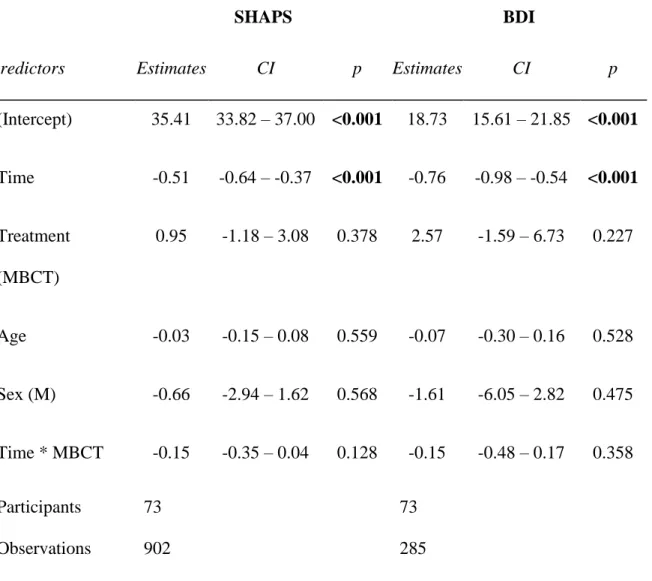
The ICC for SHAPS indicated 56% of the variability in anhedonia severity was attributed to between-person differences across the entire sample. Stated otherwise, there was a correlation of 0.56 between SHAPS scores within-person, highlighting strong dependency in the data. Growth curve modeling procedures showed a significant linear effect of time indicating SHAPS decreased about .57 points every week of therapy across the sample (p<.001). A small positive quadratic term was trending towards significance (p=.08) suggesting faster decreases in SHAPS earlier in therapy, but this effect did not significantly improve model fit (χ² (1) = 3.06, p=.08) and was not retained. Model comparison favored incorporating random slopes (χ² (2) = 243.7, p<.001) indicating the presence of variability in participant change in SHAPS over time. An autoregressive error structure also improved model fit (χ² (1) = 41.7, p<.001) demonstrating that observations closer in time were more similar. There was a weak negative correlation between the effects of random intercepts and random slopes (r=-.09) such that participants with higher baseline SHAPS tended to improve slightly more quickly over time. Incorporating participant level predictors in the model showed no effect of age, sex, treatment, or a cross-level interaction between treatment and time. In other words, there were no differences between MBCT and BATA in baseline anhedonia severity or in symptom change over time, with both groups significantly improving.
therapy (p<.001). There was no significant quadratic effect of time. There was significant variability in the change of BDI over time evinced by superior model fit with random slopes (χ² (2) = 20.1, p<.001). Incorporating serial correlations in the error structure did not improve the unconditional growth curve. A weak negative correlation between random effects for intercepts and slopes (r=-.09) indicated slightly greater rates of decrease for participants with higher baseline depressive severity. Age, sex, treatment and the cross-level interaction between
Table 3. Fixed effects estimates for full conditional growth curve models of clinical outcomes
SHAPS BDI
Predictors Estimates CI p Estimates CI p
(Intercept) 35.41 33.82 – 37.00 <0.001 18.73 15.61 – 21.85 <0.001
Time -0.51 -0.64 – -0.37 <0.001 -0.76 -0.98 – -0.54 <0.001
Treatment (MBCT)
0.95 -1.18 – 3.08 0.378 2.57 -1.59 – 6.73 0.227
Age -0.03 -0.15 – 0.08 0.559 -0.07 -0.30 – 0.16 0.528
Sex (M) -0.66 -2.94 – 1.62 0.568 -1.61 -6.05 – 2.82 0.475
Time * MBCT -0.15 -0.35 – 0.04 0.128 -0.15 -0.48 – 0.17 0.358
Participants Observations
73 902
73 285
Motion During fMRI
A total of 7 participant scans (across all time points) were excluded from analyses for excessive motion (> 20% of volumes censored), including 3 baseline scans, 2 scans at week 8, and 2 scans at week 12. Overall motion of the remaining sample was low, with a mean
framewise displacement of 0.15 (SD = 0.05) across participant timepoints. The mean number of discarded volumes per scan was 20.3 (SD = 17.3) out of 480, or about 4%.
Planned Analyses Aim 1
Estimating DMN Connectivity
The DMN showed strong positive connectivity at baseline across the sample with a mean connectivity across all six edges of .55 (SD=.16) z-scores. Strongest connectivity was evinced between the left and right lateral parietal cortices, z=.76 (SD=.21), while weakest connectivity was between the medial prefrontal cortex and left lateral parietal cortex, z=.36 (SD=.28).
Average connectivity from partial correlation analyses was expectedly much weaker with a mean of .12 (SD=.01) z-scores.
Evaluating Baseline ROI-to-ROI Connectivity as Predictors of Treatment Response
Planned Analyses Aim 2
Evaluating Mid-treatment Changes in ROI-to-ROI Connectivity as Predictors of
Treatment Response
There were no significant treatment-by-connectivity interactions predicting either SHAPS or BDI improvement (all p’s >.05). There were no significant main effects of connectivity using
partial correlations (all p’s >.05).
Using bivariate correlations, a main effect of connectivity change on SHAPS
improvement was detected with all three edges in the DMN emanating from the PCC (MPFC
Changes in Connectivity Between the Posterior Cingulate Cortex & Cortical Default Mode Network Targets Relate to Anhedonia Improvement
SH
A
PS
Im
p
ro
ve
m
e
n
t
Mid-treatment Change in Connectivity with the Posterior Cingulate Cortex
(A)
(B) (C)
(B) (A)
(C)
Notably, only the effect of PCC-RLPC connectivity remained significant after FDR adjustment for 48 tests (pFDR<.001). One outlier was removed from the model due excessive leverage (i.e., Cook’s distance > 4 times the mean). The final model was significant and explained 50% of the variance in SHAPS improvement (adjusted R2=.50, F(6,27)=6.504,
p=.018). For a given increase in PCC-RLPC connectivity by one tenth of a z-score, SHAPS scores were predicted to improve by a total of 2.1 points. Baseline SHAPS (β=.48, p=.01) and the main effect of treatment (β=3.81, p=.01) were also significant indicating that in this subset of participants, greater baseline anhedonia was associated with greater improvement and that MBCT improved anhedonia more than BATA did.
Planned Analyses Aim 3
Calculating Graph-Theory Metrics of Connectivity
A Fisher r-to-z transformed correlation coefficient of .35 was identified as maximizing the Small-Worldness properties of the whole brain network for the full baseline sample and was selected to compute adjacency matrices across all timepoints.
Evaluating Graph-Theory Predictors of Treatment Response
Post-hoc Analyses: Probing Moderation and Mechanistic Effects of DMN Connectivity with Multilevel Modeling
Time and Treatment Effects on PCC-RLPC Connectivity
Baseline PCC-RLPC Connectivity as a Moderator of Treatment Response
Optimal parameters from the unconditional growth curves for SHAPS scores were retained (i.e., random slopes plus random intercepts for time, autoregressive error structure) while testing a three-way interaction between treatment x baseline connectivity x time. This interaction term was not significant, indicating baseline PCC-RLPC connectivity did not moderate treatment response.
Time-Varying PCC-RLPC Connectivity as a Mechanism of SHAPS Improvement
CHAPTER 4: DISCUSSION
The goal of this study was to evaluate DMN resting state functional connectivity as both a predictor and a mechanism of treatment response to an MBI in a clinically-defined
transdiagnostic anhedonic sample. MBCT was compared against BATA, a novel psychosocial intervention for anhedonia, on self-reported symptoms of anhedonia and depression using the SHAPS and BDI. Multiple regression was used to predict change scores in symptoms from baseline and mid-treatment changes in DMN connectivity and multilevel modeling queried candidate biomarkers further.
DMN Connectivity as a Predictor of Treatment Response
Overall, this investigation found no evidence to suggest DMN connectivity serves as a predictor of treatment response to MBI in the context of anhedonia. Baseline connectivity values between key ROIs in the DMN were unrelated to symptomatic improvement in response to MBCT or across both treatment groups. Multilevel model analyses also failed to show a moderation effect of baseline connectivity on treatment effects over time. These findings stand contrary to hypotheses that individuals with stronger DMN connectivity would show greater benefit from MBCT due to the psychological mechanisms entailed in mindfulness practice (i.e., present-moment awareness & non-judgmental acceptance) targeting those connections. There have been no other studies to identify unique fMRI predictors to MBI for anhedonia.
treatment. Treatment non-responders showed lower baseline connectivity compared to controls which remained unperturbed over the course of treatment. Other recent studies have also
reported hypoconnectivity in the DMN among first episode drug-naïve patients (Shi et al., 2020) and patients with recurrent MDD (Yan et al., 2019). These findings challenge the notion that DMN hyperconnectivity operates as a trait-like characteristic in MDD. Future research should employ multiple analytic techniques (i.e., data drive and atlas-based connectivity) within the same sample to better characterize these patterns.
DMN Connectivity as a Mechanism of Treatment Response
While the relations between increases in PCC – RLPC connectivity and greater SHAPS improvement remained significant after FDR correction for multiple comparison, there are several reasons to caution against over-interpreting these results. The magnitude of the effect was relatively small, with a tenth of a z-score increase in connectivity associated with a total 2.1-point improvement in SHAPS. More importantly, this finding was detected in a subset of the data including 35 subjects. When multilevel models were used to investigate PCC – RLPC connectivity across all participant timepoints a mechanistic effect of connectivity on SHAPS scores was not observed. Neither changes within-person, nor between-person in PCC – RLPC connectivity were associated with changes in SHAPS, indicating connectivity didn’t track symptom improvement. It is possible a model including lagged effects would be more
appropriate to probe treatment mechanisms such that previous timepoint connectivity predicts subsequent SHAPS, and this remains to be explored.
Treatment Effects on DMN Connectivity
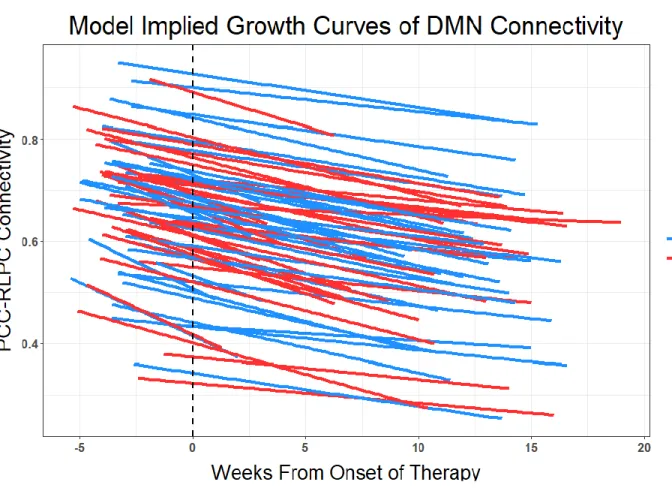
PCC – RLPC connectivity was also investigated with respect to change over time
connectivity are due to overlapping psychological mechanisms between BATA and MBCT. As previously mentioned, eastern philosophies promote meditation as a means towards personal transformation and value-clarification. It would be interesting to examine whether participants who most benefitted from MBCT also engaged in more value-congruent behavior as is
encouraged in BATA.
The attenuation of DMN connectivity observed is consistent with previous research in MDD samples using non-psychosocial interventions. Serotonin norepinephrine reuptake inhibitors (Posner et al., 2013) and transcranial magnetic stimulation (Liston et al., 2014) have both been shown to reduce hyperconnectivity within the DMN. Although MDD and anhedonia are closely related, it is notable that biomarkers occasionally differ between samples defined on the basis of DSM diagnosis and dimensional symptom severity. As an example, depressed patients show a tendency to increase discounting of large future rewards (i.e., preference for immediate rewards (Pulcu et al., 2014), while a sample defined by elevated SHAPS showed a reduced delay discounting effect (Lempert & Pizzagalli, 2010). In schizophrenia studies, increased connectivity between the PCC and MPFC (Zong et al., 2019), and the PCC and left lingual gyrus (Duan et al., 2020) has been observed following risperidone treatment, but these increases were associated with improvement in positive symptoms of psychosis and not negative symptoms such as anhedonia.
Limitations
improved with antidepressants and those who did not. A similar effect may be obscured within our sample. Secondly, the DMN was defined with respect to an atlas using only cortical nodes while anhedonia is known to have significant subcortical contributions. This decision was motivated in part by the relatively few numbers of connections to query with an ROI-to-ROI approach (decreasing the number of statistical comparisons and thus the probability of a Type I error) and evidence suggesting cortical connections are more reliable than subcortical ones (Noble et al., 2017). Additionally, if anhedonia reconfigures the DMN dramatically enough, it may be possible that essential nodes were omitted from this analysis (i.e., perhaps the anterior cingulate is strongly connected to the DMN in our sample). Using a data-driven approach such as ICA to define the DMN may be more appropriate for future investigations.
Finally, and most importantly, the total amount of resting-state date available is likely inadequate to explore individual differences in psychological constructs and treatment effects. Research shows the test-retest reliability of one 8-minute session of resting-state data is
exceptionally poor (Noble et al., 2017). Fair reliability may be achieved with a minimum of 24 minutes, but over the course of four separate sessions. While the overall design of the trial has many strengths, null findings for these hypotheses must be considered in light of these
constraints. Future Directions
used to define resting state connectivity (i.e., data-driven and atlas-based approaches) within the same sample and task-based connectivity may be especially useful to probing anhedonia with respect to the triple network model during reward processing tasks.
Poor reliability of resting state connectivity measures remain a challenge for clinical trials in psychiatry. While recent efforts have pushed for increasingly larger sample sizes, an
REFERENCES
Achard, S., & Bullmore, E. (2007). Efficiency and cost of economical brain functional networks.
PLoS Comput Biol, 3(2), e17. https://doi.org/10.1371/journal.pcbi.0030017
Alexopoulos, G. S., Hoptman, M. J., Kanellopoulos, D., Murphy, C. F., Lim, K. O., & Gunning, F. M. (2012). Functional connectivity in the cognitive control network and the default mode network in late-life depression. J Affect Disord, 139(1), 56-65.
https://doi.org/10.1016/j.jad.2011.12.002
Bauer, C. C. C., Whitfield-Gabrieli, S., Diaz, J. L., Pasaye, E. H., & Barrios, F. A. (2019). From State-to-Trait Meditation: Reconfiguration of Central Executive and Default Mode Networks. eNeuro, 6(6). https://doi.org/10.1523/ENEURO.0335-18.2019
Beck, A. T., & Steer, R. A. (1984). Internal consistencies of the original and revised Beck Depression Inventory. J Clin Psychol, 40(6), 1365-1367. https://doi.org/10.1002/1097-4679(198411)40:6<1365::aid-jclp2270400615>3.0.co;2-d
Behzadi, Y., Restom, K., Liau, J., & Liu, T. T. (2007). A component based noise correction method (CompCor) for BOLD and perfusion based fMRI. Neuroimage, 37(1), 90-101. https://doi.org/10.1016/j.neuroimage.2007.04.042
Benjamini, Y., & Hochberg, Y. (1995). Controlling the False Discovery Rate: A Practical and Powerful Approach to Multiple Testing. Journal of the Royal Statistical Society. Series B (Methodological), 57(1), 289-300. www.jstor.org/stable/2346101
Berman, M. G., Peltier, S., Nee, D. E., Kross, E., Deldin, P. J., & Jonides, J. (2011). Depression, rumination and the default network. Soc Cogn Affect Neurosci, 6(5), 548-555.
https://doi.org/10.1093/scan/nsq080
Brewer, J. A., Worhunsky, P. D., Gray, J. R., Tang, Y. Y., Weber, J., & Kober, H. (2011).
Meditation experience is associated with differences in default mode network activity and connectivity. Proc Natl Acad Sci U S A, 108(50), 20254-20259.
https://doi.org/10.1073/pnas.1112029108
Buckner, R. L., Andrews-Hanna, J. R., & Schacter, D. L. (2008). The brain's default network: anatomy, function, and relevance to disease. Ann N Y Acad Sci, 1124, 1-38.
https://doi.org/10.1196/annals.1440.011
Christoff, K., Gordon, A. M., Smallwood, J., Smith, R., & Schooler, J. W. (2009). Experience sampling during fMRI reveals default network and executive system contributions to mind wandering. Proc Natl Acad Sci U S A, 106(21), 8719-8724.
Curran, P. J., & Bauer, D. J. (2011). The disaggregation of within-person and between-person effects in longitudinal models of change. Annu Rev Psychol, 62, 583-619.
https://doi.org/10.1146/annurev.psych.093008.100356
Cuthbert, B. N., & Kozak, M. J. (2013). Constructing constructs for psychopathology: the NIMH research domain criteria. J Abnorm Psychol, 122(3), 928-937.
https://doi.org/10.1037/a0034028
Daselaar, S. M., Prince, S. E., & Cabeza, R. (2004). When less means more: deactivations during encoding that predict subsequent memory. Neuroimage, 23(3), 921-927.
https://doi.org/10.1016/j.neuroimage.2004.07.031
De Vico Fallani, F., Richiardi, J., Chavez, M., & Achard, S. (2014). Graph analysis of functional brain networks: practical issues in translational neuroscience. Philos Trans R Soc Lond B Biol Sci, 369(1653). https://doi.org/10.1098/rstb.2013.0521
Duan, X., Hu, M., Huang, X., Dong, X., Zong, X., He, C., Xiao, J., Tang, J., Chen, X., & Chen, H. (2020). Effects of risperidone monotherapy on the default-mode network in
antipsychotic-naive first-episode schizophrenia: Posteromedial cortex heterogeneity and relationship with the symptom improvements. Schizophr Res.
https://doi.org/10.1016/j.schres.2020.01.001
Felger, J. C. (2017). The Role of Dopamine in Inflammation-Associated Depression: Mechanisms and Therapeutic Implications. Curr Top Behav Neurosci, 31, 199-219. https://doi.org/10.1007/7854_2016_13
Franken, I. H., Rassin, E., & Muris, P. (2007). The assessment of anhedonia in clinical and non-clinical populations: further validation of the Snaith-Hamilton Pleasure Scale (SHAPS). J Affect Disord, 99(1-3), 83-89. https://doi.org/10.1016/j.jad.2006.08.020
Garrison, K. A., Zeffiro, T. A., Scheinost, D., Constable, R. T., & Brewer, J. A. (2015).
Meditation leads to reduced default mode network activity beyond an active task. Cogn Affect Behav Neurosci, 15(3), 712-720. https://doi.org/10.3758/s13415-015-0358-3 Hallquist, M. N., & Hillary, F. G. (2019). Graph theory approaches to functional network
organization in brain disorders: A critique for a brave new small-world. Netw Neurosci, 3(1), 1-26. https://doi.org/10.1162/netn_a_00054
Jang, J. H., Jung, W. H., Kang, D. H., Byun, M. S., Kwon, S. J., Choi, C. H., & Kwon, J. S. (2011). Increased default mode network connectivity associated with meditation.
Neurosci Lett, 487(3), 358-362. https://doi.org/10.1016/j.neulet.2010.10.056 Johnson, M. K., Nolen-Hoeksema, S., Mitchell, K. J., & Levin, Y. (2009). Medial cortex
Johnson, S. C., Baxter, L. C., Wilder, L. S., Pipe, J. G., Heiserman, J. E., & Prigatano, G. P. (2002). Neural correlates of self-reflection. Brain, 125(Pt 8), 1808-1814.
https://doi.org/10.1093/brain/awf181
Johnson, S. L., Joormann, J., & Gotlib, I. H. (2007). Does processing of emotional stimuli predict symptomatic improvement and diagnostic recovery from major depression?
Emotion, 7(1), 201-206. https://doi.org/10.1037/1528-3542.7.1.201
Kabat-Zinn, J. (2005). Bringing mindfulness to medicine: an interview with Jon Kabat-Zinn, PhD. Interview by Karolyn Gazella. Adv Mind Body Med, 21(2), 22-27.
https://www.ncbi.nlm.nih.gov/pubmed/16170903
Kelley, W. M., Macrae, C. N., Wyland, C. L., Caglar, S., Inati, S., & Heatherton, T. F. (2002). Finding the self? An event-related fMRI study. J Cogn Neurosci, 14(5), 785-794. https://doi.org/10.1162/08989290260138672
Keren, H., O'Callaghan, G., Vidal-Ribas, P., Buzzell, G. A., Brotman, M. A., Leibenluft, E., Pan, P. M., Meffert, L., Kaiser, A., Wolke, S., Pine, D. S., & Stringaris, A. (2018). Reward Processing in Depression: A Conceptual and Meta-Analytic Review Across fMRI and EEG Studies. Am J Psychiatry, 175(11), 1111-1120.
https://doi.org/10.1176/appi.ajp.2018.17101124
Kleckner, I. R., Zhang, J., Touroutoglou, A., Chanes, L., Xia, C., Simmons, W. K., Quigley, K. S., Dickerson, B. C., & Barrett, L. F. (2017). Evidence for a Large-Scale Brain System Supporting Allostasis and Interoception in Humans. Nat Hum Behav, 1.
https://doi.org/10.1038/s41562-017-0069
Korgaonkar, M. S., Goldstein-Piekarski, A. N., Fornito, A., & Williams, L. M. (2019). Intrinsic connectomes are a predictive biomarker of remission in major depressive disorder. Mol Psychiatry. https://doi.org/10.1038/s41380-019-0574-2
Kuyken, W., Warren, F. C., Taylor, R. S., Whalley, B., Crane, C., Bondolfi, G., Hayes, R., Huijbers, M., Ma, H., Schweizer, S., Segal, Z., Speckens, A., Teasdale, J. D., Van Heeringen, K., Williams, M., Byford, S., Byng, R., & Dalgleish, T. (2016). Efficacy of Mindfulness-Based Cognitive Therapy in Prevention of Depressive Relapse: An
Individual Patient Data Meta-analysis From Randomized Trials. JAMA Psychiatry, 73(6), 565-574. https://doi.org/10.1001/jamapsychiatry.2016.0076
Lempert, K. M., & Pizzagalli, D. A. (2010). Delay discounting and future-directed thinking in anhedonic individuals. J Behav Ther Exp Psychiatry, 41(3), 258-264.
https://doi.org/10.1016/j.jbtep.2010.02.003
Li, R., Zhang, S., Yin, S., Ren, W., He, R., & Li, J. (2018). The fronto-insular cortex causally mediates the default-mode and central-executive networks to contribute to individual cognitive performance in healthy elderly. Hum Brain Mapp, 39(11), 4302-4311. https://doi.org/10.1002/hbm.24247
Liston, C., Chen, A. C., Zebley, B. D., Drysdale, A. T., Gordon, R., Leuchter, B., Voss, H. U., Casey, B. J., Etkin, A., & Dubin, M. J. (2014). Default mode network mechanisms of transcranial magnetic stimulation in depression. Biol Psychiatry, 76(7), 517-526. https://doi.org/10.1016/j.biopsych.2014.01.023
MacKenzie, M. B., & Kocovski, N. L. (2016). Mindfulness-based cognitive therapy for depression: trends and developments. Psychol Res Behav Manag, 9, 125-132. https://doi.org/10.2147/PRBM.S63949
McKiernan, K. A., Kaufman, J. N., Kucera-Thompson, J., & Binder, J. R. (2003). A parametric manipulation of factors affecting task-induced deactivation in functional neuroimaging. J Cogn Neurosci, 15(3), 394-408. https://doi.org/10.1162/089892903321593117
Mulders, P. C., van Eijndhoven, P. F., Schene, A. H., Beckmann, C. F., & Tendolkar, I. (2015). Resting-state functional connectivity in major depressive disorder: A review. Neurosci Biobehav Rev, 56, 330-344. https://doi.org/10.1016/j.neubiorev.2015.07.014
Noble, S., Spann, M. N., Tokoglu, F., Shen, X., Constable, R. T., & Scheinost, D. (2017). Influences on the Test-Retest Reliability of Functional Connectivity MRI and its Relationship with Behavioral Utility. Cereb Cortex, 27(11), 5415-5429.
https://doi.org/10.1093/cercor/bhx230
Peters, A. T., Burkhouse, K., Feldhaus, C. C., Langenecker, S. A., & Jacobs, R. H. (2016). Aberrant resting-state functional connectivity in limbic and cognitive control networks relates to depressive rumination and mindfulness: A pilot study among adolescents with a history of depression. J Affect Disord, 200, 178-181.
https://doi.org/10.1016/j.jad.2016.03.059
Pigott, H. E. (2015). The STAR*D Trial: It Is Time to Reexamine the Clinical Beliefs That Guide the Treatment of Major Depression. Can J Psychiatry, 60(1), 9-13.
https://doi.org/10.1177/070674371506000104
Pizzagalli, D. A. (2014). Depression, stress, and anhedonia: toward a synthesis and integrated model. Annu Rev Clin Psychol, 10, 393-423. https://doi.org/10.1146/annurev-clinpsy-050212-185606
Posner, J., Hellerstein, D. J., Gat, I., Mechling, A., Klahr, K., Wang, Z., McGrath, P. J., Stewart, J. W., & Peterson, B. S. (2013). Antidepressants normalize the default mode network in patients with dysthymia. JAMA Psychiatry, 70(4), 373-382.
Pulcu, E., Trotter, P. D., Thomas, E. J., McFarquhar, M., Juhasz, G., Sahakian, B. J., Deakin, J. F., Zahn, R., Anderson, I. M., & Elliott, R. (2014). Temporal discounting in major depressive disorder. Psychol Med, 44(9), 1825-1834.
https://doi.org/10.1017/S0033291713002584
Raichle, M. E. (2015). The brain's default mode network. Annu Rev Neurosci, 38, 433-447. https://doi.org/10.1146/annurev-neuro-071013-014030
Ramirez-Barrantes, R., Arancibia, M., Stojanova, J., Aspe-Sanchez, M., Cordova, C., & Henriquez-Ch, R. A. (2019). Default Mode Network, Meditation, and Age-Associated Brain Changes: What Can We Learn from the Impact of Mental Training on Well-Being as a Psychotherapeutic Approach? Neural Plast, 2019, 7067592.
https://doi.org/10.1155/2019/7067592
Rush, A. J., Trivedi, M. H., Wisniewski, S. R., Nierenberg, A. A., Stewart, J. W., Warden, D., Niederehe, G., Thase, M. E., Lavori, P. W., Lebowitz, B. D., McGrath, P. J., Rosenbaum, J. F., Sackeim, H. A., Kupfer, D. J., Luther, J., & Fava, M. (2006). Acute and longer-term outcomes in depressed outpatients requiring one or several treatment steps: a STAR*D report. Am J Psychiatry, 163(11), 1905-1917.
https://doi.org/10.1176/ajp.2006.163.11.1905
Rzepa, E., & McCabe, C. (2018). Anhedonia and depression severity dissociated by dmPFC resting-state functional connectivity in adolescents. J Psychopharmacol, 32(10), 1067-1074. https://doi.org/10.1177/0269881118799935
Schneier, F. R., Slifstein, M., Whitton, A. E., Pizzagalli, D. A., Reinen, J., McGrath, P. J.,
Iosifescu, D. V., & Abi-Dargham, A. (2018). Dopamine Release in Antidepressant-Naive Major Depressive Disorder: A Multimodal [(11)C]-(+)-PHNO Positron Emission
Tomography and Functional Magnetic Resonance Imaging Study. Biol Psychiatry, 84(8), 563-573. https://doi.org/10.1016/j.biopsych.2018.05.014
Schwartz, J. E., & Stone, A. A. (1998). Strategies for analyzing ecological momentary
assessment data. Health Psychol, 17(1), 6-16. https://doi.org/10.1037//0278-6133.17.1.6 Sharma, A., Wolf, D. H., Ciric, R., Kable, J. W., Moore, T. M., Vandekar, S. N., Katchmar, N.,
Daldal, A., Ruparel, K., Davatzikos, C., Elliott, M. A., Calkins, M. E., Shinohara, R. T., Bassett, D. S., & Satterthwaite, T. D. (2017). Common Dimensional Reward Deficits Across Mood and Psychotic Disorders: A Connectome-Wide Association Study. Am J Psychiatry, 174(7), 657-666. https://doi.org/10.1176/appi.ajp.2016.16070774
Shi, Y., Li, J., Feng, Z., Xie, H., Duan, J., Chen, F., & Yang, H. (2020). Abnormal functional connectivity strength in first-episode, drug-naive adult patients with major depressive disorder. Prog Neuropsychopharmacol Biol Psychiatry, 97, 109759.
https://doi.org/10.1016/j.pnpbp.2019.109759
Shulman, G. L., Fiez, J. A., Corbetta, M., Buckner, R. L., Miezin, F. M., Raichle, M. E., & Petersen, S. E. (1997). Common Blood Flow Changes across Visual Tasks: II. Decreases in Cerebral Cortex. J Cogn Neurosci, 9(5), 648-663.
https://doi.org/10.1162/jocn.1997.9.5.648
Simon, R., & Engstrom, M. (2015). The default mode network as a biomarker for monitoring the therapeutic effects of meditation. Front Psychol, 6, 776.
https://doi.org/10.3389/fpsyg.2015.00776
Snaith, R. P., Hamilton, M., Morley, S., Humayan, A., Hargreaves, D., & Trigwell, P. (1995). A scale for the assessment of hedonic tone the Snaith-Hamilton Pleasure Scale. Br J Psychiatry, 167(1), 99-103. https://doi.org/10.1192/bjp.167.1.99
Strauss, C., Cavanagh, K., Oliver, A., & Pettman, D. (2014). Mindfulness-based interventions for people diagnosed with a current episode of an anxiety or depressive disorder: a meta-analysis of randomised controlled trials. PLoS One, 9(4), e96110.
https://doi.org/10.1371/journal.pone.0096110
Taylor, V. A., Daneault, V., Grant, J., Scavone, G., Breton, E., Roffe-Vidal, S., Courtemanche, J., Lavarenne, A. S., Marrelec, G., Benali, H., & Beauregard, M. (2013). Impact of meditation training on the default mode network during a restful state. Soc Cogn Affect Neurosci, 8(1), 4-14. https://doi.org/10.1093/scan/nsr087
van Tol, M. J., Li, M., Metzger, C. D., Hailla, N., Horn, D. I., Li, W., Heinze, H. J., Bogerts, B., Steiner, J., He, H., & Walter, M. (2014). Local cortical thinning links to resting-state disconnectivity in major depressive disorder. Psychol Med, 44(10), 2053-2065. https://doi.org/10.1017/S0033291713002742
Vignaud, P., Donde, C., Sadki, T., Poulet, E., & Brunelin, J. (2018). Neural effects of
mindfulness-based interventions on patients with major depressive disorder: A systematic review. Neurosci Biobehav Rev, 88, 98-105.
https://doi.org/10.1016/j.neubiorev.2018.03.004
Wahbeh, H., Lane, J. B., Goodrich, E., Miller, M., & Oken, B. S. (2014). One-on-one
Mindfulness Meditation Trainings in a Research Setting. Mindfulness (N Y), 5(1), 88-99. https://doi.org/10.1007/s12671-012-0155-9
Wang, X., Ongur, D., Auerbach, R. P., & Yao, S. (2016). Cognitive Vulnerability to Major Depression: View from the Intrinsic Network and Cross-network Interactions. Harv Rev Psychiatry, 24(3), 188-201. https://doi.org/10.1097/HRP.0000000000000081
Whitfield-Gabrieli, S., & Ford, J. M. (2012). Default mode network activity and connectivity in psychopathology. Annu Rev Clin Psychol, 8, 49-76. https://doi.org/10.1146/annurev-clinpsy-032511-143049
Whitfield-Gabrieli, S., Moran, J. M., Nieto-Castanon, A., Triantafyllou, C., Saxe, R., & Gabrieli, J. D. (2011). Associations and dissociations between default and self-reference networks in the human brain. Neuroimage, 55(1), 225-232.
https://doi.org/10.1016/j.neuroimage.2010.11.048
Whitfield-Gabrieli, S., & Nieto-Castanon, A. (2012). Conn: a functional connectivity toolbox for correlated and anticorrelated brain networks. Brain Connect, 2(3), 125-141.
https://doi.org/10.1089/brain.2012.0073
Wolf, D. H. (2006). Anhedonia in schizophrenia. Curr Psychiatry Rep, 8(4), 322-328. https://doi.org/10.1007/s11920-006-0069-0
Yan, C. G., Chen, X., Li, L., Castellanos, F. X., Bai, T. J., Bo, Q. J., Cao, J., Chen, G. M., Chen, N. X., Chen, W., Cheng, C., Cheng, Y. Q., Cui, X. L., Duan, J., Fang, Y. R., Gong, Q. Y., Guo, W. B., Hou, Z. H., Hu, L., Kuang, L., Li, F., Li, K. M., Li, T., Liu, Y. S., Liu, Z. N., Long, Y. C., Luo, Q. H., Meng, H. Q., Peng, D. H., Qiu, H. T., Qiu, J., Shen, Y. D., Shi, Y. S., Wang, C. Y., Wang, F., Wang, K., Wang, L., Wang, X., Wang, Y., Wu, X. P., Wu, X. R., Xie, C. M., Xie, G. R., Xie, H. Y., Xie, P., Xu, X. F., Yang, H., Yang, J., Yao, J. S., Yao, S. Q., Yin, Y. Y., Yuan, Y. G., Zhang, A. X., Zhang, H., Zhang, K. R., Zhang, L., Zhang, Z. J., Zhou, R. B., Zhou, Y. T., Zhu, J. J., Zou, C. J., Si, T. M., Zuo, X. N., Zhao, J. P., & Zang, Y. F. (2019). Reduced default mode network functional connectivity in patients with recurrent major depressive disorder. Proc Natl Acad Sci U S A, 116(18), 9078-9083. https://doi.org/10.1073/pnas.1900390116
Yang, C. C., Barros-Loscertales, A., Pinazo, D., Ventura-Campos, N., Borchardt, V.,
Bustamante, J. C., Rodriguez-Pujadas, A., Fuentes-Claramonte, P., Balaguer, R., Avila, C., & Walter, M. (2016). State and Training Effects of Mindfulness Meditation on Brain Networks Reflect Neuronal Mechanisms of Its Antidepressant Effect. Neural Plast, 2016, 9504642. https://doi.org/10.1155/2016/9504642
Zhao, X. R., Chen, Z. F., Kang, C. Y., Liu, R. X., Bai, J. Y., Cao, Y. P., Cheng, Y. Q., Xu, X. F., & Zhang, Y. L. (2019). Mindfulness-based cognitive therapy is associated with distinct resting-state neural patterns in patients with generalized anxiety disorder. Asia Pac Psychiatry, 11(4), e12368. https://doi.org/10.1111/appy.12368
Zhu, X., Wang, X., Xiao, J., Liao, J., Zhong, M., Wang, W., & Yao, S. (2012). Evidence of a dissociation pattern in resting-state default mode network connectivity in first-episode, treatment-naive major depression patients. Biol Psychiatry, 71(7), 611-617.
https://doi.org/10.1016/j.biopsych.2011.10.035