Organic or Inorganic??
Formula Organic or Inorganic?
CaCO3(s) Inorganic (carbonate ion)
C25H52(s) Organic
Ca2C(s) Inorganic (carbide ion)
CCl4(l) Organic
CH3COOH(l) Organic
CO2(g) Inorganic (oxide)
KCN(s) Inorganic (cyanide)
Four Types of Formulas
1.
Molecular Formulas C
5H
10(g)Not very useful for organic
compounds because so many
isomers can exist
2.
Structural Formulas
3.
Condensed Structural Formulas
4.
Line Diagrams
–
end of line segment represents carbonNaming Organic Compounds
• AliphaKc Hydrocarbons – contains only hydrogen and carbon
atoms
– Straight line chains of carbon atoms
– Alicyclic hydrocarbons have carbon atoms forming a closed ring. SKll
considered aliphaKc
Alkanes Alkenes Alkynes
Only single C‐C
bonds Double C‐C Bond present Triple C‐C bond present
General formula
CnH2n+2 General formula: CnH2n General formula: CnH2n‐2
Summary of Naming Alkanes
1. Find the parent chain. Use the appropriate root and suffix.
2. Number the parent chain carbon atoms, starKng from the
end closest to the branch(es) so that the numbers are the lowest possible
3. IdenKfy any branches and their locaKon number on the
parent chain (us the suffix –yl for branches)
4. If more than one of the same branch exist, use a mulEplier
(di, tri) to show this. Remember to include all numbers
5. If different branches exist, name them in alphabeKcal order
6. Separate numbers from numbers using commas, and
CYCLOALKANES
• Based on evidence, chemists believe that organic carbon
compounds someKmes take the form of cyclic hydrocarbons:
• Cycloalkanes: Alkanes that form a closed ring
– General Formula CnH2n
• Two less hydrogens are present than in straight chain alkanes because the two ends of the molecule are joined
• Are these considered saturated?? Yes, because they have only single bonds and the max amount of hydrogen's bonded to the carbons
Naming Alkenes and Alkynes
1. Find the parent chain. It MUST contain the mulKple bond.
– If the bond is a double, the suffix for the parent chain will be ‐
ene
– If the bond is a triple, the suffix for the parent chain will be –yne
2. Count carbon atoms so that the mulEple bond will be on the
lowest possible number. Indicate the number that the mulKple bond falls on directly before the suffix
Naming Alkenes and Alkynes
4.
It is possible for a molecule to have more than one
double bond. These are called
alkadienes
and have
the same general formula as alkynes (C
nH
2n‐2)
–
If this is the case, indicate both numbers where the
double bond is formed, and change the suffix to
–diene
.
a) Draw buta‐1,3‐diene:
b) What is the IUPAC name for the following:
Structural Isomerism
•
Compound with the same molecular formula
but different structures
–
They will have different chemical and physical
•
What do we know about benzene?
–
Formula is C
6H
6(
3D link
)
–
UnreacKve – so
no true
double or triple bonds
–
Carbon‐carbon bonds are the same length and strength
–
Each carbon is bonded to a hydrogen
–
So what does benzene look like??
The three double bonds resonate resulKng in an overall bond length somewhere in between a single
and a double bond, explaining benzene’s stability
We will use this line structural formula to represent benzene in
Practice Naming Aromatics
•
Draw the line structural formula for 1‐ethyl‐3‐
methylbenzene
Practice Naming Organic Halides
•
Name the following:
CH
2Cl
21,2‐dibromoethene
Bonus: Try 1,2‐dibromo‐1,2‐dichloroethene
chlorobenzene
Carboxylic Acids
•
A
carboxyl
group is composed of a carbon atom double
bonded to an oxygen atom and bonded to a hydroxyl
group (‐COOH)
–
Note:
Because the carboxyl group involves three of thecarbon atom’s four bonds, the carboxyl is always at the end of a carbon chain or branch
methanoic acid
ethanoic acid
Examples:
Naming Carboxylic Acids
1.
Name the parent alkane
2.
Replace the –e at the end of the name of than parent
alkane with –oic acid
3.
The carbon atoms of the carboxyl group is always given
posiKon number 1. Name and number the branches
that are adached to the compound.
Draw 3‐methylbutanoic acid
HOOC
Remember COOH or HOOC can also represent the
Esters
•
The reacKon between a carboxylic acid and an alcohol produces
an ester molecule and a molecule of water
– This reacKon is known as a condensaEon or esterificaEon reacKon
– The ester funcKonal group –COO– is similar to that of a carboxylic
acid, except that the H atom of the carboxyl group has been replaced by a hydrocarbon branch.
– Esters are responsible for natural and arKficial fragrance and
Naming Esters
•
Name the following ester and the acid and alcohol from
which it can be prepared.
ethyl butanoate ethanol
butanoic acid
water
Tip: The branch attached to the oxygen (of the –COO) comes first in the name, the chain attached to the carbon (of the –COO) comes second
A strong acid catalyst, such as H2SO4(aq) is used along with some heating to increase the rate of the
Physical Properties of Simple Hydrocarbons
Alkanes Non‐polar molecules
Only intermolecular forces are London Force
Boiling point and melKng point increase with number of carbons
All insoluble in water (like dissolves like) – nonpolar and polar don’t mix 1‐4Cs = gas, 5‐16Cs = liquid 17 and up = solid at SATP
Alkenes Non‐polar molecules, therefore insoluble in water
Boiling points slightly lower than alkanes with the same number of carbons due to less electrons (unsaturated), resulKng in lower London Forces
Alkynes Non‐polar molecules, therefore insoluble in water
Higher boiling points than alkanes and alkenes with similar C #s
Accepted explanaKon: Linear structure around triple bond allows electrons to come closer together than in alkanes/enes, resulKng in greater London Force
Branching The more branching, the less significant the London Force (~lower b.p.)
‐ more surface area in straight chain hydrocarbons allows more separaKon of charge, resulKng in greater London Force
‐ see Table #3 pg. 378 (i.e. pentane (with 5Cs) has a b.p. of 36oC
which is much higher than dimethylpropane (5Cs) ‐12oC) = because
Physical Properties of Hydrocarbon Derivatives
Alcohols Much higher boiling points than hydrocarbons (1‐12Cs are liquids at SATP) due to hydrogen bonding between hydroxyl groups of adjacent molecules
Small alcohols are totally miscible in water, but the larger the hydrocarbon part of the alcohol (nonpolar part), the more nonpolar the alcohol is
Carboxylic
Acids Like alcohols they have hydrogen bonding, but is more significant due to the C=O. This means greater bps and solubility than alcohols with same number of Cs. Carboxylic acids with 1‐4Cs are completely miscible in water Esters Fruity odour in some cases Polar but they lack the –OH bond therefore do not have hydrogen bonding, so lower bps than both alcohols and carboxylic acids
Esters with few carbons are polar enough to be soluble in water
Compound Boiling Point (oC)
butane ‐0.5
butan‐1‐ol 117.2
Combustion Reactions
•
Burning of hydrocarbons in the presence of oxygen
– Complete CombusEon: abundant supply of oxygen; products
are carbon dioxide, water vapour and heat
• Ex. C3H8(l) + 5O2(g) 3CO2(g) + 4H2O(g)
– Incomplete CombusEon: limited supply of oxygen; products
are carbon monoxide, soot (pure carbon) or any combinaKon of carbon dioxide, carbon monoxide and soot in addiKon to water vapour and heat
• Ex. 2C8H18(l) + 17O2(g) 16CO(g) + 18H2O(g)
• OR 2C8H18(l) + 9O2(g) 16C(s) + 18H2O(g)
1. AddiEon ReacEons: reacKon of alkenes and alkynes with hydrogen
gas, a halogen compound, or a hydrogen halide compound. – AddiKon reacKons usually occur in the presence of a catalyst
2.
SubsEtuEon
ReacKons – breaking of a C‐H bond in an alkane
or an aromaKc ring and replacing it with another atom or
group of atoms
– Usually occur slowly at room temperature, so light may be
necessary as a catalyst
– Oqen subsKtutes a halogen for a hydrogen
– No change in saturaKon
3. EliminaEon ReacKons – involves eliminaKng atoms or groups of atoms
from adjacent carbon atoms; decreases the level of saturaKon a) Alkane cracked into an alkene (uses high temperatures)
b) Alcohol is reacted with a catalyst to produce an alkene and water
(dehydra'on – removes a water molecule from the alcohol)
c) Alkyl halide reacts with a hydroxide ion (OH‐) to produce an alkene
•
AddiEon PolymerizaEon
always results in
one
product, the
polymer
•
Requires unsaturated hydrocarbon monomers and bond saturaKon
occurs when the polymer is made
Condensation Polymerization
• Monomers combine to form a polymer and a bi‐product.
Each Kme a bond forms between monomers, small molecules, such as water, ammonia, or HCl are “condensed” out.
• The polymerizaKon of nylon: •
For condensation polymerization to occur, monomers must be
bifunctional, meaning they have at least two functional groups.
Polyester
• When a carboxylic acid reacts with an alcohol in an esterificaKon
reacKon, a water molecule is eliminated and a single ester molecule is formed.
• This esterificaKon reacKon can be repeated so many esters are
joined in a long chain… a polyester
– This is created using a dicarboxylic acid (an acid with a carboxyl group
at each end) and a diol (an alcohol with a hydroxyl group at each end)
– The ester linkages are formed end to end between alternaKng acid
• A fracEonal disEllaEon tower
contains trays posiKoned at various levels.
• Heated crude oil enters near
the boWom of the tower.
• The bodom is kept hot, and
the temperature gradually decreases toward the top of the tower.
• As compounds cool to their
ReducEon – OxidaEon ReacEons “REDOX”
• Is a chemical reacKon in which electrons are transferred
• Must have both reducEon and oxidaEon happening for the reacKon to
occur
– REDUCTION – a process in which electrons are gained by an enKty – OXIDATION – a process in which electrons are lost by an enKty
– How can you remember this?
“LEO the lion says GER”
LEO = Losing Electrons = OxidaKon GER = Gaining Electrons = ReducKon
Other memory devices:
▫ Review: “LEO the lion says GER”
Loss of electrons = enKty being oxidized
Gain of electrons = enKty being reduced
BUT…. Chemists don’t say “the reactant being oxidized” or “the reactant being reduced”
Rather, they use the terms OXIDIZING AGENT (OA) and REDUCING AGENT (RA)
OXIDIZING AGENT: causes oxida'on by removing (gaining) electrons from another
substance in a redox reacKon
REDUCING AGENT: causes reduc'on by donaKng (losing) electrons to another
substance in a redox reacKon What does this mean? Let’s revisit our first example when zinc and hydrochloric acid reacted. Which reactant was reduced? Which was oxidized? So…. Which is the Oxidizing Agent (OA)? Which is the Reducing Agent (RA)
Redox Terms
Zn(s) Zn 2+
(aq) + 2 e- 2 H+
(aq) + 2 e- H2 (g)
Reducing Agent
Oxidizing Agent
LEO = Oxidized
• Check page 7 of your data booklet. Does our ranking order match up with theirs?
Au3+
(aq) + 3 e‐ Au(s)
Hg2+
(aq) + 2 e‐ Hg(s)
Ag+
(aq) + 1 e‐ Ag(s)
Cu2+
(aq) + 2 e‐ Cu(s)
Zn2+
(aq) + 2 e‐ Zn(s)
Mg2+
(aq) + 2 e‐ Mg(s)
▫ YES! Because of the spontaneity rule!
A reacEon will be spontaneous if on a redox table:
OA RA
above = Spontaneous below = Non‐spontaneous
RA ReacEon OA ReacEon
Building Redox Tables #1
SOA
Could copper pipe be used to transport a hydrochloric acid soluKon? 1. List all enKKes
2. IdenKfy all possible OA’s and RA’s
3. IdenKfy the SOA and SRA
4. Show ½ reacKons and balance
5. Predict spontaneity
Predicting Redox Reactions
Since the reacKon is nonspontaneous, it should be possible to use a copper pipe to
• Example #2
– Nickel metal is oxidized to Ni2+(aq) ions by an acidified potassium dichromate soluKon. If
2.50g of metal is oxidizes by 50.0 mL of soluKon, what is the concentraKon of the K2Cr2O7(aq) soluKon?
– List enKKes present, idenKfy SOA and SRA: Ni(s) H+(aq) K+(aq) Cr2O72‐(aq) H2O(l)
– Write oxidaKon and reducKon half reacKons. Balance the number of electrons gained and
lost and add the reacKons
3 [Ni(s) Ni2+
(aq) + 2e‐ ]
Cr2O72‐
(aq) + 14 H+(aq)+ 6 e‐ 2Cr3+(aq) + 7H2O(l) 3Ni(s) + Cr2O72‐
(aq) + 14 H+(aq) 3Ni2+(aq + 2Cr3+(aq) + 7H2O(l) 2.50 g 50.0mL
? mol/L
2.50 g x mol Ni(s) x 1 mol Cr2O72‐
(aq) x __1__= 0.284 mol/L Cr2O72‐(aq)
58.69 g 3 mol Ni(s) 0.0500L
Redox Stoichiometry
• Copper metal can be oxidized in a basic soluKon to form copper(I) oxide. What is the half‐
reacKon for this process? Cu(s) Cu2O(s)
1. Balance all atoms except H and O 2Cu(s) Cu2O(s)
2. Balance oxygen by adding water 2Cu(s) +H2O(l) Cu2O(s)
3. Balance hydrogen by adding H+(aq) 2Cu(s) +H2O(l) Cu2O(s) + 2H+(aq)
4. Balance charge by adding electrons 2Cu(s) +H2O(l) Cu2O(s) + 2H+(aq) + 2 e‐
Because the half reacKon is occurring in a basic soluKon,
5. Add OH‐(aq) to both sides to equal the number of H+(aq) present
2OH‐
(aq) + 2Cu(s) +H2O(l) Cu2O(s) + 2H+(aq) + 2 e‐ + 2OH‐(aq)
5. Combine H+(aq) and OH‐(aq) on the same side to form H2O(l). Cancel equal amounts of H2O(l) from both
sides 2OH‐
(aq) + 2Cu(s) +H2O(l) Cu2O(s) + 2H2O(l) + 2 e‐
2OH‐
(aq) + 2Cu(s) Cu2O(s) + H2O(l) + 2 e‐
Tip:
• The sum of the oxidaKon numbers for a neutral compound = 0
• The sum of the oxidaKon numbers for a polyatomic ion = ion charge
** This method only works if there is only one unknown aKer referring to the above table
• Example: When natural gas burns in a furnace, carbon dioxide and water form. IdenKfy oxidaKon
and reducKon in this reacKon.
– First write the chemical equaKon (as it is not provided)
– Determine all of the oxidaKon numbers
– Now look for the oxidaKon number of an atom/ion that increases as a result of the reacKon and label the
change as oxidaEon. There must also be an atom/ion whose oxidaKon number decreases. Label this change as reducEon.
Example: Chlorate ions and iodine react in an acidic soluKon to produce chloride ions and iodate ions. Balance the equaKon for this reacKons. ClO3‐
(aq) + I2(aq) Cl‐(aq) + IO3‐(aq)
1. Assign oxidaKon numbers to all atoms/ions and look for the numbers that change. Highlight these.
Remember to record the change in the number of electrons per atom and per molecule or polyatomic ion.
1. The next step is to determine the simplest whole numbers that will balance the number of electrons transferred for each
reactant. The numbers become the coefficients of the reactants. The coefficients for the products can be obtained by balancing the atoms whose oxidaKon numbers have changed and then any other atoms.
2. Although Cl and I atoms are balanced, oxygen is not. Add H2O(l) molecules to balance the O atoms.
3. Add H+(aq) to balance the hydrogen. The redox equaKon should now be completely balanced. Check your work by checking
the total numbers of each atom/ion on each side and checking the total electric charge, which should also be balanced.
• Example #2: Will a spontaneous reacKon occur as a result of an electron transfer from one copper(I) ion to another copper (I) ion?
Cu+
(aq) + 1 e‐ Cu(s)
Cu+
(aq) Cu2+(aq) + 1 e‐
2 Cu+
(aq) Cu2+(aq) + Cu(s)
– YES! Using the redox table and spontaneity rule, we see that copper(I) as an oxidizing
agent is above copper(I) as a reducing agent. Therefore, an aqueous soluKon of copper(I) ions will spontaneously, but slowly, disproporKonate into copper(II) ions and copper metal.
Disproportionation
Voltaic Cell Summary
• A voltaic cell consists of two‐half cells
separated by a porous boundary with solid electrodes connected by an external circuit
• SOA undergoes reducKon at the cathode (+ electrode) – cathode increases in mass
• SRA undergoes oxidaKon at the anode (‐ electrode) – anode decreases in mass
• Electrons always travel in the external circuit from anode to cathode
• Internally, caKons move toward the
Standard Cells and Cell PotenKals
A standard cell is a voltaic cell where each ½ cell contains all enKKes necessary at SATPcondiKons and all aqueous soluKons have a concentraKon of 1.0 mol/L
Standardizing makes comparisons and scienKfic study easier
Standard Cell PotenEal, E0 cell = the electric potenKal difference of the cell (voltage)
E0 cell = E0
r cathode – E0r anode
• Where E0
r is the standard reducKon potenKal, and is a measure of a standard ½
cell’s ability to adract electrons.
• The higher the E0
r , the stronger the OA
• All standard reducKon potenKals are based on the standard hydrogen ½ cell being 0.00V. This means that all standard reducKon potenKals that are posiKve are stronger OA’s than hydrogen ions and all standard reducKon potenKals that are negaKve are weaker.
• If the E0
cell is posiEve, the reacKon occurring is spontaneous.
Comparing Electrochemical Cells:
Voltaic and ElectrolyKc
Analyzing ElectrolyKc Cells #3
• Example: An electrolyKc cell is set up with a power supply connected to two nickel
electrodes immersed in an aqueous soluKon containing cadmium nitrate and zinc nitrate.
• Predict the equaKons for the iniKal reacKon at each electrode and the net cell reacKon.
The Chloride Anomaly (*****Diploma)
• Some redox reacKons predicted using the SOA and
SRA from a redox table do not always occur in an electrolyKc cell.
• The actual reducKon potenKal required for a
parKcular half‐reacKon and the reported half‐
reacKon reducKon potenKal may be quite different (depending on the condiKons or half‐reacKons)
– This difference is known as the half‐cell overvoltage.
• “As an empirical rule, you should recognize that
PracKce: Half‐Cell CalculaKons #1
• What is the mass of copper deposited at the cathode of a copper
electrorefining cell operated at 12.0 A for 40.0 min?
– Yes, we can solve for the number of moles, and then use the mole raKo
to convert from a chemical amount of one substance to another.
– The last step is to convert to the quanKty requested in the quesKon, in
this case the mass of the copper metal
PracKce: Half‐Cell CalculaKons #2
• Silver is deposited on objects in a silver electroplaKng cell. If 0.175 g of silver is to be deposited from a silver cyanide soluKon in a Kme of 10.0 min, predict the current required.
• Write the balanced equaKon for the half‐cell reacKon, list the measurements and conversion factors.
Energy from the Sun
• Stored energy in the chemical bonds of hydrocarbons
originated from the sun
Remember:
• Photosynthesis:
– Liquid H2O and CO2 gas glucose and O2(g)
• Hydrocarbon combusKon:
E
XOTHERMICE
NDOTHERMIC• A change in a chemical energy
where energy/heat EXITS the chemical system
• Results in a decrease in
chemical potenKal energy
• A change in chemical energy
where energy/heat ENTERS the chemical system
• Results in an increase in
chemical potenKal energy
An IntroducKon to EnergeKcs
Kinetic Energy (Ek) is related to the motion of an entity
Molecular motion can by translational (straight-line),
rotational and vibrational
Chemical Potential Energy (Ep) is energy stored in the
bonds of a substance and relative intermolecular forces
Thermal Energy is the total kinetic energy of all of the
particles of a system. Increases with temperature.
Symbol (Q), Units (J), Formula used (Q=mcΔT)
Temperature is a measure of the average kinetic energy
of the particles in a system
Heat is a transfer of thermal energy. Heat is not possessed by
Thermal Energy CalculaKons
Example: Determine the change in thermal energy when 115 mL
of water is heated from 19.6oC to 98.8oC?
The density of a dilute aqueous solution is the same as that of water; that is, 1.00g/mL or 1.00kg/L
c water = 4.19J/g °C or 4.19 kJ/kg °C or 4.19 kJ/L °C
MASS = DENSITY X VOLUME
Comparing Q’s
NegaKve Q value
– An exothermic change
– Heat is lost by the
system
– The temperature of the
surroundings increases and the temperature of the system decreases
– Example: Hot Pack
– QuesKon Tips: “How much
energy is released?”
PosiKve Q value
– An endothermic change
– Heat is gained by the
system
– The temperature of the
system increases and the temperature of the
surroundings decreases
– Example: Cold Pack
– QuesKon Tips: “What heat is
E
NTHALPY
C
HANGES
When 50 mL of 1.0 mol/L hydrochloric acid is neutralized completely by 75 mL of 1.0 mol/L sodium hydroxide in a polystyrene cup calorimeter, the temperature of the total solution changes from 20.2°C to 25.6°C. Determine the enthalpy change that occurs in the chemical system.
Based upon the evidence available, the enthalpy change for the neutralization of hydrochloric acid in this context is recorded as -2.83 kJ.
M
OLAR
E
NTHALPY
AND
C
ALORIMETRY
• Can we measure the molar enthalpy of reaction using calorimetry?
• Yes, but indirectly. We can measure a change in temperature, we can then calculate the change in thermal energy (Q=mct). Then, using the law of conservation of energy we
can infer the molar enthalpy.
• In doing so, we must assume that the change in enthalpy of the chemicals involved in a reaction is equal to the change in thermal energy of the surroundings.
From this equaKon, any one of the five
variables can be determined as an
C
OMMUNICATING
E
NTHALPY
• We will be learning how to communicate enthalpy changes in four ways:
1. By stating the molar enthalpy of a specific reactant in a reaction
2. By stating the enthalpy change for a balanced reaction equation
3. By including an energy value as a term in a balanced reaction equation
C
OMMUNICATING
E
NTHALPY
#3
3. By including an energy value as a term in a balanced reaction equation
• If a reaction is endothermic, it requires additional energy to react, so is listed along
with the reactants
• If a reaction is exothermic, energy is released as the reaction proceeds, and is listed
along with the products
• In order to specify the initial and final conditions for measuring the enthalpy change of
C
OMMUNICATING
E
NTHALPY
#4
During an exothermic reacKon, the enthalpy of the system decreases and heat flows into the
surroundings. We observe a temperature
increase in the surroundings.
During an endothermic reacKon, heat flows from the surroundings into the chemical system. We
Hess’ Law #4
• Example: What is the standard enthalpy of formation of butane? ΔfHm° = ???
• First, we need to be able to write this balanced formation equation.
4C(s) + 5H2(g) C4H10(g)
• The following values were determined by calorimetry:
• What will we need to do to get our net equation?
ΔfHm° = -125.6 kJ/1 mol = -125.6 kJ/mol
C4H10
‐ Reverse equaKon (1) and
change the ΔH sign
‐ MulKply equaKon (2) and
its ΔH by 4
‐ MulKply equaKon (3) and
M
OLAR
E
NTHALPY
OF
F
ORMATION
• Methane is burned in furnaces and in some power plants. What is the standard molar enthalpy of combustion of methane? Assume that water vapour is a product.
• Need a balanced chemical equation: CH4(g) + O2(g) CO2(g) + 2H2O(g)
• Use the formula and the data booklet to calculate the ΔcH°
We found all of the Δf Hm for the compounds two slides ago
A
CTIVATION
E
NERGY
OF
A
R
EACTION
Activation Energy – (EA)
• The minimum collision energy required
for effective collision
• Dependant on the kinetic energy of the
particles (depend on T)
• Analogy: If the ball does not have
enough kinetic energy to make it over the hill – the trip will not happen.
Same idea, if molecules collide without enough energy to rearrange their
bonds, the reaction will not occur.
L
ET
’
S
SEE
IF
YOU
GET
IT
C
ATALYSTS
AND
R
EACTION
R
ATE
A catalyst is a substance that increases the rate of a chemical reacKon without being
consumed itself in the overall process.
A catalyst reduces the quanKty of energy required to start the reacKon, and results in a catalyzed reacKon producing a greater yield in the same period of Kme than an uncatalyzed reacKon.
It does not alter the net enthalpy change for a chemical reacKon
Catalysts lower the acKvaKon energy, so a larger porKon of parKcles have the necessary energy
4 CondiKons of Dynamic Equilibrium*
1. Can be achieved in all reversible reacKons when the rates of
the forward and reverse reacEon become equal
Represented by rather than by
2. All observable properEes appear constant (colour, pH, etc)
3. Can only be achieved in a closed system (no exchange of
mader and must have a constant temperature)
4. Equilibrium can be approached from either direcEon. This
Describing the PosiEon of Equilibrium
1. Percent Yield‐ the yield of product measured at equilibrium
compared with the maximum possible yield of product.
% yield = product eq’m x 100 %
product max
The equilibrium concentraKon is determined
experimentally
, the maximum concentraKon
2.
Using an Equilibrium Constant, (K
c)
Example #1: Write the equilibrium law expression for
the reacKon of nitrogen monoxide gas with oxygen gas to form nitrogen dioxide gas.
2.
Using an Equilibrium Constant, (K
c)
Note: The Kc value describes the extent of the forward reacKon.
Kc reverse = 1 . = The reciprocal value
K
c forward Example #2: The value of Kc for the formaKon of HI(g) from H2(g) and I2(g) is 40, at a given temperature. What is the value of Kc for the decomposiKon of HI(g) at the same temperature.
Kc reverse = 1 . = 1 = 0.025
K
c forward40
ICE Charts and Equilibrium CalculaEons
• Example #1: Consider the following equilibrium at 100 oC:
N2O4(g) ↔ 2 NO2(g)
• 2.0 mol of N2O4(g) was introduced into an empty 2.0 L bulb. Aqer
equilibrium was established, only 1.6 mol of N2O4(g) remained. What is the value of Kc?
E: 1.0 – x = 0.80 solve for x x = 0.20 2x = 0.40
Solve for Kc = (0.40)2 = 0.20
(0.80)
N2O4(g) 2NO2(g)
I: 1.0 mol/L 0
C: ‐ x + 2x
E: 1.0 – x = 0.80 2x
2.0 mol = 1.0 mol/L (I)
2.0L
ICE Charts and Equilibrium CalculaEons
Example #3: Using a perfect square
Given the following reacKon:
N2(g) + O2(g) ↔ 2NO(g) Kc = 0.00250
Determine the equilibrium concentraKons for all species present given that the iniKal
concentraKon of each reactant is 0.200 mol/L.
0.00250 = (2x)2
square root both sides 0.005 = 2x = 0.01 – 0.05x = 2x
(0.200‐x)2 0.200 – x
= 0.01 = 2.05x = 0.00488
N2(g) O2(g) 2NO(g)
I: 0.200 0.200 0
C: ‐ x ‐ x + 2x
E: 0.200 ‐ x 0.200 ‐ x 2x
• IdenKfy the nature of the changes imposed on the following
equilibrium system at the four Kmes indicated by coordinates A, B, C and D
• At A, the concentration (or pressure) of every chemical in the system is decreased by increasing the container volume. Then the equilibrium shifts to the left (the side with more moles of gas)
• At B, the temperature is increased. Then the equilibrium shifts to left.
• At C, C2H6(g) is added to the system. Then the equilibrium shifts to the left.
• At D, no shift in equilibrium position is apparent; the change imposed must be addition
The Water IonizaKon Constant, K
w
• Since the mathemaKcal relaKonship is simple, we caneasily use Kw to calculate either the hydronium or
hydroxide ion concentraKon, if the other concentraKon is know.
The presence of substances other than water decreases the certainty of the Kw value
% IonizaKon
• The pH of 0.10 mol/L methanoic acid soluKon is 2.38.
Bronsted‐Lowry Acid‐Base Concept
• Focuses on the role of the chemical species in a reac'on
rather than on the acidic or basic properKes of their aqueous soluKons.
• Bronsted Lowry DefiniKon for an Acid: proton donor
Bronsted‐Lowry Acid‐Base Concept
• Protons may be gained in a reacKon with one enKty, but lost in
a reacKon with another enKty.
– The empirical term, amphoteric, refers to a chemical
substance with the ability to react as either an acid or base.
– The theoriKcal term, amphiproEc, describes an enKty (ion
Conjugate Acids and Bases
• RULE: The stronger the base, the more it adracts a
proton (proton acceptor). The stronger the acid, the less it adracts its own proton (proton donor)
• What does this mean about their conjugate pair??
• The stronger an acid, the weaker is its conjugate base.
– If you are good at donaKng a proton, this means the
conjugate base is not good at compeKng for it (weak adracKon for protons)
• The stronger a base, the weaker is its conjugate acid.
– If you are good at accepKng a proton, this means the
PredicKng Acid‐Base ReacKons
• 5) Predict the approximate posiEon of equilibrium
– Example: What will be the predominant reacKon if spilled
drain cleaner (sodium hydroxide) soluKon is neutralized by vinegar?
• Na+(aq) OH‐(aq) CH3COOH(aq) H2O(l)
SA
SB
The reacKon of H3O+
(aq) and OH‐(aq) is always
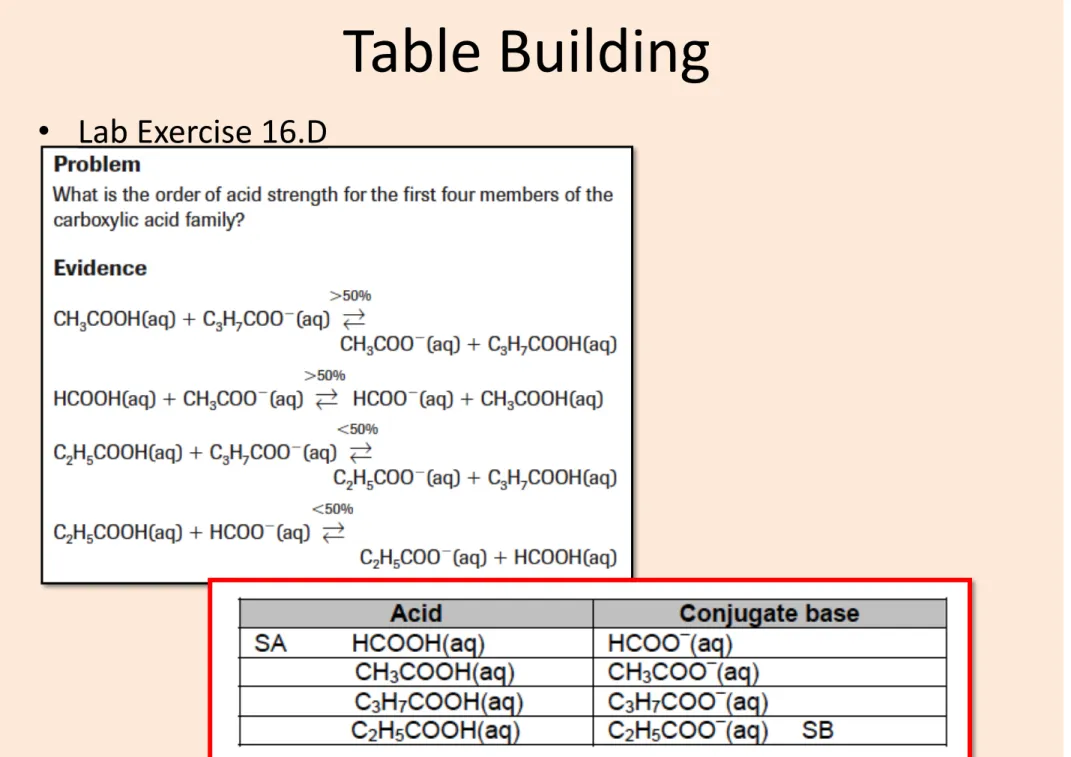
Table Building
K
a
CalculaKons
• Example #1: The pH of a 1.00 mol/L soluKon of aceKc acid is
carefully measured to be 2.38 at SATP. What is the value of Ka for aceKc acid?
Regardless of size, Ka values are usually expressed in scien'fic nota'on = 1.7 x 10‐5
1.00mol/L – 0.0042 mol/L = 0.9958 (rounds to 1.00 – precision rule)
K
a
CalculaKons
• Example #4: Predict the hydronium ion concentraKon and pH
for a 0.200 mol/L aqueous soluKon of methanoic acid.
1.8 x 10‐4 = x 2 x = 0.006 = H
3O+(aq) concentraKon
(0.200)
ApproximaKon Rule: 0.200 = >1000 1.8 x 10 ‐4
K
b
CalculaKons
• Example #1: A student measures the pH of a 0.250 mol/L
soluKon of aqueous ammonia and finds it to 11.32. Calculate the Kb for ammonia
We will use the same method as Ka calculaKons, but there is usually one extra step because pH values need to be converted to
find hydroxide ion concentraKons
14 = pH + pOH pOH = 2.68 10‐2.68 = 0.0021 = OH‐
(aq)
Kb for ammonia is 1.8 x 10‐5 Remember Kb has
CalculaKng OH
‐
from K
b
• Example #2: Find the hydroxide ion amount concentraKon, pOH, pH and the percent
reacKon (ionizaKon) of a 1.20 mol/L soluKon of baking soda.
• Baking soda = NaHCO3(s) Na+(aq) + HCO3‐(aq)
• For HCO3‐(aq), the conjugate acid is H2CO3(aq) whose Ka is = 4.5 x 10‐7
ApproximaKon Rule: 1.20 = >1000 2.2 x 10 ‐8
So (1.20‐x) = 01.20
2.2 x 10‐8 = x2 . x = 1.6 x 10‐4 = OH‐ (aq)
CalculaKng OH
‐
from K
b
• Example #2: Find the hydroxide ion amount concentraKon, pOH, pH and the percent
reacKon (ionizaKon) of a 1.20 mol/L soluKon of baking soda.
2.2 x 10‐8 = x2 . x = 1.6 x 10‐4 = OH‐ (aq)
PolyproKc EnKKes
• Chem 20 Review:
– PolyproEc acids – can lose more than one proton
– PolyproEc bases – can gain more than one proton
– If more than one proton transfer occurs in a KtraKon, chemists believe the process occurs as a series of single‐proton transfer reacKons.
• On a graph, this means there will be more than one equivalence point
First proton transfer = 100%
Second proton transfer = 100%
Buffering Capacity
• The limit of the ability of a buffer to maintain a pH level.
• When one of the enKKes of the conjugate acid‐base pair reacts with an added reagent and is completely consumed, the buffering fails and the pH changes dramaKcally.
All of the CH3COOH(aq) is used up, OH‐
addiKons will now cause the pH to drasKcally increase
All of the CH3COO‐(aq) is used up, H3O+