LECTURE PRESENTATIONS
For CAMPBELL BIOLOGY, NINTH EDITION
Jane B. Reece, Lisa A. Urry, Michael L. Cain, Steven A. Wasserman, Peter V. Minorsky, Robert B. Jackson
© 2011 Pearson Education, Inc.
Lectures by Erin Barley Kathleen Fitzpatrick
Viruses
Overview: A Borrowed Life
• Viruses called bacteriophages can infect and set in motion a genetic takeover of bacteria, such as
Escherichia coli
• Viruses lead “a kind of borrowed life” between life-forms and chemicals
Figure 19.1
Concept 19.1: A virus consists of a nucleic
acid surrounded by a protein coat
The Discovery of Viruses: Scientific Inquiry
• Tobacco mosaic disease stunts growth of tobacco plants and gives their leaves a mosaic coloration
• In the late 1800s, researchers hypothesized that a particle smaller than bacteria caused the disease
• In 1935, Wendell Stanley confirmed this
hypothesis by crystallizing the infectious particle, now known as tobacco mosaic virus (TMV)
Figure 19.2 Extracted sap from tobacco plant with tobacco mosaic disease RESULTS Passed sap through a porcelain filter known to trap bacteria
Healthy plants became infected
Rubbed filtered sap on healthy tobacco plants
1 2 3
Structure of Viruses
• Viruses are not cells
• A virus is a very small infectious particle
consisting of nucleic acid enclosed in a protein
Viral Genomes
• Viral genomes may consist of either
– Double- or single-stranded DNA, or – Double- or single-stranded RNA
• Depending on its type of nucleic acid, a virus is called a DNA virus or an RNA virus
Capsids and Envelopes
• A capsid is the protein shell that encloses the viral genome
• Capsids are built from protein subunits called
capsomeres
Figure 19.3 Capsomere of capsid RNA Capsomere DNA Glycoprotein Glycoproteins Membranous envelope RNA Capsid Head DNA Tail sheath Tail fiber
18 250 nm 70–90 nm (diameter) 80–200 nm (diameter) 80 225 nm
20 nm 50 nm 50 nm 50 nm
(a) Tobacco
Figure 19.3a
Figure 19.3b
Figure 19.3c
Figure 19.3d
• Some viruses have membranous envelopes that help them infect hosts
• These viral envelopes surround the capsids of influenza viruses and many other viruses found in animals
• Bacteriophages, also called phages, are viruses that infect bacteria
• They have the most complex capsids found among viruses
• Phages have an elongated capsid head that encloses their DNA
• A protein tail piece attaches the phage to the host and injects the phage DNA inside
Concept 19.2: Viruses replicate only in
host cells
• Viruses are obligate intracellular parasites, which means they can replicate only within a host cell
General Features of Viral Replicative
Cycles
• Once a viral genome has entered a cell, the cell begins to manufacture viral proteins
• The virus makes use of host enzymes, ribosomes, tRNAs, amino acids, ATP, and other molecules
• Viral nucleic acid molecules and capsomeres spontaneously self-assemble into new viruses
Animation: Simplified Viral Reproductive Cycle
VIRUS 2 1 3 4 Entry and uncoating Replication Transcription and manufacture of capsid proteins
Replicative Cycles of Phages
• Phages are the best understood of all viruses
The Lytic Cycle
• The lytic cycle is a phage replicative cycle that culminates in the death of the host cell
• The lytic cycle produces new phages and lyses (breaks open) the host’s cell wall, releasing the progeny viruses
• A phage that reproduces only by the lytic cycle is called a virulent phage
• Bacteria have defenses against phages, including
restriction enzymes that recognize and cut up
certain phage DNA
Animation: Phage T4 Lytic Cycle
Figure 19.5-1
Attachment
Figure 19.5-2
Attachment
2 1
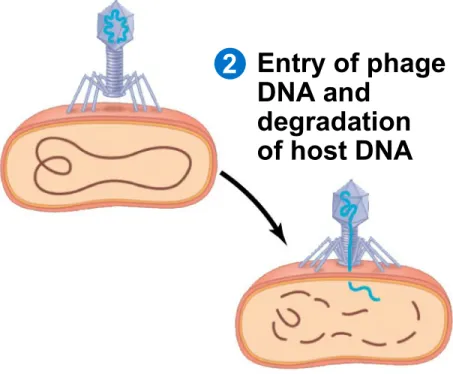
Entry of phage DNA and
Figure 19.5-3
Attachment
2 1
3
Entry of phage DNA and
degradation of host DNA
Figure 19.5-4 Attachment 2 1 4 3
Entry of phage DNA and
degradation of host DNA
Synthesis of viral genomes and proteins Assembly
Phage assembly
Head Tail Tail
Figure 19.5-5 Attachment 2 1 5 4 3
Entry of phage DNA and
degradation of host DNA Release Synthesis of viral genomes and proteins Assembly Phage assembly
Head Tail Tail
The Lysogenic Cycle
• The lysogenic cycle replicates the phage
genome without destroying the host
• The viral DNA molecule is incorporated into the host cell’s chromosome
• This integrated viral DNA is known as a prophage
© 2011 Pearson Education, Inc.
Animation: Phage Lambda Lysogenic and Lytic Cycles
• An environmental signal can trigger the virus genome to exit the bacterial chromosome and switch to the lytic mode
Figure 19.6
New phage DNA and proteins are synthesized and assembled into phages.
The cell lyses, releasing phages. Phage
Phage
DNA The phageinjects its DNA.
Bacterial chromosome
Lytic cycle
lytic cycle is induced or
Phage DNA circularizes. Certain factors determine whether lysogenic cycle is entered Lysogenic cycle Prophage Daughter cell with prophage
Occasionally, a prophage
exits the bacterial chromosome, initiating a lytic cycle.
Cell divisions produce a population of bacteria infected with the prophage.
The bacterium reproduces, copying the prophage and transmitting it to daughter cells.
New phage DNA and proteins are synthesized and assembled into phages.
The cell lyses, releasing phages. Phage
Phage
DNA The phageinjects its DNA.
Bacterial chromosome
Lytic cycle
lytic cycle is induced or
lytic cycle is induced or
Phage DNA circularizes. Certain factors determine whether lysogenic cycle is entered Lysogenic cycle Prophage Daughter cell with prophage
Occasionally, a prophage
exits the bacterial chromosome, initiating a lytic cycle.
Cell divisions produce a population of bacteria infected with the prophage.
The bacterium reproduces, copying the prophage and transmitting it to daughter cells.
Phage DNA integrates into the bacterial chromosome, becoming a prophage.
Replicative Cycles of Animal Viruses
• There are two key variables used to classify viruses that infect animals
– DNA or RNA?
Viral Envelopes
• Many viruses that infect animals have a membranous envelope
• Viral glycoproteins on the envelope bind to specific receptor molecules on the surface of a host cell
• Other viral membranes form from the host’s nuclear envelope and are then replaced by an envelope made from Golgi apparatus membrane
Figure 19.7
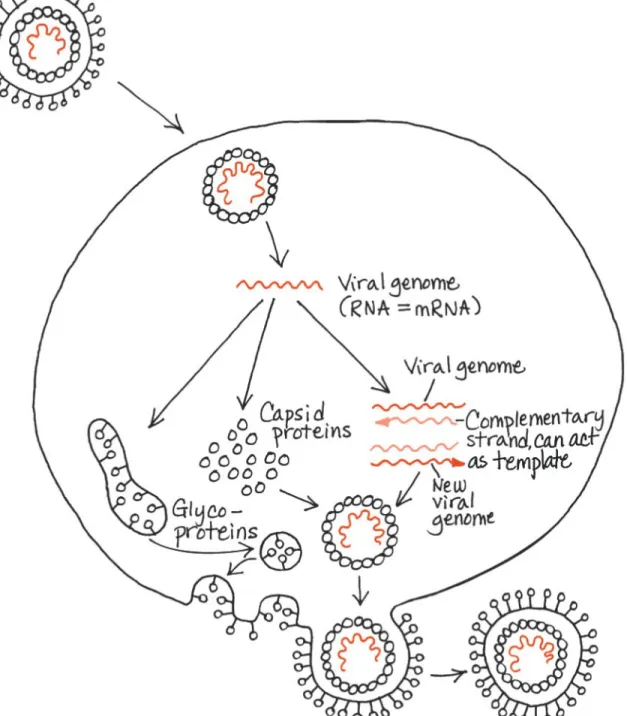
Capsid RNA
Envelope (with glycoproteins)
Capsid and viral genome enter the cell
HOST CELL
Viral genome (RNA)
Template mRNA
ER Capsidproteins
RNA as Viral Genetic Material
• The broadest variety of RNA genomes is found in viruses that infect animals
• Retroviruses use reverse transcriptase to copy
their RNA genome into DNA
• HIV (human immunodeficiency virus) is the
retrovirus that causes AIDS (acquired immunodeficiency syndrome)
Glycoprotein Reverse transcriptase HIV Viral envelope Capsid RNA (two identical
strands) HOSTCELL
Viral RNA Reverse transcriptase RNA-DNA hybrid DNA NUCLEUS Provirus Chromosomal DNA RNA genome for the next viral generation mRNA New virus HIV Membrane of white blood cell
0.25 m HIV entering a cell
New HIV leaving a cell
Glycoprotein Reverse transcriptase HIV Viral envelope Capsid RNA (two identical
strands) HOSTCELL
Viral RNA Reversetranscriptase
Figure 19.8b
HIV
Membrane of white blood cell
Figure 19.8c
HIV
Membrane of white blood cell
Figure 19.8d
Figure 19.8e
Figure 19.8f
Figure 19.8g
• The viral DNA that is integrated into the host genome is called a provirus
• Unlike a prophage, a provirus remains a permanent resident of the host cell
• The host’s RNA polymerase transcribes the proviral DNA into RNA molecules
• The RNA molecules function both as mRNA for
© 2011 Pearson Education, Inc.
Animation: HIV Reproductive Cycle
Evolution of Viruses
• Viruses do not fit our definition of living organisms
• Since viruses can replicate only within cells, they probably evolved as bits of cellular nucleic acid
• Candidates for the source of viral genomes are
plasmids, circular DNA in bacteria and yeasts, and transposons, small mobile DNA segments
• Mimivirus, a double-stranded DNA virus, the
largest virus yet discovered, is the size of a small bacterium
• There is controversy about whether this virus evolved before or after cells
Concept 19.3: Viruses, viroids, and prions
are formidable pathogens in animals and
plants
• Diseases caused by viral infections affect humans, agricultural crops, and livestock worldwide
Viral Diseases in Animals
• Viruses may damage or kill cells by causing the release of hydrolytic enzymes from lysosomes
• Some viruses cause infected cells to produce toxins that lead to disease symptoms
• Others have molecular components such as envelope proteins that are toxic
• Vaccines are harmless derivatives of pathogenic microbes that stimulate the immune system to
mount defenses against the harmful pathogen
• Vaccines can prevent certain viral illnesses
• Viral infections cannot be treated by antibiotics
Emerging Viruses
• Emerging viruses are those that suddenly become apparent
• Recently, a general outbreak (epidemic) of a flu-like illness appeared in Mexico and the United
States, caused by an influenza virus named H1N1
• Flu epidemics are caused by new strains of
influenza virus to which people have little immunity
• Viral diseases in a small isolated population can emerge and become global
• New viral diseases can emerge when viruses spread from animals to humans
• These strains can cause pandemics, global epidemics
• The 2009 flu pandemic was likely passed to
humans from pigs; for this reason it was originally called the “swine flu”
Figure 19.9
(c) 1918 flu pandemic
2009 pandemic screening
(b) 2009 pandemic H1N1 influenza A virus (a)
Figure 19.9a
2009 pandemic H1N1 influenza A virus
(a)
Figure 19.9b
Figure 19.9c
Viral Diseases in Plants
• More than 2,000 types of viral diseases of plants are known and cause spots on leaves and fruits, stunted growth, and damaged flowers or roots
• Plant viruses spread disease in two major modes
– Horizontal transmission, entering through damaged cell walls
– Vertical transmission, inheriting the virus from a parent
Viroids and Prions: The Simplest Infectious
Agents
• Viroids are small circular RNA molecules that
infect plants and disrupt their growth
• Prions are slow-acting, virtually indestructible infectious proteins that cause brain diseases in mammals
• Prions propagate by converting normal proteins into the prion version
• Scrapie in sheep, mad cow disease, and
Figure 19.11
Prion
Normal protein
Original prion
New prion
Figure 19.UN01
Phage DNA
The phage attaches to a
host cell and injects its DNA.
Bacterial
chromosome Prophage
Lytic cycle Lysogenic cycle
• Temperate phage only • Virulent or temperate phage
• Genome integrates into bacterial chromosome as prophage, which (1) is replicated and passed on to daughter cells and
(2) can be induced to leave the chromo-some and initiate a lytic cycle
• Lysis of host cell causes release of progeny phages